1983 Kennedy Half Dollar Coin Value: How Much Is It Worth?
The 1983 Kennedy half dollar carries a face value of 50 cents, and most circulated clad examples are worth exactly that. Collector guide estimates for well-preserved or proof examples range from roughly $4.96 to $10.00 depending on mint, finish and grade.
Before checking any price chart, you need to confirm whether your coin is an ordinary business strike, a San Francisco proof, or something else entirely.
Fast Way to Identify Your 1983 Kennedy Half Dollar
The quickest way to start figuring out what you have is to upload clear photos of both the front and back of your coin. Our identifier can offer a preliminary identification based on those images, helping you narrow down the mint, finish and general condition.
It is not a substitute for professional authentication, but it gives you a solid starting point.
1983 Kennedy Half Dollar Value
Upload both sides of your 1983 Kennedy Half Dollar.
Front Obverse
Upload photo
Back Reverse
Upload photo
Which 1983 Kennedy Half Dollar Versions Are Worth Money?
- Identify P, D or S mintmark first — each has a different guide value at the same grade.
- San Francisco proofs (S mint) were sold in collector sets and are the most common collectible branch for this date.
- Well-preserved Philadelphia (P) business strikes at MS65 carry the highest listed guide estimate among the three versions at roughly $10.00.
- Mint-made errors such as broadstrikes, off-center strikes and doubled dies have been reported for 1983 and are worth examining separately.
Step 1: Identify Your 1983 Kennedy Half Dollar Mint Mark and Version
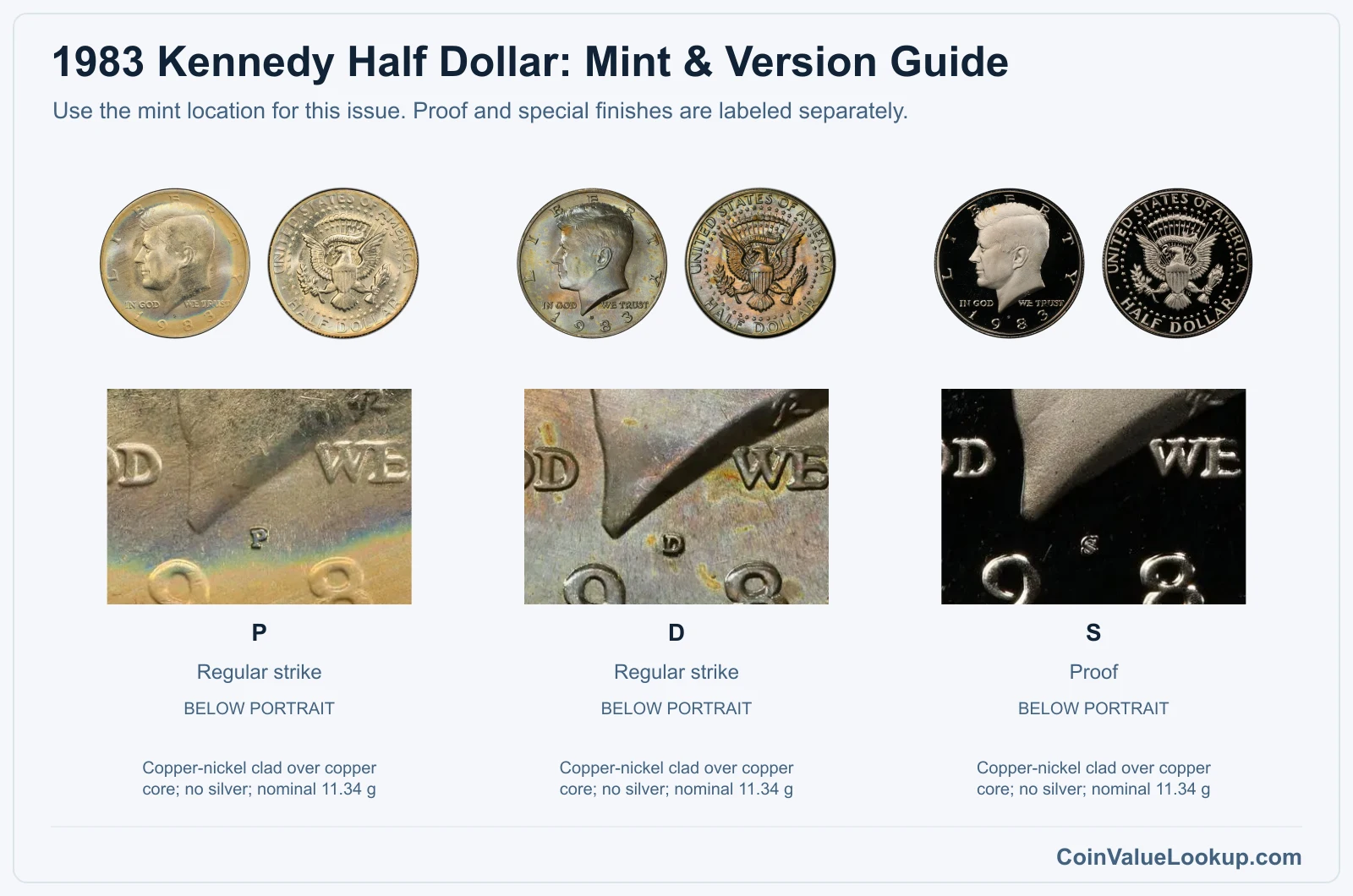
Look beneath Kennedy's portrait on the obverse, just above the date. That is where the mintmark sits.
A "P" means Philadelphia, "D" means Denver, and "S" means San Francisco. Starting in 1980, Philadelphia coins carry the P mintmark; earlier ones were left blank.
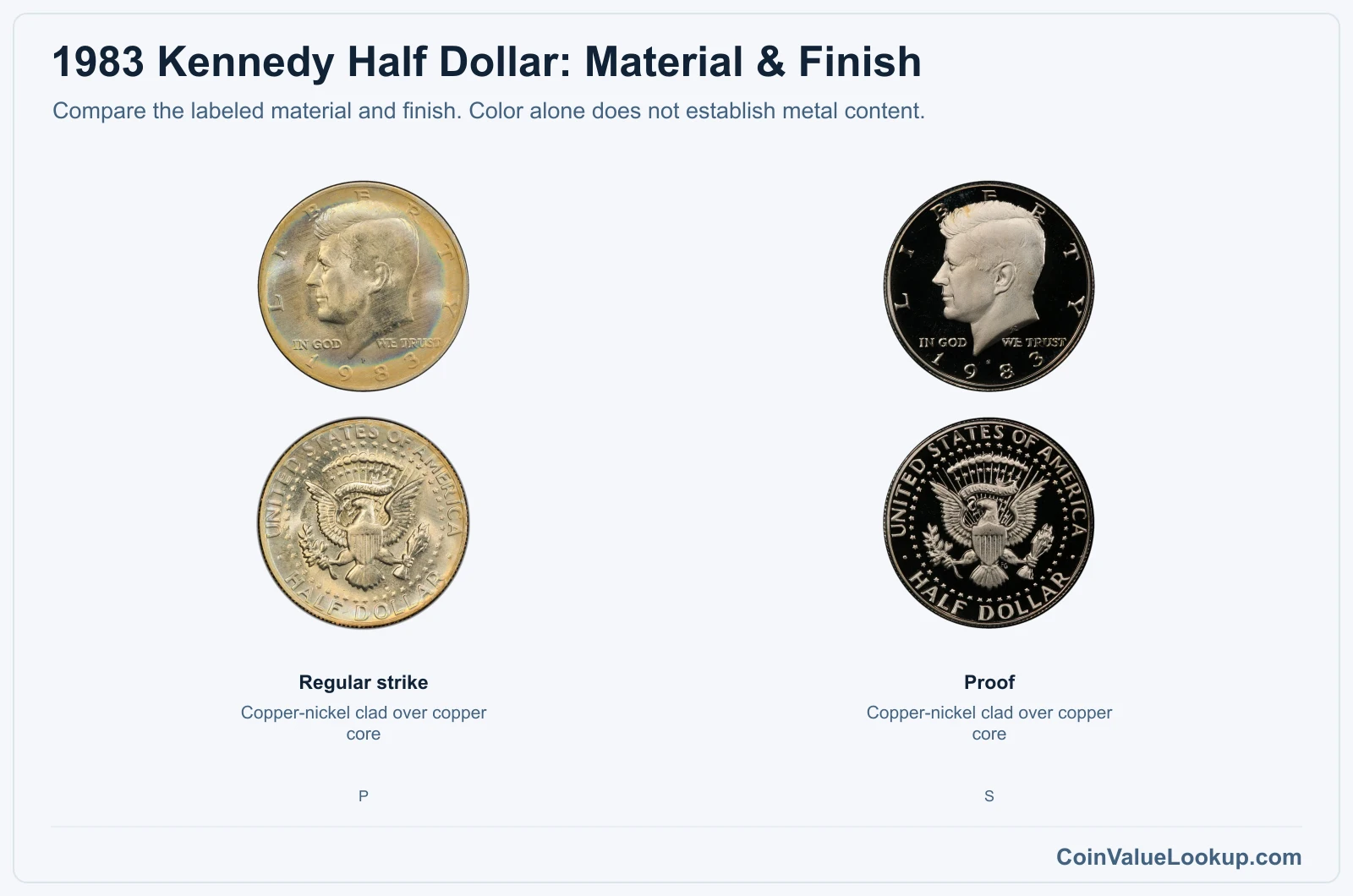
All three 1983 versions are copper-nickel clad. None contain silver.
Do not assume your half dollar is silver just because it looks shiny or has unusual toning — lighting and surface oxidation can fool you.
To double-check, look at the edge. A clad coin shows a visible copper-colored stripe sandwiched between silvery layers.
Weight should be around 11.34 grams. If someone sold you a "1983 silver proof," compare the edge and packaging carefully before celebrating.
The small initials "FG" on the reverse near the eagle's tail feathers belong to designer Frank Gasparro. If they look faint or missing, that could be wear, grease, or a genuine variety — but do not jump to conclusions without careful comparison.
Step 2: Check Your 1983 Kennedy Half Dollar Grade
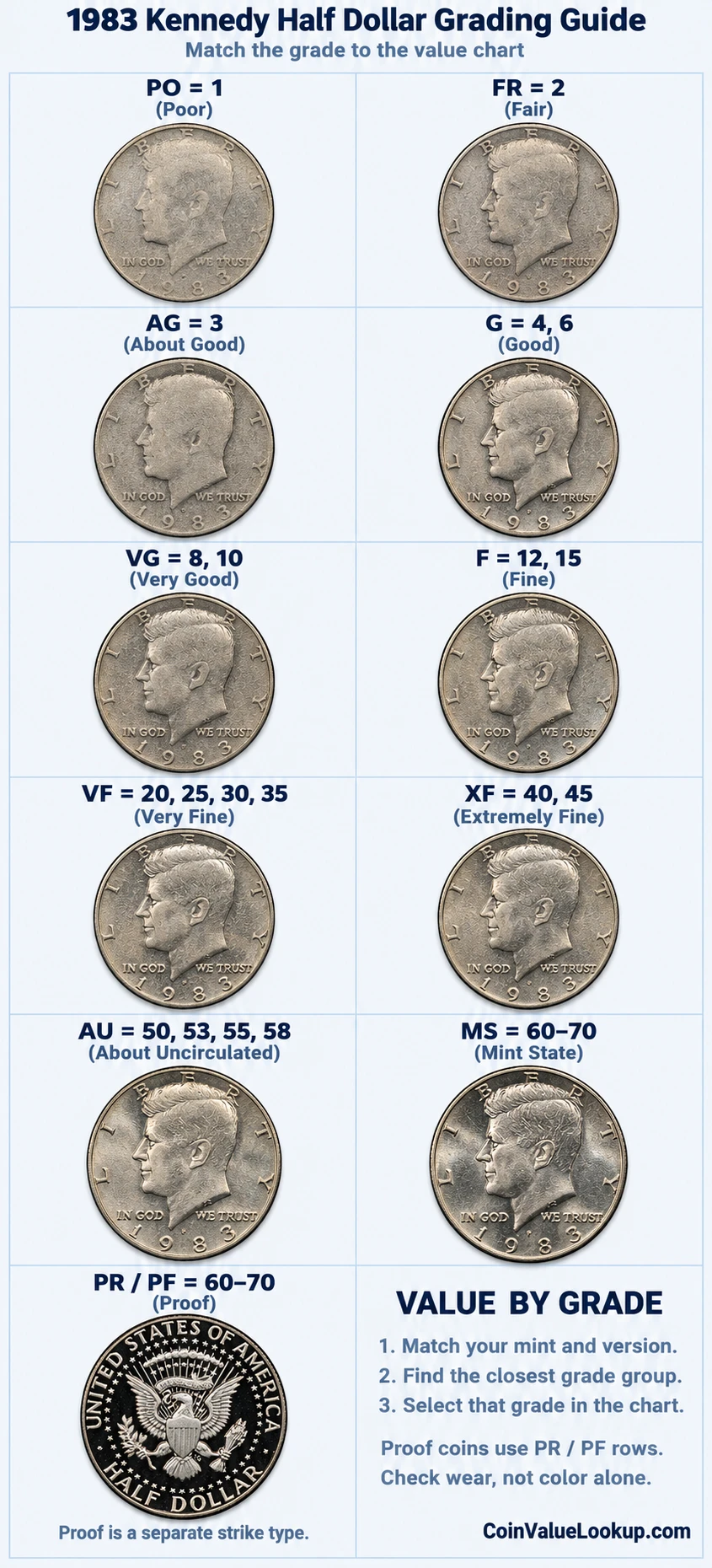
Start with Kennedy's cheek and jawline on the obverse. These are the highest points and the first to show wear.
Then check the hair detail above the ear — on a well-preserved coin, individual strands are sharp and separated.
Flip to the reverse and examine the eagle's breast feathers and the tops of the wings. Smoothing in these areas signals circulation wear.
Bag marks are a different animal. A coin can be technically uncirculated but covered in tiny contact marks from bouncing around in mint bags.
These dings lower the grade even though the coin never saw a cash register. Use the comparison image to gauge where your coin falls.
Proofs deserve their own evaluation. Look for hairlines from improper handling, haze across the mirror fields, and any contact marks on the frosted portrait.
A proof is a method of manufacture, not a grade above Mint State, so a beat-up proof can grade lower than a nice business strike.
Step 3: Check 1983 Kennedy Half Dollar Value by Mint and Version
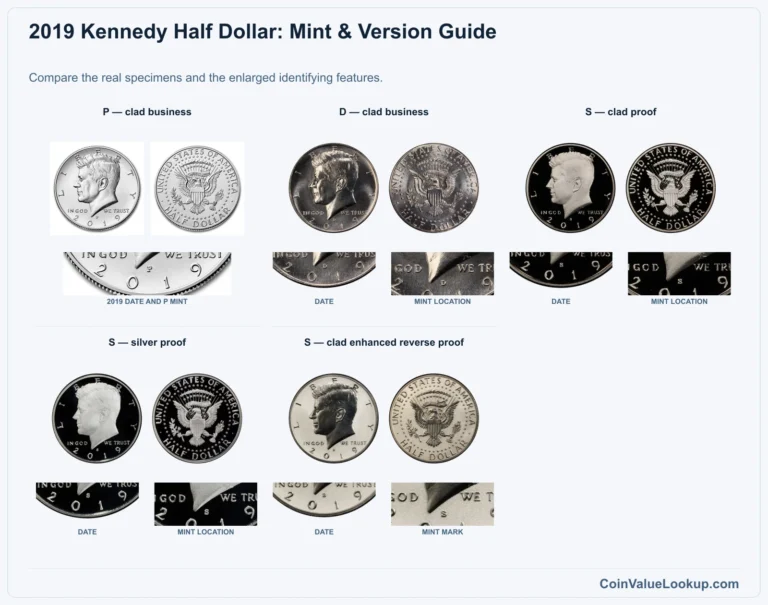
1983 Kennedy Half Dollar — P — clad business
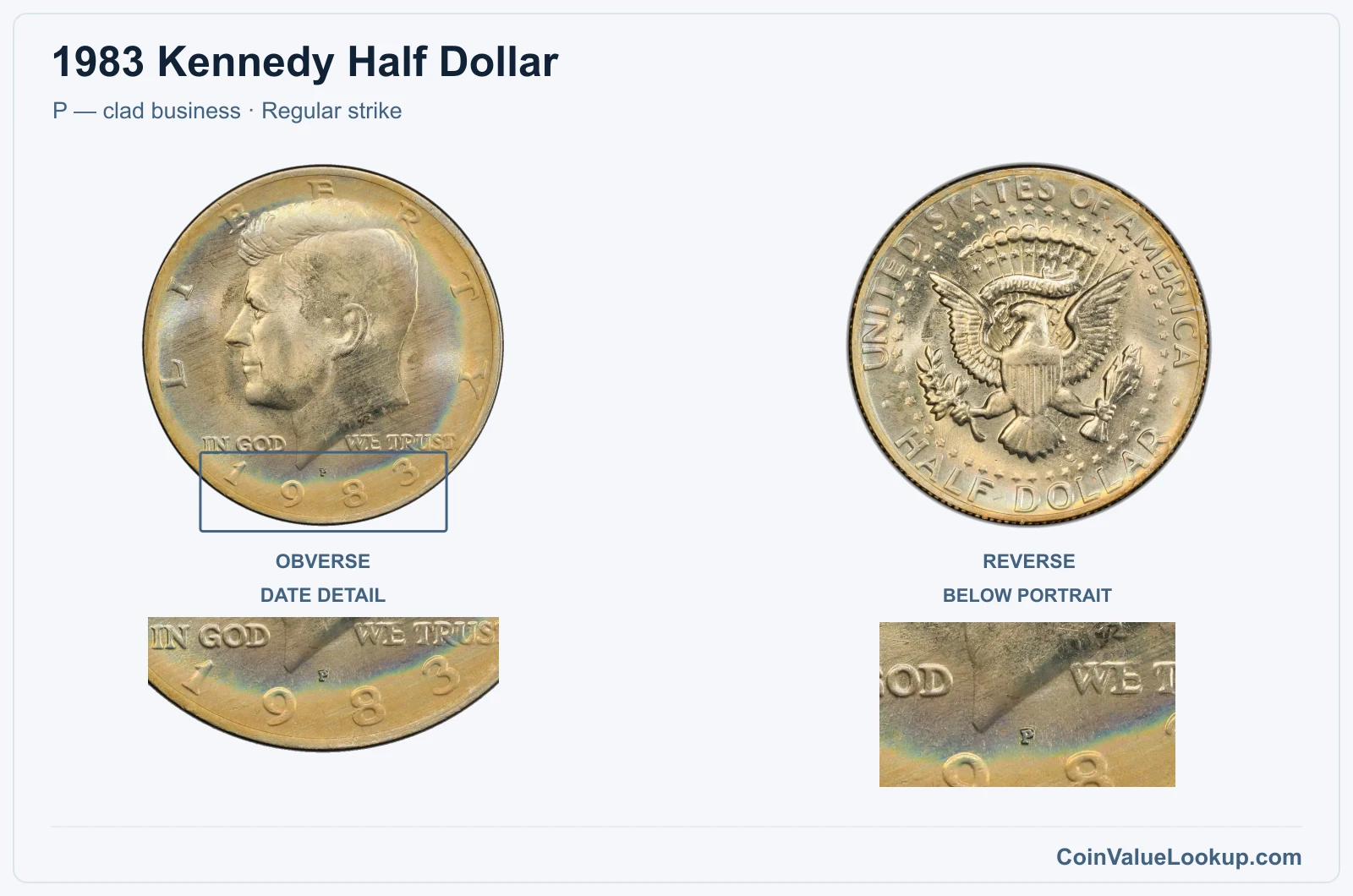
The 1983-P is a Philadelphia business strike in copper-nickel clad, weighing about 11.34 grams. Look for the "P" mintmark beneath Kennedy's portrait.
Millions were produced for general circulation, so worn examples are common face-value coins.
At MS65 — a well-preserved uncirculated grade with minimal bag marks — the USA Coin Book guide estimates this coin at around $10.00. That is a guide figure, not a guaranteed offer.
Finding one in true MS65 condition takes patience, because most survivors picked up contact marks in bulk shipping.
Range Grade
Price Auction Records Appraisal PO PO 1
—
Coin Identifier FR FR 2
—
Coin Identifier AG AG 3
—
Coin Identifier G G 4
—
Coin Identifier
G 6
—
Coin Identifier VG VG 8
—
Coin Identifier
VG 10
—
Coin Identifier F F 12
—
Coin Identifier
F 15
—
Coin Identifier VF VF 20
—
Coin Identifier
VF 25
—
Coin Identifier
VF 30
—
Coin Identifier
VF 35
—
Coin Identifier XF XF 40
—
Coin Identifier
XF 45
—
Coin Identifier AU AU 50
—
Coin Identifier
AU 53
—
Coin Identifier
AU 55
—
Coin Identifier
AU 58
Coin Identifier MS MS 60
Coin Identifier
MS 61
—
Coin Identifier
MS 62
Coin Identifier
MS 63
Coin Identifier
MS 64
Coin Identifier
MS 65
Coin Identifier
MS 66
Coin Identifier
MS 67
Coin Identifier
MS 68
—
Coin Identifier
MS 69
—
—
—
MS 70
—
—
—
1983 Kennedy Half Dollar — D — clad business
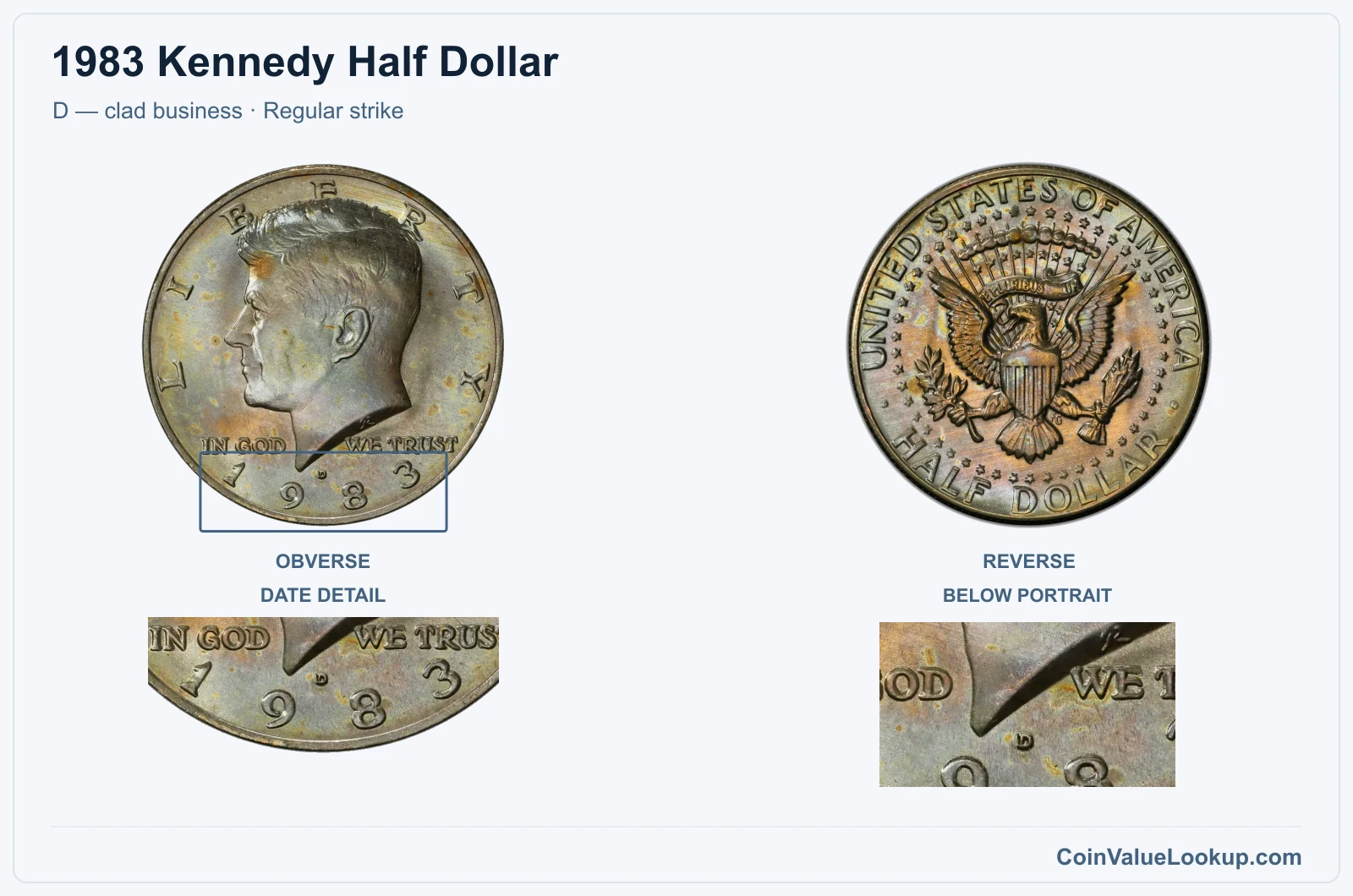
Denver's 1983-D Kennedy half is the same copper-nickel clad composition and design as the Philadelphia version. The "D" mintmark sits in the usual spot beneath Kennedy's portrait.
Like the P mint, circulated examples trade at face value. The USA Coin Book guide places an MS65 example at roughly $8.64.
Slightly below the Philadelphia coin at the same grade, but still well above 50 cents if you can find one in original, mark-free condition.
Coin Value Lookup is a handy place to look up guides for other Kennedy half dollar dates and mints if you are building a set or just curious about what else is in your jar of coins.
Range Grade
Price Auction Records Appraisal PO PO 1
—
Coin Identifier FR FR 2
—
Coin Identifier AG AG 3
—
Coin Identifier G G 4
—
Coin Identifier
G 6
—
Coin Identifier VG VG 8
—
Coin Identifier
VG 10
—
Coin Identifier F F 12
—
Coin Identifier
F 15
—
Coin Identifier VF VF 20
—
Coin Identifier
VF 25
—
Coin Identifier
VF 30
—
Coin Identifier
VF 35
—
Coin Identifier XF XF 40
—
Coin Identifier
XF 45
—
Coin Identifier AU AU 50
—
Coin Identifier
AU 53
—
Coin Identifier
AU 55
—
Coin Identifier
AU 58
—
Coin Identifier MS MS 60
—
Coin Identifier
MS 61
—
Coin Identifier
MS 62
—
Coin Identifier
MS 63
—
Coin Identifier
MS 64
—
Coin Identifier
MS 65
Coin Identifier
MS 66
Coin Identifier
MS 67
Coin Identifier
MS 68
Coin Identifier
MS 69
—
—
—
MS 70
—
—
—
1983 Kennedy Half Dollar — S — clad proof
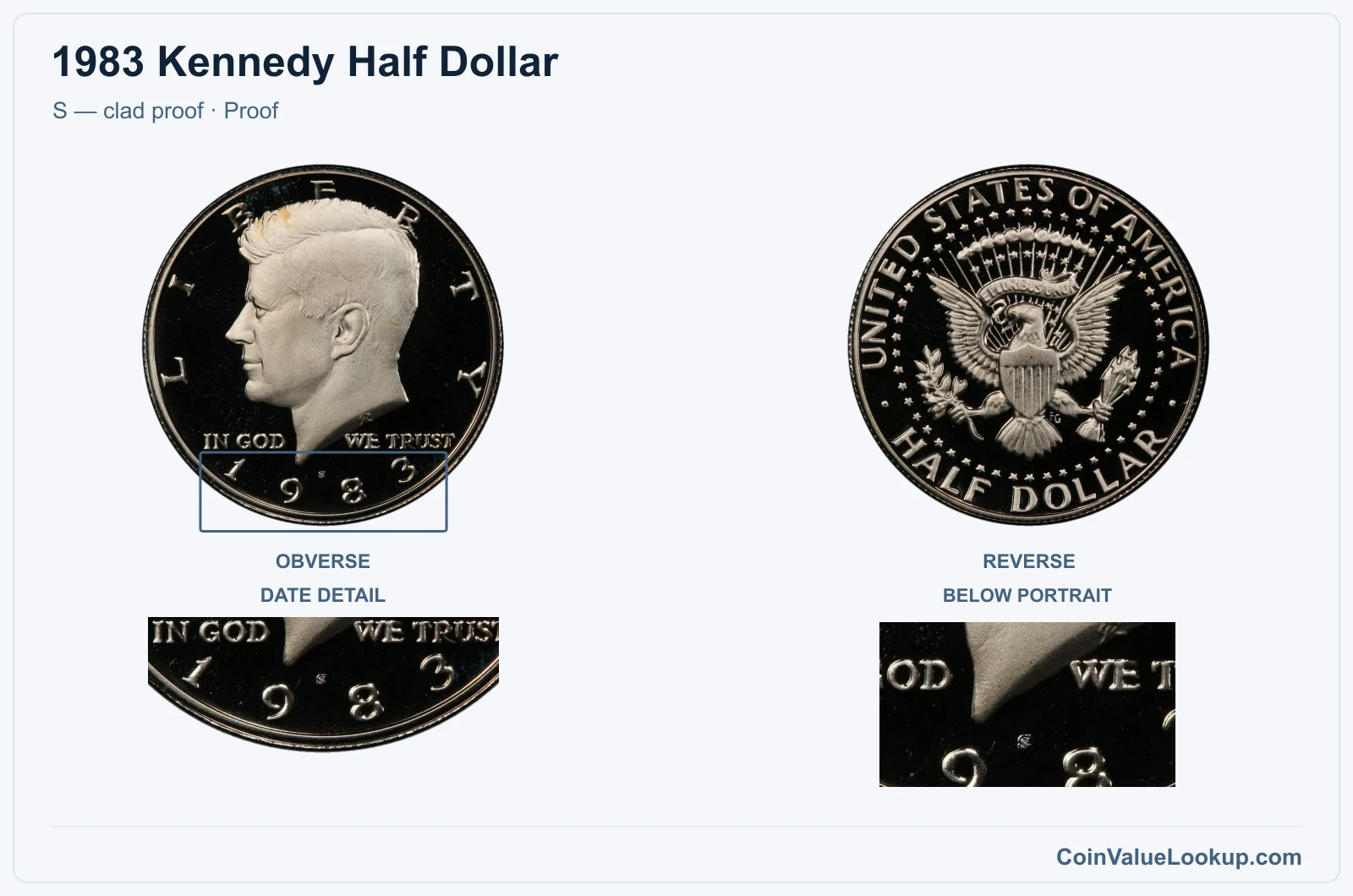
The 1983-S is a clad proof struck at San Francisco. It is not silver — same copper-nickel clad composition as the business strikes.
These were sold in annual proof sets, so most survivors are still in decent shape.
Look for mirror-like fields surrounding frosted, raised design elements. That contrast is characteristic of proof manufacture.
At PR65, the USA Coin Book guide estimates this coin at about $4.96. That modest figure reflects large proof-set production numbers and the fact that most examples grade higher than PR65 straight out of the packaging.
Condition problems like hairlines, haze or fingerprints can pull a proof below that baseline.
Range Grade
Price Auction Records Appraisal PR PR 1
—
Coin Identifier
PR 2
—
Coin Identifier
PR 3
—
Coin Identifier
PR 4
—
Coin Identifier
PR 6
—
Coin Identifier
PR 8
—
Coin Identifier
PR 10
—
Coin Identifier
PR 12
—
Coin Identifier
PR 15
—
Coin Identifier
PR 20
—
Coin Identifier
PR 25
—
Coin Identifier
PR 30
—
Coin Identifier
PR 35
—
Coin Identifier
PR 40
—
Coin Identifier
PR 45
—
Coin Identifier
PR 50
—
Coin Identifier
PR 53
—
Coin Identifier
PR 55
—
Coin Identifier
PR 58
—
Coin Identifier
PR 60
Coin Identifier
PR 61
—
Coin Identifier
PR 62
—
Coin Identifier
PR 63
—
Coin Identifier
PR 64
—
Coin Identifier
PR 65
—
Coin Identifier
PR 66
—
Coin Identifier
PR 67
Coin Identifier
PR 68
Coin Identifier
PR 69
Coin Identifier
PR 70
Coin Identifier
1983 Kennedy Half Dollar Error List
1. 1983 Kennedy Half Dollar — Missing FG Initials
The 1983-P No FG error refers to a Philadelphia business strike where Frank Gasparro's initials — normally found near the eagle's tail feathers on the reverse — are absent or dramatically weakened. This has been attributed to die polishing that removed the small letters from the working die before coins were struck.
To check yours, compare the area between the eagle's right leg and tail feathers against a normal 1983-P reverse. On a genuine No FG coin, the surrounding details remain relatively sharp while the initials are cleanly missing.
Be careful. Normal circulation wear can thin or erase these tiny letters, and grease-filled dies can obscure them temporarily.
Deliberate tooling after the fact is another possibility. No numerical price range is available here; value depends on the coin's condition, the clarity of the missing detail, and professional verification.
2. 1983 Kennedy Half Dollar — Clashed Dies
A die clash occurs when the obverse and reverse dies strike each other without a planchet between them. The result is faint ghost-like impressions of the opposite design transferred onto each die, which then appear on subsequent coins.
On a 1983 Kennedy half, look for traces of Kennedy's profile on the reverse or elements of the eagle on the obverse. These ghost images align with where the opposing design would sit during a normal strike.
They are usually subtle and require good lighting and magnification.
Do not confuse clash marks with random scratches, raised lines from a damaged die, or a brockage (which involves an actual struck coin caught in the press). No specific price data is available for this error; value depends on how visible and dramatic the clash impressions are, along with overall coin condition.
3. 1983 Kennedy Half Dollar — Broadstrike
A broadstrike happens when a coin is struck without the retaining collar that normally confines the planchet and forms the reeded or plain edge. The metal spreads outward under pressure, producing a coin that is wider and thinner than normal with a distorted rim.
Reported examples include 1983-P broadstrikes. The full design is present — both obverse and reverse — but the coin looks "fat" and the edge profile is wrong.
Compare the diameter and edge to a normal half dollar.
Do not confuse a broadstrike with an off-center strike, which shifts the design so part of it is missing. Also rule out post-mint damage — a coin flattened by a hammer or run over by a car may spread similarly but will show different surface characteristics.
No adopted price range is available; value hinges on severity, eye appeal and condition.
4. 1983 Kennedy Half Dollar — Double / Multiple Strike
A double strike or multiple strike means the coin received two or more separate impressions from the dies. Each hit leaves its own version of the design, and if the coin shifted between strikes you will see overlapping or displaced images — two dates, two portraits, two eagles.
This is different from a doubled die, where the doubling is on the die itself and appears identically on every coin struck by that die. A double strike is unique to the individual coin.
Look for clearly separate design impressions rather than just thickened or spread lettering.
Post-mint damage can sometimes mimic this. Vise marks, counterstamping, or other mechanical abuse can press design elements into odd positions.
Genuine multiple strikes show proper strike characteristics on each impression. No numerical price is available; value depends on how dramatic the displacement is and overall preservation.
5. 1983 Kennedy Half Dollar — Indented Strike
An indented strike occurs when a second blank planchet or foreign object partially overlaps the coin being struck. The result is a smooth, bounded depression on one or both sides of the finished coin where the obstruction blocked the die from reaching the surface.
The key feature is a clearly defined depressed area with a distinct boundary. The normal design is intact outside the indent, and inside the depression the surface may be flat or show a partial design impression from the overlapping planchet.
Do not confuse this with a post-mint dent, which lacks the sharp defined boundary and does not align with any minting geometry. A brockage is also different — it shows a mirrored image of a previously struck coin pressed into the surface.
No price data is available for this error; value depends on the size and location of the indent and overall condition.
6. 1983 Kennedy Half Dollar — Off-Center Strike
An off-center strike happens when the planchet is not properly seated between the dies before striking. The design shifts to one side, leaving an unstruck crescent of blank metal on the opposite edge.
The percentage off-center matters. A 5% shift is minor; a 50% shift is dramatic.
Collectors generally prefer examples where the date remains visible, since that confirms the year and makes attribution possible.
Do not confuse an off-center strike with a clipped planchet, which removes a curved section of metal before striking. Also distinguish it from a misaligned die, where the die itself shifts but the planchet is properly positioned.
Post-mint flattening can distort a coin's shape without the telltale blank crescent. No specific price range is adopted here; value depends on the degree of misalignment and whether the date is readable.
7. 1983 Kennedy Half Dollar — Misaligned Die
A misaligned die error occurs when one of the two dies shifts laterally from its correct position relative to the other die or the planchet. The result is a coin where one side's design is slightly offset from center while the other side appears normal.
Check both sides of your 1983 half dollar. If one face shows design elements crowding one rim while the opposite side looks centered, you may have a misaligned die.
This is different from an off-center strike, where the planchet itself is mispositioned and both sides shift together, leaving blank metal.
Rulers and careful rim comparison help. A tilted photograph can mimic this effect, so examine the coin in hand.
Post-mint rim damage from drops or impacts is another lookalike. No price data is available for this variety; value depends on the degree of misalignment and the coin's condition.
8. 1983 Kennedy Half Dollar — Doubled Die
A doubled die results from an error during die manufacture, where design elements are impressed onto the die in slightly different positions. Every coin struck by that die shows the same consistent doubling — thickened lettering, notched serifs, or separated design outlines.
Compare your coin's lettering and design details against a normal 1983 Kennedy half. Genuine doubled-die doubling is consistent and repeatable across affected areas.
It shows up as clean separation or shelf-like notching, not mushy or flat spreading.
Machine doubling is the most common lookalike. It produces flat, shelf-like distortion that lacks the raised, separated character of a true doubled die.
Reflections and lighting tricks can also suggest doubling that is not there. No price data is available; value depends on the specific die, the strength of the doubling and the coin's preservation.