1846 Liberty Seated Half Dollar Coin Value: How Much Is It Worth?
The 1846 Liberty Seated Half Dollar is a 90% silver coin struck at Philadelphia and New Orleans, and its value depends heavily on which date style and mint produced your particular piece. A common Philadelphia Medium Date example runs roughly $80 in G4 to $576 in AU50 based on guide estimates, but scarcer branches like the Tall Date or the 6/Horizontal 6 variety climb much higher.
Knowing your exact version matters more than almost anything else with this date.
Fast Way to Identify Your 1846 Liberty Seated Half Dollar
The quickest way to start figuring out what you have is to upload clear photos of both the front and back of your coin. Our identifier can give you a preliminary read on the mint, date style, and general type so you know which version to research further.
Sharp, well-lit images help — grab both sides and keep the coin flat.
1846 Liberty Seated Half Dollar Value
Upload both sides of your 1846 Liberty Seated Half Dollar.
Front Obverse
Upload photo
Back Reverse
Upload photo
Which 1846 Liberty Seated Half Dollar Versions Are Worth Money?
- Philadelphia 6/Horizontal 6 — Guide values reach $301 at G4 and $3,104 at AU50, making it the priciest regular-strike Philadelphia branch for this date.
- New Orleans Tall Date — Scarcer than the O-mint Medium Date, with guide estimates from $332 at G4 up to $3,104 at AU50.
- Philadelphia Tall Date — Carries a premium over the Medium Date, starting around $111 at G4 versus $80 for the Medium Date at the same grade.
- New Orleans Medium Date — Common for the O-mint but still climbs to $632 at AU50 in guide estimates, well above the Philadelphia Medium Date at the same level.
- Proof strikes — A single PR65 example sold for $57,500 at Heritage in October 2008; these are extremely rare and need professional certification.
Step 1: Identify Your 1846 Liberty Seated Half Dollar Mint Mark and Version
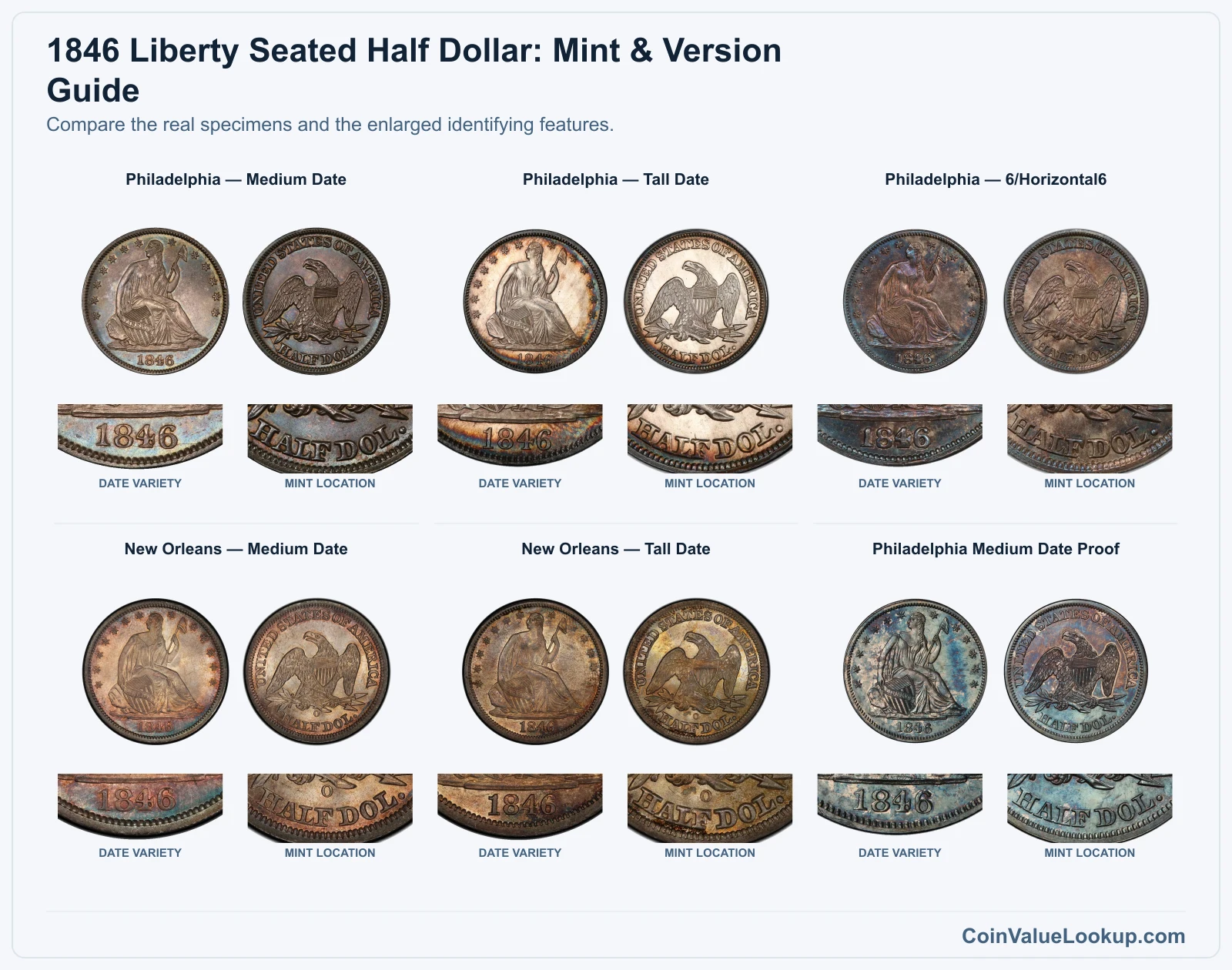
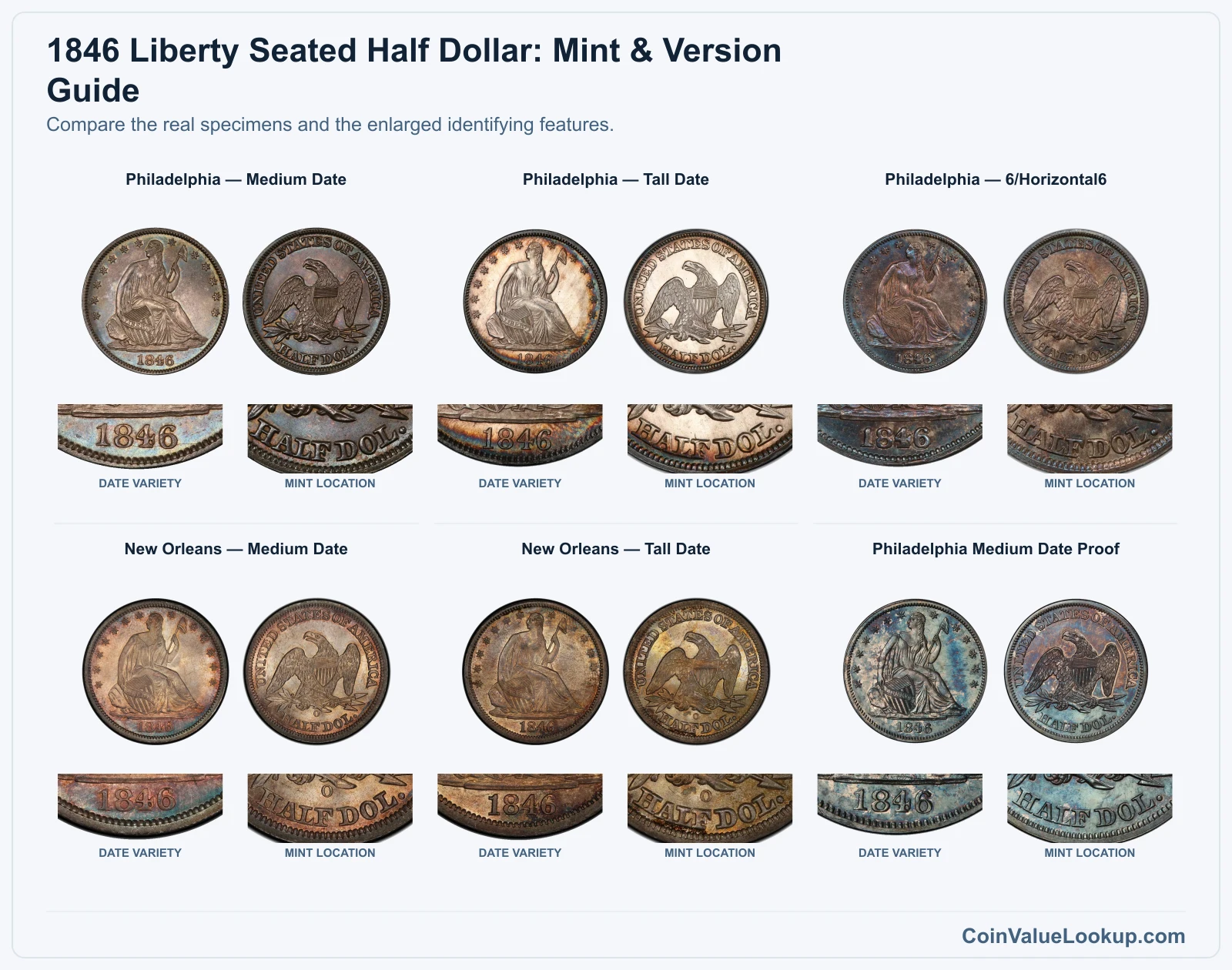
The 1846 half dollar carries the Seated Liberty design on the obverse and an eagle with HALF DOL. on the reverse, without the IN GOD WE TRUST motto added to later issues.
It is struck in 90% silver and 10% copper, with a reeded edge and a nominal weight of 13.36 grams.
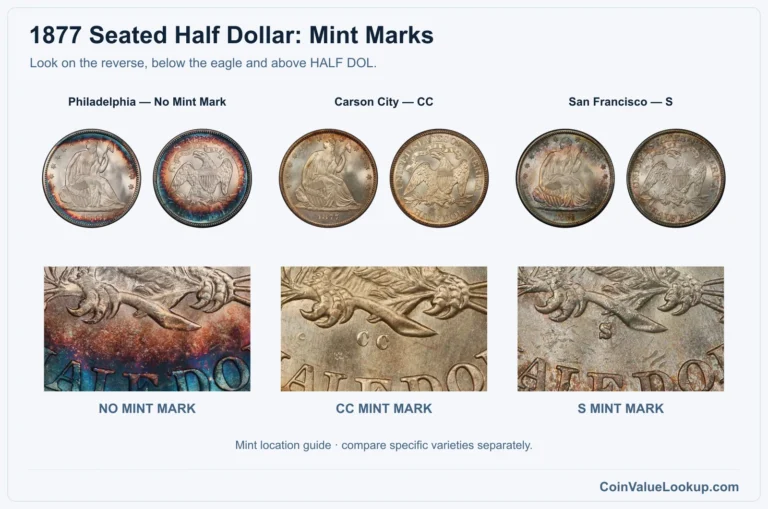
Philadelphia coins have no mintmark. New Orleans coins show a small O on the reverse below the eagle.
Do not assume shine means purity — toning, cleaning, and wear all change a coin's appearance without changing its metal content.
The critical sorting step is the date size. Medium Date numerals sit with visible space between the tops of the digits and the rock that Liberty rests on.
Tall Date numerals fill that gap noticeably, pushing closer to the rock's edge. Set both types side by side if possible, and the difference is obvious.
There is also a Philadelphia-only 6/Horizontal 6 variety where remnants of an earlier sideways 6 appear beneath the final upright 6. This is a corrected punch, not an overdate over a 5.
Finally, proof or special presentation strikes from Philadelphia exist but require professional attribution — a bright, uncleaned business strike is not the same thing.
Step 2: Check Your 1846 Liberty Seated Half Dollar Grade
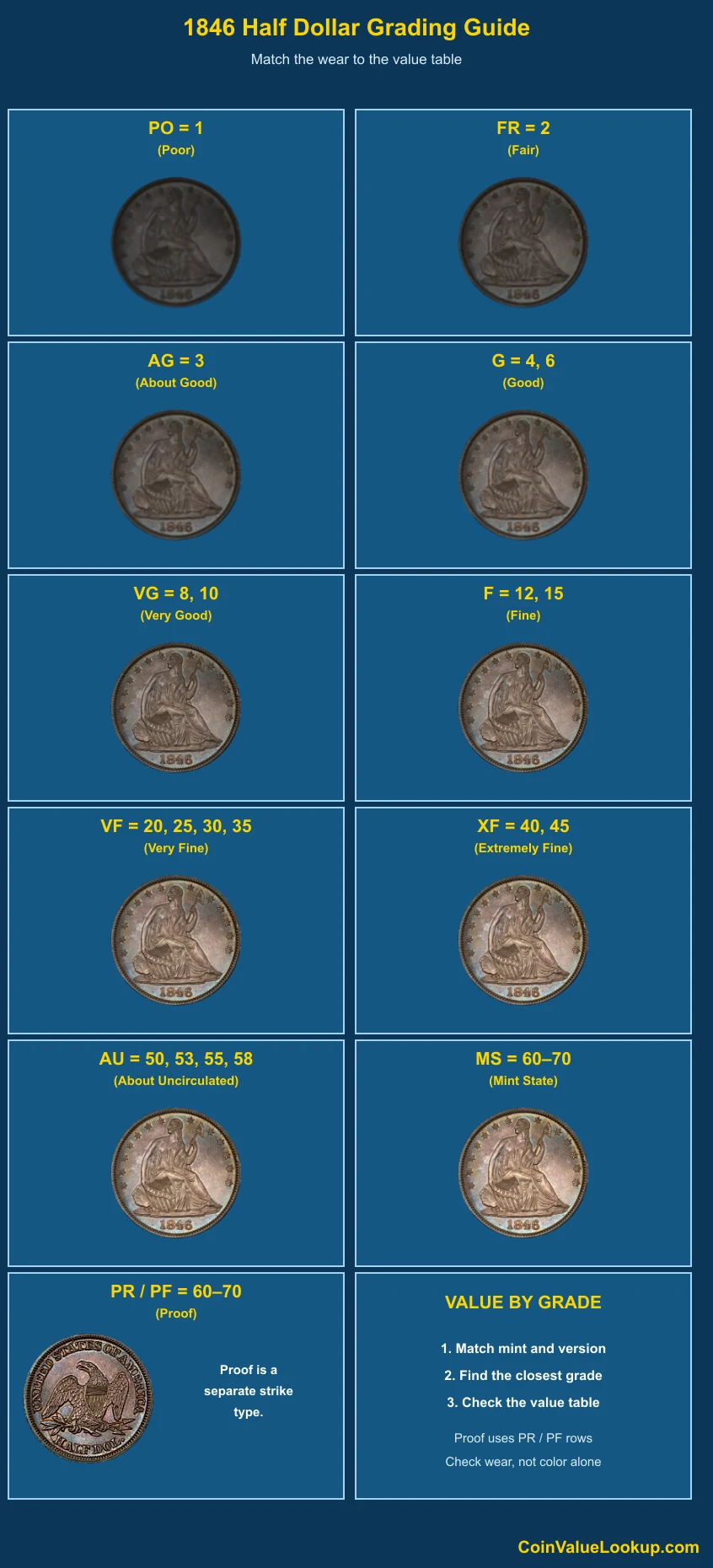
Start with the obverse. On a well-worn coin (around Good to Very Good), Liberty's head, breast, and knee will be flat or nearly gone, and the shield lines on her lap merge together.
As you move up toward Very Fine, those shield lines reappear and the knee shows rounded contour rather than a flat spot.
Flip to the reverse. The eagle's breast feathers and wing tips wear first.
In About Uncirculated condition, only the highest points show slight friction, and original mint luster survives in the protected areas around the stars and lettering.
One trap with Seated halves is weak strikes. Some coins left the press without full detail on the head or eagle, and that softness is not the same as wear.
Look for intact luster around the soft area — if luster is there, it is a strike issue, not circulation damage.
Compare your coin against the type-matched grading images shown with this guide. Check both sides carefully against examples at each grade level.
Cleaning, holes, scratches, and other surface problems reduce value sharply. If your coin looks suspiciously bright or has hairline scratches running in one direction, it may have been cleaned.
Leave it alone — further cleaning only makes things worse.
Step 3: Check 1846 Liberty Seated Half Dollar Value by Mint and Version
1846 Liberty Seated Half Dollar — Philadelphia — Medium Date
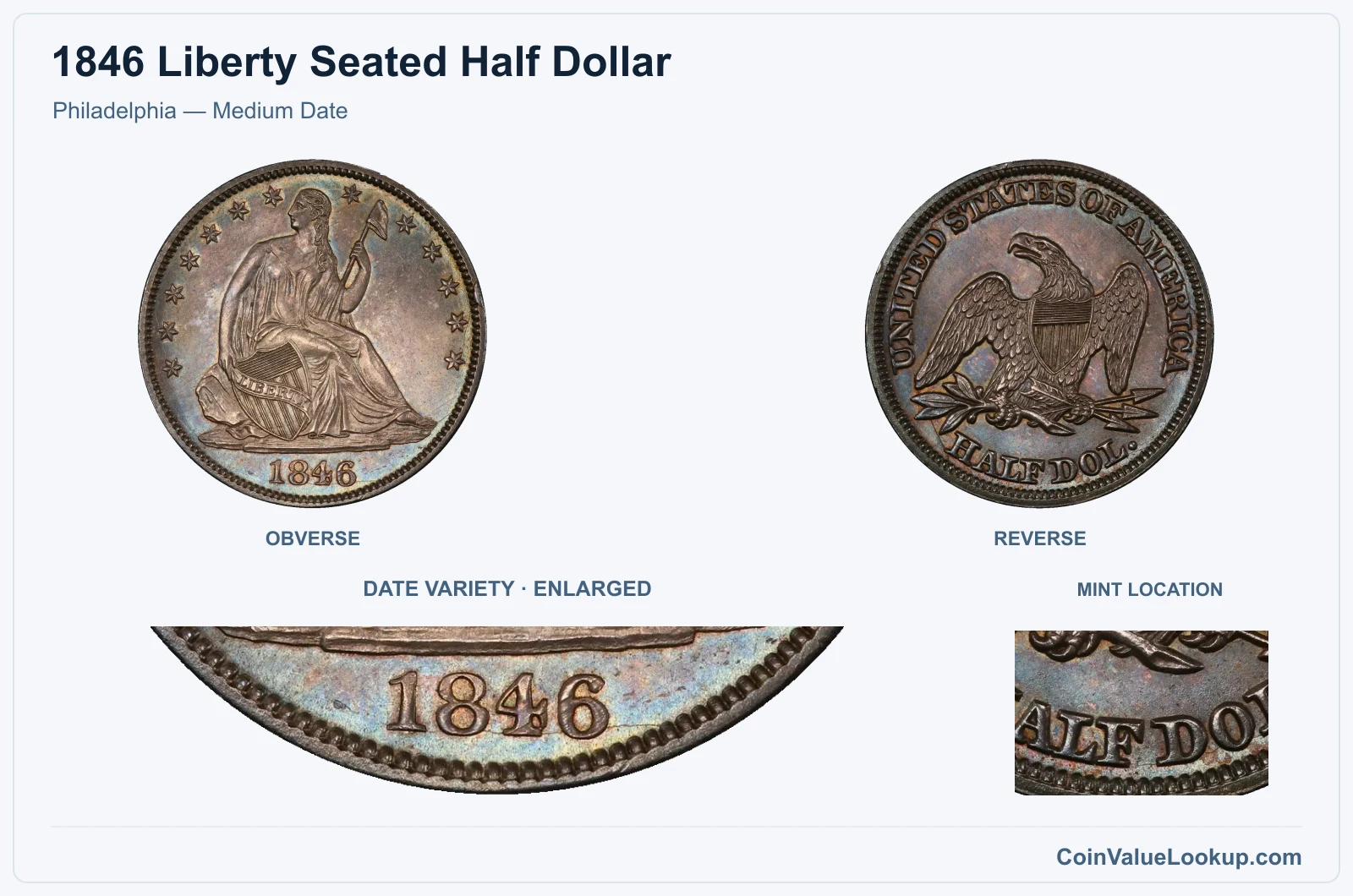
This is the baseline Philadelphia issue for 1846. The date numerals are medium height, with clear space between the top of the digits and the bottom of the rock Liberty sits on.
No mintmark appears anywhere on the coin.
Guide estimates place this version at about $80 in G4, $237 in VF20, and $576 in AU50. It is the most available branch of the date and makes a solid, affordable type coin for collectors assembling a Seated Liberty set.
Check the date height carefully before assuming you have this version rather than the Tall Date.
Range Grade
Price Auction Records Appraisal PO PO 1
—
Coin Identifier FR FR 2
—
Coin Identifier AG AG 3
—
Coin Identifier G G 4
—
Coin Identifier
G 6
—
Coin Identifier VG VG 8
—
Coin Identifier
VG 10
—
Coin Identifier F F 12
—
Coin Identifier
F 15
—
Coin Identifier VF VF 20
Coin Identifier
VF 25
—
Coin Identifier
VF 30
Coin Identifier
VF 35
Coin Identifier XF XF 40
Coin Identifier
XF 45
Coin Identifier AU AU 50
Coin Identifier
AU 53
Coin Identifier
AU 55
Coin Identifier
AU 58
Coin Identifier MS MS 60
Coin Identifier
MS 61
Coin Identifier
MS 62
Coin Identifier
MS 63
Coin Identifier
MS 64
Coin Identifier
MS 65
Coin Identifier
MS 66
—
—
—
MS 67
—
—
—
MS 68
—
—
—
MS 69
—
—
—
MS 70
—
—
—
1846 Liberty Seated Half Dollar — Philadelphia — Tall Date
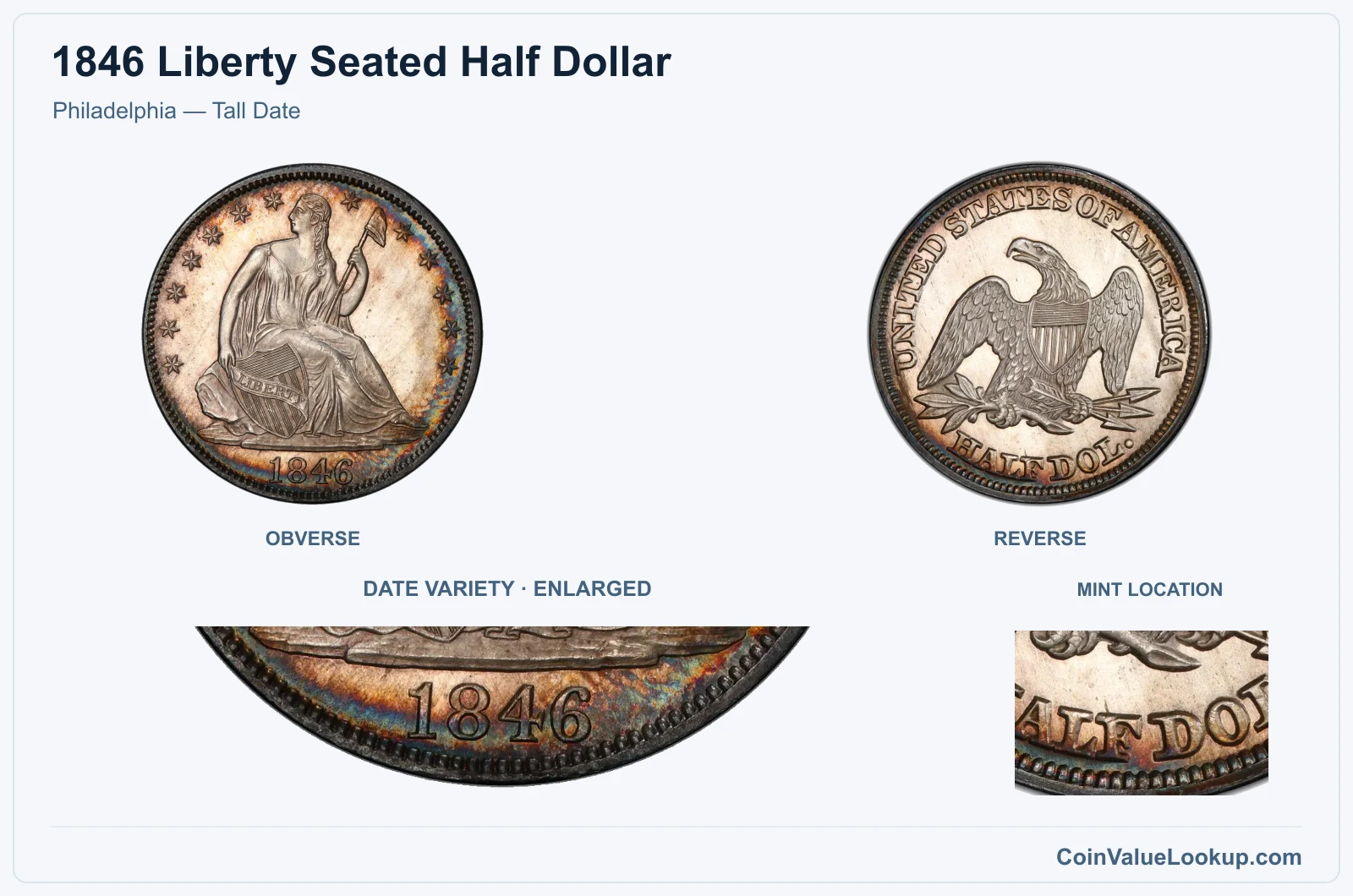
Same Philadelphia mint, same absence of a mintmark, but the date digits are taller. They push noticeably closer to the rock base above, filling the vertical gap that is clearly visible on the Medium Date.
Place both versions side by side and you will not mistake them.
Guide estimates run $111 at G4, $332 at VF20, and $576 at AU50. The premium over the Medium Date is most apparent in the lower grades — roughly 40% more at G4.
At AU50 the two converge in published guides, but market demand for the scarcer Tall Date may still produce different real-world results.
Range Grade
Price Auction Records Appraisal PO PO 1
—
Coin Identifier FR FR 2
—
Coin Identifier AG AG 3
—
Coin Identifier G G 4
—
Coin Identifier
G 6
—
Coin Identifier VG VG 8
—
Coin Identifier
VG 10
Coin Identifier F F 12
Coin Identifier
F 15
Coin Identifier VF VF 20
—
Coin Identifier
VF 25
Coin Identifier
VF 30
Coin Identifier
VF 35
Coin Identifier XF XF 40
Coin Identifier
XF 45
Coin Identifier AU AU 50
Coin Identifier
AU 53
Coin Identifier
AU 55
Coin Identifier
AU 58
Coin Identifier MS MS 60
—
Coin Identifier
MS 61
Coin Identifier
MS 62
Coin Identifier
MS 63
Coin Identifier
MS 64
Coin Identifier
MS 65
Coin Identifier
MS 66
Coin Identifier
MS 67
—
—
—
MS 68
—
—
—
MS 69
—
—
—
MS 70
—
—
—
1846 Liberty Seated Half Dollar — Philadelphia — 6/Horizontal6
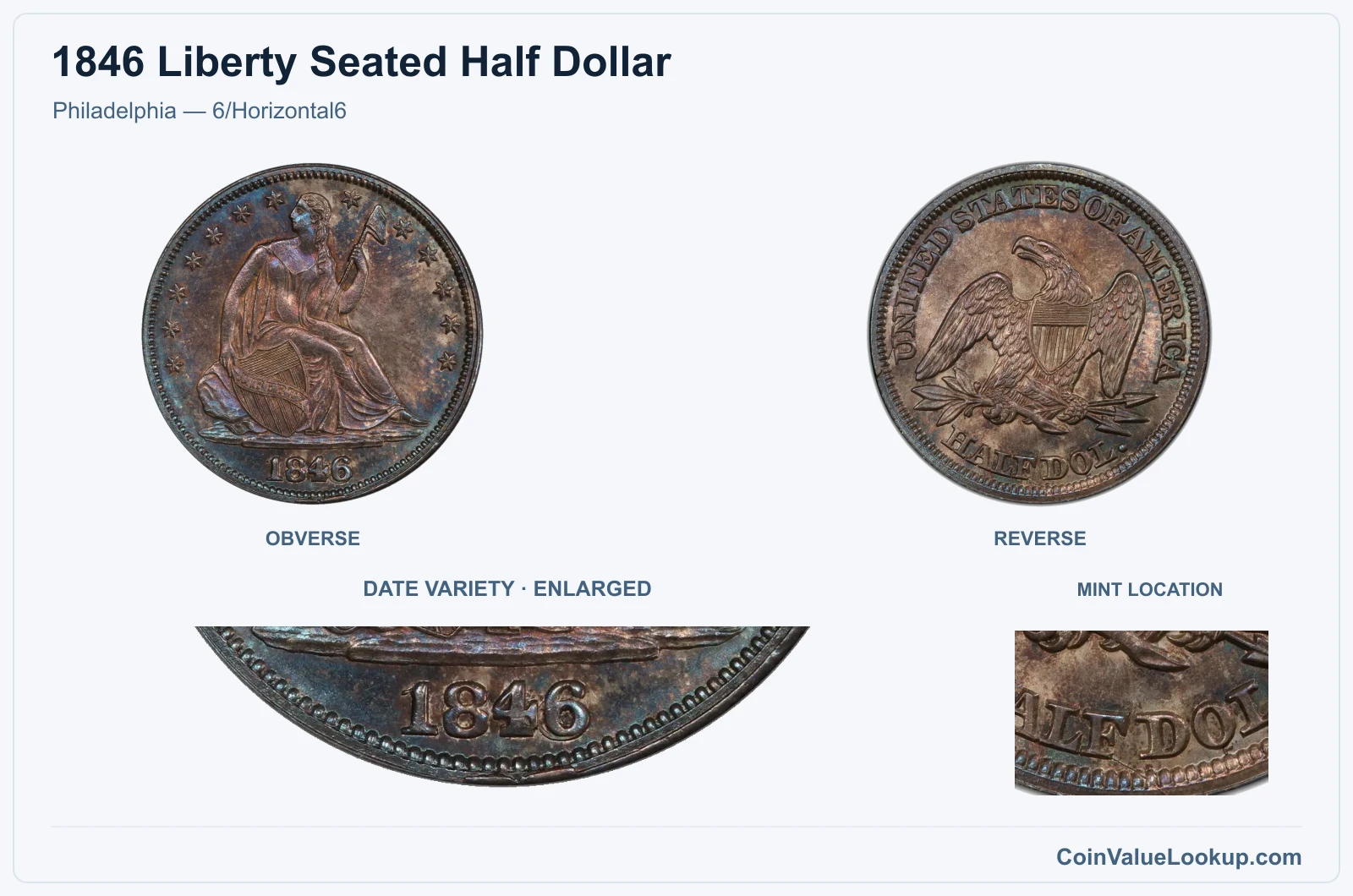
This is the famous corrected-punch variety. The die initially received the final 6 rotated sideways, and the mint corrected it by punching an upright 6 over the error.
Under magnification you can see remnants of the earlier horizontal 6 beneath the properly oriented digit. This is not an overdate — it is not a 5 underneath.
Guide estimates reflect the variety's popularity: $301 at G4, $1,263 at VF20, and $3,104 at AU50. Even in low grades this coin commands a serious premium.
Look specifically at the lower curve of the 6 in the date for traces of the sideways outline. A loupe or even a strong magnifying glass helps.
If you are browsing Coin Value Lookup for other date-specific guides, this is a good example of why variety attribution can multiply a coin's value overnight.
Range Grade
Price Auction Records Appraisal PO PO 1
—
Coin Identifier FR FR 2
—
Coin Identifier AG AG 3
Coin Identifier G G 4
Coin Identifier
G 6
Coin Identifier VG VG 8
—
Coin Identifier
VG 10
—
Coin Identifier F F 12
—
Coin Identifier
F 15
—
Coin Identifier VF VF 20
Coin Identifier
VF 25
Coin Identifier
VF 30
Coin Identifier
VF 35
—
Coin Identifier XF XF 40
Coin Identifier
XF 45
Coin Identifier AU AU 50
Coin Identifier
AU 53
Coin Identifier
AU 55
Coin Identifier
AU 58
Coin Identifier MS MS 60
—
Coin Identifier
MS 61
Coin Identifier
MS 62
Coin Identifier
MS 63
Coin Identifier
MS 64
Coin Identifier
MS 65
—
—
—
MS 66
—
—
—
MS 67
—
—
—
MS 68
—
—
—
MS 69
—
—
—
MS 70
—
—
—
1846 Liberty Seated Half Dollar — New Orleans — Medium Date
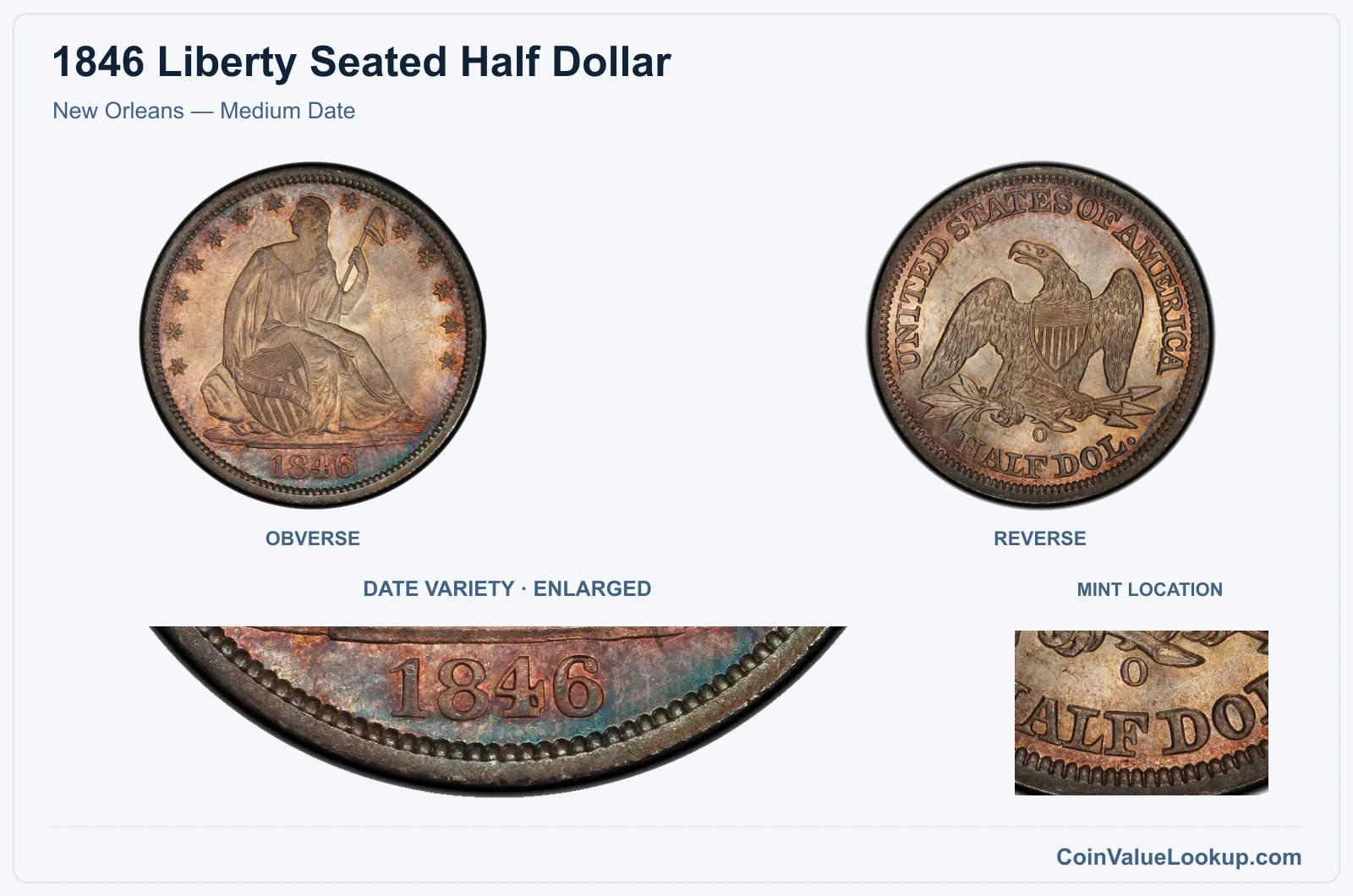
The New Orleans version with medium-height date numerals. Confirm the O mintmark on the reverse, sitting below the eagle above the D in DOL.
Then check that the date digits match the shorter medium profile rather than the taller alternative.
Guide estimates are $80 at G4, $395 at VF20, and $632 at AU50. The VF20 price already outpaces the Philadelphia Medium Date at the same grade, reflecting the generally lower survival rates for New Orleans Seated halves.
Southern climate and heavy commercial use took their toll on these coins.
Range Grade
Price Auction Records Appraisal PO PO 1
—
Coin Identifier FR FR 2
—
Coin Identifier AG AG 3
—
Coin Identifier G G 4
—
Coin Identifier
G 6
—
Coin Identifier VG VG 8
Coin Identifier
VG 10
Coin Identifier F F 12
Coin Identifier
F 15
Coin Identifier VF VF 20
Coin Identifier
VF 25
Coin Identifier
VF 30
Coin Identifier
VF 35
Coin Identifier XF XF 40
Coin Identifier
XF 45
Coin Identifier AU AU 50
Coin Identifier
AU 53
Coin Identifier
AU 55
Coin Identifier
AU 58
Coin Identifier MS MS 60
Coin Identifier
MS 61
Coin Identifier
MS 62
Coin Identifier
MS 63
Coin Identifier
MS 64
Coin Identifier
MS 65
Coin Identifier
MS 66
—
—
—
MS 67
—
—
—
MS 68
—
—
—
MS 69
—
—
—
MS 70
—
—
—
1846 Liberty Seated Half Dollar — New Orleans — Tall Date
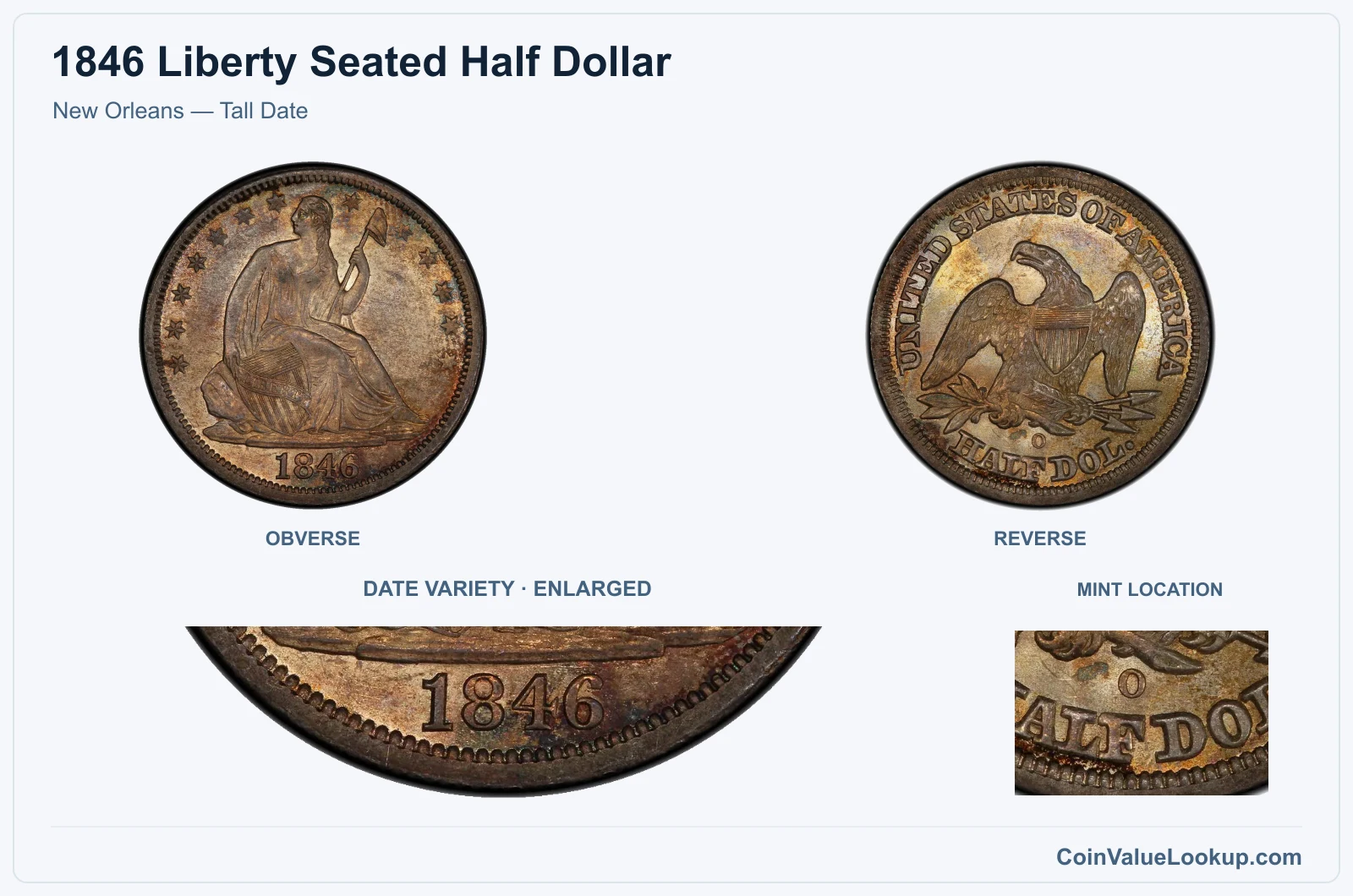
Pair the reverse O mintmark with the taller date numerals and you have one of the scarcer regular-strike branches for 1846. Do not price this coin using Philadelphia Tall Date values — the two are separate issues with different survival rates and collector demand.
Guide estimates run $332 at G4, $1,146 at VF20, and $3,104 at AU50. That G4 figure alone is four times the common Philadelphia Medium Date at the same grade.
Tall Date digits push close to the rock base; if you have an O-mint coin and the date looks large, take a closer look before selling it cheaply.
Range Grade
Price Auction Records Appraisal PO PO 1
—
Coin Identifier FR FR 2
—
Coin Identifier AG AG 3
—
Coin Identifier G G 4
—
Coin Identifier
G 6
Coin Identifier VG VG 8
Coin Identifier
VG 10
Coin Identifier F F 12
Coin Identifier
F 15
Coin Identifier VF VF 20
Coin Identifier
VF 25
Coin Identifier
VF 30
Coin Identifier
VF 35
Coin Identifier XF XF 40
Coin Identifier
XF 45
Coin Identifier AU AU 50
Coin Identifier
AU 53
Coin Identifier
AU 55
Coin Identifier
AU 58
Coin Identifier MS MS 60
—
Coin Identifier
MS 61
Coin Identifier
MS 62
Coin Identifier
MS 63
—
—
—
MS 64
—
—
—
MS 65
—
—
—
MS 66
—
—
—
MS 67
—
—
—
MS 68
—
—
—
MS 69
—
—
—
MS 70
—
—
—
1846 Liberty Seated Half Dollar — Philadelphia Medium Date Proof
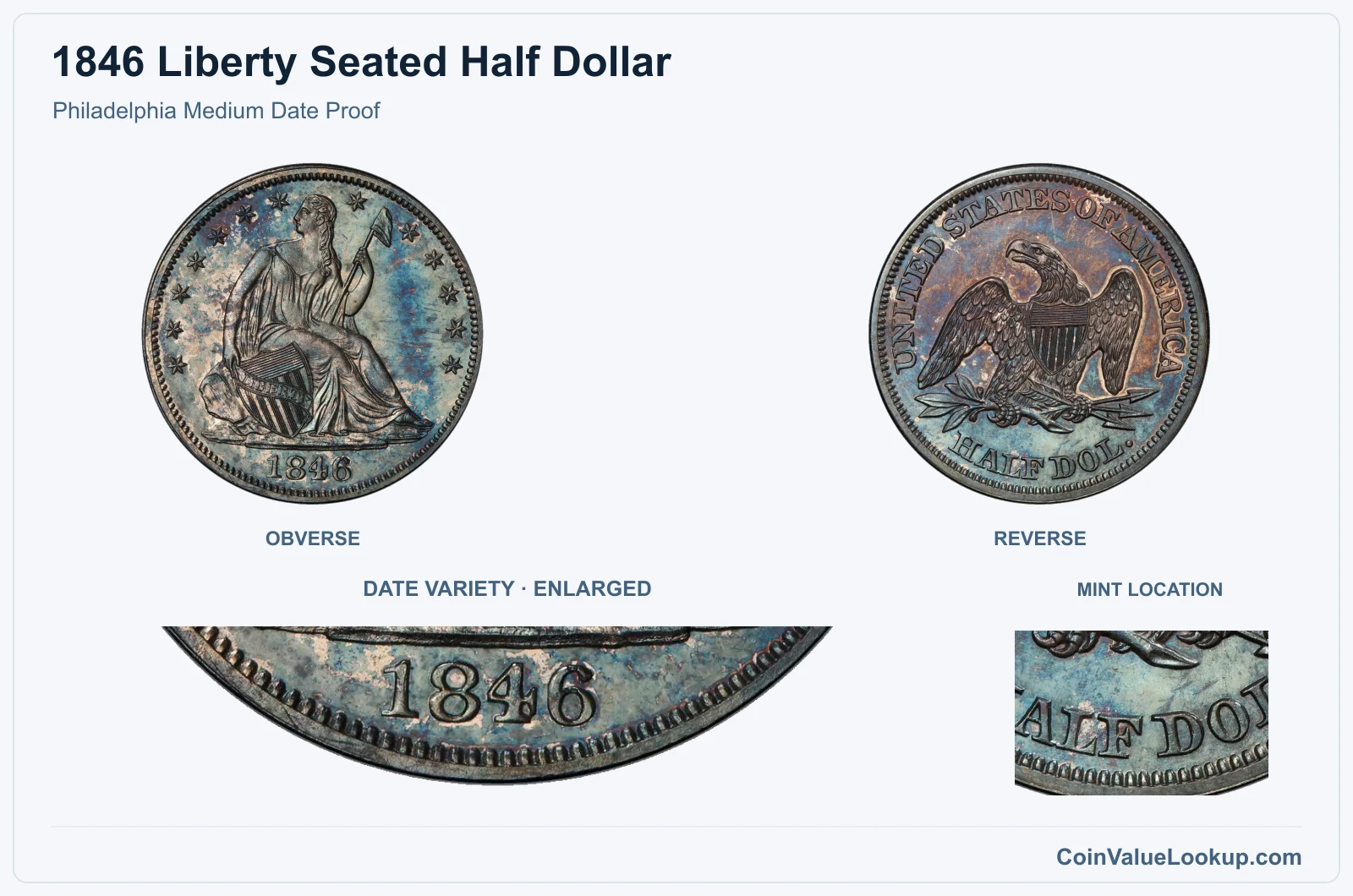
Philadelphia proof or presentation strikes of the 1846 Medium Date half dollar are extraordinarily rare. These are manufacturing distinctions — mirror fields, sharp rims, carefully prepared planchets — not simply high-grade business strikes.
A bright, well-preserved circulation coin is not a proof.
The only recorded sale in the supplied data is a single PR65 example that brought $57,500 at a Heritage auction in October 2008. That figure is a historical individual result, not a current market range.
Professional certification and attribution are essential for any coin claimed to be a proof of this date. Preserve the original surfaces and do not attempt to clean or improve the coin before submitting it.
Range Grade
Price Auction Records Appraisal PR PR 1
—
Coin Identifier
PR 2
—
Coin Identifier
PR 3
—
Coin Identifier
PR 4
—
Coin Identifier
PR 6
—
Coin Identifier
PR 8
—
Coin Identifier
PR 10
—
Coin Identifier
PR 12
—
Coin Identifier
PR 15
—
Coin Identifier
PR 20
—
Coin Identifier
PR 25
—
Coin Identifier
PR 30
—
Coin Identifier
PR 35
—
Coin Identifier
PR 40
—
Coin Identifier
PR 45
—
Coin Identifier
PR 50
—
Coin Identifier
PR 53
—
Coin Identifier
PR 55
—
Coin Identifier
PR 58
—
Coin Identifier
PR 60
—
Coin Identifier
PR 61
—
Coin Identifier
PR 62
Coin Identifier
PR 63
Coin Identifier
PR 64
Coin Identifier
PR 65
Coin Identifier
PR 66
—
—
—
PR 67
—
—
—
PR 68
—
—
—
PR 69
—
—
—
PR 70
—
—
—
1846 Liberty Seated Half Dollar Error List
1. 1846 Liberty Seated Half Dollar — Die Break / Cud
A die break or cud on an 1846 half dollar appears as a raised, irregular blob of metal, usually along the rim. The documented specimen — a 6/Horizontal 6 coin — shows two rim cuds below the digits 846 on the obverse and a later-stage reverse break above UN in UNITED.
These are separate from the corrected numeral itself; the cuds formed as the die cracked during its production run.
Do not confuse a cud with a simple rim dent, corrosion pit, or small interior die chip. A genuine cud connects to the rim and creates a solid raised area where design detail is obliterated.
Damage from contact typically leaves a depression, not a raised lump.
No specific price range is adopted for this error. Value depends on the size and visibility of the break, the coin's overall condition, and how dramatically the cud affects the design.
Each piece needs individual evaluation.
2. 1846 Liberty Seated Half Dollar — Repunched Date
A repunched date on the 1846 half dollar shows extra contours from a second impression of the same digit in a slightly different position. The documented example is an 1846-O where the 1 and the 6 both show recutting.
Specialist sources reject the older theory that the 6 is punched over a 5 — the underlying traces belong to the same numeral, shifted.
Keep this separate from the Philadelphia 6/Horizontal 6 variety, which involves a sideways punch correction rather than a simple positional shift. Also distinguish it from machine doubling, which produces flat, shelf-like distortion rather than the rounded, separated outlines of a true repunched date.
Post-strike damage to the date area can mimic repunching too, so look for consistent depth and curvature in the extra digit traces.
No specific price range is adopted for this error. Visibility, coin condition, and the degree of separation in the repunching all influence what a given example might bring.