1851 Liberty Seated Half Dollar Coin Value: How Much Is It Worth?
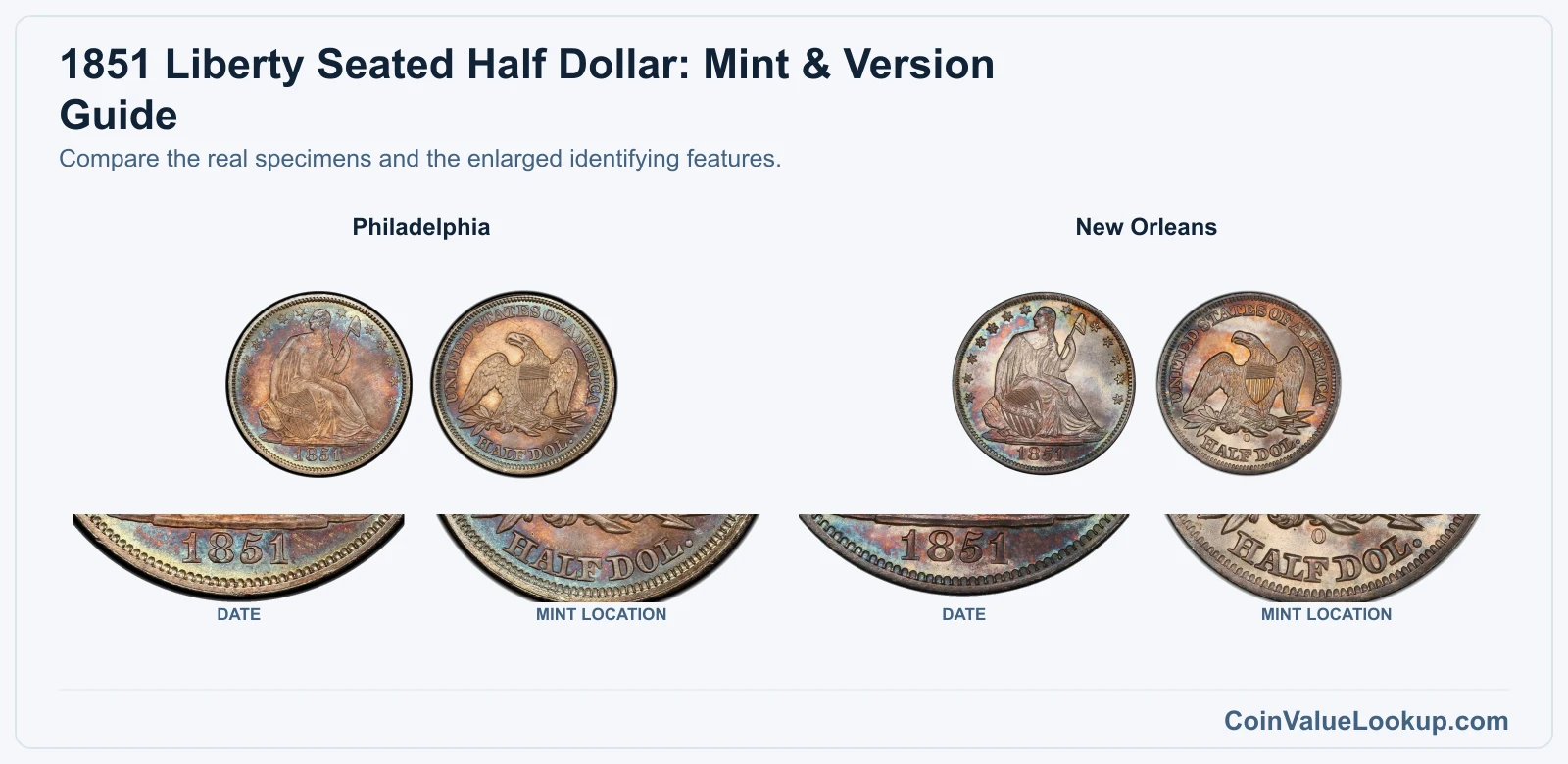
The 1851 Liberty Seated Half Dollar is a better-date coin even in well-worn condition. Philadelphia issues carry USA Coin Book guide values from around $949 in G4 to $3,520 in AU50, while the low-mintage New Orleans version starts considerably lower but climbs steeply in higher grades.
Grade, mint and specific variety drive what any individual piece is worth, so do not assume a single auction record reflects everyday pricing.
Fast Way to Identify Your 1851 Liberty Seated Half Dollar
The quickest way to start figuring out what you have is to upload clear photos of both the front and back of your coin. Our identifier can offer a preliminary identification of the mint, design type and general condition based on those images.
Snap the photos in even lighting, and try to keep the coin flat and in focus.
1851 Liberty Seated Half Dollar Value
Upload both sides of your 1851 Liberty Seated Half Dollar.
Front Obverse
Upload photo
Back Reverse
Upload photo
Which 1851 Liberty Seated Half Dollar Versions Are Worth Money?
- Philadelphia strikes are a better date across all grades, with guide values starting around $949 at G4 and reaching $3,520 at AU50.
- New Orleans (O mintmark) pieces have a notably low mintage; while guide values begin near $100 at G4, they climb sharply to $1,083 at AU50.
- Repunched-date and misplaced-date varieties exist for this year and can add collector interest beyond the base coin value.
Step 1: Identify Your 1851 Liberty Seated Half Dollar Mint Mark and Version
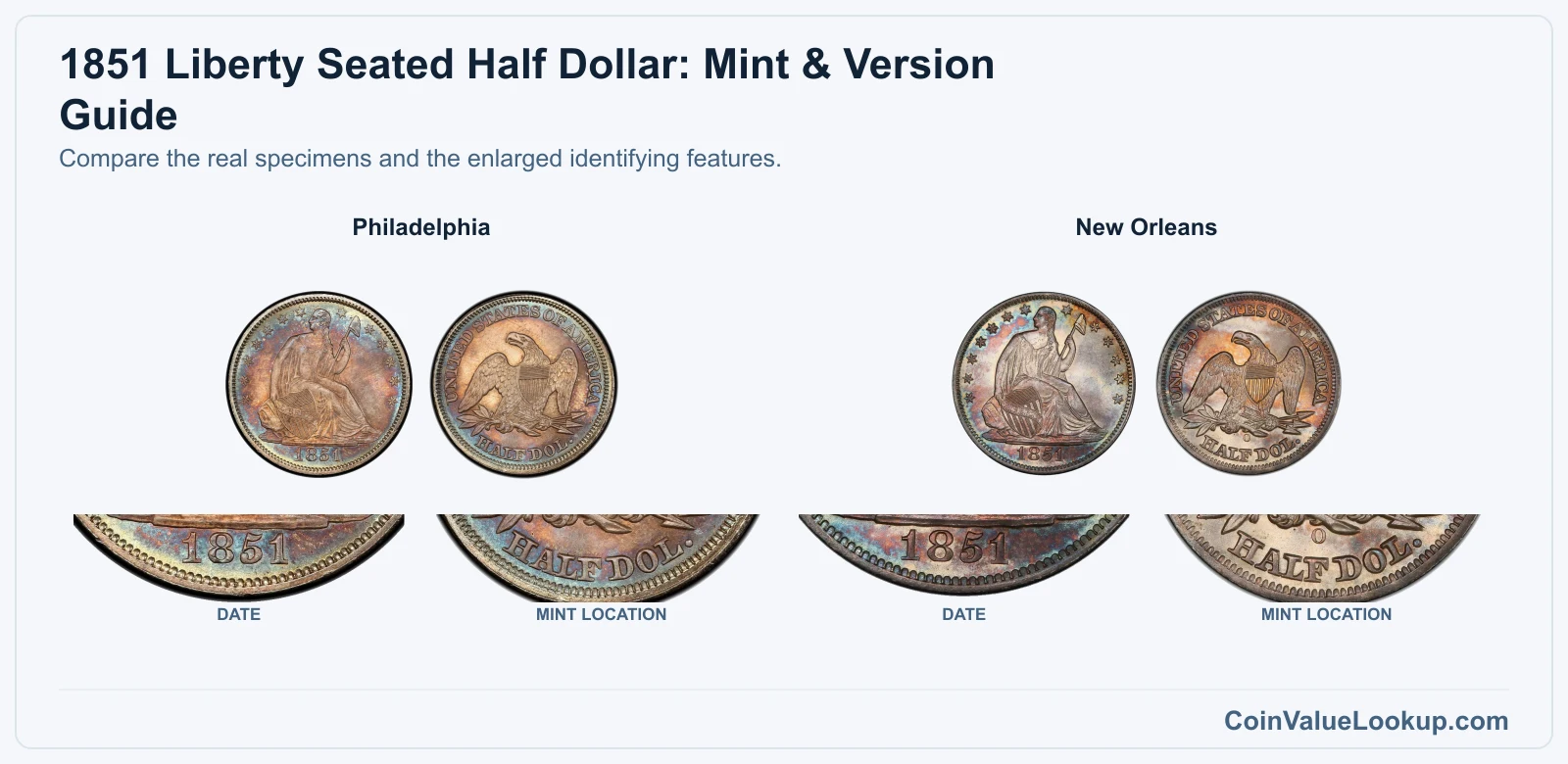
The 1851 half dollar uses the Seated Liberty No Motto design. Liberty sits on the obverse holding a pole and cap, with thirteen stars around the border.
The reverse shows an eagle clutching arrows and an olive branch, with HALF DOL below and no IN GOD WE TRUST banner.
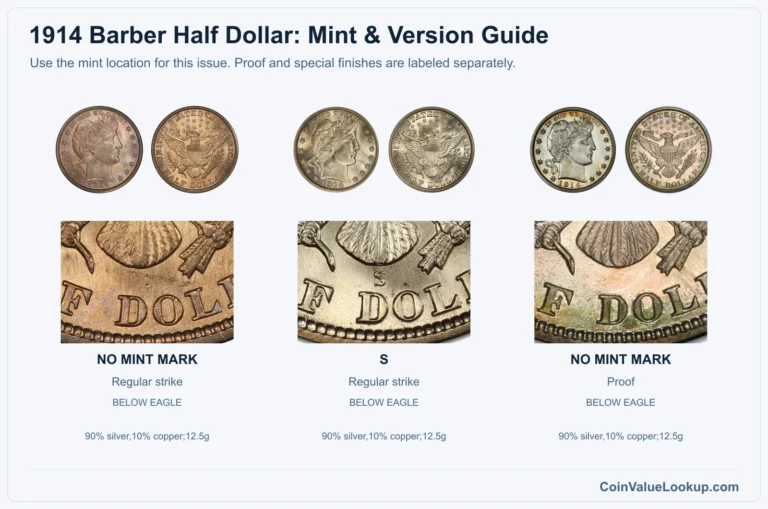
To identify the mint, flip the coin over and look directly below the eagle. A plain field means Philadelphia.
A small "O" stamped there means New Orleans.
Both versions are struck in 90% silver and 10% copper at the old 13.36-gram standard, which stayed in place until the weight reduction of 1853. Do not confuse a naturally bright or reflective surface with a Proof finish.
Proof is a specific manufacturing method involving polished dies and planchets, not just a shiny coin, and no 1851 Proof branch is established in the catalog used here.
Step 2: Check Your 1851 Liberty Seated Half Dollar Grade
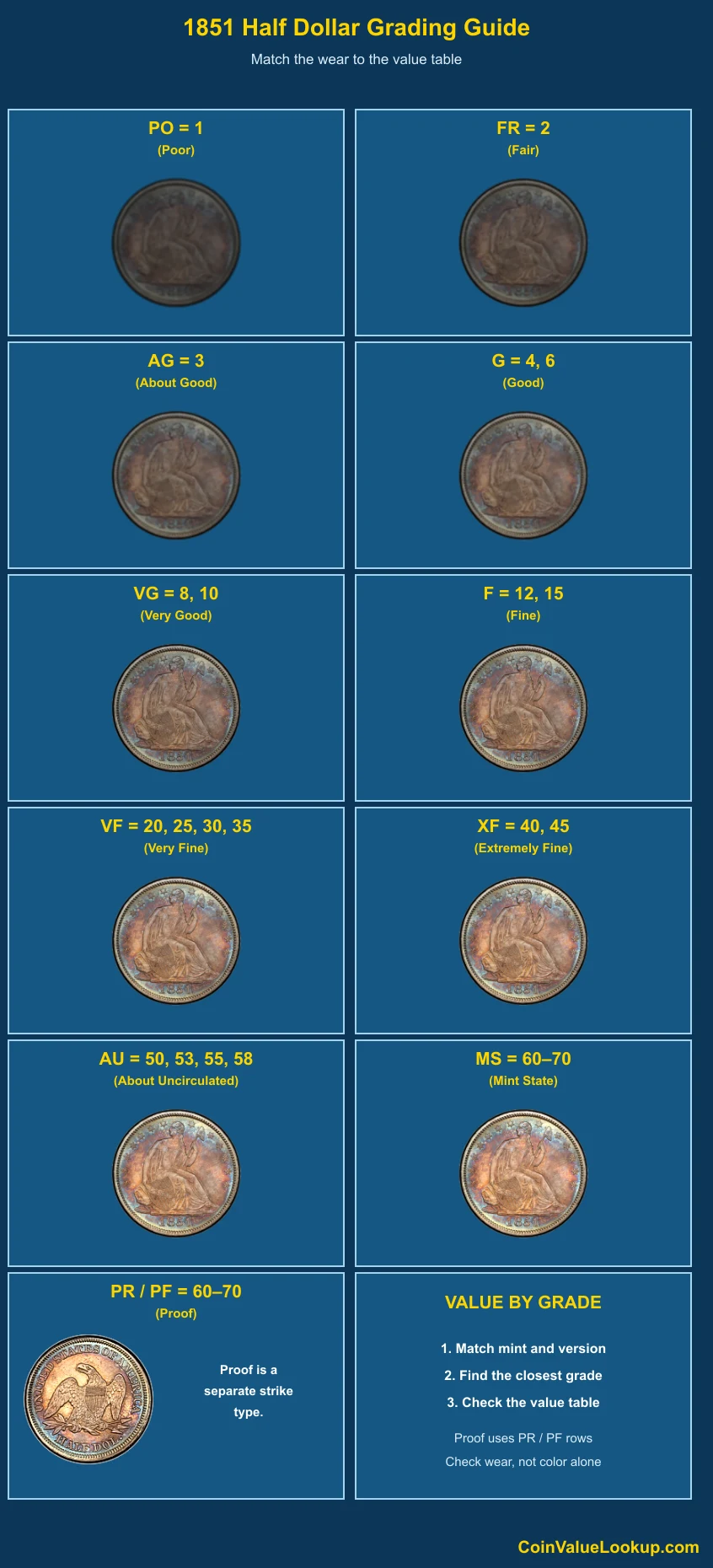
When grading your 1851 half dollar, focus on Liberty's head, breast, knee and the shield on the obverse. On the reverse, check the eagle's breast feathers, wing tips and claws.
Compare your coin to the type-matched reference image to see how much detail remains at each checkpoint.
Here is the tricky part with this date: flat high points do not always mean heavy wear. The 1851 Philadelphia issue in particular is known for weak strikes that leave the central design soft even on coins that saw little circulation.
Look for whether luster survives in protected areas. Genuine wear breaks luster and smooths high points together, while a weak strike leaves luster intact underneath the softness.
Photograph both sides and the edge in good light. Never clean your coin.
Even a gentle wipe can leave hairlines that permanently reduce its grade and desirability.
Step 3: Check 1851 Liberty Seated Half Dollar Value by Mint and Version
1851 Liberty Seated Half Dollar — Philadelphia
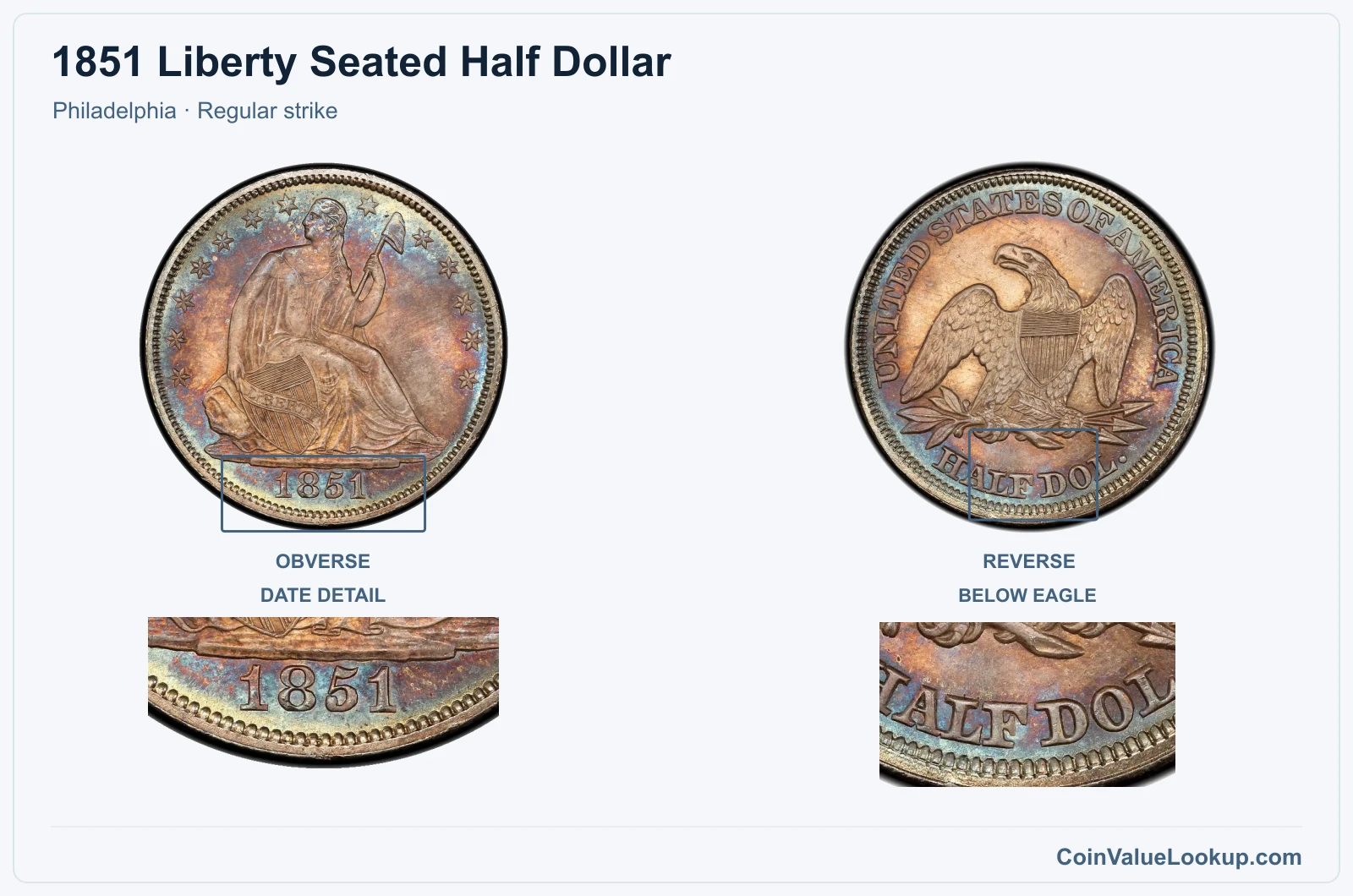
The 1851 Philadelphia half dollar carries no mintmark beneath the eagle. It is a recognized better date in the Seated Liberty series, meaning even heavily circulated examples hold solid value.
USA Coin Book lists guide estimates of about $949 at G4, $2,131 at VF20 and $3,520 at AU50.
One thing to watch: this issue often comes weakly struck on the central high points. A soft head or mushy shield does not automatically mean the coin grades low.
Check for surviving luster in the protected recesses around the stars and in the eagle's feather valleys. If luster is present but the strike is flat, the coin may grade higher than it first appears.
Coin Value Lookup is a useful starting point when you want to compare guide values across different dates and mints in the Liberty Seated series. You can look up other half dollar years there as well.
Range Grade
Price Auction Records Appraisal PO PO 1
—
Coin Identifier FR FR 2
—
Coin Identifier AG AG 3
—
Coin Identifier G G 4
—
Coin Identifier
G 6
—
Coin Identifier VG VG 8
Coin Identifier
VG 10
Coin Identifier F F 12
Coin Identifier
F 15
Coin Identifier VF VF 20
Coin Identifier
VF 25
Coin Identifier
VF 30
—
Coin Identifier
VF 35
Coin Identifier XF XF 40
Coin Identifier
XF 45
Coin Identifier AU AU 50
Coin Identifier
AU 53
Coin Identifier
AU 55
Coin Identifier
AU 58
Coin Identifier MS MS 60
Coin Identifier
MS 61
Coin Identifier
MS 62
Coin Identifier
MS 63
Coin Identifier
MS 64
Coin Identifier
MS 65
Coin Identifier
MS 66
Coin Identifier
MS 67
Coin Identifier
MS 68
—
—
—
MS 69
—
—
—
MS 70
—
—
—
1851 Liberty Seated Half Dollar — New Orleans
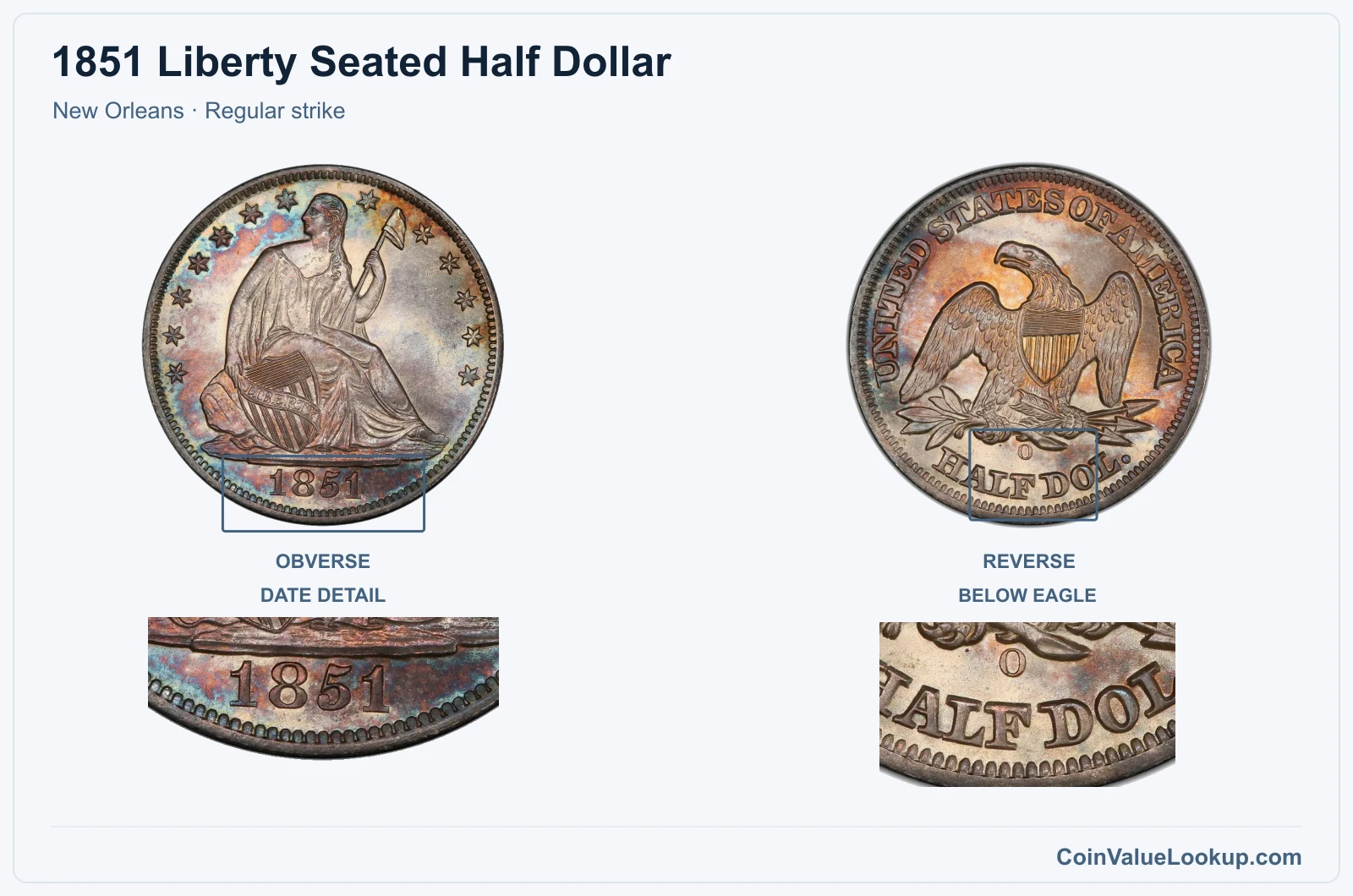
The 1851-O was struck at the New Orleans Mint and carries a small "O" mintmark below the eagle on the reverse. This is a low-mintage issue, and surviving examples turn up far less often than many other dates in the series.
USA Coin Book guide estimates place the 1851-O at roughly $100 in G4, $426 in VF20 and $1,083 in AU50. The jump between grades is steep, so accurate grading matters here more than usual.
Compare both obverse and reverse carefully before settling on a grade. New Orleans strikes can vary in sharpness, so use the same luster-check approach described for the Philadelphia issue to separate genuine wear from a soft strike.
Range Grade
Price Auction Records Appraisal PO PO 1
—
Coin Identifier FR FR 2
—
Coin Identifier AG AG 3
—
Coin Identifier G G 4
—
Coin Identifier
G 6
—
Coin Identifier VG VG 8
Coin Identifier
VG 10
—
Coin Identifier F F 12
—
Coin Identifier
F 15
Coin Identifier VF VF 20
Coin Identifier
VF 25
Coin Identifier
VF 30
Coin Identifier
VF 35
Coin Identifier XF XF 40
Coin Identifier
XF 45
Coin Identifier AU AU 50
Coin Identifier
AU 53
Coin Identifier
AU 55
Coin Identifier
AU 58
Coin Identifier MS MS 60
—
Coin Identifier
MS 61
Coin Identifier
MS 62
Coin Identifier
MS 63
Coin Identifier
MS 64
Coin Identifier
MS 65
Coin Identifier
MS 66
Coin Identifier
MS 67
—
—
—
MS 68
—
—
—
MS 69
—
—
—
MS 70
—
—
—
1851 Liberty Seated Half Dollar Error List
1. 1851 Liberty Seated Half Dollar — Repunched Date
A repunched date on the 1851 half dollar shows extra contours around one or more numerals where a date punch was impressed into the die more than once at slightly different positions. One documented example displays bold repunching at the upper left of the final digit 1, visible as a raised ghost outline that partially overlaps the primary numeral.
To spot it, tilt the coin under a single-point light source and examine each digit closely with magnification. The extra outline should be raised and follow the shape of the numeral.
Do not confuse this with machine doubling, which produces flat, shelf-like distortion rather than a second raised contour. Post-mint damage can also shift how a digit looks, but it typically leaves incuse marks rather than raised ones.
Value depends on the visibility of the repunching and the coin's overall condition; no specific price range is established for these.
2. 1851 Liberty Seated Half Dollar — Misplaced Date in Dentils
A misplaced date occurs when part of a date digit is punched into the wrong area of the die, typically into the denticles below the date. On the 1851 half dollar, an example has been reported showing an errant "8" partially visible within the denticles beneath the date position.
To check your coin, angle it so the denticles along the lower obverse rim are clearly lit. Look for any raised numeral shape that sits among or overlaps the tooth-like denticles, rather than resting in the normal date field.
This is distinct from the repunched final 1 described above. Ordinary wear, rim damage or tooling can create marks in the denticle area too, so confirm the shape matches a known numeral rather than an irregular scratch.
Pricing depends on clarity and coin condition, and no adopted numerical range is available for this variety.
3. 1851 Liberty Seated Half Dollar — Die Crack / Die Chip
Die cracks appear as thin, raised lines on the coin's surface, formed when the steel die developed fractures during use. On the 1851 half dollar, documented specimens show cracks running along the base of the date and through Liberty's head in the area between stars 7 and 8, continuing toward the cap.
These lines are raised because metal flowed into the crack in the die. That is the key diagnostic: a crack is raised, while a scratch is incuse, or pressed into the surface.
Do not mistake corrosion lines, contact marks or surface debris for die cracks. A true crack follows a consistent, slightly wandering path and appears on every coin struck from that same broken die.
Value varies with the crack's prominence and the coin's overall grade; no specific price data is established for these pieces.
4. 1851 Liberty Seated Half Dollar — Defective Planchet
A defective planchet is a flaw in the blank metal disc before the coin was struck. On one documented 1851 half dollar, a mint-made flaw appears to the right of star 8 near the edge of Liberty's cap.
It looks like an irregular patch of disturbed or missing surface metal that was present when the coin was struck, so the design still partially flows over or around it.
The critical distinction is mint-made versus post-mint damage. A post-mint gouge or corrosion pit will cut into or disrupt the design sharply, often with a different color or texture in the damaged area.
A planchet flaw shows metal disturbance that the striking process partially concealed.
Do not assume missing metal means missing weight without verification. Pricing for defective-planchet pieces depends on the size and visibility of the flaw plus the coin's condition, and no adopted numerical range is available.