1869 Liberty Seated Half Dollar Coin Value: How Much Is It Worth?
The 1869 Liberty Seated Half Dollar is a collectible silver coin with guide values starting around $110 in Good condition and reaching $739 near About Uncirculated for Philadelphia strikes. Your coin's actual worth depends heavily on its mint, grade, and exact design variety.
Proofs and scarce mintmark styles call for separate comparisons entirely.
Fast Way to Identify Your 1869 Liberty Seated Half Dollar
The quickest way to start figuring out what you have is to upload clear photos of both the front and back of your coin. Our identifier can offer a preliminary read on the mint, variety, and general condition based on those images.
It won't replace professional authentication, but it gives you a solid starting point.
1869 Liberty Seated Half Dollar Value
Upload both sides of your 1869 Liberty Seated Half Dollar.
Front Obverse
Upload photo
Back Reverse
Upload photo
Which 1869 Liberty Seated Half Dollar Versions Are Worth Money?
- Philadelphia and San Francisco strikes have different guide values in lower grades — check your mintmark before looking up a price.
- Proof 1869 half dollars carry a guide value around $1,540 at PR63, well above circulated examples.
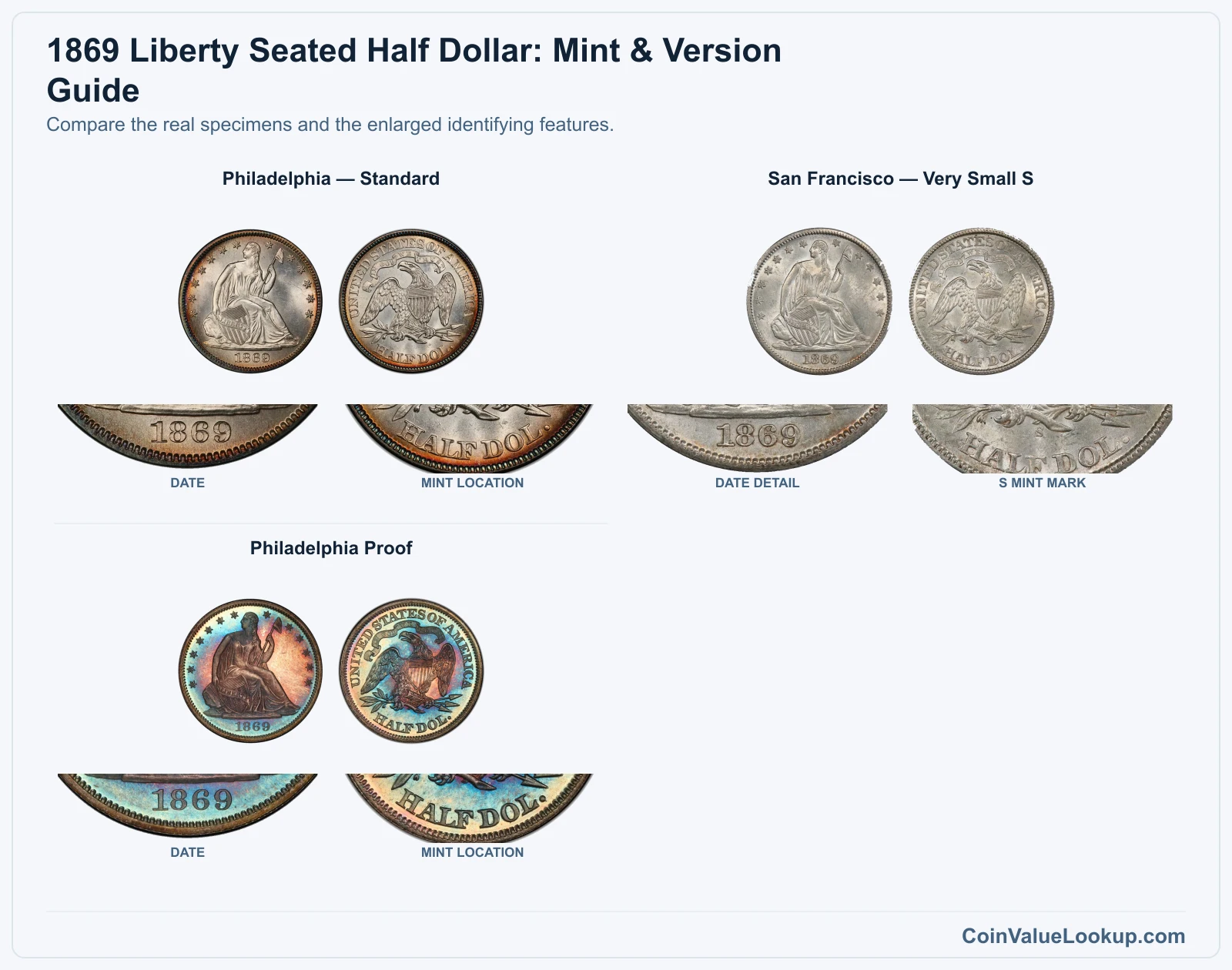
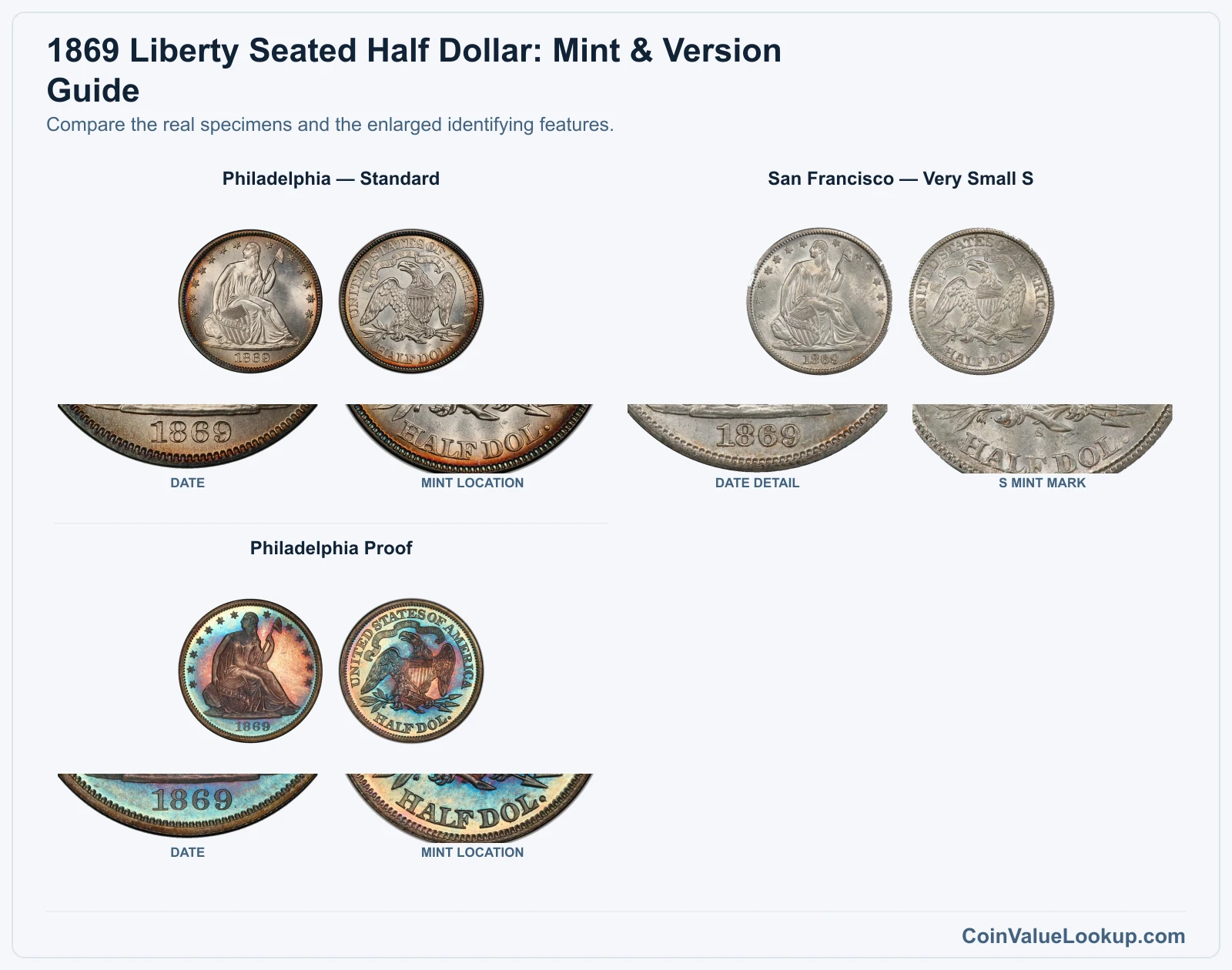
- The San Francisco issue uses a Very Small S mintmark; confirming that detail helps with accurate identification.
Step 1: Identify Your 1869 Liberty Seated Half Dollar Mint Mark and Version
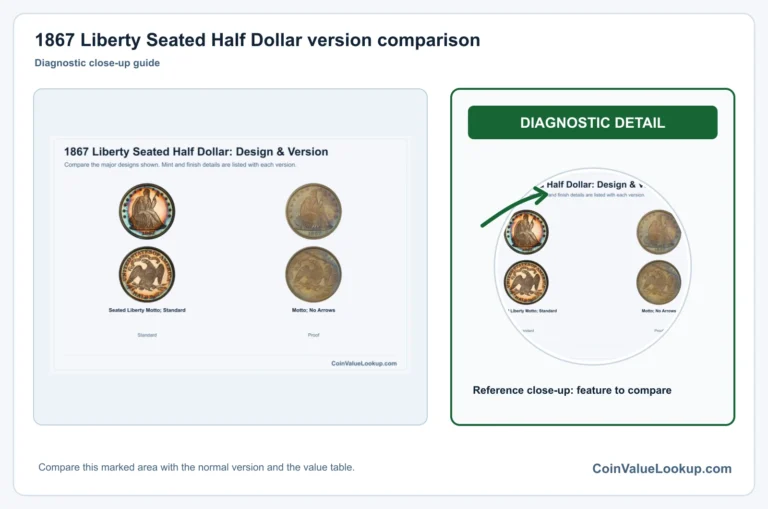
The obverse shows Liberty seated on a rock, holding a shield and a liberty pole with a cap. The reverse features an eagle beneath a ribbon inscribed "IN GOD WE TRUST," with "HALF DOL." at the bottom.
To determine your mint, flip the coin over and look directly below the eagle's tail feathers. A blank space means Philadelphia.
A small "S" means San Francisco. No other mint produced this date.
The 1869 half dollar is struck in 90% silver and 10% copper, weighing 12.44 grams. That standard weight held until the 1873 Arrows issue bumped it to 12.50 grams.
Don't confuse the date-flanking arrows seen on 1873–74 issues with damage. Those arrows are intentional design elements marking the weight change.
Your 1869 coin should have no arrows beside the date.
A Proof 1869 half dollar exists too. Proof is a special manufacturing finish with mirror-like fields and sharp rims, not a grade above Mint State.
Reflective surfaces alone don't confirm a Proof; polished circulation dies can mimic the look.
Step 2: Check Your 1869 Liberty Seated Half Dollar Grade
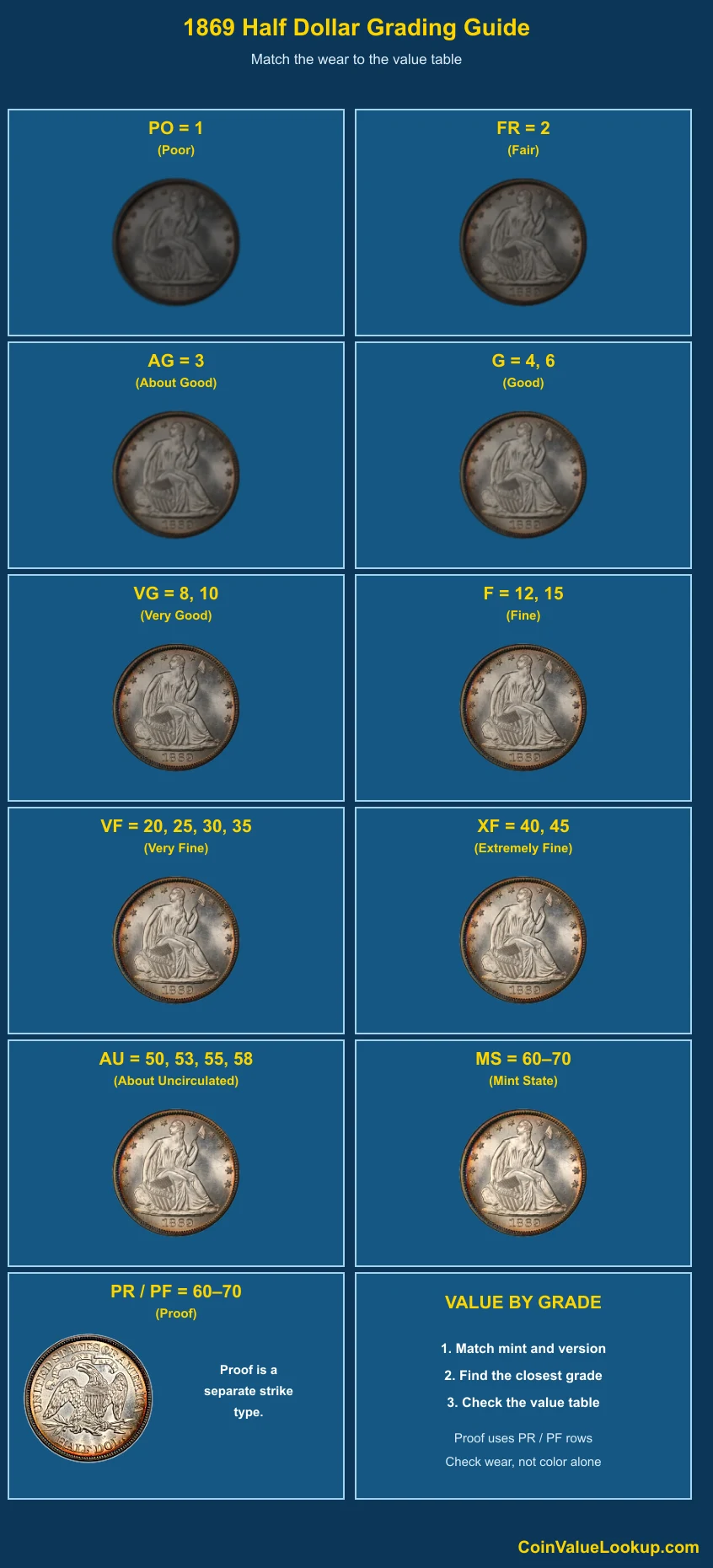
Start by checking the highest points on both sides. On the obverse, Liberty's head, her knee, and the breast area lose detail first as the coin circulates.
On the reverse, the eagle's neck feathers and the tops of the wings are the first to flatten.
Compare your coin side by side with the grading image. A coin graded Good (G4) will have a visible outline of Liberty with almost no interior detail.
By Very Fine (VF20), you should see partial lines in the shield and some separation in Liberty's gown folds.
Weak strikes can fool you. Some coins left the press with soft detail that looks like wear, but they still have original mint luster in protected areas.
Check the fields around the stars and letters for that faint cartwheel sheen.
Cleaning, rim dings, and holes all reduce value independently of the grade. A VF coin with harsh cleaning can sell for less than an honestly worn Fine example.
Look for unnatural brightness or hairline scratches running in one direction across the fields.
Step 3: Check 1869 Liberty Seated Half Dollar Value by Mint and Version
1869 Liberty Seated Half Dollar — Philadelphia — Standard
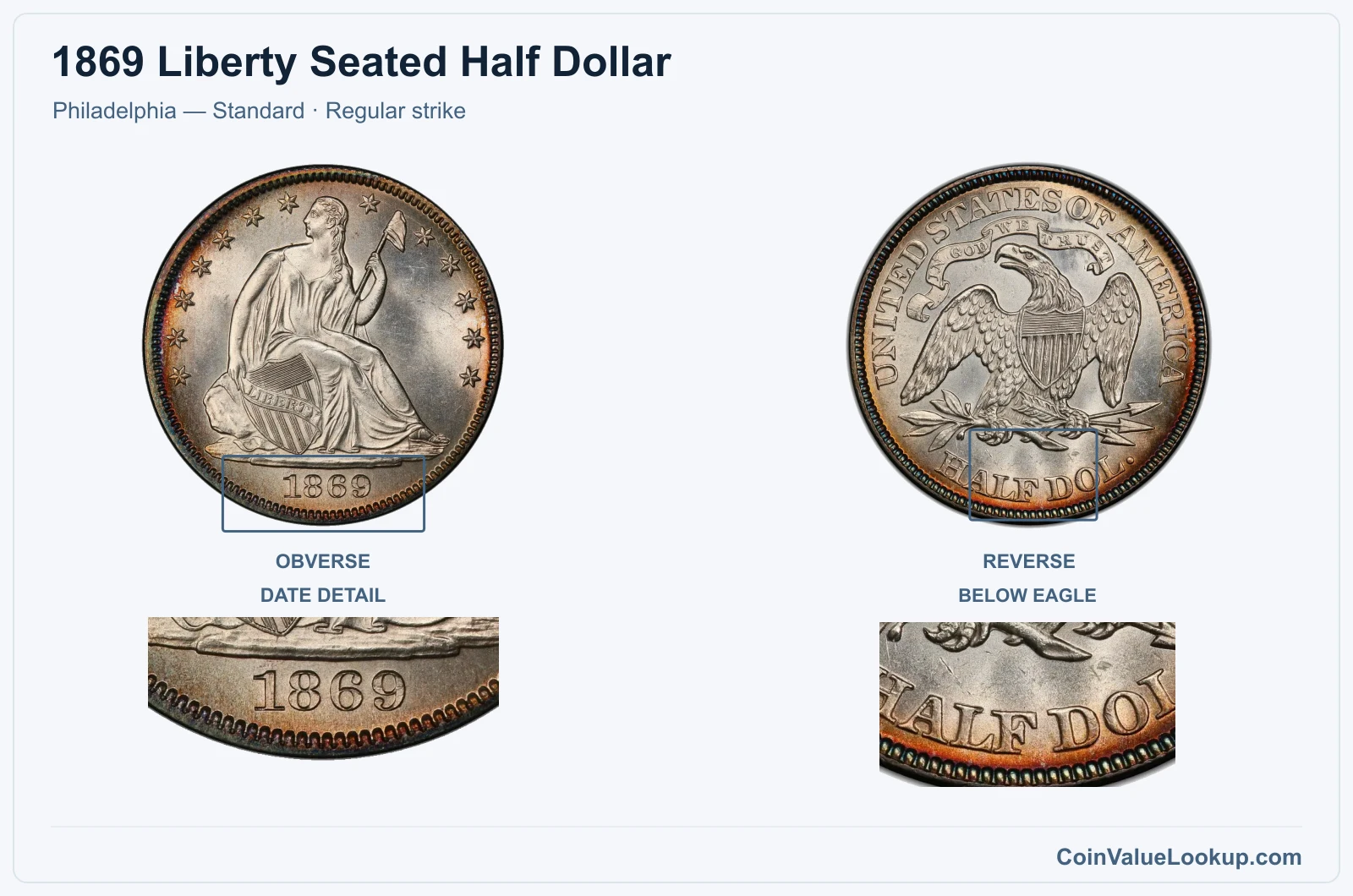
The 1869 Philadelphia half dollar has no mintmark below the eagle. This is the standard circulation strike for the year.
Guide estimates place it around $110 in G4, $394 in VF20, and $739 at AU50.
Philadelphia coins tend to show up more often than their San Francisco counterparts in collections, but "more common" is relative for a coin over 150 years old. Focus on honest, original surfaces when evaluating one of these.
Cleaned or damaged examples trade well below guide figures regardless of technical grade.
Coin Value Lookup is a useful starting point if you want to compare this date with other years in the Liberty Seated series or check values across different denominations.
Range Grade
Price Auction Records Appraisal PO PO 1
—
Coin Identifier FR FR 2
—
Coin Identifier AG AG 3
Coin Identifier G G 4
—
Coin Identifier
G 6
—
Coin Identifier VG VG 8
—
Coin Identifier
VG 10
—
Coin Identifier F F 12
—
Coin Identifier
F 15
—
Coin Identifier VF VF 20
Coin Identifier
VF 25
—
Coin Identifier
VF 30
Coin Identifier
VF 35
Coin Identifier XF XF 40
Coin Identifier
XF 45
Coin Identifier AU AU 50
Coin Identifier
AU 53
Coin Identifier
AU 55
Coin Identifier
AU 58
Coin Identifier MS MS 60
Coin Identifier
MS 61
Coin Identifier
MS 62
Coin Identifier
MS 63
Coin Identifier
MS 64
Coin Identifier
MS 65
Coin Identifier
MS 66
Coin Identifier
MS 67
—
—
—
MS 68
—
—
—
MS 69
—
—
—
MS 70
—
—
—
1869 Liberty Seated Half Dollar — San Francisco — Very Small S
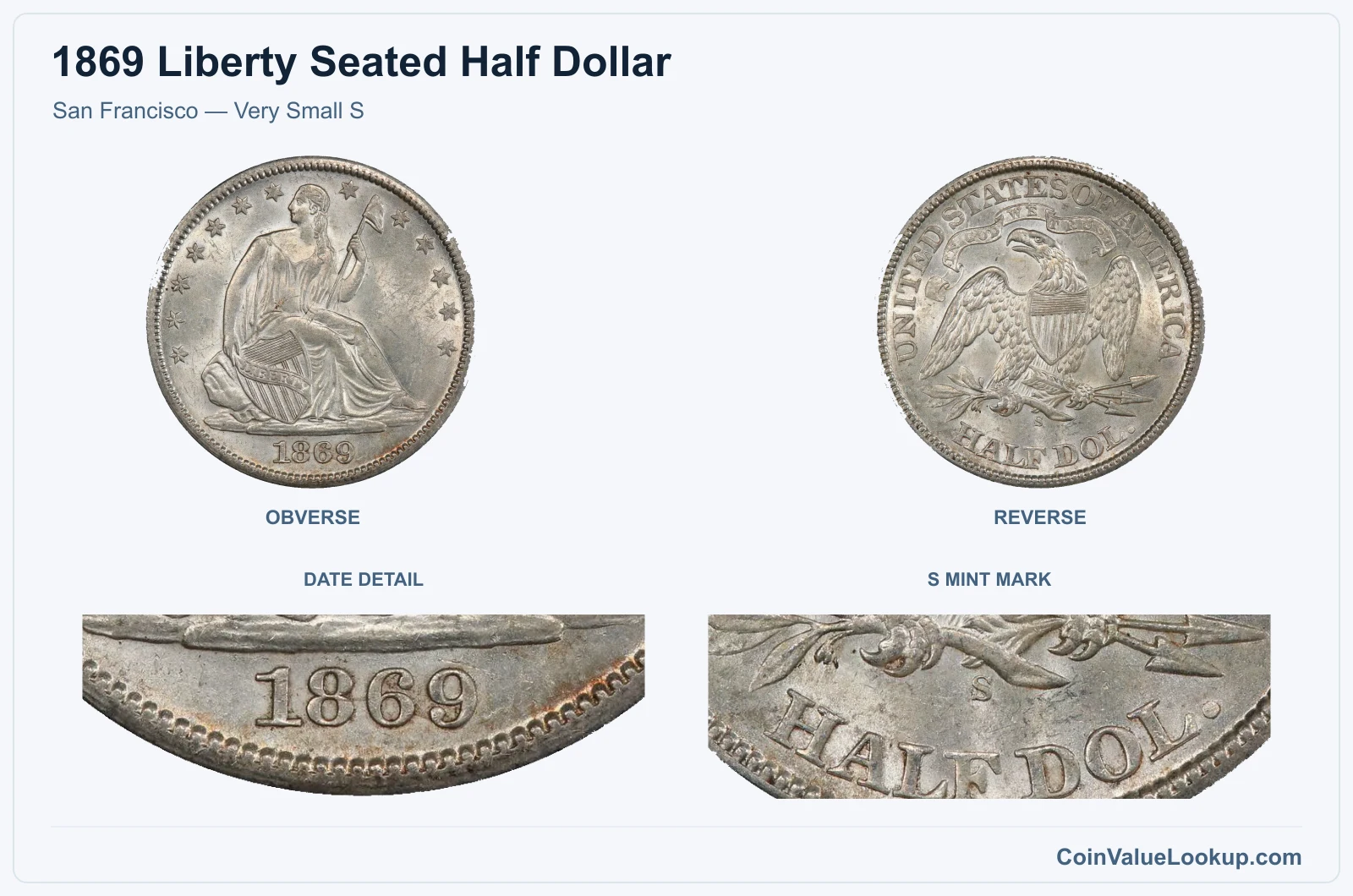
The San Francisco issue carries a Very Small S mintmark positioned below the eagle on the reverse. It's noticeably tiny, so use magnification if you're unsure whether it's there.
Guide values for the 1869-S run about $141 at G4, $394 at VF20, and $739 at AU50. The small premium in low grades over the Philadelphia coin reflects the mintmark variety's collectibility.
In higher grades the two mints converge in estimated value, though actual sale prices depend on eye appeal and surface quality. The Very Small S is the style recorded for this year specifically, so matching it against annual references rather than adjacent-year mintmark images matters for proper attribution.
Ordinary-issue reference: Ordinary-issue reference only: The table below shows prices for the 1869-S Liberty Seated Half Dollar (regular strike). It does not represent the value of the specific San Francisco — Very Small S variety or its variety premium. Year, mint, metal and strike type are matched; the specific variety is not priced by this table.
Range Grade
Price Auction Records Appraisal PO PO 1
—
Coin Identifier FR FR 2
—
Coin Identifier AG AG 3
—
Coin Identifier G G 4
—
Coin Identifier
G 6
—
Coin Identifier VG VG 8
—
Coin Identifier
VG 10
—
Coin Identifier F F 12
Coin Identifier
F 15
—
Coin Identifier VF VF 20
Coin Identifier
VF 25
Coin Identifier
VF 30
Coin Identifier
VF 35
Coin Identifier XF XF 40
Coin Identifier
XF 45
Coin Identifier AU AU 50
Coin Identifier
AU 53
Coin Identifier
AU 55
Coin Identifier
AU 58
Coin Identifier MS MS 60
Coin Identifier
MS 61
Coin Identifier
MS 62
Coin Identifier
MS 63
Coin Identifier
MS 64
Coin Identifier
MS 65
Coin Identifier
MS 66
Coin Identifier
MS 67
Coin Identifier
MS 68
—
—
—
MS 69
—
—
—
MS 70
—
—
—
1869 Liberty Seated Half Dollar — Philadelphia Proof
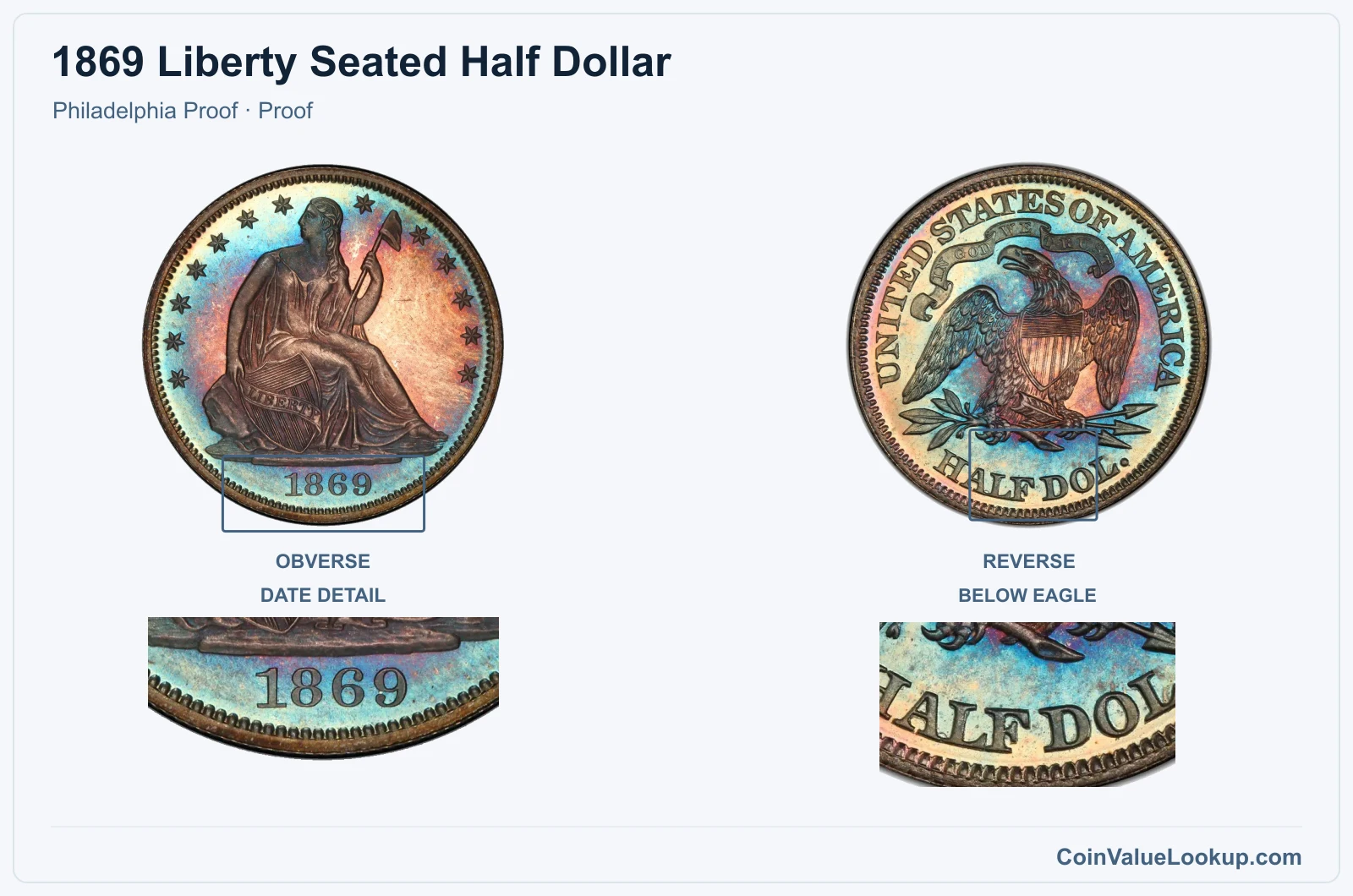
Philadelphia struck Proof half dollars in 1869 with no mintmark, just like the business strikes. The difference is in the manufacturing: Proof coins were made on polished planchets using specially prepared dies, producing mirror-like fields and crisp, squared-off rims.
A guide estimate of about $1,540 applies at PR63. That's a significant jump over even a nice AU business strike.
Surviving Proofs were made in small numbers for collectors of the era.
Don't assume a shiny coin is a Proof. Polished circulation dies can produce reflective surfaces that mimic Proof fields.
True Proofs show consistent mirror depth across the entire field and razor-sharp device edges. When in doubt, professional certification is the safest route to confirm the finish.
Range Grade
Price Auction Records Appraisal PR PR 1
—
Coin Identifier
PR 2
—
Coin Identifier
PR 3
—
Coin Identifier
PR 4
—
Coin Identifier
PR 6
—
Coin Identifier
PR 8
—
Coin Identifier
PR 10
—
Coin Identifier
PR 12
—
Coin Identifier
PR 15
—
Coin Identifier
PR 20
—
Coin Identifier
PR 25
—
Coin Identifier
PR 30
—
Coin Identifier
PR 35
—
Coin Identifier
PR 40
—
Coin Identifier
PR 45
—
Coin Identifier
PR 50
—
Coin Identifier
PR 53
Coin Identifier
PR 55
Coin Identifier
PR 58
—
Coin Identifier
PR 60
Coin Identifier
PR 61
Coin Identifier
PR 62
Coin Identifier
PR 63
Coin Identifier
PR 64
Coin Identifier
PR 65
Coin Identifier
PR 66
Coin Identifier
PR 67
Coin Identifier
PR 68
—
Coin Identifier
PR 69
—
—
—
PR 70
—
—
—
1869 Liberty Seated Half Dollar Error List
1. 1869 Liberty Seated Half Dollar — Repunched Date
A Repunched Date (RPD) occurs when the date numerals were punched into the working die more than once, with the second impression slightly offset from the first. On 1869 Philadelphia half dollars, recorded RPD examples show remnants of an earlier date impression visible beside or beneath the final digits.
To spot this, examine each numeral under magnification. Look for traces of extra serifs, shadows, or partial outlines near the base or tops of the numbers.
Compare your coin to a normal-date example; the doubled traces should be consistent and raised, not incised.
Don't confuse this with machine doubling, which produces flat, shelf-like distortion, or with post-mint damage where the date area has been scratched or dented. The value of an RPD depends on the visibility of the repunching and the coin's overall condition.
No fixed premium applies across the board.
2. 1869 Liberty Seated Half Dollar — Die Crack / Die Chip
Die cracks appear as thin, raised lines on the coin's surface where the steel die fractured during use. On 1869-S half dollars, late die states have been recorded with cracks running along the letters of AMERICA and through UNITED on the reverse.
These raised lines follow a continuous, slightly irregular path and cannot be felt as grooves — they're always raised above the field because metal filled the crack in the die. That's the key distinction from scratches or corrosion, which are incuse or pitted into the surface.
Foreign material stuck to a coin can also mimic a crack at first glance. Try gentle examination under different lighting angles; a true die crack will cast a consistent shadow and be part of the coin's metal, not sitting on top of it.
The value impact depends on crack prominence, overall coin condition, and collector interest in the specific die state.