1997 Kennedy Half Dollar Coin Value: How Much Is It Worth?
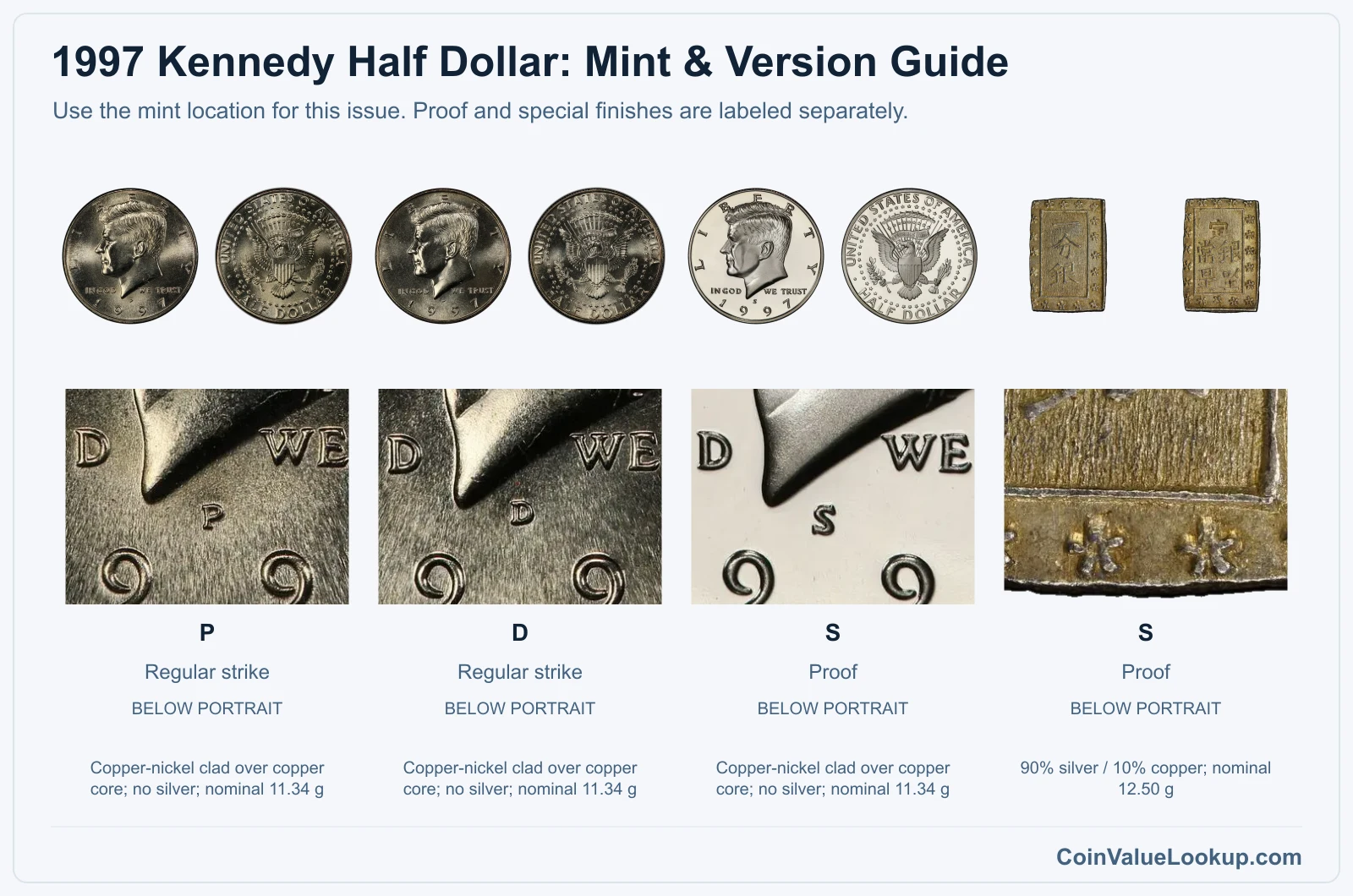
The 1997 Kennedy half dollar carries a face value of 50 cents, and most circulated clad examples are worth exactly that. Collector guide estimates for specific mint, finish and grade combinations range from about $3.62 to $55.00, according to USA Coin Book.
Before checking any price chart, you need to know whether your coin is a business strike, a clad proof or a silver proof, because each branch has a different value trajectory.
Fast Way to Identify Your 1997 Kennedy Half Dollar
The quickest way to start is to upload clear photos of the front and back of your 1997 half dollar. Our identifier can help with preliminary identification of your coin's mint and finish based on those images.
Snap both sides in good lighting, and you will have a starting point for figuring out which version you hold.
1997 Kennedy Half Dollar Value
Upload both sides of your 1997 Kennedy Half Dollar.
Front Obverse
Upload photo
Back Reverse
Upload photo
Which 1997 Kennedy Half Dollar Versions Are Worth Money?
- The 1997-S silver proof, struck in 90% silver, carries an estimated guide value of $55.00 at PR65 — confirm composition by edge color and weight.
- Clad proofs from San Francisco are worth checking at an estimated $15.00 at PR65, well above face value.
- Mint-made errors such as broadstrikes, off-center strikes and missing clad layers have been reported for 1997 and can carry premiums depending on visibility and condition.
Step 1: Identify Your 1997 Kennedy Half Dollar Mint Mark and Version
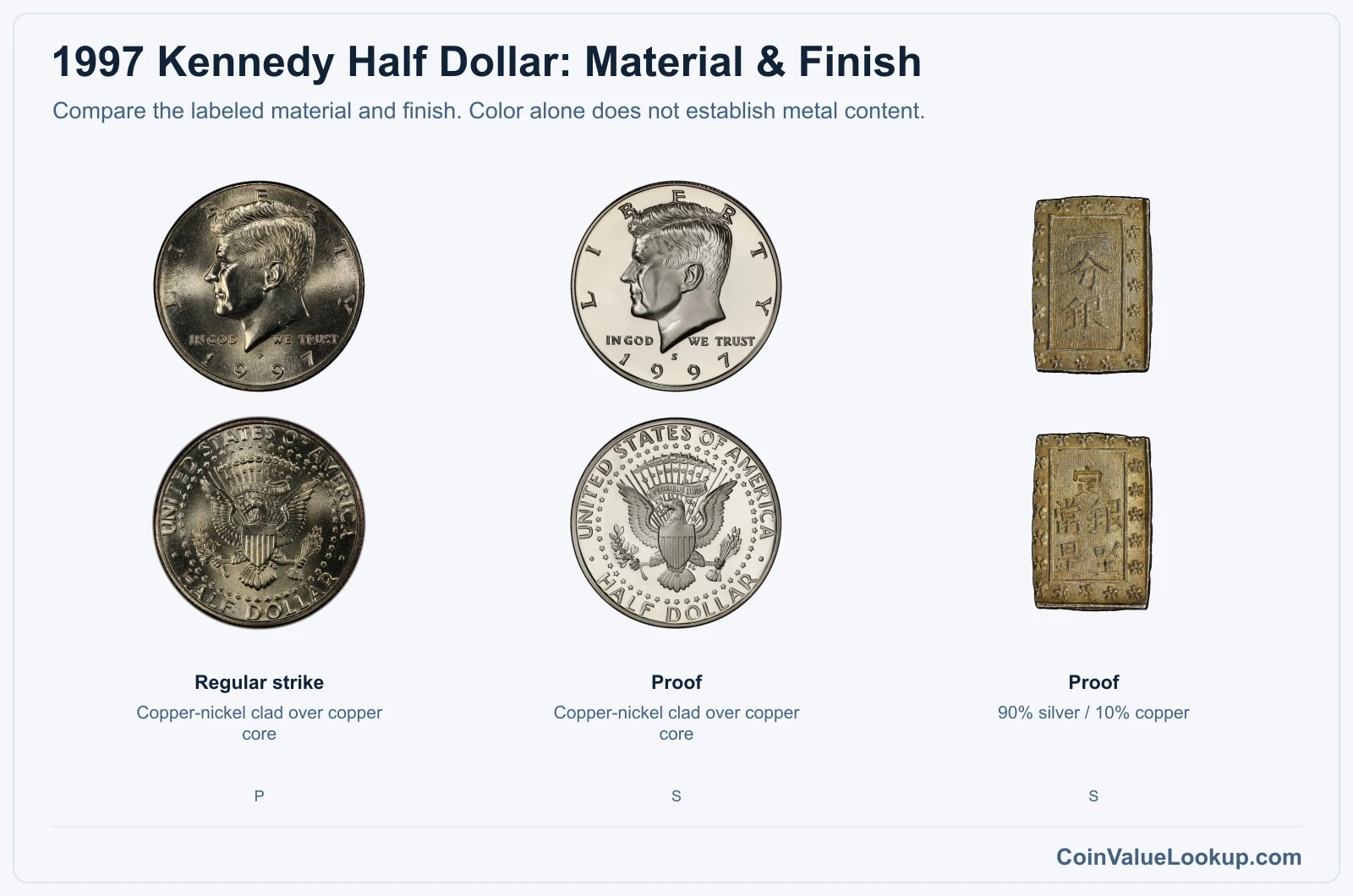
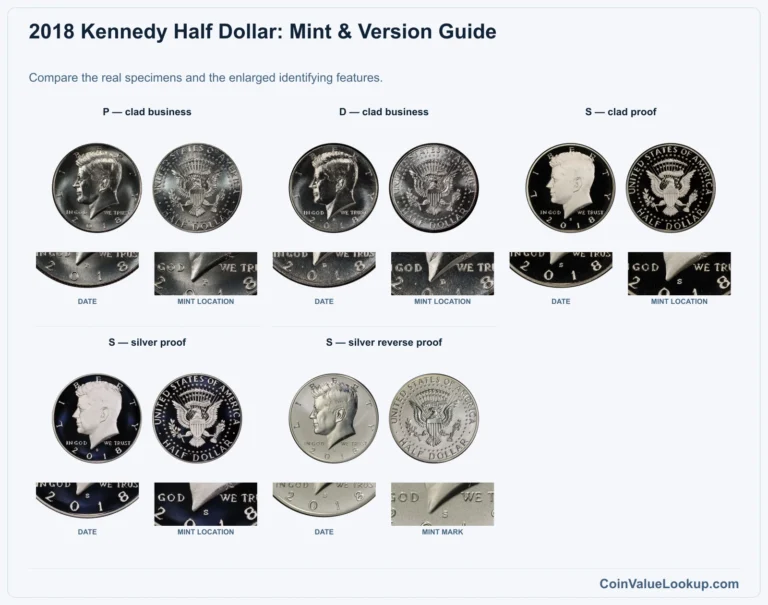
The mintmark sits on the obverse, just beneath Kennedy's portrait and above the date. Philadelphia coins carry a P mintmark, Denver coins show a D, and San Francisco coins display an S.
A P or D coin from 1997 is a copper-nickel clad business strike with no silver content. An S-mint coin could be either a clad proof or a 90% silver proof, so the mintmark alone does not settle the question.
To tell clad from silver, compare edge color and weight. A clad half dollar has a visible copper-orange stripe on its edge and weighs about 11.34 grams.
The silver proof weighs roughly 12.50 grams and shows a uniform silver-white edge.
Original government packaging also helps. Silver proofs were sold separately from the standard clad proof sets.
Toning, lighting and aftermarket plating can all mimic a silver appearance, so rely on weight and edge examination rather than surface color alone.
Step 2: Check Your 1997 Kennedy Half Dollar Grade
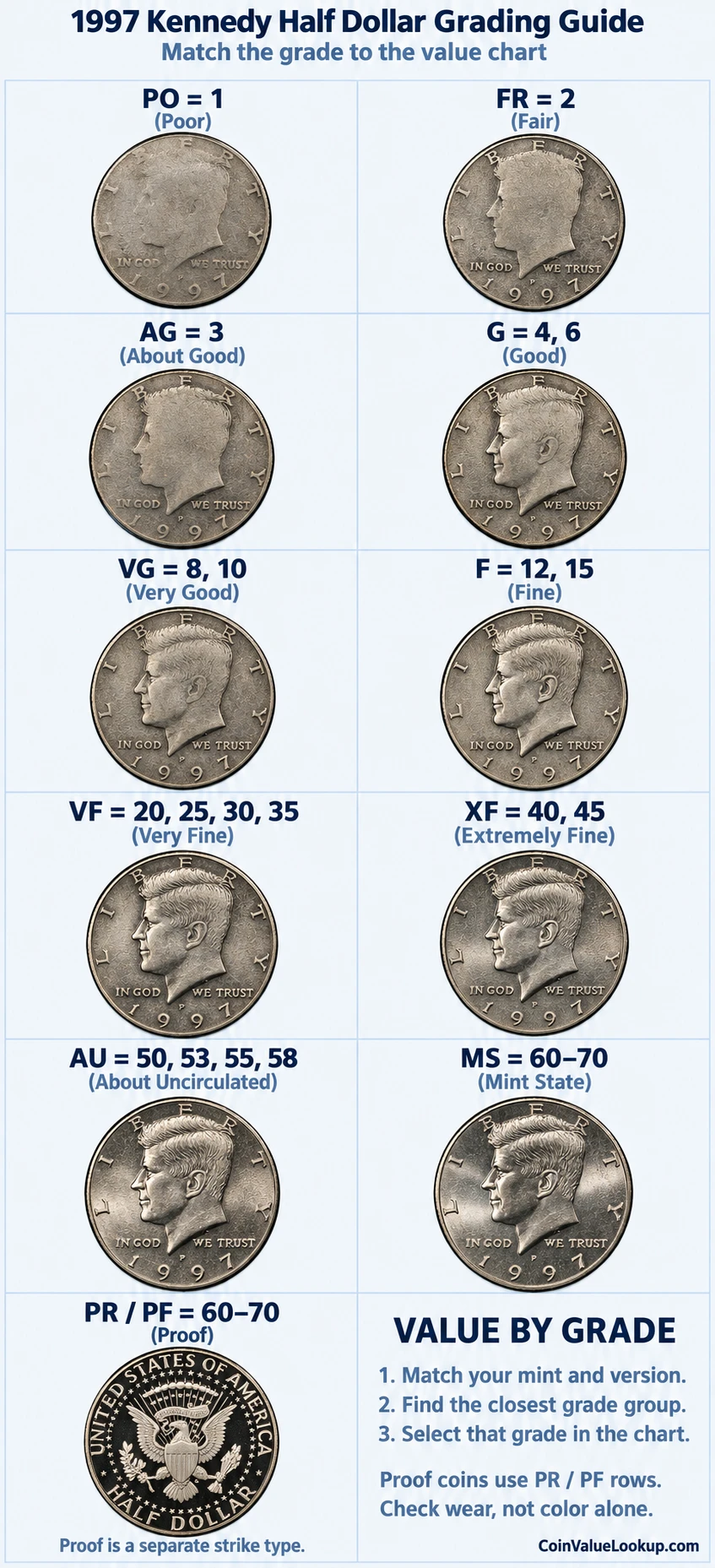
Start with Kennedy's cheek and the hair above his ear. On a well-circulated coin, those areas flatten first, producing smooth spots that are easy to see under angled light.
The eagle's breast feathers and wing tips on the reverse wear next. If both sides still show full, sharp detail with original luster, you are likely looking at a Mint State coin.
Bag marks matter here. A coin can be uncirculated yet covered in tiny contact marks from bouncing around in a mint bag, and those dings lower the grade without being true wear.
Use the comparison image to judge the difference between contact marks and actual friction.
Proofs get graded on a separate scale. Look for hairlines from handling, haze from improper storage, and any contact marks on the mirror fields.
A proof with clean, deep mirrors and frosted devices grades higher than one with visible lines across Kennedy's portrait.
Step 3: Check 1997 Kennedy Half Dollar Value by Mint and Version
1997 Kennedy Half Dollar — P — clad business
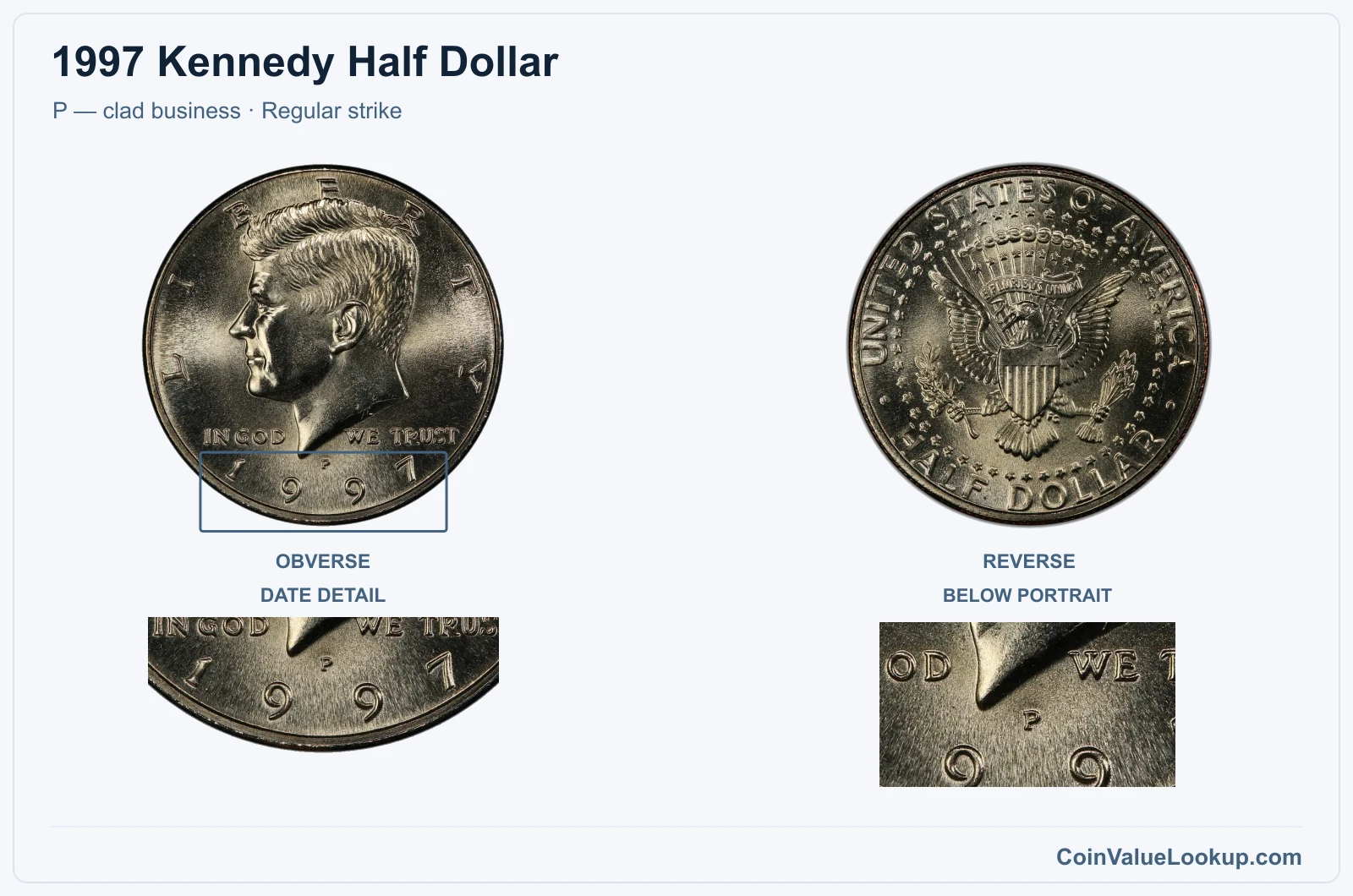
The 1997-P half dollar is a copper-nickel clad business strike from the Philadelphia Mint. You will find a small P mintmark on the obverse beneath Kennedy's portrait.
Most of these entered circulation and picked up wear quickly. A worn example is a face-value coin.
At MS65, USA Coin Book estimates roughly $3.62, so only well-preserved, original-luster pieces hold a collector premium.
If you pulled one from a roll and it still looks sharp with no bag marks, it may be worth setting aside for grading.
Range Grade
Price Auction Records Appraisal PO PO 1
—
Coin Identifier FR FR 2
—
Coin Identifier AG AG 3
—
Coin Identifier G G 4
—
Coin Identifier
G 6
—
Coin Identifier VG VG 8
—
Coin Identifier
VG 10
—
Coin Identifier F F 12
—
Coin Identifier
F 15
—
Coin Identifier VF VF 20
—
Coin Identifier
VF 25
—
Coin Identifier
VF 30
—
Coin Identifier
VF 35
—
Coin Identifier XF XF 40
—
Coin Identifier
XF 45
—
Coin Identifier AU AU 50
—
Coin Identifier
AU 53
—
Coin Identifier
AU 55
—
Coin Identifier
AU 58
—
Coin Identifier MS MS 60
—
Coin Identifier
MS 61
—
Coin Identifier
MS 62
—
Coin Identifier
MS 63
Coin Identifier
MS 64
Coin Identifier
MS 65
—
Coin Identifier
MS 66
—
Coin Identifier
MS 67
Coin Identifier
MS 68
Coin Identifier
MS 69
—
—
—
MS 70
—
—
—
1997 Kennedy Half Dollar — D — clad business
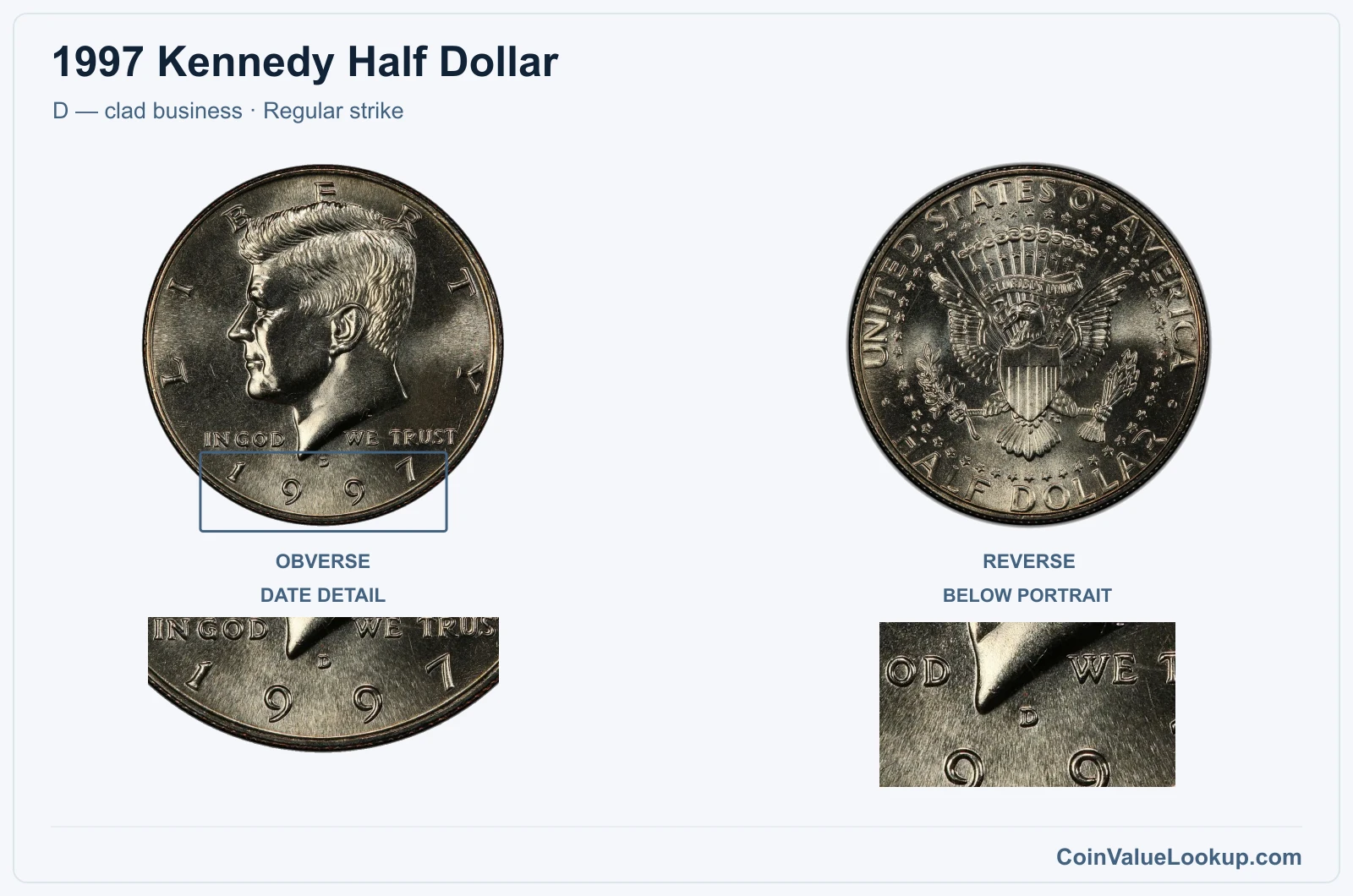
The 1997-D was struck at the Denver Mint and carries a D mintmark in the same location beneath Kennedy's portrait. It is the same copper-nickel clad composition as the Philadelphia issue.
Like its P counterpart, the 1997-D is a face-value coin once circulated. USA Coin Book estimates about $3.62 at MS65.
Finding one in true gem condition is the challenge — look for full luster, minimal bag marks and sharp hair detail above Kennedy's ear.
Coin Value Lookup is a handy place to look up guides for other Kennedy half dollar years and denominations if you are sorting through a collection.
Range Grade
Price Auction Records Appraisal PO PO 1
—
Coin Identifier FR FR 2
—
Coin Identifier AG AG 3
—
Coin Identifier G G 4
—
Coin Identifier
G 6
—
Coin Identifier VG VG 8
—
Coin Identifier
VG 10
—
Coin Identifier F F 12
—
Coin Identifier
F 15
—
Coin Identifier VF VF 20
—
Coin Identifier
VF 25
—
Coin Identifier
VF 30
—
Coin Identifier
VF 35
—
Coin Identifier XF XF 40
—
Coin Identifier
XF 45
—
Coin Identifier AU AU 50
—
Coin Identifier
AU 53
—
Coin Identifier
AU 55
—
Coin Identifier
AU 58
—
Coin Identifier MS MS 60
—
Coin Identifier
MS 61
—
Coin Identifier
MS 62
—
Coin Identifier
MS 63
Coin Identifier
MS 64
Coin Identifier
MS 65
—
Coin Identifier
MS 66
Coin Identifier
MS 67
Coin Identifier
MS 68
Coin Identifier
MS 69
—
—
—
MS 70
—
—
—
1997 Kennedy Half Dollar — S — clad proof
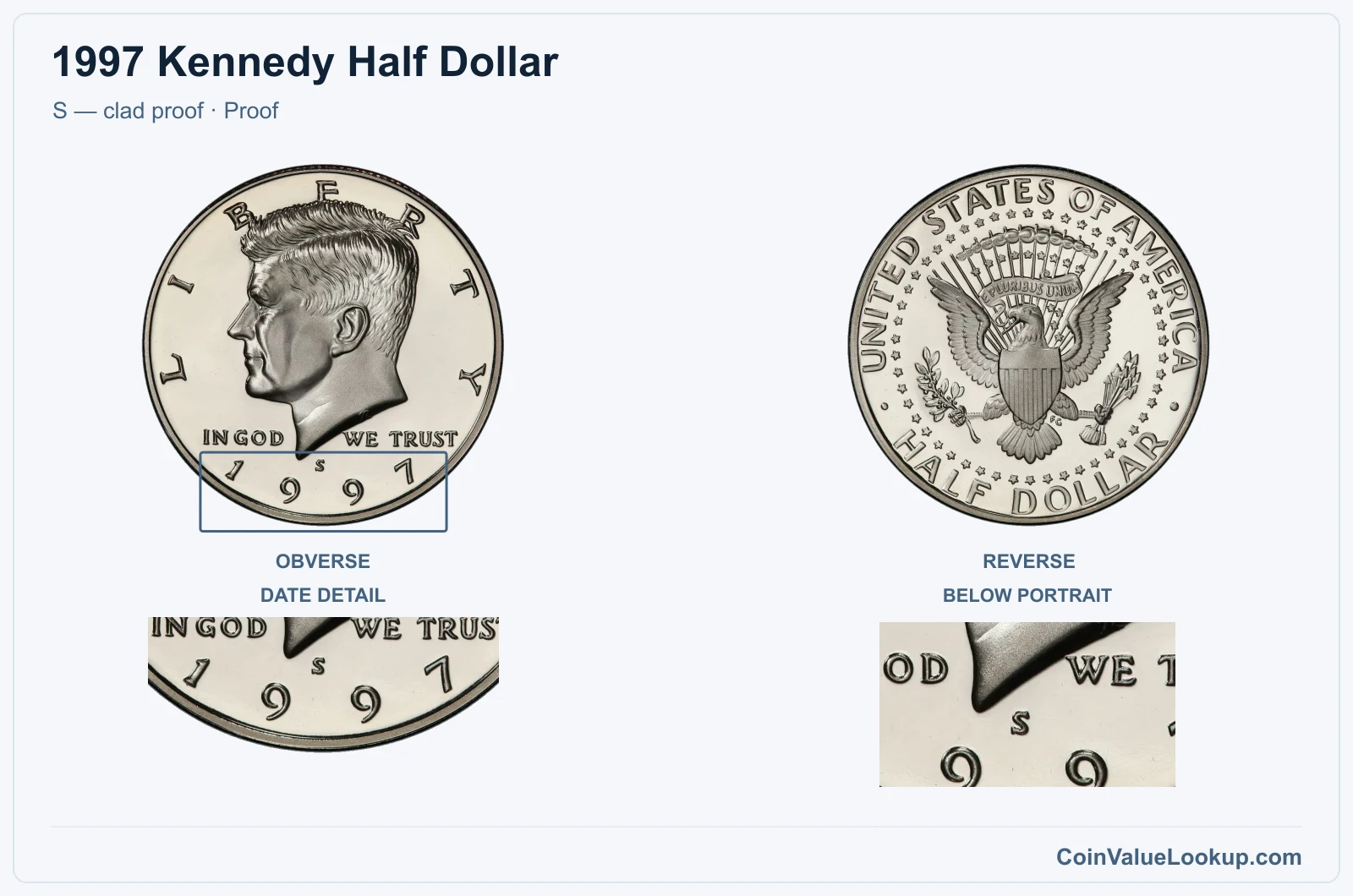
The 1997-S clad proof was produced at San Francisco for collector sets. It is copper-nickel clad, not silver, despite the S mintmark.
Look for mirror-like fields and frosted raised devices — that contrast is the hallmark of a proof finish. The edge will show the same copper-orange stripe as a business strike.
USA Coin Book estimates about $15.00 at PR65. Proof condition drops fast once hairlines and haze appear, so coins kept in their original sealed capsules tend to grade best.
If yours has been removed and handled, inspect Kennedy's cheek area under magnification for fine lines.
Range Grade
Price Auction Records Appraisal PR PR 1
—
Coin Identifier
PR 2
—
Coin Identifier
PR 3
—
Coin Identifier
PR 4
—
Coin Identifier
PR 6
—
Coin Identifier
PR 8
—
Coin Identifier
PR 10
—
Coin Identifier
PR 12
—
Coin Identifier
PR 15
—
Coin Identifier
PR 20
—
Coin Identifier
PR 25
—
Coin Identifier
PR 30
—
Coin Identifier
PR 35
—
Coin Identifier
PR 40
—
Coin Identifier
PR 45
—
Coin Identifier
PR 50
—
Coin Identifier
PR 53
—
Coin Identifier
PR 55
—
Coin Identifier
PR 58
—
Coin Identifier
PR 60
—
Coin Identifier
PR 61
—
Coin Identifier
PR 62
—
Coin Identifier
PR 63
—
Coin Identifier
PR 64
—
Coin Identifier
PR 65
—
Coin Identifier
PR 66
—
Coin Identifier
PR 67
—
Coin Identifier
PR 68
Coin Identifier
PR 69
Coin Identifier
PR 70
Coin Identifier
1997 Kennedy Half Dollar — S — silver proof
This is the one worth paying attention to. The 1997-S silver proof is struck in 90% silver and 10% copper, weighing approximately 12.50 grams — noticeably heavier than the 11.34-gram clad version.
Both S-mint proofs share the same mintmark, so you cannot rely on the letter alone. Check the edge: a silver proof shows a uniform silver-white color with no copper stripe.
Weighing the coin is even more reliable.
USA Coin Book estimates about $55.00 at PR65, making this the most valuable standard-issue branch of the 1997 Kennedy half dollar at that grade. Silver proofs were sold in separate collector packaging, so original government cases are a good provenance indicator.
Handle these by the edges — fingerprints on mirror fields are permanent grade killers.
Range Grade
Price Auction Records Appraisal PR PR 1
—
Coin Identifier
PR 2
—
Coin Identifier
PR 3
—
Coin Identifier
PR 4
—
Coin Identifier
PR 6
—
Coin Identifier
PR 8
—
Coin Identifier
PR 10
—
Coin Identifier
PR 12
—
Coin Identifier
PR 15
—
Coin Identifier
PR 20
—
Coin Identifier
PR 25
—
Coin Identifier
PR 30
—
Coin Identifier
PR 35
—
Coin Identifier
PR 40
—
Coin Identifier
PR 45
—
Coin Identifier
PR 50
—
Coin Identifier
PR 53
—
Coin Identifier
PR 55
—
Coin Identifier
PR 58
—
Coin Identifier
PR 60
—
Coin Identifier
PR 61
—
Coin Identifier
PR 62
—
Coin Identifier
PR 63
—
Coin Identifier
PR 64
—
Coin Identifier
PR 65
—
Coin Identifier
PR 66
—
Coin Identifier
PR 67
—
Coin Identifier
PR 68
Coin Identifier
PR 69
Coin Identifier
PR 70
Coin Identifier
1997 Kennedy Half Dollar Error List
1. 1997 Kennedy Half Dollar — Broadstrike
A broadstrike happens when the collar die that normally restrains the blank is absent or misaligned during striking. The coin receives a full impression but the metal spreads outward, producing a slightly larger diameter and a missing or distorted rim.
This error has been reported on 1997-P Kennedy half dollars. Look at the edge: a broadstruck coin will lack the normal raised rim and may appear wider than a standard half dollar.
The design remains centered, which separates it from an off-center strike.
Do not confuse a broadstrike with a coin that has been flattened or damaged after leaving the mint. Post-mint damage tends to distort the design unevenly.
Value depends on the degree of spread, overall condition and visual impact.
2. 1997 Kennedy Half Dollar — Double / Multiple Strike
A double-struck or multiple-struck error occurs when a coin receives two or more impressions from the dies. The result is overlapping or displaced design elements — sometimes dramatically rotated — that look nothing like normal doubling on a single strike.
This error has been reported on 1997-P half dollars, sometimes in combination with a broadstrike. Look for two distinct, separated impressions of Kennedy's portrait or the reverse eagle.
Do not confuse this with a doubled die, which shows consistent doubling across many coins from the same die. A double strike is unique to one coin.
Machine doubling — flat, shelf-like displacement of letters — is also a different phenomenon and carries far less collector interest. Condition and the visual drama of the second strike affect value.
3. 1997 Kennedy Half Dollar — Off-Center Strike
An off-center strike results when the blank is not properly seated between the dies. Part of the design is missing entirely, replaced by a blank crescent of unstruck metal.
This error has been reported for 1997 Kennedy half dollars. The key detail collectors look for is whether the date remains visible; a readable date on an off-center coin is generally more desirable than one where the date has been struck off the edge.
Do not mistake a clipped planchet or one-sided misalignment for an off-center strike. Post-mint flattening can also push metal to one side, but it distorts rather than cleanly displaces the design.
Value depends on the percentage off-center and the coin's overall condition.
4. 1997 Kennedy Half Dollar — Struck-Through Error
A struck-through error occurs when foreign material — grease, wire, cloth, another planchet fragment — sits between the die and the blank during striking. The result is a localized depression or incomplete area in the design where the obstruction blocked the die's impression.
This error has been reported for 1997 Kennedy half dollars. When examining a suspect coin, look for a smooth, recessed area that interrupts the normal design without sharp edges or scratches.
Grease-filled dies produce soft, mushy detail, while a retained foreign object can leave a distinct shape. Do not confuse struck-through errors with ordinary wear, cleaning damage or weak strikes from worn dies.
The depression should match the coin's surface level and show no tool marks. Condition and the size of the affected area influence collector interest.
5. 1997 Kennedy Half Dollar — Missing Clad Layer
A missing clad layer error means one of the outer copper-nickel layers was absent from the blank before striking. The exposed side may show a copper-colored surface instead of the normal silver tone, and the coin will weigh noticeably less than the standard 11.34 grams.
This error has been reported for 1997 Kennedy half dollars. Compare the affected face and the edge with a normal clad coin side by side.
On a genuine missing-clad error, the design on the exposed side often appears slightly weaker because the thinner blank did not fill the die completely.
Toning, environmental damage, corrosion and deliberate plating removal can all mimic this error's appearance. Weighing the coin is the most straightforward test.
Value depends on condition and how dramatically the missing layer affects the coin's appearance.
6. 1997 Kennedy Half Dollar — Clipped Planchet
A clipped planchet error means the blank was punched from strip metal that overlapped a previously punched hole or the edge of the strip. The result is a missing curved, straight or irregular section of the coin.
This error has been reported for 1997 Kennedy half dollars. Look for a characteristic weakness in the design opposite the clip — the so-called Blakesley effect — caused by uneven metal flow during striking.
The missing area should have a natural, unstruck edge texture rather than a sharp cut.
Filed edges, deliberate cuts and corrosion can all remove metal from a coin after minting. These post-mint alterations lack the metal-flow signatures and opposite-side weakness that accompany a genuine clip.
Value depends on the clip's size and the coin's overall condition.
7. 1997 Kennedy Half Dollar — Die Crack / Die Chip
A die crack appears as a raised line on the coin's surface, formed when a fracture in the steel die transfers its shape during striking. A die chip is a small raised blob from a piece of the die breaking away.
Both are common on high-volume issues like the Kennedy half dollar.
This error has been reported for 1997 half dollars. Look for raised lines that often run from the rim inward across the design.
A larger break at the rim that produces a flat, featureless blob is called a cud.
Do not confuse die cracks with incuse scratches, which are pressed into the surface rather than raised above it. Corrosion lines and foreign material on the surface can also mimic a crack.
Most minor die cracks add modest collector interest, but dramatic examples — especially large cuds — can carry a meaningful premium depending on condition.