1997 Washington Quarter Coin Value: How Much Is It Worth?
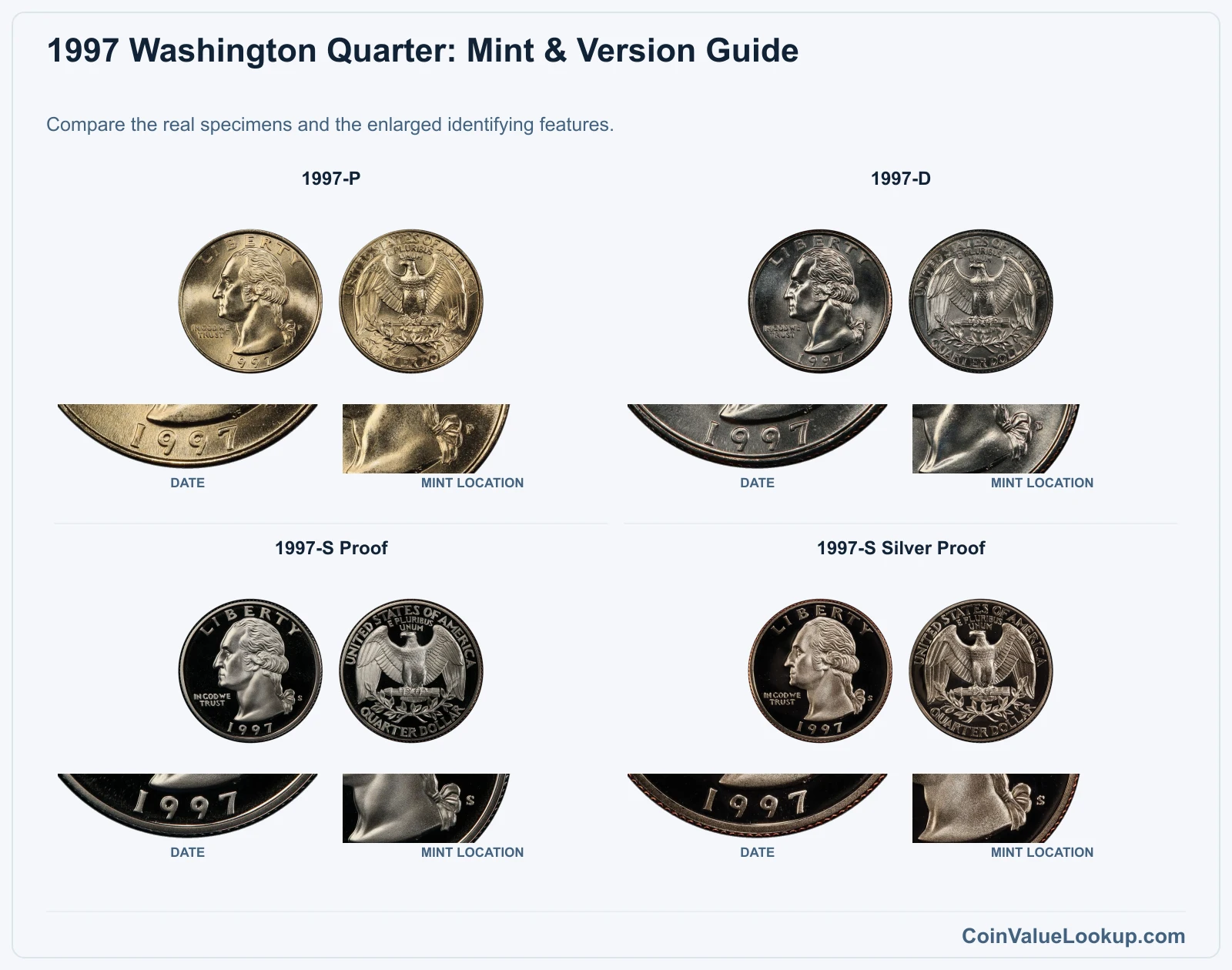
Most 1997 Washington quarters are worth face value — 25 cents. These are common clad coins that saw heavy circulation, and worn examples carry no premium.
In higher uncirculated grades the picture improves a bit: a USA Coin Book guide estimate places an MS65 1997-D at around $15 and an MS65 1997-P at about $14. The 1997-S silver proof, struck in 90% silver, carries a PR65 guide estimate near $21.
This was the penultimate year for the original eagle reverse design, with 1998 being the final year before the State Quarter program launched.
Fast Way to Identify Your 1997 Washington Quarter
Want a quick read on what you have? Upload clear photos of the front and back of your 1997 quarter.
That lets us provide a preliminary identification of your coin's mint, version and general condition. A well-lit, in-focus image of each side is all you need to get started.
1997 Washington Quarter Value
Upload both sides of your 1997 Washington Quarter.
Front Obverse
Upload photo
Back Reverse
Upload photo
Which 1997 Washington Quarter Versions Are Worth Money?
- 1997-S Silver Proof in PR65 carries a guide estimate around $21, the highest regular-issue value for this date.
- 1997-D in MS65 condition has a guide estimate near $15, above the 1997-P at the same grade.
- 1997-P quarters struck on a nickel planchet or foreign planchet are certified mint errors that require individual assessment.
- A 1997-D off-center strike with triple clip is a dramatic certified error combination worth investigating.
- Doubled die obverse and reverse varieties have been reported for 1997 quarters and can carry premiums depending on visibility and condition.
Step 1: Identify Your 1997 Washington Quarter Mint Mark and Version
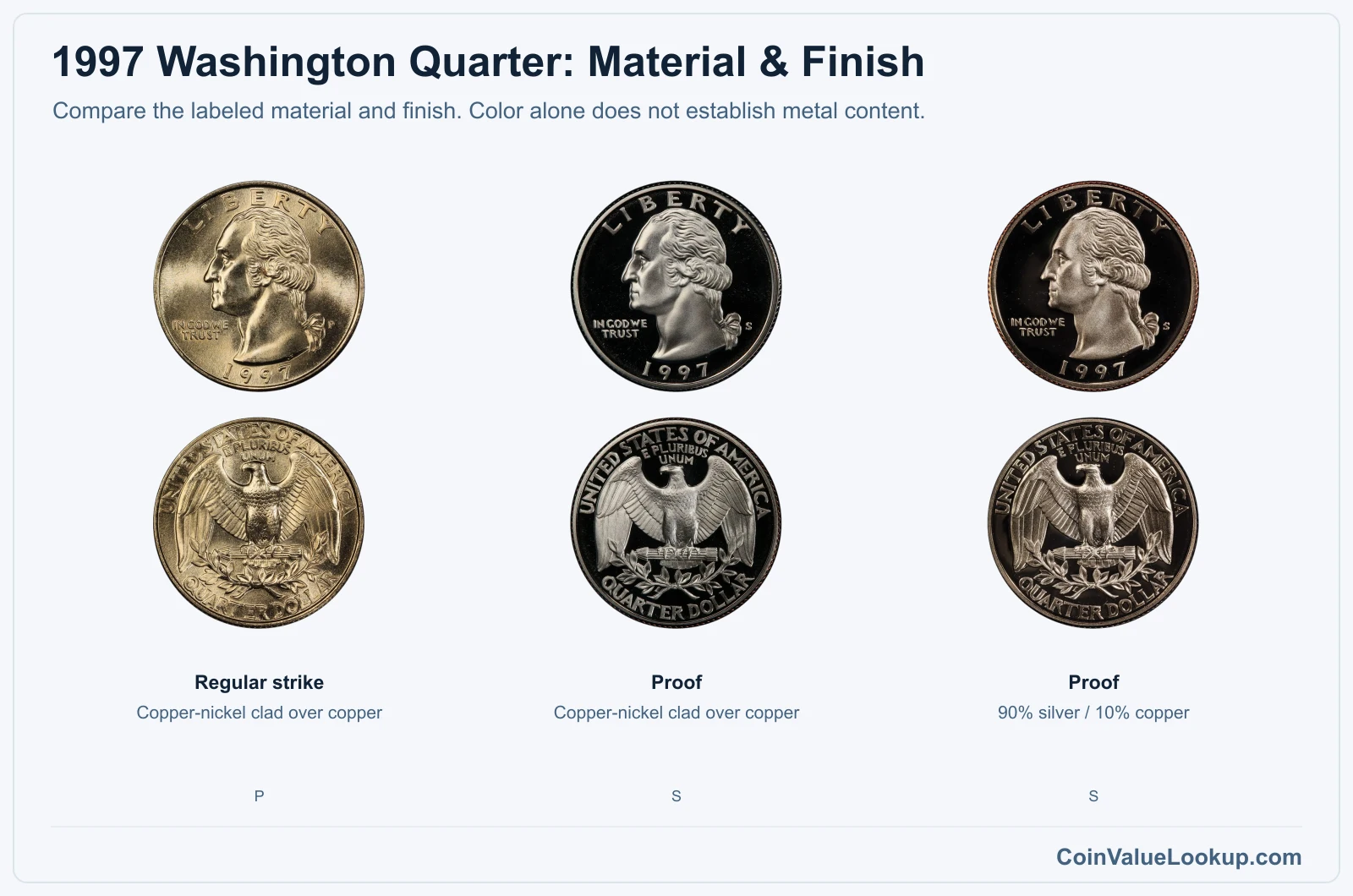
Every 1997 quarter carries a mintmark to the right of Washington's ribbon, near the date. A "P" means Philadelphia, "D" means Denver, and "S" means San Francisco.
There is no blank-mintmark variety for this date; all Philadelphia coins show the P.
Business strikes from P and D are copper-nickel clad, weighing about 5.67 grams with a diameter of roughly 24.3 mm. San Francisco produced two different proofs: a clad version using the same copper-nickel composition, and a 90% silver version weighing approximately 6.25 grams.
Both S proofs look similar from the front.
To separate the two S proofs, check the edge. A clad coin shows a visible copper-colored stripe along the rim.
A silver proof does not. Weight is another reliable separator — the silver piece is noticeably heavier.
Original government packaging also helps confirm which metal you have. The S mintmark alone does not tell you whether your proof is clad or silver.
Step 2: Check Your 1997 Washington Quarter Grade
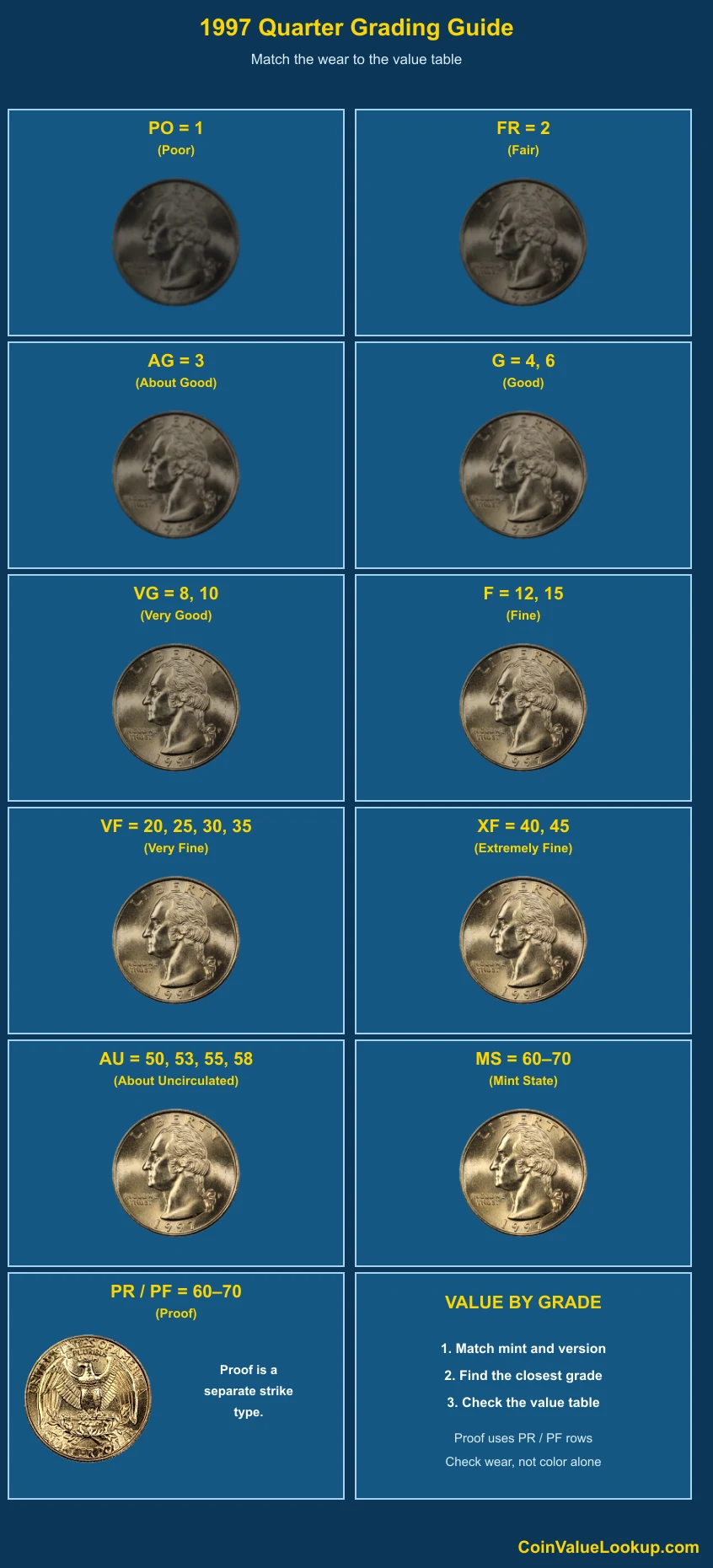
The first places wear shows on a 1997 quarter are the hair strands above Washington's ear, the high point of the cheekbone and jawline, and the eagle's breast feathers on the reverse. Compare your coin with the reference image to see how these areas look at different grade levels.
An uncirculated coin retains full original luster across both sides with no rub on those high points. Don't confuse brightness with condition — a cleaned coin can look shiny but still show hairlines and lost detail that hurt its grade.
For proofs, look at the mirrored fields for hairlines and contact marks. Deep cameo contrast (DCAM) is a separate designation describing the frosted-versus-mirrored appearance; it is not a grade and does not indicate silver content.
Step 3: Check 1997 Washington Quarter Value by Mint and Version
1997 Washington Quarter — P
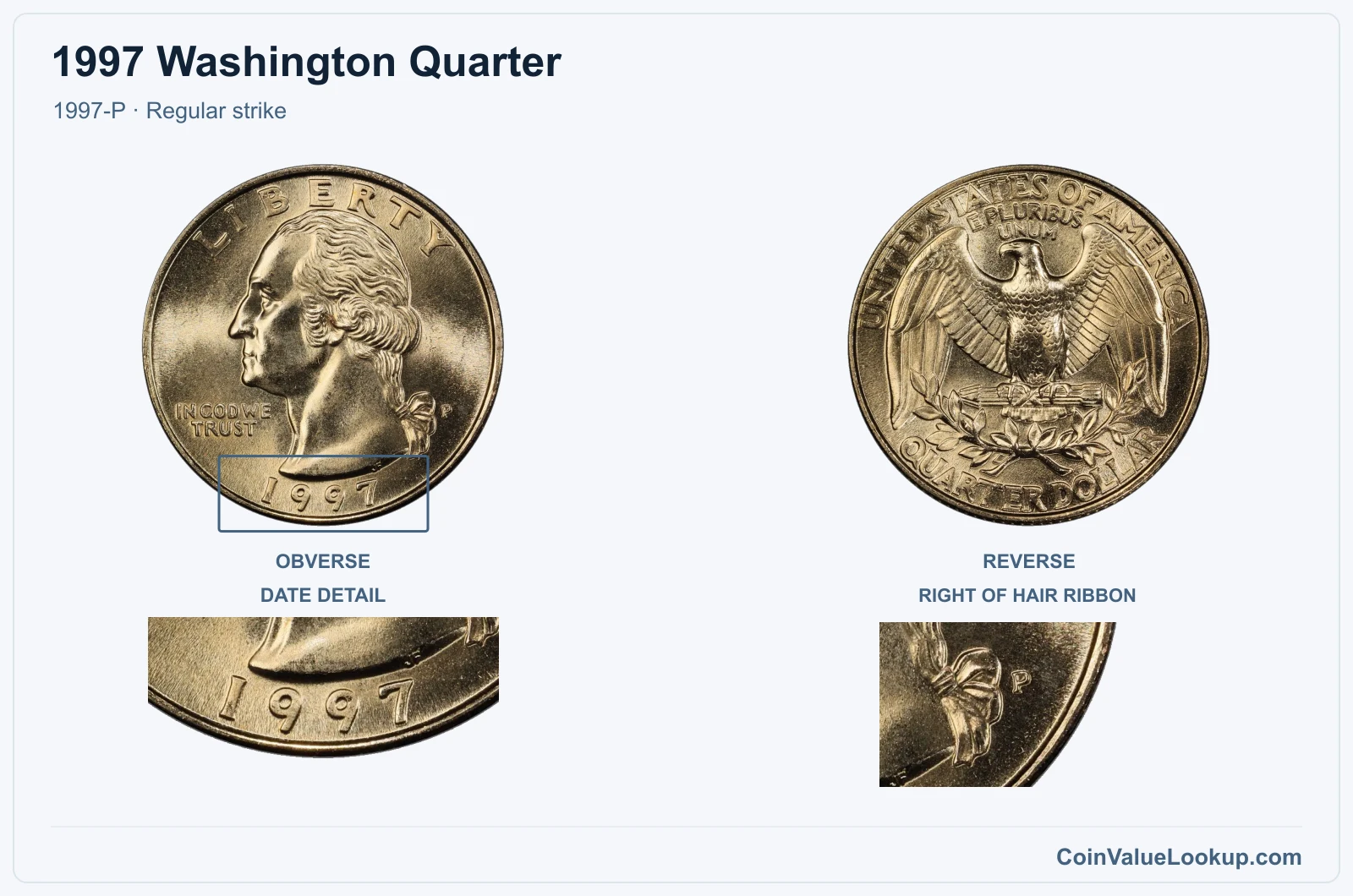
The 1997-P is a copper-nickel clad business strike from the Philadelphia Mint. It carries a small P mintmark to the right of Washington's ponytail ribbon.
The reverse features the familiar heraldic eagle clutching arrows and olive branches — the design that had been running since 1932 and would last just one more year after this.
A USA Coin Book guide estimate puts the 1997-P at about $14 in MS65 condition. In circulated grades these trade at face value.
Look for original luster and minimal bag marks if you think yours might qualify as uncirculated.
| Range | Grade | Price | Auction Records | Appraisal |
|---|---|---|---|---|
| PO | PO 1 | — | Coin Identifier | |
| FR | FR 2 | — | Coin Identifier | |
| AG | AG 3 | — | Coin Identifier | |
| G | G 4 | — | Coin Identifier | |
| G 6 | — | Coin Identifier | ||
| VG | VG 8 | — | Coin Identifier | |
| VG 10 | — | Coin Identifier | ||
| F | F 12 | — | Coin Identifier | |
| F 15 | — | Coin Identifier | ||
| VF | VF 20 | — | Coin Identifier | |
| VF 25 | — | Coin Identifier | ||
| VF 30 | — | Coin Identifier | ||
| VF 35 | — | Coin Identifier | ||
| XF | XF 40 | — | Coin Identifier | |
| XF 45 | — | Coin Identifier | ||
| AU | AU 50 | — | Coin Identifier | |
| AU 53 | — | Coin Identifier | ||
| AU 55 | — | Coin Identifier | ||
| AU 58 | — | Coin Identifier | ||
| MS | MS 60 | — | Coin Identifier | |
| MS 61 | — | Coin Identifier | ||
| MS 62 | — | Coin Identifier | ||
| MS 63 | — | Coin Identifier | ||
| MS 64 | — | Coin Identifier | ||
| MS 65 | — | Coin Identifier | ||
| MS 66 | Coin Identifier | |||
| MS 67 | Coin Identifier | |||
| MS 68 | — | Coin Identifier | ||
| MS 69 | — | — | — | |
| MS 70 | — | — | — |
1997 Washington Quarter — D
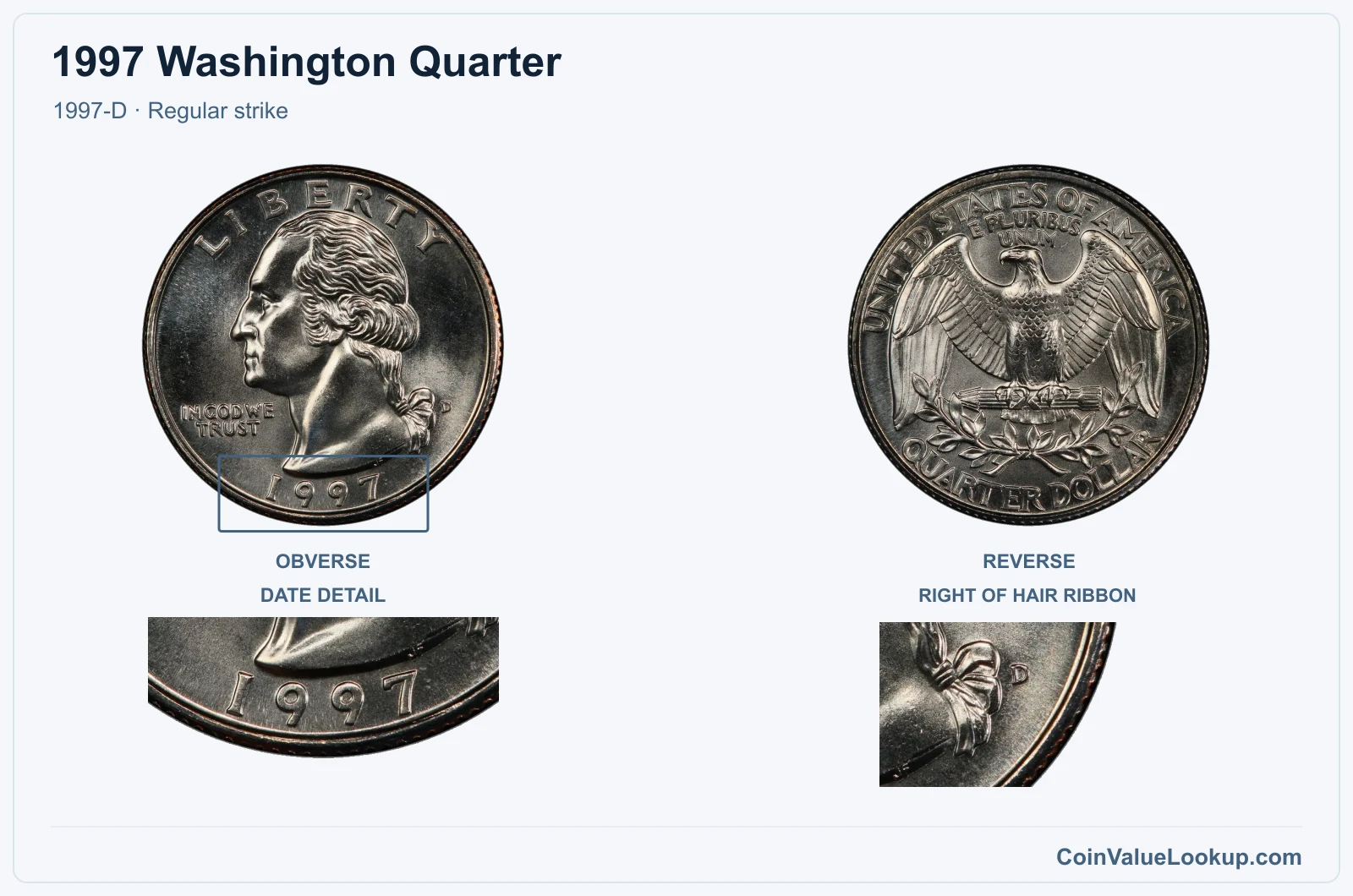
Denver's 1997-D quarter is the same copper-nickel clad composition as the P, weighing about 5.67 grams. The D mintmark sits in the same location beside the ribbon.
In MS65 condition, a USA Coin Book guide estimate is approximately $15, slightly above the Philadelphia issue at the same grade.
Coin Value Lookup is a useful starting point when you want to look up guide values for quarters and other denominations across different years. Circulated 1997-D quarters are worth 25 cents.
The jump in value only kicks in at higher uncirculated grades where original surfaces are intact.
| Range | Grade | Price | Auction Records | Appraisal |
|---|---|---|---|---|
| PO | PO 1 | — | Coin Identifier | |
| FR | FR 2 | — | Coin Identifier | |
| AG | AG 3 | — | Coin Identifier | |
| G | G 4 | — | Coin Identifier | |
| G 6 | — | Coin Identifier | ||
| VG | VG 8 | — | Coin Identifier | |
| VG 10 | — | Coin Identifier | ||
| F | F 12 | — | Coin Identifier | |
| F 15 | — | Coin Identifier | ||
| VF | VF 20 | — | Coin Identifier | |
| VF 25 | — | Coin Identifier | ||
| VF 30 | — | Coin Identifier | ||
| VF 35 | — | Coin Identifier | ||
| XF | XF 40 | — | Coin Identifier | |
| XF 45 | — | Coin Identifier | ||
| AU | AU 50 | — | Coin Identifier | |
| AU 53 | — | Coin Identifier | ||
| AU 55 | — | Coin Identifier | ||
| AU 58 | — | Coin Identifier | ||
| MS | MS 60 | — | Coin Identifier | |
| MS 61 | — | Coin Identifier | ||
| MS 62 | — | Coin Identifier | ||
| MS 63 | — | Coin Identifier | ||
| MS 64 | — | Coin Identifier | ||
| MS 65 | — | Coin Identifier | ||
| MS 66 | Coin Identifier | |||
| MS 67 | Coin Identifier | |||
| MS 68 | Coin Identifier | |||
| MS 69 | — | — | — | |
| MS 70 | — | — | — |
1997 Washington Quarter — S Proof
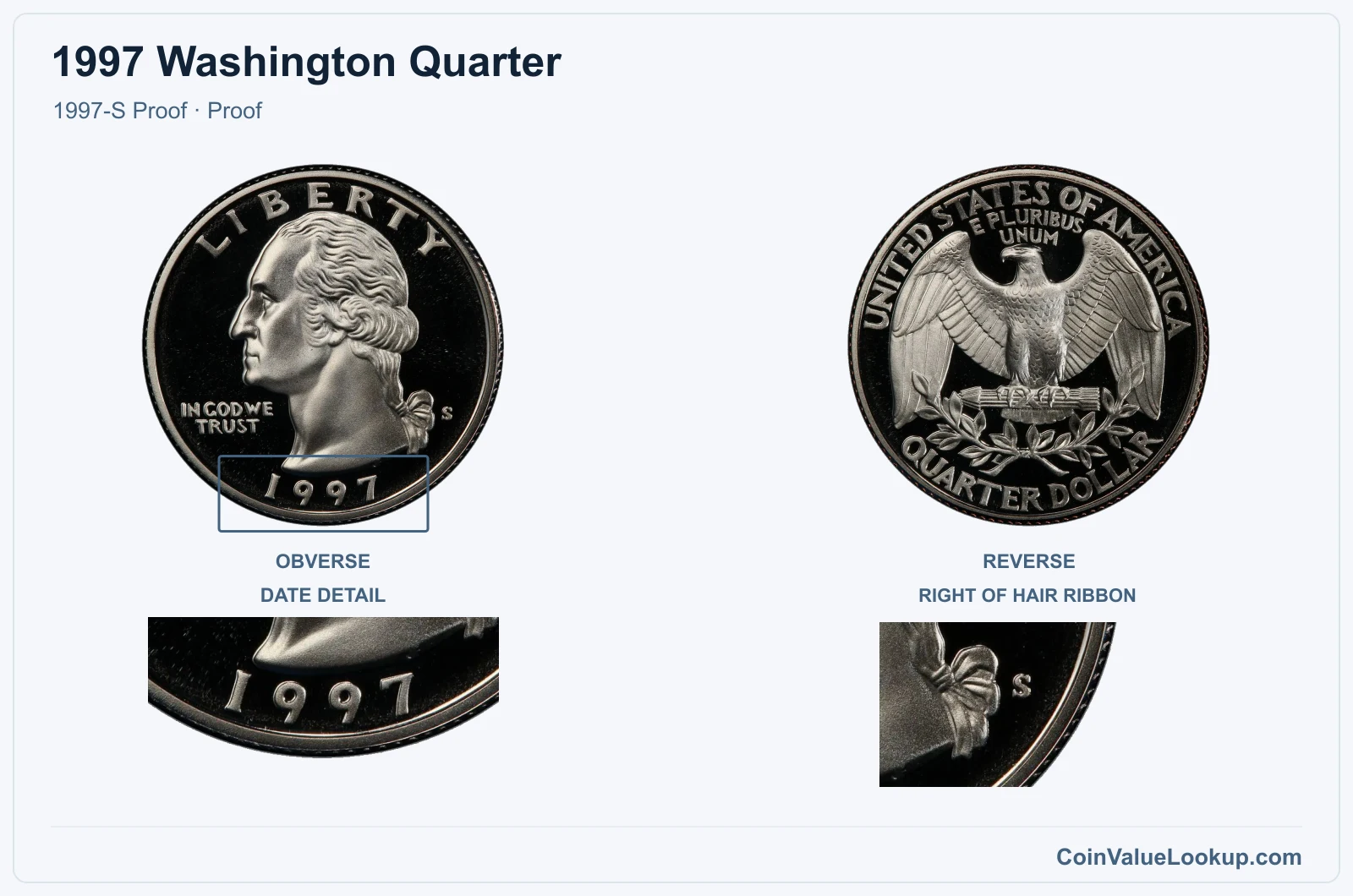
The 1997-S clad proof was struck at San Francisco on the same copper-nickel planchet used for business strikes, but with polished dies and multiple strikes for sharper detail. It carries the S mintmark.
A USA Coin Book guide estimate places this coin at about $6.25 in PR65.
This is not a silver coin. Check the edge for a copper-colored stripe to confirm clad composition.
These proofs were sold in standard government proof sets and are common in high grades. The generic PR65 guide figure does not reflect deep cameo contrast examples, which are a separate market.
| Range | Grade | Price | Auction Records | Appraisal |
|---|---|---|---|---|
| PR | PR 1 | — | Coin Identifier | |
| PR 2 | — | Coin Identifier | ||
| PR 3 | — | Coin Identifier | ||
| PR 4 | — | Coin Identifier | ||
| PR 6 | — | Coin Identifier | ||
| PR 8 | — | Coin Identifier | ||
| PR 10 | — | Coin Identifier | ||
| PR 12 | — | Coin Identifier | ||
| PR 15 | — | Coin Identifier | ||
| PR 20 | — | Coin Identifier | ||
| PR 25 | — | Coin Identifier | ||
| PR 30 | — | Coin Identifier | ||
| PR 35 | — | Coin Identifier | ||
| PR 40 | — | Coin Identifier | ||
| PR 45 | — | Coin Identifier | ||
| PR 50 | — | Coin Identifier | ||
| PR 53 | — | Coin Identifier | ||
| PR 55 | — | Coin Identifier | ||
| PR 58 | — | Coin Identifier | ||
| PR 60 | — | Coin Identifier | ||
| PR 61 | — | Coin Identifier | ||
| PR 62 | — | Coin Identifier | ||
| PR 63 | — | Coin Identifier | ||
| PR 64 | — | Coin Identifier | ||
| PR 65 | — | Coin Identifier | ||
| PR 66 | — | Coin Identifier | ||
| PR 67 | Coin Identifier | |||
| PR 68 | — | Coin Identifier | ||
| PR 69 | Coin Identifier | |||
| PR 70 | Coin Identifier |
1997 Washington Quarter — S Silver Proof
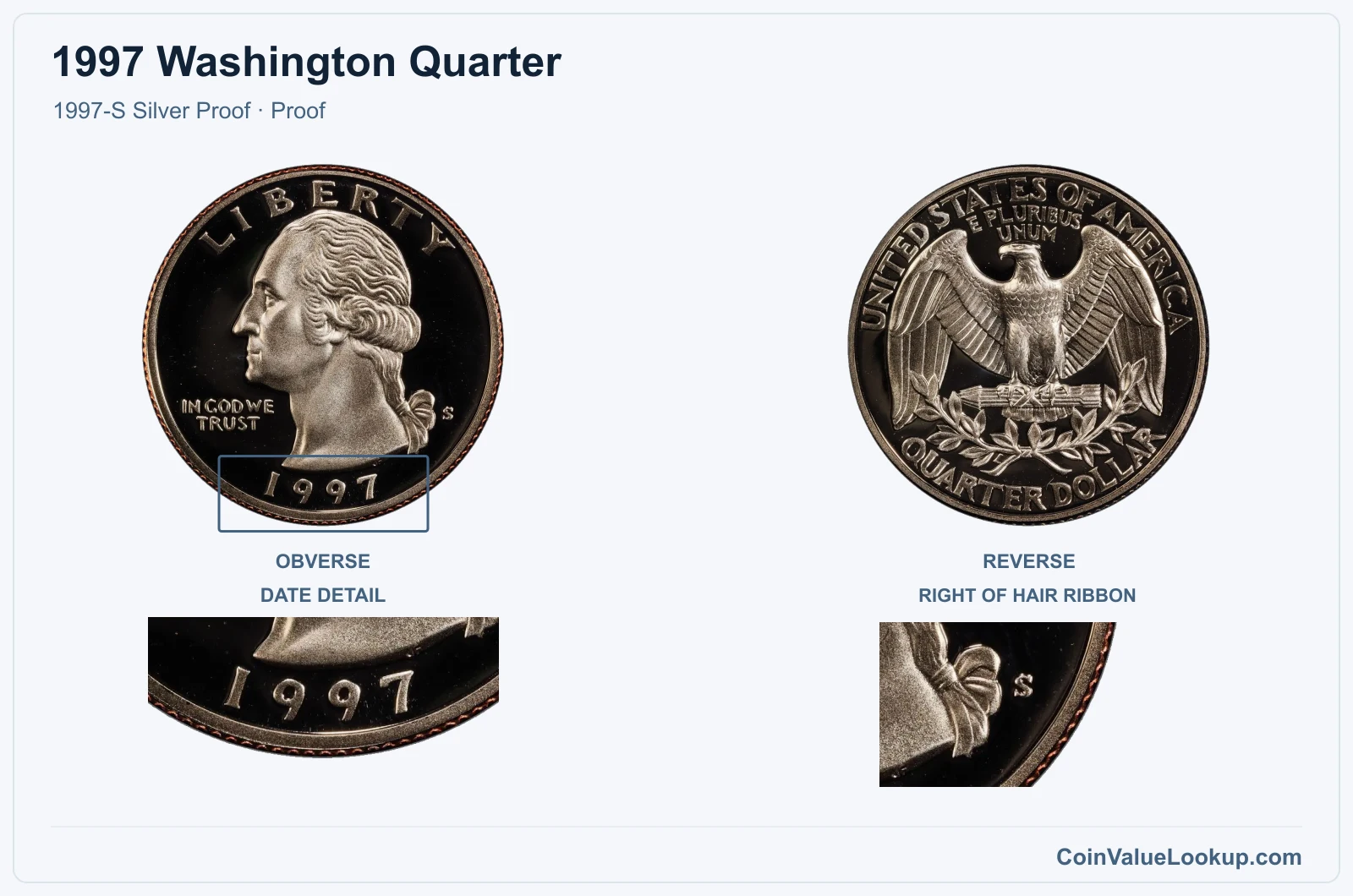
The 1997-S silver proof is struck on a 90% silver, 10% copper planchet weighing approximately 6.25 grams — PCGS rounds the catalog weight to 6.30 grams. It shares the S mintmark and proof finish with the clad version, so visual inspection alone is not enough to confirm the metal.
A silver proof has no copper stripe on the edge and feels heavier in hand.
A USA Coin Book guide estimate for PR65 is about $21, making this the highest regular-issue value among 1997 quarters at that grade level. Keep in mind this estimate is sensitive to the silver market.
The PR65 figure is a general proof grade estimate and does not represent a deep cameo quote. These were sold in Silver Proof Sets and are most reliably identified by their original government packaging or third-party authentication.
| Range | Grade | Price | Auction Records | Appraisal |
|---|---|---|---|---|
| PR | PR 1 | — | Coin Identifier | |
| PR 2 | — | Coin Identifier | ||
| PR 3 | — | Coin Identifier | ||
| PR 4 | — | Coin Identifier | ||
| PR 6 | — | Coin Identifier | ||
| PR 8 | — | Coin Identifier | ||
| PR 10 | — | Coin Identifier | ||
| PR 12 | — | Coin Identifier | ||
| PR 15 | — | Coin Identifier | ||
| PR 20 | — | Coin Identifier | ||
| PR 25 | — | Coin Identifier | ||
| PR 30 | — | Coin Identifier | ||
| PR 35 | — | Coin Identifier | ||
| PR 40 | — | Coin Identifier | ||
| PR 45 | — | Coin Identifier | ||
| PR 50 | — | Coin Identifier | ||
| PR 53 | — | Coin Identifier | ||
| PR 55 | — | Coin Identifier | ||
| PR 58 | — | Coin Identifier | ||
| PR 60 | — | Coin Identifier | ||
| PR 61 | — | Coin Identifier | ||
| PR 62 | — | Coin Identifier | ||
| PR 63 | — | Coin Identifier | ||
| PR 64 | — | Coin Identifier | ||
| PR 65 | — | Coin Identifier | ||
| PR 66 | — | Coin Identifier | ||
| PR 67 | — | Coin Identifier | ||
| PR 68 | — | Coin Identifier | ||
| PR 69 | Coin Identifier | |||
| PR 70 | Coin Identifier |
1997 Washington Quarter Error List
1. 1997 Washington Quarter — Struck on a Nickel Planchet
A 1997-P quarter struck on a five-cent nickel planchet is a genuine Mint error where a smaller, wrong-denomination blank ended up under the quarter dies. The result is a coin showing Washington quarter designs on a noticeably undersized disc.
You will see incomplete design at the edges because the planchet was too small to receive the full impression.
Heritage Auctions listed an ANACS AU58 example of this error. The AU58 grade means slight wear on the highest points — do not confuse that light rub with the design distortion caused by the wrong planchet.
Authentic examples show genuine struck surfaces and proper metal flow at the rims consistent with being struck, not trimmed after the fact.
Post-mint filing, cutting or chemical alteration can make a quarter look undersized. A legitimate wrong-planchet error needs authentication.
No specific price range is adopted; value depends on condition, error severity and individual assessment.
2. 1997 Washington Quarter — Off-Center Strike with Triple Clip
A certified 1997-D quarter exists with an off-center strike combined with three pre-strike clips — a dramatic compound error. The off-center strike leaves part of the planchet blank where the dies did not reach, and the three curved missing segments show where metal was absent from the blank before it was struck.
ANACS graded this specimen MS63. The combination of errors on one coin makes it unusual, but each piece is unique in severity and appearance.
Do not assign a made-up offset percentage or try to price the clips separately.
Look for consistent metal flow and struck surfaces to separate this from post-mint damage. Filing, cutting or hammering after striking can mimic missing metal but will not show the same strike characteristics.
Authentication is essential for a compound error like this. No adopted price range exists; value requires individual assessment based on the specific coin's condition and error characteristics.
3. 1997 Washington Quarter — Attributed Foreign-Planchet Strike
NGC attributed a 1997-P quarter struck on a foreign planchet, grading it MS64. The coin weighs 4.66 grams — well below the normal 5.67-gram clad quarter weight.
It shows strong central design with weakened borders, which is typical when a wrong-size or wrong-thickness blank receives a strike from quarter dies.
The specific country and denomination of the blank are not confirmed by the source, so the foreign origin rests on the attribution rather than an identified alloy or visual color match. This appeared in a May 2004 Heritage Auctions lot.
Underweight ordinary coins, chemically damaged quarters and plated pieces can sometimes be mistaken for foreign-planchet errors. Proper attribution requires professional authentication — edge characteristics, exact weight and strike properties all factor in.
No price range is adopted for this error; each example requires individual assessment based on its authenticated identity and condition.
4. 1997 Washington Quarter — Doubled Die Obverse
Doubled die obverse varieties have been reported for the 1997 quarter. On a genuine doubled die, you will see consistent separation or notching on obverse lettering or design elements when viewed under magnification and good lighting.
The doubling appears in the same location on every example struck from that die.
Compare your coin's obverse letters carefully against a normal 1997 quarter under the same light. True hub doubling shows a clean, consistent secondary image — not a flat shelf or mushy outline.
Machine doubling is the most common lookalike and is far less valuable. It tends to produce a flat, shelf-like distortion rather than the rounded, distinct separation of a genuine doubled die.
Worn die contours and reflected light can also create misleading appearances. Condition, the specific die variety and the visibility of the doubling all affect value; no price range is adopted here.
5. 1997 Washington Quarter — Doubled Die Reverse
Doubled die reverse varieties have also been reported for 1997 quarters. These show consistent doubling on reverse legends or design elements — the eagle, lettering, or other details may display a secondary shifted image visible under magnification.
To check, compare your coin's reverse closely with a known normal example. Genuine hub doubling produces a distinct, repeatable separation in the affected area.
Every coin struck from the same doubled die will show the same markers.
Machine doubling is again the common impostor. It creates a flat, shelf-like spread rather than a cleanly separated secondary image.
Random scratches and contact damage can also mimic doubling at first glance. The value of any doubled die reverse depends on the specific variety, how visible the doubling is, and the coin's overall condition.
No specific price range is adopted.
6. 1997 Washington Quarter — Die Crack / Die Chip
Die cracks and die chips have been reported on 1997 quarters. These appear as raised lines (cracks) or small raised blobs (chips) on the coin's surface, caused by a deteriorating or damaged die.
A crack that extends to the rim and leaves a larger raised area is sometimes called a cud.
To spot one, look for a raised feature that does not belong to the normal design. Interior die chips tend to be small lumps, while die cracks trace thin raised lines across the surface.
A rim-connected cud will show a larger flat or slightly raised area where the die broke away at the edge.
Do not confuse these with incuse scratches, corrosion spots or foreign material stuck to the surface — those are post-mint issues. Value depends on the size, location and visual impact of the crack or chip, as well as overall coin condition.
No specific price range is adopted.
7. 1997 Washington Quarter — Struck-Through Error
Struck-through errors have been reported on 1997 quarters. These occur when foreign material — grease, a thread, a metal fragment or other debris — sits between the die and planchet during striking.
The result is a localized depression, an impression of the obstruction, or an area of incomplete design.
Grease-filled dies tend to produce smooth, shallow missing detail, often in specific letters or design areas. A retained foreign object leaves a more distinct impression or may even remain embedded in the coin.
These are different categories with different collector interest.
Wear, cleaning, scratches and ordinary weak strikes can look similar to a casual observer. A struck-through error will show disrupted design in a contained area while the surrounding metal appears normally struck.
Condition and the size and nature of the obstruction all affect value. No price range is adopted for this category.
8. 1997 Washington Quarter — Missing Clad Layer
Missing clad layer errors have been reported on 1997 quarters. On a normal clad quarter, the outer copper-nickel layer covers both faces.
When one layer is absent before striking, the exposed side may show a different color and the coin will weigh less than the standard 5.67 grams.
To check, compare the affected face, the edge and the weight against a normal quarter. The edge profile of a missing-clad coin will look different from a standard three-layer sandwich.
A scale accurate to at least 0.1 grams is helpful.
Toning, environmental damage, corrosion and deliberate removal of surface metal after minting can all mimic the appearance of a missing clad layer. The key difference is that a genuine error was struck that way at the Mint, and the exposed surface will still show properly struck design detail.
Value depends on which side is affected, the coin's condition and overall visual impact. No price range is adopted.