1996 Washington Quarter Coin Value: How Much Is It Worth?
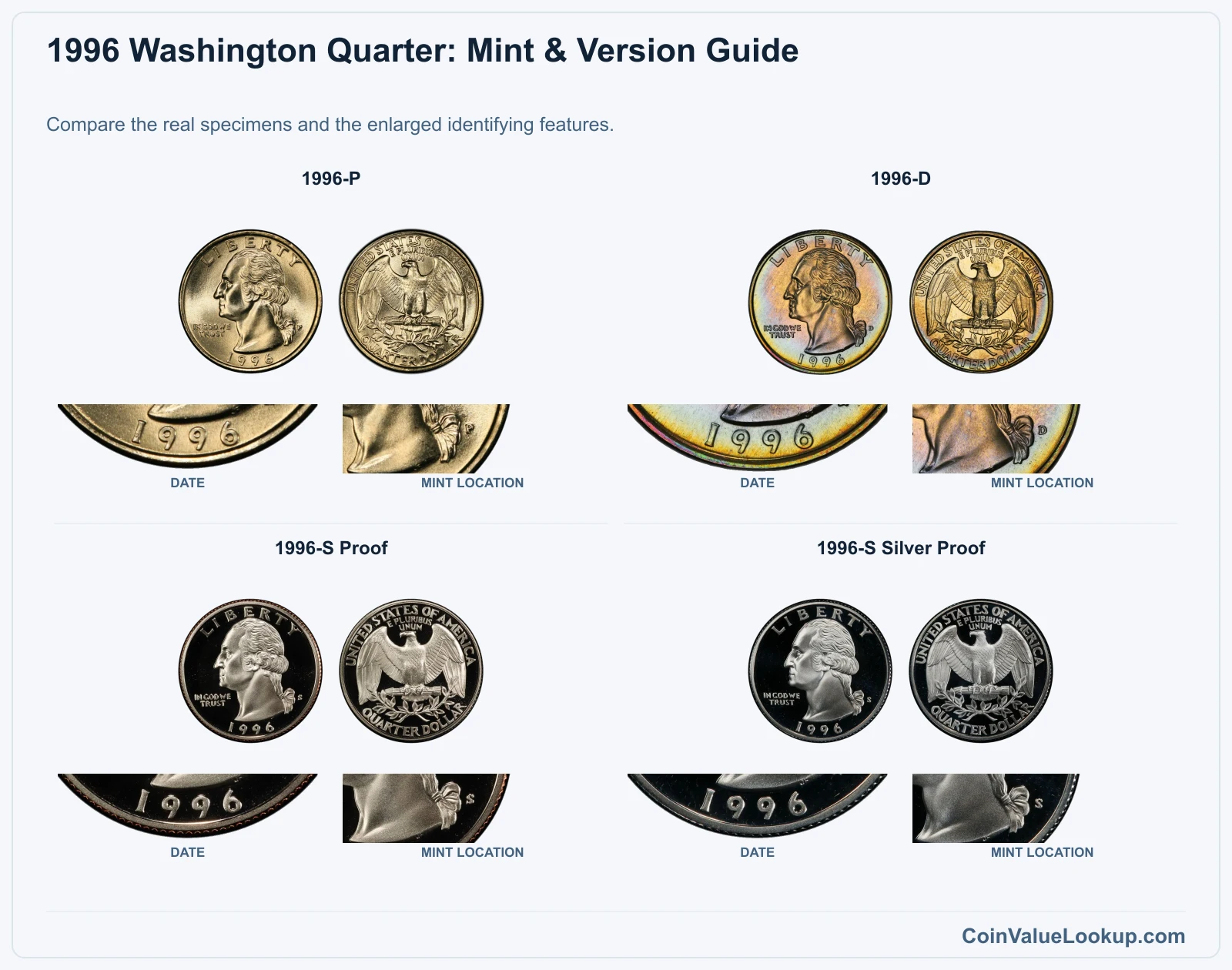
Most 1996 Washington quarters you pull from pocket change are worth face value — 25 cents. Worn clad examples from Philadelphia or Denver just don't carry a premium.
In higher uncirculated grades, though, a USA Coin Book guide estimate puts an MS65 piece around $12. The 1996-S silver proof stands apart, with a PR65 guide estimate near $21.
Errors like wrong-planchet strikes can push values much higher.
Fast Way to Identify Your 1996 Washington Quarter
Want a quick read on what you have? Snap clear photos of the front and back of your 1996 quarter and upload them here.
Our identifier can give you a preliminary identification of the mint, version and general type, helping you figure out which branch your coin belongs to before you dig deeper into values.
1996 Washington Quarter Value
Upload both sides of your 1996 Washington Quarter.
Front Obverse
Upload photo
Back Reverse
Upload photo
Which 1996 Washington Quarter Versions Are Worth Money?
- 1996-D struck on a nickel blank sold for $528 in MS63 at Heritage Auctions — a wrong-planchet error worth checking for if your coin looks undersized and weighs about 5.0 g.
- 1996-D with a large (45%) clipped planchet brought $79 in MS66 at Heritage — look for a major missing section and substantially low weight.
- 1996-S silver proof carries a PR65 guide estimate of $21, well above the clad proof's $6.25 estimate at the same grade.
- High-grade uncirculated 1996-P and 1996-D business strikes reach about $12 at MS65 per guide estimates, worth setting aside from your change finds.
Step 1: Identify Your 1996 Washington Quarter Mint Mark and Version
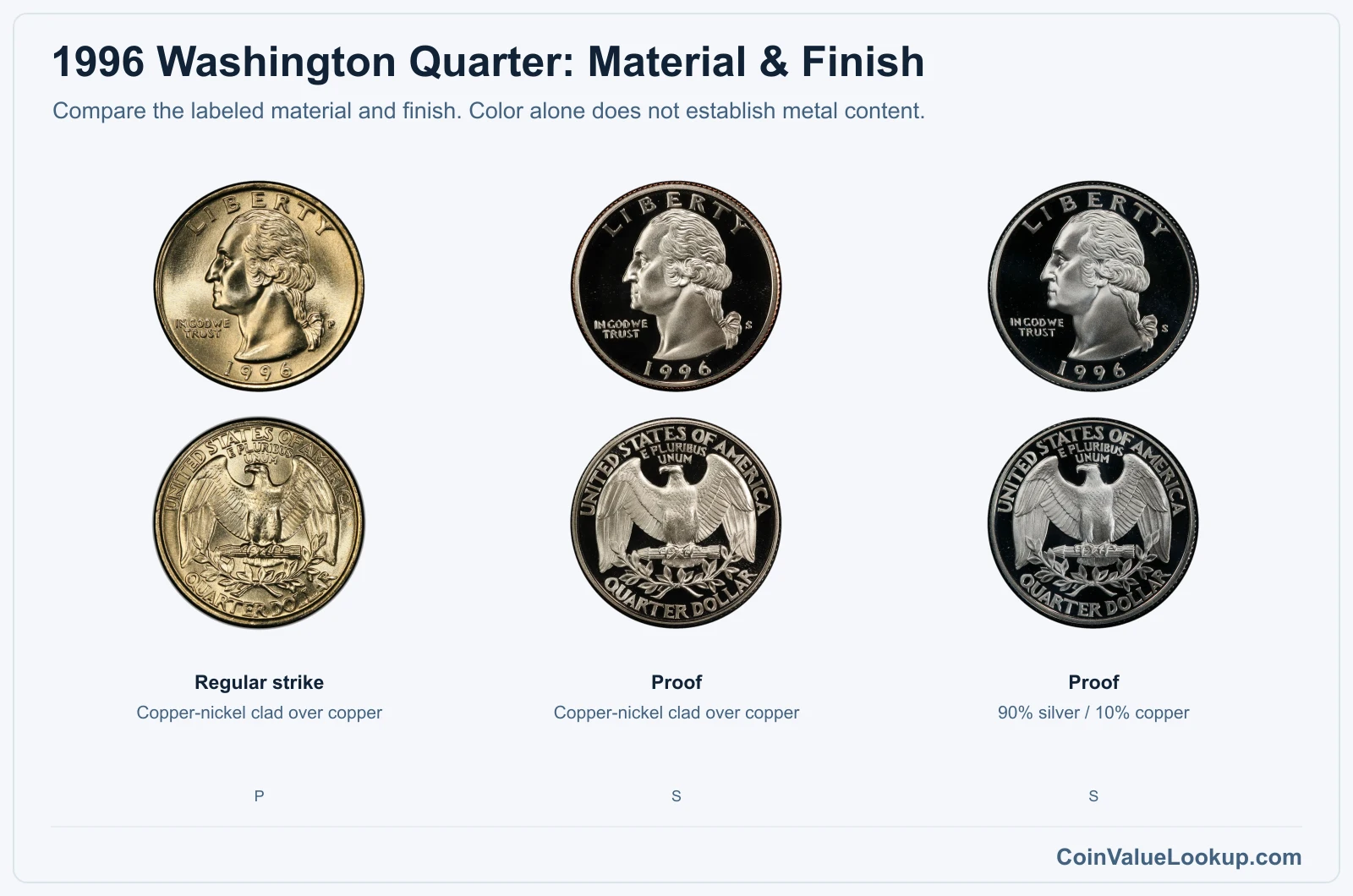
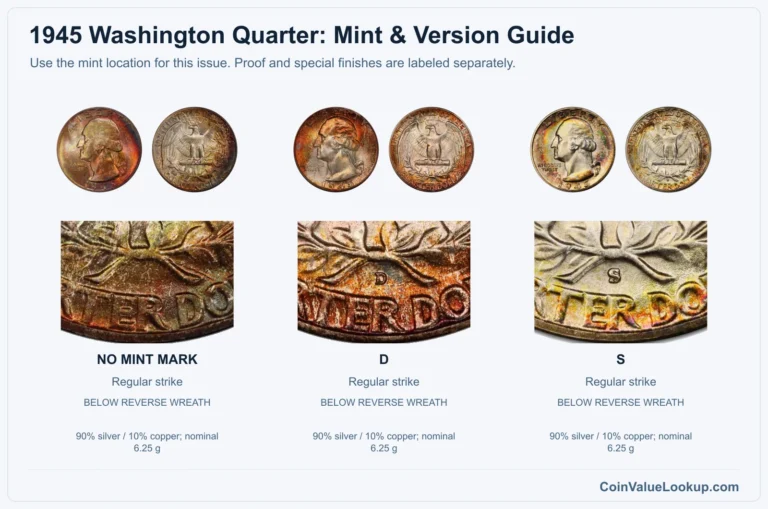
Start by checking the mintmark. Look just to the right of Washington's ponytail ribbon, above the date.
A "P" means Philadelphia, a "D" means Denver, and an "S" means San Francisco. There is no plain (no-mintmark) Philadelphia variety for this date.
P and D coins are copper-nickel clad business strikes weighing about 5.67 g with a diameter of roughly 24.3 mm. The overall composition is 91.67% copper and 8.33% nickel.
An "S" mintmark alone does not tell you whether you have the clad proof or the silver proof — both carry the same letter. To separate them, check the edge: a clad proof shows a visible copper-colored stripe along the rim, while a silver proof has a uniform gray edge.
Weight helps too. The silver version (90% silver, 10% copper) weighs approximately 6.25 g, versus 5.67 g for the clad.
Original government packaging is another reliable indicator.
Step 2: Check Your 1996 Washington Quarter Grade
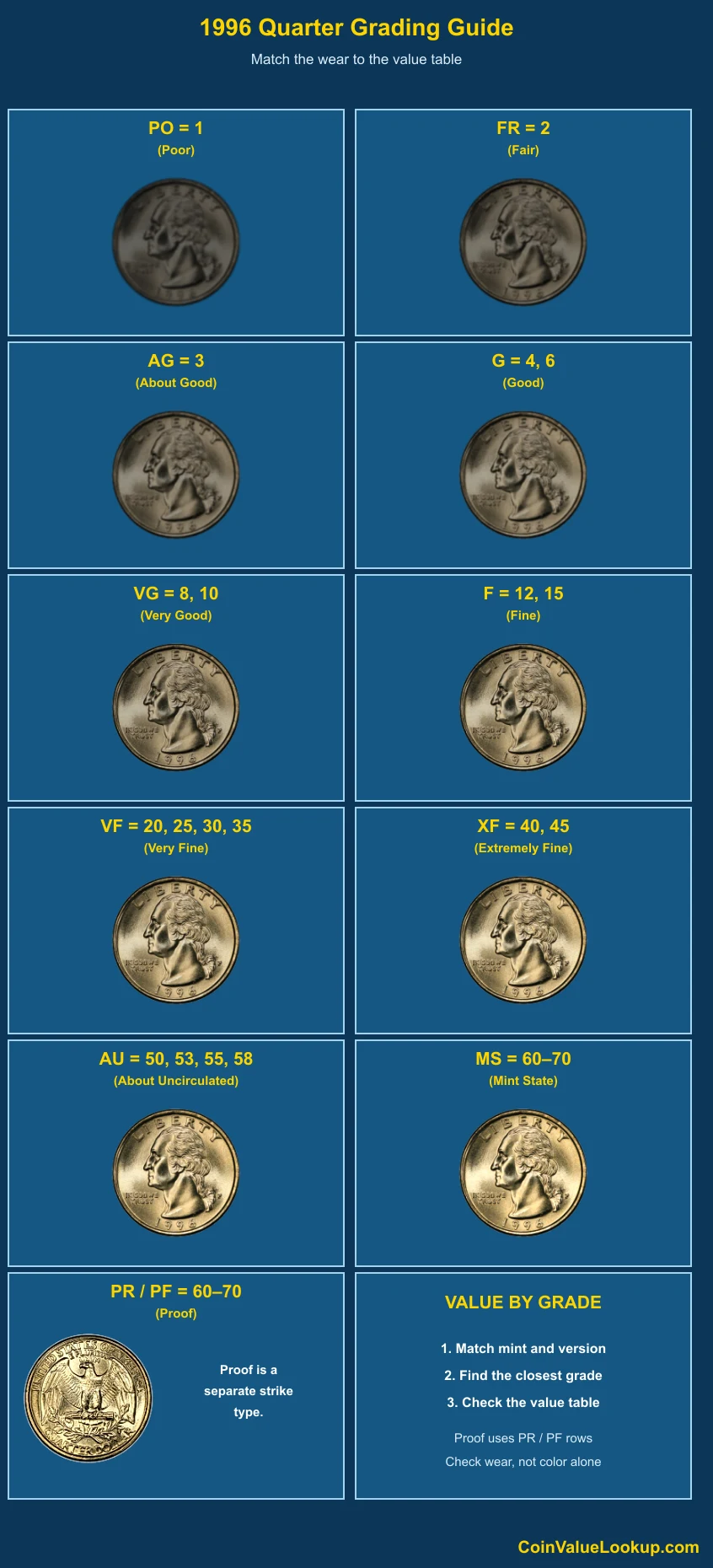
The first place wear shows up on a Washington quarter is the hair above the ear and along the cheekbone and jaw. On the reverse, the eagle's breast feathers lose definition early.
Compare your coin's luster in those spots against the reference image rather than judging by brightness alone — a cleaned coin can look shiny but still be heavily worn.
Contact marks, bag scuffs and hairlines all count against the grade. For proofs, look for haze or handling lines in the fields.
DCAM (Deep Cameo) is a contrast designation describing frosted devices against mirror fields; it is not a measure of silver content or a grade above regular proof.
Step 3: Check 1996 Washington Quarter Value by Mint and Version
1996 Washington Quarter — P
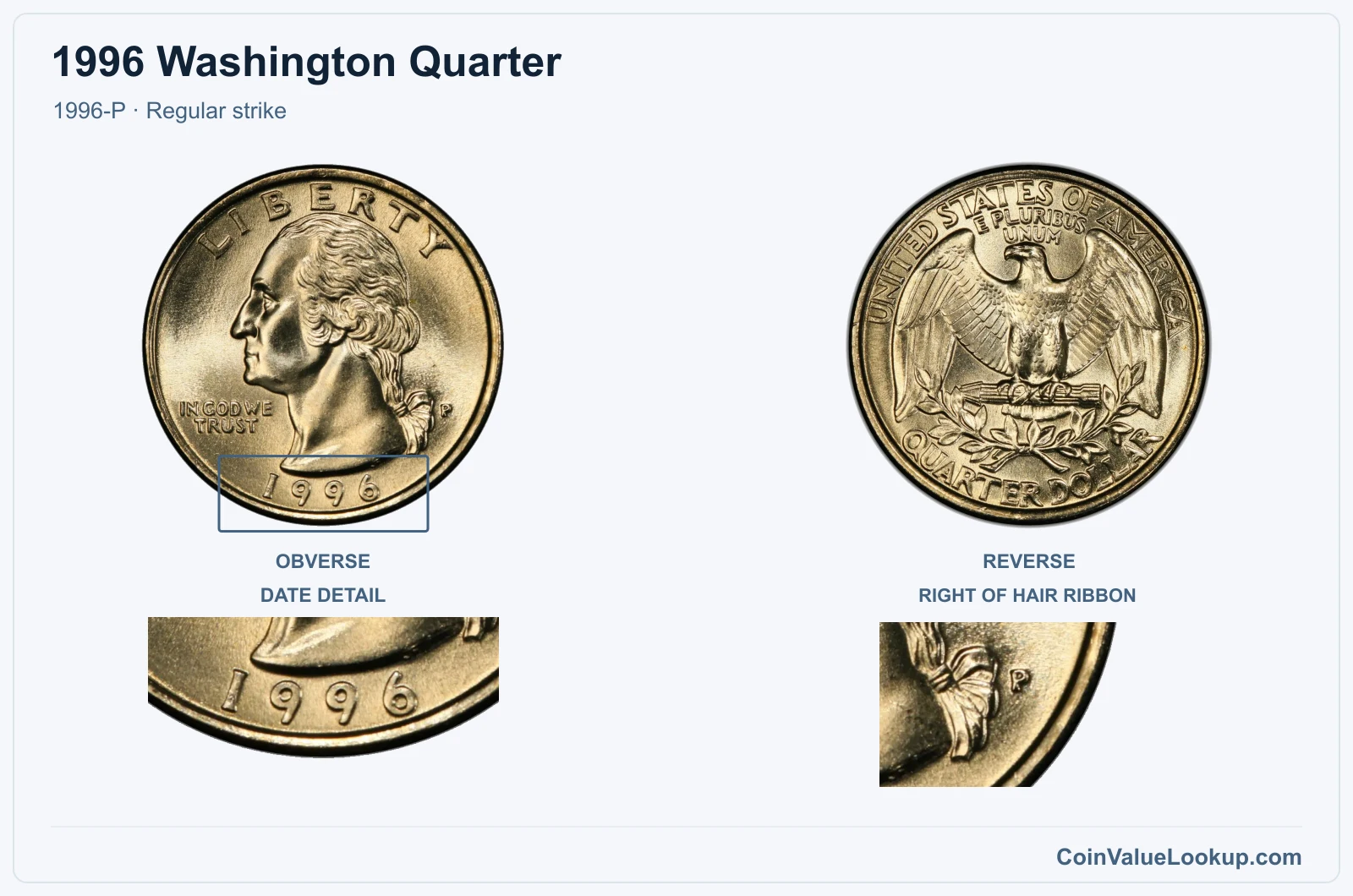
The 1996-P is a copper-nickel clad business strike from Philadelphia, carrying a small "P" mintmark beside Washington's ribbon. Billions of these were produced, so circulated examples trade at face value.
In gem uncirculated condition, a USA Coin Book guide estimate places an MS65 around $12. Look for full hair detail above the ear, no contact marks on the cheek, and original cartwheel luster across both sides.
Any cleaning or polishing drops the coin back toward spend-it territory.
| Range | Grade | Price | Auction Records | Appraisal |
|---|---|---|---|---|
| PO | PO 1 | — | Coin Identifier | |
| FR | FR 2 | — | Coin Identifier | |
| AG | AG 3 | — | Coin Identifier | |
| G | G 4 | — | Coin Identifier | |
| G 6 | — | Coin Identifier | ||
| VG | VG 8 | — | Coin Identifier | |
| VG 10 | — | Coin Identifier | ||
| F | F 12 | — | Coin Identifier | |
| F 15 | — | Coin Identifier | ||
| VF | VF 20 | — | Coin Identifier | |
| VF 25 | — | Coin Identifier | ||
| VF 30 | — | Coin Identifier | ||
| VF 35 | — | Coin Identifier | ||
| XF | XF 40 | — | Coin Identifier | |
| XF 45 | — | Coin Identifier | ||
| AU | AU 50 | — | Coin Identifier | |
| AU 53 | — | Coin Identifier | ||
| AU 55 | — | Coin Identifier | ||
| AU 58 | — | Coin Identifier | ||
| MS | MS 60 | — | Coin Identifier | |
| MS 61 | — | Coin Identifier | ||
| MS 62 | — | Coin Identifier | ||
| MS 63 | — | Coin Identifier | ||
| MS 64 | — | Coin Identifier | ||
| MS 65 | Coin Identifier | |||
| MS 66 | Coin Identifier | |||
| MS 67 | Coin Identifier | |||
| MS 68 | Coin Identifier | |||
| MS 69 | — | — | — | |
| MS 70 | — | — | — |
1996 Washington Quarter — D
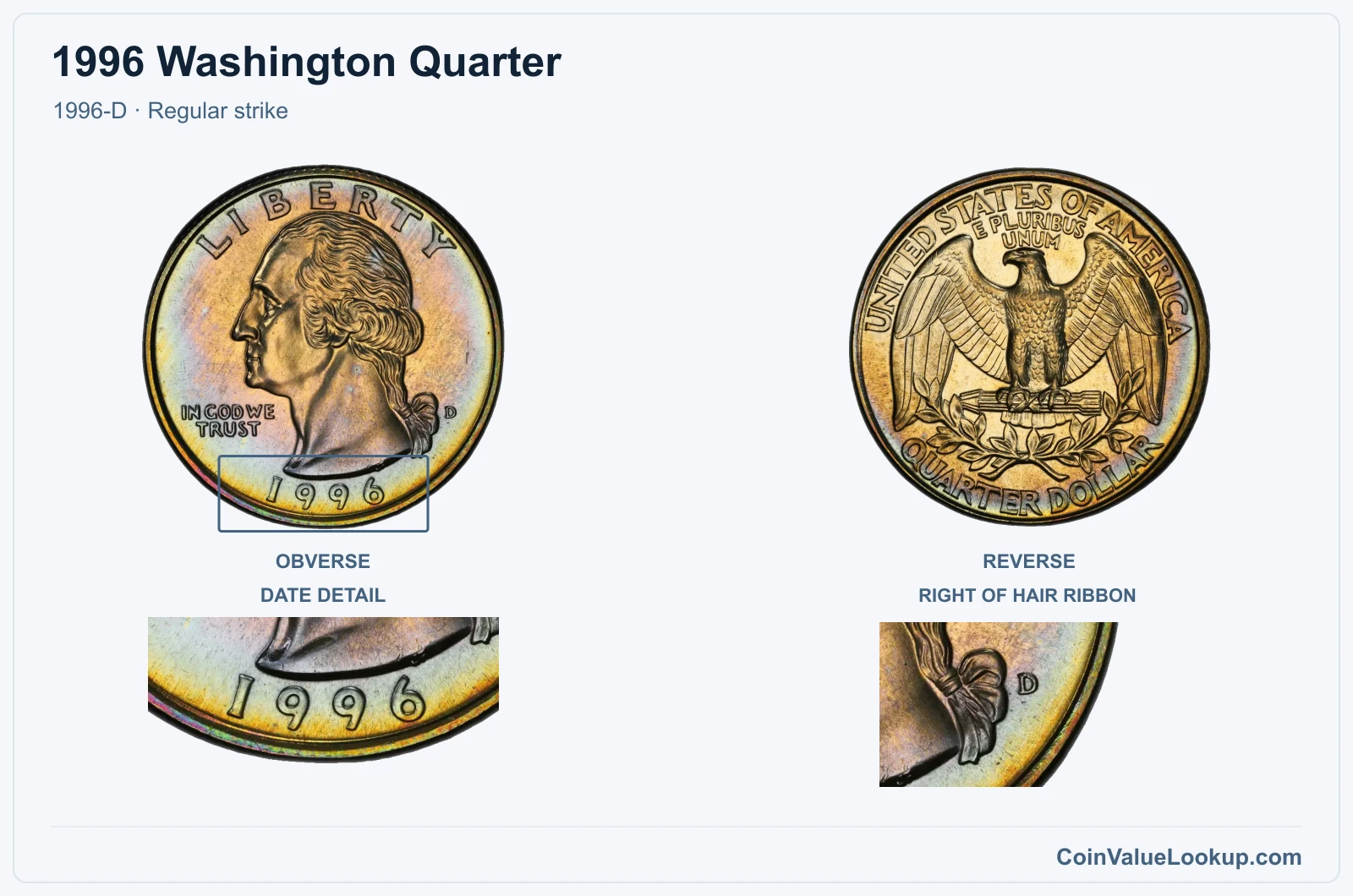
The 1996-D comes from Denver and is identical in composition and design to the P issue — copper-nickel clad, about 5.67 g. Same story on value: circulated coins are worth 25 cents.
The USA Coin Book guide estimate for an MS65 is roughly $12. This mint mark sits in the same location, right of the ponytail.
Both documented wrong-planchet and large-clip errors for 1996 quarters are attributed to Denver strikes, making D-mint error hunting a bit more interesting than usual.
| Range | Grade | Price | Auction Records | Appraisal |
|---|---|---|---|---|
| PO | PO 1 | — | Coin Identifier | |
| FR | FR 2 | — | Coin Identifier | |
| AG | AG 3 | — | Coin Identifier | |
| G | G 4 | — | Coin Identifier | |
| G 6 | — | Coin Identifier | ||
| VG | VG 8 | — | Coin Identifier | |
| VG 10 | — | Coin Identifier | ||
| F | F 12 | — | Coin Identifier | |
| F 15 | — | Coin Identifier | ||
| VF | VF 20 | — | Coin Identifier | |
| VF 25 | — | Coin Identifier | ||
| VF 30 | — | Coin Identifier | ||
| VF 35 | — | Coin Identifier | ||
| XF | XF 40 | — | Coin Identifier | |
| XF 45 | — | Coin Identifier | ||
| AU | AU 50 | — | Coin Identifier | |
| AU 53 | — | Coin Identifier | ||
| AU 55 | — | Coin Identifier | ||
| AU 58 | — | Coin Identifier | ||
| MS | MS 60 | — | Coin Identifier | |
| MS 61 | — | Coin Identifier | ||
| MS 62 | — | Coin Identifier | ||
| MS 63 | Coin Identifier | |||
| MS 64 | — | Coin Identifier | ||
| MS 65 | Coin Identifier | |||
| MS 66 | Coin Identifier | |||
| MS 67 | Coin Identifier | |||
| MS 68 | Coin Identifier | |||
| MS 69 | — | — | — | |
| MS 70 | — | — | — |
1996 Washington Quarter — S Proof
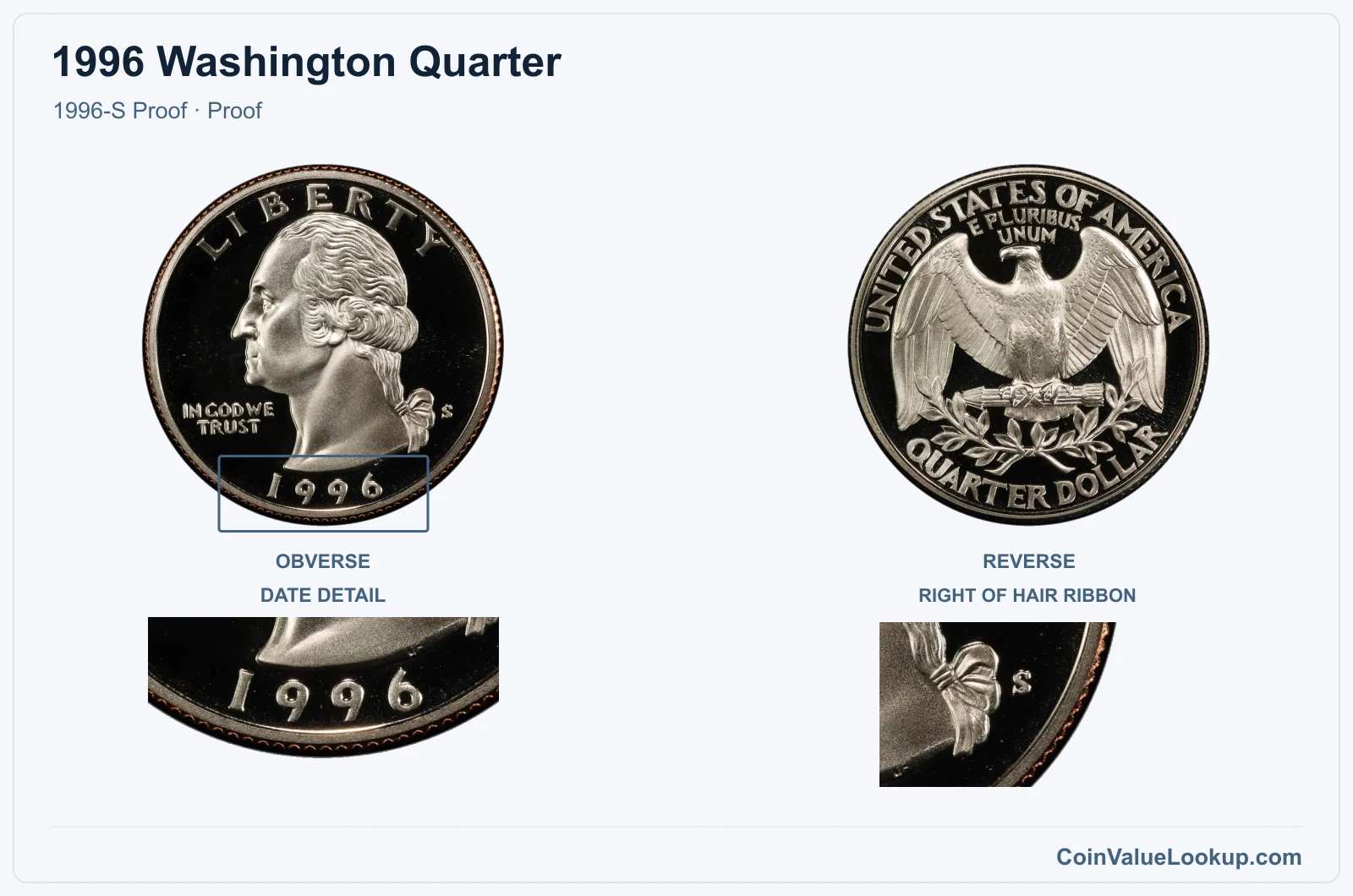
The 1996-S clad proof was struck at San Francisco on the same copper-nickel clad planchet used for business strikes, but with polished dies and planchets producing mirror fields. A USA Coin Book guide places a PR65 example at about $6.25.
This is the more common of the two S-mint proofs. Do not confuse it with the silver version — check the edge for that telltale copper stripe and weigh the coin.
A clad proof weighs around 5.67 g. DCAM contrast is a separate designation and carries its own market; the PR65 guide figure here applies to a standard proof without that contrast call.
Coin Value Lookup is a handy starting point if you are sorting through other dates or denominations alongside your 1996-S proof.
| Range | Grade | Price | Auction Records | Appraisal |
|---|---|---|---|---|
| PR | PR 1 | — | Coin Identifier | |
| PR 2 | — | Coin Identifier | ||
| PR 3 | — | Coin Identifier | ||
| PR 4 | — | Coin Identifier | ||
| PR 6 | — | Coin Identifier | ||
| PR 8 | — | Coin Identifier | ||
| PR 10 | — | Coin Identifier | ||
| PR 12 | — | Coin Identifier | ||
| PR 15 | — | Coin Identifier | ||
| PR 20 | — | Coin Identifier | ||
| PR 25 | — | Coin Identifier | ||
| PR 30 | — | Coin Identifier | ||
| PR 35 | — | Coin Identifier | ||
| PR 40 | — | Coin Identifier | ||
| PR 45 | — | Coin Identifier | ||
| PR 50 | — | Coin Identifier | ||
| PR 53 | — | Coin Identifier | ||
| PR 55 | — | Coin Identifier | ||
| PR 58 | — | Coin Identifier | ||
| PR 60 | — | Coin Identifier | ||
| PR 61 | — | Coin Identifier | ||
| PR 62 | — | Coin Identifier | ||
| PR 63 | — | Coin Identifier | ||
| PR 64 | — | Coin Identifier | ||
| PR 65 | — | Coin Identifier | ||
| PR 66 | — | Coin Identifier | ||
| PR 67 | Coin Identifier | |||
| PR 68 | — | Coin Identifier | ||
| PR 69 | Coin Identifier | |||
| PR 70 | Coin Identifier |
1996 Washington Quarter — S Silver Proof
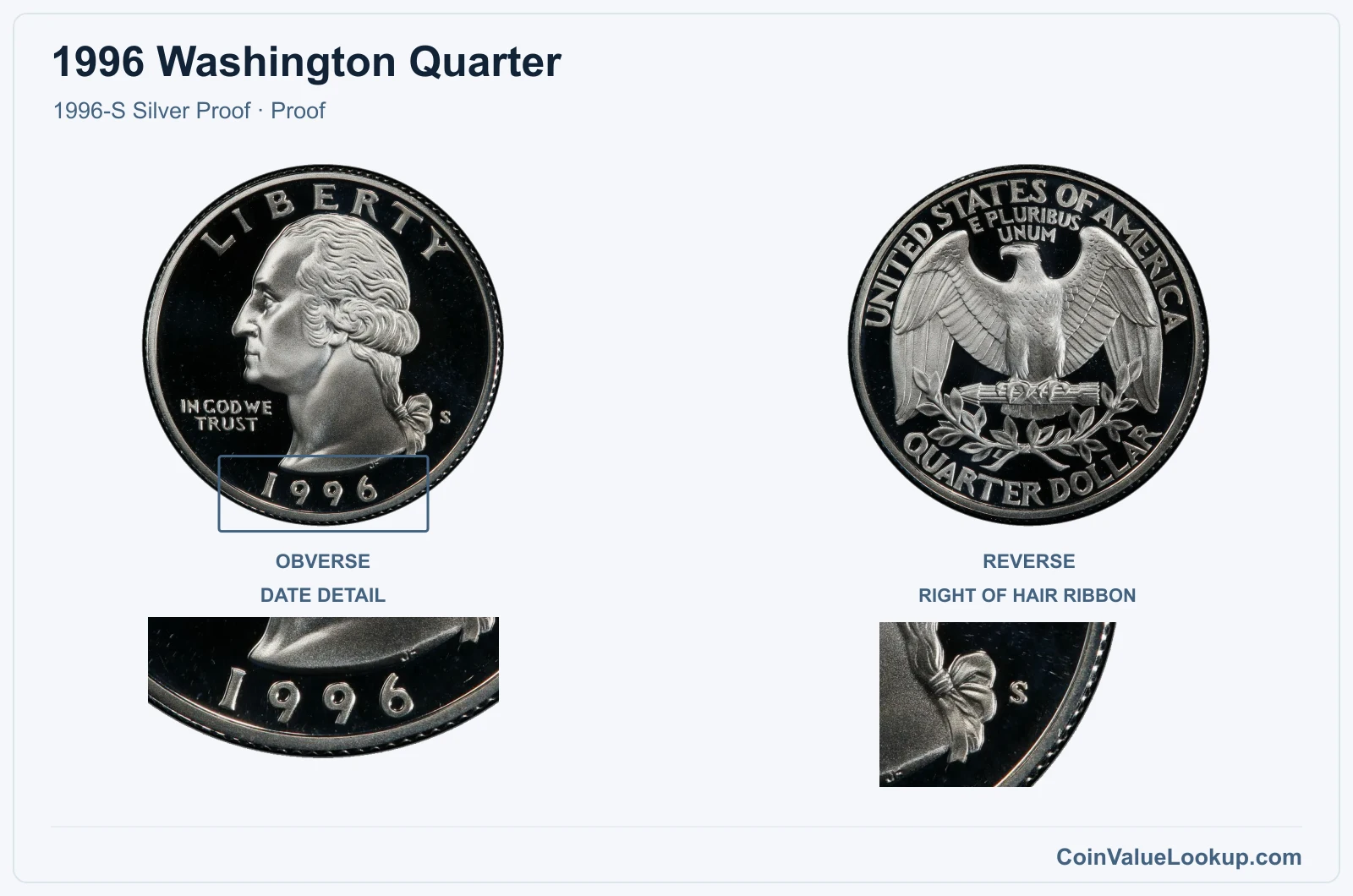
The 1996-S silver proof is the premium version: 90% silver and 10% copper, weighing approximately 6.25 g. Its PR65 guide estimate from USA Coin Book is about $21, well above the clad proof's figure at the same grade.
Silver-proof values are sensitive to the silver market, so that number can shift.
Identify it by a uniform gray edge with no copper stripe and heavier weight compared to the clad proof. Original mint packaging helps confirm the metal.
This is a normal, intended product — owning a silver proof is not the same as owning an error coin. DCAM examples command their own premiums, but the $21 estimate applies to a standard PR65 finish without a cameo designation.
| Range | Grade | Price | Auction Records | Appraisal |
|---|---|---|---|---|
| PR | PR 1 | — | Coin Identifier | |
| PR 2 | — | Coin Identifier | ||
| PR 3 | — | Coin Identifier | ||
| PR 4 | — | Coin Identifier | ||
| PR 6 | — | Coin Identifier | ||
| PR 8 | — | Coin Identifier | ||
| PR 10 | — | Coin Identifier | ||
| PR 12 | — | Coin Identifier | ||
| PR 15 | — | Coin Identifier | ||
| PR 20 | — | Coin Identifier | ||
| PR 25 | — | Coin Identifier | ||
| PR 30 | — | Coin Identifier | ||
| PR 35 | — | Coin Identifier | ||
| PR 40 | — | Coin Identifier | ||
| PR 45 | — | Coin Identifier | ||
| PR 50 | — | Coin Identifier | ||
| PR 53 | — | Coin Identifier | ||
| PR 55 | — | Coin Identifier | ||
| PR 58 | — | Coin Identifier | ||
| PR 60 | — | Coin Identifier | ||
| PR 61 | — | Coin Identifier | ||
| PR 62 | — | Coin Identifier | ||
| PR 63 | — | Coin Identifier | ||
| PR 64 | — | Coin Identifier | ||
| PR 65 | — | Coin Identifier | ||
| PR 66 | — | Coin Identifier | ||
| PR 67 | — | Coin Identifier | ||
| PR 68 | — | Coin Identifier | ||
| PR 69 | Coin Identifier | |||
| PR 70 | Coin Identifier |
1996 Washington Quarter Error List
1. 1996 Washington Quarter — Struck on a Nickel Blank
A 1996-D quarter struck on a Type One Jefferson nickel blank is a genuine wrong-planchet error. The coin carries the full Washington obverse and eagle reverse design, but on a noticeably smaller, lighter blank — documented at 5.0 g instead of the normal 5.67 g.
Peripheral design elements are missing because the smaller blank could not receive the full quarter impression.
One example graded NGC MS63 sold for $528 at Heritage Auctions in December 2025. That price reflects a specific grade and a confirmed attribution.
Watch out for fakes. Post-mint cutting, filing, hammering or chemical alteration can make a regular quarter look odd.
The key is authentic struck surfaces that show the design naturally flowing to the edge of the undersized blank, plus a confirmed weight near 5.0 g. Unusual color or an irregular outline alone does not prove a wrong-planchet strike.
2. 1996 Washington Quarter — Large Clipped Planchet
A 1996-D quarter with a large clipped planchet is missing a significant portion of its blank due to a mis-feed before striking. The documented example has roughly 45% of the planchet absent and weighs just 3.16 g — far below the standard 5.67 g.
You can see the strike design flowing toward the clipped boundary, with a curved missing section rather than a straight cut.
That specific coin sold for $79 in NGC MS66 at Heritage Auctions in July 2021. The percentage and weight are for that particular specimen, not a formula you can apply to every clip.
Imitations from post-mint cutting or grinding will show tool marks and lack the natural metal flow at the clipped edge. Look carefully at the boundary: authentic clips have a smooth, curved edge from the original blanking operation, not jagged or filed surfaces.
3. 1996 Washington Quarter — Off-Center Strike
An off-center 1996 quarter results from the planchet sitting incorrectly between the dies at the moment of striking. You will see the design shifted to one side with an unstruck crescent of blank metal on the opposite edge.
The date needs to remain visible for the coin to be attributed to 1996.
Condition, the percentage of off-center shift, and whether the date is readable all affect what these are worth. No specific price range is established here, so individual assessment matters.
Do not confuse an off-center strike with a clipped planchet, a one-sided die misalignment, or a coin that was flattened after it left the mint. A true off-center piece shows a complete but displaced design impression, not a damaged edge or smashed surface.
4. 1996 Washington Quarter — Broadstrike
A broadstrike happens when the retaining collar fails to contain the planchet during striking. The result is a 1996 quarter that spreads outward, appearing wider than normal with a distorted or absent rim.
The full design is still present — it just extends beyond the usual boundary.
Value depends on the degree of spread, overall condition, and eye appeal. No specific price range is adopted here, so each coin needs to be evaluated on its own merits.
An off-center strike is different: it shifts the design, leaving blank metal. Post-mint flattening from a vise or hammer can mimic a broadstrike but will show damage marks and lack the uniform metal flow of a genuine collar-free strike.
Examine the edge profile carefully — a real broadstrike has a smooth, spread rim rather than compressed or scraped metal.
5. 1996 Washington Quarter — Double / Multiple Strike
A double-struck or multiple-struck 1996 quarter received two or more impressions from the dies, producing overlapping or rotated design images on the same planchet. You should see distinct, separate impressions — not just thickened letters.
The relationship between the two strikes (rotation, displacement) is what makes each piece unique.
No specific price range is established here. Value depends on how dramatic and visible the second strike is, plus the coin's overall condition.
This is not the same as a doubled die, which is a single strike from a die that was made incorrectly. It is also different from post-mint impressions where someone pressed the coin against another object.
Authentic double strikes show genuine die detail in both impressions with natural metal flow between them.
6. 1996 Washington Quarter — Struck-Through Error
A struck-through error on a 1996 quarter occurs when foreign material — grease, cloth, wire or debris — sits between the die and the planchet at the moment of striking. The result is a localized area of incomplete or depressed design.
Grease fill-ins typically produce a smooth, flat patch where detail is missing, while a retained foreign object may leave a textured impression.
No specific price is adopted here. The size, location and type of obstruction all affect collector interest.
Do not confuse a struck-through area with ordinary wear, scratches, cleaning damage or a weakly struck section from worn dies. A genuine struck-through has a distinct boundary and sits within an otherwise normally struck surface.
The surrounding design should show full detail and proper luster.
7. 1996 Washington Quarter — Doubled Die
A 1996 quarter doubled die shows consistent doubling in the design elements caused by a misaligned hub impression during die manufacture. Look for separation, notching or shelf-like doubling on lettering or design features.
Each letter or device affected should show the doubling in the same direction and magnitude.
No specific price range is adopted here. The strength and location of the doubling, along with the coin's condition, drive collector value.
Machine doubling — flat, shelf-like distortion from die chatter during striking — is far more common and much less valuable. Reflections and lighting tricks can also mimic doubling in photos.
Compare suspect areas against a known normal coin, checking that the separation is raised and consistent rather than mushy or directionally random.
8. 1996 Washington Quarter — Die Crack / Die Chip
A die crack on a 1996-P quarter appears as a raised line running across the coin's surface, corresponding to a crack that developed in the steel die during production. Die chips show up as small raised blobs where a piece of the die face broke away.
Both are genuine mint errors, though most are minor.
No specific price is established here. Value depends on the size, location and visual drama of the crack or chip.
A crack connecting to the rim is sometimes called a cud and tends to attract more collector attention than a small interior chip.
Do not confuse die cracks with scratches, which are incuse (sunken into the surface). Corrosion, environmental damage or foreign material sitting on the coin can also look like raised features.
A true die crack has a consistent raised profile and repeats on every coin struck by that damaged die.