1953 Washington Quarter Coin Value: How Much Is It Worth?
A 1953 Washington quarter is a 90% silver coin, and even heavily worn examples carry a guide value around $16.43 in Good condition. Mint State pieces range higher depending on mint and grade, with ordinary MS65 examples listed up to about $48 by USA Coin Book.
Actual value depends on your coin's specific condition, mintmark and whether it carries a recognized variety or mint error. Philadelphia proofs and authenticated error coins fall outside those ordinary ranges.
Fast Way to Identify Your 1953 Washington Quarter
The quickest way to start figuring out what you have is to upload clear photos of the front and back of your coin. That lets us provide a preliminary identification of your mintmark, general condition and version.
Snap both sides in even lighting, no flash glare, and make sure the date and any small letter below the wreath on the reverse are visible.
1953 Washington Quarter Value
Upload both sides of your 1953 Washington Quarter.
Front Obverse
Upload photo
Back Reverse
Upload photo
Which 1953 Washington Quarter Versions Are Worth Money?
- The 1953-D in MS65 carries the highest ordinary guide value among business strikes at about $48, making the Denver mint coin worth checking for pristine survivors.
- 1953 Proof quarters from Philadelphia in PR65 are listed around $65, and the re-engraved tail feathers proof variety is a separately recognized die variety whose value depends on individual authentication and condition.
- A 1953-S quarter struck over a Jefferson nickel sold for $2,760 at Heritage Auctions, illustrating how dramatic mint errors can far exceed standard values.
- A 1953 Philadelphia quarter with a partial collar and uniface reverse brought $2,040 at Heritage in 2024, showing that striking errors on this date attract serious bidding.
- A 1953 quarter struck on a five-cent planchet realized $720 at Heritage in September 2024, a wrong-planchet error worth knowing about.
Step 1: Identify Your 1953 Washington Quarter Mint Mark and Version
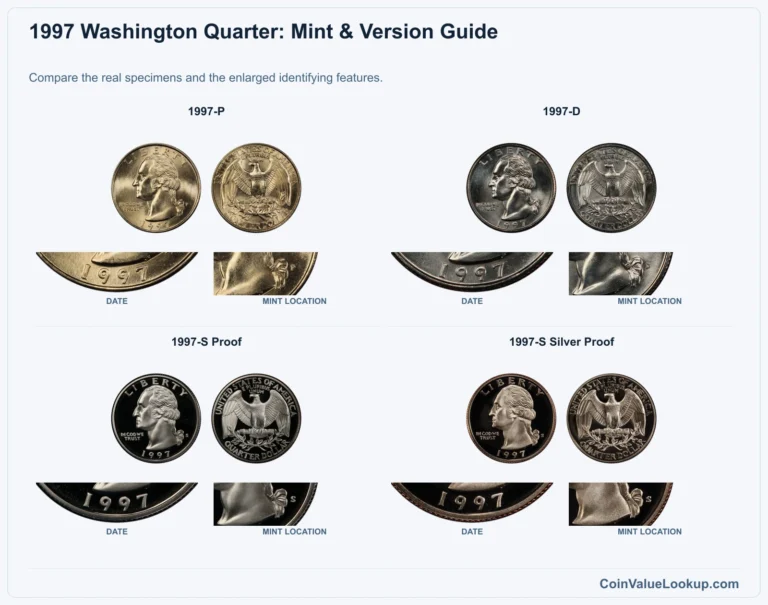
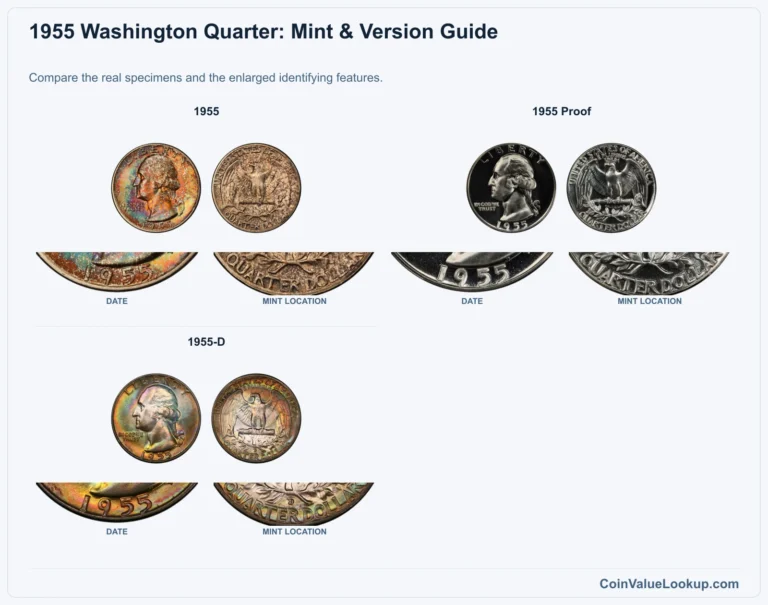
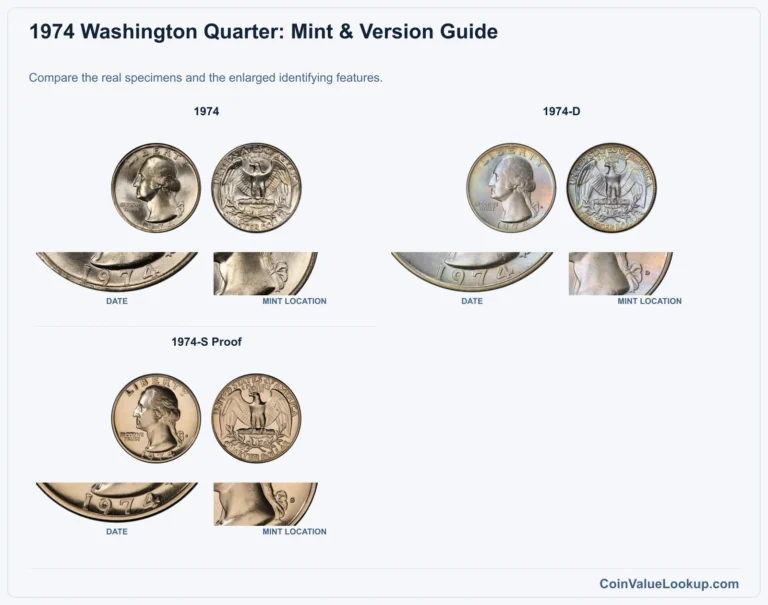
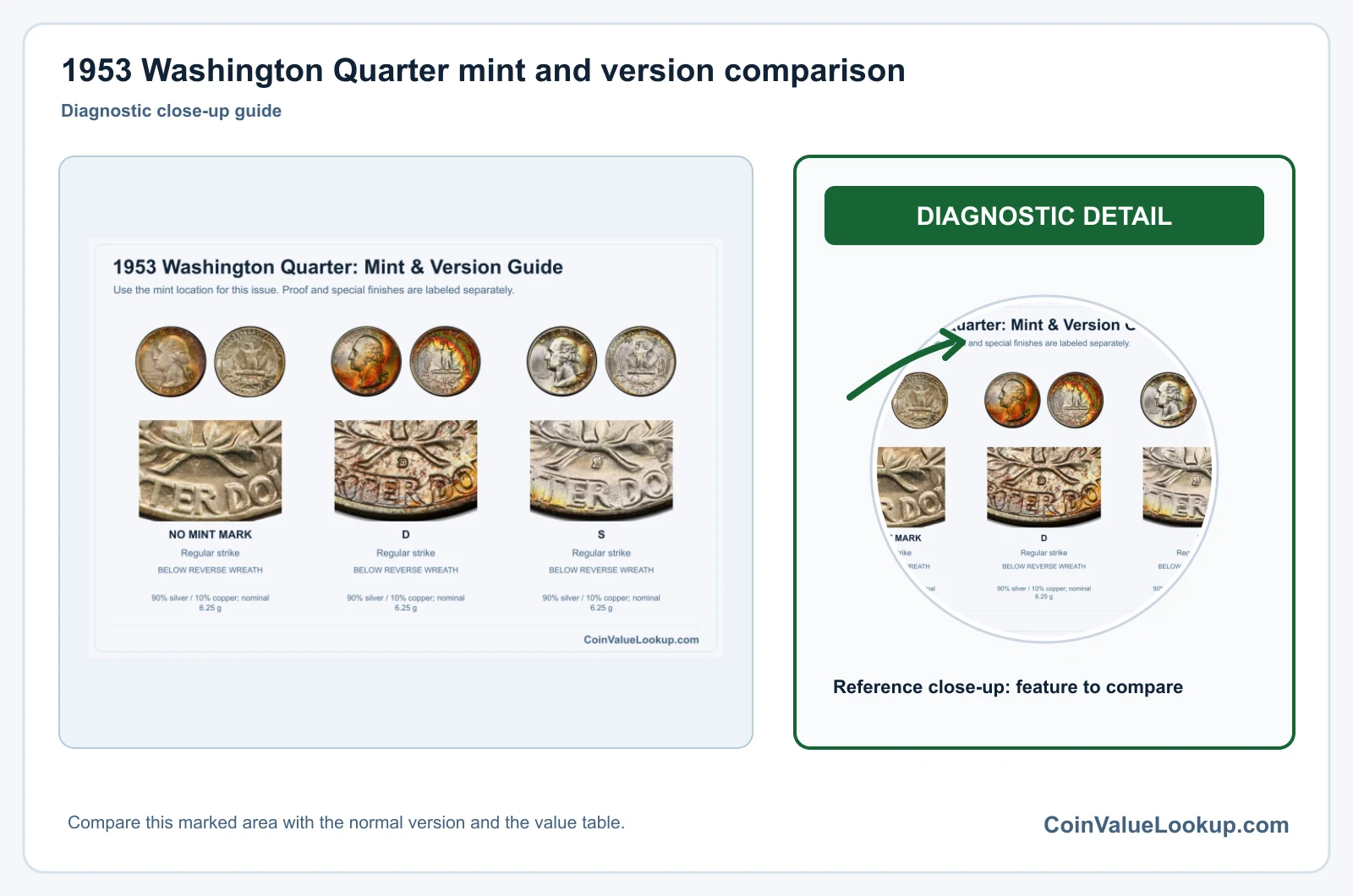
The date sits on the obverse beneath Washington's bust. Flip the coin over and look below the wreath, just above the denomination.
A small "D" means Denver, an "S" means San Francisco, and no letter at all means Philadelphia. A blank mintmark area on a 1953 quarter is completely normal for the Philadelphia issue, not a mistake.
All 1953 quarters share the same composition: 90% silver and 10% copper, weighing about 6.25 grams and measuring roughly 24.3 mm across. They carry the standard Washington obverse and eagle-with-arrows reverse.
Philadelphia also struck proof quarters this year in the same alloy. Proofs have deeply mirrored fields and sharper detail than business strikes.
If your coin has a glassy, reflective surface and crisp edges on the design, it may be a proof rather than a well-preserved circulation coin. A recognized proof variety features re-engraved tail feathers on the eagle, which is a separate die variety confirmed by PCGS.
One thing worth knowing: stories about a 1953 doubled die obverse on Lincoln cents sometimes get mixed up with quarters online. Those are cent varieties and do not apply here.
Step 2: Check Your 1953 Washington Quarter Grade
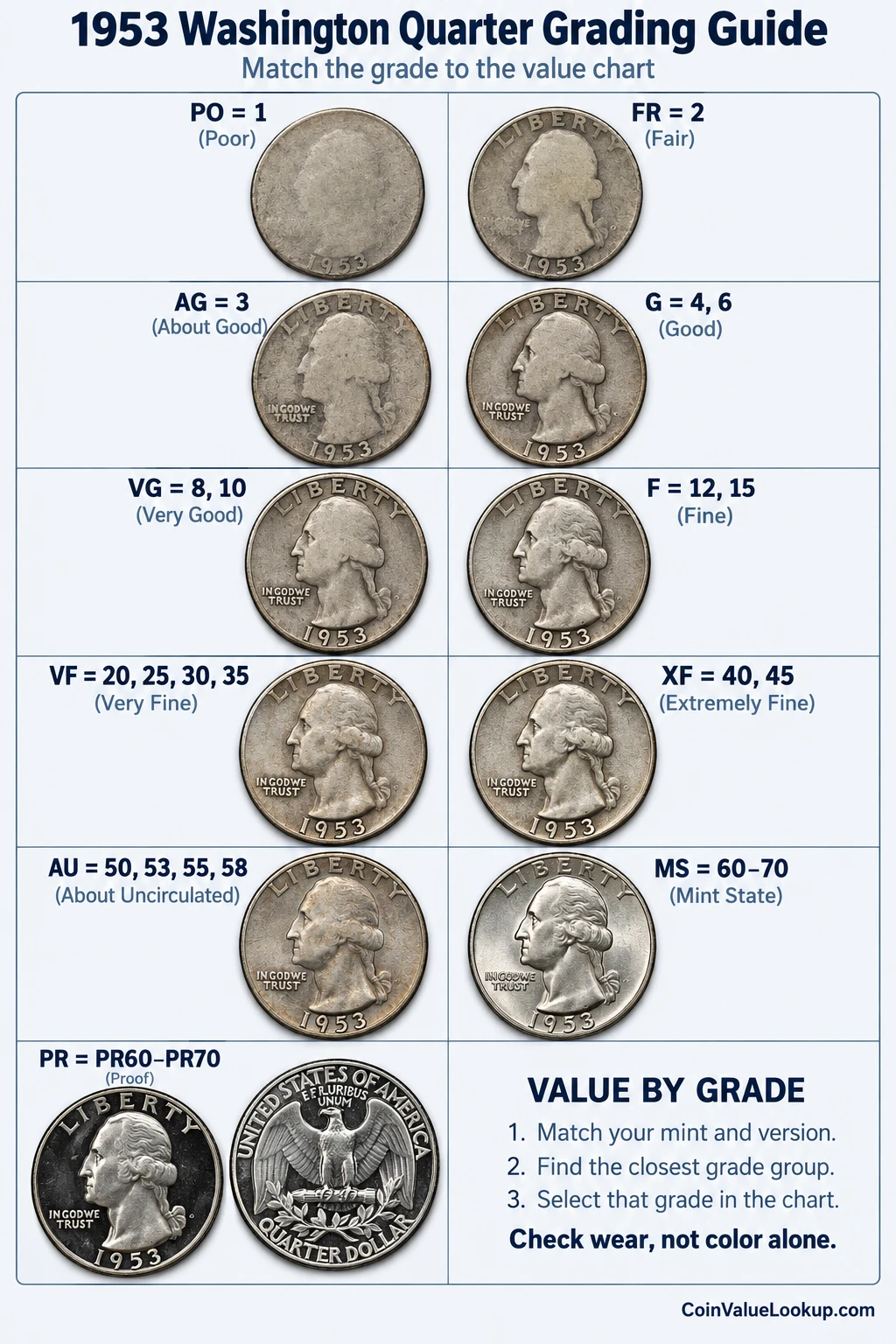
Start on the obverse. Washington's cheekbone, jawline and the hair directly above his ear show friction first.
On a lightly circulated coin those areas lose their luster while the rest of the surface still shines. A coin grading Good-4 will have a clear outline but most fine detail worn smooth.
On the reverse, check the eagle's breast feathers and wingtips. These high points flatten before the surrounding legends do.
Compare your coin to the reference image to see how much feather separation remains.
Luster matters a lot on Mint State pieces. Original, unbroken cartwheel luster across the entire surface is characteristic of MS63 and above.
A weak strike can mimic wear, so look for luster in the flat areas, not just sharpness of detail.
Also inspect for cleaning. Fine parallel hairlines visible under a light at an angle usually mean someone polished the coin at some point, and that will significantly reduce its grade and value.
Contact marks, rim dings and dark spots all factor into the final assessment as well. For proofs, contrast between frosted devices and mirrored fields is a designation like Cameo or Deep Cameo, not a higher numerical grade.
Step 3: Check 1953 Washington Quarter Value by Mint and Version
1953 Washington Quarter
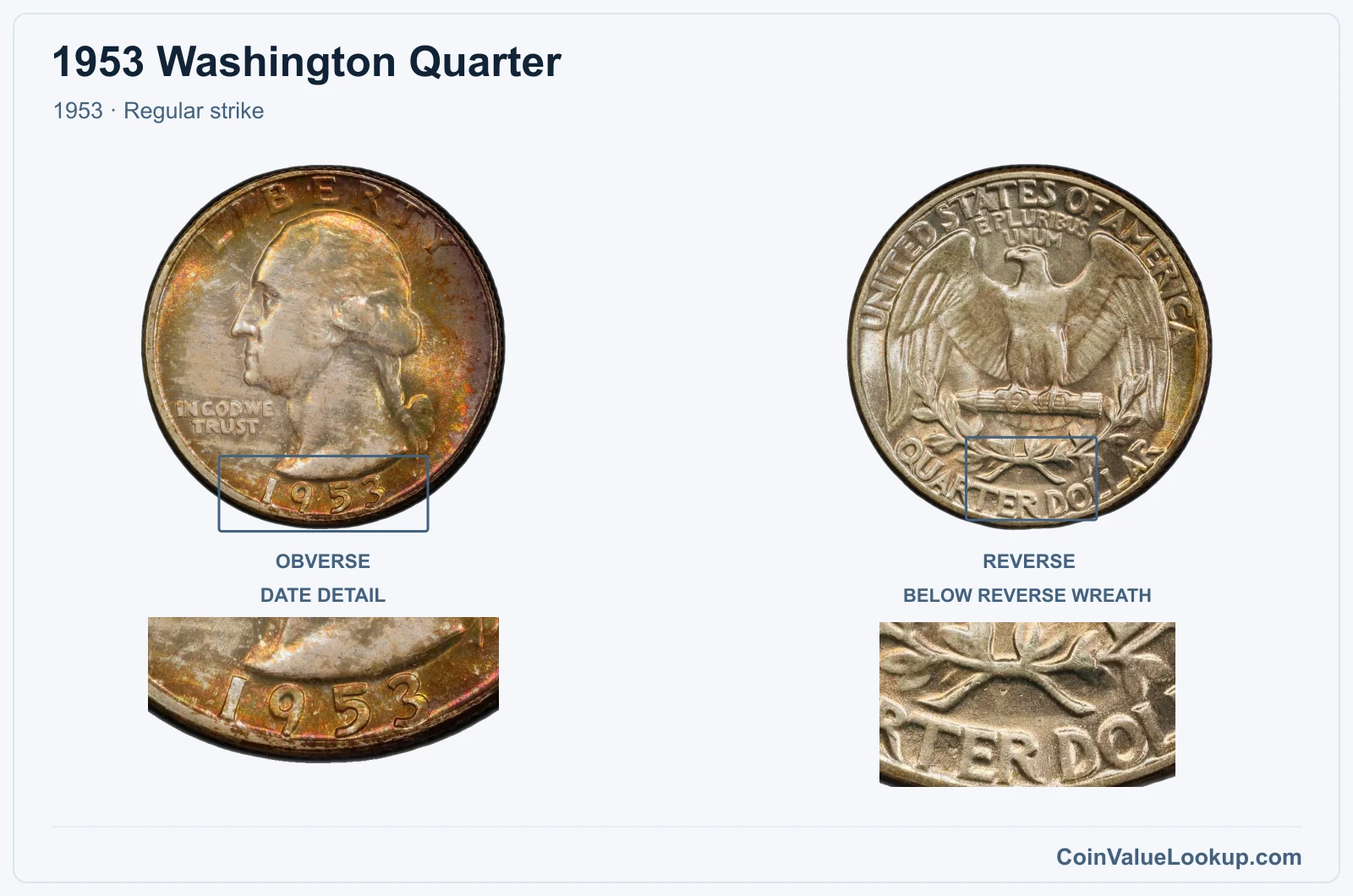
The 1953 Philadelphia quarter has no mintmark below the reverse wreath. It is a standard 90% silver business strike weighing about 6.25 grams.
USA Coin Book lists this issue around $16.43 in Good-4 condition, roughly $20 in MS60 and about $39 in MS65.
Bag marks and contact hits are common on Philadelphia quarters from this era, which limits the number of truly premium survivors. Original luster without cleaning is the main thing to look for if you think yours is uncirculated.
| Range | Grade | Price | Auction Records | Appraisal |
|---|---|---|---|---|
| PO | PO 1 | — | Coin Identifier | |
| FR | FR 2 | — | Coin Identifier | |
| AG | AG 3 | — | Coin Identifier | |
| G | G 4 | — | Coin Identifier | |
| G 6 | — | Coin Identifier | ||
| VG | VG 8 | — | Coin Identifier | |
| VG 10 | — | Coin Identifier | ||
| F | F 12 | — | Coin Identifier | |
| F 15 | — | Coin Identifier | ||
| VF | VF 20 | — | Coin Identifier | |
| VF 25 | — | Coin Identifier | ||
| VF 30 | — | Coin Identifier | ||
| VF 35 | — | Coin Identifier | ||
| XF | XF 40 | — | Coin Identifier | |
| XF 45 | — | Coin Identifier | ||
| AU | AU 50 | — | Coin Identifier | |
| AU 53 | — | Coin Identifier | ||
| AU 55 | — | Coin Identifier | ||
| AU 58 | — | Coin Identifier | ||
| MS | MS 60 | — | Coin Identifier | |
| MS 61 | — | Coin Identifier | ||
| MS 62 | — | Coin Identifier | ||
| MS 63 | — | Coin Identifier | ||
| MS 64 | Coin Identifier | |||
| MS 65 | Coin Identifier | |||
| MS 66 | Coin Identifier | |||
| MS 67 | Coin Identifier | |||
| MS 68 | — | — | — | |
| MS 69 | — | — | — | |
| MS 70 | — | — | — |
1953 Washington Quarter — Proof
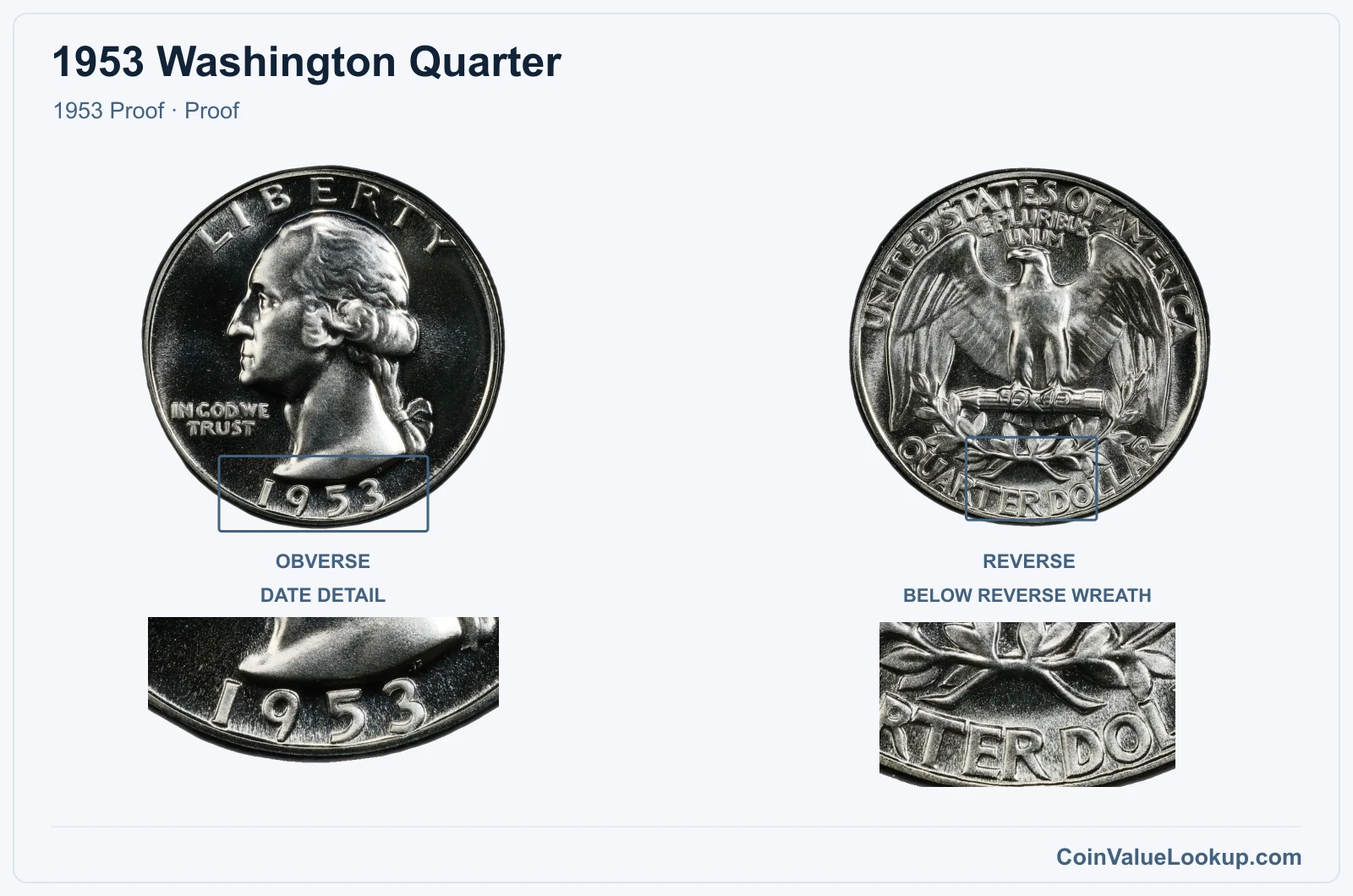
Philadelphia also produced proof quarters in 1953, struck with the same 90% silver alloy but using specially prepared dies and planchets. These coins display deeply mirrored fields and crisp, well-defined devices.
A PR65 example is listed at approximately $65 according to USA Coin Book.
Contrast designations such as Cameo or Deep Cameo describe the degree of frost on the raised design against the mirror fields. These are separate designations, not substitutes for the numerical proof grade.
A recognized die variety on the 1953 proof features re-engraved tail feathers on the eagle, which is cataloged separately by PCGS.
| Range | Grade | Price | Auction Records | Appraisal |
|---|---|---|---|---|
| PR | PR 1 | — | Coin Identifier | |
| PR 2 | — | Coin Identifier | ||
| PR 3 | — | Coin Identifier | ||
| PR 4 | — | Coin Identifier | ||
| PR 6 | — | Coin Identifier | ||
| PR 8 | — | Coin Identifier | ||
| PR 10 | — | Coin Identifier | ||
| PR 12 | — | Coin Identifier | ||
| PR 15 | — | Coin Identifier | ||
| PR 20 | — | Coin Identifier | ||
| PR 25 | — | Coin Identifier | ||
| PR 30 | — | Coin Identifier | ||
| PR 35 | — | Coin Identifier | ||
| PR 40 | — | Coin Identifier | ||
| PR 45 | — | Coin Identifier | ||
| PR 50 | — | Coin Identifier | ||
| PR 53 | — | Coin Identifier | ||
| PR 55 | — | Coin Identifier | ||
| PR 58 | — | Coin Identifier | ||
| PR 60 | — | Coin Identifier | ||
| PR 61 | — | Coin Identifier | ||
| PR 62 | — | Coin Identifier | ||
| PR 63 | Coin Identifier | |||
| PR 64 | Coin Identifier | |||
| PR 65 | Coin Identifier | |||
| PR 66 | Coin Identifier | |||
| PR 67 | Coin Identifier | |||
| PR 68 | Coin Identifier | |||
| PR 69 | — | — | — | |
| PR 70 | — | — | — |
1953 Washington Quarter — D
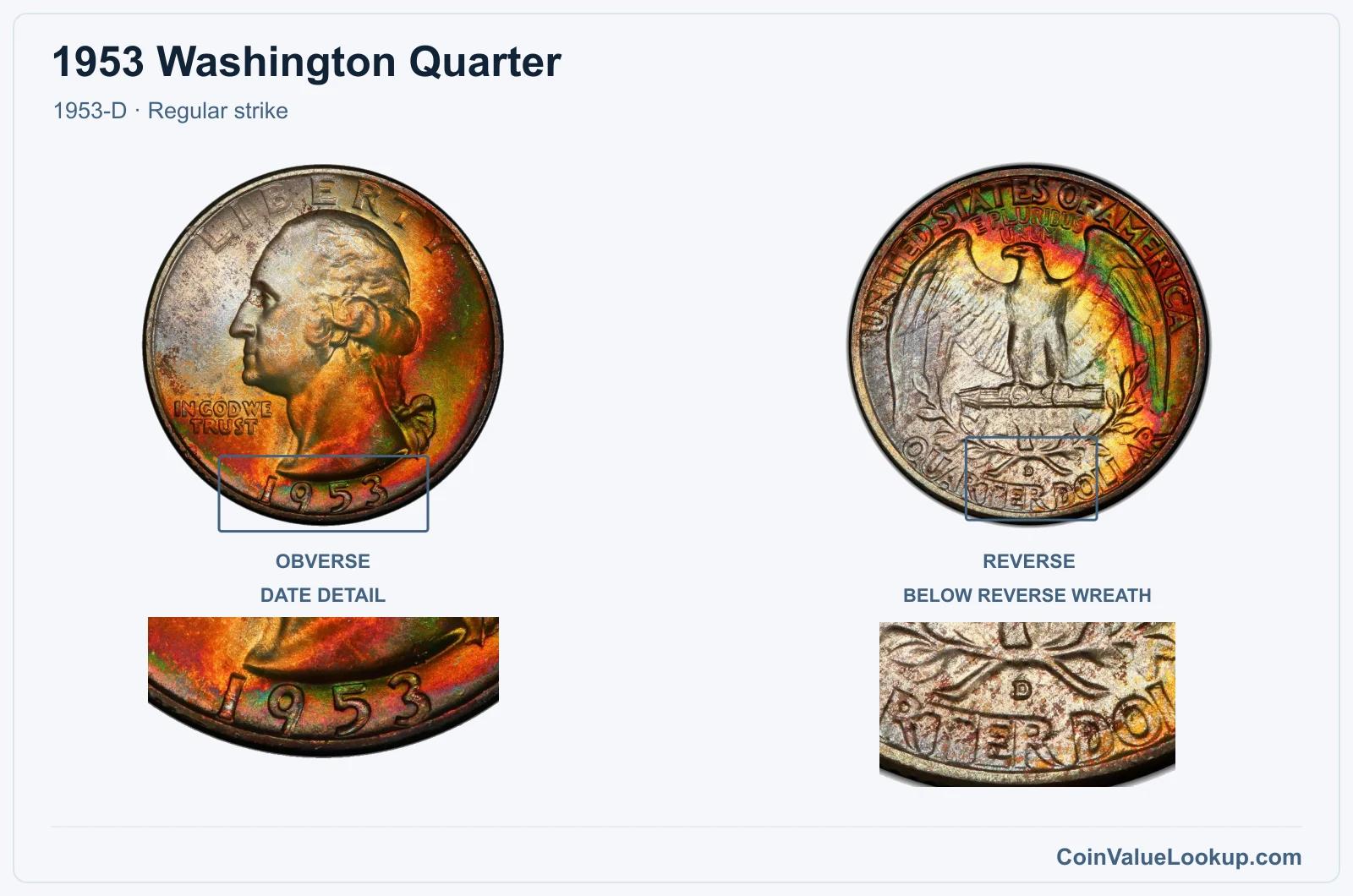
Look for a small "D" mintmark below the wreath on the reverse. The 1953-D is a Denver business strike in the standard 90% silver composition.
Guide estimates from USA Coin Book place it at about $16.43 in Good-4, $20 in MS60 and around $48 in MS65.
That MS65 figure is the highest among the three business-strike mints for this year. Denver quarters can have softer strikes than Philadelphia coins, so confirm luster in flat areas before assuming wear.
| Range | Grade | Price | Auction Records | Appraisal |
|---|---|---|---|---|
| PO | PO 1 | — | Coin Identifier | |
| FR | FR 2 | — | Coin Identifier | |
| AG | AG 3 | — | Coin Identifier | |
| G | G 4 | — | Coin Identifier | |
| G 6 | — | Coin Identifier | ||
| VG | VG 8 | — | Coin Identifier | |
| VG 10 | — | Coin Identifier | ||
| F | F 12 | — | Coin Identifier | |
| F 15 | — | Coin Identifier | ||
| VF | VF 20 | — | Coin Identifier | |
| VF 25 | — | Coin Identifier | ||
| VF 30 | — | Coin Identifier | ||
| VF 35 | — | Coin Identifier | ||
| XF | XF 40 | — | Coin Identifier | |
| XF 45 | — | Coin Identifier | ||
| AU | AU 50 | — | Coin Identifier | |
| AU 53 | — | Coin Identifier | ||
| AU 55 | — | Coin Identifier | ||
| AU 58 | — | Coin Identifier | ||
| MS | MS 60 | — | Coin Identifier | |
| MS 61 | — | Coin Identifier | ||
| MS 62 | — | Coin Identifier | ||
| MS 63 | Coin Identifier | |||
| MS 64 | Coin Identifier | |||
| MS 65 | Coin Identifier | |||
| MS 66 | Coin Identifier | |||
| MS 67 | Coin Identifier | |||
| MS 68 | — | Coin Identifier | ||
| MS 69 | — | — | — | |
| MS 70 | — | — | — |
1953 Washington Quarter — S
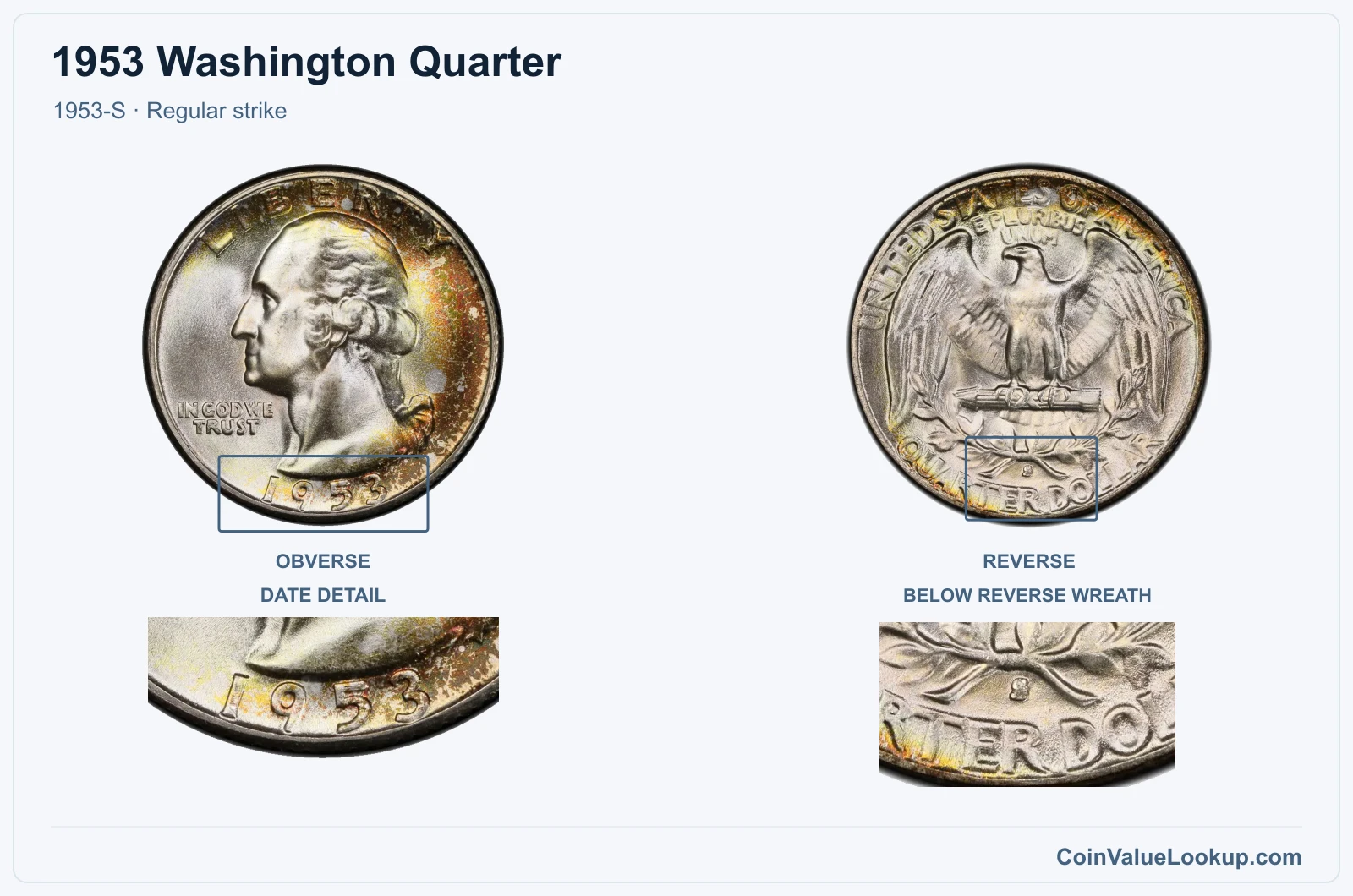
The 1953-S carries a small "S" mintmark below the reverse wreath, identifying it as a San Francisco business strike. Composition is the same 90% silver and 10% copper, 6.25 grams.
USA Coin Book lists it around $16.43 in Good-4, about $20 in MS60 and roughly $39 in MS65.
Coin Value Lookup is a handy place to look up current guide values for Washington quarters and other series if you are comparing across dates or mints.
| Range | Grade | Price | Auction Records | Appraisal |
|---|---|---|---|---|
| PO | PO 1 | — | Coin Identifier | |
| FR | FR 2 | — | Coin Identifier | |
| AG | AG 3 | — | Coin Identifier | |
| G | G 4 | — | Coin Identifier | |
| G 6 | — | Coin Identifier | ||
| VG | VG 8 | — | Coin Identifier | |
| VG 10 | — | Coin Identifier | ||
| F | F 12 | — | Coin Identifier | |
| F 15 | — | Coin Identifier | ||
| VF | VF 20 | — | Coin Identifier | |
| VF 25 | — | Coin Identifier | ||
| VF 30 | — | Coin Identifier | ||
| VF 35 | — | Coin Identifier | ||
| XF | XF 40 | — | Coin Identifier | |
| XF 45 | — | Coin Identifier | ||
| AU | AU 50 | — | Coin Identifier | |
| AU 53 | — | Coin Identifier | ||
| AU 55 | — | Coin Identifier | ||
| AU 58 | — | Coin Identifier | ||
| MS | MS 60 | — | Coin Identifier | |
| MS 61 | — | Coin Identifier | ||
| MS 62 | — | Coin Identifier | ||
| MS 63 | Coin Identifier | |||
| MS 64 | Coin Identifier | |||
| MS 65 | Coin Identifier | |||
| MS 66 | Coin Identifier | |||
| MS 67 | Coin Identifier | |||
| MS 68 | Coin Identifier | |||
| MS 69 | — | — | — | |
| MS 70 | — | — | — |
1953 Washington Quarter — Proof with Re-engraved Tail Feathers
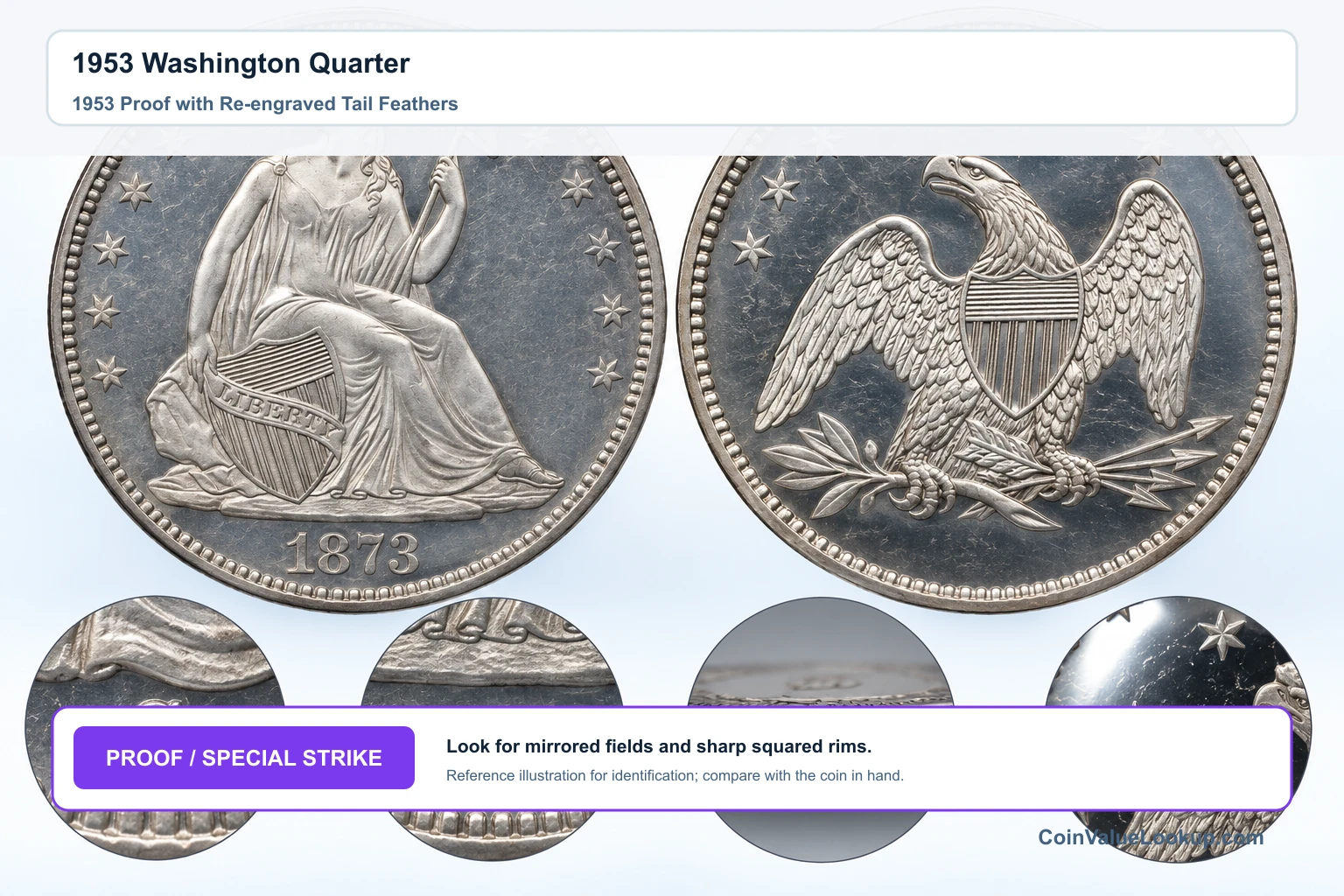
This is a proof-only die variety struck at Philadelphia. The eagle's tail feathers on the reverse show re-engraved raised detail where the die was reworked.
PCGS recognizes this as a distinct variety.
To identify it, compare the tail feather area of your proof against a normal 1953 proof under magnification. The re-engraved lines are die-made and consistent across all coins struck from that die, unlike a random scratch which would be unique to one coin.
A scratch tends to cut into the surface, while re-engraving produces raised, repeated contours.
No reliable numeric price range is available from the supplied references. Value depends on the coin's individual condition, contrast designation and authentication by a recognized grading service.
Range Grade
Price Auction Records Appraisal PR PR 1
—
Coin Identifier
PR 2
—
Coin Identifier
PR 3
—
Coin Identifier
PR 4
—
Coin Identifier
PR 6
—
Coin Identifier
PR 8
—
Coin Identifier
PR 10
—
Coin Identifier
PR 12
—
Coin Identifier
PR 15
—
Coin Identifier
PR 20
—
Coin Identifier
PR 25
—
Coin Identifier
PR 30
—
Coin Identifier
PR 35
—
Coin Identifier
PR 40
—
Coin Identifier
PR 45
—
Coin Identifier
PR 50
—
Coin Identifier
PR 53
—
Coin Identifier
PR 55
—
Coin Identifier
PR 58
—
Coin Identifier
PR 60
—
Coin Identifier
PR 61
—
Coin Identifier
PR 62
Coin Identifier
PR 63
—
Coin Identifier
PR 64
Coin Identifier
PR 65
Coin Identifier
PR 66
Coin Identifier
PR 67
Coin Identifier
PR 68
Coin Identifier
PR 69
—
—
—
PR 70
—
—
—
1953 Washington Quarter Error List
1. 1953 Washington Quarter — Quarter Struck over a Jefferson Nickel
This is a 1953-S Washington quarter struck over a previously struck 1953-S Jefferson nickel. The documented Heritage Auctions specimen, graded ANACS AU58, sold for $2,760 in April 2006.
On the genuine coin, faint traces of Monticello from the nickel's reverse are visible on the quarter's obverse. The nickel's "S" mintmark also appears in the right obverse field, displaced from where the quarter's own design sits.
This is what distinguishes a struck-over-a-nickel error from a quarter struck on a blank nickel planchet, which would show no prior design.
Look out for post-mint alterations like grinding, hammering or glued-on metal that can mimic an overstrike. Genuine double-denomination coins show strike-made surfaces and intact design flow from both denominations.
That single sale is a historical example at one grade, not a guaranteed market value.
2. 1953 Washington Quarter — Curved Clipped Planchet
A curved clipped planchet error occurs when the coin blank is punched from strip metal that overlaps a previously punched hole, leaving a crescent-shaped piece missing before the coin is ever struck. The documented 1953 Philadelphia example weighed 5.89 grams, noticeably below the normal 6.25 grams, and was graded ANACS MS64.
It sold for $79 at Heritage Auctions.
The clip edge will look different from a filed or cut edge. On a genuine clip, the rim tapers and design elements flow toward the missing area rather than stopping abruptly.
Weight alone does not confirm a clip because someone could file metal off a normal coin and produce a similar reading. You need the curved contour, rim thinning and characteristic metal-flow pattern together.
3. 1953 Washington Quarter — Struck on a Five-Cent Planchet
This error happened when a copper-nickel five-cent planchet, weighing about 5.0 grams and smaller in diameter than a quarter, ended up in the quarter press. Because the blank is undersized, outer legends and rim detail can be missing or distorted while the central portrait and eagle remain.
A PCGS MS63 example of a 1953 Philadelphia quarter on a five-cent planchet sold for $720 at Heritage Auctions in September 2024, lot 52400. To confirm this type of error, check the coin's weight, diameter and edge.
Silver color alone is not proof, since a quarter planchet is silver and a nickel planchet is copper-nickel. The struck edge should look genuine rather than filed or ground down.
4. 1953 Washington Quarter — Partial Collar / Uniface Reverse
A partial collar combined with a uniface reverse means the planchet was not properly seated in the collar die during striking. The result is a raised, rail-like ridge along part of the rim from the partial collar, and the reverse may be blank or show minimal detail because only one die fully impressed the metal.
Heritage Auctions sold a 1953 Philadelphia example graded PCGS AU58 for $2,040 in May 2024, lot 5021. That raised partial collar geometry is struck into the coin and distinct from a bent rim or post-mint squeeze.
If you see a smooth, blank reverse paired with a fully struck obverse and a raised collar line, this error is worth having professionally examined.
5. 1953 Washington Quarter — Doubled Die Reverse
A doubled die reverse on the 1953-D quarter involves doubled impressions in the reverse die that produce consistent separation or notching on design elements and lettering. This is reported as a recognized variety for the Denver mint issue.
To check, compare your coin's reverse legends and eagle details against a normal 1953-D under magnification and consistent lighting. Genuine die doubling shows raised, repeated contours that appear on every coin struck from that die.
Machine doubling, by contrast, tends to produce flat, shelf-like distortion and is far less valuable.
No reliable numeric price is available from the supplied references. Value depends on the visibility of the doubling, the coin's overall condition and professional attribution.
6. 1953 Washington Quarter — Doubled Die Obverse
A doubled die obverse is reported for the 1953 Philadelphia quarter. This involves a misaligned hub impression during die production that leaves doubled contours on obverse lettering or design elements.
Examine the obverse letters and date under magnification with angled light. Genuine doubled die obverse features show consistent separation or notching across multiple design elements on the same side.
Machine doubling looks different: it creates flat, shelf-like displacement rather than distinctly raised secondary contours. Worn dies can also blur details, but that produces a mushy look rather than clear doubling.
No reliable numeric price is available from the supplied references. The value of a doubled die obverse depends on the specific die variety, how visible the doubling is and the coin's condition.
Professional attribution is recommended.