1953 Roosevelt Dime Coin Value: How Much Is It Worth?
The 1953 Roosevelt Dime is a 90% silver coin struck across three mints, and even well-worn examples carry a baseline tied to their metal content. Guide estimates place ordinary circulated pieces around $5.81 in G4, while uncirculated MS65 business strikes range from about $14 to $17 depending on the mint.
Philadelphia proofs in PR65 carry a guide estimate near $53. These are grade-specific retail reference points from USA Coin Book, not guaranteed offers, and silver prices shift with the market.
A few varieties and striking errors can push values well beyond those figures, so it pays to look closely at what you have.
Fast Way to Identify Your 1953 Roosevelt Dime
The quickest way to start figuring out what your 1953 dime might be worth is to upload clear photos of both the front and back. Our identifier can give you a preliminary read on mint, finish, and version based on those images.
It will not authenticate, certify, or assign an exact grade, but it narrows down what you are looking at so you know where to dig deeper.
1953 Roosevelt Dime Value
Upload both sides of your 1953 Roosevelt Dime.
Front Obverse
Upload photo
Back Reverse
Upload photo
Which 1953 Roosevelt Dime Versions Are Worth Money?
- Uncirculated examples (MS65 or higher) with strong, fully separated torch bands and original surfaces command the best premiums among business strikes.
- Philadelphia proofs, especially those independently graded with cameo or deep-cameo contrast, sit in a separate price tier above ordinary proof finishes.
- The 1953-D "D Over Sideways D" repunched mintmark is a recognized variety; confirm the rotated underlying D under magnification before applying any premium.
- Striking errors such as clipped planchets combined with broadstrikes, partial collars, and double strikes have been authenticated on 1953 dimes and are individually assessed.
- Die cracks producing raised lines or a "spike head" effect have been documented across all three mints and add collector interest when well-defined.
Step 1: Identify Your 1953 Roosevelt Dime Mint Mark and Version
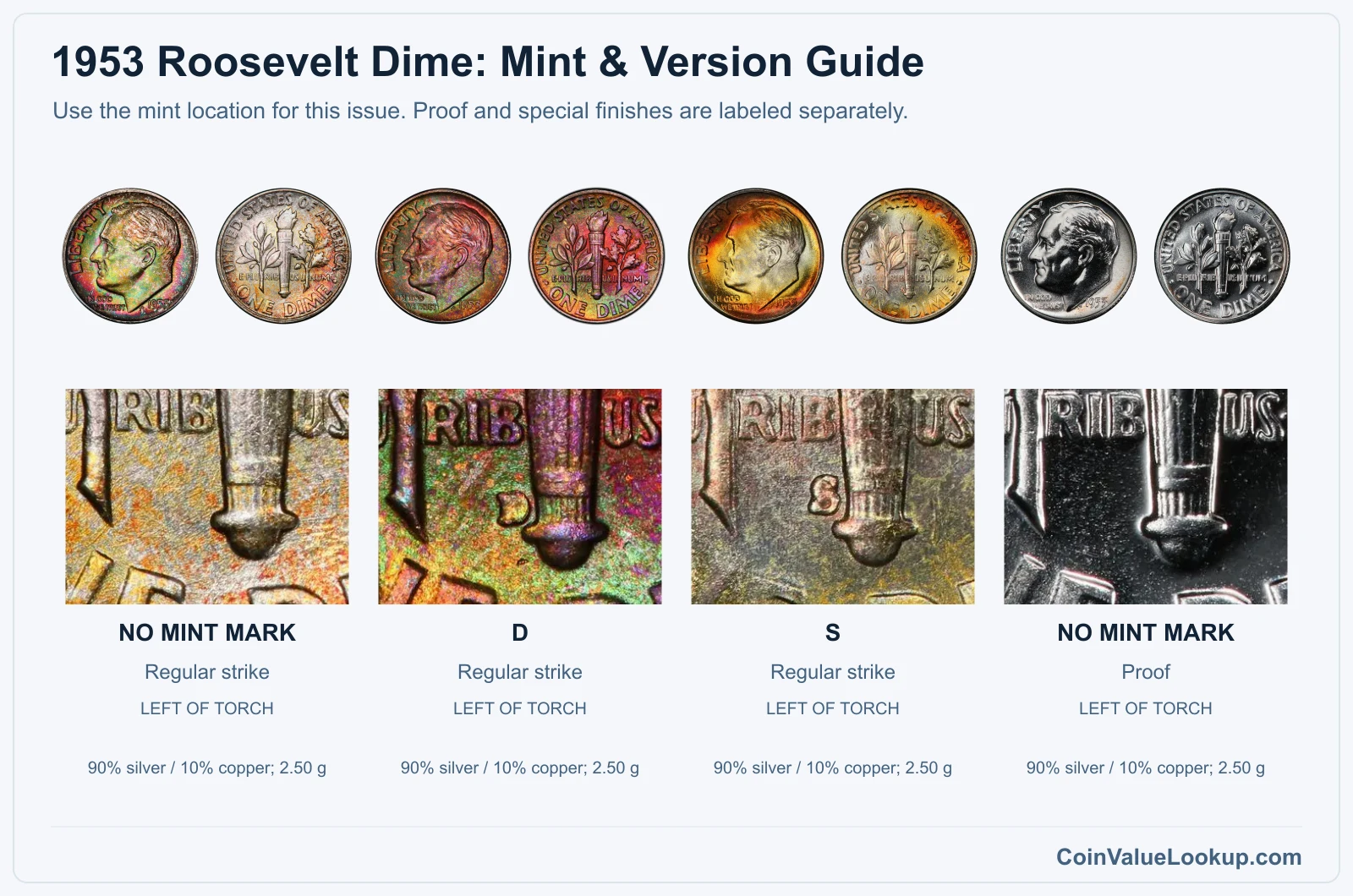
First, confirm you are looking at a Roosevelt portrait on the obverse and a torch flanked by olive and oak branches on the reverse, with the date 1953. All regular 1953 dimes are struck in 90% silver and 10% copper, weighing about 2.50 grams and measuring roughly 17.9 mm across.
There is no clad version for this year.
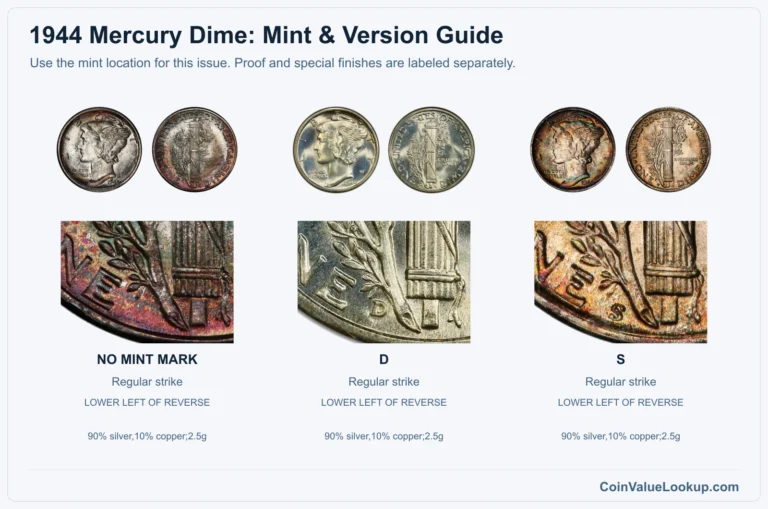
Next, check the reverse near the base of the torch for a mintmark. A "D" means Denver, an "S" means San Francisco, and no mintmark at all means Philadelphia.
The absence of a mintmark is perfectly normal and is not a missing-mintmark error.
If you have a Denver coin, take a closer look at the D under magnification. Some 1953-D dimes show a repunched mintmark where the underlying D was punched sideways before the final upright D was applied.
A routine D mintmark does not carry the variety premium, so do not assume every Denver piece qualifies.
Step 2: Check Your 1953 Roosevelt Dime Grade
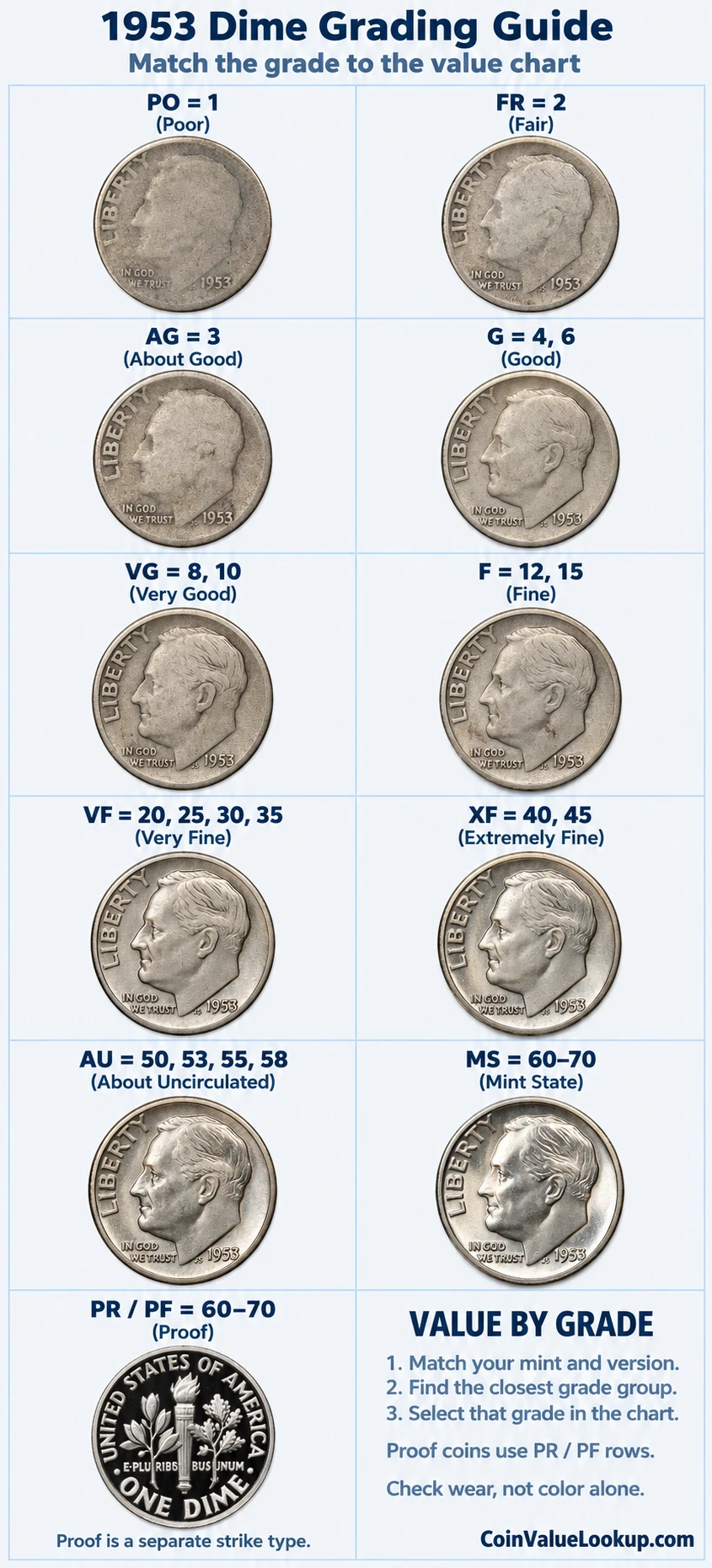
Start on the obverse. Roosevelt's cheekbone, the hair directly above the ear, and the jawline are the first places to lose detail.
Even light wear will flatten the cheekbone highlight and soften the hair strands into a smooth patch.
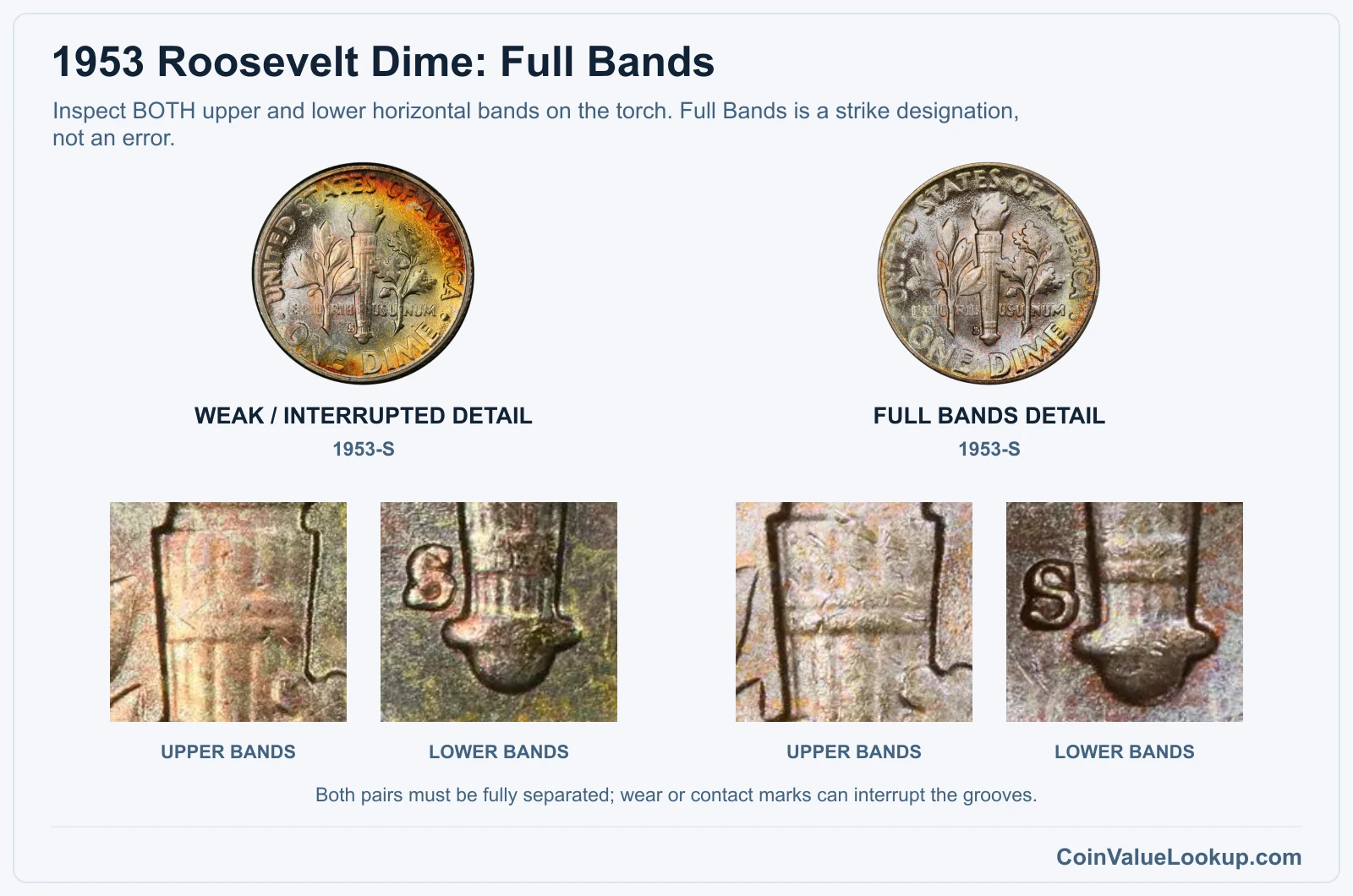
Flip it over and examine the upper torch and the leaves. The horizontal bands across the torch are the key strike indicator.
Full, unbroken separation of both pairs of bands earns the Full Bands designation, which is a strike quality call, not a grade bump.
Do not confuse a weak strike with wear. Some mint-state coins come off the press with mushy torch bands because of die spacing, not because someone spent the coin at a drugstore.
Compare your coin to the reference image for the same grade level.
Original luster matters more than raw shininess. A harshly cleaned coin that gleams like a mirror will grade lower than a slightly toned piece with undisturbed surfaces.
Look for hairlines under a light angled across the fields; they reveal past polishing.
Step 3: Check 1953 Roosevelt Dime Value by Mint and Version
1953 Roosevelt Dime — No Mintmark / Philadelphia
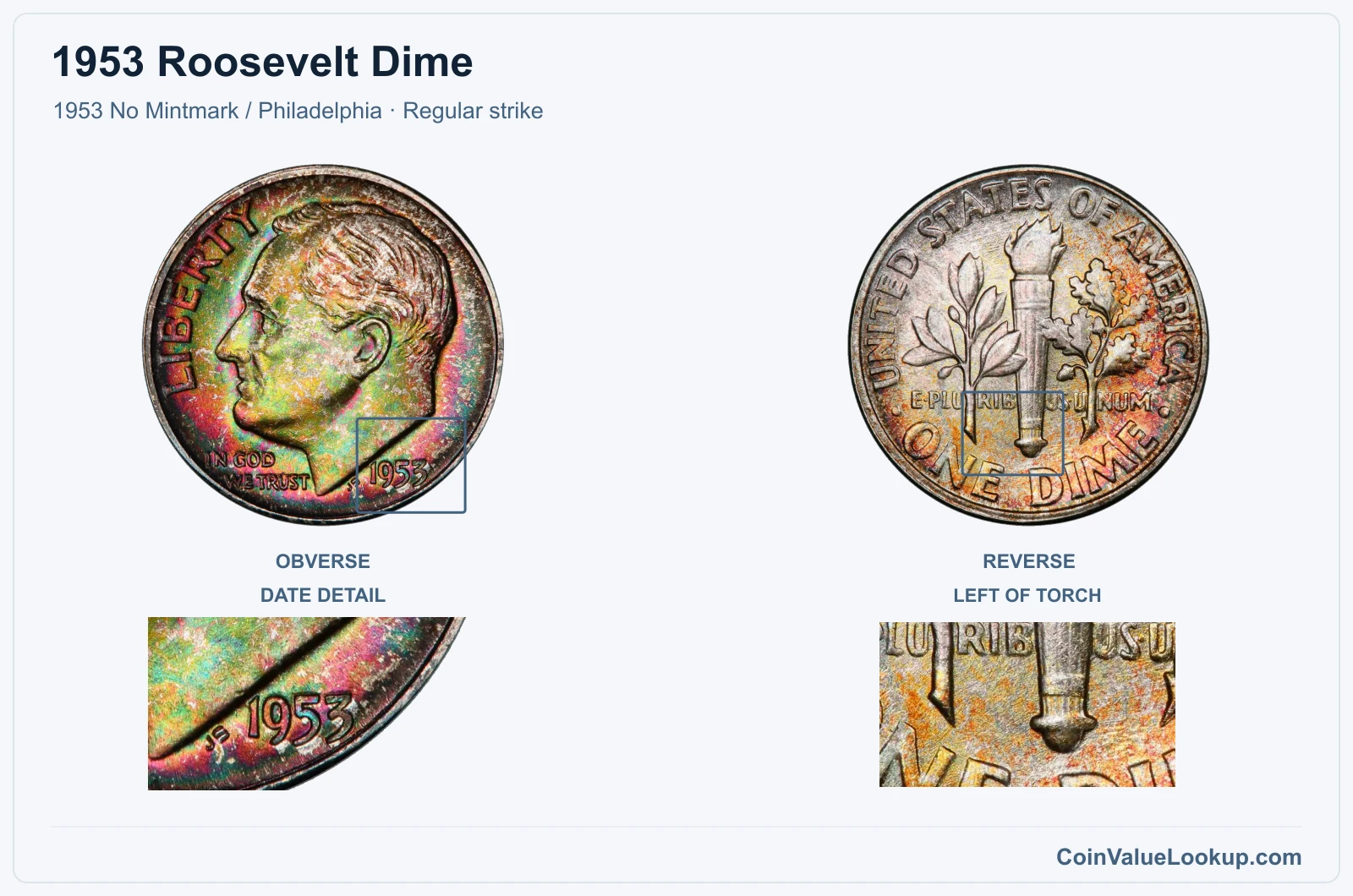
The 1953 Philadelphia dime carries no mintmark, which is standard for this mint. Guide estimates run about $5.81 in G4 and around $14 in MS65.
In circulated grades the coin's value tracks silver content closely, so the spread between Good and Fine is slim.
For uncirculated coins, look for complete luster across both sides and fully separated torch bands. A Full Bands example in a high mint-state grade is a different animal than a typical soft-strike survivor.
Preserve original surfaces; do not clean your coin trying to make it look "better." Cleaned coins are graded lower and sell for less.
Range Grade
Price Auction Records Appraisal PO PO 1
—
Coin Identifier FR FR 2
—
Coin Identifier AG AG 3
—
Coin Identifier G G 4
—
Coin Identifier
G 6
—
Coin Identifier VG VG 8
—
Coin Identifier
VG 10
—
Coin Identifier F F 12
—
Coin Identifier
F 15
—
Coin Identifier VF VF 20
—
Coin Identifier
VF 25
—
Coin Identifier
VF 30
—
Coin Identifier
VF 35
—
Coin Identifier XF XF 40
—
Coin Identifier
XF 45
—
Coin Identifier AU AU 50
—
Coin Identifier
AU 53
—
Coin Identifier
AU 55
—
Coin Identifier
AU 58
—
Coin Identifier MS MS 60
—
Coin Identifier
MS 61
—
Coin Identifier
MS 62
—
Coin Identifier
MS 63
—
Coin Identifier
MS 64
Coin Identifier
MS 65
Coin Identifier
MS 66
Coin Identifier
MS 67
Coin Identifier
MS 68
—
—
—
MS 69
—
—
—
MS 70
—
—
—
1953 Roosevelt Dime — D / Denver
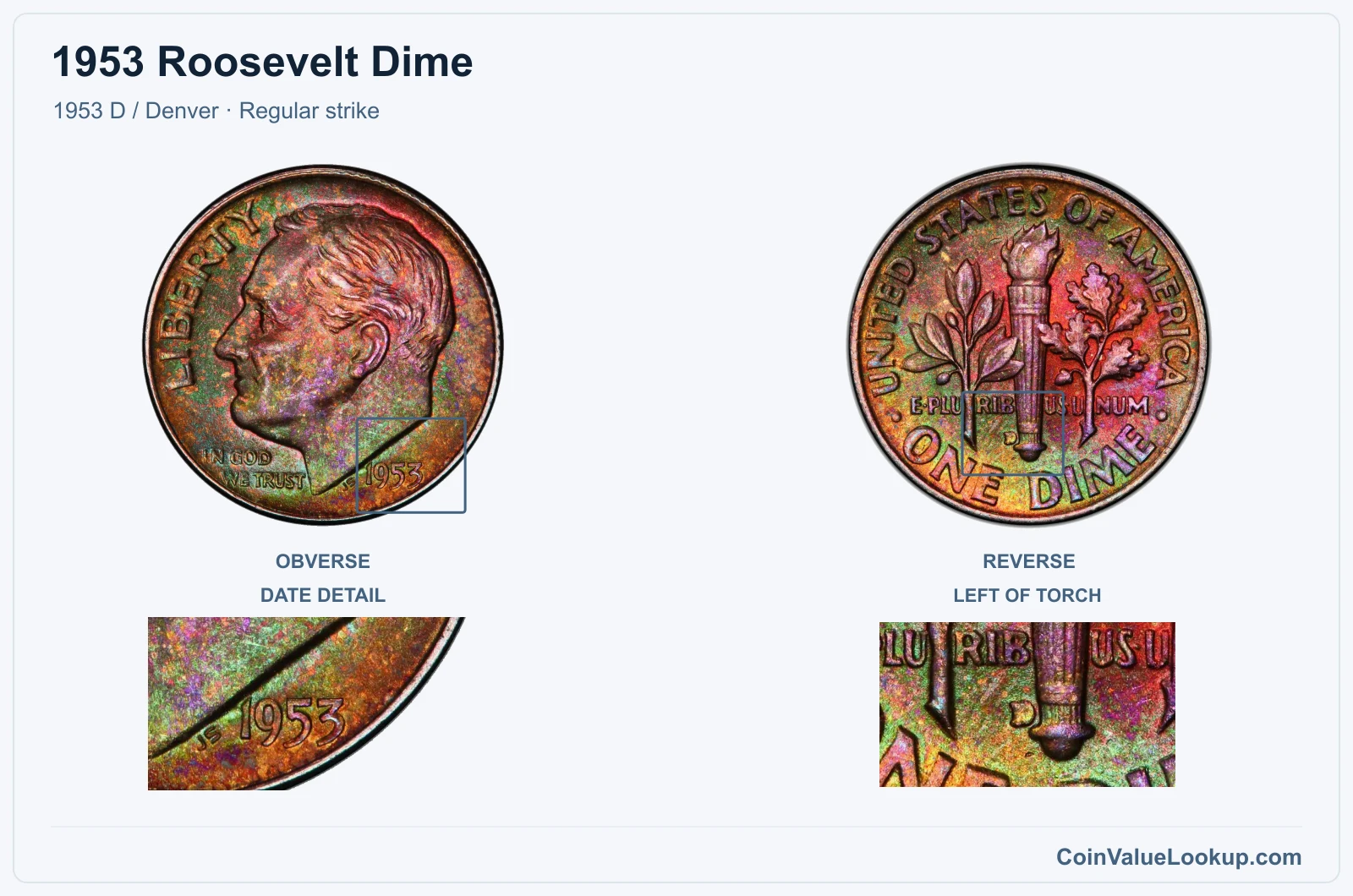
Denver struck a large run of 1953-D dimes, so finding one is not hard. Guide estimates sit at about $5.81 in G4 and roughly $16 in MS65.
The D mintmark appears on the reverse near the torch base.
Here is the thing worth checking: some 1953-D dimes display a repunched mintmark where the original D was punched roughly 90 degrees sideways before the final upright D was applied. That is a recognized variety with its own collector following.
If your D looks perfectly normal under magnification, you have a standard Denver issue. Do not assume every D coin is special.
Coin Value Lookup is a handy starting point if you want to look up guides for other Roosevelt Dime years or different series entirely.
Range Grade
Price Auction Records Appraisal PO PO 1
—
Coin Identifier FR FR 2
—
Coin Identifier AG AG 3
—
Coin Identifier G G 4
—
Coin Identifier
G 6
—
Coin Identifier VG VG 8
—
Coin Identifier
VG 10
—
Coin Identifier F F 12
—
Coin Identifier
F 15
—
Coin Identifier VF VF 20
—
Coin Identifier
VF 25
—
Coin Identifier
VF 30
—
Coin Identifier
VF 35
—
Coin Identifier XF XF 40
—
Coin Identifier
XF 45
—
Coin Identifier AU AU 50
—
Coin Identifier
AU 53
—
Coin Identifier
AU 55
—
Coin Identifier
AU 58
—
Coin Identifier MS MS 60
—
Coin Identifier
MS 61
—
Coin Identifier
MS 62
—
Coin Identifier
MS 63
—
Coin Identifier
MS 64
—
Coin Identifier
MS 65
Coin Identifier
MS 66
Coin Identifier
MS 67
Coin Identifier
MS 68
—
—
—
MS 69
—
—
—
MS 70
—
—
—
1953 Roosevelt Dime — S / San Francisco
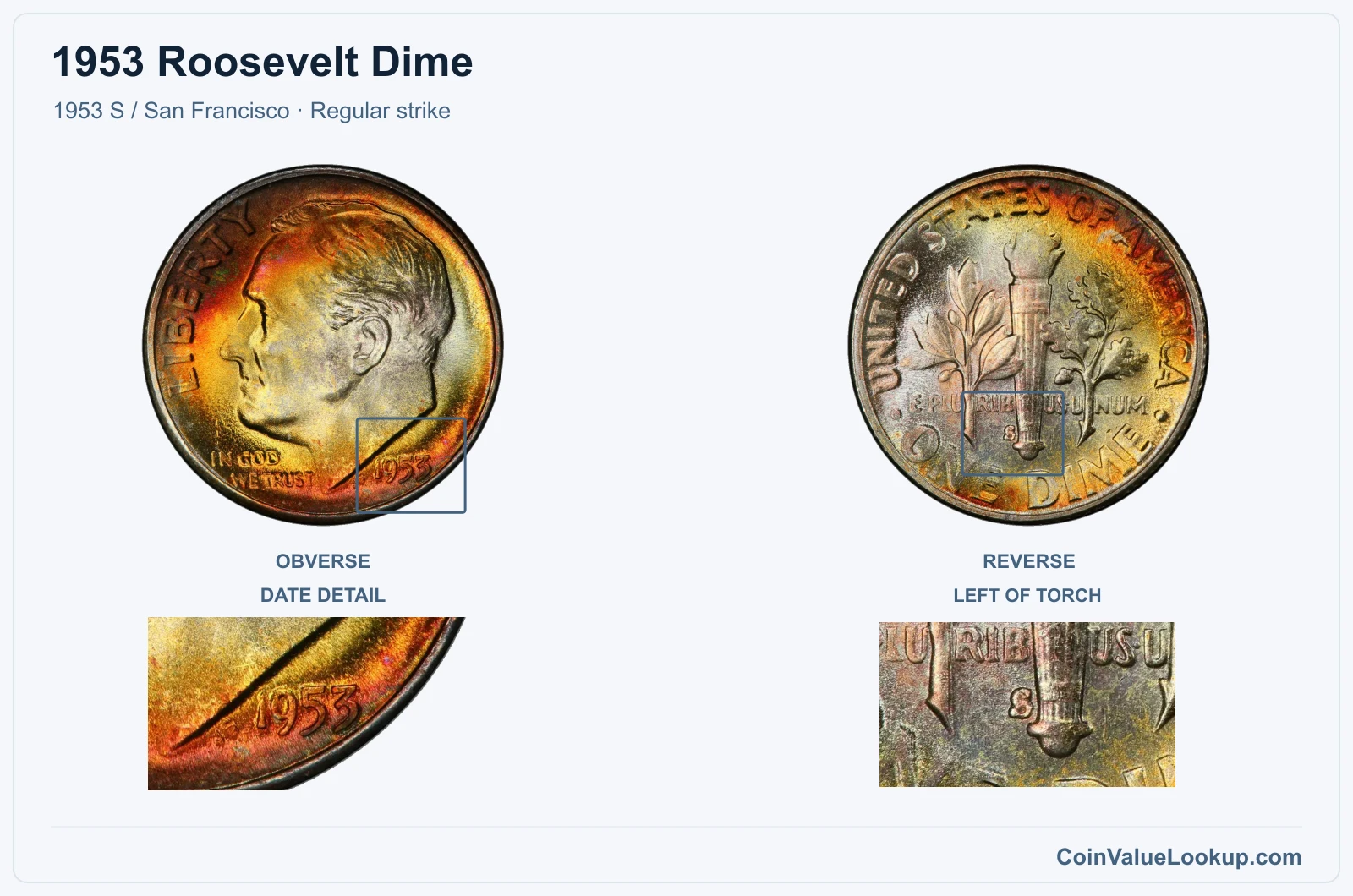
San Francisco's 1953-S dime is the one that edges slightly higher in uncirculated condition, with a guide estimate near $17 in MS65 versus $14–$16 for the other mints. In worn grades, all three mints sit at the same $5.81 floor in G4 because the silver content is identical.
The S mintmark sits in the same reverse location beside the torch. Full Bands examples in high mint state are the coins that draw the most attention from Roosevelt series collectors.
Keep comparisons within the same mint and grade; an MS65 FB from San Francisco is not directly comparable to a Philadelphia proof.
Range Grade
Price Auction Records Appraisal PO PO 1
—
Coin Identifier FR FR 2
—
Coin Identifier AG AG 3
—
Coin Identifier G G 4
—
Coin Identifier
G 6
—
Coin Identifier VG VG 8
—
Coin Identifier
VG 10
—
Coin Identifier F F 12
—
Coin Identifier
F 15
—
Coin Identifier VF VF 20
—
Coin Identifier
VF 25
—
Coin Identifier
VF 30
—
Coin Identifier
VF 35
—
Coin Identifier XF XF 40
—
Coin Identifier
XF 45
—
Coin Identifier AU AU 50
—
Coin Identifier
AU 53
—
Coin Identifier
AU 55
—
Coin Identifier
AU 58
—
Coin Identifier MS MS 60
—
Coin Identifier
MS 61
—
Coin Identifier
MS 62
—
Coin Identifier
MS 63
—
Coin Identifier
MS 64
Coin Identifier
MS 65
Coin Identifier
MS 66
Coin Identifier
MS 67
Coin Identifier
MS 68
Coin Identifier
MS 69
—
—
—
MS 70
—
—
—
1953 Roosevelt Dime — Philadelphia Proof (No Mintmark)
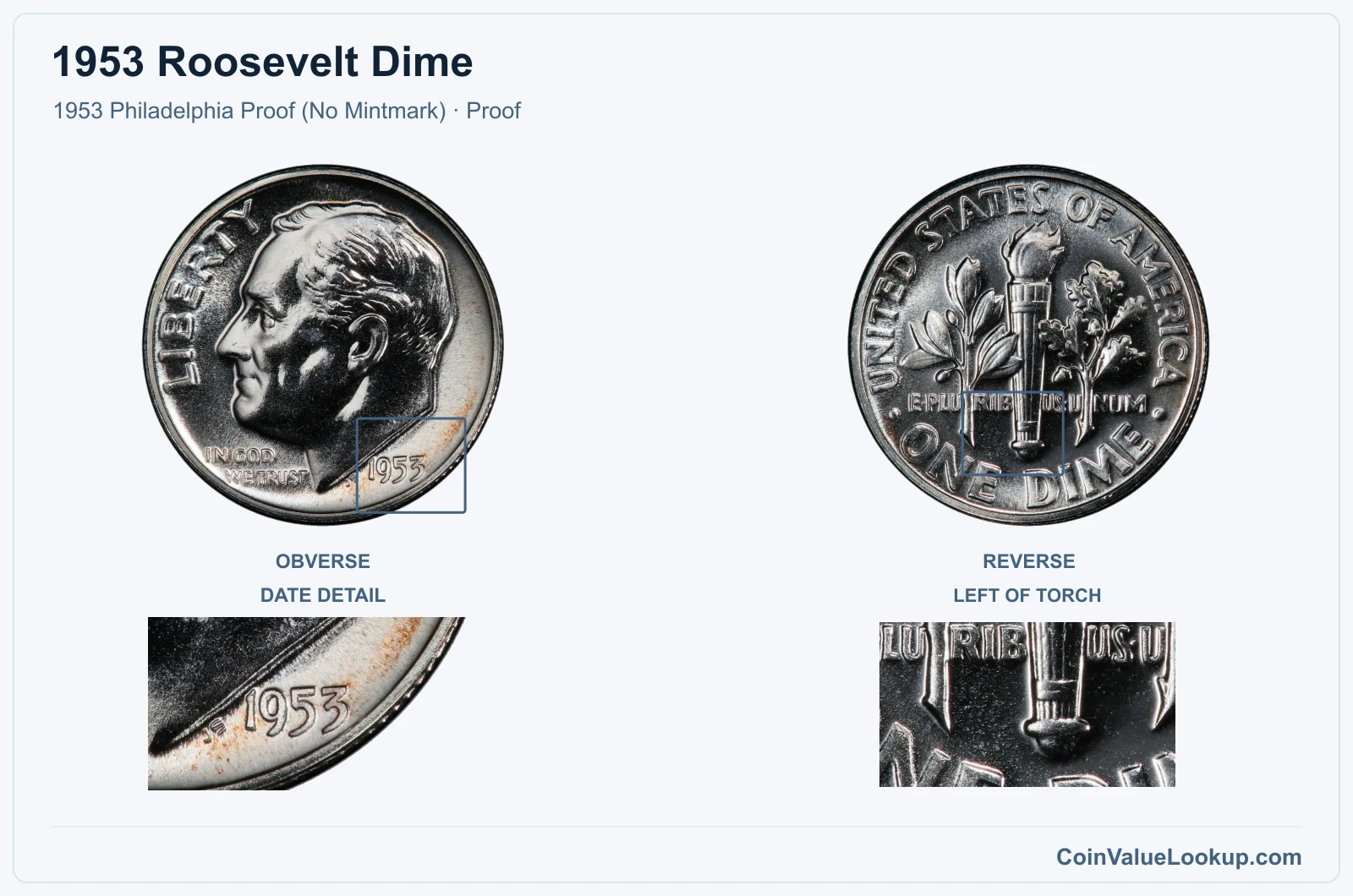
Philadelphia produced proof Roosevelt Dimes beginning in 1950, and the 1953 issue continues that tradition. These coins feature mirrored fields, squared rims, and sharply detailed devices struck from specially prepared dies.
A PR65 example carries a guide estimate of about $53.
That $53 figure applies to a standard brilliant proof without cameo contrast. Independently graded cameo or deep-cameo proofs, where frosted devices stand against mirror fields, occupy a separate and higher price tier.
Do not apply the ordinary PR65 value to those designations.
A proof is a manufacturing method, not a grade above mint state. Proof coins are graded on their own PR scale, and condition problems like hairlines or haze still lower the number.
Range Grade
Price Auction Records Appraisal PR PR 1
—
Coin Identifier
PR 2
—
Coin Identifier
PR 3
—
Coin Identifier
PR 4
—
Coin Identifier
PR 6
—
Coin Identifier
PR 8
—
Coin Identifier
PR 10
—
Coin Identifier
PR 12
—
Coin Identifier
PR 15
—
Coin Identifier
PR 20
—
Coin Identifier
PR 25
—
Coin Identifier
PR 30
—
Coin Identifier
PR 35
—
Coin Identifier
PR 40
—
Coin Identifier
PR 45
—
Coin Identifier
PR 50
—
Coin Identifier
PR 53
—
Coin Identifier
PR 55
—
Coin Identifier
PR 58
—
Coin Identifier
PR 60
—
Coin Identifier
PR 61
—
Coin Identifier
PR 62
—
Coin Identifier
PR 63
Coin Identifier
PR 64
Coin Identifier
PR 65
Coin Identifier
PR 66
Coin Identifier
PR 67
Coin Identifier
PR 68
Coin Identifier
PR 69
Coin Identifier
PR 70
—
—
—
1953 Roosevelt Dime Error List
1. 1953 Roosevelt Dime — Clipped Planchet and Broadstrike
This error combines two separate minting mishaps on a single 1953-S dime. The planchet entered the press missing roughly one-fifth of its metal, creating the characteristic curved clip.
Then the coin was struck outside the restraining collar, so the metal spread outward without the normal rim and reeding.
A Heritage Auctions specimen, Lot 91700, was certified by PCGS at MS66, confirming both the clipped planchet and broadstrike on one coin. Because two distinct error types are present, the piece is assessed individually based on the authenticated identity, condition, and severity of each feature.
To avoid misidentification, compare against a coin that is only clipped or only broadstruck. Post-mint damage such as cutting or deliberate flattening can mimic these features.
If the clip edge is straight rather than curved, that is a red flag for alteration.
2. 1953 Roosevelt Dime — Partial Collar
A partial collar error happens when the coin is not fully seated in the collar die during striking. Part of the edge gets normal reeding while the rest expands outward, creating a visible shoulder or step between the two zones.
On a 1953-S example, Heritage Auctions Lot 91701 was graded NGC MS64 Full Bands with this error confirmed. The key diagnostic is the edge itself.
A straight-on photo of the obverse may hide the error entirely, so always examine the coin's edge under good light.
Do not confuse a partial collar with normal edge reeding that has minor dents, or a rim that got bent after leaving the mint. A genuine partial collar shows a clean geometric transition between the reeded and expanded portions.
Value depends on how dramatic the collar shift is, the coin's overall condition, and third-party authentication.
3. 1953 Roosevelt Dime — D Over a Sideways D
The 1953-D "D Over Sideways D" is a repunched mintmark variety. Under magnification you can see remnants of a D punched approximately 90 degrees from vertical lurking beneath the final upright D.
The horizontal letter's serifs or curves protrude at the sides of the corrected mintmark.
A PCGS MS64 Full Bands example has been documented through GreatCollections with the sideways underlying D confirmed. This is a die variety, not a striking error, and it requires careful magnification to verify.
What it is not: a scratch running through the mintmark area, a shadow from die deterioration, or ordinary shelf doubling from a worn die. Those are common lookalikes.
The genuine variety shows a coherent second D rotated roughly perpendicular to the final punch. Pricing depends on individual assessment of the coin's grade, Full Bands status, and how clearly the underlying D shows.
4. 1953 Roosevelt Dime — Die Cracks / Spike Head
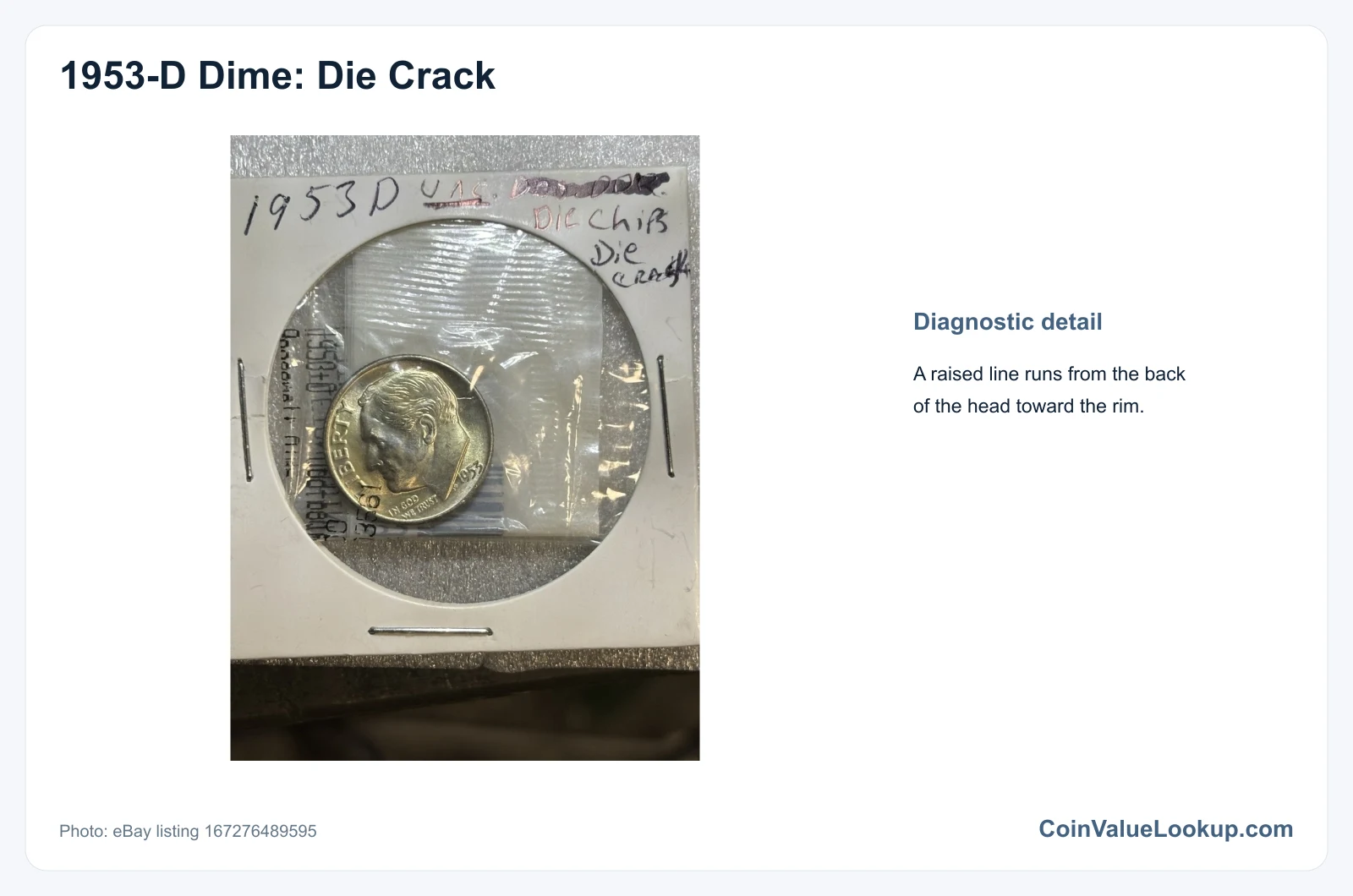
Die cracks show up as thin raised lines on the coin's surface, running from the rim toward or across design elements. On 1953 Roosevelt Dimes, documented examples exist for Philadelphia, Denver, and San Francisco business strikes.
The most dramatic version sends a raised line from the rim into Roosevelt's head, producing a "spike head" effect.
These lines are raised because metal fills the crack in the die during striking. That is the opposite of a scratch, which is incuse, meaning cut into the surface.
If you see a thin line that sits below the coin's surface, it is damage, not a die crack.
Do not count every crack path on one coin as a separate error. Multiple cracks from the same deteriorating die are one coin with die cracks, not five errors stacked together.
Value varies with the crack's prominence and the coin's grade, assessed individually by authenticated identity and condition.
5. 1953 Roosevelt Dime — Double Strike with Off-Center Second Strike
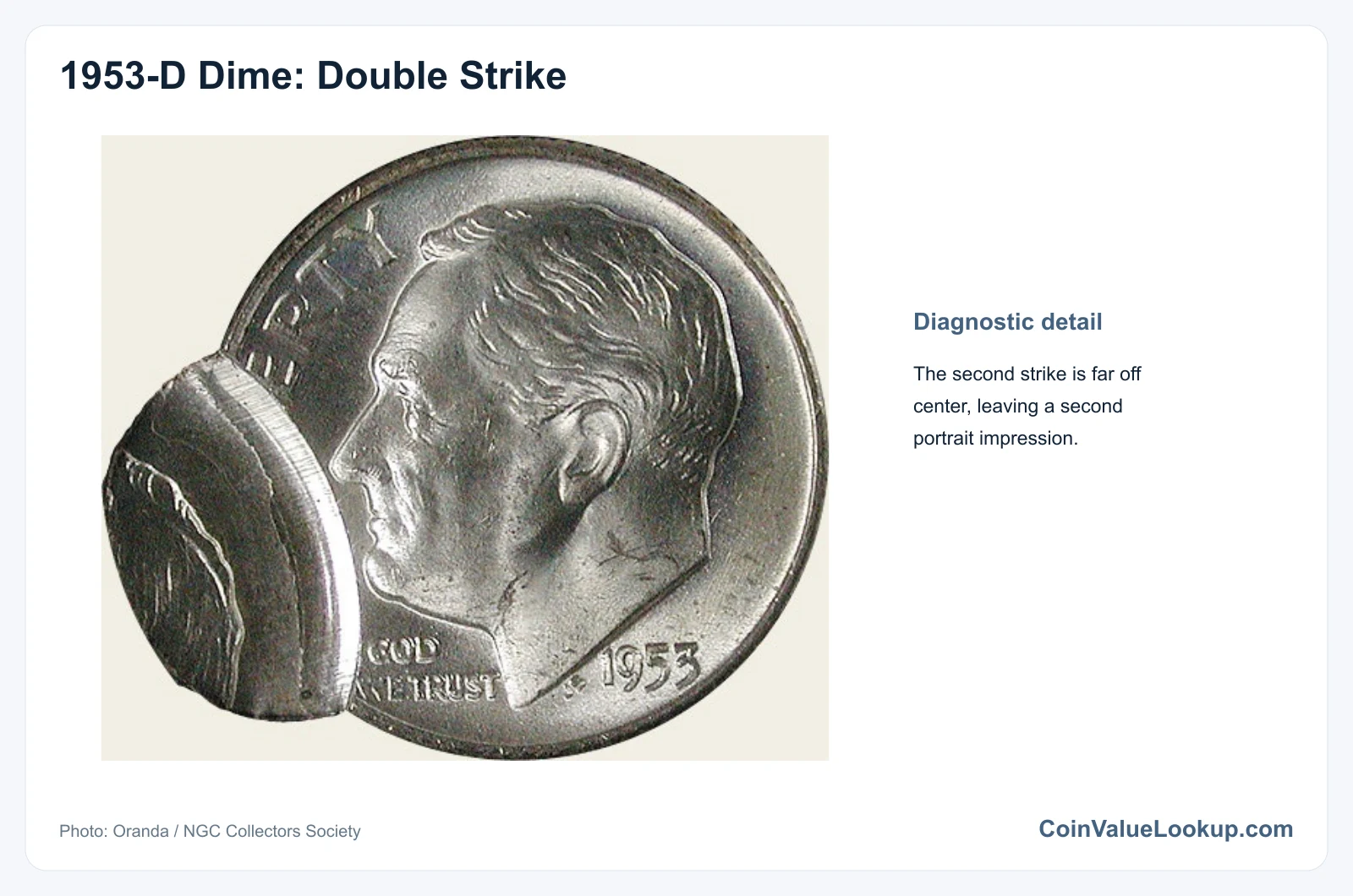
A double-struck 1953-D dime is a dramatic error. The documented example, certified NGC MS64, shows a second Roosevelt portrait struck about 75 percent off center from the first, with a uniface reverse on the second strike.
Both the date and D mintmark remain visible on the normally struck portion.
This is not the same as a doubled die, where a single strike transfers a slightly shifted image from a defective die. A genuine double strike physically moves the planchet between two full impressions of the press.
The result is two distinct, overlapping portraits rather than slightly thickened lettering.
Also rule out a coin that was pressed against another coin after leaving the mint, which produces a faint incuse mirror image rather than a second full raised strike. Pricing is individual, based on the severity of the off-center shift, overall condition, and third-party authentication.