1955 Washington Quarter Coin Value: How Much Is It Worth?
A 1955 Washington quarter in circulated condition carries a guide estimate starting around $16.43, reflecting its 90% silver content and collector demand. Mint State examples from Philadelphia or Denver can reach guide values in the range of $39 to $58 at the MS65 level, depending on the mint.
Condition matters enormously, and authenticated errors or proof strikes sit outside those ordinary ranges. All values are in USD and fluctuate with the silver market and numismatic demand.
Fast Way to Identify Your 1955 Washington Quarter
Snap a clear photo of both sides of your 1955 quarter and upload them here. That gives us a starting point for preliminary identification — which mint struck it, whether it is a business strike or proof, and any obvious variety features.
It is not a substitute for professional authentication, but it helps you figure out what you are holding before you take the next step.
1955 Washington Quarter Value
Upload both sides of your 1955 Washington Quarter.
Front Obverse
Upload photo
Back Reverse
Upload photo
Which 1955 Washington Quarter Versions Are Worth Money?
- The 1955-D quarter in MS65 condition carries the highest guide estimate among regular issues at $58, partly because Denver's lower production makes original, high-grade survivors scarcer.
- A 1955 Philadelphia proof in PR65 lists at a $39 guide estimate — original mirrored surfaces with minimal hairlines are the key to value.
- Authenticated clipped planchet errors on 1955 quarters have appeared at auction, and while individual prices are hard to pin down, confirmed examples attract specialized collectors.
- A documented Doubled Die Obverse variety (WDDO-001) exists for the 1955 quarter; value depends on the strength of the doubling and the coin's condition.
- Repunched mintmark varieties are reported on the 1955-D quarter, where traces of a second punch position are visible near the D mintmark.
Step 1: Identify Your 1955 Washington Quarter Mint Mark and Version
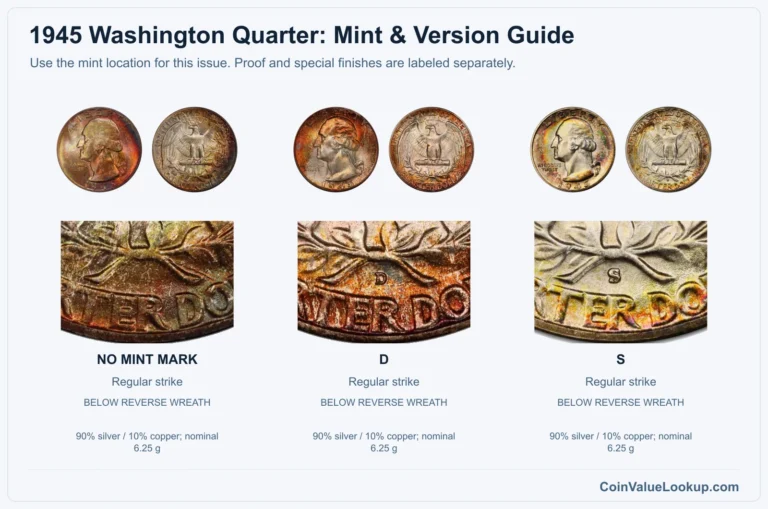
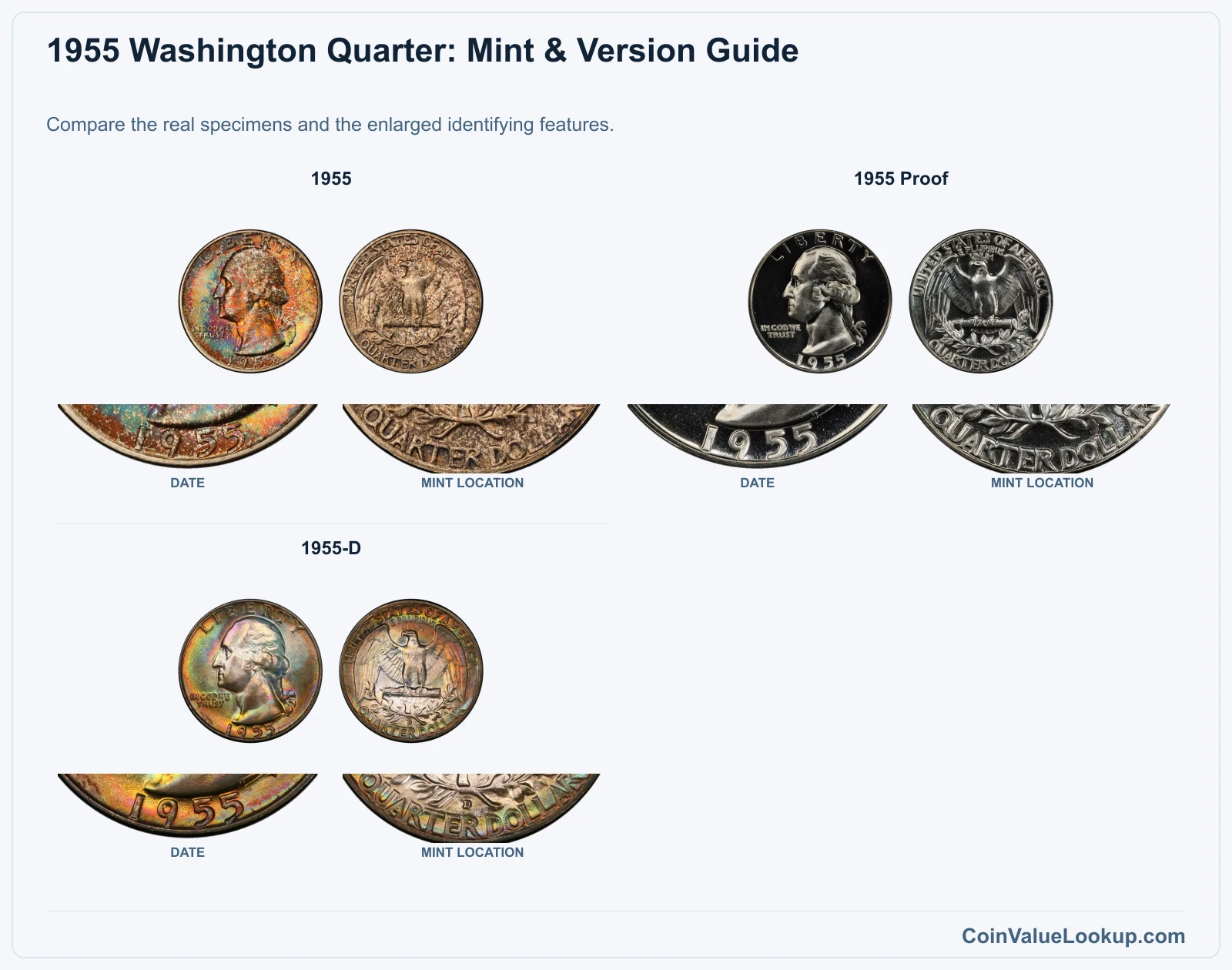
Look at the obverse for the date below Washington's bust. Flip the coin over and check directly beneath the wreath on the reverse for a mintmark.
A "D" means Denver. No mintmark at all means Philadelphia — that is completely normal for this era, not a sign of an error.
The 1955 quarter comes in just two business-strike versions (Philadelphia and Denver) plus a Philadelphia proof. There is no San Francisco issue this year, so do not go hunting for an "S" mintmark.
All versions are struck in 90% silver and 10% copper, weigh about 6.25 grams, and measure roughly 24.3 millimeters across. If your coin feels unusually light or has a copper-colored edge stripe, it may not be genuine silver — worth investigating further.
To distinguish a proof from a business strike, look at the fields (flat background areas). Proofs have deeply mirrored, reflective surfaces and sharply defined design elements produced by a special manufacturing process.
A business strike may be lustrous in high grade, but it will not show that glassy mirror finish.
Step 2: Check Your 1955 Washington Quarter Grade
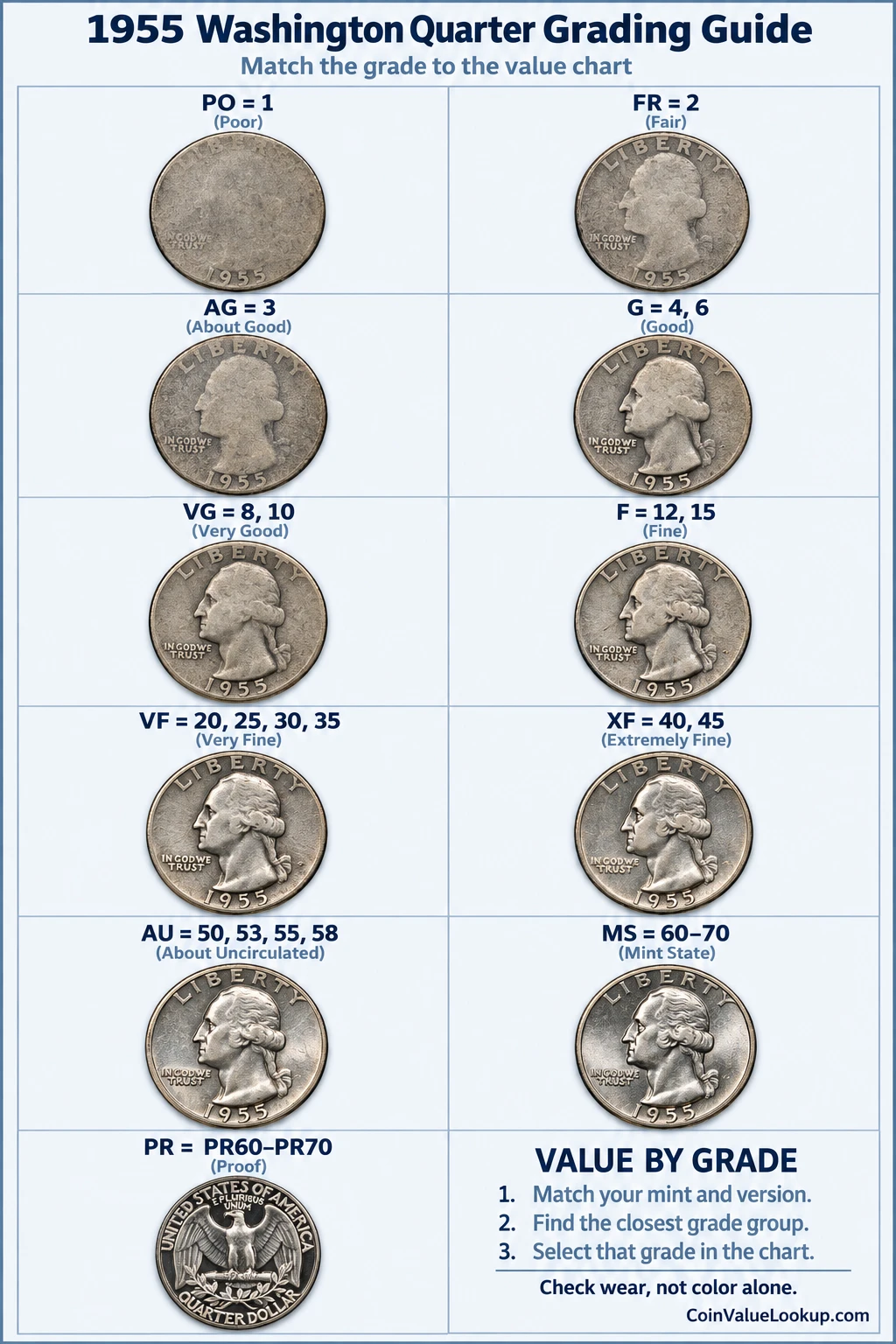
Start on the obverse. Washington's cheek and jawline pick up friction first, so check those areas for any dullness or smoothing.
The hair directly above the ear is another early-wear zone — in higher grades, individual strands remain sharp and distinct.
On the reverse, examine the eagle's breast feathers and wingtips. These high points lose detail quickly in circulation.
Compare what you see against the reference image.
Do not confuse a weakly struck coin with a worn one. A weak strike shows soft detail but retains unbroken luster across the surface.
Wear, by contrast, interrupts the luster and creates flat, dull patches.
Also look for cleaning hairlines under good light — fine parallel scratches from someone polishing the coin years ago. Contact marks (bag marks from jostling against other coins at the mint) are normal on business strikes but can limit the grade.
Rim dings and edge damage count against condition too.
Proof coins get their own grading scale (PR rather than MS). A proof designation describes how the coin was made, not that it is somehow better than Mint State.
A scratched-up proof can grade lower than a pristine business strike.
Step 3: Check 1955 Washington Quarter Value by Mint and Version
1955 Washington Quarter
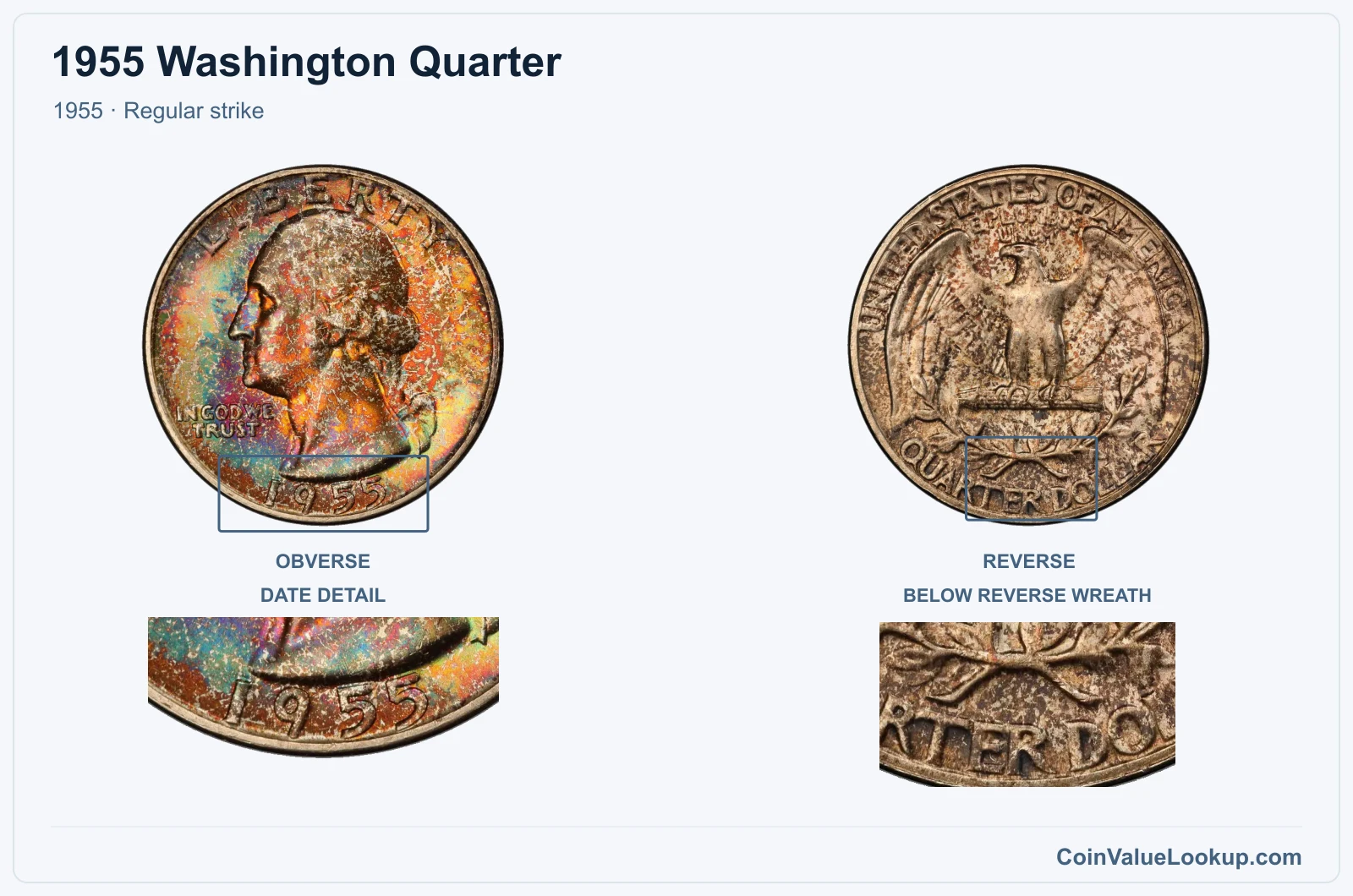
The 1955 Philadelphia quarter has no mintmark — look below the wreath on the reverse and you will see a blank space. That is exactly how it left the mint.
In well-worn condition (G4), the USA Coin Book guide places this coin at about $16.43. Step up to MS60 — lightly handled but uncirculated — and the estimate is around $20.
At MS65, where full original luster and minimal contact marks are present, the guide estimate is $39.
These are 90% silver coins weighing roughly 6.25 grams, so the silver melt value provides a price floor. What pushes a coin above melt is original, undamaged surfaces and sharp detail.
Do not confuse this business strike with the 1955 proof, which shares the same mint and lack of mintmark but has a distinct mirrored finish.
| Range | Grade | Price | Auction Records | Appraisal |
|---|---|---|---|---|
| PO | PO 1 | — | Coin Identifier | |
| FR | FR 2 | — | Coin Identifier | |
| AG | AG 3 | — | Coin Identifier | |
| G | G 4 | — | Coin Identifier | |
| G 6 | — | Coin Identifier | ||
| VG | VG 8 | — | Coin Identifier | |
| VG 10 | — | Coin Identifier | ||
| F | F 12 | — | Coin Identifier | |
| F 15 | — | Coin Identifier | ||
| VF | VF 20 | — | Coin Identifier | |
| VF 25 | — | Coin Identifier | ||
| VF 30 | — | Coin Identifier | ||
| VF 35 | — | Coin Identifier | ||
| XF | XF 40 | — | Coin Identifier | |
| XF 45 | — | Coin Identifier | ||
| AU | AU 50 | — | Coin Identifier | |
| AU 53 | — | Coin Identifier | ||
| AU 55 | — | Coin Identifier | ||
| AU 58 | — | Coin Identifier | ||
| MS | MS 60 | — | Coin Identifier | |
| MS 61 | — | Coin Identifier | ||
| MS 62 | — | Coin Identifier | ||
| MS 63 | Coin Identifier | |||
| MS 64 | Coin Identifier | |||
| MS 65 | Coin Identifier | |||
| MS 66 | Coin Identifier | |||
| MS 67 | Coin Identifier | |||
| MS 68 | — | — | — | |
| MS 69 | — | — | — | |
| MS 70 | — | — | — |
1955 Washington Quarter — Proof
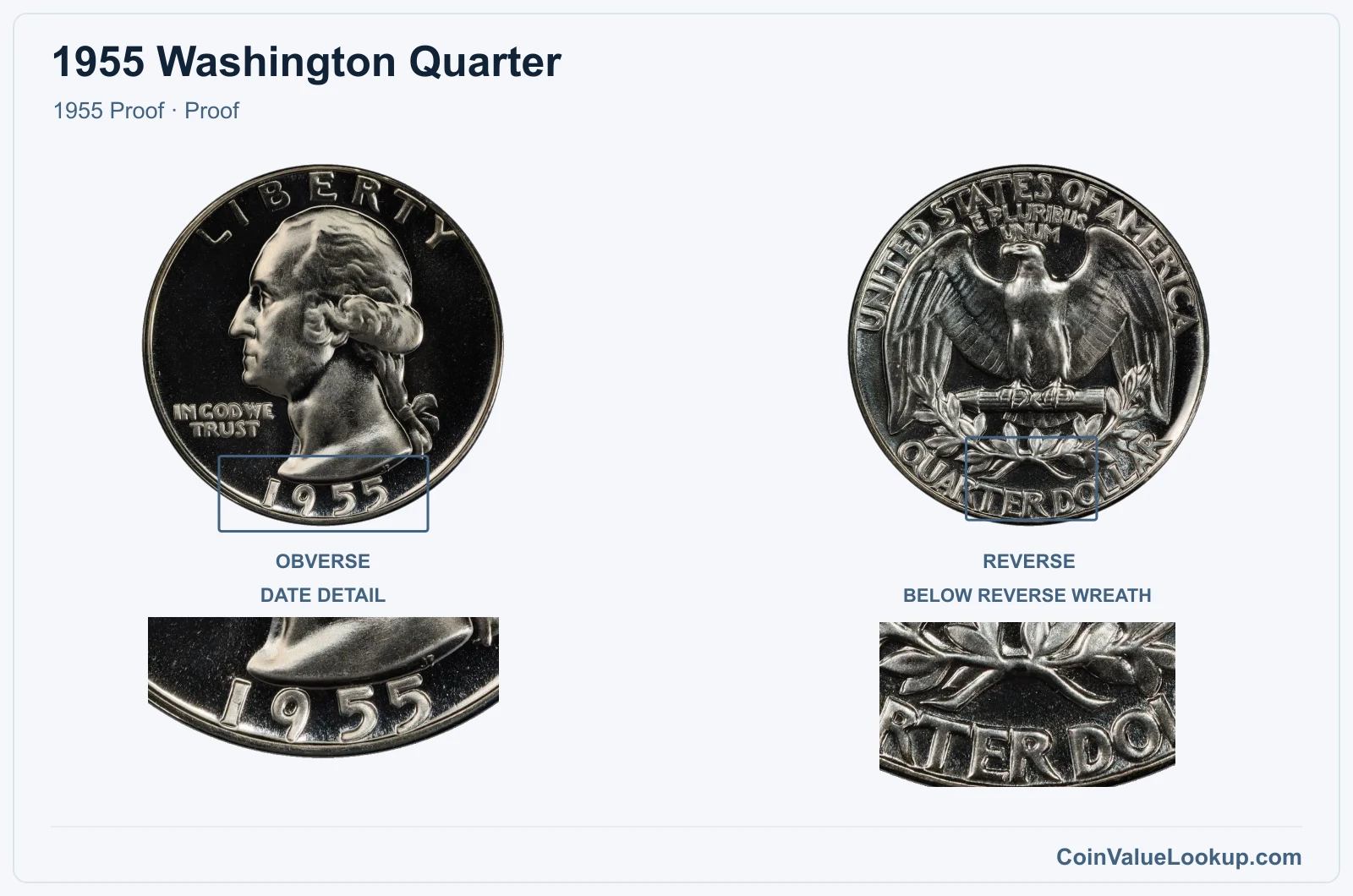
The 1955 proof quarter was struck at Philadelphia using specially prepared dies and polished planchets, producing mirror-like fields and crisp design edges. Like the business strike, it carries no mintmark.
At PR65, the USA Coin Book guide estimate is $39. Proof grading focuses on hairlines, haze and contact marks rather than wear — these coins were not intended for circulation.
Coin Value Lookup is a handy starting point when you want to look up guides for other dates and denominations in the Washington quarter series.
The proof and the business strike share the same 90% silver, 10% copper composition and Washington/eagle design, but a side-by-side comparison reveals the difference immediately. If your coin has deep, glassy reflections in the fields, you likely have the proof version.
| Range | Grade | Price | Auction Records | Appraisal |
|---|---|---|---|---|
| PR | PR 1 | — | Coin Identifier | |
| PR 2 | — | Coin Identifier | ||
| PR 3 | — | Coin Identifier | ||
| PR 4 | — | Coin Identifier | ||
| PR 6 | — | Coin Identifier | ||
| PR 8 | — | Coin Identifier | ||
| PR 10 | — | Coin Identifier | ||
| PR 12 | — | Coin Identifier | ||
| PR 15 | — | Coin Identifier | ||
| PR 20 | — | Coin Identifier | ||
| PR 25 | — | Coin Identifier | ||
| PR 30 | — | Coin Identifier | ||
| PR 35 | — | Coin Identifier | ||
| PR 40 | — | Coin Identifier | ||
| PR 45 | — | Coin Identifier | ||
| PR 50 | — | Coin Identifier | ||
| PR 53 | — | Coin Identifier | ||
| PR 55 | — | Coin Identifier | ||
| PR 58 | — | Coin Identifier | ||
| PR 60 | — | Coin Identifier | ||
| PR 61 | — | Coin Identifier | ||
| PR 62 | — | Coin Identifier | ||
| PR 63 | — | Coin Identifier | ||
| PR 64 | Coin Identifier | |||
| PR 65 | Coin Identifier | |||
| PR 66 | Coin Identifier | |||
| PR 67 | Coin Identifier | |||
| PR 68 | Coin Identifier | |||
| PR 69 | Coin Identifier | |||
| PR 70 | — | — | — |
1955 Washington Quarter — D
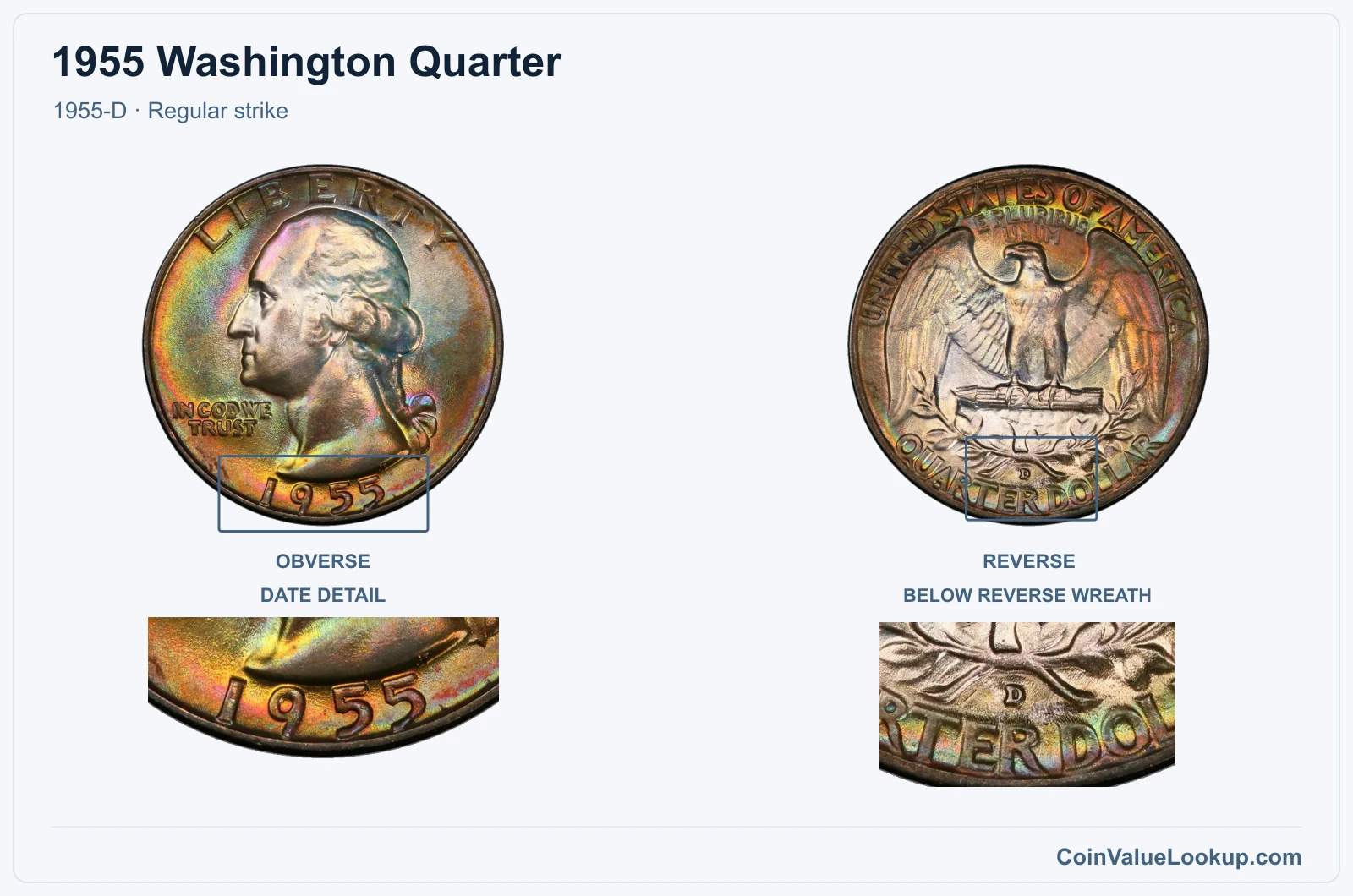
The 1955-D quarter carries a small "D" mintmark below the wreath on the reverse, confirming it was struck at the Denver Mint. Denver's production run was lower than Philadelphia's this year.
That said, lower mintage alone does not guarantee a large premium in circulated grades. At G4, the USA Coin Book guide estimate is about $16.43 — the same as the Philadelphia issue.
At MS60, it rises to roughly $20.
Where the Denver coin pulls ahead is in gem condition. An MS65 example carries a guide estimate of $58, the highest among regular 1955 quarter issues.
Finding one with full, original mint luster, clean surfaces and sharp strike detail is the challenge. Most survivors show bag marks or light friction that keep them below that level.
| Range | Grade | Price | Auction Records | Appraisal |
|---|---|---|---|---|
| PO | PO 1 | — | Coin Identifier | |
| FR | FR 2 | — | Coin Identifier | |
| AG | AG 3 | — | Coin Identifier | |
| G | G 4 | — | Coin Identifier | |
| G 6 | — | Coin Identifier | ||
| VG | VG 8 | — | Coin Identifier | |
| VG 10 | — | Coin Identifier | ||
| F | F 12 | — | Coin Identifier | |
| F 15 | — | Coin Identifier | ||
| VF | VF 20 | — | Coin Identifier | |
| VF 25 | — | Coin Identifier | ||
| VF 30 | — | Coin Identifier | ||
| VF 35 | — | Coin Identifier | ||
| XF | XF 40 | — | Coin Identifier | |
| XF 45 | — | Coin Identifier | ||
| AU | AU 50 | — | Coin Identifier | |
| AU 53 | — | Coin Identifier | ||
| AU 55 | — | Coin Identifier | ||
| AU 58 | — | Coin Identifier | ||
| MS | MS 60 | — | Coin Identifier | |
| MS 61 | — | Coin Identifier | ||
| MS 62 | — | Coin Identifier | ||
| MS 63 | Coin Identifier | |||
| MS 64 | Coin Identifier | |||
| MS 65 | Coin Identifier | |||
| MS 66 | Coin Identifier | |||
| MS 67 | Coin Identifier | |||
| MS 68 | — | — | — | |
| MS 69 | — | — | — | |
| MS 70 | — | — | — |
1955 Washington Quarter Error List
1. 1955 Washington Quarter — Straight Clipped Planchet
A straight clipped planchet occurs when a portion of the blank is sheared off along a straight line before the coin is struck. On a genuine example, the design and rim trail off toward the flat missing edge, and the remaining metal shows natural strike flow rather than tool marks.
One documented 1955 Philadelphia quarter with a straight clip was attributed by ANACS at MS63 and weighed 6.07 grams — lighter than the standard 6.25 grams, which is consistent with missing metal. It appeared in a Heritage Auctions lot of three clipped quarters that sold together for $51 in July 2021, so no individual price for the 1955 coin can be isolated from that sale.
Watch out for coins that have been cut, ground or filed after leaving the mint. A genuine clip will show undisturbed strike characteristics where the metal meets the missing area, while a post-mint alteration typically leaves sharp tool marks, disturbed surfaces or an unnatural edge profile.
2. 1955 Washington Quarter — Curved Clipped Planchet
A curved clipped planchet shows an arc-shaped portion of metal missing, caused when the punch overlaps a previously punched area of the strip before striking. If the clip is large enough, you may see Blakesley weakness — a soft area on the rim directly opposite the clip where metal could not flow fully during striking.
A 1955 Philadelphia quarter with a curved clip is documented in Heritage Auctions archive lot 91873, grouped with other clipped quarters. Because it sold in a multi-coin lot, no standalone price is available.
To tell a genuine clip from a fake, inspect the edge where the missing area meets the remaining coin. Genuine clips show natural metal flow and an intact (though fading) rim.
Post-mint alterations — filing, cutting or grinding — leave sharp edges, tool marks and disturbed surfaces that do not match what the die would produce.
3. 1955 Washington Quarter — Repunched Mintmark
Repunched mintmark varieties on the 1955-D quarter show traces of the "D" mintmark in more than one position. This happened when a mint worker punched the mintmark into the working die, then repositioned and struck again, leaving a ghost or partial outline of the first impression.
Under magnification, look for a secondary outline, notching or thickening on one side of the D that is not present on normal strikes. Compare your coin's mintmark to a known normal example at the same magnification and lighting — differences become obvious quickly.
Do not confuse a repunched mintmark with machine doubling, which produces a flat shelf with no raised profile. Die chips or corrosion near the mintmark can also mimic the appearance.
Value depends on the visibility of the repunching and the coin's overall condition; no specific price range is available for these varieties.
4. 1955 Washington Quarter — Doubled Die Obverse
A Doubled Die Obverse variety has been reported for the 1955 quarter, cataloged as WDDO-001. Doubled dies are created during the die-making process when a hub impression is slightly misaligned on a second press, transferring a doubled image into the die itself.
Every coin struck from that die then carries the same doubling.
To check your coin, examine obverse lettering — especially "LIBERTY" and "IN GOD WE TRUST" — under magnification. Genuine hub doubling shows consistent separation or notching on affected elements, and it will appear in the same position on every specimen from that die.
Machine doubling is the common lookalike and is far less valuable. It produces a flat, shelf-like distortion without the raised, distinct secondary image that true hub doubling shows.
Worn die contours and light reflections can also fool the eye. Condition and the strength of visible doubling drive the value of confirmed examples, though no specific price range is available.