1898 Barber Quarter Coin Value: How Much Is It Worth?
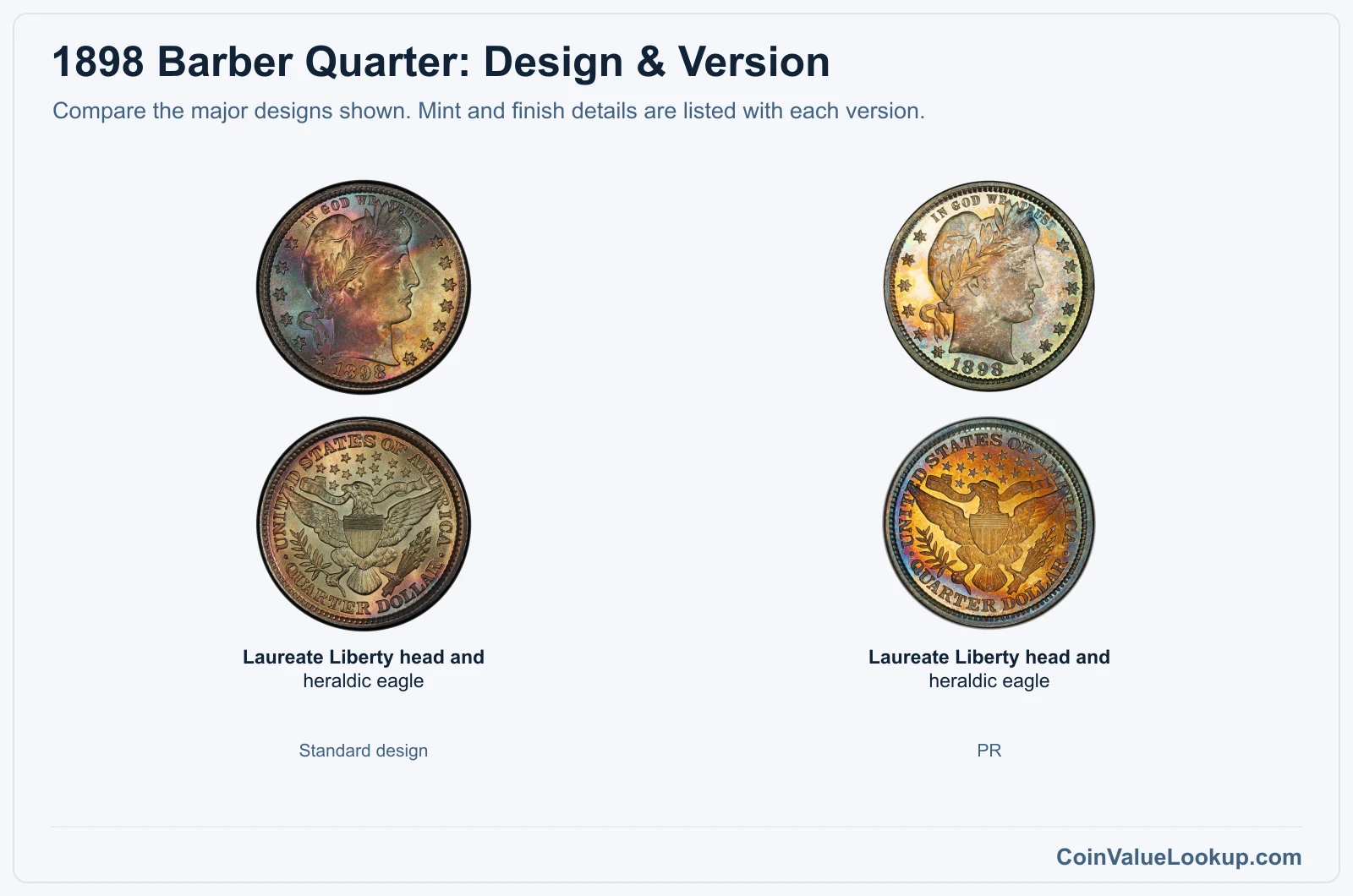
The 1898 Barber Quarter is a 90% silver coin featuring Charles Barber's laureate Liberty head on the obverse and a heraldic eagle on the reverse. Guide estimates for this year range from about $21.00 to $2,910.00 depending on mint, finish and condition.
That spread is not one price for every coin — your specific version and grade determine where your quarter falls.
Fast Way to Identify Your 1898 Barber Quarter
The quickest way to start figuring out what you have is to upload clear photos of both sides of your coin. A front and back image lets us provide a preliminary identification of your mint, version and approximate condition.
Snap the photos in even lighting, avoid glare, and keep the full rim visible in each shot.
1898 Barber Quarter Value
Upload both sides of your 1898 Barber Quarter.
Front Obverse
Upload photo
Back Reverse
Upload photo
Which 1898 Barber Quarter Versions Are Worth Money?
- 1898-S quarter: Guide estimate reaches $2,910.00 at MS63, making the San Francisco mint the one to watch in higher grades.
- 1898-O quarter: New Orleans coins carry a guide estimate up to $2,181.00 at MS63, with a notable jump from the $28.00 Good-4 level.
- 1898 Proof (PR): A proof-finish Philadelphia coin is listed at $799.00 in PR63 — confirm proof surfaces, not just shine.
- Check the mintmark first. Damage, cleaning or heavy wear does not transform a Philadelphia coin into a scarce branch.
Step 1: Identify Your 1898 Barber Quarter Mint Mark and Version
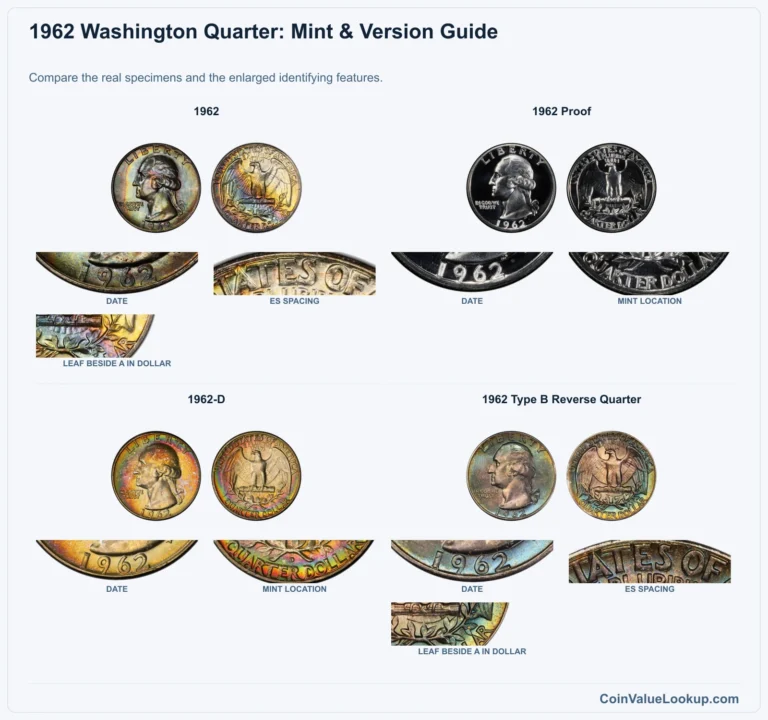
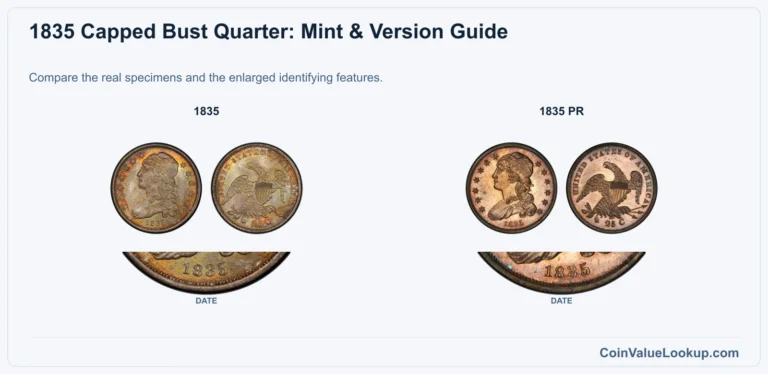
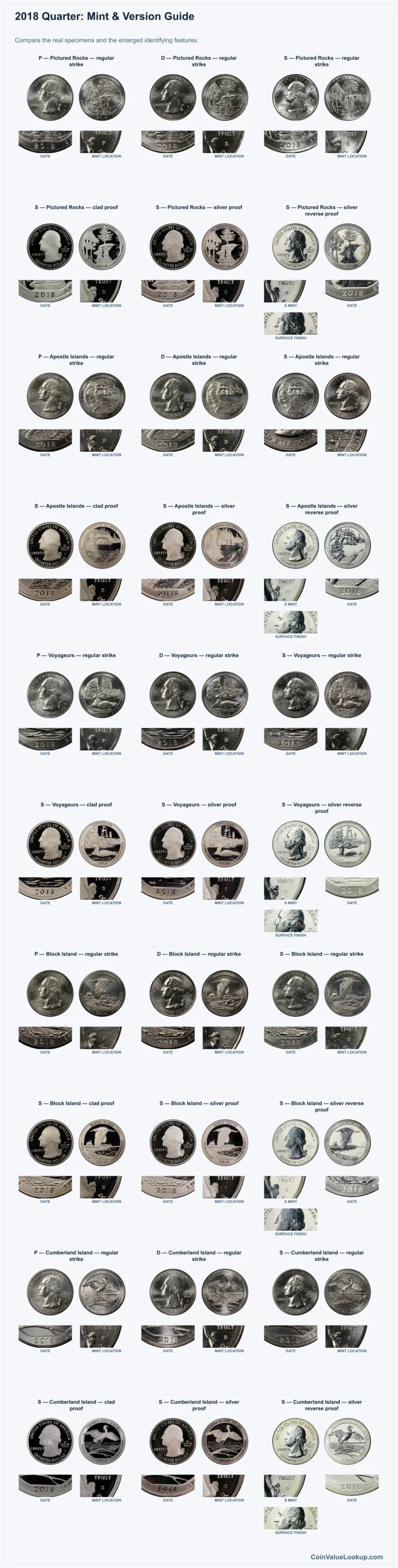
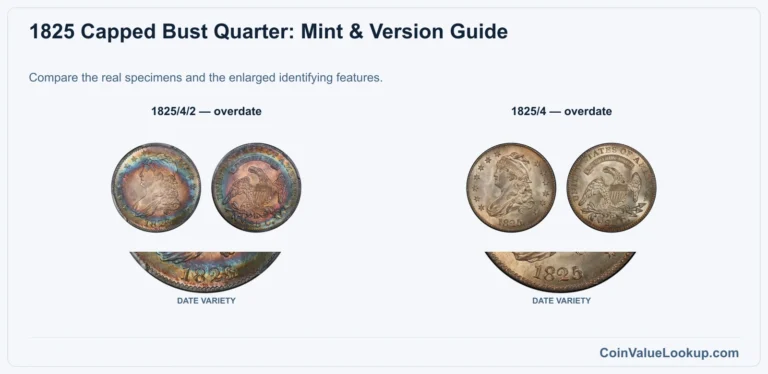
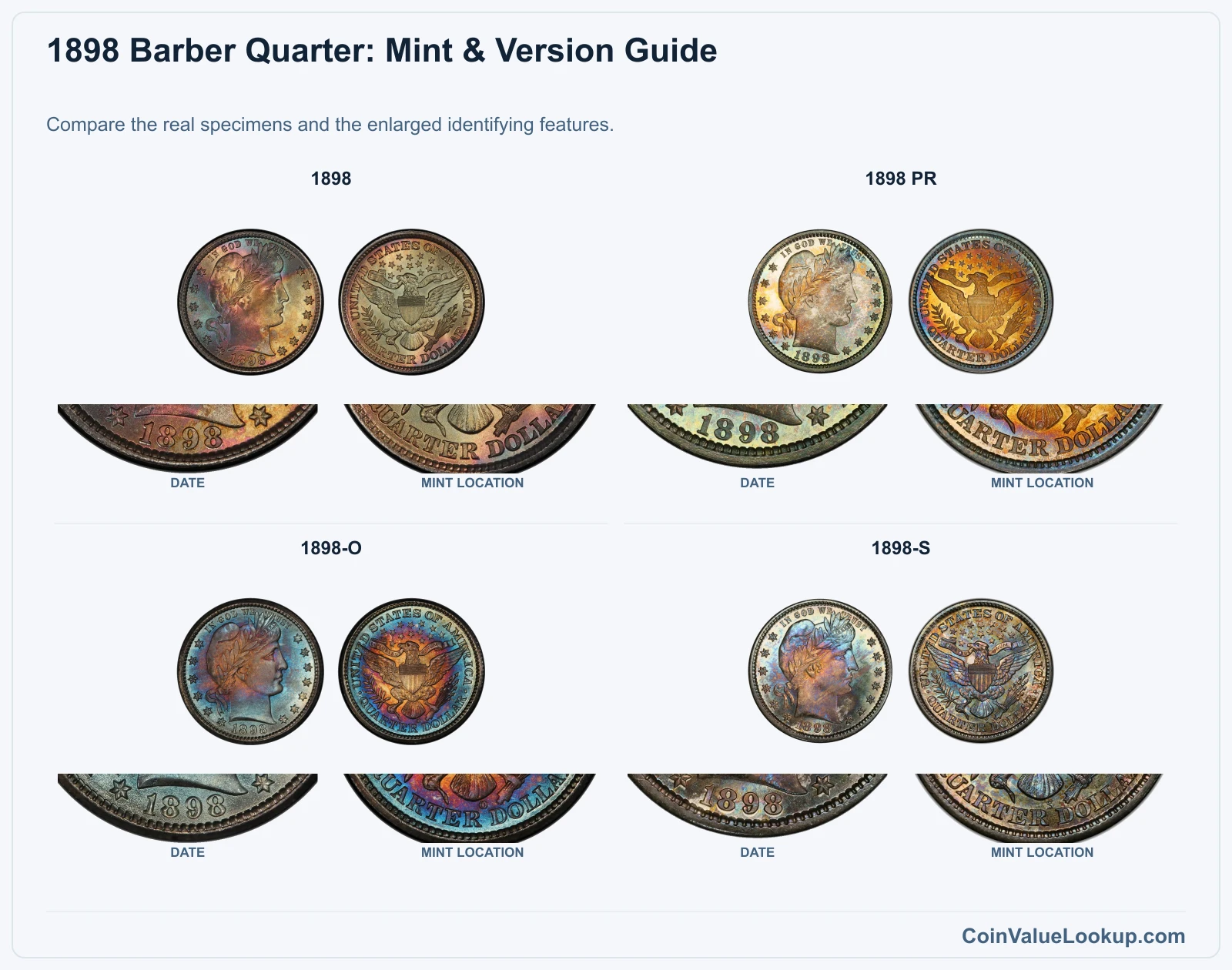
Four distinct branches exist for the 1898 Barber Quarter: the Philadelphia business strike (no mintmark), the Philadelphia proof (no mintmark, proof finish), the New Orleans issue (O mintmark) and the San Francisco issue (S mintmark). Look on the reverse, just below the eagle's tail feathers and above the word QUARTER.
If you see no letter at all, you have a Philadelphia coin. An "O" means New Orleans; an "S" means San Francisco.
All versions are struck in 90% silver and 10% copper, weighing 6.25 grams. A magnet test is a quick sanity check — silver will not stick.
The obverse shows Liberty wearing a laurel wreath with a headband inscribed LIBERTY, while the reverse carries the heraldic eagle, shield and arrows.
Determining proof versus business strike takes more than brightness. Proofs were intentionally struck on polished planchets with polished dies, producing mirror-like fields.
A shiny circulated coin that has been cleaned is not a proof.
Step 2: Check Your 1898 Barber Quarter Grade
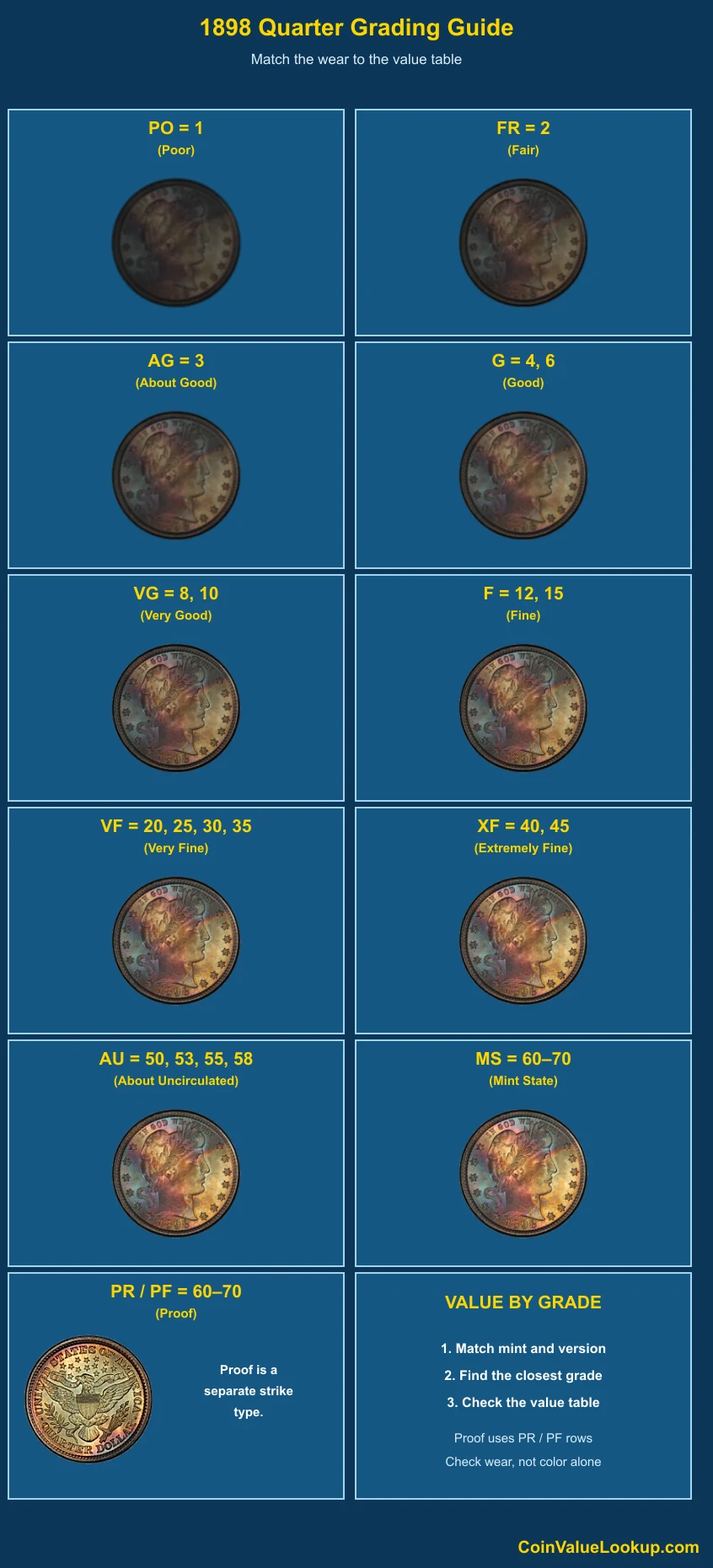
Start with Liberty's hair just above the forehead. On a well-worn coin (around Good-4), outline detail survives but fine strands are gone.
As condition improves, check the cheek for smoothness, the wreath leaves for separation, and the headband for all seven letters of LIBERTY.
On the reverse, the eagle's breast feathers, wingtips and tail are the first areas to show friction. Use these together — not just the LIBERTY letters in isolation — because weak strikes can blur those letters even on an unworn coin.
Compare your quarter against the reference comparison image, matching both wear and remaining luster. A coin with full detail but dull, washed-out surfaces may have been cleaned, which reduces collector value.
Similarly, do not assume a coin with bold reflectivity is Mint State; look at the high points for actual contact wear.
Step 3: Check 1898 Barber Quarter Value by Mint and Version
1898 Barber Quarter
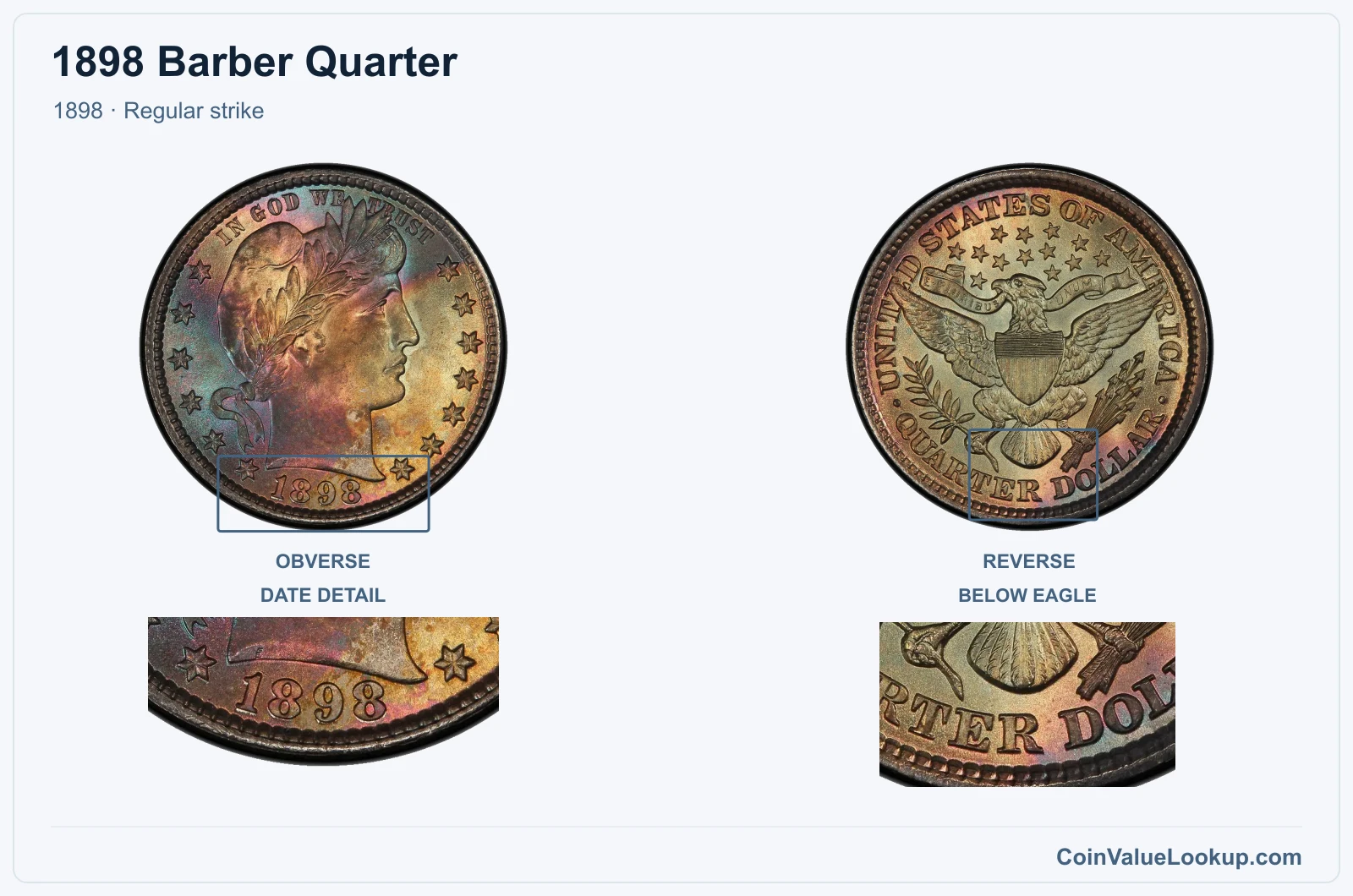
The 1898 Philadelphia business strike carries no mintmark. In well-worn Good-4 condition, USA Coin Book lists it at about $21.00.
At Mint State 60 the guide jumps to $290.00, and an MS63 example sits around $447.00.
Before comparing grades, confirm you have original surfaces. Cleaning strips the natural toning and luster that collectors look for, and it can sharply reduce what a buyer will pay.
Strike quality varies on Philadelphia Barbers, so do not confuse a soft strike with actual wear — check the high points for friction, not just detail sharpness.
Range Grade
Price Auction Records Appraisal PO PO 1
—
Coin Identifier FR FR 2
—
Coin Identifier AG AG 3
—
Coin Identifier G G 4
—
Coin Identifier
G 6
—
Coin Identifier VG VG 8
—
Coin Identifier
VG 10
—
Coin Identifier F F 12
—
Coin Identifier
F 15
—
Coin Identifier VF VF 20
—
Coin Identifier
VF 25
Coin Identifier
VF 30
Coin Identifier
VF 35
—
Coin Identifier XF XF 40
Coin Identifier
XF 45
Coin Identifier AU AU 50
Coin Identifier
AU 53
Coin Identifier
AU 55
Coin Identifier
AU 58
Coin Identifier MS MS 60
Coin Identifier
MS 61
Coin Identifier
MS 62
Coin Identifier
MS 63
Coin Identifier
MS 64
Coin Identifier
MS 65
Coin Identifier
MS 66
Coin Identifier
MS 67
Coin Identifier
MS 68
Coin Identifier
MS 69
—
—
—
MS 70
—
—
—
1898 Barber Quarter — PR
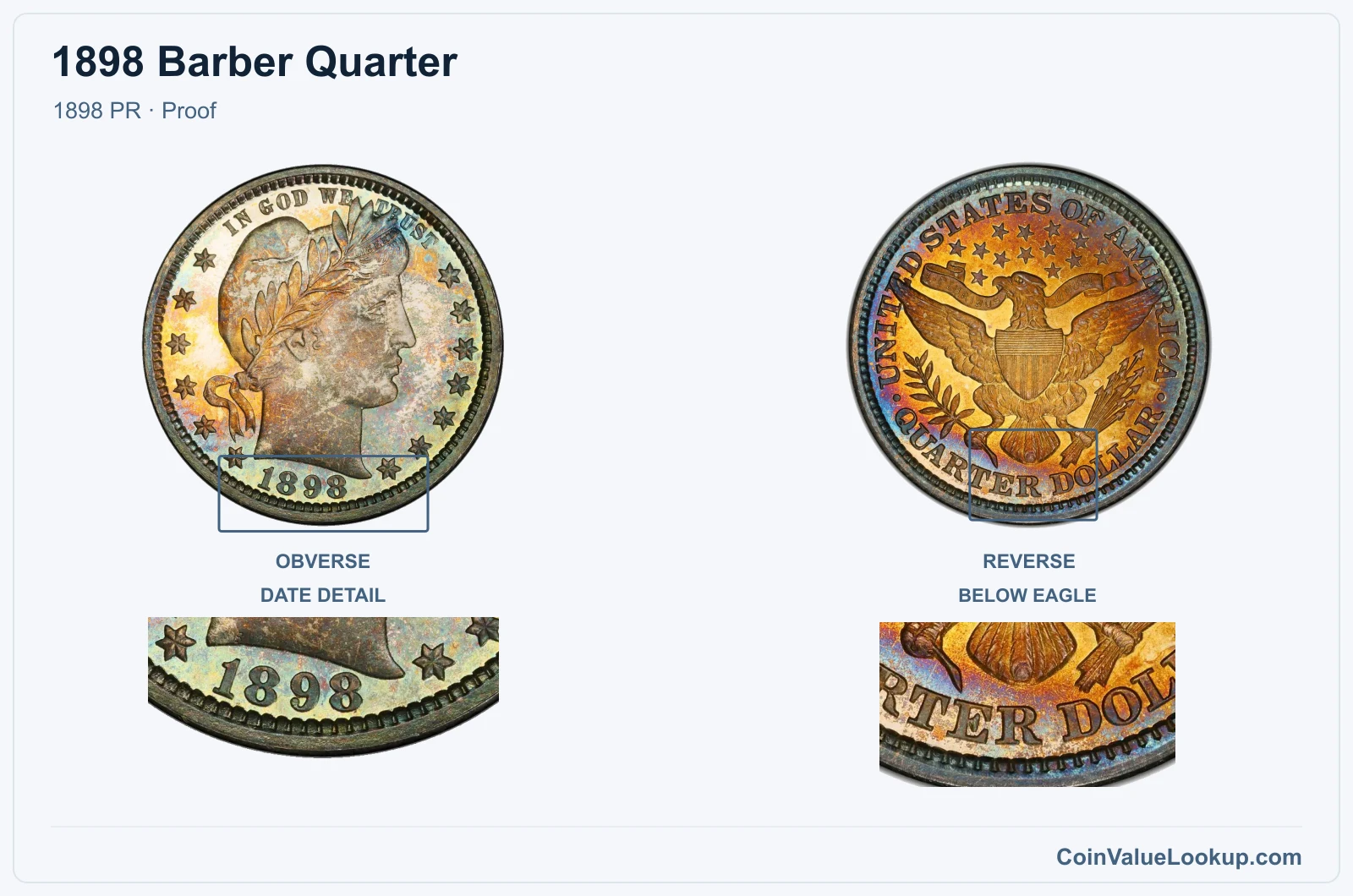
The 1898 Proof was struck at Philadelphia with no mintmark, just like the business strike, so identifying it requires examining the surfaces rather than hunting for a letter. Genuine proofs show deeply mirrored fields and sharp, squared-off rims produced by specially prepared dies and planchets.
USA Coin Book lists PR63 at $799.00. Surface haze, hairlines from improper storage and fingerprint residue are common on proofs of this era, and each flaw lowers collector appeal.
If your coin simply looks shiny but has rounded rims and luster breaks on Liberty's cheek, it is more likely a well-preserved business strike or a cleaned coin, not a proof.
Range Grade
Price Auction Records Appraisal PR PR 1
—
Coin Identifier
PR 2
—
Coin Identifier
PR 3
—
Coin Identifier
PR 4
—
Coin Identifier
PR 6
—
Coin Identifier
PR 8
—
Coin Identifier
PR 10
—
Coin Identifier
PR 12
—
Coin Identifier
PR 15
—
Coin Identifier
PR 20
—
Coin Identifier
PR 25
—
Coin Identifier
PR 30
—
Coin Identifier
PR 35
—
Coin Identifier
PR 40
—
Coin Identifier
PR 45
—
Coin Identifier
PR 50
—
Coin Identifier
PR 53
—
Coin Identifier
PR 55
—
Coin Identifier
PR 58
Coin Identifier
PR 60
Coin Identifier
PR 61
Coin Identifier
PR 62
Coin Identifier
PR 63
Coin Identifier
PR 64
Coin Identifier
PR 65
Coin Identifier
PR 66
Coin Identifier
PR 67
Coin Identifier
PR 68
Coin Identifier
PR 69
Coin Identifier
PR 70
—
—
—
1898 Barber Quarter — O
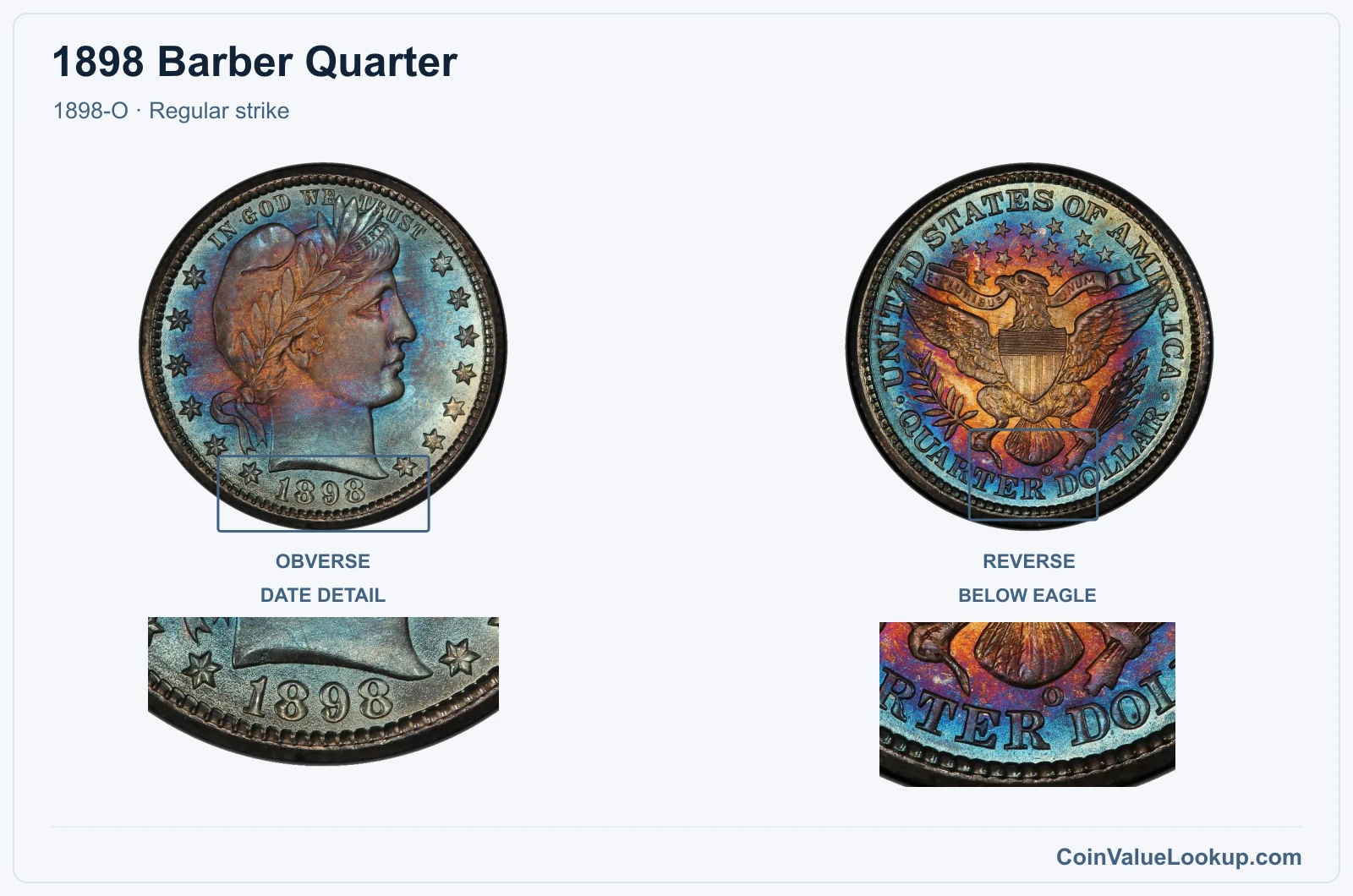
The 1898-O was struck at the New Orleans Mint. Flip the coin over and look for a small "O" below the eagle's tail.
In Good-4 the guide estimate is $28.00 — only slightly above the Philadelphia issue. The gap widens dramatically in higher grades: $1,196.00 at MS60 and $2,181.00 at MS63 per USA Coin Book.
That steep climb tells you surviving uncirculated examples are scarce. Original surfaces matter here.
A cleaned MS60 coin will not command the same premium as one with natural toning and undisturbed luster, so resist the urge to polish your find.
Coin Value Lookup is a good starting point if you want to look up other dates and mints in the Barber Quarter series or compare values across different denominations.
Range Grade
Price Auction Records Appraisal PO PO 1
—
Coin Identifier FR FR 2
—
Coin Identifier AG AG 3
Coin Identifier G G 4
—
Coin Identifier
G 6
—
Coin Identifier VG VG 8
Coin Identifier
VG 10
—
Coin Identifier F F 12
Coin Identifier
F 15
Coin Identifier VF VF 20
Coin Identifier
VF 25
Coin Identifier
VF 30
Coin Identifier
VF 35
Coin Identifier XF XF 40
Coin Identifier
XF 45
Coin Identifier AU AU 50
Coin Identifier
AU 53
Coin Identifier
AU 55
Coin Identifier
AU 58
Coin Identifier MS MS 60
—
Coin Identifier
MS 61
Coin Identifier
MS 62
Coin Identifier
MS 63
Coin Identifier
MS 64
Coin Identifier
MS 65
Coin Identifier
MS 66
Coin Identifier
MS 67
Coin Identifier
MS 68
Coin Identifier
MS 69
—
—
—
MS 70
—
—
—
1898 Barber Quarter — S
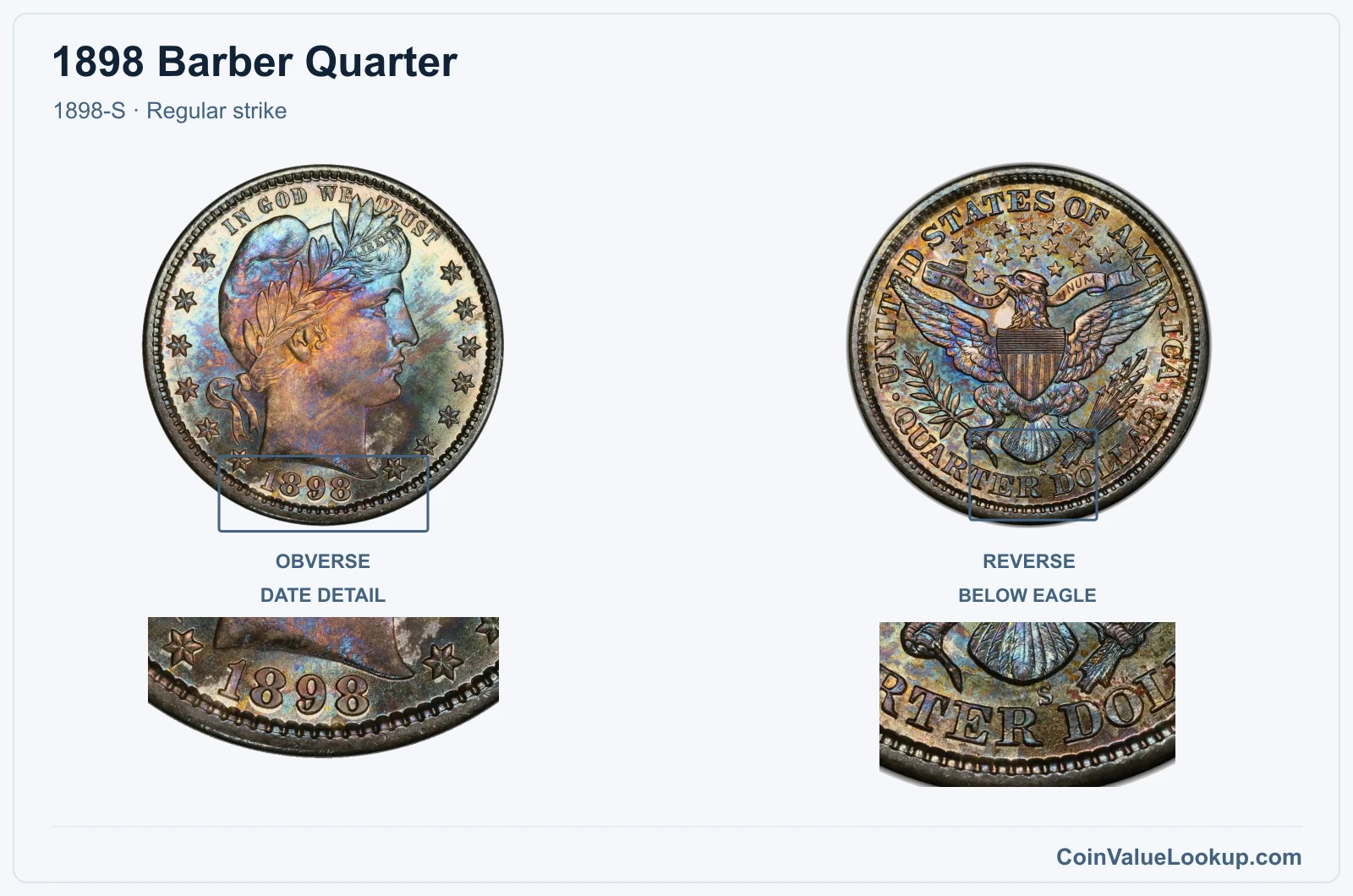
The 1898-S, struck in San Francisco, carries the highest guide estimates of any business-strike branch this year. At Good-4, USA Coin Book places it at $24.00 — modest, since plenty circulated out West.
At MS60 the estimate leaps to $1,399.00, and MS63 reaches $2,910.00.
Look for the "S" mintmark on the reverse below the eagle's tail. San Francisco Barber Quarters can come softly struck in the centers, which sometimes gets mistaken for wear.
Check the rims and fields for luster before downgrading based on central detail alone. Original, problem-free surfaces are essential at these price levels — any cleaning, scratches or environmental damage will cut into the premium significantly.
Range Grade
Price Auction Records Appraisal PO PO 1
—
Coin Identifier FR FR 2
—
Coin Identifier AG AG 3
—
Coin Identifier G G 4
—
Coin Identifier
G 6
—
Coin Identifier VG VG 8
Coin Identifier
VG 10
—
Coin Identifier F F 12
—
Coin Identifier
F 15
—
Coin Identifier VF VF 20
—
Coin Identifier
VF 25
Coin Identifier
VF 30
Coin Identifier
VF 35
Coin Identifier XF XF 40
Coin Identifier
XF 45
Coin Identifier AU AU 50
Coin Identifier
AU 53
Coin Identifier
AU 55
Coin Identifier
AU 58
Coin Identifier MS MS 60
—
Coin Identifier
MS 61
Coin Identifier
MS 62
Coin Identifier
MS 63
Coin Identifier
MS 64
Coin Identifier
MS 65
Coin Identifier
MS 66
Coin Identifier
MS 67
Coin Identifier
MS 68
Coin Identifier
MS 69
—
—
—
MS 70
—
—
—
1898 Barber Quarter Error List
1. 1898 Barber Quarter — Doubled Die Reverse
A Doubled Die Reverse has been reported for the 1898-S Barber Quarter. This error shows doubling on reverse design elements — legends, feathers or other contours — caused by a misaligned second impression of the hub into the working die.
To check, compare your coin's reverse lettering and eagle details side by side with a normal 1898-S at the same magnification. Genuine hub doubling produces a consistent secondary image across multiple design elements, with a uniform direction and spread.
Do not confuse it with machine doubling, which tends to look flat and shelf-like rather than raised and rounded. Reflections under certain lighting and random post-mint damage can also mimic doubling.
Condition, the strength of the doubling and third-party confirmation all influence what a collector will pay, so no single price applies.
2. 1898 Barber Quarter — Off-Center Strike
Off-center strikes have been reported for the 1898-S Barber Quarter. This happens when the planchet is not seated properly between the dies, producing a displaced design and a blank crescent where the die never reached the metal.
The percentage of off-center shift and whether the date remains visible are the two biggest factors in desirability. A 5% shift is minor; 10–20% with a readable date gets more attention.
A coin missing its date loses much of its attribution value.
Be careful not to confuse this with a clipped planchet, which removes metal from the edge but keeps the design centered, or with post-mint flattening from a vise or similar tool. The value depends on the degree of displacement and overall condition, so no standard price applies without individual assessment.
3. 1898 Barber Quarter — Die Crack / Die Chip
Die cracks and die chips have been reported on the 1898-S Barber Quarter. These show up as raised lines or small raised blobs on the coin's surface, created when the steel die itself develops fractures or loses small chunks during production.
A die crack typically runs as a thin raised line, often connecting design elements or reaching the rim. A die chip appears as a small raised lump, usually within a letter or design detail.
When a crack reaches the rim and a piece of the die breaks away, the resulting raised blob is called a cud — that is a more dramatic form worth distinguishing.
Do not mistake incuse scratches, corrosion pitting or debris stuck to the surface for a genuine die crack. True die cracks are raised, not recessed.
Value depends on size, location and the coin's overall condition.
4. 1898 Barber Quarter — Die Cap / Capped-Die Strike
A die cap or capped-die strike has been reported for the 1898-S Barber Quarter. This dramatic error occurs when a struck coin sticks to the upper die and is carried along for subsequent strikes, gradually cupping around the die like a bottle cap.
The coin that became the cap will show a normal obverse and a progressively distorted, spread-out reverse. Coins struck underneath the cap display a mushy, brockage-like impression on one side.
Both types are collectible, but they look very different from each other.
A bent coin from post-mint damage, vise marks or a weak strike should not be confused with a genuine cap. Authentic capped-die errors show progressive metal flow and characteristic cupping that simple bending cannot replicate.
Value hinges on the stage of the cap and overall preservation; no standard price is available without individual evaluation.
5. 1898 Barber Quarter — Repunched Mintmark
Repunched mintmarks have been reported on the 1898-S Barber Quarter. During this era, mintmarks were hand-punched into each working die individually, so misalignment between punches was a real possibility.
A repunched mintmark shows traces of a previous position — a shadow or partial outline of the "S" offset from the final placement.
Examine the mintmark area under magnification and compare it with a normal 1898-S at the same zoom level. Genuine repunching produces a secondary impression that follows the contour of the letter.
Machine doubling, by contrast, tends to look flat and shelf-like. A die chip or corrosion near the mintmark can also create confusing shapes.
Value depends on the visibility and degree of separation of the repunching, plus the coin's grade. No standard price is available for this variety without individual assessment.