1898 Morgan Silver Dollar Coin Value: How Much Is It Worth?
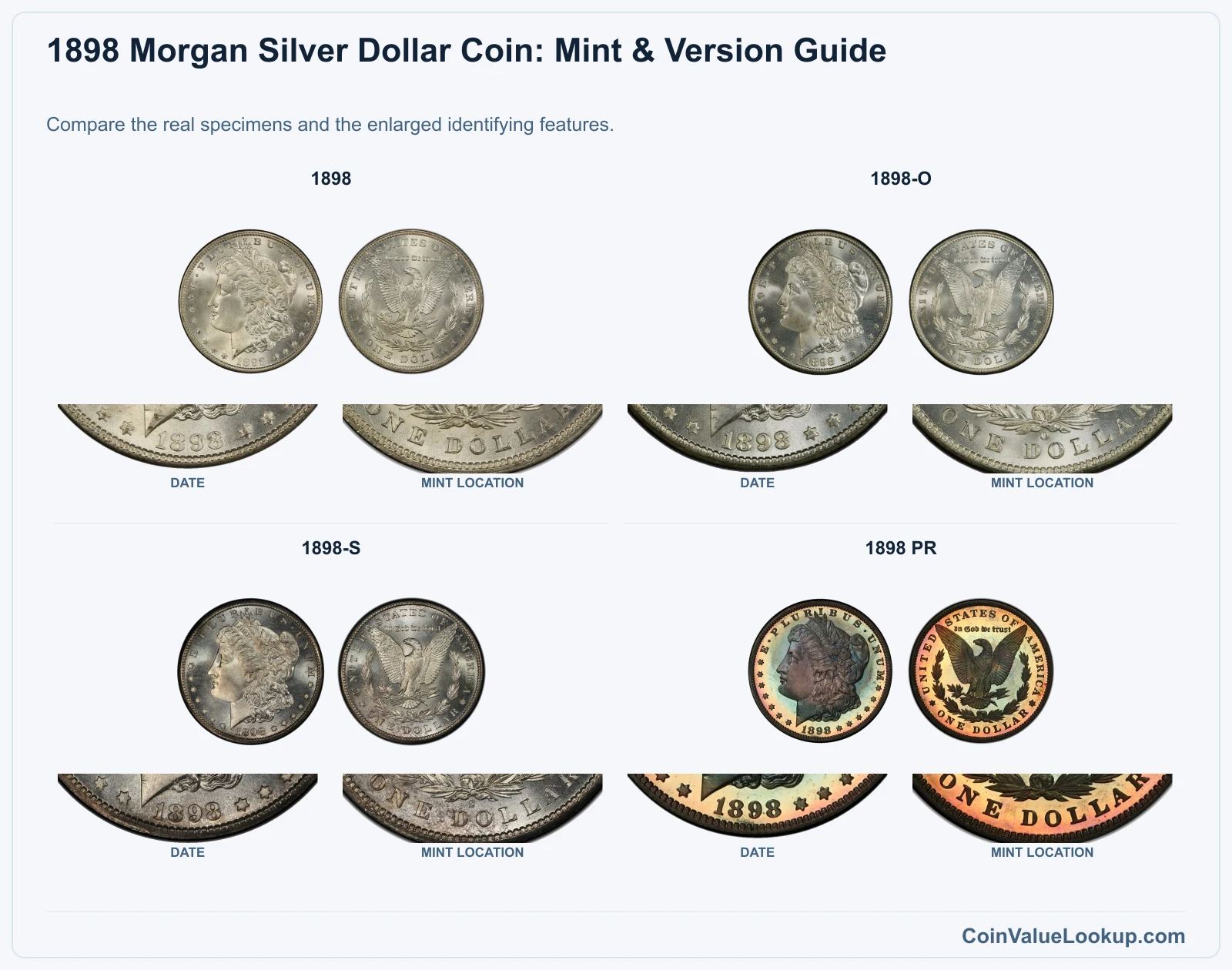
The 1898 Morgan Silver Dollar is a collectible piece struck in 90% silver and 10% copper, weighing 26.73 grams. Its value depends on which mint produced it, the coin's condition, surface quality and whether any striking errors are present.
Individual assessment by authenticated identity and grade is the reliable path to an accurate valuation.
Fast Way to Identify Your 1898 Morgan Silver Dollar
Upload clear photos of the front and back of your 1898 Morgan Dollar for a preliminary identification. This helps confirm the mint, surface type and overall condition so you can compare it against the right version.
Snap both sides in even lighting, avoiding glare that can mimic prooflike surfaces.
1898 Morgan Silver Dollar Value
Upload both sides of your 1898 Morgan Silver Dollar.
Front Obverse
Upload photo
Back Reverse
Upload photo
Which 1898 Morgan Silver Dollar Versions Are Worth Money?
- Check for the 1898 Proof (PR) finish, which was produced in limited numbers at Philadelphia and requires professional authentication to confirm.
- PL or DMPL surface designations on business strikes can carry premiums, but a shiny surface alone does not qualify; professional attribution is needed.
- Mint-specific scarcity varies across grades for the 1898, 1898-O and 1898-S, so confirming the exact mintmark and grade is essential before estimating value.
Step 1: Identify Your 1898 Morgan Silver Dollar Mint Mark and Version
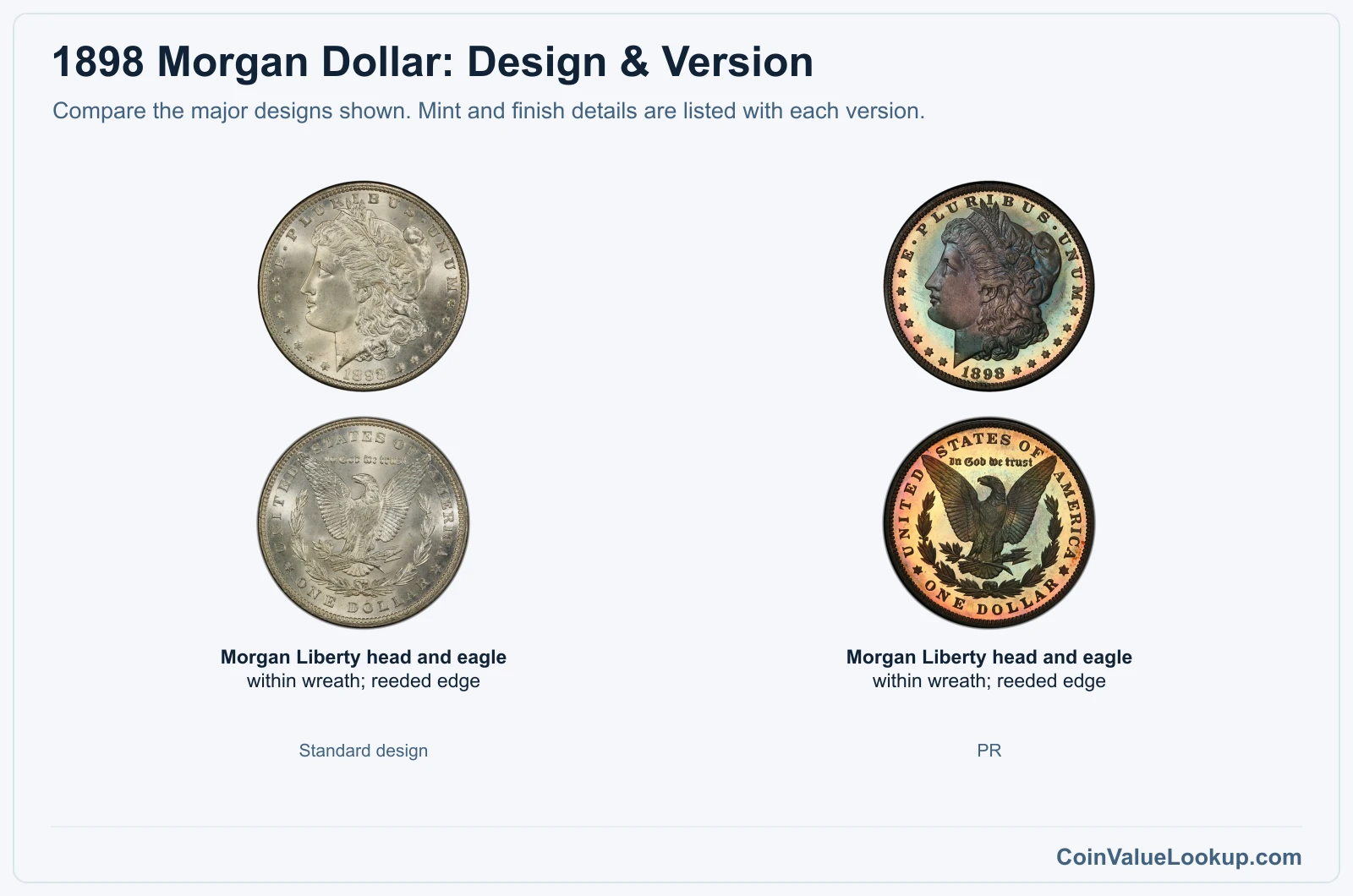
Flip your coin over. The mintmark sits just below the bow that ties the wreath on the reverse.
No letter means Philadelphia. An "O" means New Orleans, and an "S" means San Francisco.
There is no Carson City or Denver version for 1898.
The design is George T. Morgan's Liberty head on the obverse and an eagle within a wreath on the reverse.
The edge is reeded. Every genuine example weighs 26.73 grams in 90% silver.
Four distinct collectible branches exist for this date: the Philadelphia business strike, the 1898-O, the 1898-S, and the 1898 Proof. Prooflike (PL) and Deep Mirror Prooflike (DMPL) are surface designations applied to eligible business strikes, not proof manufacture.
A shiny coin is not automatically prooflike or proof. Cleaned, polished or plated coins lose collector comparability, so look for original surfaces before assuming a premium.
Step 2: Check Your 1898 Morgan Silver Dollar Grade
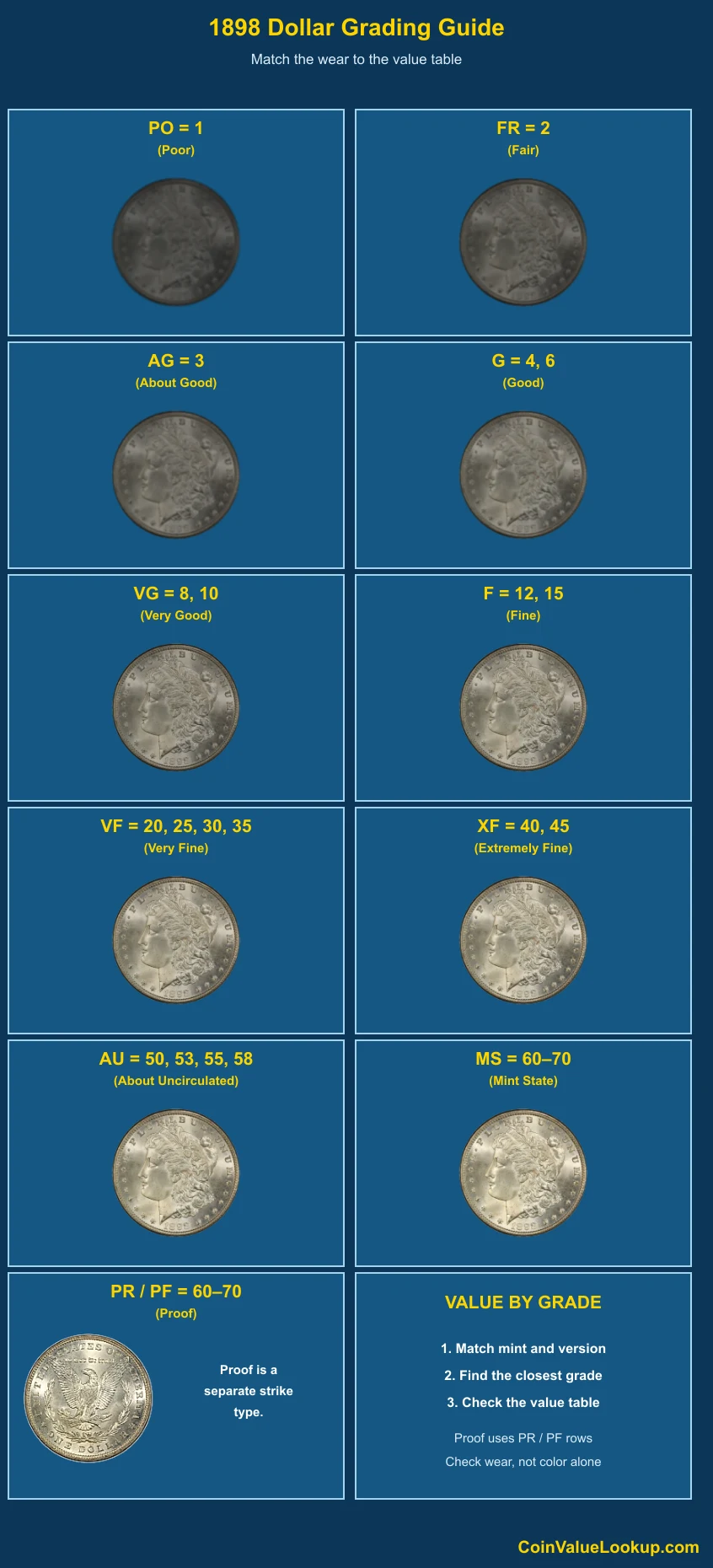
Start at Liberty's hair above the ear. On a well-circulated coin, this area is flat and merged with the headband.
Move to the cheek and the cap. These high points lose detail first as the coin wears.
On the reverse, check the eagle's breast feathers. A coin with full, separated feathers and bright cartwheel luster is solidly Mint State.
Slight rub on the cheek and breast tips puts you in the About Uncirculated range.
Bag marks matter a lot for Morgan Dollars. These heavy silver coins banged around in canvas bags at the Treasury, so even uncirculated examples can show contact marks.
Bag marks lower a Mint State grade but are not the same as circulation wear. Compare your coin against the grading comparison image to separate honest wear from storage hits.
If you see hairline scratches in a pattern, that usually means someone cleaned the coin at some point. Cleaning reduces the grade to a details designation and significantly affects desirability.
Step 3: Check 1898 Morgan Silver Dollar Value by Mint and Version
1898 Morgan Silver Dollar
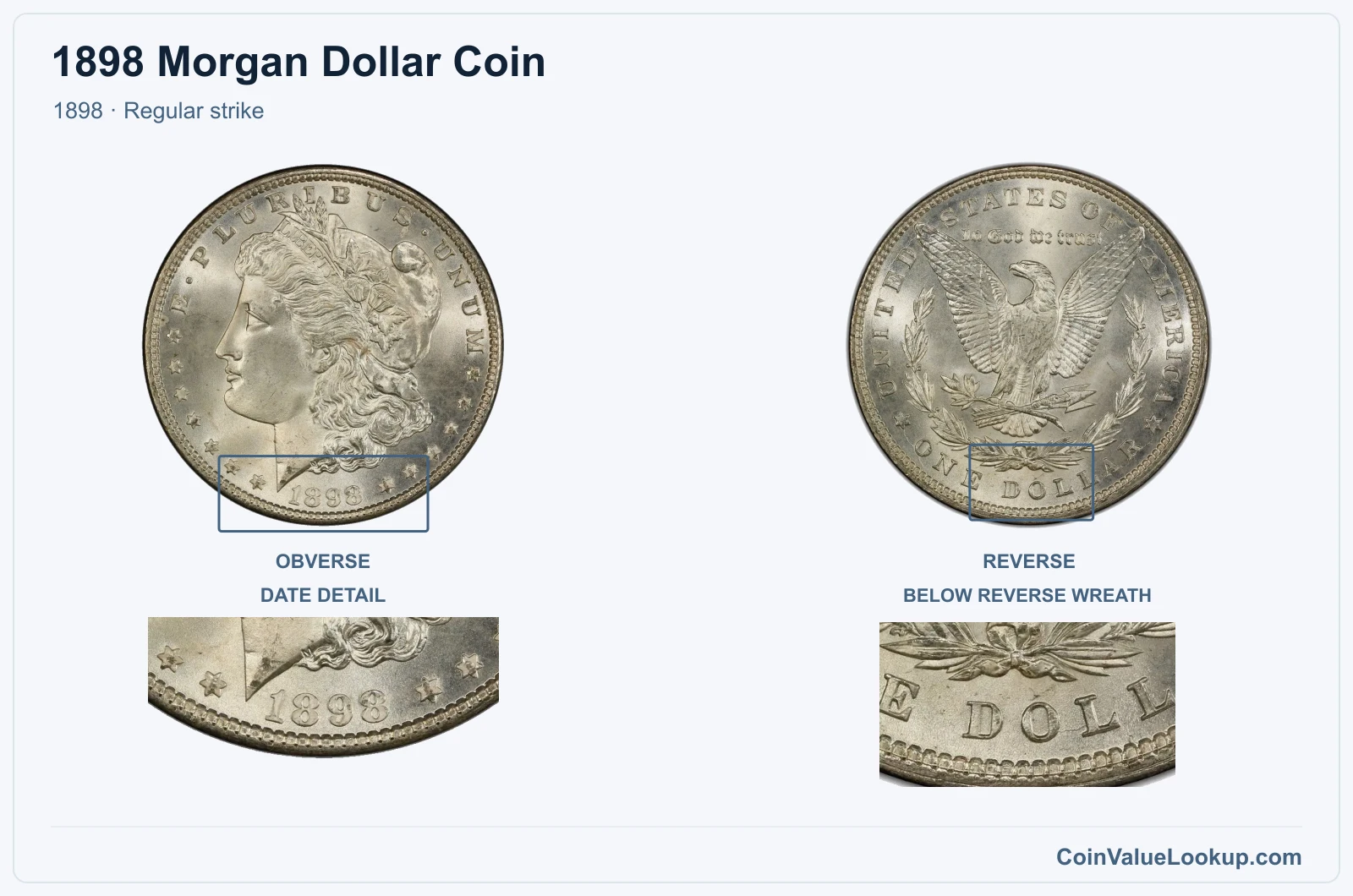
The 1898 Philadelphia Morgan Dollar carries no mintmark. It was a business strike produced in the standard 90% silver composition.
Value depends entirely on the coin's authenticated grade and whether it retains original, undamaged surfaces.
PL and DMPL surface designations can apply to this issue when the fields show mirror-like reflectivity. These are not proof coins.
Polishing or cleaning removes the natural luster and reduces the coin's comparability to graded examples, so avoid confusing an artificially shiny surface with a prooflike one. Have the coin evaluated individually for its precise condition and surface quality.
Range Grade
Price Auction Records Appraisal PO PO 1
—
Coin Identifier FR FR 2
—
Coin Identifier AG AG 3
—
Coin Identifier G G 4
—
Coin Identifier
G 6
—
Coin Identifier VG VG 8
—
Coin Identifier
VG 10
—
Coin Identifier F F 12
—
Coin Identifier
F 15
—
Coin Identifier VF VF 20
—
Coin Identifier
VF 25
—
Coin Identifier
VF 30
—
Coin Identifier
VF 35
—
Coin Identifier XF XF 40
—
Coin Identifier
XF 45
—
Coin Identifier AU AU 50
Coin Identifier
AU 53
Coin Identifier
AU 55
Coin Identifier
AU 58
Coin Identifier MS MS 60
—
Coin Identifier
MS 61
Coin Identifier
MS 62
Coin Identifier
MS 63
Coin Identifier
MS 64
Coin Identifier
MS 65
Coin Identifier
MS 66
Coin Identifier
MS 67
Coin Identifier
MS 68
—
—
—
MS 69
—
—
—
MS 70
—
—
—
1898 Morgan Silver Dollar — O
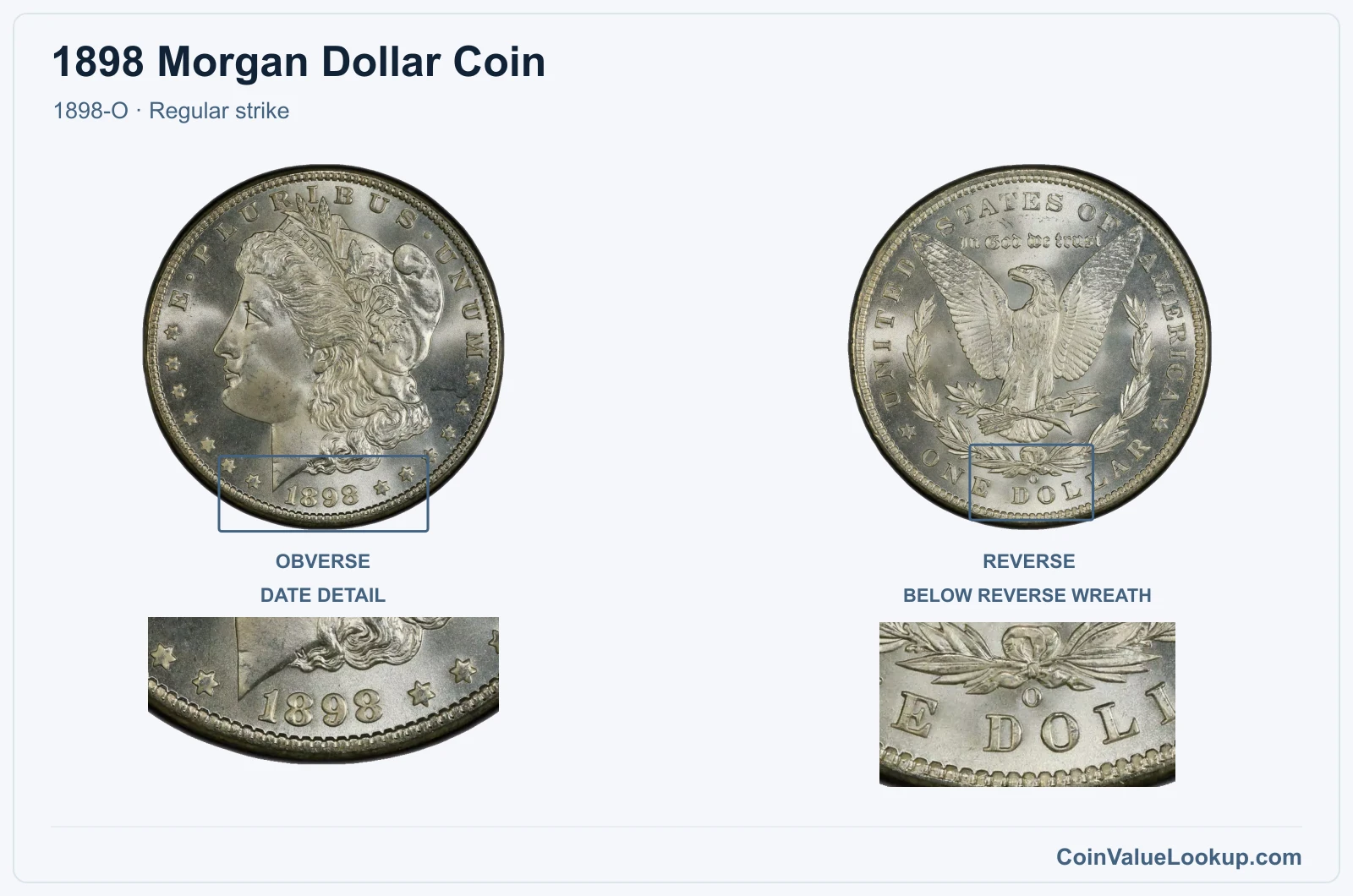
The 1898-O was struck at the New Orleans Mint. Look for the small "O" mintmark below the wreath bow on the reverse.
Same weight and silver content as the Philadelphia issue.
Original surfaces and grade drive the value here. PL and DMPL examples exist for this mint and carry their own market interest, but they need professional attribution.
A coin that looks reflective from cleaning or environmental exposure does not qualify. Condition and authenticity should be individually assessed before drawing conclusions about value.
Coin Value Lookup is a useful starting point if you want to look up guides for other Morgan Dollar dates and mints while sorting through your collection.
Range Grade
Price Auction Records Appraisal PO PO 1
—
Coin Identifier FR FR 2
—
Coin Identifier AG AG 3
—
Coin Identifier G G 4
—
Coin Identifier
G 6
—
Coin Identifier VG VG 8
—
Coin Identifier
VG 10
Coin Identifier F F 12
—
Coin Identifier
F 15
—
Coin Identifier VF VF 20
—
Coin Identifier
VF 25
—
Coin Identifier
VF 30
—
Coin Identifier
VF 35
—
Coin Identifier XF XF 40
—
Coin Identifier
XF 45
—
Coin Identifier AU AU 50
—
Coin Identifier
AU 53
—
Coin Identifier
AU 55
—
Coin Identifier
AU 58
Coin Identifier MS MS 60
Coin Identifier
MS 61
Coin Identifier
MS 62
Coin Identifier
MS 63
Coin Identifier
MS 64
Coin Identifier
MS 65
Coin Identifier
MS 66
Coin Identifier
MS 67
Coin Identifier
MS 68
Coin Identifier
MS 69
—
—
—
MS 70
—
—
—
1898 Morgan Silver Dollar — S
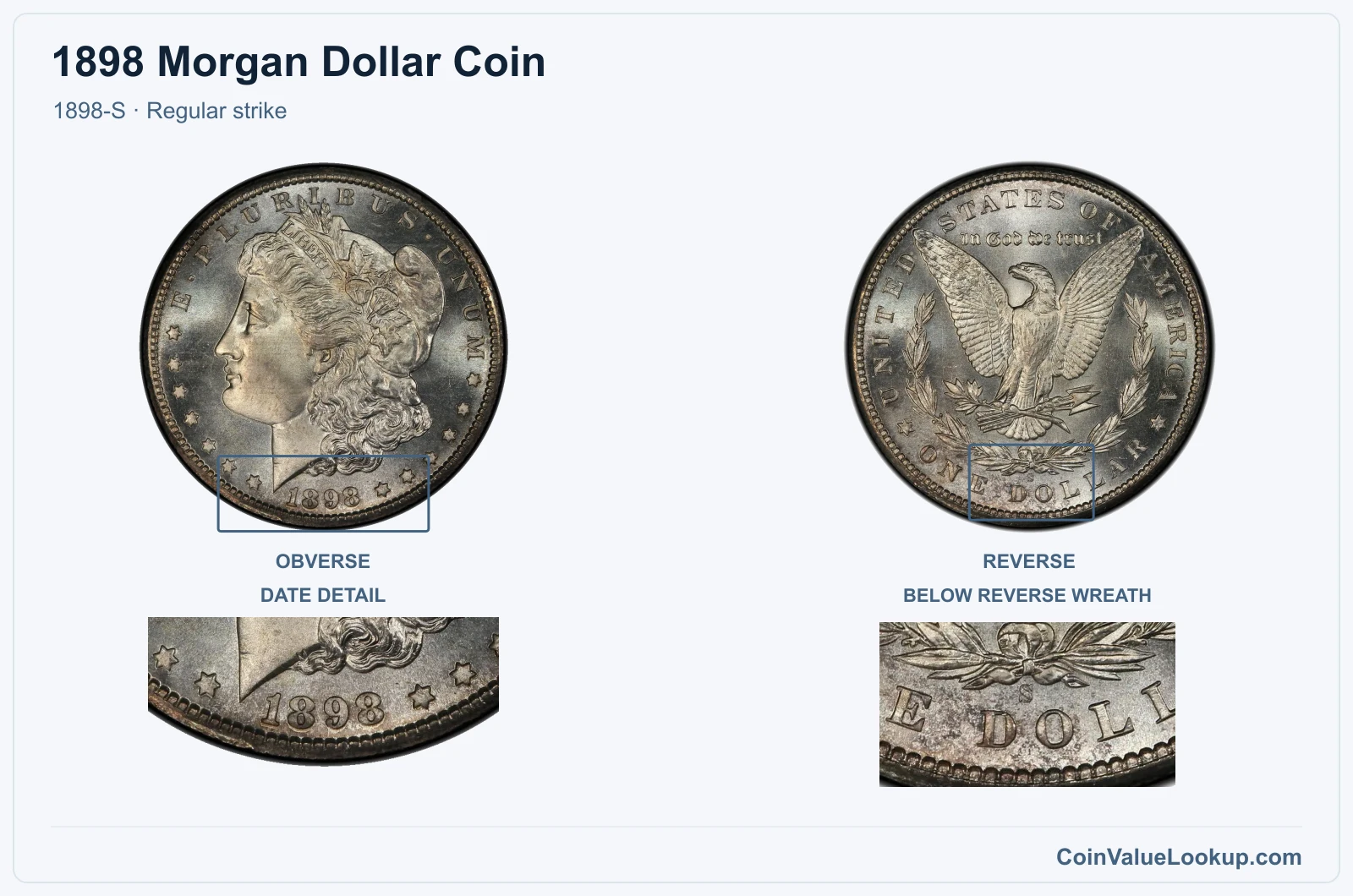
The 1898-S bears an "S" mintmark for the San Francisco Mint, visible below the reverse wreath bow. San Francisco strikes from this era often show better overall sharpness than their New Orleans counterparts, though quality still varies coin to coin.
As with the other business strikes, PL and DMPL designations apply to qualifying surfaces but are not proof manufacture. Cleaned or polished coins lose much of their collector appeal.
Value depends on the coin's authenticated grade, surface integrity and any confirmed varieties or errors. Individual assessment is the most reliable approach.
Range Grade
Price Auction Records Appraisal PO PO 1
—
Coin Identifier FR FR 2
—
Coin Identifier AG AG 3
—
Coin Identifier G G 4
—
Coin Identifier
G 6
—
Coin Identifier VG VG 8
—
Coin Identifier
VG 10
Coin Identifier F F 12
Coin Identifier
F 15
—
Coin Identifier VF VF 20
Coin Identifier
VF 25
—
Coin Identifier
VF 30
Coin Identifier
VF 35
—
Coin Identifier XF XF 40
Coin Identifier
XF 45
Coin Identifier AU AU 50
Coin Identifier
AU 53
Coin Identifier
AU 55
Coin Identifier
AU 58
Coin Identifier MS MS 60
Coin Identifier
MS 61
Coin Identifier
MS 62
Coin Identifier
MS 63
Coin Identifier
MS 64
Coin Identifier
MS 65
Coin Identifier
MS 66
Coin Identifier
MS 67
Coin Identifier
MS 68
Coin Identifier
MS 69
—
—
—
MS 70
—
—
—
1898 Morgan Silver Dollar — PR
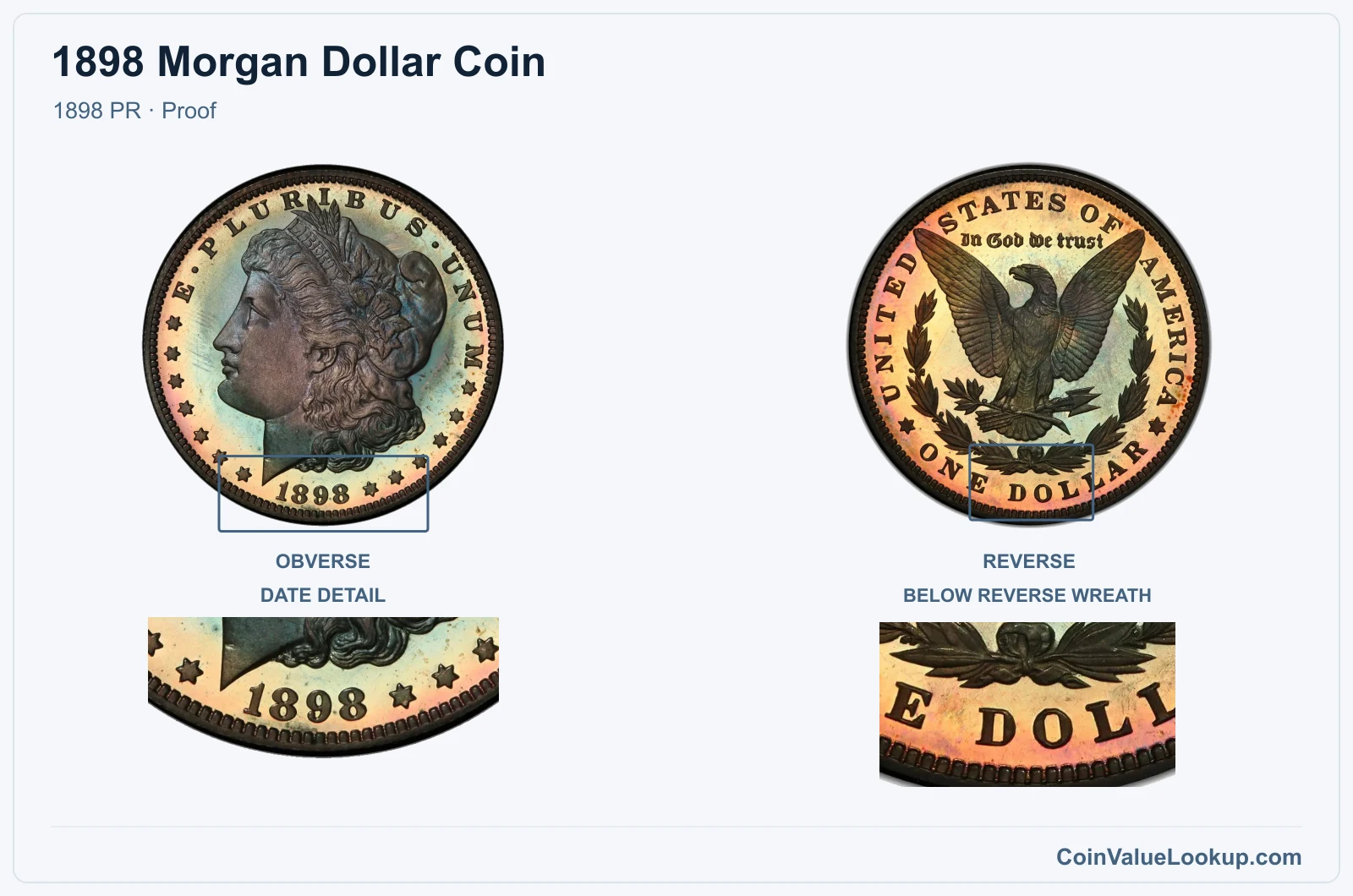
The 1898 Proof is a Philadelphia-only issue made with a specialized manufacturing process that produces mirrored fields and sharp design details. A proof is a finish, not a grade above Mint State.
Proof Morgan Dollars were struck in very limited quantities for collectors, not commerce.
Do not assume your coin is a proof just because it looks shiny or pristine. Many high-grade business strikes and cleaned coins get mistaken for proofs.
Genuine proofs show squared, knife-like rim edges and exceptionally deep mirrors in the fields. Professional authentication is necessary to confirm this designation.
Value hinges on the coin's authenticated proof grade and the quality of its original surfaces.
Range Grade
Price Auction Records Appraisal PR PR 1
—
Coin Identifier
PR 2
—
Coin Identifier
PR 3
—
Coin Identifier
PR 4
—
Coin Identifier
PR 6
—
Coin Identifier
PR 8
—
Coin Identifier
PR 10
—
Coin Identifier
PR 12
—
Coin Identifier
PR 15
—
Coin Identifier
PR 20
—
Coin Identifier
PR 25
—
Coin Identifier
PR 30
—
Coin Identifier
PR 35
—
Coin Identifier
PR 40
—
Coin Identifier
PR 45
Coin Identifier
PR 50
—
Coin Identifier
PR 53
—
Coin Identifier
PR 55
—
Coin Identifier
PR 58
Coin Identifier
PR 60
Coin Identifier
PR 61
Coin Identifier
PR 62
Coin Identifier
PR 63
Coin Identifier
PR 64
Coin Identifier
PR 65
Coin Identifier
PR 66
Coin Identifier
PR 67
Coin Identifier
PR 68
Coin Identifier
PR 69
—
Coin Identifier
PR 70
—
—
—
1898 Morgan Silver Dollar Error List
1. 1898 Morgan Silver Dollar — Off-Center Strike
An off-center 1898 Morgan Dollar shows a displaced design with an unstruck crescent of blank planchet visible along one side. The coin was not properly seated between the dies when struck, so the image shifted.
The more dramatic the displacement, and the more of the date that remains visible, the more collector interest it draws.
Condition and the degree of the error both affect value. A coin missing half its design but retaining the full date is a different proposition than one barely off-center.
Look carefully at the unstruck area: it should be a smooth, curved crescent of blank metal. Post-mint flattening, a clipped planchet or one-sided die misalignment can mimic an off-center strike to an untrained eye.
Professional authentication is recommended before attributing this error.
2. 1898 Morgan Silver Dollar — Broadstrike
A broadstrike happens when the collar die, which normally confines the planchet and forms the reeded edge, fails to engage. The result is a coin that spreads outward beyond its normal diameter.
The design is fully centered, unlike an off-center strike, but the rim is weak or absent and the edge lacks normal reeding.
Examine the edge closely. A genuine broadstrike shows smooth, expanded metal where the collar should have contained it.
If the design is also shifted to one side, that is an off-center strike, not a broadstrike. Coins flattened after leaving the mint can look spread out, but they typically show damage or distortion inconsistent with a single press strike.
Individual value depends on the severity of the error and the coin's overall condition.
3. 1898 Morgan Silver Dollar — Double / Multiple Strike
A double-struck or multiple-struck 1898 Morgan Dollar received two or more impressions from the dies. You will see separate, displaced or rotated design images overlapping on the same planchet.
The second strike may be offset or turned, creating a dramatic visual effect with two distinct outlines of Liberty's head or the eagle.
This is different from a doubled die, which is a die-manufacturing issue that produces slightly thickened or doubled lettering from a single strike. A true double strike shows an entirely separate impression, not just puffy letters.
Also watch out for post-mint damage where someone deliberately struck the coin again outside the Mint. Professional authentication matters here because the distinction between genuine and fabricated double strikes is not always obvious in hand.
Value depends on how visible and dramatic the error is, plus the coin's condition.