1962 Washington Quarter Coin Value: How Much Is It Worth?
A 1962 Washington Quarter is a 90% silver coin, so even well-worn examples carry a melt-related floor around $16.43 in Good condition. Mint State pieces range higher, with guide estimates near $27 for a Philadelphia MS65 and up to $30 for a Denver MS65.
Proof strikes, a scarce Type B reverse variety, and several documented errors can push values well beyond those ordinary figures depending on authentication and condition.
Fast Way to Identify Your 1962 Washington Quarter
The quickest way to start figuring out what your 1962 quarter is worth is to upload clear photos of the front and back. Our identifier can give you a preliminary read on the mint, finish type and general condition so you know which version you are holding before diving deeper into specifics.
1962 Washington Quarter Value
Upload both sides of your 1962 Washington Quarter.
Front Obverse
Upload photo
Back Reverse
Upload photo
Which 1962 Washington Quarter Versions Are Worth Money?
- The 1962-D in MS65 carries guide estimates around $30, and despite huge mintage, bag marks can make gem survivors scarcer than expected.
- The 1962 Philadelphia business strike in MS65 is estimated near $27; original luster and clean surfaces matter most.
- The 1962 Type B Reverse is a recognized Philadelphia variety with a proof-style reverse hub used on a circulation strike; value depends on authenticated identity and condition.
- A 1962 quarter struck on a silver dime planchet sold for $660 in PCGS MS62 at a July 2022 Heritage auction, making wrong-planchet errors among the most dramatic for this date.
- Proof examples in PR65 have guide estimates around $23, with Cameo and Deep Cameo designations potentially adding further premiums.
Step 1: Identify Your 1962 Washington Quarter Mint Mark and Version
Look at the obverse first. The date sits at the bottom, and George Washington faces left.
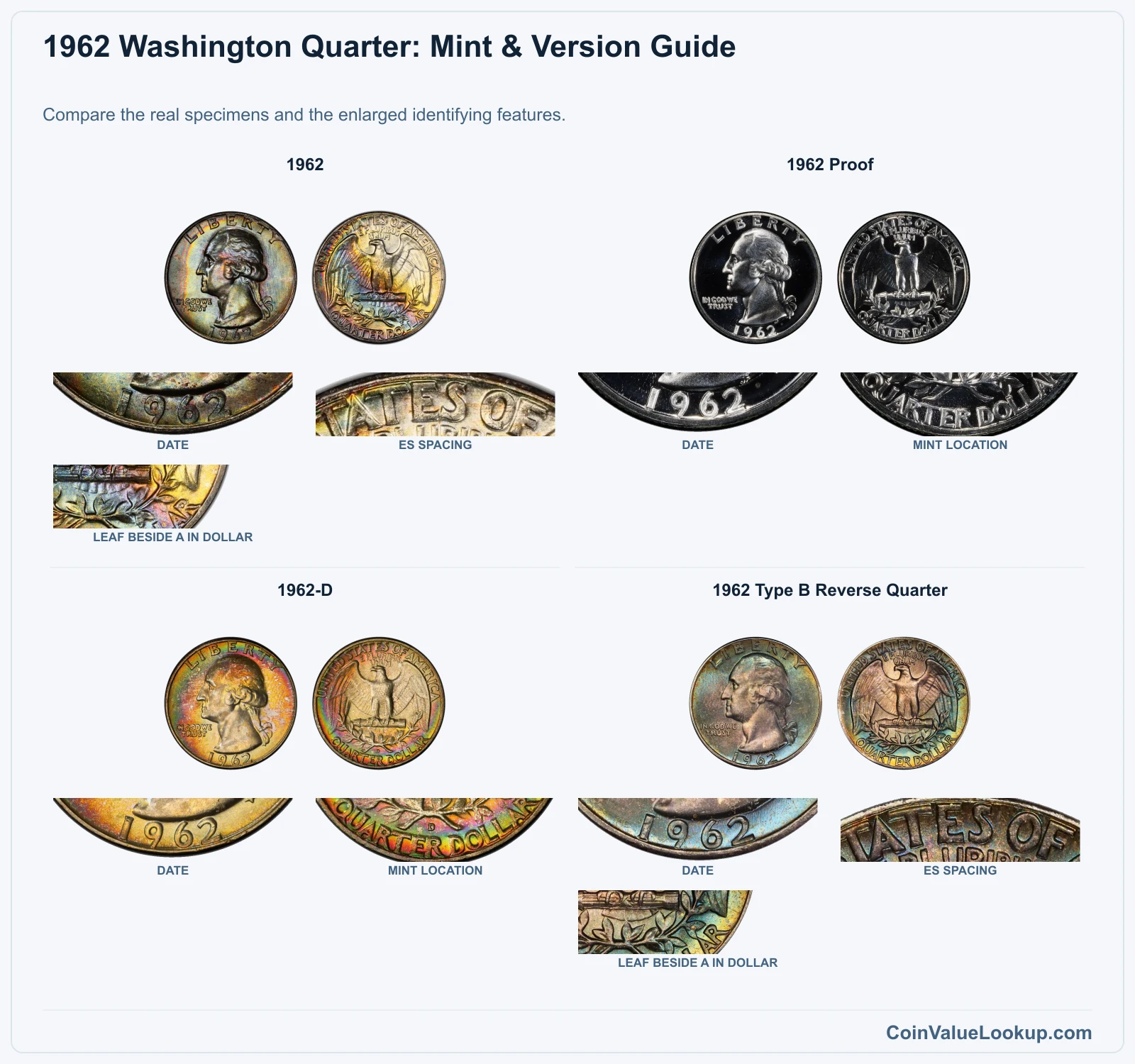
Flip the coin over and check directly below the wreath for a small D mintmark, which means Denver. If that space is blank, your coin was struck in Philadelphia, and that is perfectly normal for this era.
All standard 1962 quarters are 90% silver and 10% copper, weigh about 6.25 grams, and measure roughly 24.3 mm across. Both business strikes and Philadelphia proofs share the same alloy, so silver content alone will not tell you which you have.
The real branches to sort out are Philadelphia business strike, Denver business strike, Philadelphia proof and the Philadelphia Type B reverse variety. Despite Denver's much larger production run, bag-marked survivors can actually make gem-quality D-mint coins tougher to locate than you might expect, so raw mintage numbers do not tell the whole condition-rarity story.
To distinguish a proof from a business strike, look at the fields. Proofs show deeply mirrored surfaces and sharply defined details from a specially prepared die, while business strikes have a satiny or cartwheel luster.
A proof is a manufacturing method, not a higher grade than Mint State.
Step 2: Check Your 1962 Washington Quarter Grade
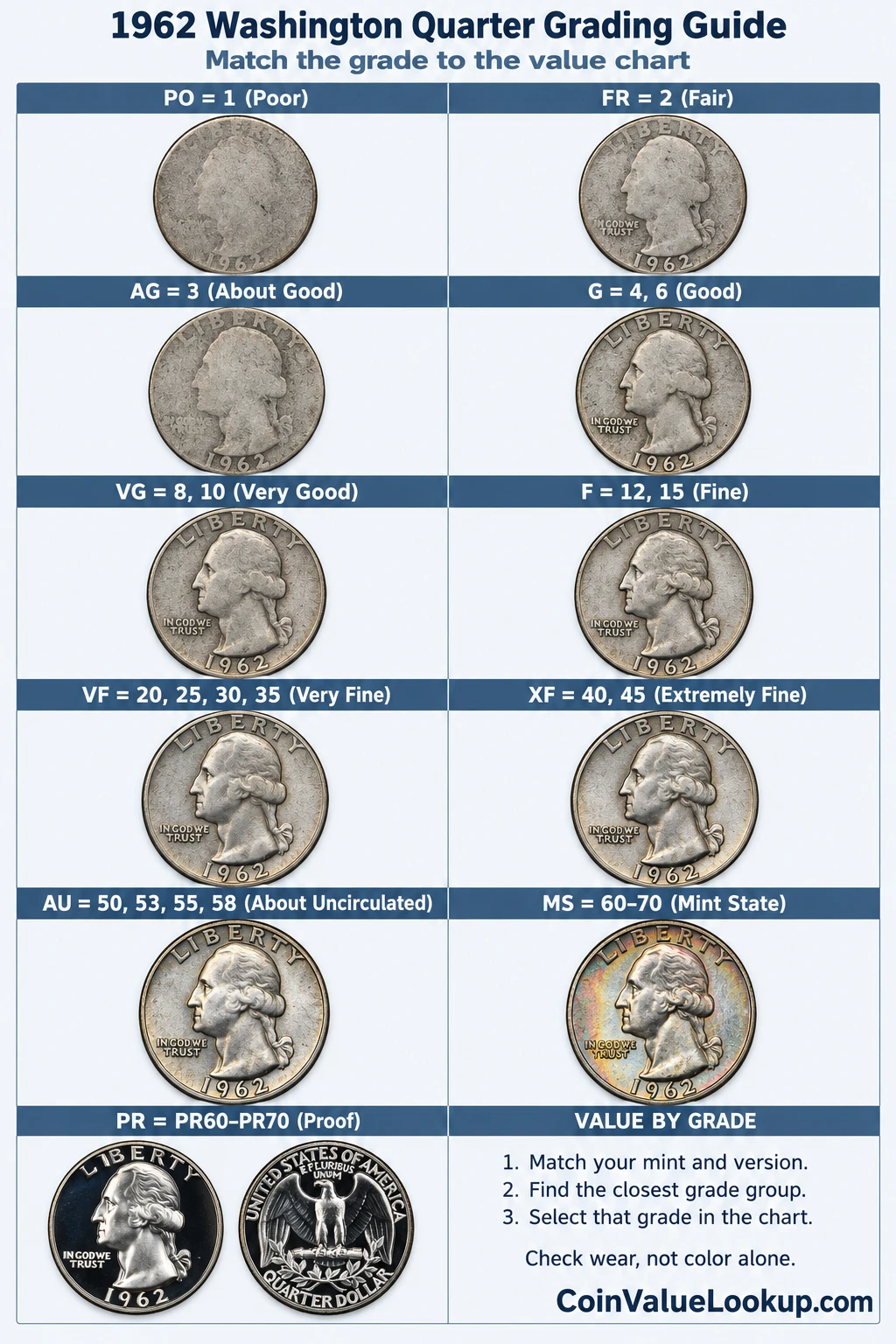
Start on the obverse. Washington's cheek and the hair directly over his ear are the first areas to show friction.
Even light wear will interrupt the original mint luster there, giving those high points a dull, flat look compared to the protected recesses around them.
On the reverse, examine the eagle's breast feathers and wing tips. These are the corresponding weak spots.
A coin that still has full, unbroken luster across both sides is a candidate for Mint State, while any smoothing on those high points drops it into About Uncirculated or below.
Do not confuse a weakly struck area with wear. A weak strike leaves soft detail but the luster remains intact underneath, while genuine wear removes luster and leaves the surface flat and shiny in a different way.
Compare your coin against the reference image to see the difference side by side.
Finally, check for cleaning hairlines under angled light, contact marks from other coins in rolls or bags, and any rim dings. On proofs, surface quality is everything.
Cameo or Deep Cameo contrast is a designation describing frosted devices against mirrored fields, and it adds appeal, but it does not replace the numerical grade.
Step 3: Check 1962 Washington Quarter Value by Mint and Version
1962 Washington Quarter
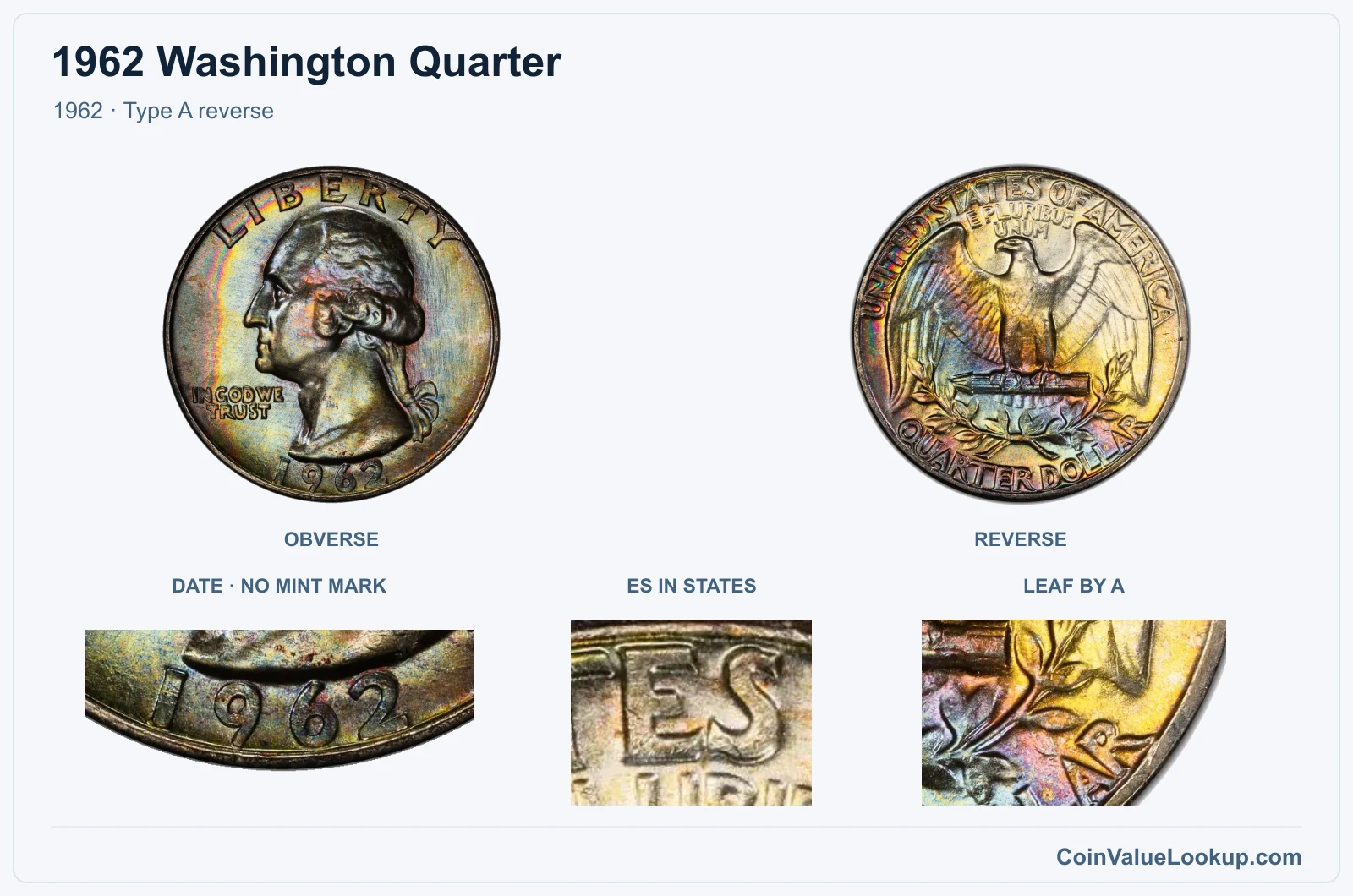
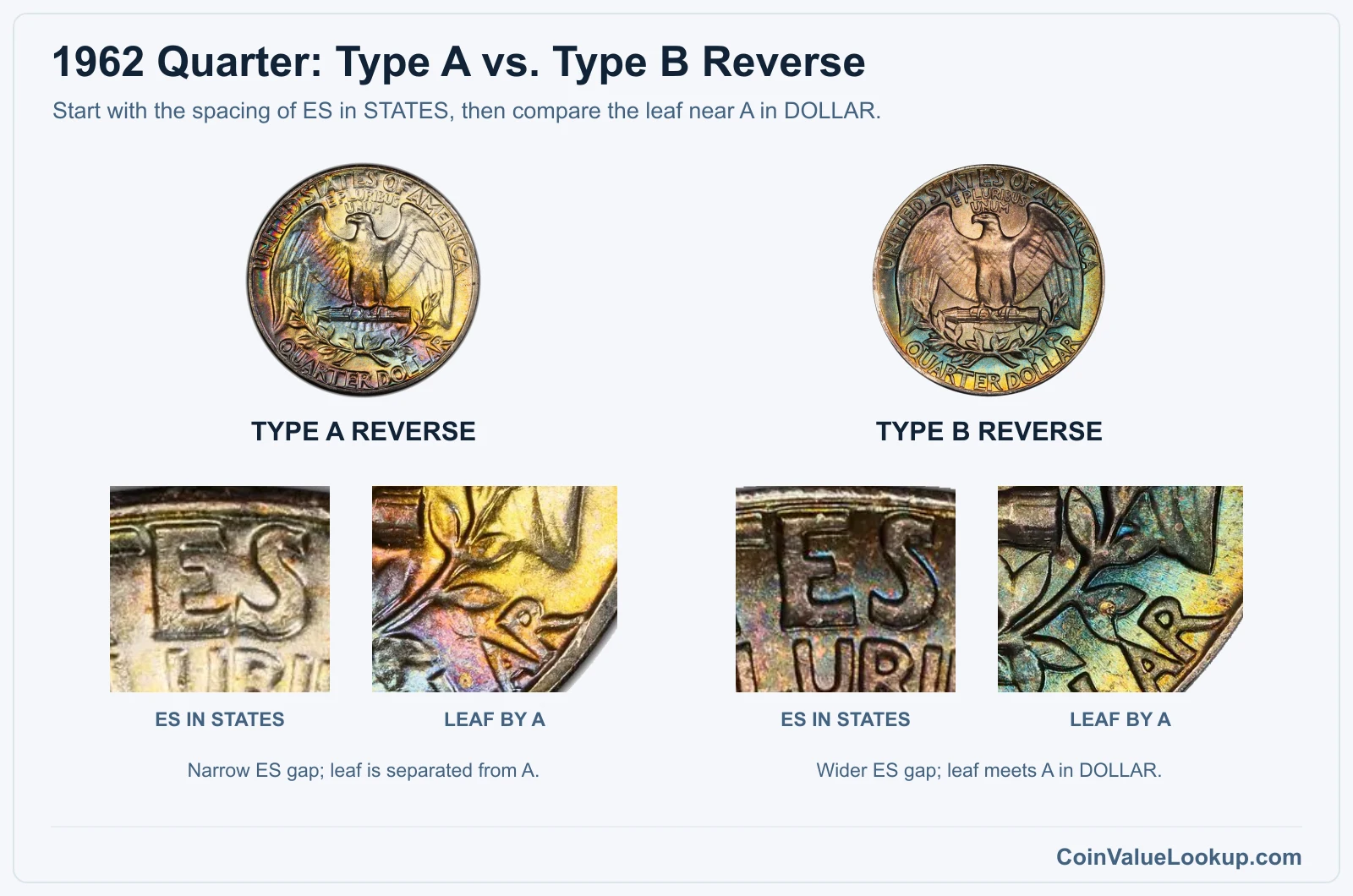
This is the standard 1962 Philadelphia business strike, identifiable by the blank mintmark area below the reverse wreath. It uses the ordinary Type A circulation reverse where the letters E and S in STATES nearly touch.
Guide estimates place this version around $16.43 in Good, about $20 in MS60, and roughly $27 in MS65 per USA Coin Book. Original, unbroken mint luster is the key separator between a coin worth melt and one worth a meaningful premium.
Look for clean cheeks and minimal bag marks if you think yours is uncirculated.
| Range | Grade | Price | Auction Records | Appraisal |
|---|---|---|---|---|
| PO | PO 1 | — | Coin Identifier | |
| FR | FR 2 | — | Coin Identifier | |
| AG | AG 3 | — | Coin Identifier | |
| G | G 4 | — | Coin Identifier | |
| G 6 | — | Coin Identifier | ||
| VG | VG 8 | — | Coin Identifier | |
| VG 10 | — | Coin Identifier | ||
| F | F 12 | — | Coin Identifier | |
| F 15 | — | Coin Identifier | ||
| VF | VF 20 | — | Coin Identifier | |
| VF 25 | — | Coin Identifier | ||
| VF 30 | — | Coin Identifier | ||
| VF 35 | — | Coin Identifier | ||
| XF | XF 40 | — | Coin Identifier | |
| XF 45 | — | Coin Identifier | ||
| AU | AU 50 | — | Coin Identifier | |
| AU 53 | — | Coin Identifier | ||
| AU 55 | — | Coin Identifier | ||
| AU 58 | Coin Identifier | |||
| MS | MS 60 | — | Coin Identifier | |
| MS 61 | — | Coin Identifier | ||
| MS 62 | — | Coin Identifier | ||
| MS 63 | Coin Identifier | |||
| MS 64 | Coin Identifier | |||
| MS 65 | Coin Identifier | |||
| MS 66 | Coin Identifier | |||
| MS 67 | Coin Identifier | |||
| MS 68 | — | — | — | |
| MS 69 | — | — | — | |
| MS 70 | — | — | — |
1962 Washington Quarter — Proof
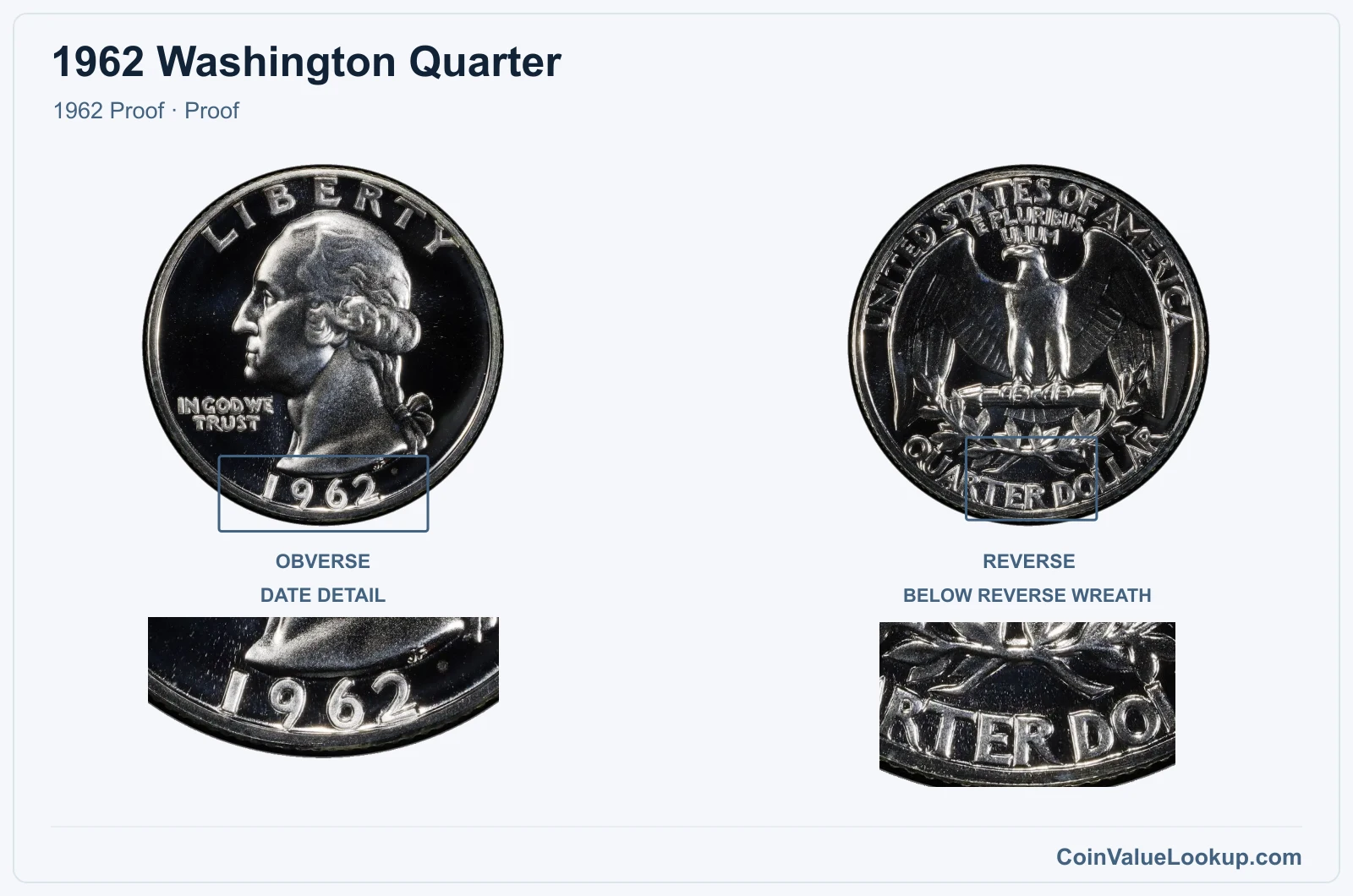
Philadelphia also produced proof quarters in 1962, struck on polished planchets with specially prepared dies to create mirrored fields and sharp detail. There is no mintmark, same as the business strike, so identifying a proof comes down to surface character: look for deeply reflective fields and crisp, sometimes frosted, design elements.
A PR65 example carries a guide estimate of about $23 according to USA Coin Book. Coins with Cameo or Deep Cameo frost contrast are tracked separately and can command different premiums depending on the degree of contrast.
A proof is a finish, not a grade above Mint State, so a PR65 and an MS65 are two different manufacturing categories at the same numerical quality level.
| Range | Grade | Price | Auction Records | Appraisal |
|---|---|---|---|---|
| PR | PR 1 | — | Coin Identifier | |
| PR 2 | — | Coin Identifier | ||
| PR 3 | — | Coin Identifier | ||
| PR 4 | — | Coin Identifier | ||
| PR 6 | — | Coin Identifier | ||
| PR 8 | — | Coin Identifier | ||
| PR 10 | — | Coin Identifier | ||
| PR 12 | — | Coin Identifier | ||
| PR 15 | — | Coin Identifier | ||
| PR 20 | — | Coin Identifier | ||
| PR 25 | — | Coin Identifier | ||
| PR 30 | — | Coin Identifier | ||
| PR 35 | — | Coin Identifier | ||
| PR 40 | — | Coin Identifier | ||
| PR 45 | — | Coin Identifier | ||
| PR 50 | — | Coin Identifier | ||
| PR 53 | — | Coin Identifier | ||
| PR 55 | — | Coin Identifier | ||
| PR 58 | — | Coin Identifier | ||
| PR 60 | — | Coin Identifier | ||
| PR 61 | — | Coin Identifier | ||
| PR 62 | — | Coin Identifier | ||
| PR 63 | — | Coin Identifier | ||
| PR 64 | Coin Identifier | |||
| PR 65 | Coin Identifier | |||
| PR 66 | Coin Identifier | |||
| PR 67 | Coin Identifier | |||
| PR 68 | Coin Identifier | |||
| PR 69 | Coin Identifier | |||
| PR 70 | Coin Identifier |
1962 Washington Quarter — D
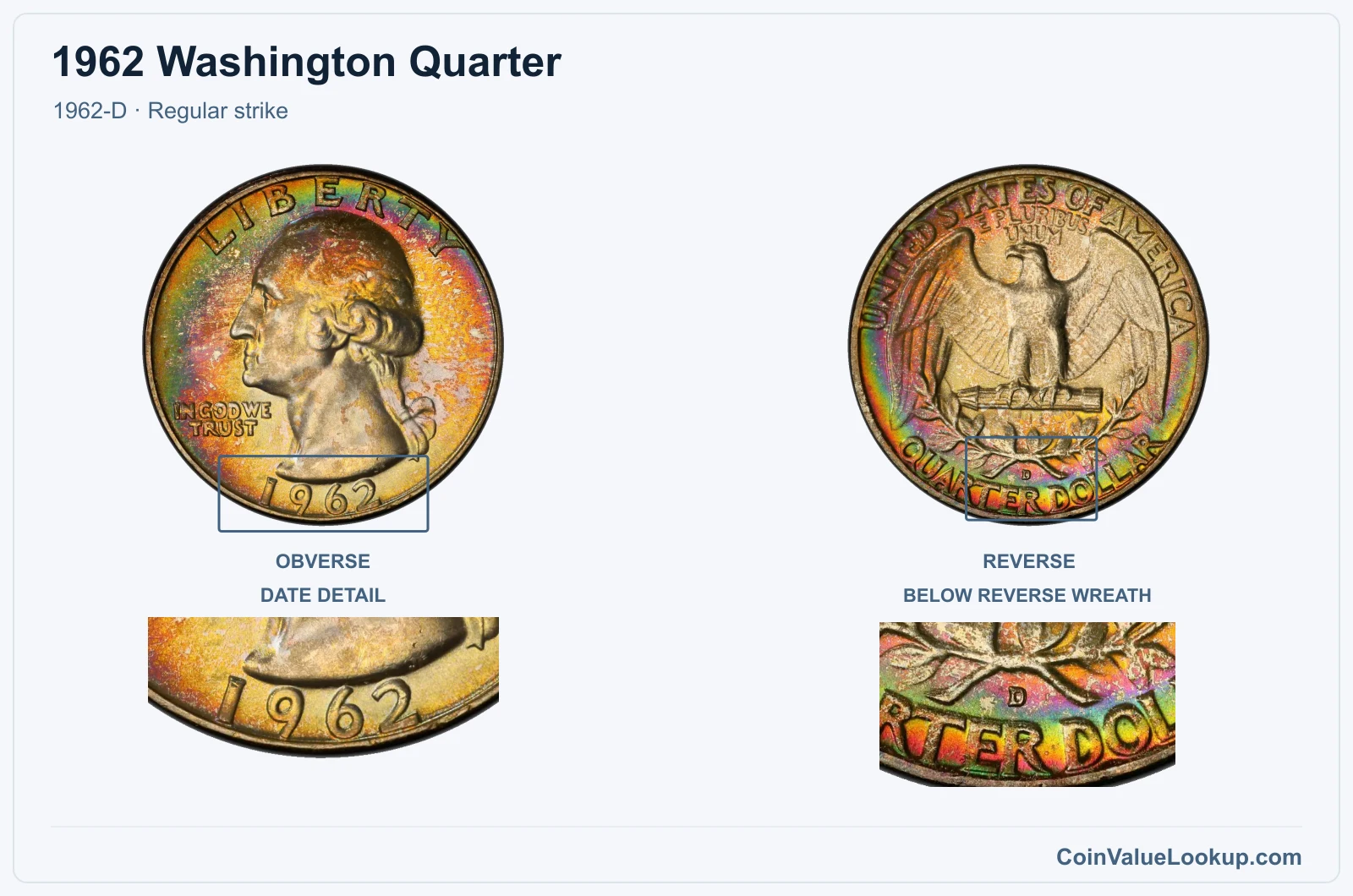
The 1962-D quarter bears a small D mintmark below the wreath on the reverse, indicating it was struck at the Denver Mint. Denver had a much larger production run than Philadelphia for this date, yet that does not automatically mean gem examples are easy to find.
Heavy bag marks from bulk handling can make MS65 survivors surprisingly scarce.
Guide estimates from USA Coin Book put this version at about $16.43 in Good, around $20 in MS60 and approximately $30 in MS65. That MS65 figure edges above the Philadelphia business strike, reflecting the irony that bigger mintage sometimes means rougher handling.
If yours has clean, lustrous surfaces with minimal marks, it is worth a careful second look.
| Range | Grade | Price | Auction Records | Appraisal |
|---|---|---|---|---|
| PO | PO 1 | — | Coin Identifier | |
| FR | FR 2 | — | Coin Identifier | |
| AG | AG 3 | — | Coin Identifier | |
| G | G 4 | — | Coin Identifier | |
| G 6 | — | Coin Identifier | ||
| VG | VG 8 | — | Coin Identifier | |
| VG 10 | — | Coin Identifier | ||
| F | F 12 | — | Coin Identifier | |
| F 15 | — | Coin Identifier | ||
| VF | VF 20 | — | Coin Identifier | |
| VF 25 | — | Coin Identifier | ||
| VF 30 | — | Coin Identifier | ||
| VF 35 | — | Coin Identifier | ||
| XF | XF 40 | — | Coin Identifier | |
| XF 45 | — | Coin Identifier | ||
| AU | AU 50 | — | Coin Identifier | |
| AU 53 | — | Coin Identifier | ||
| AU 55 | — | Coin Identifier | ||
| AU 58 | — | Coin Identifier | ||
| MS | MS 60 | — | Coin Identifier | |
| MS 61 | — | Coin Identifier | ||
| MS 62 | — | Coin Identifier | ||
| MS 63 | Coin Identifier | |||
| MS 64 | Coin Identifier | |||
| MS 65 | Coin Identifier | |||
| MS 66 | Coin Identifier | |||
| MS 67 | Coin Identifier | |||
| MS 68 | — | — | — | |
| MS 69 | — | — | — | |
| MS 70 | — | — | — |
1962 Washington Quarter — Type B Reverse Quarter
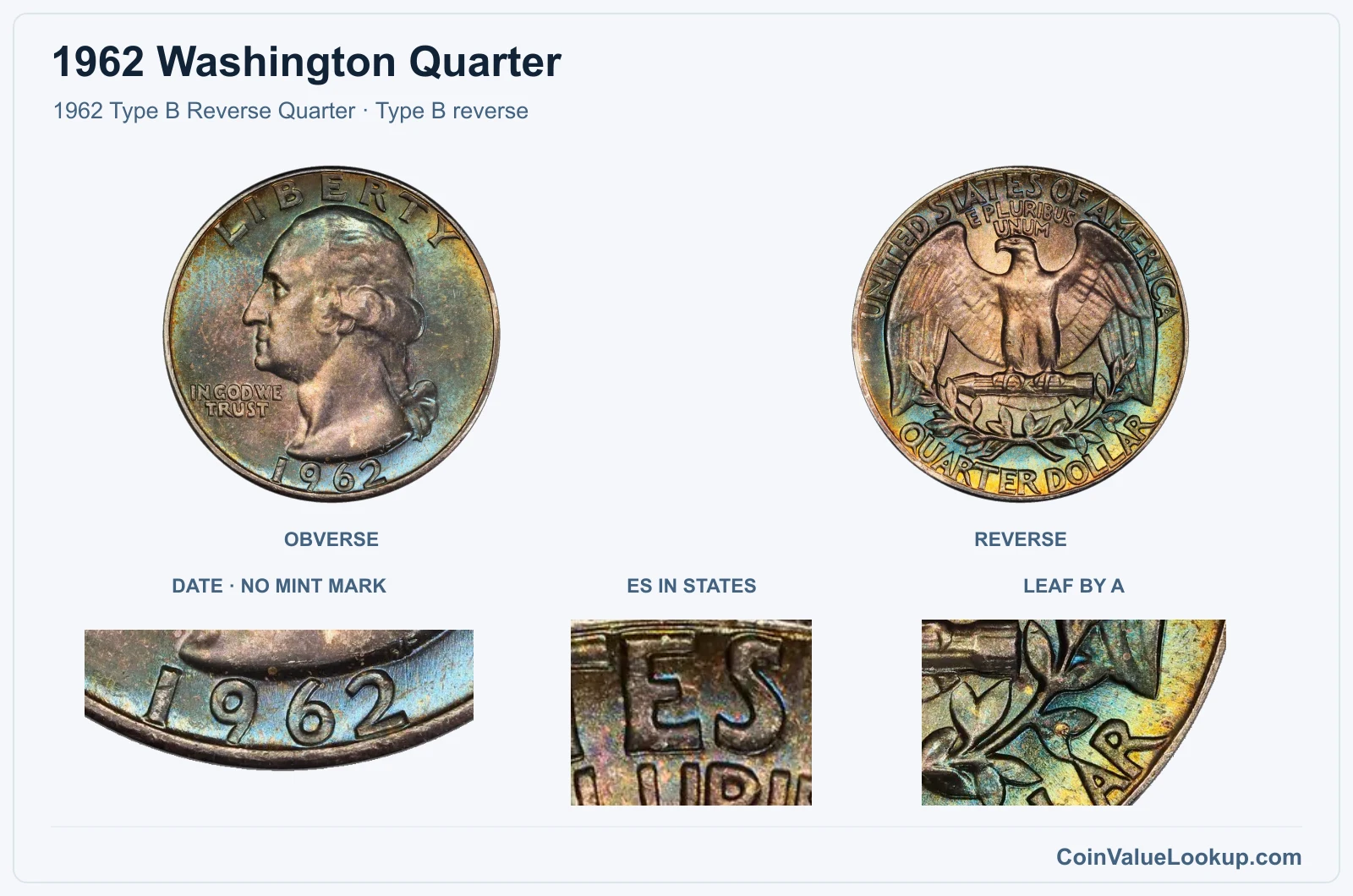
This is a Philadelphia circulation strike that used a proof-style reverse die hub, recognized by PCGS as the Type B reverse. The diagnostic is the gap between the letters E and S in STATES on the reverse.
On a normal circulation reverse the two letters nearly touch, while on the Type B they are clearly separated.
Confirm your coin has business-strike surfaces, not proof mirrors, because an ordinary proof naturally uses this reverse hub and is not the same variety. The Type B reverse has been documented on Philadelphia circulation quarters dated 1956 through 1964.
Coin Value Lookup is a good starting point if you want to compare your coin against other Washington Quarter dates or check different denominations entirely. No firm numeric price range is established for this variety; value depends on authenticated identity and the coin's individual condition, so professional evaluation is worthwhile if you believe you have one.
Range Grade
Price Auction Records Appraisal PO PO 1
—
Coin Identifier FR FR 2
—
Coin Identifier AG AG 3
—
Coin Identifier G G 4
—
Coin Identifier
G 6
—
Coin Identifier VG VG 8
—
Coin Identifier
VG 10
—
Coin Identifier F F 12
—
Coin Identifier
F 15
—
Coin Identifier VF VF 20
—
Coin Identifier
VF 25
—
Coin Identifier
VF 30
—
Coin Identifier
VF 35
—
Coin Identifier XF XF 40
—
Coin Identifier
XF 45
—
Coin Identifier AU AU 50
—
Coin Identifier
AU 53
—
Coin Identifier
AU 55
—
Coin Identifier
AU 58
—
Coin Identifier MS MS 60
—
Coin Identifier
MS 61
—
Coin Identifier
MS 62
—
Coin Identifier
MS 63
—
Coin Identifier
MS 64
—
Coin Identifier
MS 65
Coin Identifier
MS 66
Coin Identifier
MS 67
—
Coin Identifier
MS 68
—
—
—
MS 69
—
—
—
MS 70
—
—
—
1962 Washington Quarter Error List
1. 1962 Washington Quarter — Straight Clipped Planchet
A straight clipped planchet means a flat, linear edge segment was already missing from the blank before the dies struck it. On the attributed 1962 Philadelphia specimen, graded ANACS AU50, the coin weighs only 5.63 grams instead of the standard 6.25 grams, and the design and rim taper naturally toward the missing portion rather than showing sharp tool marks.
The critical distinction is between a genuine pre-strike clip and post-mint damage like sawing, grinding or hammering. A real clip will show the struck design flowing into the flat edge, with undisturbed original surfaces.
If the edge looks filed or the surrounding metal has scratches inconsistent with die contact, that is a red flag.
A three-coin lot including this piece plus two other clipped quarters sold for $51 total at Heritage in July 2021, so no individual price can be isolated from that result. Value depends on the size and type of the clip, the coin's overall condition, and third-party authentication.
2. 1962 Washington Quarter — Repunched D Mintmark
A repunched mintmark on a 1962-D quarter shows overlapping outlines of the D below the reverse wreath, the result of the mintmark punch being applied more than once at slightly different positions or angles. Under magnification and matched-angle lighting you can see a secondary D contour beneath or beside the primary one, with genuine raised relief rather than a flat shelf.
This is distinct from machine doubling, which leaves flat, shelf-like distortion without true separation, and from photographic shadows that disappear when you change the light angle. Also watch out for tampered mintmarks where someone has scratched or added metal to simulate a repunch.
No established numeric price range is available for this variety. Value depends on the clarity of the repunch, the coin's grade, and whether it has been authenticated by a recognized grading service.
3. 1962 Washington Quarter — Type B Reverse Variety
The Type B reverse variety occurs when a proof-style reverse hub was used to produce a circulation-strike die at the Philadelphia Mint. The telltale sign is the spacing between the letters E and S in STATES on the reverse.
On the normal circulation reverse those letters nearly touch, while on the Type B hub they are distinctly separated.
You must confirm that the coin has business-strike surfaces, meaning satiny or cartwheel luster rather than mirrored proof fields. A standard proof quarter naturally carries this reverse design, so a proof with separated ES is not the Type B variety, it is just a proof.
Be careful not to confuse worn or mushy lettering on a circulated coin with the hub difference, and do not mistake mechanical doubling of the legends for the Type B gap. No firm numeric price range is adopted for this variety.
Individual value depends on authenticated identity, condition and market demand at the time of sale.
4. 1962 Washington Quarter — Struck on a Silver Dime Planchet
This is one of the more dramatic errors for the date. A 1962 Philadelphia quarter was struck on a silver dime planchet, which is smaller and lighter than a quarter blank.
The result is a coin with a compact central strike preserving Washington's portrait and parts of the inner design, while the outer legends and rim are partially or entirely missing because the blank was too small to reach them.
To identify a genuine wrong-planchet strike, check the weight and diameter. A silver dime planchet is noticeably smaller and lighter than 6.25 grams.
The struck edge should show evidence of die contact, not post-mint cutting or grinding. Silver color alone does not confirm the planchet since both denominations used 90% silver in 1962.
A PCGS MS62 example sold for $660 at Heritage Auctions in July 2022, giving a concrete benchmark for this error in that grade.
5. 1962 Washington Quarter — Doubled Die Obverse
A doubled die obverse on a 1962 quarter shows consistent doubling or notching on obverse design elements such as lettering, the date, or details of Washington's portrait. The key word is consistent: true hub doubling repeats in the same direction and with similar separation across multiple features on the same side of the coin.
Under magnification, look for clear secondary contours with genuine relief rather than a flat, shelf-like displacement. Machine doubling, worn die contours, and light reflections can all mimic a doubled die to the naked eye but fall apart under careful inspection with proper lighting.
No numeric price range is established for this variety. Value depends on the visibility of the doubling, the coin's overall condition, and whether it has been confirmed by a third-party grading service.
If you suspect doubling, compare your coin side by side with a known normal example under the same light angle.
6. 1962 Washington Quarter — Off-Center Strike
An off-center strike happens when the planchet is not properly seated between the dies, resulting in a displaced design and an unstruck crescent-shaped blank area on one side. The more dramatic the percentage off center, the more visually striking the error, but collectors generally want the date to remain fully visible.
Do not confuse an off-center strike with a clipped planchet, which removes metal before striking, or with one-sided die misalignment, which shifts only one side's design. Post-mint flattening can also create an odd appearance but will not produce an unstruck crescent with original planchet surface.
No numeric price range is established for this error on a 1962 quarter. Value depends on the percentage of displacement, whether the date is readable, the coin's condition, and third-party authentication.