1962 Jefferson Nickel Coin Value: How Much Is It Worth?
Most 1962 Jefferson nickels you pull from a jar are worth face value or close to it. The coins that matter are uncirculated survivors and certified error pieces.
Guide estimates for ordinary uncirculated examples run from about $0.30 at MS60 up to $19–$38 at MS65 depending on the mint, while proofs and mint errors follow their own pricing curves entirely.
Fast Way to Identify Your 1962 Jefferson Nickel
Snap clear photos of both sides of your 1962 nickel and upload them here for a preliminary identification. Good lighting and a steady hand make a big difference.
This step can help you figure out whether you have a Philadelphia, Denver, or proof issue and whether anything unusual is going on before you dig deeper.
1962 Jefferson Nickel Value
Upload both sides of your 1962 Jefferson Nickel.
Front Obverse
Upload photo
Back Reverse
Upload photo
Which 1962 Jefferson Nickel Versions Are Worth Money?
- Uncirculated Philadelphia and Denver business strikes in MS65 or higher are worth checking, with guide values of $19 and $38 respectively at that grade.
- Proof specimens have their own value track, with a PR65 guide estimate around $3.62; cameo contrast examples may carry additional premiums.
- Authenticated wrong-planchet errors, such as a nickel struck on a cent planchet, have sold individually at auction for meaningful sums.
- Double-denomination strikes, like a nickel struck over a Lincoln cent, are rare and require professional verification to distinguish from altered coins.
Step 1: Identify Your 1962 Jefferson Nickel Mint Mark and Version
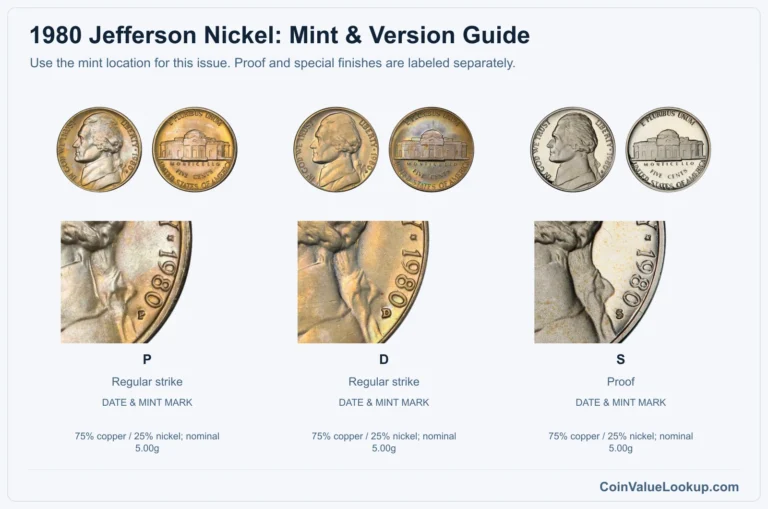
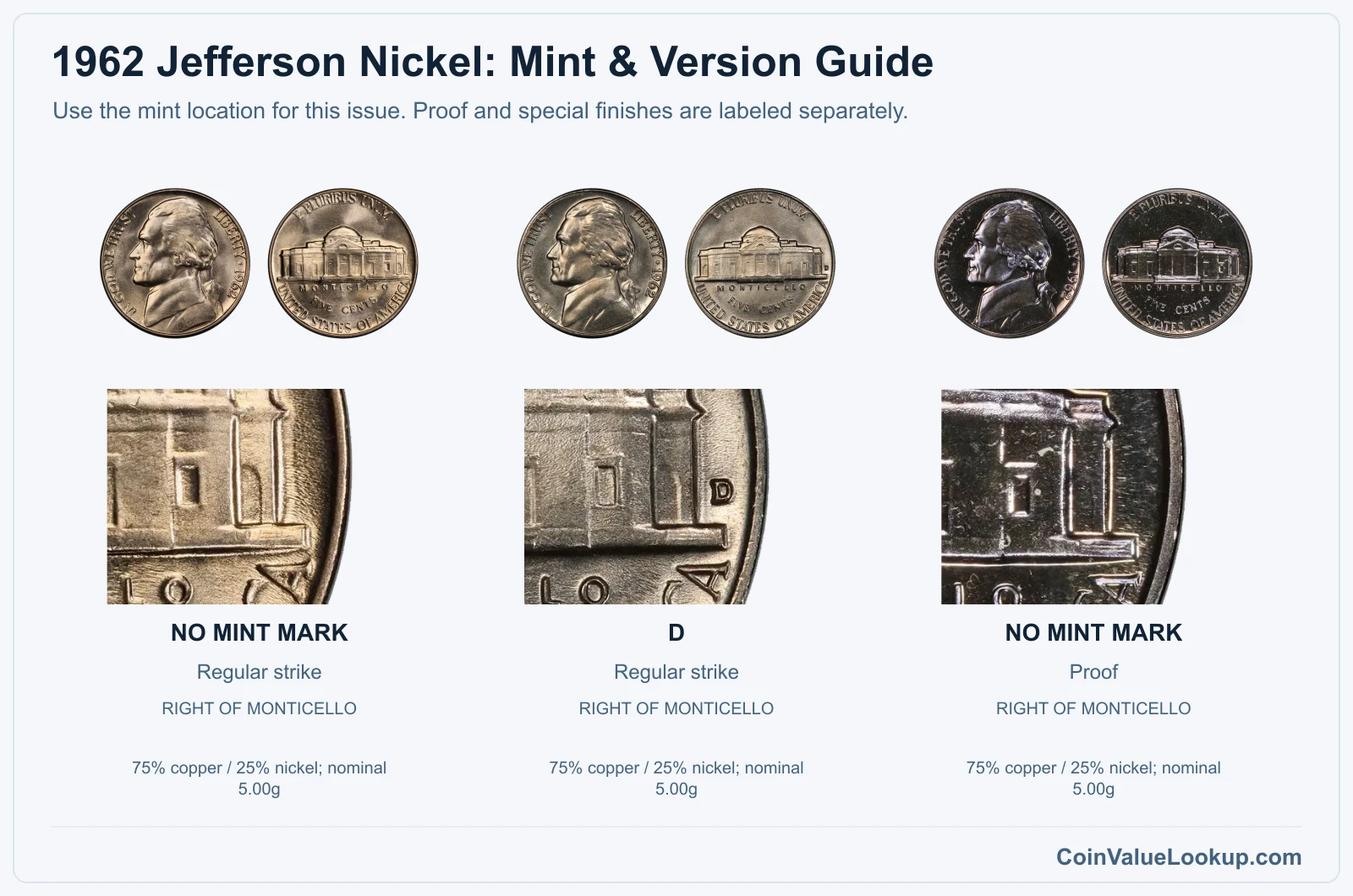
The 1962 nickel comes in three flavors. Philadelphia business strikes carry no mintmark at all.
Denver coins show a small "D" to the right of Monticello on the reverse. Proofs were also struck at Philadelphia and likewise have no mintmark, but their mirror-like fields and sharp detail set them apart from circulation pieces.
All three versions share the same specs: 75% copper and 25% nickel, 5.00 grams, 21.2 mm diameter, plain edge. Weighing your coin is a useful first screening step if you suspect something odd about the planchet, though weight alone cannot authenticate an error.
Before looking up value, record the date, mintmark presence or absence, strike finish, and note anything unusual on both faces. That information determines which price column applies to your specific coin.
Step 2: Check Your 1962 Jefferson Nickel Grade
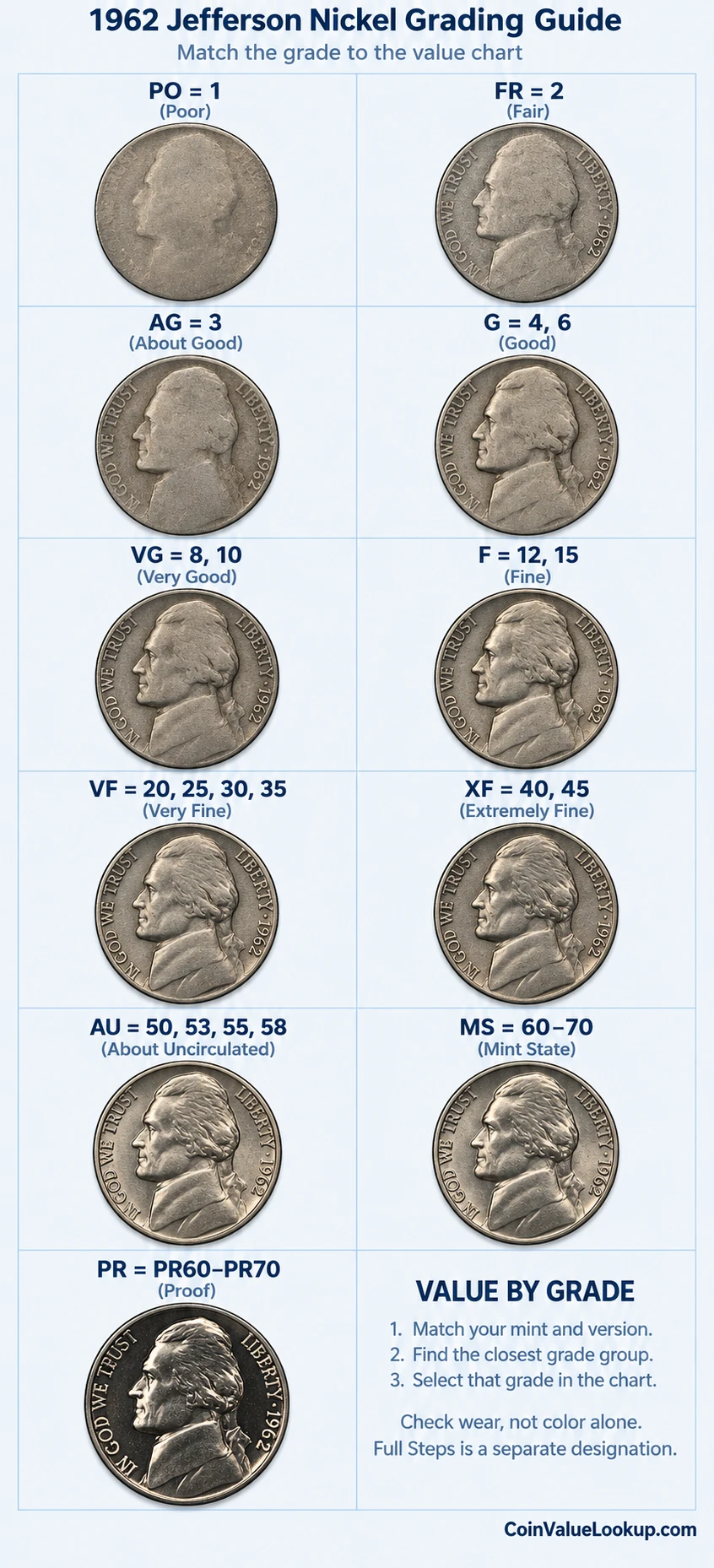
Start with Jefferson's cheek and the hair detail above his ear. On a lightly circulated coin those areas show flattening first, and luster disappears from the high points.
A coin that still has full original mint luster across both sides, with no contact wear on the cheek, is a candidate for Mint State grades.
On the reverse, check the roof lines and columns of Monticello. Flat or mushy columns might mean wear, or they might mean the coin was weakly struck to begin with.
That distinction matters a lot.
Full Steps is a separate strike-quality designation applied only to Mint State business strikes. It requires uninterrupted, fully formed steps at the base of Monticello.
A shiny surface alone does not guarantee a high grade or a Full Steps designation, so compare your coin carefully against the reference image provided.
Step 3: Check 1962 Jefferson Nickel Value by Mint and Version
1962 Jefferson Nickel — No mintmark (Philadelphia) Business strike
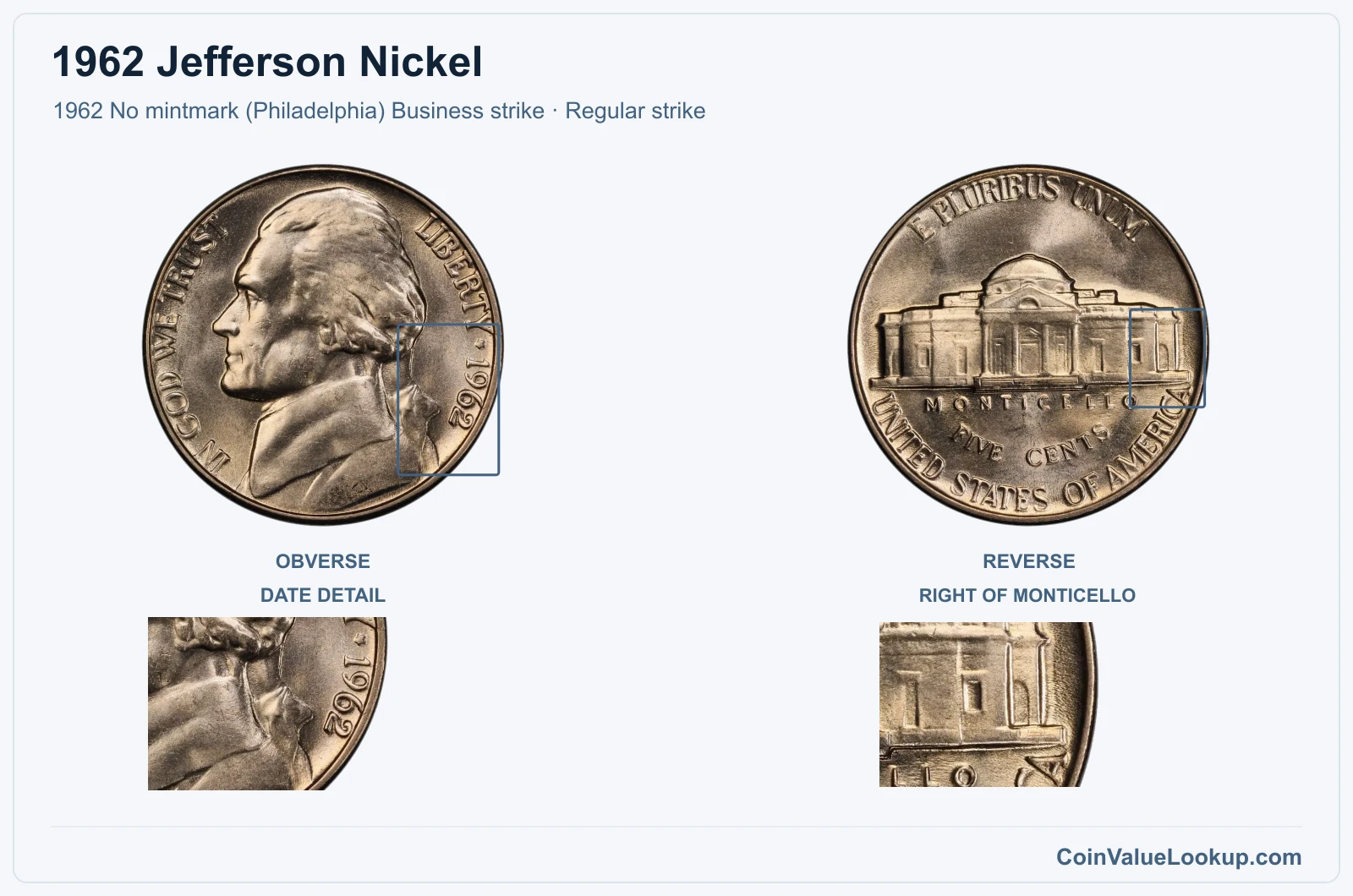
The 1962 Philadelphia business strike has no mintmark anywhere on the coin. Look for Jefferson's portrait on the obverse and Monticello on the reverse, with standard circulation-strike surfaces rather than proof mirrors.
USA Coin Book lists guide estimates of about $0.30 at MS60 and $19 at MS65.
Full Steps examples command separate premiums beyond those figures. A genuinely sharp strike with complete, unbroken steps at the base of Monticello is uncommon for this date, so do not assume every lustrous piece qualifies.
| Range | Grade | Price | Auction Records | Appraisal |
|---|---|---|---|---|
| PO | PO 1 | — | Coin Identifier | |
| FR | FR 2 | — | — | — |
| AG | AG 3 | — | — | — |
| G | G 4 | — | — | — |
| G 6 | — | — | — | |
| VG | VG 8 | — | — | — |
| VG 10 | — | — | — | |
| F | F 12 | — | — | — |
| F 15 | — | — | — | |
| VF | VF 20 | — | — | — |
| VF 25 | — | — | — | |
| VF 30 | — | — | — | |
| VF 35 | — | — | — | |
| XF | XF 40 | — | Coin Identifier | |
| XF 45 | — | Coin Identifier | ||
| AU | AU 50 | — | Coin Identifier | |
| AU 53 | — | Coin Identifier | ||
| AU 55 | — | Coin Identifier | ||
| AU 58 | — | Coin Identifier | ||
| MS | MS 60 | — | Coin Identifier | |
| MS 61 | — | Coin Identifier | ||
| MS 62 | — | Coin Identifier | ||
| MS 63 | — | Coin Identifier | ||
| MS 64 | Coin Identifier | |||
| MS 65 | Coin Identifier | |||
| MS 66 | Coin Identifier | |||
| MS 67 | Coin Identifier | |||
| MS 68 | — | — | — | |
| MS 69 | — | — | — | |
| MS 70 | — | — | — |
1962 Jefferson Nickel — D Business strike
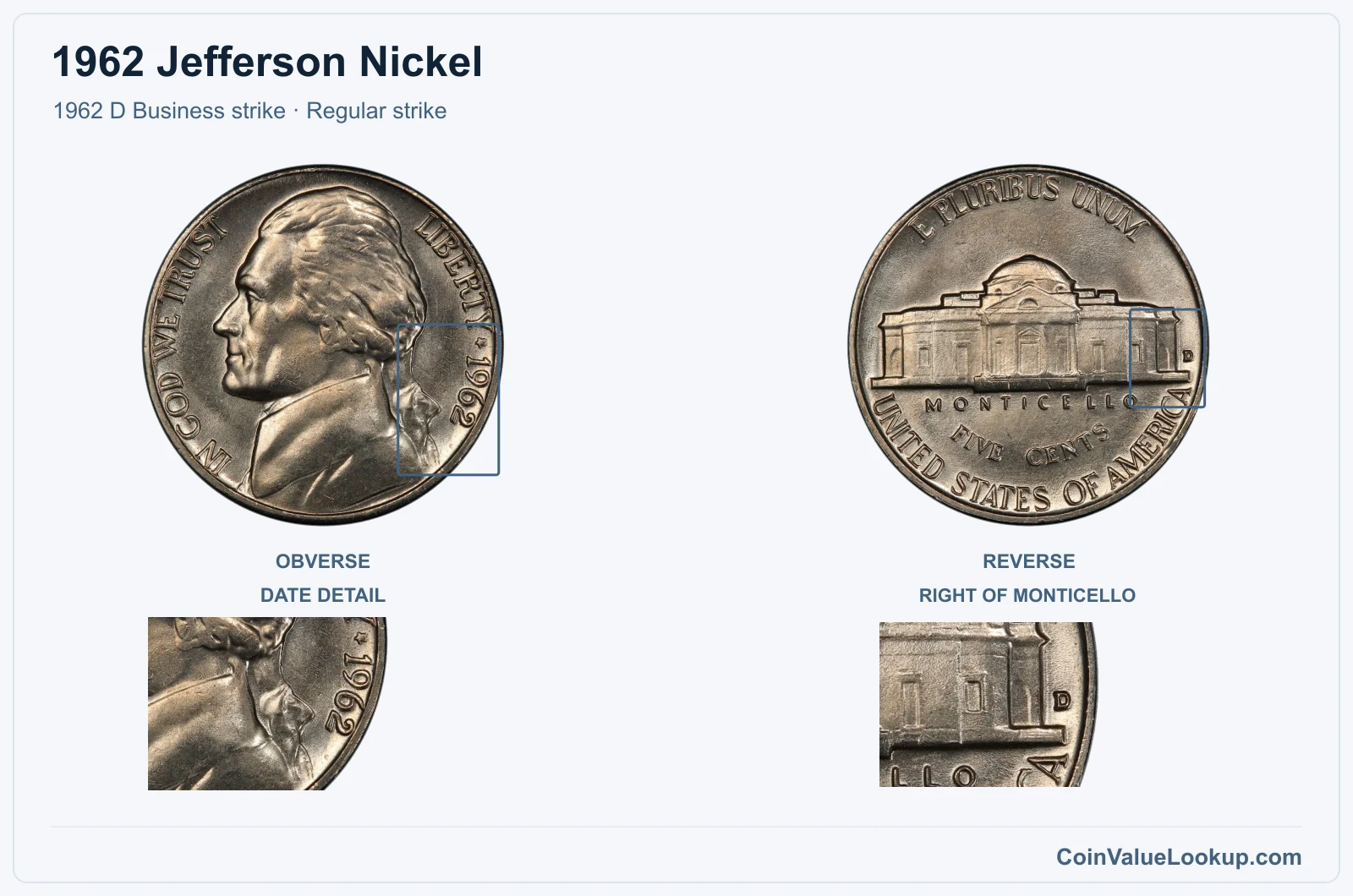
Denver-minted 1962 nickels carry a small "D" mintmark to the right of Monticello on the reverse. These are business strikes with the same 75% copper, 25% nickel composition and 5.00-gram weight as the Philadelphia issue.
USA Coin Book guide estimates place them at roughly $0.30 in MS60 and $38 at MS65, making the D-mint the higher-valued regular issue at gem grade.
Coin Value Lookup is a handy starting point if you want to look up other dates or denominations alongside your 1962-D. Two minutes there can save you a long search.
| Range | Grade | Price | Auction Records | Appraisal |
|---|---|---|---|---|
| PO | PO 1 | — | Coin Identifier | |
| FR | FR 2 | — | — | — |
| AG | AG 3 | — | — | — |
| G | G 4 | — | — | — |
| G 6 | — | — | — | |
| VG | VG 8 | — | — | — |
| VG 10 | — | — | — | |
| F | F 12 | — | — | — |
| F 15 | — | — | — | |
| VF | VF 20 | — | — | — |
| VF 25 | — | — | — | |
| VF 30 | — | — | — | |
| VF 35 | — | — | — | |
| XF | XF 40 | — | Coin Identifier | |
| XF 45 | — | Coin Identifier | ||
| AU | AU 50 | — | Coin Identifier | |
| AU 53 | — | Coin Identifier | ||
| AU 55 | — | Coin Identifier | ||
| AU 58 | — | Coin Identifier | ||
| MS | MS 60 | — | Coin Identifier | |
| MS 61 | — | Coin Identifier | ||
| MS 62 | — | Coin Identifier | ||
| MS 63 | Coin Identifier | |||
| MS 64 | Coin Identifier | |||
| MS 65 | Coin Identifier | |||
| MS 66 | Coin Identifier | |||
| MS 67 | — | Coin Identifier | ||
| MS 68 | — | — | — | |
| MS 69 | — | — | — | |
| MS 70 | — | — | — |
1962 Jefferson Nickel — No mintmark (Philadelphia) Proof
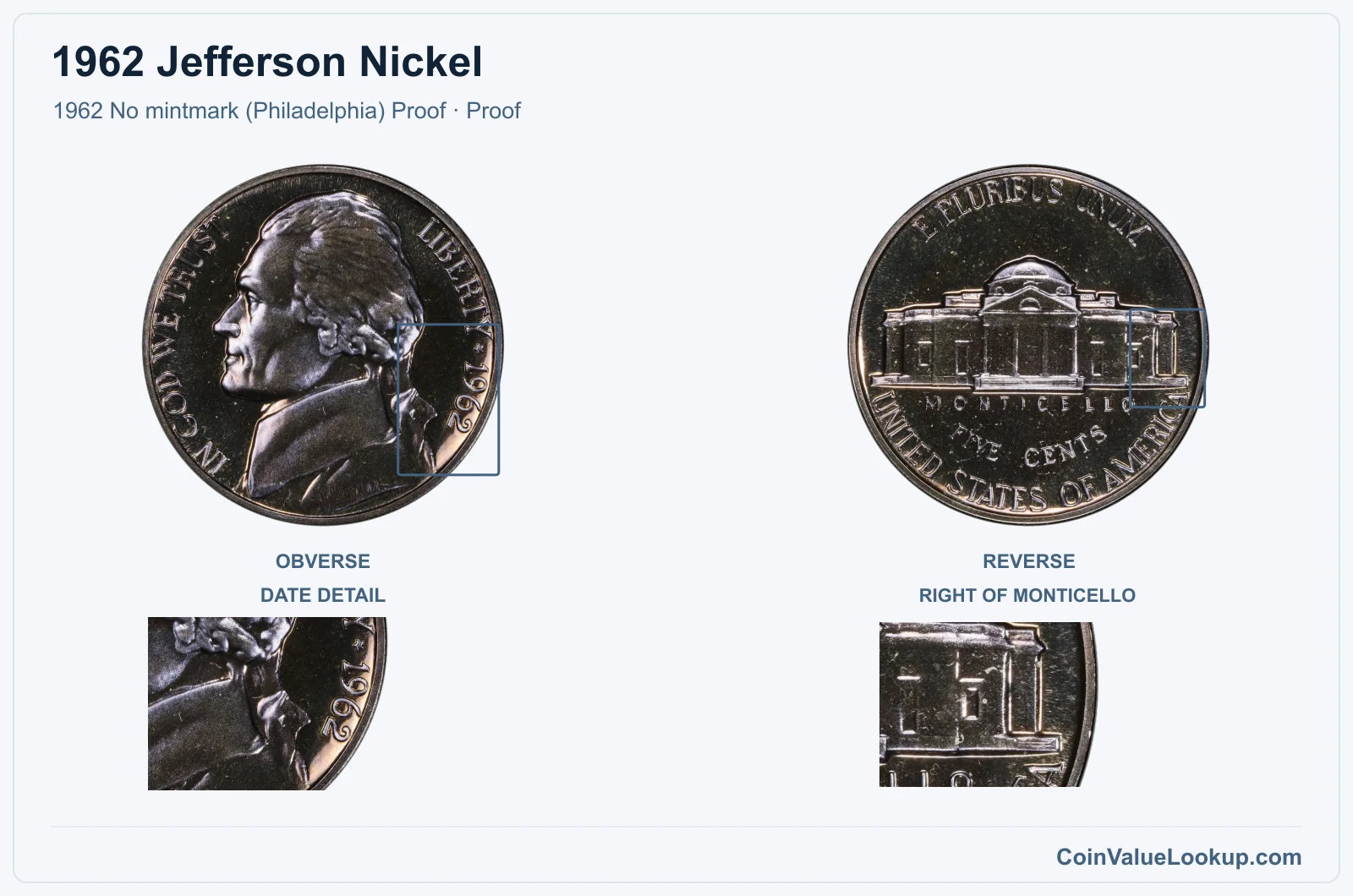
Proof 1962 nickels were struck at Philadelphia and carry no mintmark, just like the business strikes. The difference is obvious once you know what to look for: proofs have deeply mirrored fields and crisp, squared-off design details from specially prepared dies and planchets.
A guide estimate of about $3.62 at PR65 gives you a baseline. Some proof specimens exhibit cameo or deep cameo contrast between frosted devices and mirror fields, which can push value above the standard proof figure.
Do not confuse a well-preserved business strike for a proof; the manufacturing finish is distinct from the grade.
| Range | Grade | Price | Auction Records | Appraisal |
|---|---|---|---|---|
| PR | PR 1 | — | Coin Identifier | |
| PR 2 | — | Coin Identifier | ||
| PR 3 | — | Coin Identifier | ||
| PR 4 | — | Coin Identifier | ||
| PR 6 | — | Coin Identifier | ||
| PR 8 | — | Coin Identifier | ||
| PR 10 | — | Coin Identifier | ||
| PR 12 | — | Coin Identifier | ||
| PR 15 | — | Coin Identifier | ||
| PR 20 | — | Coin Identifier | ||
| PR 25 | — | Coin Identifier | ||
| PR 30 | — | Coin Identifier | ||
| PR 35 | — | Coin Identifier | ||
| PR 40 | — | Coin Identifier | ||
| PR 45 | — | Coin Identifier | ||
| PR 50 | — | Coin Identifier | ||
| PR 53 | — | Coin Identifier | ||
| PR 55 | — | Coin Identifier | ||
| PR 58 | — | Coin Identifier | ||
| PR 60 | — | Coin Identifier | ||
| PR 61 | — | Coin Identifier | ||
| PR 62 | — | Coin Identifier | ||
| PR 63 | — | Coin Identifier | ||
| PR 64 | Coin Identifier | |||
| PR 65 | Coin Identifier | |||
| PR 66 | Coin Identifier | |||
| PR 67 | Coin Identifier | |||
| PR 68 | Coin Identifier | |||
| PR 69 | Coin Identifier | |||
| PR 70 | — | — | — |
1962 Jefferson Nickel Error List
1. 1962 Jefferson Nickel — Struck on a cent planchet
A 1962 nickel struck on a cent planchet is a wrong-planchet error. The coin will be noticeably smaller than a standard nickel and show copper color rather than the usual silver-gray nickel alloy.
Legends and design elements appear cropped or stretched because the smaller blank could not accommodate the full die impression.
Weigh the coin. A normal nickel is 5.00 grams; a cent planchet is lighter.
Edge inspection helps too, since a copper blank has a different appearance from the solid nickel alloy. Beware of coins that have been copper-plated, chemically toned, or physically ground down to mimic this error.
A Heritage Auctions November 2020 example, a 1962-D graded PCGS MS62, sold for $348. That is one authenticated specimen's result, not a universal price for every similar-looking coin.
2. 1962 Jefferson Nickel — Obverse die break
Die breaks on the 1962 nickel appear as raised, irregular lumps of metal on the coin's surface, caused by a piece of the die cracking and eventually breaking away. The broken area fills with metal during striking, leaving a blob that is part of the coin rather than something stuck on top.
Authenticated examples exist from the Denver mint. Value depends on the size, location, and severity of the break, plus the coin's overall condition.
There is no single adopted price range for this error, so each piece needs individual assessment based on its specific characteristics and certification.
Do not confuse a die break with incuse damage, corrosion pitting, or solder residue. A genuine break is raised, follows the coin's contour, and shows no tool marks or foreign material.
3. 1962 Jefferson Nickel — Struck over a Lincoln cent
A 1962 nickel struck over a Lincoln cent is a double-denomination error. The nickel dies impressed their design onto an already-struck cent, so remnants of Lincoln's portrait or the cent's reverse legends survive underneath the nickel design.
This is different from a coin struck on an unstruck cent blank.
An authenticated example exists: a 1962-D nickel struck over a 1962-D cent, graded NGC MS64. No adopted price range is available, so value depends on the specific coin's condition, the visibility of the underlying cent design, and professional authentication.
Glued coins and vise jobs can fake this look. A genuine double-denomination strike shows both designs integrated into the metal at die-strike depth, with no seam or adhesive residue.
Professional certification is essential here.
4. 1962 Jefferson Nickel — Doubled Die Obverse
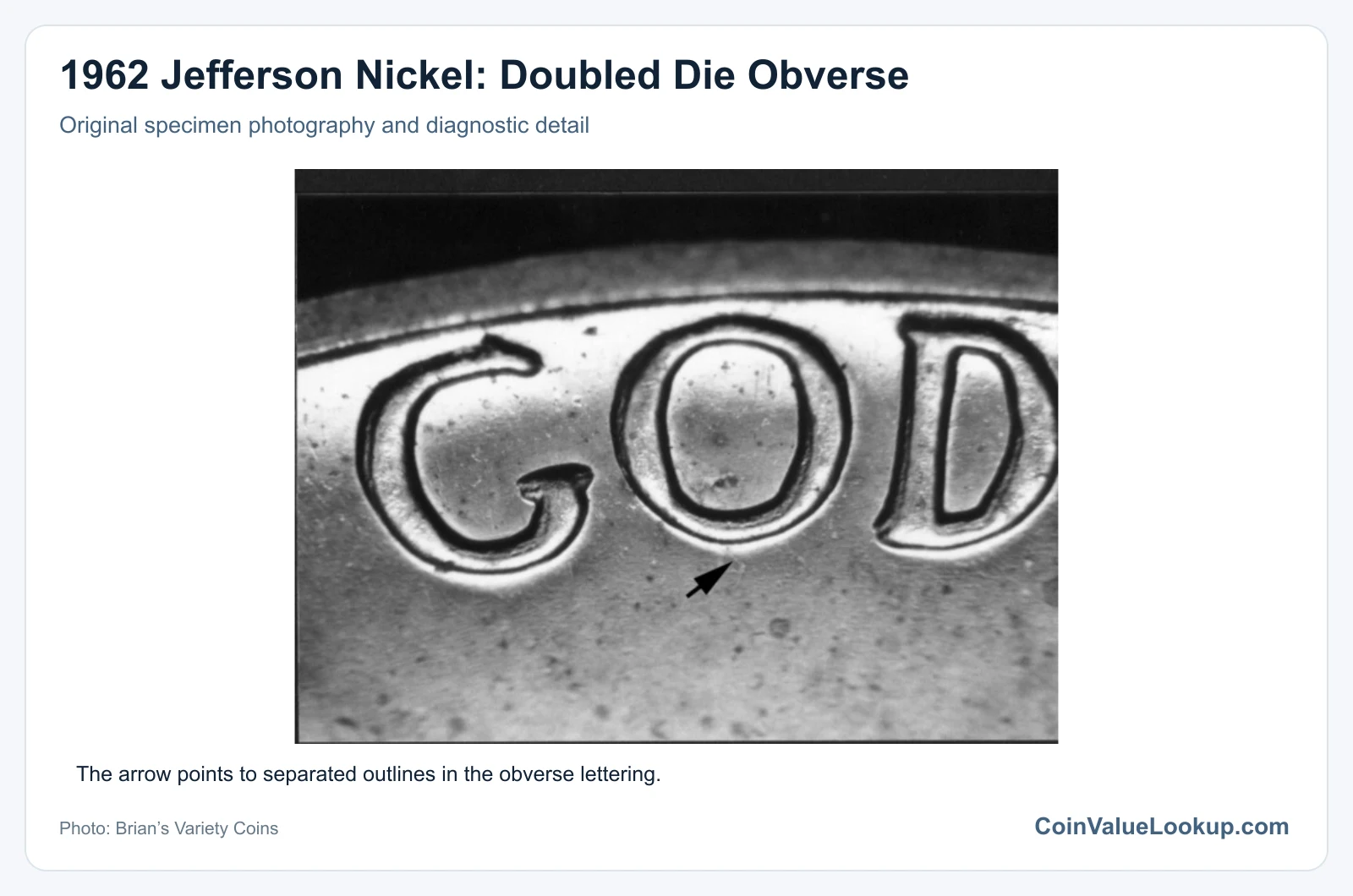
Doubled die obverse varieties have been reported for the 1962 nickel. The doubling appears as consistent separation or notching on obverse lettering or design elements, visible under magnification.
Compare suspect areas against a normal 1962 nickel under the same lighting.
True hub doubling produces uniform, directional separation that repeats across multiple design elements. Machine doubling, by contrast, tends to create flat, shelf-like distortion and generally adds little or no premium.
Reflections and worn die contours can also mimic doubling to an untrained eye.
No specific price range is adopted for this variety. Value depends on the particular die pair, the strength and visibility of the doubling, and the coin's overall condition.
Professional attribution is the safest path to confirming what you have.
5. 1962 Jefferson Nickel — Doubled Die Reverse
Doubled die reverse varieties are also reported for the 1962 nickel. Check the reverse legends and the architectural details of Monticello for consistent separation that matches a known doubled die pattern.
A loupe at 5x to 10x magnification is your minimum tool here.
Genuine doubled dies show separation that is uniform in direction and appears on multiple design elements. Machine doubling, random damage, and die deterioration can all produce misleading look-alikes.
If the doubling looks flat and shelf-like rather than rounded and raised, it is more likely mechanical.
No numerical price range is adopted for this error. Condition, the degree of visible doubling, and the specific die variety all factor into value.
Certification from a grading service that attributes die varieties is the standard way to confirm authenticity.
6. 1962 Jefferson Nickel — Repunched Mintmark
Repunched mintmark varieties exist for the 1962-D nickel. Look at the "D" mintmark on the reverse for traces of a second, slightly offset punch beneath or beside the primary mark.
You will need magnification and good directional light to spot the remnant.
A genuine repunched mintmark shows a partial duplicate impression of the same letter, with consistent depth and style. Die chips, corrosion buildup, and machine doubling near the mintmark can create similar-looking artifacts, so compare your coin to a known normal example at the same magnification.
No specific price is adopted for this variety. The premium depends on the visibility of the repunching, which die pair produced it, and the coin's grade.
Professional attribution helps distinguish a true RPM from a common die chip or surface issue.
7. 1962 Jefferson Nickel — Off-Center Strike
Off-center strikes have been reported for the 1962 nickel. The design is shifted to one side, leaving an unstruck crescent of blank metal on the opposite edge.
The further off-center the strike, the more dramatic the coin looks, but the date must remain visible for the coin to be attributed to a specific year.
Do not confuse an off-center strike with a clipped planchet, which removes a curved bite from the blank before striking. Post-mint flattening or one-sided die misalignment can also produce misleading results.
A true off-center strike shifts the entire design uniformly.
No adopted price range exists for this error on the 1962 nickel. Value depends on the percentage of off-center displacement, date visibility, and overall condition.
Coins with the date intact and a significant shift typically generate the most collector interest.
8. 1962 Jefferson Nickel — Lamination / Split Planchet
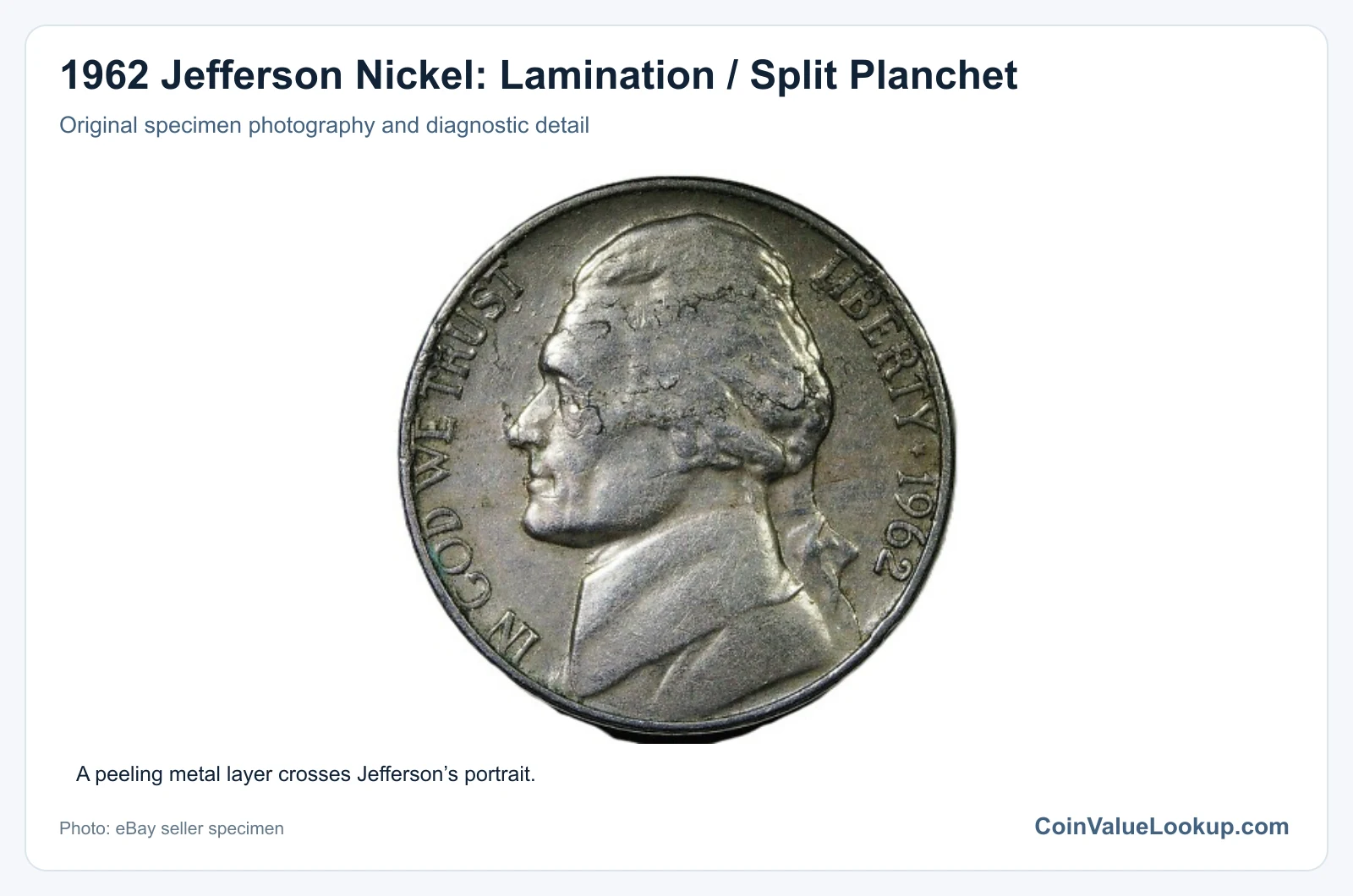
Lamination errors, also called split planchet errors, have been reported for the 1962 nickel. These occur when impurities or gas pockets within the alloy cause the metal to separate into layers.
You will see peeling metal, a retained flap, or an area where part of the coin's surface has lifted or split away.
Photograph the edge alongside the affected face. A genuine lamination shows separation within the alloy itself, with a natural, layered texture at the split.
Scraping, corrosion, and deliberately cut or peeled coins can mimic this error, so look for signs of tool marks or unnatural edges.
No numerical price is adopted for this variety. Value depends on the size and location of the lamination, whether the flap is still attached, and the coin's overall preservation.
Authentication by a grading service provides the strongest confirmation.