1955 Franklin Half Dollar Coin Value: How Much Is It Worth?
The 1955 Franklin Half Dollar is a 90% silver coin that collectors actively pursue. Guide estimates for this date range from about $34.00 in well-worn condition up to $109.00 for a proof example, depending on the specific branch and grade.
Mint, condition, and special versions like Full Bell Lines all play a role in what your coin might bring. These guide figures are reference anchors, not guaranteed selling prices or current silver-melt quotes.
Fast Way to Identify Your 1955 Franklin Half Dollar
The quickest way to start figuring out what you have is to upload clear photos of both the front and back of your coin. Our identifier can give you a preliminary read on the mint, version, and general condition.
It works from images alone, so good lighting and a flat angle help. This is not a substitute for professional authentication, but it is a solid first step.
1955 Franklin Half Dollar Value
Upload both sides of your 1955 Franklin Half Dollar.
Front Obverse
Upload photo
Back Reverse
Upload photo
Which 1955 Franklin Half Dollar Versions Are Worth Money?
- The 1955 proof (PR65) carries the highest listed guide estimate at $109.00, reflecting its collector-only manufacture and mirrored finish.
- A 1955 business strike in MS65 condition lists at $87.00 in the guide, well above the $34.00 anchor for a heavily worn G4 example.
- Full Bell Lines detail on either branch can push the value above standard guide figures, but requires intact, unbroken lower bell lines under magnification.
- Check for reported mint errors such as wrong planchet strikes, Bugs Bunny die clashes, and clipped planchets, as these carry separate collector interest beyond the standard branches.
Step 1: Identify Your 1955 Franklin Half Dollar Mint Mark and Version
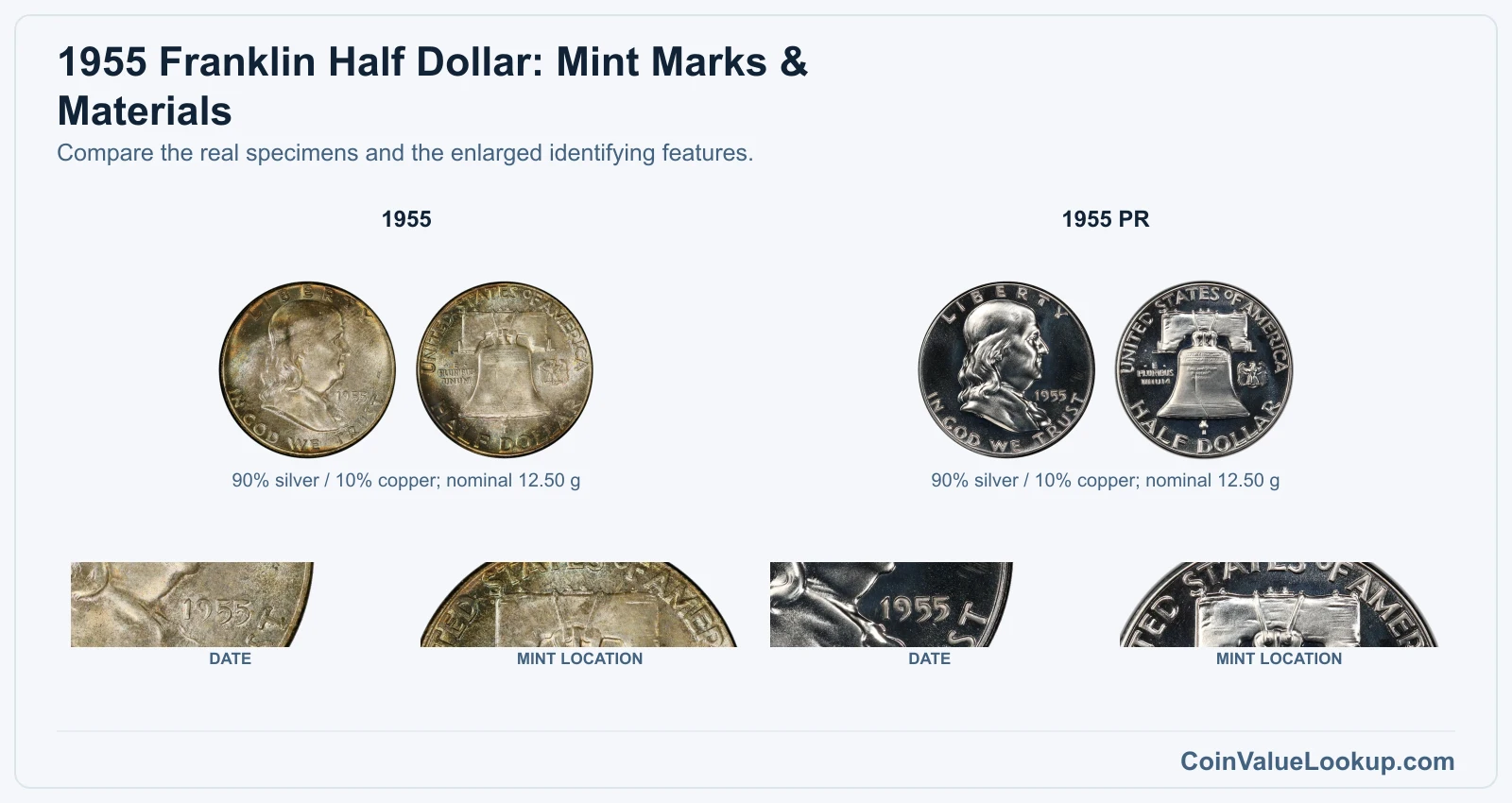
The 1955 Franklin Half Dollar is struck in 90% silver and 10% copper, with a nominal weight of 12.50 grams. Toning or dark surfaces do not change the underlying alloy.
To figure out your coin's branch, flip it over. The mintmark sits on the reverse above the Liberty Bell, just below E PLURIBUS UNUM.
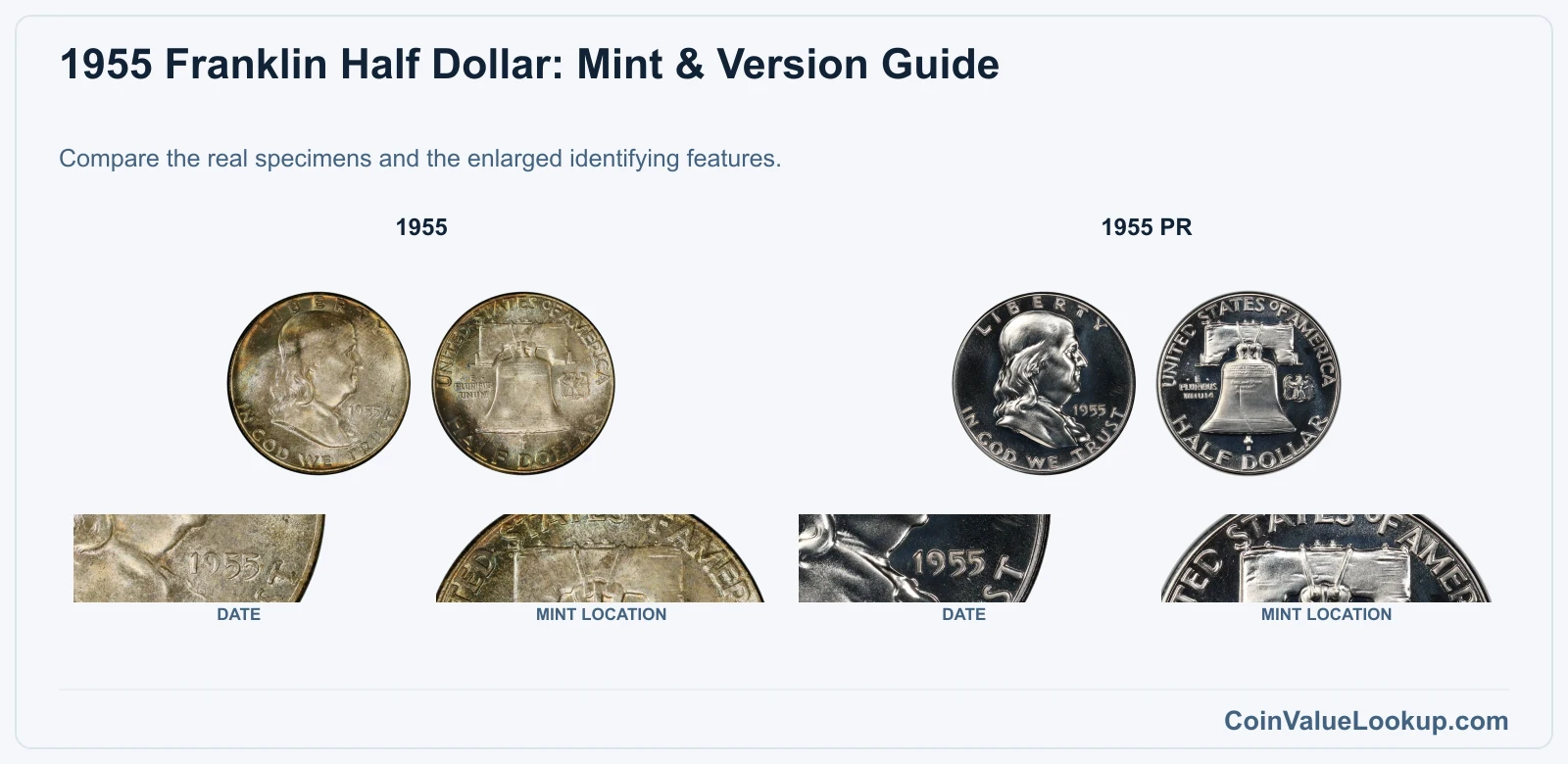
No mintmark means Philadelphia. For this particular year, the only branches are the 1955 Philadelphia business strike and the 1955 Philadelphia proof.
Separating those two is the key identification task. A business strike has slightly satiny or lustered fields.
A proof has deeply mirrored, reflective fields with razor-sharp device edges. If you have to squint and wonder, it is almost certainly a business strike.
A polished regular coin is not a proof, no matter how shiny someone made it.
Coin Value Lookup is a good place to look up guides for Franklin halves and other series if you are working through a collection or a handful of coins at once.
Step 2: Check Your 1955 Franklin Half Dollar Grade
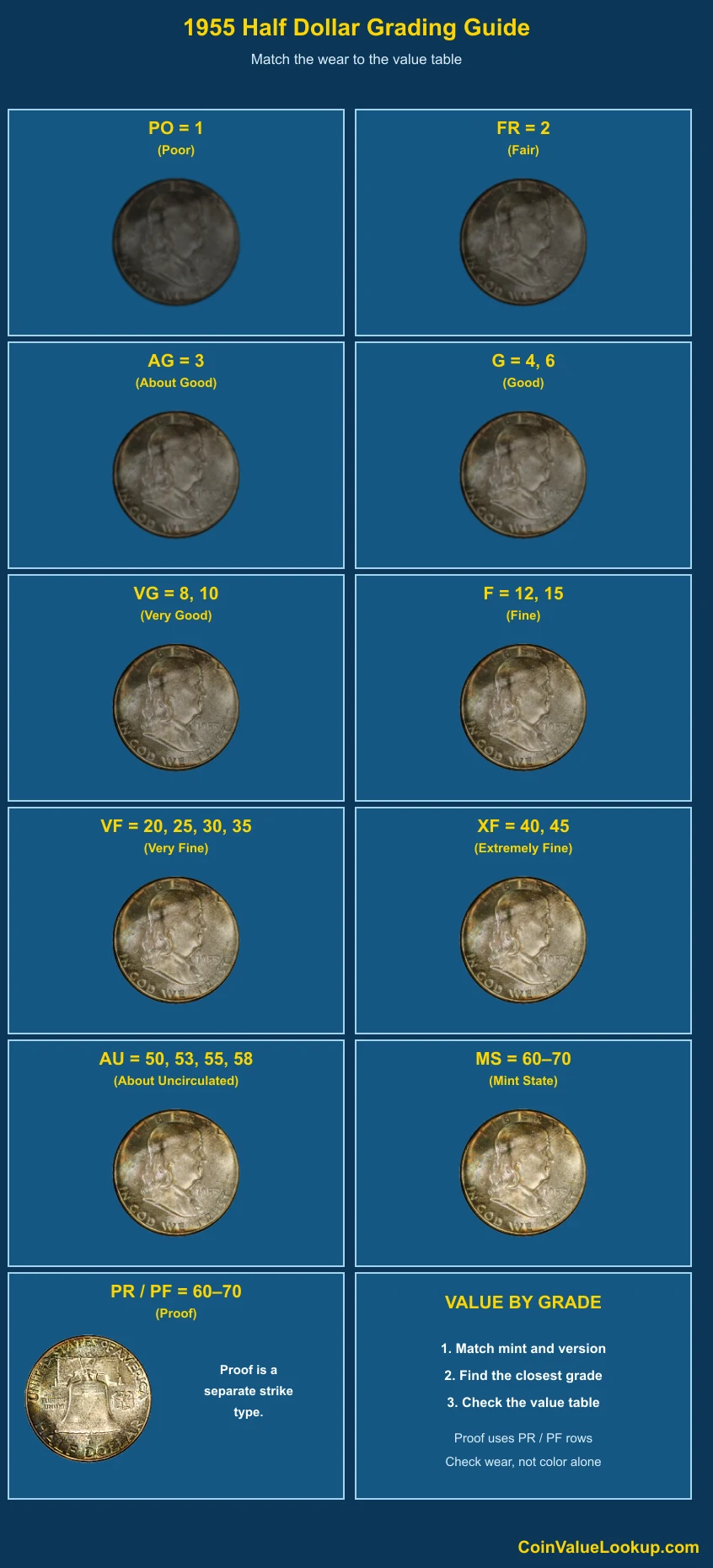
Start with Franklin's cheek, the hair behind his ear, and the shoulder area on the obverse. These are the first spots to show wear.
A coin grading around Good (G4) will have those areas nearly flat, while a Mint State coin keeps full, rounded detail across the portrait.
On the reverse, check the Liberty Bell lettering and the lower bell lines. Full Bell Lines (FBL) is a strike-quality designation, not a higher grade.
It means the horizontal lines at the bottom of the bell are complete and unbroken. FBL coins carry a premium, but you need to evaluate grade separately.
For proofs, ignore wear and focus on hairlines, haze, and contact marks. A proof can still be low-grade if the surfaces are damaged.
Compare your coin against the reference image to judge where it falls on the spectrum. Contact marks from other coins are different from the smooth, flat wear of circulation.
Step 3: Check 1955 Franklin Half Dollar Value by Mint and Version
1955 Franklin Half Dollar
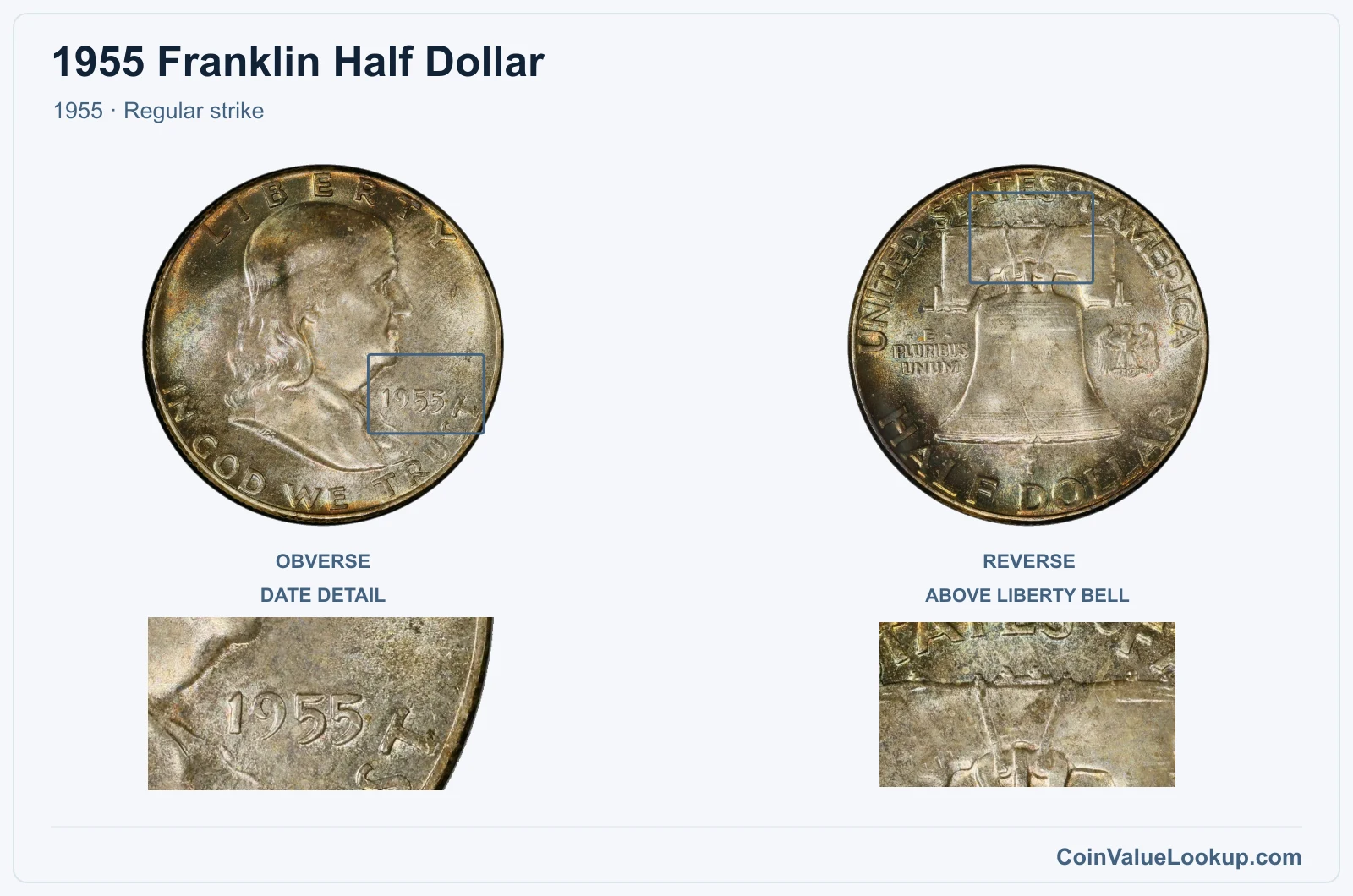
The 1955 business strike was produced at Philadelphia with no mintmark. You will find the mintmark area on the reverse above the Liberty Bell, below E PLURIBUS UNUM.
If that space is empty, you have the Philadelphia issue.
USA Coin Book guide estimates place this coin at about $34.00 in G4 (a heavily worn but readable grade) and around $87.00 in MS65 (a gem with strong luster and minimal marks). These are reference points, not guaranteed offers.
Silver content supports a baseline, but cleaned or damaged pieces will not match problem-free examples at the same grade. Full Bell Lines is a strike-detail designation, not a separate mint or metal, so do not confuse it with the standard grade.
Range Grade
Price Auction Records Appraisal PO PO 1
—
Coin Identifier FR FR 2
—
Coin Identifier AG AG 3
—
Coin Identifier G G 4
—
Coin Identifier
G 6
—
Coin Identifier VG VG 8
—
Coin Identifier
VG 10
—
Coin Identifier F F 12
—
Coin Identifier
F 15
—
Coin Identifier VF VF 20
—
Coin Identifier
VF 25
—
Coin Identifier
VF 30
—
Coin Identifier
VF 35
—
Coin Identifier XF XF 40
—
Coin Identifier
XF 45
—
Coin Identifier AU AU 50
—
Coin Identifier
AU 53
—
Coin Identifier
AU 55
Coin Identifier
AU 58
Coin Identifier MS MS 60
—
Coin Identifier
MS 61
—
Coin Identifier
MS 62
Coin Identifier
MS 63
Coin Identifier
MS 64
Coin Identifier
MS 65
Coin Identifier
MS 66
Coin Identifier
MS 67
Coin Identifier
MS 68
—
—
—
MS 69
—
—
—
MS 70
—
—
—
1955 Franklin Half Dollar — PR
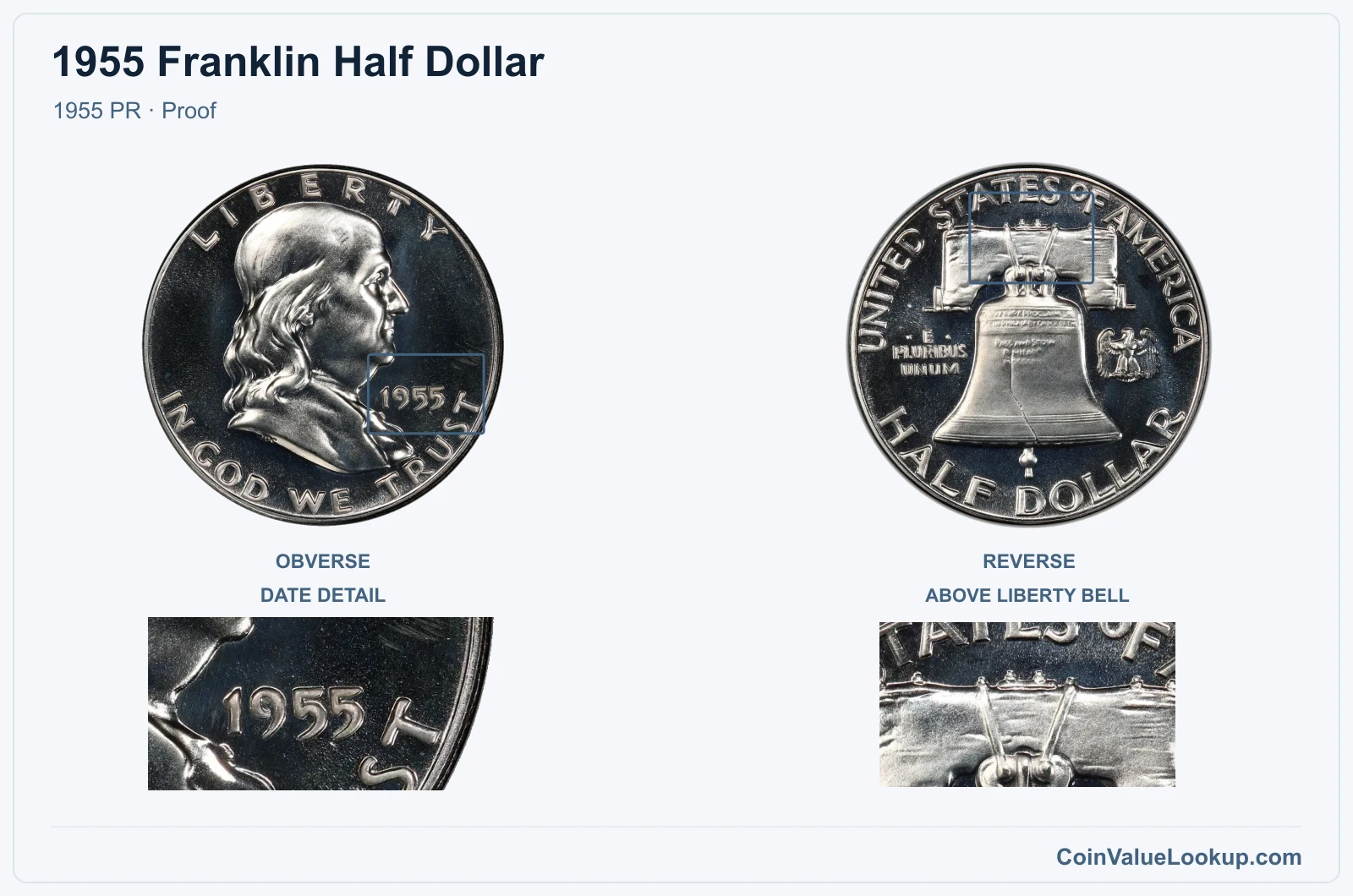
The 1955 proof was struck at Philadelphia for collectors, not for circulation. These coins have deeply mirrored fields and exceptionally sharp details from specially prepared dies.
No mintmark appears, same as the business strike, so you have to identify it by surface quality.
Confirm mirror-like reflective fields and crisp device edges. Then assess hairlines, haze, and whether the coin shows cameo contrast between frosted devices and mirrored fields.
A polished circulation strike is not a proof. If you are unsure, tilt the coin under a single light source.
A proof reflects like a dark mirror.
The USA Coin Book guide estimate for a PR65 example is about $109.00. Condition, surface quality, and the presence or absence of cameo contrast all affect what a specific proof might bring.
That guide figure is not a guaranteed sale price.
Range Grade
Price Auction Records Appraisal PR PR 1
—
Coin Identifier
PR 2
—
Coin Identifier
PR 3
—
Coin Identifier
PR 4
—
Coin Identifier
PR 6
—
Coin Identifier
PR 8
—
Coin Identifier
PR 10
—
Coin Identifier
PR 12
—
Coin Identifier
PR 15
—
Coin Identifier
PR 20
—
Coin Identifier
PR 25
—
Coin Identifier
PR 30
—
Coin Identifier
PR 35
—
Coin Identifier
PR 40
—
Coin Identifier
PR 45
—
Coin Identifier
PR 50
—
Coin Identifier
PR 53
—
Coin Identifier
PR 55
—
Coin Identifier
PR 58
—
Coin Identifier
PR 60
Coin Identifier
PR 61
—
Coin Identifier
PR 62
—
Coin Identifier
PR 63
Coin Identifier
PR 64
Coin Identifier
PR 65
Coin Identifier
PR 66
Coin Identifier
PR 67
Coin Identifier
PR 68
Coin Identifier
PR 69
Coin Identifier
PR 70
—
—
—
1955 Franklin Half Dollar Error List
1. 1955 Franklin Half Dollar — Wrong Planchet / Off-Metal Strike
A 1955 Franklin Half Dollar struck on a wrong planchet means the design was impressed onto a blank intended for a different denomination. The reported variety is a strike on a nickel planchet.
If you suspect this, weigh and measure your coin carefully. A nickel planchet is significantly lighter and smaller than the standard 12.50-gram silver half dollar blank, and the design will appear incomplete or distorted around the edges.
The edge texture and color will differ from a normal Franklin half. Compare directly against a known standard example.
Plating, corrosion, acid-treated surfaces, or deliberate alterations can mimic a wrong-metal appearance, so professional verification matters here. No specific price range is available for this error, but value depends on condition, the degree of design completion, and verification of the planchet mismatch.
2. 1955 Franklin Half Dollar — Bugs Bunny Die Clash
The 1955 Bugs Bunny Franklin Half Dollar is a die clash variety that gets its nickname from what happens to Franklin's mouth. When obverse and reverse dies strike each other without a planchet between them, design elements transfer.
On affected 1955 coins, raised lines appear near Franklin's lips that resemble buck teeth.
To check, magnify the area around Franklin's mouth and lower lip. Compare it to a normal 1955 portrait.
The clash marks are raised, follow a consistent pattern, and should not be confused with random scratches, tooling marks, or other surface irregularities. Brockage errors look different because they involve a struck coin acting as a die.
No specific price range is available for this variety. Value depends on the strength of the clash, the overall grade of the coin, and surface condition.
3. 1955 Franklin Half Dollar — Clipped Planchet
A 1955 curved clip planchet error occurs when the punch that cuts coin blanks from a metal strip overlaps a previously punched hole, producing a blank with a missing curved section. The result is a coin with an incomplete edge and, often, design weakness on the side opposite the clip.
Look for a smooth, curved missing portion along the rim. The edge at the clip will have a different texture from a deliberately filed or cut edge.
Metal flow near the clip area may show a characteristic fin or Blakesley effect, which is weakness on the opposite side of the coin from the clip.
Do not confuse a clip with post-mint damage such as edge filing, cuts, or corrosion eating away the rim. Those tend to look rougher and more irregular.
No price range is available for this error. The size and location of the clip, along with the coin's overall grade, will influence what it is worth.