1997 Jefferson Nickel Coin Value: How Much Is It Worth?
Most 1997 Jefferson nickels pulled from pocket change are worth face value or close to it. For uncirculated examples, USA Coin Book retail guide anchors range from about $0.61 at MS60 to $2.50 at MS65, depending on mint.
Proofs, the scarce 1997-P special collector finish, and authenticated mint errors each occupy their own value tier. Guide estimates reflect retail asking prices for graded coins, not guaranteed cash offers for every nickel in your jar.
Fast Way to Identify Your 1997 Jefferson Nickel
Snap a clear photo of both sides of your 1997 nickel and upload them here for a preliminary identification. This helps narrow down the mint, finish type, and any visible anomalies.
It is not a substitute for professional authentication or certified grading, but it gives you a solid starting point before deciding whether further evaluation is worthwhile.
1997 Jefferson Nickel Value
Upload both sides of your 1997 Jefferson Nickel.
Front Obverse
Upload photo
Back Reverse
Upload photo
Which 1997 Jefferson Nickel Versions Are Worth Money?
- The 1997-P Special Strike, distributed only in the Botanic Garden Coin and Currency Set (about 25,000 sets), is a distinct collector finish worth individual assessment when authenticated.
- Certified Full Steps examples of the P and D business strikes can command premiums above standard Mint State values, though worn coins do not share those prices.
- 1997-S proofs, especially those with deep cameo contrast, trade in a separate market from business strikes.
- Several confirmed mint errors exist for 1997 nickels, including curved clips, indent errors, and off-metal strikes, each valued individually by type and severity.
Step 1: Identify Your 1997 Jefferson Nickel Mint Mark and Version
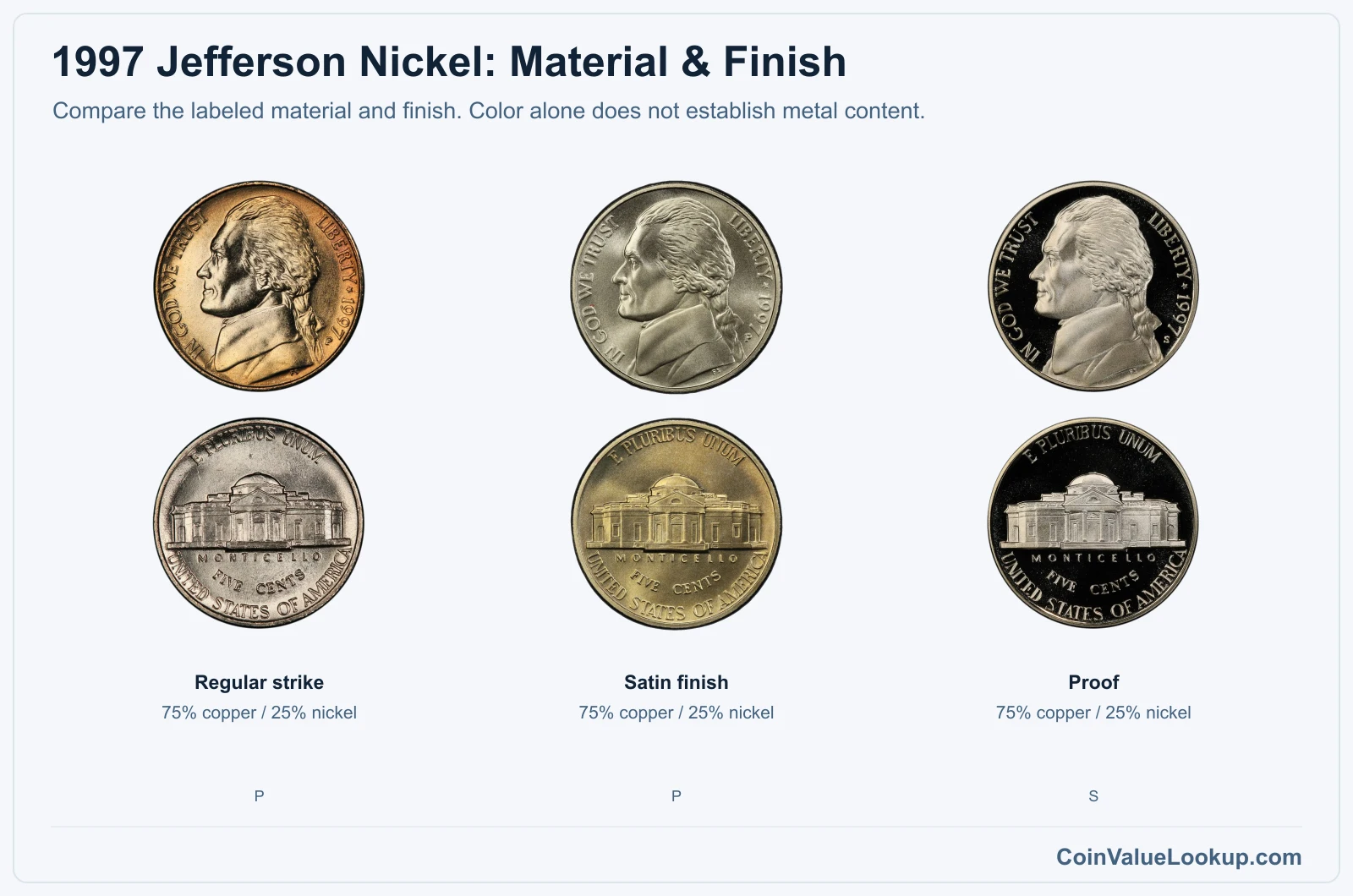
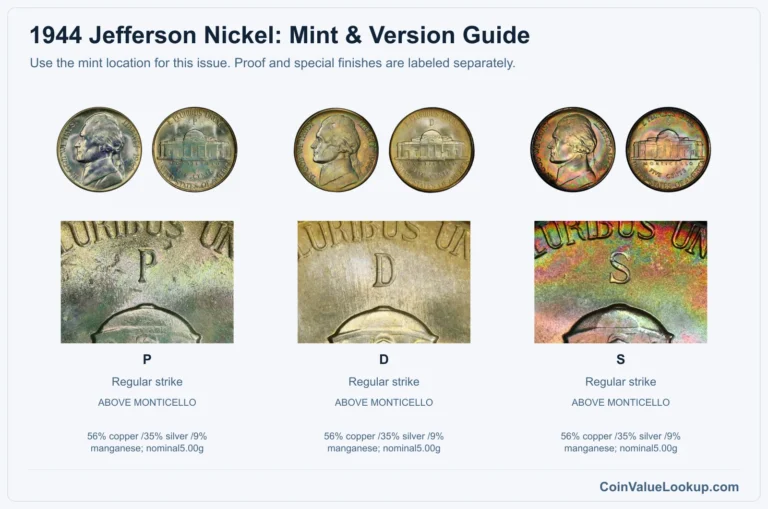
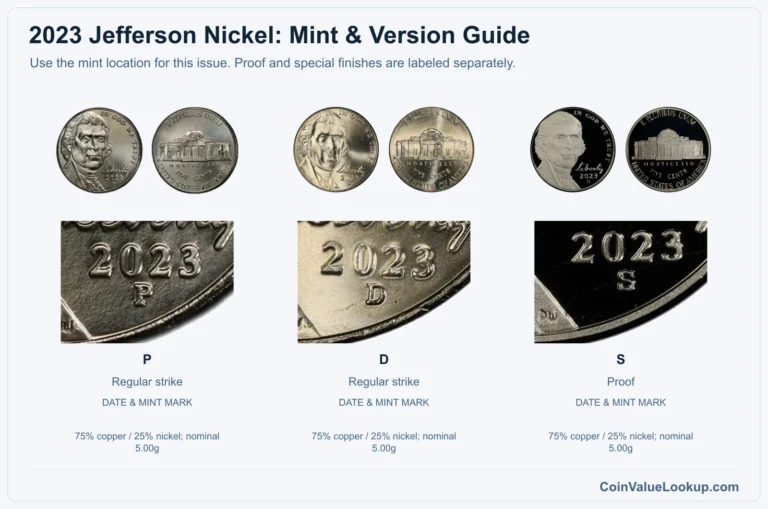
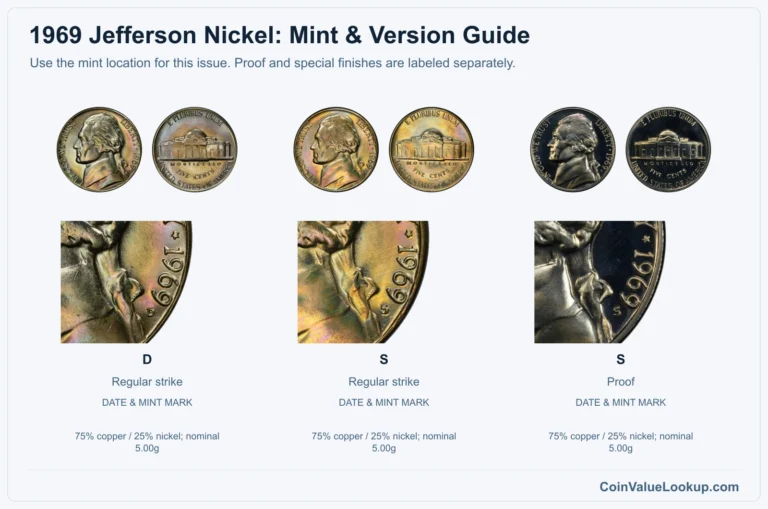
Three mints produced 1997 Jefferson nickels. Philadelphia (P) and Denver (D) made business strikes for circulation, while San Francisco (S) struck proofs for collectors.
The mintmark sits on the obverse, just below the date on Jefferson's right side.
All regular 1997 nickels are 75% copper and 25% nickel, weigh about 5 grams, measure 21.2 mm across, and have a plain edge. There is no silver version of this date.
Philadelphia also produced a special matte or satin-finish nickel in 1997, distributed exclusively in the Botanic Garden Coin and Currency Set. Only about 25,000 sets were issued.
That finish looks distinctly different from a normal business strike, but you cannot diagnose it from brightness or cleaning alone. Proper attribution requires comparison with authenticated examples and ideally the original set provenance.
Before looking up values, record the date, mintmark, and finish type. A proof has mirrored fields and sharp rims.
A business strike has a satiny or cartwheel luster. The special strike has a matte or satin texture that falls outside both categories.
Step 2: Check Your 1997 Jefferson Nickel Grade
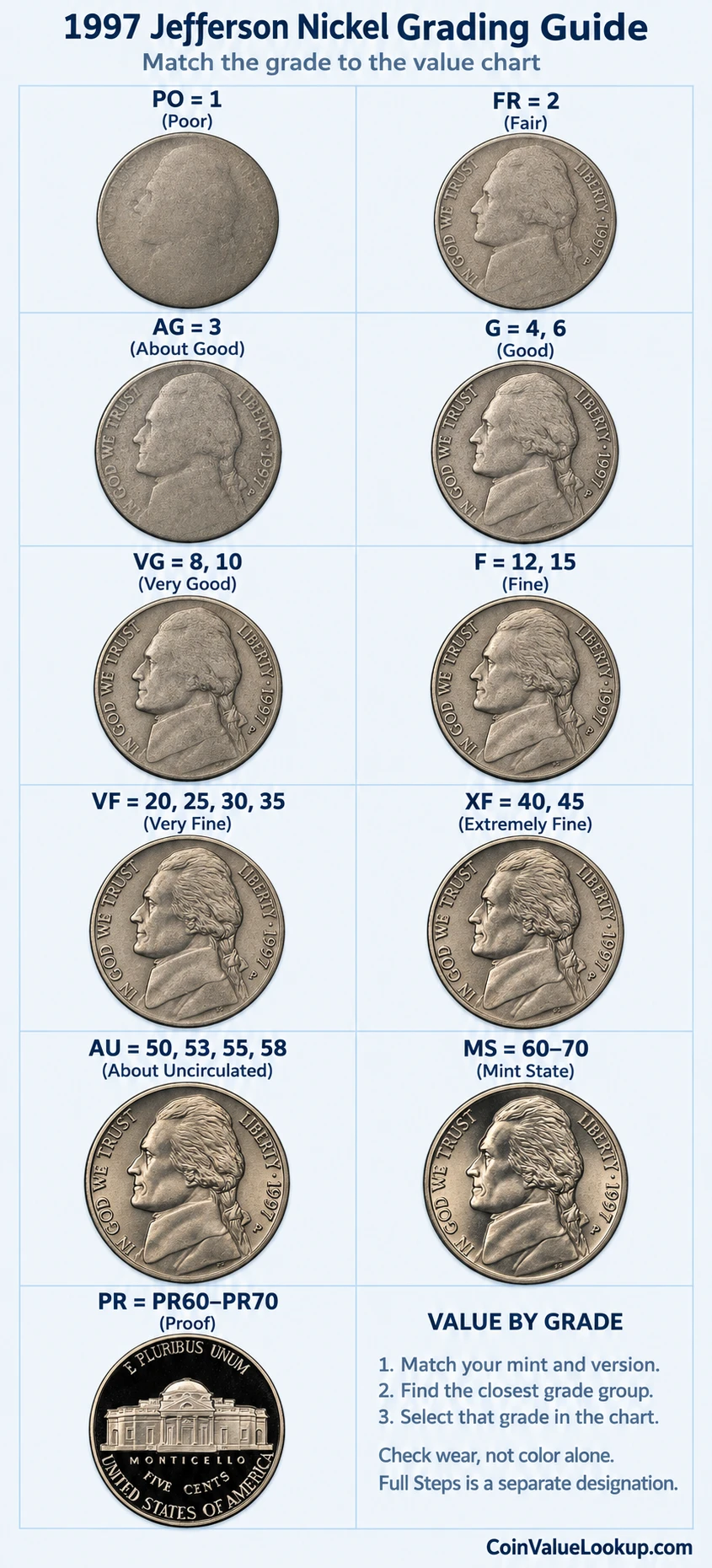
Focus on Jefferson's cheekbone and the hair detail above his ear. These are the first areas to show wear.
On a well-circulated coin, the cheek flattens noticeably and the individual hair strands merge into a smooth patch.
Flip the coin over and check Monticello. The columns and the triangular pediment lose definition early.
A coin with sharp columns and full original luster is a candidate for Mint State grades.
The comparison image is your best friend here. Hold your coin next to it under the same lighting and look for matching wear patterns.
Even a small amount of friction on the cheek drops a coin out of Mint State.
Full Steps is a separate designation, not a numerical grade. It describes complete, unbroken horizontal lines on Monticello's base and reflects strike quality, not wear.
Proof cameo designations are likewise an additional filter on top of the proof grade. Neither one adds to a circulated coin's value.
Step 3: Check 1997 Jefferson Nickel Value by Mint and Version
1997 Jefferson Nickel — P Business strike
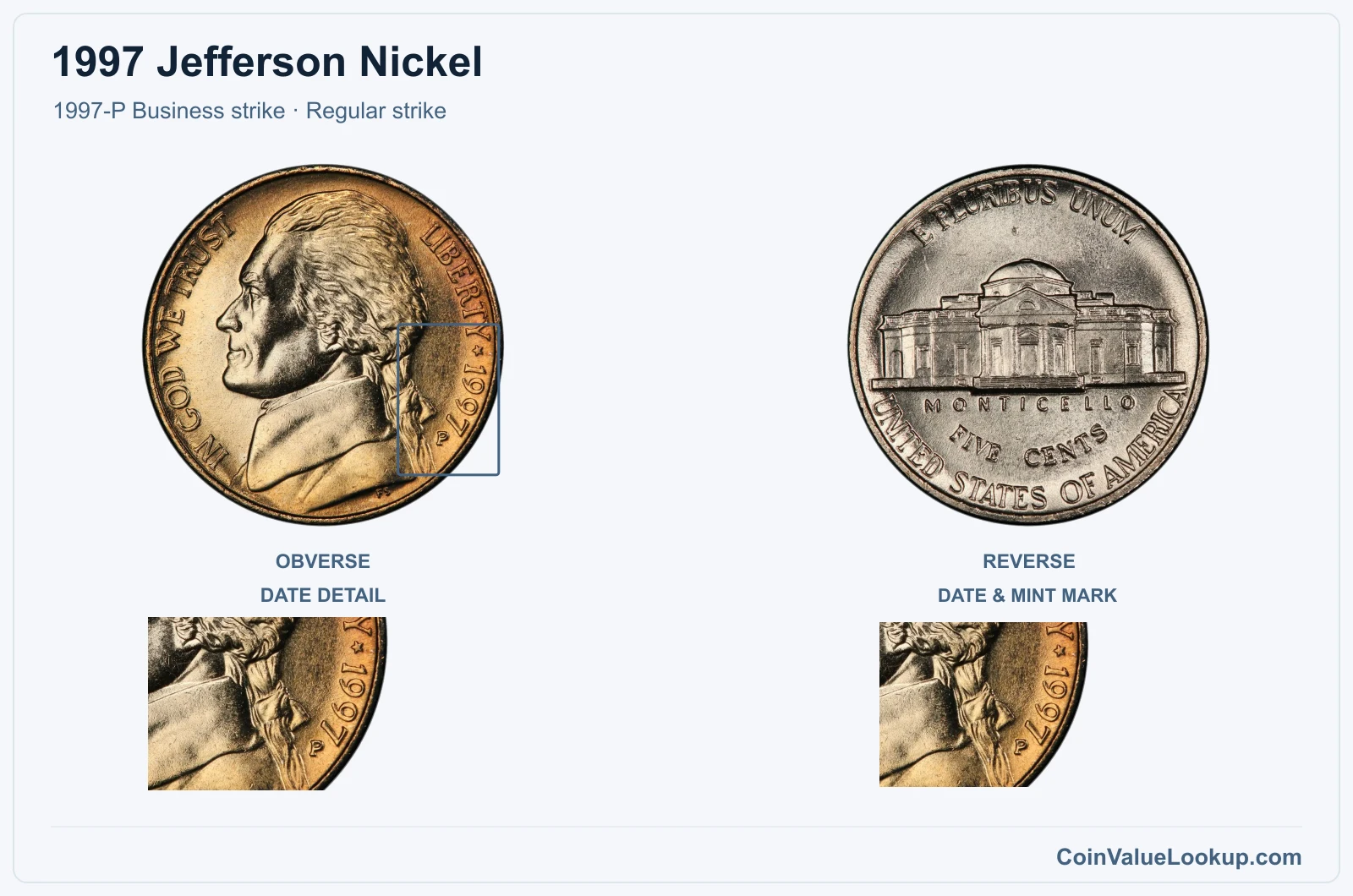
The 1997-P is the standard Philadelphia business strike, carrying a small "P" mintmark below the date. It uses the normal Jefferson portrait obverse and Monticello reverse in 75% copper and 25% nickel.
USA Coin Book lists retail guide anchors of about $0.61 at MS60 and $2.50 at MS65. Circulated examples are common and typically worth face value.
Certified coins with a Full Steps designation can trade at a premium above these guide points, but that designation applies only to Mint State pieces with complete, unbroken steps on Monticello.
| Range | Grade | Price | Auction Records | Appraisal |
|---|---|---|---|---|
| PO | PO 1 | — | Coin Identifier | |
| FR | FR 2 | — | Coin Identifier | |
| AG | AG 3 | — | Coin Identifier | |
| G | G 4 | — | Coin Identifier | |
| G 6 | — | Coin Identifier | ||
| VG | VG 8 | — | Coin Identifier | |
| VG 10 | — | Coin Identifier | ||
| F | F 12 | — | Coin Identifier | |
| F 15 | — | Coin Identifier | ||
| VF | VF 20 | — | Coin Identifier | |
| VF 25 | — | Coin Identifier | ||
| VF 30 | — | Coin Identifier | ||
| VF 35 | — | Coin Identifier | ||
| XF | XF 40 | — | Coin Identifier | |
| XF 45 | — | Coin Identifier | ||
| AU | AU 50 | — | Coin Identifier | |
| AU 53 | — | Coin Identifier | ||
| AU 55 | — | Coin Identifier | ||
| AU 58 | — | Coin Identifier | ||
| MS | MS 60 | — | Coin Identifier | |
| MS 61 | — | Coin Identifier | ||
| MS 62 | — | Coin Identifier | ||
| MS 63 | — | Coin Identifier | ||
| MS 64 | — | Coin Identifier | ||
| MS 65 | — | Coin Identifier | ||
| MS 66 | — | Coin Identifier | ||
| MS 67 | Coin Identifier | |||
| MS 68 | — | — | — | |
| MS 69 | — | — | — | |
| MS 70 | — | — | — |
1997 Jefferson Nickel — P Special Strike, matte/satin collector finish
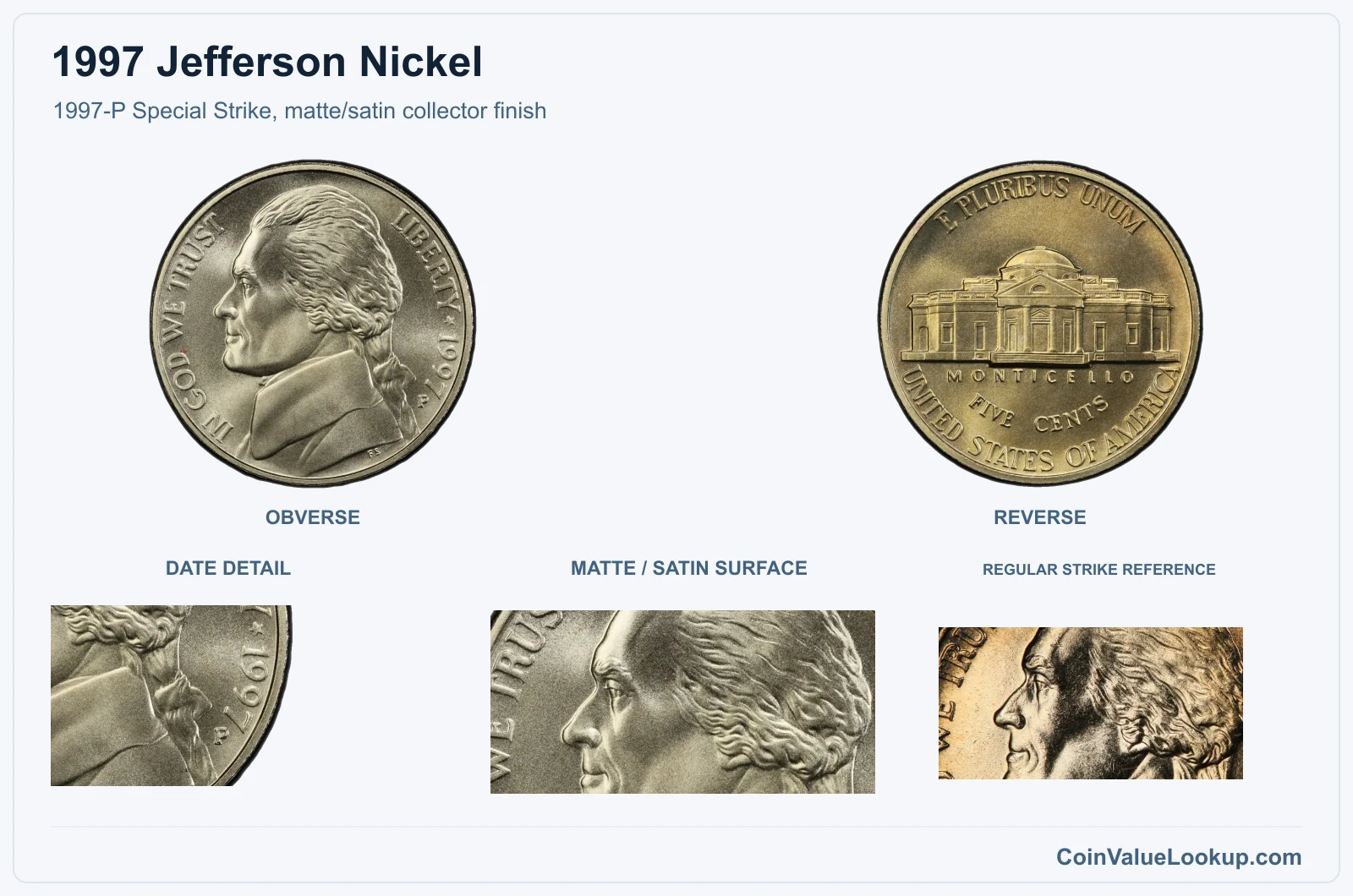
This is the 1997-P Special Strike, a matte or satin collector finish produced only for the Botanic Garden Coin and Currency Set. About 25,000 sets were issued, all from the Philadelphia Mint, using the same 75% copper and 25% nickel alloy at 5 grams.
The surface has a distinctive soft, non-reflective texture that differs from both a standard business strike's cartwheel luster and a proof's mirrored fields. Do not confuse a cleaned or lightly polished circulation nickel with this finish.
Proper identification relies on comparison with authenticated specimens and, ideally, original set packaging.
No supported retail guide range is adopted here for SP grades. Value depends on authenticated identity, condition, and whether the coin carries a Full Steps designation.
Individual assessment by a grading service is the reliable path for pricing this variety.
| Range | Grade | Price | Auction Records | Appraisal |
|---|---|---|---|---|
| SP | SP 1 | — | Coin Identifier | |
| SP 2 | — | Coin Identifier | ||
| SP 3 | — | Coin Identifier | ||
| SP 4 | — | Coin Identifier | ||
| SP 6 | — | Coin Identifier | ||
| SP 8 | — | Coin Identifier | ||
| SP 10 | — | Coin Identifier | ||
| SP 12 | — | Coin Identifier | ||
| SP 15 | — | Coin Identifier | ||
| SP 20 | — | Coin Identifier | ||
| SP 25 | — | Coin Identifier | ||
| SP 30 | — | Coin Identifier | ||
| SP 35 | — | Coin Identifier | ||
| SP 40 | — | Coin Identifier | ||
| SP 45 | — | Coin Identifier | ||
| SP 50 | — | Coin Identifier | ||
| SP 53 | — | Coin Identifier | ||
| SP 55 | — | Coin Identifier | ||
| SP 58 | — | Coin Identifier | ||
| SP 60 | — | Coin Identifier | ||
| SP 61 | — | Coin Identifier | ||
| SP 62 | — | Coin Identifier | ||
| SP 63 | — | Coin Identifier | ||
| SP 64 | — | Coin Identifier | ||
| SP 65 | — | Coin Identifier | ||
| SP 66 | — | Coin Identifier | ||
| SP 67 | — | Coin Identifier | ||
| SP 68 | Coin Identifier | |||
| SP 69 | Coin Identifier | |||
| SP 70 | Coin Identifier |
1997 Jefferson Nickel — D Business strike
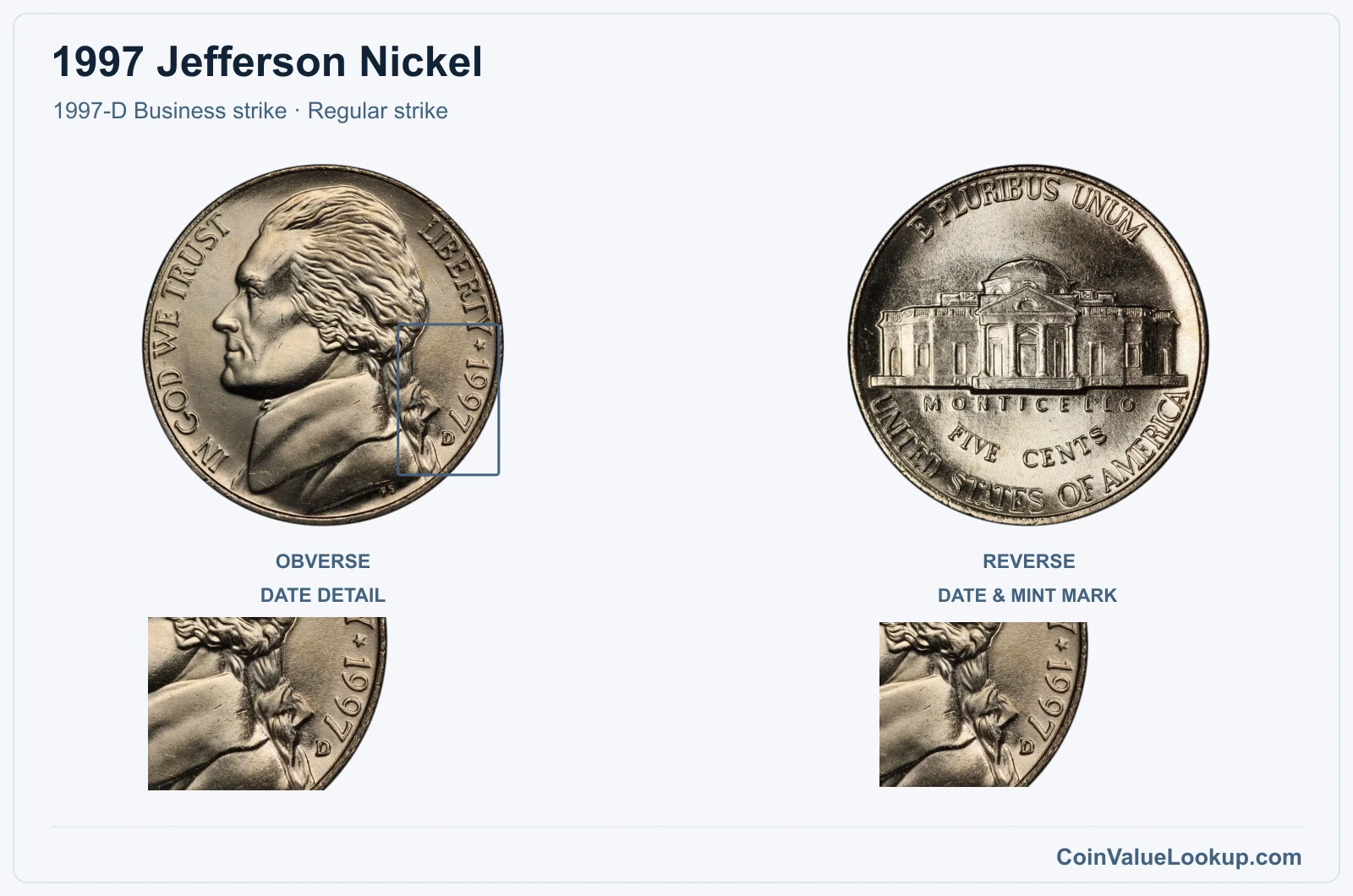
The 1997-D comes from the Denver Mint, identified by the "D" mintmark below the date. Same alloy, same design, same weight as the Philadelphia issue.
USA Coin Book retail guide anchors sit at about $1.24 at MS60 and $2.50 at MS65. Like its P counterpart, circulated pieces are face-value coins.
Full Steps certified examples can exceed these guide estimates, but most Denver strikes you find in change will not qualify. Look for complete, uninterrupted horizontal lines across Monticello's base to assess strike quality before submitting for grading.
| Range | Grade | Price | Auction Records | Appraisal |
|---|---|---|---|---|
| PO | PO 1 | — | Coin Identifier | |
| FR | FR 2 | — | Coin Identifier | |
| AG | AG 3 | — | Coin Identifier | |
| G | G 4 | — | Coin Identifier | |
| G 6 | — | Coin Identifier | ||
| VG | VG 8 | — | Coin Identifier | |
| VG 10 | — | Coin Identifier | ||
| F | F 12 | — | Coin Identifier | |
| F 15 | — | Coin Identifier | ||
| VF | VF 20 | — | Coin Identifier | |
| VF 25 | — | Coin Identifier | ||
| VF 30 | — | Coin Identifier | ||
| VF 35 | — | Coin Identifier | ||
| XF | XF 40 | — | Coin Identifier | |
| XF 45 | — | Coin Identifier | ||
| AU | AU 50 | — | Coin Identifier | |
| AU 53 | — | Coin Identifier | ||
| AU 55 | — | Coin Identifier | ||
| AU 58 | — | Coin Identifier | ||
| MS | MS 60 | — | Coin Identifier | |
| MS 61 | — | Coin Identifier | ||
| MS 62 | — | Coin Identifier | ||
| MS 63 | — | Coin Identifier | ||
| MS 64 | — | Coin Identifier | ||
| MS 65 | — | Coin Identifier | ||
| MS 66 | — | Coin Identifier | ||
| MS 67 | — | — | — | |
| MS 68 | — | — | — | |
| MS 69 | — | — | — | |
| MS 70 | — | — | — |
1997 Jefferson Nickel — S Proof
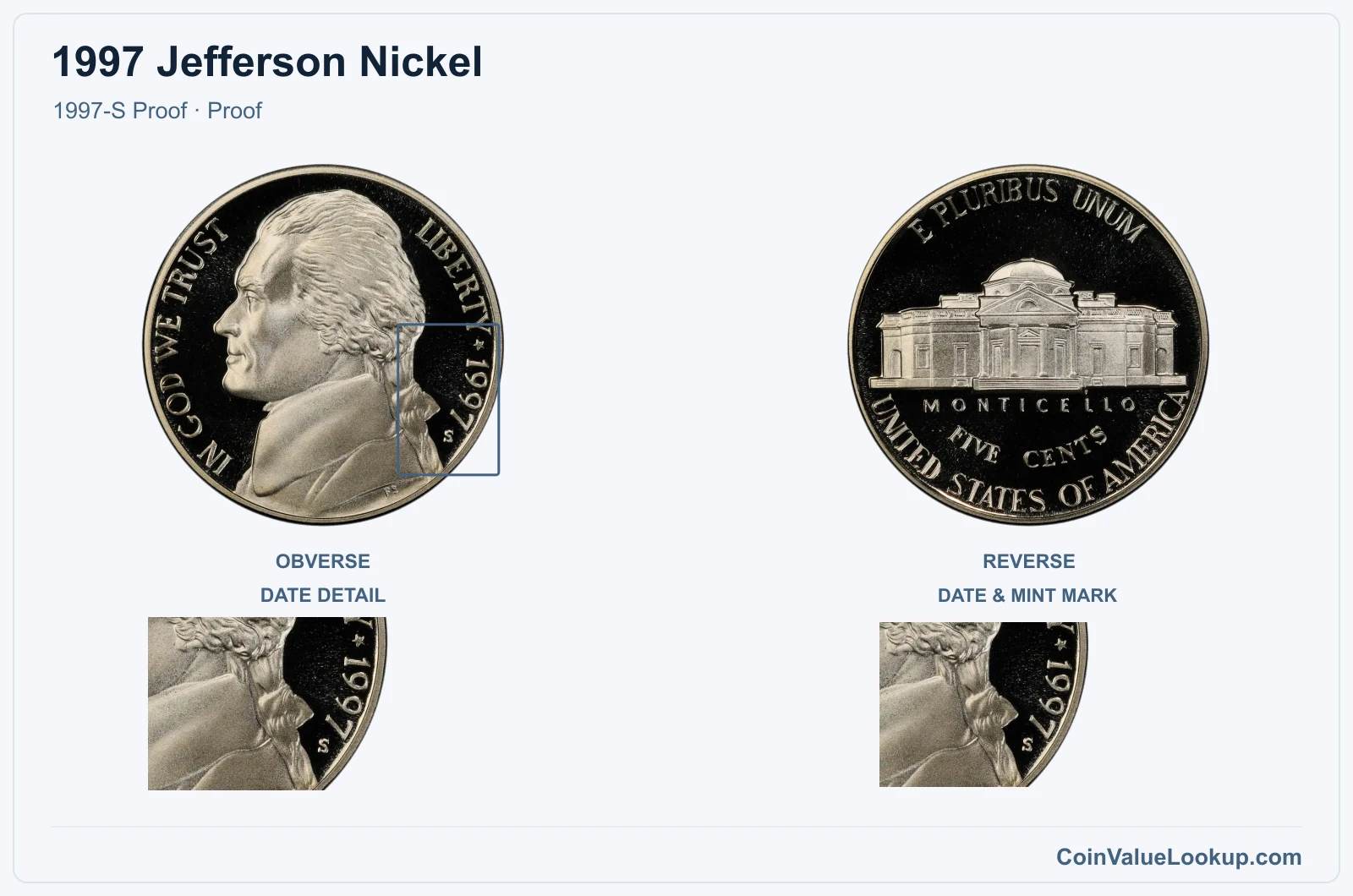
The 1997-S Proof was struck at San Francisco for collector sets. It carries the "S" mintmark and features the same copper-nickel alloy as the business strikes.
USA Coin Book lists a generic PR65 guide anchor of about $3.62. That figure is not specific to deep cameo or ultra cameo designations, which can carry different premiums depending on the depth of frost contrast against the mirrored fields.
Coin Value Lookup is a handy starting point when you want to compare guide values across different Jefferson nickel dates and mints. It can help you quickly narrow down which coins in a collection deserve closer attention.
| Range | Grade | Price | Auction Records | Appraisal |
|---|---|---|---|---|
| PR | PR 1 | — | Coin Identifier | |
| PR 2 | — | Coin Identifier | ||
| PR 3 | — | Coin Identifier | ||
| PR 4 | — | Coin Identifier | ||
| PR 6 | — | Coin Identifier | ||
| PR 8 | — | Coin Identifier | ||
| PR 10 | — | Coin Identifier | ||
| PR 12 | — | Coin Identifier | ||
| PR 15 | — | Coin Identifier | ||
| PR 20 | — | Coin Identifier | ||
| PR 25 | — | Coin Identifier | ||
| PR 30 | — | Coin Identifier | ||
| PR 35 | — | Coin Identifier | ||
| PR 40 | — | Coin Identifier | ||
| PR 45 | — | Coin Identifier | ||
| PR 50 | — | Coin Identifier | ||
| PR 53 | — | Coin Identifier | ||
| PR 55 | — | Coin Identifier | ||
| PR 58 | — | Coin Identifier | ||
| PR 60 | — | Coin Identifier | ||
| PR 61 | — | Coin Identifier | ||
| PR 62 | — | Coin Identifier | ||
| PR 63 | — | Coin Identifier | ||
| PR 64 | — | Coin Identifier | ||
| PR 65 | — | Coin Identifier | ||
| PR 66 | — | Coin Identifier | ||
| PR 67 | — | Coin Identifier | ||
| PR 68 | — | Coin Identifier | ||
| PR 69 | Coin Identifier | |||
| PR 70 | Coin Identifier |
1997 Jefferson Nickel Error List
1. 1997 Jefferson Nickel — Curved clip
A curved clip happens when the blank is punched from an area of strip metal that overlaps a previously punched hole. The result is a crescent-shaped missing section with a natural, smooth rim transition, not a jagged or tooled edge.
Strike flow around the clip area often shows distortion as the metal stretches to fill the void.
A 1997-P nickel with approximately a 20% curved clip, graded PCGS MS62, sold through Heritage Auctions in March 2025 for $124. That is a single auction result, not a fixed market price.
Clip size, date visibility, and certified grade all affect what a given example brings.
Do not confuse a clipped planchet with post-mint damage from pliers, vice grips, or saw cuts. Genuine clips show the Blakesley effect, a weak area on the rim opposite the clip, and metal flow consistent with being struck while incomplete.
2. 1997 Jefferson Nickel — Reverse indented by cent blank
A reverse indent occurs when a stray blank, in this case a cent-sized planchet, lands on top of the nickel planchet before striking. The intervening blank absorbs the die's force, leaving a large, smooth depression on the reverse while the obverse retains a relatively normal appearance.
A 1997-P nickel with a 90% reverse indent from a cent blank, graded PCGS MS62, sold at Heritage Auctions in March 2025 for $780. The severity of the indent, roughly 90% of the reverse surface, makes this a dramatic example.
That is one auction result, not a baseline price.
Post-mint hammering or deliberate pressing can mimic an indent, but a genuine strike-through indent will show consistent depth and a defined border matching the intruding blank's shape. Authentication matters here.
3. 1997 Jefferson Nickel — Struck on clad dime blank
When a nickel die pair strikes a clad dime blank instead of the correct nickel planchet, the result is a smaller, thinner coin carrying an incomplete Jefferson nickel design. The outer portions of the design trail off or disappear because the smaller blank cannot reach the full die cavity.
A 1997-P example graded PCGS MS62 appeared in a Heritage Auctions lot in August 2023. That lot sold for $630 but included two nickels struck on dime blanks, a 1997 and a 1998, so the price cannot be assigned to either coin individually.
Check the edge carefully. A genuine off-metal strike on a clad dime blank will show clad layering at the rim.
A trimmed or plated regular nickel will lack that edge profile. Third-party certification is essential for this error type because visual similarity to an altered coin is high.
4. 1997 Jefferson Nickel — Off-Center Strike
An off-center strike happens when the planchet is not seated properly in the collar before the dies come together. The design shifts to one side, leaving an unstruck crescent of blank metal.
The farther off center the strike, the more dramatic the appearance and, generally, the more collectors will pay.
Date visibility matters. An off-center nickel where the 1997 date is still fully readable is far more attributable and collectible than one struck so far off that no date remains.
Value depends on the percentage of displacement, whether the date shows, the coin's surface condition, and certification. No specific price range is adopted here.
A lopsided design caused by a clipped planchet, single-sided die misalignment, or post-mint flattening can look superficially similar, so compare carefully before assuming you have a genuine off-center strike.
5. 1997 Jefferson Nickel — Broadstrike
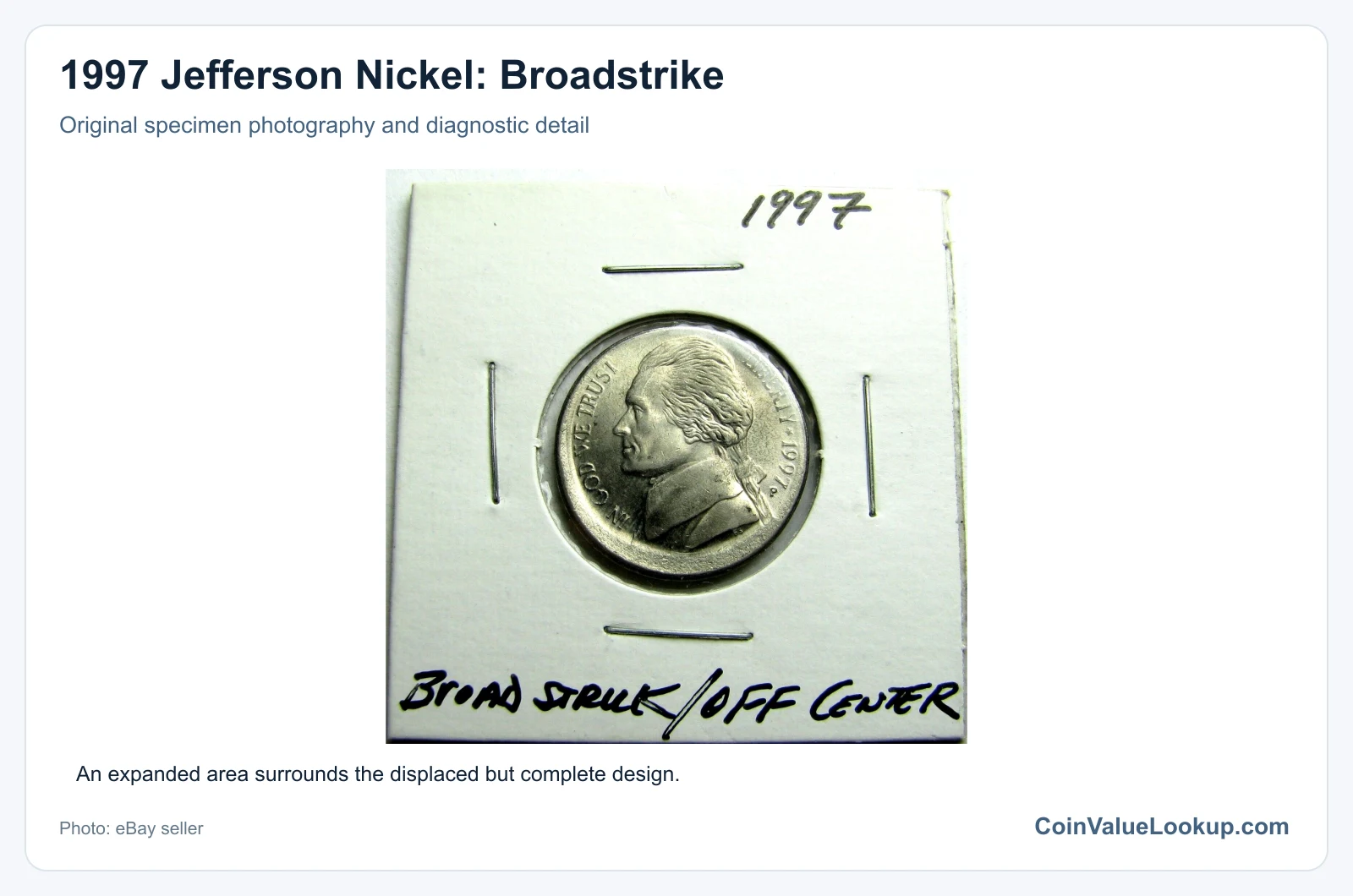
A broadstrike occurs when the collar, the retaining ring that normally confines the planchet during striking, fails to engage. Without that ring, metal spreads outward freely, producing a coin that is wider than normal with a distorted or absent rim.
The design itself stays centered, unlike an off-center strike. Both obverse and reverse images appear complete, but they spread toward the edges and the coin feels noticeably larger in diameter.
No specific price range is adopted for 1997 broadstruck nickels. Value depends on how pronounced the spread is, surface condition, and whether the coin has been certified.
Do not confuse a broadstrike with an off-center error, where the design is shifted, or with a coin flattened by machinery or deliberate pressing after it left the mint. A genuine broadstrike retains proper strike detail across the full design.
6. 1997 Jefferson Nickel — Doubled Die Obverse
A doubled die obverse shows consistent, repeatable doubling on design elements created during the die-making process. On a Jefferson nickel, check the lettering in LIBERTY, IN GOD WE TRUST, and the date numerals.
Genuine hub doubling produces uniform separation or notching that repeats identically from coin to coin struck by the same die.
No specific price range is adopted for 1997 doubled die obverse nickels. Condition, the strength of the doubling, and which design elements are affected all influence collector interest.
The most common lookalike is machine doubling, also called strike doubling, which produces a flat, shelf-like distortion rather than the rounded, separated profiles of true hub doubling. Lighting angle can also create the illusion of doubling on a perfectly normal coin.
Compare your nickel to a known normal example under consistent illumination before drawing conclusions.
7. 1997 Jefferson Nickel — Doubled Die Reverse
A doubled die reverse affects the Monticello side. Look at MONTICELLO, E PLURIBUS UNUM, and FIVE CENTS for consistent separation or notching in the lettering.
Genuine die doubling will be identical on every coin struck from that particular die.
No specific price range is adopted for 1997 doubled die reverse nickels. The strength and location of the doubling, along with the coin's grade, determine collector value.
Machine doubling is the usual suspect that fools people. It leaves flat, shelf-like distortion without the distinct rounded profile of true hub doubling.
Random contact marks or corrosion pitting can also mimic doubled features at a glance. Use magnification of at least 5x and compare reverse legends directly against a confirmed normal 1997 nickel.
If the doubling is not consistent across multiple design elements in the reported area, it is likely not a doubled die.
8. 1997 Jefferson Nickel — Die-Adjustment / Low-Pressure Strike
A die-adjustment strike, sometimes called a setup strike, results from intentionally low press pressure during die installation or calibration. Both sides of the coin show uniformly weak detail, but the surfaces remain unworn and free of the friction marks you would see on a circulated coin.
These are tricky to identify. A weak strike alone does not prove a die-adjustment piece.
Grease-filled dies, worn dies, and ordinary light strikes from normal production can all produce similarly mushy detail. Circulation wear is another obvious mimic, though it leaves telltale friction on the high points rather than uniform weakness everywhere.
No specific price range is adopted for 1997 die-adjustment nickels. Value depends on how definitively the error can be attributed, the coin's surface preservation, and certification.
This is a category where third-party grading service attribution carries significant weight, because visual diagnosis alone is rarely conclusive.