1842 Liberty Seated Half Dollar Coin Value: How Much Is It Worth?
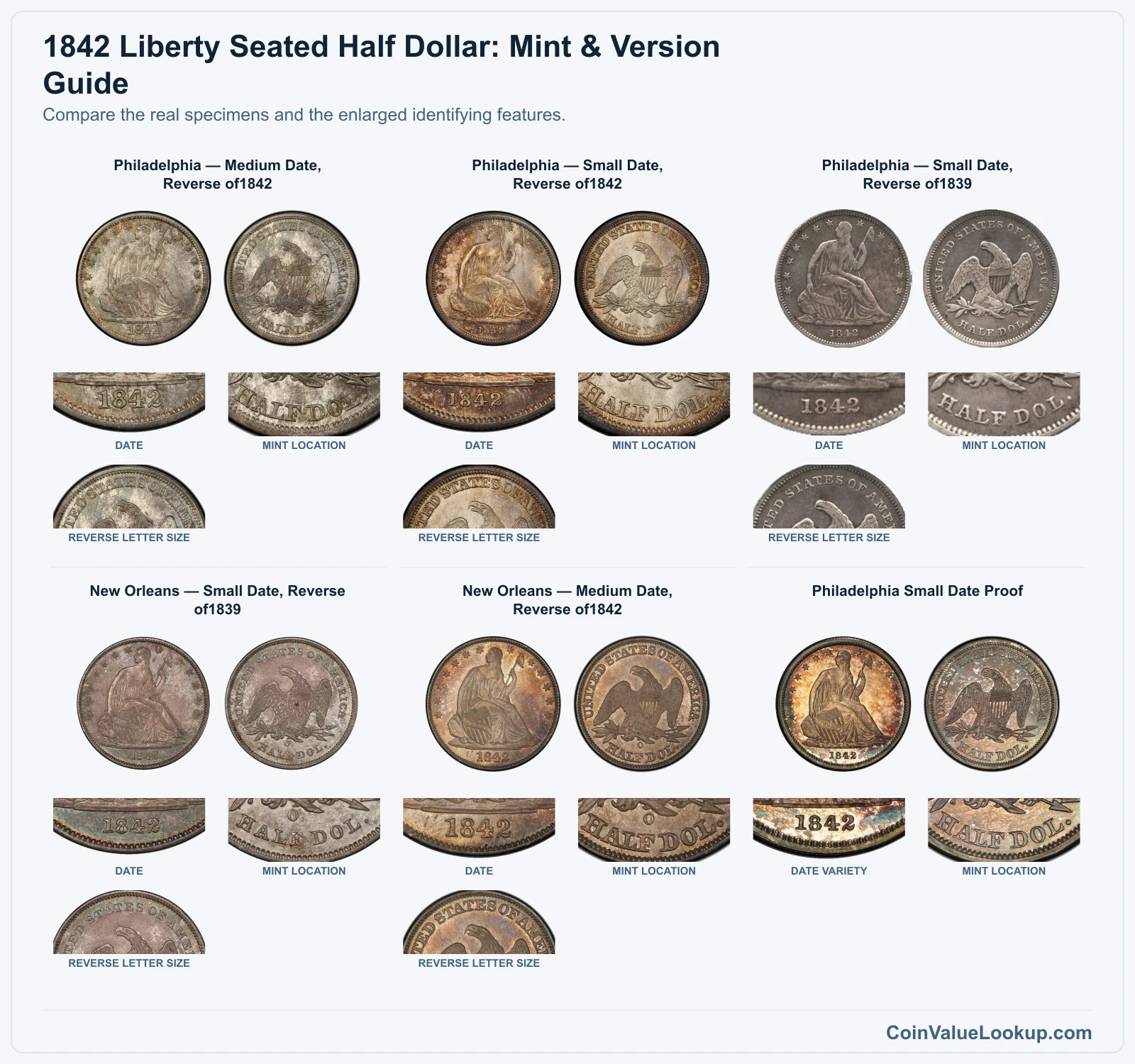
The 1842 Liberty Seated Half Dollar is a 90% silver coin struck at Philadelphia and New Orleans. Its value depends heavily on which date size and reverse style your coin carries.
Common Philadelphia Medium Date pieces range from about $80 at G4 to $457 at AU50 in guide estimates, but the Philadelphia Small Date with the old Reverse of 1839 is an extreme rarity valued in the tens of thousands. Identifying your exact version is the first step.
Fast Way to Identify Your 1842 Liberty Seated Half Dollar
The quickest way to start figuring out what you have is to upload clear photos of the front and back of your coin. Our identifier can give you a preliminary read on the mint, date size, and reverse style, though professional attribution is needed for the rarer versions.
Snap both sides in good light and submit them for a first look.
1842 Liberty Seated Half Dollar Value
Upload both sides of your 1842 Liberty Seated Half Dollar.
Front Obverse
Upload photo
Back Reverse
Upload photo
Which 1842 Liberty Seated Half Dollar Versions Are Worth Money?
- Philadelphia Small Date with Reverse of 1839 is extremely rare, with guide values of $37,269 at VF20 and nearly $50,000 at AU50. Professional attribution is essential before applying rarity pricing.
- New Orleans Small Date with Reverse of 1839 carries guide values from $1,263 at G4 to over $20,000 at AU50, far above the common New Orleans Medium Date version.
- Philadelphia Small Date with Reverse of 1842 runs $100 at G4 to $576 at AU50, a noticeable premium over the Medium Date Philadelphia issue.
- New Orleans Medium Date with Reverse of 1842 guides at $100 (G4) to $879 (AU50), roughly double the common Philadelphia Medium Date at upper grades.
- A Philadelphia Small Date Proof sold for $77,000 in PR65 at a May 1998 David Akers sale, an individual historical result that is not a current market range.
- Error coins such as repunched dates, die cracks, and cuds exist for 1842 and can add collector interest depending on the specific variety and condition.
Step 1: Identify Your 1842 Liberty Seated Half Dollar Mint Mark and Version
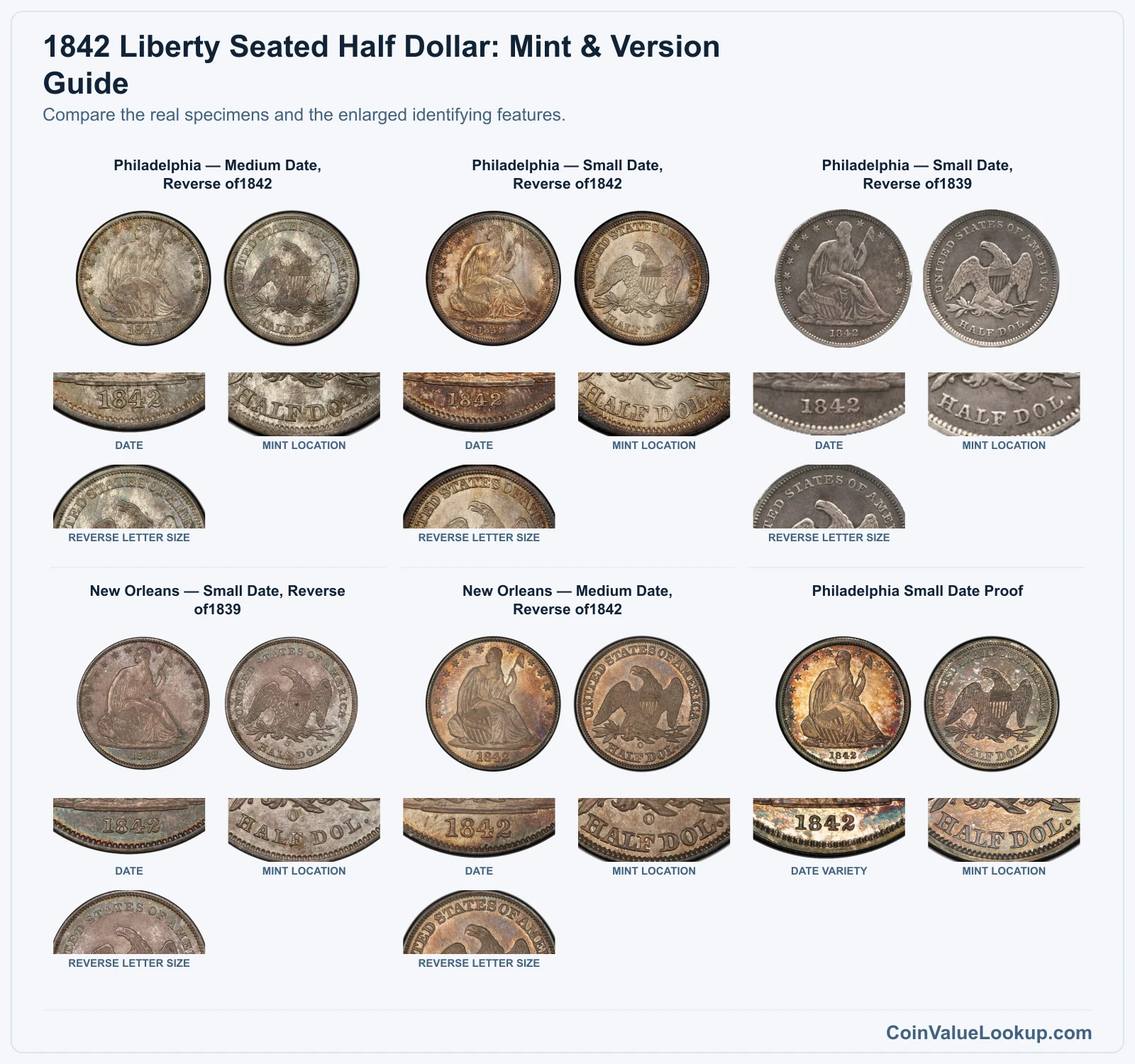
Every 1842 half dollar shows the Seated Liberty portrait on the obverse and an eagle with HALF DOL. on the reverse.
There is no IN GOD WE TRUST motto on this type. The coin is 90% silver and 10% copper, with a nominal weight of 13.36 grams and a reeded edge.
Do not assume purity from how shiny a coin looks.
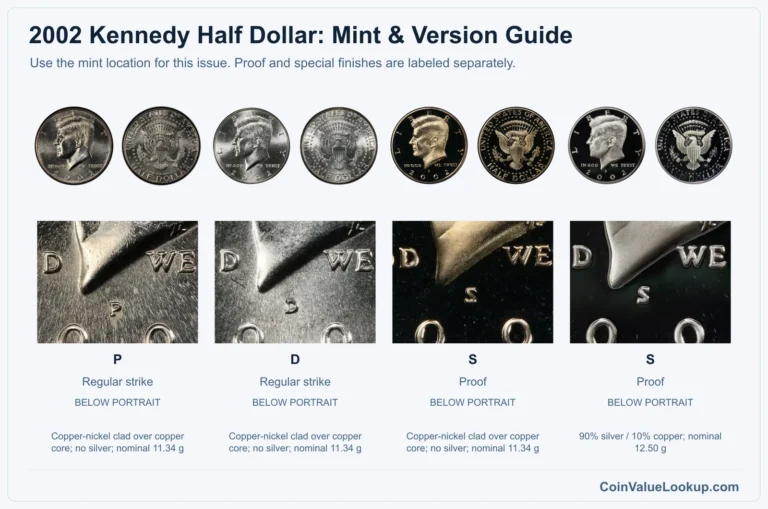
Philadelphia coins carry no mintmark. New Orleans coins have a small O on the reverse below the eagle.
Be careful: a faint or weakly struck O can make a New Orleans coin look like a Philadelphia piece, which matters enormously for value.
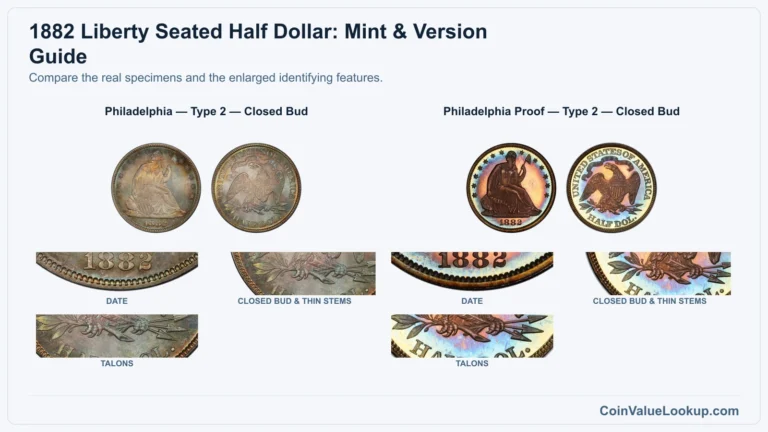
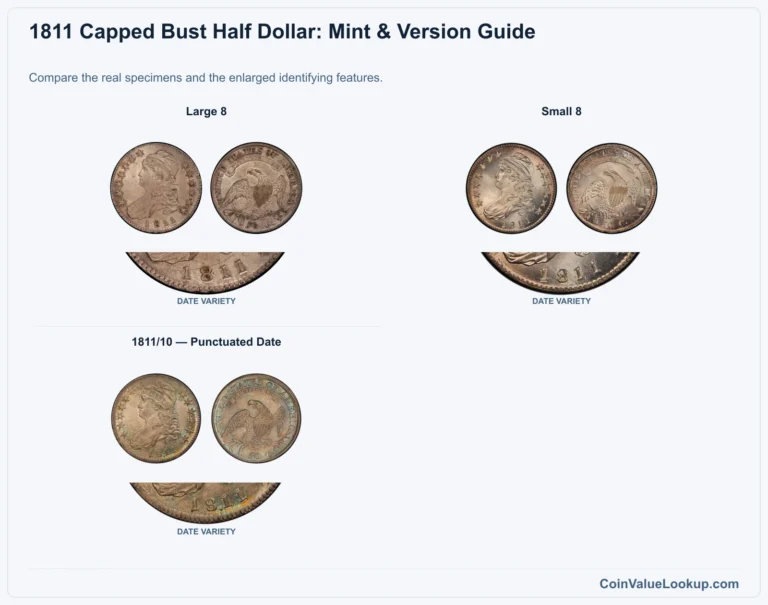
The two critical things to check are the date size and the reverse letter size. A "Medium Date" has noticeably taller, broader numerals than a "Small Date." On the reverse, the Reverse of 1839 uses smaller letters in the legend, while the Reverse of 1842 uses larger ones.
You need to match both sides together because date size alone does not pin down your version.
One helpful diagnostic for the Small Date: the numeral 4 lacks a crosslet (the small serif at the base of the upright stroke) on several Small Date varieties. Compare your 4 against known examples before deciding.
There are five regular circulation-strike versions and a rare proof. The Philadelphia Small Date with Reverse of 1839 is the standout rarity.
Confusing it with the more common Philadelphia Small Date with Reverse of 1842 would be a costly mistake in either direction, so always check the reverse lettering carefully.
Step 2: Check Your 1842 Liberty Seated Half Dollar Grade
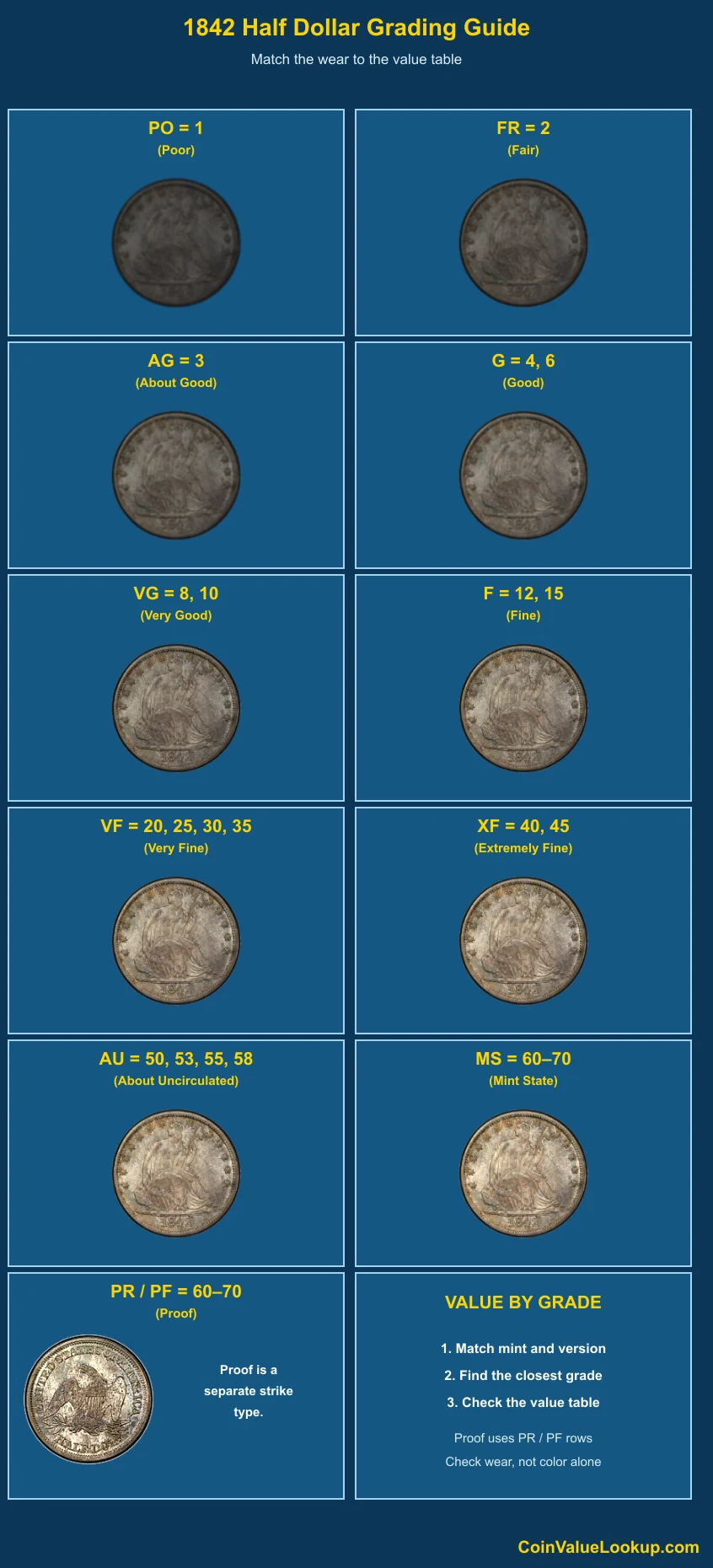
On the obverse, focus on Liberty's head, breast, knee, and the horizontal lines of the shield. These are the first areas to lose detail as a coin wears.
A coin grading around G4 will show a visible outline of Liberty but most interior detail will be gone. By VF20, you should see partial shield lines and moderate detail on Liberty's gown.
The eagle's breast feathers, wing tips, and claws on the reverse tell the same story in reverse. Compare your coin's wear pattern against type-matched photographs showing circulated-through-Mint-State examples.
The comparison image is your best friend here.
One trap: these coins were sometimes weakly struck at the mint, especially at New Orleans. A soft strike can mimic wear on the high points.
True wear breaks the original luster and flattens surfaces uniformly, while a weak strike leaves luster intact in the affected area. Look for that difference under good light.
Cleaning, holes, scratches, and altered surfaces all reduce value significantly. If your coin has been cleaned, leave it alone.
Further cleaning only makes things worse.
Step 3: Check 1842 Liberty Seated Half Dollar Value by Mint and Version
1842 Liberty Seated Half Dollar — Philadelphia — Medium Date, Reverse of1842
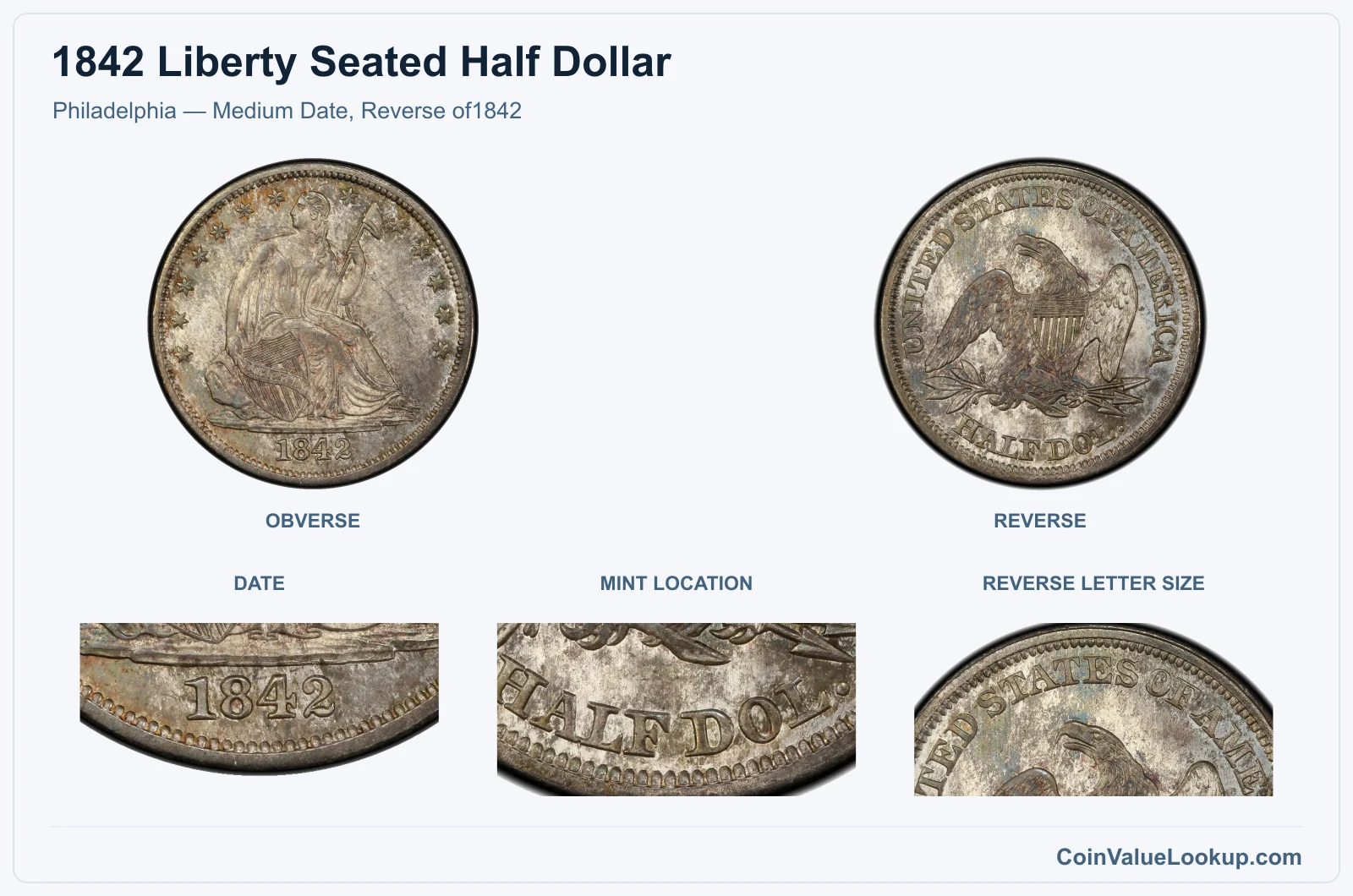
This is the most frequently encountered version of the 1842 half dollar. It was struck at Philadelphia, so there is no mintmark.
The date numerals are the larger "Medium Date" style, and the reverse carries the Reverse of 1842 with its larger legend lettering.
USA Coin Book guide estimates place this version at about $80 in G4, $205 in VF20, and $457 in AU50. Compare your coin against both Small Date reverse pairings to make sure you are not holding a scarcer variety.
Range Grade
Price Auction Records Appraisal PO PO 1
—
Coin Identifier FR FR 2
—
Coin Identifier AG AG 3
—
Coin Identifier G G 4
—
Coin Identifier
G 6
—
Coin Identifier VG VG 8
—
Coin Identifier
VG 10
—
Coin Identifier F F 12
—
Coin Identifier
F 15
—
Coin Identifier VF VF 20
Coin Identifier
VF 25
Coin Identifier
VF 30
Coin Identifier
VF 35
Coin Identifier XF XF 40
Coin Identifier
XF 45
Coin Identifier AU AU 50
Coin Identifier
AU 53
Coin Identifier
AU 55
Coin Identifier
AU 58
Coin Identifier MS MS 60
—
Coin Identifier
MS 61
Coin Identifier
MS 62
Coin Identifier
MS 63
Coin Identifier
MS 64
Coin Identifier
MS 65
Coin Identifier
MS 66
Coin Identifier
MS 67
—
—
—
MS 68
—
—
—
MS 69
—
—
—
MS 70
—
—
—
1842 Liberty Seated Half Dollar — Philadelphia — Small Date, Reverse of1842
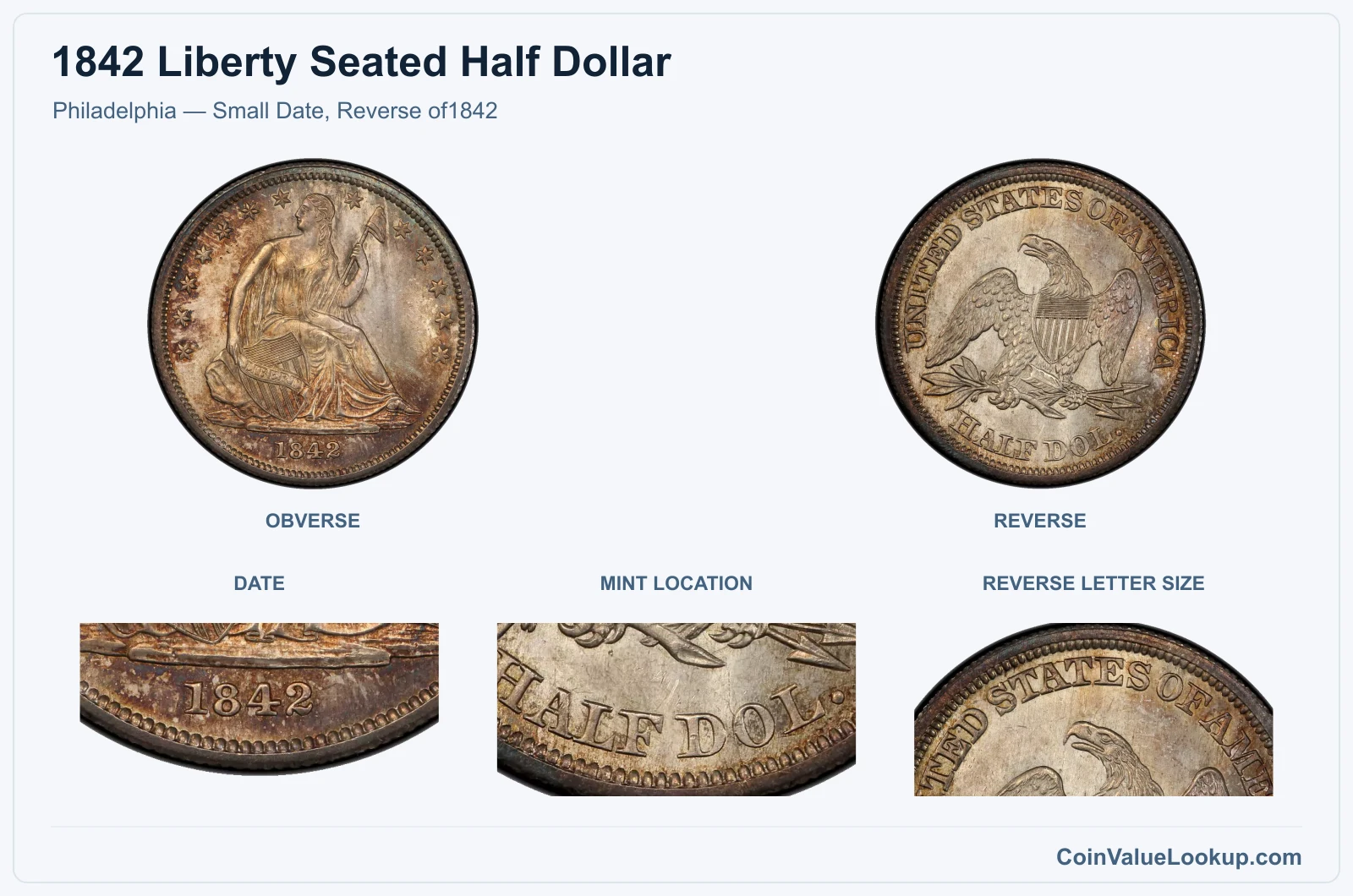
Also struck at Philadelphia with no mintmark, this version pairs a Small Date obverse with the modified Reverse of 1842 and its larger lettering. You need to confirm both sides: the smaller date numerals on the front and the larger legend letters on the back.
Guide estimates from USA Coin Book run about $100 at G4, $301 at VF20, and $576 at AU50. That is a meaningful step up from the Medium Date issue.
The price difference alone tells you it is worth a few minutes with a loupe to measure those date numerals carefully.
Range Grade
Price Auction Records Appraisal PO PO 1
—
Coin Identifier FR FR 2
—
Coin Identifier AG AG 3
—
Coin Identifier G G 4
—
Coin Identifier
G 6
—
Coin Identifier VG VG 8
—
Coin Identifier
VG 10
—
Coin Identifier F F 12
—
Coin Identifier
F 15
Coin Identifier VF VF 20
Coin Identifier
VF 25
Coin Identifier
VF 30
Coin Identifier
VF 35
Coin Identifier XF XF 40
Coin Identifier
XF 45
Coin Identifier AU AU 50
Coin Identifier
AU 53
Coin Identifier
AU 55
Coin Identifier
AU 58
Coin Identifier MS MS 60
Coin Identifier
MS 61
Coin Identifier
MS 62
Coin Identifier
MS 63
Coin Identifier
MS 64
Coin Identifier
MS 65
Coin Identifier
MS 66
—
—
—
MS 67
—
—
—
MS 68
—
—
—
MS 69
—
—
—
MS 70
—
—
—
1842 Liberty Seated Half Dollar — Philadelphia — Small Date, Reverse of1839
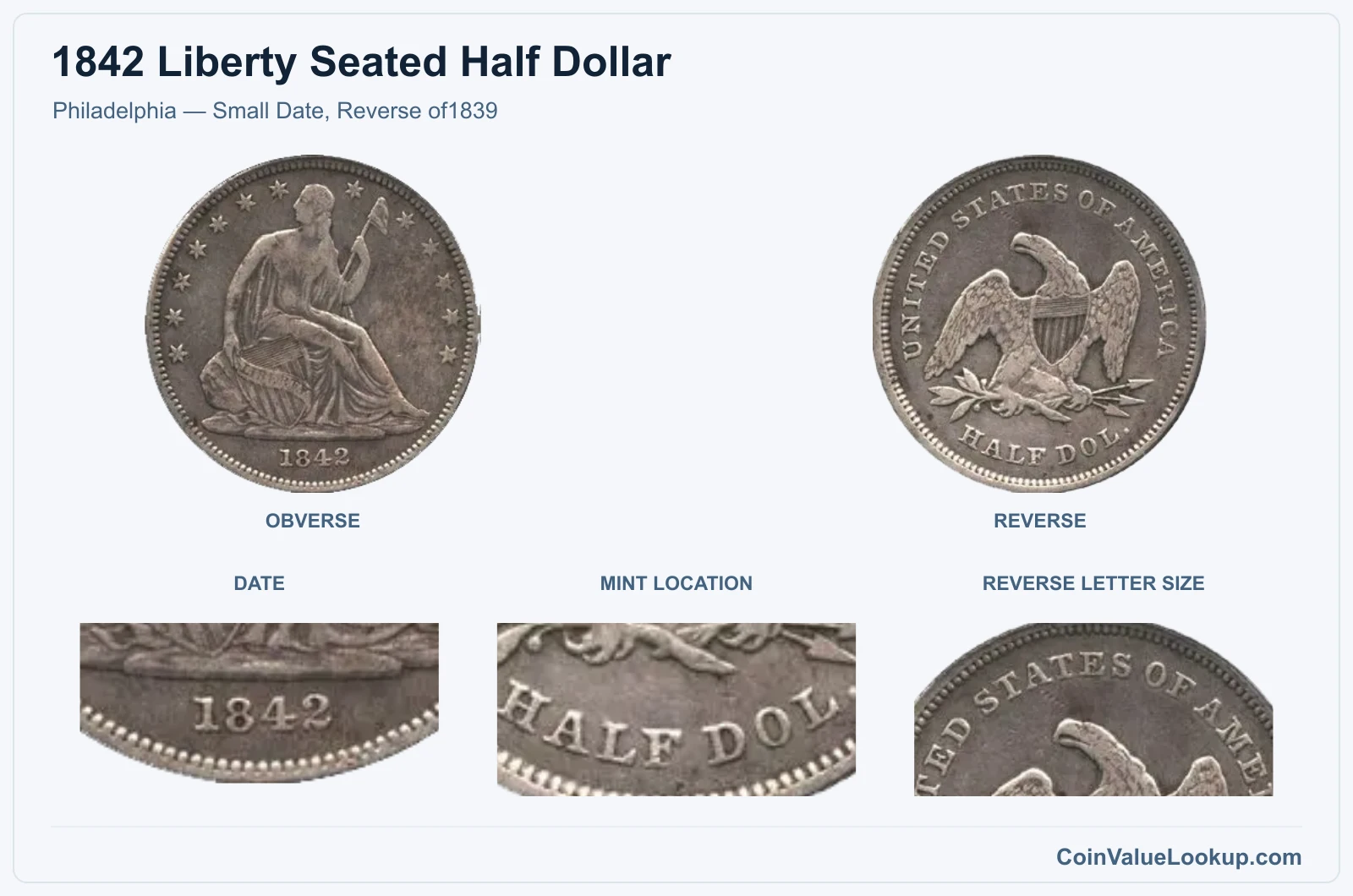
This is the version that makes 1842 half dollar collectors sit up straight. It pairs the Small Date obverse with the old Reverse of 1839, which has noticeably smaller letters in the reverse legend.
Philadelphia struck it, so no mintmark.
No guide value is adopted at G4 because the coin is simply too rare at that level. At VF20, the USA Coin Book guide estimate is $37,269.
At EF40 it climbs to $42,853, and at AU50 the figure reaches $49,988. These are guide-level numbers, not guaranteed sale prices.
Because of the stakes involved, professional attribution is strongly recommended before you assume your coin is this version. Mistaking the more common Reverse of 1842 for the Reverse of 1839 is easy without careful letter-size comparison.
Range Grade
Price Auction Records Appraisal PO PO 1
—
Coin Identifier FR FR 2
—
Coin Identifier AG AG 3
—
Coin Identifier G G 4
—
Coin Identifier
G 6
—
Coin Identifier VG VG 8
—
Coin Identifier
VG 10
—
Coin Identifier F F 12
—
Coin Identifier
F 15
—
Coin Identifier VF VF 20
Coin Identifier
VF 25
—
—
—
VF 30
—
—
—
VF 35
—
—
— XF XF 40
—
—
—
XF 45
—
—
— AU AU 50
—
—
—
AU 53
—
—
—
AU 55
—
—
—
AU 58
—
—
— MS MS 60
—
—
—
MS 61
—
—
—
MS 62
—
—
—
MS 63
—
—
—
MS 64
Coin Identifier
MS 65
—
—
—
MS 66
—
—
—
MS 67
—
—
—
MS 68
—
—
—
MS 69
—
—
—
MS 70
—
—
—
1842 Liberty Seated Half Dollar — New Orleans — Small Date, Reverse of1839
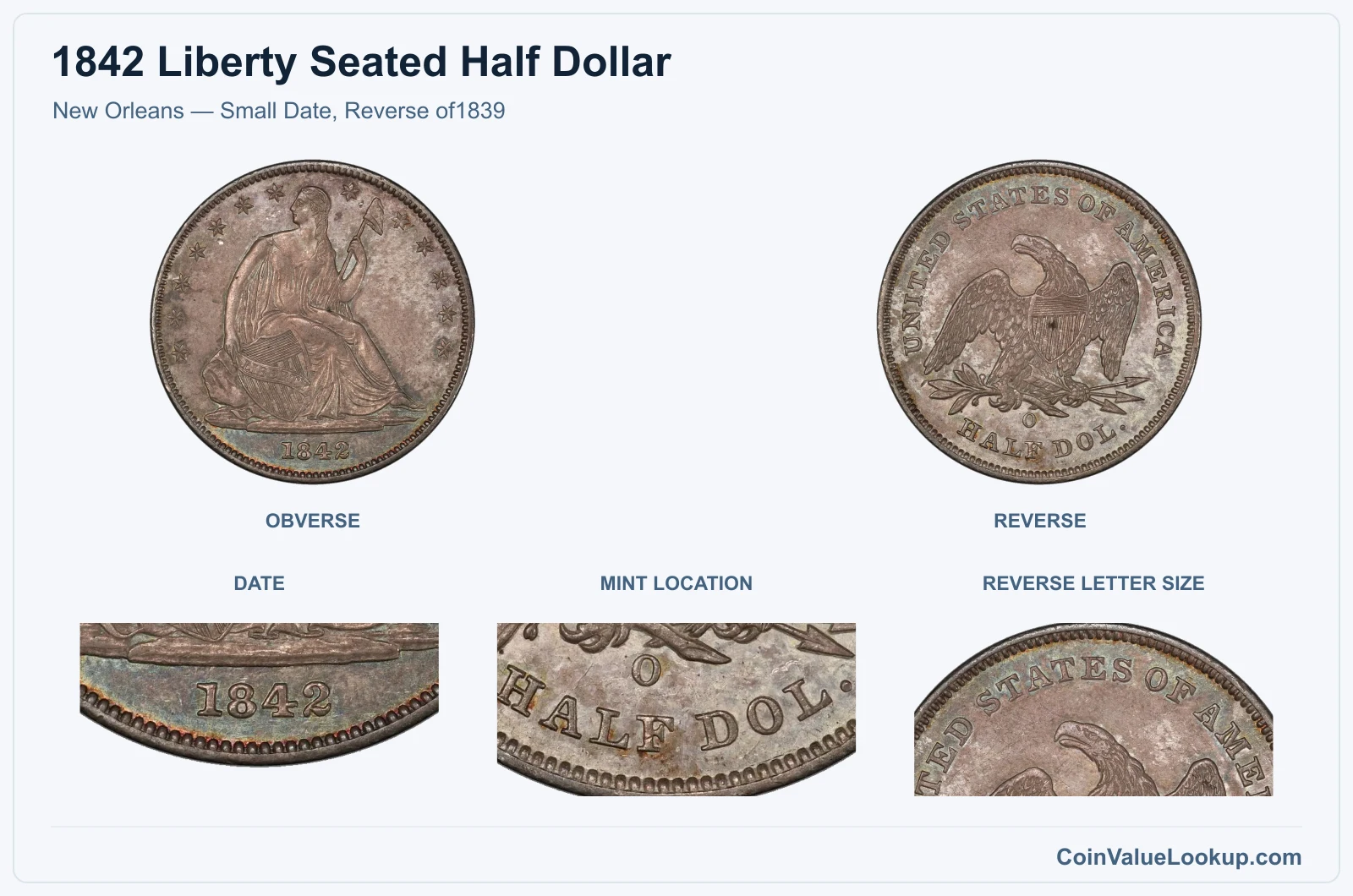
New Orleans struck a Small Date half dollar with the older Reverse of 1839 as well. Look for the small O mintmark on the reverse below the eagle, plus the smaller legend letters and Small Date numerals.
The lack of a crosslet on the 4 is a helpful clue.
USA Coin Book guide estimates run $1,263 at G4, $4,266 at VF20, and $20,111 at AU50. This is a genuinely scarce coin, though not as extreme as its Philadelphia Small Date / Reverse of 1839 counterpart.
A faint mintmark can cause confusion with the Philadelphia issue, so examine the reverse carefully under magnification.
Coin Value Lookup is a good starting point if you are trying to compare values across different Seated Liberty dates and mints before deciding whether professional attribution is your next step.
Range Grade
Price Auction Records Appraisal PO PO 1
—
Coin Identifier FR FR 2
—
Coin Identifier AG AG 3
—
Coin Identifier G G 4
Coin Identifier
G 6
Coin Identifier VG VG 8
Coin Identifier
VG 10
Coin Identifier F F 12
Coin Identifier
F 15
—
Coin Identifier VF VF 20
Coin Identifier
VF 25
Coin Identifier
VF 30
Coin Identifier
VF 35
Coin Identifier XF XF 40
Coin Identifier
XF 45
Coin Identifier AU AU 50
Coin Identifier
AU 53
Coin Identifier
AU 55
Coin Identifier
AU 58
Coin Identifier MS MS 60
—
Coin Identifier
MS 61
Coin Identifier
MS 62
Coin Identifier
MS 63
—
—
—
MS 64
—
—
—
MS 65
—
—
—
MS 66
—
—
—
MS 67
—
—
—
MS 68
—
—
—
MS 69
—
—
—
MS 70
—
—
—
1842 Liberty Seated Half Dollar — New Orleans — Medium Date, Reverse of1842
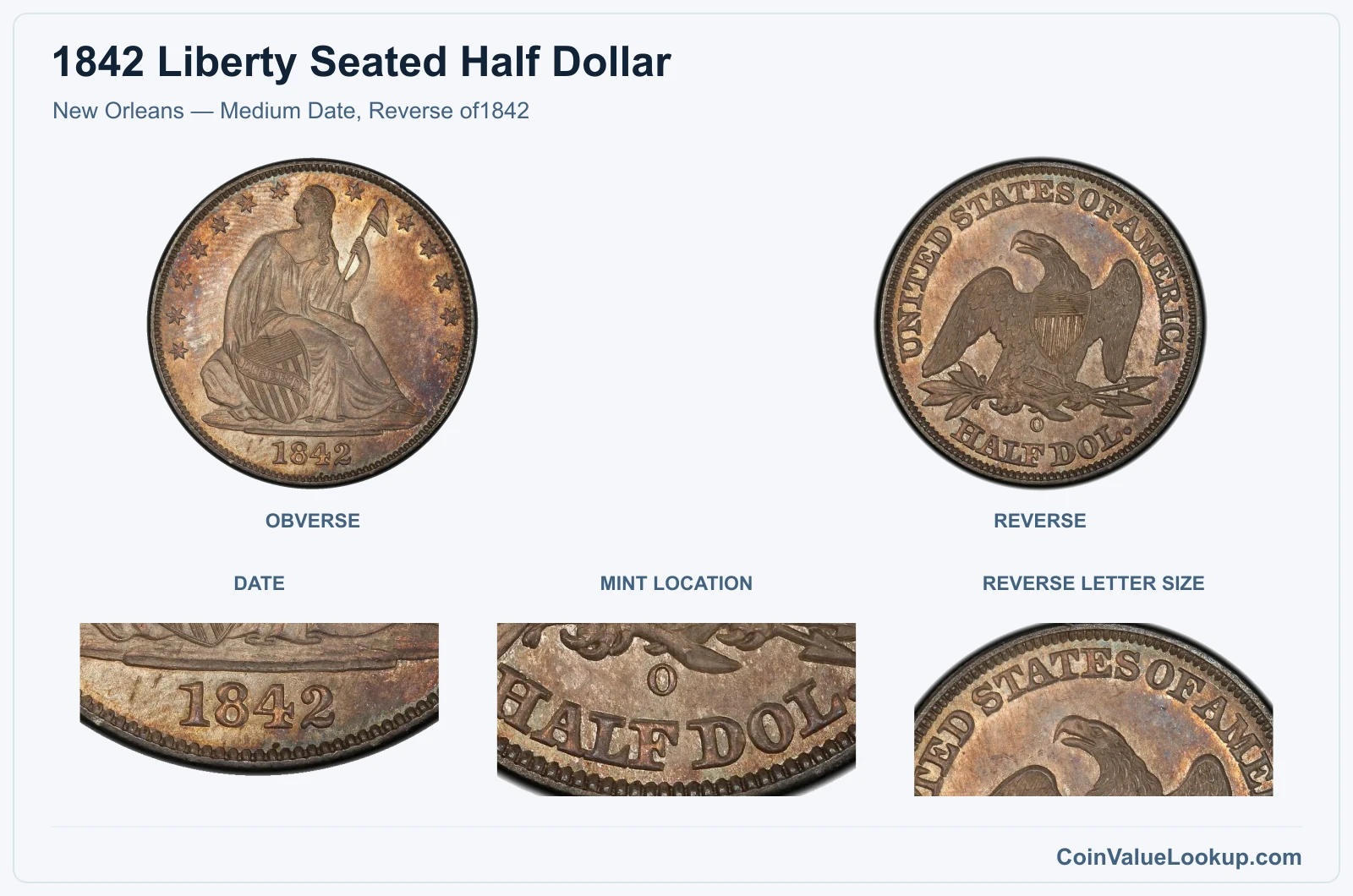
The New Orleans Medium Date with Reverse of 1842 is the more common O-mint version. It shows the larger date numerals on the obverse and the larger reverse lettering of the 1842 reverse style.
Confirm the O mintmark below the eagle.
USA Coin Book guide values are about $100 at G4, $332 at VF20, and $879 at AU50. Do not apply the much higher Small Date price curve to this coin.
The difference between the two New Orleans varieties is substantial, and mixing them up in either direction is a problem.
Range Grade
Price Auction Records Appraisal PO PO 1
—
Coin Identifier FR FR 2
—
Coin Identifier AG AG 3
—
Coin Identifier G G 4
—
Coin Identifier
G 6
—
Coin Identifier VG VG 8
—
Coin Identifier
VG 10
Coin Identifier F F 12
—
Coin Identifier
F 15
Coin Identifier VF VF 20
Coin Identifier
VF 25
—
Coin Identifier
VF 30
Coin Identifier
VF 35
Coin Identifier XF XF 40
Coin Identifier
XF 45
Coin Identifier AU AU 50
Coin Identifier
AU 53
Coin Identifier
AU 55
Coin Identifier
AU 58
Coin Identifier MS MS 60
—
Coin Identifier
MS 61
Coin Identifier
MS 62
Coin Identifier
MS 63
Coin Identifier
MS 64
Coin Identifier
MS 65
Coin Identifier
MS 66
—
—
—
MS 67
—
—
—
MS 68
—
—
—
MS 69
—
—
—
MS 70
—
—
—
1842 Liberty Seated Half Dollar — Philadelphia Small Date Proof
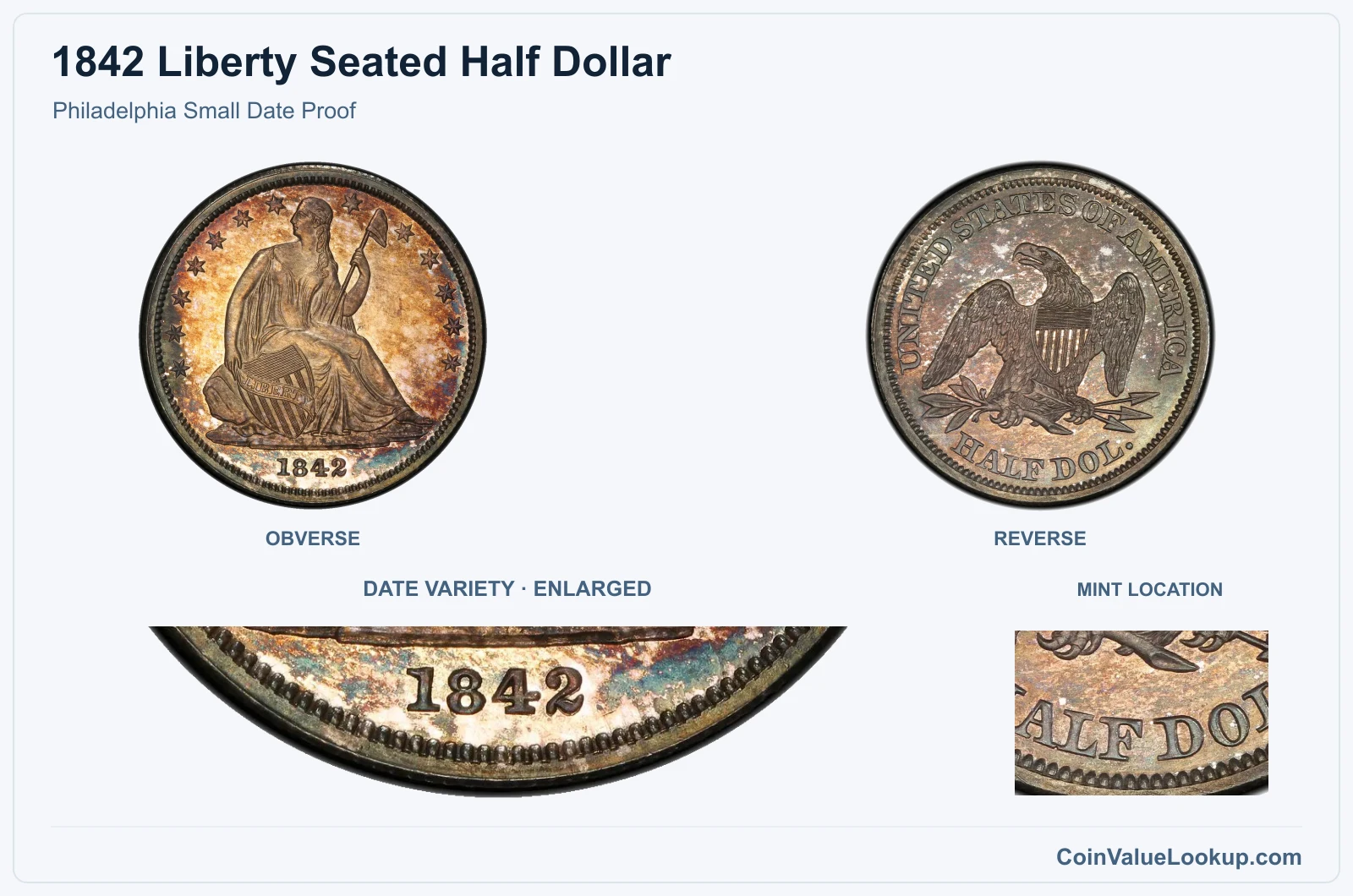
A small number of proof or presentation strikes exist for the 1842 half dollar, struck at Philadelphia with the Small Date. These are manufactured differently from regular circulation strikes: proof is a method of manufacture, not a grade above Mint State.
One historical sale is documented: a PR65 example sold for $77,000 at a May 1998 David Akers auction. That is a single data point from over 25 years ago, not a current market range.
Professional attribution and certification are required to confirm a coin as a genuine proof. Bright, well-preserved regular strikes can superficially resemble proofs, so surface characteristics, rim details, and die diagnostics all matter.
Range Grade
Price Auction Records Appraisal PR PR 1
—
Coin Identifier
PR 2
—
Coin Identifier
PR 3
—
Coin Identifier
PR 4
—
Coin Identifier
PR 6
—
Coin Identifier
PR 8
—
Coin Identifier
PR 10
—
Coin Identifier
PR 12
—
Coin Identifier
PR 15
—
Coin Identifier
PR 20
—
Coin Identifier
PR 25
—
Coin Identifier
PR 30
—
Coin Identifier
PR 35
—
Coin Identifier
PR 40
—
Coin Identifier
PR 45
—
Coin Identifier
PR 50
—
Coin Identifier
PR 53
—
Coin Identifier
PR 55
—
Coin Identifier
PR 58
—
Coin Identifier
PR 60
—
Coin Identifier
PR 61
—
Coin Identifier
PR 62
—
Coin Identifier
PR 63
—
—
—
PR 64
Coin Identifier
PR 65
Coin Identifier
PR 66
Coin Identifier
PR 67
—
—
—
PR 68
—
—
—
PR 69
—
—
—
PR 70
—
—
—
1842 Liberty Seated Half Dollar Error List
1. 1842 Liberty Seated Half Dollar — Rotated Dies
A rotated die error means the reverse is turned from its normal alignment relative to the obverse. On a properly struck coin, flipping it top-to-bottom should show the reverse right-side up.
If the eagle is tilted, you may have a rotation.
A rotated reverse has been reported on an 1842-O Medium Date half dollar, documented in the Gobrecht Journal. The source does not specify the exact degree of rotation, and not every 1842-O Medium Date will show this.
The value of a rotated die error depends on the degree of rotation, the coin's condition, and buyer interest. No specific price range is adopted here.
Be careful to distinguish a genuine die rotation from a coin that has simply been photographed or held at an angle. Check the alignment by holding the coin at the edges and flipping along the vertical axis.
2. 1842 Liberty Seated Half Dollar — Die Break / Cud
A cud is a raised, blob-like area at the rim caused by a piece of the die breaking away. It is connected to the rim, which separates it from interior die chips.
One documented example appears on an 1842 Philadelphia Small Date (Reverse of 1842) half dollar, with a cud located above the letters TAT on the reverse.
To check, look at the rim area above those reverse letters for an irregular raised lump of metal that merges into the rim. A rim dent, corrosion spot, or small interior die chip is not the same thing.
Dents are incuse (pressed in), while a cud is raised.
Condition and the size of the break affect what a cud is worth. No specific price range is adopted for this error.
3. 1842 Liberty Seated Half Dollar — Die Crack / Die Chip
Die cracks appear as thin raised lines on the coin's surface, formed when the steel die developed a fracture during use. An 1842-O Small Date reverse has been documented with a crack running between the letters AL of HALF.
Do not assume every 1842-O Small Date coin shows this exact crack. Dies went through progressive stages of deterioration, so the crack may appear at different lengths or may be absent entirely on coins struck earlier from the same die pair.
Look for a fine raised line, not an incuse scratch. Scratches are cut into the surface, while die cracks sit above it.
Corrosion or foreign material stuck to the surface can also mimic a crack. A loupe helps.
The value of a die crack depends on its prominence and the coin's overall condition. No specific price is adopted here.
4. 1842 Liberty Seated Half Dollar — Repunched Date
Repunched dates occur when the date numerals were punched into the die more than once, leaving traces of the earlier impression. For the 1842 half dollar, documented examples include an 1842 over 842 Medium Date and an 8 over 8 misplaced-date variety, both cataloged in the Newman collection records.
What you are looking for under magnification is a ghostly second set of numeral outlines near the primary date digits. The remnants are typically slightly offset.
Compare them with known images of confirmed repunched examples rather than guessing.
Machine doubling, which is flat and shelf-like, is not the same thing. Neither is simple date damage from a hit or scratch.
A repunched date shows distinct rounded numeral forms. Value depends on the visibility of the repunching and the coin's condition.
No price range is adopted here.