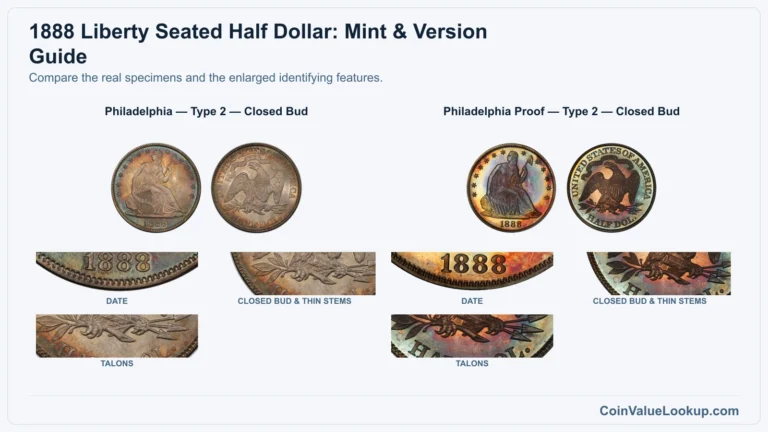
1882 Liberty Seated Half Dollar Coin Value: How Much Is It Worth?
The 1882 Liberty Seated Half Dollar is a low-production Philadelphia date that collectors prize for its scarcity. A guide estimate places this coin around $456 in G4 (a well-worn but identifiable grade) up to roughly $1,145 near AU50, where most design details survive.
Proofs carry a separate guide anchor of about $1,409 at PR63. These are retail guide estimates, not guaranteed buy offers — actual value depends on your coin's grade, surfaces, and authenticity.
Fast Way to Identify Your 1882 Liberty Seated Half Dollar
Want a quick read on what you have? Upload clear photos of the front and back of your 1882 half dollar and our identifier will provide a preliminary identification of the coin's type, mint, and general condition.
Sharp, well-lit images help — try to capture the date, any mintmark area, and the reverse eagle clearly.
1882 Liberty Seated Half Dollar Value
Upload both sides of your 1882 Liberty Seated Half Dollar.
Front Obverse
Upload photo
Back Reverse
Upload photo
Which 1882 Liberty Seated Half Dollar Versions Are Worth Money?
- The 1882 Philadelphia half dollar had low circulation production, making even well-worn examples collectible — guide estimates start around $456 at G4.
- Proof strikes are a separate manufacturing category; a PR63 example carries a guide estimate near $1,409. Do not confuse prooflike circulation strikes with actual Proofs.
- Original mint-state surfaces with correct hub identification (Type 2 closed bud) can command stronger prices than cleaned or misattributed examples.
Step 1: Identify Your 1882 Liberty Seated Half Dollar Mint Mark and Version
The 1882 half dollar shows the Seated Liberty obverse (Liberty seated on a rock, holding a pole and shield) paired with an eagle-and-motto reverse reading HALF DOL. The coin is struck in 90% silver and 10% copper, weighs a nominal 12.50 grams, and has a reeded edge.
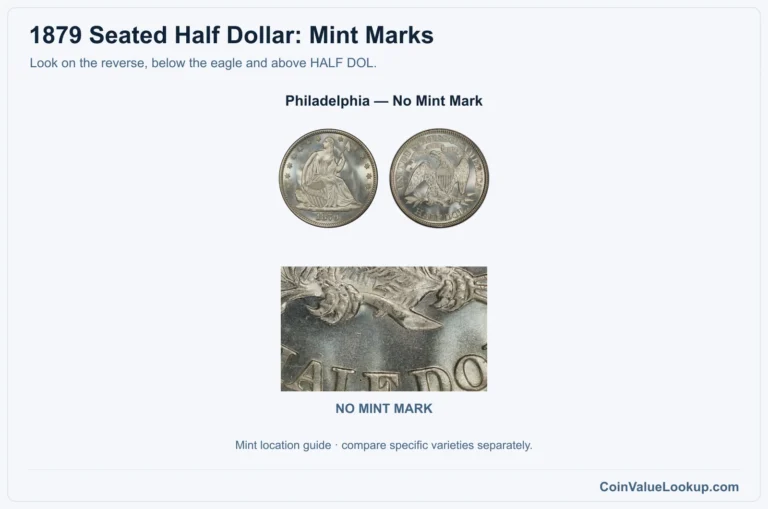
Only Philadelphia produced half dollars this year. There is no mintmark — the blank space below the eagle's tail confirms it.
If you see an S, O, or CC mintmark, you have a different date or an altered coin.
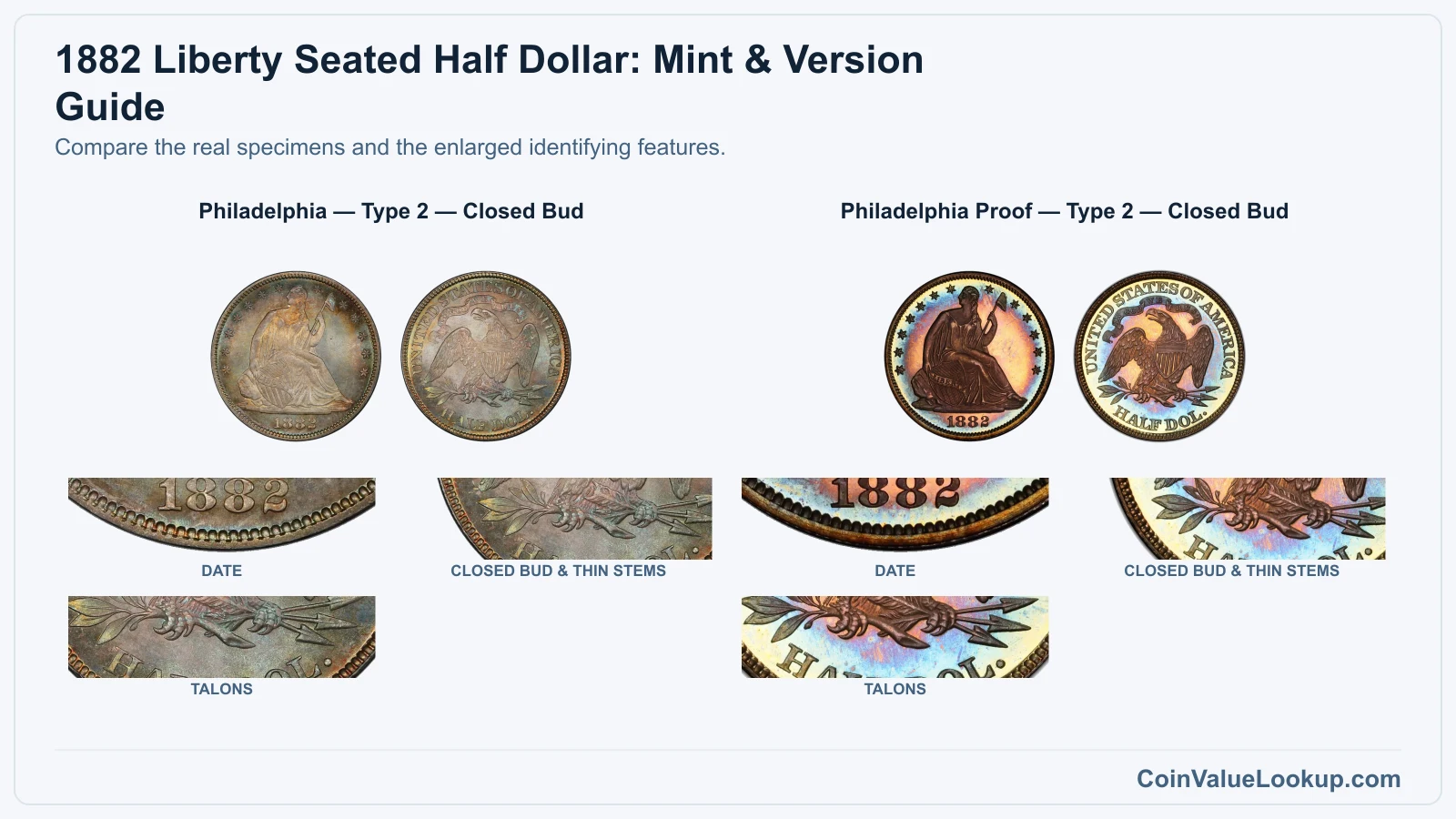
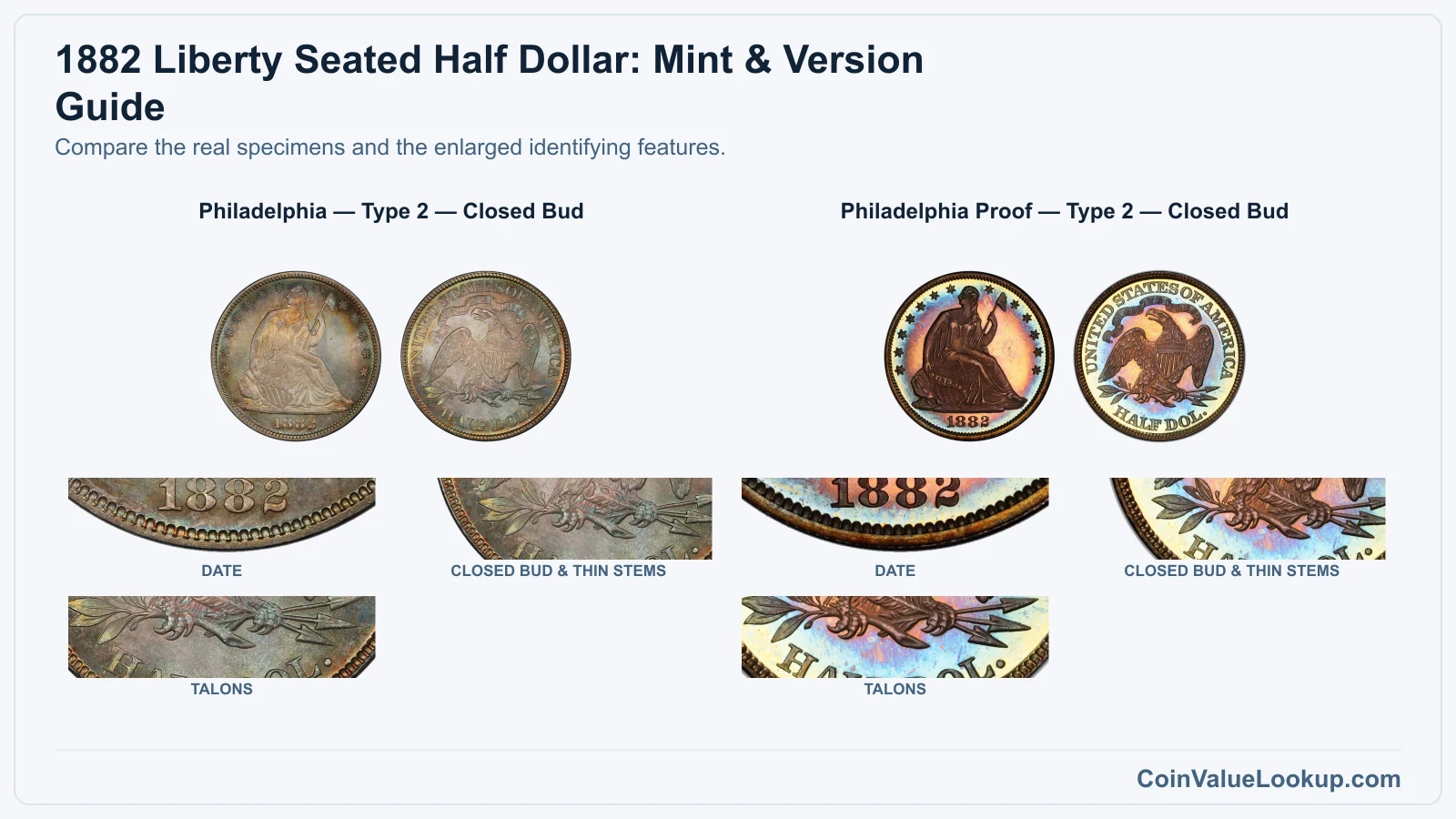
The 1882 uses the Type 2 reverse hub, identified by a closed lower olive bud, open eagle talons, and strong olive stems. The earlier Type 1 hub had an open bud, closed talons, and weaker stems.
Look at the olive branch below the eagle's left talon with magnification to confirm the bud shape.
One critical distinction: Proof and circulation strike are manufacturing categories, not successive grade levels. A Proof is not simply a nicer Mint State coin.
Prooflike reflectivity can appear on regular strikes and does not make them Proofs.
Step 2: Check Your 1882 Liberty Seated Half Dollar Grade
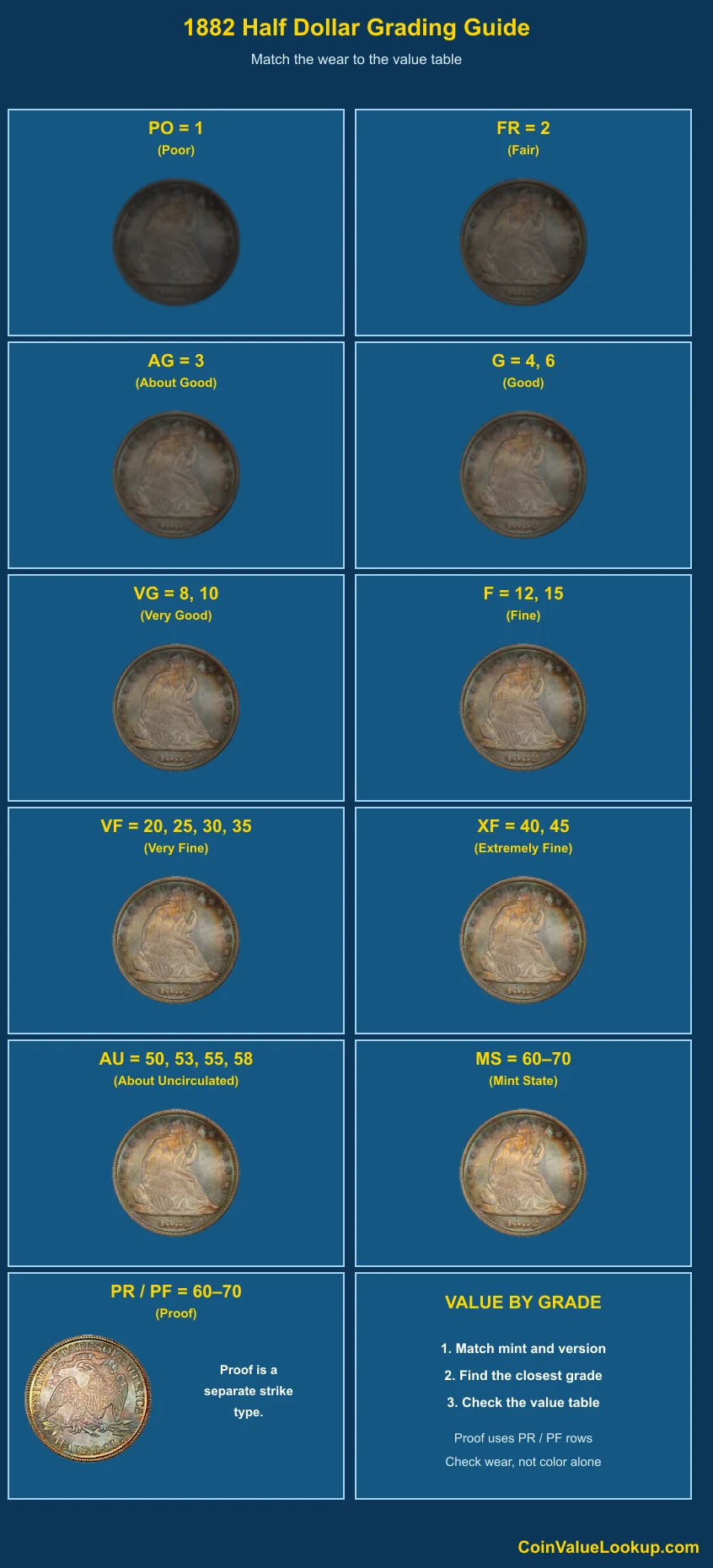
Start by examining Liberty's head, breast, knee, and the horizontal shield lines on the obverse. These are the first areas to lose detail as a coin circulates.
On the reverse, check the eagle's head, neck feathers, and wing tips.
Weak strikes exist in this series and can fool you. The key is luster: a weakly struck coin still shows original cartwheel luster in protected areas, while a worn coin loses that sheen.
Tilt the coin under a single light source and watch for that frosty glow.
Compare your coin against the reference image at a matching grade. Cleaning, holes, and rim damage are not mint errors — they reduce value sharply.
If the surfaces look unnaturally bright or show hairlines under magnification, the coin was likely cleaned at some point. Resist any urge to clean it further.
Step 3: Check 1882 Liberty Seated Half Dollar Value by Mint and Version
1882 Liberty Seated Half Dollar — Philadelphia — Type 2 — Closed Bud
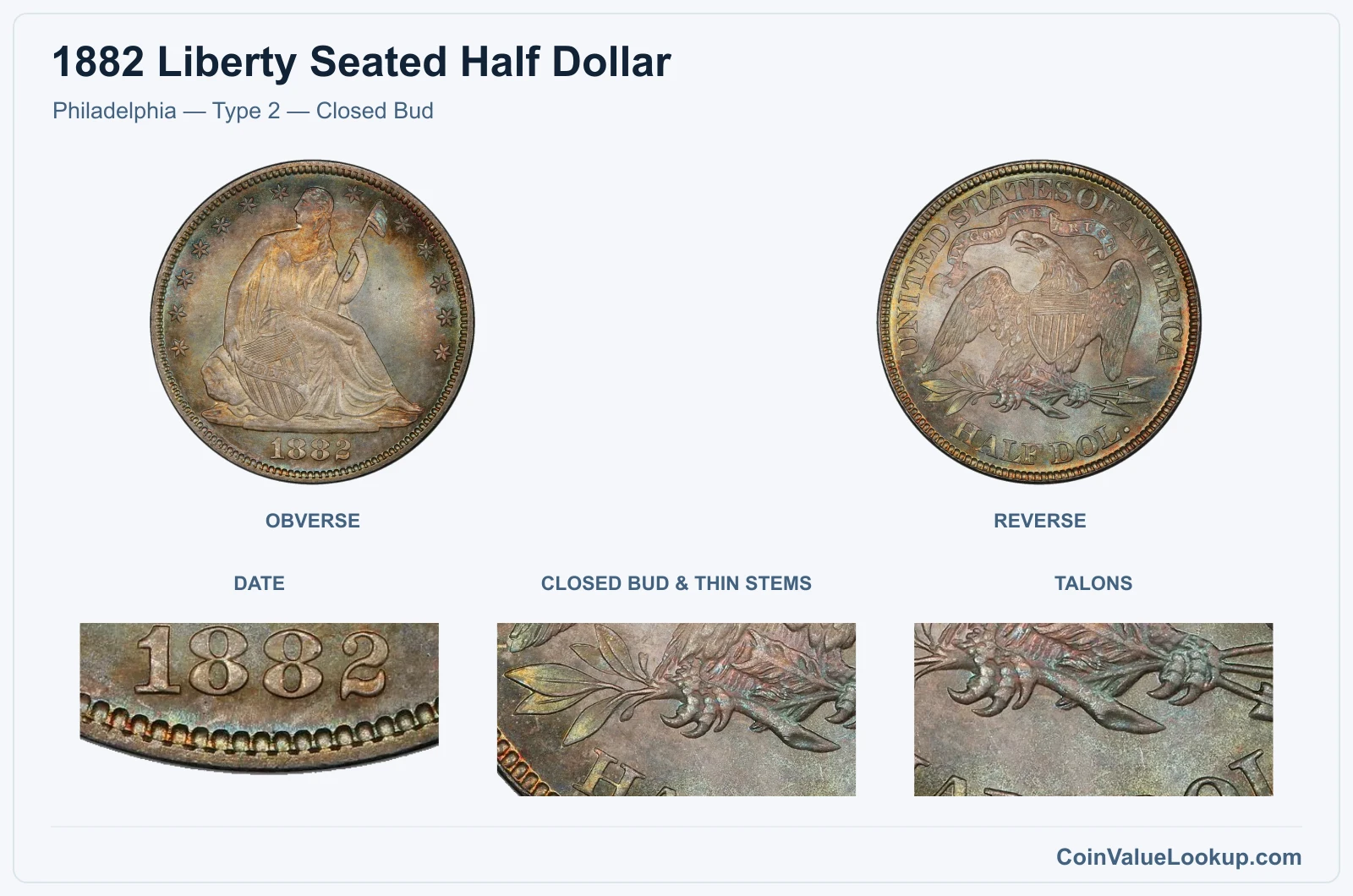
This is the standard 1882 circulation strike from Philadelphia, carrying the Type 2 reverse with a closed lower olive bud, open talons, and strong stems. No mintmark appears on the reverse.
Guide estimates place this coin at roughly $456 in G4, $809 in VF20, and $1,145 in AU50.
To confirm the variety, examine the small olive bud at the tip of the branch beneath the eagle's left talon — it should appear as a solid, closed shape rather than two separated lobes. Prooflike reflections sometimes appear on regular strikes of this era, but mirror-like fields alone do not make a coin a Proof.
Surface quality and strike sharpness together determine how this coin grades.
Coin Value Lookup is a handy starting point if you want to look up guide values for other dates and mints in this series.
Ordinary-issue reference: Ordinary-issue reference only: The table below shows prices for the 1882 Liberty Seated Half Dollar (regular strike). It does not represent the value of the specific Philadelphia — Type 2 — Closed Bud variety or its variety premium. Year, mint, metal and strike type are matched; the specific variety is not priced by this table.
Range Grade
Price Auction Records Appraisal PO PO 1
—
Coin Identifier FR FR 2
—
Coin Identifier AG AG 3
—
Coin Identifier G G 4
—
Coin Identifier
G 6
Coin Identifier VG VG 8
Coin Identifier
VG 10
Coin Identifier F F 12
Coin Identifier
F 15
Coin Identifier VF VF 20
Coin Identifier
VF 25
Coin Identifier
VF 30
Coin Identifier
VF 35
Coin Identifier XF XF 40
Coin Identifier
XF 45
Coin Identifier AU AU 50
Coin Identifier
AU 53
Coin Identifier
AU 55
Coin Identifier
AU 58
Coin Identifier MS MS 60
Coin Identifier
MS 61
Coin Identifier
MS 62
Coin Identifier
MS 63
Coin Identifier
MS 64
Coin Identifier
MS 65
Coin Identifier
MS 66
Coin Identifier
MS 67
Coin Identifier
MS 68
Coin Identifier
MS 69
—
—
—
MS 70
—
—
—
1882 Liberty Seated Half Dollar — Philadelphia Proof — Type 2 — Closed Bud
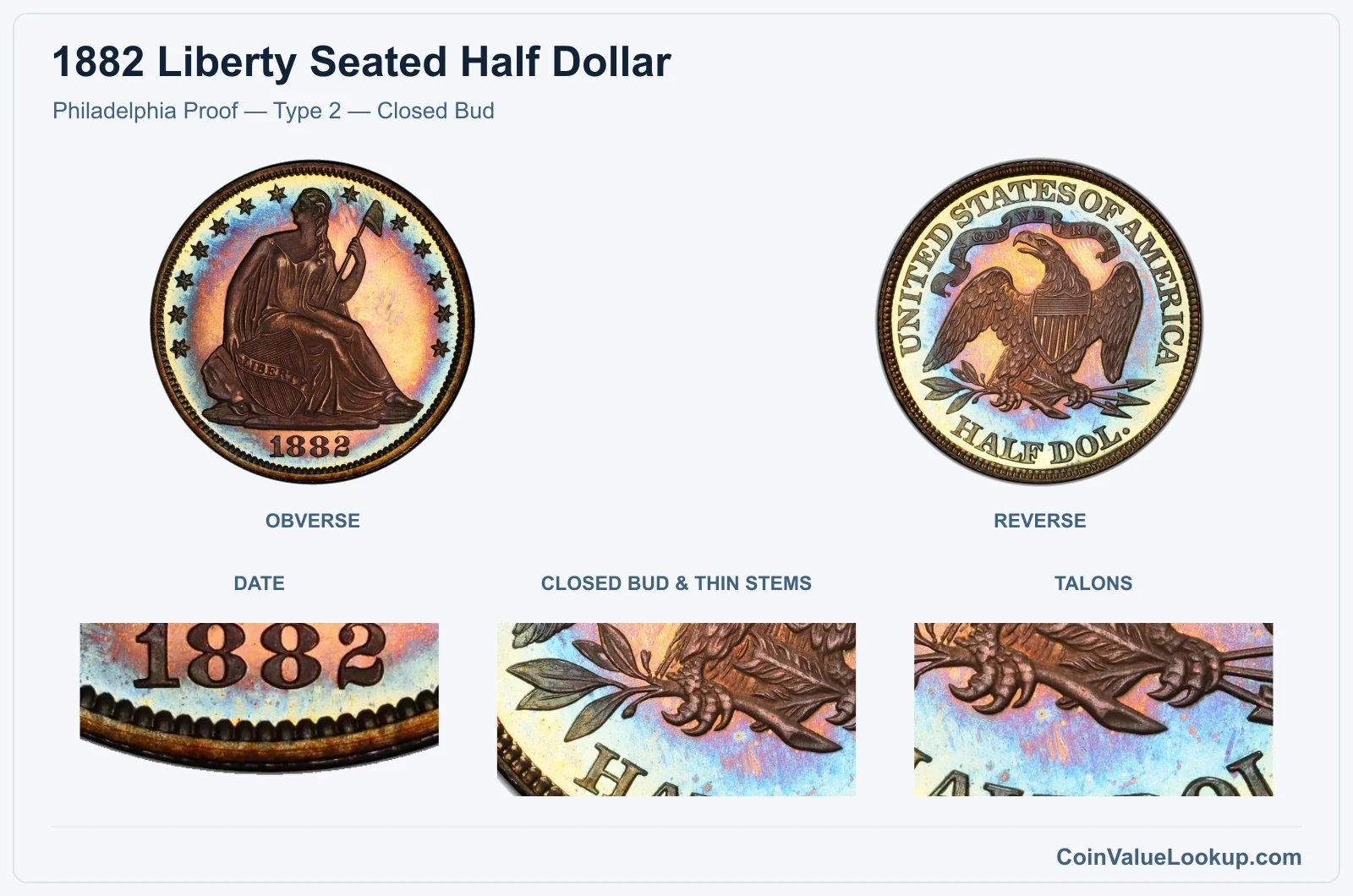
The 1882 Proof half dollar was struck at Philadelphia specifically for collectors, using polished dies and planchets. It shares the Type 2 closed-bud reverse with the circulation issue.
A guide estimate places this coin at approximately $1,409 in PR63.
True Proof surfaces show squared, knife-like rims and deeply mirrored fields that differ from the rounded rims and satiny luster of a business strike. Cameo and Deep Cameo are contrast designations within the Proof finish, describing how frosted the devices appear against the mirrored fields.
Expert attribution is recommended because early regular strikes and Proofs of this era can resemble each other, as noted by major grading services. Confirming genuine Proof manufacture matters more than any single visual shortcut.
Ordinary-issue reference: Ordinary-issue reference only: The table below shows prices for the 1882 Liberty Seated Half Dollar (proof). It does not represent the value of the specific Philadelphia Proof — Type 2 — Closed Bud variety or its variety premium. Year, mint, metal and strike type are matched; the specific variety is not priced by this table.
Range Grade
Price Auction Records Appraisal PR PR 1
—
Coin Identifier
PR 2
—
Coin Identifier
PR 3
—
Coin Identifier
PR 4
—
Coin Identifier
PR 6
—
Coin Identifier
PR 8
—
Coin Identifier
PR 10
—
Coin Identifier
PR 12
—
Coin Identifier
PR 15
—
Coin Identifier
PR 20
—
Coin Identifier
PR 25
—
Coin Identifier
PR 30
—
Coin Identifier
PR 35
—
Coin Identifier
PR 40
—
Coin Identifier
PR 45
—
Coin Identifier
PR 50
—
Coin Identifier
PR 53
—
Coin Identifier
PR 55
Coin Identifier
PR 58
Coin Identifier
PR 60
Coin Identifier
PR 61
Coin Identifier
PR 62
Coin Identifier
PR 63
Coin Identifier
PR 64
Coin Identifier
PR 65
Coin Identifier
PR 66
Coin Identifier
PR 67
Coin Identifier
PR 68
Coin Identifier
PR 69
—
—
—
PR 70
—
—
—