1882 Trade Dollar Coin Value: How Much Is It Worth?
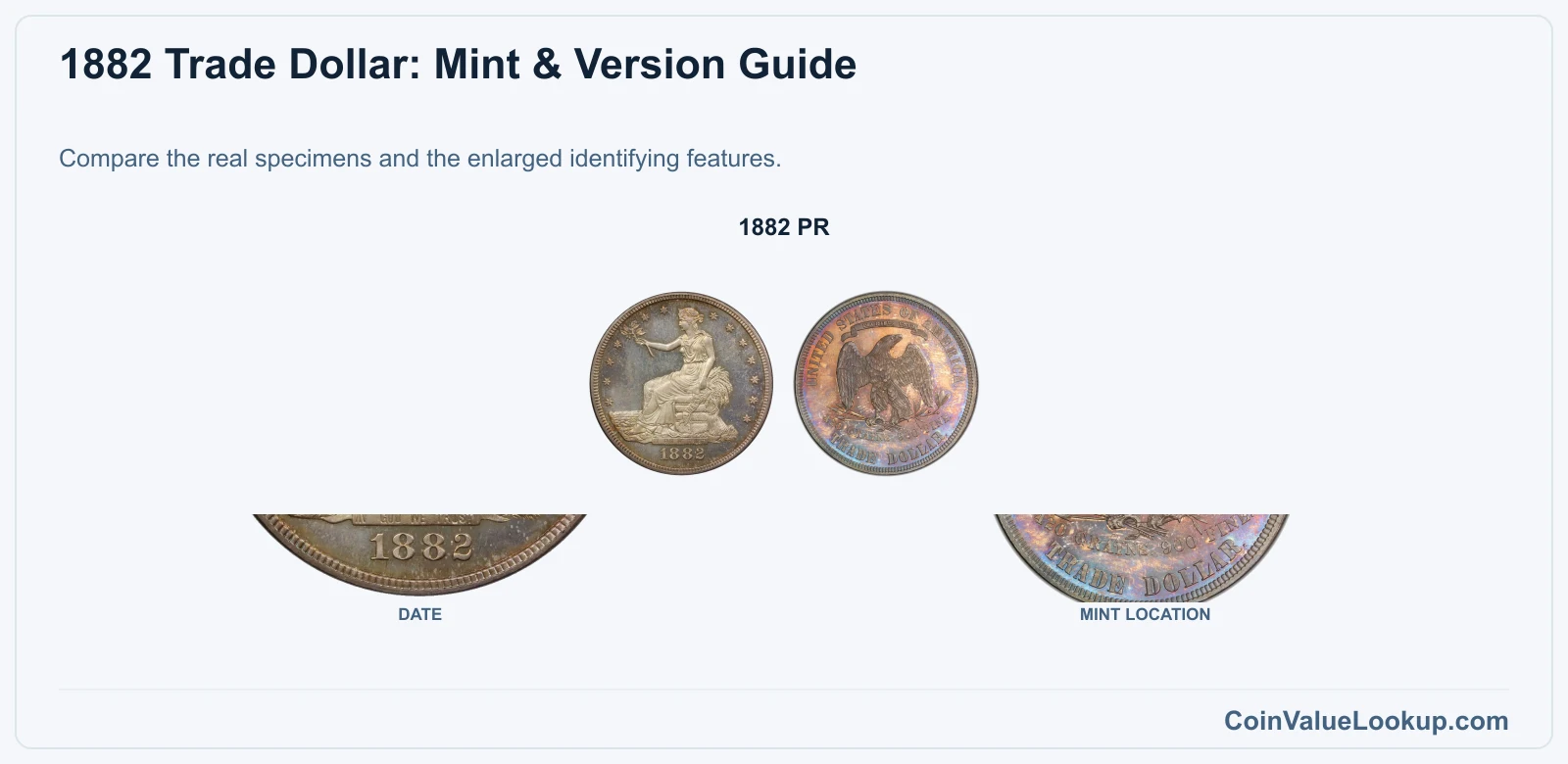
The 1882 Trade Dollar is a proof-only issue, meaning the Philadelphia Mint struck these exclusively for collectors that year — no business strikes entered commerce. A USA Coin Book guide estimate places the 1882 Trade Dollar at around $4,286.00 in PR63, though actual market results depend on the individual coin's condition and eye appeal.
Before assuming your coin is genuine, confirm the mint, finish and design details described below.
Fast Way to Identify Your 1882 Trade Dollar
The quickest way to start figuring out what you have is to upload clear photos of both the front and back of your coin. Our identifier can offer a preliminary identification based on those images, helping you narrow down the version, mint and finish.
It is not a substitute for professional authentication or grading, but it gives you a solid starting point.
1882 Trade Dollar Value
Upload both sides of your 1882 Trade Dollar.
Front Obverse
Upload photo
Back Reverse
Upload photo
Which 1882 Trade Dollar Versions Are Worth Money?
- 1882 PR (Proof): The only version struck this year; a USA Coin Book guide estimate places PR63 examples around $4,286.00.
- Verify proof finish and Philadelphia origin before assuming premium value — do not pay extra for ordinary wear, cleaning, plating, glare or an unverified error claim.
Step 1: Identify Your 1882 Trade Dollar Mint Mark and Version
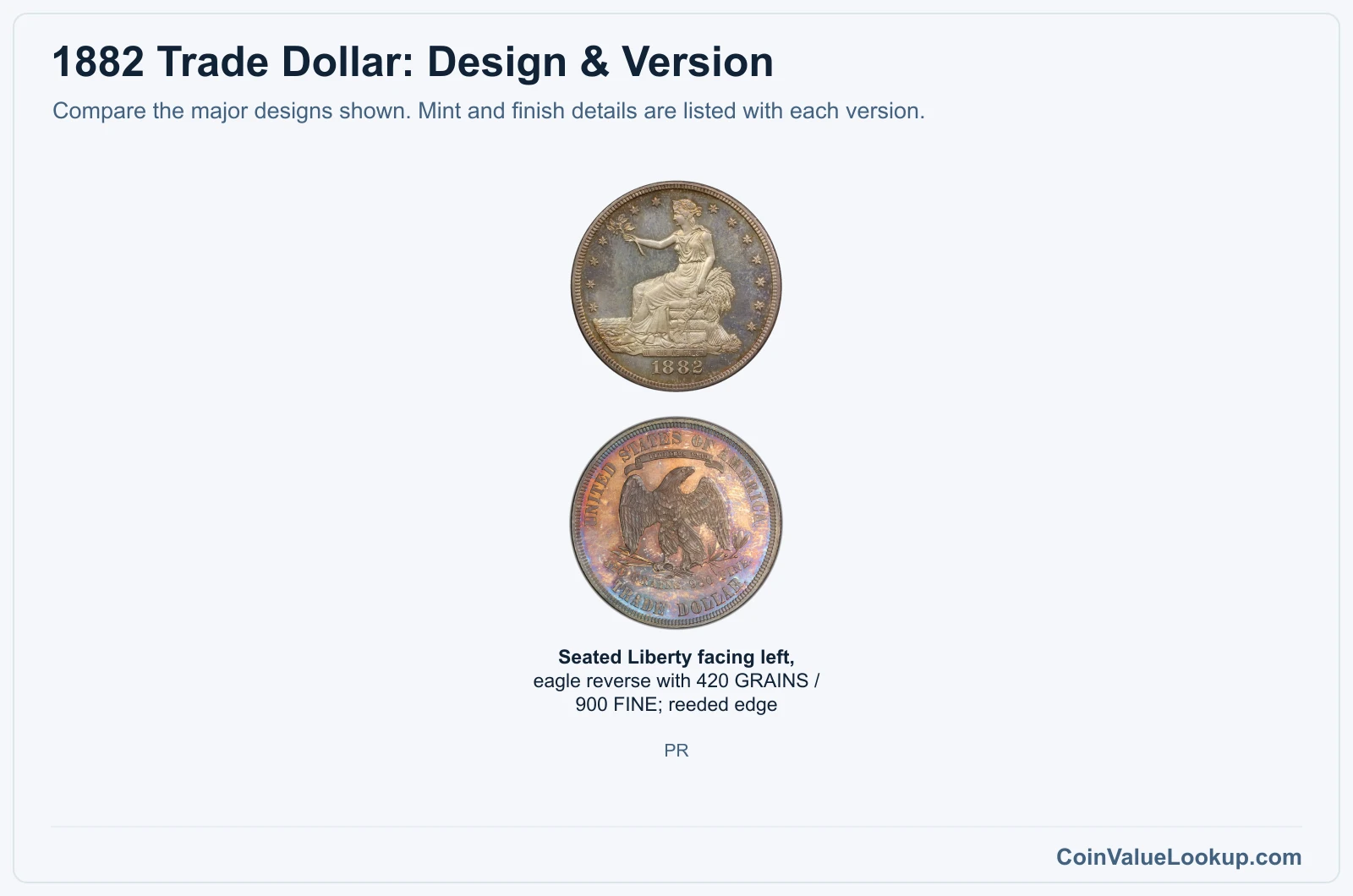
The 1882 Trade Dollar was struck only as a proof at the Philadelphia Mint. Philadelphia coins carry no mintmark.
If your coin shows a CC or S mintmark on the reverse beneath the eagle, it is not an 1882 — those mints did not produce Trade Dollars that year.
The design features Seated Liberty facing left on the obverse, with an eagle on the reverse surrounded by the inscriptions 420 GRAINS and 900 FINE. The edge is reeded.
The coin is composed of 90% silver and 10% copper, weighing 27.22 grams.
Chopmarks — small stamps punched into the surface by Asian merchants — sometimes appear on Trade Dollars. These are later additions, not mint errors.
Their presence significantly affects the coin's grade and value, so note them carefully.
Because 1882 is proof-only, any coin showing obvious wear from circulation needs extra scrutiny. Genuine proofs exist with impaired surfaces, but a well-worn example should raise questions about authenticity.
Step 2: Check Your 1882 Trade Dollar Grade
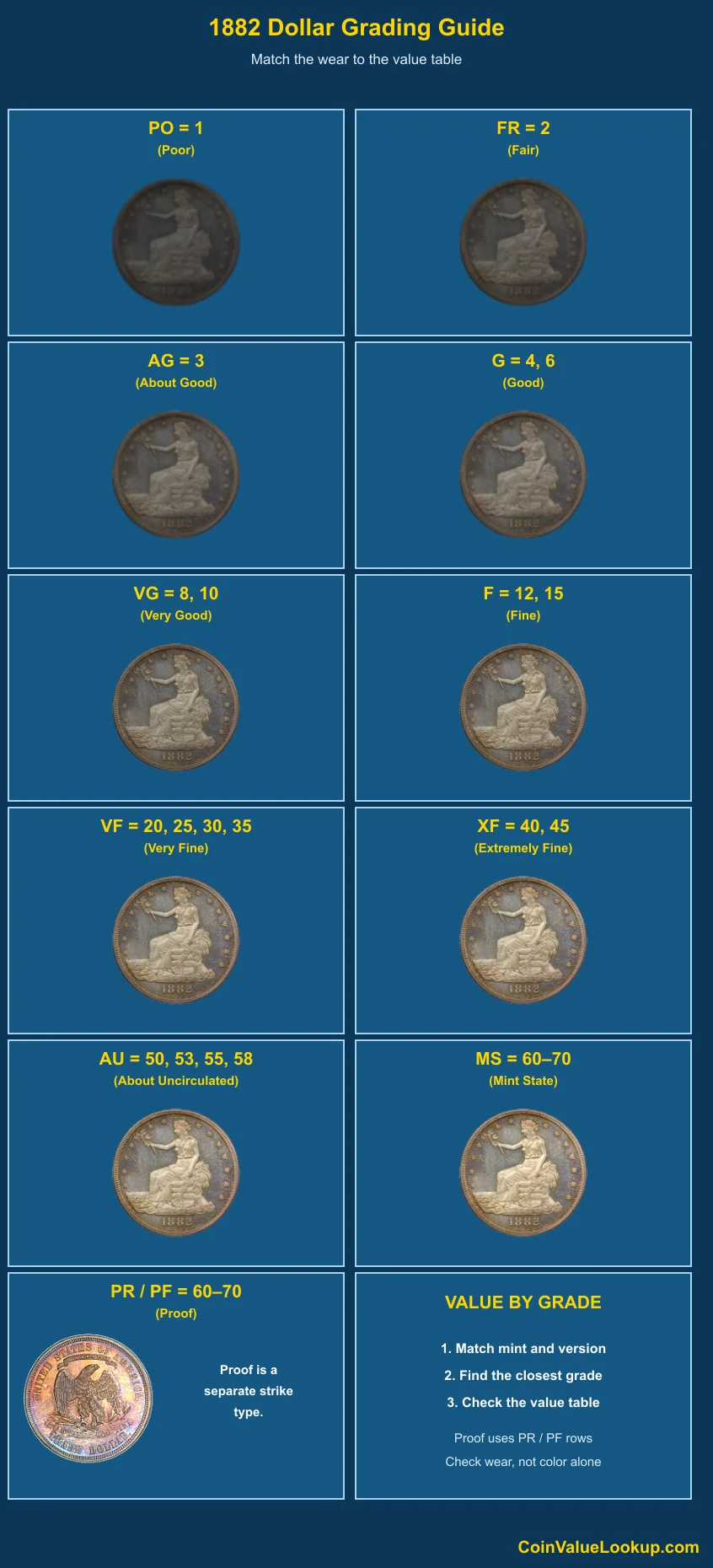
When evaluating an 1882 Trade Dollar proof, focus first on the high points: Liberty's head, shoulder and knee on the obverse, and the eagle's breast feathers and upper wing tips on the reverse. Proofs should show squared, sharp rims and mirrored fields, with frosted devices on well-preserved examples.
Hairlines from cleaning or wiping are the most common detractor on proof Trade Dollars. Hold the coin under a single light source and tilt it slowly — fine lines will flash across the mirrored fields.
Heavy hairlines can drop a coin's effective grade by several points.
Use the comparison image to see how a proof surface differs from a merely uncirculated coin. A proof is a specific manufacturing finish with specially prepared dies and planchets, not simply a high-grade coin that looks shiny.
Damage, cleaning and environmental toning should be assessed separately from the proof designation itself.
Step 3: Check 1882 Trade Dollar Value by Mint and Version
1882 Trade Dollar — PR
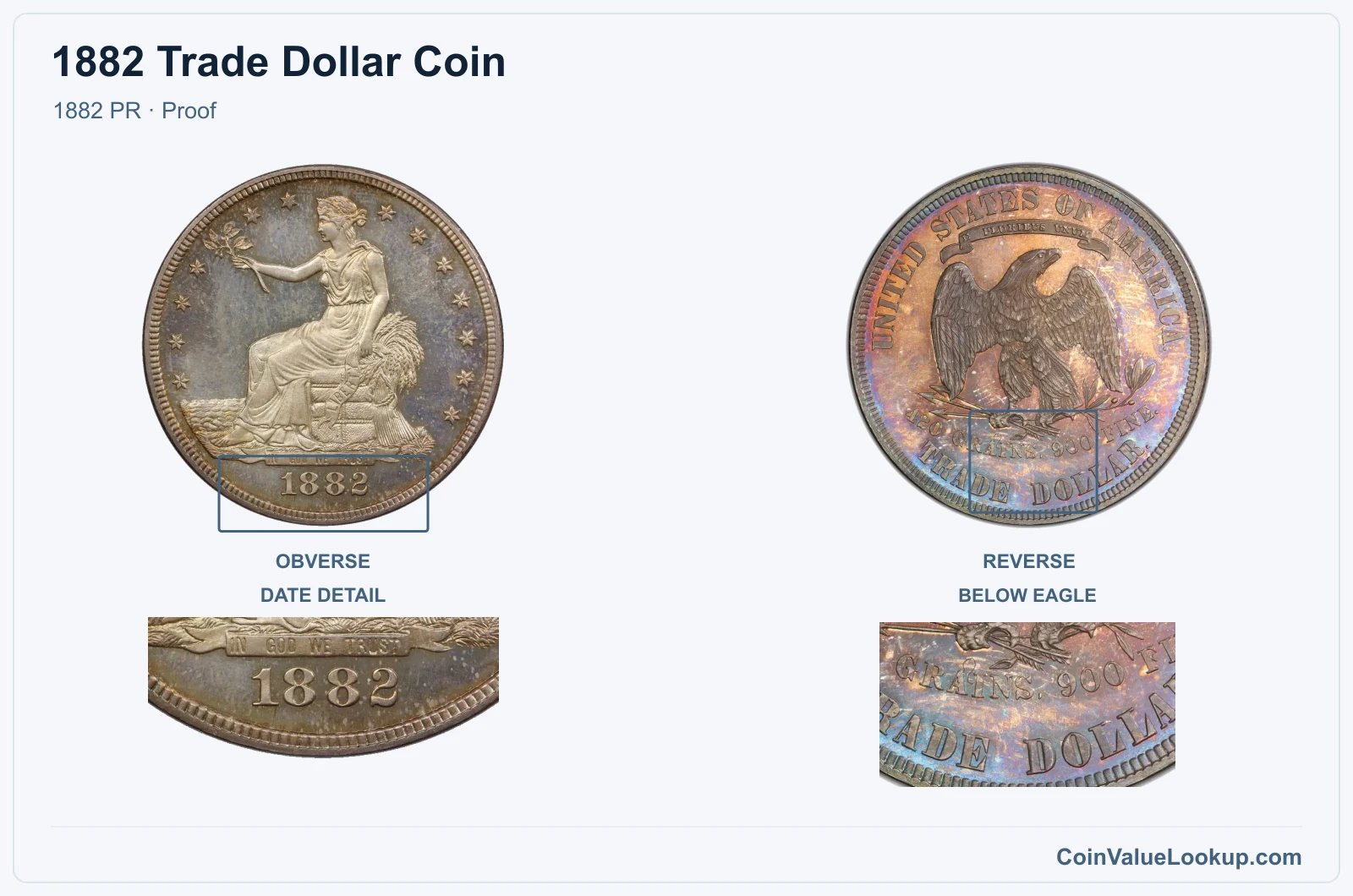
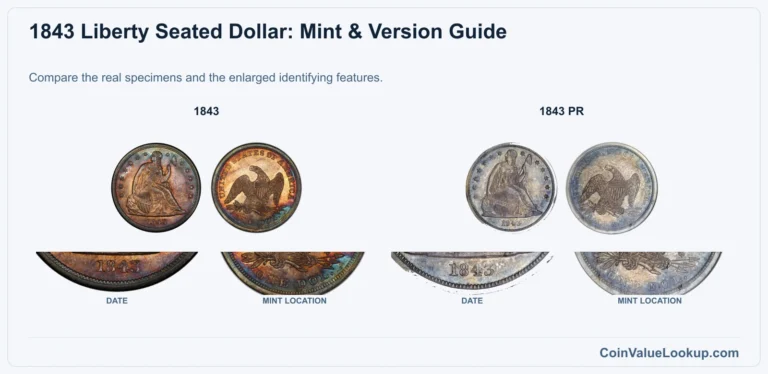
The 1882 Trade Dollar was produced solely as a proof issue at the Philadelphia Mint, with no mintmark. These coins feature the standard Seated Liberty obverse and eagle reverse with 420 GRAINS / 900 FINE inscriptions on a reeded edge.
A proof is a manufacturing finish using specially prepared dies and planchets — not simply a shiny or high-grade regular coin.
A USA Coin Book guide estimate places the 1882 proof at approximately $4,286.00 in PR63. Match Type I or Type II obverse and reverse combinations where specified; pay attention to ribbon and hand positioning on the obverse and eagle arrow details on the reverse against attributed reference images.
Confirming these design elements matters, because slight die differences can affect attribution.
Coin Value Lookup is a useful starting point if you want to look up other Trade Dollar years or different series entirely. You can browse guides organized by denomination and date to compare what you have.
Range Grade
Price Auction Records Appraisal PR PR 1
—
Coin Identifier
PR 2
—
Coin Identifier
PR 3
—
Coin Identifier
PR 4
—
Coin Identifier
PR 6
—
Coin Identifier
PR 8
—
Coin Identifier
PR 10
—
Coin Identifier
PR 12
—
Coin Identifier
PR 15
—
Coin Identifier
PR 20
Coin Identifier
PR 25
—
Coin Identifier
PR 30
—
Coin Identifier
PR 35
Coin Identifier
PR 40
Coin Identifier
PR 45
Coin Identifier
PR 50
Coin Identifier
PR 53
—
Coin Identifier
PR 55
Coin Identifier
PR 58
Coin Identifier
PR 60
Coin Identifier
PR 61
Coin Identifier
PR 62
Coin Identifier
PR 63
Coin Identifier
PR 64
Coin Identifier
PR 65
Coin Identifier
PR 66
Coin Identifier
PR 67
—
—
—
PR 68
Coin Identifier
PR 69
—
—
—
PR 70
—
—
—
1882 Trade Dollar Error List
1. 1882 Trade Dollar — Misplaced Date
A misplaced date error on the Trade Dollar series involves remnants of date-punch digits appearing in an unusual position on the coin, separate from where the final date was placed. The normal date remains visible in its expected location, but faint ghost digits may appear nearby or in an unexpected area of the field or design.
The reported example is specifically associated with an 1882-CC designation. That said, the 1882 Trade Dollar from Philadelphia is proof-only, and the CC mint did not produce Trade Dollars that year, so this entry warrants careful verification before applying it to any coin you hold.
When examining a potential misplaced date, distinguish it from scratches, die cracks, random dents or incorrectly assigned die varieties, all of which can mimic the appearance of stray digits. No specific price data is available for this error, as value depends heavily on the coin's condition, the visibility of the misplaced digits and professional confirmation of the variety.