1873 Trade Dollar Coin Value: How Much Is It Worth?
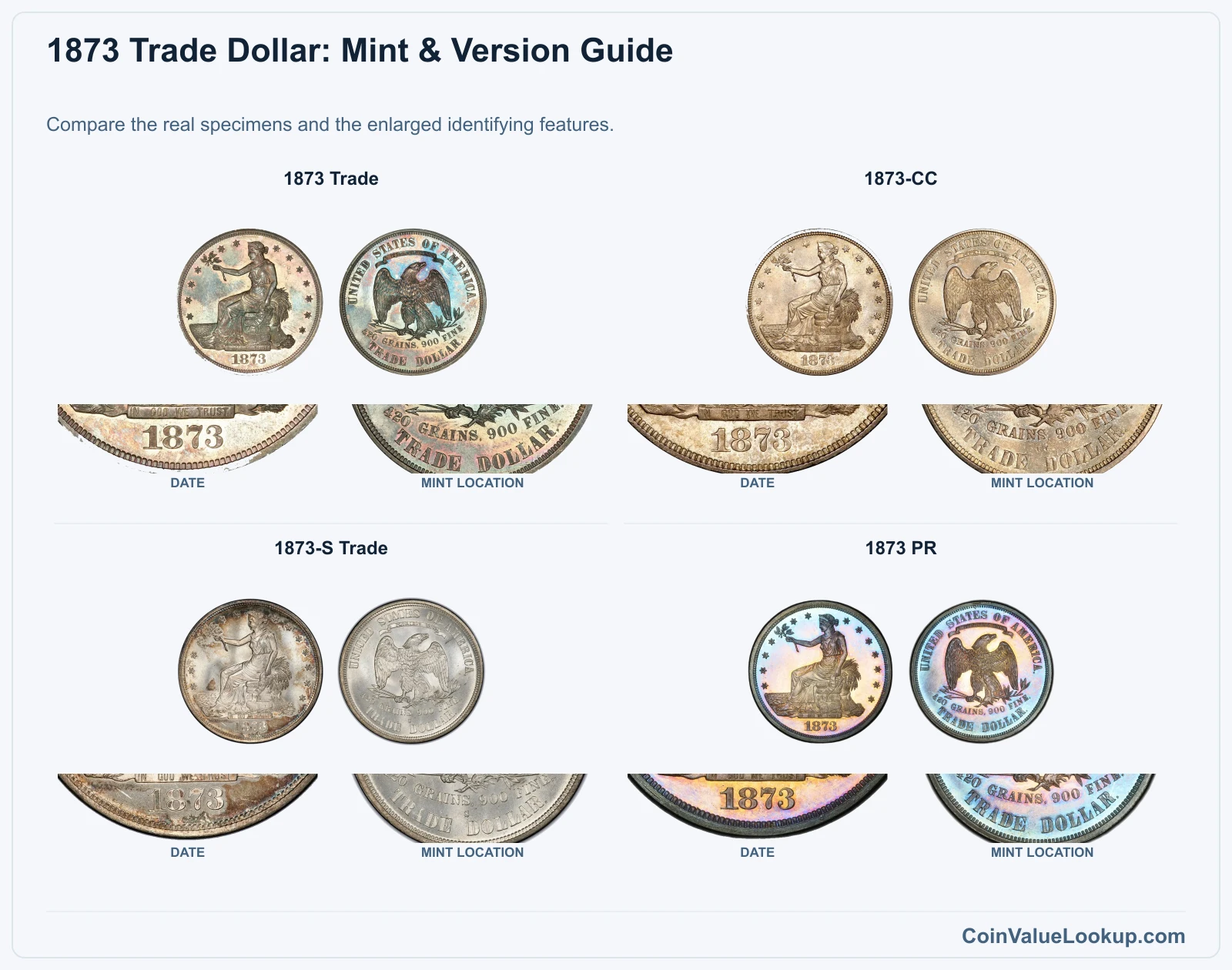
The 1873 Trade Dollar is a first-year-of-issue silver coin struck for international commerce, and it draws steady collector interest across all three mints. Guide estimates for explicitly listed grades and versions span $414.00 to $30,967.00, though your coin's actual value depends on its mint, finish, condition and whether it carries a recognized variety or error.
Identifying the exact branch matters before anything else.
Fast Way to Identify Your 1873 Trade Dollar
The quickest way to start figuring out what you have is to upload clear photos of both the front and back of your coin. Our identifier can give you a preliminary read on the mint, design type and general condition.
Snap the images in even light, avoid glare, and make sure the date and any mintmark area below the eagle are sharp.
1873 Trade Dollar Value
Upload both sides of your 1873 Trade Dollar.
Front Obverse
Upload photo
Back Reverse
Upload photo
Which 1873 Trade Dollar Versions Are Worth Money?
- The 1873-CC Trade Dollar carries adopted guide estimates from $414.00 in G4 to $30,967.00 in MS63, making the Carson City mint a key branch to confirm.
- The 1873 Philadelphia "Arm Worm" die gouge variety is a recognized named variety worth checking for on any unmarked 1873 Trade Dollar.
- The 1873-CC is reported with a broadstrike and reverse brockage combination, a dramatic mint error for that issue.
- Proof 1873 Trade Dollars from Philadelphia require professional authentication but represent a distinct collectible finish.
Step 1: Identify Your 1873 Trade Dollar Mint Mark and Version
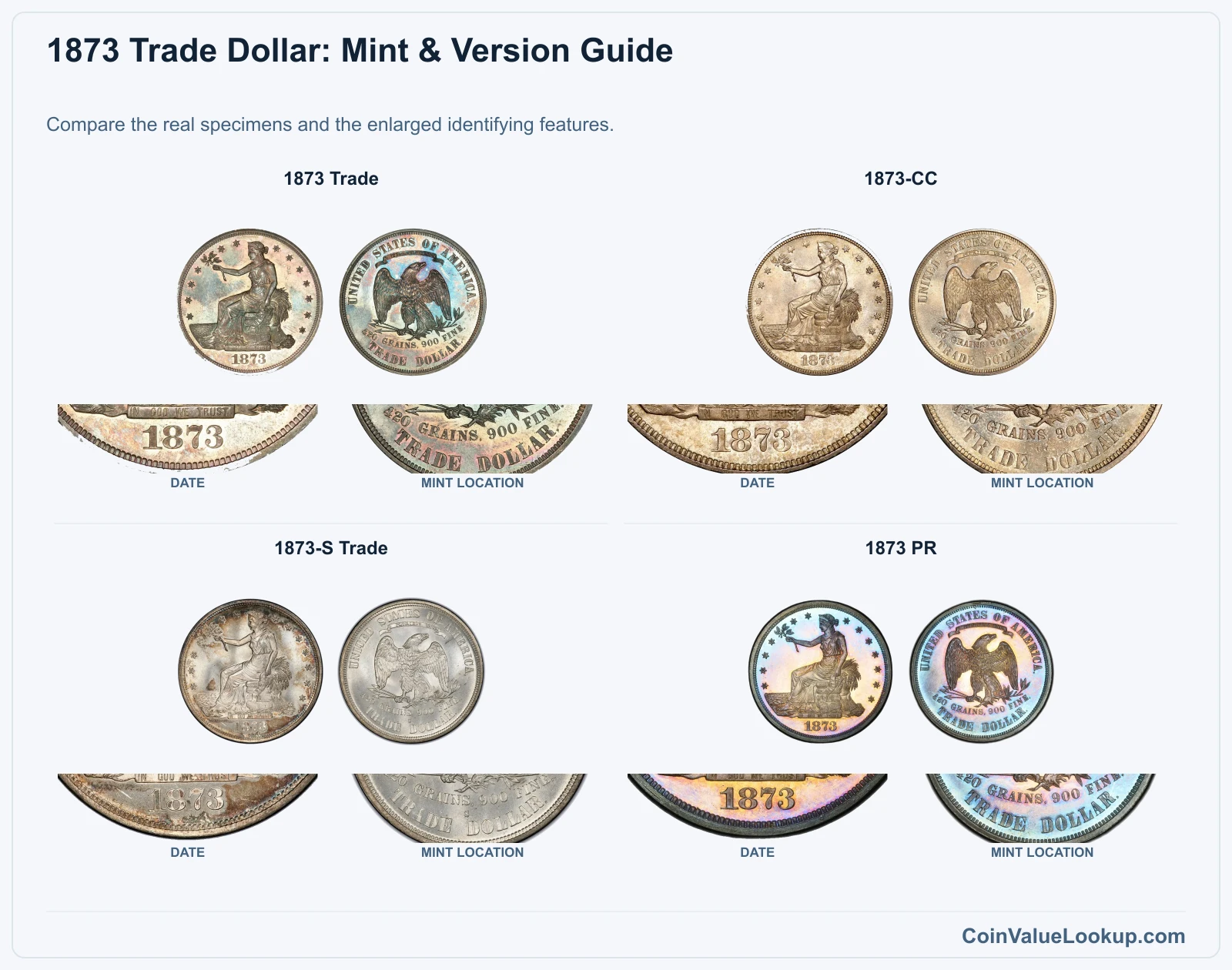
Flip the coin to the reverse side and look just below the eagle's tail feathers. A small "CC" means Carson City, an "S" means San Francisco, and no mark at all means Philadelphia.
The design is the same across all three mints: Seated Liberty facing left on the obverse, an eagle on the reverse with "420 GRAINS" and "900 FINE" spelled out, and a reeded edge.
The coin is 90% silver and 10% copper, weighing 27.22 grams. If your coin feels too light or doesn't have a reeded edge, something is off.
Chopmarks, those small stamped symbols sometimes found on Trade Dollars, are merchant counter-stamps applied in Asia. They are not mint errors and should be evaluated separately from the coin's grade.
Proof examples also exist from Philadelphia. A proof is a special manufacturing finish with mirrored fields, not simply a well-preserved business strike.
If your coin has deeply reflective surfaces and squared-off rims, it may be a proof, but professional authentication is the only reliable way to confirm that.
Step 2: Check Your 1873 Trade Dollar Grade
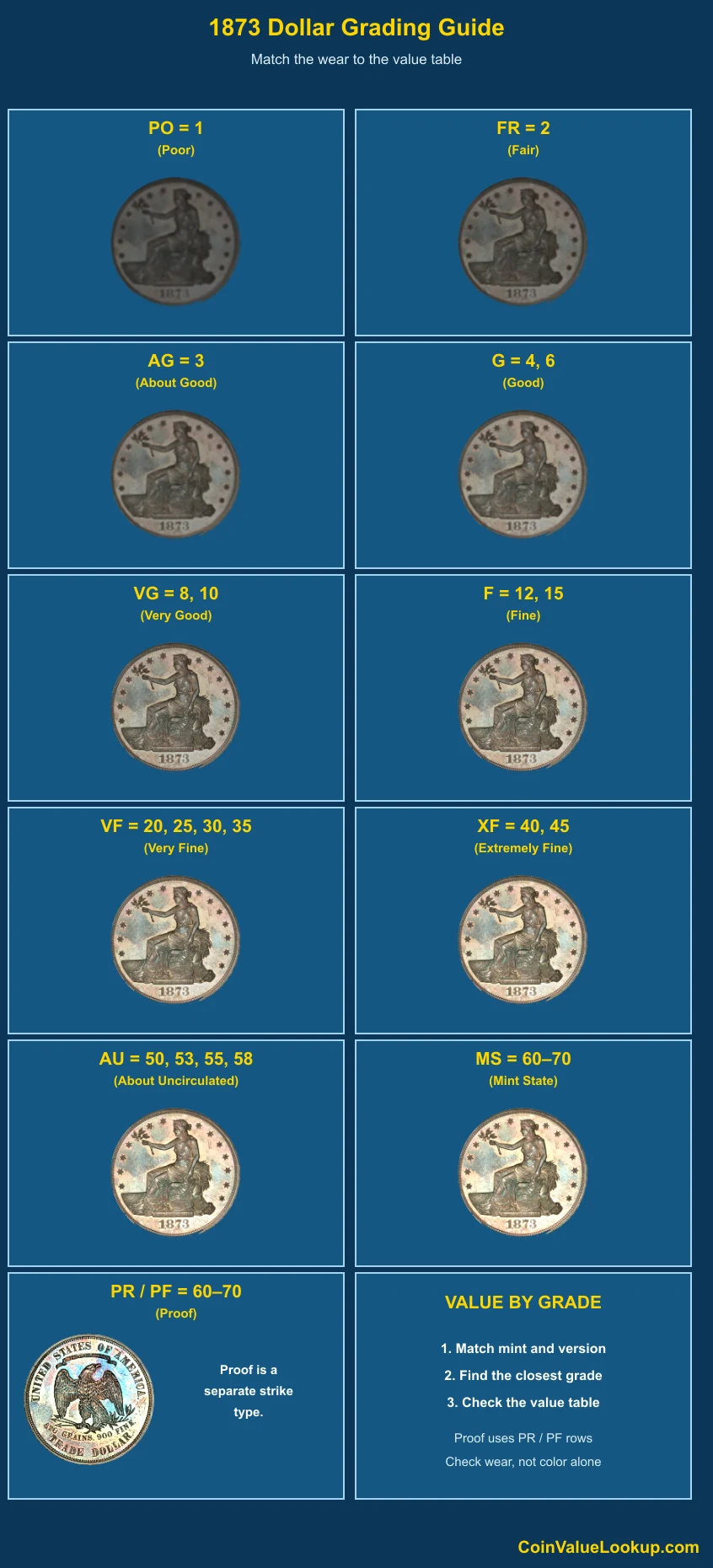
When grading a Trade Dollar, focus on the high points first. On the obverse, check Liberty's head, the cap of her shoulder and her knee for signs of wear.
On the reverse, the eagle's breast feathers and the tops of the wings lose detail earliest.
A well-circulated coin in the Good-4 range will show a clear outline of Liberty with most interior detail worn away. Around About Uncirculated, you will see only light friction on those high points, with luster still visible in the protected areas.
Mint State pieces retain full original luster with no wear, though they may show bag marks or contact marks from storage. Compare your coin against the same-type grading image to judge where it falls.
Cleaning, polishing and environmental damage are graded separately and usually lower a coin's market appeal. If you see hairline scratches running in one direction across the fields, somebody likely wiped the coin at some point.
Step 3: Check 1873 Trade Dollar Value by Mint and Version
1873 Trade Dollar — Trade
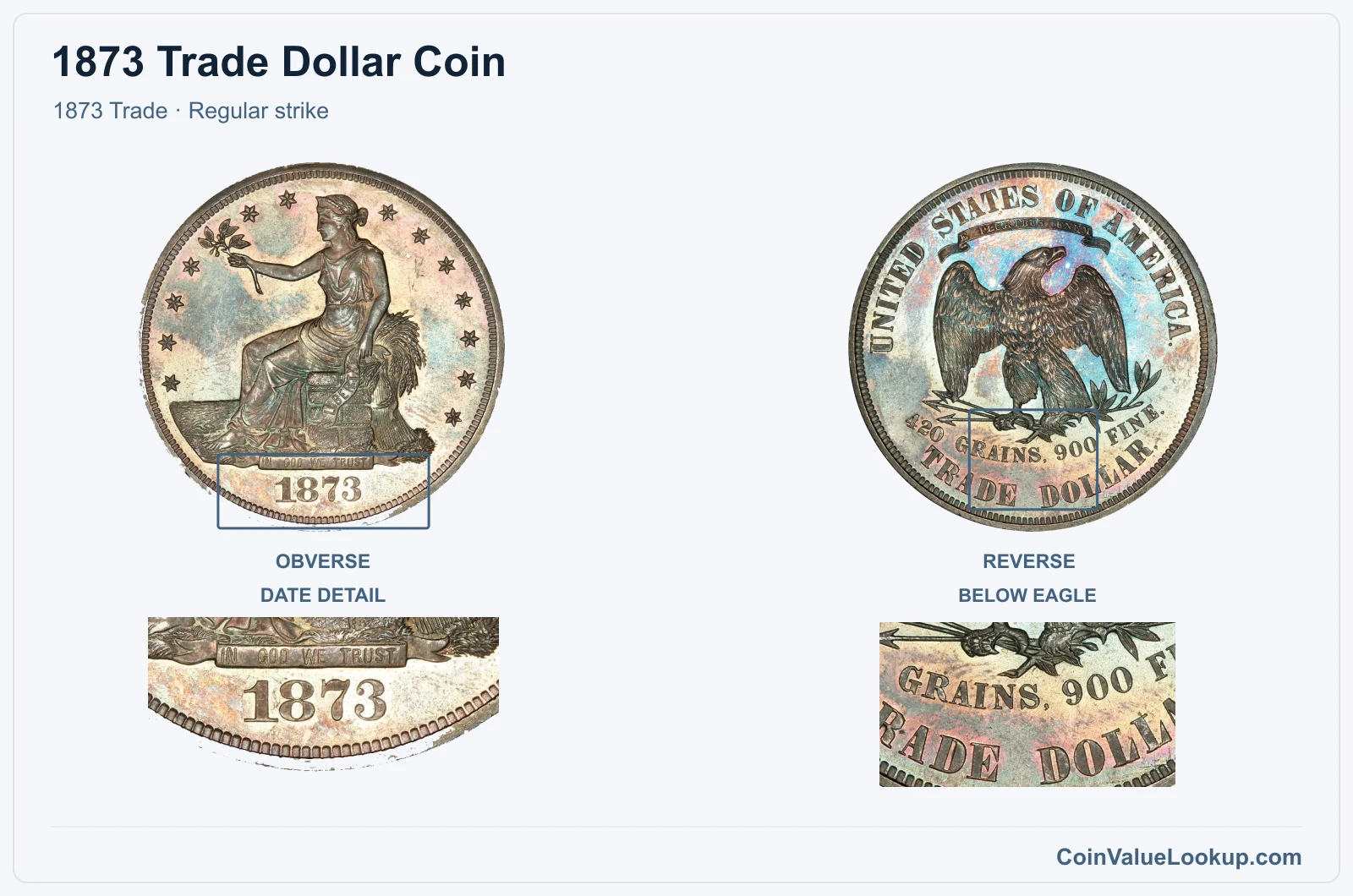
The 1873 Trade Dollar from Philadelphia carries no mintmark. Look below the eagle on the reverse: if the field is clean there, you have the Philadelphia issue.
This is the first year of the series, and collectors care about Type I versus Type II obverse and reverse pairings. Examine the position of Liberty's hand and the olive branch ribbon, and compare the eagle's arrow arrangement to attributed images.
Differences can be subtle.
Original, uncleaned surfaces matter here. Polished or cleaned coins lose much of their comparability to graded examples.
Value depends on authenticated identity and condition, so professional assessment is the best route for an accurate picture.
Range Grade
Price Auction Records Appraisal PO PO 1
—
Coin Identifier FR FR 2
Coin Identifier AG AG 3
—
Coin Identifier G G 4
—
Coin Identifier
G 6
—
Coin Identifier VG VG 8
—
Coin Identifier
VG 10
—
Coin Identifier F F 12
—
Coin Identifier
F 15
—
Coin Identifier VF VF 20
Coin Identifier
VF 25
—
Coin Identifier
VF 30
Coin Identifier
VF 35
Coin Identifier XF XF 40
Coin Identifier
XF 45
Coin Identifier AU AU 50
Coin Identifier
AU 53
Coin Identifier
AU 55
Coin Identifier
AU 58
Coin Identifier MS MS 60
Coin Identifier
MS 61
Coin Identifier
MS 62
Coin Identifier
MS 63
Coin Identifier
MS 64
Coin Identifier
MS 65
Coin Identifier
MS 66
Coin Identifier
MS 67
—
Coin Identifier
MS 68
—
—
—
MS 69
—
—
—
MS 70
—
—
—
1873 Trade Dollar — CC
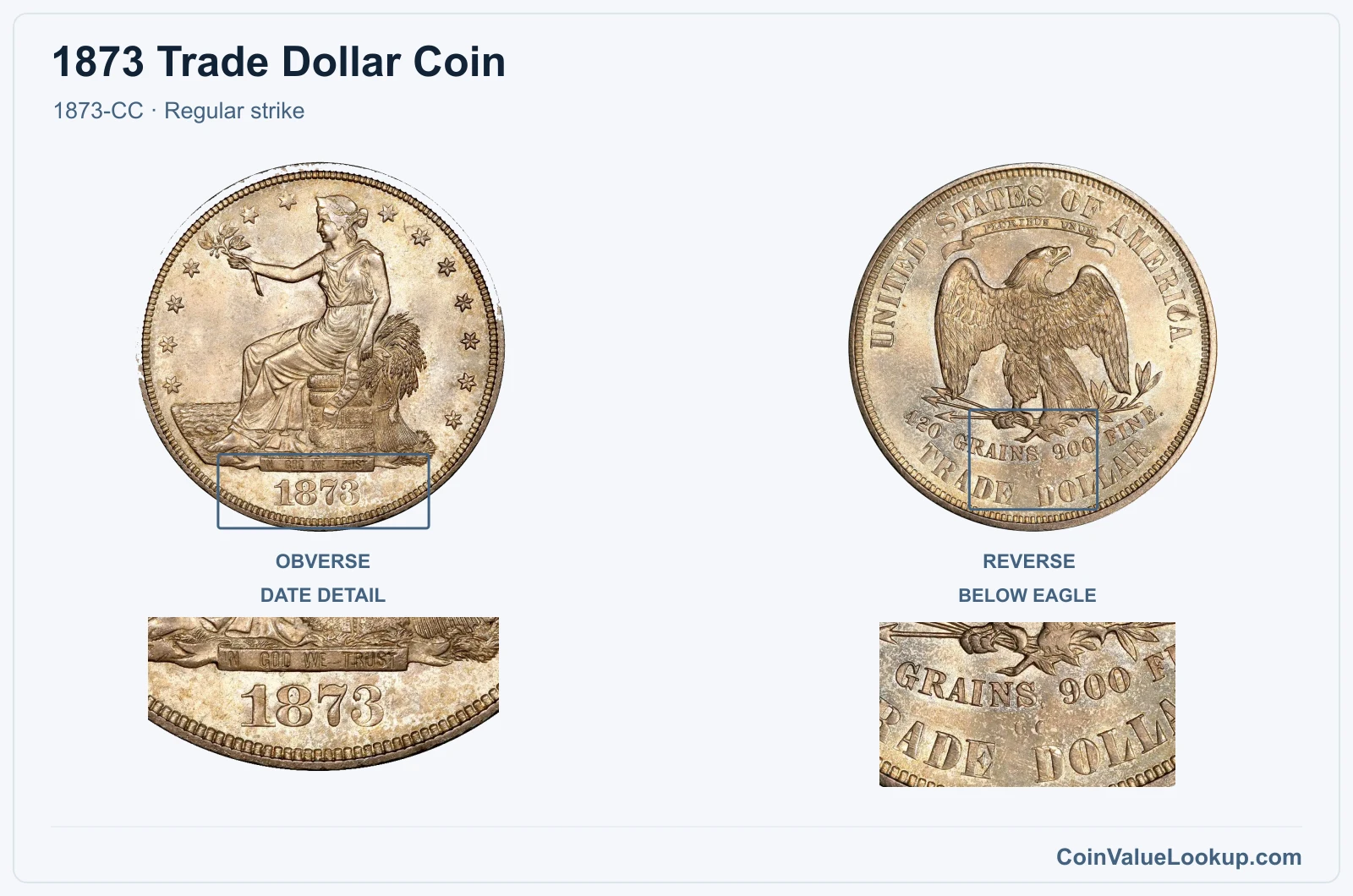
The 1873-CC Trade Dollar was struck at the Carson City Mint in Nevada, and you will find a small "CC" mintmark on the reverse below the eagle. Carson City coins carry a persistent collector premium because of the mint's relatively short operational life and lower production volumes.
According to USA Coin Book guide estimates, a 1873-CC in G4 condition sits around $414.00, while an MS63 example jumps to roughly $30,967.00. These are guide estimates, not guaranteed offers, and real-world results depend on the specific coin's surfaces, eye appeal and authentication.
Coin Value Lookup is a good starting point if you want to look up guides for other dates or denominations alongside your 1873-CC. It covers a wide range of U.S. coin series.
Pay attention to Type I/II die combinations on this issue. Match the ribbon, hand and arrow details against attributed images before assuming grade alone sets the price.
Range Grade
Price Auction Records Appraisal PO PO 1
—
Coin Identifier FR FR 2
—
Coin Identifier AG AG 3
—
Coin Identifier G G 4
—
Coin Identifier
G 6
—
Coin Identifier VG VG 8
—
Coin Identifier
VG 10
—
Coin Identifier F F 12
Coin Identifier
F 15
Coin Identifier VF VF 20
Coin Identifier
VF 25
Coin Identifier
VF 30
Coin Identifier
VF 35
Coin Identifier XF XF 40
Coin Identifier
XF 45
Coin Identifier AU AU 50
Coin Identifier
AU 53
Coin Identifier
AU 55
Coin Identifier
AU 58
Coin Identifier MS MS 60
Coin Identifier
MS 61
Coin Identifier
MS 62
Coin Identifier
MS 63
Coin Identifier
MS 64
Coin Identifier
MS 65
—
Coin Identifier
MS 66
—
—
—
MS 67
—
—
—
MS 68
—
—
—
MS 69
—
—
—
MS 70
—
—
—
1873 Trade Dollar — S Trade
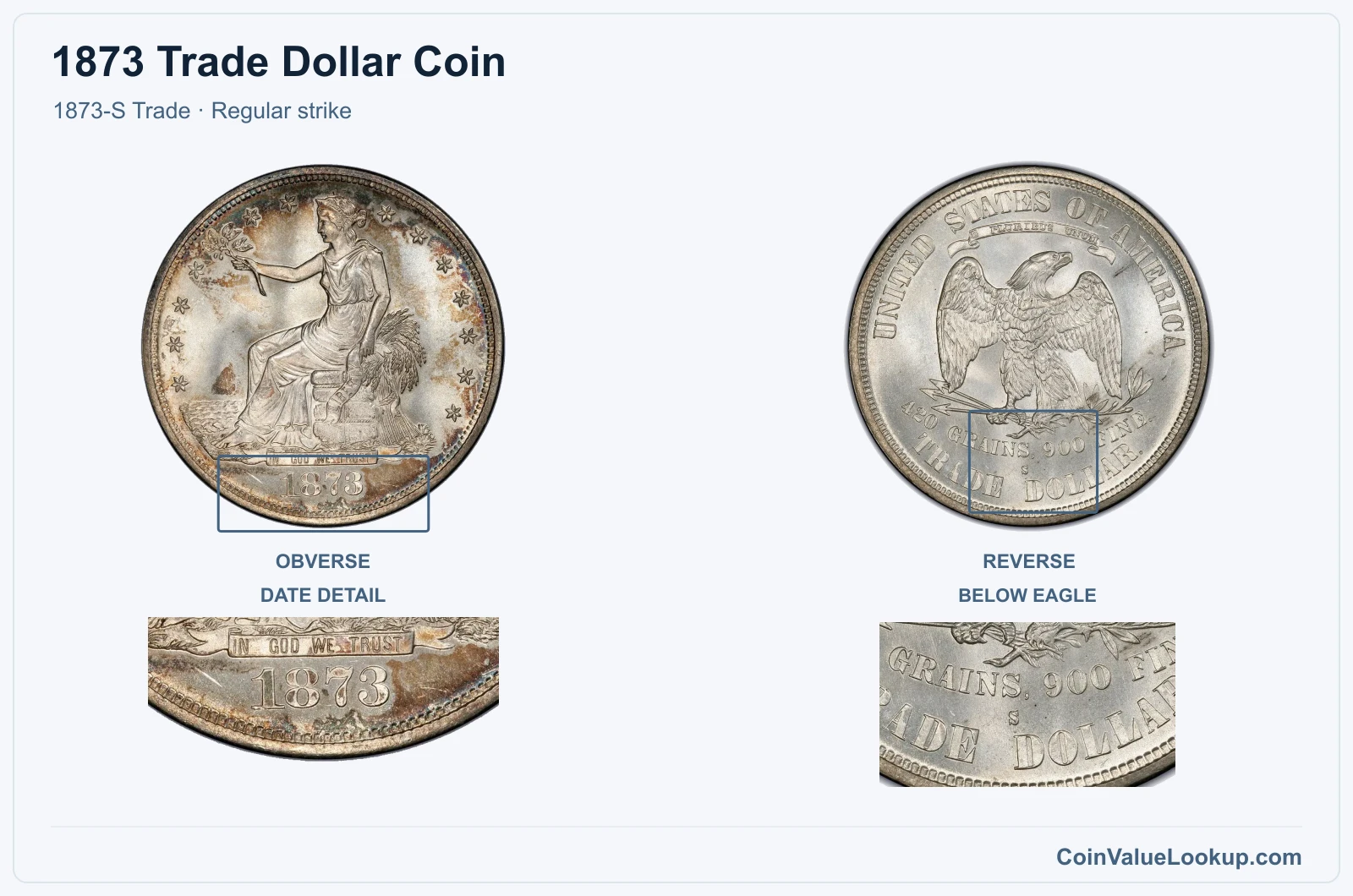
The 1873-S Trade Dollar bears a small "S" mintmark on the reverse, below the eagle's tail feathers. San Francisco struck Trade Dollars in large quantities because the coin was designed primarily for Pacific trade.
As with the Philadelphia issue, identifying Type I or Type II die pairings matters. Check the details of Liberty's hand and the ribbon ends, along with the eagle's arrow arrangement.
No specific numeric price range was adopted for this version. Value hinges on authenticated identity, grade and whether any recognized variety or error is present.
Cleaned or damaged coins trade well below problem-free examples at the same technical grade.
Range Grade
Price Auction Records Appraisal PO PO 1
—
Coin Identifier FR FR 2
—
Coin Identifier AG AG 3
—
Coin Identifier G G 4
—
Coin Identifier
G 6
—
Coin Identifier VG VG 8
—
Coin Identifier
VG 10
—
Coin Identifier F F 12
—
Coin Identifier
F 15
—
Coin Identifier VF VF 20
Coin Identifier
VF 25
—
Coin Identifier
VF 30
Coin Identifier
VF 35
Coin Identifier XF XF 40
Coin Identifier
XF 45
Coin Identifier AU AU 50
Coin Identifier
AU 53
Coin Identifier
AU 55
Coin Identifier
AU 58
Coin Identifier MS MS 60
Coin Identifier
MS 61
Coin Identifier
MS 62
Coin Identifier
MS 63
Coin Identifier
MS 64
Coin Identifier
MS 65
Coin Identifier
MS 66
Coin Identifier
MS 67
—
—
—
MS 68
—
—
—
MS 69
—
—
—
MS 70
—
—
—
1873 Trade Dollar — PR
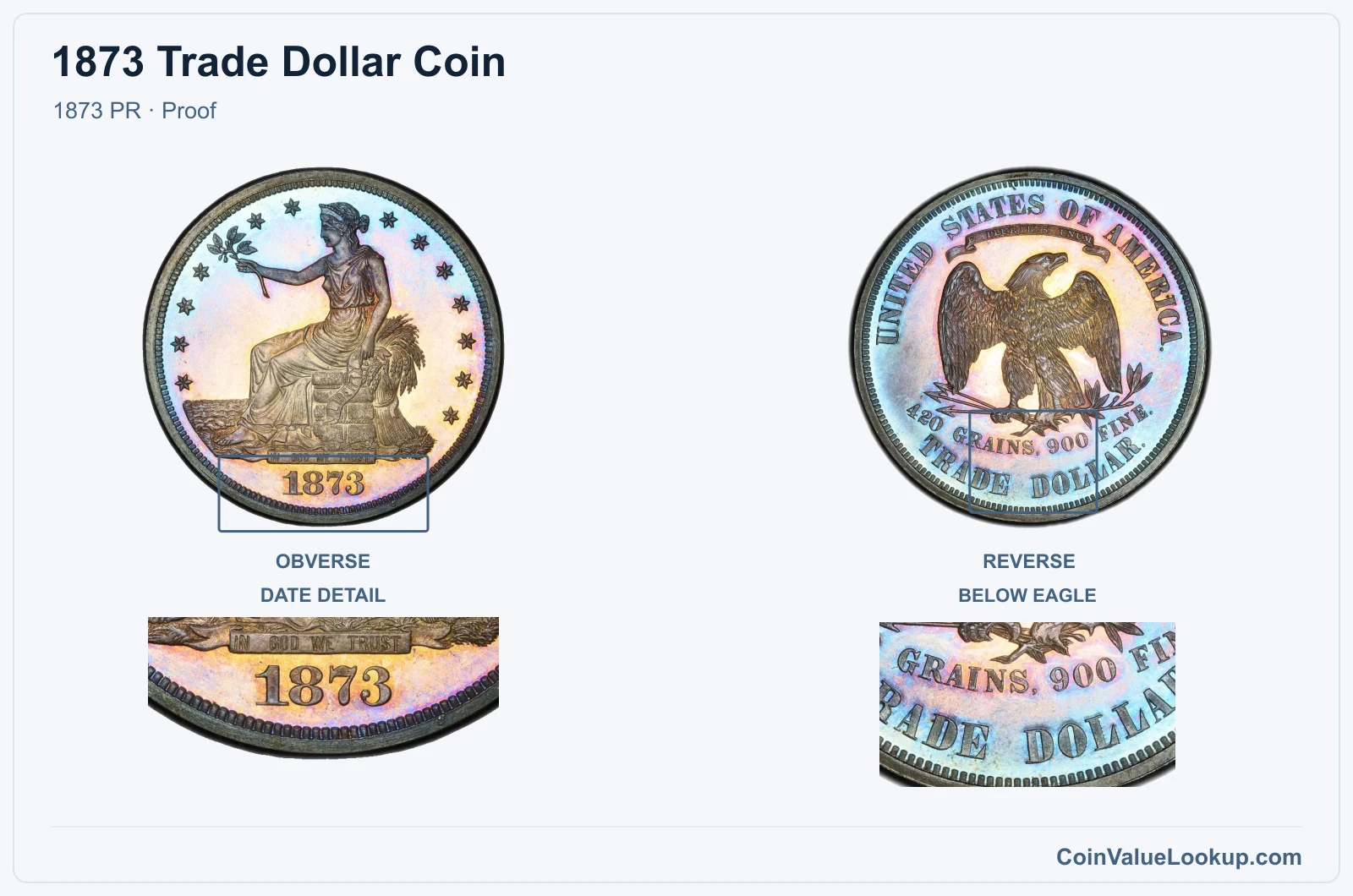
The 1873 Proof Trade Dollar is a Philadelphia product struck with specially prepared dies on polished planchets. The fields should be deeply mirrored, and the devices will show sharp, squared-off detail that business strikes rarely match.
A proof is a manufacturing method, not a grade. Proof coins are graded on their own numeric scale and evaluated for hairlines, haze, toning and surface quality rather than circulation wear.
No specific numeric price range was adopted for this proof issue. Authenticated condition and eye appeal drive value significantly.
If you suspect you have a proof, professional certification is essential; a shiny business strike with minimal wear is not the same thing.
Range Grade
Price Auction Records Appraisal PR PR 1
—
Coin Identifier
PR 2
—
Coin Identifier
PR 3
—
Coin Identifier
PR 4
—
Coin Identifier
PR 6
—
Coin Identifier
PR 8
—
Coin Identifier
PR 10
—
Coin Identifier
PR 12
—
Coin Identifier
PR 15
—
Coin Identifier
PR 20
—
Coin Identifier
PR 25
—
Coin Identifier
PR 30
—
Coin Identifier
PR 35
—
Coin Identifier
PR 40
—
Coin Identifier
PR 45
—
Coin Identifier
PR 50
—
Coin Identifier
PR 53
—
Coin Identifier
PR 55
—
Coin Identifier
PR 58
Coin Identifier
PR 60
Coin Identifier
PR 61
Coin Identifier
PR 62
Coin Identifier
PR 63
Coin Identifier
PR 64
Coin Identifier
PR 65
Coin Identifier
PR 66
Coin Identifier
PR 67
—
—
—
PR 68
—
—
—
PR 69
—
—
—
PR 70
—
—
—
1873 Trade Dollar Error List
1. 1873 Trade Dollar — Broadstrike
A broadstrike occurs when a coin is struck without the normal collar die that constrains its edges. The result is a coin that spreads outward, appearing slightly wider than normal with a softer or absent rim, while the full design is still present and centered.
This error has been reported specifically on the 1873-CC Trade Dollar, as part of a combined broadstrike with reverse brockage. Other mints are not implied by this listing.
To spot it, compare the coin's diameter and rim profile to a normal example. The design should be complete but the edge will lack the usual sharp, raised rim.
Do not confuse this with an off-center strike, which shifts and truncates the design, or with post-mint flattening from damage. Condition, the degree of spread and the specific error combination all affect value, so professional evaluation is recommended.
2. 1873 Trade Dollar — Brockage
A brockage happens when a previously struck coin fails to eject from the press and acts as a die for the next planchet. The result is a normal image on one side and an incuse, mirror-image impression on the other, transferred from that stuck coin.
The reported example is a reverse brockage on the 1873-CC Trade Dollar, combined with a broadstrike. This means the reverse side shows an incuse, backwards version of the design rather than the normal raised eagle.
Look for the reversed, sunken impression and compare it to the normal obverse to confirm the mirror-image quality. A die clash can leave faint transferred design elements too, but a true brockage produces a full, deeply incuse impression.
Coins pressed together outside the mint can mimic this, so authentication matters. Value depends on the clarity of the brockage, overall condition and the specific error combination.
3. 1873 Trade Dollar — Misplaced Date
A misplaced date variety shows remnants of one or more date digits punched into the wrong position on the die before the final, correctly placed date was added. You might see faint outlines of numerals protruding from the denticles, Liberty's gown or other nearby design elements below the normal date.
This error has been reported on the 1873-CC Trade Dollar. Other mints are not implied by this listing.
Examine the area around and below the date with magnification. The extra digit traces should match the style and shape of the normal date numerals.
Be careful not to confuse die cracks, scratches or random dents with actual digit remnants. A real misplaced date will show consistent, purposeful letter forms.
Value depends on visibility, condition and confirmed attribution, so third-party grading helps establish the variety.
4. 1873 Trade Dollar — Die Gouge / Named Raised-Line Variety
The 1873 Philadelphia Trade Dollar has a recognized die gouge variety nicknamed the "Arm Worm." This refers to a raised line of extra metal on Liberty's arm caused by a gouge or defect in the die itself. Because it is a die defect, the feature appears raised on the coin's surface, the opposite of a scratch.
To check for it, examine Liberty's arm area closely with a loupe. The raised line should be consistent in location across all examples struck from that die.
Compare to a normal 1873 Philadelphia coin to see the difference clearly.
Do not confuse this with an incuse scratch, which would be recessed into the surface, or with an unrelated die crack, which typically runs in a different pattern. Value depends on the clarity of the feature and the coin's overall condition.
Professional attribution confirms the specific die variety.