1873 Liberty Seated Dollar Coin Value: How Much Is It Worth?
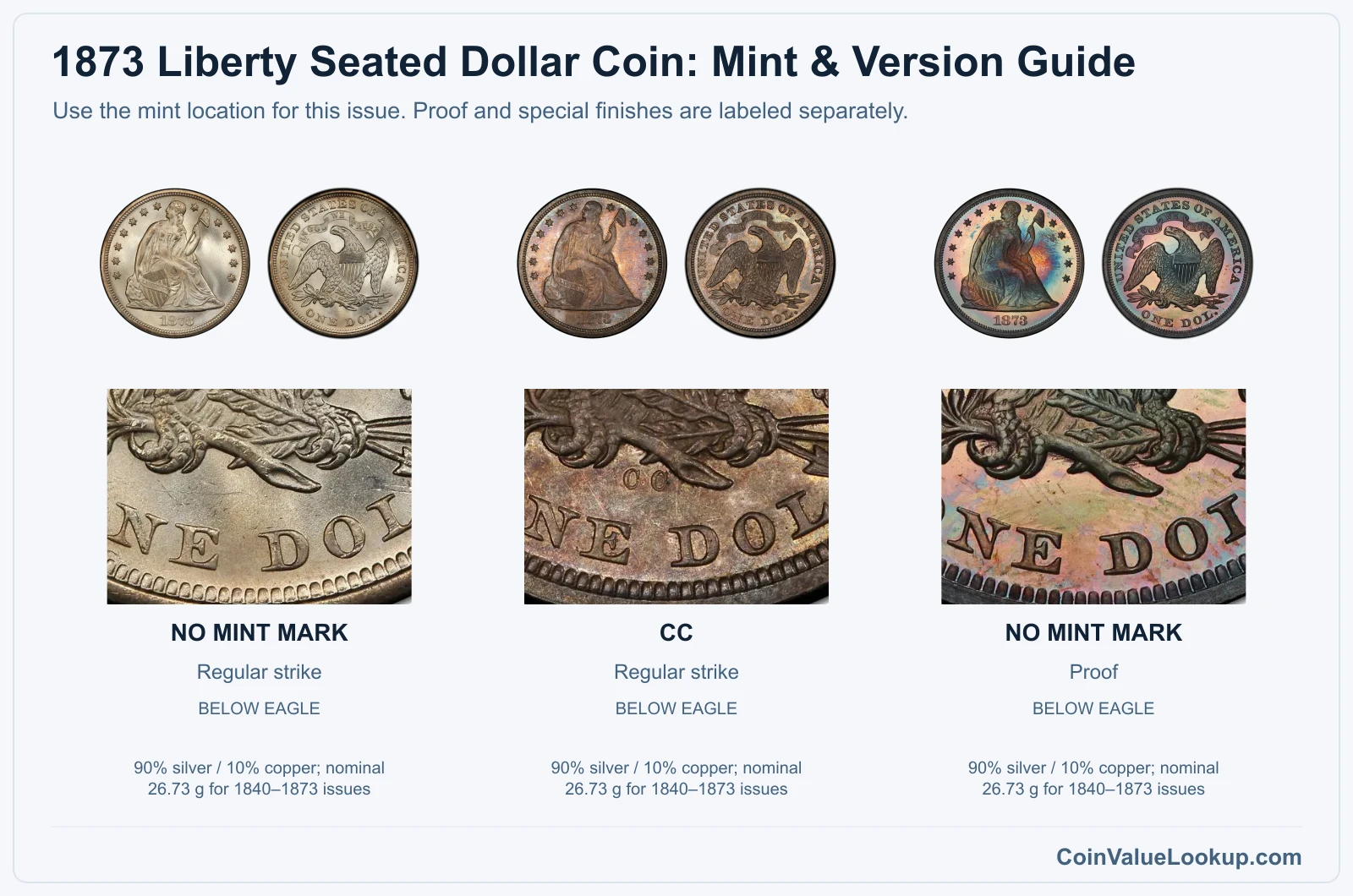
The 1873 Liberty Seated Dollar is the final year of a long-running series, making it a coin that draws serious collector attention. Its value depends on which mint produced it, whether it is a business strike or proof, and its overall condition.
Because this is an unusual late-date issue, each version requires individual assessment based on authenticated identity and grade rather than a simple lookup number.
Fast Way to Identify Your 1873 Liberty Seated Dollar
Upload clear photos of both the front and back of your 1873 Seated Dollar, and our identifier can give you a preliminary read on which version you have. This step helps distinguish the Philadelphia issue from the Carson City mint and from proof strikes.
It is not a substitute for professional authentication, but it points you in the right direction fast.
1873 Liberty Seated Dollar Value
Upload both sides of your 1873 Liberty Seated Dollar.
Front Obverse
Upload photo
Back Reverse
Upload photo
Which 1873 Liberty Seated Dollar Versions Are Worth Money?
- The 1873-CC Seated Dollar was struck at the Carson City Mint, and its low original production makes it one of the key issues collectors pursue in this series.
- The 1873 Seated PR (proof) is a specially manufactured coin with mirrored surfaces, produced in small numbers for collectors at the Philadelphia Mint.
- Confirm mint, finish and condition before assuming premium value; cleaning, polishing or unverified error claims do not justify higher prices.
Step 1: Identify Your 1873 Liberty Seated Dollar Mint Mark and Version
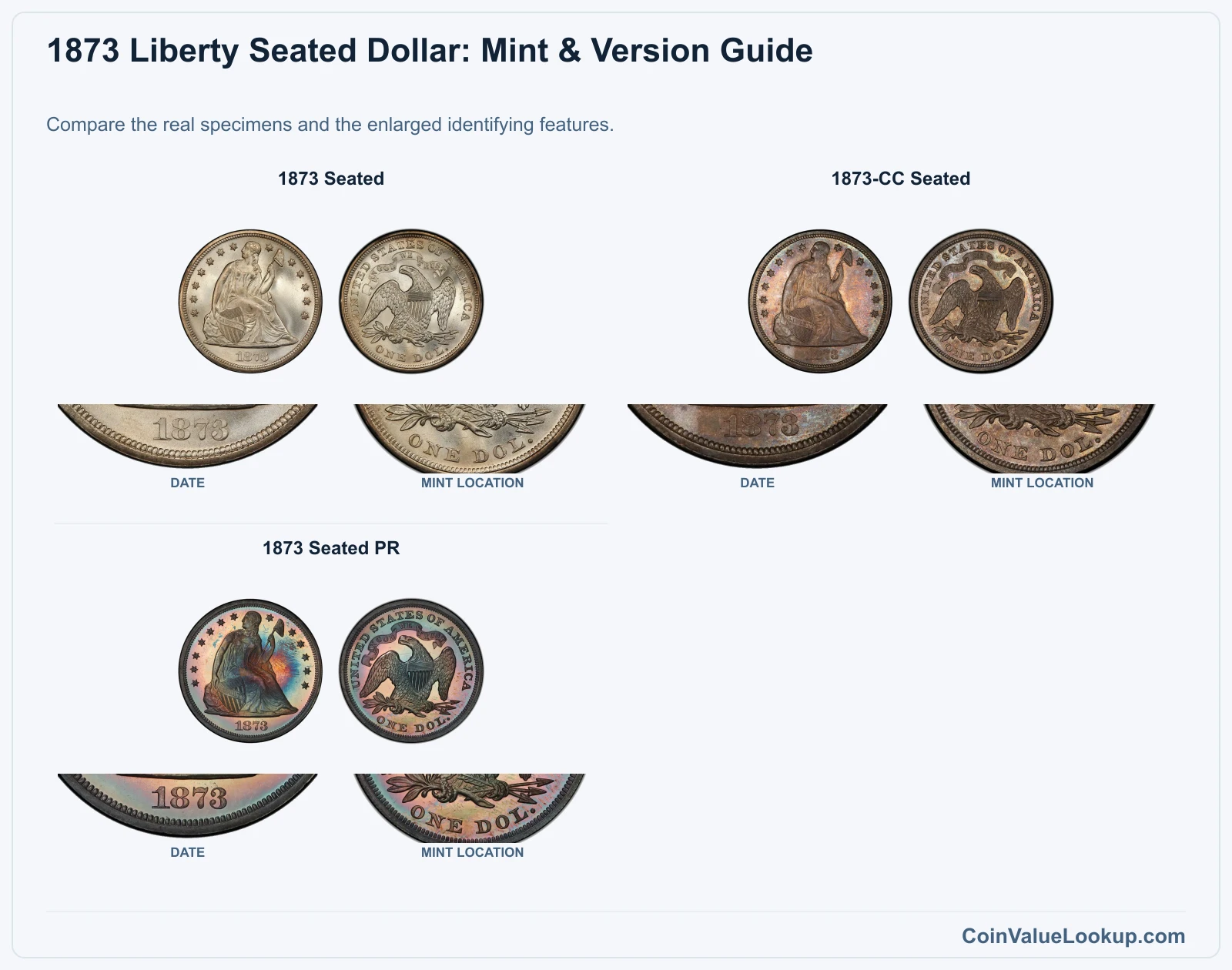
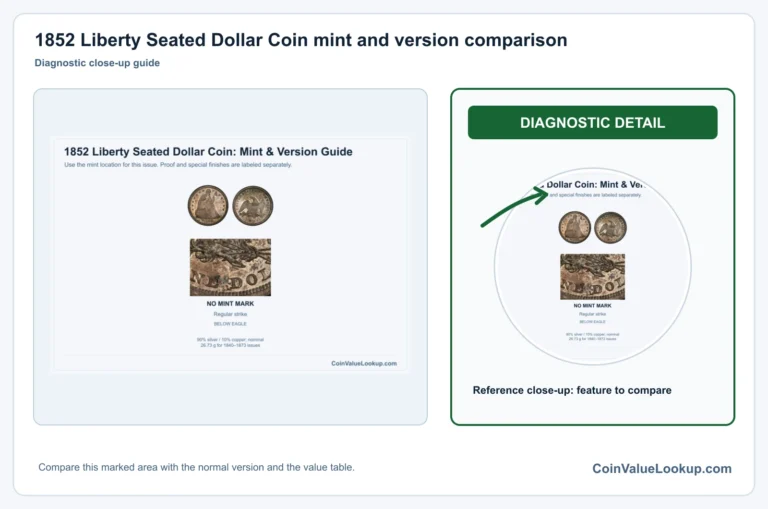
Start by flipping the coin to the reverse. Philadelphia strikes carry no mintmark.
Carson City coins show a small "CC" below the eagle, just above the ONE DOL. inscription.
Both business-strike versions use the Seated Liberty obverse paired with a with-motto eagle reverse.
The coin is 90% silver and 10% copper, with a nominal weight of 26.73 grams for the 1840–1873 design. If your coin feels light or does not respond to a magnet test correctly, it may be plated or counterfeit, and a professional opinion is warranted.
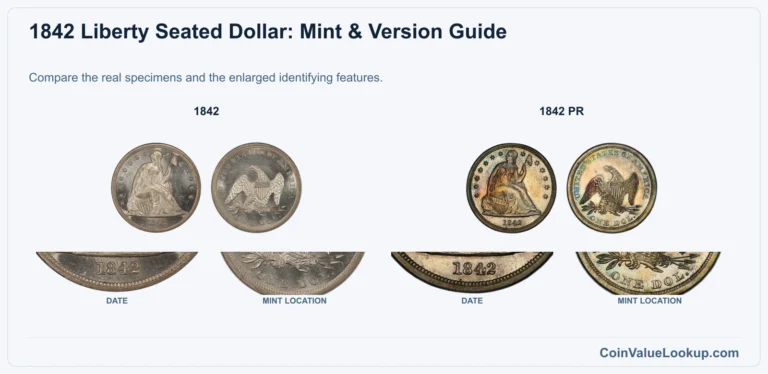
Proofs were struck at Philadelphia only, using specially prepared dies and planchets. A proof is a manufacturing finish, not simply a high-grade coin that looks shiny.
Genuine proofs show squared, mirrored rims and fully reflective fields that differ from a polished business strike. Three branches exist for 1873: the Philadelphia business strike, the Carson City business strike, and the Philadelphia proof.
Step 2: Check Your 1873 Liberty Seated Dollar Grade
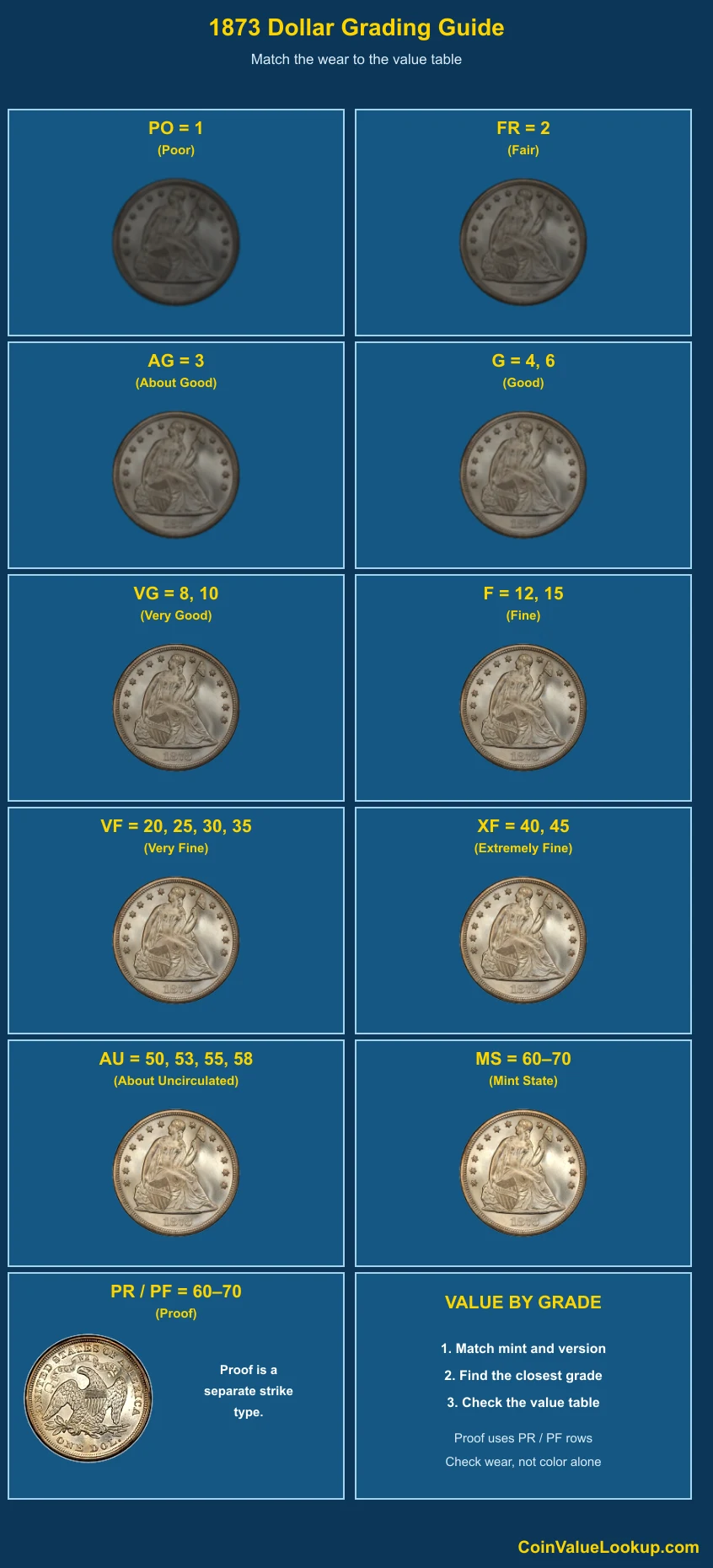
Focus on Liberty's head, breast, knee and the horizontal lines of the shield on the obverse. These are the first areas to lose detail as the coin circulates.
On the reverse, check the eagle's breast feathers and wing tips for wear.
A coin in lower circulated grades will show flatness across Liberty's knee and the eagle's breast, while a piece approaching About Uncirculated retains most detail with only slight friction on the highest points. Mint State coins display full original luster with no wear, though they may still have contact marks from storage or bag handling.
Use the comparison image to match your coin against circulated, AU and Mint State examples of the same type. Do not grade a weakly struck area as wear; some Seated Dollars left the press with soft detail on Liberty's head, particularly on certain die states.
Cleaning, polishing or artificial toning all reduce a coin's desirability and make direct grade comparisons unreliable.
Coin Value Lookup is a good starting point if you want to look up guides for other dates and denominations in the Seated Dollar series or any other U.S. coin type.
Step 3: Check 1873 Liberty Seated Dollar Value by Mint and Version
1873 Liberty Seated Dollar — Seated
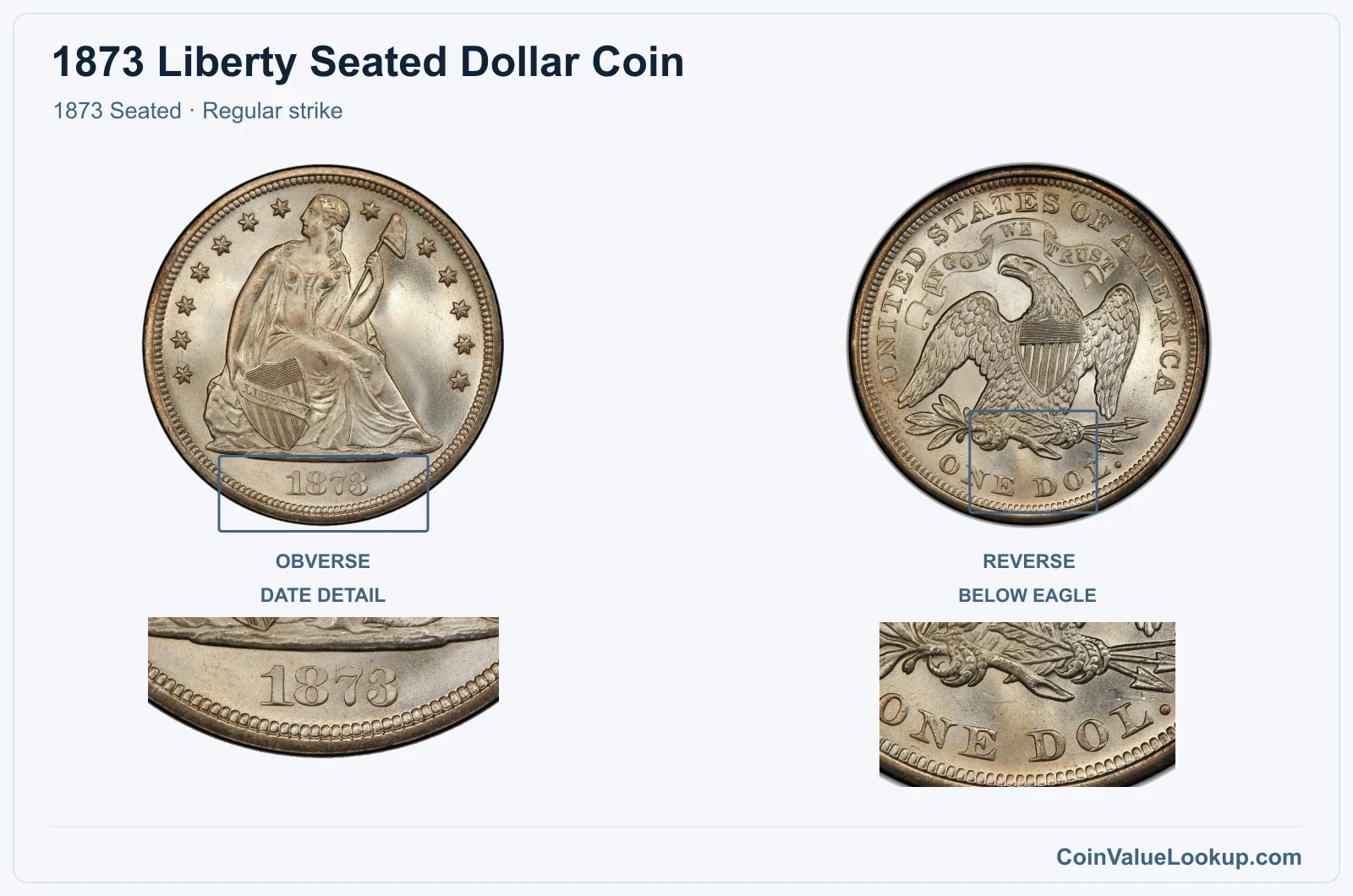
The 1873 Philadelphia business strike carries no mintmark. Look for the Seated Liberty obverse with the with-motto eagle reverse.
This coin is 90% silver, 10% copper, weighing about 26.73 grams.
Because this is the final year of the series, Philadelphia examples attract collectors building complete date sets. Value depends entirely on authenticated identity and condition.
Original surfaces matter; a coin that has been polished or cleaned loses much of its appeal and trades differently from one with natural toning or luster. Have the coin professionally graded before drawing conclusions about its worth.
Range Grade
Price Auction Records Appraisal PO PO 1
—
Coin Identifier FR FR 2
—
Coin Identifier AG AG 3
—
Coin Identifier G G 4
Coin Identifier
G 6
Coin Identifier VG VG 8
—
Coin Identifier
VG 10
—
Coin Identifier F F 12
Coin Identifier
F 15
Coin Identifier VF VF 20
Coin Identifier
VF 25
Coin Identifier
VF 30
Coin Identifier
VF 35
Coin Identifier XF XF 40
Coin Identifier
XF 45
Coin Identifier AU AU 50
Coin Identifier
AU 53
Coin Identifier
AU 55
Coin Identifier
AU 58
Coin Identifier MS MS 60
—
Coin Identifier
MS 61
Coin Identifier
MS 62
Coin Identifier
MS 63
Coin Identifier
MS 64
Coin Identifier
MS 65
Coin Identifier
MS 66
Coin Identifier
MS 67
—
—
—
MS 68
—
—
—
MS 69
—
—
—
MS 70
—
—
—
1873 Liberty Seated Dollar — CC Seated
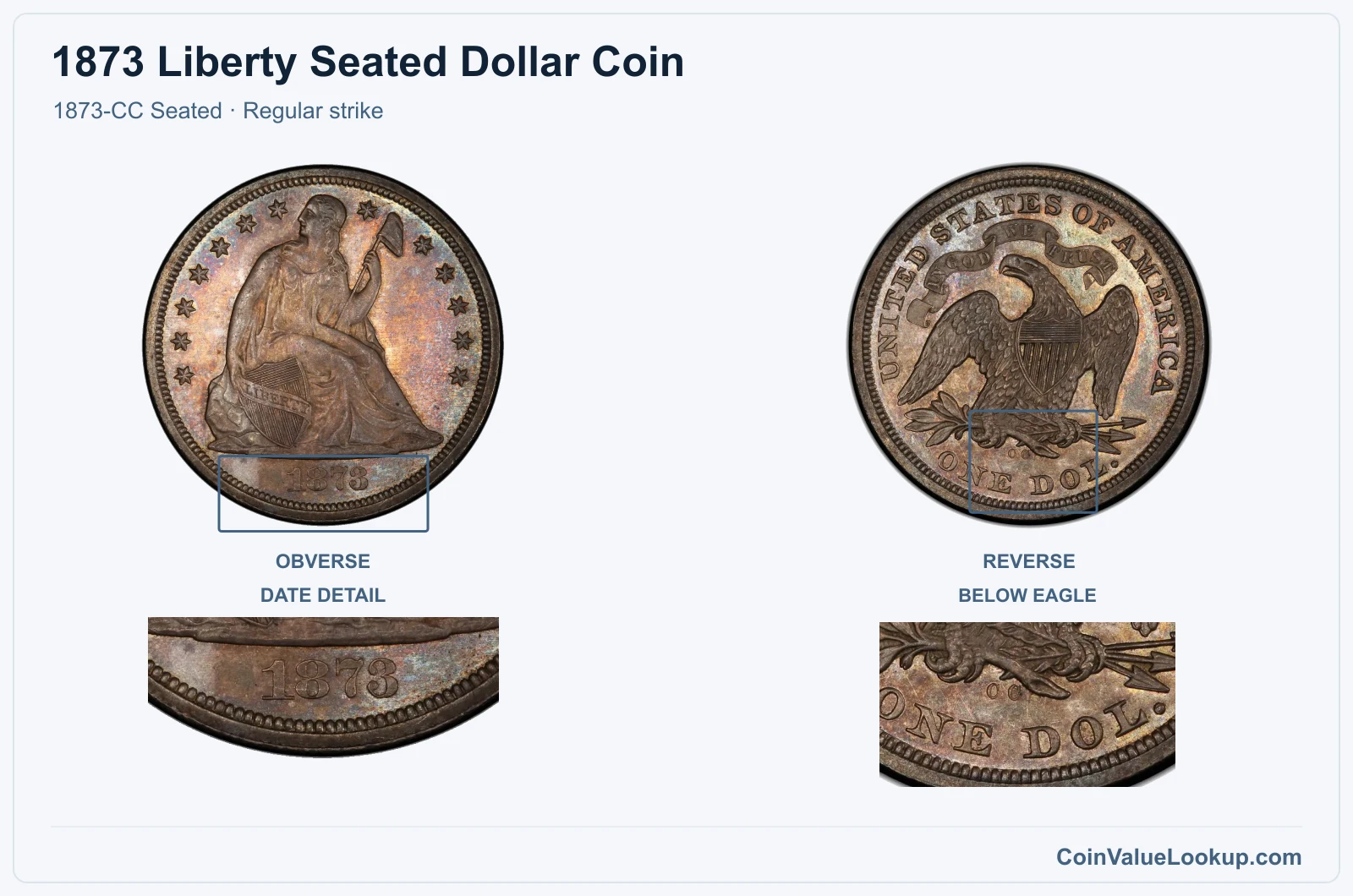
The 1873-CC was produced at the Carson City Mint, and you will find a small "CC" mintmark on the reverse below the eagle, above ONE DOL. It shares the same 90% silver composition and with-motto design as the Philadelphia issue.
Carson City dollars carry a strong collector following because of the mint's relatively short operational history and typically lower production numbers. The 1873-CC is no exception.
Condition is critical here; even well-worn examples command attention, but original surfaces with no signs of cleaning or damage are what serious buyers look for. An authenticated example in any grade deserves individual assessment by a reputable grading service, since the spread between cleaned and original coins is significant.
Range Grade
Price Auction Records Appraisal PO PO 1
—
Coin Identifier FR FR 2
—
Coin Identifier AG AG 3
Coin Identifier G G 4
—
Coin Identifier
G 6
Coin Identifier VG VG 8
—
Coin Identifier
VG 10
Coin Identifier F F 12
Coin Identifier
F 15
Coin Identifier VF VF 20
Coin Identifier
VF 25
Coin Identifier
VF 30
Coin Identifier
VF 35
Coin Identifier XF XF 40
Coin Identifier
XF 45
Coin Identifier AU AU 50
Coin Identifier
AU 53
Coin Identifier
AU 55
Coin Identifier
AU 58
Coin Identifier MS MS 60
Coin Identifier
MS 61
Coin Identifier
MS 62
—
Coin Identifier
MS 63
—
Coin Identifier
MS 64
—
Coin Identifier
MS 65
—
Coin Identifier
MS 66
—
—
—
MS 67
—
—
—
MS 68
—
—
—
MS 69
—
—
—
MS 70
—
—
—
1873 Liberty Seated Dollar — Seated PR
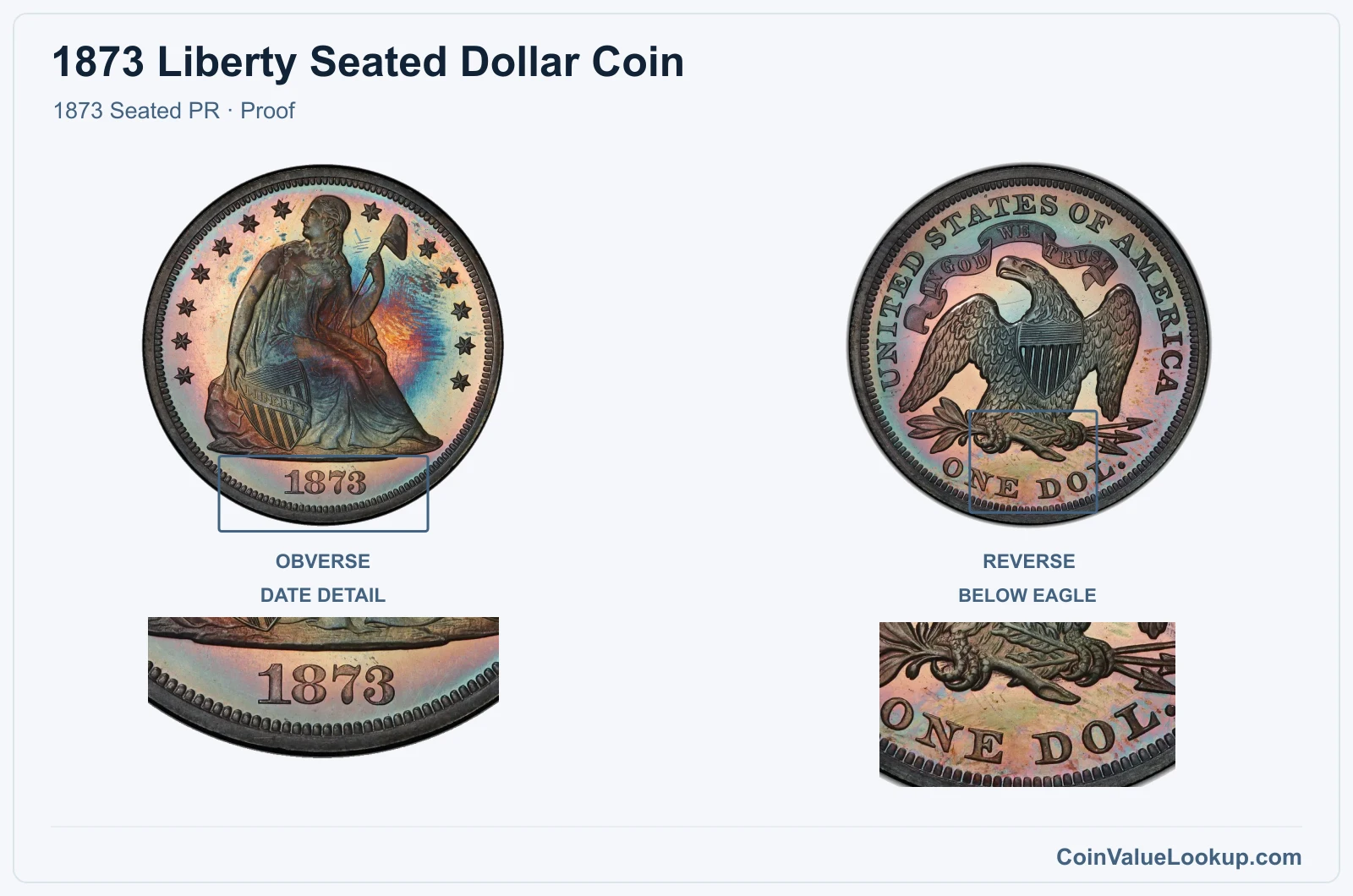
The 1873 Seated PR is a proof strike from the Philadelphia Mint, made with polished dies on specially prepared planchets. Genuine proofs display deeply mirrored fields, sharp squared rims and full design detail that business strikes rarely match.
Do not confuse a polished or lightly circulated business strike with a proof. The difference is in how the coin was manufactured, not simply how shiny it appears today.
Proof Seated Dollars from 1873 were produced in very limited quantities for collectors of the era. Because no supported numeric range is available here, the value of any individual proof depends on its authenticated finish, surface preservation and eye appeal.
Professional certification is essential for this version.
Range Grade
Price Auction Records Appraisal PR PR 1
—
Coin Identifier
PR 2
—
Coin Identifier
PR 3
—
Coin Identifier
PR 4
—
Coin Identifier
PR 6
—
Coin Identifier
PR 8
—
Coin Identifier
PR 10
—
Coin Identifier
PR 12
—
Coin Identifier
PR 15
—
Coin Identifier
PR 20
—
Coin Identifier
PR 25
—
Coin Identifier
PR 30
—
Coin Identifier
PR 35
—
Coin Identifier
PR 40
—
Coin Identifier
PR 45
—
Coin Identifier
PR 50
—
Coin Identifier
PR 53
Coin Identifier
PR 55
Coin Identifier
PR 58
Coin Identifier
PR 60
Coin Identifier
PR 61
Coin Identifier
PR 62
Coin Identifier
PR 63
Coin Identifier
PR 64
Coin Identifier
PR 65
Coin Identifier
PR 66
Coin Identifier
PR 67
—
—
—
PR 68
—
—
—
PR 69
—
—
—
PR 70
—
—
—