1873 Shield Nickel Coin Value: How Much Is It Worth?
A circulated 1873 Shield nickel in Good-4 condition carries a USA Coin Book retail estimate around $38 to $43, depending on the date style. Uncirculated pieces climb much higher, with an MS63 Closed 3 listed near $929.
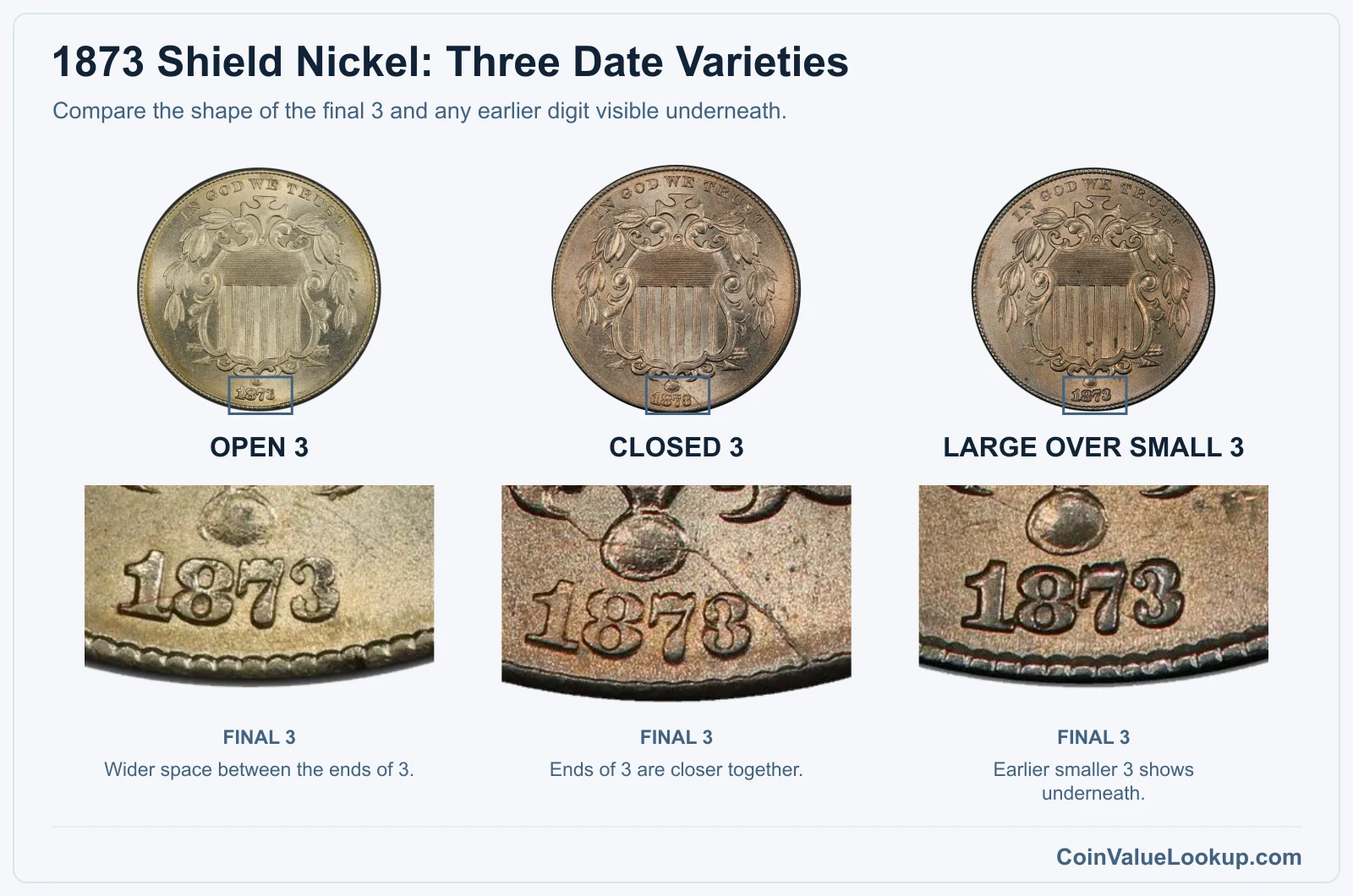
Before you look up any price, though, you need to figure out whether your coin has an Open 3 or a Closed 3 — they are priced separately.
Fast Way to Identify Your 1873 Shield Nickel
Snap a clear photo of both sides of your 1873 Shield nickel and upload them here. A close-up of the date is especially helpful because the shape of the final digit determines which variety you have.
Our identifier can offer a preliminary read on the date style and overall condition from your images alone.
1873 Shield Nickel Value
Upload both sides of your 1873 Shield Nickel.
Front Obverse
Upload photo
Back Reverse
Upload photo
Which 1873 Shield Nickel Versions Are Worth Money?
- Check the final digit first: Open 3 and Closed 3 business strikes carry different guide values across every grade.
- The Large over Small 3 is a recognized repunched-date variety that collectors pursue independently — look for remnants of a smaller punch around the final digit.
- Closed 3 proofs in PR63 list around $468 per the USA Coin Book guide and are the only regular proof branch for this date.
- Several mint-error categories are reported for 1873 Shield nickels, including doubled die obverse, off-center strikes and wrong-planchet examples — each can add meaningful value depending on severity and condition.
Step 1: Identify Your 1873 Shield Nickel Mint Mark and Version
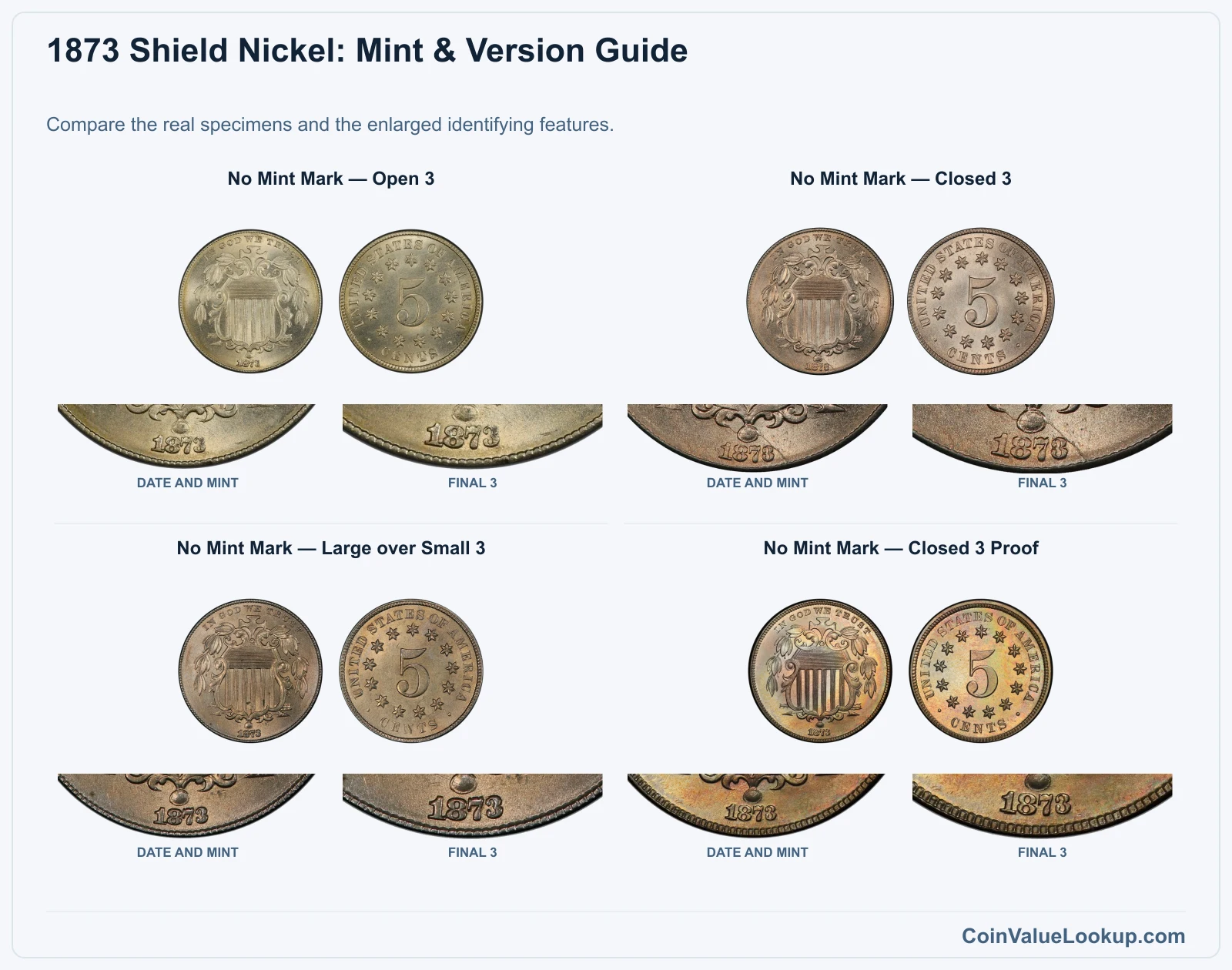
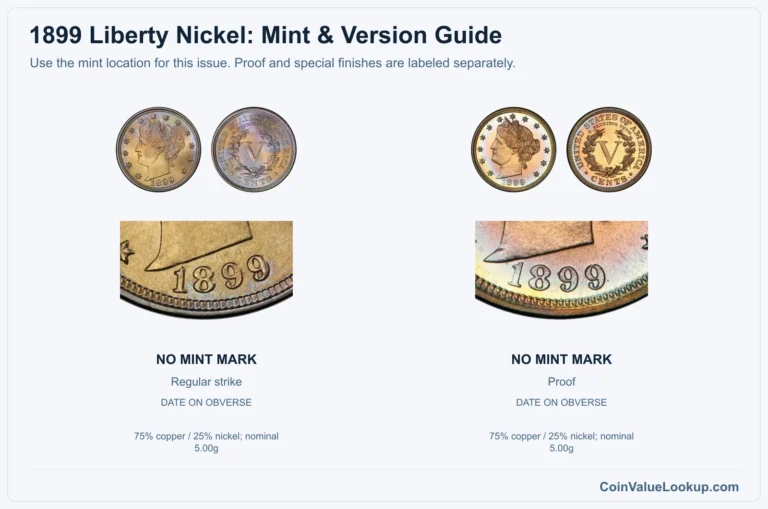
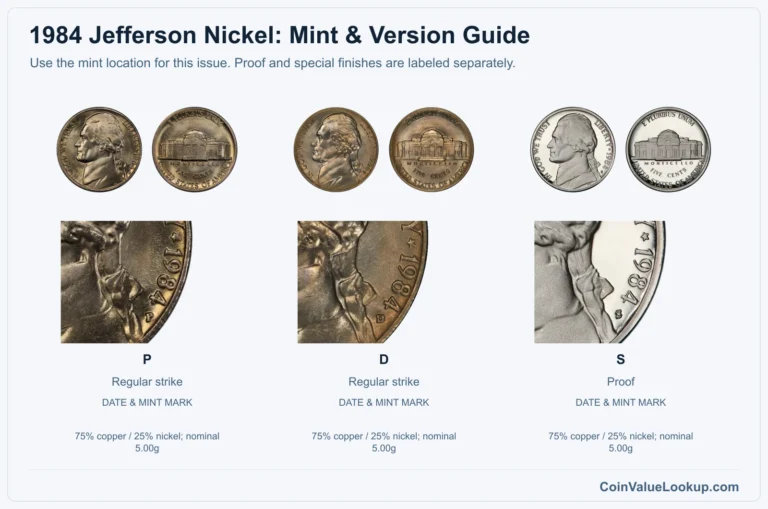
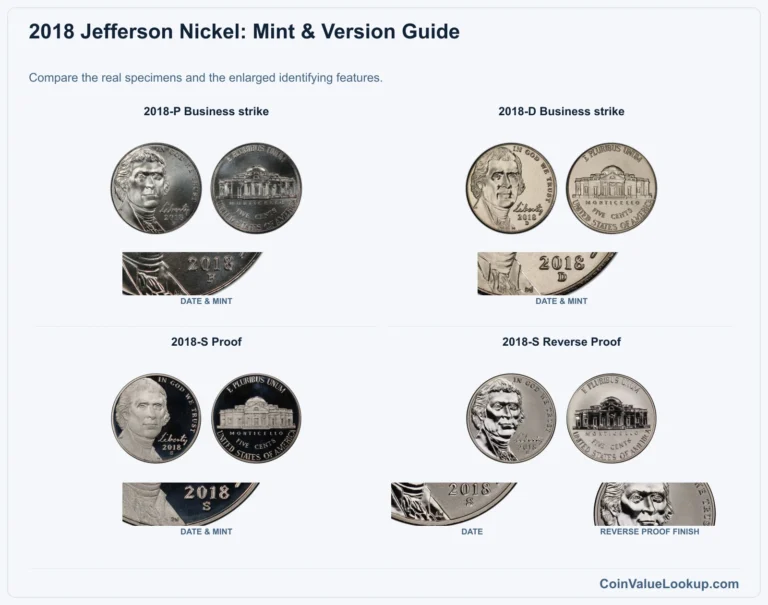
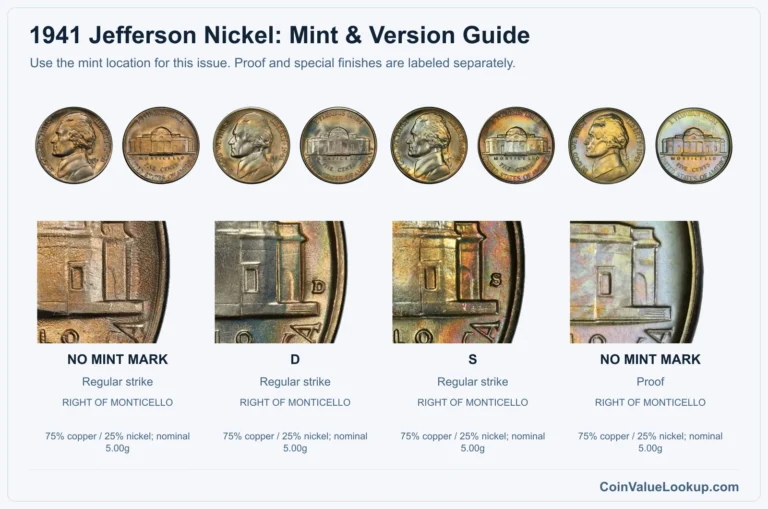
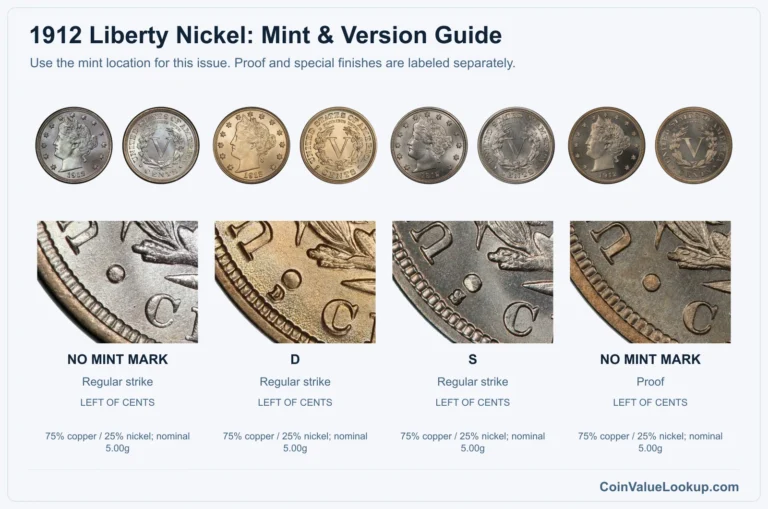
Every 1873 Shield nickel was struck in Philadelphia. There is no mintmark, and a missing letter beneath the wreath is completely normal — not an error.
The coin is 75% copper and 25% nickel, weighs about 5 grams, and measures 20.5 mm with a plain edge. The obverse shows a Union shield; the reverse displays a large numeral 5 surrounded by stars.
No silver version exists for this date.
Your first job is the date. Grab a loupe and look at the final digit.
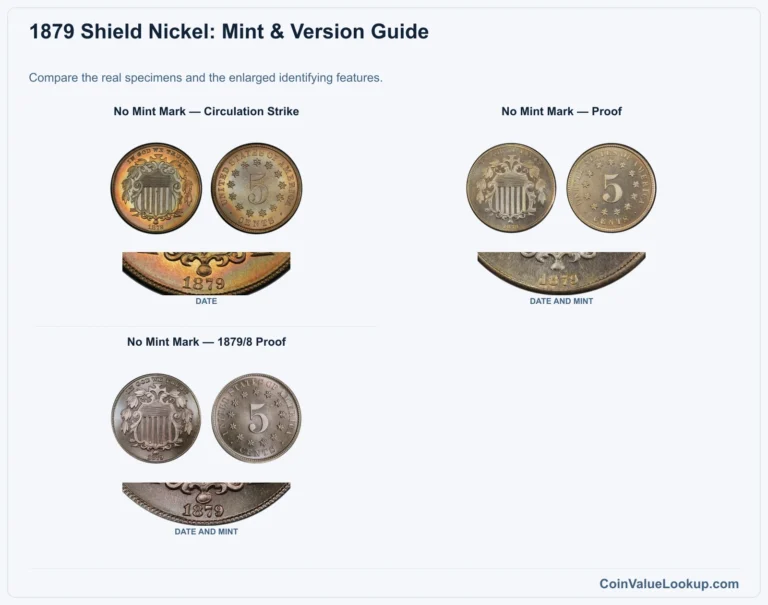
On an Open 3, the upper and lower tips of the 3 have clear daylight between them. On a Closed 3, those tips nearly touch — and on a worn coin the digit can look almost like an 8.
There is also a recognized Large over Small 3 variety where remnants of an earlier, smaller date punch are visible around the final digit. That is a separate collectible variety, not just a different style.
Regular proof coins use the Closed 3 date only.
Get the date style right first, then assess condition. And never clean the coin — even a gentle wipe can cut its value in half.
Step 2: Check Your 1873 Shield Nickel Grade
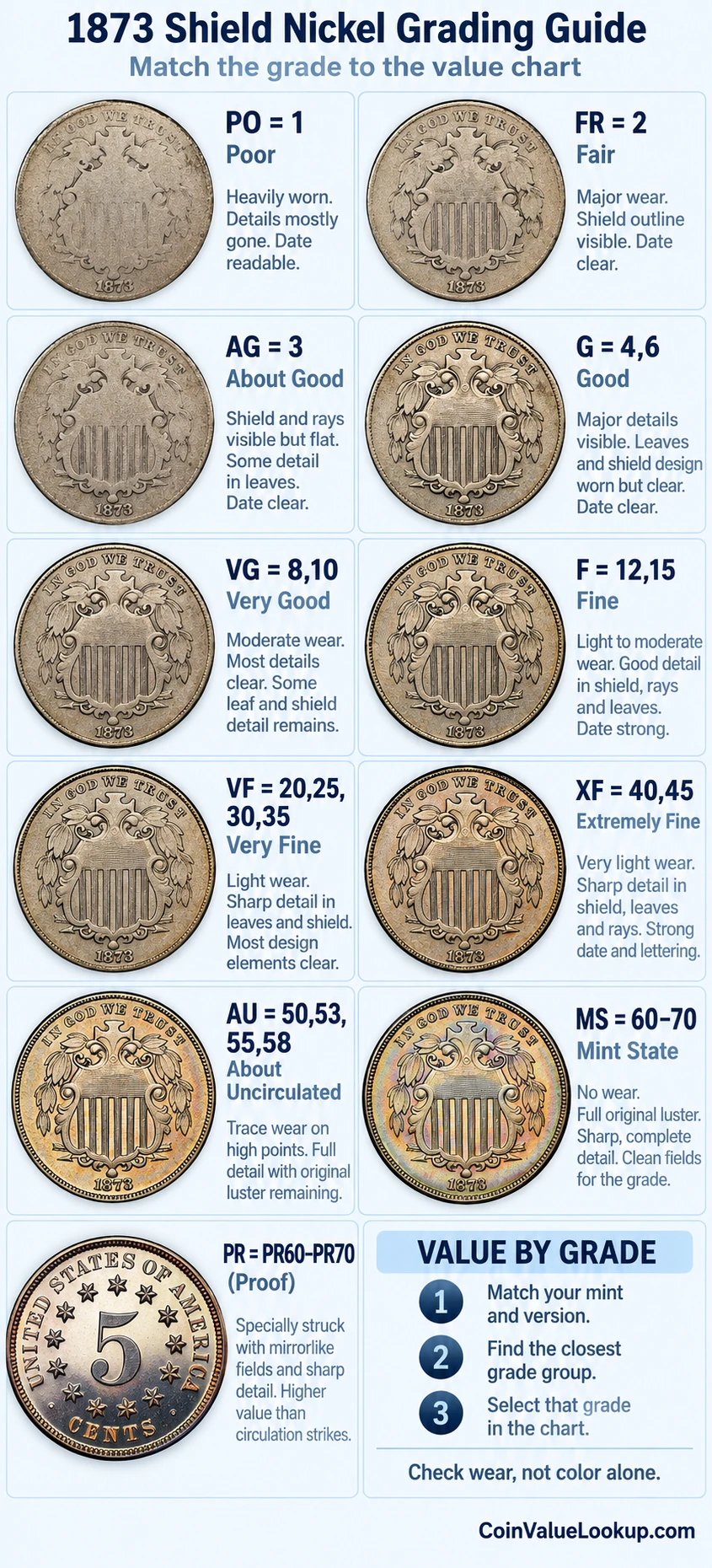
Start on the obverse. The horizontal and vertical lines inside the shield are the first features to wear down.
In lower grades the horizontal lines merge into the vertical ones, eventually disappearing. Check the cross at the top and the leaves flanking the shield for the same kind of smoothing.
Here is the tricky part: Shield nickels were sometimes weakly struck from the factory. A coin can have fuzzy shield lines with full original luster, meaning it left Philadelphia that way.
Compare both sides — if the reverse stars and numeral are equally soft but the surfaces are bright and undisturbed, you are probably looking at a strike issue, not wear.
Use the comparison image to match your coin's detail level against known grade benchmarks. Separate problem-free coins from those with cleaning, corrosion or rim damage, because guide estimates assume original surfaces.
Step 3: Check 1873 Shield Nickel Value by Mint and Version
1873 Shield Nickel — No Mint Mark — Open 3
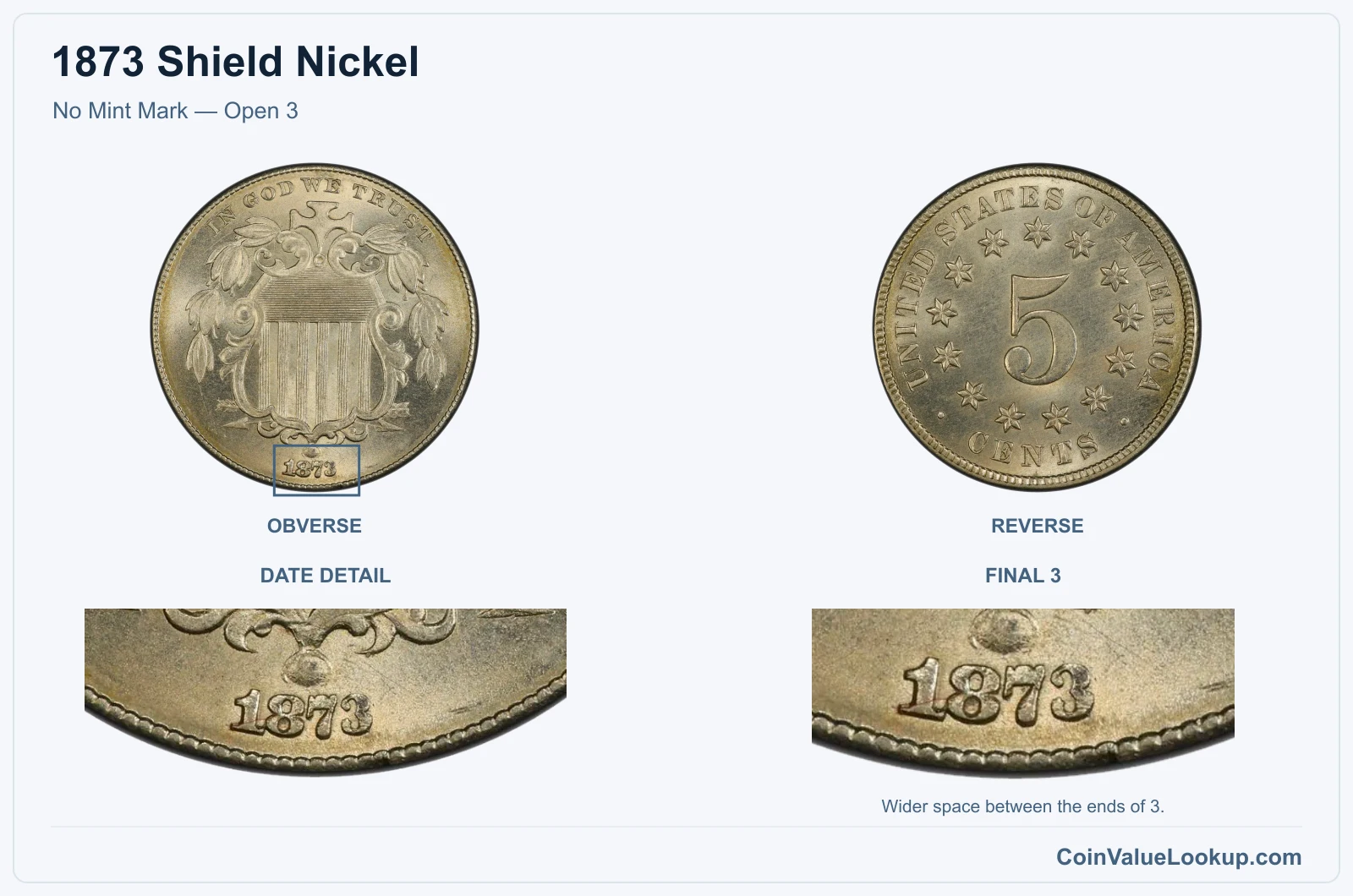
On the Open 3 business strike, the two tips of the final digit have visible separation — they do not curl toward each other. You need a close-up of the date to confirm this; at arm's length both styles look similar.
USA Coin Book lists the Open 3 at about $43 in G4 and around $376 in MS63. Those are retail guide estimates, not guaranteed sale prices.
Still, an honest MS63 example with original surfaces is a solid coin.
Wear shows first on the shield's horizontal lines and the cross. If you can see most shield detail but the highest lines are starting to blend, you are likely in the VF range.
Range Grade
Price Auction Records Appraisal PO PO 1
—
Coin Identifier FR FR 2
—
Coin Identifier AG AG 3
—
Coin Identifier G G 4
—
Coin Identifier
G 6
—
Coin Identifier VG VG 8
—
Coin Identifier
VG 10
—
Coin Identifier F F 12
—
Coin Identifier
F 15
—
Coin Identifier VF VF 20
—
Coin Identifier
VF 25
Coin Identifier
VF 30
Coin Identifier
VF 35
—
Coin Identifier XF XF 40
Coin Identifier
XF 45
Coin Identifier AU AU 50
Coin Identifier
AU 53
Coin Identifier
AU 55
Coin Identifier
AU 58
Coin Identifier MS MS 60
—
Coin Identifier
MS 61
Coin Identifier
MS 62
Coin Identifier
MS 63
Coin Identifier
MS 64
Coin Identifier
MS 65
Coin Identifier
MS 66
Coin Identifier
MS 67
Coin Identifier
MS 68
—
—
—
MS 69
—
—
—
MS 70
—
—
—
1873 Shield Nickel — No Mint Mark — Closed 3
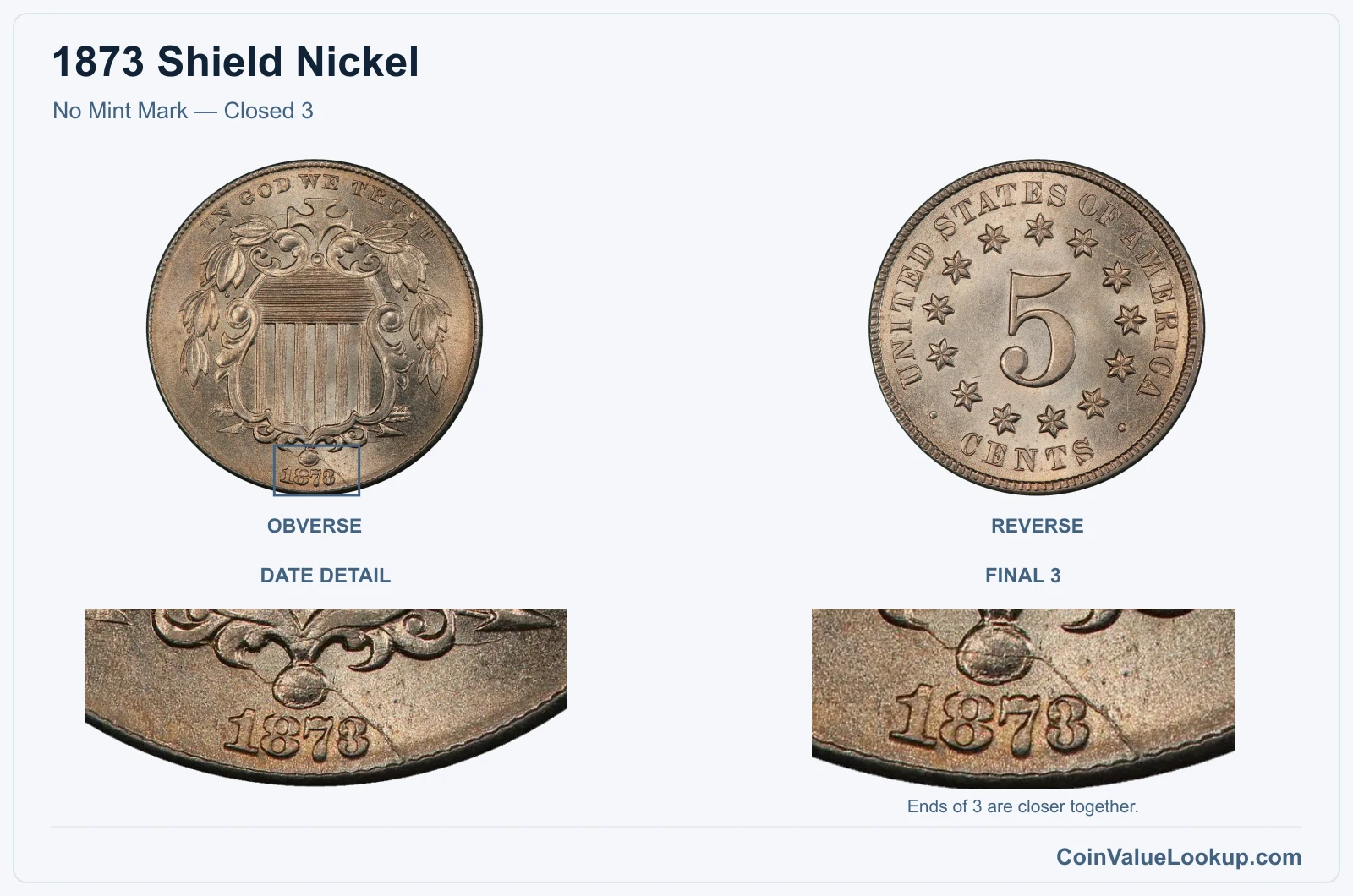
The Closed 3 business strike has the tips of the final 3 nearly meeting, giving the digit a rounder, tighter look. On heavily worn examples the 3 can genuinely resemble an 8, so compare it with reference images before deciding.
Guide values from USA Coin Book place this version at roughly $38 in G4 and approximately $929 in MS63. That MS63 figure is noticeably higher than the Open 3, which tells you the Closed 3 in high grade is the tougher find among business strikes.
Coin Value Lookup is a good starting point if you want to compare this date against other Shield nickel years or look up related denominations.
Range Grade
Price Auction Records Appraisal PO PO 1
—
Coin Identifier FR FR 2
—
Coin Identifier AG AG 3
—
Coin Identifier G G 4
—
Coin Identifier
G 6
—
Coin Identifier VG VG 8
—
Coin Identifier
VG 10
—
Coin Identifier F F 12
—
Coin Identifier
F 15
—
Coin Identifier VF VF 20
—
Coin Identifier
VF 25
Coin Identifier
VF 30
—
Coin Identifier
VF 35
—
Coin Identifier XF XF 40
Coin Identifier
XF 45
Coin Identifier AU AU 50
Coin Identifier
AU 53
Coin Identifier
AU 55
Coin Identifier
AU 58
Coin Identifier MS MS 60
—
Coin Identifier
MS 61
Coin Identifier
MS 62
Coin Identifier
MS 63
Coin Identifier
MS 64
Coin Identifier
MS 65
Coin Identifier
MS 66
Coin Identifier
MS 67
—
—
—
MS 68
—
—
—
MS 69
—
—
—
MS 70
—
—
—
1873 Shield Nickel — No Mint Mark — Large over Small 3
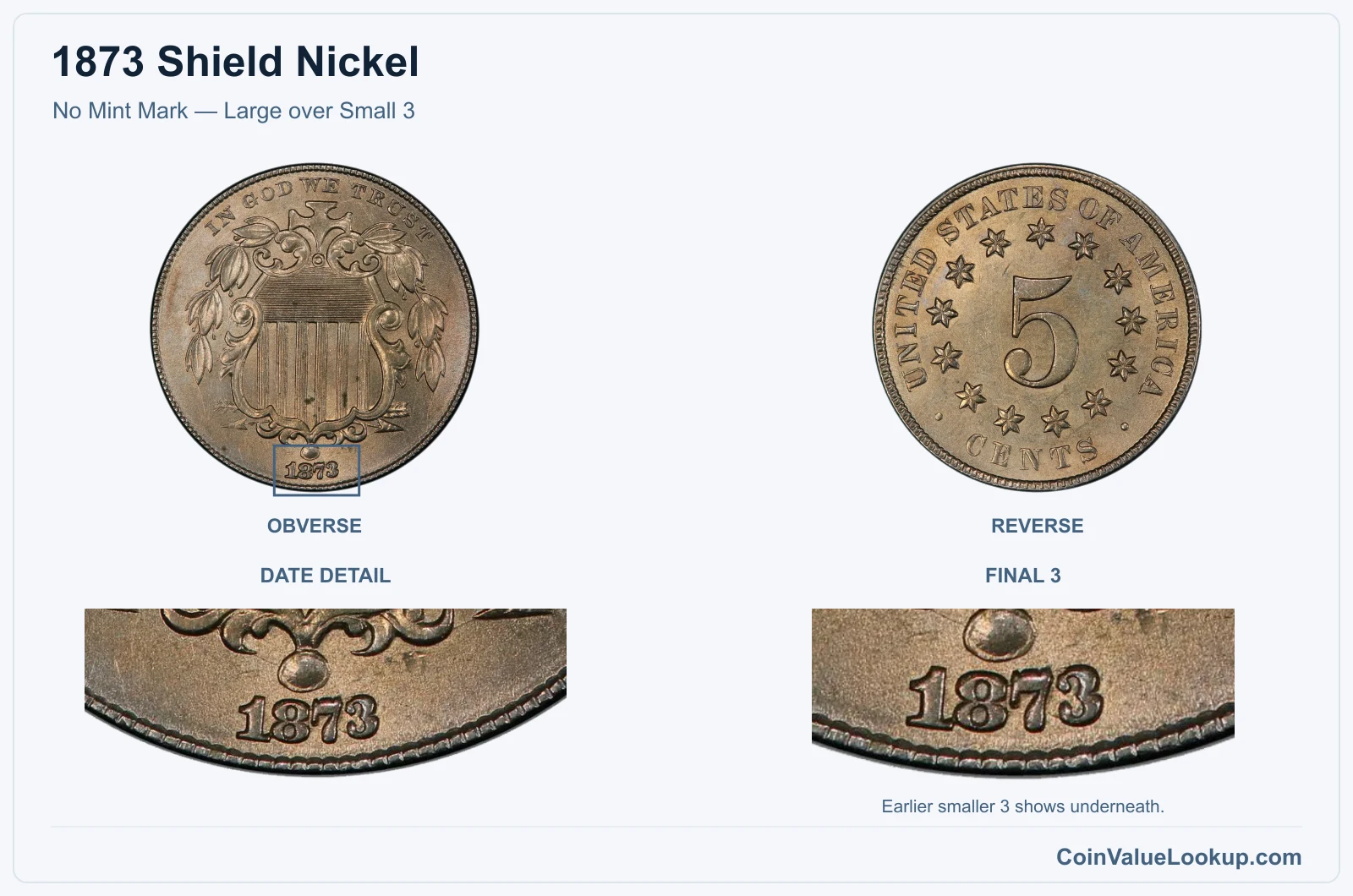
This is a recognized repunched-date variety where a larger date punch replaced a smaller one, leaving traces of the original smaller 3 visible around the final digit. Look under magnification for ghosting or a secondary outline near the curves of the 3.
PCGS recognizes the Large over Small 3 separately from ordinary Open and Closed 3 coins. Because it is a distinct collectible variety, its value depends on how clearly the remnants show, the coin's overall condition, and whether it has been authenticated by a grading service.
No specific retail price range is adopted here. Individual pieces trade based on visibility of the under-punch and the coin's grade, so professional evaluation matters more than a generic lookup.
Range Grade
Price Auction Records Appraisal PO PO 1
—
Coin Identifier FR FR 2
—
Coin Identifier AG AG 3
—
Coin Identifier G G 4
—
Coin Identifier
G 6
—
Coin Identifier VG VG 8
—
Coin Identifier
VG 10
—
Coin Identifier F F 12
—
Coin Identifier
F 15
—
Coin Identifier VF VF 20
—
Coin Identifier
VF 25
—
Coin Identifier
VF 30
—
Coin Identifier
VF 35
—
Coin Identifier XF XF 40
—
Coin Identifier
XF 45
Coin Identifier AU AU 50
—
Coin Identifier
AU 53
Coin Identifier
AU 55
—
Coin Identifier
AU 58
—
Coin Identifier MS MS 60
—
Coin Identifier
MS 61
—
Coin Identifier
MS 62
—
Coin Identifier
MS 63
—
Coin Identifier
MS 64
—
Coin Identifier
MS 65
—
Coin Identifier
MS 66
—
—
—
MS 67
—
—
—
MS 68
—
—
—
MS 69
—
—
—
MS 70
—
—
—
1873 Shield Nickel — No Mint Mark — Closed 3 Proof
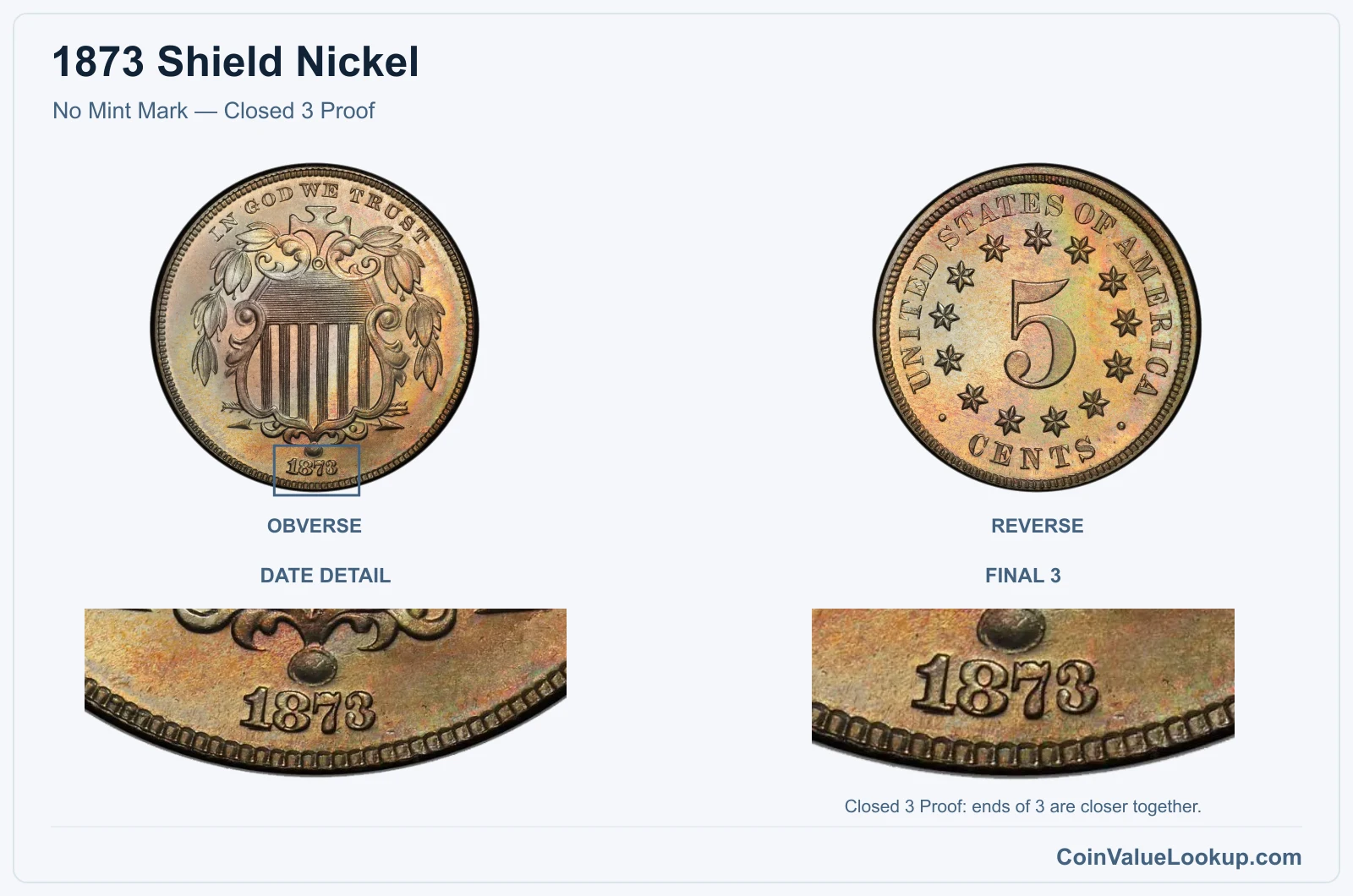
Regular proof 1873 Shield nickels use the Closed 3 date exclusively. Proofs were struck with polished dies on prepared planchets, so the fields should appear mirror-like under direct light and the design details should be sharply defined.
USA Coin Book lists the PR63 at about $468. Remember that proof is a method of manufacture, not a grade above Mint State — a proof can still have hairlines, haze or toning that lower its technical grade.
Look for squared-up rims and fully struck shield lines. If your coin has deep mirrors and sharp detail but shows fine hairlines, it may grade below PR63.
Avoid cleaning it; originality matters to buyers.
Range Grade
Price Auction Records Appraisal PR PR 1
—
Coin Identifier
PR 2
—
Coin Identifier
PR 3
—
Coin Identifier
PR 4
—
Coin Identifier
PR 6
—
Coin Identifier
PR 8
—
Coin Identifier
PR 10
—
Coin Identifier
PR 12
—
Coin Identifier
PR 15
—
Coin Identifier
PR 20
—
Coin Identifier
PR 25
—
Coin Identifier
PR 30
—
Coin Identifier
PR 35
—
Coin Identifier
PR 40
—
Coin Identifier
PR 45
—
Coin Identifier
PR 50
—
Coin Identifier
PR 53
—
Coin Identifier
PR 55
—
Coin Identifier
PR 58
Coin Identifier
PR 60
—
Coin Identifier
PR 61
Coin Identifier
PR 62
Coin Identifier
PR 63
Coin Identifier
PR 64
Coin Identifier
PR 65
Coin Identifier
PR 66
Coin Identifier
PR 67
Coin Identifier
PR 68
—
—
—
PR 69
—
—
—
PR 70
—
—
—
1873 Shield Nickel Error List
1. 1873 Shield Nickel — Doubled Die Obverse
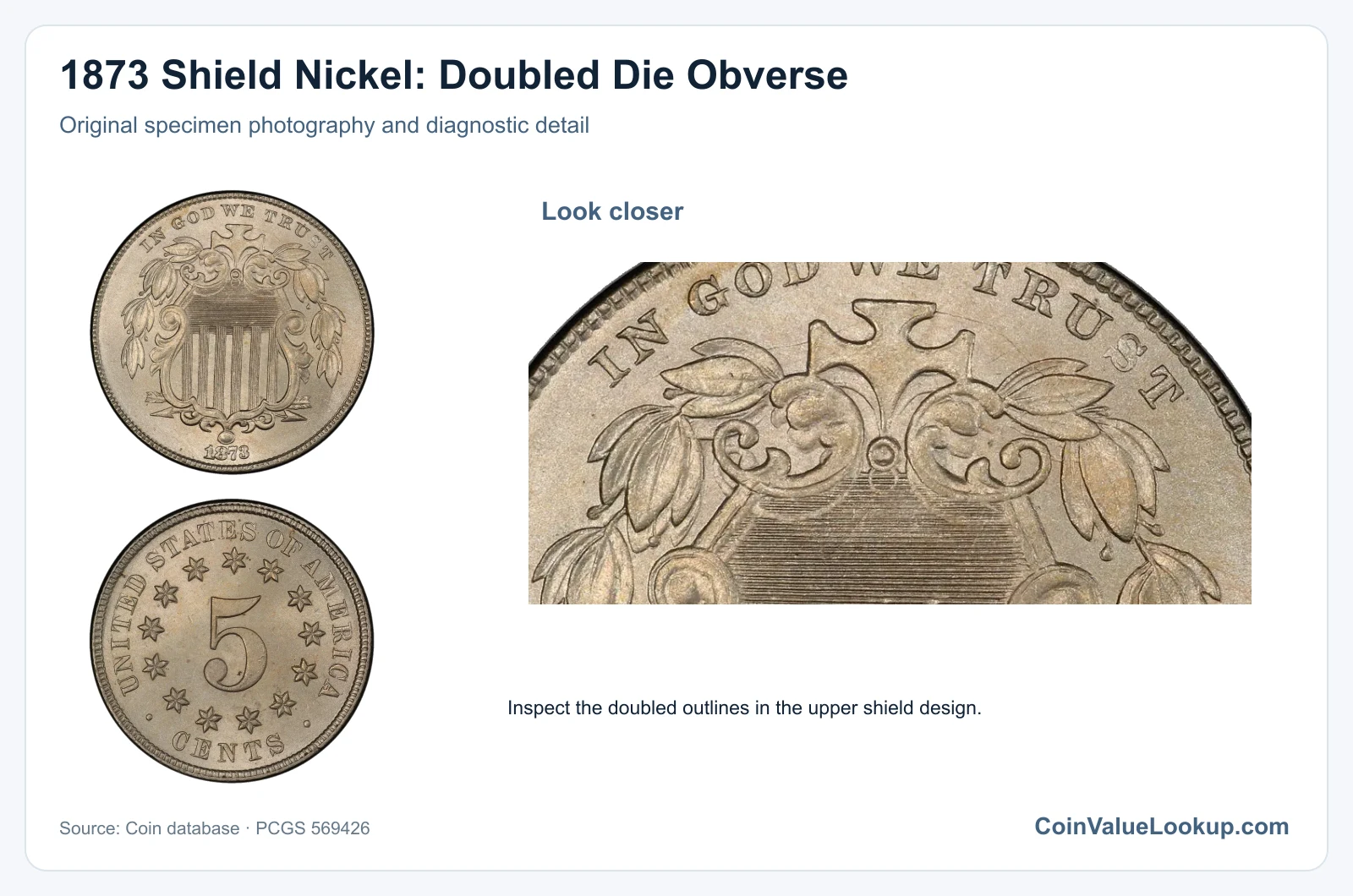
A doubled die obverse on the 1873 Shield nickel shows consistent doubling on obverse design elements — letters, the shield or the date — that repeats in the same direction across affected features. Under magnification, look for separation or notching on the edges of raised details rather than a flat, shelf-like distortion.
The key distinction is consistency. True hub doubling affects multiple design elements uniformly, while machine doubling tends to produce flat, shelf-like displacement in one direction, often varying across the coin.
Reflections and worn die contours can also mimic doubling at first glance.
No specific price data is adopted for this category. Value depends on which die pair is involved, how visible the doubling is, and the coin's overall grade.
Professional authentication is worthwhile if the doubling is clear and repeatable.
2. 1873 Shield Nickel — Repunched Date
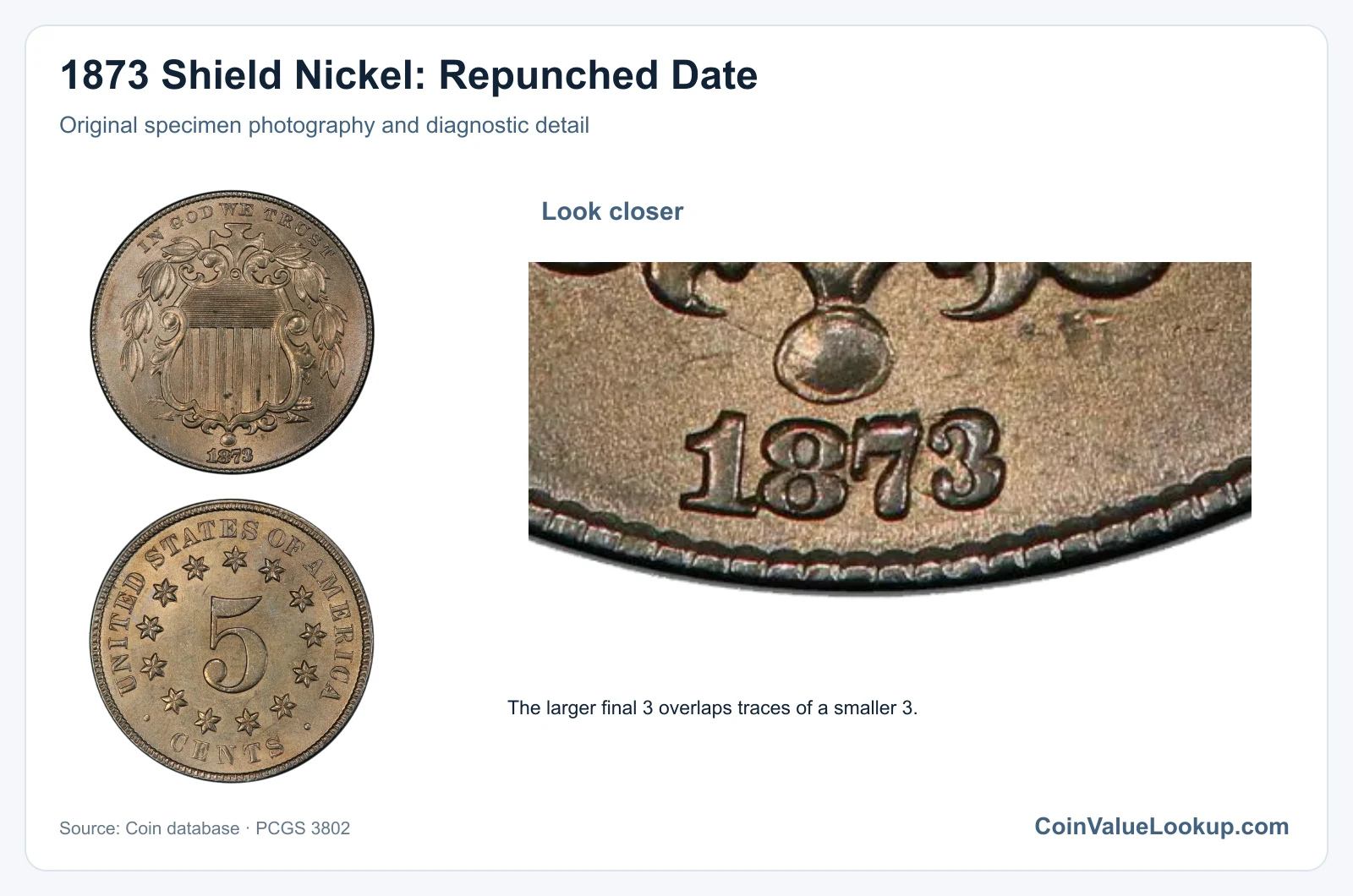
A repunched date on an 1873 Shield nickel shows remnants of an earlier position of one or more date numerals beside or overlapping the final digits. The effect differs from a doubled die because only the hand-punched date is affected, not the entire obverse design.
Look under magnification at the bases, curves and serifs of each numeral. You may see a ghost outline offset slightly from the final position.
Compare your coin against a normal date image at the same angle to spot the discrepancy.
Don't confuse a repunched date with a damaged date caused by a hit or gouge, or with machine doubling that creates a flat shelf on one side of the digits. No adopted price range exists here; value hinges on the clarity of the secondary punch, the coin's condition, and independent verification.
3. 1873 Shield Nickel — Die Crack / Die Chip
Die cracks appear as thin raised lines on the coin's surface, created when the steel die developed a fracture during use. On an 1873 Shield nickel, these lines often run from the rim inward through lettering or design elements.
A die chip is a small raised blob where a tiny piece of the die face broke away.
To identify one, tilt the coin under a single light source. Raised lines that cross design elements without interruption — and that feel slightly elevated with a fingernail — are likely die cracks.
Incuse scratches, corrosion tracks or foreign material stuck to the surface sit below or on the surface, not above it.
No numerical price range is adopted. A dramatic crack or a chip in a prominent location on a higher-grade coin draws more collector interest than a faint hairline crack on a well-worn piece.
4. 1873 Shield Nickel — Die Break / Cud
A cud is a raised, featureless lump connected to the rim where a section of the die broke away entirely. On an 1873 Shield nickel, a cud will obliterate part of the design near the rim and replace it with a smooth, blob-like area.
Look at the boundary between the cud and the surrounding design. It should have a distinct, somewhat irregular edge corresponding to the shape of the missing die fragment.
The displaced design underneath will be absent, not just weak.
Do not confuse a cud with a rim dent from post-mint damage, which pushes metal inward rather than raising it, or with surface corrosion that roughens without adding metal. An interior die chip that does not connect to the rim is technically a die break, not a cud.
Value depends on size, location and condition; no specific price is adopted.
5. 1873 Shield Nickel — Off-Center Strike
An off-center strike happens when the planchet is not seated properly between the dies, producing a coin with the design shifted to one side and a blank crescent on the opposite edge. On an 1873 Shield nickel, the percentage of off-center displacement and whether the date remains visible are the two biggest value drivers.
Check that the blank area is genuinely unstruck — smooth and consistent in texture — rather than flattened by post-mint damage. A clipped planchet will show a curved or straight cut through the metal, and a misaligned die usually still covers the full planchet with a slightly shifted design.
No price range is adopted for this category. A coin that is 10–15% off-center with a full date is far more collectible than one shifted so far the date disappears.
Condition and eye appeal still matter.
6. 1873 Shield Nickel — Lamination / Split Planchet
Lamination errors occur when the alloy separates within the planchet, creating peeling flaps, cracks or missing layers on one or both faces. On an 1873 Shield nickel the copper-nickel alloy can show a retained flap of metal lifting away from the surface, or a smooth void where the flap detached.
Photograph the edge alongside the affected face so the depth and character of the separation are visible. The peeling should follow the contour of the metal internally, not look like a surface scratch or deliberate cut.
Corrosion pits, scrapes from a tool, or coins that have been intentionally split can mimic lamination. True lamination typically has a layered, organic boundary rather than sharp or gouged edges.
No specific price is adopted; the size, location and condition of the error all influence its desirability.
7. 1873 Shield Nickel — Wrong Planchet / Off-Metal Strike
An 1873 Shield nickel struck on a cent planchet is a dramatic wrong-planchet error reported by Mint Error News. Because the cent blank differs in weight, diameter and possibly composition from a standard nickel planchet, the resulting coin looks undersized or incomplete, with the design partially missing at the edges.
To evaluate a suspected wrong-planchet piece, weigh it on a precise scale and measure the diameter. Compare those numbers against the normal 5-gram, 20.5 mm nickel specification.
The edge character may also differ. Do not assume the metal based on color alone — plating, acid treatment and corrosion can all change a coin's appearance.
No adopted price range exists. These errors are rare and individually assessed, so professional authentication is essentially mandatory before assigning serious value.