1873 Liberty Seated Dime Coin Value: How Much Is It Worth?
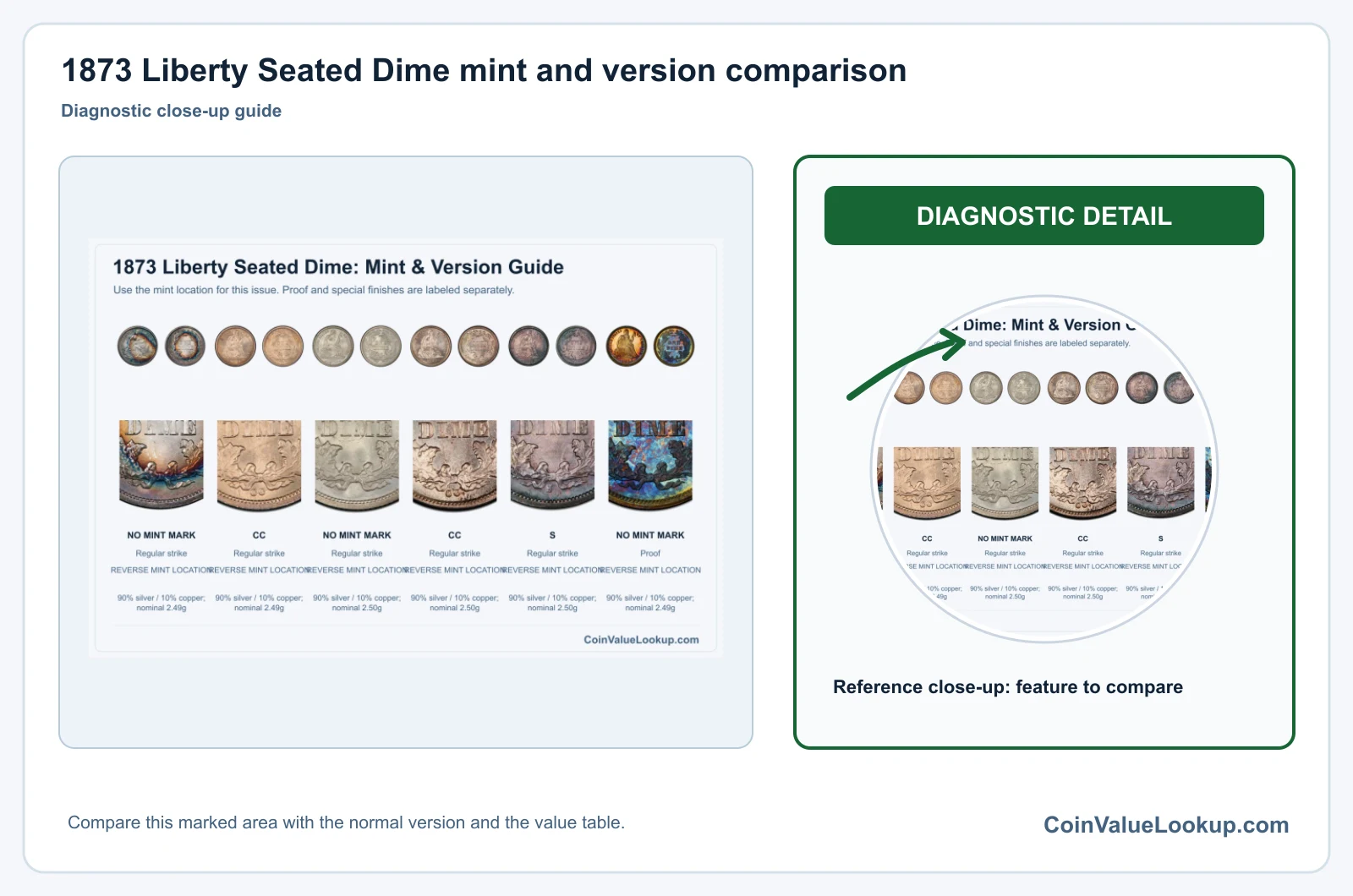
The 1873 Liberty Seated dime is one of the more complex years in the series, with multiple date styles, a mid-year weight change, and one legendary rarity all packed into a single date. Retail guide values for the normal listed business-strike issues range from about $23 at G4 up to around $92,687 at MS63, depending on the specific mint and version.
That broad span reflects the enormous difference between a common Philadelphia No Arrows coin and the scarce Carson City With Arrows issue. A unique CC No Arrows variety sits far outside any normal price curve.
Whether yours is a Closed 3, Open 3, With Arrows, or something rarer, the mint, date style, and finish determine which price chart applies.
Fast Way to Identify Your 1873 Liberty Seated Dime
The fastest way to start figuring out what you have is to upload clear photos of the front and back of your coin. That lets us help with a preliminary identification of the mint, date style, and whether arrows appear beside the date.
Good lighting and a sharp image of the date digits and any mintmark on the reverse make the process much smoother.
1873 Liberty Seated Dime Value
Upload both sides of your 1873 Liberty Seated Dime.
Front Obverse
Upload photo
Back Reverse
Upload photo
Which 1873 Liberty Seated Dime Versions Are Worth Money?
- The 1873 CC No Arrows dime is a unique coin; USA CoinBook lists an MS63 guide point of $3,737,500, but this is not a normal market value you should expect to encounter.
- Carson City With Arrows dimes carry guide values from about $3,637 at G4 to $92,687 at MS63, making them the most valuable commonly traded business strikes of this date.
- The Doubled Die Obverse version lists around $616 at G4 and $33,692 at MS63, a large premium over normal Philadelphia issues.
- Open 3 No Arrows Philadelphia coins guide around $29 at G4 to $1,882 at MS63, higher than the more common Closed 3.
- Proof With Arrows dimes guide around $1,067 at PR63, a distinct collectible from the regular business strikes.
- San Francisco With Arrows dimes, while more affordable, still guide at about $2,501 in MS63.
Step 1: Identify Your 1873 Liberty Seated Dime Mint Mark and Version
Start with the basics. You are looking for a seated Liberty on the obverse and ONE DIME within a wreath on the reverse.
If yours says HALF DIME, set it aside; that is a different denomination.
Philadelphia coins carry no mintmark. Carson City pieces show a small CC on the reverse below or within the wreath, and San Francisco issues show an S in the same location.
Check carefully with magnification.
Next, look at the date. The 1873 No Arrows issues come in two flavors: a Closed 3, where the knobs of the numeral 3 nearly touch, and an Open 3, where the gap between the knobs is clearly visible.
This distinction matters for value.
Then check for arrows. If two small arrowheads flank the date on the obverse, you have a With Arrows coin struck at the new 2.50g weight standard.
No Arrows coins weigh 2.49g. A sensitive scale can confirm this.
All regular-issue 1873 dimes are 90% silver and 10% copper, 17.9mm diameter, with a reeded edge. Proofs were struck only at Philadelphia and share the same composition but have mirror-like fields from specially prepared dies.
Step 2: Check Your 1873 Liberty Seated Dime Grade
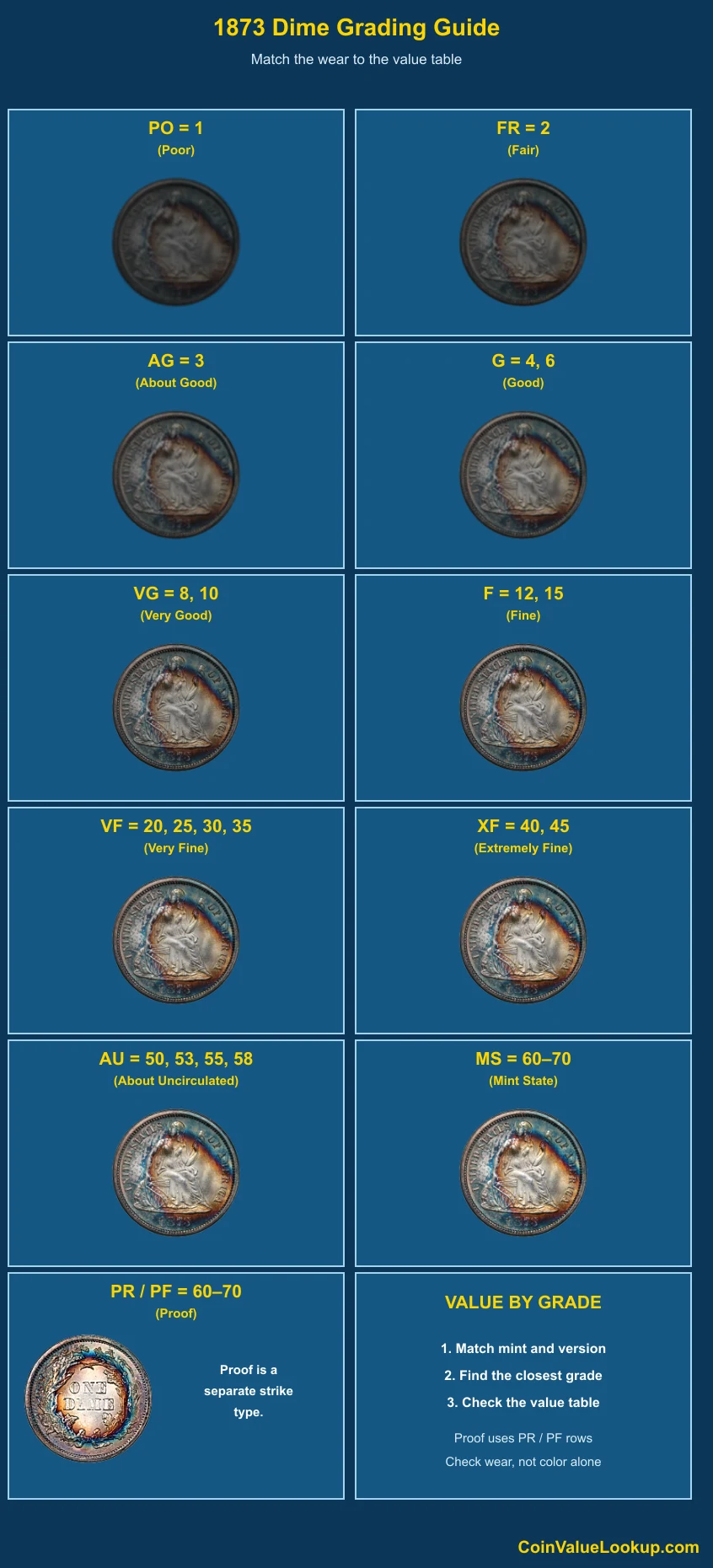
Focus on Liberty first. Her head, the area around the breast and knee, and the details of the shield on her lap wear down earliest.
Compare your coin to the reference image to see how much fine detail remains in those spots.
On the reverse, the highest wreath leaves lose definition first. Look there for friction.
Luster matters as much as detail. A coin with full design sharpness but dull, cleaned surfaces grades lower than you might expect.
Conversely, some coins were struck from tired or lightly clashed dies that never fully brought up the design, which is not the same as circulation wear.
Proof coins have deeply mirrored fields from polished dies and planchets. A shiny coin is not automatically a Proof.
Genuine Proofs show deliberate preparation: squared-off rims, full mirror reflectivity in the fields, and often fine hairlines from old cleaning. Compare both sides under angled light before jumping to conclusions.
Coin Value Lookup can help you look up guides for other dates and denominations in the Liberty Seated dime series once you have identified your coin.
Step 3: Check 1873 Liberty Seated Dime Value by Mint and Version
1873 Liberty Seated Dime — No Mint Mark — Closed 3 – No Arrows
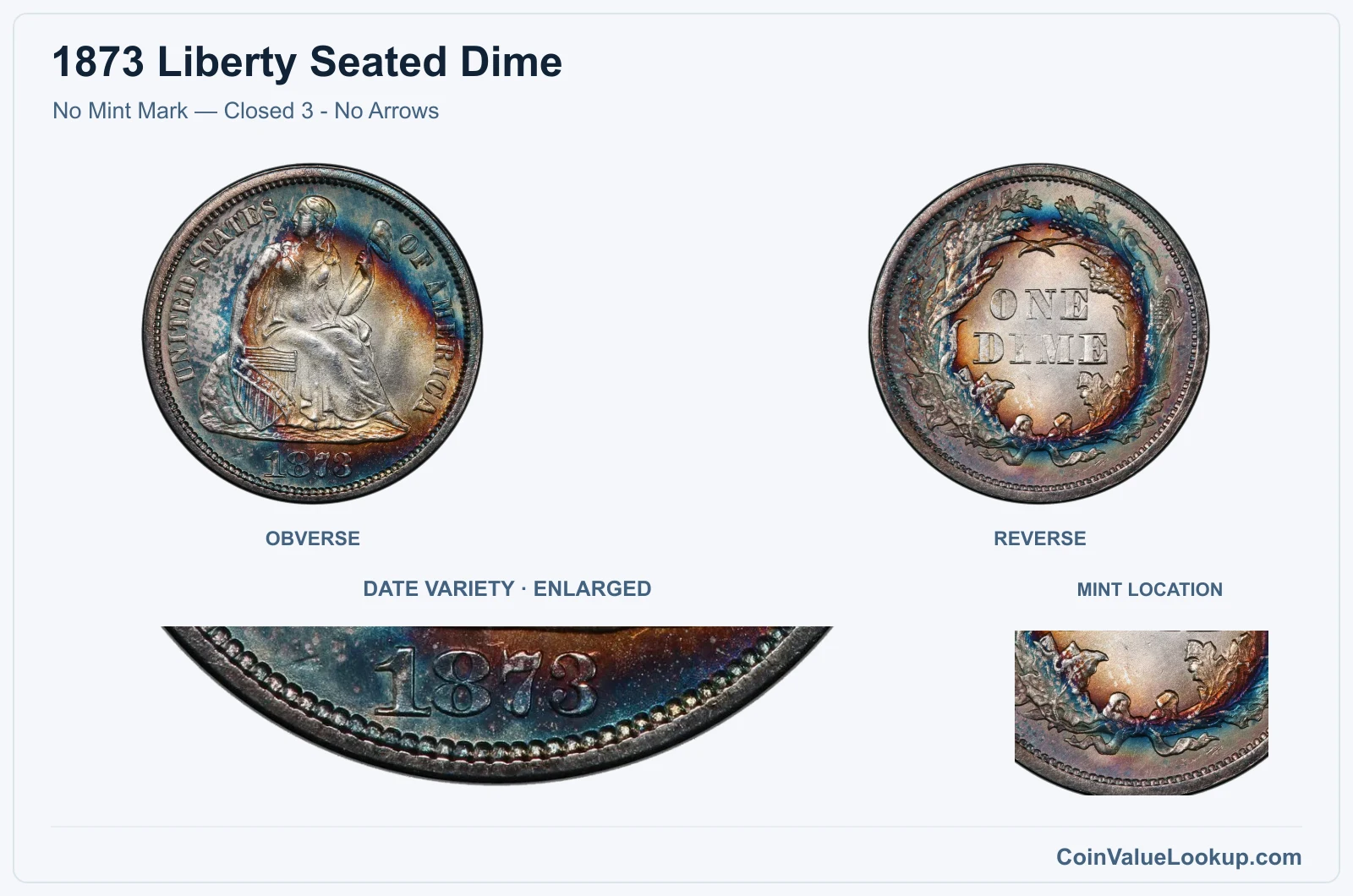
This is the Philadelphia business strike with no arrows at the date and the Closed 3 date style, where the knobs of the 3 nearly meet. It weighs a nominal 2.49g, the pre-change standard.
No mintmark appears on the reverse.
USA CoinBook guide values run from about $23 at G4 to $595 at MS63. This is generally the most affordable regular 1873 dime, making it a reasonable entry point for the date.
Look at the 3 under magnification: if there is a clear gap between the upper and lower knobs, you have an Open 3 instead.
Range Grade
Price Auction Records Appraisal PO PO 1
—
Coin Identifier FR FR 2
—
Coin Identifier AG AG 3
—
Coin Identifier G G 4
—
Coin Identifier
G 6
—
Coin Identifier VG VG 8
—
Coin Identifier
VG 10
—
Coin Identifier F F 12
—
Coin Identifier
F 15
—
Coin Identifier VF VF 20
—
Coin Identifier
VF 25
—
Coin Identifier
VF 30
—
Coin Identifier
VF 35
Coin Identifier XF XF 40
Coin Identifier
XF 45
Coin Identifier AU AU 50
Coin Identifier
AU 53
Coin Identifier
AU 55
Coin Identifier
AU 58
Coin Identifier MS MS 60
Coin Identifier
MS 61
Coin Identifier
MS 62
Coin Identifier
MS 63
Coin Identifier
MS 64
Coin Identifier
MS 65
Coin Identifier
MS 66
Coin Identifier
MS 67
Coin Identifier
MS 68
—
—
—
MS 69
—
—
—
MS 70
—
—
—
1873 Liberty Seated Dime — No Mint Mark — Open 3 – No Arrows
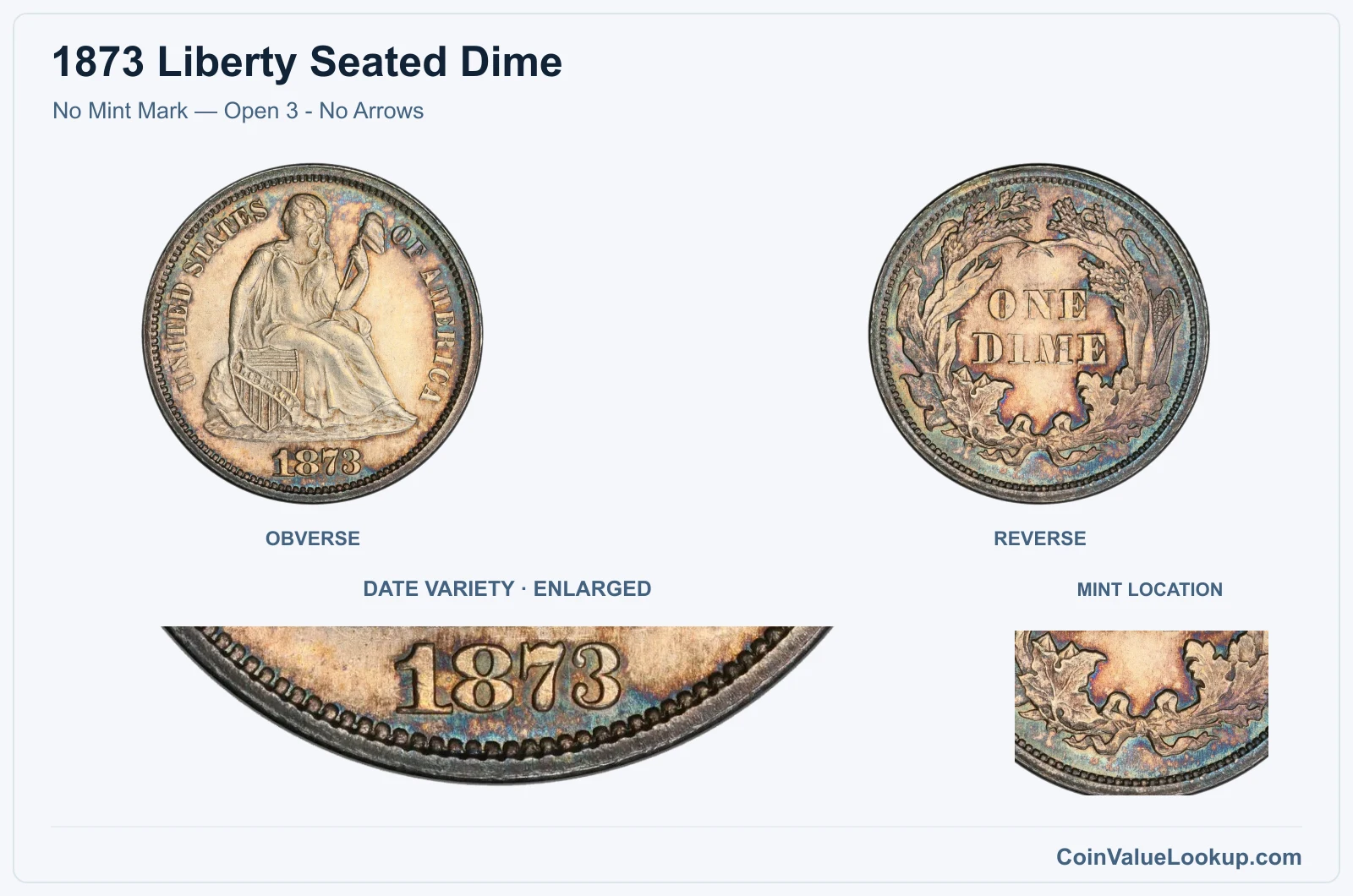
Same mint, same weight, same lack of mintmark, but the 3 in the date has visibly separated knobs. That small difference pushes guide values to about $29 at G4 and $1,882 at MS63, roughly triple the Closed 3 in uncirculated grades.
The Open 3 style was used briefly before the With Arrows weight change took effect. To tell them apart, hold the coin so the date is upright and examine the numeral 3 closely.
If the two curved ends of the 3 leave a noticeable open space between them, this is your version.
Range Grade
Price Auction Records Appraisal PO PO 1
—
Coin Identifier FR FR 2
—
Coin Identifier AG AG 3
—
Coin Identifier G G 4
—
Coin Identifier
G 6
—
Coin Identifier VG VG 8
—
Coin Identifier
VG 10
—
Coin Identifier F F 12
—
Coin Identifier
F 15
—
Coin Identifier VF VF 20
Coin Identifier
VF 25
Coin Identifier
VF 30
Coin Identifier
VF 35
Coin Identifier XF XF 40
Coin Identifier
XF 45
Coin Identifier AU AU 50
Coin Identifier
AU 53
Coin Identifier
AU 55
Coin Identifier
AU 58
Coin Identifier MS MS 60
Coin Identifier
MS 61
Coin Identifier
MS 62
Coin Identifier
MS 63
Coin Identifier
MS 64
Coin Identifier
MS 65
Coin Identifier
MS 66
—
—
—
MS 67
—
—
—
MS 68
—
—
—
MS 69
—
—
—
MS 70
—
—
—
1873 Liberty Seated Dime — CC — No Arrows
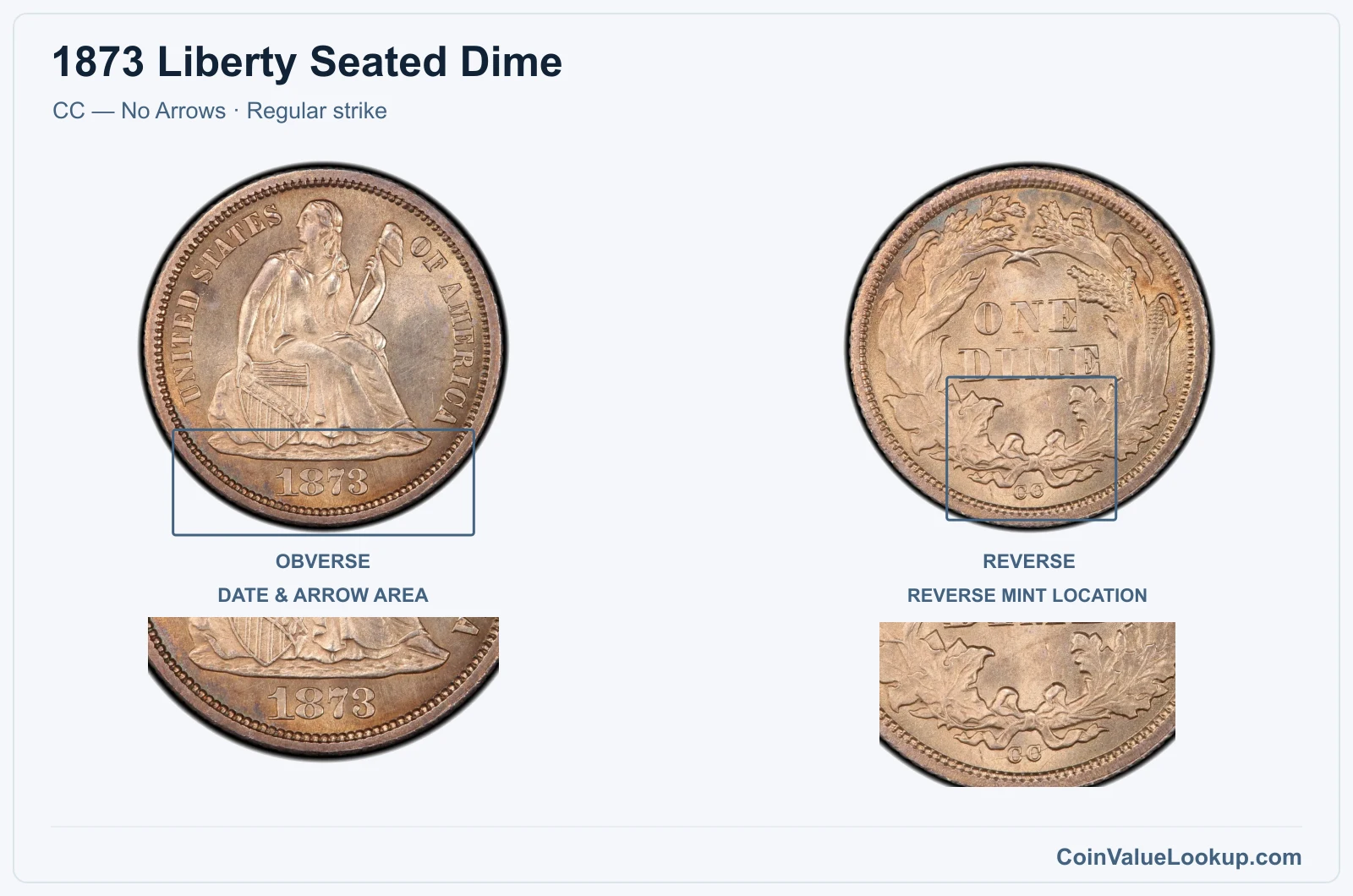
This is the famous one. The 1873 CC No Arrows dime is a unique coin.
Only one specimen is confirmed to exist. USA CoinBook displays an MS63 guide point of $3,737,500, but that figure should not be treated as an ordinary price-range endpoint or a guaranteed realization.
It represents an extreme-rarity valuation for a coin that essentially never trades.
The CC mintmark appears on the reverse, and the coin carries the pre-change 2.49g weight with no arrows flanking the date. If you believe you have one, professional third-party authentication is essential.
No photograph-based identification can substitute for hands-on expert examination of a coin this rare.
Range Grade
Price Auction Records Appraisal PO PO 1
—
Coin Identifier FR FR 2
—
Coin Identifier AG AG 3
—
Coin Identifier G G 4
—
Coin Identifier
G 6
—
Coin Identifier VG VG 8
—
Coin Identifier
VG 10
—
Coin Identifier F F 12
—
Coin Identifier
F 15
—
Coin Identifier VF VF 20
—
Coin Identifier
VF 25
—
Coin Identifier
VF 30
—
Coin Identifier
VF 35
—
Coin Identifier XF XF 40
—
Coin Identifier
XF 45
—
Coin Identifier AU AU 50
—
Coin Identifier
AU 53
—
Coin Identifier
AU 55
—
Coin Identifier
AU 58
—
Coin Identifier MS MS 60
—
Coin Identifier
MS 61
—
Coin Identifier
MS 62
—
Coin Identifier
MS 63
—
Coin Identifier
MS 64
—
Coin Identifier
MS 65
Coin Identifier
MS 66
—
—
—
MS 67
—
—
—
MS 68
—
—
—
MS 69
—
—
—
MS 70
—
—
—
1873 Liberty Seated Dime — No Mint Mark — With Arrows
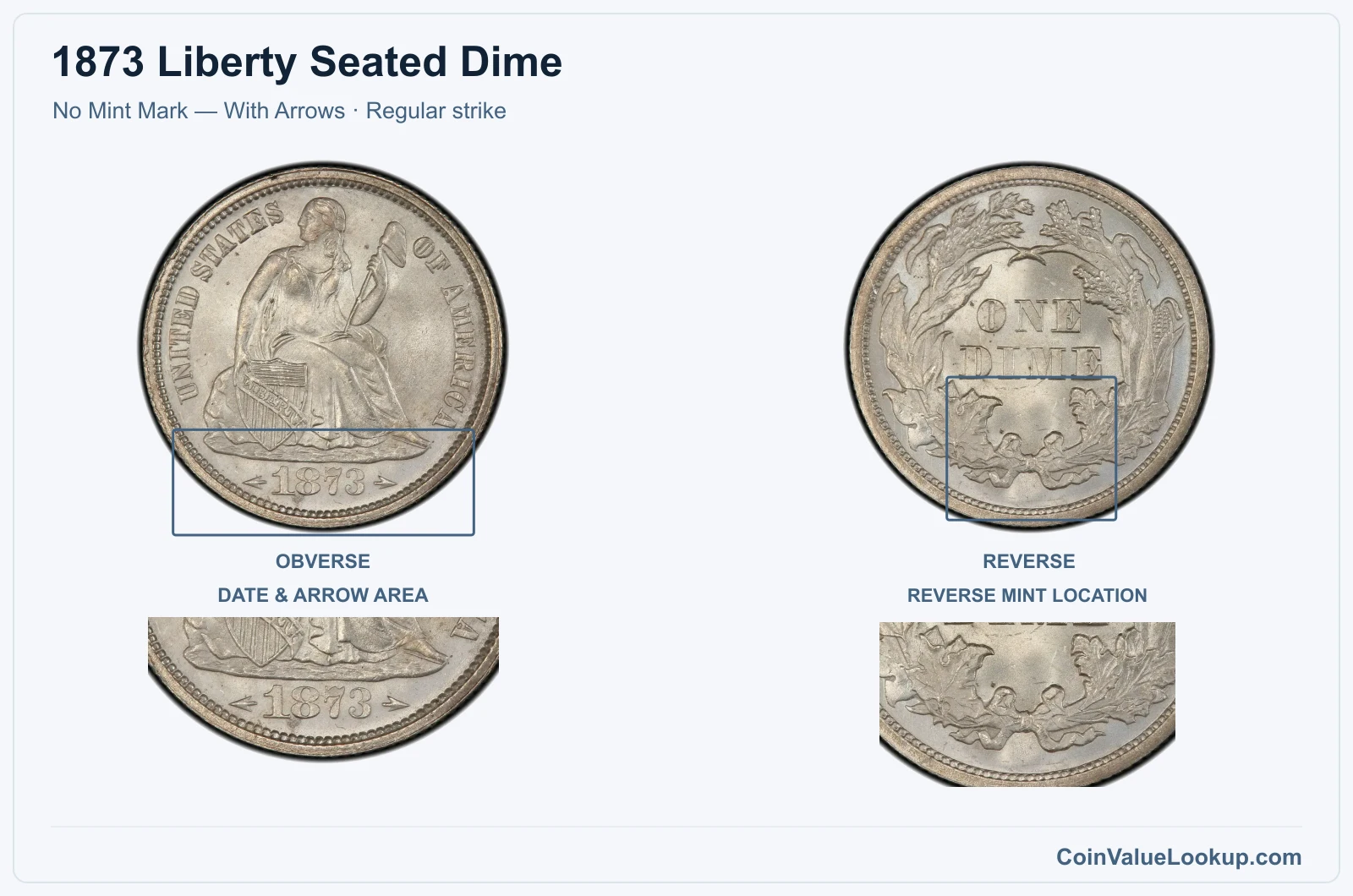
When the Mint raised the dime weight from 2.49g to 2.50g in 1873, they added small arrowheads on each side of the date so the public could distinguish the new-weight coins. This Philadelphia issue has no mintmark.
Guide values sit at about $26 at G4 and $1,131 at MS63. The arrows are easy to spot with the naked eye.
If you see them, you also know the coin is the heavier standard. These were produced in large numbers, so circulated examples are common and affordable.
Range Grade
Price Auction Records Appraisal PO PO 1
—
Coin Identifier FR FR 2
—
Coin Identifier AG AG 3
—
Coin Identifier G G 4
—
Coin Identifier
G 6
—
Coin Identifier VG VG 8
—
Coin Identifier
VG 10
—
Coin Identifier F F 12
—
Coin Identifier
F 15
—
Coin Identifier VF VF 20
Coin Identifier
VF 25
Coin Identifier
VF 30
—
Coin Identifier
VF 35
Coin Identifier XF XF 40
Coin Identifier
XF 45
Coin Identifier AU AU 50
Coin Identifier
AU 53
Coin Identifier
AU 55
Coin Identifier
AU 58
Coin Identifier MS MS 60
Coin Identifier
MS 61
Coin Identifier
MS 62
Coin Identifier
MS 63
Coin Identifier
MS 64
Coin Identifier
MS 65
Coin Identifier
MS 66
Coin Identifier
MS 67
—
—
—
MS 68
—
—
—
MS 69
—
—
—
MS 70
—
—
—
1873 Liberty Seated Dime — No Mint Mark — Doubled Die Obverse
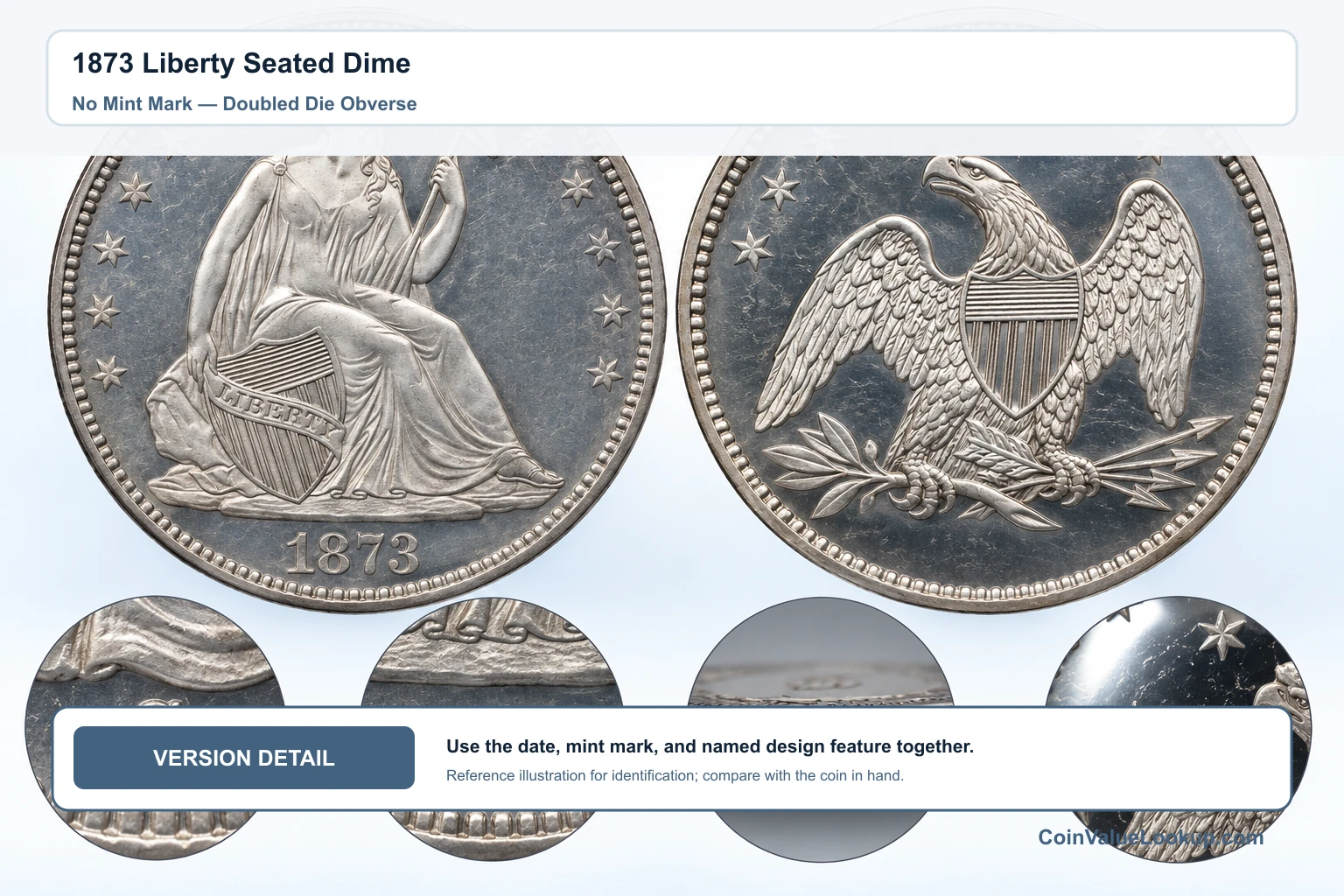
This Philadelphia With Arrows dime shows doubling on obverse design elements, visible as consistent separation or notching on letters or other features when compared to a normal strike under magnification. It is not the same as machine doubling, which produces a flat shelf appearance.
Guide values reflect the premium: about $616 at G4 and $33,692 at MS63, dramatically higher than a standard With Arrows Philadelphia coin. That jump in value makes careful attribution important.
Compare your coin to known examples before drawing conclusions.
Range Grade
Price Auction Records Appraisal PO PO 1
—
Coin Identifier FR FR 2
—
Coin Identifier AG AG 3
—
Coin Identifier G G 4
—
Coin Identifier
G 6
—
Coin Identifier VG VG 8
Coin Identifier
VG 10
Coin Identifier F F 12
—
Coin Identifier
F 15
—
Coin Identifier VF VF 20
—
Coin Identifier
VF 25
Coin Identifier
VF 30
—
Coin Identifier
VF 35
Coin Identifier XF XF 40
—
Coin Identifier
XF 45
—
Coin Identifier AU AU 50
—
Coin Identifier
AU 53
—
Coin Identifier
AU 55
—
Coin Identifier
AU 58
Coin Identifier MS MS 60
—
—
—
MS 61
—
—
—
MS 62
—
—
—
MS 63
—
—
—
MS 64
—
—
—
MS 65
—
—
—
MS 66
—
—
—
MS 67
—
—
—
MS 68
—
—
—
MS 69
—
—
—
MS 70
—
—
—
1873 Liberty Seated Dime — CC — With Arrows
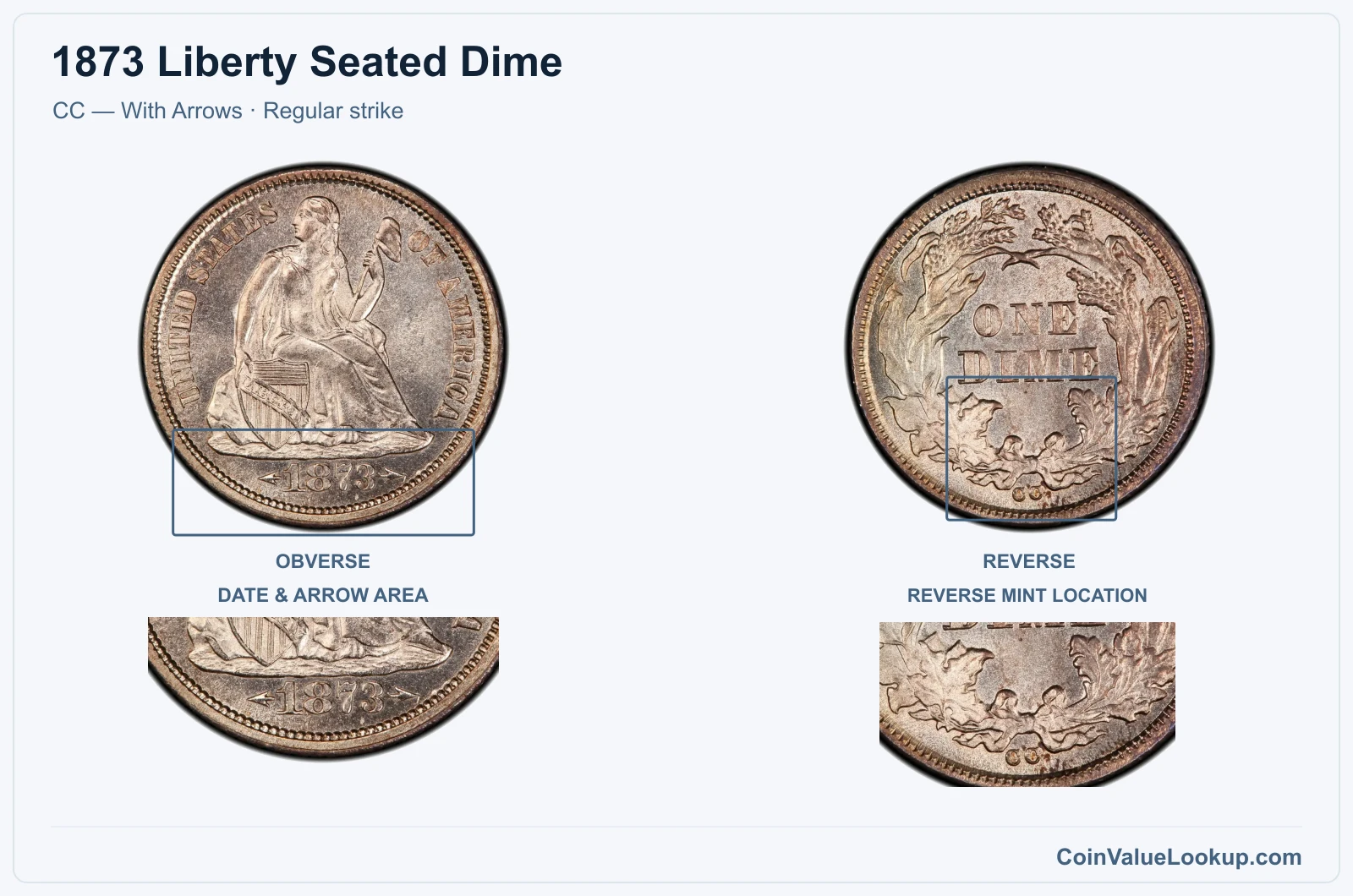
The Carson City With Arrows dime is the most valuable commonly traded business strike of 1873. Guide values run from about $3,637 at G4 to $92,687 at MS63.
Even heavily worn examples command serious money.
Look for the CC mintmark on the reverse and arrows flanking the date on the obverse. The coin weighs a nominal 2.50g.
Carson City mintages for this period were small, and survival rates in higher grades are low, which drives those steep prices. Any CC dime from this era deserves careful handling and professional grading consideration.
Range Grade
Price Auction Records Appraisal PO PO 1
—
Coin Identifier FR FR 2
Coin Identifier AG AG 3
Coin Identifier G G 4
Coin Identifier
G 6
Coin Identifier VG VG 8
Coin Identifier
VG 10
Coin Identifier F F 12
Coin Identifier
F 15
Coin Identifier VF VF 20
Coin Identifier
VF 25
Coin Identifier
VF 30
Coin Identifier
VF 35
Coin Identifier XF XF 40
Coin Identifier
XF 45
Coin Identifier AU AU 50
Coin Identifier
AU 53
—
Coin Identifier
AU 55
—
—
—
AU 58
—
—
— MS MS 60
—
—
—
MS 61
—
—
—
MS 62
—
—
—
MS 63
—
—
—
MS 64
—
—
—
MS 65
Coin Identifier
MS 66
—
—
—
MS 67
—
—
—
MS 68
—
—
—
MS 69
—
—
—
MS 70
—
—
—
1873 Liberty Seated Dime — S — With Arrows
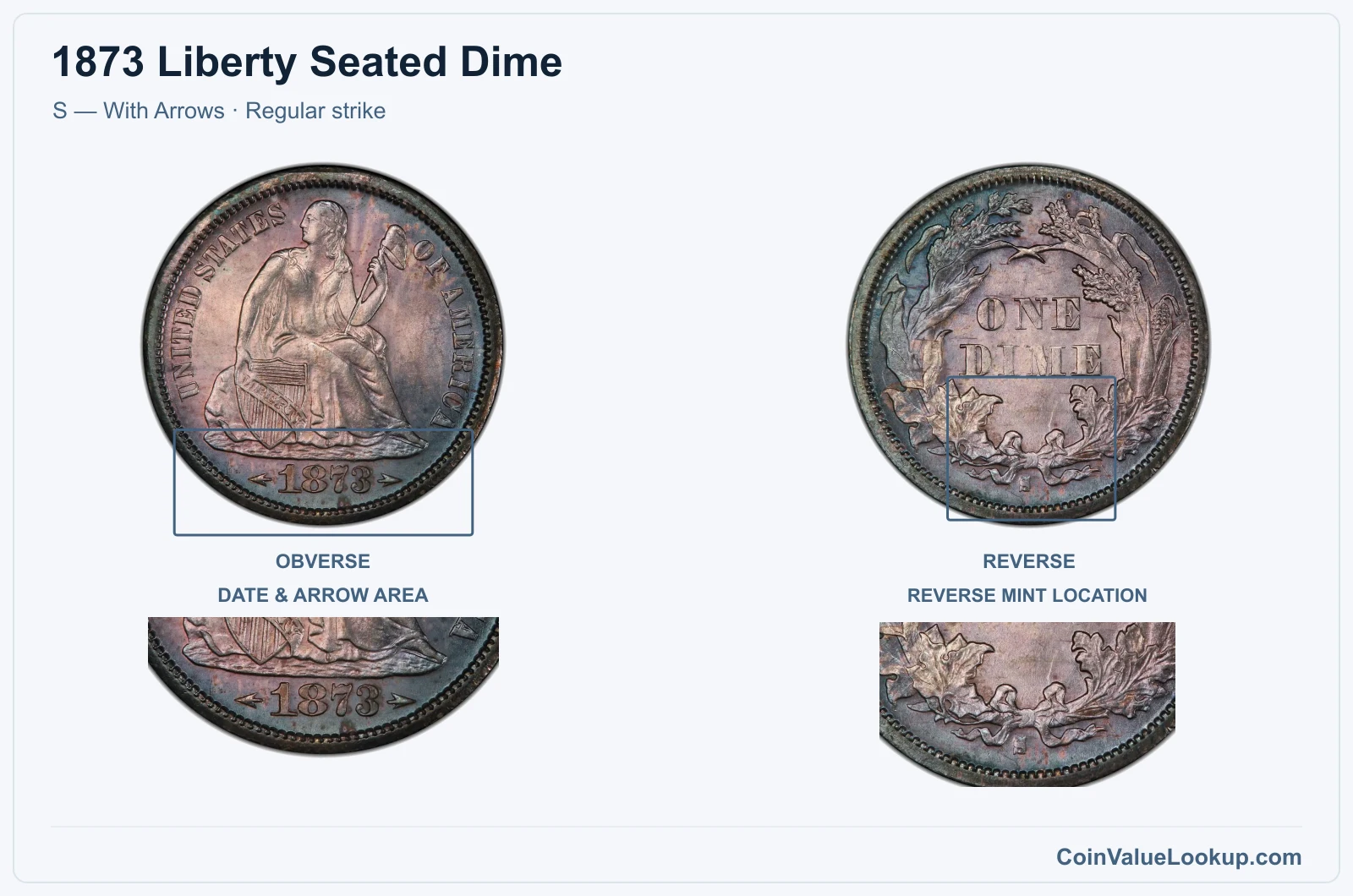
San Francisco struck With Arrows dimes in 1873, identified by a small S mintmark on the reverse. These weigh the new 2.50g standard.
Guide values come in at about $30 at G4 and $2,501 at MS63.
In lower grades these are affordable, but mint-state examples carry a meaningful premium. The S mintmark can be faint on worn coins, so use magnification.
San Francisco did not produce No Arrows dimes this year, so any S-mint 1873 should show the arrows beside the date.
Range Grade
Price Auction Records Appraisal PO PO 1
—
Coin Identifier FR FR 2
—
Coin Identifier AG AG 3
—
Coin Identifier G G 4
—
Coin Identifier
G 6
—
Coin Identifier VG VG 8
—
Coin Identifier
VG 10
—
Coin Identifier F F 12
—
Coin Identifier
F 15
—
Coin Identifier VF VF 20
Coin Identifier
VF 25
Coin Identifier
VF 30
—
Coin Identifier
VF 35
Coin Identifier XF XF 40
Coin Identifier
XF 45
Coin Identifier AU AU 50
Coin Identifier
AU 53
Coin Identifier
AU 55
Coin Identifier
AU 58
Coin Identifier MS MS 60
—
Coin Identifier
MS 61
Coin Identifier
MS 62
Coin Identifier
MS 63
Coin Identifier
MS 64
Coin Identifier
MS 65
Coin Identifier
MS 66
—
—
—
MS 67
—
—
—
MS 68
—
—
—
MS 69
—
—
—
MS 70
—
—
—
1873 Liberty Seated Dime — No Mint Mark — Proof Closed 3 – No Arrows
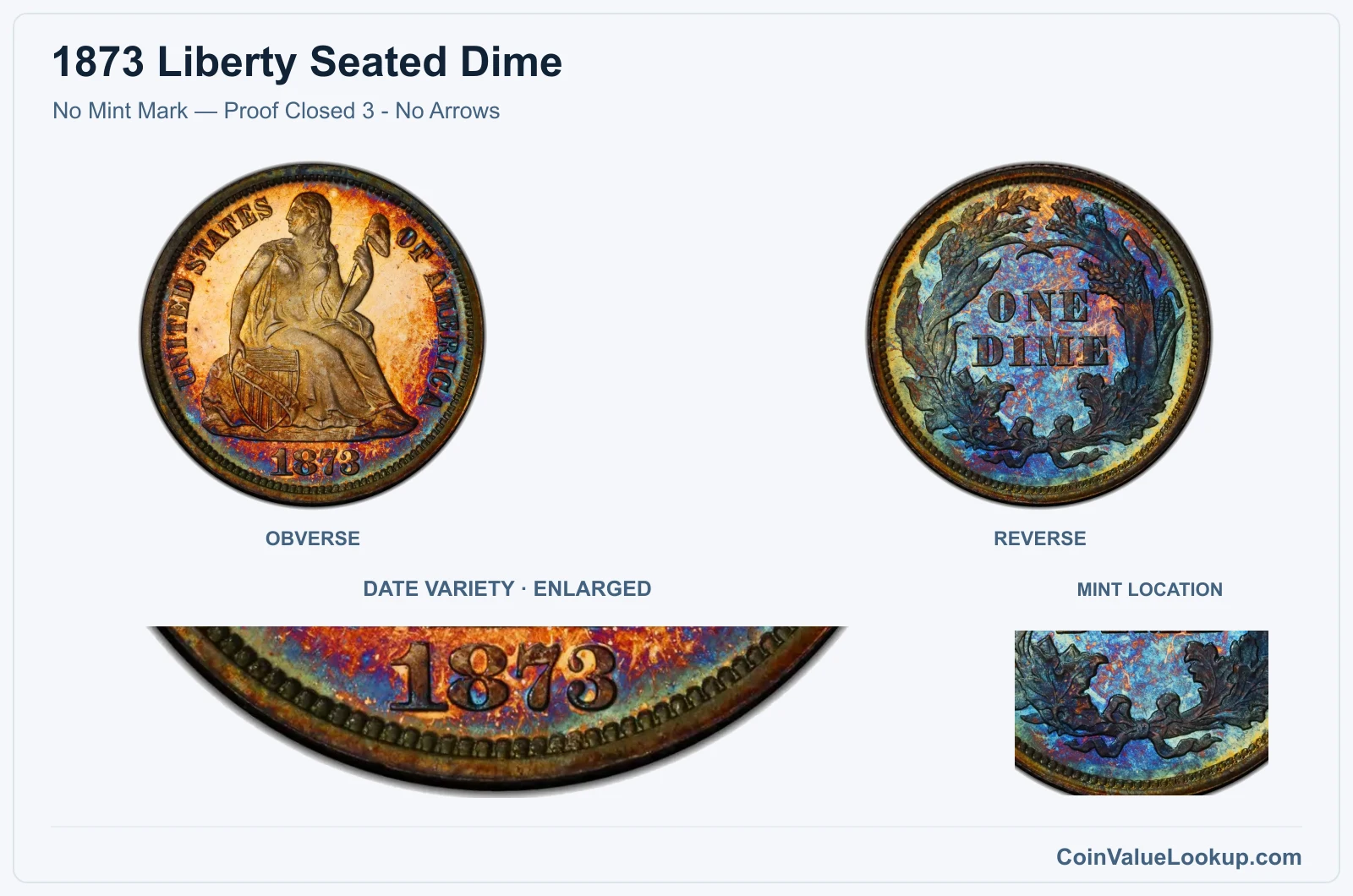
Philadelphia struck Proof Closed 3 No Arrows dimes with the pre-change 2.49g weight. These have deeply mirrored fields created by polished dies and planchets.
The guide value at PR63 is about $725.
A Proof is a method of manufacture, not a grade above Mint State. Look for squared rims, full mirror reflectivity across the fields, and sharp design details.
Hairlines from old cleaning are common on Proofs and affect the grade. A lustrous business strike can look flashy, but it will not show the same flat mirror surface in the fields that a genuine Proof displays under angled light.
Range Grade
Price Auction Records Appraisal PR PR 1
—
Coin Identifier
PR 2
—
Coin Identifier
PR 3
—
Coin Identifier
PR 4
—
Coin Identifier
PR 6
—
Coin Identifier
PR 8
—
Coin Identifier
PR 10
—
Coin Identifier
PR 12
—
Coin Identifier
PR 15
—
Coin Identifier
PR 20
—
Coin Identifier
PR 25
—
Coin Identifier
PR 30
—
Coin Identifier
PR 35
—
Coin Identifier
PR 40
—
Coin Identifier
PR 45
—
Coin Identifier
PR 50
—
Coin Identifier
PR 53
—
Coin Identifier
PR 55
—
Coin Identifier
PR 58
—
Coin Identifier
PR 60
—
Coin Identifier
PR 61
Coin Identifier
PR 62
Coin Identifier
PR 63
Coin Identifier
PR 64
Coin Identifier
PR 65
Coin Identifier
PR 66
Coin Identifier
PR 67
Coin Identifier
PR 68
—
—
—
PR 69
—
—
—
PR 70
—
—
—
1873 Liberty Seated Dime — No Mint Mark — Proof With Arrows
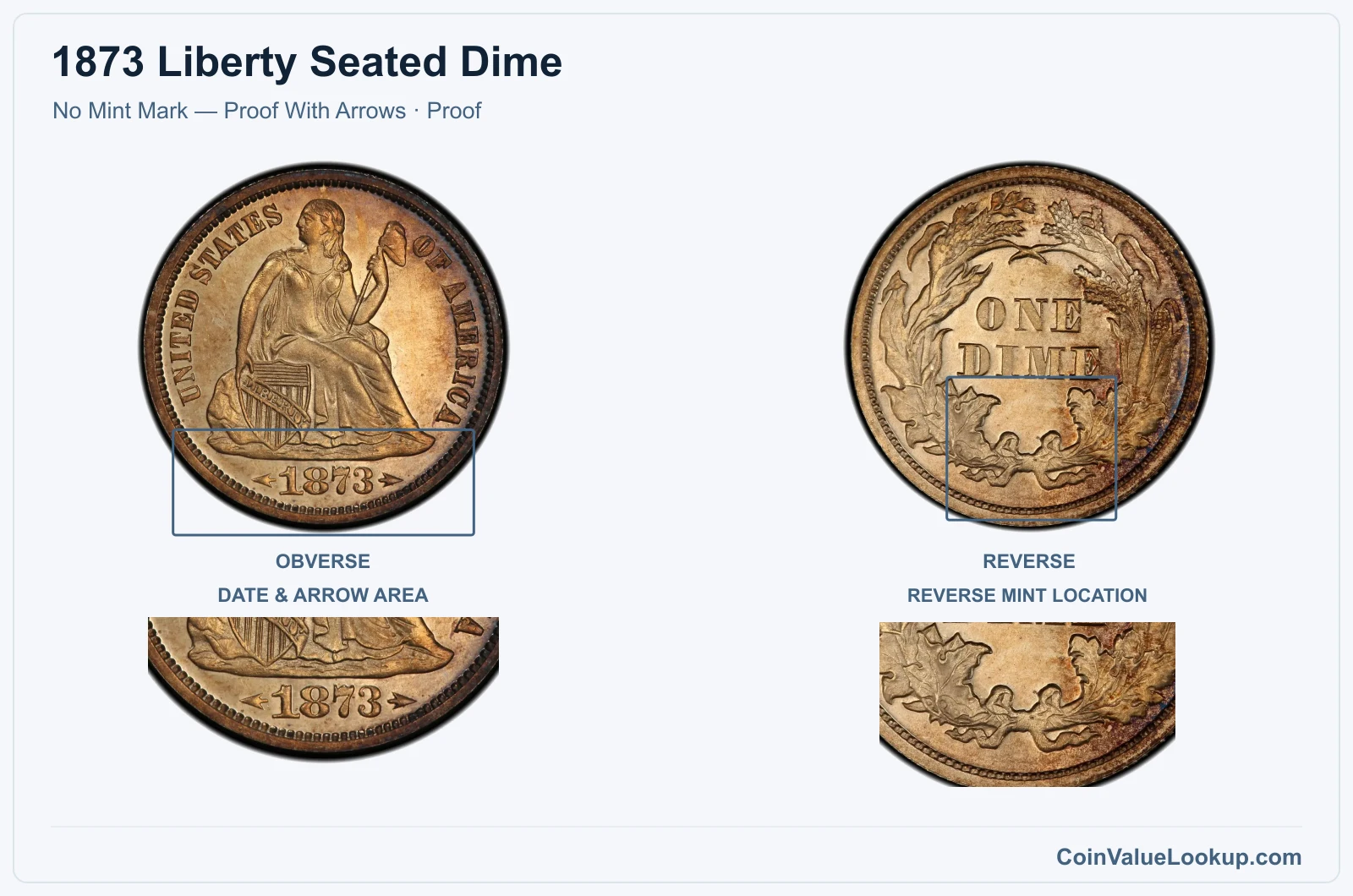
The Proof With Arrows version was struck at Philadelphia after the mid-year weight increase. It carries the 2.50g standard and shows arrows flanking the date, just like the business strike, but with mirror fields from specially prepared dies.
The guide value at PR63 is about $1,067.
This is a distinct collectible from the Proof Closed 3 No Arrows. Both must be distinguished from polished or dipped business strikes.
Tilt the coin under a single light source: genuine Proof fields reflect like a mirror in a flat plane, while business-strike luster tends to show cartwheel reflections that rotate as you move the coin.
Range Grade
Price Auction Records Appraisal PR PR 1
—
Coin Identifier
PR 2
—
Coin Identifier
PR 3
—
Coin Identifier
PR 4
—
Coin Identifier
PR 6
—
Coin Identifier
PR 8
—
Coin Identifier
PR 10
—
Coin Identifier
PR 12
—
Coin Identifier
PR 15
—
Coin Identifier
PR 20
—
Coin Identifier
PR 25
—
Coin Identifier
PR 30
—
Coin Identifier
PR 35
—
Coin Identifier
PR 40
—
Coin Identifier
PR 45
—
Coin Identifier
PR 50
—
Coin Identifier
PR 53
—
Coin Identifier
PR 55
—
Coin Identifier
PR 58
—
Coin Identifier
PR 60
—
Coin Identifier
PR 61
Coin Identifier
PR 62
Coin Identifier
PR 63
Coin Identifier
PR 64
Coin Identifier
PR 65
Coin Identifier
PR 66
Coin Identifier
PR 67
—
—
—
PR 68
—
—
—
PR 69
—
—
—
PR 70
—
—
—
1873 Liberty Seated Dime Error List
1. 1873 Liberty Seated Dime — Repunched Date
A repunched date on an 1873 dime shows remnants of an earlier punch position next to the final date numerals. Under magnification, you may see traces of a displaced 1, 8, 7, or 3 slightly offset from the accepted position.
This is a die variety, not a doubled die: it results from the date punch being applied more than once in slightly different positions.
Do not confuse this with a damaged date from a coin that took a hit, or with machine doubling, which leaves flat shelf-like distortions. True repunched dates show distinct, rounded remnants of the extra impression.
The value of a repunched date depends on the visibility of the extra impression, the specific die, and the coin's condition. No standard price range applies across the board.
2. 1873 Liberty Seated Dime — Doubled Die Obverse
A doubled die obverse on an 1873 dime shows consistent separation or notching on obverse design elements such as letters or the date. Compare your coin to a normal example under the same lighting.
Genuine hub doubling produces raised, rounded secondary images that appear in the same relative position on every coin struck from that die.
Machine doubling is the common lookalike. It creates a flat, shelf-like distortion that lacks the depth and definition of true hub doubling.
Worn die contours and reflections under certain light angles can also mimic doubling at first glance. The value depends on the specific die, how visible the doubling is, and the coin's overall condition.
A confirmed doubled die obverse version is listed in the version section above with its own guide values.
3. 1873 Liberty Seated Dime — Off-Center Strike
An off-center strike occurs when the planchet is not properly centered between the dies, leaving a crescent-shaped unstruck area on one side and a shifted design on the rest of the coin. On an 1873 Seated dime, the key factor for collectibility is whether the full date remains visible in the struck portion.
Date-visible off-center errors are more desirable.
Do not confuse an off-center strike with a straight-clipped planchet, which shows a flat missing edge rather than a crescent. A coin flattened after leaving the Mint can also mimic the look.
Value depends on the percentage of off-center shift, date visibility, and overall condition. No standard price range has been adopted for this error on this date.
4. 1873 Liberty Seated Dime — Clashed Dies
Clashed dies result when the obverse and reverse dies strike each other without a planchet between them, transferring faint impressions of one design onto the opposite die. On an 1873 Seated dime, you might see ghost-like traces of the wreath in Liberty's fields, or seated Liberty outlines on the reverse, positioned where the opposing die features would align.
These transferred images differ from random scratches or raised lines because they correspond to specific features of the opposite design. They are also distinct from brockage errors, which involve a struck coin acting as a die.
Look under good lighting at open field areas for the telltale traces. Value depends on how bold the clash marks are and the coin's overall condition.
5. 1873 Liberty Seated Dime — Die Crack / Die Chip
Die cracks appear as thin raised lines on the coin's surface, created when the steel die develops fractures from repeated use. Die chips are small raised blobs where a tiny piece of the die face broke away.
Both are common on 19th-century coinage.
A crack running from the rim inward is a standard die crack. A larger break at the rim that leaves a raised blob of metal is called a cud.
Interior chips usually appear as small bumps on flat field areas. Do not confuse these with incuse scratches, which are recessed into the surface, or with corrosion and foreign material sitting on top of the coin.
The value of die cracks and chips on an 1873 dime depends on the size, location, and the coin's overall condition.