1887 Liberty Seated Dime Coin Value: How Much Is It Worth?
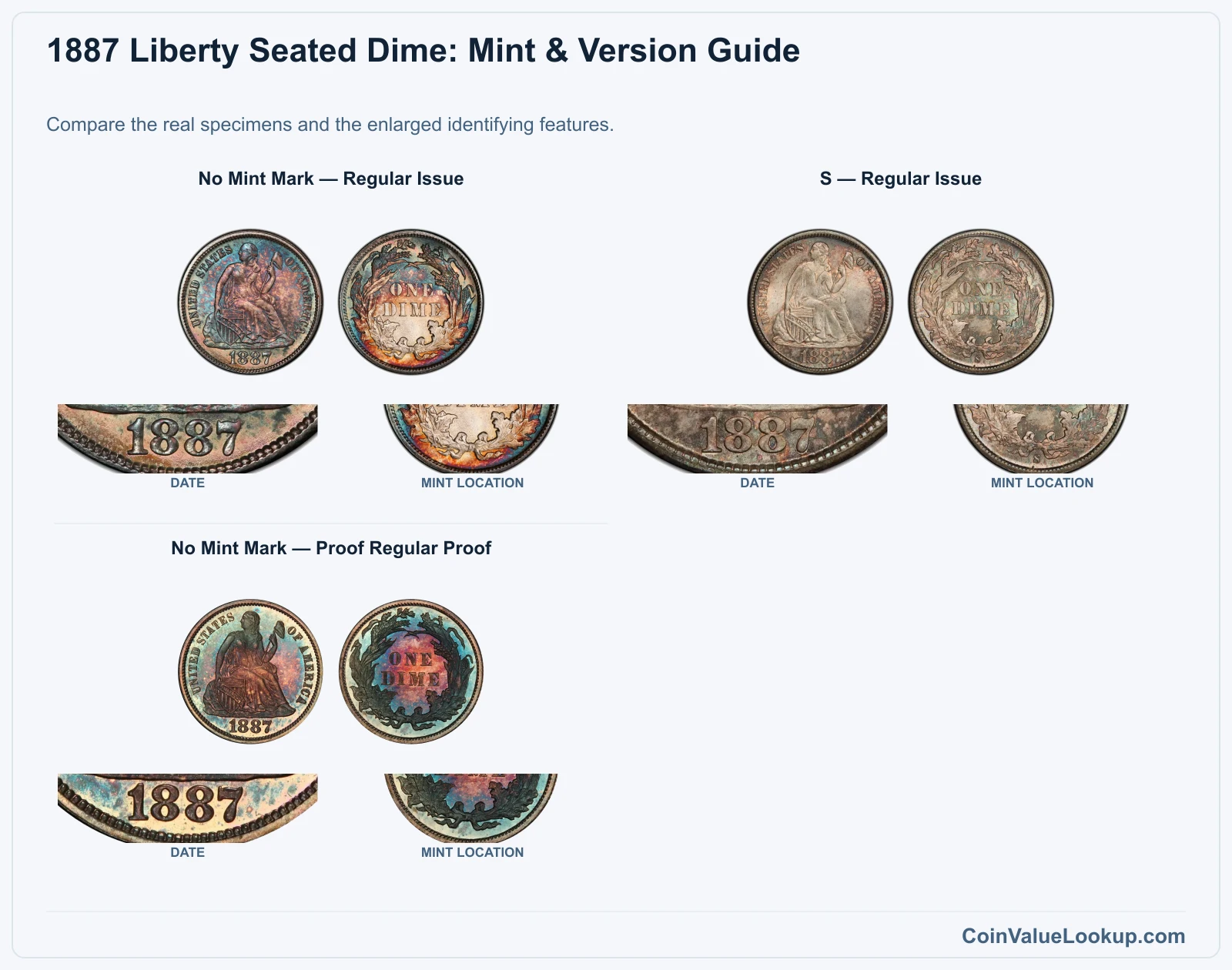
The 1887 Liberty Seated Dime comes in Philadelphia and San Francisco circulation strikes plus a Philadelphia Proof. USA Coin Book retail guide estimates range from about $22 at G4 to $316 at MS63 for regular issues, while Proofs carry an estimate around $725 at PR63.
Several die varieties and mint errors have been reported for this date, so a closer look at your coin is worthwhile.
Fast Way to Identify Your 1887 Liberty Seated Dime
The quickest way to start figuring out what you have is to upload clear photos of both the front and back of your coin. Our identifier can offer a preliminary identification based on those images, helping you narrow down the mint, version and general condition.
It is not a substitute for professional authentication, but it gives you a solid starting point.
1887 Liberty Seated Dime Value
Upload both sides of your 1887 Liberty Seated Dime.
Front Obverse
Upload photo
Back Reverse
Upload photo
Which 1887 Liberty Seated Dime Versions Are Worth Money?
- Philadelphia regular issues are listed from about $22 (G4) to $316 (MS63) in the USA Coin Book guide — condition drives the spread.
- San Francisco "S" mint issues share a similar guide range of roughly $22 (G4) to $316 (MS63) and add the possibility of a repunched mintmark variety.
- Philadelphia Proofs carry a guide estimate of about $725 at PR63, reflecting lower original mintage and collector demand for the mirror-field finish.
- Reported die errors for 1887 include repunched dates, misplaced dates, die cracks, clashed dies, doubled die reverses, off-center strikes and struck-through errors — all worth checking.
Step 1: Identify Your 1887 Liberty Seated Dime Mint Mark and Version
The 1887 Seated Dime shows the Legend Obverse design with UNITED STATES OF AMERICA around a seated Liberty figure, paired with an agricultural wreath reverse reading ONE DIME. The coin is 90% silver and 10% copper, 17.9 mm across with a reeded edge and a nominal weight of 2.50 grams.
Philadelphia coins carry no mintmark. San Francisco pieces have a small "S" on the reverse within the wreath, near the base.
Check that spot carefully, because a worn or weakly struck mintmark can be easy to miss.
Don't confuse this with a half dime, which is smaller and lighter. And don't mistake a polished coin for a Proof; the Proof finish is a specific manufacturing process, not just a shiny surface.
Original surfaces matter for accurate identification and valuation.
Step 2: Check Your 1887 Liberty Seated Dime Grade
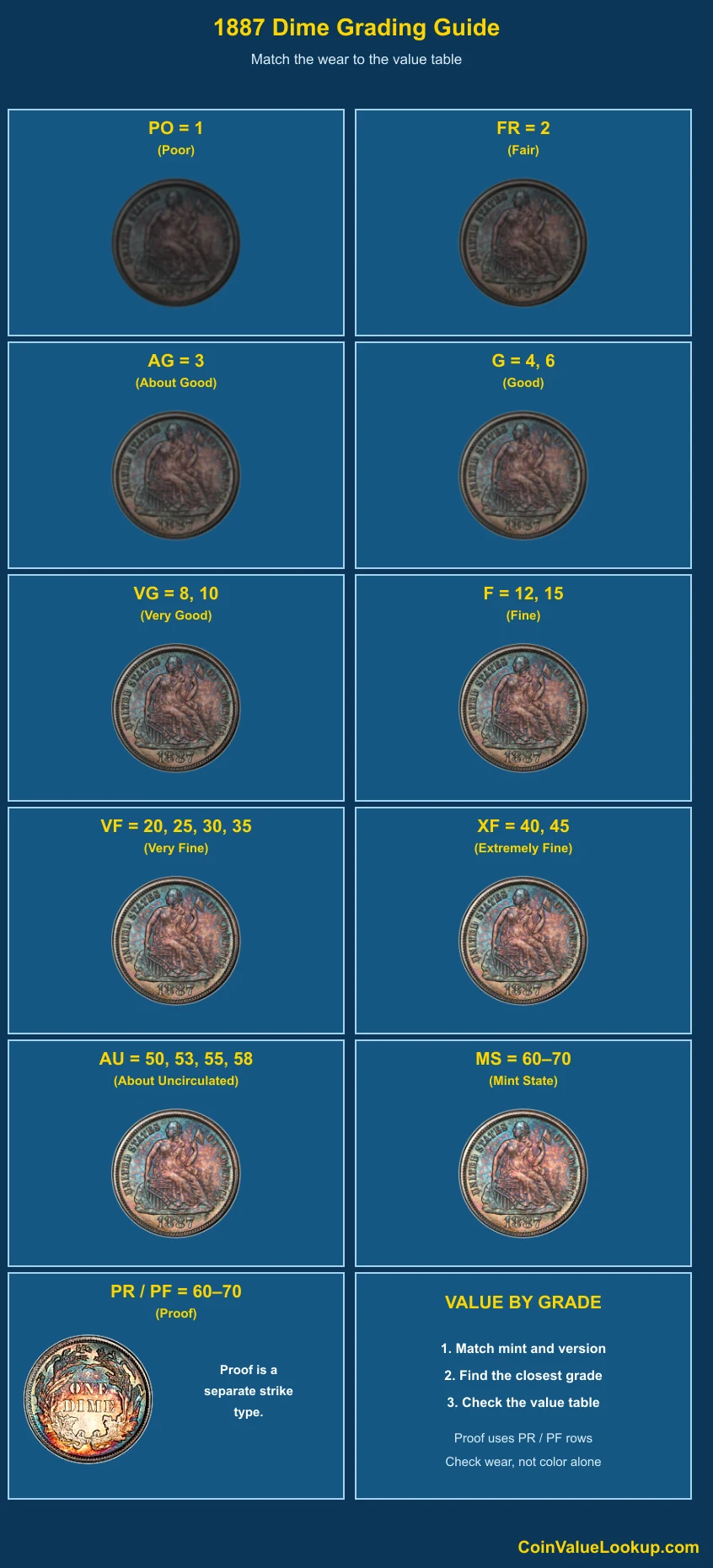
Start with Liberty's head and the area around her knee and breast on the obverse. These are the first spots to lose detail from circulation.
On the reverse, the high points of the wreath leaves wear down earliest.
Compare your coin side by side with the reference comparison image. A coin in G4 will show a smooth Liberty outline with most interior detail gone, while an MS63 example retains full luster and only minor contact marks.
Surviving luster matters as much as design sharpness. A weakly struck coin from tired dies can look soft without ever being circulated, so look at the fields for friction rather than relying only on device detail.
Hairlines from old cleaning will also knock a coin down in grade, even if the design looks sharp.
Step 3: Check 1887 Liberty Seated Dime Value by Mint and Version
1887 Liberty Seated Dime — No Mint Mark — Regular Issue
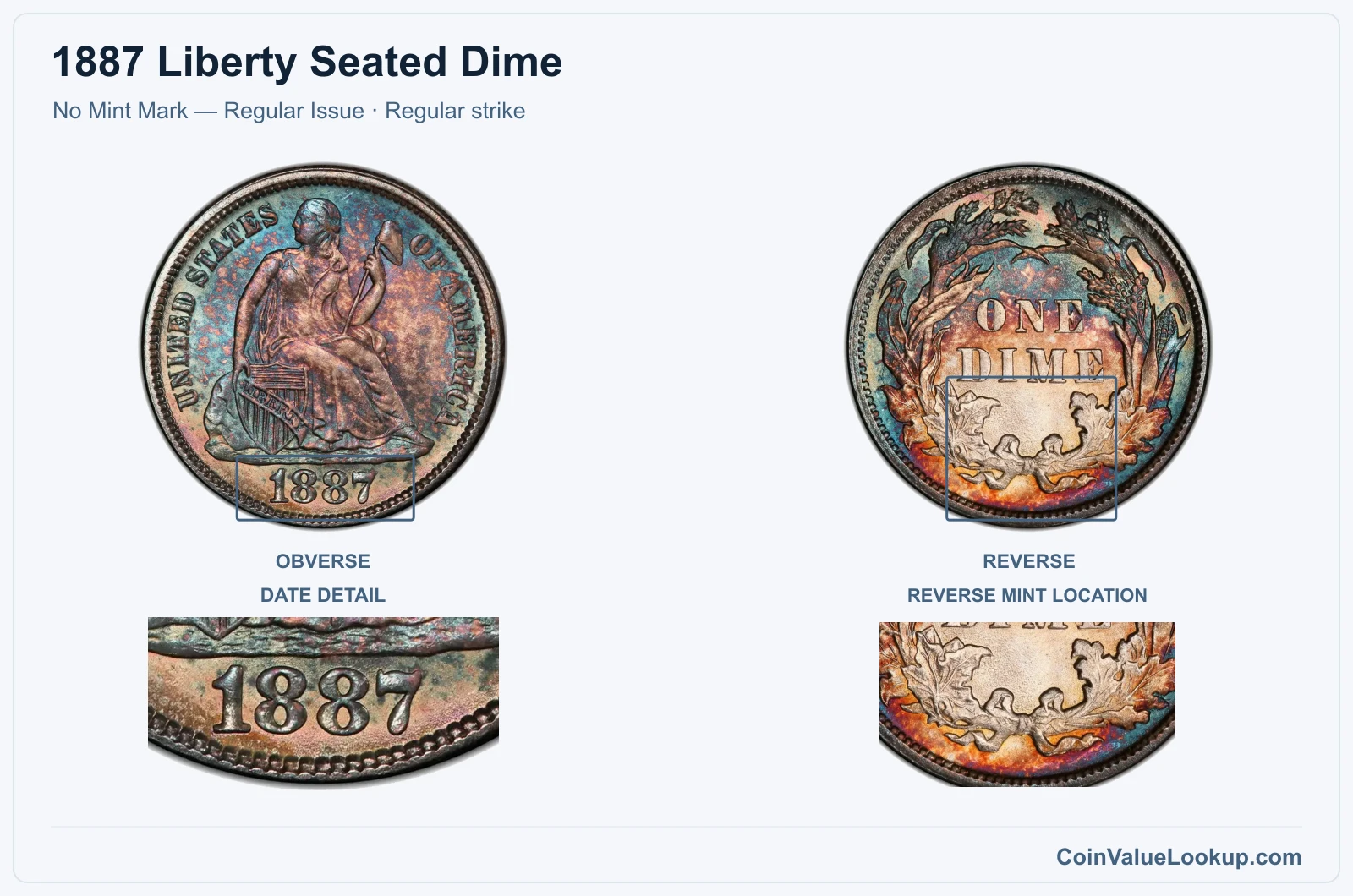
The Philadelphia issue has no mintmark anywhere on the coin. Look at the reverse below the wreath bow to confirm the space is empty.
This is the most straightforward version to identify.
USA Coin Book lists guide values of about $22 at G4 and $316 at MS63 for this issue. Coins with original, uncleaned surfaces and strong detail will sit toward the higher end.
Several die varieties have been documented at this mint for 1887, including clashed dies and minor doubled die reverses, so inspect your Philadelphia piece carefully before calling it ordinary.
Range Grade
Price Auction Records Appraisal PO PO 1
Coin Identifier FR FR 2
—
Coin Identifier AG AG 3
—
Coin Identifier G G 4
—
Coin Identifier
G 6
—
Coin Identifier VG VG 8
—
Coin Identifier
VG 10
—
Coin Identifier F F 12
—
Coin Identifier
F 15
—
Coin Identifier VF VF 20
Coin Identifier
VF 25
—
Coin Identifier
VF 30
—
Coin Identifier
VF 35
—
Coin Identifier XF XF 40
Coin Identifier
XF 45
—
Coin Identifier AU AU 50
Coin Identifier
AU 53
Coin Identifier
AU 55
Coin Identifier
AU 58
Coin Identifier MS MS 60
Coin Identifier
MS 61
Coin Identifier
MS 62
Coin Identifier
MS 63
Coin Identifier
MS 64
Coin Identifier
MS 65
Coin Identifier
MS 66
Coin Identifier
MS 67
Coin Identifier
MS 68
Coin Identifier
MS 69
—
—
—
MS 70
—
—
—
1887 Liberty Seated Dime — S — Regular Issue
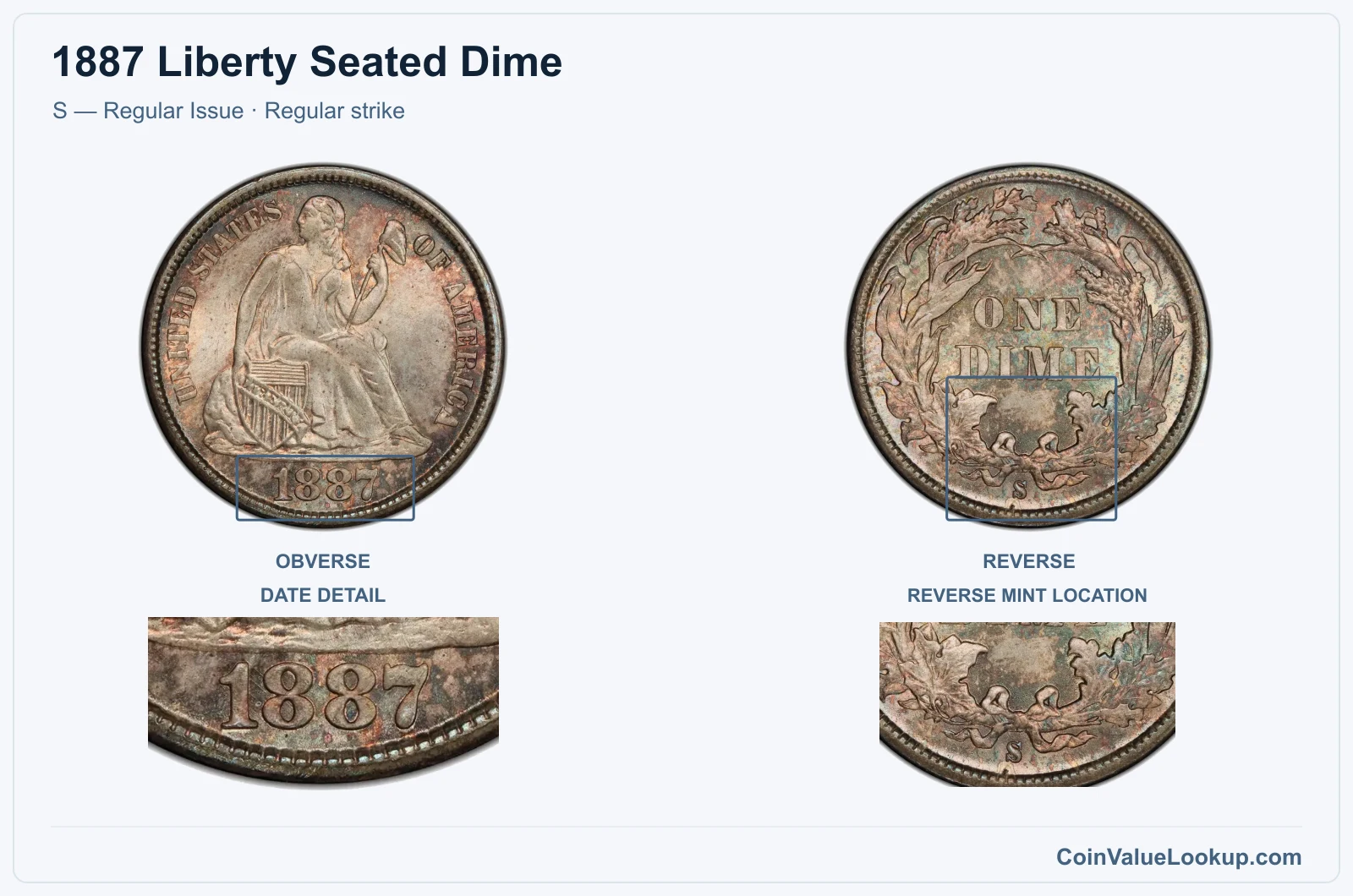
San Francisco strikes carry a small "S" mintmark on the reverse, positioned within the wreath near the bottom. Confirm the letter shape under magnification; a worn mintmark can resemble a lump.
Guide estimates from USA Coin Book place this issue at roughly $22 in G4 and $316 in MS63. Repunched mintmark varieties have been reported for the 1887-S, where remnants of an earlier "S" punch appear near the final position.
Dramatic shattered reverse die states are also documented for San Francisco this year, making it worth studying both sides under good light.
Coin Value Lookup is a handy place to look up guides for other Liberty Seated Dime dates and mints if you are working through a collection.
Range Grade
Price Auction Records Appraisal PO PO 1
—
Coin Identifier FR FR 2
Coin Identifier AG AG 3
—
Coin Identifier G G 4
—
Coin Identifier
G 6
—
Coin Identifier VG VG 8
—
Coin Identifier
VG 10
—
Coin Identifier F F 12
—
Coin Identifier
F 15
—
Coin Identifier VF VF 20
Coin Identifier
VF 25
—
Coin Identifier
VF 30
—
Coin Identifier
VF 35
—
Coin Identifier XF XF 40
—
Coin Identifier
XF 45
Coin Identifier AU AU 50
Coin Identifier
AU 53
Coin Identifier
AU 55
Coin Identifier
AU 58
Coin Identifier MS MS 60
—
Coin Identifier
MS 61
Coin Identifier
MS 62
Coin Identifier
MS 63
Coin Identifier
MS 64
Coin Identifier
MS 65
Coin Identifier
MS 66
Coin Identifier
MS 67
Coin Identifier
MS 68
—
—
—
MS 69
—
—
—
MS 70
—
—
—
1887 Liberty Seated Dime — No Mint Mark — Proof Regular Proof
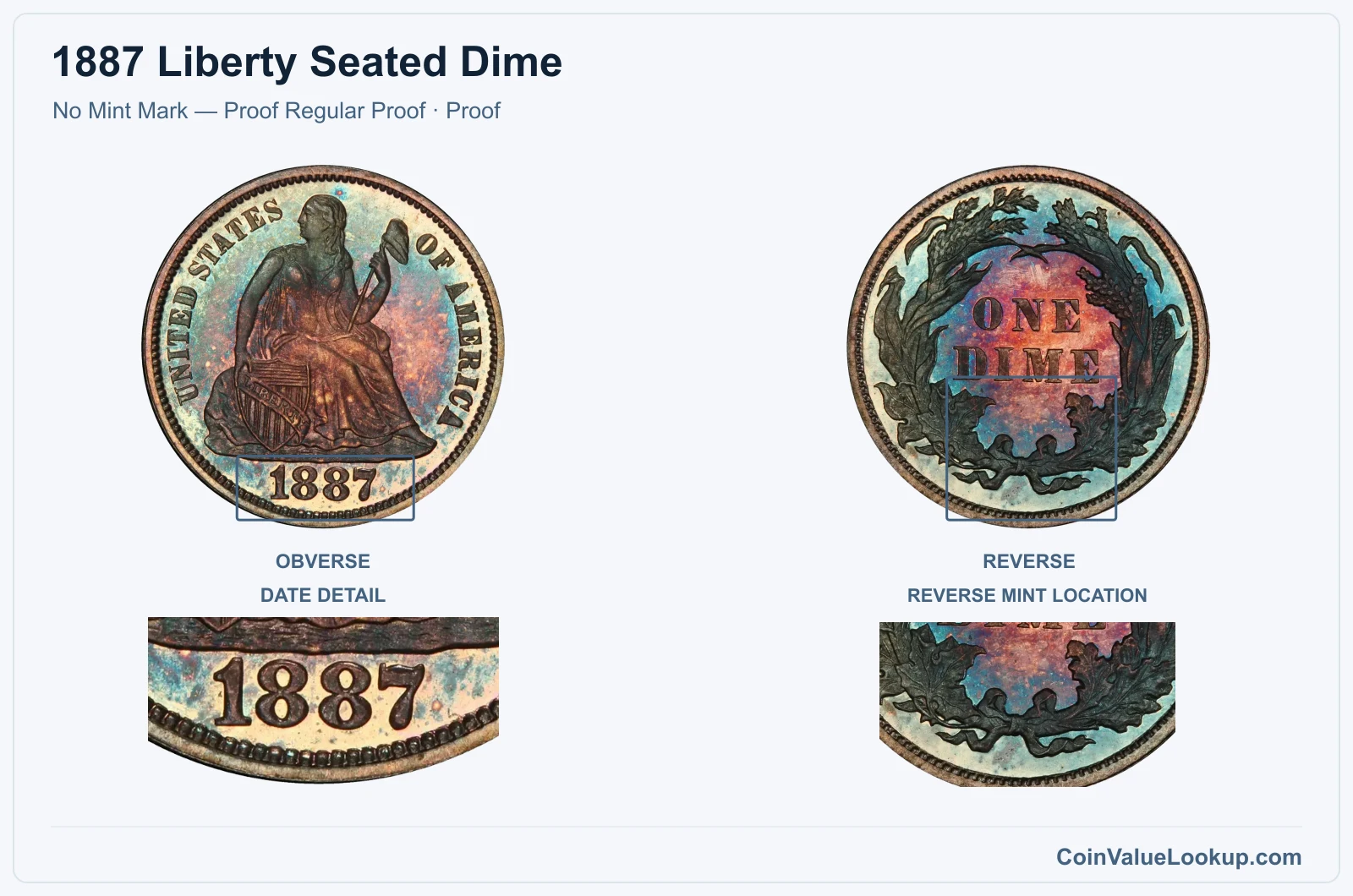
Philadelphia Proofs were struck with specially prepared dies on polished planchets, producing mirror-like fields and sharply defined devices. The USA Coin Book guide places the PR63 value at about $725.
To tell a genuine Proof from a polished circulation strike, look for perfectly flat, reflective fields that show no cartwheel luster when tilted under a light. Hairlines from handling or improper storage are common on Proofs and will affect the grade.
Brilliance alone does not confirm Proof status — the overall field quality, die preparation marks and sharp rim definition all matter. If you suspect you have a Proof, professional authentication is the safest route.
Range Grade
Price Auction Records Appraisal PR PR 1
—
Coin Identifier
PR 2
—
Coin Identifier
PR 3
—
Coin Identifier
PR 4
—
Coin Identifier
PR 6
—
Coin Identifier
PR 8
—
Coin Identifier
PR 10
—
Coin Identifier
PR 12
—
Coin Identifier
PR 15
—
Coin Identifier
PR 20
—
Coin Identifier
PR 25
—
Coin Identifier
PR 30
—
Coin Identifier
PR 35
—
Coin Identifier
PR 40
—
Coin Identifier
PR 45
—
Coin Identifier
PR 50
—
Coin Identifier
PR 53
—
Coin Identifier
PR 55
—
Coin Identifier
PR 58
—
Coin Identifier
PR 60
—
Coin Identifier
PR 61
Coin Identifier
PR 62
Coin Identifier
PR 63
Coin Identifier
PR 64
Coin Identifier
PR 65
Coin Identifier
PR 66
Coin Identifier
PR 67
Coin Identifier
PR 68
—
—
—
PR 69
—
—
—
PR 70
—
—
—
1887 Liberty Seated Dime Error List
1. 1887 Liberty Seated Dime — Repunched Date
A repunched date on the 1887 Seated Dime shows remnants of an earlier position of one or more date numerals beside or overlapping the final digits. Under magnification, you will see extra serifs, partial outlines or thickened areas around the 1, 8, 8 or 7 that do not match normal design contours.
This is a die variety, not a strike error — the date punch was applied to the die more than once in slightly different positions. Do not confuse it with machine doubling, which produces flat, shelf-like shadows without the raised, separated contours of a true repunched date.
Damage to the date area from hits or scratches can also mimic the effect. The value of a repunched date depends on its visibility, the specific variety and overall coin condition.
2. 1887 Liberty Seated Dime — Misplaced Date
A misplaced date variety on the 1887 dime places recognizable numeral fragments outside the intended date position. The most commonly reported diagnostic is to check the base of the design or denticles for a stray digit, such as a partial "1" protruding where no number belongs.
These fragments are raised and match the shape of a date digit. That distinguishes them from random die scratches or polishing lines, which tend to be irregular and lack the contour of a specific numeral.
Under magnification, compare the suspect area to the known shapes of the date numerals on the same coin. Value depends on how clear the misplaced digit is, the coin's condition and collector demand for the specific variety.
3. 1887 Liberty Seated Dime — Die Crack / Die Chip
Die cracks appear as raised, irregular lines on the coin's surface, caused by fractures in the steel die during production. On the 1887 Seated Dime, look for thin raised lines that may run from the rim inward or connect design elements.
A die chip is a small raised blob where a piece of the die surface broke away.
A crack that extends from the rim and removes part of the design creates what collectors call a "cud" — a larger, more dramatic feature. Do not confuse raised die cracks with incuse scratches, which are depressed into the surface.
Corrosion deposits or foreign material stuck to the coin can also mimic a chip. The extent and location of the crack, along with the coin's overall condition, determine whether a premium applies.
4. 1887 Liberty Seated Dime — Repunched Mintmark
A repunched mintmark on the 1887-S dime shows traces of a second "S" punch near the final mintmark position. Under magnification, look for a shadow, partial letter or offset outline adjacent to the primary "S" on the reverse.
The key is that a genuine repunched mintmark shows a clear second impression with the form of the letter, not just a vague thickening. Machine doubling tends to produce a flat, shelf-like secondary image without the rounded contours of a separate punch.
Die chips or corrosion around the mintmark can also create misleading shapes. Value depends on the clarity of the extra impression, the specific variety and the coin's overall grade.
This category applies to San Francisco issues only.
5. 1887 Liberty Seated Dime — Clashed Dies
Clashed dies occur when the obverse and reverse dies strike each other without a planchet between them, transferring design elements from one die onto the other. On the 1887 Philadelphia dime, look for faint outlines of the wreath on the obverse fields, or traces of Liberty's figure ghosted onto the reverse.
These transferred images align with where the opposite design would sit during a normal strike, which helps distinguish them from random scratches or raised lines. A brockage — where a struck coin sticks to the die and impresses itself on the next blank — looks different because the transferred image is incuse rather than raised.
Condition and the boldness of the clash determine collector interest and any premium.
6. 1887 Liberty Seated Dime — Doubled Die Reverse
A doubled die reverse on the 1887 dime displays separated or notched contours on reverse lettering, wreath leaves or the denomination. This results from a misalignment during the die-making process, producing a true doubled image on every coin struck from that die.
The critical distinction is between hub doubling and machine doubling. Hub doubling creates raised, separated design elements with distinct contours.
Machine doubling, by contrast, leaves flat, shelf-like shadows that lack sharp definition. Reflections under certain lighting can also trick the eye.
Compare your coin's reverse lettering to a known normal example at the same magnification. The degree of separation and the coin's condition both affect whether a premium is justified.
7. 1887 Liberty Seated Dime — Off-Center Strike
An off-center strike happens when the planchet is not properly seated in the collar during striking, shifting the entire design away from center and leaving an unstruck crescent of blank metal along one edge. On an 1887 Seated Dime, an off-center example is most collectible when the date remains fully visible despite the misalignment.
Do not confuse an off-center strike with a clipped planchet, which removes a curved section of the blank before striking, or with post-mint damage that flattens part of the rim. A genuine off-center coin shows a complete design that is simply displaced.
The percentage of misalignment, date visibility and overall condition all affect desirability and any potential premium.
8. 1887 Liberty Seated Dime — Struck-Through Error
A struck-through error occurs when foreign material — grease, cloth fibers, wire or a metal fragment — gets between the die and the planchet during striking. The result is a localized depression or incomplete area in the design where the obstruction blocked the full impression.
Grease-filled dies typically produce a smooth, slightly sunken blank spot, while a retained foreign object can leave a distinct impression of the material's shape or texture. Do not confuse a struck-through area with ordinary wear, cleaning or weak strike from tired dies.
Wear affects high points first and shows a progressive pattern, while a struck-through spot is random and sharply bounded. The size, clarity and location of the impression, along with the coin's condition, determine collector interest.