1887 Liberty Nickel Coin Value: How Much Is It Worth?
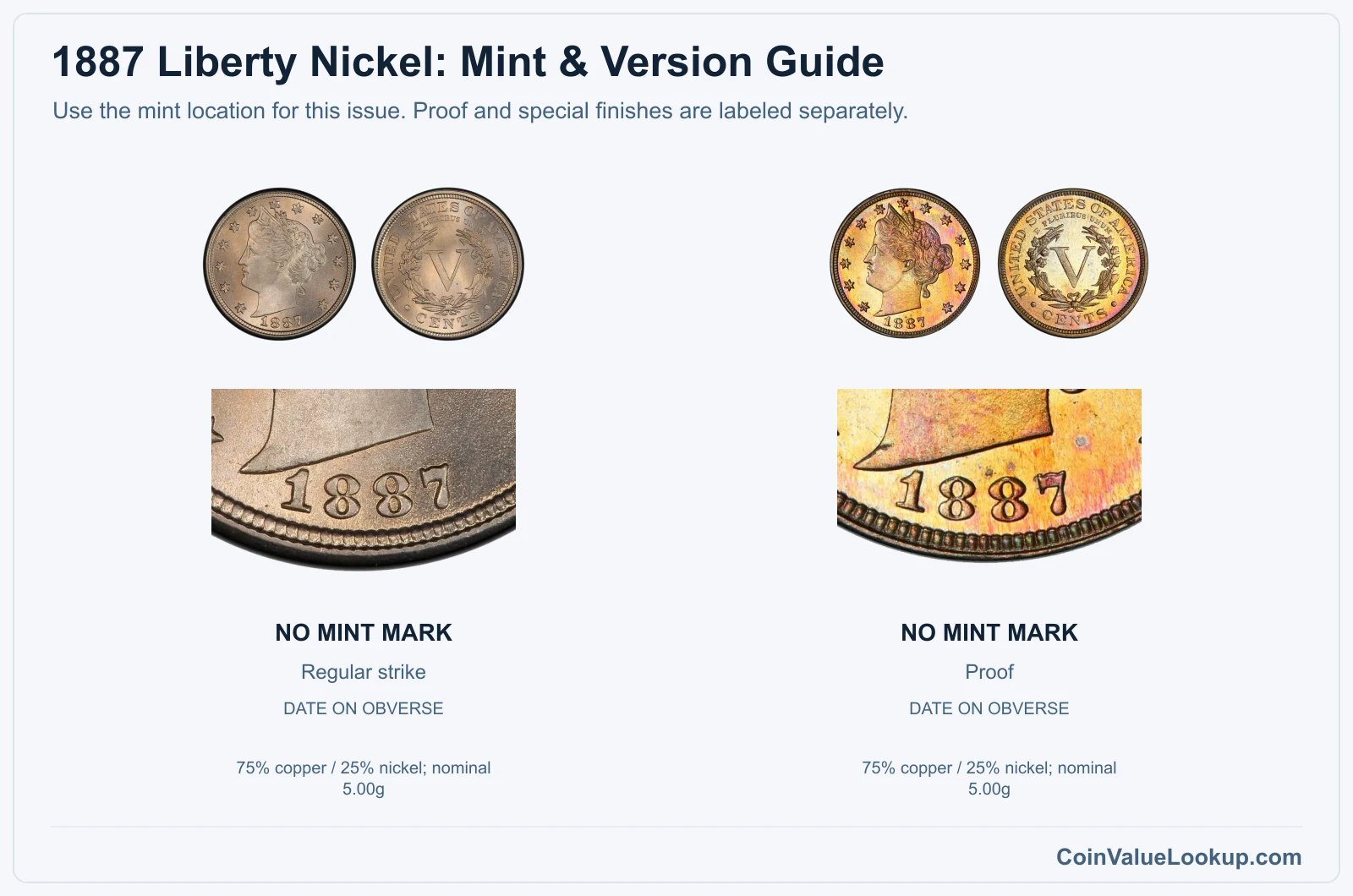
The 1887 Liberty Nickel is a Philadelphia-only issue struck in copper-nickel, and guide estimates place an ordinary With CENTS business strike at about $19 in G4 and around $236 in MS63. Proofs were also struck that year, with a PR63 guide anchor near $344.
Both finishes share the same With CENTS reverse design, and a doubled die reverse variety exists as a separate collectible die variety worth investigating.
Fast Way to Identify Your 1887 Liberty Nickel
Want a quick read on your 1887 nickel? Upload clear photos of the front and back, and the identifier can offer a preliminary take on what version you have.
Good lighting and a sharp image of the reverse lettering help the most. This is not a substitute for professional authentication, but it is a solid starting point.
1887 Liberty Nickel Value
Upload both sides of your 1887 Liberty Nickel.
Front Obverse
Upload photo
Back Reverse
Upload photo
Which 1887 Liberty Nickel Versions Are Worth Money?
- Business strikes in higher grades can reach guide levels around $236 at MS63, well above the $19 G4 baseline.
- Proofs carry a separate premium, with a PR63 guide anchor near $344.
- A doubled die reverse variety is a recognized collectible die variety for 1887 — check reverse legends carefully.
- Coins with original, uncleaned surfaces in any grade tend to be more desirable than cleaned examples.
Step 1: Identify Your 1887 Liberty Nickel Mint Mark and Version
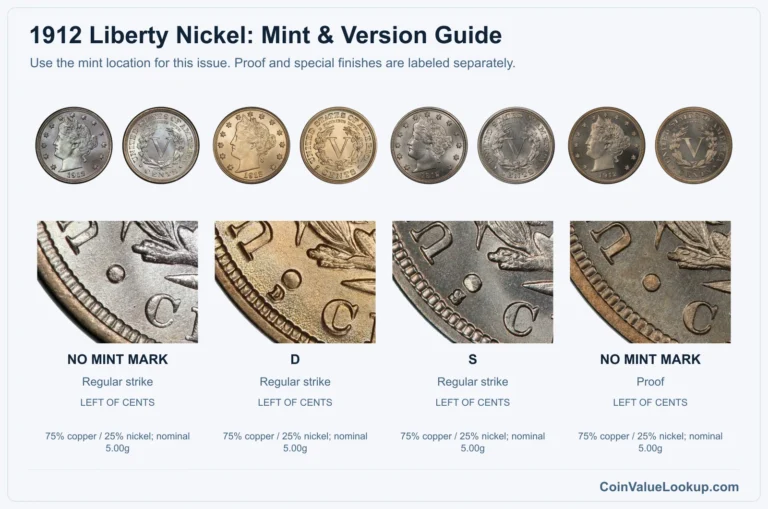
Every 1887 Liberty Nickel was struck at Philadelphia, so there is no mintmark to hunt for. Do not expect a D or S branch — they do not exist for this date.
The coin is 75% copper and 25% nickel, nominally 5 grams, 21.2 mm across, with a plain edge.
All regular 1887 nickels carry the With CENTS reverse, meaning the word CENTS appears at the bottom of the wreath. The earlier No CENTS design was a separate 1883-only issue.
If your coin says CENTS on the back, you have the standard type.
The two main branches are business strike and proof. Business strikes were made for commerce; proofs were specially manufactured presentation pieces with mirror-like fields.
A doubled die reverse variety has also been reported for this year — that is a specific die variety, not a different denomination or design type. Compare your reverse lettering closely against a known normal example to check.
Step 2: Check Your 1887 Liberty Nickel Grade
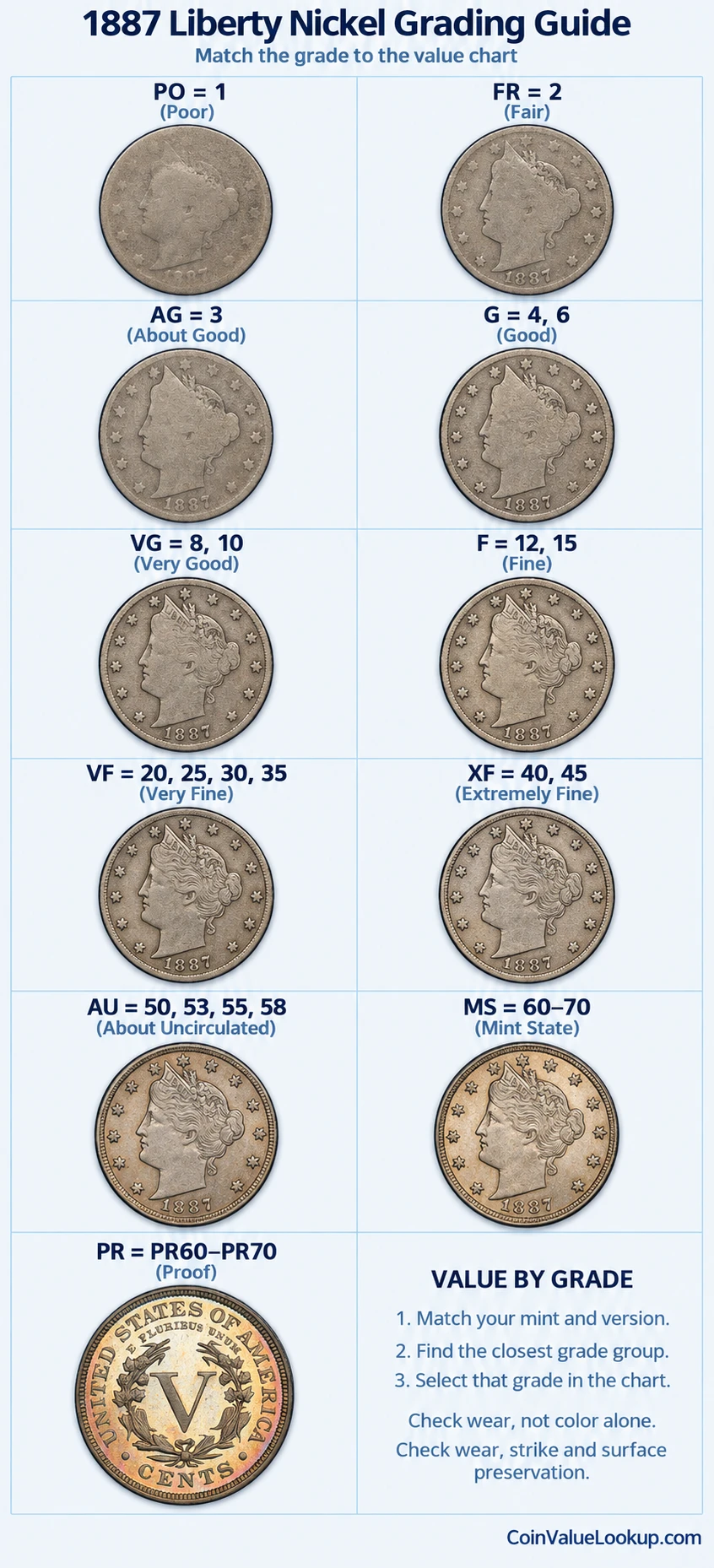
Start with LIBERTY on the coronet. On a well-worn coin those letters fade unevenly, with the B and E often going first.
A G4 example will show a full outline of the head and partial LIBERTY at best. Move to the high hair curls above the ear and the cheek — these are the first areas to lose detail from circulation.
On the reverse, check the ears of corn and wreath leaves for flattening. But here is the catch: some 1887 nickels left the mint with a weak strike, especially on the hair and corn details.
Weak design elements alone do not prove the coin circulated. Assess the fields and luster before downgrading.
For mint-state pieces, look at overall luster, the severity of contact marks (bag marks from storage), and how sharp the strike is. Use the comparison image to gauge where your coin falls.
Proof is a manufacturing method, not a grade sitting above MS. Genuine proofs show deeply mirrored fields, squared-off rims, and a different surface texture.
Hairlines from cleaning are the biggest condition issue on proofs — examine under angled light.
Step 3: Check 1887 Liberty Nickel Value by Mint and Version
1887 Liberty Nickel — No Mint Mark — With CENTS Circulation
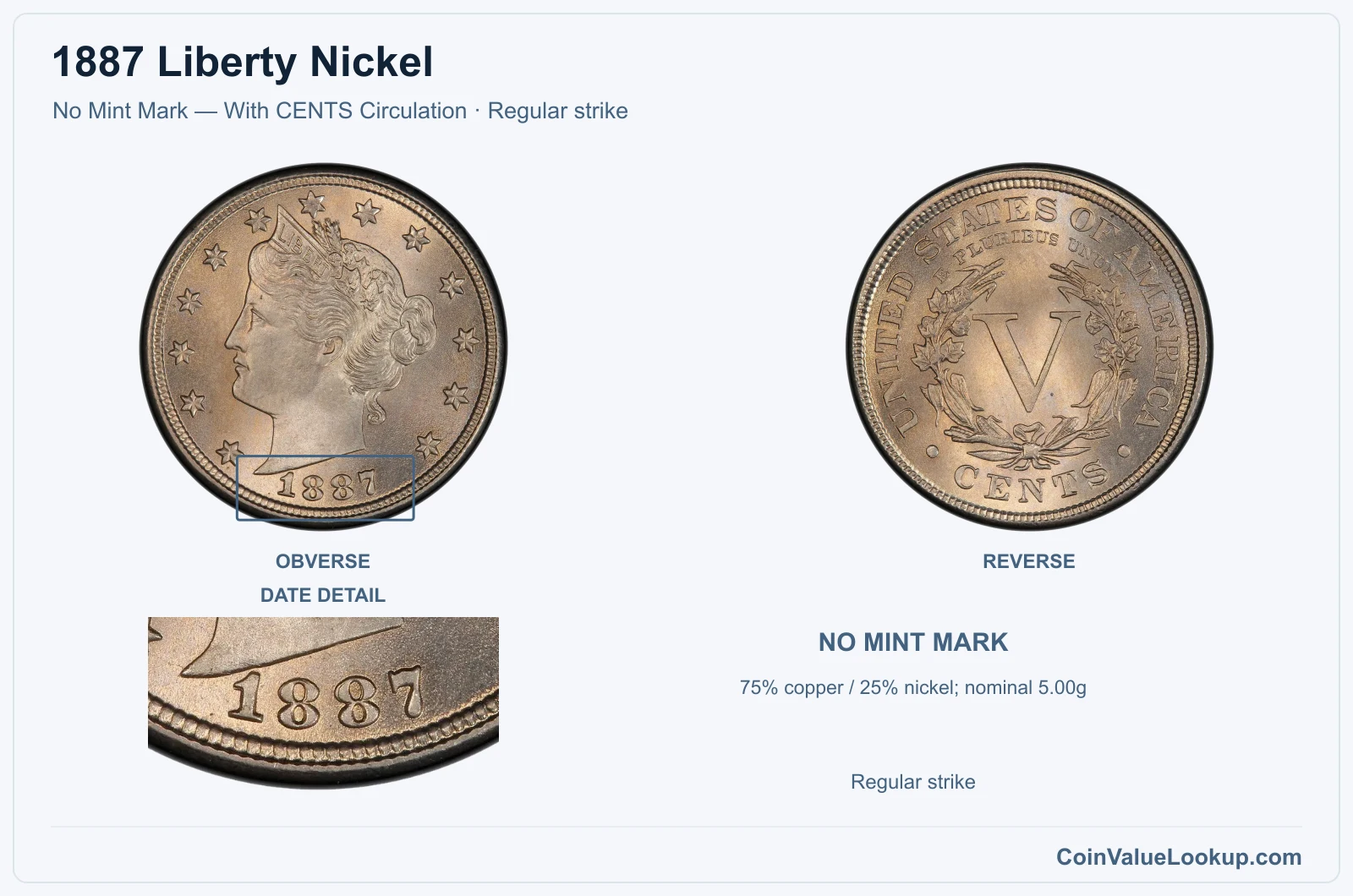
The standard 1887 With CENTS business strike is what most collectors encounter. It was produced only at Philadelphia, so there is no mintmark anywhere on the coin.
The alloy is 75% copper and 25% nickel.
Guide estimates place this version at roughly $19 in G4 and around $236 in MS63, based on a USA Coin Book snapshot. These are retail guide figures, not guaranteed sale prices.
Actual results depend on eye appeal, strike quality, and whether the surfaces are original.
A doubled die reverse variety has been reported for 1887 business strikes. That is a die variety — a separate collectible category — not a different denomination.
If you spot unusual doubling on the reverse lettering or design, it is worth a closer look and professional attribution.
Range Grade
Price Auction Records Appraisal PO PO 1
—
Coin Identifier FR FR 2
—
Coin Identifier AG AG 3
—
Coin Identifier G G 4
—
Coin Identifier
G 6
—
Coin Identifier VG VG 8
—
Coin Identifier
VG 10
—
Coin Identifier F F 12
—
Coin Identifier
F 15
—
Coin Identifier VF VF 20
—
Coin Identifier
VF 25
—
Coin Identifier
VF 30
—
Coin Identifier
VF 35
Coin Identifier XF XF 40
—
Coin Identifier
XF 45
Coin Identifier AU AU 50
Coin Identifier
AU 53
—
Coin Identifier
AU 55
Coin Identifier
AU 58
Coin Identifier MS MS 60
—
Coin Identifier
MS 61
Coin Identifier
MS 62
Coin Identifier
MS 63
Coin Identifier
MS 64
Coin Identifier
MS 65
Coin Identifier
MS 66
Coin Identifier
MS 67
Coin Identifier
MS 68
—
—
—
MS 69
—
—
—
MS 70
—
—
—
1887 Liberty Nickel — No Mint Mark — With CENTS Proof
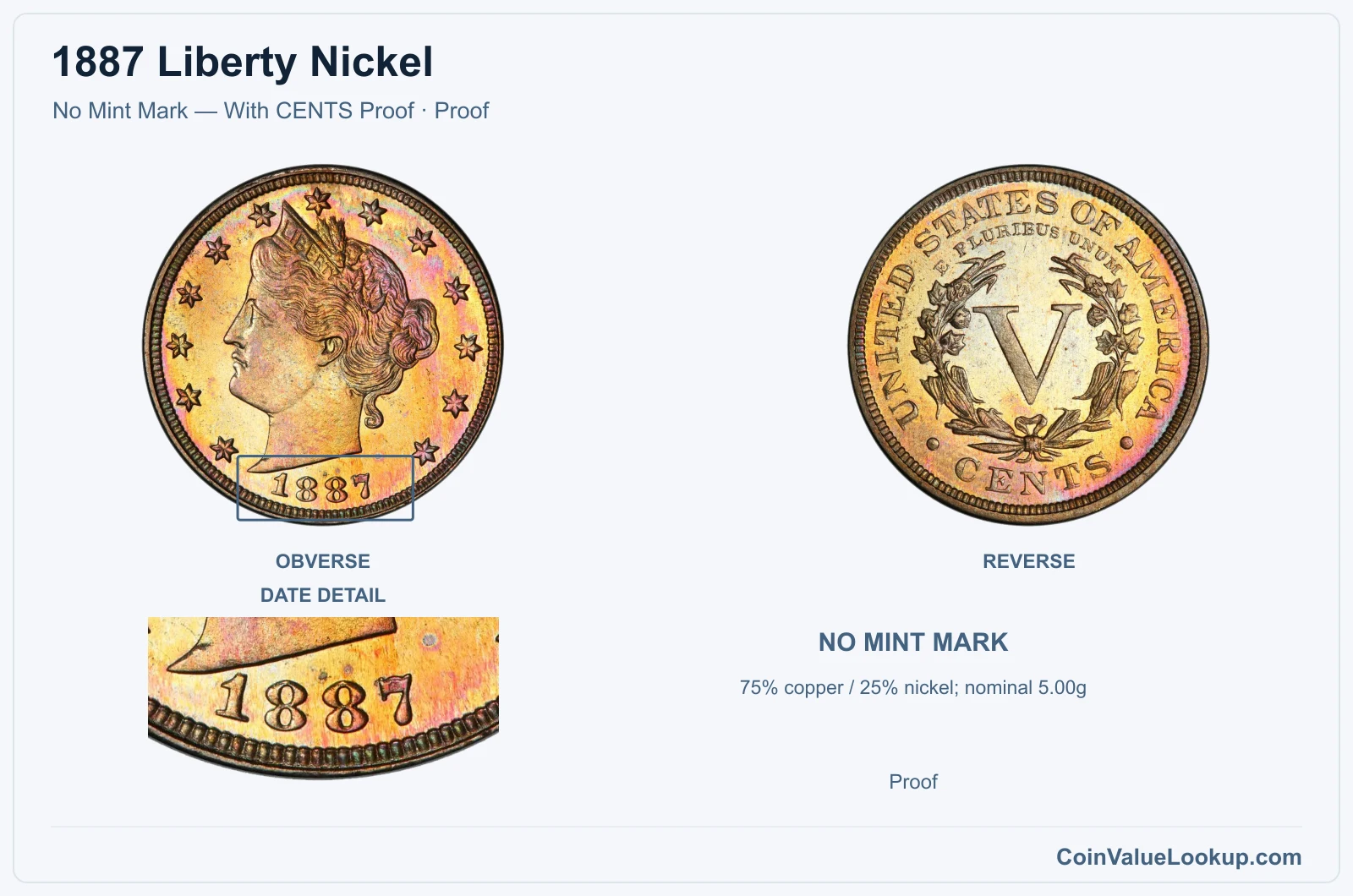
Philadelphia also produced proof Liberty Nickels in 1887, and these are struck with polished dies on specially prepared planchets. The result is a coin with deeply mirrored fields and sharp design edges that look nothing like a business strike under magnification.
A PR63 example carries a guide anchor of about $344 per USA Coin Book. That is a single-snapshot retail estimate; your mileage will vary based on surface preservation, hairlines, and overall eye appeal.
Show both faces clearly and pay attention to the field and rim detail when photographing a suspected proof.
Coin Value Lookup is a good place to look up guides for Liberty Nickels and other series if you are sorting through a collection. A quick search by year and denomination can save time.
Range Grade
Price Auction Records Appraisal PR PR 1
—
Coin Identifier
PR 2
—
Coin Identifier
PR 3
—
Coin Identifier
PR 4
—
Coin Identifier
PR 6
—
Coin Identifier
PR 8
—
Coin Identifier
PR 10
—
Coin Identifier
PR 12
—
Coin Identifier
PR 15
—
Coin Identifier
PR 20
—
Coin Identifier
PR 25
—
Coin Identifier
PR 30
—
Coin Identifier
PR 35
—
Coin Identifier
PR 40
—
Coin Identifier
PR 45
—
Coin Identifier
PR 50
—
Coin Identifier
PR 53
—
Coin Identifier
PR 55
—
Coin Identifier
PR 58
—
Coin Identifier
PR 60
—
Coin Identifier
PR 61
Coin Identifier
PR 62
Coin Identifier
PR 63
Coin Identifier
PR 64
Coin Identifier
PR 65
Coin Identifier
PR 66
Coin Identifier
PR 67
Coin Identifier
PR 68
—
—
—
PR 69
—
—
—
PR 70
—
—
—
1887 Liberty Nickel Error List
1. 1887 Liberty Nickel — Doubled Die Reverse
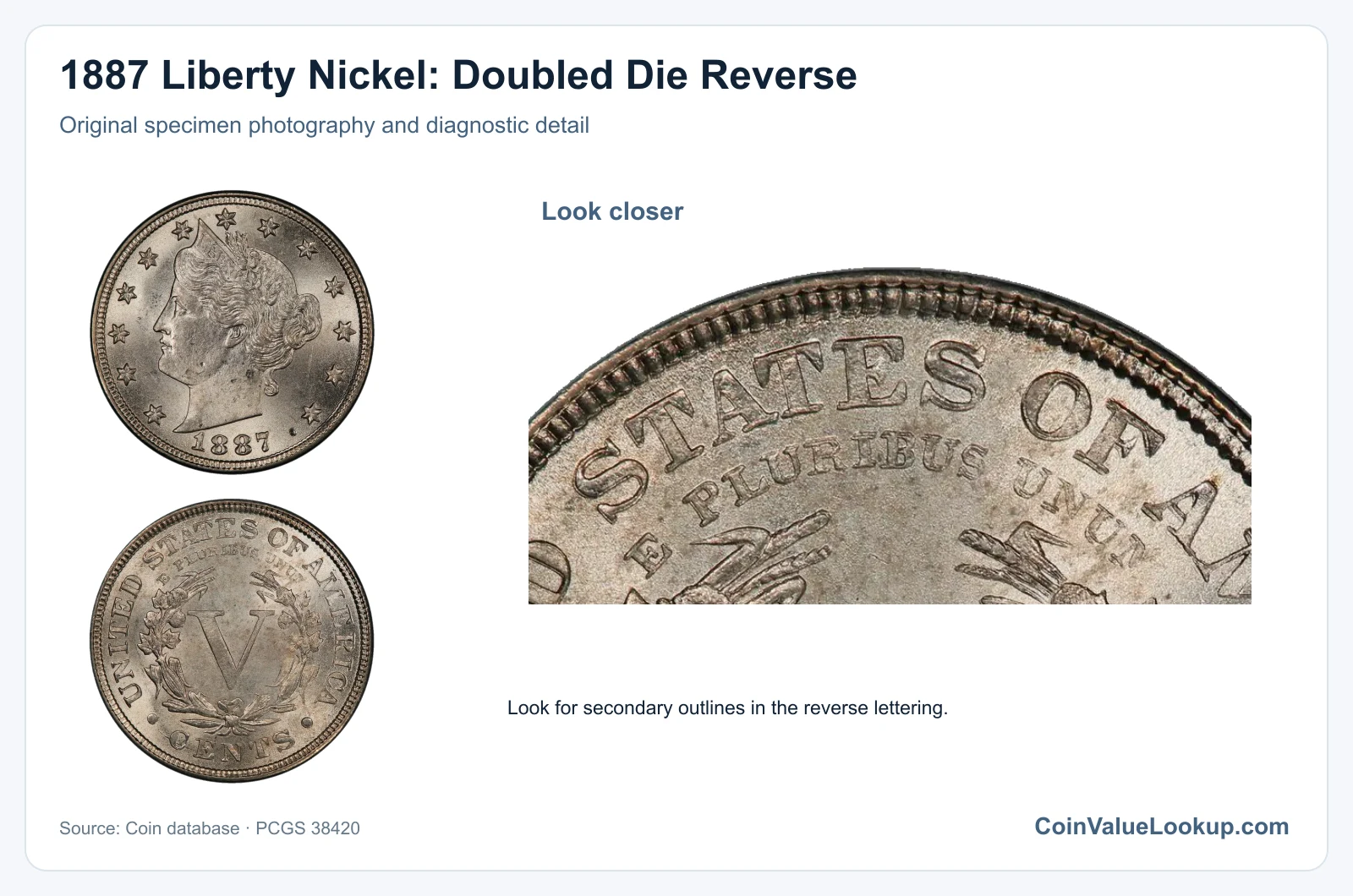
A doubled die reverse has been reported for the 1887 Nickel. This variety shows doubling on the reverse legends or design contours created during the die-making process.
Compare your coin's reverse lettering side by side with a known normal example — the doubling should be consistent and appear as a secondary image slightly offset from the primary design.
The key distinction is separating a true doubled die from machine doubling, which is flat and shelf-like and adds little or no collector premium. Reflections from lighting or random surface damage can also mimic doubling to an untrained eye.
A loupe at 5x or higher helps.
Condition, the visibility of the doubling, and the specific die involved all affect what a doubled die reverse is worth. No specific price range is established here, so individual assessment by a professional grading service is the safest route for determining value.
2. 1887 Liberty Nickel — Die Crack / Die Chip
Die cracks appear as thin raised lines on a coin's surface, caused by fractures in the steel die during production. On an 1887 Nickel, look for fine raised ridges running across the fields or through design elements.
Die chips show up as small raised blobs — little lumps of metal filling a void where a piece of the die surface broke away.
These are distinct from incuse scratches, which are pressed into the surface rather than raised above it. Corrosion or foreign material stuck to the coin can also look similar at first glance, so check under magnification and feel for raised relief.
The value of a die crack or chip depends on its size, location, and how dramatically it affects the coin's appearance. No specific price range is adopted here; each piece needs individual evaluation based on condition and the prominence of the feature.
3. 1887 Liberty Nickel — Die Break / Cud
A cud is a major die break that connects to the rim of the coin, leaving a raised, featureless blob where part of the design should be. It happens when a chunk of the die edge breaks off entirely.
On an 1887 Nickel, you would see a smooth raised area along the rim with displaced or missing design detail adjacent to it.
Do not confuse a cud with a rim dent or ding, which is post-mint damage and pushes metal inward rather than leaving a raised, flat mass. Interior die chips also differ — they sit within the design field and do not touch the rim.
Corrosion buildup near the edge can mimic a cud under poor lighting, so examine the area carefully with magnification.
Value depends on the size, location, and visual impact of the cud, as well as the overall condition of the coin. No specific price range is established here; professional evaluation is recommended for any significant die break.