1984 Jefferson Nickel Coin Value: How Much Is It Worth?
Most 1984 Jefferson nickels you pull from a jar are worth face value. Circulated pieces simply do not carry a meaningful premium.
In uncirculated condition, USA Coin Book guide estimates place these coins between roughly $0.30 and $3.62 depending on mint and grade (MS60–MS65). S-mint proofs and authenticated error coins occupy their own separate markets.
Fast Way to Identify Your 1984 Jefferson Nickel
Snap clear photos of the front and back of your 1984 nickel and upload them here. This gives you a preliminary identification of the mint, finish, and any visible oddities.
It is not a substitute for professional certification, but it is a solid first step before you dig deeper.
1984 Jefferson Nickel Value
Upload both sides of your 1984 Jefferson Nickel.
Front Obverse
Upload photo
Back Reverse
Upload photo
Which 1984 Jefferson Nickel Versions Are Worth Money?
- Uncirculated 1984-P nickels in MS65 carry a USA Coin Book guide estimate around $3.62, well above the MS60 figure of $1.24, so condition matters.
- 1984-D nickels at MS65 also guide near $3.62, but MS60 examples sit at roughly $0.30, making grade the biggest value driver.
- 1984-S proofs guide around $6.25 at PR65; cameo or deep-cameo designations are separate categories that may trade differently.
- Confirmed striking errors such as wrong-planchet strikes and flip-over double strikes have sold individually for hundreds to over a thousand dollars at auction.
- Coins with Full Steps designation on certified holders reflect superior strike quality and attract a distinct collector audience.
Step 1: Identify Your 1984 Jefferson Nickel Mint Mark and Version
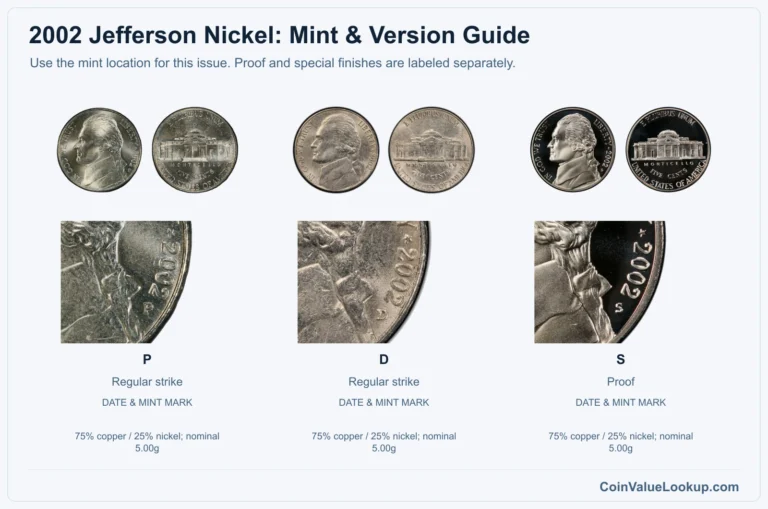
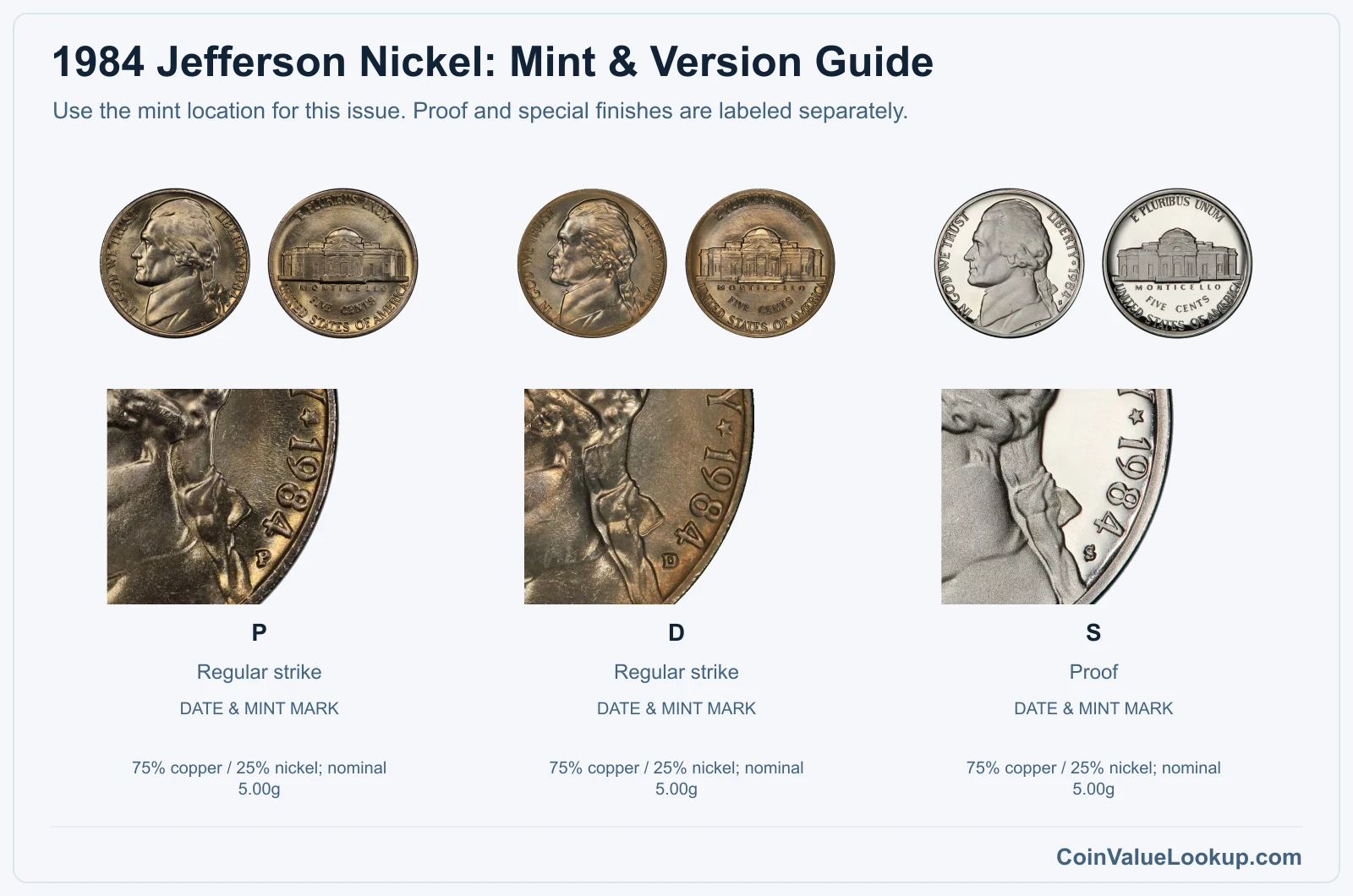
Three versions of the 1984 Jefferson nickel exist: the P (Philadelphia), D (Denver), and S (San Francisco proof). The mintmark sits on the obverse, just below the date.
If you see a "P" or "D," you have a business strike meant for circulation. An "S" means a proof coin sold to collectors in a set.
All three share the same alloy: 75% copper and 25% nickel, weighing about 5 grams with a plain edge and a 21.2 mm diameter. Do not confuse this composition with a clad sandwich; it is a solid copper-nickel alloy.
Before checking any price chart, confirm the mintmark and finish. A proof has mirror-like fields and sharp rims that look nothing like a business strike, even a nice one.
Photograph both sides and the edge so the mintmark and surface character are visible.
Step 2: Check Your 1984 Jefferson Nickel Grade
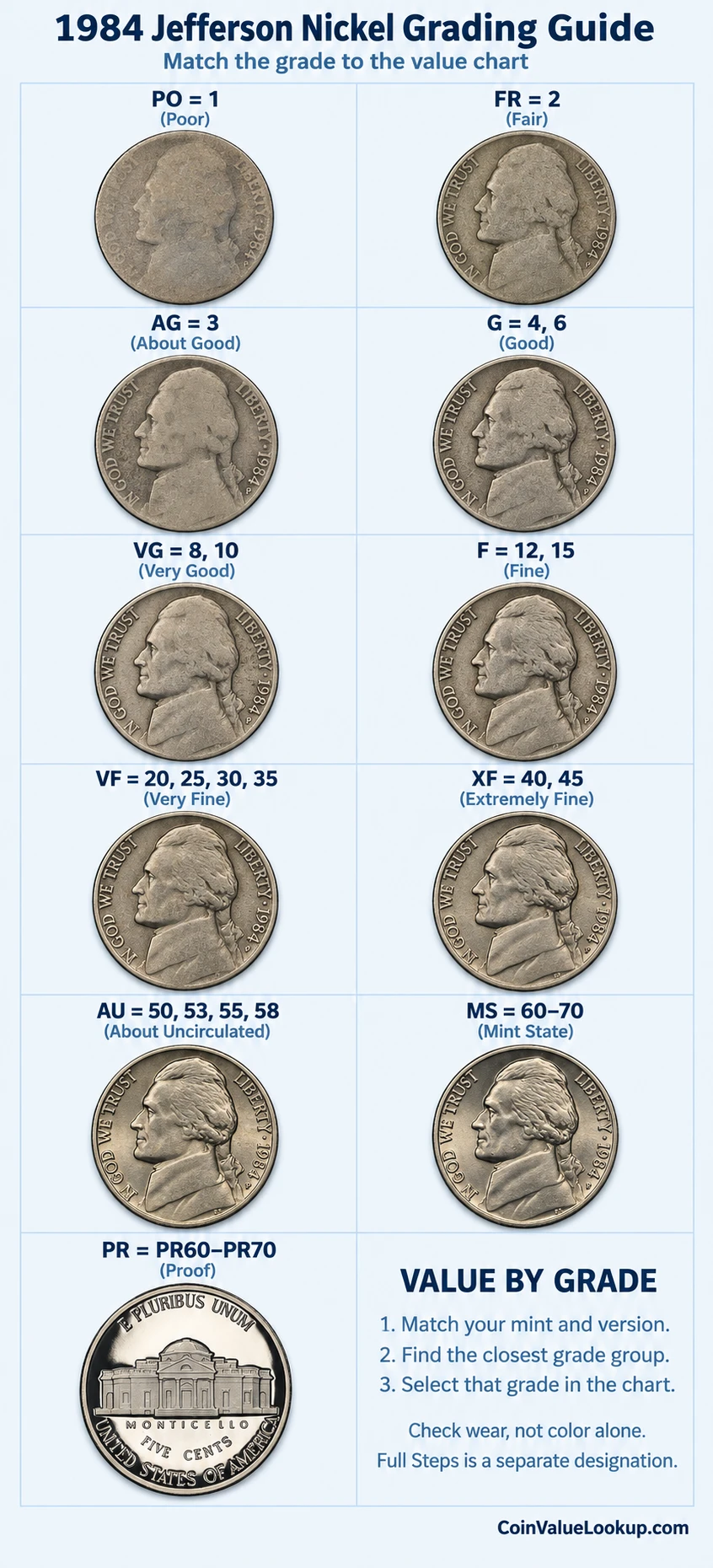
Start with Jefferson's cheek and the hair above his ear. On a well-worn coin, these high points flatten first and the original mint luster disappears.
A coin that still shows full luster and no contact marks on the cheek is heading into Mint State territory.
Flip to the reverse and check Monticello's columns and the steps at the base. Sharp, uninterrupted steps reflect strike quality, not necessarily a higher grade.
Full Steps is a separate designation applied only to certified Mint State business strikes; it is not an error and does not automatically appear on every unworn coin.
Use the comparison image to match your coin's wear pattern. A coin grading around MS60 will show luster but may have bag marks, while an MS65 example is clean with strong eye appeal.
Proof coins are graded on a different scale (PR) and should never be compared directly to business-strike grades.
Step 3: Check 1984 Jefferson Nickel Value by Mint and Version
1984 Jefferson Nickel — P Business strike
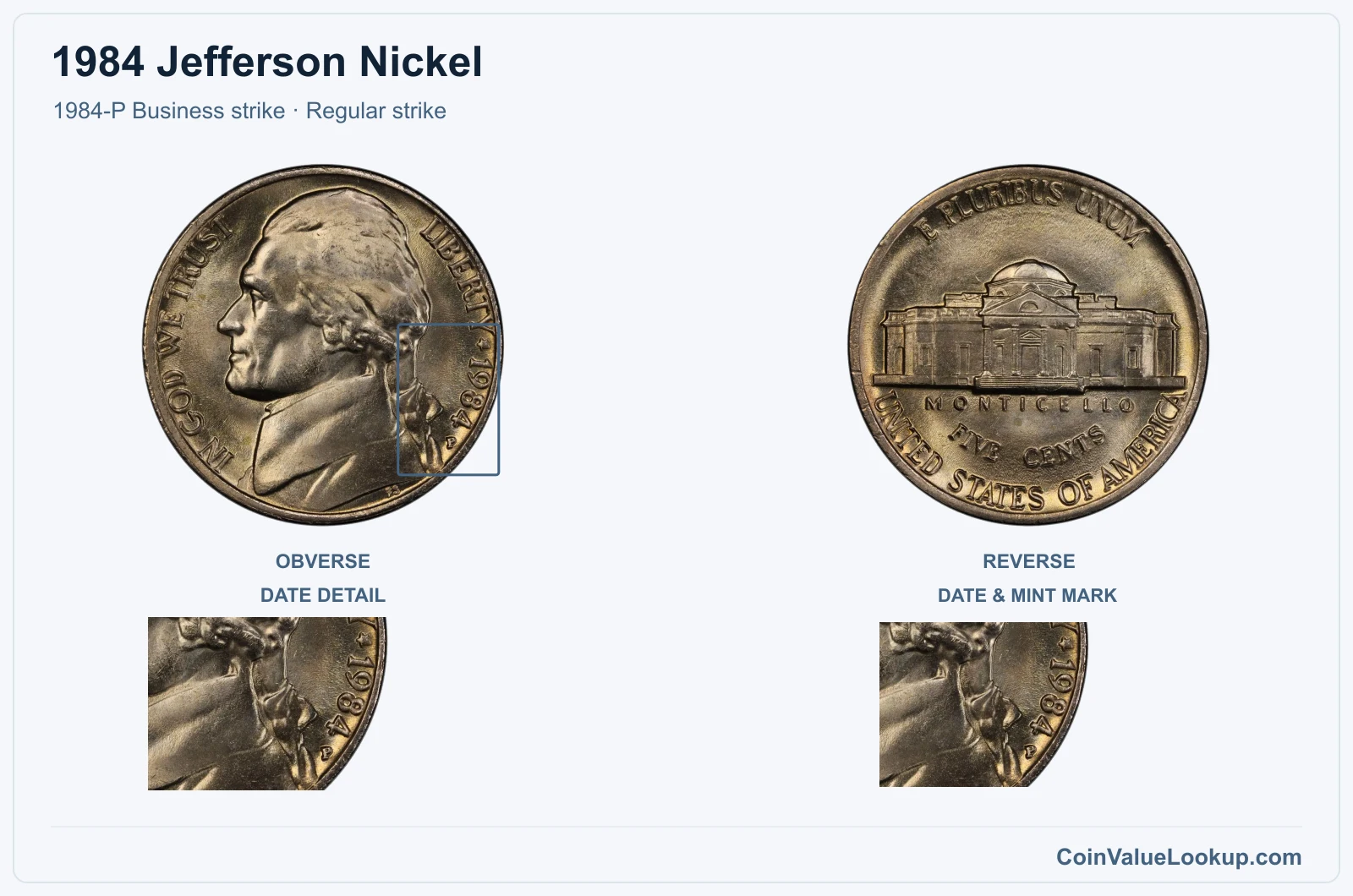
The 1984-P is the Philadelphia business strike, marked with a small "P" below the date. It is a standard 75% copper, 25% nickel coin weighing about 5 grams.
USA Coin Book guide estimates place this version at roughly $1.24 in MS60 and $3.62 in MS65. That jump tells you condition is the whole game here.
A scuffed example fresh from a roll is not the same animal as a clean, lustrous gem.
There is no silver collector branch for this date. If your coin looks coppery or discolored, that is environmental damage or toning, not a different composition.
| Range | Grade | Price | Auction Records | Appraisal |
|---|---|---|---|---|
| PO | PO 1 | — | Coin Identifier | |
| FR | FR 2 | — | Coin Identifier | |
| AG | AG 3 | — | Coin Identifier | |
| G | G 4 | — | Coin Identifier | |
| G 6 | — | Coin Identifier | ||
| VG | VG 8 | — | Coin Identifier | |
| VG 10 | — | Coin Identifier | ||
| F | F 12 | — | Coin Identifier | |
| F 15 | — | Coin Identifier | ||
| VF | VF 20 | — | Coin Identifier | |
| VF 25 | — | Coin Identifier | ||
| VF 30 | — | Coin Identifier | ||
| VF 35 | — | Coin Identifier | ||
| XF | XF 40 | — | Coin Identifier | |
| XF 45 | — | Coin Identifier | ||
| AU | AU 50 | — | Coin Identifier | |
| AU 53 | — | Coin Identifier | ||
| AU 55 | — | Coin Identifier | ||
| AU 58 | — | Coin Identifier | ||
| MS | MS 60 | — | Coin Identifier | |
| MS 61 | — | Coin Identifier | ||
| MS 62 | Coin Identifier | |||
| MS 63 | — | Coin Identifier | ||
| MS 64 | — | Coin Identifier | ||
| MS 65 | Coin Identifier | |||
| MS 66 | — | Coin Identifier | ||
| MS 67 | — | Coin Identifier | ||
| MS 68 | — | — | — | |
| MS 69 | — | — | — | |
| MS 70 | — | — | — |
1984 Jefferson Nickel — D Business strike
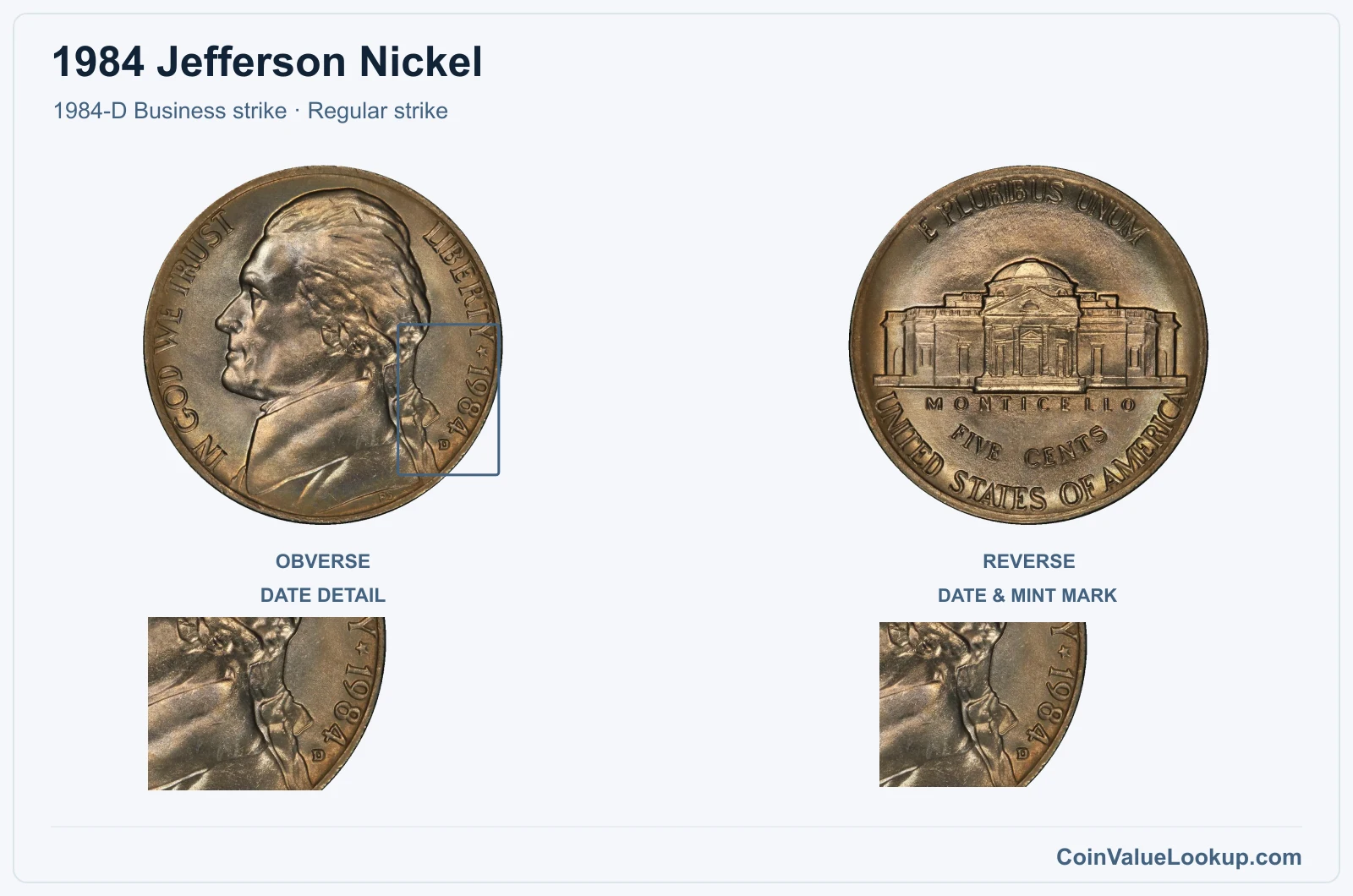
The 1984-D was struck in Denver and carries a "D" mintmark below the date. Same alloy, same weight, same design as its Philadelphia sibling.
Guide estimates from USA Coin Book put this one at about $0.30 in MS60 and $3.62 in MS65. That wide spread means a typical uncirculated coin barely edges past face value, but a well-preserved gem grades out to the same ballpark as the P-mint version.
Coin Value Lookup is a good starting point if you want to compare this nickel against other dates and mints in the Jefferson series. You can browse guides for different denominations there as well.
| Range | Grade | Price | Auction Records | Appraisal |
|---|---|---|---|---|
| PO | PO 1 | — | Coin Identifier | |
| FR | FR 2 | — | Coin Identifier | |
| AG | AG 3 | — | Coin Identifier | |
| G | G 4 | — | Coin Identifier | |
| G 6 | — | Coin Identifier | ||
| VG | VG 8 | — | Coin Identifier | |
| VG 10 | — | Coin Identifier | ||
| F | F 12 | — | Coin Identifier | |
| F 15 | — | Coin Identifier | ||
| VF | VF 20 | — | Coin Identifier | |
| VF 25 | — | Coin Identifier | ||
| VF 30 | — | Coin Identifier | ||
| VF 35 | — | Coin Identifier | ||
| XF | XF 40 | — | Coin Identifier | |
| XF 45 | — | Coin Identifier | ||
| AU | AU 50 | — | Coin Identifier | |
| AU 53 | — | Coin Identifier | ||
| AU 55 | — | Coin Identifier | ||
| AU 58 | — | Coin Identifier | ||
| MS | MS 60 | — | Coin Identifier | |
| MS 61 | — | Coin Identifier | ||
| MS 62 | — | Coin Identifier | ||
| MS 63 | — | Coin Identifier | ||
| MS 64 | — | Coin Identifier | ||
| MS 65 | — | Coin Identifier | ||
| MS 66 | Coin Identifier | |||
| MS 67 | Coin Identifier | |||
| MS 68 | — | — | — | |
| MS 69 | — | — | — | |
| MS 70 | — | — | — |
1984 Jefferson Nickel — S Proof
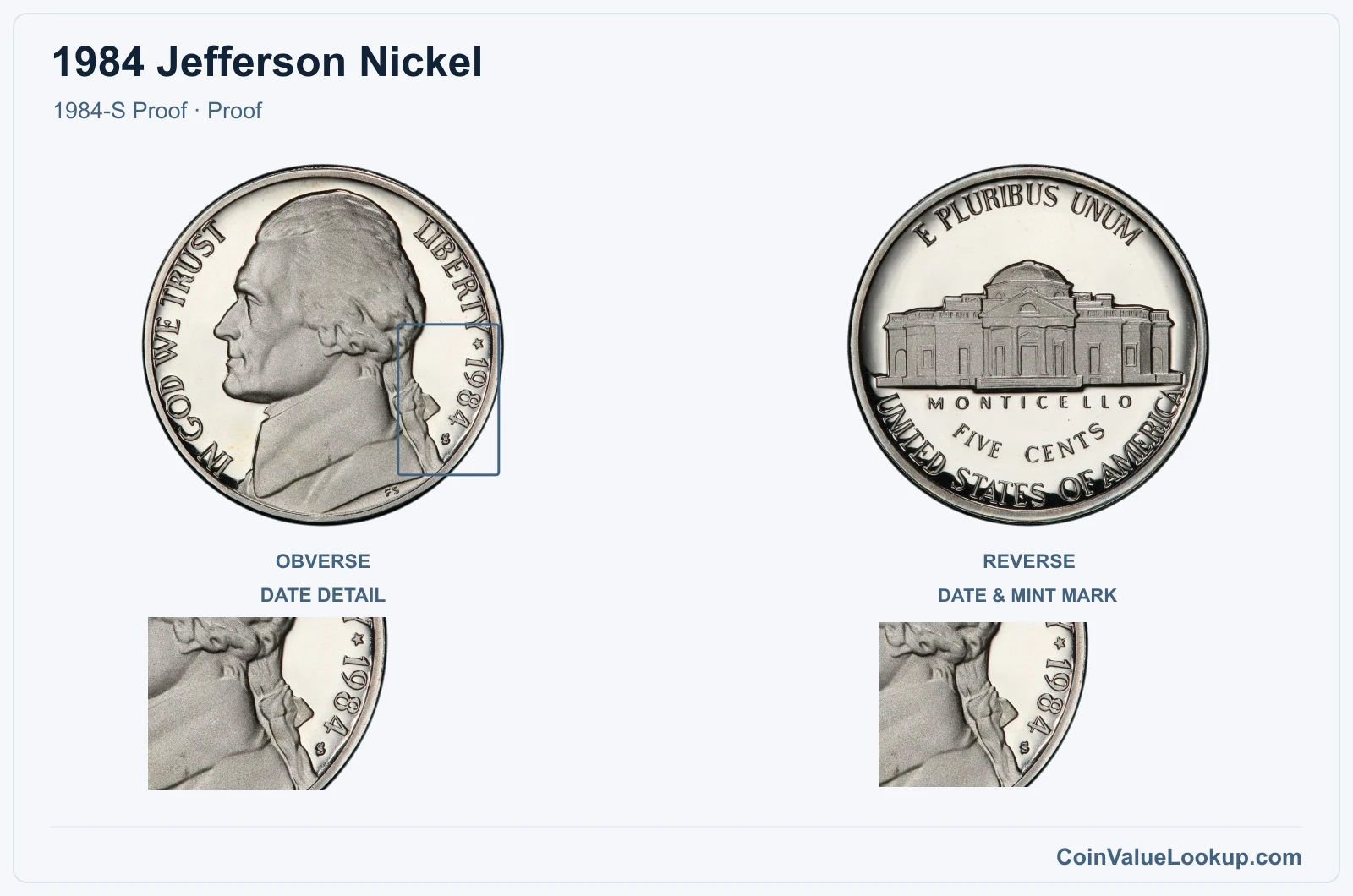
The 1984-S is a proof coin, struck at San Francisco for collector sets. It carries the "S" mintmark and has mirror-like fields with frosted design elements that set it apart instantly from any business strike.
USA Coin Book lists a guide estimate of about $6.25 at PR65. Cameo and deep-cameo contrast levels are tracked separately and may carry different premiums, but no specific cameo valuation is adopted here.
Proof is a manufacturing method, not a grade above Mint State. A PR65 proof and an MS65 business strike are graded on parallel scales.
Do not mix them up when comparing values.
| Range | Grade | Price | Auction Records | Appraisal |
|---|---|---|---|---|
| PR | PR 1 | — | Coin Identifier | |
| PR 2 | — | Coin Identifier | ||
| PR 3 | — | Coin Identifier | ||
| PR 4 | — | Coin Identifier | ||
| PR 6 | — | Coin Identifier | ||
| PR 8 | — | Coin Identifier | ||
| PR 10 | — | Coin Identifier | ||
| PR 12 | — | Coin Identifier | ||
| PR 15 | — | Coin Identifier | ||
| PR 20 | — | Coin Identifier | ||
| PR 25 | — | Coin Identifier | ||
| PR 30 | — | Coin Identifier | ||
| PR 35 | — | Coin Identifier | ||
| PR 40 | — | Coin Identifier | ||
| PR 45 | — | Coin Identifier | ||
| PR 50 | — | Coin Identifier | ||
| PR 53 | — | Coin Identifier | ||
| PR 55 | — | Coin Identifier | ||
| PR 58 | — | Coin Identifier | ||
| PR 60 | — | Coin Identifier | ||
| PR 61 | — | Coin Identifier | ||
| PR 62 | — | Coin Identifier | ||
| PR 63 | — | Coin Identifier | ||
| PR 64 | — | Coin Identifier | ||
| PR 65 | — | Coin Identifier | ||
| PR 66 | — | Coin Identifier | ||
| PR 67 | Coin Identifier | |||
| PR 68 | Coin Identifier | |||
| PR 69 | Coin Identifier | |||
| PR 70 | Coin Identifier |
1984 Jefferson Nickel Error List
1. 1984 Jefferson Nickel — Broadstruck on dime blank with indent
This error occurred when a smaller dime-sized blank overlapped the nickel blank during striking, preventing the collar from engaging properly. The result is a broadstruck nickel with a visible depression, typically around the 10 to 12 o'clock area on the obverse, where the dime blank pressed into the surface.
A Heritage Auctions example from August 2010, graded NGC MS67 and struck at the P mint, sold for $1,063.75. That is a single recorded sale, not a guaranteed market price for every specimen.
Do not confuse this with a simple post-mint dent or a plain wrong-planchet strike. The key diagnostic is the combination of broadstrike evidence and the smaller blank's impression in the nickel's surface.
2. 1984 Jefferson Nickel — Flip-over double strike
A flip-over double strike happens when the coin is struck, flips inside the press, and gets struck again. The second impression lands on the opposite face, producing overlapping designs from both sides on one surface.
It is visually dramatic and hard to miss.
A Heritage Auctions example from September 2024, P mint and graded NGC MS66, brought $480. That is one sale, not a blanket valuation.
The main lookalikes are machine doubling and vise transfer marks. Machine doubling creates a flat, shelf-like distortion on one side only.
A genuine flip-over double strike shows design elements from the opposite die superimposed in a way that no secondary damage can replicate.
3. 1984 Jefferson Nickel — Struck on cent planchet
This is a 1984 nickel design struck on a Lincoln cent planchet. Because the cent blank is smaller, the nickel's design gets cropped around the edges, and the finished product weighs and measures like a cent rather than a nickel.
A Heritage Auctions example from August 2020, P mint and graded PCGS MS62 Brown, sold for $528. That is one auction result.
Color alone is not proof. Copper plating, environmental toning, and coins ground down to a smaller size can all mimic the look.
Proper attribution requires confirming the weight and alloy match a cent blank, which means professional certification. If it just looks coppery but weighs five grams, it is not this error.
4. 1984 Jefferson Nickel — Doubled Die Obverse
A doubled die obverse on a 1984 nickel shows consistent doubling in the obverse lettering or design elements. Look for separation or notching in letters like LIBERTY or IN GOD WE TRUST when compared to a normal coin under the same lighting.
The key word is consistent. Genuine hub doubling repeats in a predictable pattern across multiple design elements.
Machine doubling, by contrast, produces a flat, shelf-like displacement that lacks the rounded, separated quality of a true doubled die.
No specific price range is adopted for this category. Value depends on the visibility of the doubling, the specific die involved, and the coin's overall condition.
Professional attribution is the standard path to confirming this type of variety.
5. 1984 Jefferson Nickel — Off-Center Strike
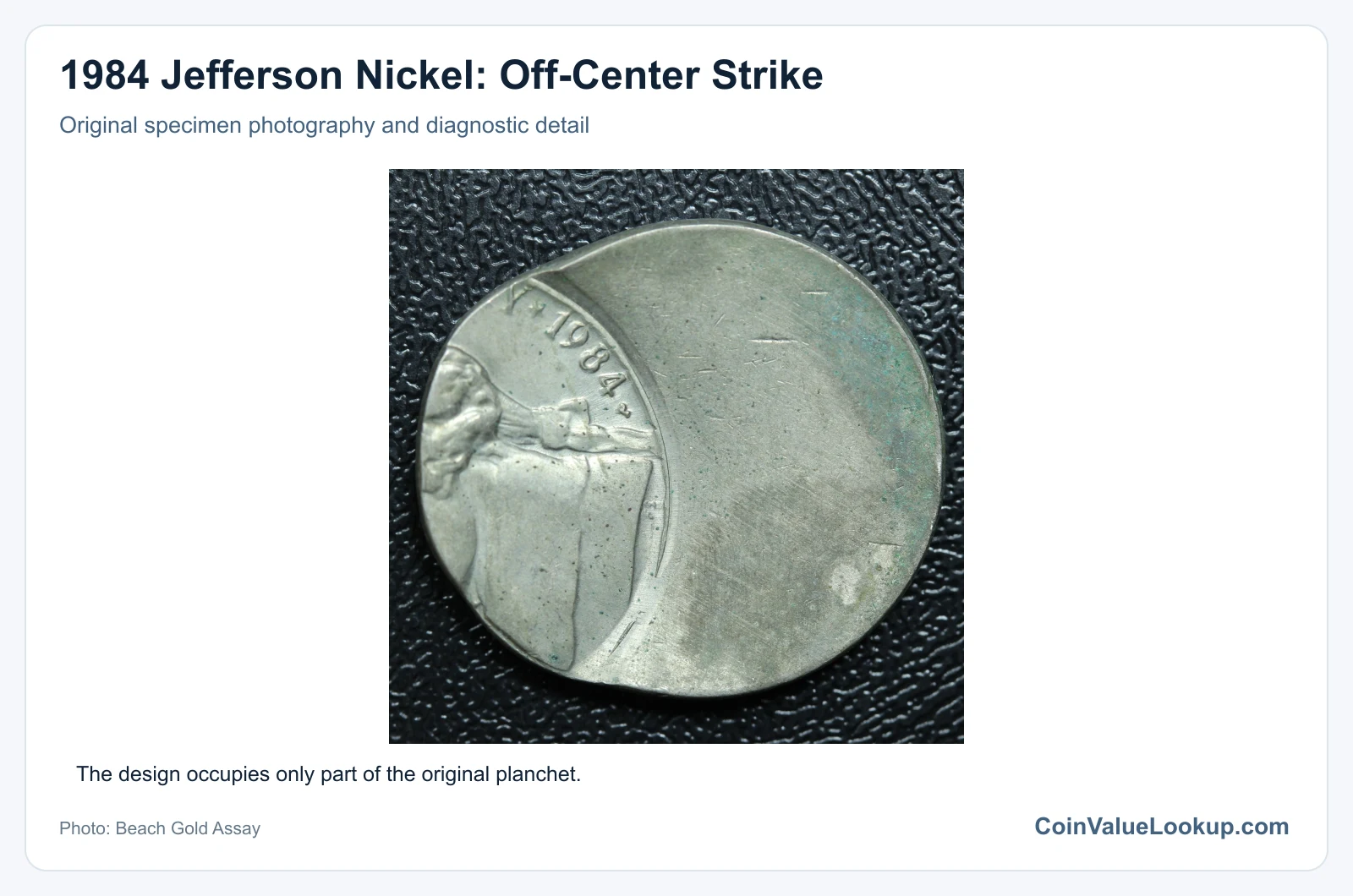
An off-center strike means the blank was not properly seated between the dies when struck. The design shifts to one side, and you get an unstruck crescent of blank metal on the opposite edge.
The most collectible off-center errors still show a readable date. Without the date, attribution to a specific year is difficult and value drops.
Check that the unstruck area is a smooth crescent matching the original blank, not a clipped or post-mint flattened edge.
No numerical price is adopted here. Value depends on the percentage of off-center displacement, whether the date is visible, and overall condition.
Heavier shifts with a legible date tend to attract more attention.
6. 1984 Jefferson Nickel — Die Crack / Die Chip
Die cracks and die chips show up as raised lines or small raised blobs on the coin's surface. They result from fractures in the steel die during production.
A crack running to the rim that produces a raised lump of metal at the edge is called a cud, which is generally more collectible than a thin interior crack.
Look carefully at the raised feature. If it is incuse (pressed into the surface) rather than raised, it is more likely a scratch or corrosion.
Genuine die cracks are always raised because metal flows into the gap in the broken die.
No specific price is adopted for this category. Larger cuds and prominently placed cracks draw more collector interest than hairline interior cracks.
7. 1984 Jefferson Nickel — Lamination / Split Planchet
A lamination error shows peeling or separating metal within the coin's alloy. You might see a retained flap of metal lifting away from the surface, or an area where a layer has already broken off, exposing a rough underlayer.
Photograph the affected area alongside the coin's edge. The edge view can reveal whether the separation extends through the thickness of the planchet, which helps distinguish it from surface scraping or corrosion.
A deliberately cut or filed coin will show tool marks and a clean separation line that looks nothing like the irregular texture of a true lamination.
No price range is adopted. Value depends on size, location, and whether the separated piece is still attached.
8. 1984 Jefferson Nickel — Repunched Mintmark
A repunched mintmark shows traces of a second or shifted position beneath the final mintmark. On 1984 nickels, inspect the P or D below the date under magnification.
Remnants of an earlier punch position may appear as a partial letter offset from the primary mark.
Compare your coin's mintmark to a normal example at the same magnification. Machine doubling around a mintmark tends to look flat and shelf-like, while a genuine repunched mintmark has a rounded, letter-shaped remnant in a distinctly different position.
Die chips or corrosion near the letter can also mimic the look.
No price is adopted for this variety. Condition and the clarity of the repunching affect desirability.
9. 1984 Jefferson Nickel — Struck-Through Error
A struck-through error occurs when foreign material sits between the die and the blank during striking. Grease-filled dies are the most common type, leaving a smooth, featureless area where the design should be.
A retained foreign object leaves an impression of whatever was trapped.
Look for a localized depression or missing design detail that does not match normal wear. Wear removes metal gradually from high points; a struck-through error typically affects a specific patch regardless of the design's relief.
Cleaning residue and scratches can also obscure detail, but they leave different surface textures.
No specific price is adopted. Value depends on the size and location of the affected area, plus whether the obstruction created a distinctive impression.
10. 1984 Jefferson Nickel — Doubled Die Reverse
A doubled die reverse on a 1984 nickel affects the Monticello side. Compare the reverse lettering, particularly MONTICELLO and E PLURIBUS UNUM, against a normal coin.
Genuine doubling will show consistent separation or notching across multiple letters.
Machine doubling is the most common lookalike and produces a flat, shelf-like shadow rather than the rounded, distinct secondary image of a true doubled die. Random nicks or reflections under certain lighting can also create an illusion of doubling.
No numerical price is adopted for this category. The value of any doubled die reverse depends on which specific die is involved, how visible the doubling is to the unaided eye, and the coin's overall grade.
11. 1984 Jefferson Nickel — Improper Annealing
Improper annealing results from a problem in the heating and cooling process that prepares blanks before striking. The coin may show unusual surface discoloration, a streaky or mottled texture, or an oddly dark or light appearance that does not match normal toning patterns.
This is a screening clue, not a definitive diagnosis from a photo. Environmental toning, corrosion, and heat damage applied after minting can all produce similar-looking surfaces.
Photograph the affected coin next to a normal 1984 nickel and include an edge shot for comparison.
No price is adopted. Condition, the severity of the annealing issue, and third-party attribution all influence whether a given example has collector value.