2002 Jefferson Nickel Coin Value: How Much Is It Worth?
Most 2002 Jefferson nickels are worth close to face value in circulated condition. For standard Philadelphia and Denver business strikes, a USA Coin Book retail guide lists roughly $0.30 at MS60 and $1.24 at MS65.
San Francisco proofs occupy a separate collector market. Genuine mint errors can carry premiums, but condition, finish and mintmark all matter before any price applies.
Fast Way to Identify Your 2002 Jefferson Nickel
Snap clear photos of both the front and back of your 2002 nickel and upload them here. The identifier can offer a preliminary look at your coin's mint, finish and general condition.
It is not a substitute for professional authentication or certified grading, but it gives you a solid starting point for figuring out what you have.
2002 Jefferson Nickel Value
Upload both sides of your 2002 Jefferson Nickel.
Front Obverse
Upload photo
Back Reverse
Upload photo
Which 2002 Jefferson Nickel Versions Are Worth Money?
- The 2002-S proof nickel is listed around $3.08 at PR65 per USA Coin Book, well above the face value of ordinary circulation strikes.
- Certain mint errors such as off-center strikes, die clashes and clipped planchets are reported for this year and can carry premiums depending on severity and condition.
- Uncirculated 2002-P and 2002-D nickels in MS65 or better condition are worth checking, since most surviving examples show some degree of wear or contact marks.
Step 1: Identify Your 2002 Jefferson Nickel Mint Mark and Version
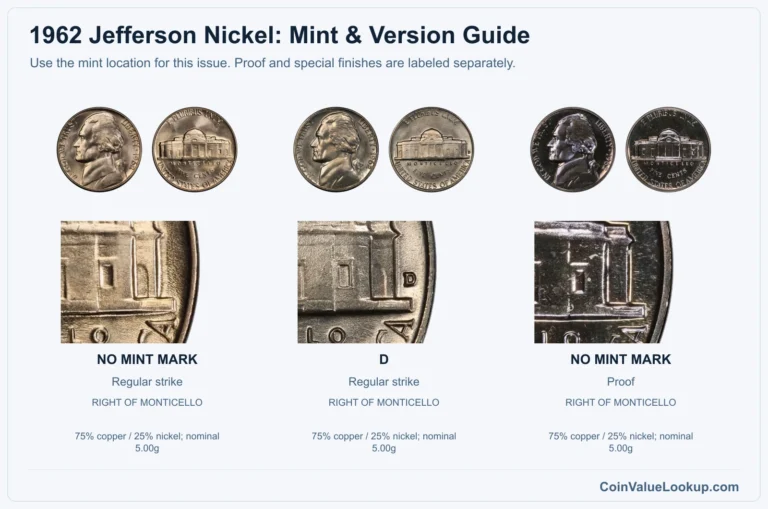
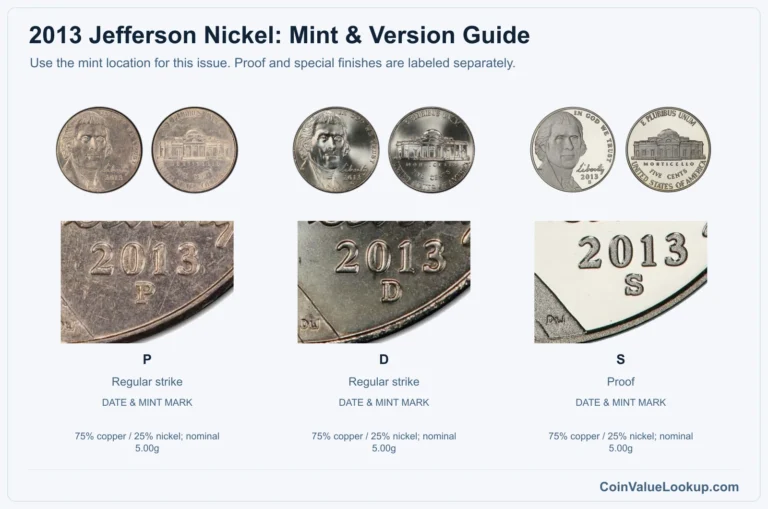
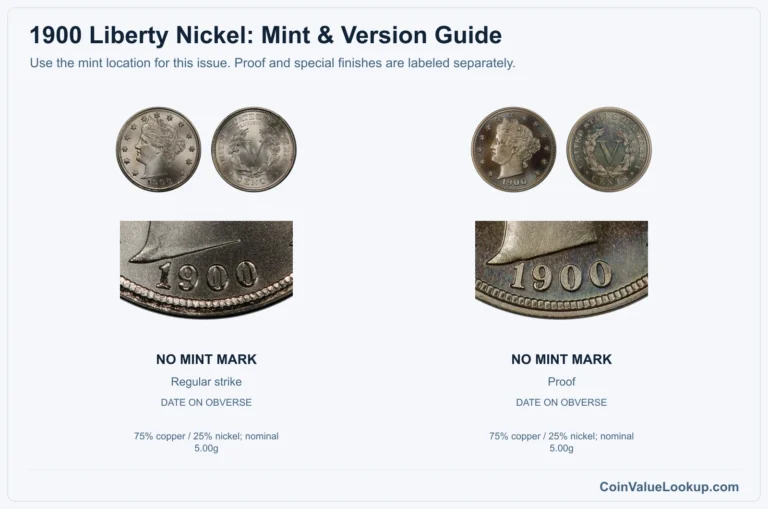
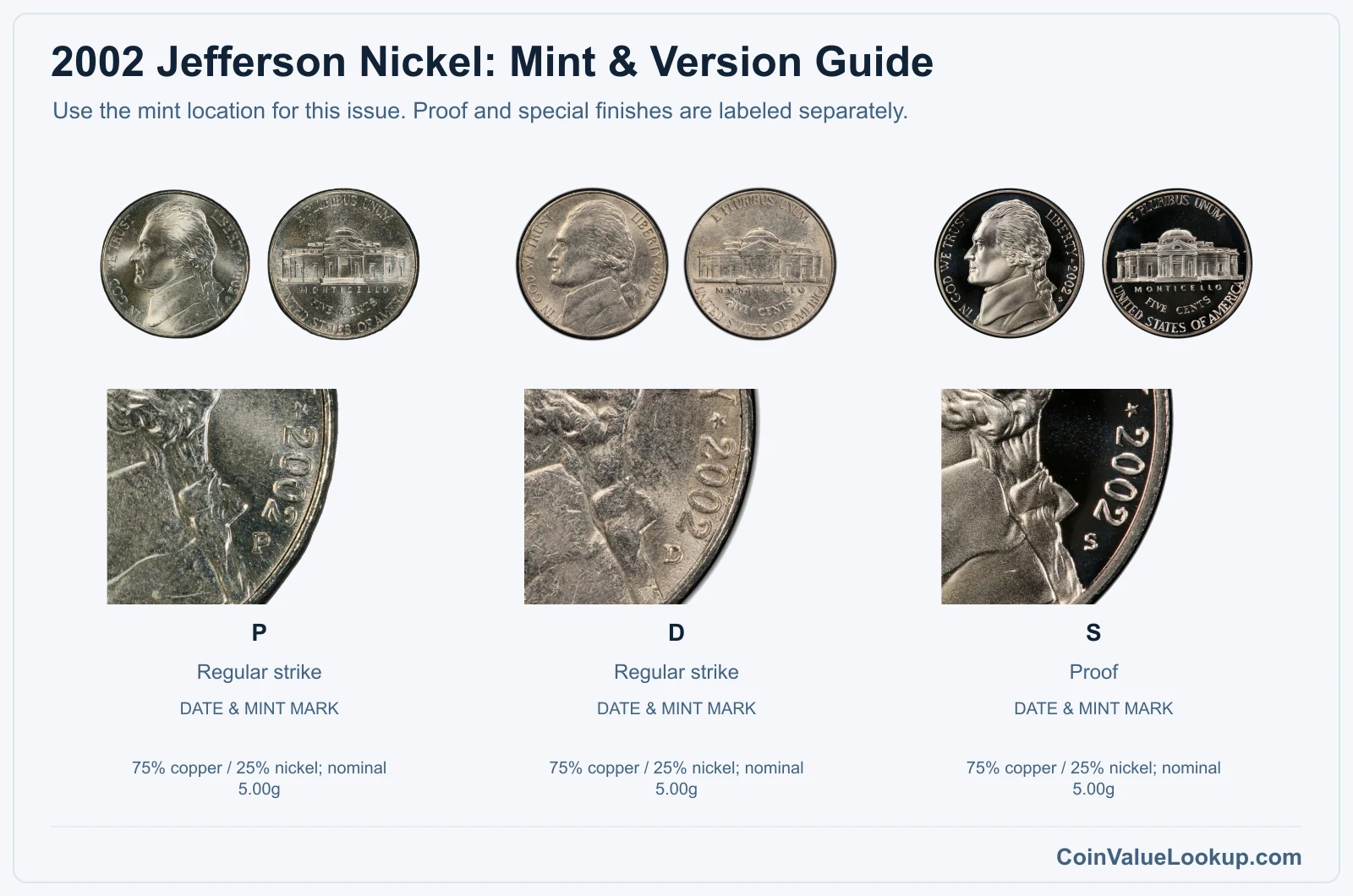
Start by reading the date on the obverse — it should say 2002. Then check below the date for a small "P" (Philadelphia) or "D" (Denver).
If there is an "S" mintmark, you have a San Francisco proof, which was sold in sets, not released into circulation.
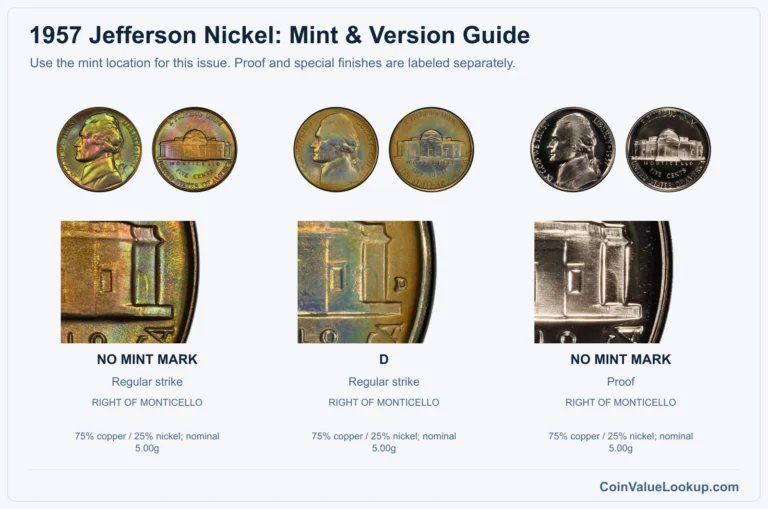
All three versions share the classic Jefferson profile on the obverse and Monticello on the reverse. The standard composition is 75% copper and 25% nickel, weighing about 5 grams with a plain edge and a diameter of 21.2 mm.
Color alone does not confirm the alloy; a worn copper-nickel nickel can look surprisingly different under various lighting.
Do not confuse this coin with the later Westward Journey designs. The 2004 nickels carry Peace Medal and Keelboat reverses, while the 2005 coins feature American Bison and Ocean in View reverses with a redesigned portrait.
The 2002 uses the traditional portrait and Monticello — if the reverse building looks unfamiliar, double-check the date.
Step 2: Check Your 2002 Jefferson Nickel Grade
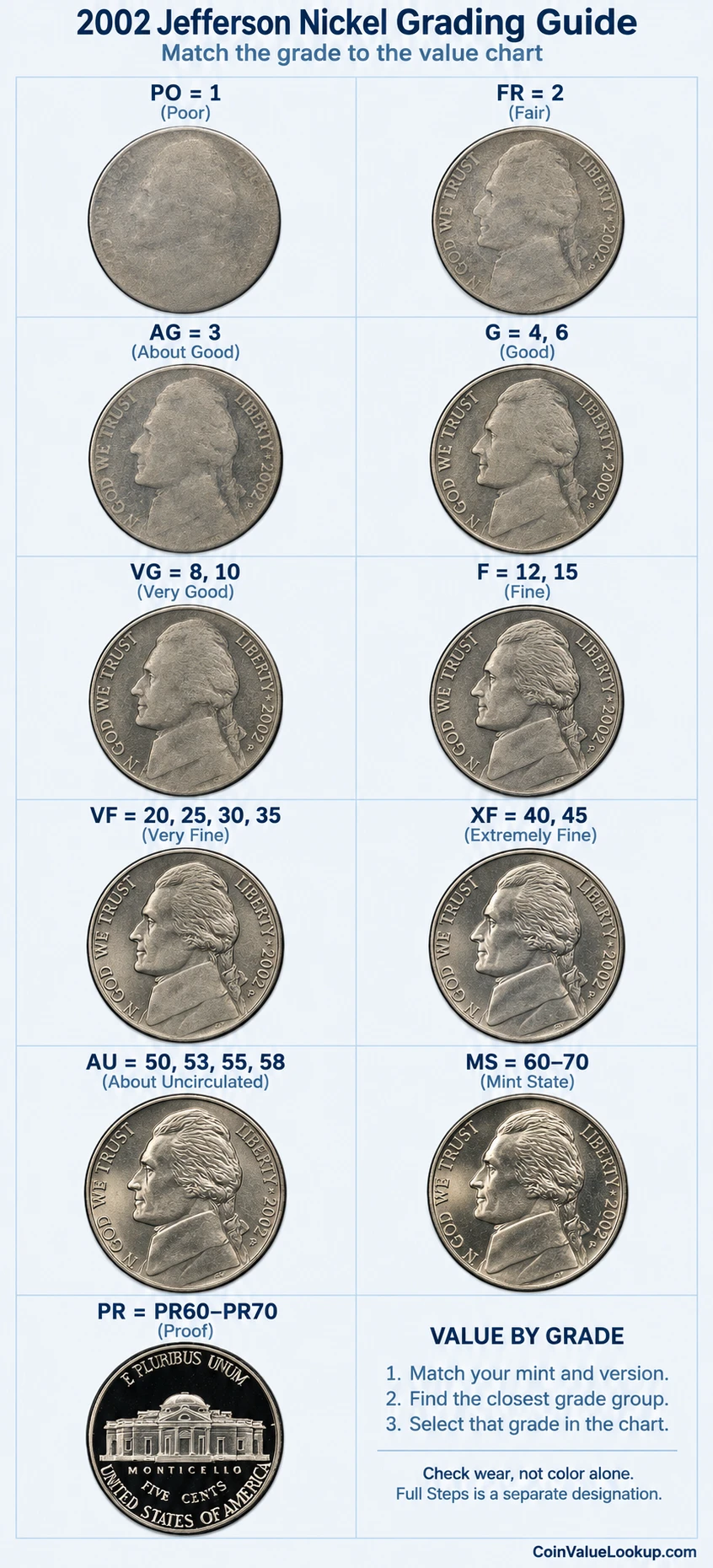
Look at Jefferson's cheek and the hair above his ear first. On a well-worn coin, those areas will be flat and dull.
A coin with original mint luster across the entire surface and no visible wear is a candidate for Mint State grades.
Bag marks and contact scratches also play a role. Even an unworn coin can drop in grade if the surfaces are heavily marked from rolling around with other coins.
Use the comparison image to judge how your coin's detail lines up against known grade examples of the same design.
On the reverse, the sharpness of the Monticello steps relates to strike quality, not wear. A weakly struck coin can look like it has wear on the steps when the rest of the coin is pristine.
Proof coins from San Francisco have mirror fields and frosted devices — that is a finish, not a higher tier of grade above Mint State.
Step 3: Check 2002 Jefferson Nickel Value by Mint and Version
2002 Jefferson Nickel — P — Business strike
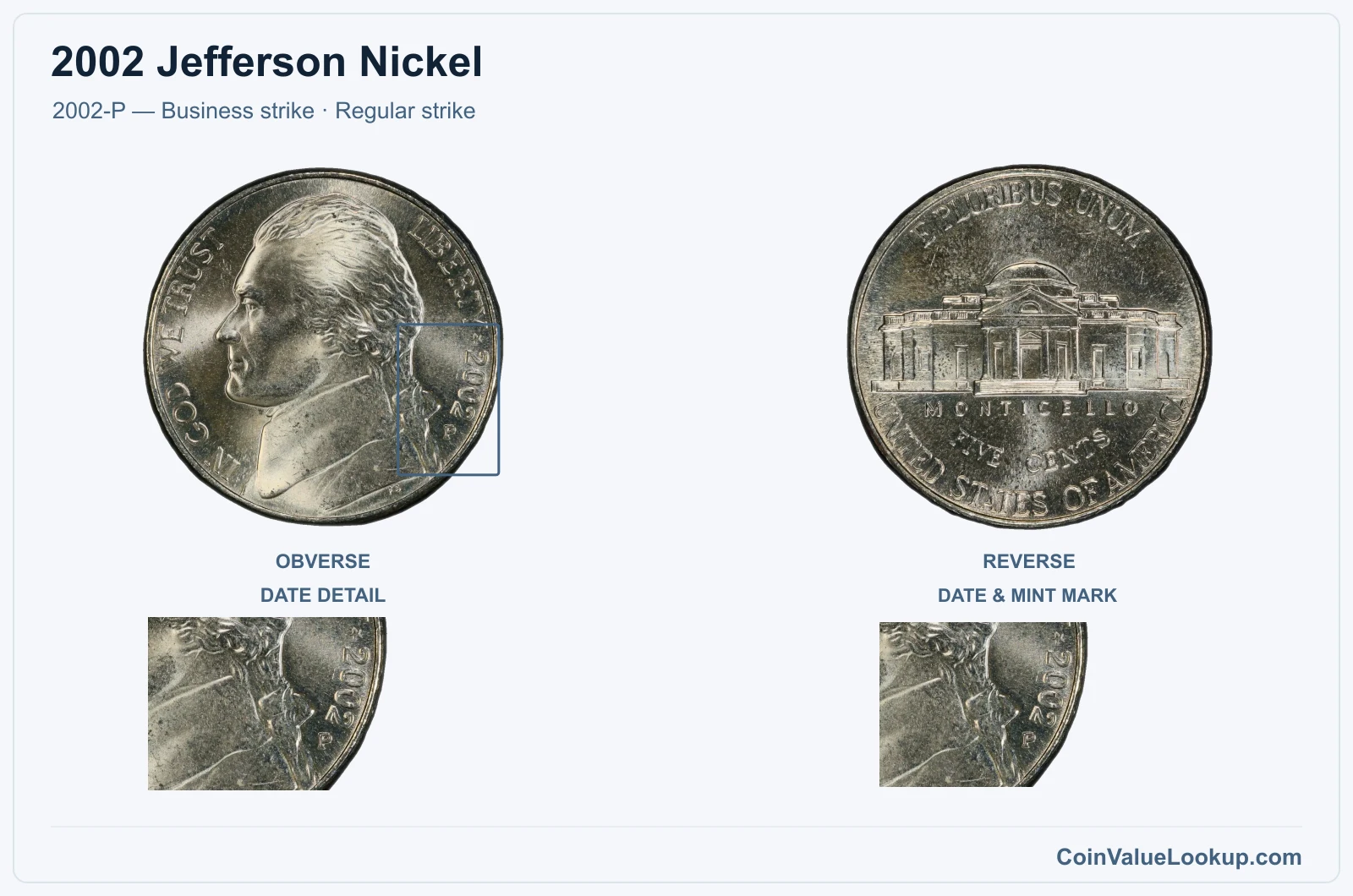
The 2002-P nickel was struck at Philadelphia and carries a small "P" mintmark on the obverse. It features the classic Jefferson profile and Monticello reverse in standard 75% copper / 25% nickel composition at a nominal 5 grams.
A USA Coin Book guide lists this coin at about $0.30 in MS60 and $1.24 in MS65. Those are retail guide estimates for ordinary business strikes, not offers to buy your coin.
Circulated examples are generally worth face value. If your coin has full, undisturbed luster and minimal bag marks, it may qualify for one of those uncirculated grades.
| Range | Grade | Price | Auction Records | Appraisal |
|---|---|---|---|---|
| PO | PO 1 | — | Coin Identifier | |
| FR | FR 2 | — | Coin Identifier | |
| AG | AG 3 | — | Coin Identifier | |
| G | G 4 | — | Coin Identifier | |
| G 6 | — | Coin Identifier | ||
| VG | VG 8 | — | Coin Identifier | |
| VG 10 | — | Coin Identifier | ||
| F | F 12 | — | Coin Identifier | |
| F 15 | — | Coin Identifier | ||
| VF | VF 20 | — | Coin Identifier | |
| VF 25 | — | Coin Identifier | ||
| VF 30 | — | Coin Identifier | ||
| VF 35 | — | Coin Identifier | ||
| XF | XF 40 | — | Coin Identifier | |
| XF 45 | — | Coin Identifier | ||
| AU | AU 50 | — | Coin Identifier | |
| AU 53 | — | Coin Identifier | ||
| AU 55 | — | Coin Identifier | ||
| AU 58 | — | Coin Identifier | ||
| MS | MS 60 | — | Coin Identifier | |
| MS 61 | — | Coin Identifier | ||
| MS 62 | — | Coin Identifier | ||
| MS 63 | — | Coin Identifier | ||
| MS 64 | — | Coin Identifier | ||
| MS 65 | Coin Identifier | |||
| MS 66 | — | Coin Identifier | ||
| MS 67 | — | Coin Identifier | ||
| MS 68 | — | — | — | |
| MS 69 | — | — | — | |
| MS 70 | — | — | — |
2002 Jefferson Nickel — D — Business strike
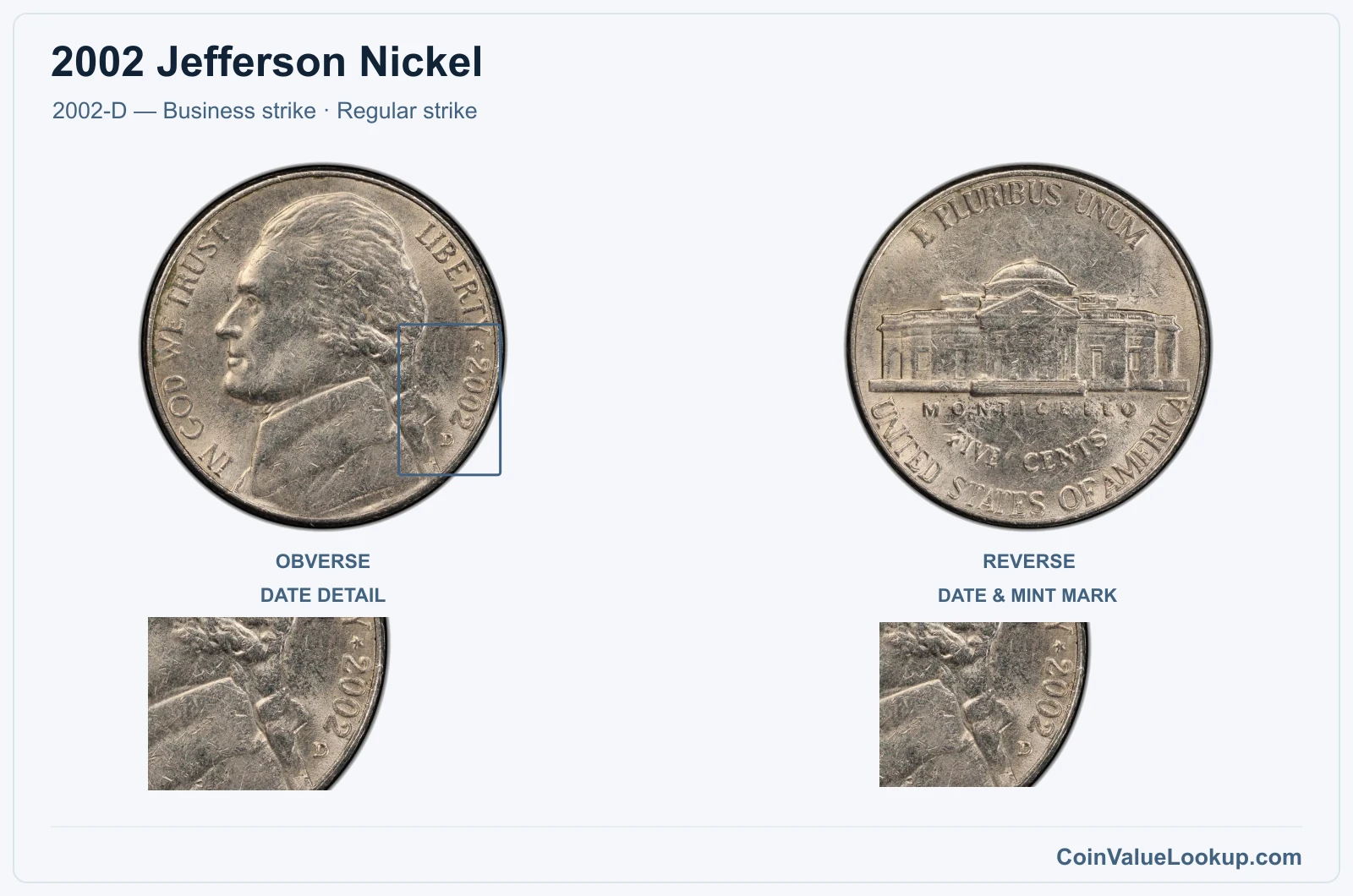
The 2002-D nickel came from the Denver Mint and shows a "D" mintmark on the obverse. Same alloy, same weight, same design as the Philadelphia version — the only difference is where it was made.
Retail guide values from USA Coin Book are identical to the P issue: around $0.30 at MS60 and $1.24 at MS65. Most pocket-change examples have enough wear and marks to keep them at face value.
To command a premium, the coin needs to be genuinely uncirculated with clean surfaces.
Coin Value Lookup is a handy place to look up guides for other dates and denominations in the Jefferson nickel series if you are sorting through a jar of coins.
| Range | Grade | Price | Auction Records | Appraisal |
|---|---|---|---|---|
| PO | PO 1 | — | Coin Identifier | |
| FR | FR 2 | — | Coin Identifier | |
| AG | AG 3 | — | Coin Identifier | |
| G | G 4 | — | Coin Identifier | |
| G 6 | — | Coin Identifier | ||
| VG | VG 8 | — | Coin Identifier | |
| VG 10 | — | Coin Identifier | ||
| F | F 12 | — | Coin Identifier | |
| F 15 | — | Coin Identifier | ||
| VF | VF 20 | — | Coin Identifier | |
| VF 25 | — | Coin Identifier | ||
| VF 30 | — | Coin Identifier | ||
| VF 35 | — | Coin Identifier | ||
| XF | XF 40 | — | Coin Identifier | |
| XF 45 | — | Coin Identifier | ||
| AU | AU 50 | — | Coin Identifier | |
| AU 53 | — | Coin Identifier | ||
| AU 55 | — | Coin Identifier | ||
| AU 58 | — | Coin Identifier | ||
| MS | MS 60 | — | Coin Identifier | |
| MS 61 | — | Coin Identifier | ||
| MS 62 | — | Coin Identifier | ||
| MS 63 | — | Coin Identifier | ||
| MS 64 | — | Coin Identifier | ||
| MS 65 | — | Coin Identifier | ||
| MS 66 | Coin Identifier | |||
| MS 67 | — | — | — | |
| MS 68 | — | — | — | |
| MS 69 | — | — | — | |
| MS 70 | — | — | — |
2002 Jefferson Nickel — S PR — Proof
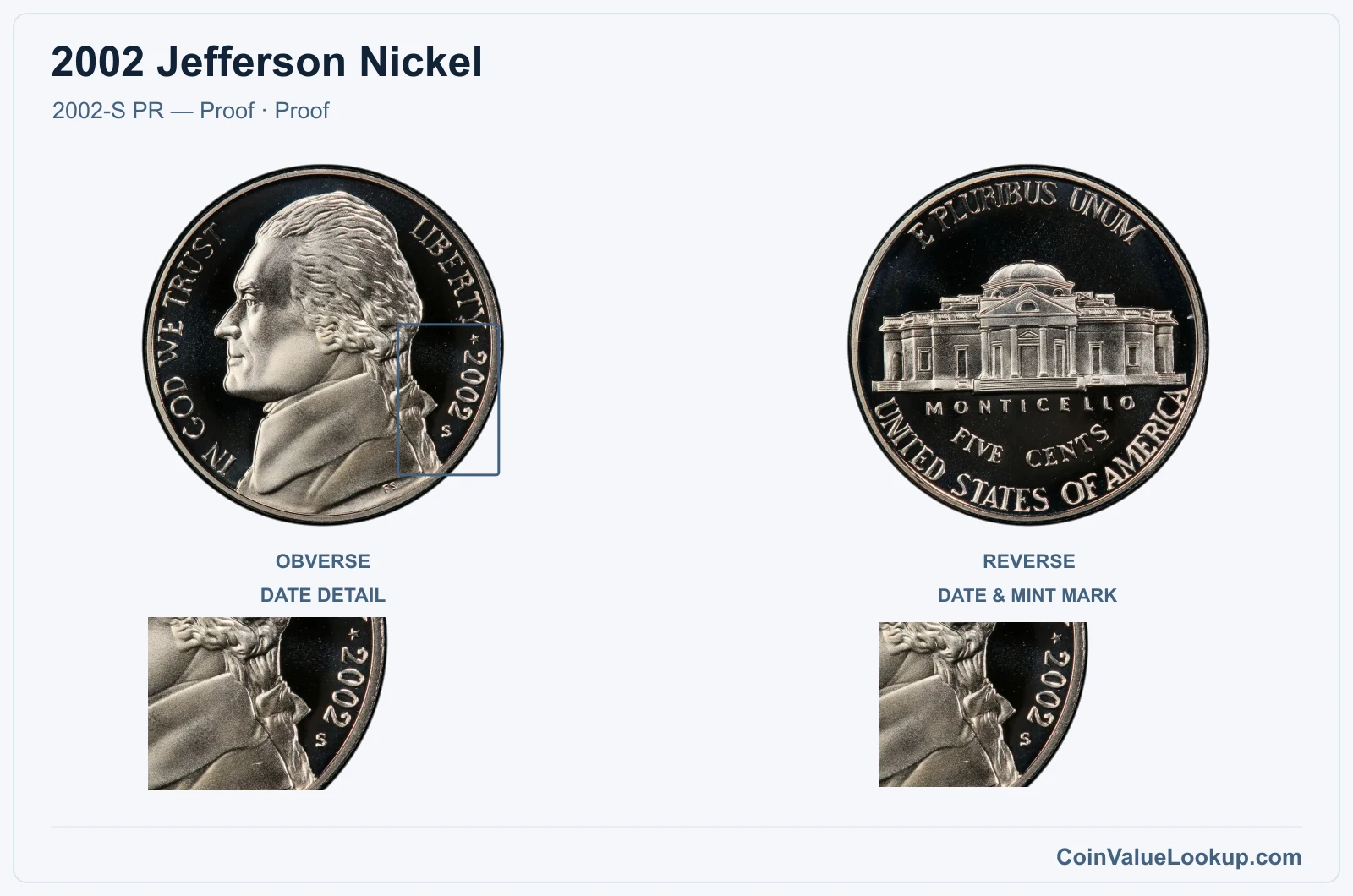
The 2002-S proof nickel was produced at San Francisco strictly for collector sets. It has an "S" mintmark and features mirror-like fields with sharply struck devices.
The composition remains 75% copper / 25% nickel.
USA Coin Book lists this coin at about $3.08 in PR65. That is a retail guide figure for a standard proof; it does not reflect cameo or deep cameo designations, which are separate finish categories with their own market.
If your proof has hazy or fingerprinted surfaces, it may grade lower than you expect. Handle proofs by the edges only, and keep them in their original capsules whenever possible.
| Range | Grade | Price | Auction Records | Appraisal |
|---|---|---|---|---|
| PR | PR 1 | — | Coin Identifier | |
| PR 2 | — | Coin Identifier | ||
| PR 3 | — | Coin Identifier | ||
| PR 4 | — | Coin Identifier | ||
| PR 6 | — | Coin Identifier | ||
| PR 8 | — | Coin Identifier | ||
| PR 10 | — | Coin Identifier | ||
| PR 12 | — | Coin Identifier | ||
| PR 15 | — | Coin Identifier | ||
| PR 20 | — | Coin Identifier | ||
| PR 25 | — | Coin Identifier | ||
| PR 30 | — | Coin Identifier | ||
| PR 35 | — | Coin Identifier | ||
| PR 40 | — | Coin Identifier | ||
| PR 45 | — | Coin Identifier | ||
| PR 50 | — | Coin Identifier | ||
| PR 53 | — | Coin Identifier | ||
| PR 55 | — | Coin Identifier | ||
| PR 58 | — | Coin Identifier | ||
| PR 60 | — | Coin Identifier | ||
| PR 61 | — | Coin Identifier | ||
| PR 62 | — | Coin Identifier | ||
| PR 63 | — | Coin Identifier | ||
| PR 64 | — | Coin Identifier | ||
| PR 65 | — | Coin Identifier | ||
| PR 66 | — | Coin Identifier | ||
| PR 67 | Coin Identifier | |||
| PR 68 | Coin Identifier | |||
| PR 69 | Coin Identifier | |||
| PR 70 | Coin Identifier |
2002 Jefferson Nickel Error List
1. 2002 Jefferson Nickel — Die Crack / Die Chip
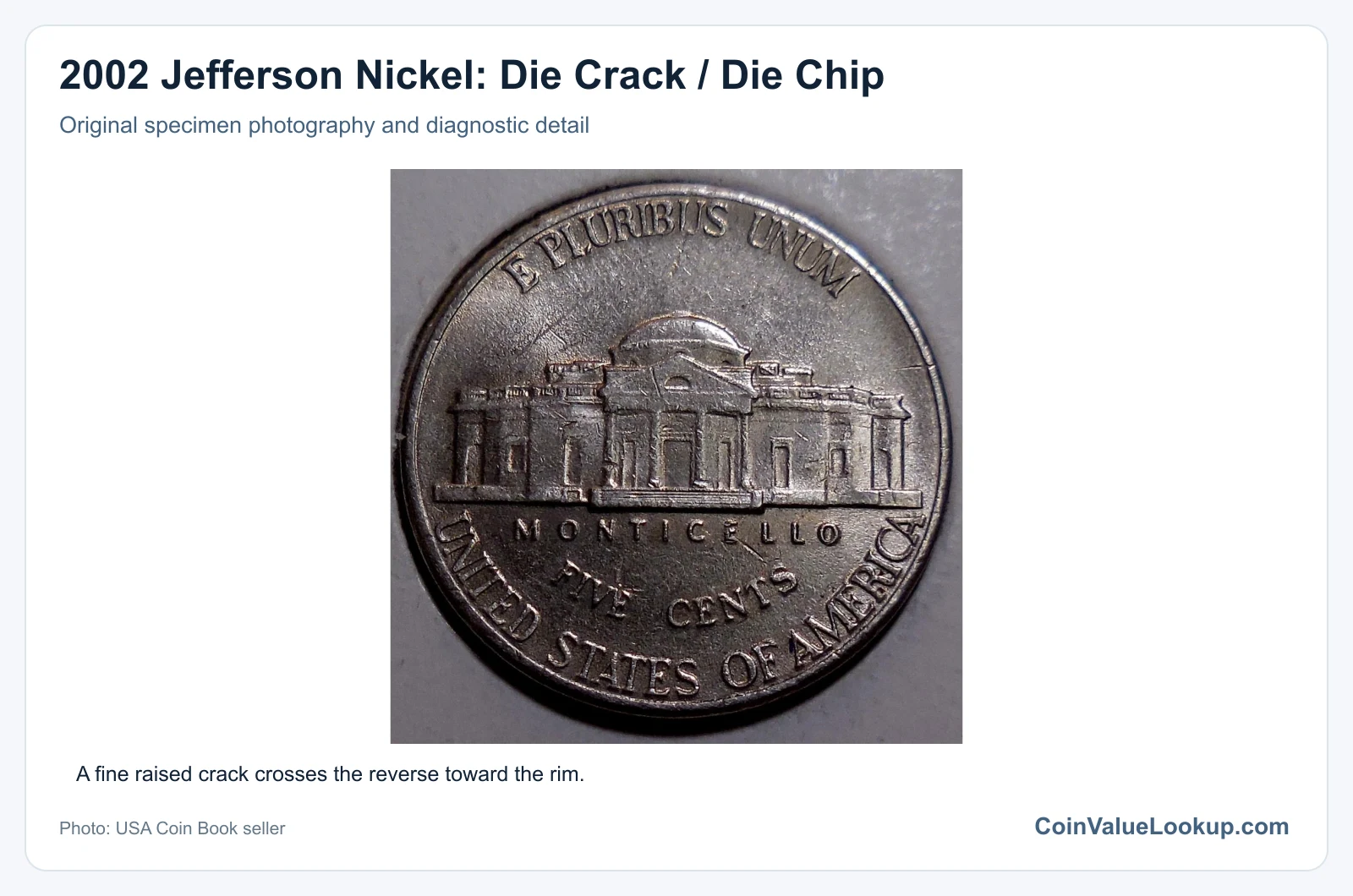
A die crack or die chip appears as a small raised line or blob on the coin's surface, caused by damage to the steel die before striking. One well-known variety for this year is called the "Beehive" die chip, named for a raised lump near Monticello that resembles a beehive.
To identify one, look for raised material that follows no design element. A raised line running from one design feature toward the rim is a classic die crack, while an isolated raised blob is a die chip.
If the irregularity is recessed rather than raised, it is more likely a scratch, corrosion pit or debris pressed into the surface after minting.
Value depends on the size, visibility and location of the chip or crack, as well as the coin's overall condition. No specific price range is adopted here, so individual assessment is needed.
2. 2002 Jefferson Nickel — Improper Annealing
Improper annealing occurs when the metal blank is not heated correctly before striking. The result is unusual surface discoloration or a rough, grainy texture that looks different from a normally struck coin.
Check your 2002 nickel for streaky or blotchy coloring that does not wipe off and seems embedded in the metal itself. Compare the edge and surface texture to a normal example under the same lighting.
The appearance is a screening clue, not proof of the cause — environmental toning, corrosion or post-mint heat exposure can mimic the look.
Condition and the degree of the annealing anomaly affect value. No specific price range is adopted, so each coin needs to be evaluated on its own merits by someone experienced with error coins.
3. 2002 Jefferson Nickel — Clipped Planchet
A clipped planchet error happens when the coin blank is punched incorrectly from the metal strip, leaving a missing curved, straight or ragged section. The result is a coin that is visibly incomplete along part of its rim.
Look for a smooth, curved absence — not a rough or filed edge. Genuine clips often show a slight weakness in the design directly opposite the missing area, because the metal could not flow evenly during the strike.
That opposite-side weakness is a useful diagnostic.
Do not confuse a clip with a coin that someone filed, notched or corroded after leaving the mint. Post-mint damage tends to leave rough, uneven edges without the corresponding design weakness on the far side.
Value depends on the clip's size and the coin's overall condition; no specific price range is adopted here.
4. 2002 Jefferson Nickel — Off-Center Strike
An off-center strike occurs when the blank is not properly seated between the dies. The design shifts to one side, leaving an unstruck crescent of blank metal.
The more dramatic the misalignment and the more of the date that remains visible, the more appealing the error tends to be to collectors. A coin that is 5% off-center looks like a minor curiosity; one that is 50% off with a full date is a different story.
Be careful not to confuse a clipped planchet or post-mint flattening with an off-center strike. A genuine off-center coin has a complete, round blank — the design is simply displaced.
Value varies with the percentage of off-center shift and overall condition; no specific price range is adopted.
5. 2002 Jefferson Nickel — Clashed Dies
Die clash errors happen when the obverse and reverse dies strike each other without a blank between them. The impact transfers faint impressions of each die's design onto the opposite die, and those ghost images then appear on subsequent coins.
On a 2002 nickel, look for traces of Monticello's outline in the obverse field, or Jefferson's profile ghosted onto the reverse. The transferred design elements should align with where the opposing die would have contacted — random scratches or raised lines that do not match the opposite design are not die clashes.
A brockage, where a previously struck coin acts as a die, produces a different kind of transferred image. Value depends on how visible the clash marks are and the coin's condition.
No specific price range is adopted.
6. 2002 Jefferson Nickel — Lamination / Split Planchet
A lamination or split planchet error shows up as peeling, flaking or outright separation within the metal. It happens when impurities or gas pockets in the alloy create weak spots that come apart during or after striking.
Look for a raised flap of metal, a missing patch that reveals a different layer underneath, or a coin that has literally split into two thinner halves. Photograph both the affected face and the edge — the edge view is especially helpful for seeing separation.
This is not the same as a coin that someone scraped, corroded or deliberately cut. Post-mint damage tends to leave tool marks and sharp edges that differ from the natural-looking separation of a genuine lamination.
Value depends on the extent of the split and the coin's condition; no specific price range is adopted.
7. 2002 Jefferson Nickel — Broadstrike
A broadstrike occurs when a coin is struck without the retaining collar that normally constrains the blank. The metal spreads outward freely, producing a coin that is wider than normal with a slightly thinner profile and no reeded or raised rim.
The full design is still present — just expanded. That is the key distinction from an off-center strike, where part of the design is missing.
Also watch out for coins that were simply flattened after minting; those will show distorted design elements and surface damage inconsistent with a single clean strike.
Check the edge carefully. A genuine broadstrike has a smooth, spreading edge rather than the normal raised rim.
Value depends on how pronounced the spread is and the coin's overall condition; no specific price range is adopted.
8. 2002 Jefferson Nickel — Doubled Die Obverse
A doubled die obverse shows consistent doubling on design elements caused by a misalignment during the die-making process. On a 2002 nickel, compare the obverse lettering — especially "IN GOD WE TRUST" and "LIBERTY" — against a normal example under the same lighting.
Genuine doubled die doubling produces separation or notching that is consistent across multiple letters or design features. It looks like a second, slightly offset impression.
Machine doubling, by contrast, creates a flat, shelf-like distortion and is far less collectible.
Tilt the coin under a single light source and look for clean, consistent separation rather than mushy outlines. Reflections and die wear can also mimic doubling to the untrained eye.
Value depends on the strength and location of the doubling as well as the coin's condition; no specific price range is adopted.
9. 2002 Jefferson Nickel — Die Cap / Capped-Die Strike
A die cap error is dramatic. It starts when a struck coin sticks to one of the dies instead of being ejected.
That coin becomes a "cap" over the die, and subsequent blanks are struck through it, picking up a distorted, spread-out mirror image.
The capped coin itself cups around the die face over repeated strikes, eventually resembling a small metal bottle cap. Coins struck through the cap show a softened, spread impression on one side.
Both forms exist as collectible errors.
Do not confuse a die cap with a coin that was simply bent by a vise or pliers. Post-mint bending produces creases, tool marks and uneven distortion that differ from the symmetrical cupping of a genuine cap.
Value depends on the stage of the cap and the coin's condition; no specific price range is adopted.