2002 Sacagawea Dollar Coin Value: How Much Is It Worth?
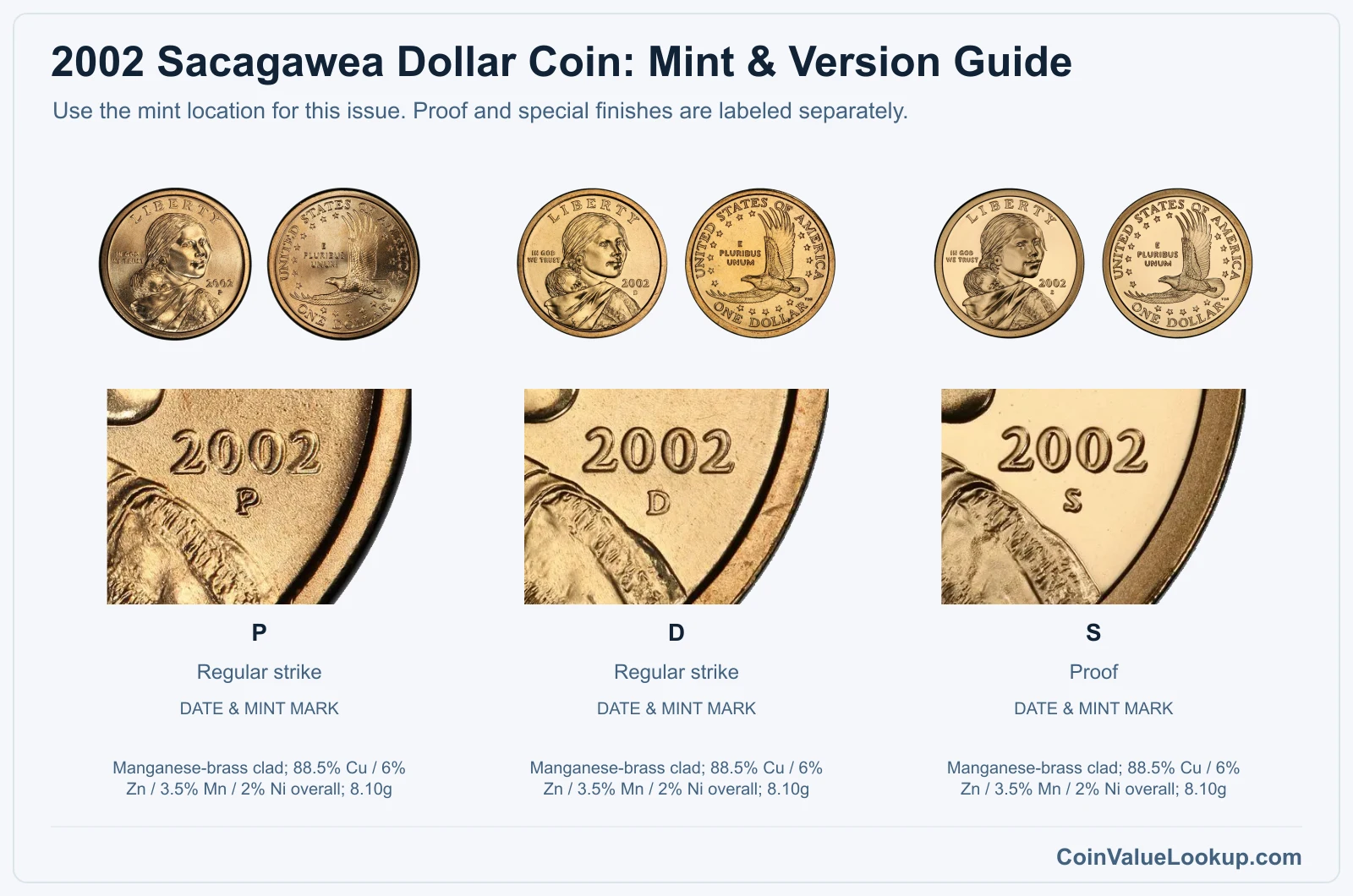
The 2002 Sacagawea Dollar is a manganese-brass clad coin that most people still confuse with gold. It is not gold.
Guide estimates for this year range from about $6.25 to $7.29 depending on mint, finish and grade — these are not guaranteed offers. Identifying your specific version matters, because an ordinary circulated example is worth face value while a proof or a genuine error coin is a different story entirely.
Fast Way to Identify Your 2002 Sacagawea Dollar
The fastest way to start figuring out what you have is to upload clear photos of both sides of your coin. A front and back image lets us provide a preliminary identification of the mint, finish and design.
This is not a substitute for professional authentication, but it gets you pointed in the right direction quickly.
2002 Sacagawea Dollar Value
Upload both sides of your 2002 Sacagawea Dollar.
Front Obverse
Upload photo
Back Reverse
Upload photo
Which 2002 Sacagawea Dollar Versions Are Worth Money?
- 2002-S Proof — the only collector-finish version this year, with a guide estimate around $7.29 in PR65.
- Genuine error coins such as wrong-planchet strikes or significant off-center strikes can carry premiums well above standard issues, but require verification.
Step 1: Identify Your 2002 Sacagawea Dollar Mint Mark and Version
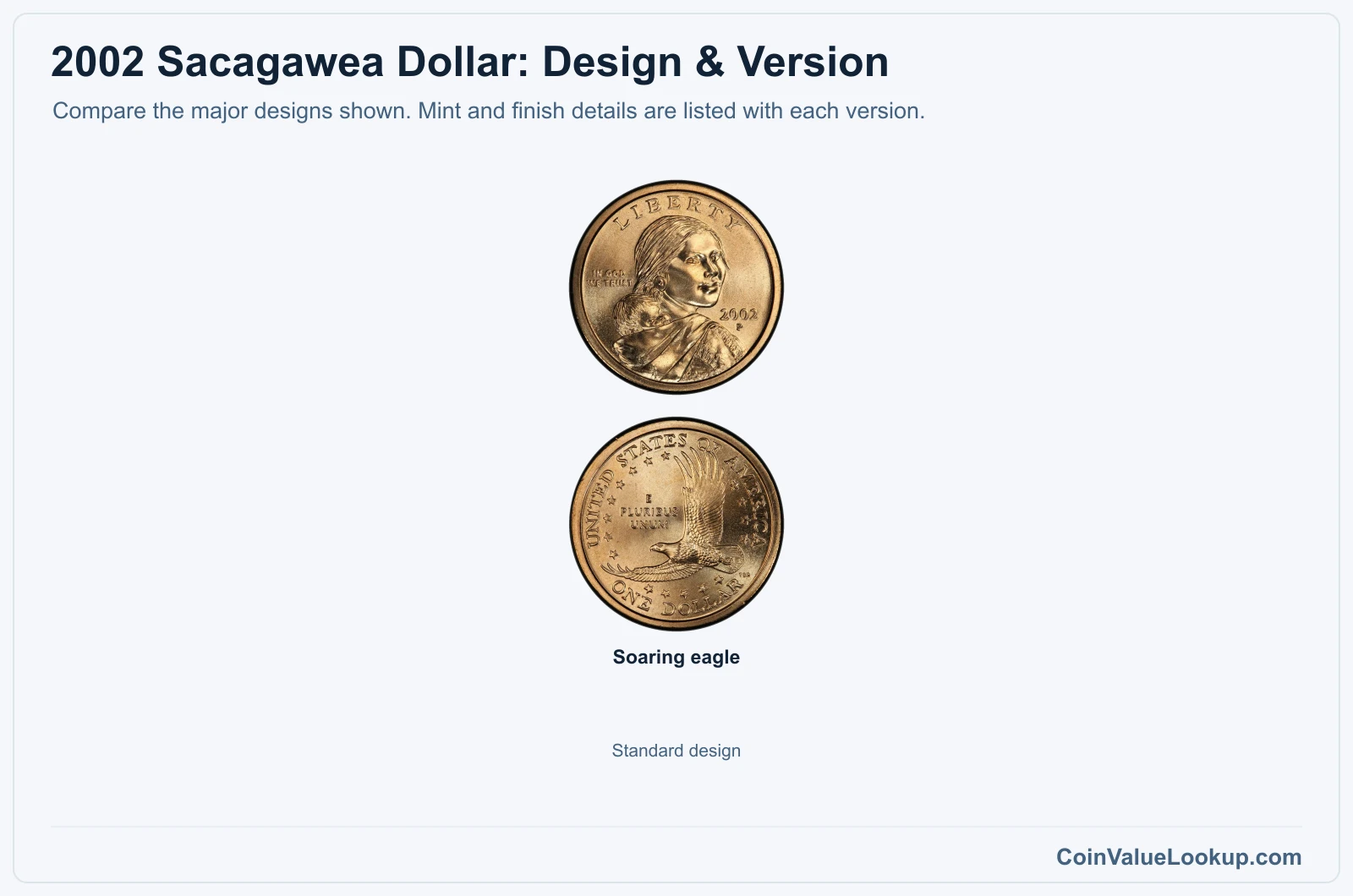
Start with the obverse. On 2002 Sacagawea Dollars the date and mintmark appear on the front, below the portrait.
You are looking for a small "P" (Philadelphia), "D" (Denver) or "S" (San Francisco) letter. No mintmark at all still means Philadelphia on some older issues, but this year you should see a letter.
The golden color comes from the manganese-brass clad composition — 88.5% copper, 6% zinc, 3.5% manganese and 2% nickel — not from any precious metal. Weight is 8.10 grams.
If it feels light or looks silver-white, something is off.
The reverse on all 2002 issues shows the soaring eagle design, which ran through 2008. Native American reverse designs replaced it starting in 2009, so if you see anything other than the eagle your coin is a different year.
Three versions exist for 2002: the P business strike, the D business strike, and the S proof. The S proof was made for collector sets and has a mirror-like finish with sharply contrasting devices.
Step 2: Check Your 2002 Sacagawea Dollar Grade
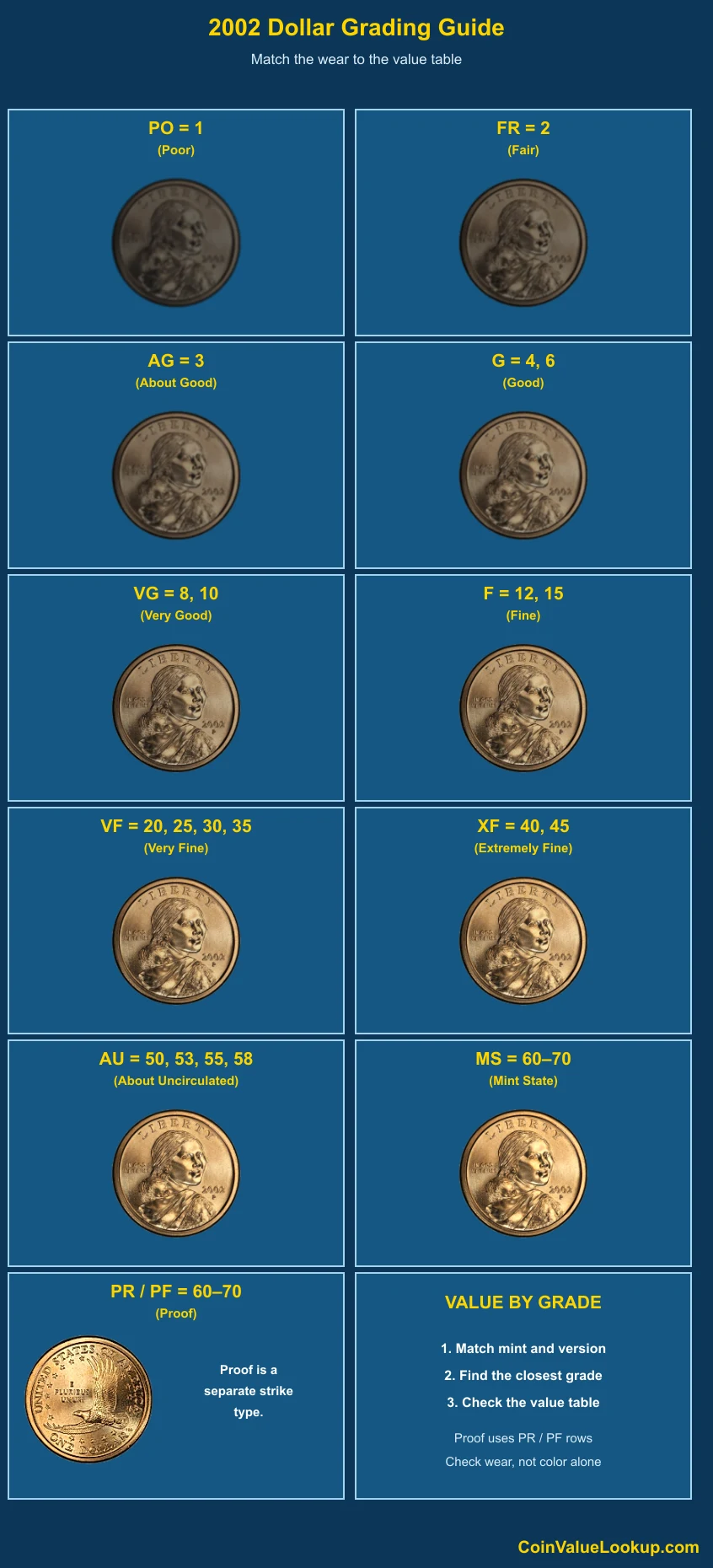
When grading a 2002 Sacagawea Dollar, focus on the highest points first. On the obverse, Sacagawea's cheekbone, hair detail and the infant Jean-Baptiste on her back wear earliest.
On the reverse, the eagle's breast feathers and wing tips show contact first.
A circulated coin will have flattened cheek detail and dulled luster. An AU example keeps most luster but shows light friction on the cheek and hair above the ear.
A Mint State coin retains full original luster with no wear, though bag marks are normal.
Proof coins deserve separate evaluation. Compare finish quality — sharp, squared-off rims and reflective fields — rather than just brightness.
A proof with hazy or cloudy fields has been mishandled. Use the comparison image to match your coin against known circulated, AU, Mint State and proof examples side by side.
Step 3: Check 2002 Sacagawea Dollar Value by Mint and Version
2002 Sacagawea Dollar — P — Soaring eagle
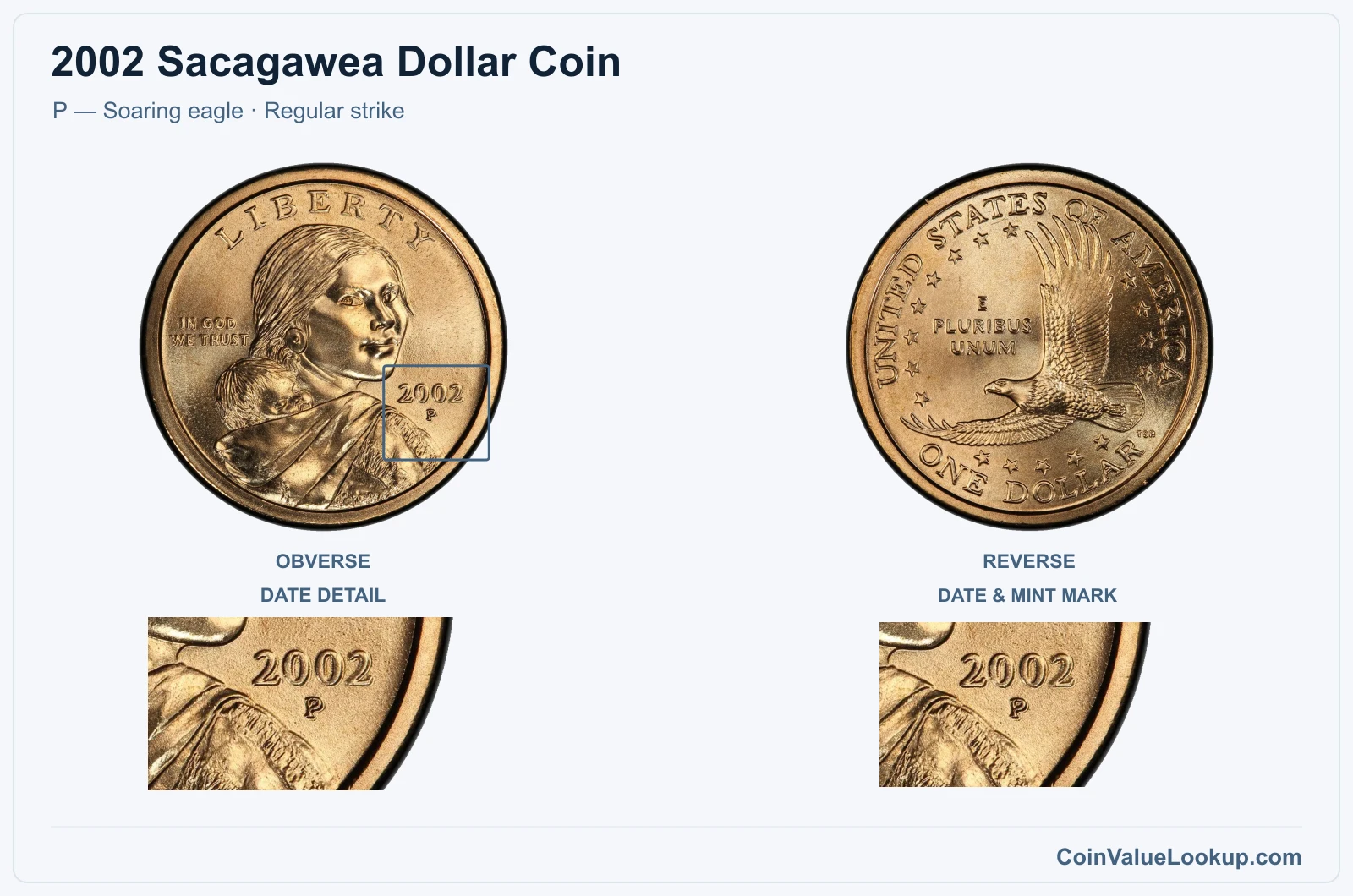
The 2002-P Sacagawea Dollar is the Philadelphia business strike. Look for the small "P" mintmark on the obverse beneath Sacagawea's portrait.
It uses the standard soaring eagle reverse.
A guide estimate places this coin at about $6.25 in MS65 grade. That is not a guaranteed purchase offer, just a reference point.
In circulated condition, these are worth face value — they were produced in large numbers for everyday commerce. Only well-preserved uncirculated examples start to carry a modest premium.
Range Grade
Price Auction Records Appraisal PO PO 1
—
Coin Identifier FR FR 2
—
Coin Identifier AG AG 3
—
Coin Identifier G G 4
—
Coin Identifier
G 6
—
Coin Identifier VG VG 8
—
Coin Identifier
VG 10
—
Coin Identifier F F 12
—
Coin Identifier
F 15
—
Coin Identifier VF VF 20
—
Coin Identifier
VF 25
—
Coin Identifier
VF 30
—
Coin Identifier
VF 35
—
Coin Identifier XF XF 40
—
Coin Identifier
XF 45
—
Coin Identifier AU AU 50
—
Coin Identifier
AU 53
—
Coin Identifier
AU 55
—
Coin Identifier
AU 58
—
Coin Identifier MS MS 60
—
Coin Identifier
MS 61
—
Coin Identifier
MS 62
—
Coin Identifier
MS 63
—
Coin Identifier
MS 64
—
Coin Identifier
MS 65
—
Coin Identifier
MS 66
Coin Identifier
MS 67
Coin Identifier
MS 68
Coin Identifier
MS 69
Coin Identifier
MS 70
—
—
—
2002 Sacagawea Dollar — D — Soaring eagle
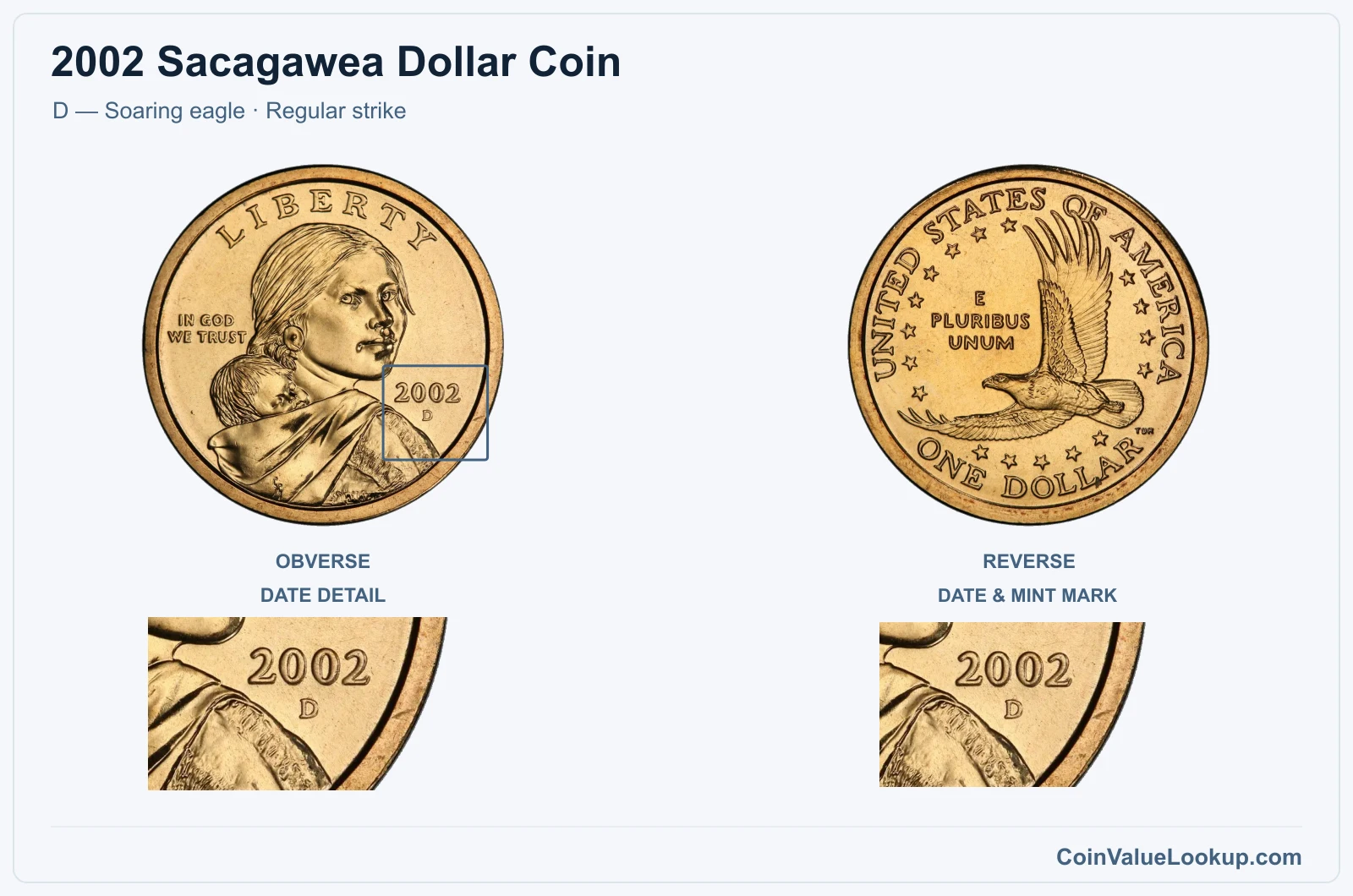
The 2002-D version was struck at the Denver Mint. Flip the coin over and find the "D" mintmark on the obverse.
Same manganese-brass composition, same soaring eagle reverse, same weight.
Guide estimates put the 2002-D at roughly $6.25 in MS65. Again, this is a reference estimate, not a firm offer.
Circulated pieces trade at face value. If yours shows strong luster with minimal bag marks, it could qualify for a Mint State grade worth a small premium.
Coin Value Lookup is a good starting point if you want to look up guides for other Sacagawea Dollar years or different coin series altogether.
Range Grade
Price Auction Records Appraisal PO PO 1
—
Coin Identifier FR FR 2
—
Coin Identifier AG AG 3
—
Coin Identifier G G 4
—
Coin Identifier
G 6
—
Coin Identifier VG VG 8
—
Coin Identifier
VG 10
—
Coin Identifier F F 12
—
Coin Identifier
F 15
—
Coin Identifier VF VF 20
—
Coin Identifier
VF 25
—
Coin Identifier
VF 30
—
Coin Identifier
VF 35
—
Coin Identifier XF XF 40
—
Coin Identifier
XF 45
—
Coin Identifier AU AU 50
—
Coin Identifier
AU 53
—
Coin Identifier
AU 55
—
Coin Identifier
AU 58
—
Coin Identifier MS MS 60
—
Coin Identifier
MS 61
—
Coin Identifier
MS 62
—
Coin Identifier
MS 63
—
Coin Identifier
MS 64
—
Coin Identifier
MS 65
Coin Identifier
MS 66
Coin Identifier
MS 67
Coin Identifier
MS 68
Coin Identifier
MS 69
—
—
—
MS 70
—
—
—
2002 Sacagawea Dollar — S — Soaring eagle — proof
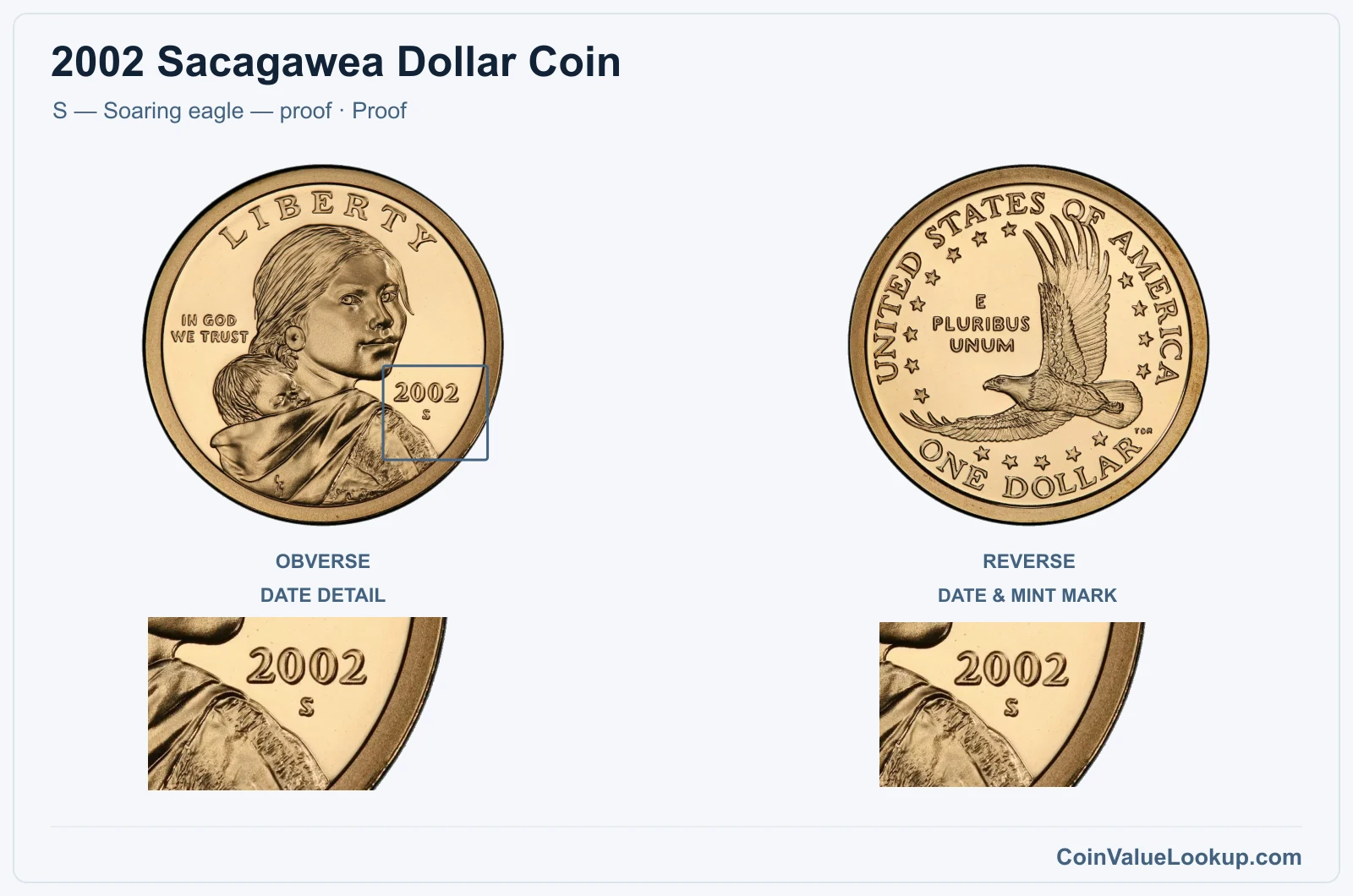
The 2002-S is the proof version, struck at San Francisco exclusively for collector sets. It has deeply mirrored fields and frosted, sharply struck devices — a distinctly different look from the business strikes.
The "S" mintmark appears on the obverse.
A guide estimate places this at about $7.29 in PR65. One common mistake: people assume that because the 2002-S came packaged alongside silver proof coins in certain sets, the dollar itself is silver.
It is not. It is the same manganese-brass clad composition as the P and D issues.
Check weight (8.10 grams) if you have any doubt. Proof coins in their original government capsules with no haze or fingerprints are the ones that grade well.
Range Grade
Price Auction Records Appraisal PR PR 1
—
Coin Identifier
PR 2
—
Coin Identifier
PR 3
—
Coin Identifier
PR 4
—
Coin Identifier
PR 6
—
Coin Identifier
PR 8
—
Coin Identifier
PR 10
—
Coin Identifier
PR 12
—
Coin Identifier
PR 15
—
Coin Identifier
PR 20
—
Coin Identifier
PR 25
—
Coin Identifier
PR 30
—
Coin Identifier
PR 35
—
Coin Identifier
PR 40
—
Coin Identifier
PR 45
—
Coin Identifier
PR 50
—
Coin Identifier
PR 53
—
Coin Identifier
PR 55
—
Coin Identifier
PR 58
—
Coin Identifier
PR 60
—
Coin Identifier
PR 61
—
Coin Identifier
PR 62
—
Coin Identifier
PR 63
—
Coin Identifier
PR 64
—
Coin Identifier
PR 65
—
Coin Identifier
PR 66
—
Coin Identifier
PR 67
Coin Identifier
PR 68
Coin Identifier
PR 69
Coin Identifier
PR 70
Coin Identifier
2002 Sacagawea Dollar Error List
1. 2002 Sacagawea Dollar — Wrong Planchet / Off-Metal Strike
A wrong-planchet error means the 2002 Sacagawea Dollar design was struck on a blank intended for a different coin. The result looks immediately strange — the diameter, thickness, color or weight will not match a normal Sacagawea Dollar (8.10 grams, 26.5 mm).
To check, weigh and measure the coin carefully. Compare the edge and overall appearance against a known normal example.
If the design is complete but the metal and dimensions are wrong, you may have something significant.
Watch out for coins that have been plated, corroded, acid-treated or deliberately altered to look unusual. Those are not mint errors.
Condition, the specific wrong planchet involved and how much of the design transferred all affect value, so professional authentication is important before drawing conclusions.
2. 2002 Sacagawea Dollar — Doubled Die Obverse
A doubled die obverse on the 2002 Sacagawea Dollar shows consistent doubling on obverse lettering or design elements. Under magnification you would see separation, notching or a shelf-like extra outline on letters such as LIBERTY or the date.
The key word is consistent. True doubled-die doubling appears the same way on every coin struck from that die.
Compare your coin's obverse lettering to a normal example under the same lighting.
Machine doubling is the most common lookalike — it creates a flat, shelf-like spread rather than distinctly separated raised lines. Reflections from the coin's luster or worn die contours can also mimic doubling.
Value depends on how visible the doubling is and the coin's overall condition, so have a suspect coin examined by a grading service.
3. 2002 Sacagawea Dollar — Doubled Die Reverse
A doubled die reverse affects the back of the coin — look at the lettering around the eagle, particularly UNITED STATES OF AMERICA and the denomination. True hub doubling produces raised, separated outlines that repeat identically on every coin from that die.
Compare your reverse closely to a normal 2002 Sacagawea Dollar. Use consistent lighting and at least 5x magnification.
You are looking for clear separation on lettering or design contours, not a mushy spread.
Machine doubling, random surface damage and reflections all mimic doubled dies to the naked eye. Machine doubling tends to look flat and shelf-like rather than sharply raised.
Value depends on the strength of the doubling and the coin's condition; professional verification is the prudent step before assuming premium value.
4. 2002 Sacagawea Dollar — Die Crack / Die Chip
Die cracks on the 2002 Sacagawea Dollar appear as thin, raised lines on the coin's surface. They are caused by fractures in the steel die that transferred as raised metal during striking.
A die chip looks like a small raised blob, often found inside letters or near the rim.
A crack that extends from the rim inward and displaces a section of the design is called a cud — these are more dramatic and typically more collectible than fine hairline cracks.
Do not confuse die cracks with incuse scratches, corrosion trails or debris stuck to the surface. Die cracks are raised above the field, not sunk into it.
The location, length and visual impact of the crack all influence collectibility and value.
5. 2002 Sacagawea Dollar — Struck-Through Error
A struck-through error occurs when foreign material — grease, a thread, a metal fragment — sits between the die and the blank during striking. The result is a localized depression or incomplete area where the design did not fully transfer.
On a 2002 Sacagawea Dollar, look for a smooth depression or a distinct impression of whatever object was trapped. A grease-filled die creates a soft, washed-out patch, while a retained foreign object leaves a sharper, more defined impression.
Don't confuse this with normal wear, cleaning marks or a weakly struck area from low die pressure. Struck-through areas are recessed and typically have sharp boundaries.
Condition and the size of the affected area drive value; a tiny grease spot is far less significant than a large retained-object impression.
6. 2002 Sacagawea Dollar — Off-Center Strike
An off-center strike happens when the blank is not seated properly between the dies, so part of the design is missing and a blank crescent appears along one edge. On the 2002 Sacagawea Dollar, the most collectible off-center errors retain a visible date.
The percentage off-center matters. A 5% shift is barely noticeable.
A 10–50% shift with the date intact is where collector interest picks up significantly.
Don't mistake a clipped planchet or post-mint damage for an off-center strike. A clip has a curved bite from the blank-cutting process, while an off-center coin shows a displaced but otherwise normally shaped design.
One-sided die misalignment or post-mint flattening can also fool you. Value depends on the percentage of displacement, date visibility and overall condition.