1924 Peace Silver Dollar Coin Value: How Much Is It Worth?
The 1924 Peace Dollar is one of the more available dates in the series, but that does not mean every example is created equal. Guide estimates for explicitly listed grades and versions range from about $64 in well-worn condition up to $7,373 for a gem-quality San Francisco issue.
Several die varieties and a scarce mint mark push certain coins well beyond the norm. Identifying your exact mint, variety and condition is the first step toward an accurate assessment.
Fast Way to Identify Your 1924 Peace Silver Dollar
The quickest way to start figuring out what you have is to snap clear, well-lit photos of both the front and back of your coin and upload them here. Our identifier can give you a preliminary read on the mint mark, design details and general version, which saves you time before digging deeper into variety diagnostics or grading nuances.
1924 Peace Silver Dollar Value
Upload both sides of your 1924 Peace Silver Dollar.
Front Obverse
Upload photo
Back Reverse
Upload photo
Which 1924 Peace Silver Dollar Versions Are Worth Money?
- 1924-S in high grade commands a significant premium, with guide estimates reaching $7,373 at MS65 compared to $233 for a Philadelphia MS65.
- 1924 Bar D is a recognized die variety with a distinctive raised bar near the mintmark area; value depends on authenticated identity and condition.
- 1924 Doubled Reverse (Philadelphia) shows doubled lettering on the reverse and requires individual assessment based on visibility and grade.
- 1924 Broken Wing features a die break across the eagle's wing, making it visually distinct and collectible as a variety.
- 1924-S Doubled Reverse combines the scarcer San Francisco mint with doubled reverse lettering, warranting careful authentication.
Step 1: Identify Your 1924 Peace Silver Dollar Mint Mark and Version
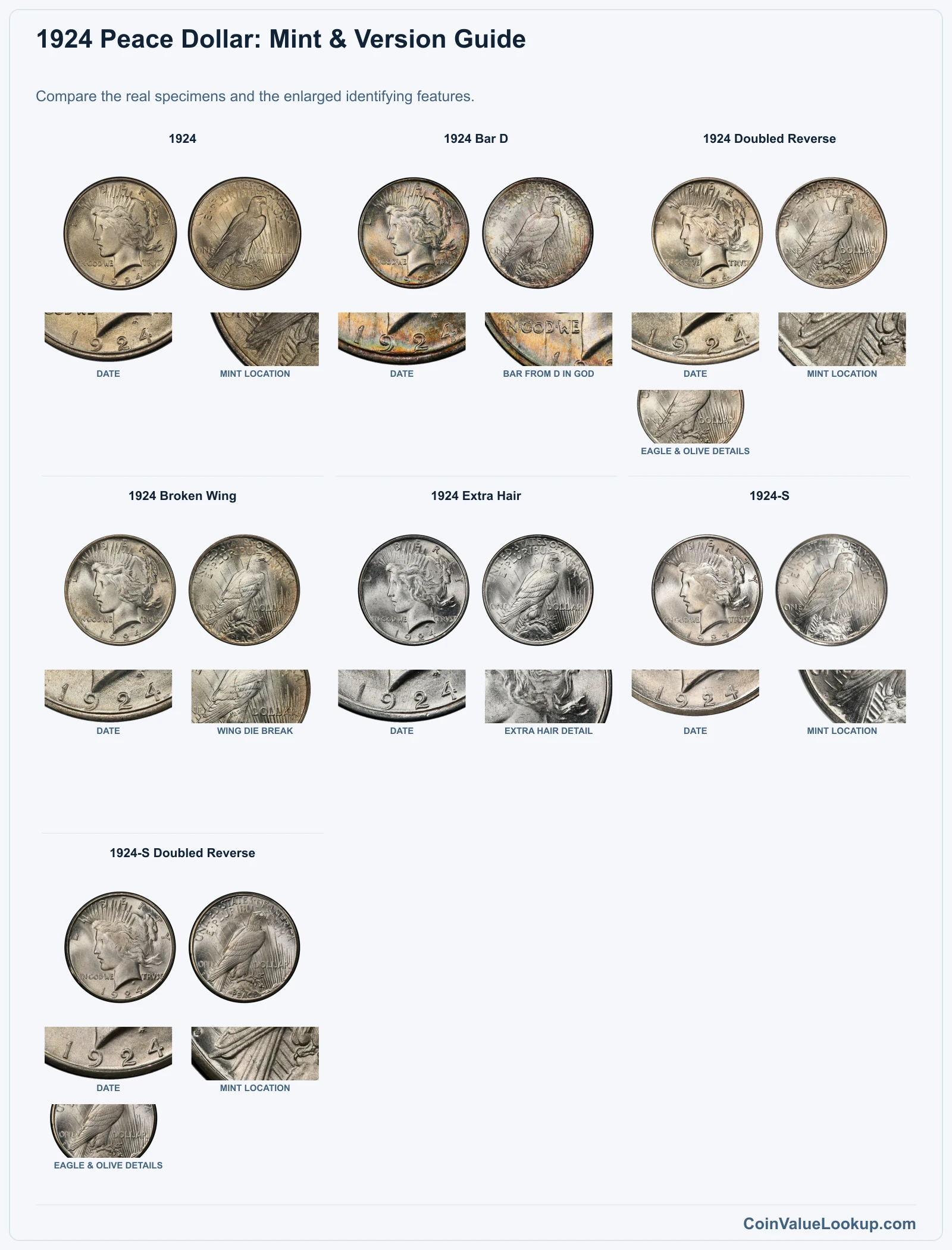
Flip the coin to the reverse and look beneath the word ONE, near the eagle's tail feathers. A small "S" means San Francisco.
A "D" would indicate Denver, but no Denver-minted Peace Dollar exists for 1924, so if you see no mint mark at all, you have a Philadelphia strike. Do not mistake the "V" in TRVST for an error; that is the standard Latin spelling used on every Peace Dollar.
All genuine 1924 Peace Dollars are struck in 90% silver and 10% copper, weighing 26.73 grams. The obverse shows a radiate Liberty head facing left, while the reverse features a perched eagle atop a mountain with PEACE inscribed below.
The edge is reeded.
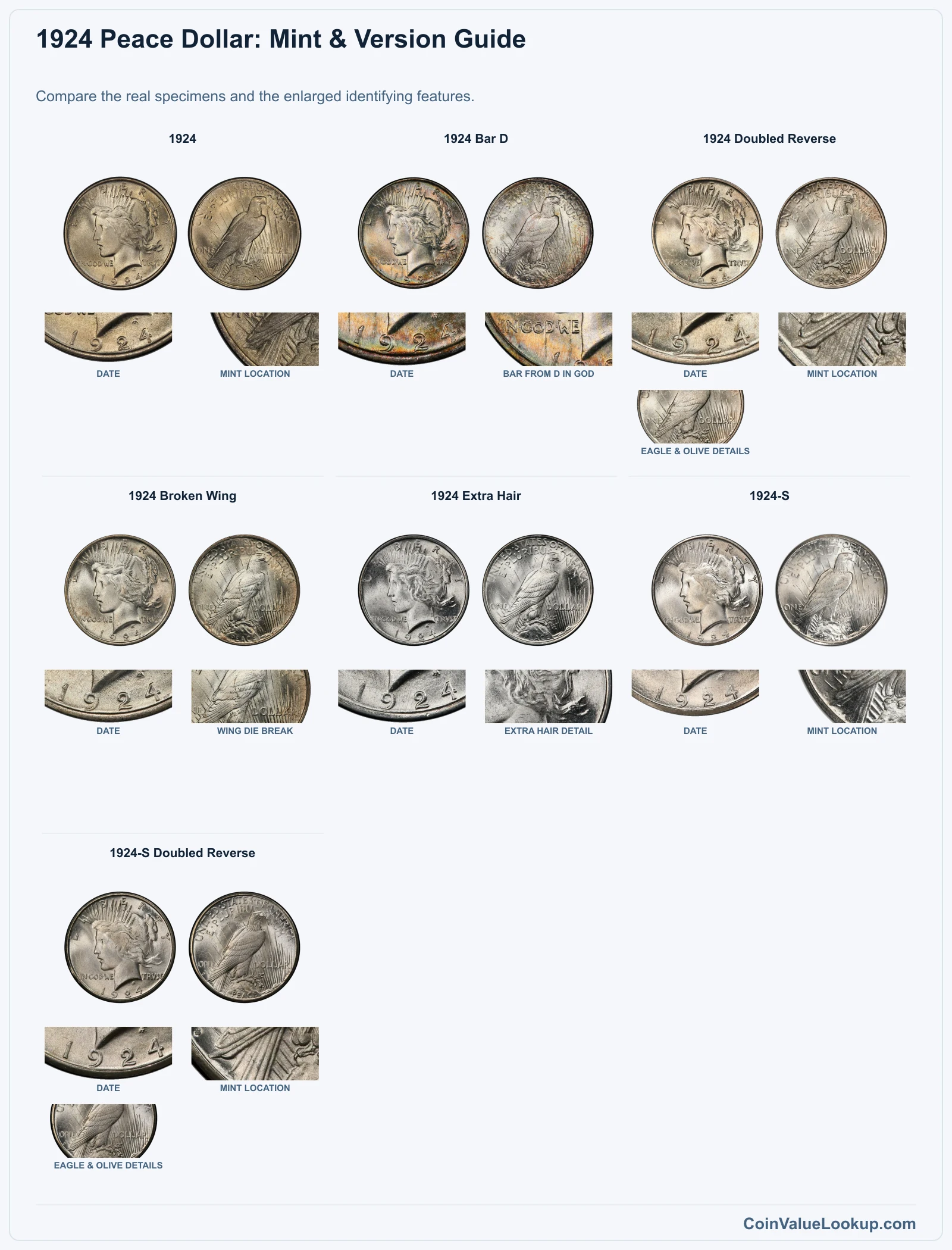
For 1924, the version branches you need to consider are: the standard Philadelphia issue, the Bar D variety, the Doubled Reverse, the Broken Wing, the Extra Hair, the standard 1924-S, and the 1924-S Doubled Reverse. Each has distinct diagnostics, so confirm yours before comparing prices.
Step 2: Check Your 1924 Peace Silver Dollar Grade
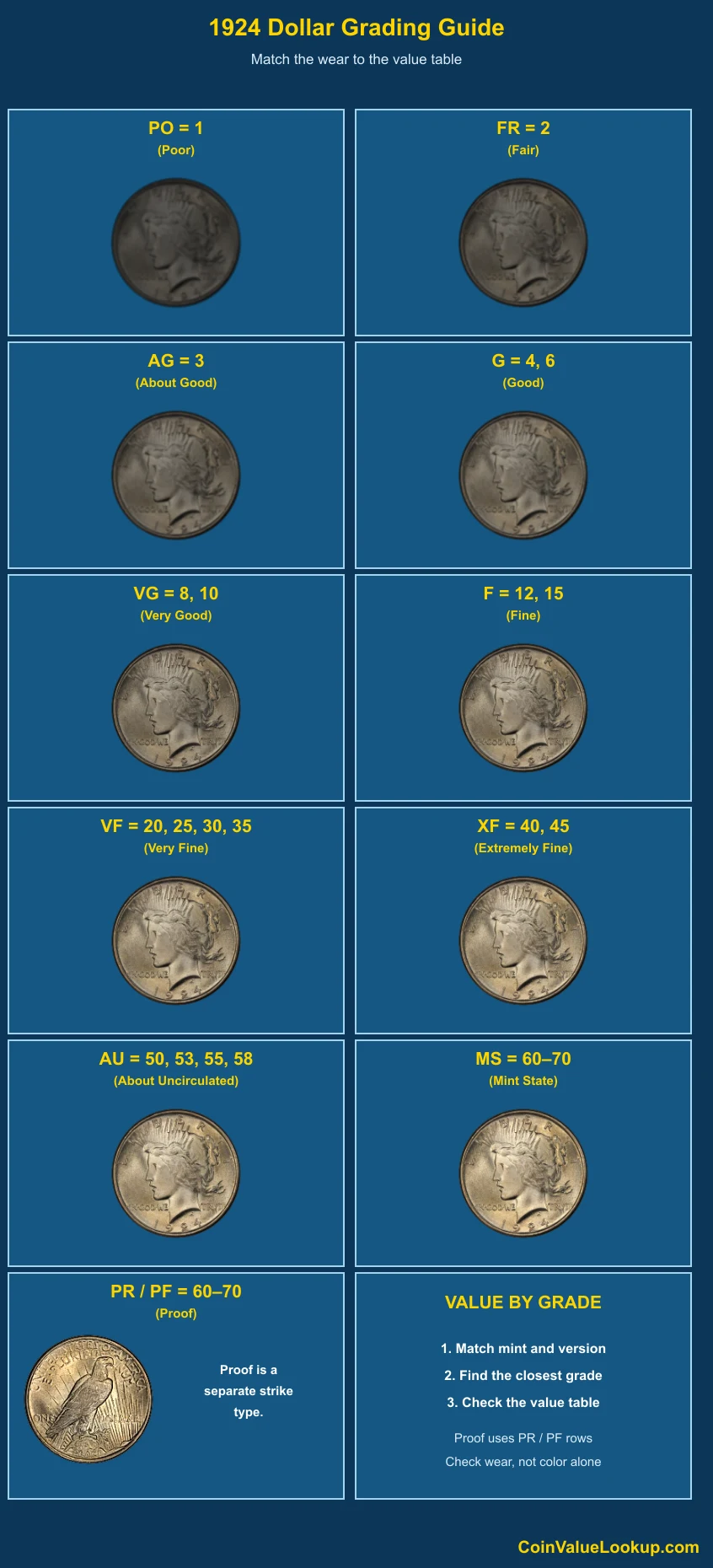
Focus on the hair strands directly above Liberty's ear and across her cheek. On a well-circulated coin, those areas flatten first and merge together.
The eagle's shoulder and the top of the wing feathers on the reverse wear at roughly the same rate.
A coin grading around Good-4 will show a smooth cheek and heavily blended hair, while an About Uncirculated piece retains most detail with only slight friction on the highest points. Mint State coins display full original luster with no wear, though contact marks from bag storage are common on Peace Dollars and affect the grade.
Use the comparison image to gauge where your coin falls. Central weakness on some Peace Dollars is a strike characteristic, not necessarily wear, so compare overall luster and edge sharpness alongside detail loss.
Cleaned or polished coins lose their original surface texture and trade at a discount compared to problem-free examples at the same apparent grade.
Step 3: Check 1924 Peace Silver Dollar Value by Mint and Version
1924 Peace Silver Dollar
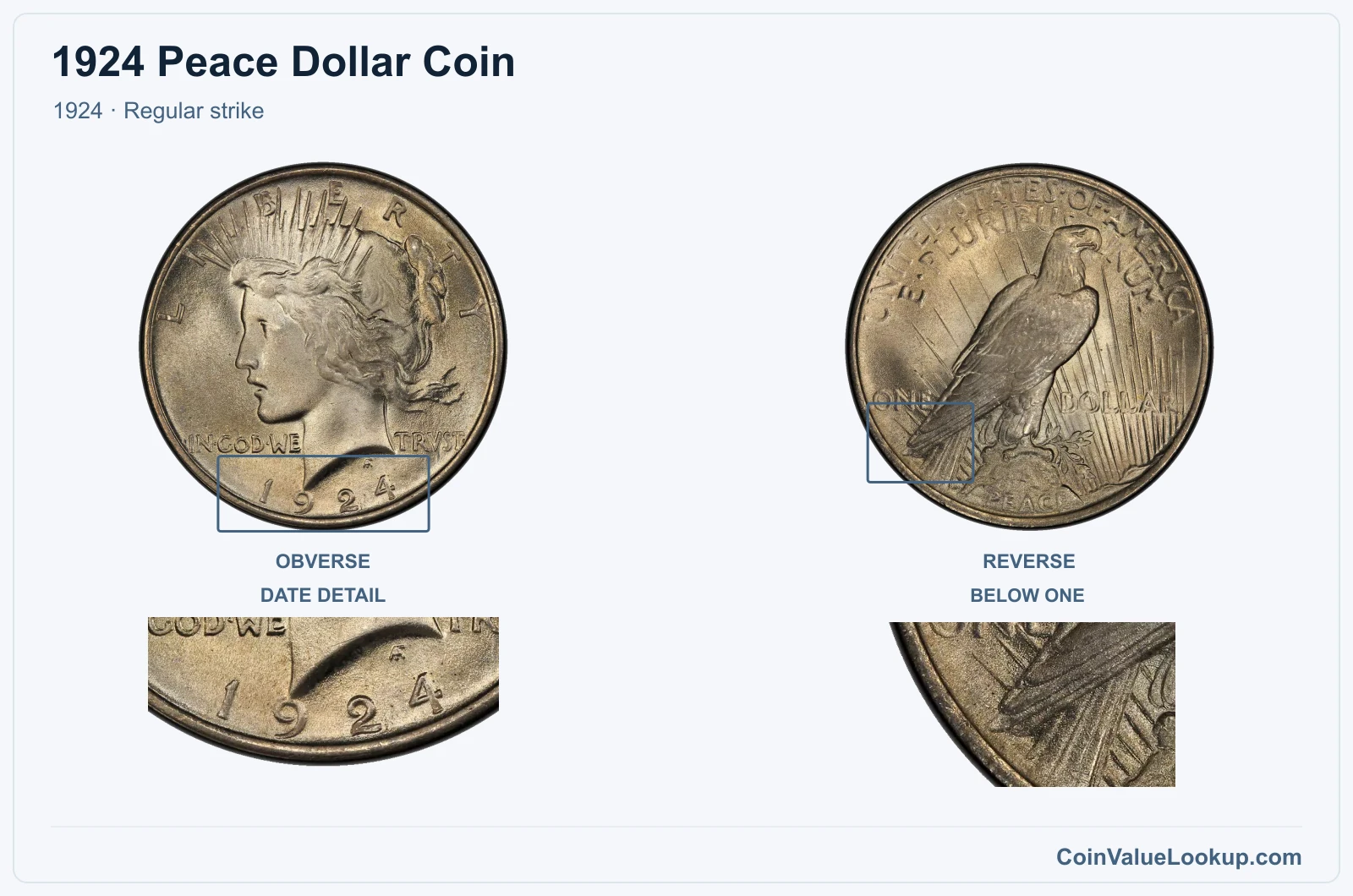
The standard 1924 Philadelphia Peace Dollar had a large mintage and remains one of the easiest dates to find in the series. In worn condition around Good-4, guide estimates from USA Coin Book place it at roughly $64.
A gem Mint State example at MS65 runs about $233.
Original, uncleaned surfaces matter. A coin that has been polished or dipped will not compare favorably to one with natural luster, even if the detail looks similar.
Check both sides for uniform toning and cartwheel luster before assuming a high grade.
Range Grade
Price Auction Records Appraisal PO PO 1
Coin Identifier FR FR 2
—
Coin Identifier AG AG 3
—
Coin Identifier G G 4
—
Coin Identifier
G 6
—
Coin Identifier VG VG 8
—
Coin Identifier
VG 10
—
Coin Identifier F F 12
—
Coin Identifier
F 15
—
Coin Identifier VF VF 20
—
Coin Identifier
VF 25
—
Coin Identifier
VF 30
—
Coin Identifier
VF 35
—
Coin Identifier XF XF 40
—
Coin Identifier
XF 45
Coin Identifier AU AU 50
—
Coin Identifier
AU 53
Coin Identifier
AU 55
Coin Identifier
AU 58
Coin Identifier MS MS 60
Coin Identifier
MS 61
Coin Identifier
MS 62
Coin Identifier
MS 63
Coin Identifier
MS 64
Coin Identifier
MS 65
Coin Identifier
MS 66
Coin Identifier
MS 67
Coin Identifier
MS 68
Coin Identifier
MS 69
—
—
—
MS 70
—
—
—
1924 Peace Silver Dollar — Bar D
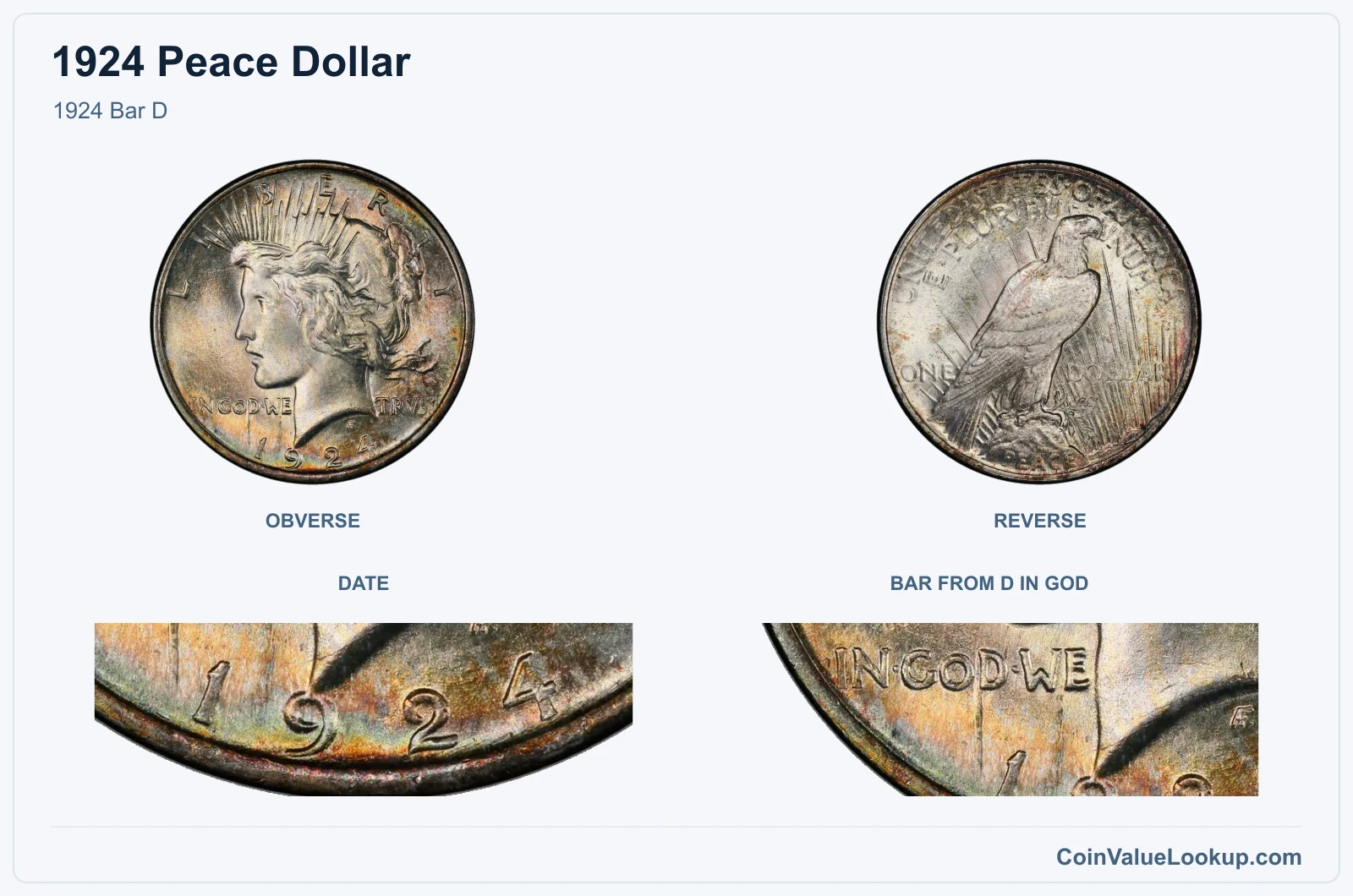
The 1924 Bar D variety is a Philadelphia-struck coin, not a Denver issue, despite the nickname. It shows a raised bar of extra metal near the "D" area on the reverse, caused by a die gouge or similar die defect.
That raised line is the key diagnostic; it should be part of the coin's surface, not an incuse scratch.
No specific guide price is adopted for this variety. Value depends on authenticated identity, the visibility of the bar and overall condition.
If you think you have one, get it in front of a third-party grading service for confirmation before paying or asking a premium.
Range Grade
Price Auction Records Appraisal PO PO 1
—
Coin Identifier FR FR 2
—
Coin Identifier AG AG 3
—
Coin Identifier G G 4
—
Coin Identifier
G 6
—
Coin Identifier VG VG 8
—
Coin Identifier
VG 10
—
Coin Identifier F F 12
—
Coin Identifier
F 15
—
Coin Identifier VF VF 20
—
Coin Identifier
VF 25
—
Coin Identifier
VF 30
—
Coin Identifier
VF 35
—
Coin Identifier XF XF 40
—
Coin Identifier
XF 45
—
Coin Identifier AU AU 50
—
Coin Identifier
AU 53
—
Coin Identifier
AU 55
—
Coin Identifier
AU 58
Coin Identifier MS MS 60
—
Coin Identifier
MS 61
Coin Identifier
MS 62
Coin Identifier
MS 63
Coin Identifier
MS 64
Coin Identifier
MS 65
Coin Identifier
MS 66
—
—
—
MS 67
—
—
—
MS 68
—
—
—
MS 69
—
—
—
MS 70
—
—
—
1924 Peace Silver Dollar — Doubled Reverse
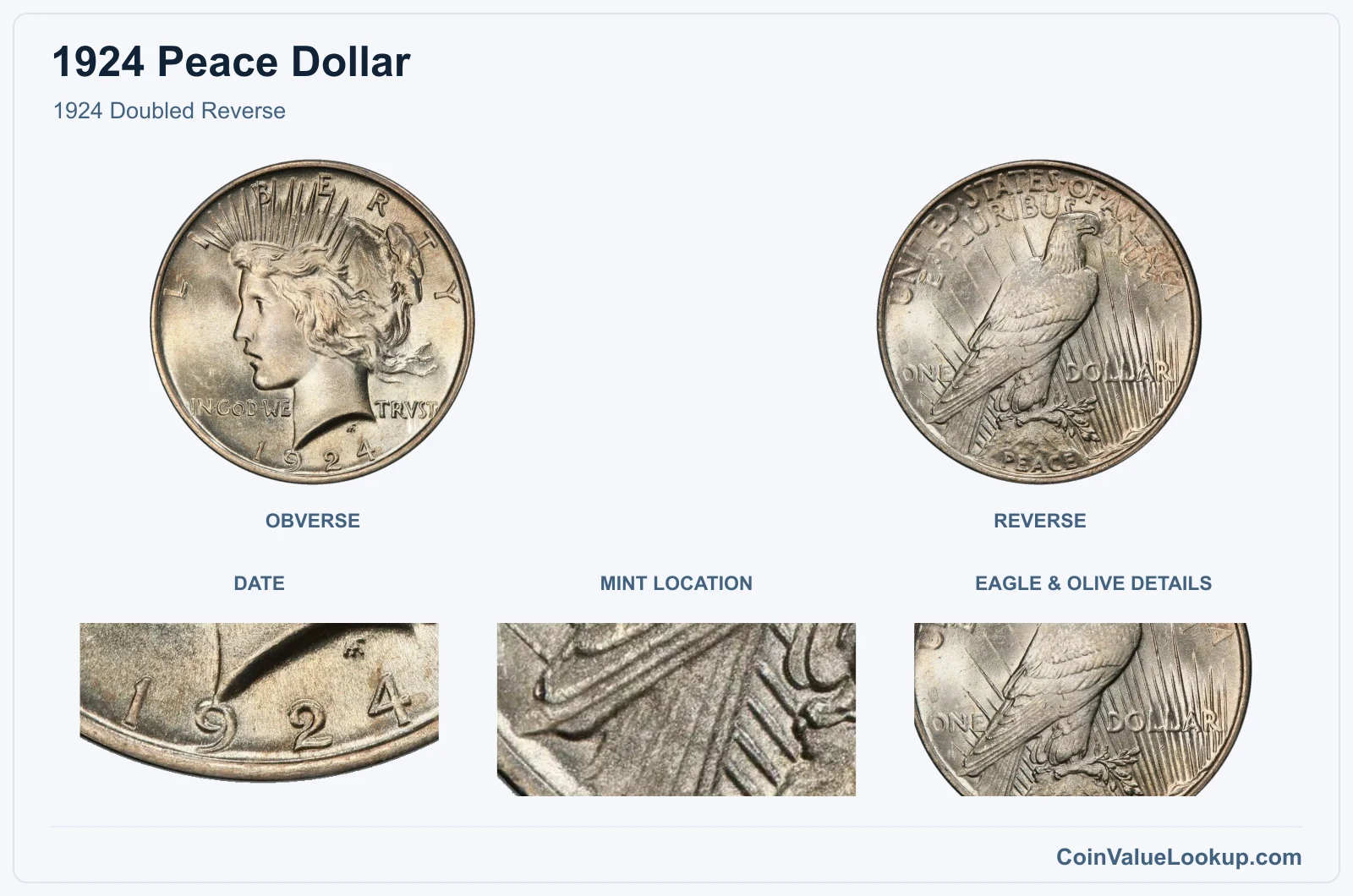
The 1924 Doubled Reverse is a Philadelphia variety showing visible doubling on the reverse lettering. Look closely at PEACE, ONE, and the motto for slightly offset or spread letters.
A loupe at 5x or higher helps.
No adopted guide price exists for this variety in the supplied data. What your example is worth comes down to the strength of the doubling, the coin's grade and whether it has been authenticated.
Doubling that is only visible under extreme magnification commands less interest than bold, obvious separation.
Range Grade
Price Auction Records Appraisal PO PO 1
—
Coin Identifier FR FR 2
—
Coin Identifier AG AG 3
—
Coin Identifier G G 4
—
Coin Identifier
G 6
—
Coin Identifier VG VG 8
—
Coin Identifier
VG 10
—
Coin Identifier F F 12
—
Coin Identifier
F 15
—
Coin Identifier VF VF 20
—
Coin Identifier
VF 25
—
Coin Identifier
VF 30
—
Coin Identifier
VF 35
—
Coin Identifier XF XF 40
—
Coin Identifier
XF 45
—
Coin Identifier AU AU 50
—
Coin Identifier
AU 53
—
Coin Identifier
AU 55
—
Coin Identifier
AU 58
—
Coin Identifier MS MS 60
—
Coin Identifier
MS 61
Coin Identifier
MS 62
Coin Identifier
MS 63
Coin Identifier
MS 64
Coin Identifier
MS 65
Coin Identifier
MS 66
—
Coin Identifier
MS 67
—
—
—
MS 68
—
—
—
MS 69
—
—
—
MS 70
—
—
—
1924 Peace Silver Dollar — Broken Wing
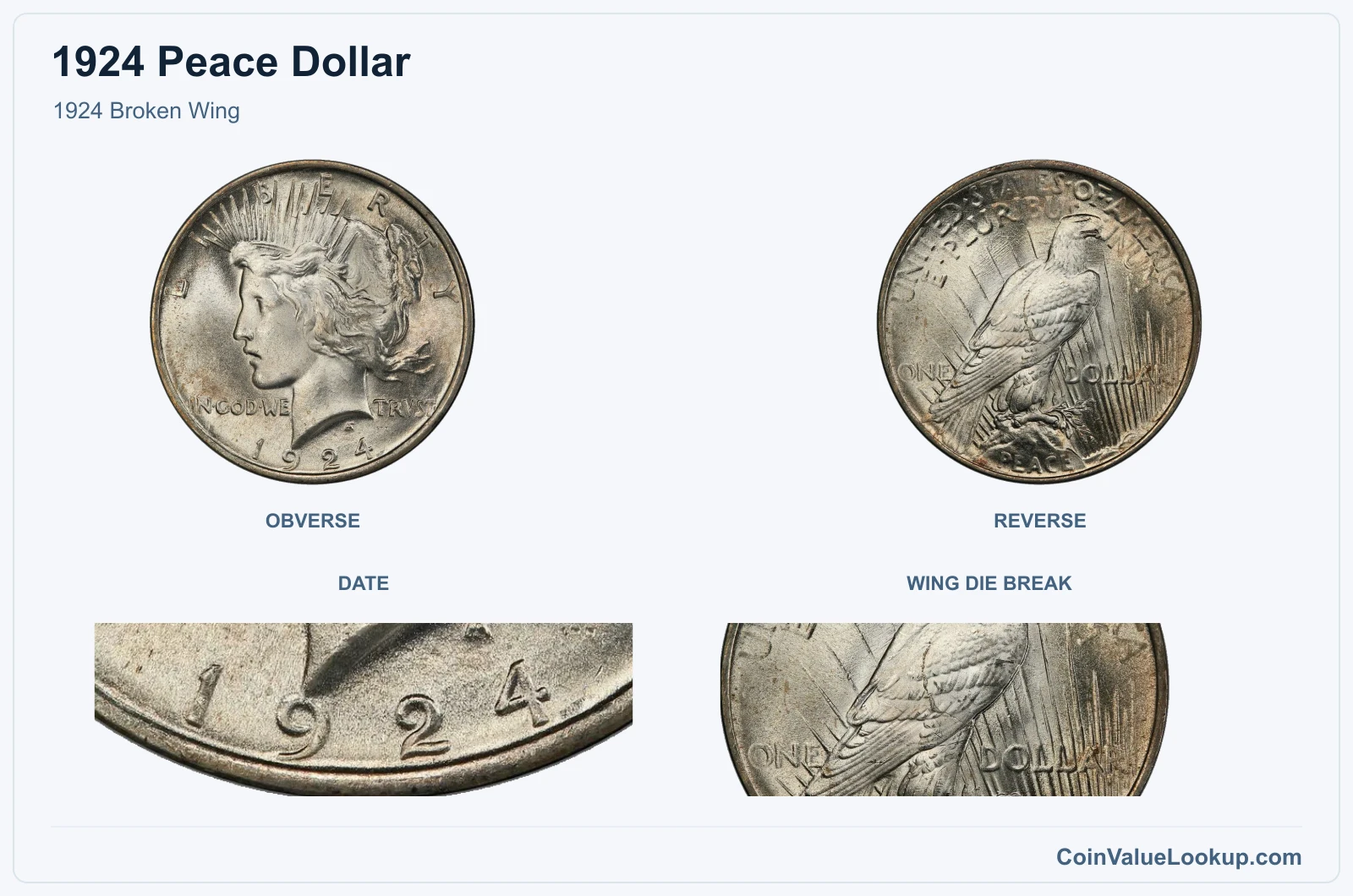
The 1924 Broken Wing variety shows a die crack running across the eagle's wing on the reverse. This crack transfers as a raised line on the struck coin, and it is often visible without magnification on well-preserved examples.
There is no adopted guide price for this variety. A coin's value here depends on how prominent the break is, the overall grade and surface quality, and whether a recognized grading service has attributed it.
Die cracks can be subtle, so compare yours carefully against known examples before drawing conclusions.
Range Grade
Price Auction Records Appraisal PO PO 1
—
Coin Identifier FR FR 2
—
Coin Identifier AG AG 3
—
Coin Identifier G G 4
—
Coin Identifier
G 6
—
Coin Identifier VG VG 8
—
Coin Identifier
VG 10
—
Coin Identifier F F 12
—
Coin Identifier
F 15
—
Coin Identifier VF VF 20
—
Coin Identifier
VF 25
—
Coin Identifier
VF 30
—
Coin Identifier
VF 35
—
Coin Identifier XF XF 40
—
Coin Identifier
XF 45
—
Coin Identifier AU AU 50
—
Coin Identifier
AU 53
Coin Identifier
AU 55
Coin Identifier
AU 58
Coin Identifier MS MS 60
—
Coin Identifier
MS 61
Coin Identifier
MS 62
Coin Identifier
MS 63
Coin Identifier
MS 64
Coin Identifier
MS 65
Coin Identifier
MS 66
—
Coin Identifier
MS 67
—
—
—
MS 68
—
—
—
MS 69
—
—
—
MS 70
—
—
—
1924 Peace Silver Dollar — Extra Hair
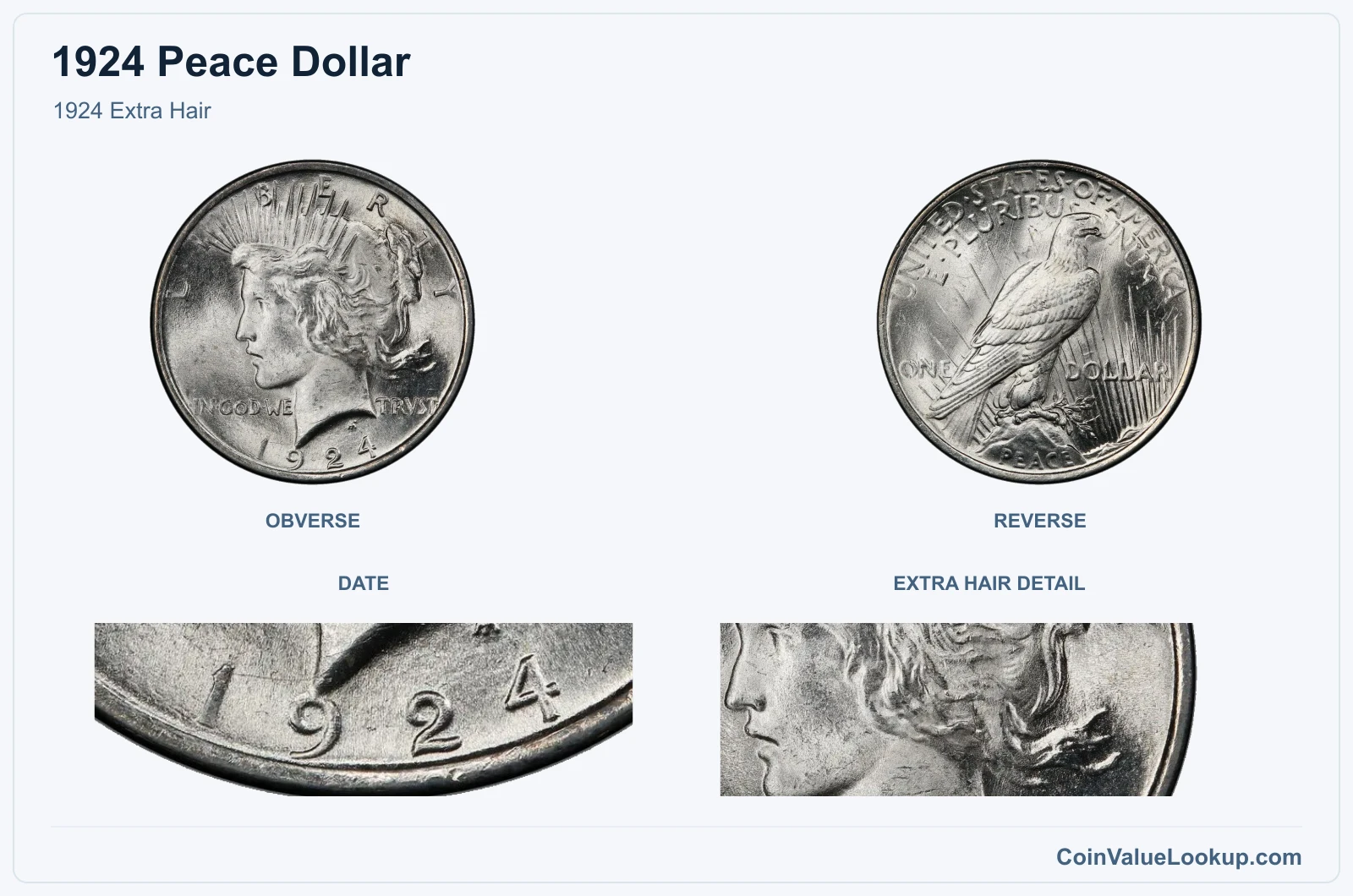
The 1924 Extra Hair variety displays additional raised hair detail on Liberty's head, typically above or behind the ear, resulting from a doubled or re-engraved die. It is not simply a strong strike; the extra lines appear in positions that do not match the normal hair flow.
Coin Value Lookup is a handy starting point if you want to look up guides for other Peace Dollar dates or denominations while you research this one.
No specific guide price is available for this variety. Authenticated examples with clear, bold extra-hair diagnostics and original surfaces will carry more collector interest than weakly expressed or cleaned pieces.
Range Grade
Price Auction Records Appraisal PO PO 1
—
Coin Identifier FR FR 2
—
Coin Identifier AG AG 3
Coin Identifier G G 4
—
Coin Identifier
G 6
—
Coin Identifier VG VG 8
—
Coin Identifier
VG 10
—
Coin Identifier F F 12
—
Coin Identifier
F 15
—
Coin Identifier VF VF 20
—
Coin Identifier
VF 25
—
Coin Identifier
VF 30
—
Coin Identifier
VF 35
—
Coin Identifier XF XF 40
—
Coin Identifier
XF 45
—
Coin Identifier AU AU 50
—
Coin Identifier
AU 53
—
Coin Identifier
AU 55
Coin Identifier
AU 58
—
Coin Identifier MS MS 60
—
Coin Identifier
MS 61
—
Coin Identifier
MS 62
Coin Identifier
MS 63
Coin Identifier
MS 64
Coin Identifier
MS 65
—
Coin Identifier
MS 66
—
—
—
MS 67
—
—
—
MS 68
—
—
—
MS 69
—
—
—
MS 70
—
—
—
1924 Peace Silver Dollar — S
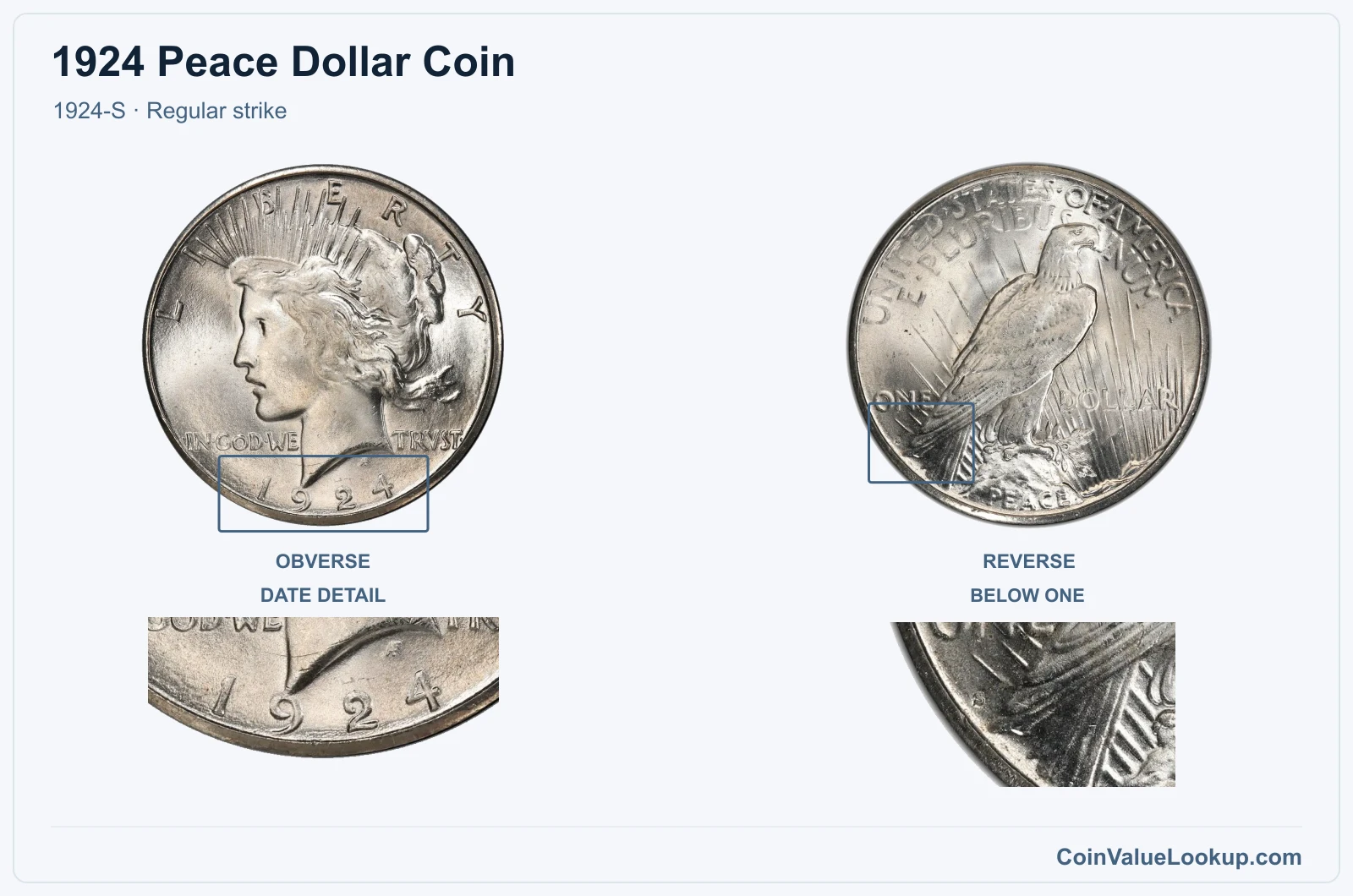
The 1924-S is the San Francisco issue, and it is the key coin of the 1924 Peace Dollar family in high grade. At Good-4, the USA Coin Book guide places it around $78, only modestly above the Philadelphia coin.
But jump to MS65 and you are looking at $7,373, a massive leap that reflects how scarce gem survivors are.
San Francisco coins of this era often came weakly struck and were heavily circulated, so finding one with full detail and original luster is genuinely difficult. Confirm the S mintmark on the reverse, check for cleaning, and grade carefully before assuming you hold a high-end piece.
Range Grade
Price Auction Records Appraisal PO PO 1
—
Coin Identifier FR FR 2
—
Coin Identifier AG AG 3
Coin Identifier G G 4
Coin Identifier
G 6
—
Coin Identifier VG VG 8
—
Coin Identifier
VG 10
Coin Identifier F F 12
—
Coin Identifier
F 15
—
Coin Identifier VF VF 20
—
Coin Identifier
VF 25
—
Coin Identifier
VF 30
Coin Identifier
VF 35
—
Coin Identifier XF XF 40
Coin Identifier
XF 45
Coin Identifier AU AU 50
Coin Identifier
AU 53
Coin Identifier
AU 55
Coin Identifier
AU 58
Coin Identifier MS MS 60
Coin Identifier
MS 61
Coin Identifier
MS 62
Coin Identifier
MS 63
Coin Identifier
MS 64
Coin Identifier
MS 65
Coin Identifier
MS 66
Coin Identifier
MS 67
—
—
—
MS 68
—
—
—
MS 69
—
—
—
MS 70
—
—
—
1924 Peace Silver Dollar — S Doubled Reverse
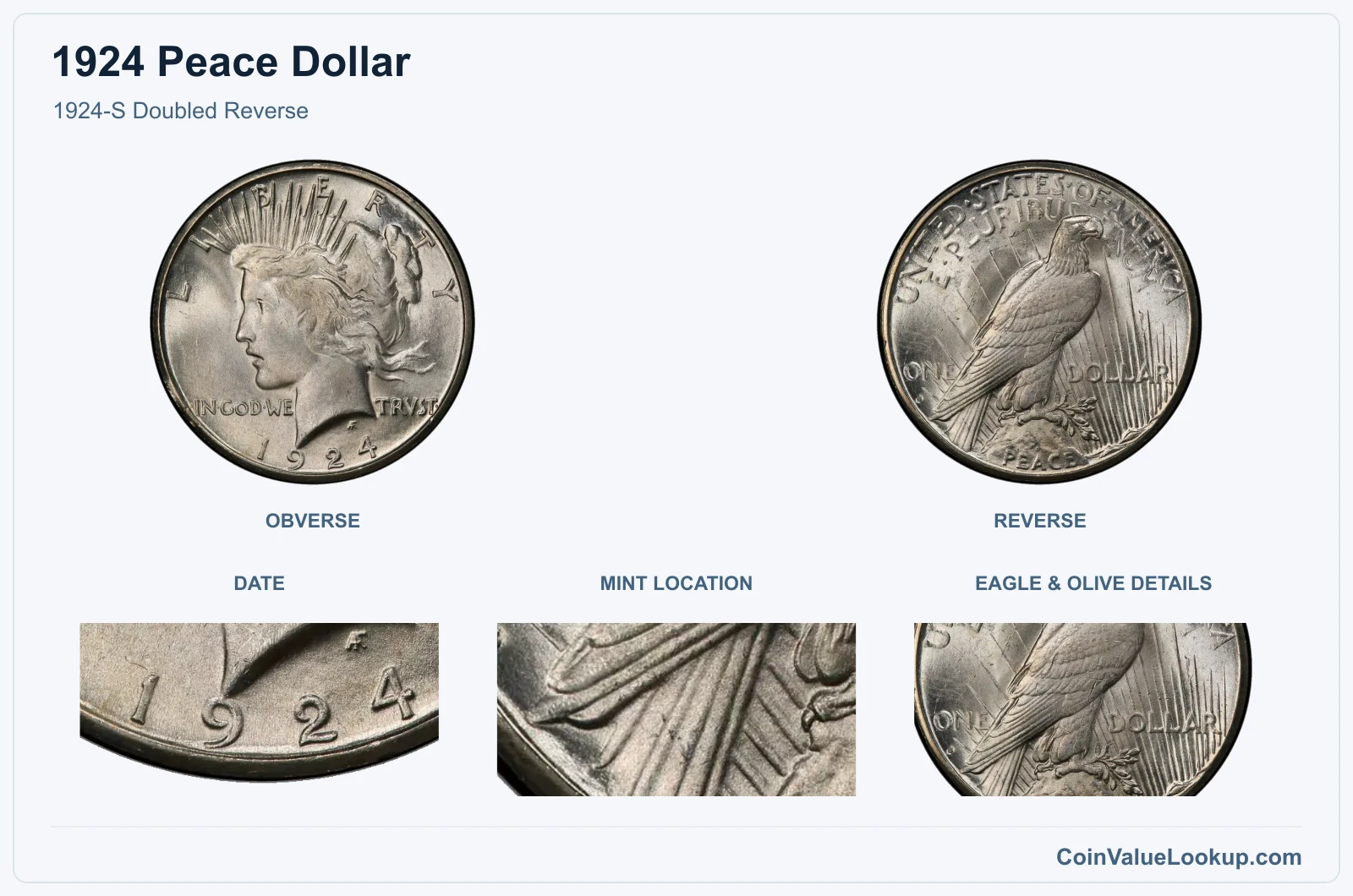
The 1924-S Doubled Reverse combines the already-scarce San Francisco mint with visible doubling on the reverse design elements. Look for spread or offset lettering in PEACE, ONE DOLLAR, or E PLURIBUS UNUM, similar to the Philadelphia doubled reverse but on a coin bearing the S mintmark.
No adopted guide price exists for this variety. Its value depends on authentication, the degree of doubling and the coin's condition.
Because the 1924-S is already a tougher coin in high grades, a confirmed doubled-reverse attribution on a well-preserved example adds meaningful collector interest.
Range Grade
Price Auction Records Appraisal PO PO 1
—
Coin Identifier FR FR 2
—
Coin Identifier AG AG 3
—
Coin Identifier G G 4
—
Coin Identifier
G 6
—
Coin Identifier VG VG 8
—
Coin Identifier
VG 10
—
Coin Identifier F F 12
—
Coin Identifier
F 15
—
Coin Identifier VF VF 20
—
Coin Identifier
VF 25
—
Coin Identifier
VF 30
—
Coin Identifier
VF 35
—
Coin Identifier XF XF 40
—
Coin Identifier
XF 45
—
Coin Identifier AU AU 50
—
Coin Identifier
AU 53
Coin Identifier
AU 55
Coin Identifier
AU 58
—
Coin Identifier MS MS 60
—
Coin Identifier
MS 61
Coin Identifier
MS 62
Coin Identifier
MS 63
Coin Identifier
MS 64
Coin Identifier
MS 65
—
—
—
MS 66
—
—
—
MS 67
—
—
—
MS 68
—
—
—
MS 69
—
—
—
MS 70
—
—
—
1924 Peace Silver Dollar Error List
1. 1924 Peace Silver Dollar — Die Gouge / Named Raised-Line Variety
A die gouge on a 1924 Peace Dollar appears as a raised line or lump of extra metal on the coin's surface, created when the die itself was damaged or gouged before striking. The most recognized example for this date is the Bar D variety, which shows a distinctive raised bar near the reverse design.
To identify it, look for a raised feature that is part of the coin's metal, not cut into it. Tilt the coin under a light; a genuine die gouge will catch light the same way as the surrounding design elements.
An incuse scratch, post-mint damage or an unrelated die crack will look different under magnification, typically showing displaced or missing metal rather than added material.
No numerical price is adopted for this error. Value depends on the specific gouge, its visibility, the coin's grade and authenticated attribution.
2. 1924 Peace Silver Dollar — Clipped Planchet
A clipped planchet error on a 1924 Peace Dollar occurs when the blank was incompletely punched from the silver strip before striking. The result is a missing curved section along the rim, and the coin may show weakness in the design opposite the clip where metal did not fully flow into the die.
Look for a smooth, consistent curve where metal is absent, not a rough or filed edge. The rim adjacent to the clip often blends gradually rather than ending abruptly.
Compare the edge texture in the clipped area with the normal reeded edge elsewhere.
Do not confuse this with an edge cut, a filed notch or corrosion eating into the rim. Those show rough, irregular surfaces.
No numerical price is adopted; the value depends on clip size, visibility, coin condition and authenticated confirmation.
3. 1924 Peace Silver Dollar — Lamination / Split Planchet
A lamination error on a 1924 Peace Dollar shows as peeling, flaking or separated layers of metal on one or both faces. This happens when impurities or gas pockets within the silver alloy cause the planchet to delaminate during or after striking.
Sometimes a thin flap of metal remains attached; other times a section has lifted away, leaving a recessed area.
Photograph the affected area alongside the coin's edge to document the separation clearly. A genuine lamination will show clean internal metal where the layers split, distinct from surface corrosion or deliberate scraping.
Look-alikes include heavy corrosion, environmental damage and coins that have been intentionally cut or scraped. No numerical price is adopted for this error.
Value depends on the size and location of the lamination, overall coin condition and professional authentication.