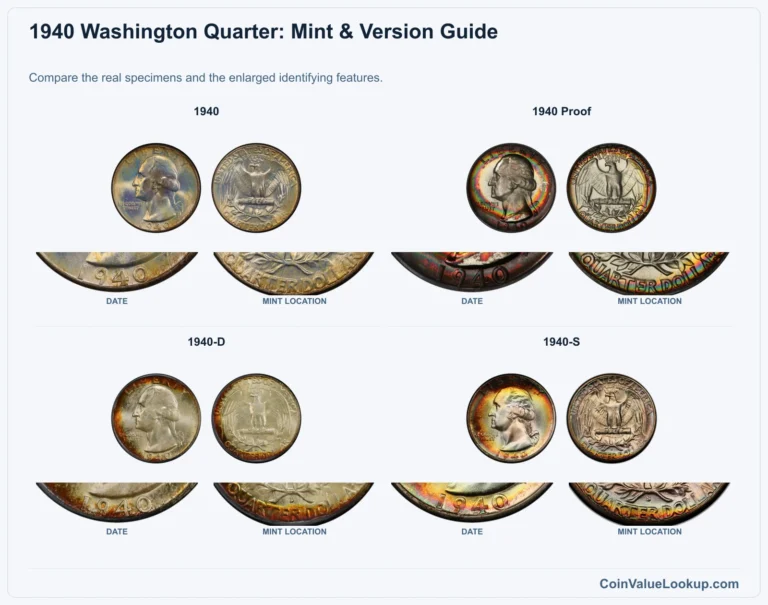
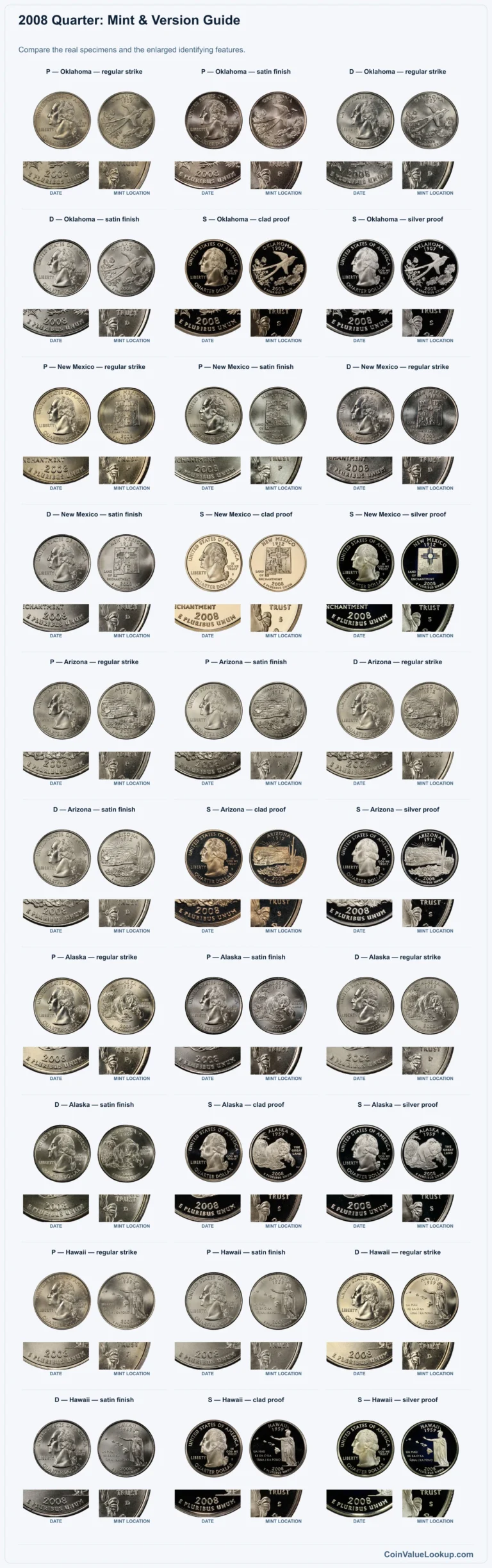
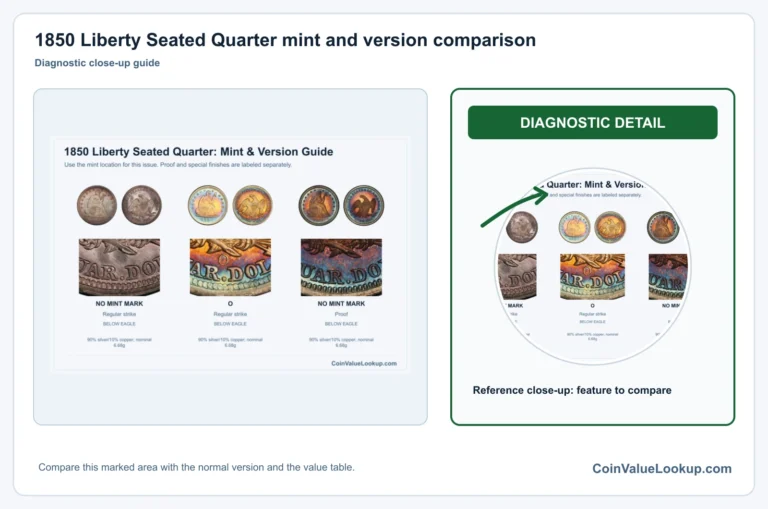
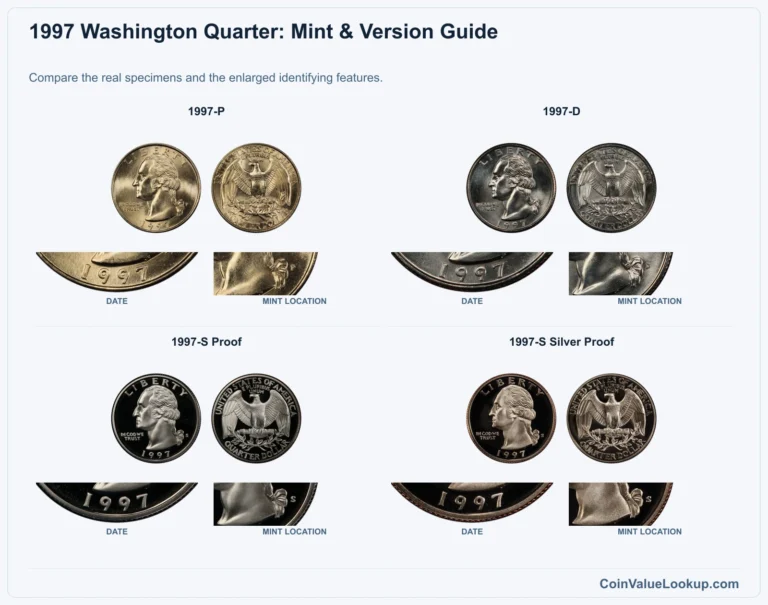
2002 Quarter Coin Value: How Much Is It Worth?
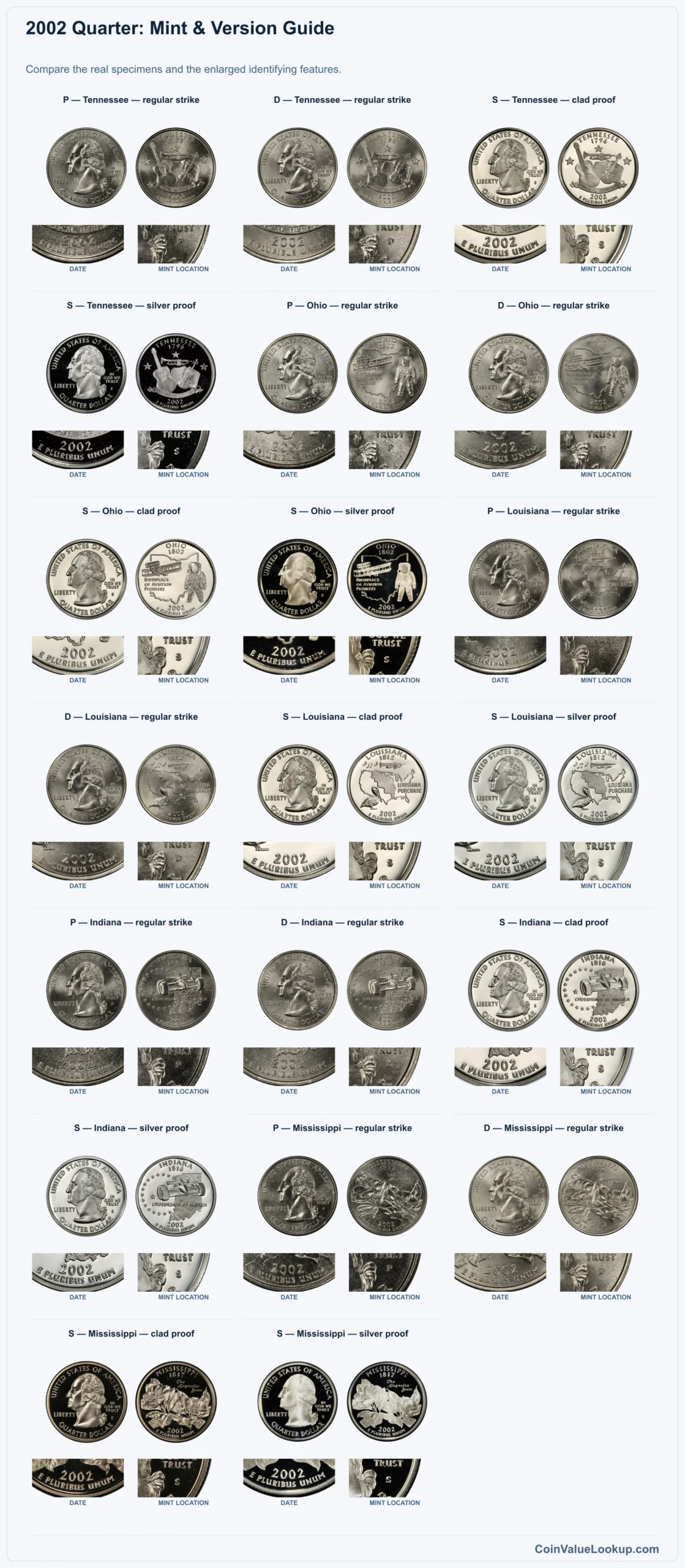
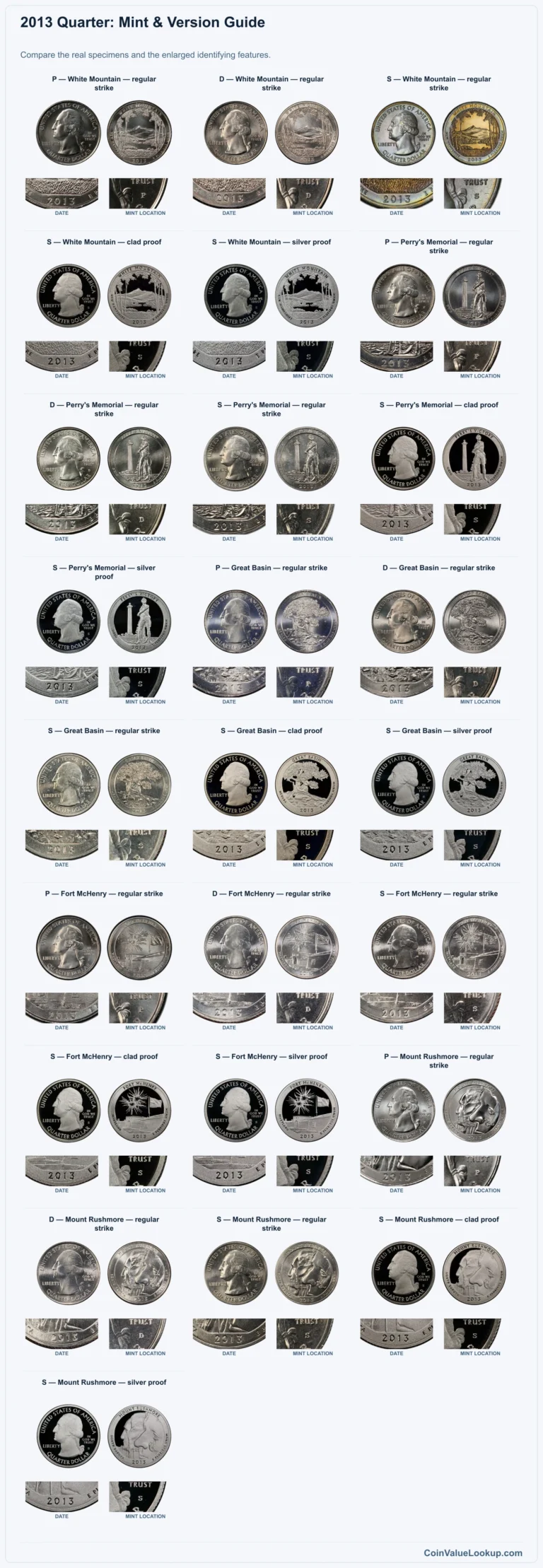
The 2002 quarter belongs to the Washington 50 States Quarters series, and five different reverse designs were issued that year: Tennessee, Ohio, Louisiana, Indiana and Mississippi. Guide estimates from USA Coin Book range from about $0.74 to $23.00 depending on the specific mint, reverse, finish and grade.
That is not one price for every coin — a circulated P-mint Ohio quarter and a silver proof Tennessee quarter sit at opposite ends of that span.
Fast Way to Identify Your 2002 Quarter
The quickest way to start figuring out what you have is to upload clear photos of both sides of your coin. A front-and-back image lets us provide a preliminary identification of your mint, reverse design and finish.
From there you can narrow down which version and price chart applies to your specific quarter.
2002 Quarter Value
Upload both sides of your 2002 Quarter.
Front Obverse
Upload photo
Back Reverse
Upload photo
Which 2002 Quarter Versions Are Worth Money?
- S-mint silver proof Tennessee quarter: USA Coin Book lists about $23.00 at PR65, the highest guide anchor among 2002 Tennessee versions.
- S-mint silver proof Ohio quarter: also guided at about $23.00 at PR65, tied for the top value among Ohio versions.
- S-mint silver proof Mississippi quarter: guided at about $23.00 at PR65 — silver proofs across all five states share this premium.
- S-mint silver proof Louisiana and Indiana quarters each carry the same $23.00 PR65 guide anchor, well above their clad proof counterparts at $6.25.
- Always confirm the S mintmark and silver composition before assuming a proof is silver; clad proofs look similar but carry a lower value.
Step 1: Identify Your 2002 Quarter Mint Mark and Version
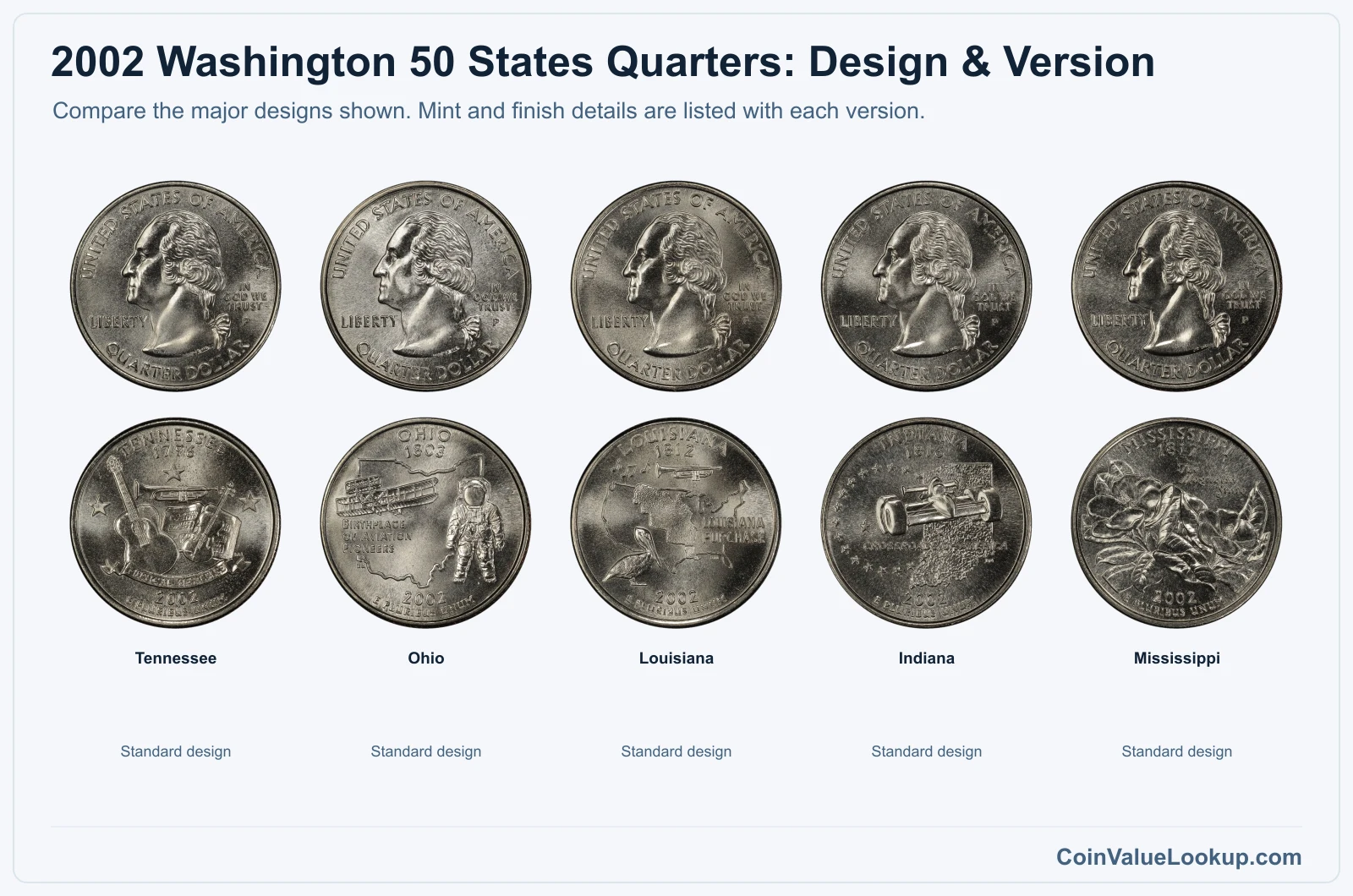
Start with the obverse. Look for a small mintmark — P, D or S — near Washington's portrait below "In God We Trust." P means Philadelphia, D is Denver and S is San Francisco.
Next, flip the coin over. The reverse tells you which state design you have: Tennessee, Ohio, Louisiana, Indiana or Mississippi.
Each state had its own unique artwork, so matching the image is straightforward.
Ordinary business-strike quarters are copper-nickel clad over a copper core, weigh about 5.67 grams and measure 24.26 mm across. Silver proofs, struck only at the San Francisco Mint, are 90% silver and 10% copper, with a slightly heavier nominal weight of 6.25 grams.
You cannot reliably separate the two by color alone — check the edge for a copper stripe (clad) or a uniform silver-gray edge (silver), and weigh the coin if possible.
Keep in mind that a date on the reverse design represents the state's history, not the year the coin was minted. The minting year is always on the obverse.
A proof finish — mirror fields and frosted raised devices — is a deliberate manufacturing method, not an error or a grade above Mint State.
Step 2: Check Your 2002 Quarter Grade
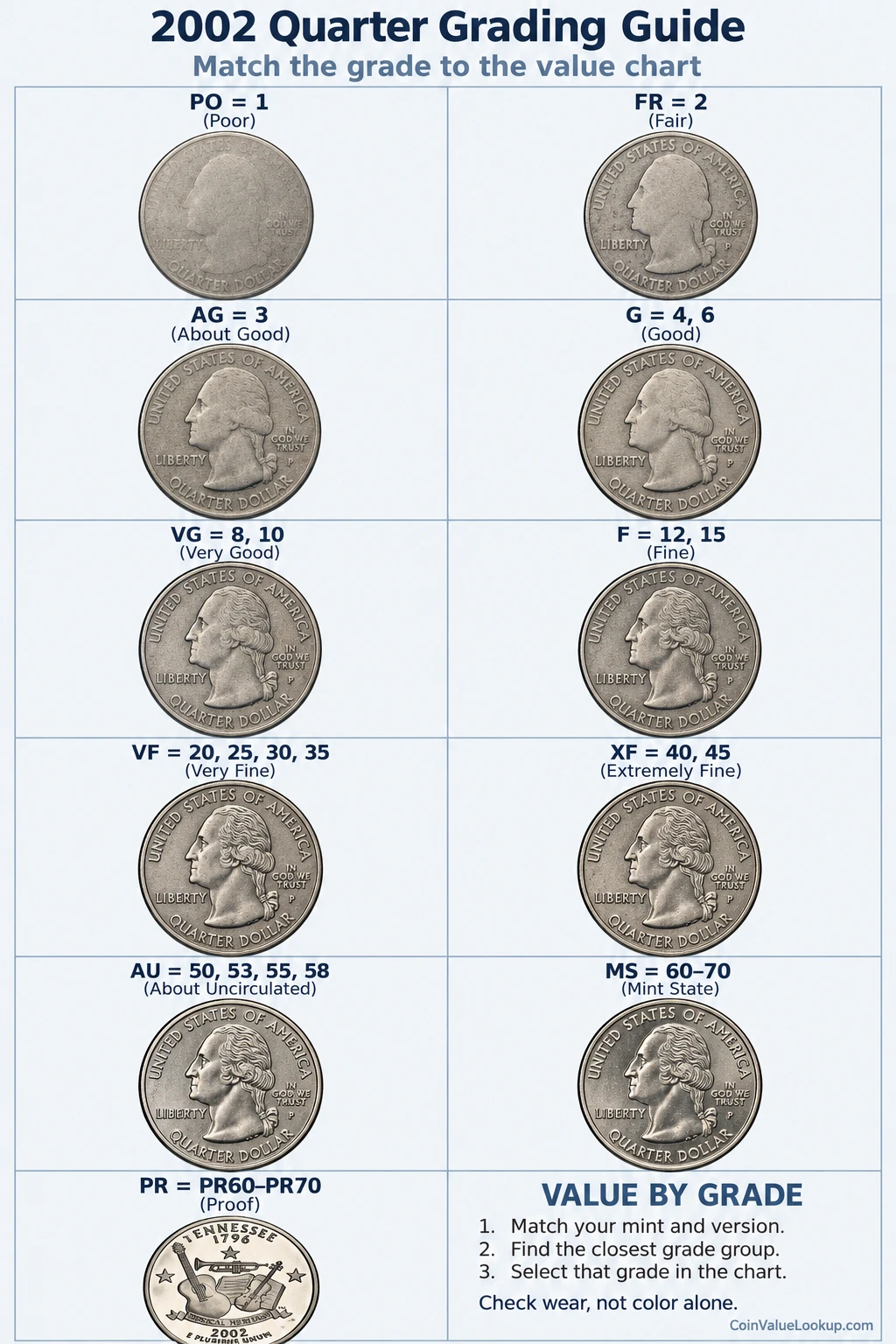
Focus on Washington's cheek and the hair detail above his ear on the obverse. These are the first areas to show wear.
On the reverse, check the highest relief points of the state design — musical instruments on Tennessee, the astronaut on Ohio, the pelican on Louisiana, the race car on Indiana or the magnolias on Mississippi.
Compare your coin side-by-side with the reference image. Luster matters as much as detail: a coin can retain sharp lines but have dull, lifeless fields from cleaning or heavy contact.
That coin grades lower than one with original mint frost.
For proofs, look at the mirror fields under angled light. Hairlines, haze and fingerprints all reduce the grade.
A weak strike can soften detail even on an unworn coin, so do not assume sharp frost equals a top grade. Cameo or deep-cameo designations require a specific contrast between frosted devices and reflective fields — brightness alone does not qualify.
Step 3: Check 2002 Quarter Value by Mint and Version
2002 Quarter — P — Tennessee — regular strike
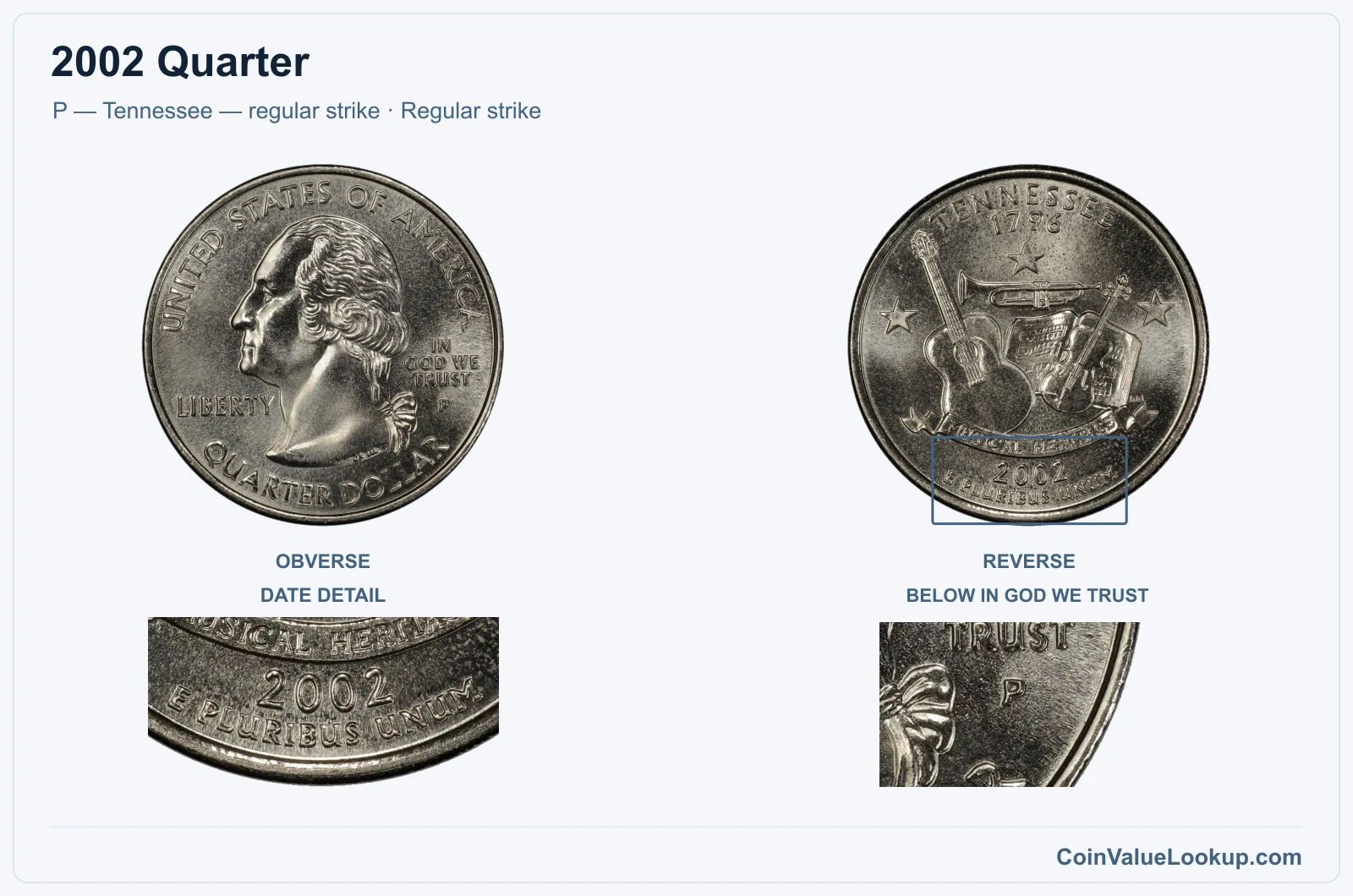
The 2002 P Tennessee quarter is a copper-nickel clad business strike from the Philadelphia Mint. Look for the "P" mintmark on the obverse and the Tennessee reverse featuring musical instruments and a star.
Worn examples from circulation generally trade near face value. USA Coin Book estimates about $0.93 at MS60 and $3.62 at MS65.
To reach those higher grades, the coin needs full original luster and minimal contact marks — no easy feat for a coin that spent time in pockets and registers.
Range Grade
Price Auction Records Appraisal PO PO 1
—
Coin Identifier FR FR 2
—
Coin Identifier AG AG 3
—
Coin Identifier G G 4
—
Coin Identifier
G 6
—
Coin Identifier VG VG 8
—
Coin Identifier
VG 10
—
Coin Identifier F F 12
—
Coin Identifier
F 15
—
Coin Identifier VF VF 20
—
Coin Identifier
VF 25
—
Coin Identifier
VF 30
—
Coin Identifier
VF 35
—
Coin Identifier XF XF 40
—
Coin Identifier
XF 45
—
Coin Identifier AU AU 50
—
Coin Identifier
AU 53
—
Coin Identifier
AU 55
—
Coin Identifier
AU 58
—
Coin Identifier MS MS 60
—
Coin Identifier
MS 61
—
Coin Identifier
MS 62
—
Coin Identifier
MS 63
—
Coin Identifier
MS 64
Coin Identifier
MS 65
—
Coin Identifier
MS 66
Coin Identifier
MS 67
Coin Identifier
MS 68
Coin Identifier
MS 69
Coin Identifier
MS 70
—
—
—
2002 Quarter — D — Tennessee — regular strike
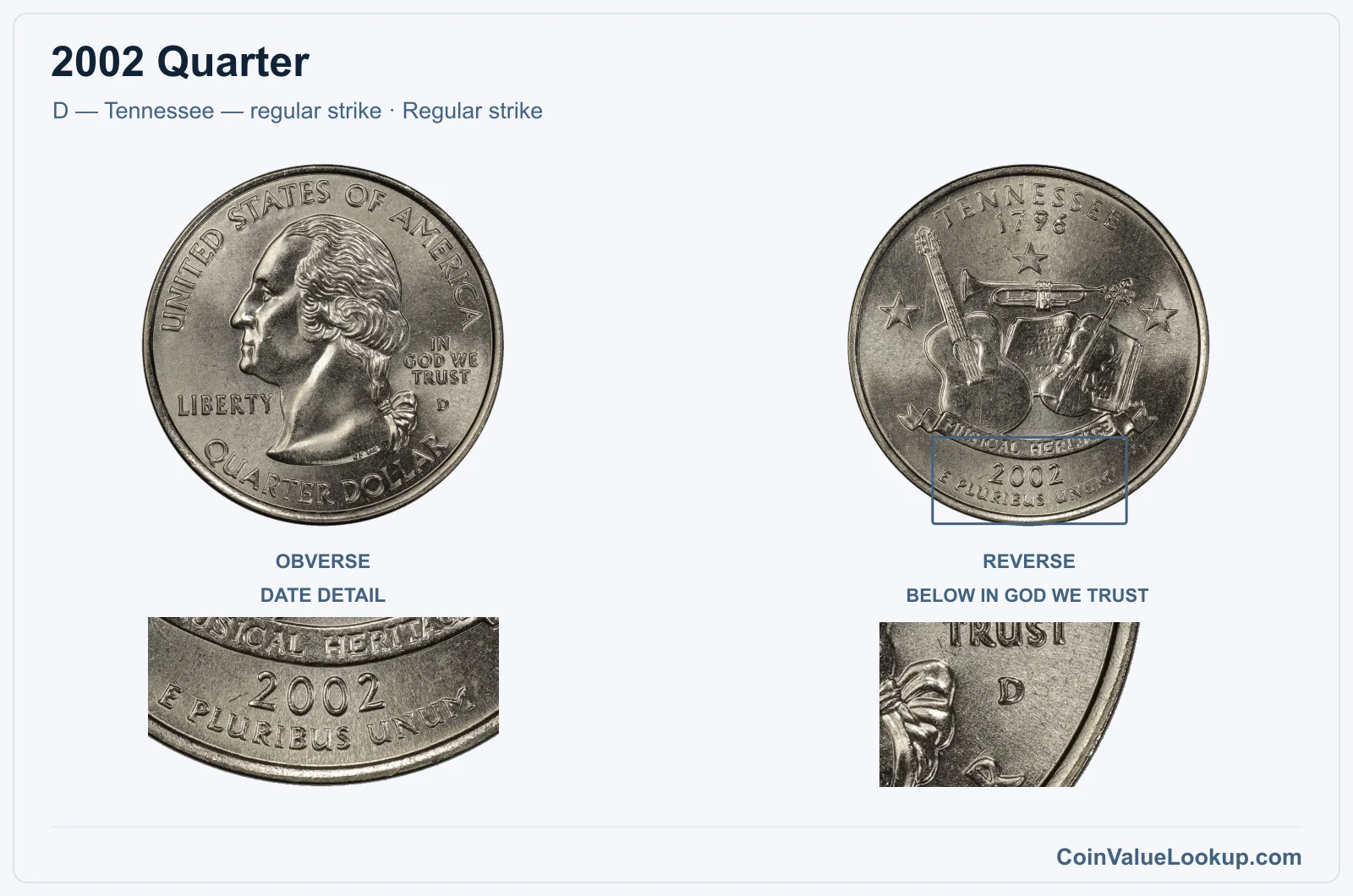
The 2002 D Tennessee quarter is the Denver Mint's version of the same copper-nickel clad design. Confirm the "D" mintmark on the obverse.
In circulated grades, expect face value at best. USA Coin Book guides place it around $0.93 at MS60 and $3.62 at MS65.
High-grade uncirculated rolls were saved by collectors, so well-preserved examples do exist — but bag marks and scuffs from banking contact keep most coins below the MS65 threshold.
Range Grade
Price Auction Records Appraisal PO PO 1
—
Coin Identifier FR FR 2
—
Coin Identifier AG AG 3
—
Coin Identifier G G 4
—
Coin Identifier
G 6
—
Coin Identifier VG VG 8
—
Coin Identifier
VG 10
—
Coin Identifier F F 12
—
Coin Identifier
F 15
—
Coin Identifier VF VF 20
—
Coin Identifier
VF 25
—
Coin Identifier
VF 30
—
Coin Identifier
VF 35
—
Coin Identifier XF XF 40
—
Coin Identifier
XF 45
—
Coin Identifier AU AU 50
—
Coin Identifier
AU 53
—
Coin Identifier
AU 55
—
Coin Identifier
AU 58
—
Coin Identifier MS MS 60
—
Coin Identifier
MS 61
—
Coin Identifier
MS 62
—
Coin Identifier
MS 63
—
Coin Identifier
MS 64
—
Coin Identifier
MS 65
Coin Identifier
MS 66
—
Coin Identifier
MS 67
Coin Identifier
MS 68
Coin Identifier
MS 69
—
—
—
MS 70
—
—
—
2002 Quarter — S — Tennessee — clad proof
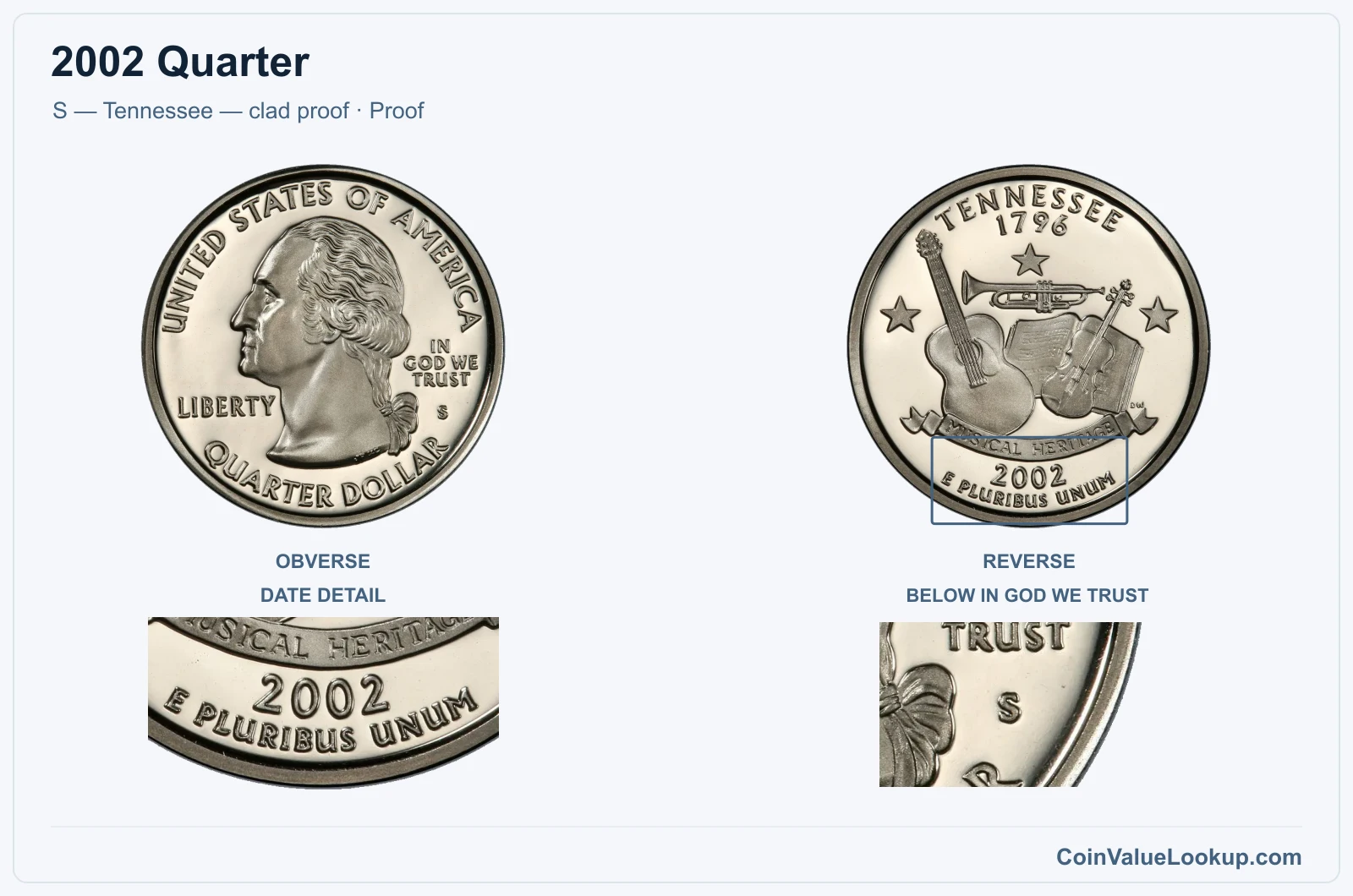
This is the 2002 S Tennessee clad proof, struck at San Francisco from the same copper-nickel clad composition as business strikes. It came in sealed proof sets and features mirror-like fields with frosted devices.
Check the edge: a visible copper stripe means clad, not silver. USA Coin Book estimates about $6.25 at PR65.
Separating this from the silver proof is essential, because the silver version carries a significantly higher guide value.
Range Grade
Price Auction Records Appraisal PR PR 1
—
Coin Identifier
PR 2
—
Coin Identifier
PR 3
—
Coin Identifier
PR 4
—
Coin Identifier
PR 6
—
Coin Identifier
PR 8
—
Coin Identifier
PR 10
—
Coin Identifier
PR 12
—
Coin Identifier
PR 15
—
Coin Identifier
PR 20
—
Coin Identifier
PR 25
—
Coin Identifier
PR 30
—
Coin Identifier
PR 35
—
Coin Identifier
PR 40
—
Coin Identifier
PR 45
—
Coin Identifier
PR 50
—
Coin Identifier
PR 53
—
Coin Identifier
PR 55
—
Coin Identifier
PR 58
—
Coin Identifier
PR 60
—
Coin Identifier
PR 61
—
Coin Identifier
PR 62
—
Coin Identifier
PR 63
—
Coin Identifier
PR 64
—
Coin Identifier
PR 65
—
Coin Identifier
PR 66
—
Coin Identifier
PR 67
—
Coin Identifier
PR 68
—
Coin Identifier
PR 69
Coin Identifier
PR 70
Coin Identifier
2002 Quarter — S — Tennessee — silver proof
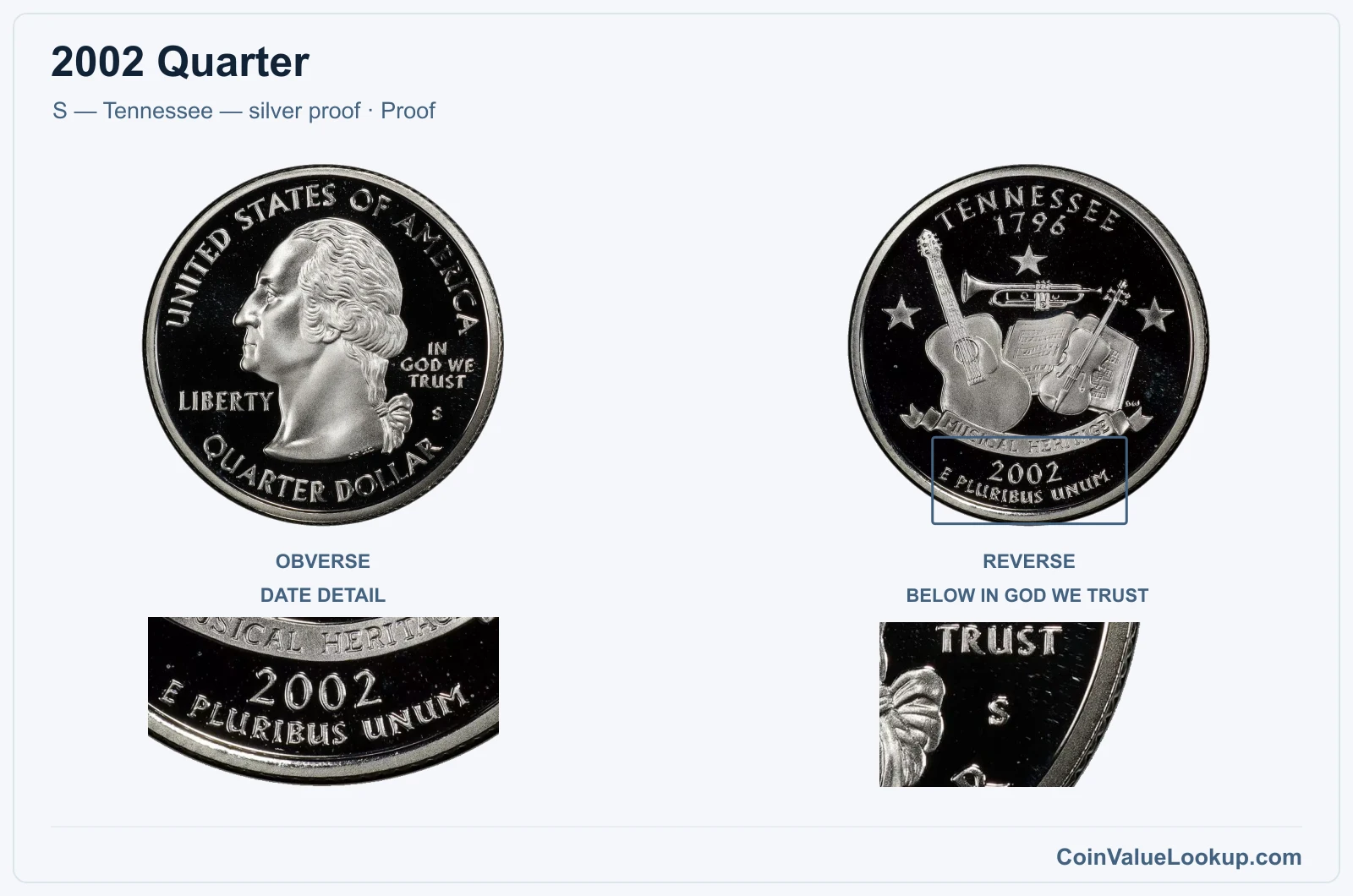
The 2002 S Tennessee silver proof is struck from 90% silver and 10% copper, weighing a nominal 6.25 grams — heavier than the 5.67-gram clad version. The edge should appear uniformly silver-gray with no copper stripe.
USA Coin Book guides this at about $23.00 at PR65, placing it among the highest-valued regular 2002 quarter versions. Confirm composition by weight or original packaging before assuming silver.
A pristine example with deep contrast between frosted devices and mirror fields is what collectors prize most in this issue.
Range Grade
Price Auction Records Appraisal PR PR 1
—
Coin Identifier
PR 2
—
Coin Identifier
PR 3
—
Coin Identifier
PR 4
—
Coin Identifier
PR 6
—
Coin Identifier
PR 8
—
Coin Identifier
PR 10
—
Coin Identifier
PR 12
—
Coin Identifier
PR 15
—
Coin Identifier
PR 20
—
Coin Identifier
PR 25
—
Coin Identifier
PR 30
—
Coin Identifier
PR 35
—
Coin Identifier
PR 40
—
Coin Identifier
PR 45
—
Coin Identifier
PR 50
—
Coin Identifier
PR 53
—
Coin Identifier
PR 55
—
Coin Identifier
PR 58
—
Coin Identifier
PR 60
—
Coin Identifier
PR 61
—
Coin Identifier
PR 62
—
Coin Identifier
PR 63
—
Coin Identifier
PR 64
—
Coin Identifier
PR 65
—
Coin Identifier
PR 66
—
Coin Identifier
PR 67
—
Coin Identifier
PR 68
—
Coin Identifier
PR 69
Coin Identifier
PR 70
Coin Identifier
2002 Quarter — P — Ohio — regular strike
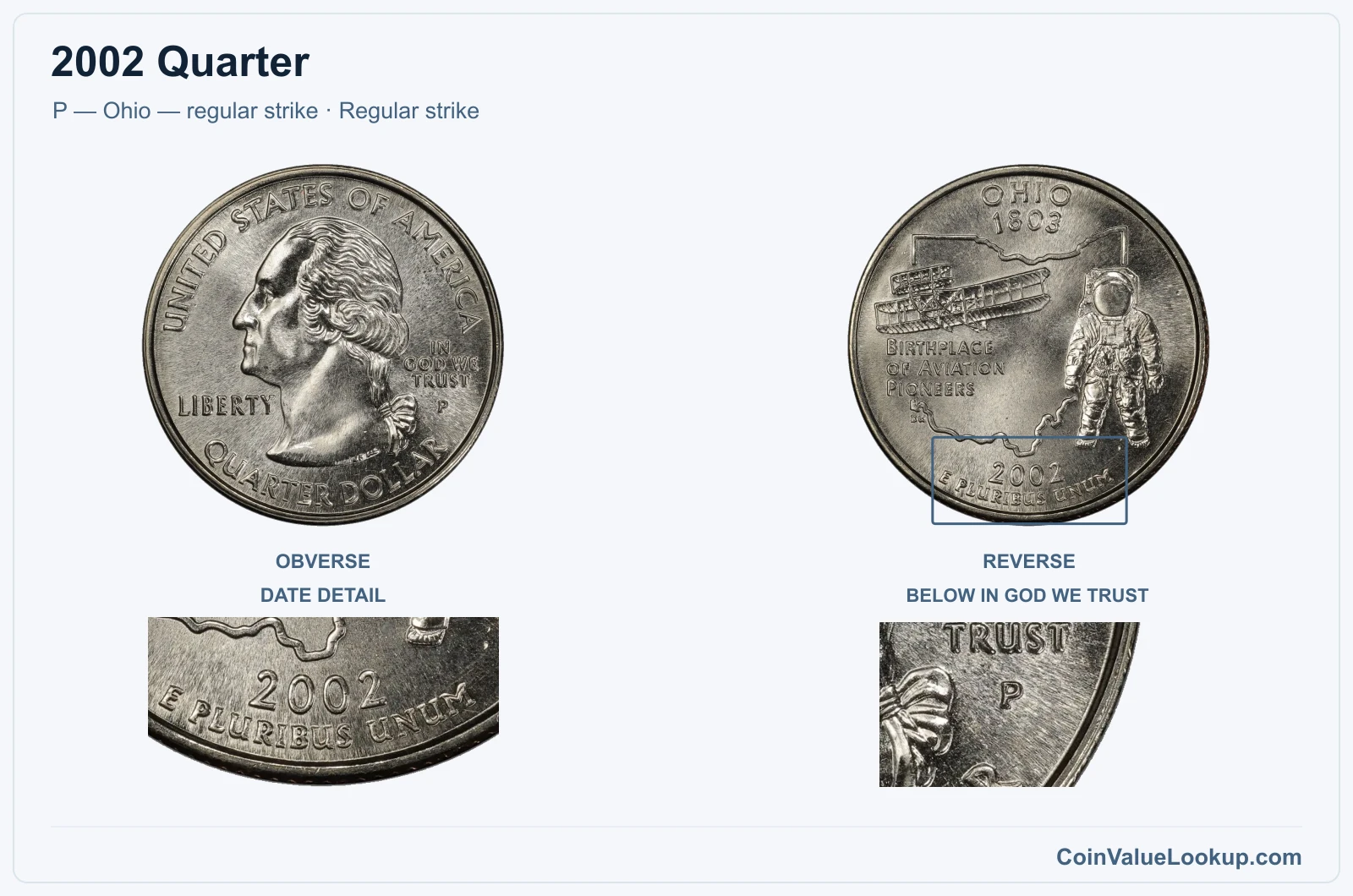
The 2002 P Ohio quarter is a copper-nickel clad business strike from Philadelphia, carrying the "P" mintmark. The Ohio reverse features an astronaut and the Wright Flyer.
Circulated coins trade at face value. USA Coin Book estimates about $0.74 at MS60 and $1.88 at MS65.
These are slightly lower guide anchors than the Tennessee versions at the same grades. Bags and rolls were widely saved, so uncirculated examples are common — but truly mark-free coins stand out.
Coin Value Lookup is a good starting point if you want to look up quarter values across different years and designs. You can compare your 2002 Ohio quarter against other dates in the series.
Range Grade
Price Auction Records Appraisal PO PO 1
—
Coin Identifier FR FR 2
—
Coin Identifier AG AG 3
—
Coin Identifier G G 4
—
Coin Identifier
G 6
—
Coin Identifier VG VG 8
—
Coin Identifier
VG 10
—
Coin Identifier F F 12
—
Coin Identifier
F 15
—
Coin Identifier VF VF 20
—
Coin Identifier
VF 25
—
Coin Identifier
VF 30
—
Coin Identifier
VF 35
—
Coin Identifier XF XF 40
—
Coin Identifier
XF 45
—
Coin Identifier AU AU 50
—
Coin Identifier
AU 53
—
Coin Identifier
AU 55
—
Coin Identifier
AU 58
—
Coin Identifier MS MS 60
—
Coin Identifier
MS 61
—
Coin Identifier
MS 62
—
Coin Identifier
MS 63
—
Coin Identifier
MS 64
—
Coin Identifier
MS 65
—
Coin Identifier
MS 66
Coin Identifier
MS 67
Coin Identifier
MS 68
Coin Identifier
MS 69
Coin Identifier
MS 70
—
—
—
2002 Quarter — D — Ohio — regular strike
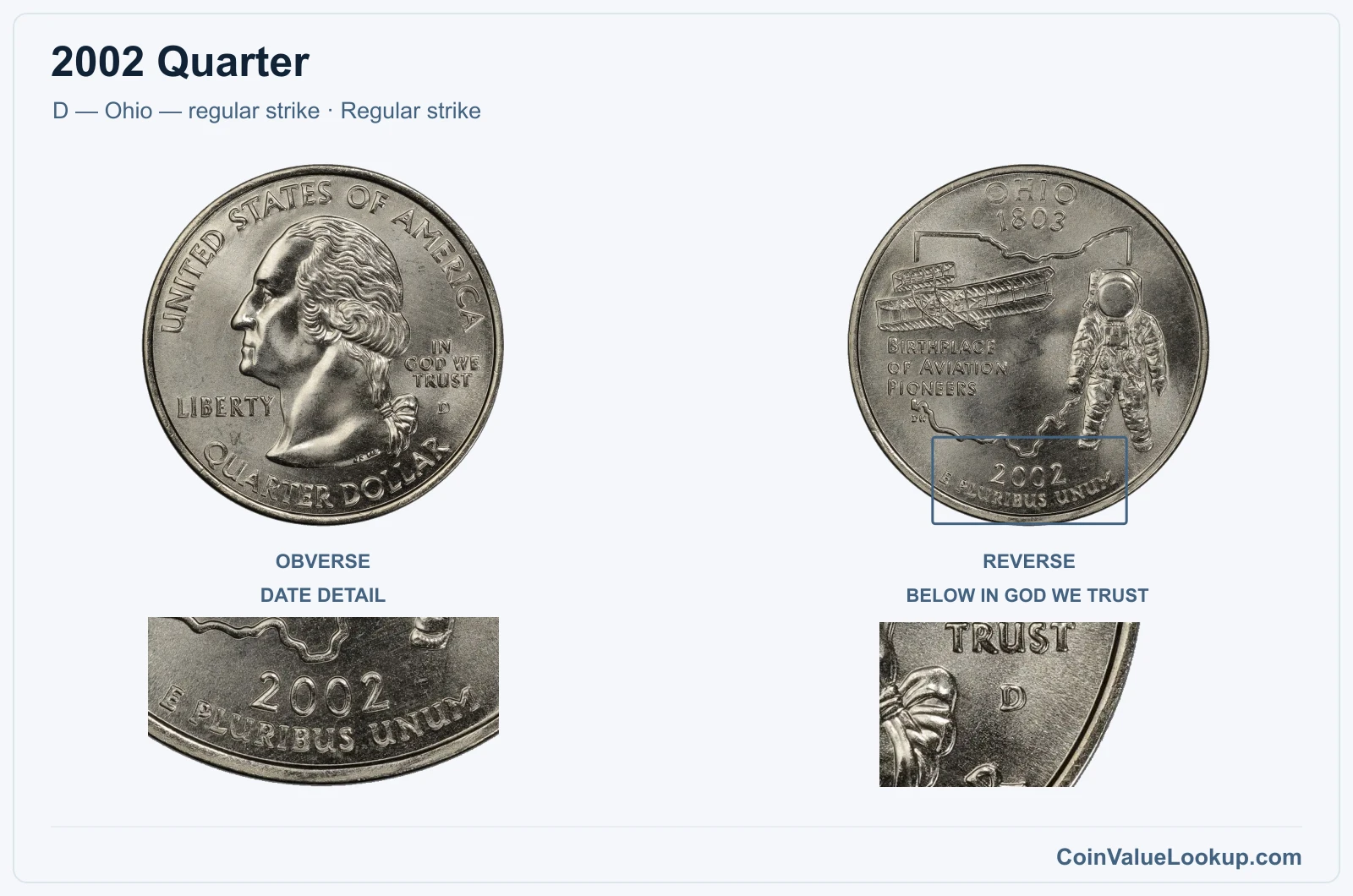
Denver's version of the 2002 Ohio quarter shares the same copper-nickel clad composition and Ohio reverse design. Look for the "D" mintmark.
Circulated examples are worth 25 cents. USA Coin Book places the guide at about $0.74 at MS60 and $1.88 at MS65.
As with the Philadelphia version, high production numbers keep these affordable in most grades. Only truly pristine coins push into the higher end of the guide range.
Range Grade
Price Auction Records Appraisal PO PO 1
—
Coin Identifier FR FR 2
—
Coin Identifier AG AG 3
—
Coin Identifier G G 4
—
Coin Identifier
G 6
—
Coin Identifier VG VG 8
—
Coin Identifier
VG 10
—
Coin Identifier F F 12
—
Coin Identifier
F 15
—
Coin Identifier VF VF 20
—
Coin Identifier
VF 25
—
Coin Identifier
VF 30
—
Coin Identifier
VF 35
—
Coin Identifier XF XF 40
—
Coin Identifier
XF 45
—
Coin Identifier AU AU 50
—
Coin Identifier
AU 53
—
Coin Identifier
AU 55
—
Coin Identifier
AU 58
—
Coin Identifier MS MS 60
—
Coin Identifier
MS 61
—
Coin Identifier
MS 62
—
Coin Identifier
MS 63
—
Coin Identifier
MS 64
—
Coin Identifier
MS 65
—
Coin Identifier
MS 66
—
Coin Identifier
MS 67
Coin Identifier
MS 68
Coin Identifier
MS 69
—
—
—
MS 70
—
—
—
2002 Quarter — S — Ohio — clad proof
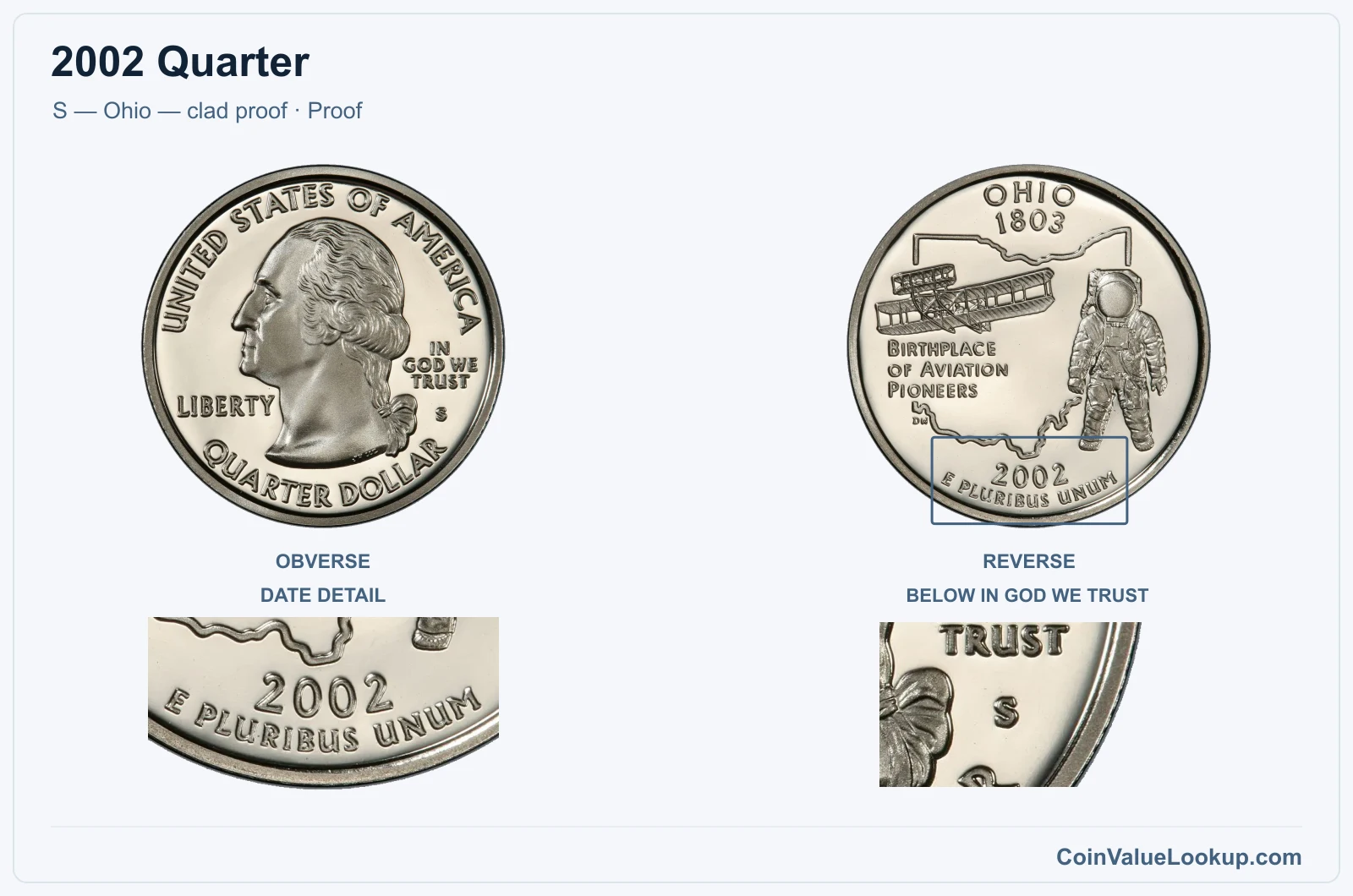
The 2002 S Ohio clad proof is a collector proof struck on a standard copper-nickel clad planchet at San Francisco. Mirror fields and frosted devices distinguish it from business strikes.
USA Coin Book estimates about $6.25 at PR65. Be sure to compare the edge with the silver proof version before settling on a value — the two look nearly identical from the face but differ in weight and edge appearance.
Original packaging is the easiest confirmation.
Range Grade
Price Auction Records Appraisal PR PR 1
—
Coin Identifier
PR 2
—
Coin Identifier
PR 3
—
Coin Identifier
PR 4
—
Coin Identifier
PR 6
—
Coin Identifier
PR 8
—
Coin Identifier
PR 10
—
Coin Identifier
PR 12
—
Coin Identifier
PR 15
—
Coin Identifier
PR 20
—
Coin Identifier
PR 25
—
Coin Identifier
PR 30
—
Coin Identifier
PR 35
—
Coin Identifier
PR 40
—
Coin Identifier
PR 45
—
Coin Identifier
PR 50
—
Coin Identifier
PR 53
—
Coin Identifier
PR 55
—
Coin Identifier
PR 58
—
Coin Identifier
PR 60
—
Coin Identifier
PR 61
—
Coin Identifier
PR 62
—
Coin Identifier
PR 63
—
Coin Identifier
PR 64
—
Coin Identifier
PR 65
—
Coin Identifier
PR 66
—
Coin Identifier
PR 67
—
Coin Identifier
PR 68
—
Coin Identifier
PR 69
Coin Identifier
PR 70
Coin Identifier
2002 Quarter — S — Ohio — silver proof
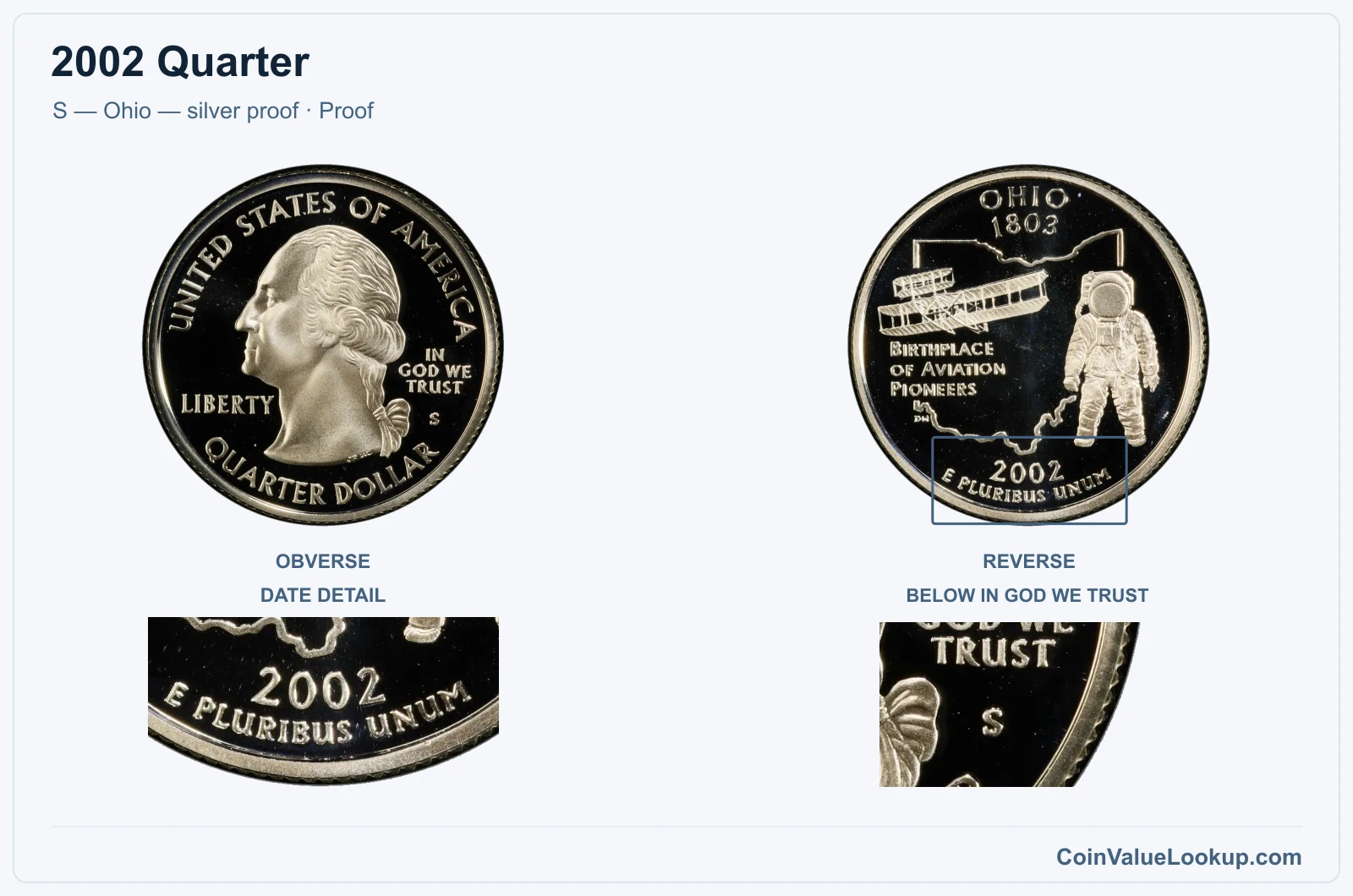
The 2002 S Ohio silver proof is a 90% silver coin weighing about 6.25 grams. Its edge is uniformly silver-gray, unlike the copper-striped edge of the clad proof.
USA Coin Book guides this version at about $23.00 at PR65. The silver content alone gives it a base premium, and collector demand for the Ohio astronaut design adds appeal.
Verify composition through weight or the original silver proof set packaging before claiming the higher value.
Range Grade
Price Auction Records Appraisal PR PR 1
—
Coin Identifier
PR 2
—
Coin Identifier
PR 3
—
Coin Identifier
PR 4
—
Coin Identifier
PR 6
—
Coin Identifier
PR 8
—
Coin Identifier
PR 10
—
Coin Identifier
PR 12
—
Coin Identifier
PR 15
—
Coin Identifier
PR 20
—
Coin Identifier
PR 25
—
Coin Identifier
PR 30
—
Coin Identifier
PR 35
—
Coin Identifier
PR 40
—
Coin Identifier
PR 45
—
Coin Identifier
PR 50
—
Coin Identifier
PR 53
—
Coin Identifier
PR 55
—
Coin Identifier
PR 58
—
Coin Identifier
PR 60
—
Coin Identifier
PR 61
—
Coin Identifier
PR 62
—
Coin Identifier
PR 63
—
Coin Identifier
PR 64
—
Coin Identifier
PR 65
—
Coin Identifier
PR 66
—
Coin Identifier
PR 67
—
Coin Identifier
PR 68
—
Coin Identifier
PR 69
Coin Identifier
PR 70
Coin Identifier
2002 Quarter — P — Louisiana — regular strike
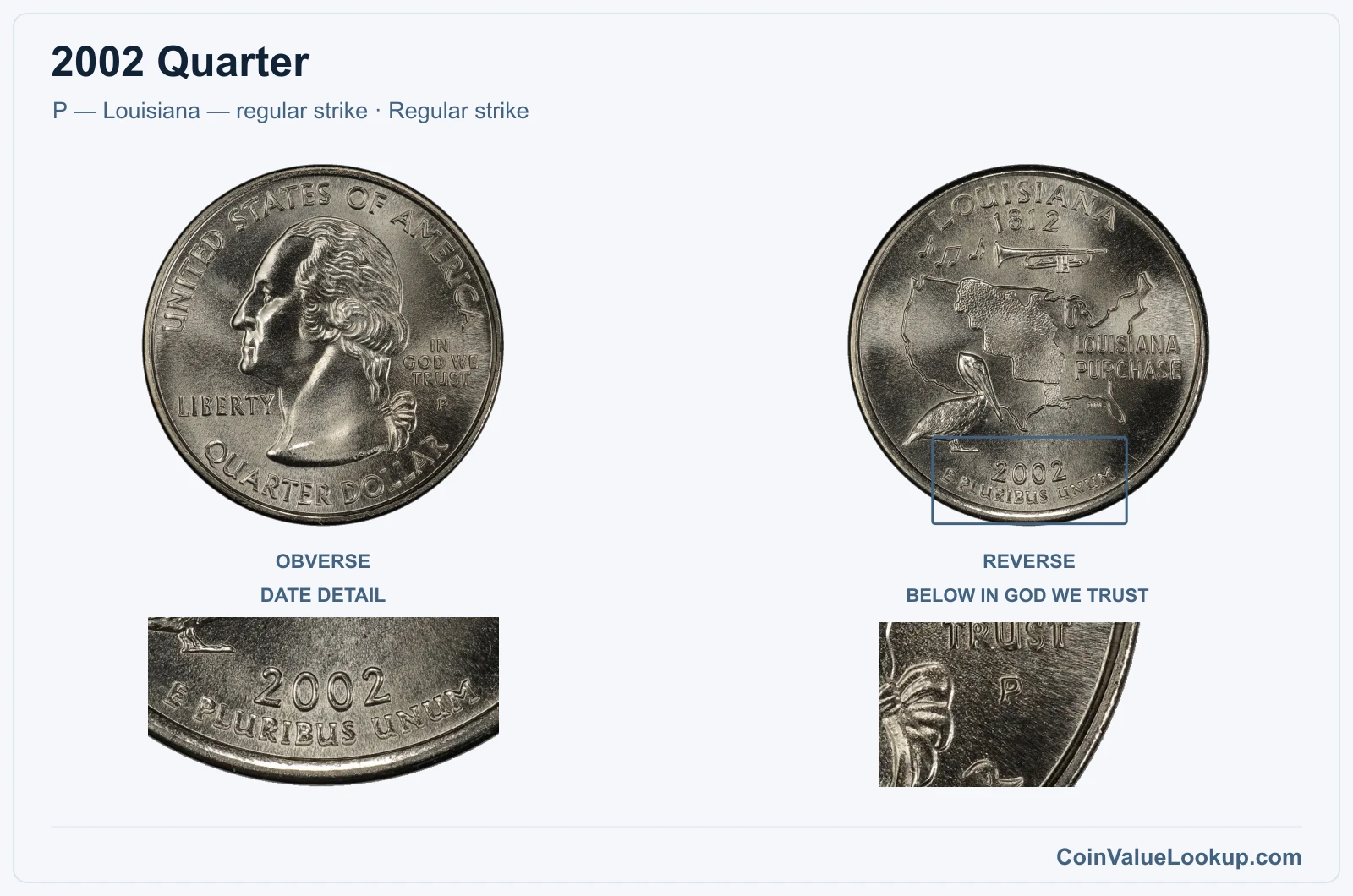
This is the 2002 P Louisiana quarter, a copper-nickel clad business strike from Philadelphia. The reverse shows the Louisiana Purchase outline and a pelican.
Circulated coins are worth face value. USA Coin Book estimates around $0.74 at MS60 and $1.88 at MS65.
High-grade survivors from original rolls are out there, but most coins you find in change will show enough contact to keep them well below gem territory.
Range Grade
Price Auction Records Appraisal PO PO 1
—
Coin Identifier FR FR 2
—
Coin Identifier AG AG 3
—
Coin Identifier G G 4
—
Coin Identifier
G 6
—
Coin Identifier VG VG 8
—
Coin Identifier
VG 10
—
Coin Identifier F F 12
—
Coin Identifier
F 15
—
Coin Identifier VF VF 20
—
Coin Identifier
VF 25
—
Coin Identifier
VF 30
—
Coin Identifier
VF 35
—
Coin Identifier XF XF 40
—
Coin Identifier
XF 45
—
Coin Identifier AU AU 50
—
Coin Identifier
AU 53
—
Coin Identifier
AU 55
—
Coin Identifier
AU 58
—
Coin Identifier MS MS 60
—
Coin Identifier
MS 61
—
Coin Identifier
MS 62
—
Coin Identifier
MS 63
—
Coin Identifier
MS 64
—
Coin Identifier
MS 65
—
Coin Identifier
MS 66
Coin Identifier
MS 67
Coin Identifier
MS 68
Coin Identifier
MS 69
Coin Identifier
MS 70
—
—
—
2002 Quarter — D — Louisiana — regular strike
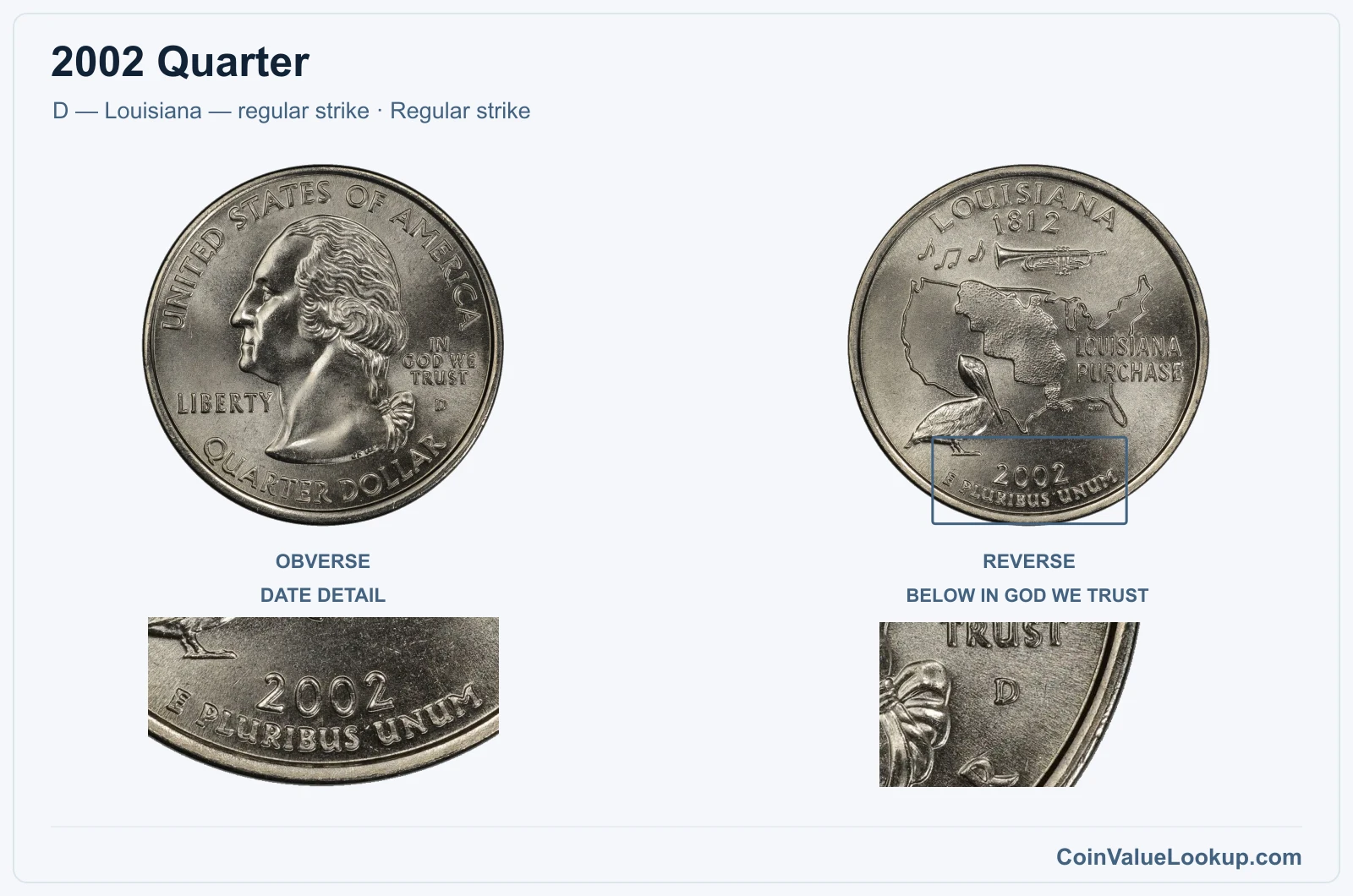
The 2002 D Louisiana quarter is Denver's copper-nickel clad version of the same reverse design. Confirm the "D" mintmark.
Guide estimates from USA Coin Book are about $0.74 at MS60 and $1.88 at MS65. Like most circulated state quarters, these trade at 25 cents in everyday grades.
An original-luster coin free of nicks and scratches is the minimum bar for any meaningful collector premium here.
Range Grade
Price Auction Records Appraisal PO PO 1
—
Coin Identifier FR FR 2
—
Coin Identifier AG AG 3
—
Coin Identifier G G 4
—
Coin Identifier
G 6
—
Coin Identifier VG VG 8
—
Coin Identifier
VG 10
—
Coin Identifier F F 12
—
Coin Identifier
F 15
—
Coin Identifier VF VF 20
—
Coin Identifier
VF 25
—
Coin Identifier
VF 30
—
Coin Identifier
VF 35
—
Coin Identifier XF XF 40
—
Coin Identifier
XF 45
—
Coin Identifier AU AU 50
—
Coin Identifier
AU 53
—
Coin Identifier
AU 55
—
Coin Identifier
AU 58
—
Coin Identifier MS MS 60
—
Coin Identifier
MS 61
—
Coin Identifier
MS 62
—
Coin Identifier
MS 63
—
Coin Identifier
MS 64
—
Coin Identifier
MS 65
—
Coin Identifier
MS 66
—
Coin Identifier
MS 67
—
Coin Identifier
MS 68
Coin Identifier
MS 69
—
—
—
MS 70
—
—
—
2002 Quarter — S — Louisiana — clad proof
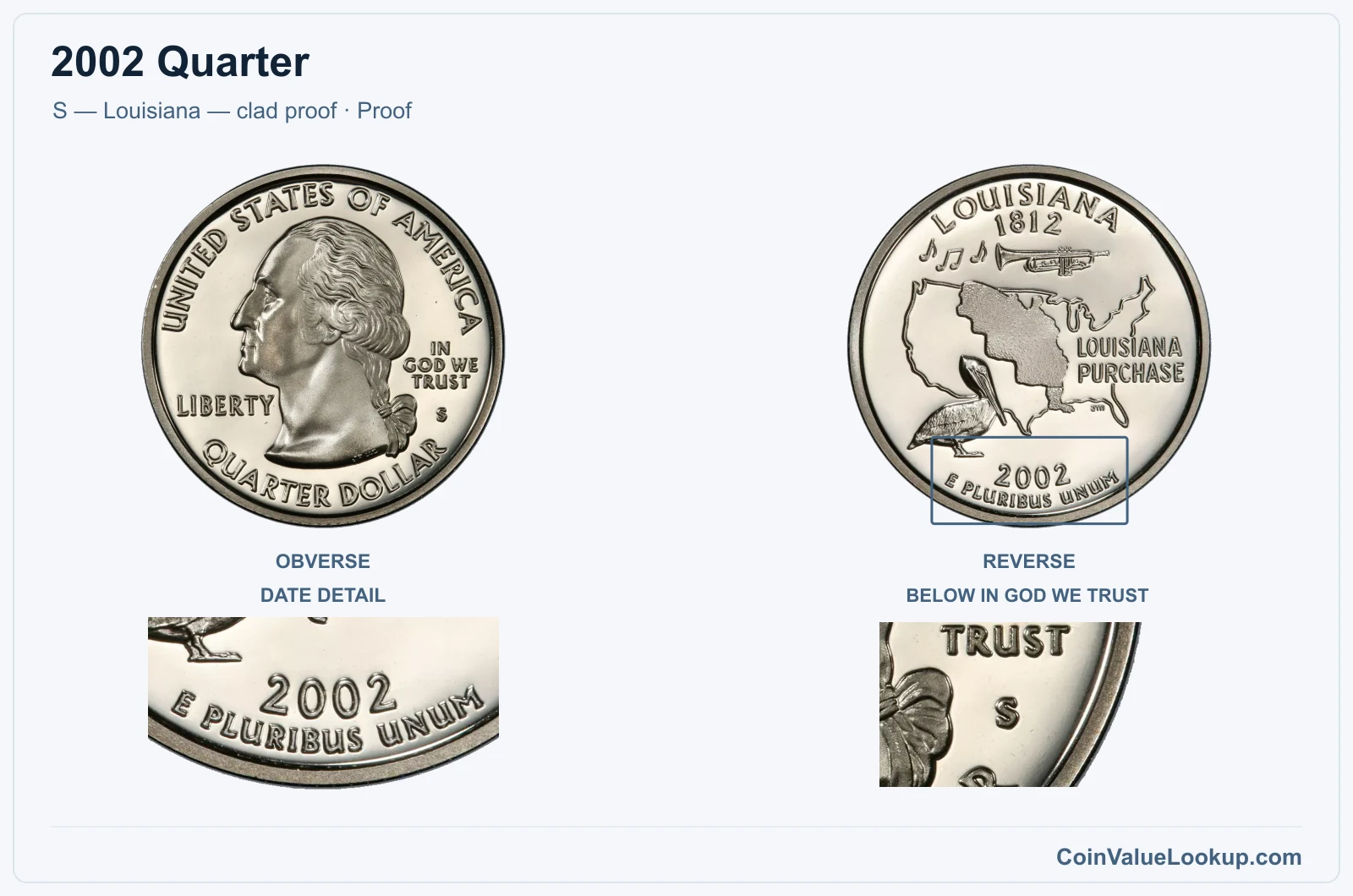
The 2002 S Louisiana clad proof was struck at San Francisco on a copper-nickel clad planchet with proof finishing. Expect mirror fields and frosted raised devices on the pelican and state outline.
USA Coin Book estimates about $6.25 at PR65. The edge should show a visible copper layer if this is the clad version.
Keeping clad and silver proof values separate matters — the silver issue is worth several times more.
Range Grade
Price Auction Records Appraisal PR PR 1
—
Coin Identifier
PR 2
—
Coin Identifier
PR 3
—
Coin Identifier
PR 4
—
Coin Identifier
PR 6
—
Coin Identifier
PR 8
—
Coin Identifier
PR 10
—
Coin Identifier
PR 12
—
Coin Identifier
PR 15
—
Coin Identifier
PR 20
—
Coin Identifier
PR 25
—
Coin Identifier
PR 30
—
Coin Identifier
PR 35
—
Coin Identifier
PR 40
—
Coin Identifier
PR 45
—
Coin Identifier
PR 50
—
Coin Identifier
PR 53
—
Coin Identifier
PR 55
—
Coin Identifier
PR 58
—
Coin Identifier
PR 60
—
Coin Identifier
PR 61
—
Coin Identifier
PR 62
—
Coin Identifier
PR 63
—
Coin Identifier
PR 64
—
Coin Identifier
PR 65
—
Coin Identifier
PR 66
—
Coin Identifier
PR 67
—
Coin Identifier
PR 68
Coin Identifier
PR 69
Coin Identifier
PR 70
Coin Identifier
2002 Quarter — S — Louisiana — silver proof
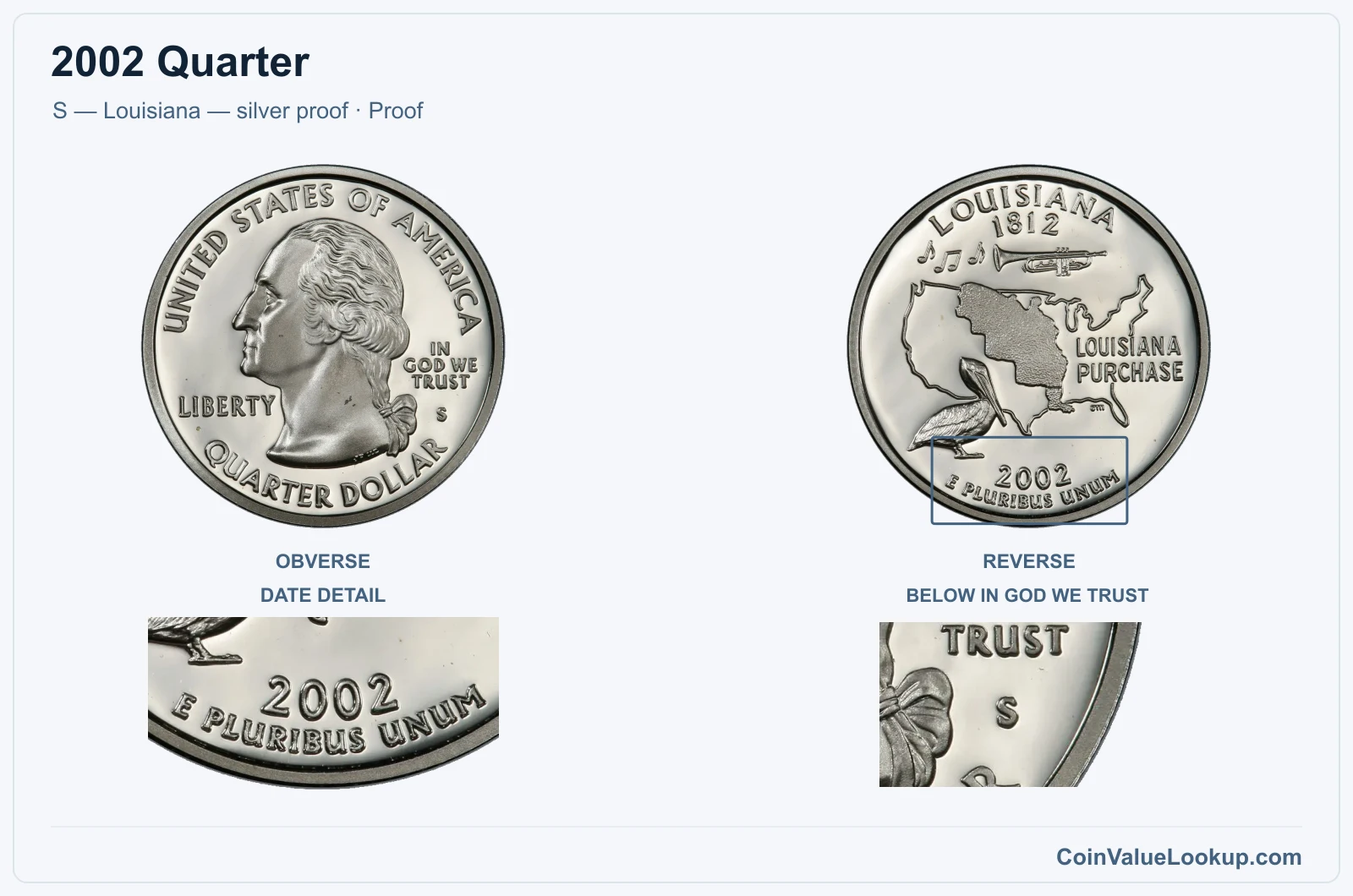
The 2002 S Louisiana silver proof is composed of 90% silver, weighing roughly 6.25 grams. USA Coin Book guides it at about $23.00 at PR65.
This is the premium Louisiana quarter for the year. Confirm silver composition by checking the edge for a uniform silver-gray appearance, or weigh the coin on a precision scale.
Coins still sealed in the original silver proof set are the simplest to verify, and they tend to have fewer handling marks.
Range Grade
Price Auction Records Appraisal PR PR 1
—
Coin Identifier
PR 2
—
Coin Identifier
PR 3
—
Coin Identifier
PR 4
—
Coin Identifier
PR 6
—
Coin Identifier
PR 8
—
Coin Identifier
PR 10
—
Coin Identifier
PR 12
—
Coin Identifier
PR 15
—
Coin Identifier
PR 20
—
Coin Identifier
PR 25
—
Coin Identifier
PR 30
—
Coin Identifier
PR 35
—
Coin Identifier
PR 40
—
Coin Identifier
PR 45
—
Coin Identifier
PR 50
—
Coin Identifier
PR 53
—
Coin Identifier
PR 55
—
Coin Identifier
PR 58
—
Coin Identifier
PR 60
—
Coin Identifier
PR 61
—
Coin Identifier
PR 62
—
Coin Identifier
PR 63
—
Coin Identifier
PR 64
—
Coin Identifier
PR 65
—
Coin Identifier
PR 66
—
Coin Identifier
PR 67
—
Coin Identifier
PR 68
Coin Identifier
PR 69
Coin Identifier
PR 70
Coin Identifier
2002 Quarter — P — Indiana — regular strike
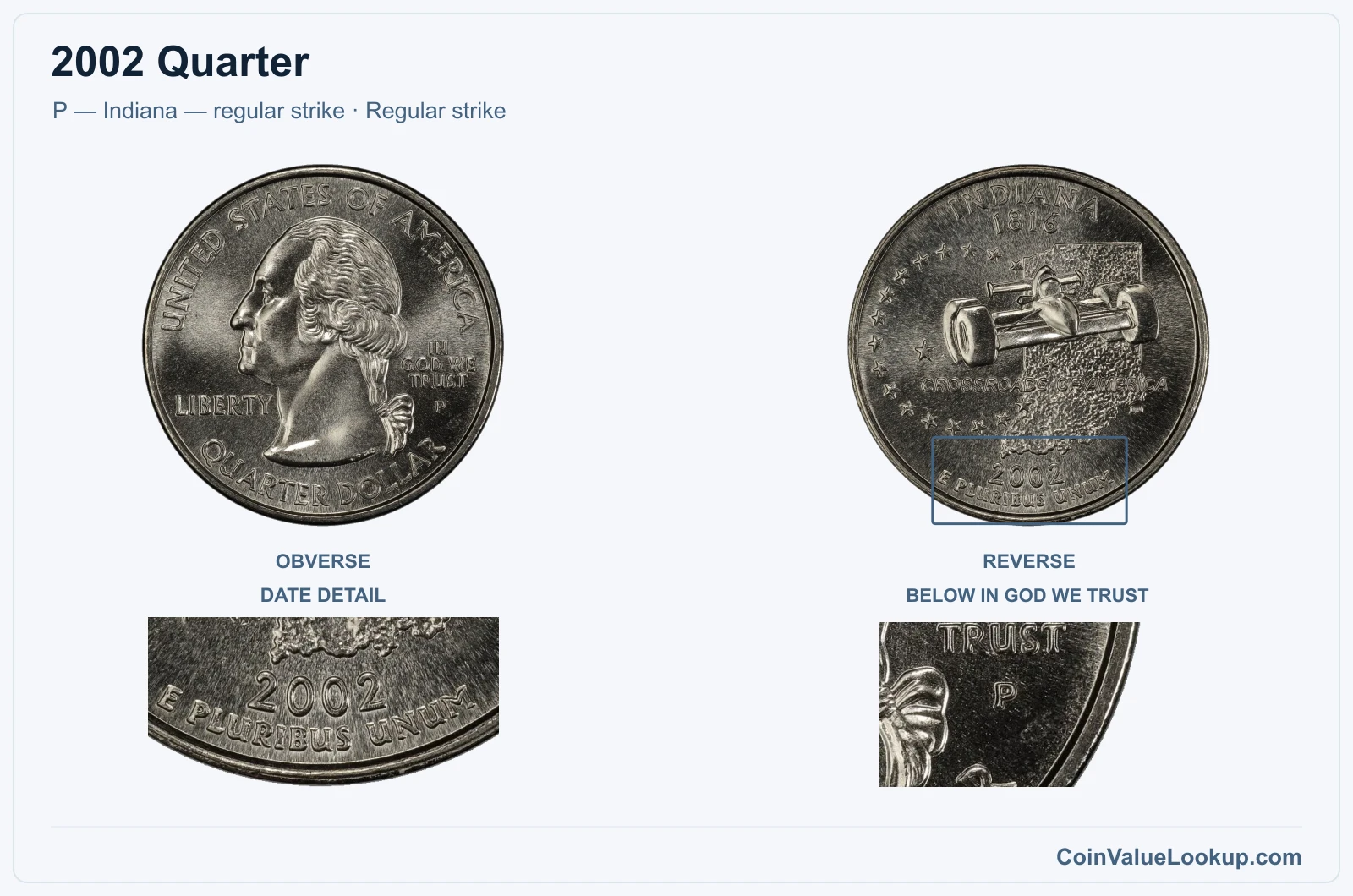
The 2002 P Indiana quarter is a copper-nickel clad business strike from Philadelphia. Its reverse depicts a race car and the state outline.
Circulated examples trade at face value. USA Coin Book guides about $0.74 at MS60 and $1.88 at MS65.
The race car design is visually distinctive among 2002 issues, but high mintage keeps prices modest in all but the highest uncirculated grades.
Range Grade
Price Auction Records Appraisal PO PO 1
—
Coin Identifier FR FR 2
—
Coin Identifier AG AG 3
—
Coin Identifier G G 4
—
Coin Identifier
G 6
—
Coin Identifier VG VG 8
—
Coin Identifier
VG 10
—
Coin Identifier F F 12
—
Coin Identifier
F 15
—
Coin Identifier VF VF 20
—
Coin Identifier
VF 25
—
Coin Identifier
VF 30
—
Coin Identifier
VF 35
—
Coin Identifier XF XF 40
—
Coin Identifier
XF 45
—
Coin Identifier AU AU 50
—
Coin Identifier
AU 53
—
Coin Identifier
AU 55
—
Coin Identifier
AU 58
—
Coin Identifier MS MS 60
—
Coin Identifier
MS 61
—
Coin Identifier
MS 62
—
Coin Identifier
MS 63
—
Coin Identifier
MS 64
—
Coin Identifier
MS 65
—
Coin Identifier
MS 66
—
Coin Identifier
MS 67
Coin Identifier
MS 68
Coin Identifier
MS 69
Coin Identifier
MS 70
—
—
—
2002 Quarter — D — Indiana — regular strike
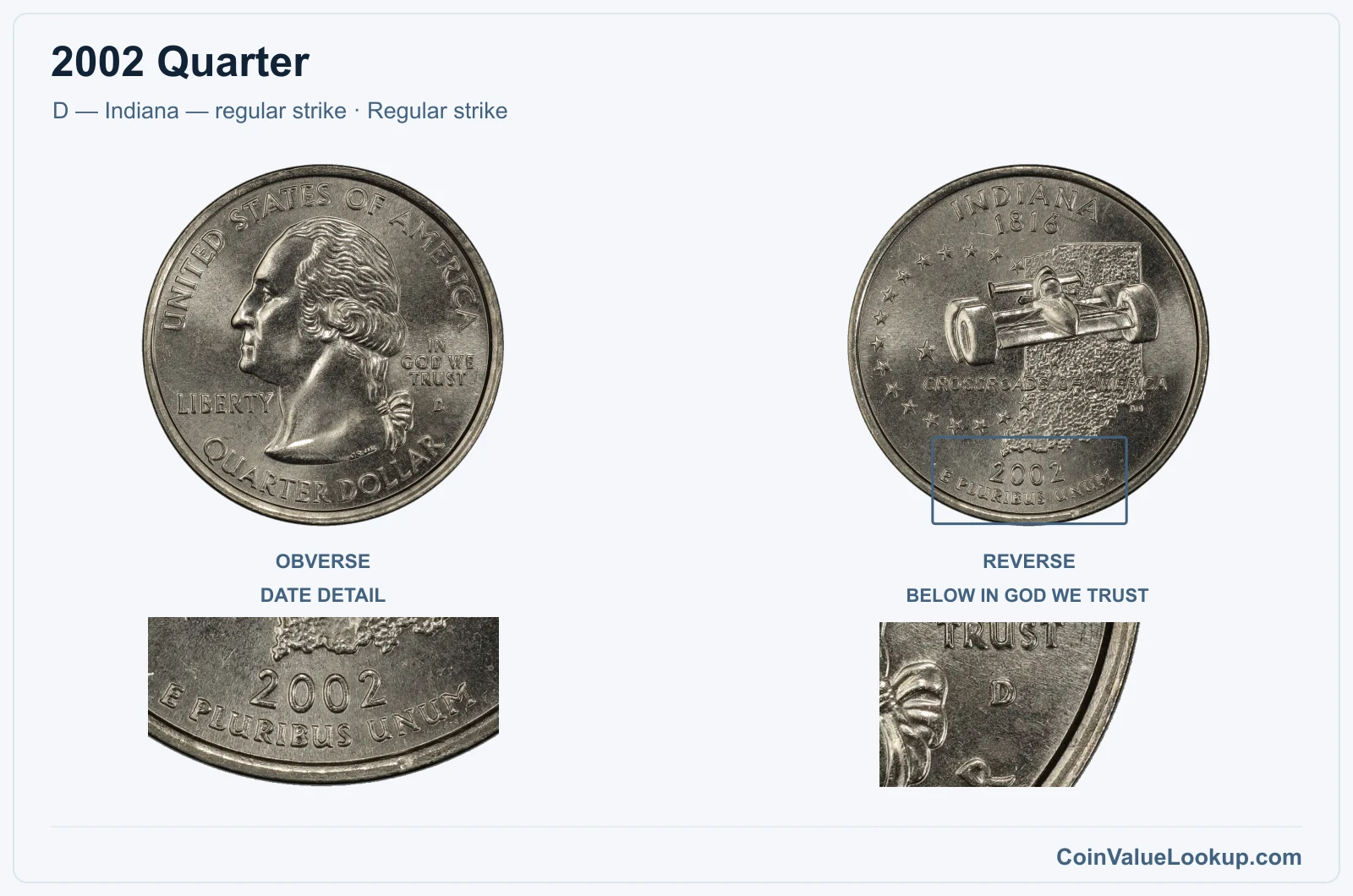
Denver's 2002 D Indiana quarter shares the same copper-nickel clad composition and race car reverse. Look for the "D" mintmark.
USA Coin Book estimates about $0.74 at MS60 and $1.88 at MS65. As with other 2002 business strikes, circulated coins are face-value items.
Collectors looking for gem examples should focus on coins from original mint rolls that were never released into circulation.
Range Grade
Price Auction Records Appraisal PO PO 1
—
Coin Identifier FR FR 2
—
Coin Identifier AG AG 3
—
Coin Identifier G G 4
—
Coin Identifier
G 6
—
Coin Identifier VG VG 8
—
Coin Identifier
VG 10
—
Coin Identifier F F 12
—
Coin Identifier
F 15
—
Coin Identifier VF VF 20
—
Coin Identifier
VF 25
—
Coin Identifier
VF 30
—
Coin Identifier
VF 35
—
Coin Identifier XF XF 40
—
Coin Identifier
XF 45
—
Coin Identifier AU AU 50
—
Coin Identifier
AU 53
—
Coin Identifier
AU 55
—
Coin Identifier
AU 58
—
Coin Identifier MS MS 60
—
Coin Identifier
MS 61
—
Coin Identifier
MS 62
—
Coin Identifier
MS 63
—
Coin Identifier
MS 64
—
Coin Identifier
MS 65
—
Coin Identifier
MS 66
—
Coin Identifier
MS 67
Coin Identifier
MS 68
Coin Identifier
MS 69
—
—
—
MS 70
—
—
—
2002 Quarter — S — Indiana — clad proof
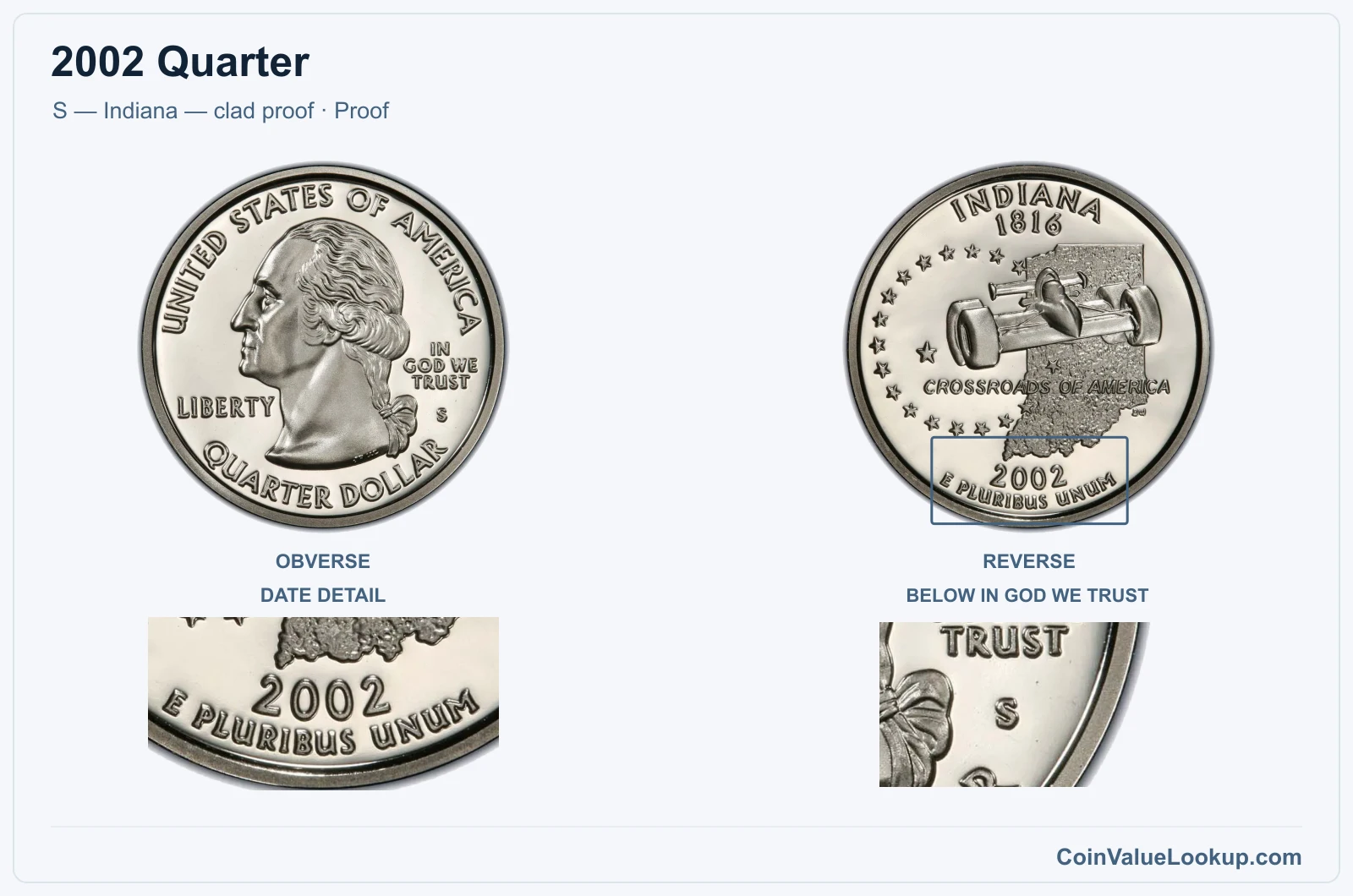
The 2002 S Indiana clad proof is a San Francisco proof on a standard copper-nickel clad planchet. Mirror fields and frosted devices are the hallmarks.
USA Coin Book estimates about $6.25 at PR65. Check the edge for a copper stripe to confirm it is clad rather than silver.
A well-preserved proof without hairlines or haze is what this grade point represents.
Range Grade
Price Auction Records Appraisal PR PR 1
—
Coin Identifier
PR 2
—
Coin Identifier
PR 3
—
Coin Identifier
PR 4
—
Coin Identifier
PR 6
—
Coin Identifier
PR 8
—
Coin Identifier
PR 10
—
Coin Identifier
PR 12
—
Coin Identifier
PR 15
—
Coin Identifier
PR 20
—
Coin Identifier
PR 25
—
Coin Identifier
PR 30
—
Coin Identifier
PR 35
—
Coin Identifier
PR 40
—
Coin Identifier
PR 45
—
Coin Identifier
PR 50
—
Coin Identifier
PR 53
—
Coin Identifier
PR 55
—
Coin Identifier
PR 58
—
Coin Identifier
PR 60
—
Coin Identifier
PR 61
—
Coin Identifier
PR 62
—
Coin Identifier
PR 63
—
Coin Identifier
PR 64
—
Coin Identifier
PR 65
—
Coin Identifier
PR 66
—
Coin Identifier
PR 67
—
Coin Identifier
PR 68
Coin Identifier
PR 69
Coin Identifier
PR 70
Coin Identifier
2002 Quarter — S — Indiana — silver proof
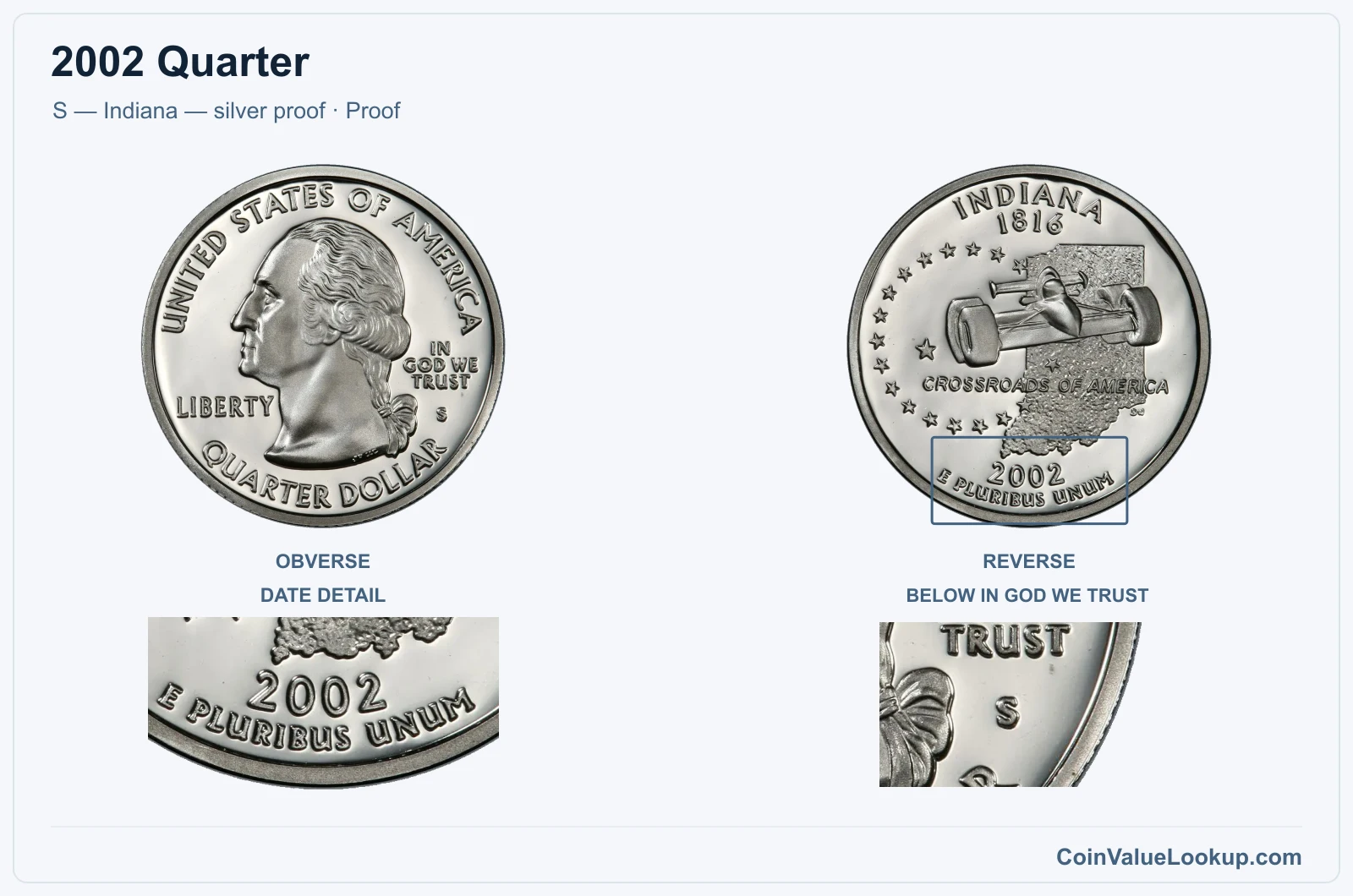
The 2002 S Indiana silver proof uses a 90% silver planchet at a nominal 6.25 grams. USA Coin Book guides it at about $23.00 at PR65, matching the other silver proof state quarters from this year.
The edge should look uniformly silver-gray. Original silver proof set packaging is the simplest way to confirm composition.
These silver proofs carry both a precious-metal base and collector demand that together explain the premium over clad proofs.
Range Grade
Price Auction Records Appraisal PR PR 1
—
Coin Identifier
PR 2
—
Coin Identifier
PR 3
—
Coin Identifier
PR 4
—
Coin Identifier
PR 6
—
Coin Identifier
PR 8
—
Coin Identifier
PR 10
—
Coin Identifier
PR 12
—
Coin Identifier
PR 15
—
Coin Identifier
PR 20
—
Coin Identifier
PR 25
—
Coin Identifier
PR 30
—
Coin Identifier
PR 35
—
Coin Identifier
PR 40
—
Coin Identifier
PR 45
—
Coin Identifier
PR 50
—
Coin Identifier
PR 53
—
Coin Identifier
PR 55
—
Coin Identifier
PR 58
—
Coin Identifier
PR 60
—
Coin Identifier
PR 61
—
Coin Identifier
PR 62
—
Coin Identifier
PR 63
—
Coin Identifier
PR 64
—
Coin Identifier
PR 65
—
Coin Identifier
PR 66
—
Coin Identifier
PR 67
—
Coin Identifier
PR 68
Coin Identifier
PR 69
Coin Identifier
PR 70
Coin Identifier
2002 Quarter — P — Mississippi — regular strike
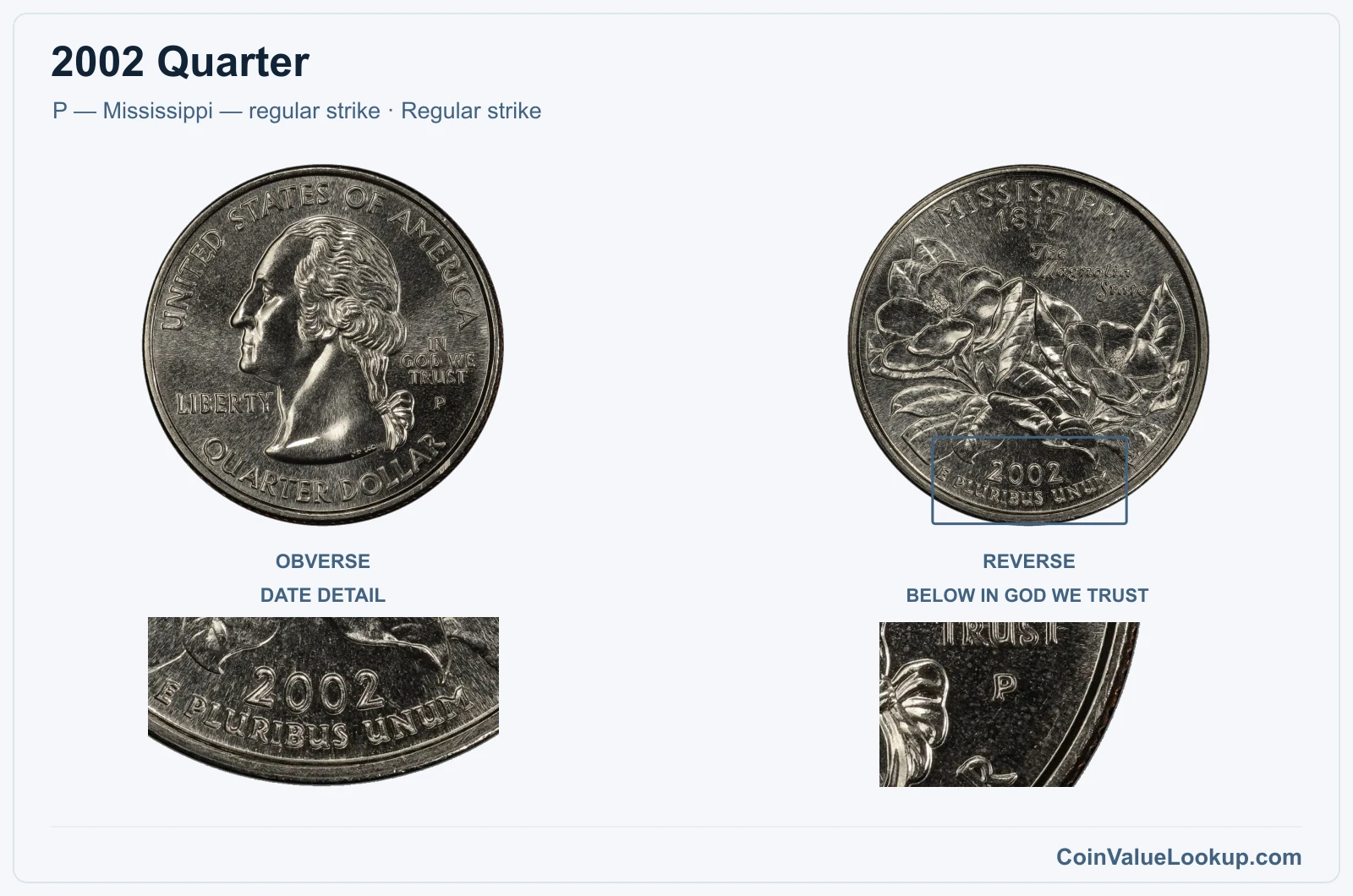
The 2002 P Mississippi quarter is a copper-nickel clad business strike from Philadelphia. The reverse shows the state flower, the magnolia.
Circulated examples are worth face value. USA Coin Book estimates about $0.74 at MS60 and $1.88 at MS65.
The magnolia design has areas of high relief that can mask a weak strike, so compare detail carefully against a known gem-quality reference before assuming a high grade.
Range Grade
Price Auction Records Appraisal PO PO 1
—
Coin Identifier FR FR 2
—
Coin Identifier AG AG 3
—
Coin Identifier G G 4
—
Coin Identifier
G 6
—
Coin Identifier VG VG 8
—
Coin Identifier
VG 10
—
Coin Identifier F F 12
—
Coin Identifier
F 15
—
Coin Identifier VF VF 20
—
Coin Identifier
VF 25
—
Coin Identifier
VF 30
—
Coin Identifier
VF 35
—
Coin Identifier XF XF 40
—
Coin Identifier
XF 45
—
Coin Identifier AU AU 50
—
Coin Identifier
AU 53
—
Coin Identifier
AU 55
—
Coin Identifier
AU 58
—
Coin Identifier MS MS 60
—
Coin Identifier
MS 61
—
Coin Identifier
MS 62
—
Coin Identifier
MS 63
—
Coin Identifier
MS 64
—
Coin Identifier
MS 65
Coin Identifier
MS 66
—
Coin Identifier
MS 67
Coin Identifier
MS 68
Coin Identifier
MS 69
—
Coin Identifier
MS 70
—
—
—
2002 Quarter — D — Mississippi — regular strike
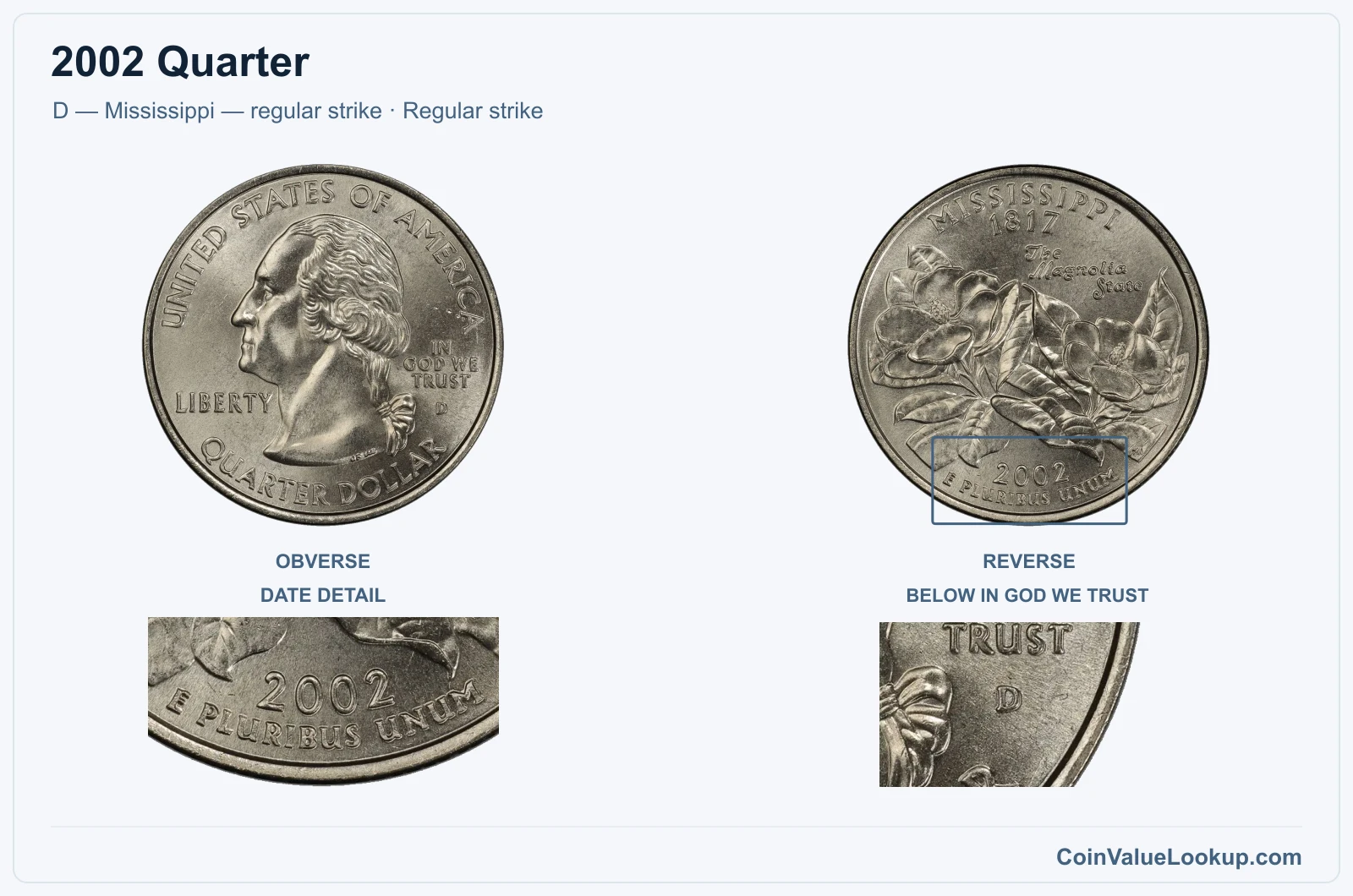
Denver's 2002 D Mississippi quarter carries the "D" mintmark and the same copper-nickel clad composition. USA Coin Book guides about $0.74 at MS60 and $1.88 at MS65.
In circulated condition, you are looking at face value. Uncirculated rolls were widely saved, so finding one is not difficult — finding one without bag marks in the magnolia petals is harder.
Range Grade
Price Auction Records Appraisal PO PO 1
—
Coin Identifier FR FR 2
—
Coin Identifier AG AG 3
—
Coin Identifier G G 4
—
Coin Identifier
G 6
—
Coin Identifier VG VG 8
—
Coin Identifier
VG 10
—
Coin Identifier F F 12
—
Coin Identifier
F 15
—
Coin Identifier VF VF 20
—
Coin Identifier
VF 25
—
Coin Identifier
VF 30
—
Coin Identifier
VF 35
—
Coin Identifier XF XF 40
—
Coin Identifier
XF 45
—
Coin Identifier AU AU 50
—
Coin Identifier
AU 53
—
Coin Identifier
AU 55
—
Coin Identifier
AU 58
—
Coin Identifier MS MS 60
—
Coin Identifier
MS 61
—
Coin Identifier
MS 62
—
Coin Identifier
MS 63
—
Coin Identifier
MS 64
—
Coin Identifier
MS 65
—
Coin Identifier
MS 66
Coin Identifier
MS 67
Coin Identifier
MS 68
Coin Identifier
MS 69
—
—
—
MS 70
—
—
—
2002 Quarter — S — Mississippi — clad proof
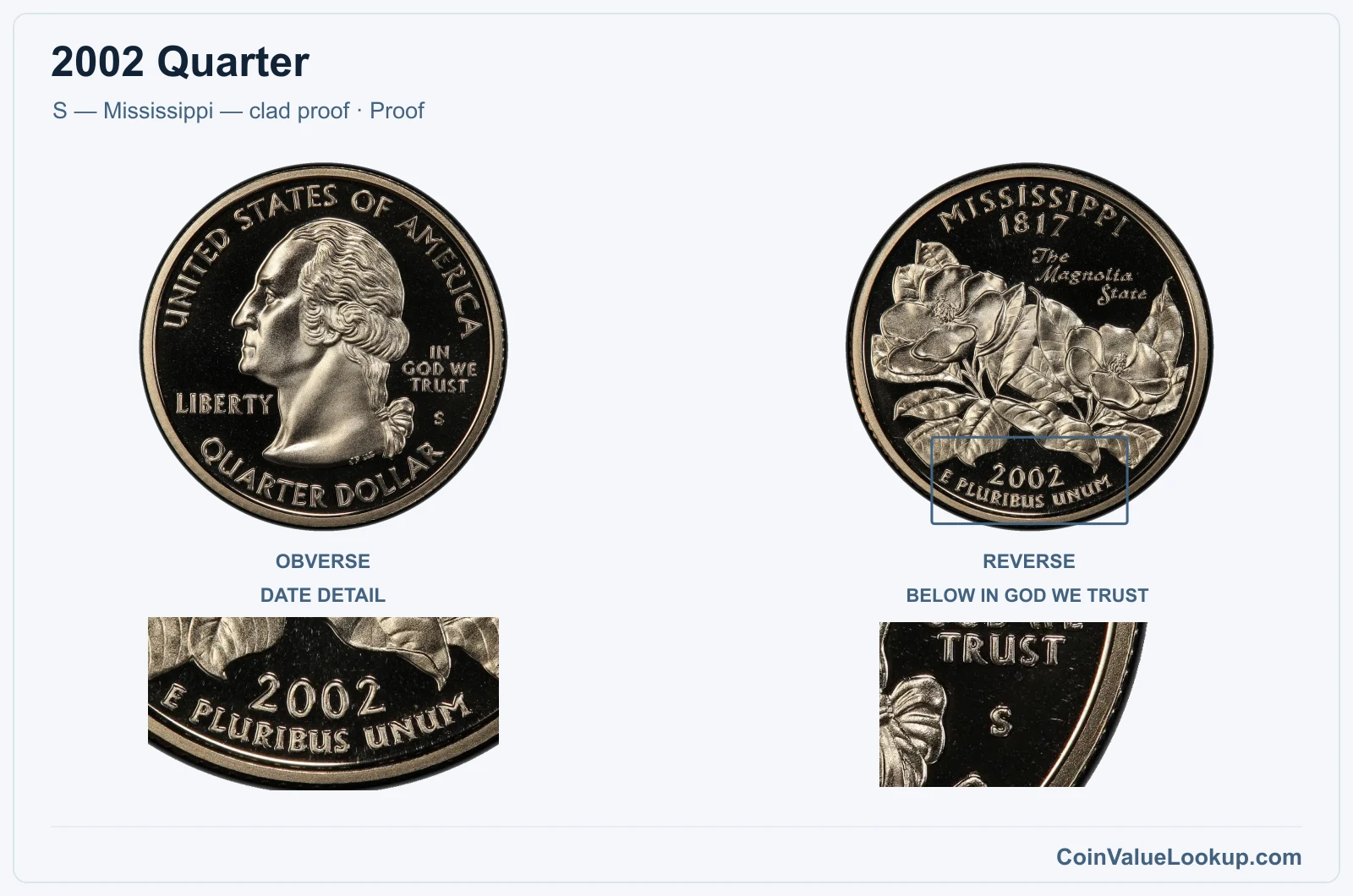
The 2002 S Mississippi clad proof was struck at San Francisco with proof finishing on a copper-nickel clad planchet. The fields should be deeply reflective with frosted devices on the magnolia blossoms.
USA Coin Book estimates about $6.25 at PR65. As always, confirm the clad versus silver distinction through the edge or original packaging before applying the silver proof value.
Range Grade
Price Auction Records Appraisal PR PR 1
—
Coin Identifier
PR 2
—
Coin Identifier
PR 3
—
Coin Identifier
PR 4
—
Coin Identifier
PR 6
—
Coin Identifier
PR 8
—
Coin Identifier
PR 10
—
Coin Identifier
PR 12
—
Coin Identifier
PR 15
—
Coin Identifier
PR 20
—
Coin Identifier
PR 25
—
Coin Identifier
PR 30
—
Coin Identifier
PR 35
—
Coin Identifier
PR 40
—
Coin Identifier
PR 45
—
Coin Identifier
PR 50
—
Coin Identifier
PR 53
—
Coin Identifier
PR 55
—
Coin Identifier
PR 58
—
Coin Identifier
PR 60
—
Coin Identifier
PR 61
—
Coin Identifier
PR 62
—
Coin Identifier
PR 63
—
Coin Identifier
PR 64
—
Coin Identifier
PR 65
—
Coin Identifier
PR 66
Coin Identifier
PR 67
—
Coin Identifier
PR 68
Coin Identifier
PR 69
Coin Identifier
PR 70
Coin Identifier
2002 Quarter — S — Mississippi — silver proof
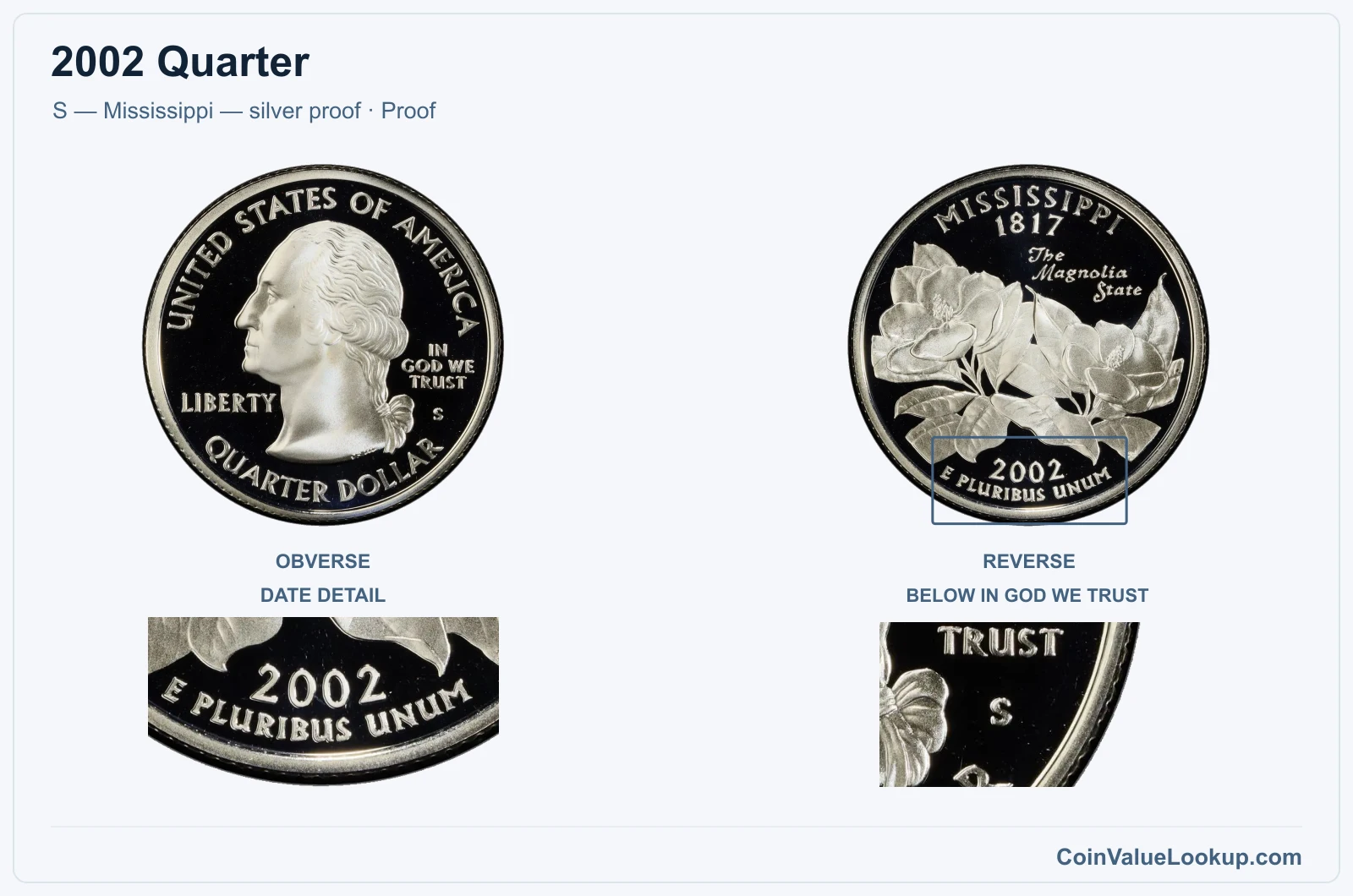
The 2002 S Mississippi silver proof is composed of 90% silver, nominally weighing 6.25 grams. USA Coin Book guides this at about $23.00 at PR65.
A uniform silver-gray edge and a weight above 6 grams distinguish it from its clad counterpart. This is the premium Mississippi quarter version for the year, and well-preserved examples in original packaging tend to command the most confidence from buyers.
Silver proof sets from 2002 remain available on the secondary market, so supply has not dried up entirely.
Range Grade
Price Auction Records Appraisal PR PR 1
—
Coin Identifier
PR 2
—
Coin Identifier
PR 3
—
Coin Identifier
PR 4
—
Coin Identifier
PR 6
—
Coin Identifier
PR 8
—
Coin Identifier
PR 10
—
Coin Identifier
PR 12
—
Coin Identifier
PR 15
—
Coin Identifier
PR 20
—
Coin Identifier
PR 25
—
Coin Identifier
PR 30
—
Coin Identifier
PR 35
—
Coin Identifier
PR 40
—
Coin Identifier
PR 45
—
Coin Identifier
PR 50
—
Coin Identifier
PR 53
—
Coin Identifier
PR 55
—
Coin Identifier
PR 58
—
Coin Identifier
PR 60
—
Coin Identifier
PR 61
—
Coin Identifier
PR 62
—
Coin Identifier
PR 63
—
Coin Identifier
PR 64
—
Coin Identifier
PR 65
—
Coin Identifier
PR 66
Coin Identifier
PR 67
—
Coin Identifier
PR 68
Coin Identifier
PR 69
Coin Identifier
PR 70
Coin Identifier
2002 Quarter Error List
1. 2002 Quarter — Ohio — Doubled Die Obverse
A doubled die obverse on the 2002 D Ohio quarter shows consistent doubling in the obverse lettering or design elements. Under magnification, look for separation or notching on letters such as "IN GOD WE TRUST" or "LIBERTY" that repeats in the same direction across multiple characters.
This consistency is the key diagnostic — true hub doubling affects the entire die, not just one spot.
Do not confuse this with machine doubling, which produces a flat, shelf-like displacement without the raised, split appearance of a genuine doubled die. Reflections under certain lighting can also mimic doubling.
Condition, the strength of the doubling and the specific variety all affect value; no single guide price applies to every doubled die.
2. 2002 Quarter — Tennessee — Wrong Planchet / Off-Metal Strike
A wrong-planchet error on the 2002 P Tennessee quarter means the coin was struck on a blank intended for a different denomination or composition. To verify, compare the coin's measured weight, diameter and edge characteristics to the standard 5.67-gram, 24.26-mm copper-nickel clad quarter specification.
A significant departure in any of these measurements points toward a wrong planchet.
Be cautious. Coins that look "off" may actually be corroded, acid-treated, or intentionally altered after leaving the mint.
Plating loss or environmental damage can change a coin's color and weight slightly. Genuine wrong-planchet errors are scarce and typically need professional authentication.
Value depends on the specific blank used, the coin's condition and the visibility of the design.
3. 2002 Quarter — Tennessee — Repunched Mintmark
Repunched mintmarks on the 2002 Tennessee quarter have been reported on Denver ("D") mint coins. The diagnostic is a trace of a second mintmark position visible alongside or slightly overlapping the primary "D." Under magnification, you may see part of a second letter outline that does not align perfectly with the final punch.
This is different from machine doubling, which flattens the area around the mintmark in a shelf-like pattern. A die chip or corrosion near the letter can also look like a secondary impression, so compare your coin at the same magnification as a confirmed normal example.
Value depends on the clarity of the repunching, the coin's overall condition and collector interest in the specific variety.
4. 2002 Quarter — Delaware Spitting Horse Die Gouge
Small die cracks have been reported on 2002 Tennessee quarters, appearing near design elements such as the trumpet, guitar strings or stars on the reverse. These show up as thin raised lines on the coin's surface — they are raised because the crack in the die creates a recessed channel that fills with metal during striking.
Check whether the line is raised (die crack) or incuse (scratch). An incuse groove is post-mint damage.
Also distinguish an interior die crack from a rim-connected break, which would be a cud. Corrosion or foreign material stuck to the surface can mimic a small crack as well.
Value depends on the crack's length, location and the coin's overall condition.
5. 2002 Quarter — Tennessee — Doubled Die Obverse
A doubled die obverse has been reported on 2002 Tennessee quarters. The diagnostic involves comparing obverse lettering and design elements against a normal coin under consistent lighting.
Look for separation or notching on letters that is uniform across multiple characters — this consistency distinguishes a true doubled die from random damage.
Machine doubling is the most common lookalike. It creates a flat, shelf-like displacement rather than the rounded, split profile of hub doubling.
Worn die contours and lighting reflections can also fool you. The value of a doubled die depends on the strength and visibility of the doubling, the coin's grade and collector recognition of the specific variety.
6. 2002 Quarter — Tennessee — Doubled Die Reverse
A doubled die reverse has been reported on 2002 Tennessee quarters. Examine the reverse legends and design contours — the musical instruments, state name and motto — and compare them with a normal coin.
True hub doubling shows consistent directional separation across multiple design elements on the same side.
Machine doubling is the primary lookalike and shows as flat, shelf-like displacement rather than the clearly split or notched profiles of a genuine doubled die. Random damage and reflections under strong light can also create false positives.
Value depends on the visibility of the doubling, which specific die pair is involved and the coin's condition.
7. 2002 Quarter — Louisiana — Missing Clad Layer
A missing clad layer error has been reported on 2002 Louisiana quarters. When one of the outer copper-nickel clad layers is absent, the exposed face may appear a different color than normal.
Weigh the coin — a quarter missing one clad layer will be noticeably lighter than the standard 5.67 grams. Also examine the edge for an asymmetric layering pattern.
Toning, corrosion and acid exposure can all change a coin's surface color and mimic a missing-clad appearance. Deliberate removal of a clad layer after minting is another common lookalike.
A genuine missing-clad error originates at the mint and affects the entire face uniformly. Value depends on which face is affected, the coin's condition and the completeness of the remaining design.
8. 2002 Quarter — Delaware Spitting Horse Die Gouge
A die gouge has been reported on 2002 Tennessee quarters. This appears as a raised blob or short raised line on the coin's surface, caused by damage to the die itself.
The feature will appear in the same position on every coin struck by that die, which is one way to confirm it is a die variety rather than random damage.
An incuse scratch — a groove pressed into the surface — is post-mint damage and the most common lookalike. Die gouges are raised because the gouge in the die creates a recessed area that fills with metal during striking.
Value depends on the gouge's size, location within the design and the coin's overall condition.
9. 2002 Quarter — Ohio — Off-Center Strike
An off-center strike has been reported on the 2002 D Ohio quarter, described as having a wide collar on the obverse combined with an off-center reverse. The diagnostic is a displaced design with an unstruck crescent on one or both sides.
The degree of misalignment matters — a barely noticeable shift has minimal collector interest compared to a dramatic displacement.
Keep the date visible when evaluating: off-center coins that retain a readable date and mintmark are more desirable. A clipped planchet, one-sided die misalignment or post-mint flattening can mimic an off-center appearance, so check both sides carefully.
Value depends on the percentage off-center, whether the date is visible and the coin's condition.
10. 2002 Quarter — Louisiana — Die Crack / Die Chip
Die chips on the ship's hull have been reported on 2002 Louisiana quarters. These appear as small raised blobs of extra metal where the die surface has chipped away.
The raised feature corresponds to a recessed defect in the die, which fills during striking.
Distinguish a die chip from an incuse scratch or foreign material sitting on the surface. A true die chip is raised and integrated into the metal, not loose.
Also note whether the feature connects to the rim — if it does, it may qualify as a cud rather than an interior chip. Value depends on the chip's size, position on the hull design and the coin's overall preservation.
11. 2002 Quarter — Lamination / Split Planchet
Lamination errors have been reported on 2002 Washington State Quarters. A lamination occurs when layers within the planchet separate, producing peeling metal, a retained flap or a visible split along the edge.
These result from impurities or voids in the metal strip before the blank was punched.
Photograph both the edge and the affected face together to show the separation clearly. Lookalikes include surface scraping, corrosion and deliberately cut or peeled coins.
A genuine lamination will follow the coin's contour and appear as a natural separation rather than a sharp or tooled edge. Value depends on the size and visibility of the lamination, as well as the coin's overall condition.
12. 2002 Quarter — Rotated Dies
Rotated die errors have been reported on 2002 Washington State Quarters. To check, hold the obverse upright and flip the coin top-to-bottom along a vertical axis.
On a normal US coin, the reverse should appear upright as well. If the reverse is tilted, you have a die rotation.
Small rotations of a few degrees are relatively common and carry minimal premium. Larger rotations — say 45 degrees or more — attract stronger collector interest.
Be careful that you are not simply photographing or holding the coin at an angle. A tilted photo is not a rotated die.
Value depends on the degree of rotation and the coin's condition.
13. 2002 Quarter — Die Break / Cud
Cud errors have been reported on 2002 Washington State Quarters. A cud is a raised, featureless blob that connects to the rim, caused by a piece of the die breaking away entirely.
The missing die section leaves no design impression in that area, so the blank metal flows up to fill the void.
Distinguish a cud from a rim dent (which is recessed, not raised) and from an interior die chip (which does not touch the rim). Corrosion buildup near the rim can also look similar at first glance.
Value depends on the cud's size, its position relative to important design elements and the coin's overall condition.
14. 2002 Quarter — Mississippi — Die Crack / Die Chip
Die cracks have been reported on 2002 Mississippi quarters, most often along the edge of the flower design on the reverse. These appear as thin raised lines running through or near the magnolia petals.
The lines are raised on the coin because the crack in the die acts as a recessed channel that fills with metal during striking.
Check whether any line you see is raised (die crack) or incuse (scratch). Incuse marks are post-mint damage.
Also look at whether the crack reaches the rim, which could make it a cud. Corrosion and foreign material on the surface are other lookalikes.
Value depends on the crack's prominence, location and the coin's grade.
15. 2002 Quarter — Mississippi — Struck-Through Error
Struck-through errors have been reported on 2002 Mississippi quarters. This occurs when particles or foreign material sit between the die and the planchet during striking, leaving an indentation or incomplete area in the design.
The result is a localized depression, sometimes with the texture of whatever material was trapped.
Distinguish a struck-through from normal wear, which affects high points gradually and uniformly. Scratches and cleaning marks create linear grooves, not the rounded depressions typical of a struck-through.
Grease fill-in, which leaves a smooth featureless patch, is a related but distinct category. Value depends on the size and sharpness of the impression, the coin's grade and whether the foreign material was retained.
16. 2002 Quarter — Mississippi — Indented Strike
Indented strike errors have been reported on 2002 Mississippi quarters. An indented strike occurs when another blank or object overlaps part of the planchet during striking, leaving a bounded depressed area without a full design impression.
The indent typically has a clear border separating the struck design from the depressed zone.
A post-mint dent can look similar, but a dent disrupts the existing design rather than preventing it from forming in the first place. A brockage — where a previously struck coin leaves a mirrored impression — is another related category.
Check for a clear boundary and the absence of design detail within the indent. Value depends on the indent's size, position and the coin's overall condition.
17. 2002 Quarter — Mississippi — Off-Center Strike
Off-center strikes have been reported on 2002 Mississippi quarters. Look for a displaced design and an unstruck crescent where the planchet was not covered by the die.
The percentage of misalignment determines both the visual impact and the value — a 5% shift is common and worth little, while a major shift with a visible date is collectible.
A clipped planchet, a one-sided die misalignment or post-mint flattening can all mimic the appearance. Clipped planchets have a curved missing edge but the design is centered.
A die misalignment shifts one side but not the other. Value depends on the degree off-center, date visibility and condition.
18. 2002 Quarter — Mississippi — Partial Collar Strike
Partial collar strikes have been reported on 2002 Mississippi quarters. This happens when the collar die — which forms the coin's edge — does not fully engage the blank during striking.
The result is a stepped or irregular edge on part of the coin, where the metal expanded beyond normal diameter on the unconstrained side.
Compare the edge profile around the entire circumference with a normal coin. A partial collar will show a distinct transition from a properly reeded section to a smooth or expanded section.
Edge damage from drops or impacts is the main lookalike, along with a complete broadstrike where no collar was present at all. Value depends on the extent of the partial collar and the coin's overall condition.
19. 2002 Quarter — Ohio — Missing Clad Layer
A missing clad layer error has been reported on 2002 Ohio quarters. One outer layer of the copper-nickel clad sandwich is absent, exposing a different-colored surface on one face.
Weigh the coin — it should come in noticeably under 5.67 grams if a layer is genuinely missing. Examine the edge for an uneven layering pattern.
Toning, environmental damage and deliberate acid removal of a clad layer are common lookalikes. A genuine missing-clad error affects the entire face uniformly and originates at the mint.
If only part of the surface looks odd, corrosion or plating loss is more likely. Value depends on which side is affected, the design's completeness and the coin's condition.
20. 2002 Quarter — Tennessee — Struck-Through Error
Struck-through errors have been reported on 2002 P Tennessee quarters. The diagnostic is a localized depression or incomplete design area where foreign material was trapped between the die and the planchet during striking.
The impression may retain the texture or outline of whatever intervened.
Normal wear, scratches and cleaning create different patterns — wear is gradual and affects high points, while scratches are linear. A grease-filled die leaves a smooth, featureless area and is a related but distinct category from a retained-object struck-through.
Value depends on the impression's size, clarity, what material caused it and the coin's overall grade.
21. 2002 Quarter — Tennessee — Double / Multiple Strike
Double or multiple strike errors have been reported on 2002 P Tennessee quarters. The diagnostic is two or more separate design impressions on the same coin, often displaced or rotated relative to each other.
You should be able to see distinct overlapping images of the design rather than merely thickened or enlarged letters.
A doubled die is different — it results from a single strike with a doubled die, not from the coin being struck more than once. Post-mint impressions from machinery or vises can also create secondary marks but lack the full-design character of a genuine second strike.
Value depends on the degree of displacement, the completeness of both impressions and the coin's condition.
22. 2002 Quarter — Ohio — Die Crack / Die Chip
Die cracks have been reported on 2002 Ohio quarters. These appear as thin raised lines on the coin's surface, running through the design or field areas.
They are raised because the crack in the die creates a recessed channel that fills with metal during striking.
Distinguish raised die cracks from incuse scratches, which are recessed grooves from post-mint contact. Corrosion or deposits on the surface can also mimic a crack.
Check whether the feature runs to the rim — a rim-connected break may be a cud rather than a simple crack. Value depends on the crack's length, position and the coin's overall condition.
23. 2002 Quarter — Ohio — Misaligned Die
Misaligned die errors have been reported on 2002 Ohio quarters. A misaligned die shifts one face of the design relative to the blank or opposite face, creating an uneven rim width.
One side of the rim will appear wider than the opposite side on the affected face, while the other face may look normal.
This is different from an off-center strike, where the entire coin shows a displaced design. It is also different from a rotated die, where the alignment is angular rather than lateral.
A tilted photograph or post-mint rim damage can create the illusion of misalignment. Value depends on the degree of the shift and the coin's condition.
24. 2002 Quarter — Ohio — Double / Multiple Strike
Double-struck errors have been reported on 2002 Ohio state quarters. A double strike means the coin received two separate impressions from the dies, and you should see two distinct overlapping or displaced design images.
The second impression may be rotated or shifted relative to the first.
Do not confuse this with a doubled die, which involves a single strike from a die that was itself doubled during manufacture. Post-mint damage from machinery can also leave secondary impressions, but these typically lack full-design detail.
A genuine double strike affects both obverse and reverse. Value depends on the degree of separation between impressions, the completeness of each strike and the coin's condition.
25. 2002 Quarter — Ohio — Broadstrike
A broadstrike error has been reported on the 2002 S Ohio quarter. A broadstrike occurs when the coin is struck without the collar die in place, allowing the metal to spread outward beyond the normal diameter.
The result is a coin with a full design but no reeded edge and a larger-than-normal diameter.
Compare the edge and overall size with a normal quarter. A broadstrike will feel flat on the edge and measure wider than 24.26 mm.
An off-center strike also involves collar issues but shows a displaced design, while a coin flattened after minting will have distorted detail rather than a clean, spread impression. Value depends on the extent of spread and the coin's condition.
26. 2002 Quarter — Ohio — Clashed Dies
Clashed die errors have been reported on the 2002 S Ohio quarter. This happens when the obverse and reverse dies strike each other without a planchet between them, transferring traces of the opposite design onto each die.
Subsequent coins struck by those dies show faint outlines of the wrong design in the fields.
Look for ghostly traces of the reverse design on the obverse or vice versa, positioned where the opposing features would normally align. These marks are subtle and usually require magnification and angled light.
Scratches, random raised lines and brockages can mimic clash marks. Value depends on the visibility and completeness of the transferred design as well as the coin's overall condition.