2008 Quarter Coin Value: How Much Is It Worth?
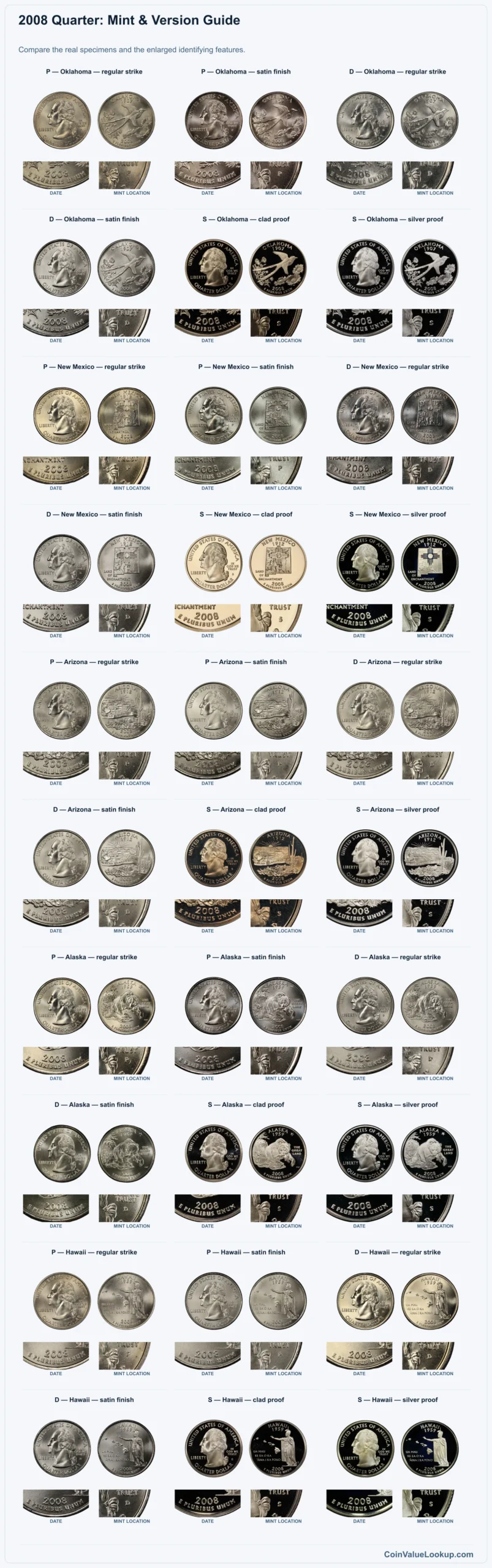
The 2008 quarter belongs to the Washington 50 States Quarters series and comes in five different reverse designs: Oklahoma, New Mexico, Arizona, Alaska and Hawaii. Guide estimates from USA Coin Book range from $0.49 to $24.00, depending on mint, reverse design, finish and condition.
That is not one flat range for every coin — a worn P-mint business strike and an S-mint silver proof occupy very different parts of the scale.
Fast Way to Identify Your 2008 Quarter
The quickest way to start is to upload clear photos of both sides of your coin. A front-and-back image lets us provide a preliminary identification of your mint, reverse design and finish type.
From there you can compare your coin against the right version and condition guide rather than guessing.
2008 Quarter Value
Upload both sides of your 2008 Quarter.
Front Obverse
Upload photo
Back Reverse
Upload photo
Which 2008 Quarter Versions Are Worth Money?
- S-mint Hawaii silver proof: guide estimate of $24.00 at PR65, the highest single anchor among 2008 quarter versions listed here.
- S-mint Oklahoma and New Mexico silver proofs: each guided at $23.00 in PR65 — worth confirming the silver composition through edge inspection or weight.
- Satin-finish coins from P and D mints (all five designs) are a separate collectible category; value depends on authenticated identity and condition rather than a standard guide row.
- S-mint clad proofs across all five designs carry PR65 guide estimates between $6.25 and $12.00 — well above face value but lower than their silver counterparts.
Step 1: Identify Your 2008 Quarter Mint Mark and Version
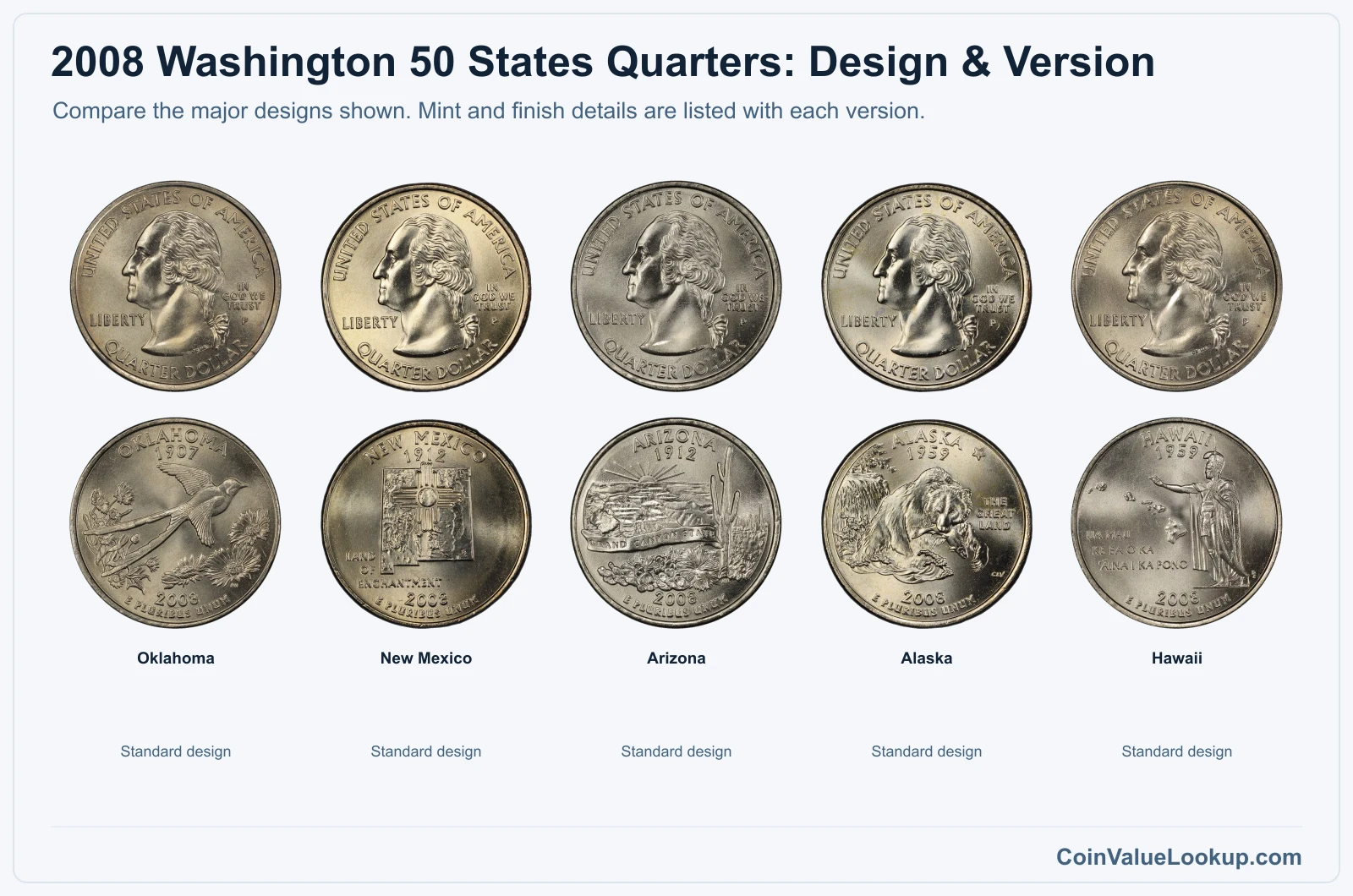
Start on the obverse. The mintmark — P, D or S — sits near Washington's portrait.
That tells you which facility struck it.
Next, flip the coin over. The reverse shows one of five state designs issued in 2008: Oklahoma, New Mexico, Arizona, Alaska or Hawaii.
Any date molded into the reverse design itself is a statehood or commemorative date, not the year the coin was made — the minting year is on the obverse.
Finish matters as much as mint. Regular business strikes have a normal luster.
Satin-finish coins came only in 2008 Mint Sets and show a distinctive fine-grain texture across the entire surface; a worn or artificially dulled coin does not qualify. Proofs from the San Francisco Mint have mirror-like fields and frosted raised devices.
Composition is the last fork. Standard quarters are copper-nickel clad.
Silver proofs are 90% silver and weigh about 6.25 grams versus the clad coin's 5.67 grams. Check the edge — a copper-nickel clad coin shows a visible layered stripe, while silver does not.
Weight and original packaging can also confirm which you have.
Step 2: Check Your 2008 Quarter Grade
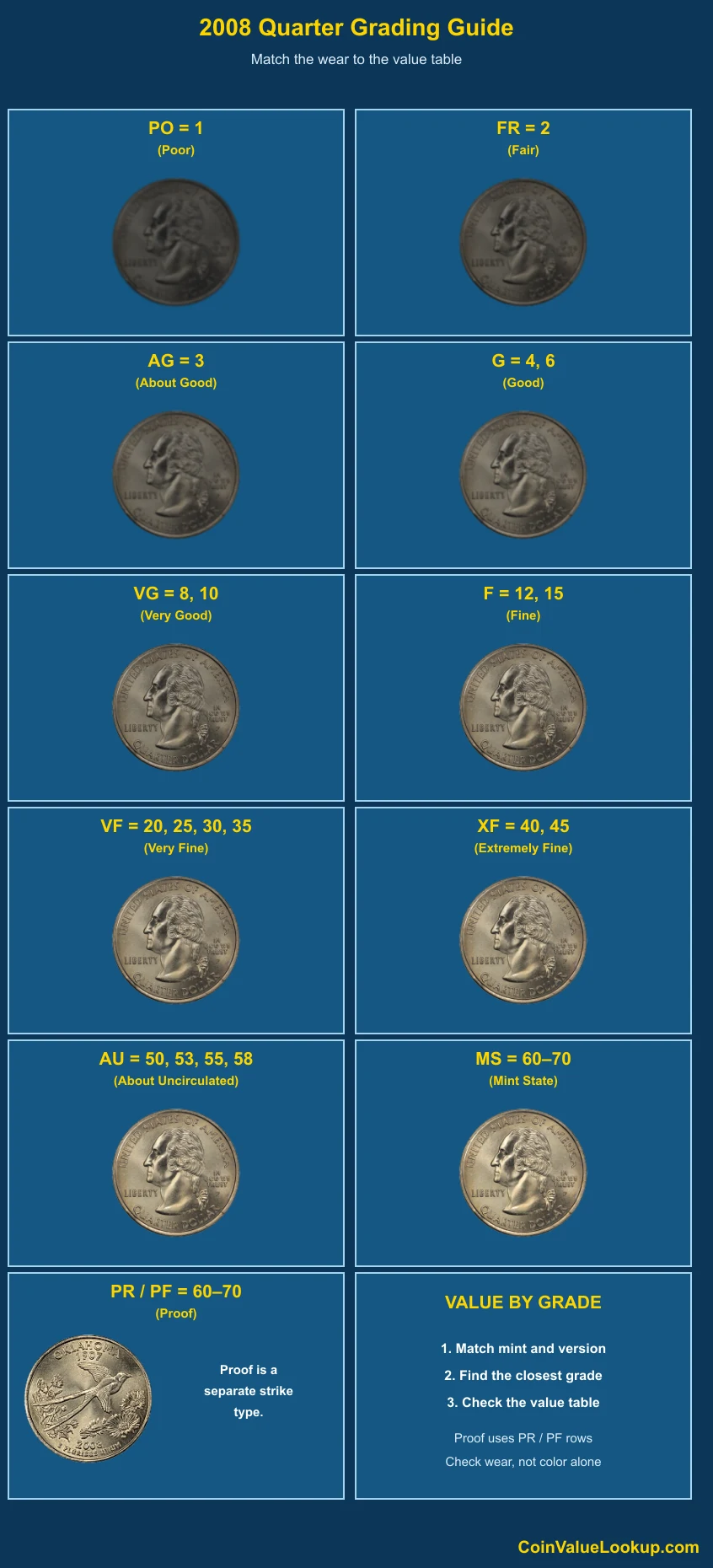
Focus on the obverse first. Washington's cheekbone and the hair above his ear are the highest relief points and the first places to lose detail from circulation wear.
On the reverse, the highest areas of each state design wear earliest — look for flatness compared to your comparison image.
Luster is just as important as sharpness. A coin can show full design detail but have dull, cleaned or damaged surfaces that hurt its grade.
Conversely, a weakly struck coin may look worn even though it never circulated — strike strength is not the same as wear.
For proofs, tilt the coin under a light and look for hairlines, haze or fingerprints in the mirror fields. A proof with heavy hairlines grades lower than a clean one even if the frosted devices are perfect.
Use the comparison image to calibrate your eye before deciding where your coin falls on the scale.
Step 3: Check 2008 Quarter Value by Mint and Version
2008 Quarter — P — Oklahoma — regular strike
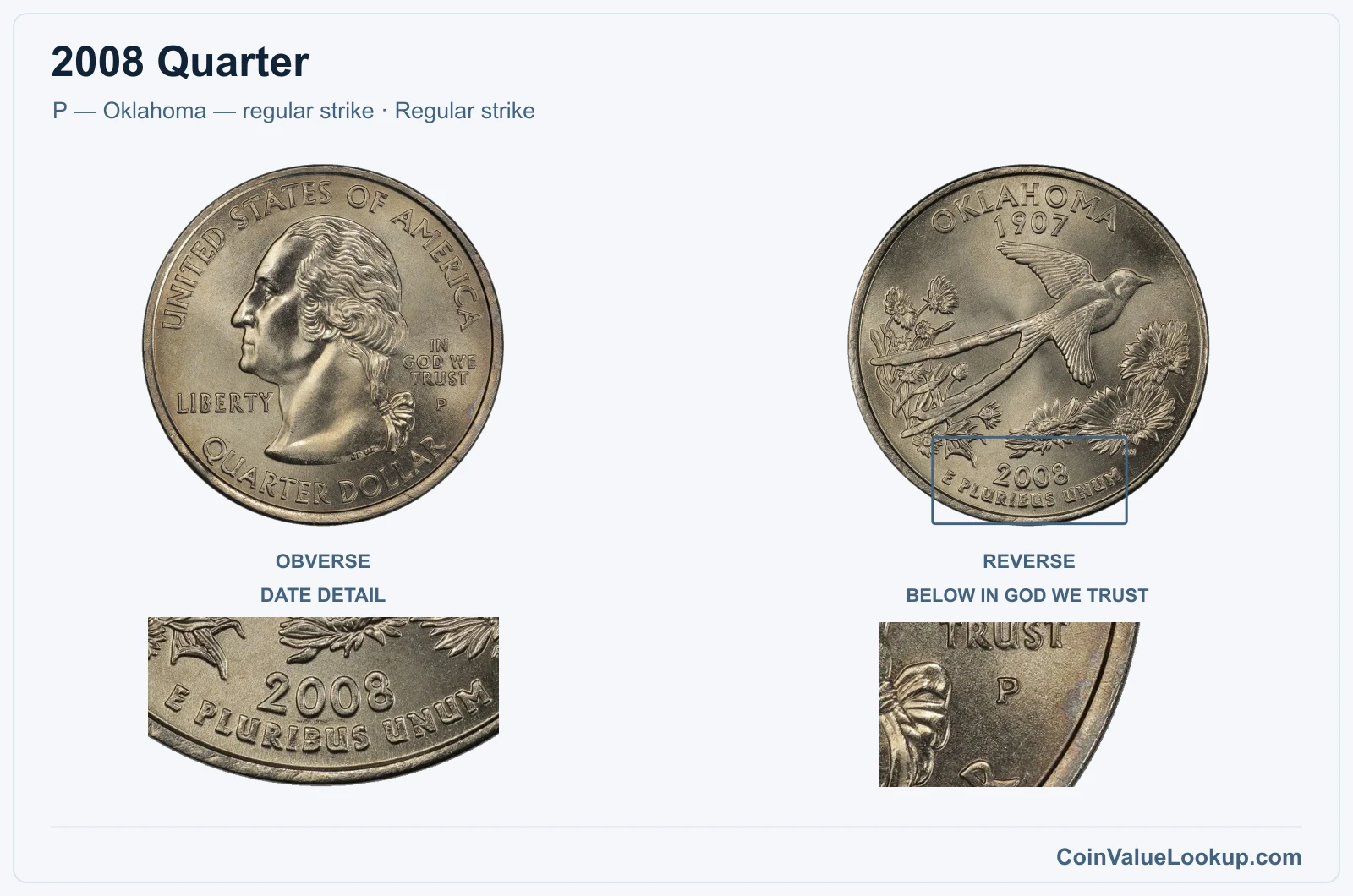
This is the Philadelphia Mint regular business strike with the Oklahoma reverse. It is copper-nickel clad, measuring 24.26 mm in diameter and weighing about 5.67 grams.
USA Coin Book estimates place it around $0.49 in MS60 and $2.50 in MS65. Worn examples circulating in pocket change trade at face value.
If yours is uncirculated with original luster and no contact marks, it is worth comparing against the MS65 benchmark.
Range Grade
Price Auction Records Appraisal PO PO 1
—
Coin Identifier FR FR 2
—
Coin Identifier AG AG 3
—
Coin Identifier G G 4
—
Coin Identifier
G 6
—
Coin Identifier VG VG 8
—
Coin Identifier
VG 10
—
Coin Identifier F F 12
—
Coin Identifier
F 15
—
Coin Identifier VF VF 20
—
Coin Identifier
VF 25
—
Coin Identifier
VF 30
—
Coin Identifier
VF 35
—
Coin Identifier XF XF 40
—
Coin Identifier
XF 45
—
Coin Identifier AU AU 50
—
Coin Identifier
AU 53
—
Coin Identifier
AU 55
—
Coin Identifier
AU 58
—
Coin Identifier MS MS 60
—
Coin Identifier
MS 61
—
Coin Identifier
MS 62
—
Coin Identifier
MS 63
—
Coin Identifier
MS 64
—
Coin Identifier
MS 65
—
Coin Identifier
MS 66
—
Coin Identifier
MS 67
Coin Identifier
MS 68
—
Coin Identifier
MS 69
—
—
—
MS 70
—
—
—
2008 Quarter — P — Oklahoma — satin finish
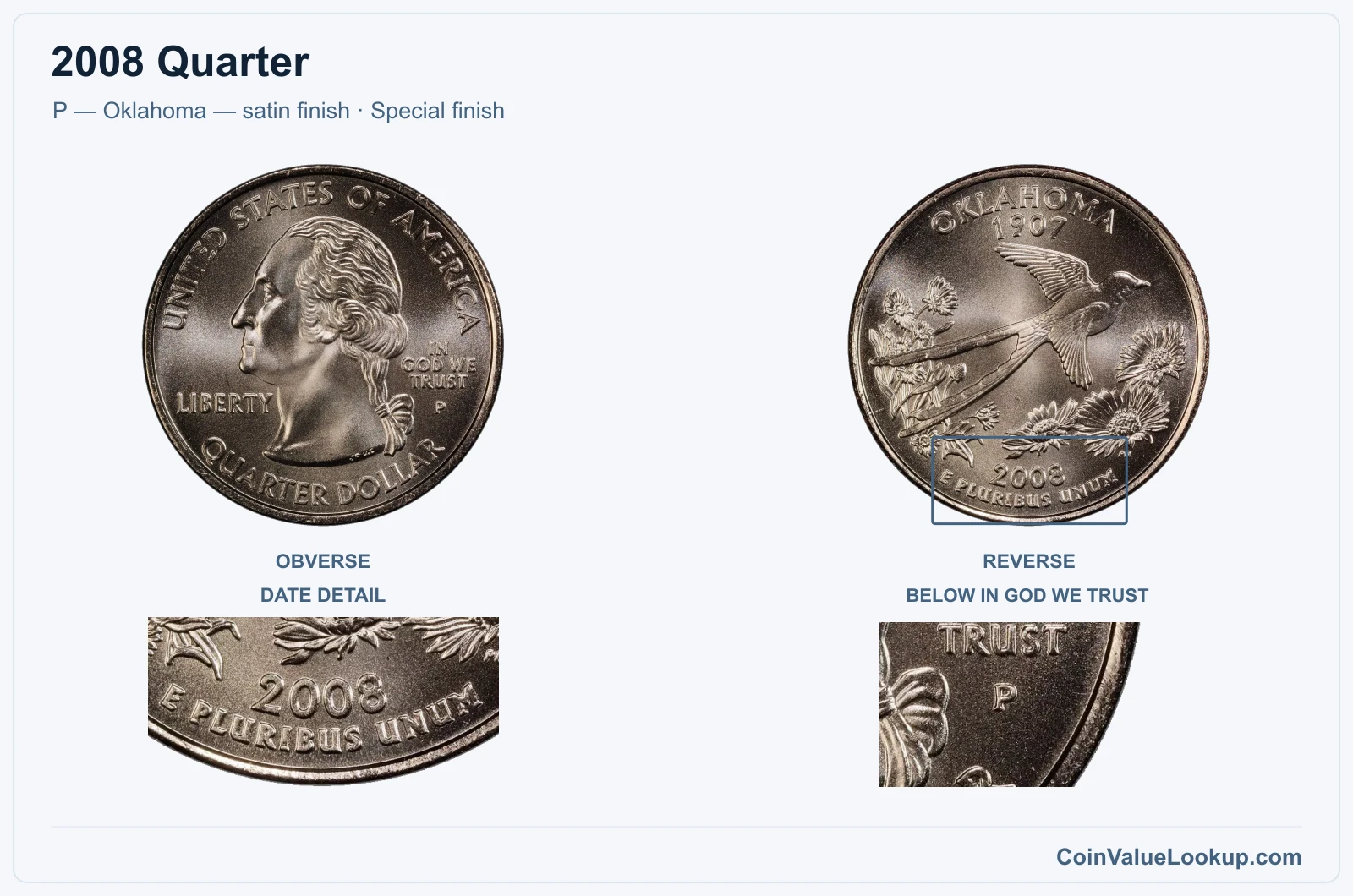
The P-mint Oklahoma satin finish came exclusively in 2008 Uncirculated Mint Sets. These coins have a distinctive fine-grain texture across both faces — softer than a business strike's cartwheel luster but not the mirror surface of a proof.
A coin that has simply lost its shine from wear or cleaning does not qualify as satin finish.
No standard guide price is adopted for this version, so value depends on authenticated identity, condition and any error present. If you think you have one, confirming its provenance from a Mint Set is the best starting point.
Range Grade
Price Auction Records Appraisal SP SP 1
—
Coin Identifier
SP 2
—
Coin Identifier
SP 3
—
Coin Identifier
SP 4
—
Coin Identifier
SP 6
—
Coin Identifier
SP 8
—
Coin Identifier
SP 10
—
Coin Identifier
SP 12
—
Coin Identifier
SP 15
—
Coin Identifier
SP 20
—
Coin Identifier
SP 25
—
Coin Identifier
SP 30
—
Coin Identifier
SP 35
—
Coin Identifier
SP 40
—
Coin Identifier
SP 45
—
Coin Identifier
SP 50
—
Coin Identifier
SP 53
—
Coin Identifier
SP 55
—
Coin Identifier
SP 58
—
Coin Identifier
SP 60
—
Coin Identifier
SP 61
—
Coin Identifier
SP 62
—
Coin Identifier
SP 63
—
Coin Identifier
SP 64
—
Coin Identifier
SP 65
—
Coin Identifier
SP 66
—
Coin Identifier
SP 67
—
Coin Identifier
SP 68
Coin Identifier
SP 69
Coin Identifier
SP 70
—
—
—
2008 Quarter — D — Oklahoma — regular strike
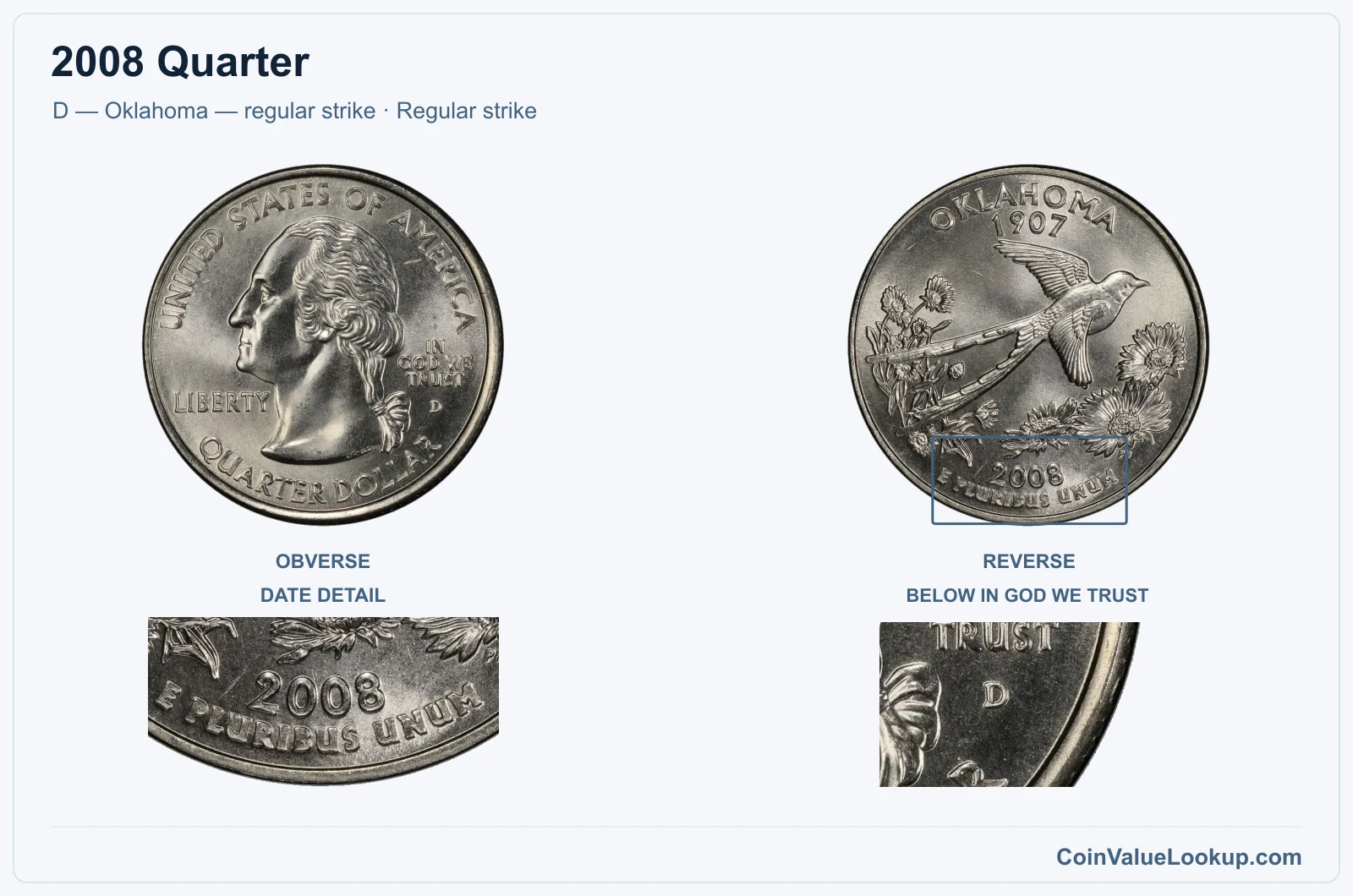
The Denver Mint regular strike Oklahoma quarter is copper-nickel clad with the same 24.26 mm diameter and 5.67 g weight as its Philadelphia sibling. Look for the D mintmark near Washington's portrait.
USA Coin Book guides it at about $0.49 in MS60 and $2.50 in MS65. Circulated pieces are worth face value.
High-grade examples with clean fields and strong luster are the ones that move above a quarter.
Range Grade
Price Auction Records Appraisal PO PO 1
—
Coin Identifier FR FR 2
—
Coin Identifier AG AG 3
—
Coin Identifier G G 4
—
Coin Identifier
G 6
—
Coin Identifier VG VG 8
—
Coin Identifier
VG 10
—
Coin Identifier F F 12
—
Coin Identifier
F 15
—
Coin Identifier VF VF 20
—
Coin Identifier
VF 25
—
Coin Identifier
VF 30
—
Coin Identifier
VF 35
—
Coin Identifier XF XF 40
—
Coin Identifier
XF 45
—
Coin Identifier AU AU 50
—
Coin Identifier
AU 53
—
Coin Identifier
AU 55
—
Coin Identifier
AU 58
—
Coin Identifier MS MS 60
—
Coin Identifier
MS 61
—
Coin Identifier
MS 62
—
Coin Identifier
MS 63
—
Coin Identifier
MS 64
—
Coin Identifier
MS 65
—
Coin Identifier
MS 66
—
Coin Identifier
MS 67
Coin Identifier
MS 68
Coin Identifier
MS 69
—
—
—
MS 70
—
—
—
2008 Quarter — D — Oklahoma — satin finish
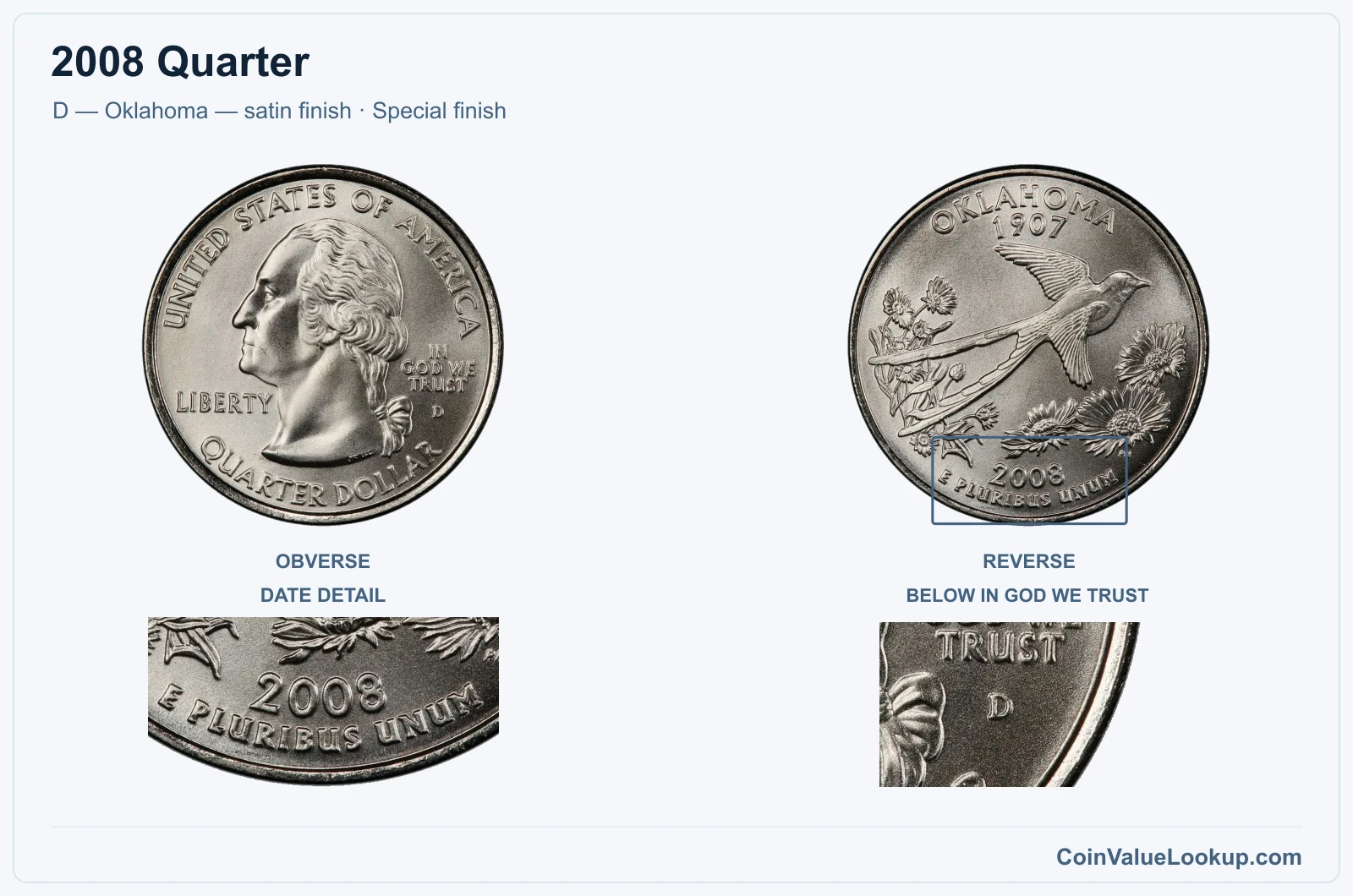
This is the D-mint satin finish Oklahoma quarter, distributed only in 2008 Mint Sets. The satin texture is uniform and intentional — it differs from both a worn business strike and a proof's mirror field.
A dull surface from environmental damage does not make a satin coin.
No standard guide estimate is adopted here. Value is assessed individually based on authenticated finish, preservation and any recognized error.
Packaging or third-party attribution helps establish it.
Range Grade
Price Auction Records Appraisal SP SP 1
—
Coin Identifier
SP 2
—
Coin Identifier
SP 3
—
Coin Identifier
SP 4
—
Coin Identifier
SP 6
—
Coin Identifier
SP 8
—
Coin Identifier
SP 10
—
Coin Identifier
SP 12
—
Coin Identifier
SP 15
—
Coin Identifier
SP 20
—
Coin Identifier
SP 25
—
Coin Identifier
SP 30
—
Coin Identifier
SP 35
—
Coin Identifier
SP 40
—
Coin Identifier
SP 45
—
Coin Identifier
SP 50
—
Coin Identifier
SP 53
—
Coin Identifier
SP 55
—
Coin Identifier
SP 58
—
Coin Identifier
SP 60
—
Coin Identifier
SP 61
—
Coin Identifier
SP 62
—
Coin Identifier
SP 63
—
Coin Identifier
SP 64
—
Coin Identifier
SP 65
—
Coin Identifier
SP 66
—
Coin Identifier
SP 67
—
Coin Identifier
SP 68
—
Coin Identifier
SP 69
Coin Identifier
SP 70
—
—
—
2008 Quarter — S — Oklahoma — clad proof
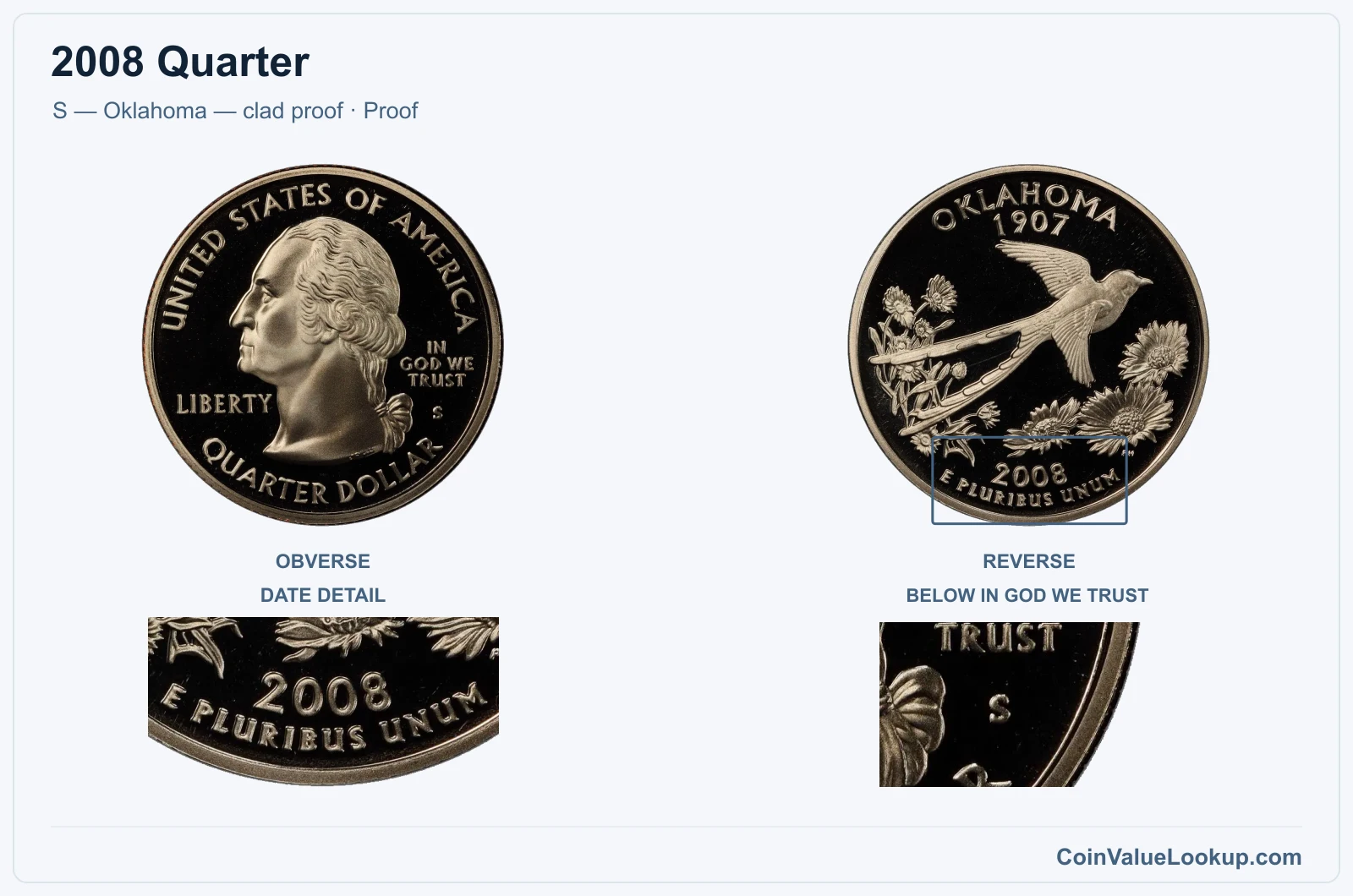
The S-mint clad proof Oklahoma quarter was struck at San Francisco for collector proof sets. Expect mirror-like fields and frosted raised design elements.
It is copper-nickel clad — not silver — so check the edge for the telltale layered stripe or weigh it (about 5.67 g for clad versus 6.25 g for silver).
USA Coin Book guides this version at about $6.25 in PR65. That estimate is not a guaranteed offer, but it gives you a ballpark.
Hairlines and haze in the fields are the main grade reducers for proofs.
Range Grade
Price Auction Records Appraisal PR PR 1
—
Coin Identifier
PR 2
—
Coin Identifier
PR 3
—
Coin Identifier
PR 4
—
Coin Identifier
PR 6
—
Coin Identifier
PR 8
—
Coin Identifier
PR 10
—
Coin Identifier
PR 12
—
Coin Identifier
PR 15
—
Coin Identifier
PR 20
—
Coin Identifier
PR 25
—
Coin Identifier
PR 30
—
Coin Identifier
PR 35
—
Coin Identifier
PR 40
—
Coin Identifier
PR 45
—
Coin Identifier
PR 50
—
Coin Identifier
PR 53
—
Coin Identifier
PR 55
—
Coin Identifier
PR 58
—
Coin Identifier
PR 60
—
Coin Identifier
PR 61
—
Coin Identifier
PR 62
—
Coin Identifier
PR 63
—
Coin Identifier
PR 64
—
Coin Identifier
PR 65
—
Coin Identifier
PR 66
—
Coin Identifier
PR 67
—
Coin Identifier
PR 68
—
Coin Identifier
PR 69
Coin Identifier
PR 70
Coin Identifier
2008 Quarter — S — Oklahoma — silver proof
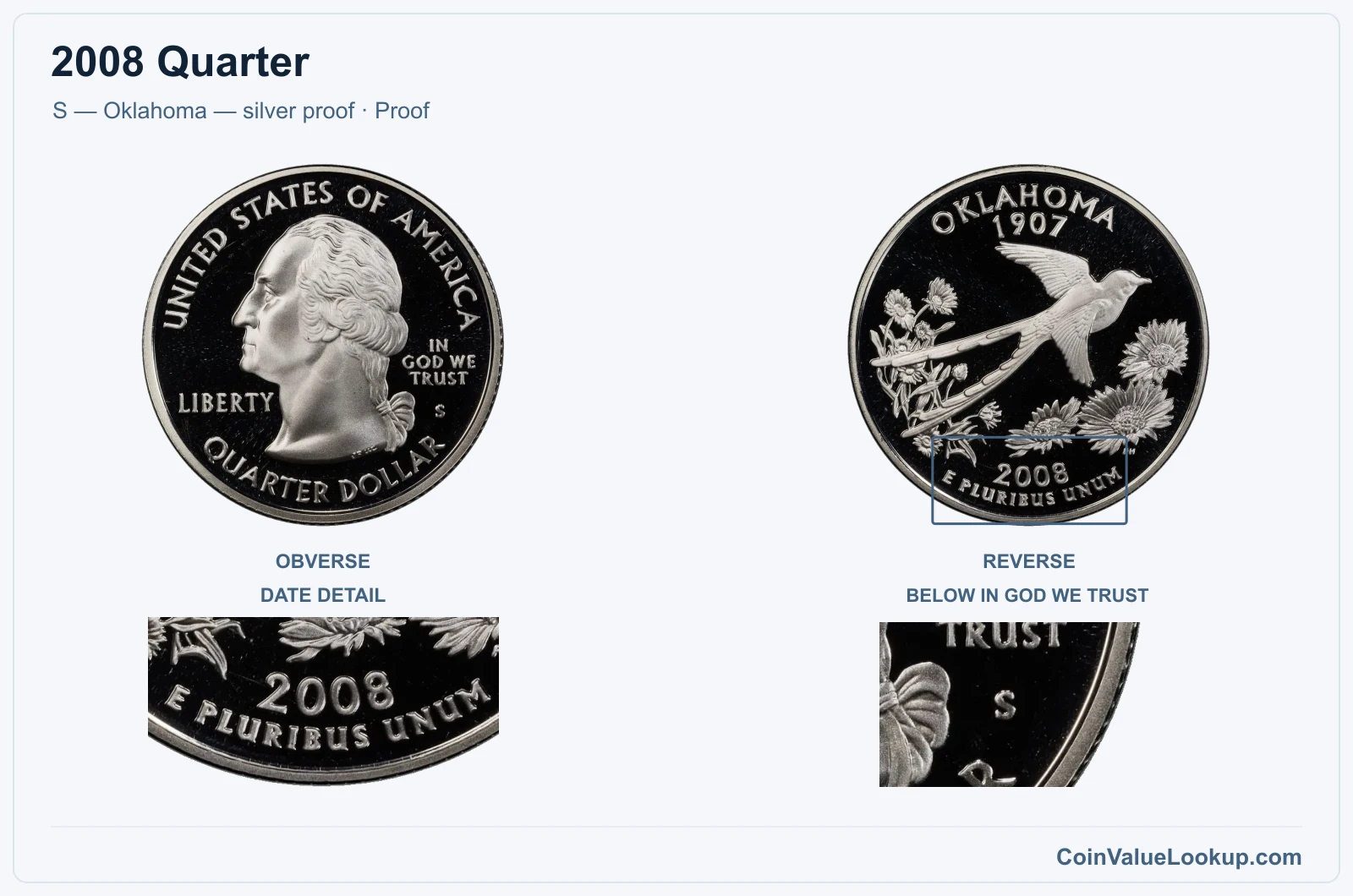
The S-mint silver proof Oklahoma quarter is struck in 90% silver with a nominal weight around 6.25 grams. The edge will not show a copper stripe.
These came in Silver Proof Sets from the U.S. Mint.
USA Coin Book estimates this coin at about $23.00 in PR65. That is nearly four times the clad proof's guide value, so confirming composition is well worth the effort.
A kitchen scale accurate to 0.1 g or an edge check is usually enough to tell the two apart. Keep the clad and silver values strictly separate when evaluating your coin.
Range Grade
Price Auction Records Appraisal PR PR 1
—
Coin Identifier
PR 2
—
Coin Identifier
PR 3
—
Coin Identifier
PR 4
—
Coin Identifier
PR 6
—
Coin Identifier
PR 8
—
Coin Identifier
PR 10
—
Coin Identifier
PR 12
—
Coin Identifier
PR 15
—
Coin Identifier
PR 20
—
Coin Identifier
PR 25
—
Coin Identifier
PR 30
—
Coin Identifier
PR 35
—
Coin Identifier
PR 40
—
Coin Identifier
PR 45
—
Coin Identifier
PR 50
—
Coin Identifier
PR 53
—
Coin Identifier
PR 55
—
Coin Identifier
PR 58
—
Coin Identifier
PR 60
—
Coin Identifier
PR 61
—
Coin Identifier
PR 62
—
Coin Identifier
PR 63
—
Coin Identifier
PR 64
—
Coin Identifier
PR 65
—
Coin Identifier
PR 66
—
Coin Identifier
PR 67
—
Coin Identifier
PR 68
—
Coin Identifier
PR 69
Coin Identifier
PR 70
Coin Identifier
2008 Quarter — P — New Mexico — regular strike
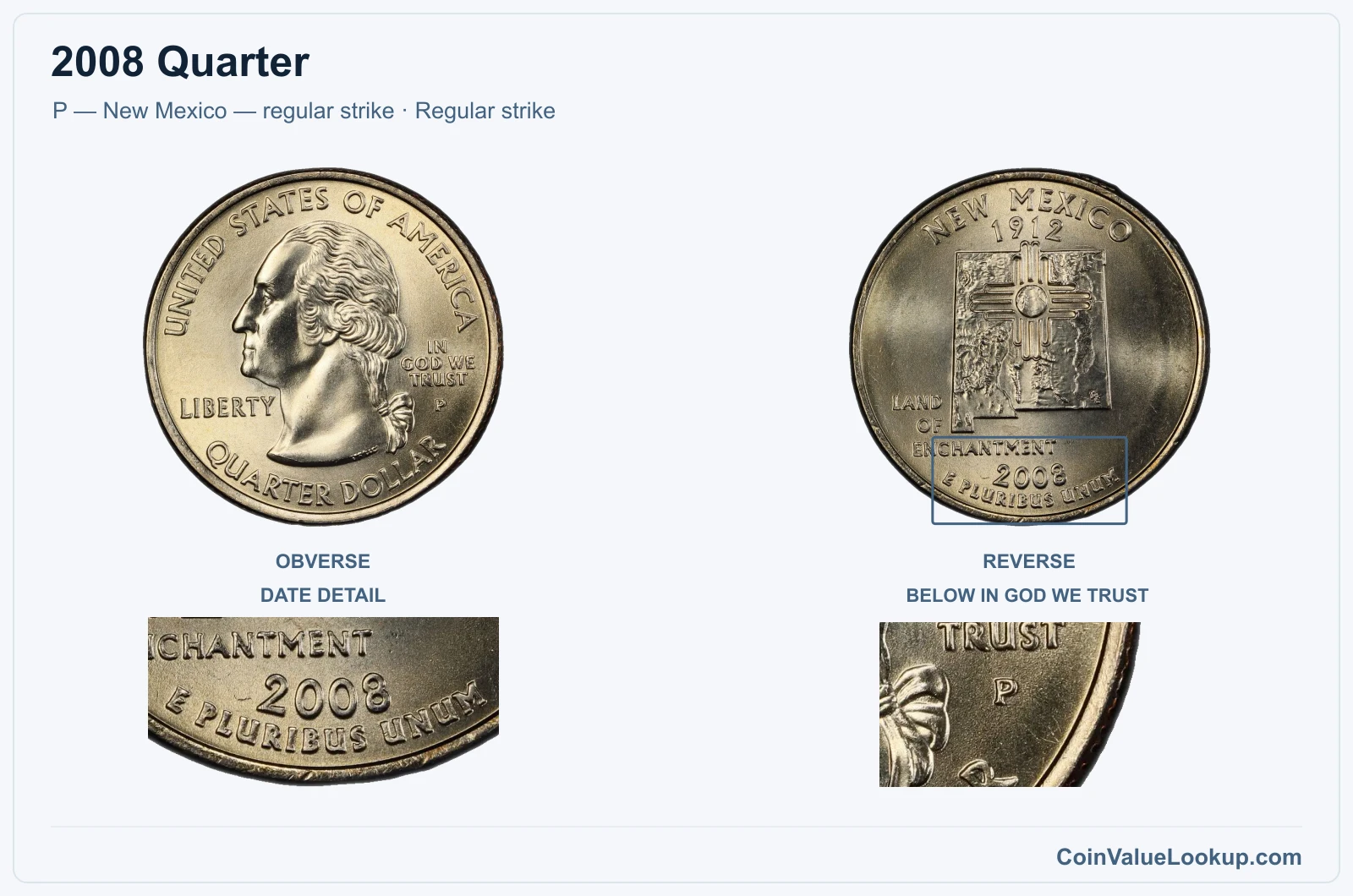
The Philadelphia Mint regular strike New Mexico quarter is copper-nickel clad at 24.26 mm and about 5.67 grams. Flip to the reverse and confirm the New Mexico design before pricing.
USA Coin Book guides it at roughly $0.49 in MS60 and $2.50 in MS65. Like other business strikes, circulated examples spend at face value.
Original mint luster and minimal bag marks separate a collectible piece from a spender.
Range Grade
Price Auction Records Appraisal PO PO 1
—
Coin Identifier FR FR 2
—
Coin Identifier AG AG 3
—
Coin Identifier G G 4
—
Coin Identifier
G 6
—
Coin Identifier VG VG 8
—
Coin Identifier
VG 10
—
Coin Identifier F F 12
—
Coin Identifier
F 15
—
Coin Identifier VF VF 20
—
Coin Identifier
VF 25
—
Coin Identifier
VF 30
—
Coin Identifier
VF 35
—
Coin Identifier XF XF 40
—
Coin Identifier
XF 45
—
Coin Identifier AU AU 50
—
Coin Identifier
AU 53
—
Coin Identifier
AU 55
—
Coin Identifier
AU 58
—
Coin Identifier MS MS 60
—
Coin Identifier
MS 61
—
Coin Identifier
MS 62
—
Coin Identifier
MS 63
—
Coin Identifier
MS 64
—
Coin Identifier
MS 65
—
Coin Identifier
MS 66
—
Coin Identifier
MS 67
Coin Identifier
MS 68
—
—
—
MS 69
—
—
—
MS 70
—
—
—
2008 Quarter — P — New Mexico — satin finish
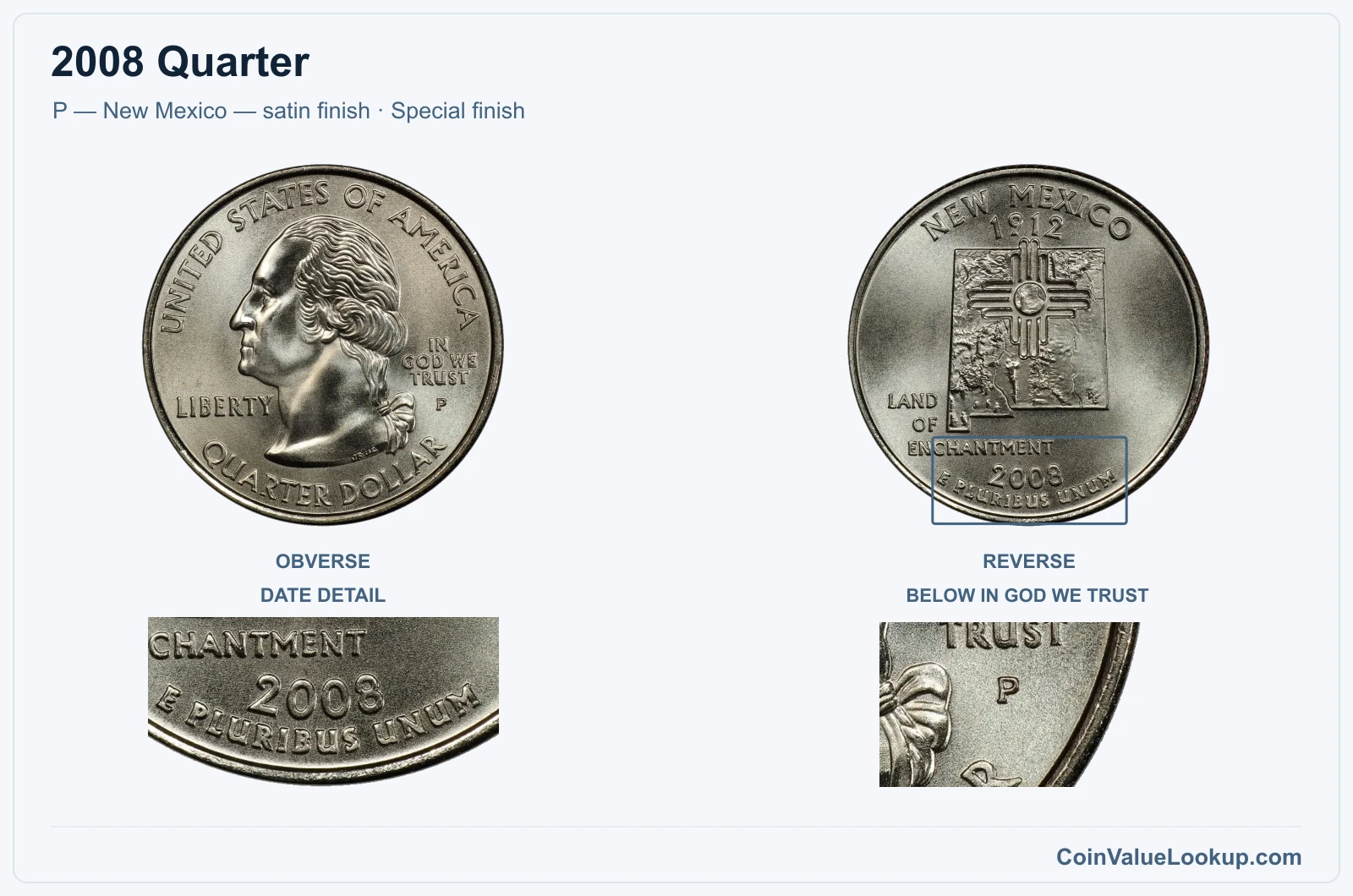
The P-mint New Mexico satin finish was released only in 2008 Uncirculated Mint Sets. Its surface has a soft, even texture that differs clearly from business-strike luster under a lamp.
A coin dulled by cleaning or wear is not the same thing.
No guide price is adopted for this version. Individual assessment based on confirmed identity, condition and any errors applies.
Holding the original Mint Set packaging or getting third-party authentication strengthens any claim to satin-finish status.
Range Grade
Price Auction Records Appraisal SP SP 1
—
Coin Identifier
SP 2
—
Coin Identifier
SP 3
—
Coin Identifier
SP 4
—
Coin Identifier
SP 6
—
Coin Identifier
SP 8
—
Coin Identifier
SP 10
—
Coin Identifier
SP 12
—
Coin Identifier
SP 15
—
Coin Identifier
SP 20
—
Coin Identifier
SP 25
—
Coin Identifier
SP 30
—
Coin Identifier
SP 35
—
Coin Identifier
SP 40
—
Coin Identifier
SP 45
—
Coin Identifier
SP 50
—
Coin Identifier
SP 53
—
Coin Identifier
SP 55
—
Coin Identifier
SP 58
—
Coin Identifier
SP 60
—
Coin Identifier
SP 61
—
Coin Identifier
SP 62
—
Coin Identifier
SP 63
—
Coin Identifier
SP 64
—
Coin Identifier
SP 65
—
Coin Identifier
SP 66
—
Coin Identifier
SP 67
—
Coin Identifier
SP 68
Coin Identifier
SP 69
Coin Identifier
SP 70
—
—
—
2008 Quarter — D — New Mexico — regular strike
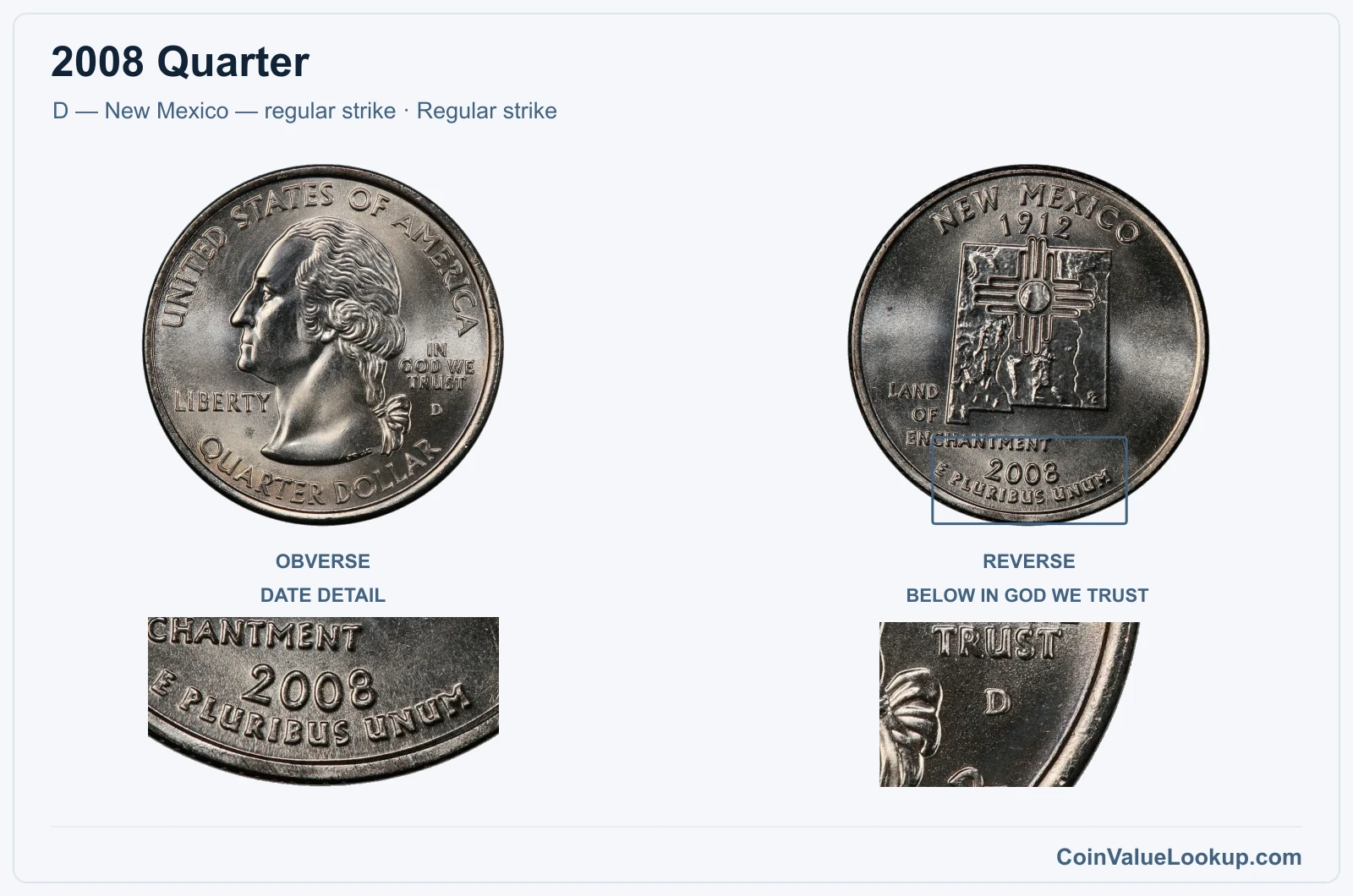
Denver's regular strike New Mexico quarter carries the D mintmark and the same copper-nickel clad specs: 24.26 mm, about 5.67 grams. USA Coin Book places it near $0.49 at MS60 and $2.50 at MS65.
In worn condition it is a quarter — no more, no less. Uncirculated examples with full luster and clean surfaces are what the guide prices describe.
Range Grade
Price Auction Records Appraisal PO PO 1
—
Coin Identifier FR FR 2
—
Coin Identifier AG AG 3
—
Coin Identifier G G 4
—
Coin Identifier
G 6
—
Coin Identifier VG VG 8
—
Coin Identifier
VG 10
—
Coin Identifier F F 12
—
Coin Identifier
F 15
—
Coin Identifier VF VF 20
—
Coin Identifier
VF 25
—
Coin Identifier
VF 30
—
Coin Identifier
VF 35
—
Coin Identifier XF XF 40
—
Coin Identifier
XF 45
—
Coin Identifier AU AU 50
—
Coin Identifier
AU 53
—
Coin Identifier
AU 55
—
Coin Identifier
AU 58
—
Coin Identifier MS MS 60
—
Coin Identifier
MS 61
—
Coin Identifier
MS 62
—
Coin Identifier
MS 63
—
Coin Identifier
MS 64
—
Coin Identifier
MS 65
—
Coin Identifier
MS 66
—
Coin Identifier
MS 67
Coin Identifier
MS 68
Coin Identifier
MS 69
—
—
—
MS 70
—
—
—
2008 Quarter — D — New Mexico — satin finish
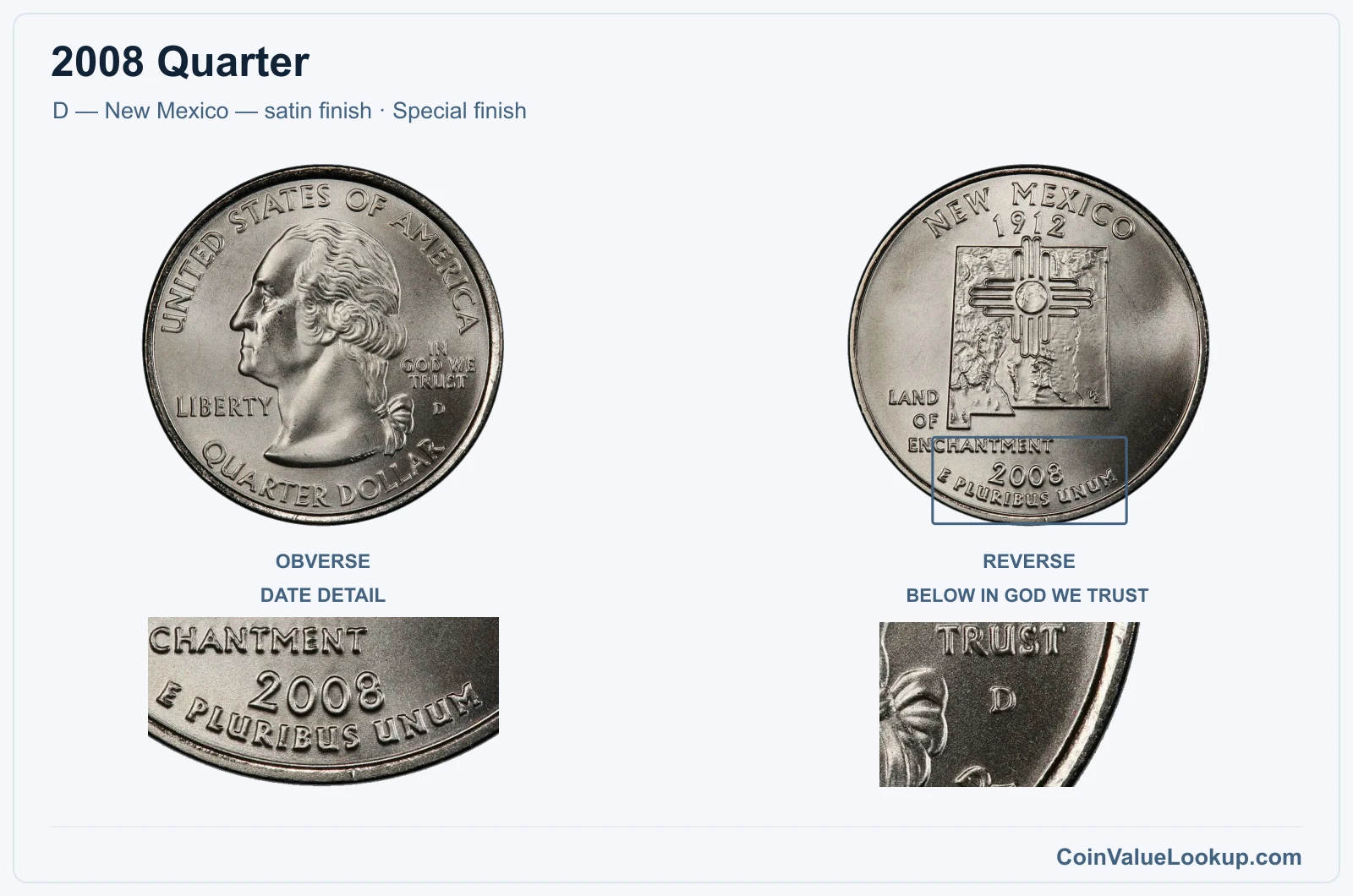
This is the D-mint satin finish New Mexico quarter from the 2008 Mint Set. The uniform fine-grain texture is the defining feature, and it must be an intentional Mint-produced surface rather than wear-related dullness.
No adopted guide range covers this version. Assessment depends on confirmed satin-finish attribution, the coin's preservation and whether any recognized error is present.
Provenance from an original Mint Set helps.
Range Grade
Price Auction Records Appraisal SP SP 1
—
Coin Identifier
SP 2
—
Coin Identifier
SP 3
—
Coin Identifier
SP 4
—
Coin Identifier
SP 6
—
Coin Identifier
SP 8
—
Coin Identifier
SP 10
—
Coin Identifier
SP 12
—
Coin Identifier
SP 15
—
Coin Identifier
SP 20
—
Coin Identifier
SP 25
—
Coin Identifier
SP 30
—
Coin Identifier
SP 35
—
Coin Identifier
SP 40
—
Coin Identifier
SP 45
—
Coin Identifier
SP 50
—
Coin Identifier
SP 53
—
Coin Identifier
SP 55
—
Coin Identifier
SP 58
—
Coin Identifier
SP 60
—
Coin Identifier
SP 61
—
Coin Identifier
SP 62
—
Coin Identifier
SP 63
—
Coin Identifier
SP 64
—
Coin Identifier
SP 65
—
Coin Identifier
SP 66
—
Coin Identifier
SP 67
—
Coin Identifier
SP 68
—
Coin Identifier
SP 69
Coin Identifier
SP 70
—
—
—
2008 Quarter — S — New Mexico — clad proof
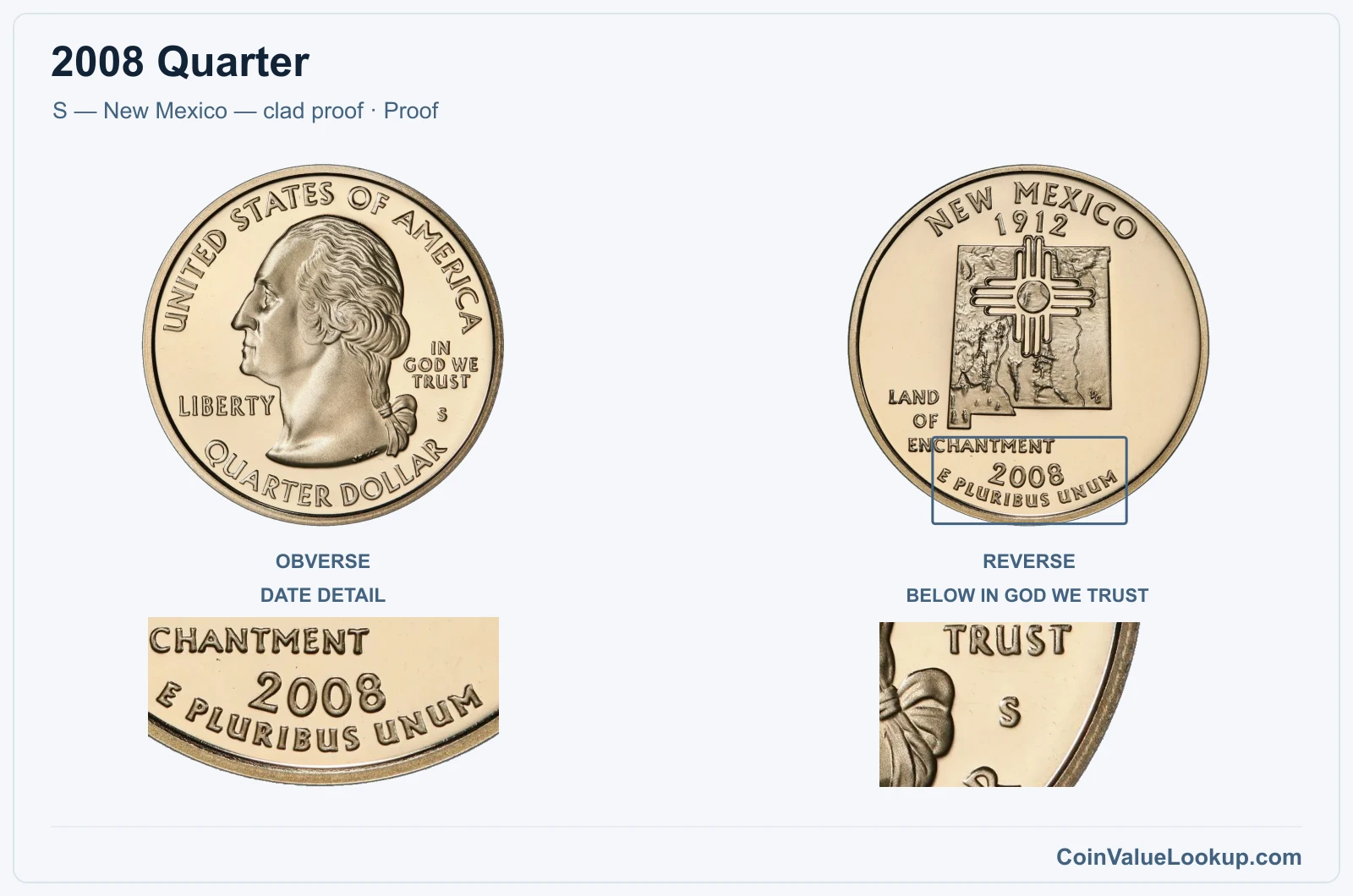
San Francisco's clad proof New Mexico quarter has mirror fields and frosted devices, struck in copper-nickel clad. Confirm the composition by checking the edge for a visible layer line or by weighing the coin.
USA Coin Book guides it at about $6.25 in PR65. For proofs, surface quality is everything — hairlines, haze and fingerprints bring the grade down fast.
Range Grade
Price Auction Records Appraisal PR PR 1
—
Coin Identifier
PR 2
—
Coin Identifier
PR 3
—
Coin Identifier
PR 4
—
Coin Identifier
PR 6
—
Coin Identifier
PR 8
—
Coin Identifier
PR 10
—
Coin Identifier
PR 12
—
Coin Identifier
PR 15
—
Coin Identifier
PR 20
—
Coin Identifier
PR 25
—
Coin Identifier
PR 30
—
Coin Identifier
PR 35
—
Coin Identifier
PR 40
—
Coin Identifier
PR 45
—
Coin Identifier
PR 50
—
Coin Identifier
PR 53
—
Coin Identifier
PR 55
—
Coin Identifier
PR 58
—
Coin Identifier
PR 60
—
Coin Identifier
PR 61
—
Coin Identifier
PR 62
—
Coin Identifier
PR 63
—
Coin Identifier
PR 64
—
Coin Identifier
PR 65
—
Coin Identifier
PR 66
—
Coin Identifier
PR 67
—
Coin Identifier
PR 68
—
Coin Identifier
PR 69
Coin Identifier
PR 70
Coin Identifier
2008 Quarter — S — New Mexico — silver proof
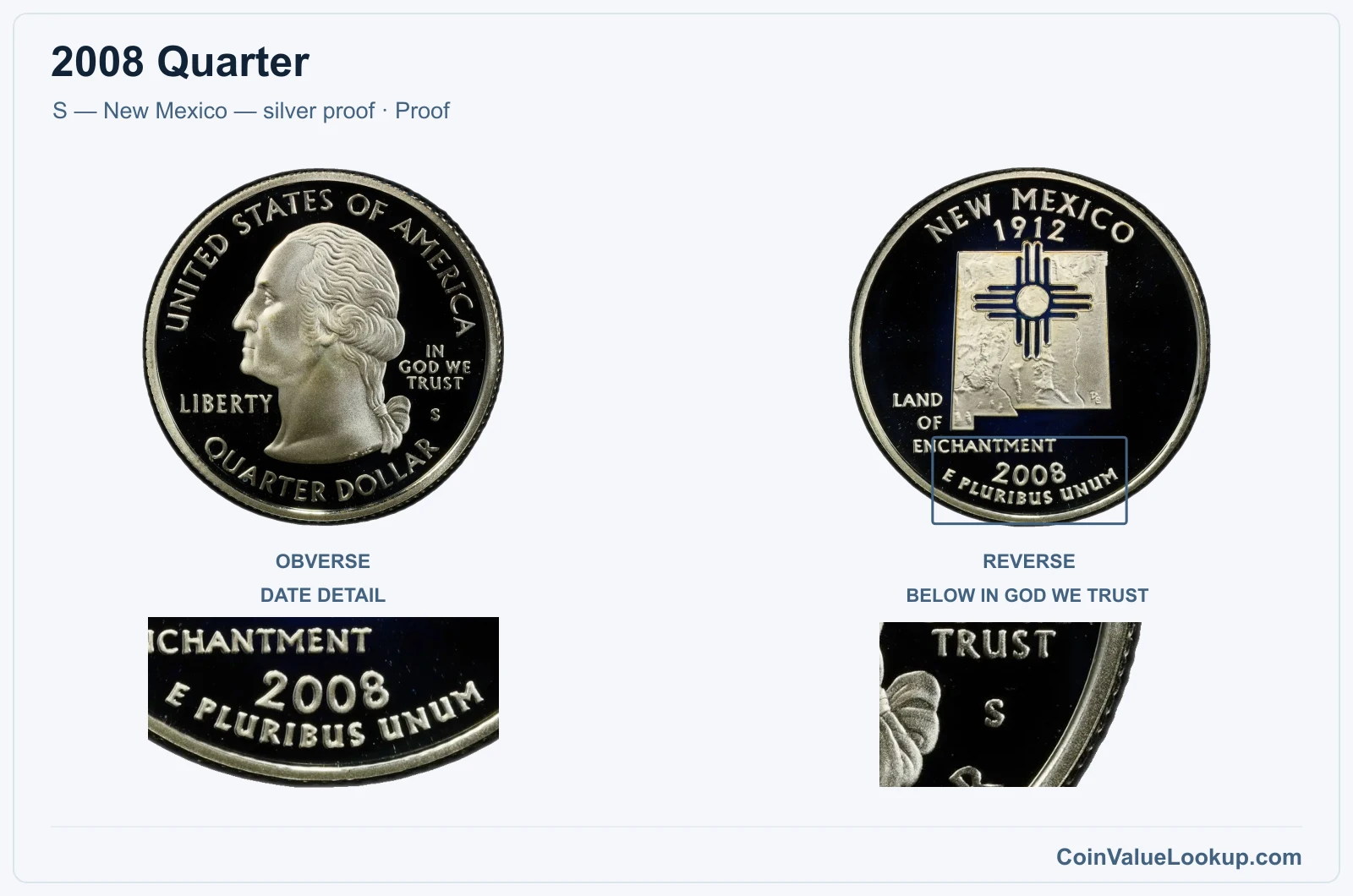
The S-mint silver proof New Mexico quarter is composed of 90% silver, weighing roughly 6.25 grams. No copper stripe shows on the edge.
USA Coin Book estimates it at $23.00 in PR65. The silver content plus collector demand places it well above the clad proof version, so always verify composition before assuming which guide line applies.
Original Silver Proof Set packaging is the easiest confirmation.
Range Grade
Price Auction Records Appraisal PR PR 1
—
Coin Identifier
PR 2
—
Coin Identifier
PR 3
—
Coin Identifier
PR 4
—
Coin Identifier
PR 6
—
Coin Identifier
PR 8
—
Coin Identifier
PR 10
—
Coin Identifier
PR 12
—
Coin Identifier
PR 15
—
Coin Identifier
PR 20
—
Coin Identifier
PR 25
—
Coin Identifier
PR 30
—
Coin Identifier
PR 35
—
Coin Identifier
PR 40
—
Coin Identifier
PR 45
—
Coin Identifier
PR 50
—
Coin Identifier
PR 53
—
Coin Identifier
PR 55
—
Coin Identifier
PR 58
—
Coin Identifier
PR 60
—
Coin Identifier
PR 61
—
Coin Identifier
PR 62
—
Coin Identifier
PR 63
—
Coin Identifier
PR 64
—
Coin Identifier
PR 65
—
Coin Identifier
PR 66
—
Coin Identifier
PR 67
—
Coin Identifier
PR 68
—
Coin Identifier
PR 69
Coin Identifier
PR 70
Coin Identifier
2008 Quarter — P — Arizona — regular strike
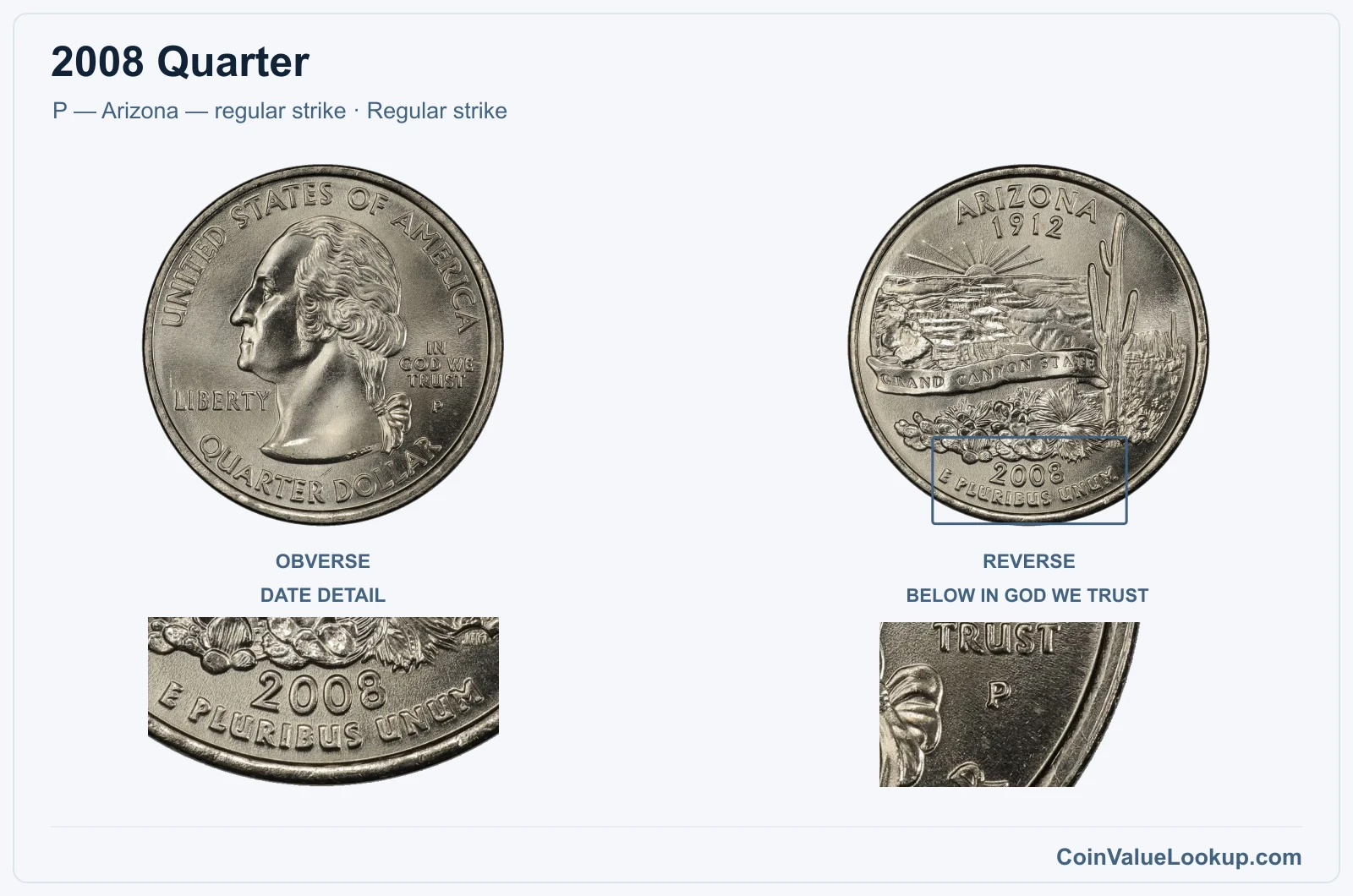
Philadelphia's regular strike Arizona quarter is copper-nickel clad, 24.26 mm across and about 5.67 grams. Check for the P mintmark and the Arizona reverse design.
USA Coin Book guides this version at $0.49 in MS60 and $2.50 in MS65. Circulated coins are face-value spenders.
A well-preserved uncirculated example is where the modest premium lives.
Coin Value Lookup is a good place to look up guides for other dates and denominations if you are sorting through a pile of state quarters.
Range Grade
Price Auction Records Appraisal PO PO 1
—
Coin Identifier FR FR 2
—
Coin Identifier AG AG 3
—
Coin Identifier G G 4
—
Coin Identifier
G 6
—
Coin Identifier VG VG 8
—
Coin Identifier
VG 10
—
Coin Identifier F F 12
—
Coin Identifier
F 15
—
Coin Identifier VF VF 20
—
Coin Identifier
VF 25
—
Coin Identifier
VF 30
—
Coin Identifier
VF 35
—
Coin Identifier XF XF 40
—
Coin Identifier
XF 45
—
Coin Identifier AU AU 50
—
Coin Identifier
AU 53
—
Coin Identifier
AU 55
—
Coin Identifier
AU 58
—
Coin Identifier MS MS 60
—
Coin Identifier
MS 61
—
Coin Identifier
MS 62
—
Coin Identifier
MS 63
—
Coin Identifier
MS 64
—
Coin Identifier
MS 65
—
Coin Identifier
MS 66
—
Coin Identifier
MS 67
Coin Identifier
MS 68
Coin Identifier
MS 69
—
—
—
MS 70
—
—
—
2008 Quarter — P — Arizona — satin finish
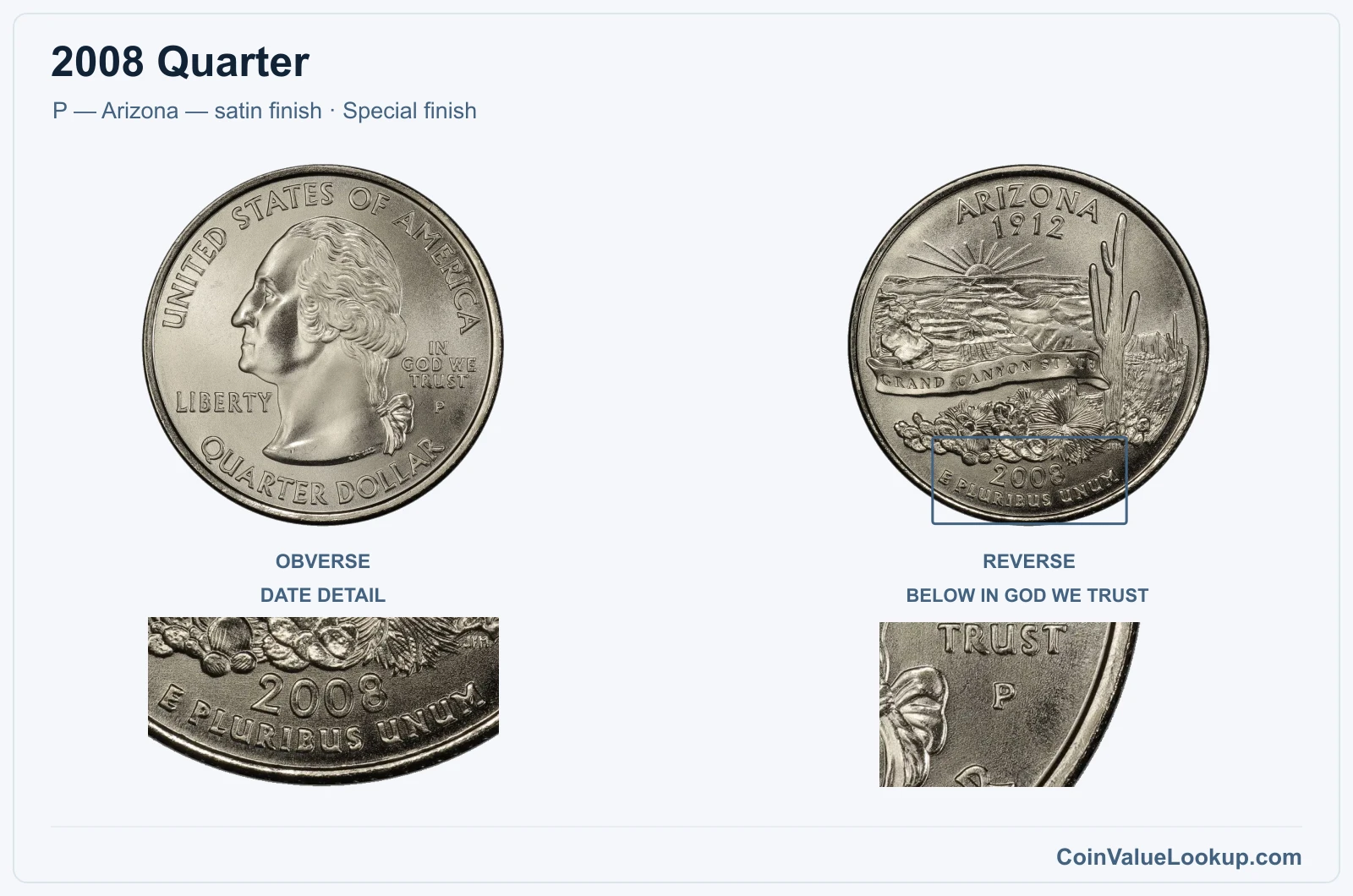
The P-mint Arizona satin finish was available only through the 2008 Uncirculated Mint Set. Its uniform fine-grain surface sits between a business strike's bright cartwheel luster and a proof's mirror finish.
A coin that looks dull because of wear or environmental exposure is not satin finish.
No guide estimate is adopted for this version. Value depends on authenticated finish confirmation, condition and the presence of any recognized error.
Range Grade
Price Auction Records Appraisal SP SP 1
—
Coin Identifier
SP 2
—
Coin Identifier
SP 3
—
Coin Identifier
SP 4
—
Coin Identifier
SP 6
—
Coin Identifier
SP 8
—
Coin Identifier
SP 10
—
Coin Identifier
SP 12
—
Coin Identifier
SP 15
—
Coin Identifier
SP 20
—
Coin Identifier
SP 25
—
Coin Identifier
SP 30
—
Coin Identifier
SP 35
—
Coin Identifier
SP 40
—
Coin Identifier
SP 45
—
Coin Identifier
SP 50
—
Coin Identifier
SP 53
—
Coin Identifier
SP 55
—
Coin Identifier
SP 58
—
Coin Identifier
SP 60
—
Coin Identifier
SP 61
—
Coin Identifier
SP 62
—
Coin Identifier
SP 63
—
Coin Identifier
SP 64
—
Coin Identifier
SP 65
—
Coin Identifier
SP 66
—
Coin Identifier
SP 67
—
Coin Identifier
SP 68
Coin Identifier
SP 69
Coin Identifier
SP 70
—
—
—
2008 Quarter — D — Arizona — regular strike
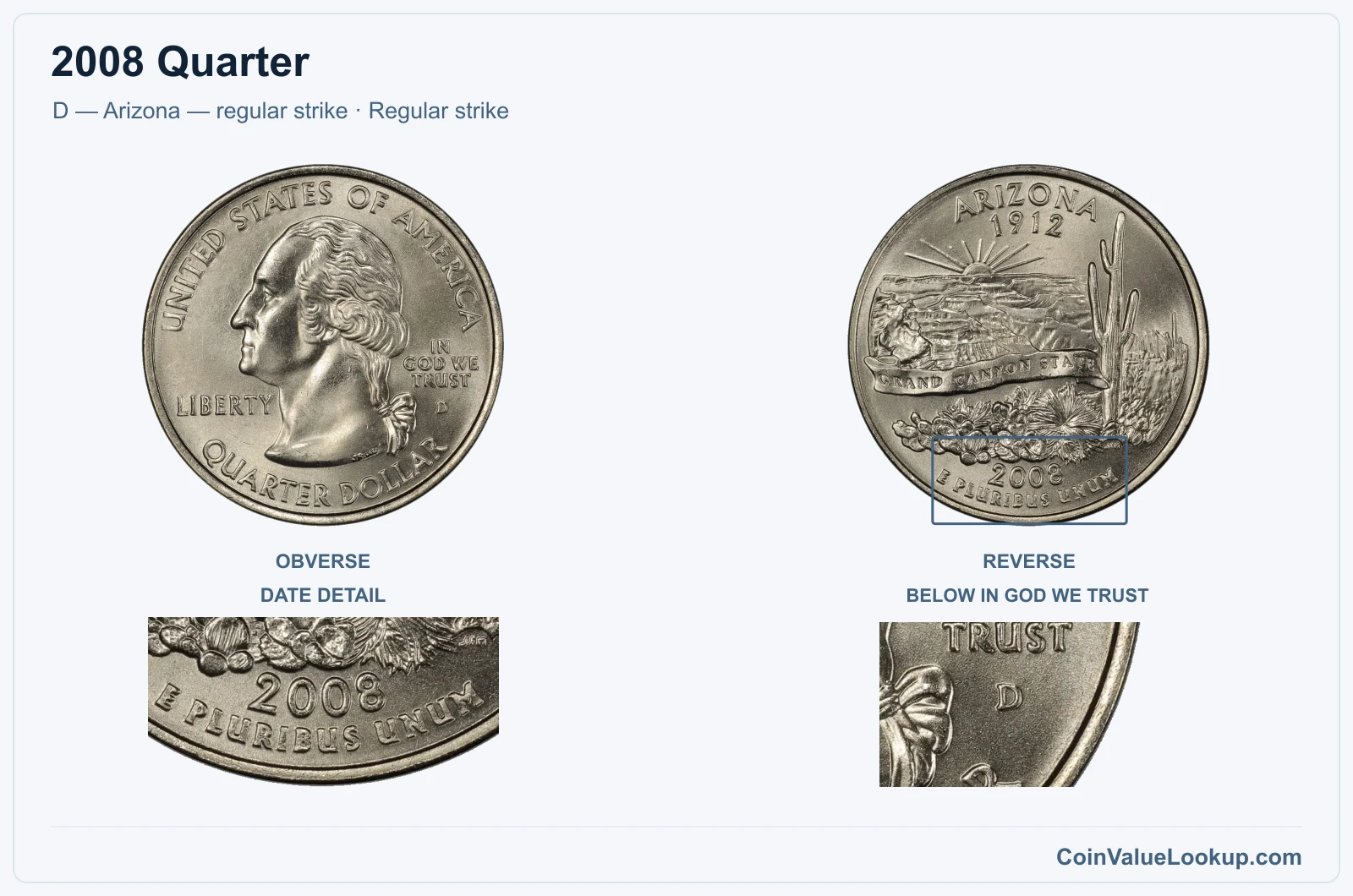
Denver struck a regular business-strike Arizona quarter in copper-nickel clad. Look for the D mintmark on the obverse and the Arizona reverse before pricing.
USA Coin Book guides it at roughly $0.49 in MS60 and $2.50 in MS65. Worn pieces spend at 25 cents.
Uncirculated survivors with full luster are the ones worth comparing to the guide.
Range Grade
Price Auction Records Appraisal PO PO 1
—
Coin Identifier FR FR 2
—
Coin Identifier AG AG 3
—
Coin Identifier G G 4
—
Coin Identifier
G 6
—
Coin Identifier VG VG 8
—
Coin Identifier
VG 10
—
Coin Identifier F F 12
—
Coin Identifier
F 15
—
Coin Identifier VF VF 20
—
Coin Identifier
VF 25
—
Coin Identifier
VF 30
—
Coin Identifier
VF 35
—
Coin Identifier XF XF 40
—
Coin Identifier
XF 45
—
Coin Identifier AU AU 50
—
Coin Identifier
AU 53
—
Coin Identifier
AU 55
—
Coin Identifier
AU 58
—
Coin Identifier MS MS 60
—
Coin Identifier
MS 61
—
Coin Identifier
MS 62
—
Coin Identifier
MS 63
—
Coin Identifier
MS 64
—
Coin Identifier
MS 65
—
Coin Identifier
MS 66
—
Coin Identifier
MS 67
Coin Identifier
MS 68
Coin Identifier
MS 69
—
—
—
MS 70
—
—
—
2008 Quarter — D — Arizona — satin finish
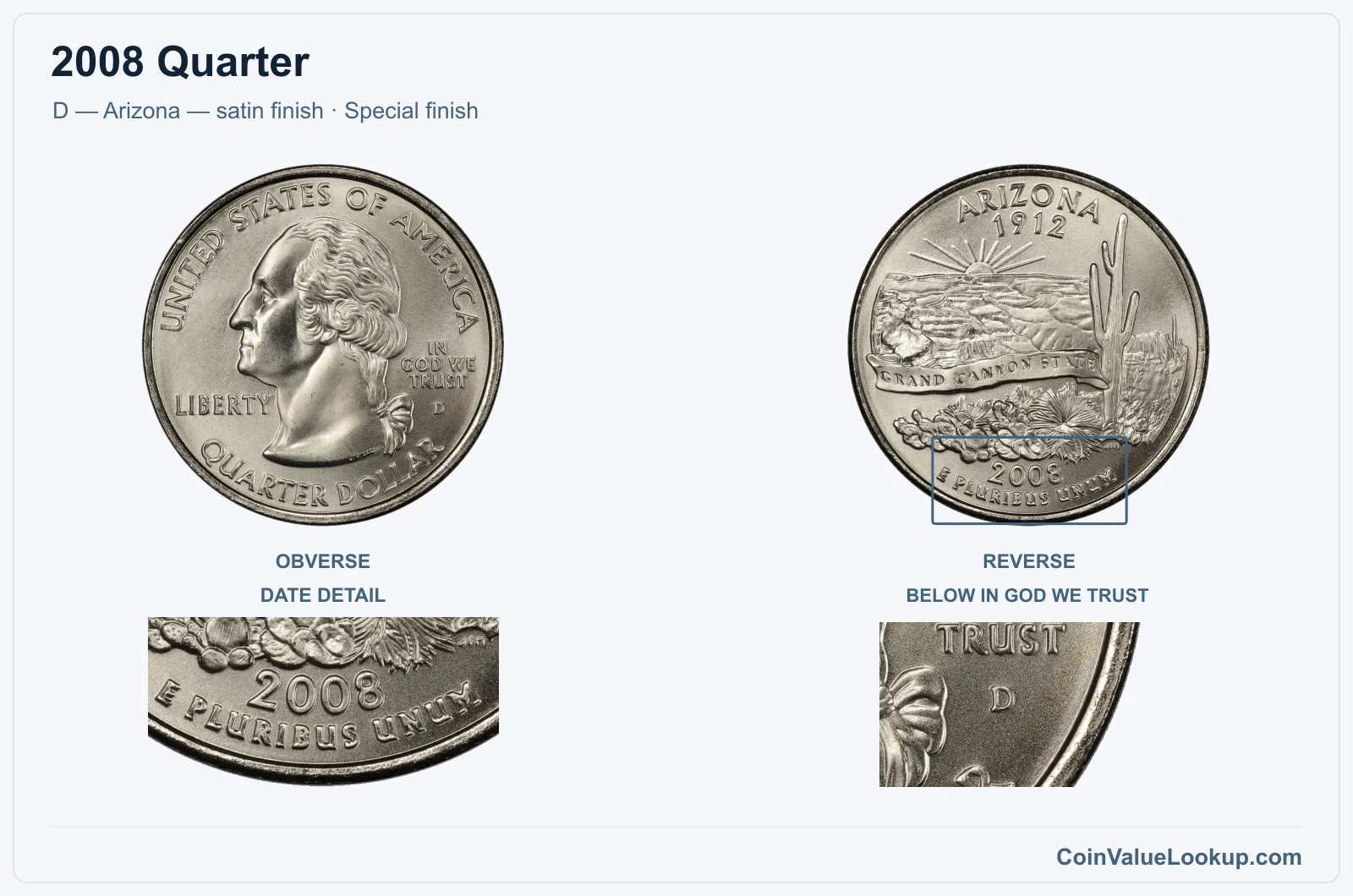
The D-mint Arizona satin finish came in the 2008 Mint Set only. Its intentional fine-grain texture must be distinguished from a business strike that simply lost its shine.
Artificially dulled surfaces do not count.
No standard guide price is adopted. Each coin's value is assessed individually by confirmed identity, preservation and whether any error applies.
Range Grade
Price Auction Records Appraisal SP SP 1
—
Coin Identifier
SP 2
—
Coin Identifier
SP 3
—
Coin Identifier
SP 4
—
Coin Identifier
SP 6
—
Coin Identifier
SP 8
—
Coin Identifier
SP 10
—
Coin Identifier
SP 12
—
Coin Identifier
SP 15
—
Coin Identifier
SP 20
—
Coin Identifier
SP 25
—
Coin Identifier
SP 30
—
Coin Identifier
SP 35
—
Coin Identifier
SP 40
—
Coin Identifier
SP 45
—
Coin Identifier
SP 50
—
Coin Identifier
SP 53
—
Coin Identifier
SP 55
—
Coin Identifier
SP 58
—
Coin Identifier
SP 60
—
Coin Identifier
SP 61
—
Coin Identifier
SP 62
—
Coin Identifier
SP 63
—
Coin Identifier
SP 64
—
Coin Identifier
SP 65
—
Coin Identifier
SP 66
—
Coin Identifier
SP 67
—
Coin Identifier
SP 68
—
Coin Identifier
SP 69
Coin Identifier
SP 70
—
—
—
2008 Quarter — S — Arizona — clad proof
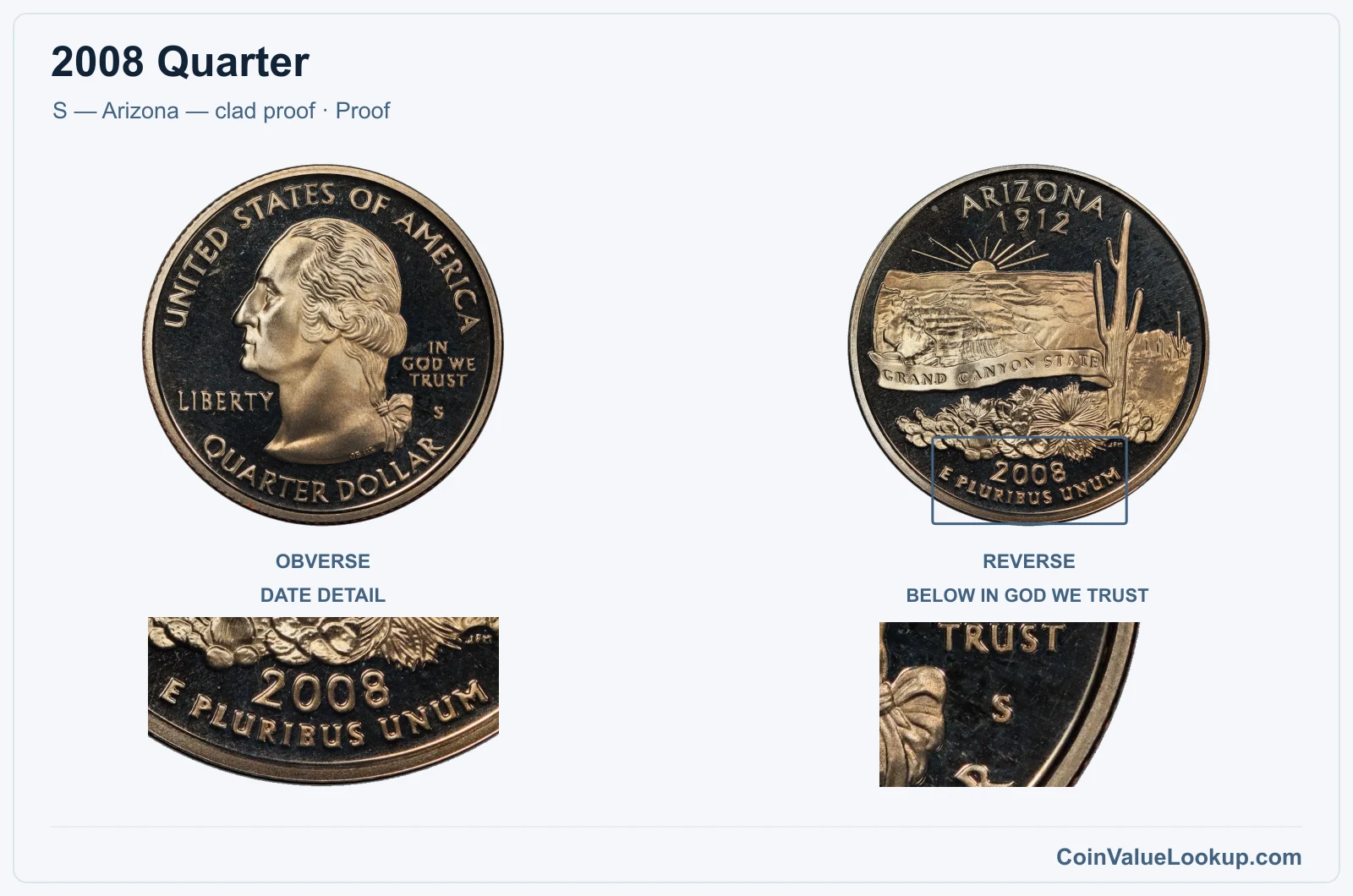
San Francisco's clad proof Arizona quarter shows classic proof characteristics: deep mirror fields and frosted devices. It is copper-nickel clad, not silver, so expect a layered edge stripe and a weight near 5.67 grams.
USA Coin Book guides it at about $6.25 in PR65. Keep it separate from the silver proof; the price difference is significant.
Range Grade
Price Auction Records Appraisal PR PR 1
—
Coin Identifier
PR 2
—
Coin Identifier
PR 3
—
Coin Identifier
PR 4
—
Coin Identifier
PR 6
—
Coin Identifier
PR 8
—
Coin Identifier
PR 10
—
Coin Identifier
PR 12
—
Coin Identifier
PR 15
—
Coin Identifier
PR 20
—
Coin Identifier
PR 25
—
Coin Identifier
PR 30
—
Coin Identifier
PR 35
—
Coin Identifier
PR 40
—
Coin Identifier
PR 45
—
Coin Identifier
PR 50
—
Coin Identifier
PR 53
—
Coin Identifier
PR 55
—
Coin Identifier
PR 58
—
Coin Identifier
PR 60
—
Coin Identifier
PR 61
—
Coin Identifier
PR 62
—
Coin Identifier
PR 63
—
Coin Identifier
PR 64
—
Coin Identifier
PR 65
—
Coin Identifier
PR 66
—
Coin Identifier
PR 67
—
Coin Identifier
PR 68
Coin Identifier
PR 69
Coin Identifier
PR 70
Coin Identifier
2008 Quarter — S — Arizona — silver proof
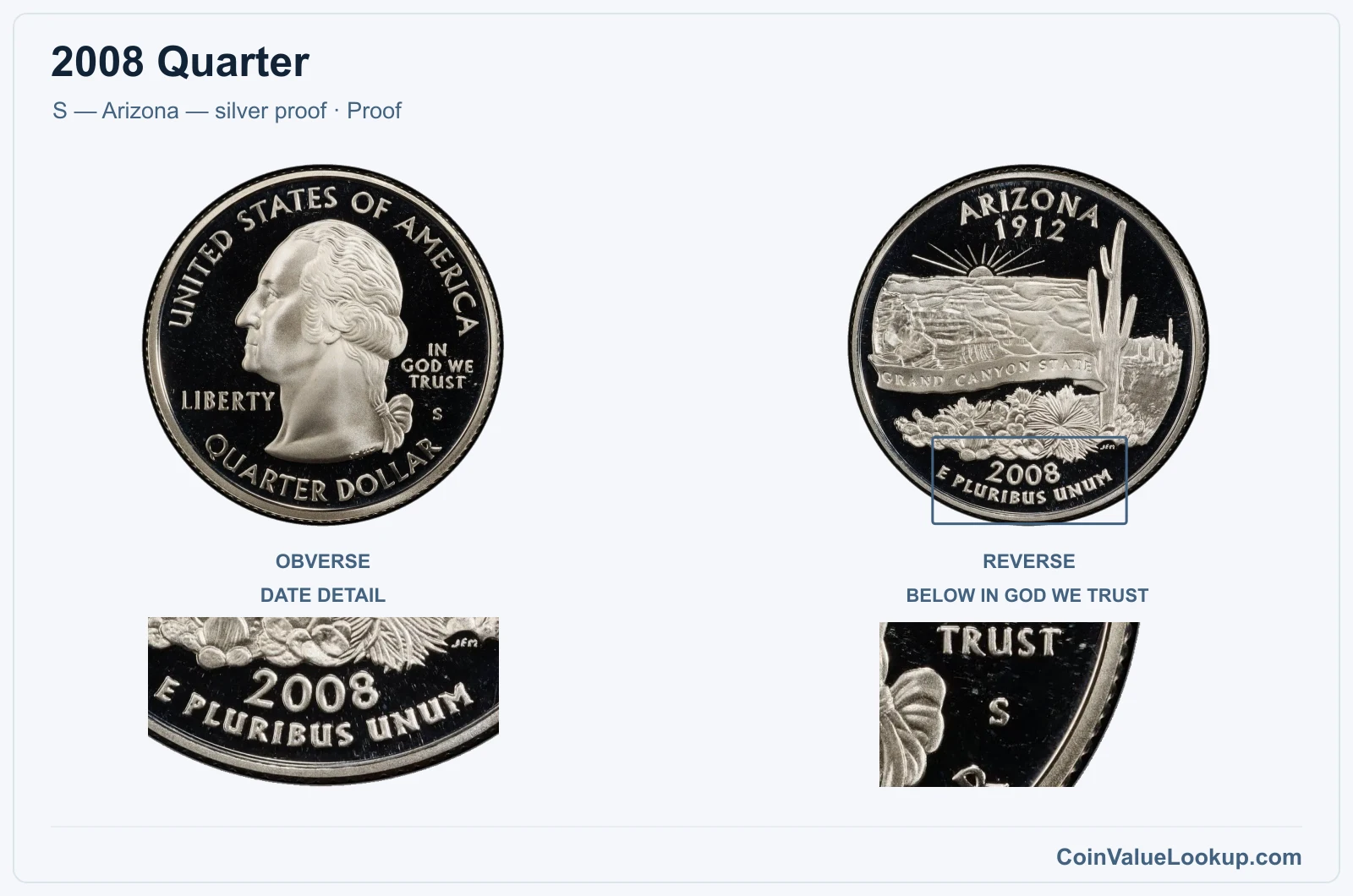
The S-mint silver proof Arizona quarter is 90% silver, around 6.25 grams, and its edge shows no copper layer. USA Coin Book estimates it at $23.00 in PR65.
Silver Proof Set packaging is the simplest way to confirm which proof you hold. A scale that reads to a tenth of a gram is another reliable check.
The premium over the clad version makes composition verification worthwhile every time.
Range Grade
Price Auction Records Appraisal PR PR 1
—
Coin Identifier
PR 2
—
Coin Identifier
PR 3
—
Coin Identifier
PR 4
—
Coin Identifier
PR 6
—
Coin Identifier
PR 8
—
Coin Identifier
PR 10
—
Coin Identifier
PR 12
—
Coin Identifier
PR 15
—
Coin Identifier
PR 20
—
Coin Identifier
PR 25
—
Coin Identifier
PR 30
—
Coin Identifier
PR 35
—
Coin Identifier
PR 40
—
Coin Identifier
PR 45
—
Coin Identifier
PR 50
—
Coin Identifier
PR 53
—
Coin Identifier
PR 55
—
Coin Identifier
PR 58
—
Coin Identifier
PR 60
—
Coin Identifier
PR 61
—
Coin Identifier
PR 62
—
Coin Identifier
PR 63
—
Coin Identifier
PR 64
—
Coin Identifier
PR 65
—
Coin Identifier
PR 66
—
Coin Identifier
PR 67
—
Coin Identifier
PR 68
Coin Identifier
PR 69
Coin Identifier
PR 70
Coin Identifier
2008 Quarter — P — Alaska — regular strike
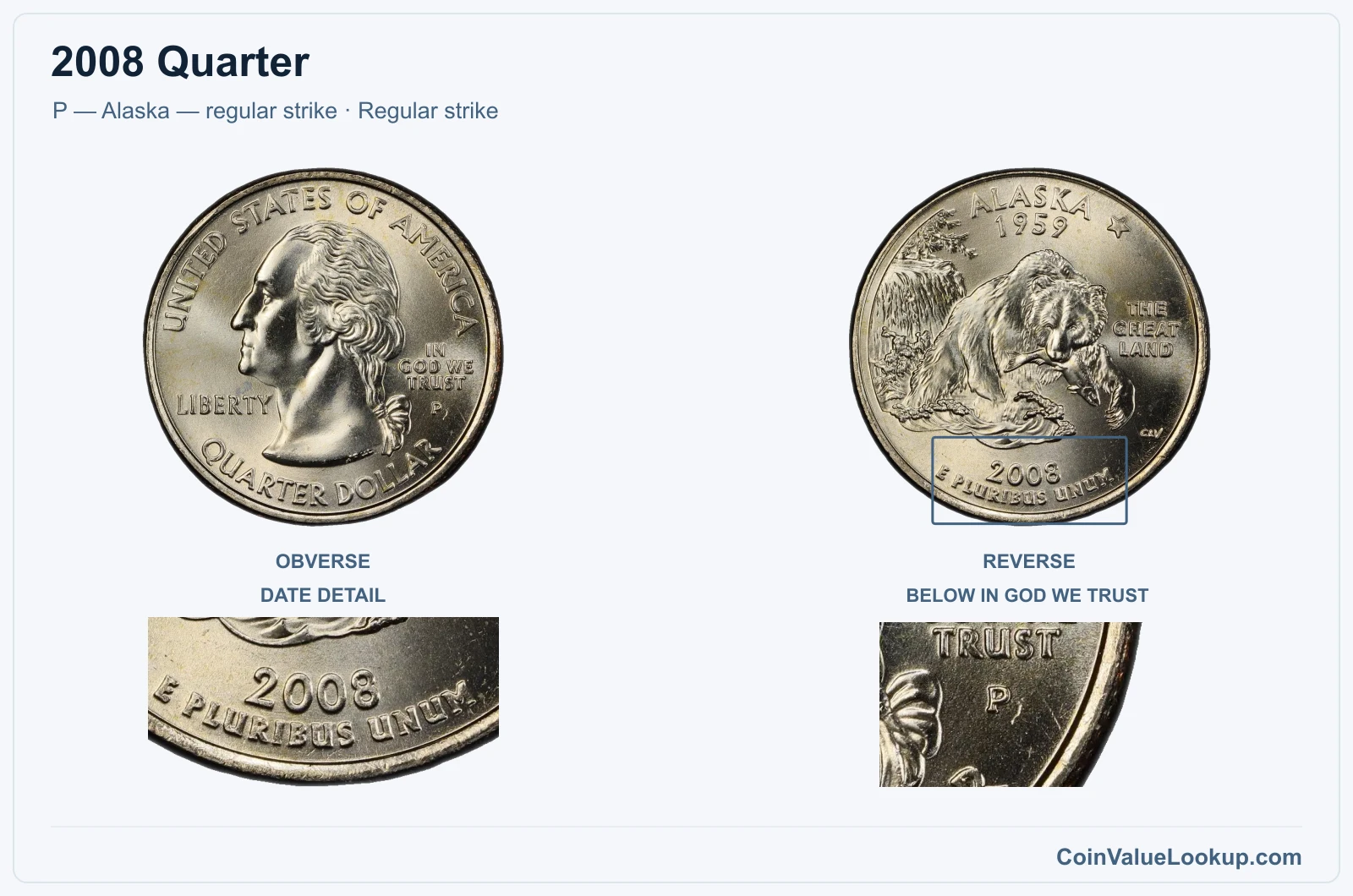
The P-mint Alaska regular strike is copper-nickel clad, 24.26 mm diameter, about 5.67 grams. Confirm the Alaska reverse design and the P mintmark on the obverse.
USA Coin Book guides it at approximately $0.49 in MS60 and $2.50 in MS65. Circulated examples are worth face value.
Clean, lustrous uncirculated coins match the guide benchmarks.
Range Grade
Price Auction Records Appraisal PO PO 1
—
Coin Identifier FR FR 2
—
Coin Identifier AG AG 3
—
Coin Identifier G G 4
—
Coin Identifier
G 6
—
Coin Identifier VG VG 8
—
Coin Identifier
VG 10
—
Coin Identifier F F 12
—
Coin Identifier
F 15
—
Coin Identifier VF VF 20
—
Coin Identifier
VF 25
—
Coin Identifier
VF 30
—
Coin Identifier
VF 35
—
Coin Identifier XF XF 40
—
Coin Identifier
XF 45
—
Coin Identifier AU AU 50
—
Coin Identifier
AU 53
—
Coin Identifier
AU 55
—
Coin Identifier
AU 58
—
Coin Identifier MS MS 60
—
Coin Identifier
MS 61
—
Coin Identifier
MS 62
—
Coin Identifier
MS 63
—
Coin Identifier
MS 64
—
Coin Identifier
MS 65
—
Coin Identifier
MS 66
—
Coin Identifier
MS 67
Coin Identifier
MS 68
—
—
—
MS 69
—
—
—
MS 70
—
—
—
2008 Quarter — P — Alaska — satin finish
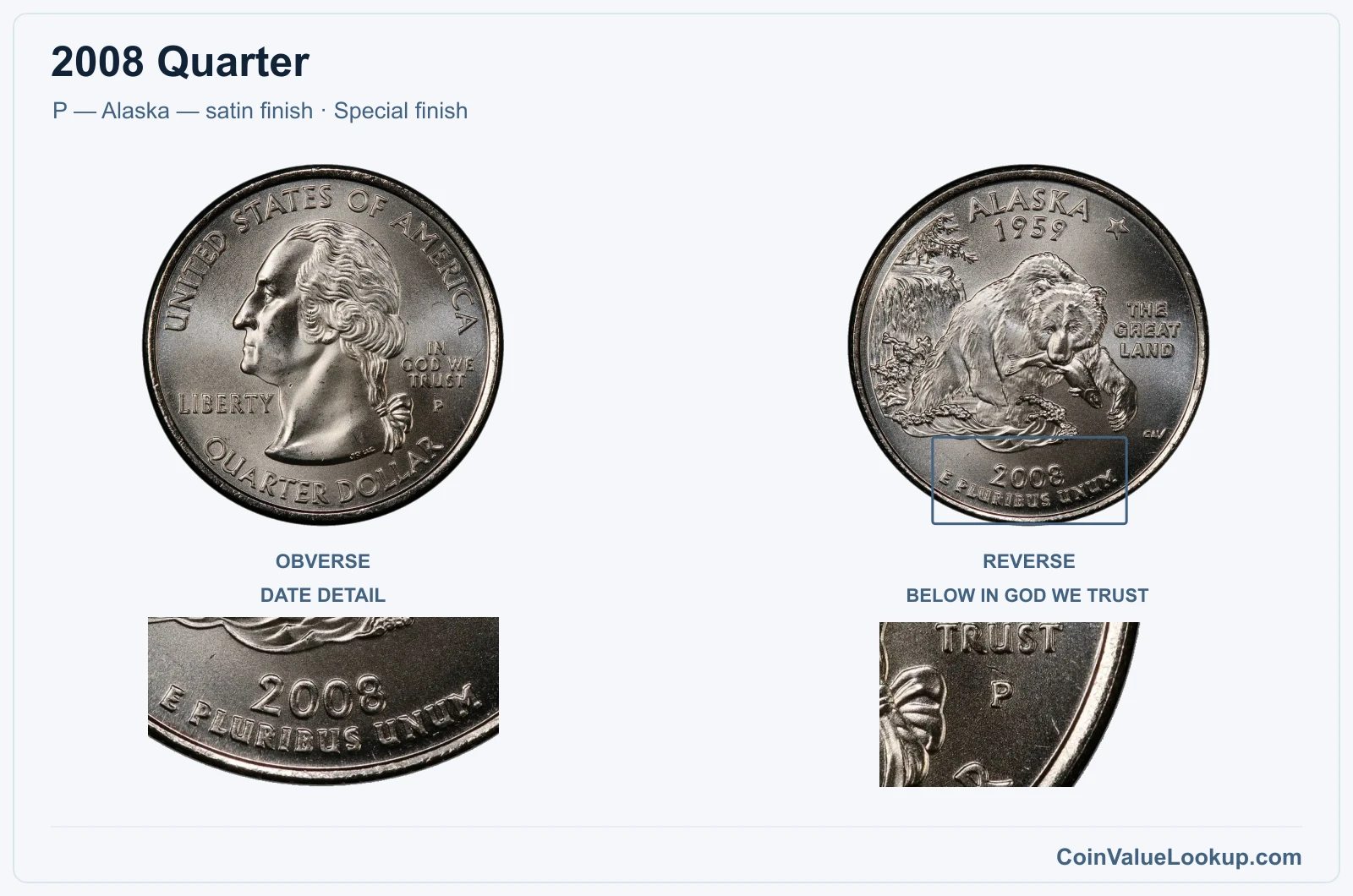
Philadelphia's satin finish Alaska quarter appeared only in 2008 Mint Sets. The fine-grain surface texture is applied during production and covers the entire coin.
A worn or cleaned surface does not replicate this effect.
No guide price is adopted for this specific version. Assessment relies on confirmed satin-finish attribution, overall condition and any recognized error.
If the coin came out of a sealed Mint Set, that is your strongest evidence.
Range Grade
Price Auction Records Appraisal SP SP 1
—
Coin Identifier
SP 2
—
Coin Identifier
SP 3
—
Coin Identifier
SP 4
—
Coin Identifier
SP 6
—
Coin Identifier
SP 8
—
Coin Identifier
SP 10
—
Coin Identifier
SP 12
—
Coin Identifier
SP 15
—
Coin Identifier
SP 20
—
Coin Identifier
SP 25
—
Coin Identifier
SP 30
—
Coin Identifier
SP 35
—
Coin Identifier
SP 40
—
Coin Identifier
SP 45
—
Coin Identifier
SP 50
—
Coin Identifier
SP 53
—
Coin Identifier
SP 55
—
Coin Identifier
SP 58
—
Coin Identifier
SP 60
—
Coin Identifier
SP 61
—
Coin Identifier
SP 62
—
Coin Identifier
SP 63
—
Coin Identifier
SP 64
—
Coin Identifier
SP 65
—
Coin Identifier
SP 66
—
Coin Identifier
SP 67
—
Coin Identifier
SP 68
—
Coin Identifier
SP 69
Coin Identifier
SP 70
—
—
—
2008 Quarter — D — Alaska — regular strike
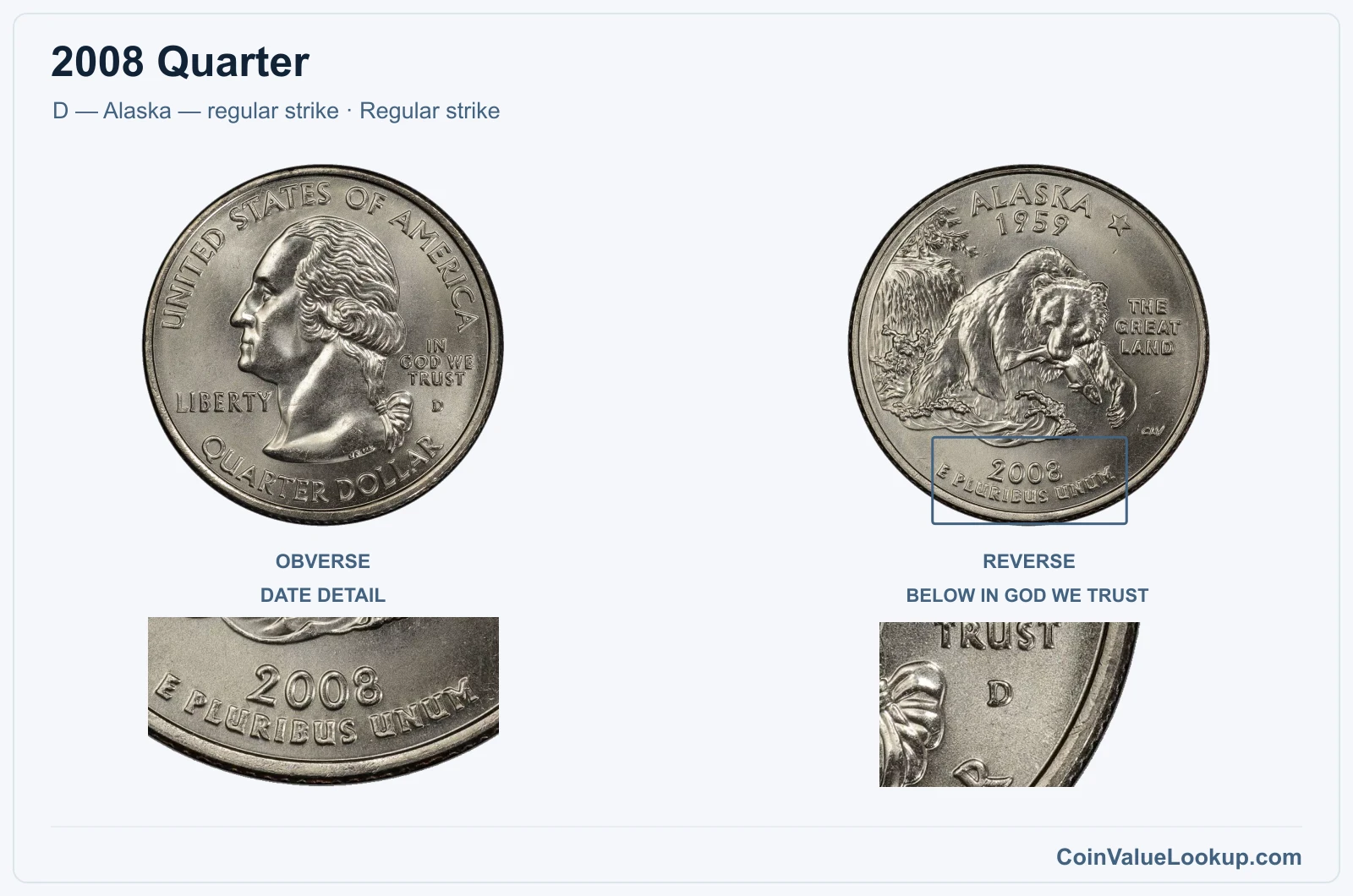
The Denver Mint business strike Alaska quarter is copper-nickel clad with the D mintmark. Specs match the P-mint version: 24.26 mm diameter, roughly 5.67 grams.
USA Coin Book guides it at $0.49 in MS60 and $2.50 in MS65. Like all circulated business strikes, worn examples equal face value.
Uncirculated coins with sharp details and original luster are the ones worth a second look.
Range Grade
Price Auction Records Appraisal PO PO 1
—
Coin Identifier FR FR 2
—
Coin Identifier AG AG 3
—
Coin Identifier G G 4
—
Coin Identifier
G 6
—
Coin Identifier VG VG 8
—
Coin Identifier
VG 10
—
Coin Identifier F F 12
—
Coin Identifier
F 15
—
Coin Identifier VF VF 20
—
Coin Identifier
VF 25
—
Coin Identifier
VF 30
—
Coin Identifier
VF 35
—
Coin Identifier XF XF 40
—
Coin Identifier
XF 45
—
Coin Identifier AU AU 50
—
Coin Identifier
AU 53
—
Coin Identifier
AU 55
—
Coin Identifier
AU 58
—
Coin Identifier MS MS 60
—
Coin Identifier
MS 61
—
Coin Identifier
MS 62
—
Coin Identifier
MS 63
—
Coin Identifier
MS 64
—
Coin Identifier
MS 65
—
Coin Identifier
MS 66
—
Coin Identifier
MS 67
Coin Identifier
MS 68
Coin Identifier
MS 69
—
—
—
MS 70
—
—
—
2008 Quarter — D — Alaska — satin finish
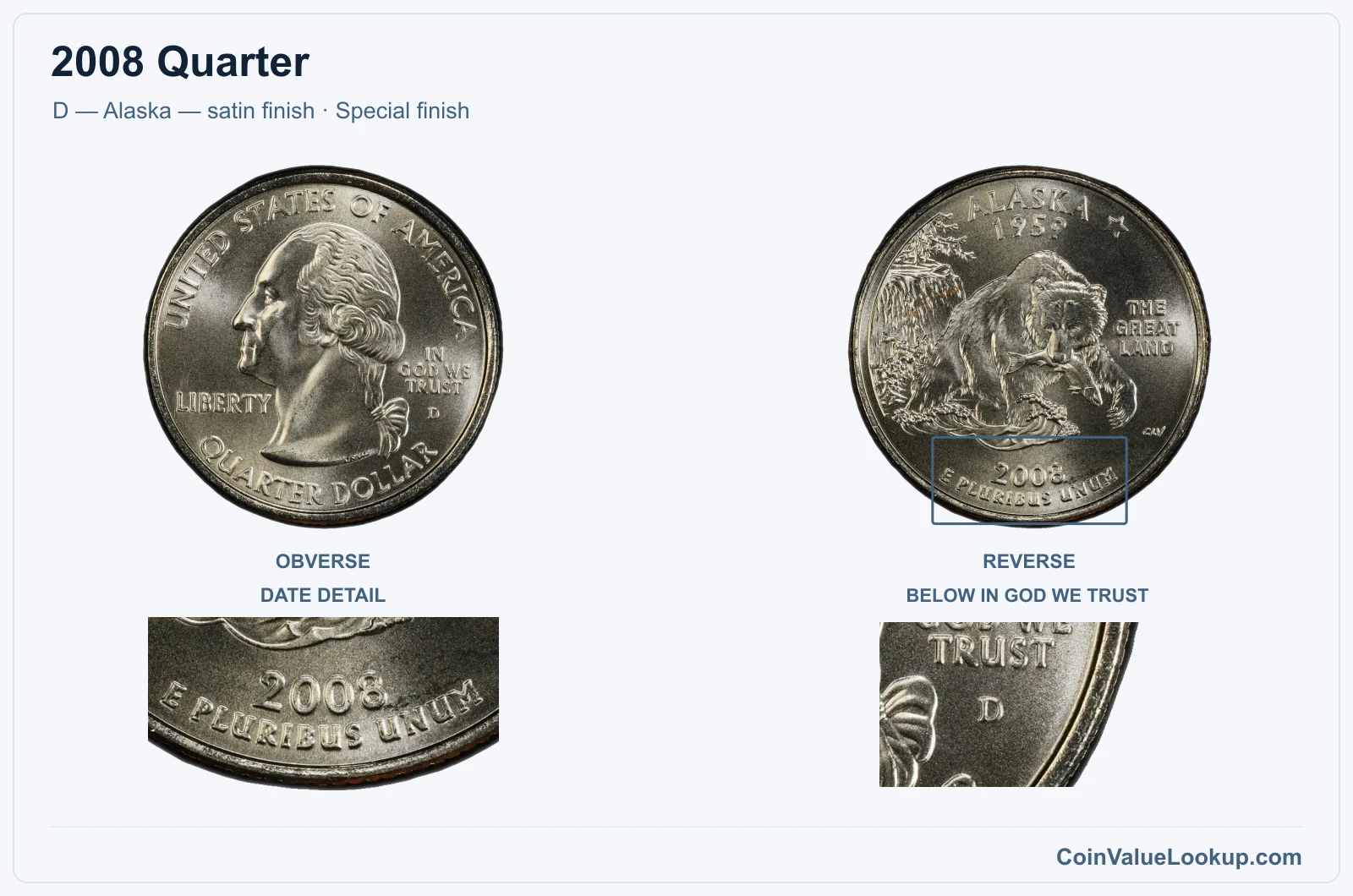
The D-mint Alaska satin finish is another Mint Set exclusive. Its intentional even texture is the calling card — neither the bright flash of a business strike nor the mirror depth of a proof.
A dulled or environmentally damaged coin is not a satin finish.
No guide estimate is adopted. Value is determined individually by confirmed identity, preservation and error status.
Range Grade
Price Auction Records Appraisal SP SP 1
—
Coin Identifier
SP 2
—
Coin Identifier
SP 3
—
Coin Identifier
SP 4
—
Coin Identifier
SP 6
—
Coin Identifier
SP 8
—
Coin Identifier
SP 10
—
Coin Identifier
SP 12
—
Coin Identifier
SP 15
—
Coin Identifier
SP 20
—
Coin Identifier
SP 25
—
Coin Identifier
SP 30
—
Coin Identifier
SP 35
—
Coin Identifier
SP 40
—
Coin Identifier
SP 45
—
Coin Identifier
SP 50
—
Coin Identifier
SP 53
—
Coin Identifier
SP 55
—
Coin Identifier
SP 58
—
Coin Identifier
SP 60
—
Coin Identifier
SP 61
—
Coin Identifier
SP 62
—
Coin Identifier
SP 63
—
Coin Identifier
SP 64
—
Coin Identifier
SP 65
—
Coin Identifier
SP 66
—
Coin Identifier
SP 67
—
Coin Identifier
SP 68
—
Coin Identifier
SP 69
Coin Identifier
SP 70
—
—
—
2008 Quarter — S — Alaska — clad proof
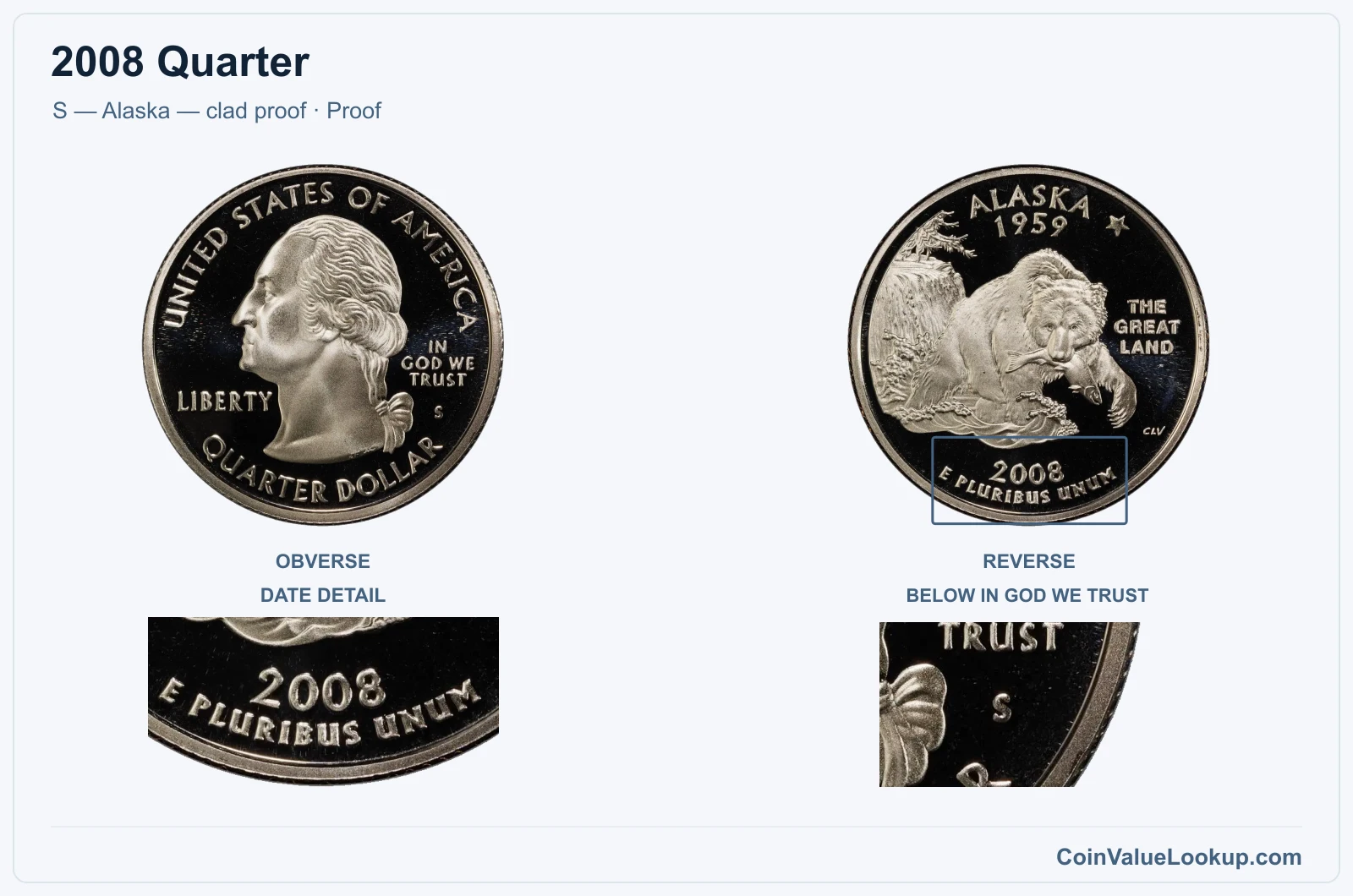
San Francisco struck a clad proof Alaska quarter with mirror fields and frosted devices. Composition is copper-nickel clad, so the edge shows a visible layer and weight runs about 5.67 grams.
USA Coin Book estimates it at $6.25 in PR65. Don't confuse it with the silver proof — check the edge or weigh it.
Hairlines and haze in the mirror fields are the main things that separate a PR65 from a lower grade.
Range Grade
Price Auction Records Appraisal PR PR 1
—
Coin Identifier
PR 2
—
Coin Identifier
PR 3
—
Coin Identifier
PR 4
—
Coin Identifier
PR 6
—
Coin Identifier
PR 8
—
Coin Identifier
PR 10
—
Coin Identifier
PR 12
—
Coin Identifier
PR 15
—
Coin Identifier
PR 20
—
Coin Identifier
PR 25
—
Coin Identifier
PR 30
—
Coin Identifier
PR 35
—
Coin Identifier
PR 40
—
Coin Identifier
PR 45
—
Coin Identifier
PR 50
—
Coin Identifier
PR 53
—
Coin Identifier
PR 55
—
Coin Identifier
PR 58
—
Coin Identifier
PR 60
—
Coin Identifier
PR 61
—
Coin Identifier
PR 62
—
Coin Identifier
PR 63
—
Coin Identifier
PR 64
—
Coin Identifier
PR 65
—
Coin Identifier
PR 66
—
Coin Identifier
PR 67
—
Coin Identifier
PR 68
—
Coin Identifier
PR 69
Coin Identifier
PR 70
Coin Identifier
2008 Quarter — S — Alaska — silver proof
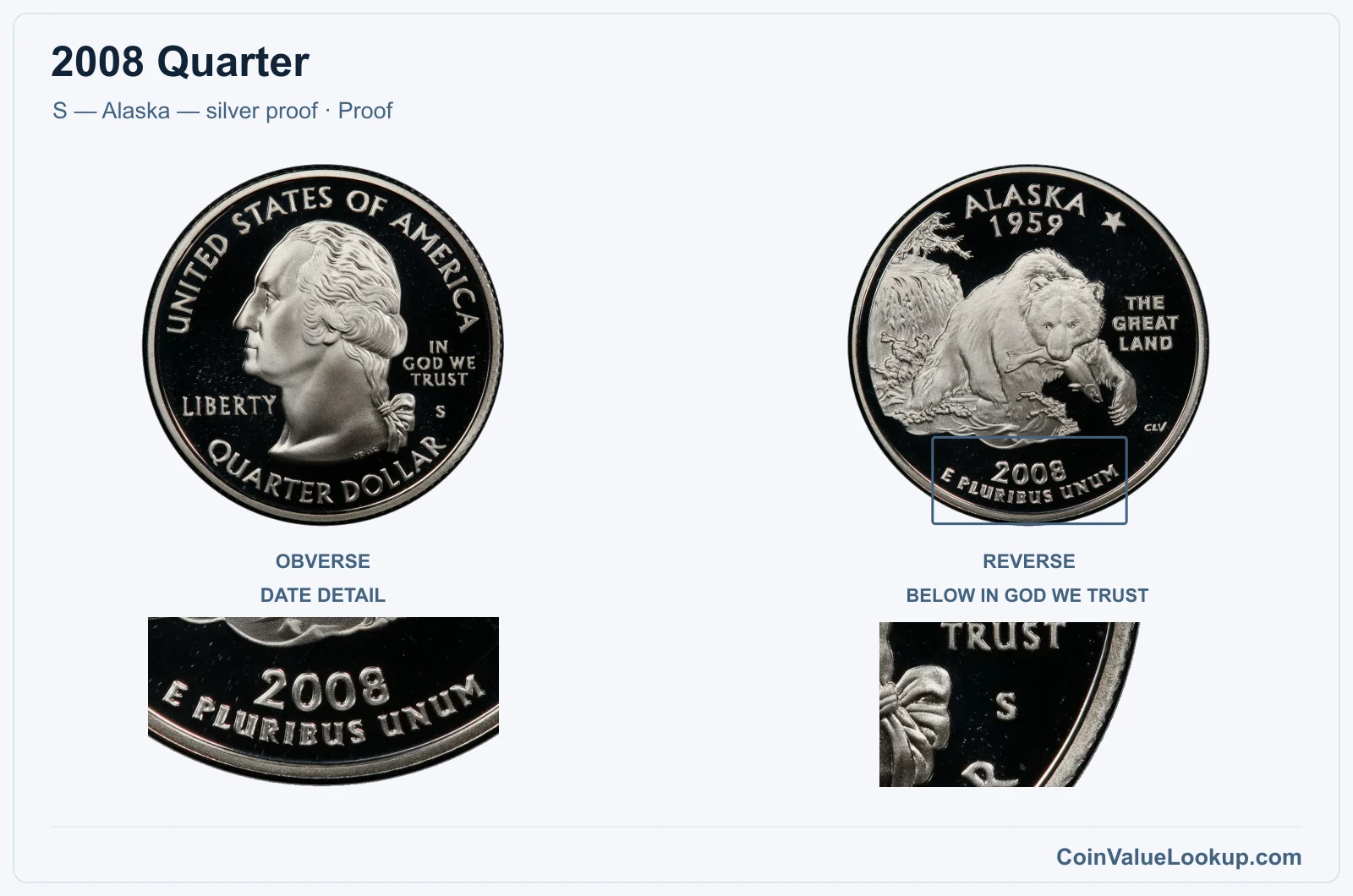
The S-mint silver proof Alaska quarter is 90% silver, approximately 6.25 grams, with a uniform silver-colored edge. USA Coin Book guides it at about $23.00 in PR65.
That sits well above the clad proof, so confirming the composition is a quick win. Original Silver Proof Set packaging removes all doubt, but a scale or edge check works fine in the field.
Range Grade
Price Auction Records Appraisal PR PR 1
—
Coin Identifier
PR 2
—
Coin Identifier
PR 3
—
Coin Identifier
PR 4
—
Coin Identifier
PR 6
—
Coin Identifier
PR 8
—
Coin Identifier
PR 10
—
Coin Identifier
PR 12
—
Coin Identifier
PR 15
—
Coin Identifier
PR 20
—
Coin Identifier
PR 25
—
Coin Identifier
PR 30
—
Coin Identifier
PR 35
—
Coin Identifier
PR 40
—
Coin Identifier
PR 45
—
Coin Identifier
PR 50
—
Coin Identifier
PR 53
—
Coin Identifier
PR 55
—
Coin Identifier
PR 58
—
Coin Identifier
PR 60
—
Coin Identifier
PR 61
—
Coin Identifier
PR 62
—
Coin Identifier
PR 63
—
Coin Identifier
PR 64
—
Coin Identifier
PR 65
—
Coin Identifier
PR 66
—
Coin Identifier
PR 67
—
Coin Identifier
PR 68
—
Coin Identifier
PR 69
Coin Identifier
PR 70
Coin Identifier
2008 Quarter — P — Hawaii — regular strike
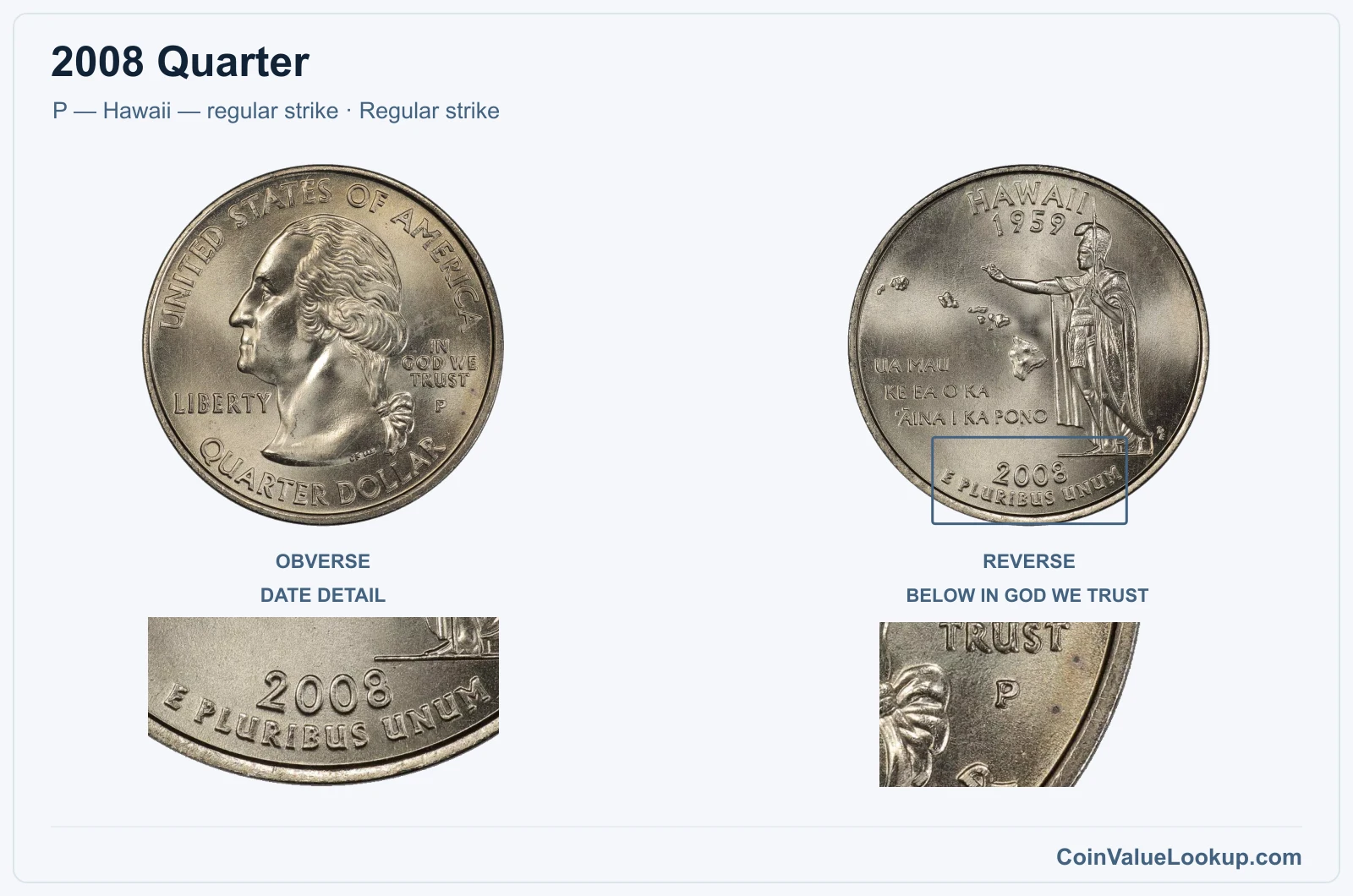
The Philadelphia regular strike Hawaii quarter is copper-nickel clad at 24.26 mm and about 5.67 grams. Look for the P mintmark on the obverse and the Hawaii reverse design.
USA Coin Book guides it at approximately $0.49 in MS60 and $2.50 in MS65. A pocket-change example is still a quarter.
Uncirculated coins with full cartwheel luster are worth pulling aside.
Range Grade
Price Auction Records Appraisal PO PO 1
—
Coin Identifier FR FR 2
—
Coin Identifier AG AG 3
—
Coin Identifier G G 4
—
Coin Identifier
G 6
—
Coin Identifier VG VG 8
—
Coin Identifier
VG 10
—
Coin Identifier F F 12
—
Coin Identifier
F 15
—
Coin Identifier VF VF 20
—
Coin Identifier
VF 25
—
Coin Identifier
VF 30
—
Coin Identifier
VF 35
—
Coin Identifier XF XF 40
—
Coin Identifier
XF 45
—
Coin Identifier AU AU 50
—
Coin Identifier
AU 53
—
Coin Identifier
AU 55
—
Coin Identifier
AU 58
—
Coin Identifier MS MS 60
—
Coin Identifier
MS 61
—
Coin Identifier
MS 62
—
Coin Identifier
MS 63
—
Coin Identifier
MS 64
—
Coin Identifier
MS 65
—
Coin Identifier
MS 66
—
Coin Identifier
MS 67
Coin Identifier
MS 68
—
—
—
MS 69
—
—
—
MS 70
—
—
—
2008 Quarter — P — Hawaii — satin finish
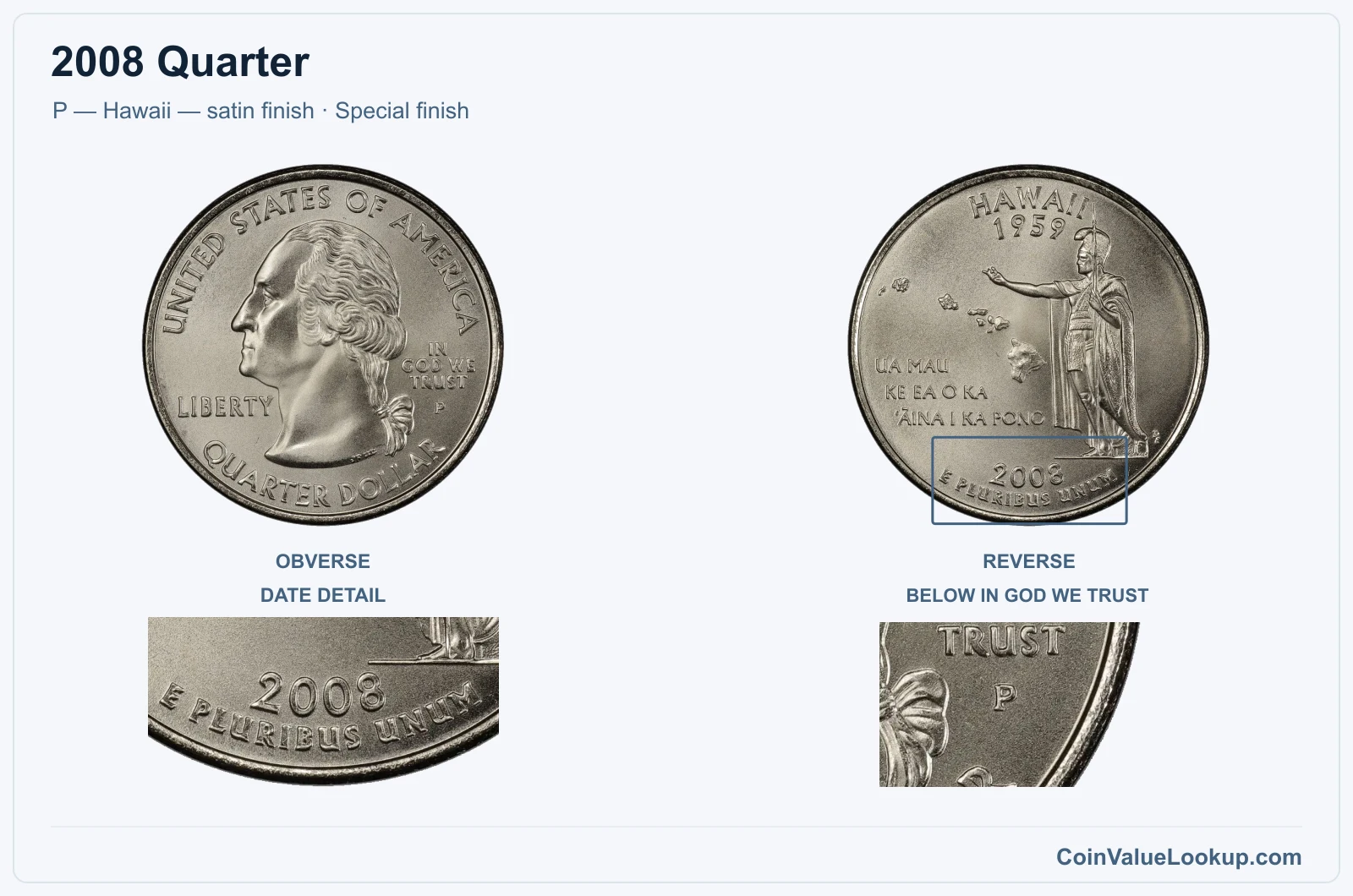
The P-mint Hawaii satin finish came exclusively in 2008 Mint Sets. The surface shows a uniform fine-grain texture applied during production.
A coin that is merely dull or cleaned does not qualify.
No guide price is adopted for this version. Value depends on authenticated identity, condition and any recognized error present.
Provenance from an original Mint Set is the clearest evidence of satin finish.
Range Grade
Price Auction Records Appraisal SP SP 1
—
Coin Identifier
SP 2
—
Coin Identifier
SP 3
—
Coin Identifier
SP 4
—
Coin Identifier
SP 6
—
Coin Identifier
SP 8
—
Coin Identifier
SP 10
—
Coin Identifier
SP 12
—
Coin Identifier
SP 15
—
Coin Identifier
SP 20
—
Coin Identifier
SP 25
—
Coin Identifier
SP 30
—
Coin Identifier
SP 35
—
Coin Identifier
SP 40
—
Coin Identifier
SP 45
—
Coin Identifier
SP 50
—
Coin Identifier
SP 53
—
Coin Identifier
SP 55
—
Coin Identifier
SP 58
—
Coin Identifier
SP 60
—
Coin Identifier
SP 61
—
Coin Identifier
SP 62
—
Coin Identifier
SP 63
—
Coin Identifier
SP 64
—
Coin Identifier
SP 65
—
Coin Identifier
SP 66
—
Coin Identifier
SP 67
—
Coin Identifier
SP 68
—
Coin Identifier
SP 69
Coin Identifier
SP 70
—
—
—
2008 Quarter — D — Hawaii — regular strike
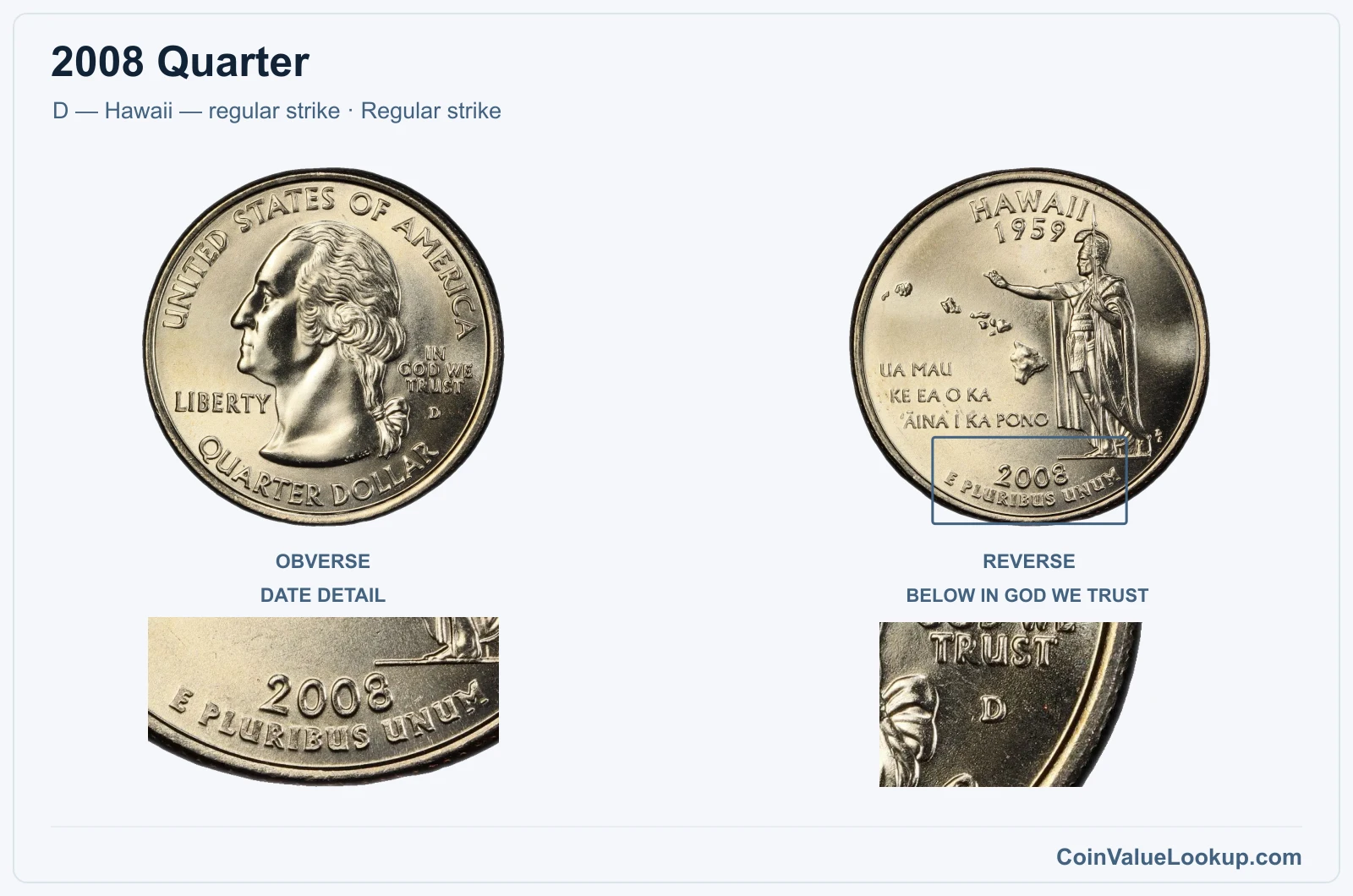
Denver's regular strike Hawaii quarter carries the D mintmark and standard copper-nickel clad construction. USA Coin Book places it near $0.49 at MS60 and $2.50 at MS65.
Worn coins trade at face value. An uncirculated example with original luster and clean fields is the target for collectors working through the state quarter series.
Range Grade
Price Auction Records Appraisal PO PO 1
—
Coin Identifier FR FR 2
—
Coin Identifier AG AG 3
—
Coin Identifier G G 4
—
Coin Identifier
G 6
—
Coin Identifier VG VG 8
—
Coin Identifier
VG 10
—
Coin Identifier F F 12
—
Coin Identifier
F 15
—
Coin Identifier VF VF 20
—
Coin Identifier
VF 25
—
Coin Identifier
VF 30
—
Coin Identifier
VF 35
—
Coin Identifier XF XF 40
—
Coin Identifier
XF 45
—
Coin Identifier AU AU 50
—
Coin Identifier
AU 53
—
Coin Identifier
AU 55
—
Coin Identifier
AU 58
—
Coin Identifier MS MS 60
—
Coin Identifier
MS 61
—
Coin Identifier
MS 62
—
Coin Identifier
MS 63
—
Coin Identifier
MS 64
—
Coin Identifier
MS 65
—
Coin Identifier
MS 66
—
Coin Identifier
MS 67
Coin Identifier
MS 68
—
—
—
MS 69
—
—
—
MS 70
—
—
—
2008 Quarter — D — Hawaii — satin finish
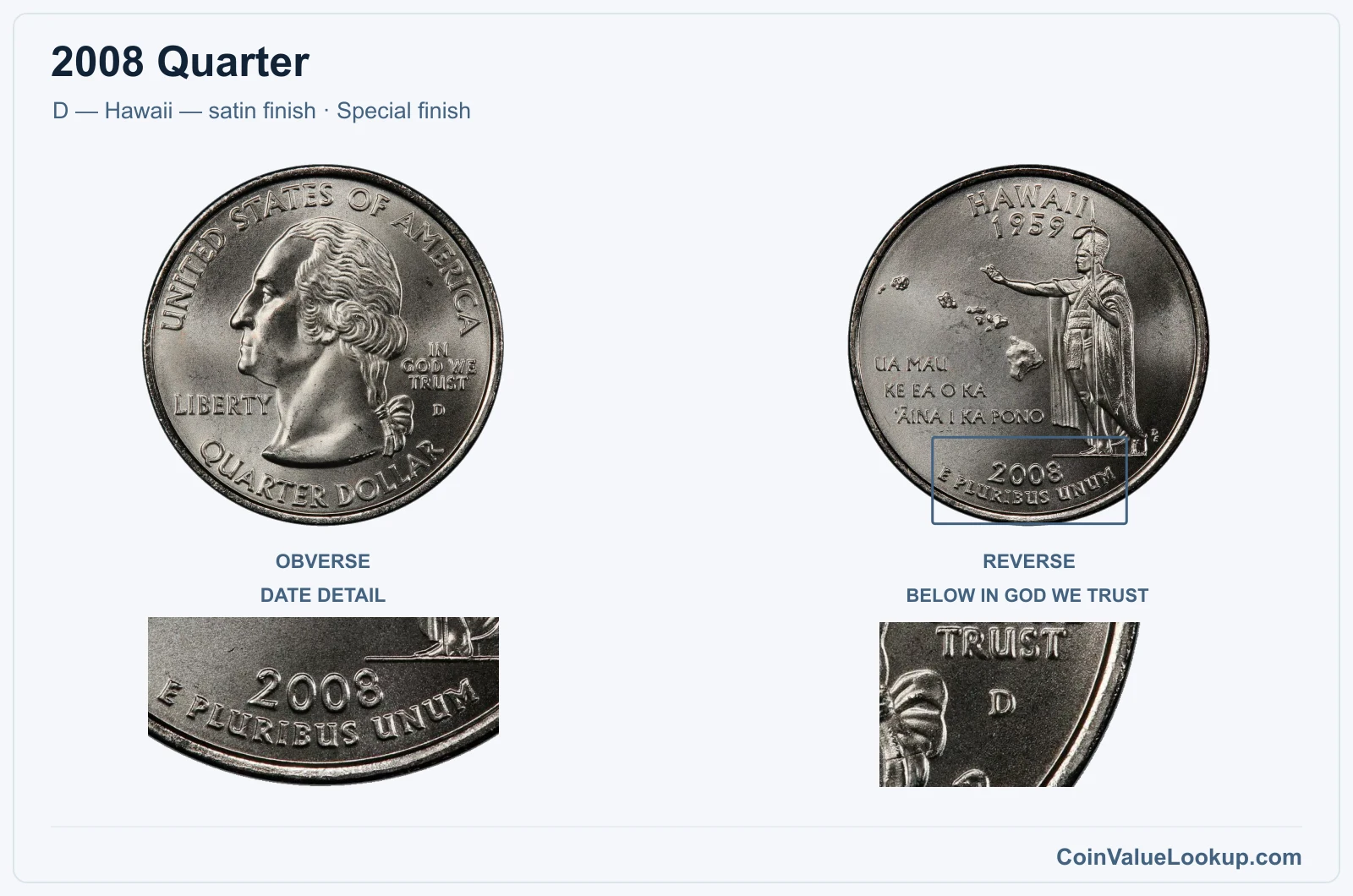
The D-mint satin finish Hawaii quarter was distributed only in the 2008 Mint Set. Its uniform fine-grain texture must be distinguished from wear or artificial dulling.
The surface is intentional and consistent across the entire coin.
No guide range is adopted. Individual assessment by confirmed finish, preservation and error status applies.
Range Grade
Price Auction Records Appraisal SP SP 1
—
Coin Identifier
SP 2
—
Coin Identifier
SP 3
—
Coin Identifier
SP 4
—
Coin Identifier
SP 6
—
Coin Identifier
SP 8
—
Coin Identifier
SP 10
—
Coin Identifier
SP 12
—
Coin Identifier
SP 15
—
Coin Identifier
SP 20
—
Coin Identifier
SP 25
—
Coin Identifier
SP 30
—
Coin Identifier
SP 35
—
Coin Identifier
SP 40
—
Coin Identifier
SP 45
—
Coin Identifier
SP 50
—
Coin Identifier
SP 53
—
Coin Identifier
SP 55
—
Coin Identifier
SP 58
—
Coin Identifier
SP 60
—
Coin Identifier
SP 61
—
Coin Identifier
SP 62
—
Coin Identifier
SP 63
—
Coin Identifier
SP 64
—
Coin Identifier
SP 65
—
Coin Identifier
SP 66
—
Coin Identifier
SP 67
—
Coin Identifier
SP 68
Coin Identifier
SP 69
Coin Identifier
SP 70
—
—
—
2008 Quarter — S — Hawaii — clad proof
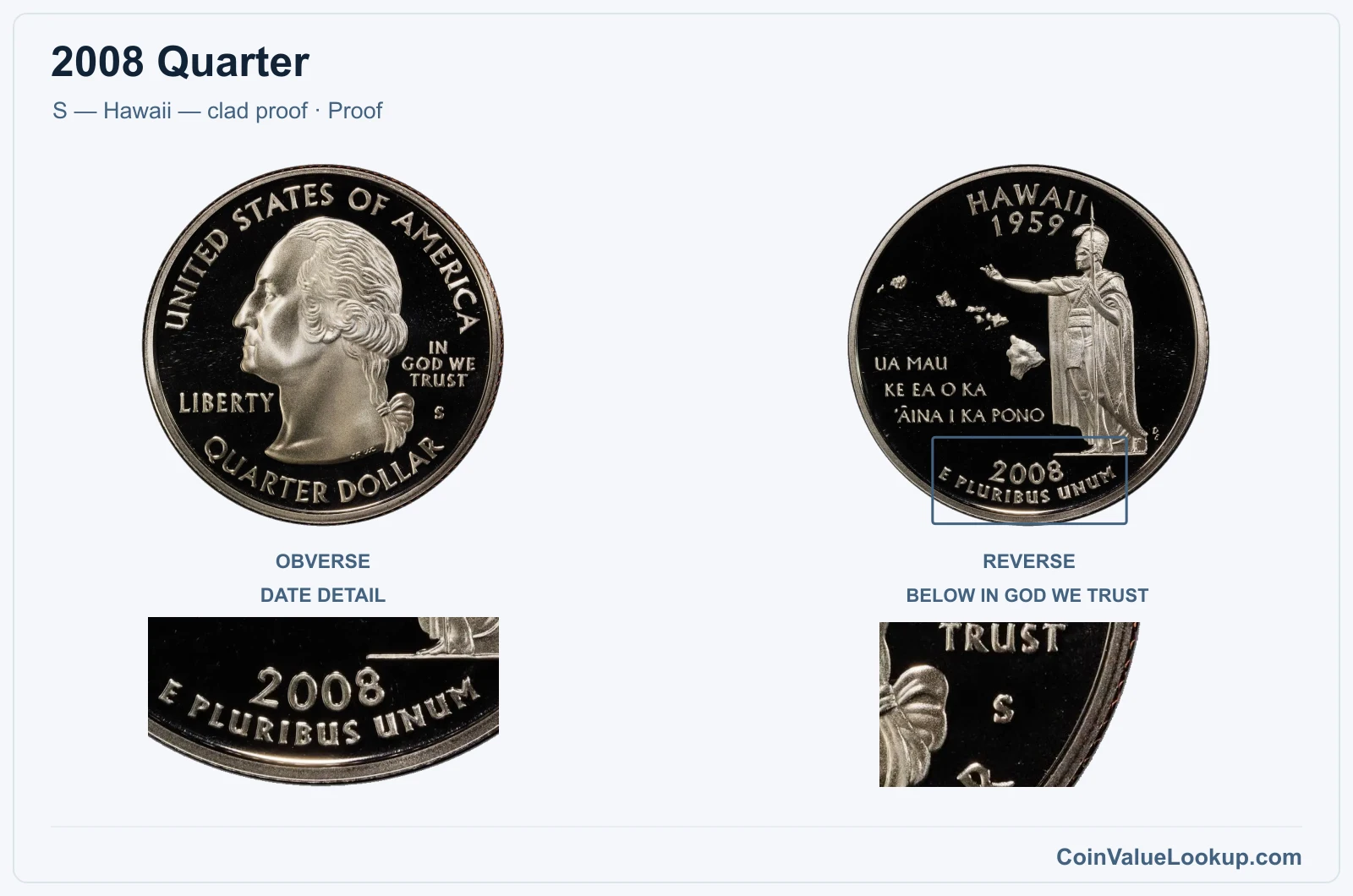
San Francisco's clad proof Hawaii quarter has the expected mirror fields and frosted devices. It is copper-nickel clad — the edge stripe and a weight near 5.67 grams confirm it.
USA Coin Book guides it at about $12.00 in PR65, which is noticeably higher than the clad proofs for the other four 2008 state designs. Condition still matters: hairlines and fingerprints in those mirror fields will pull the grade down.
Range Grade
Price Auction Records Appraisal PR PR 1
—
Coin Identifier
PR 2
—
Coin Identifier
PR 3
—
Coin Identifier
PR 4
—
Coin Identifier
PR 6
—
Coin Identifier
PR 8
—
Coin Identifier
PR 10
—
Coin Identifier
PR 12
—
Coin Identifier
PR 15
—
Coin Identifier
PR 20
—
Coin Identifier
PR 25
—
Coin Identifier
PR 30
—
Coin Identifier
PR 35
—
Coin Identifier
PR 40
—
Coin Identifier
PR 45
—
Coin Identifier
PR 50
—
Coin Identifier
PR 53
—
Coin Identifier
PR 55
—
Coin Identifier
PR 58
—
Coin Identifier
PR 60
—
Coin Identifier
PR 61
—
Coin Identifier
PR 62
—
Coin Identifier
PR 63
—
Coin Identifier
PR 64
—
Coin Identifier
PR 65
—
Coin Identifier
PR 66
—
Coin Identifier
PR 67
—
Coin Identifier
PR 68
—
Coin Identifier
PR 69
Coin Identifier
PR 70
Coin Identifier
2008 Quarter — S — Hawaii — silver proof
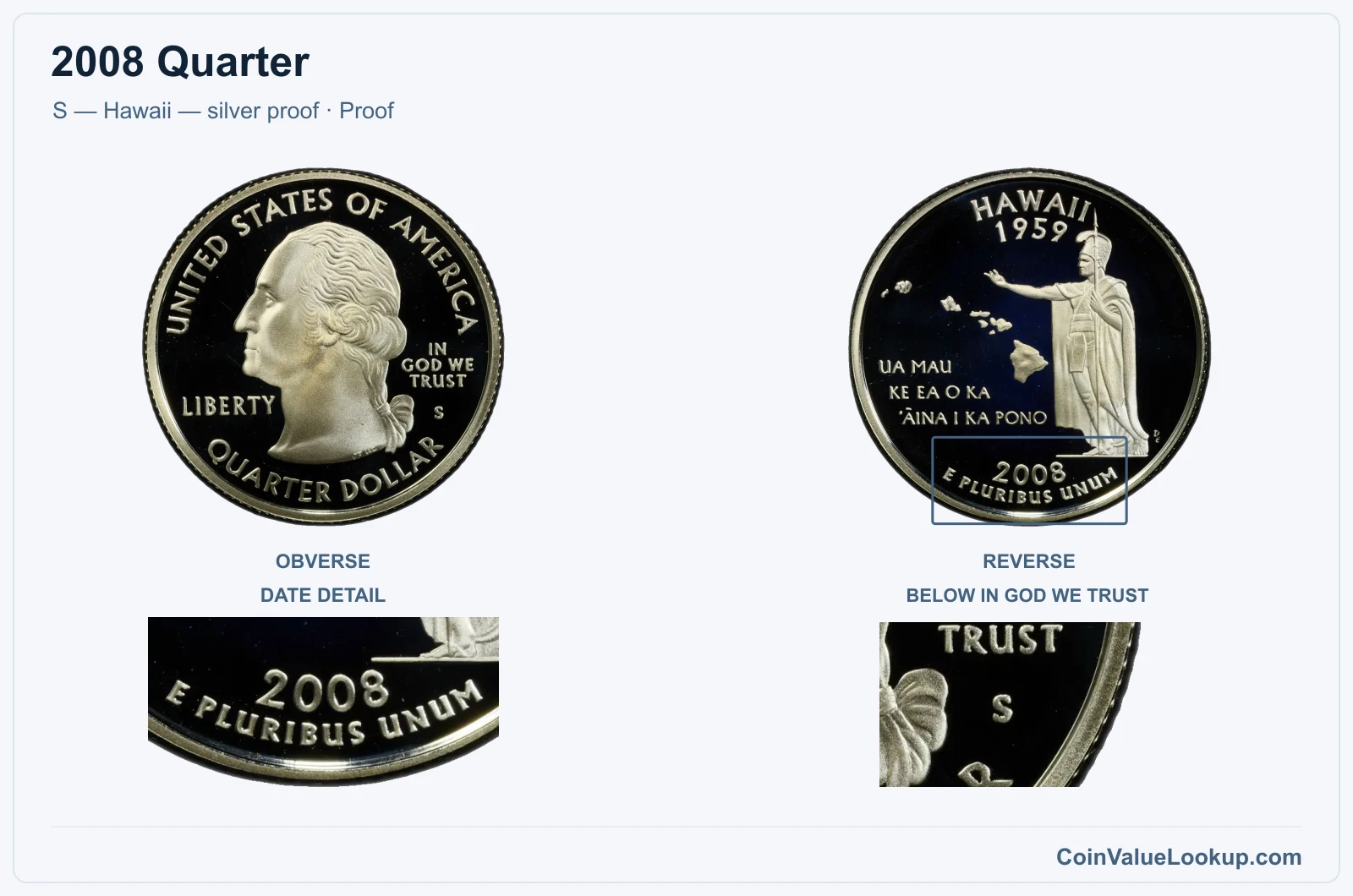
The S-mint silver proof Hawaii quarter is 90% silver, weighing roughly 6.25 grams, with no copper stripe on the edge. USA Coin Book estimates it at $24.00 in PR65, the highest guide anchor among all 2008 quarter versions listed here.
Confirm the composition before comparing to this price — the clad proof looks similar from the front but is worth half as much. Original Silver Proof Set packaging or a precise weight reading is your fastest path to confirmation.
Range Grade
Price Auction Records Appraisal PR PR 1
—
Coin Identifier
PR 2
—
Coin Identifier
PR 3
—
Coin Identifier
PR 4
—
Coin Identifier
PR 6
—
Coin Identifier
PR 8
—
Coin Identifier
PR 10
—
Coin Identifier
PR 12
—
Coin Identifier
PR 15
—
Coin Identifier
PR 20
—
Coin Identifier
PR 25
—
Coin Identifier
PR 30
—
Coin Identifier
PR 35
—
Coin Identifier
PR 40
—
Coin Identifier
PR 45
—
Coin Identifier
PR 50
—
Coin Identifier
PR 53
—
Coin Identifier
PR 55
—
Coin Identifier
PR 58
—
Coin Identifier
PR 60
—
Coin Identifier
PR 61
—
Coin Identifier
PR 62
—
Coin Identifier
PR 63
—
Coin Identifier
PR 64
—
Coin Identifier
PR 65
—
Coin Identifier
PR 66
—
Coin Identifier
PR 67
—
Coin Identifier
PR 68
—
Coin Identifier
PR 69
Coin Identifier
PR 70
Coin Identifier
2008 Quarter Error List
1. 2008 Quarter — Alaska — Die Crack / Die Chip
Die cracks and die chips have been reported on the 2008 Alaska quarter, including a variety sometimes called the "Extra Claw" die chip. On the coin, these appear as small raised lines or tiny raised blobs of metal — the result of a damaged die transferring its flaw to the struck coin.
To check, look carefully at the Alaska reverse design under magnification. A die chip will be a raised lump, not a scratch or groove.
Die cracks tend to run as thin raised lines. Compare your coin to a normal example to spot any extra raised material.
Do not confuse these with incuse scratches, surface corrosion or foreign material stuck to the coin after minting. Condition, visibility and the specific nature of the flaw all affect value, so individual assessment applies.
2. 2008 Quarter — Arizona — Off-Center Strike
Off-center strikes have been reported on 2008 Arizona quarters. This happens when the blank is not seated properly between the dies, so the design gets stamped off to one side and an unstruck crescent of blank metal remains.
To identify one, look for a visible shift of the entire design in one direction, with a corresponding blank area on the opposite edge. The more dramatic the shift — while still showing the date — the more collector interest it typically generates.
Do not confuse this with a clipped planchet (which removes a curved chunk from the blank before striking), a one-sided die misalignment or damage inflicted after the coin left the Mint. Condition, degree of misalignment and date visibility all affect value; each coin needs individual evaluation.
3. 2008 Quarter — Doubled Die Obverse
Doubled die obverse errors have been reported on 2008 Washington quarters. A doubled die shows consistent doubling of design elements — letters, the date or portrait details — created during the die-making process rather than during the strike itself.
To look for one, compare the obverse lettering and design contours on your coin with a normal 2008 quarter under the same lighting. Genuine doubling from a doubled die shows uniform separation or notching on affected elements, and it appears the same way on every coin struck from that die.
Machine doubling is the common lookalike. It produces a flat shelf of displaced metal rather than distinct separated images, and it does not carry the same collector premium.
Reflections and worn die contours can also mimic doubling at first glance. Value depends on the specific die, the strength of the doubling and the coin's condition.
4. 2008 Quarter — Clipped Planchet
Clipped planchet errors have been reported on 2008 quarters. This occurs when the blank is punched from strip metal that overlaps a previously punched hole, leaving a missing curved, straight or irregularly shaped portion of the coin.
Look for a section of the rim and adjacent design that is simply absent, with the remaining edge showing metal-flow characteristics rather than a sharp cut. On a genuine clip, the area directly opposite the missing portion often shows weakness in the design — the so-called Blakesley effect — because the planchet was thinner there during striking.
A filed notch, deliberate edge cut or corrosion pit is not a clip. Post-mint damage tends to leave sharp or rough tool marks rather than the smooth flow of a genuine pre-strike defect.
Condition, clip size and visibility of the affected design all factor into value.
5. 2008 Quarter — Oklahoma — Missing Clad Layer
A missing clad layer has been reported on the 2008-D Oklahoma quarter. On a normal clad coin, copper-nickel layers cover both faces.
When one layer is absent before striking, the exposed face can show a different color or surface texture where the underlying metal is visible.
To check, examine the edge of the coin closely. A normal clad quarter shows distinct layers; a coin missing one clad layer may show an uneven edge profile or unusual weight.
Compare the affected face's color with a known normal coin.
Toning, corrosion, plating or deliberate surface removal after minting can all mimic a missing clad layer. The distinction matters: a genuine missing layer is a Mint error, while post-mint damage is not.
Condition, the extent of the missing layer and overall eye appeal determine value on an individual basis.
6. 2008 Quarter — Oklahoma — Improper Annealing
Improper annealing has been reported on the 2008-D Oklahoma quarter. Annealing is a heat-treatment step during blank preparation; when it goes wrong, the resulting coin can show unusual surface discoloration, woodgrain-like streaking or an atypical texture compared to a normally processed coin.
To screen for this, compare your coin's surface and color to a known normal 2008-D Oklahoma quarter under the same lighting. An improperly annealed coin's discoloration typically appears as part of the metal itself rather than sitting on top.
Environmental toning, corrosion and heat exposure after minting can all produce similar-looking discoloration. Surface appearance alone is a screening clue, not definitive proof.
Value depends on condition, the visibility of the annealing defect and whether the attribution can be confirmed through professional evaluation.
7. 2008 Quarter — Doubled Die Reverse
Doubled die reverse errors have been reported on 2008 Washington quarters. Like the obverse version, a doubled die reverse shows consistent, repeatable doubling on the reverse design elements — letters, state imagery or other raised features — that originated during the die-manufacturing process.
Compare your coin's reverse legends and design contours to a normal 2008 quarter under magnification and consistent lighting. Genuine doubled-die doubling appears as distinct separation or notching on the same elements across every coin struck by that die.
Machine doubling is the most common lookalike. It creates flat, shelf-like displaced metal rather than two clearly separated images.
Random damage and reflections can also fool the eye. Value depends on the specific die, the clarity of doubling and overall condition.
8. 2008 Quarter — Rotated Dies
Rotated die errors have been reported on 2008 quarters. Normally, when you flip a U.S. coin top to bottom, the reverse appears right-side up.
If the reverse is rotated — tilted to any degree from normal — you may have a rotated die error.
To test, hold the obverse upright and rotate the coin on its vertical axis, like turning a page. If the reverse is not properly oriented, measure the approximate degree of rotation.
Small rotations are relatively common and carry modest premiums, while large rotations closer to 180 degrees are much scarcer.
Make sure you are not simply holding the coin sideways or looking at a rotated photograph. The coin itself must show the misalignment.
Value depends on the degree of rotation and the coin's condition.
9. 2008 Quarter — Struck-Through Error
Struck-through errors have been reported on 2008 quarters. This happens when foreign material — grease, fabric, wire, a metal fragment or other debris — gets trapped between the die and the planchet during striking.
The result is a localized depression, an impression of the object or an incomplete design in the affected area.
Look for a smooth depression or a clearly defined shape pressed into the coin's surface. A grease-filled die produces a softer, more diffuse area of missing detail, while a retained foreign object can leave a sharp impression.
Ordinary wear, scratches, cleaning marks and weak strike areas can all look vaguely similar. The key distinction is that a struck-through defect is created at the moment of striking and usually has clean, undisturbed metal around it.
Value depends on the size, clarity and nature of the obstruction, plus the coin's overall condition.
10. 2008 Quarter — Oklahoma — Off-Center Strike
Off-center strikes have been reported on the 2008-D Oklahoma quarter. When the planchet is not properly centered between the dies, the design shifts to one side and an unstruck crescent of blank metal remains on the opposite edge.
Check for a visible displacement of the entire design in one direction. The unstruck area will be flat, featureless metal — no rim, no design.
Coins that retain the full date despite the shift tend to attract more collector attention.
A clipped planchet removes a piece of the blank before striking, which is a different error. One-sided die misalignment shifts only part of the design relative to the rim.
Post-mint flattening can also create a misleading appearance. Condition, severity and date visibility all factor into value assessment.
11. 2008 Quarter — Alaska — Die Break / Cud
Die breaks and cuds have been reported on the 2008 Alaska quarter, including a variety described as the "Sixth Claw" die break. A cud forms when a piece of the die breaks away at the rim, leaving a raised, featureless blob of metal on the coin that connects to the rim.
An interior die break is similar but occurs away from the rim.
Look for a raised, flat or irregularly shaped area that disrupts the normal design. A true cud will have a smooth, featureless surface where the broken die piece could no longer impart design detail.
Rim dents, corrosion and interior die chips can mimic a cud at first glance. Rim dents are pushed inward; a cud is raised outward.
Value depends on size, location and the coin's overall condition.
12. 2008 Quarter — Arizona — Die Break / Cud
A die break described as the "Extra Cactus" has been reported on 2008 Arizona quarters. This raised feature appears where a section of the die cracked or broke, transferring extra raised metal onto the struck coin in or near the cactus area of the reverse design.
To identify it, look for a raised lump or line that does not belong to the normal Arizona design. A cud specifically connects to the rim; a die break interior to the design may appear as a raised blob or ridge.
Compare your coin's reverse to a normal example.
Rim dents push metal inward and are post-mint. Corrosion creates pitting, not raised features.
Interior die chips are smaller and more contained. Value depends on the size of the break, its visual impact and the coin's condition.
13. 2008 Quarter — Alaska — Die Gouge / Named Raised-Line Variety
A die gouge or raised-line variety has been reported on the 2008 Alaska quarter. One reported variety is sometimes called the "Spitting Eagle," where a raised line of extra metal appears in a specific position on the reverse design, giving the appearance of something projecting from the eagle's beak area.
To check, examine the reverse under magnification and compare to a normal 2008 Alaska quarter. The raised line should be consistent and in the same location on other affected coins — that distinguishes a die-produced feature from random damage.
An incuse scratch cuts into the surface and is the opposite of a raised line. Unrelated die cracks may run in different directions or locations.
Post-mint damage can create confusing marks but usually lacks the uniform, repeatable character of a die-produced feature. Value depends on sharpness, condition and collector demand.
14. 2008 Quarter — Alaska — Misaligned Die
Misaligned die errors have been reported on the 2008 Alaska quarter. A misaligned die shifts one face of the coin relative to the planchet without rotating it.
The result is an uneven rim — wider on one side, narrower on the opposite — while the other face remains centered.
To check, look at both sides of the coin and compare the rim width around the full circumference. If one face is shifted while the other is normal, you likely have a misaligned die.
This is different from an off-center strike, where the entire planchet misses the die pair, and from a rotated die, where the alignment angle is wrong.
Tilted photographs, post-mint rim damage and off-center strikes can all look similar at first glance. Confirm by physically handling the coin rather than relying on a single photo angle.
Value depends on the degree of misalignment and overall condition.
15. 2008 Quarter — Alaska — Defective Planchet
Defective planchet errors have been reported on the 2008 Alaska quarter. This category covers flaws in the blank itself — voids, laminations, cracks, irregular shapes or other metal defects that existed before the coin was struck.
To identify one, look for areas where the metal appears split, layered, pitted or missing in a way that the struck design flows around or over. Both faces and the edge should be examined.
A genuine planchet defect is part of the coin's metal structure, not something applied or removed after production.
Post-mint gouges, corrosion pits and deliberate metal removal can all create marks that resemble planchet flaws. The distinction is that a pre-strike defect will typically show struck design detail conforming to the flaw's edges.
Value depends on the type and severity of the defect and the coin's overall condition.