2008 Jefferson Nickel Coin Value: How Much Is It Worth?
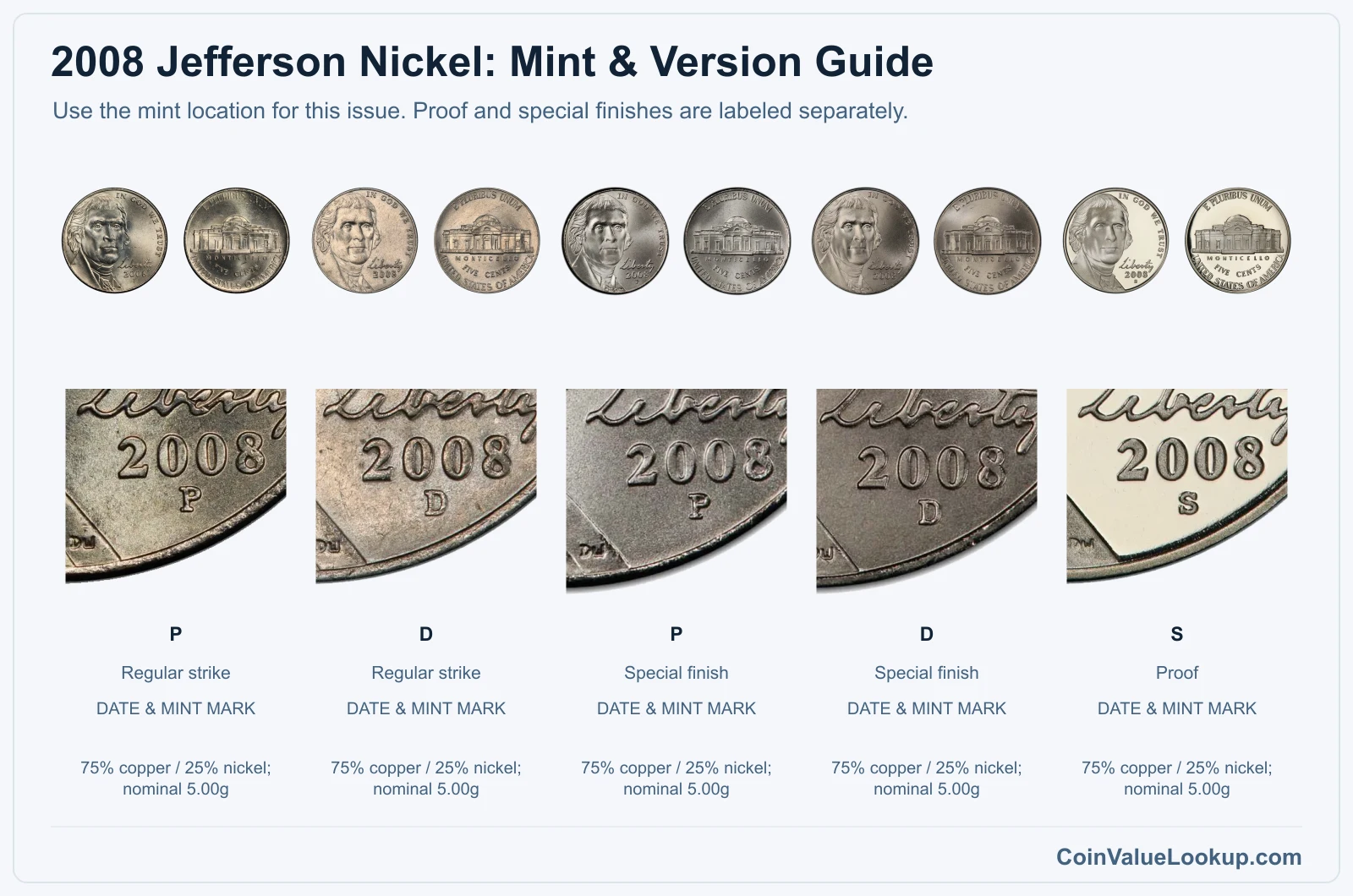
Most 2008 Jefferson nickels are worth close to face value if pulled from pocket change. According to USA Coin Book guide estimates, standard Philadelphia and Denver business strikes range from about $0.30 in MS60 to $0.61 in MS65 — uncirculated grades where the coin still has original luster.
Proofs, satin-finish Mint Set coins, and genuine mint errors each follow their own pricing, so separating what you have is the first step.
Fast Way to Identify Your 2008 Jefferson Nickel
The quickest way to start figuring out what your 2008 nickel is worth is to upload clear photos of the front and back. Our identifier can give you a preliminary read on the mint, finish, and design branch so you know which value range to look at.
Good lighting and a sharp focus on the mintmark area help the most.
2008 Jefferson Nickel Value
Upload both sides of your 2008 Jefferson Nickel.
Front Obverse
Upload photo
Back Reverse
Upload photo
Which 2008 Jefferson Nickel Versions Are Worth Money?
- The 2008-S proof nickel carries a USA Coin Book guide value of about $5.30 in PR65, well above face value and the most accessible collector issue this year.
- Satin-finish P and D coins from 2008 Mint Sets trade in a separate collector market; values depend on authenticated identity and condition rather than standard business-strike guides.
- A doubled die reverse has been documented on the 2008-P nickel, with duplicated detail below the Monticello doorway frame — worth checking under magnification.
- Error coins such as off-center strikes and broadstrikes can carry premiums that depend on severity, visibility, and certification.
Step 1: Identify Your 2008 Jefferson Nickel Mint Mark and Version
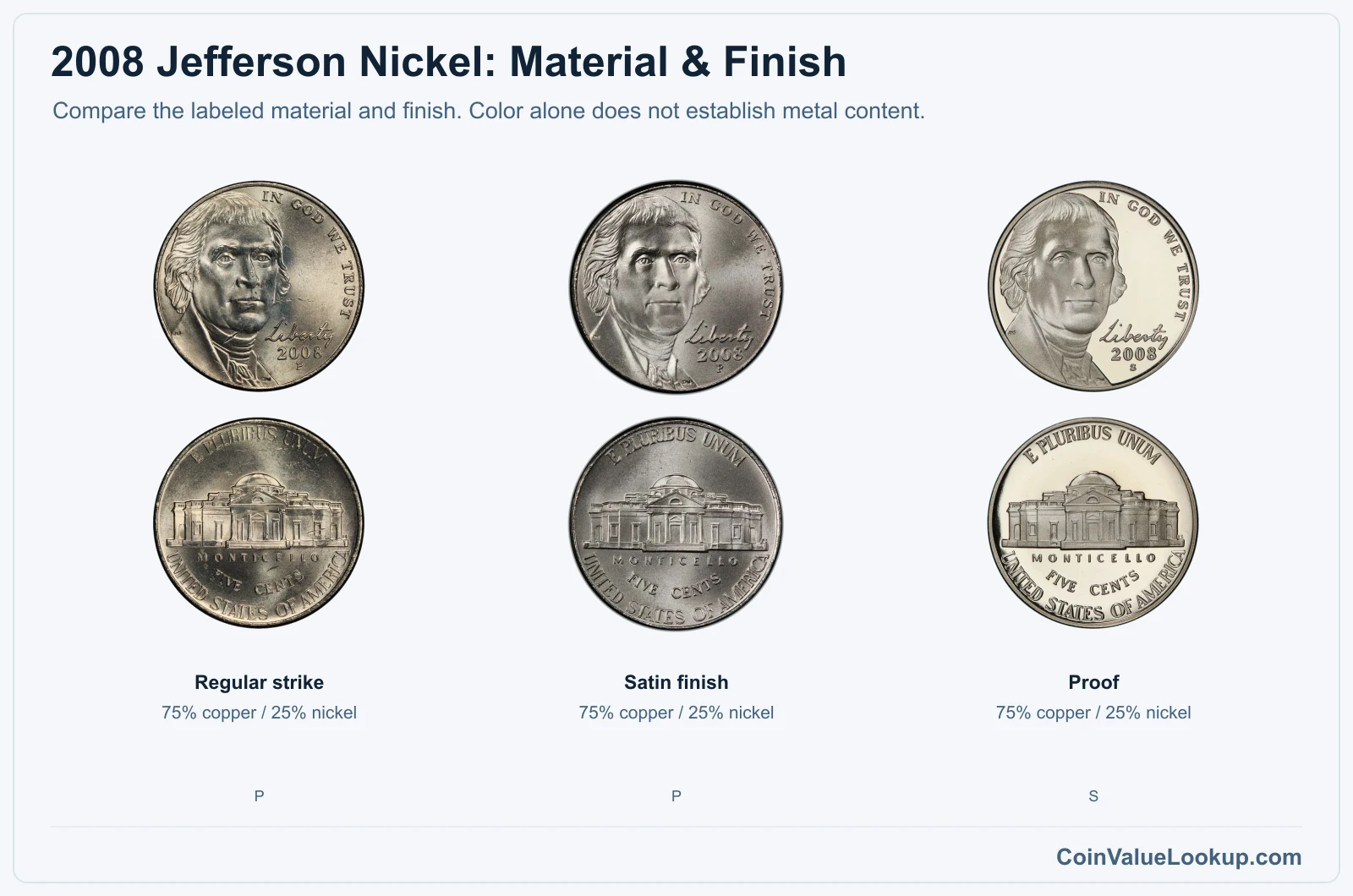
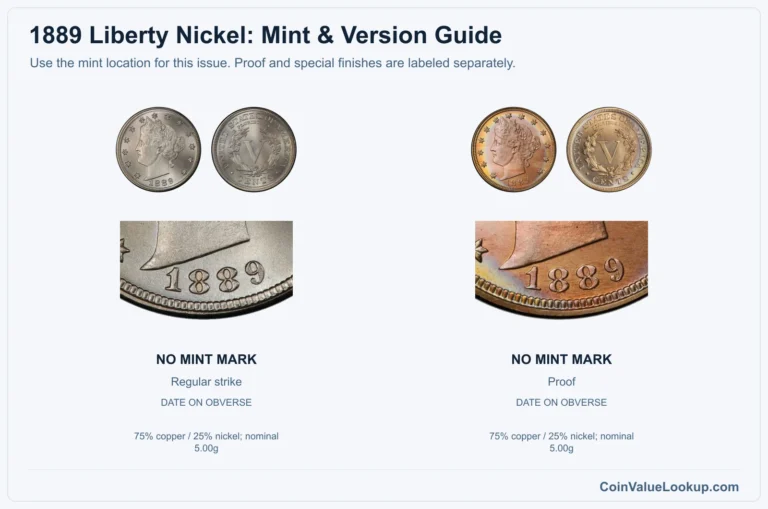
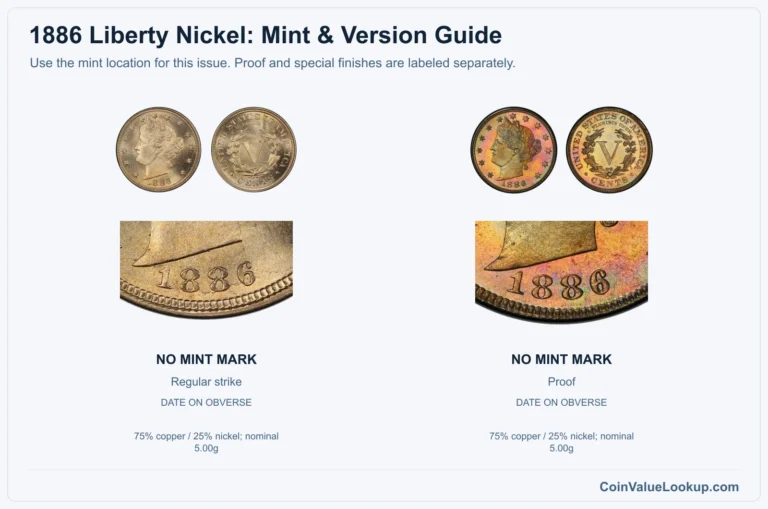
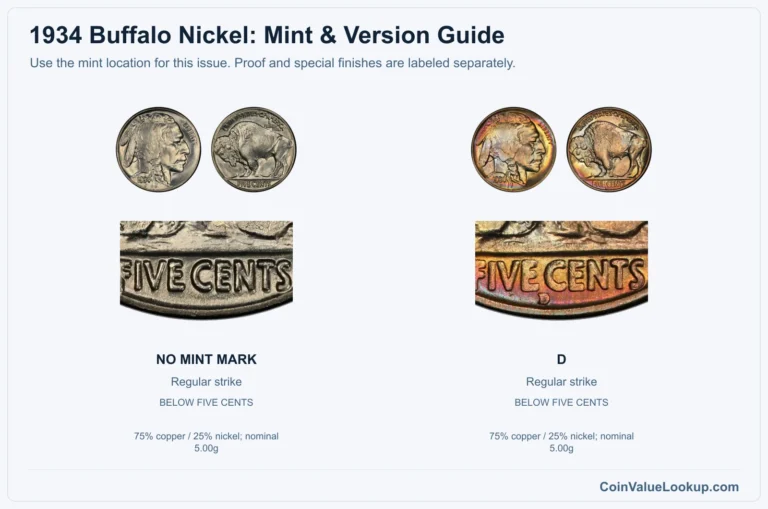
Flip your coin to the obverse and look for the mintmark letter near the date. A "P" means Philadelphia, a "D" means Denver, and an "S" means San Francisco proof.
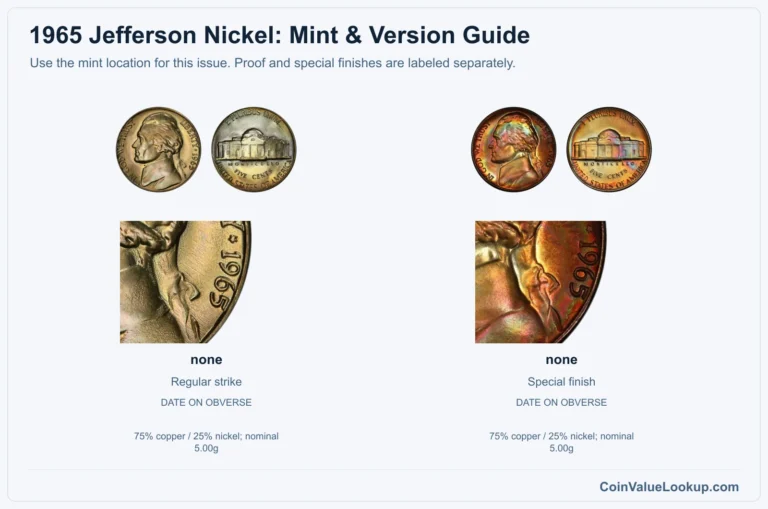
All three share the same forward-facing Jefferson portrait on the obverse and the Monticello building on the reverse — the design restored in 2006 after the 2004–2005 Westward Journey commemorative reverses.
The standard composition is 75% copper and 25% nickel, weighing about 5 grams with a plain edge and a diameter of 21.2 mm. Color alone does not tell you the alloy; a toned or darkened nickel is still the same metal.
Satin-finish coins came packaged in 2008 US Mint Sets and have a distinctly soft, even luster that differs from the shiny, cartwheel look of a regular business strike. A bright circulated nickel is not automatically a satin coin.
If it did not come out of an official Mint Set holder, it is almost certainly a standard strike.
Step 2: Check Your 2008 Jefferson Nickel Grade
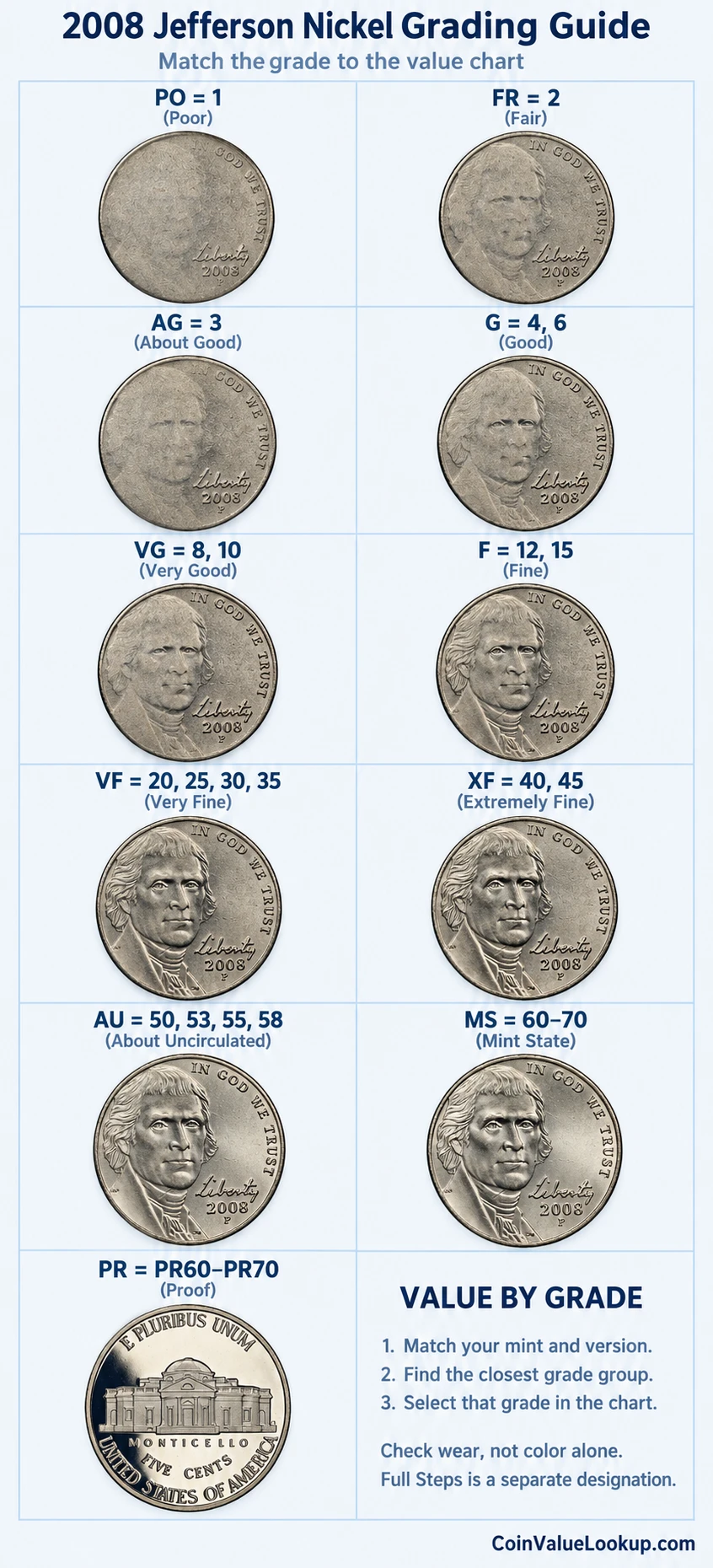
Start with the cheek and hair detail on Jefferson's portrait. On a well-worn coin, the cheekbone flattens first, followed by the hair above the ear.
An uncirculated piece retains full original luster with no wear on those high points, though it may still show bag marks or contact scratches that separate an MS60 from an MS65.
On the Monticello reverse, step sharpness at the base of the building reflects strike quality rather than wear. A softly struck coin can look worn on the steps even in mint state, so do not confuse the two.
Use the comparison image to match your coin's surface against known grade examples of the same design. The 2006-onward forward-facing portrait wears differently than the older profile, so make sure you are comparing apples to apples.
Proof finish and satin finish are manufacturing categories, not grades above mint state.
Step 3: Check 2008 Jefferson Nickel Value by Mint and Version
2008 Jefferson Nickel — P — Business strike
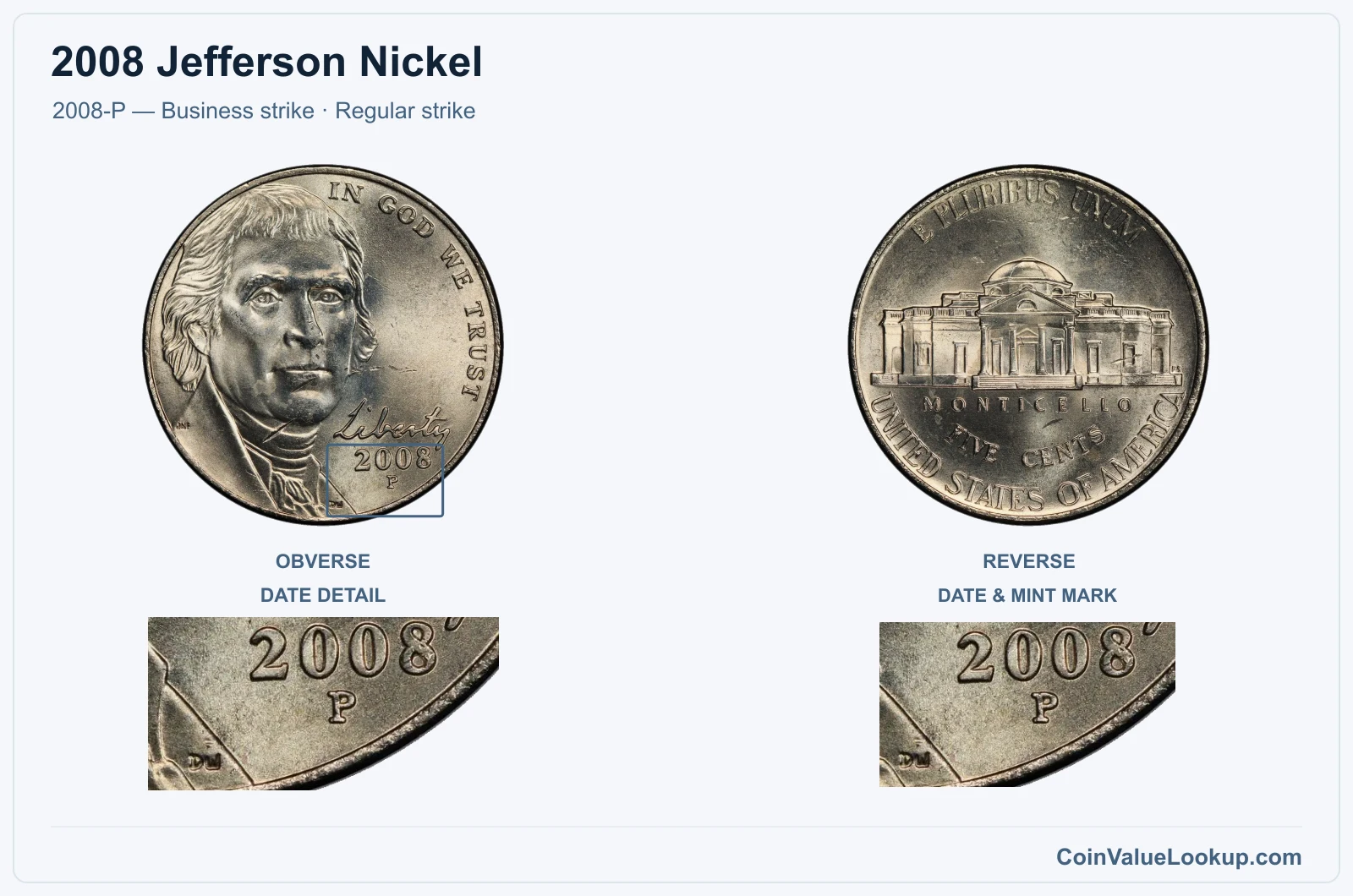
The 2008-P business strike is the standard Philadelphia issue you will find in circulation or bank rolls. It shows the forward-facing Jefferson portrait and Monticello reverse in 75% copper / 25% nickel at about 5 grams.
According to USA Coin Book, guide values sit around $0.30 in MS60 and $0.61 in MS65. Those are retail guide estimates for ordinary examples without special designations.
In circulated condition, this coin is essentially worth face value.
| Range | Grade | Price | Auction Records | Appraisal |
|---|---|---|---|---|
| PO | PO 1 | — | Coin Identifier | |
| FR | FR 2 | — | Coin Identifier | |
| AG | AG 3 | — | Coin Identifier | |
| G | G 4 | — | Coin Identifier | |
| G 6 | — | Coin Identifier | ||
| VG | VG 8 | — | Coin Identifier | |
| VG 10 | — | Coin Identifier | ||
| F | F 12 | — | Coin Identifier | |
| F 15 | — | Coin Identifier | ||
| VF | VF 20 | — | Coin Identifier | |
| VF 25 | — | Coin Identifier | ||
| VF 30 | — | Coin Identifier | ||
| VF 35 | — | Coin Identifier | ||
| XF | XF 40 | — | Coin Identifier | |
| XF 45 | — | Coin Identifier | ||
| AU | AU 50 | — | Coin Identifier | |
| AU 53 | — | Coin Identifier | ||
| AU 55 | — | Coin Identifier | ||
| AU 58 | — | Coin Identifier | ||
| MS | MS 60 | — | Coin Identifier | |
| MS 61 | — | Coin Identifier | ||
| MS 62 | — | Coin Identifier | ||
| MS 63 | — | Coin Identifier | ||
| MS 64 | — | Coin Identifier | ||
| MS 65 | — | Coin Identifier | ||
| MS 66 | — | — | — | |
| MS 67 | — | — | — | |
| MS 68 | — | — | — | |
| MS 69 | — | — | — | |
| MS 70 | — | — | — |
2008 Jefferson Nickel — P SP — Satin Finish Special Strike
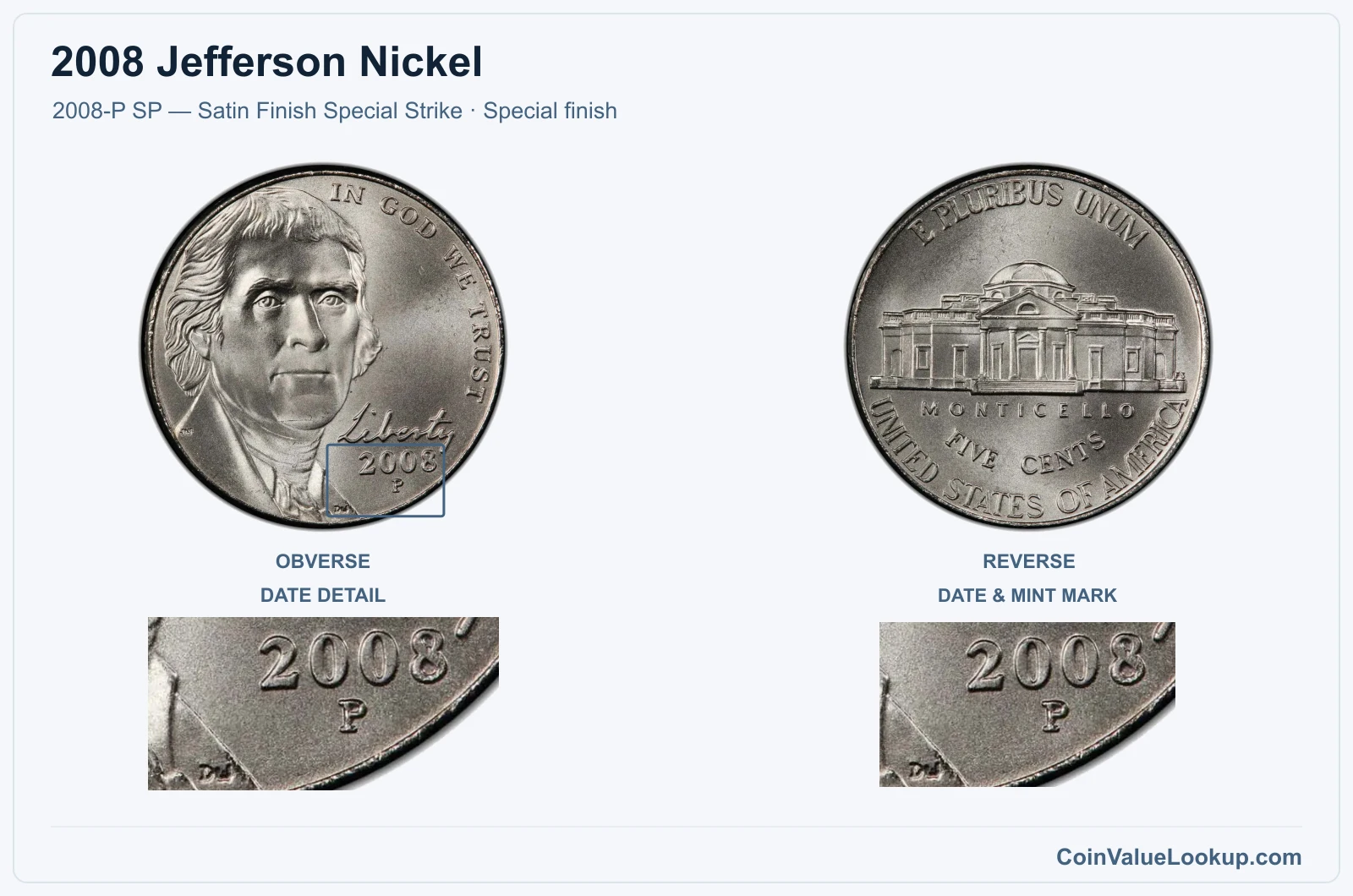
The 2008-P satin-finish nickel was produced exclusively for the 2008 US Mint Set. Its surface has a uniform, matte-like luster that looks nothing like the bright cartwheel sheen of a regular business strike.
Same composition, same weight, same design — just a different manufacturing process.
No standard guide price range has been adopted for these satin issues. Their value depends on authenticated identity and condition, so having a coin confirmed as a genuine satin strike matters.
If yours came loose from a Mint Set, compare it side-by-side with a known business strike under the same light. The difference is subtle but consistent across the entire surface.
Coin Value Lookup is a good starting point if you want to compare your satin nickel against other Jefferson nickel years and finishes.
| Range | Grade | Price | Auction Records | Appraisal |
|---|---|---|---|---|
| SP | SP 1 | — | Coin Identifier | |
| SP 2 | — | Coin Identifier | ||
| SP 3 | — | Coin Identifier | ||
| SP 4 | — | Coin Identifier | ||
| SP 6 | — | Coin Identifier | ||
| SP 8 | — | Coin Identifier | ||
| SP 10 | — | Coin Identifier | ||
| SP 12 | — | Coin Identifier | ||
| SP 15 | — | Coin Identifier | ||
| SP 20 | — | Coin Identifier | ||
| SP 25 | — | Coin Identifier | ||
| SP 30 | — | Coin Identifier | ||
| SP 35 | — | Coin Identifier | ||
| SP 40 | — | Coin Identifier | ||
| SP 45 | — | Coin Identifier | ||
| SP 50 | — | Coin Identifier | ||
| SP 53 | — | Coin Identifier | ||
| SP 55 | — | Coin Identifier | ||
| SP 58 | — | Coin Identifier | ||
| SP 60 | — | Coin Identifier | ||
| SP 61 | — | Coin Identifier | ||
| SP 62 | — | Coin Identifier | ||
| SP 63 | — | Coin Identifier | ||
| SP 64 | — | Coin Identifier | ||
| SP 65 | — | Coin Identifier | ||
| SP 66 | — | Coin Identifier | ||
| SP 67 | — | Coin Identifier | ||
| SP 68 | — | Coin Identifier | ||
| SP 69 | — | Coin Identifier | ||
| SP 70 | — | — | — |
2008 Jefferson Nickel — D — Business strike
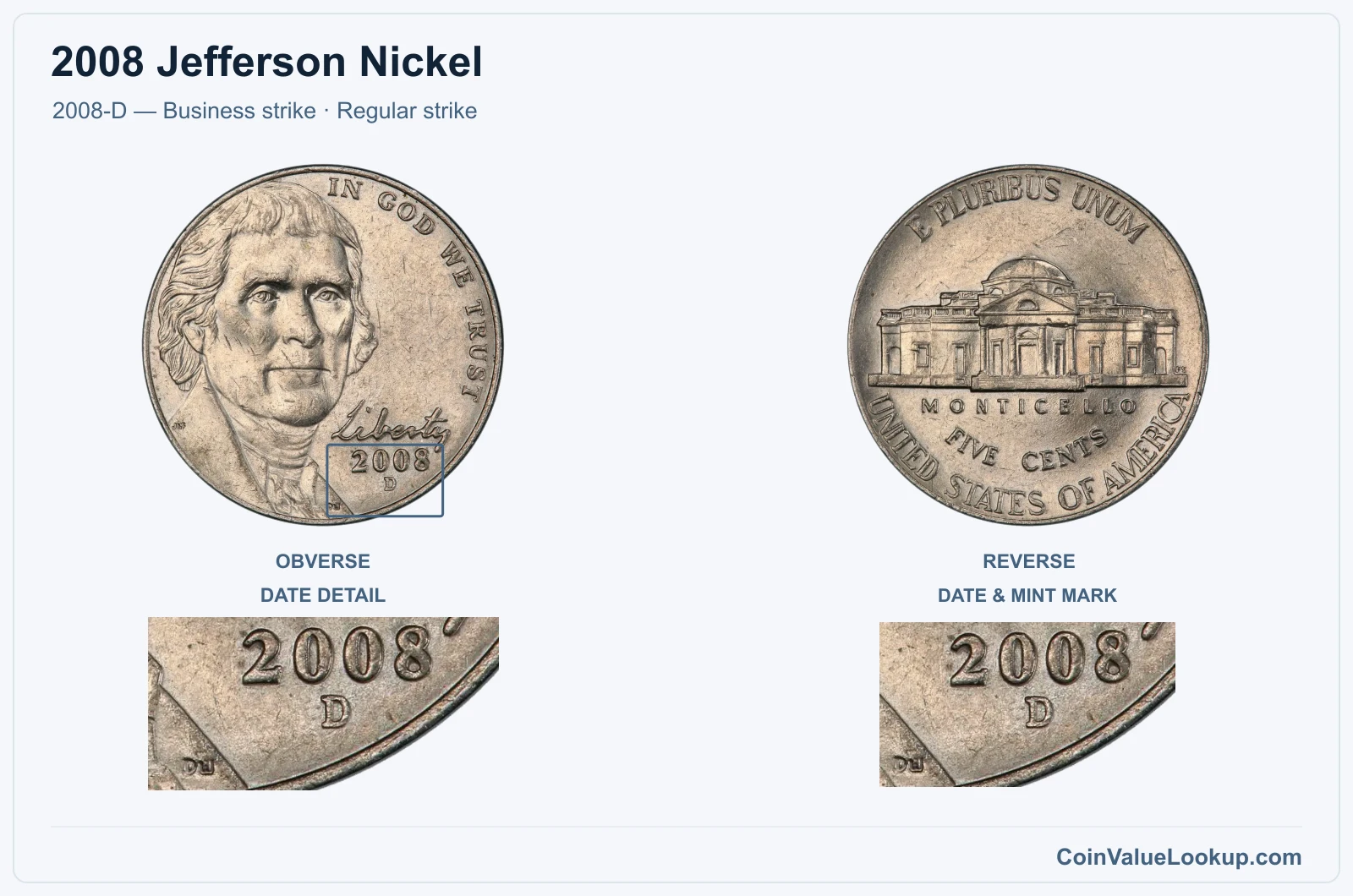
The 2008-D is Denver's business strike, identical in design and composition to the Philadelphia version but carrying a "D" mintmark. USA Coin Book lists guide values of roughly $0.30 at MS60 and $0.61 at MS65.
In worn condition, it spends for five cents like any other nickel. Uncirculated rolls are common enough that most examples are not hard to find, and value comes down to surface quality and luster at the upper grades.
| Range | Grade | Price | Auction Records | Appraisal |
|---|---|---|---|---|
| PO | PO 1 | — | Coin Identifier | |
| FR | FR 2 | — | Coin Identifier | |
| AG | AG 3 | — | Coin Identifier | |
| G | G 4 | — | Coin Identifier | |
| G 6 | — | Coin Identifier | ||
| VG | VG 8 | — | Coin Identifier | |
| VG 10 | — | Coin Identifier | ||
| F | F 12 | — | Coin Identifier | |
| F 15 | — | Coin Identifier | ||
| VF | VF 20 | — | Coin Identifier | |
| VF 25 | — | Coin Identifier | ||
| VF 30 | — | Coin Identifier | ||
| VF 35 | — | Coin Identifier | ||
| XF | XF 40 | — | Coin Identifier | |
| XF 45 | — | Coin Identifier | ||
| AU | AU 50 | — | Coin Identifier | |
| AU 53 | — | Coin Identifier | ||
| AU 55 | — | Coin Identifier | ||
| AU 58 | — | Coin Identifier | ||
| MS | MS 60 | — | Coin Identifier | |
| MS 61 | — | Coin Identifier | ||
| MS 62 | — | Coin Identifier | ||
| MS 63 | — | Coin Identifier | ||
| MS 64 | — | Coin Identifier | ||
| MS 65 | — | Coin Identifier | ||
| MS 66 | — | — | — | |
| MS 67 | — | — | — | |
| MS 68 | — | — | — | |
| MS 69 | — | — | — | |
| MS 70 | — | — | — |
2008 Jefferson Nickel — D SP — Satin Finish Special Strike
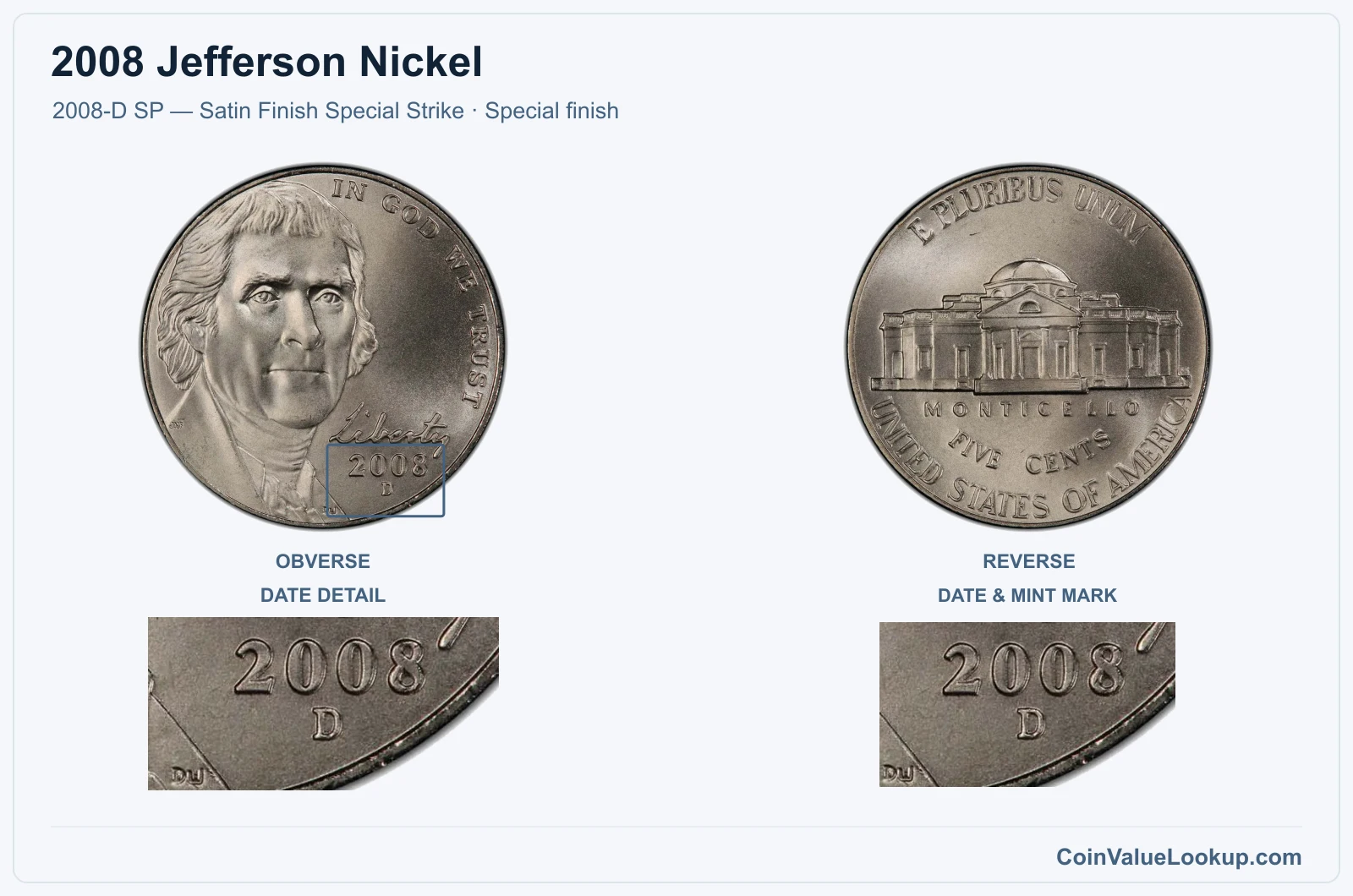
Like its Philadelphia twin, the 2008-D satin-finish nickel was a Mint Set exclusive. It shares the standard 75% copper / 25% nickel composition and forward-facing Jefferson design but has that telltale soft, even finish across both sides.
No numeric guide price range has been adopted for these coins. What they bring depends on condition and confirmation that the coin is genuinely a satin strike rather than a lightly toned business strike.
If you still have the original Mint Set packaging, that settles the question quickly. Without it, a side-by-side comparison under good light is the reliable test.
| Range | Grade | Price | Auction Records | Appraisal |
|---|---|---|---|---|
| SP | SP 1 | — | Coin Identifier | |
| SP 2 | — | Coin Identifier | ||
| SP 3 | — | Coin Identifier | ||
| SP 4 | — | Coin Identifier | ||
| SP 6 | — | Coin Identifier | ||
| SP 8 | — | Coin Identifier | ||
| SP 10 | — | Coin Identifier | ||
| SP 12 | — | Coin Identifier | ||
| SP 15 | — | Coin Identifier | ||
| SP 20 | — | Coin Identifier | ||
| SP 25 | — | Coin Identifier | ||
| SP 30 | — | Coin Identifier | ||
| SP 35 | — | Coin Identifier | ||
| SP 40 | — | Coin Identifier | ||
| SP 45 | — | Coin Identifier | ||
| SP 50 | — | Coin Identifier | ||
| SP 53 | — | Coin Identifier | ||
| SP 55 | — | Coin Identifier | ||
| SP 58 | — | Coin Identifier | ||
| SP 60 | — | Coin Identifier | ||
| SP 61 | — | Coin Identifier | ||
| SP 62 | — | Coin Identifier | ||
| SP 63 | — | Coin Identifier | ||
| SP 64 | — | Coin Identifier | ||
| SP 65 | — | Coin Identifier | ||
| SP 66 | — | Coin Identifier | ||
| SP 67 | — | Coin Identifier | ||
| SP 68 | — | Coin Identifier | ||
| SP 69 | — | Coin Identifier | ||
| SP 70 | — | — | — |
2008 Jefferson Nickel — S PR — Proof
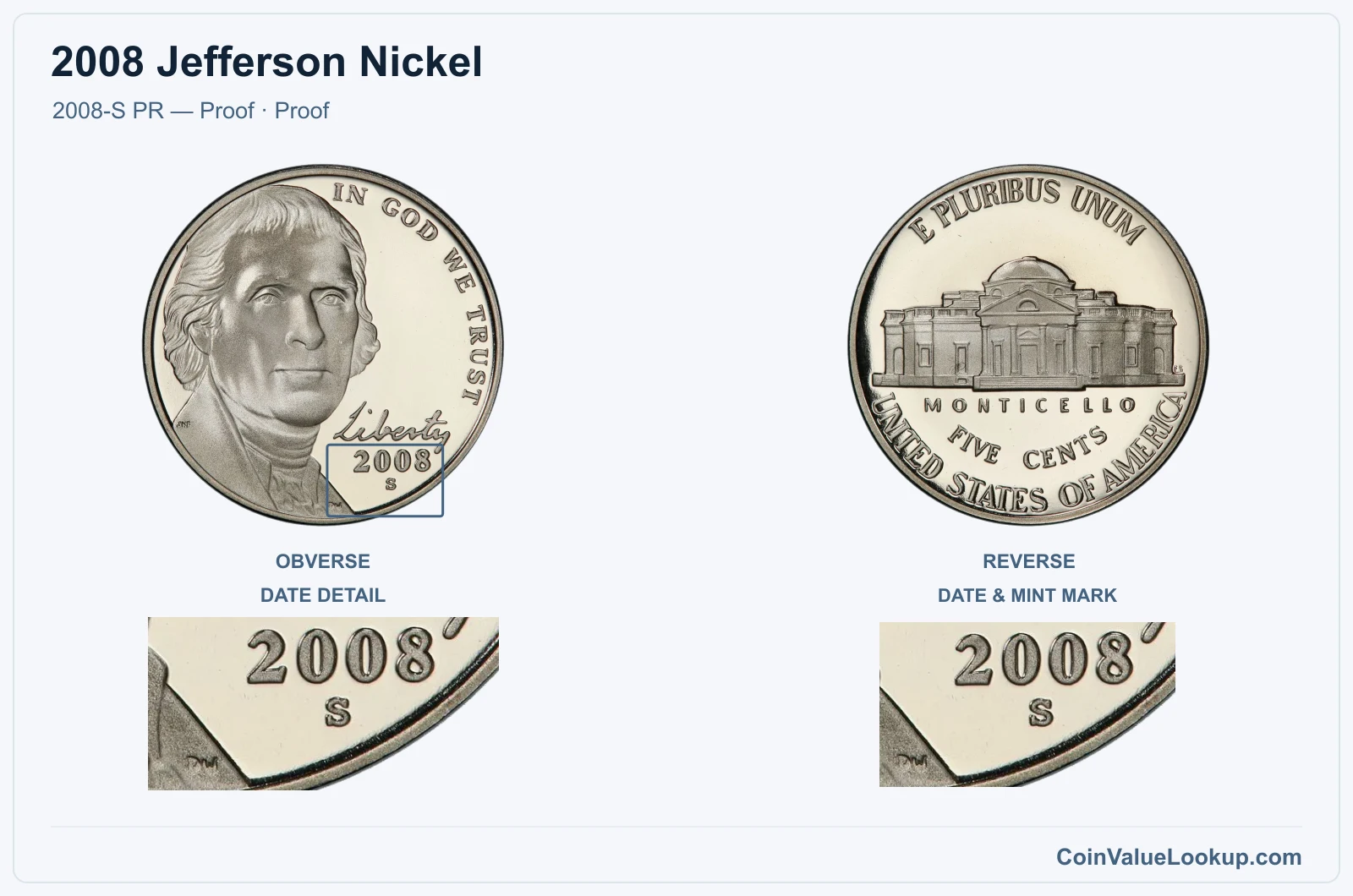
The 2008-S proof was struck at San Francisco for collector sets. It features sharp, squared-off rims and mirror-like fields — the hallmarks of proof manufacturing.
USA Coin Book places the guide value at about $5.30 in PR65.
This is a collectible coin, not something you will pull from a cash register. The proof finish can range from brilliant to deep cameo contrast, though the guide figure here applies to the standard PR65 level without a cameo or deep cameo designation.
Look for the "S" mintmark to confirm origin.
| Range | Grade | Price | Auction Records | Appraisal |
|---|---|---|---|---|
| PR | PR 1 | — | Coin Identifier | |
| PR 2 | — | Coin Identifier | ||
| PR 3 | — | Coin Identifier | ||
| PR 4 | — | Coin Identifier | ||
| PR 6 | — | Coin Identifier | ||
| PR 8 | — | Coin Identifier | ||
| PR 10 | — | Coin Identifier | ||
| PR 12 | — | Coin Identifier | ||
| PR 15 | — | Coin Identifier | ||
| PR 20 | — | Coin Identifier | ||
| PR 25 | — | Coin Identifier | ||
| PR 30 | — | Coin Identifier | ||
| PR 35 | — | Coin Identifier | ||
| PR 40 | — | Coin Identifier | ||
| PR 45 | — | Coin Identifier | ||
| PR 50 | — | Coin Identifier | ||
| PR 53 | — | Coin Identifier | ||
| PR 55 | — | Coin Identifier | ||
| PR 58 | — | Coin Identifier | ||
| PR 60 | — | Coin Identifier | ||
| PR 61 | — | Coin Identifier | ||
| PR 62 | — | Coin Identifier | ||
| PR 63 | — | Coin Identifier | ||
| PR 64 | — | Coin Identifier | ||
| PR 65 | — | Coin Identifier | ||
| PR 66 | — | Coin Identifier | ||
| PR 67 | — | Coin Identifier | ||
| PR 68 | — | Coin Identifier | ||
| PR 69 | Coin Identifier | |||
| PR 70 | Coin Identifier |
2008 Jefferson Nickel Error List
1. 2008 Jefferson Nickel — Doubled die reverse
A doubled die reverse has been documented on the 2008-P Jefferson nickel. The key diagnostic is duplicated raised detail below the upper central doorway frame on Monticello, above the steps.
Under magnification and good lighting, compare that area to a normal 2008-P nickel — the doubling should be visible as an extra shelf of design where there should be only one clean line.
Confirm the date and "P" mintmark before concluding you have this variety. Flat, shelf-like machine doubling, odd reflections, and impact damage can mimic a genuine doubled die to the untrained eye.
Real hub doubling shows consistent, rounded secondary design elements rather than flat smears. No standard price range has been adopted; value depends on the coin's authenticated identity, condition, and the strength of the doubling.
2. 2008 Jefferson Nickel — Off-Center Strike
An off-center strike happens when the blank is not seated properly in the collar before the dies come together. The result is a displaced design with an unstruck crescent of blank metal along one edge.
On a 2008 nickel, the more dramatic the shift and the more of the date that remains visible, the more collector interest the coin generates.
Do not confuse an off-center strike with a clipped planchet, a one-sided die misalignment, or post-mint flattening from damage. A genuine off-center coin will have a complete design that is simply shifted — not partially missing from a defective blank.
No specific price range has been adopted for this error; value depends on the percentage of off-center shift, overall condition, and whether the date is fully readable.
3. 2008 Jefferson Nickel — Die Crack / Die Chip
Die cracks and die chips show up as raised lines or small raised blobs on the coin's surface, created when the steel die itself fractured during production. A crack that runs from the rim inward produces a thin raised line, while an interior chip leaves a small raised lump.
A larger break connecting to the rim is sometimes called a cud.
These are not scratches. Scratches are incuse — pressed into the surface — while die cracks are raised above it.
Corrosion bubbles and foreign material stuck to the coin can also look similar under casual inspection. Run a fingernail across the mark: a genuine die crack will feel like a tiny raised ridge.
No specific price range has been adopted, and value depends on the size, location, and visual prominence of the crack along with the coin's overall condition.
4. 2008 Jefferson Nickel — Broadstrike
A broadstrike occurs when the coin is struck without the retaining collar that normally confines the metal and forms the rim. The result is a coin that spreads outward, appearing slightly wider than normal with a weak or absent rim.
The full design is still present — it just extends further toward the edge than it should.
Check the edge profile carefully. A genuine broadstrike will have a rounded, spread edge rather than the sharp vertical rim of a normal nickel.
Do not confuse this with an off-center strike, where the design is displaced, or with post-mint flattening from being run over or hammered. No adopted price range exists for this error on the 2008 nickel; value depends on how pronounced the spread is, overall condition, and whether the coin has been authenticated.
5. 2008 Jefferson Nickel — Rotated Dies
Rotated dies produce a coin where the obverse and reverse are not in their normal 180-degree alignment. To test for this, hold the obverse upright, then flip the coin top to bottom along a vertical axis.
On a normal US coin, the reverse should appear upright. If it is tilted, you may have a die rotation error.
Small rotations of a few degrees are relatively common and carry modest interest. Larger rotations — 45 degrees, 90 degrees, or more — attract more attention.
Make sure you are not simply holding a photograph sideways or turning the coin in the wrong direction. No adopted price range exists; the premium depends on the degree of rotation, condition, and authentication.
6. 2008 Jefferson Nickel — Clashed Dies
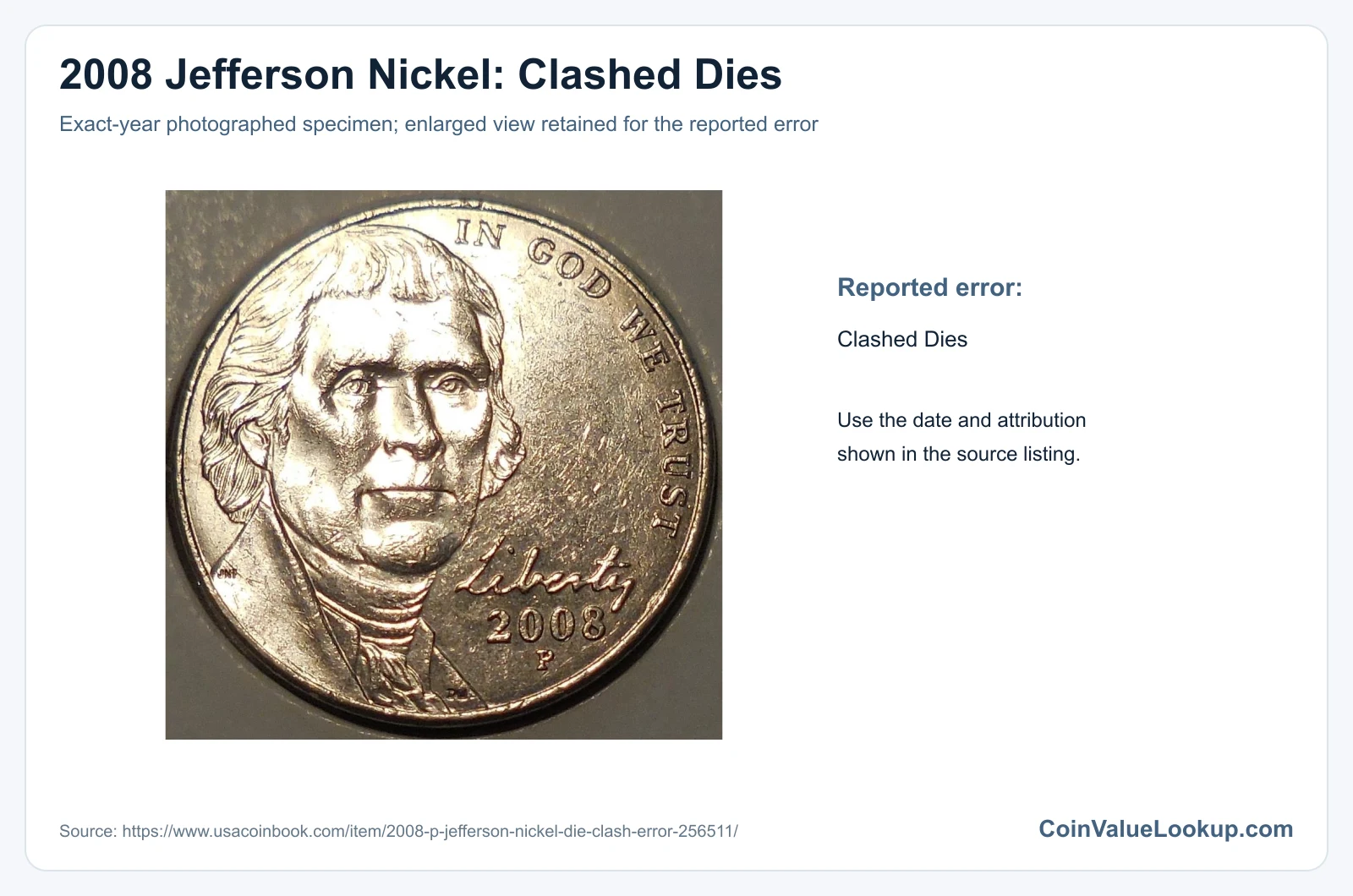
A die clash happens when the obverse and reverse dies strike each other without a planchet between them. The collision transfers ghost-like traces of each die's design onto the opposing die.
When a coin is subsequently struck, you can see faint outlines of Monticello on Jefferson's side, or parts of the portrait on the building side, positioned where the opposite design would align.
Look in the open fields of the coin — areas without major design elements — for ghost impressions that match features from the other side. Random scratches, raised lines from die cracks, or brockage impressions from another coin are not die clashes.
No specific price range has been adopted for this error; value depends on how clearly the transferred design is visible and the coin's overall condition.