1999 Jefferson Nickel Coin Value: How Much Is It Worth?
Most 1999 Jefferson nickels are worth face value in circulated condition. Uncirculated examples carry modest premiums, with retail guide anchors ranging from about $0.30 at MS60 to $1.24 at MS65 for normal business strikes.
Proofs and authenticated mint errors occupy their own pricing tiers. These guide figures are not guaranteed cash offers for every coin you find.
Fast Way to Identify Your 1999 Jefferson Nickel
The quickest way to start is to snap clear photos of both sides of your nickel and upload them here. That gives you a preliminary identification of the mint, finish, and any obvious features worth investigating further.
Make sure the date, mintmark area, and edges are all visible in the shots.
1999 Jefferson Nickel Value
Upload both sides of your 1999 Jefferson Nickel.
Front Obverse
Upload photo
Back Reverse
Upload photo
Which 1999 Jefferson Nickel Versions Are Worth Money?
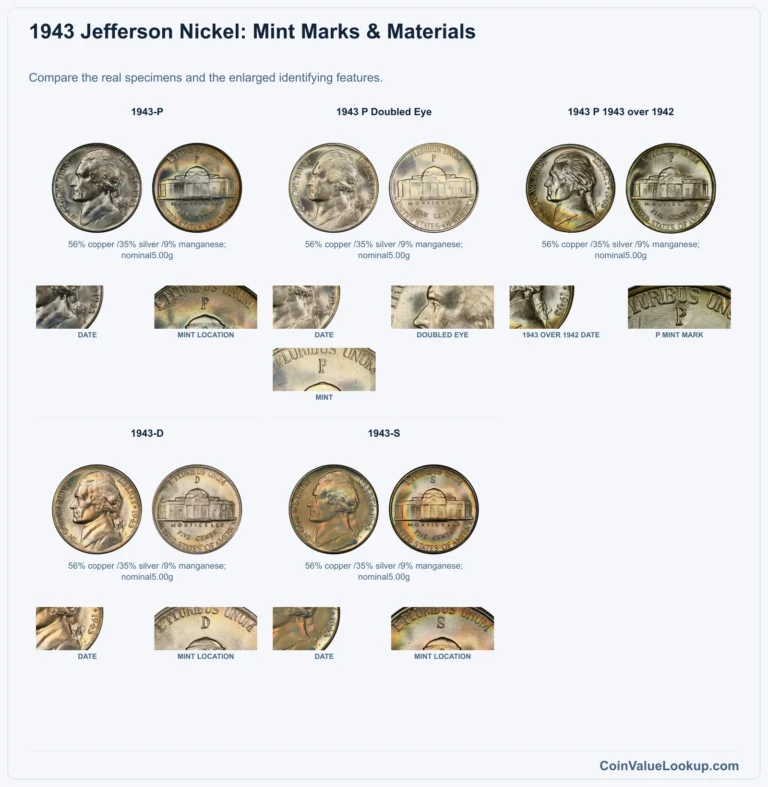
- Certified Full Steps examples of the P or D business strikes can command premiums above the base guide values, though worn pocket-change coins do not inherit those prices.
- The 1999-S proof has a separate collector market; a PR65 guide anchor sits at about $4.27, and cameo or deep cameo designations are valued differently.
- A 1999 nickel struck over a 1999-D cent sold at Heritage Auctions in September 2024 for $1,320 (ANACS MS64 Red), making authenticated wrong-planchet and double-denomination errors the most dramatic finds for this date.
- Off-center strikes, broadstrikes, and struck-on-cent-planchet errors have also sold at auction and are worth checking for if your coin looks unusual.
Step 1: Identify Your 1999 Jefferson Nickel Mint Mark and Version
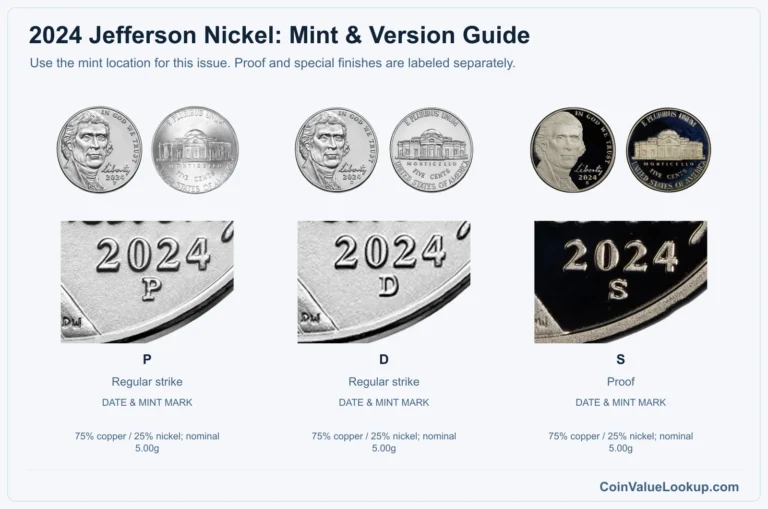
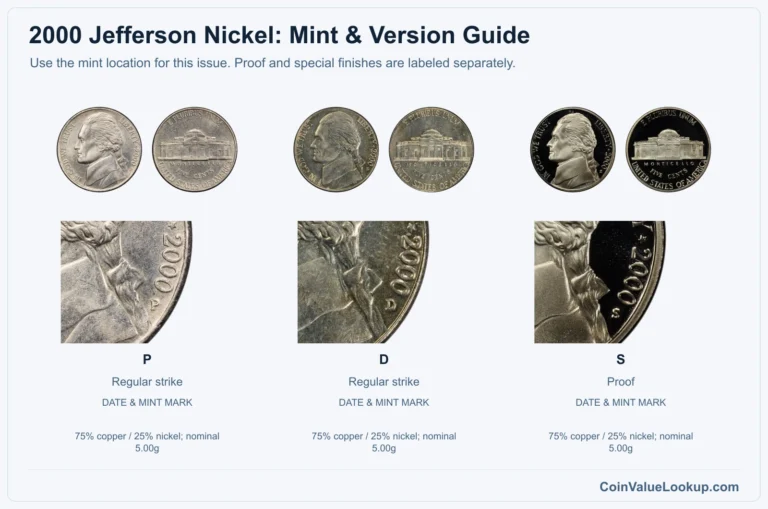
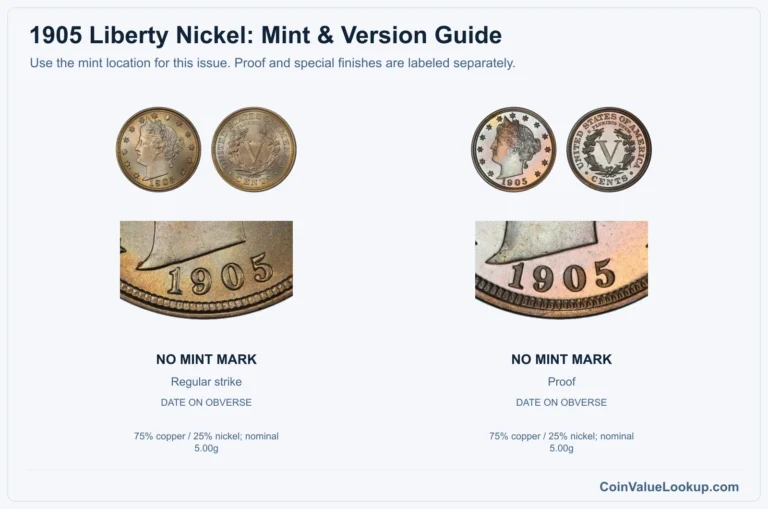
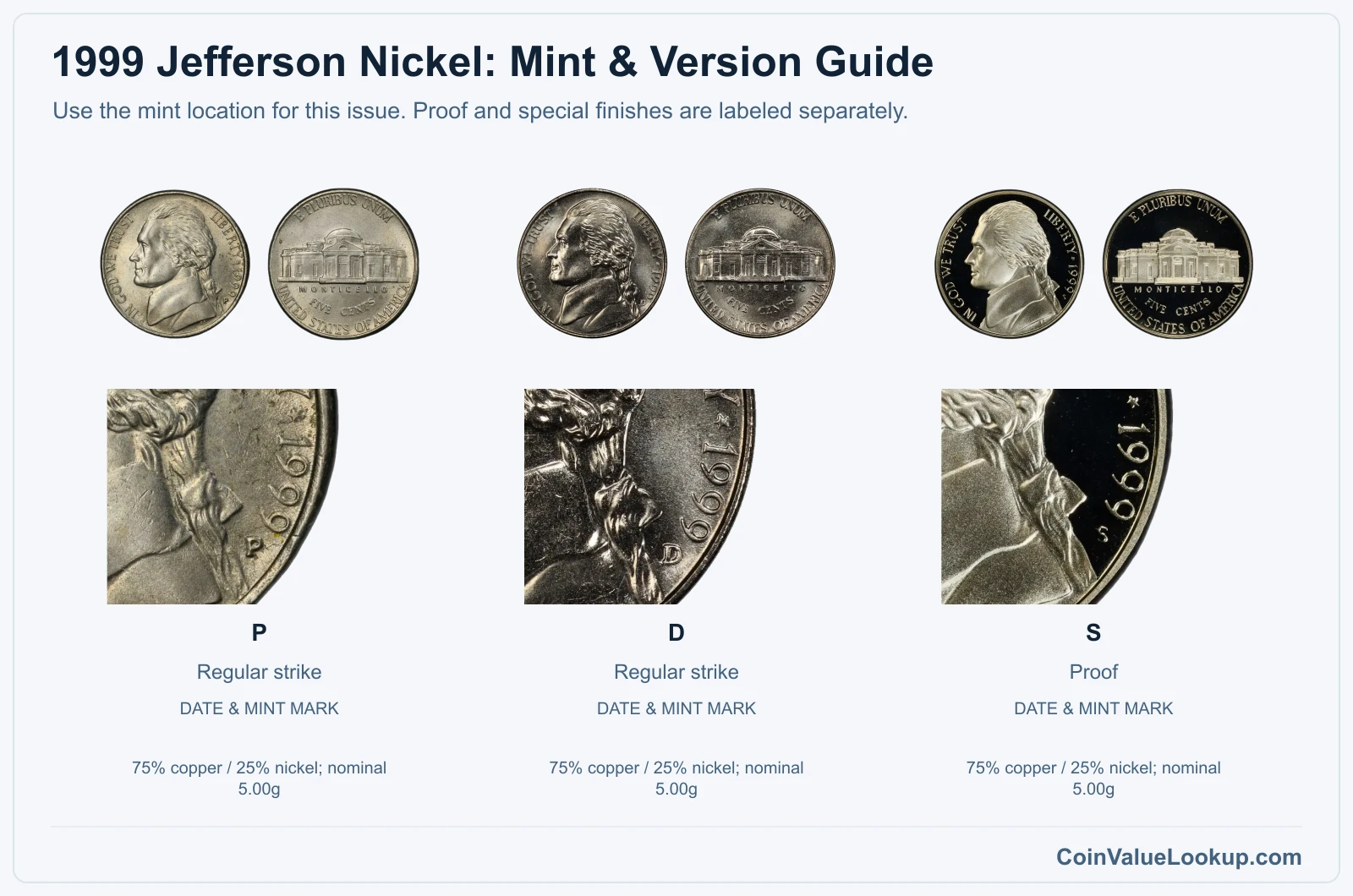
Three versions of the 1999 Jefferson nickel exist: the Philadelphia (P) business strike, the Denver (D) business strike, and the San Francisco (S) proof. Find the mintmark on the obverse, just below the date on the right side.
P and D coins were made for general circulation, while S coins are proofs produced for collectors.
All three share the same composition: 75% copper and 25% nickel, weighing about 5 grams with a 21.2 mm diameter and a plain edge. Record the date, mintmark, and whether the surfaces look satiny (business strike) or mirror-like (proof) before comparing to any value chart.
A coin that looks unusually shiny is not automatically a proof. Frosted collector finishes need correct attribution and provenance, not just a visual guess based on brightness.
Step 2: Check Your 1999 Jefferson Nickel Grade
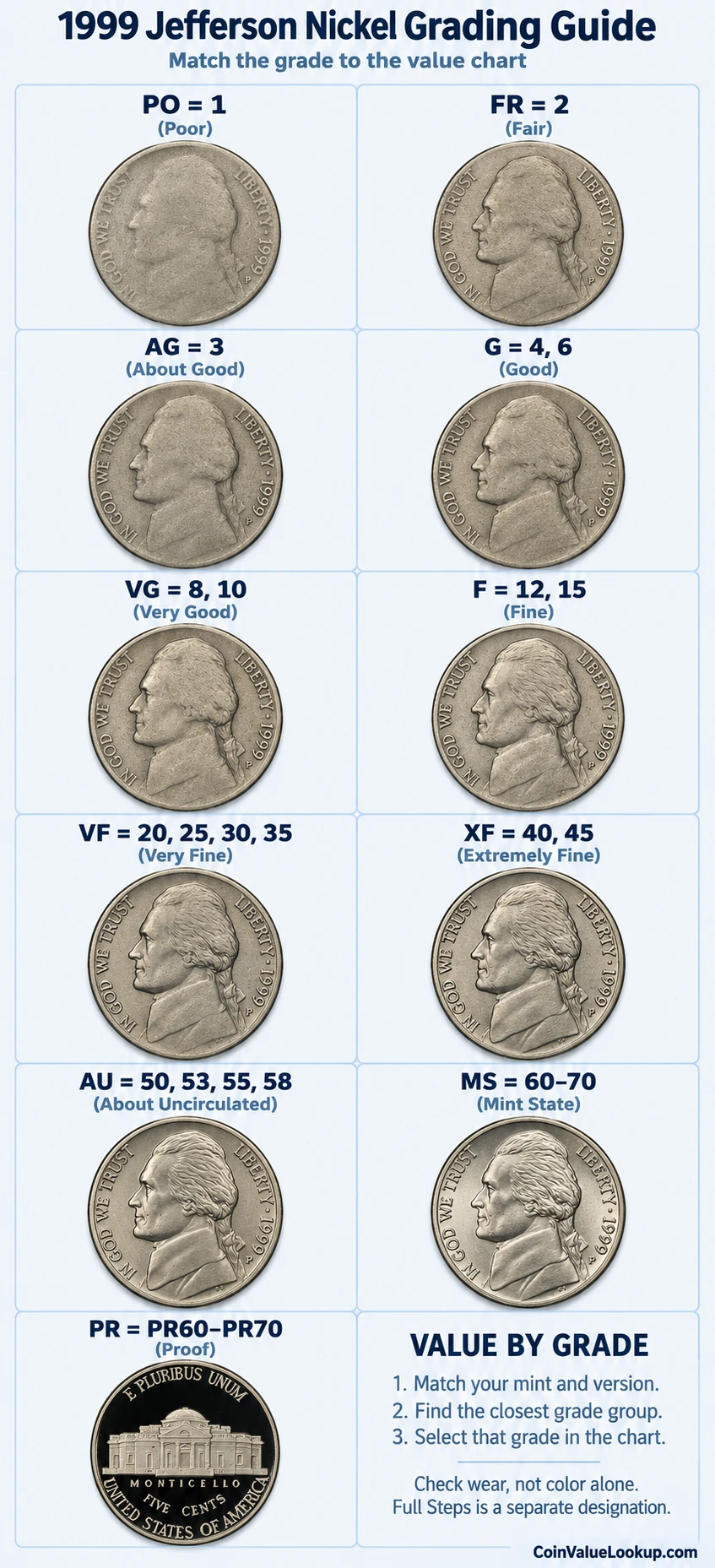
Focus on Jefferson's cheek and the hair detail above his ear. These are the first areas to show wear, so a coin that still has sharp definition there is in better shape than one where those spots are smooth.
Luster across the fields matters too; original mint bloom versus dull, handled surfaces is a big tell.
On the reverse, check the columns and steps of Monticello. Incomplete steps can result from a weak strike rather than circulation wear, so do not confuse the two.
Full Steps is a separate strike-quality designation applied to Mint State coins, not a numerical grade upgrade.
Use the comparison image to match your coin's wear pattern against known grade benchmarks. A coin with obvious rub on the high points but decent remaining detail might land around AU, while one with no trace of wear and full luster sits in the Mint State range.
Step 3: Check 1999 Jefferson Nickel Value by Mint and Version
1999 Jefferson Nickel — P Business strike
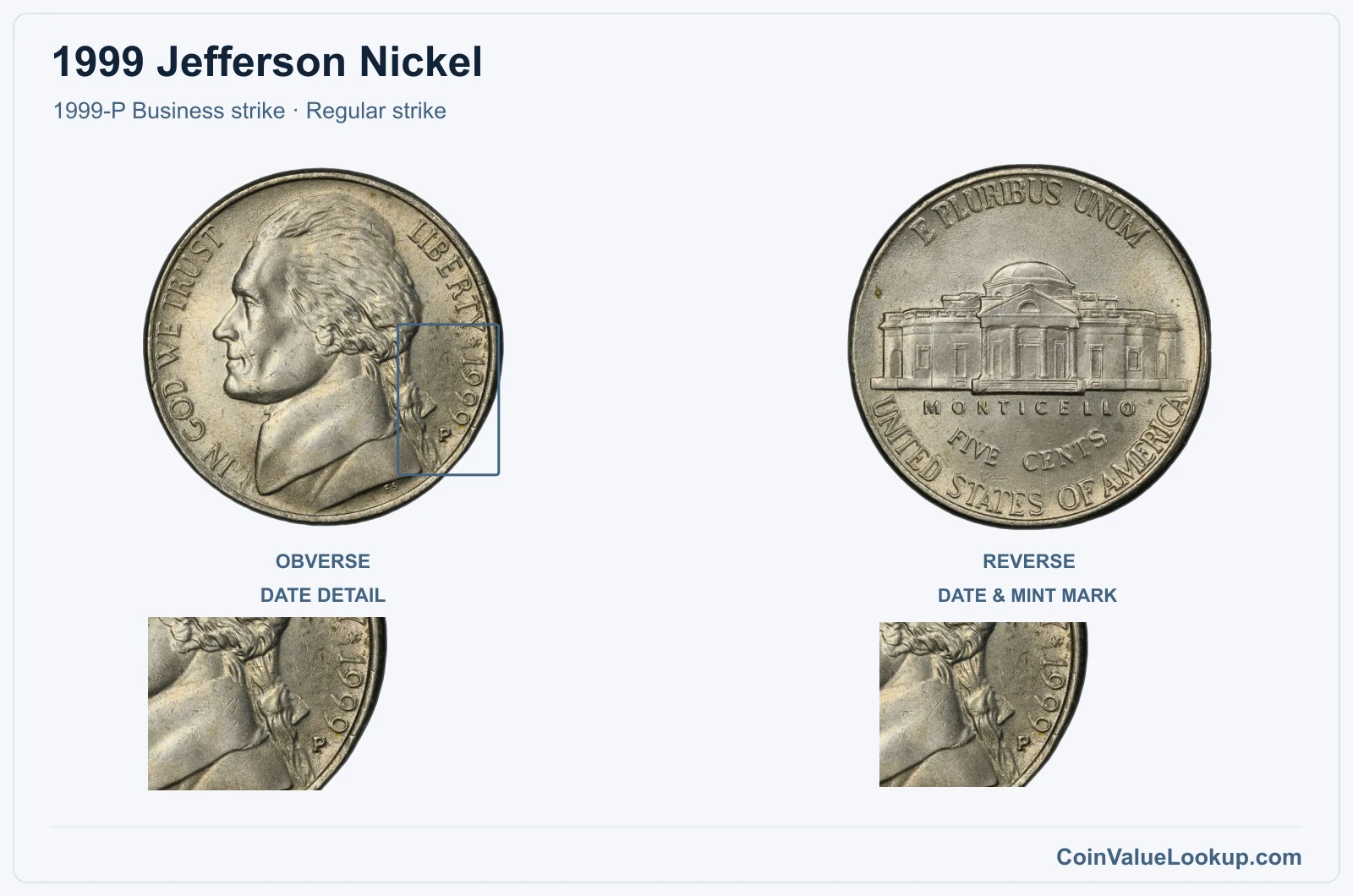
The 1999-P is the Philadelphia business strike, carrying the standard Jefferson portrait on the obverse and Monticello on the reverse. It is struck in 75% copper and 25% nickel at a nominal weight of 5 grams.
Retail guide anchors from USA Coin Book place this coin at roughly $0.30 in MS60 and $1.24 in MS65. Those are estimates for uncirculated coins, not what a worn example from your pocket is worth.
Circulated pieces generally trade at face value unless they carry a certified Full Steps designation, which reflects strike quality on the Monticello steps.
| Range | Grade | Price | Auction Records | Appraisal |
|---|---|---|---|---|
| PO | PO 1 | — | Coin Identifier | |
| FR | FR 2 | — | Coin Identifier | |
| AG | AG 3 | — | Coin Identifier | |
| G | G 4 | — | Coin Identifier | |
| G 6 | — | Coin Identifier | ||
| VG | VG 8 | — | Coin Identifier | |
| VG 10 | — | Coin Identifier | ||
| F | F 12 | — | Coin Identifier | |
| F 15 | — | Coin Identifier | ||
| VF | VF 20 | — | Coin Identifier | |
| VF 25 | — | Coin Identifier | ||
| VF 30 | — | Coin Identifier | ||
| VF 35 | — | Coin Identifier | ||
| XF | XF 40 | — | Coin Identifier | |
| XF 45 | — | Coin Identifier | ||
| AU | AU 50 | — | Coin Identifier | |
| AU 53 | — | Coin Identifier | ||
| AU 55 | — | Coin Identifier | ||
| AU 58 | — | Coin Identifier | ||
| MS | MS 60 | — | Coin Identifier | |
| MS 61 | — | Coin Identifier | ||
| MS 62 | — | Coin Identifier | ||
| MS 63 | — | Coin Identifier | ||
| MS 64 | — | Coin Identifier | ||
| MS 65 | — | Coin Identifier | ||
| MS 66 | — | Coin Identifier | ||
| MS 67 | Coin Identifier | |||
| MS 68 | — | — | — | |
| MS 69 | — | — | — | |
| MS 70 | — | — | — |
1999 Jefferson Nickel — D Business strike
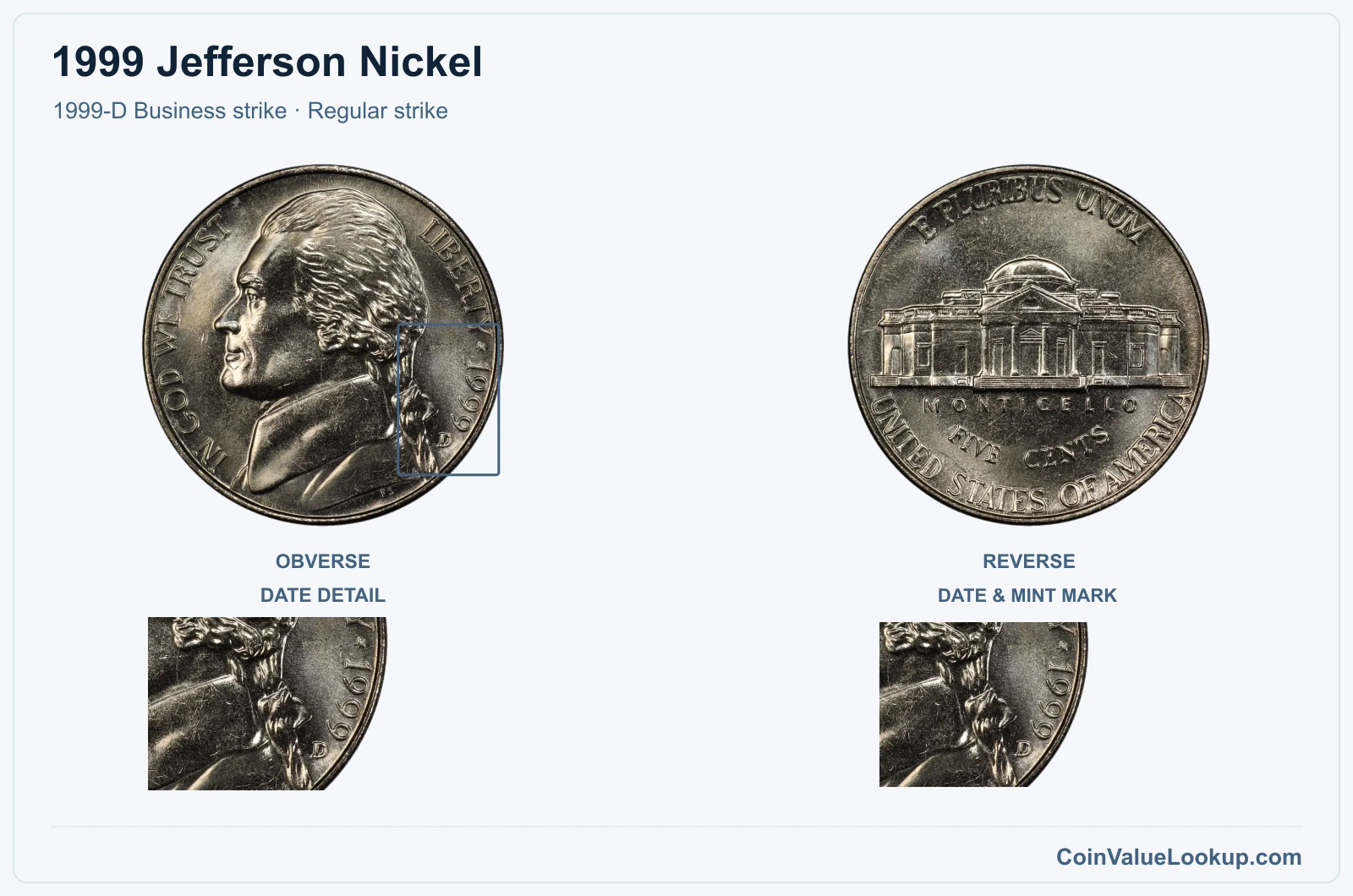
The 1999-D was struck at the Denver Mint and shares the same design, alloy, and weight as the Philadelphia issue. Look for the small "D" mintmark below the date.
Guide anchors mirror the P mint: about $0.30 at MS60 and $1.24 at MS65 per USA Coin Book. Again, these apply to uncirculated coins.
A worn 1999-D nickel is a five-cent coin unless it has a notable variety or authenticated error.
Coin Value Lookup is a handy place to look up guides for other dates and denominations in the Jefferson series if you are working through a collection.
| Range | Grade | Price | Auction Records | Appraisal |
|---|---|---|---|---|
| PO | PO 1 | — | Coin Identifier | |
| FR | FR 2 | — | Coin Identifier | |
| AG | AG 3 | — | Coin Identifier | |
| G | G 4 | — | Coin Identifier | |
| G 6 | — | Coin Identifier | ||
| VG | VG 8 | — | Coin Identifier | |
| VG 10 | — | Coin Identifier | ||
| F | F 12 | — | Coin Identifier | |
| F 15 | — | Coin Identifier | ||
| VF | VF 20 | — | Coin Identifier | |
| VF 25 | — | Coin Identifier | ||
| VF 30 | — | Coin Identifier | ||
| VF 35 | — | Coin Identifier | ||
| XF | XF 40 | — | Coin Identifier | |
| XF 45 | — | Coin Identifier | ||
| AU | AU 50 | — | Coin Identifier | |
| AU 53 | — | Coin Identifier | ||
| AU 55 | — | Coin Identifier | ||
| AU 58 | — | Coin Identifier | ||
| MS | MS 60 | — | Coin Identifier | |
| MS 61 | — | Coin Identifier | ||
| MS 62 | — | Coin Identifier | ||
| MS 63 | — | Coin Identifier | ||
| MS 64 | — | Coin Identifier | ||
| MS 65 | — | Coin Identifier | ||
| MS 66 | — | Coin Identifier | ||
| MS 67 | — | — | — | |
| MS 68 | — | — | — | |
| MS 69 | — | — | — | |
| MS 70 | — | — | — |
1999 Jefferson Nickel — S Proof
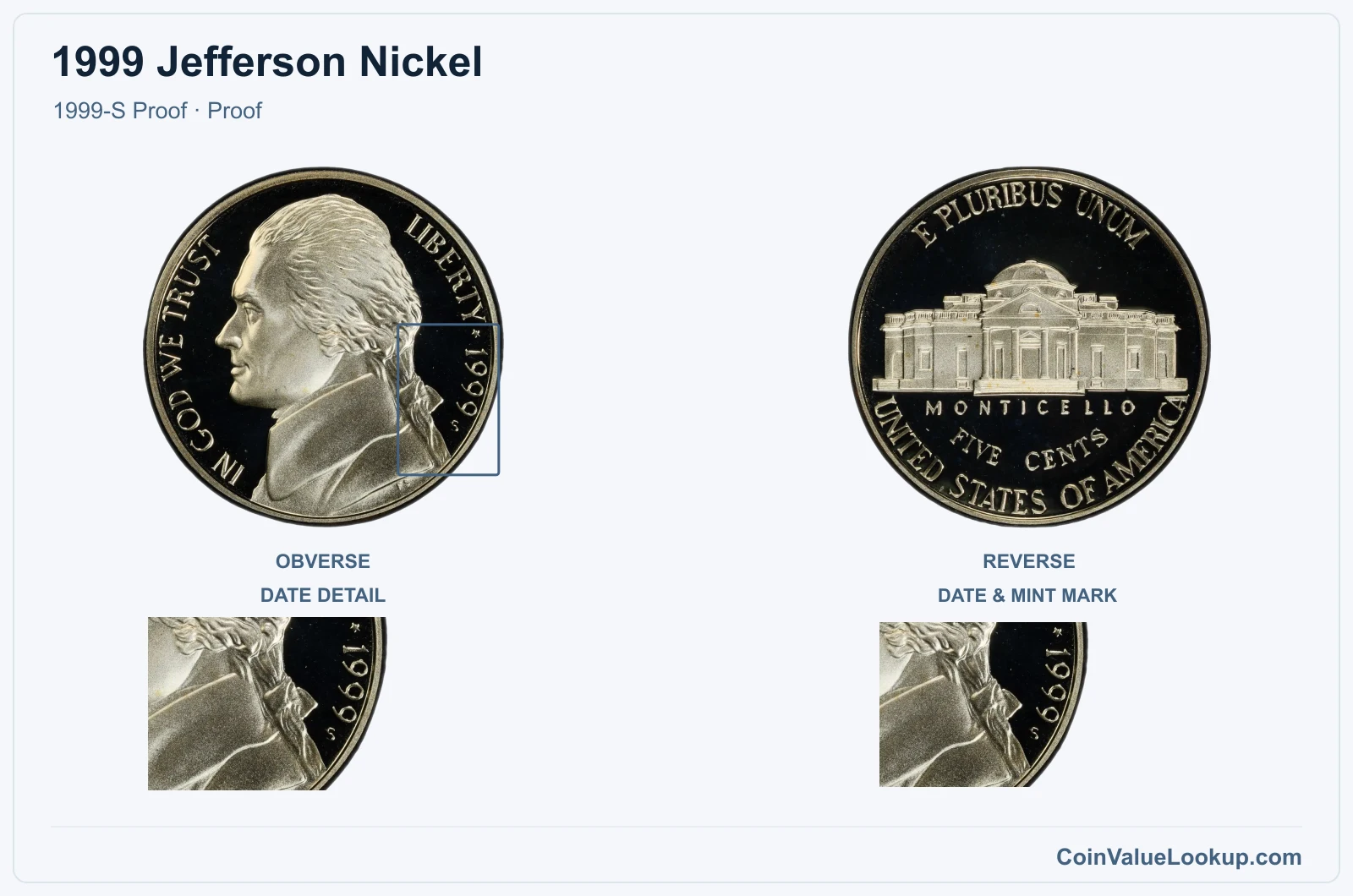
The 1999-S proof was produced at the San Francisco Mint exclusively for collector sets. It features the same Jefferson and Monticello design but with sharp, mirror-like fields and frosted devices characteristic of the proof manufacturing process.
A generic PR65 guide anchor from USA Coin Book sits at about $4.27. That figure is not specific to deep cameo or cameo designations, which carry their own market.
If your proof has heavy frosting contrasted against deeply mirrored fields, it may warrant separate evaluation under those cameo categories.
Proof is a finish, not a grade above Mint State. A proof can still have contact marks or haze that affect its numerical grade.
| Range | Grade | Price | Auction Records | Appraisal |
|---|---|---|---|---|
| PR | PR 1 | — | Coin Identifier | |
| PR 2 | — | Coin Identifier | ||
| PR 3 | — | Coin Identifier | ||
| PR 4 | — | Coin Identifier | ||
| PR 6 | — | Coin Identifier | ||
| PR 8 | — | Coin Identifier | ||
| PR 10 | — | Coin Identifier | ||
| PR 12 | — | Coin Identifier | ||
| PR 15 | — | Coin Identifier | ||
| PR 20 | — | Coin Identifier | ||
| PR 25 | — | Coin Identifier | ||
| PR 30 | — | Coin Identifier | ||
| PR 35 | — | Coin Identifier | ||
| PR 40 | — | Coin Identifier | ||
| PR 45 | — | Coin Identifier | ||
| PR 50 | — | Coin Identifier | ||
| PR 53 | — | Coin Identifier | ||
| PR 55 | — | Coin Identifier | ||
| PR 58 | — | Coin Identifier | ||
| PR 60 | — | Coin Identifier | ||
| PR 61 | — | Coin Identifier | ||
| PR 62 | — | Coin Identifier | ||
| PR 63 | — | Coin Identifier | ||
| PR 64 | — | Coin Identifier | ||
| PR 65 | — | Coin Identifier | ||
| PR 66 | — | Coin Identifier | ||
| PR 67 | Coin Identifier | |||
| PR 68 | Coin Identifier | |||
| PR 69 | Coin Identifier | |||
| PR 70 | Coin Identifier |
1999 Jefferson Nickel Error List
1. 1999 Jefferson Nickel — Struck on cent planchet
This error occurs when a 1999 nickel die pair strikes a copper cent-sized planchet instead of the correct nickel blank. The result is a coin about the size of a cent, weighing roughly 2.5 grams, with the nickel design cropped because the smaller blank cannot capture the full image.
A P-mint example graded NGC MS66 Red sold at Heritage Auctions in September 2024 for $588. That is a single auction result, not a guaranteed market price, but it shows what a certified specimen can bring.
Do not assume copper color alone means you have this error. Chemical exposure, environmental toning, and deliberate plating can all make a normal nickel look copper-colored.
Weight and attribution by a grading service are essential to confirm the wrong-planchet strike.
2. 1999 Jefferson Nickel — Struck over a1999-Dcent
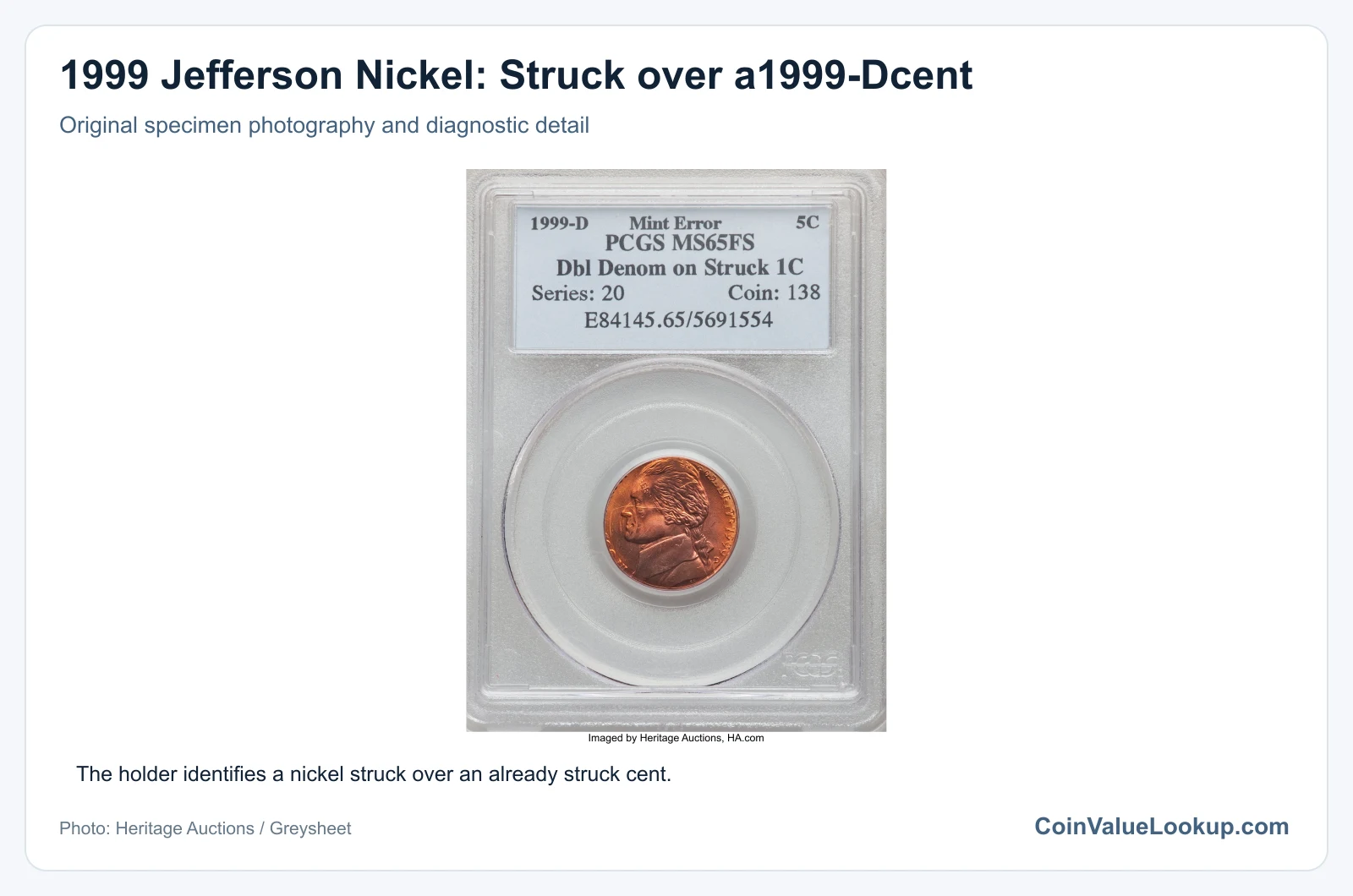
A step beyond a wrong-planchet strike, this coin was struck by 1999 nickel dies over an already-minted 1999-D Lincoln cent. Remnants of the cent design survive beneath the nickel impression, which is what distinguishes a double denomination from a simple wrong-blank error.
A D-mint example graded ANACS MS64 Red sold at Heritage Auctions in September 2024 for $1,320. That price reflects the rarity and visual drama of two recognizable designs on one coin.
Look for traces of Lincoln's portrait or the Memorial reverse peeking through the nickel design. Coins that merely struck an unstruck cent blank, or pieces showing vise-squeeze transfer marks from contact with another coin, are different categories entirely.
Third-party certification is the practical way to confirm a double denomination.
3. 1999 Jefferson Nickel — Off-center strike
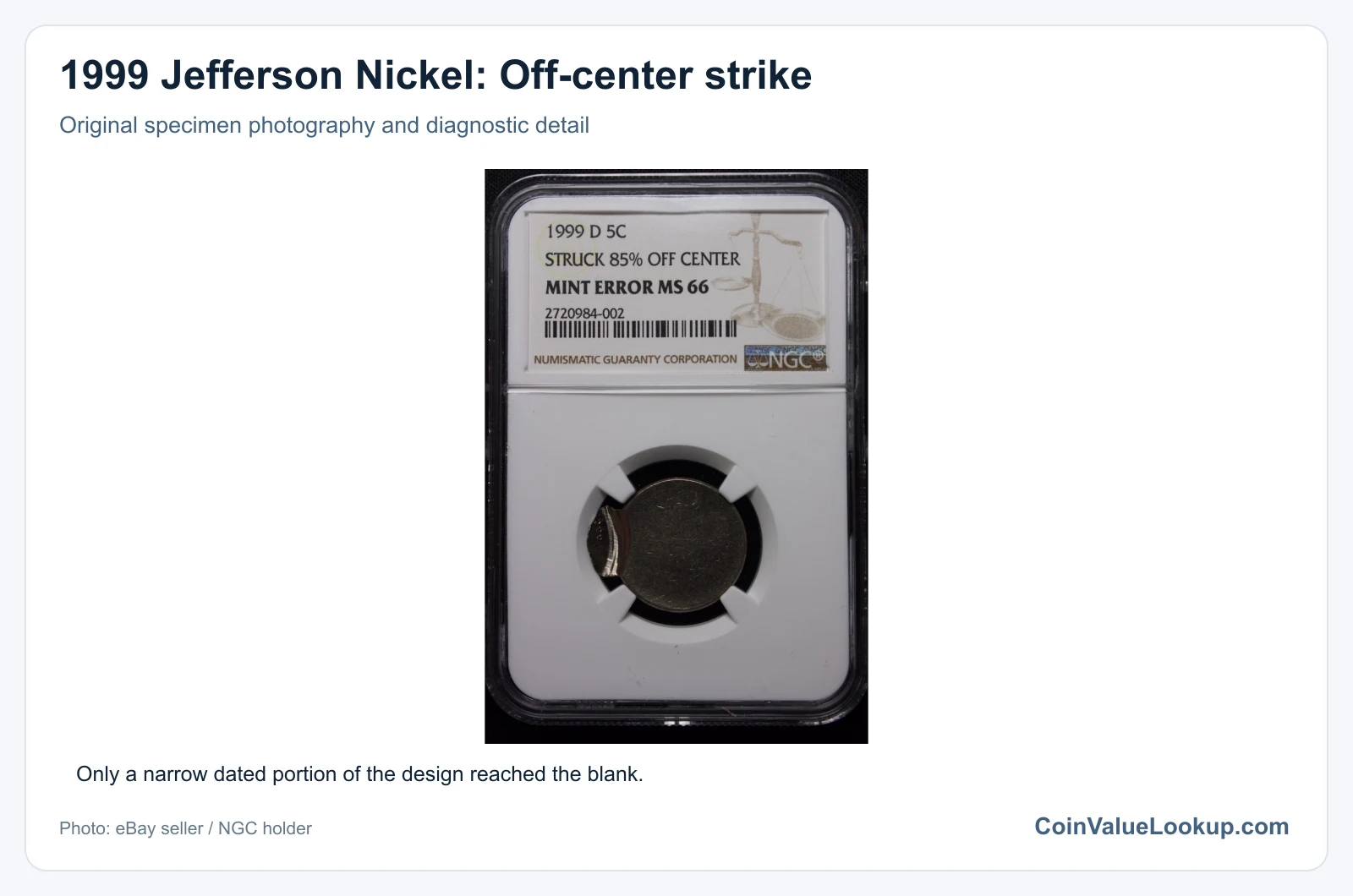
An off-center strike happens when the planchet is not seated properly between the dies, shifting the entire design to one side. The result is a blank crescent on part of the coin and a partial or missing design on the opposite edge.
A 1999-D example struck approximately 65% off center, graded PCGS MS64, sold at Heritage Auctions in September 2024 for $75. Value depends heavily on the percentage of displacement and whether the date is still visible.
A retained date is critical for attribution.
Do not confuse an off-center strike with a single misaligned die, a clipped edge, or post-mint damage such as a cut rim. An off-center strike displaces the entire design uniformly on both sides of the coin.
4. 1999 Jefferson Nickel — Broadstrike
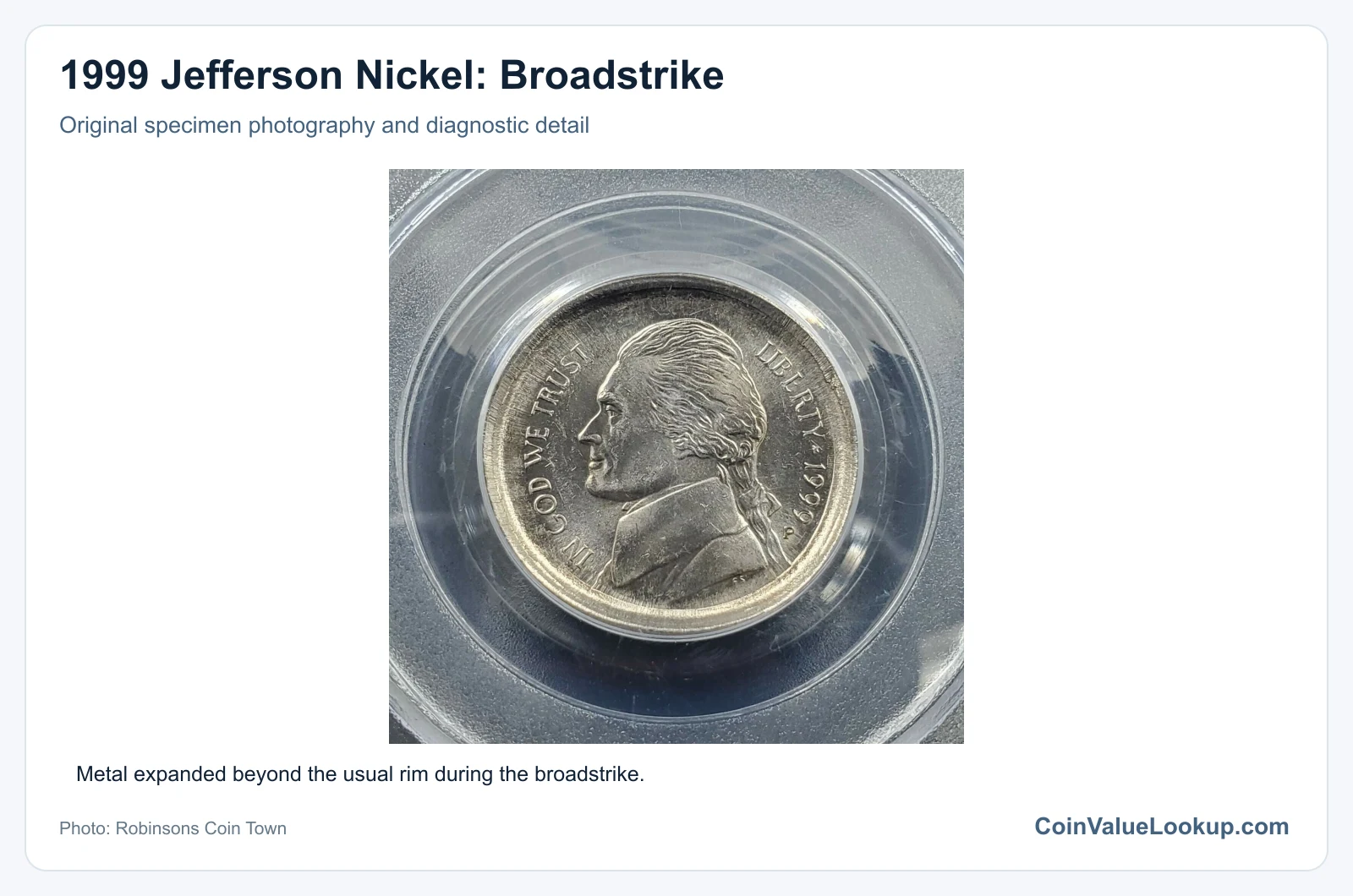
A broadstrike occurs when the collar die that normally restrains the planchet's edge is absent or fails. The metal spreads outward under striking pressure, producing a coin that is wider than normal with a spread, undefined border but still shows the complete design.
A 1999-P example graded PCGS MS63 sold at Heritage Auctions in March 2025 for $89. That is a single sale, not a range.
Check both the diameter and the edge. A broadstruck nickel will be visibly larger than a normal 21.2 mm coin, and the rim will lack the usual raised definition.
Coins with rims that have been ground down or hammered flat after leaving the mint can mimic this look, so edge texture and overall metal flow matter when distinguishing genuine broadstrikes from altered pieces.
5. 1999 Jefferson Nickel — Clipped Planchet
A clipped planchet error results when the blank is punched from strip metal that overlaps a previously punched hole or the strip's edge. The coin will show a missing curved, straight, or ragged section where metal was never present.
Look at the edge carefully. Genuine clips often produce a characteristic area of weakness in the design directly opposite the missing section, caused by incomplete metal flow during striking.
The edge at the clip itself will have a texture consistent with the original blank rather than tool marks or corrosion.
An edge that has been filed, cut with a tool, or eaten away by corrosion can look superficially similar. Value depends on the type of clip, its size, how visible it is, and the coin's overall condition.
Have unusual pieces evaluated individually.
6. 1999 Jefferson Nickel — Misaligned Die
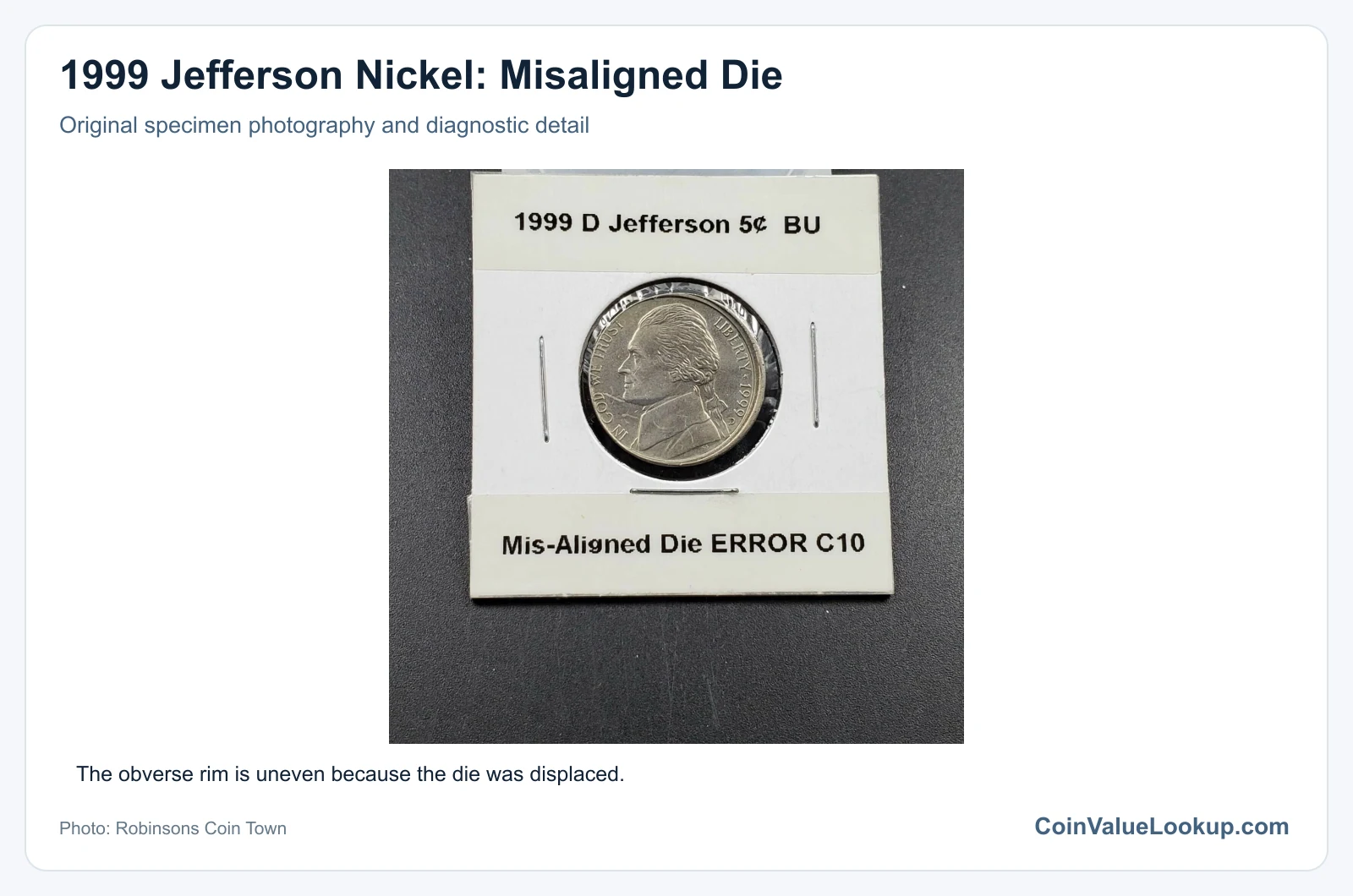
A misaligned die error shows up when one die is shifted laterally relative to the planchet or the opposite die. The design on the affected side appears off-center while the other side may look normal, which is the key difference from a true off-center strike where both sides shift together.
This is also distinct from a rotational misalignment, where the dies are turned relative to each other rather than shifted sideways. Compare both sides of your coin carefully to see if only one face has the displacement.
A tilted photograph or uneven lighting can make a perfectly normal coin look misaligned, so photograph the coin flat and centered. Value depends on how dramatic the shift is, the coin's condition, and the specific mint and finish.
Post-mint rim damage does not qualify.
7. 1999 Jefferson Nickel — Double / Multiple Strike
A double or multiple strike error happens when a coin is struck more than once by the dies, producing separate, displaced, or rotated impressions of the design. You will see overlapping or distinctly offset versions of Jefferson or Monticello, not just slightly thickened lettering.
This is not the same as a doubled die, which is a single strike from a die that has a doubled image engraved into it. A doubled die creates uniform doubling across every coin struck by that die, while a double strike is unique to the individual coin.
Also watch out for impressions added after the coin left the mint, such as vise marks or contact damage. Genuine multiple strikes show full die detail in each impression.
Value depends on the number of strikes, degree of displacement, and overall condition of the coin.