1999 Kennedy Half Dollar Coin Value: How Much Is It Worth?
The 1999 Kennedy half dollar carries a face value of fifty cents, and most circulated clad examples are worth exactly that. Before you toss it back in the jar, though, know that the right combination of mint, finish and condition can push a coin well above spare-change territory.
Guide estimates from USA Coin Book place collectible examples between roughly $3.62 and $47.00 depending on the specific branch and grade. Proofs, silver strikes and mint-made errors each follow their own pricing logic, so identifying what you actually have is the first step.
Fast Way to Identify Your 1999 Kennedy Half Dollar
The quickest way to start is to snap clear photos of both sides of your coin and upload them here for a preliminary identification. Good lighting and a steady hand help — get the mintmark area beneath Kennedy's portrait in focus.
This tool can help sort out which branch you are holding, though it is not a substitute for professional authentication or certified grading.
1999 Kennedy Half Dollar Value
Upload both sides of your 1999 Kennedy Half Dollar.
Front Obverse
Upload photo
Back Reverse
Upload photo
Which 1999 Kennedy Half Dollar Versions Are Worth Money?
- The 1999-S silver proof commands the highest guide value at $47.00 in PR65, thanks to its 90% silver composition and proof finish.
- Clad proofs from San Francisco are listed at $16.00 in PR65, well above face value for a coin that cost little in its original proof set.
- Business strikes from Philadelphia or Denver in strong MS65 condition are estimated at $3.62 each — modest, but still above face value.
- Several mint-made error types have been reported for this date; condition, visibility and authentication all affect what an error coin is worth.
Step 1: Identify Your 1999 Kennedy Half Dollar Mint Mark and Version
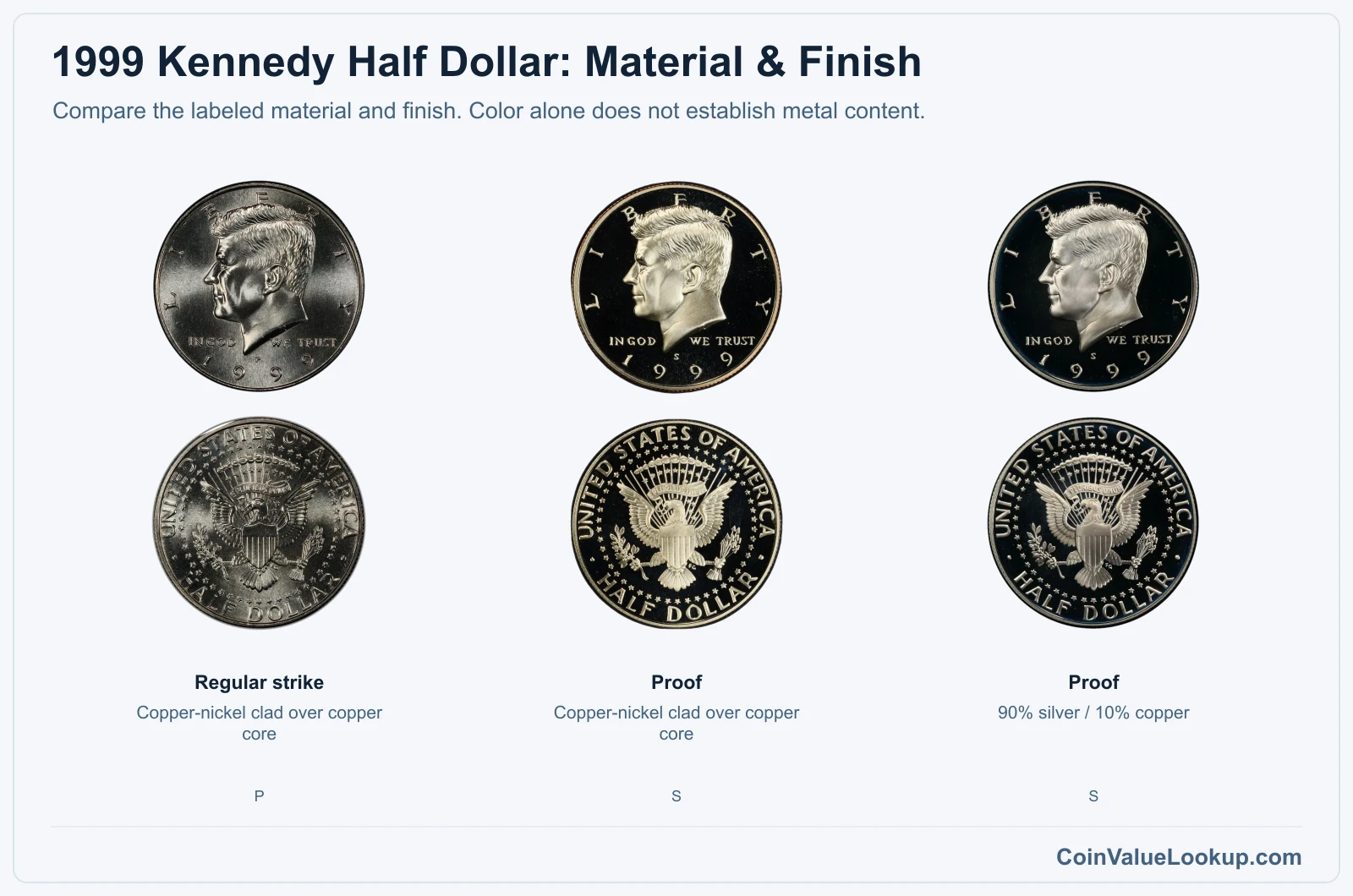
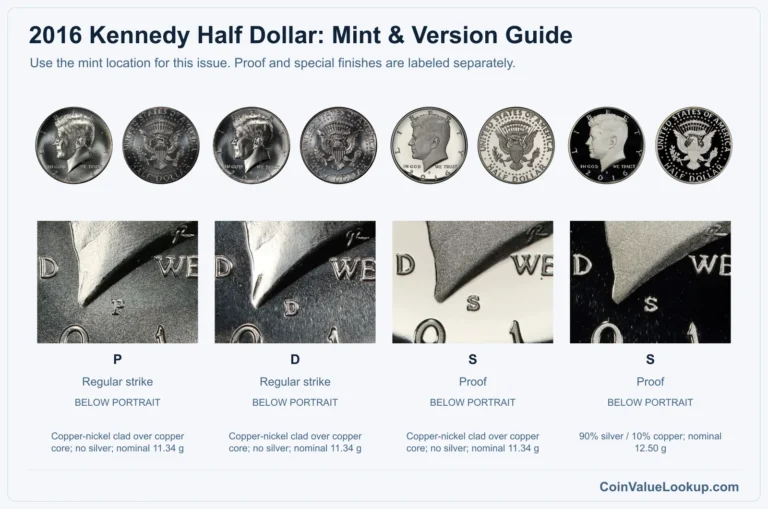
Look beneath Kennedy's portrait on the obverse, just above the date. That is where the mintmark lives.
A "P" means Philadelphia, "D" means Denver, and "S" means San Francisco. Philadelphia coins struck before 1980 carry no mintmark at all, but by 1999 the P was standard.
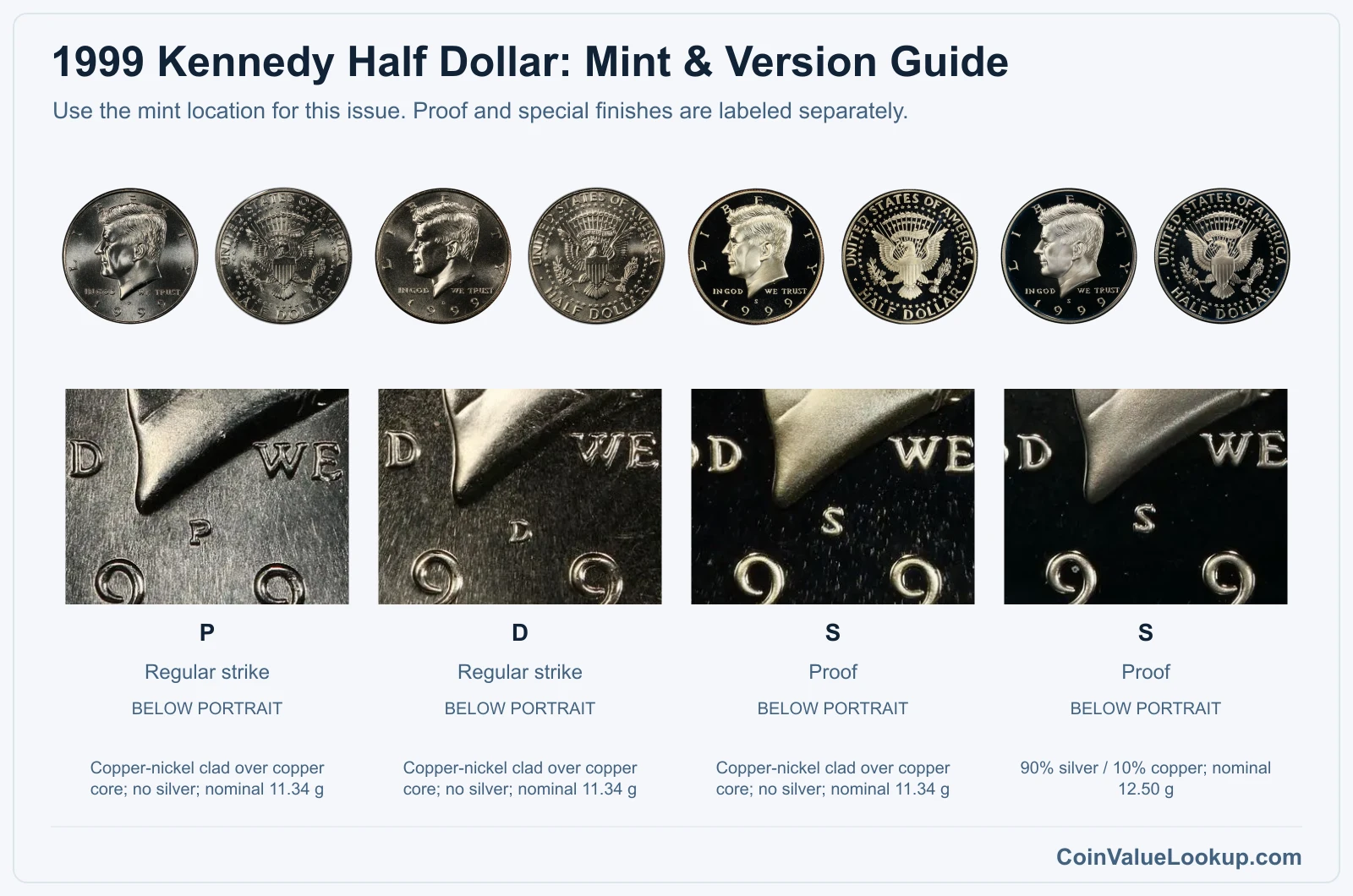
All P and D strikes are copper-nickel clad business coins with no silver content. San Francisco produced two proof versions this year: a clad proof and a 90% silver proof.
Both carry the S mintmark, so the letter alone will not tell you which one you have.
To separate the silver proof from the clad proof, compare weight and edge. The silver proof weighs roughly 12.50 grams versus about 11.34 grams for clad.
On the edge of a clad coin you may see a visible copper-colored stripe; the silver proof edge is uniformly silver-white. Original government packaging also helps confirm composition.
Do not rely on surface color alone — toning, lighting and even household chemicals can make clad look like silver or vice versa.
Step 2: Check Your 1999 Kennedy Half Dollar Grade
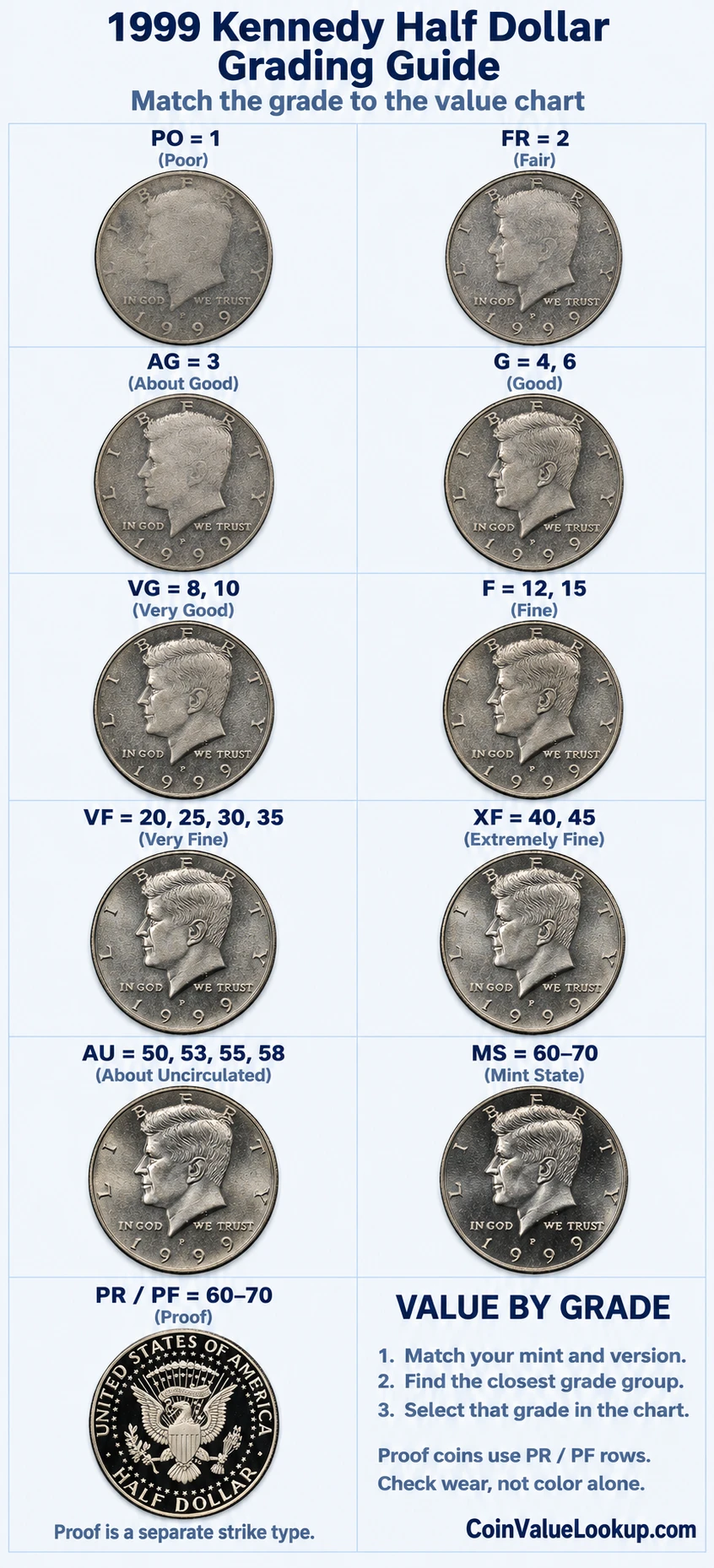
Start with Kennedy's cheek and jawline. On a lightly circulated coin these high points show smooth, flat patches where the original texture has worn away.
The hair just above the ear is another early-wear zone — compare yours to the reference image and note how much fine detail remains.
On the reverse, check the eagle's breast feathers and the tops of the wings. These are the first areas to lose definition as a coin circulates.
Mint State coins show no wear at all, but that does not mean they are perfect. Bag marks — small nicks from coins banging together in bulk storage — can lower a Mint State grade significantly.
A coin covered in contact marks is still uncirculated, just not a pretty one.
Proofs need a different eye. Look for hairlines from improper handling, haze from moisture exposure, and contact marks on the mirror fields.
A proof is a method of manufacture, not a grade above Mint State, so a beat-up proof can absolutely be worth less than a clean business strike.
Coin Value Lookup is a handy starting point when you want to look up guides for other dates and denominations in the Kennedy series or beyond.
Step 3: Check 1999 Kennedy Half Dollar Value by Mint and Version
1999 Kennedy Half Dollar — P — clad business
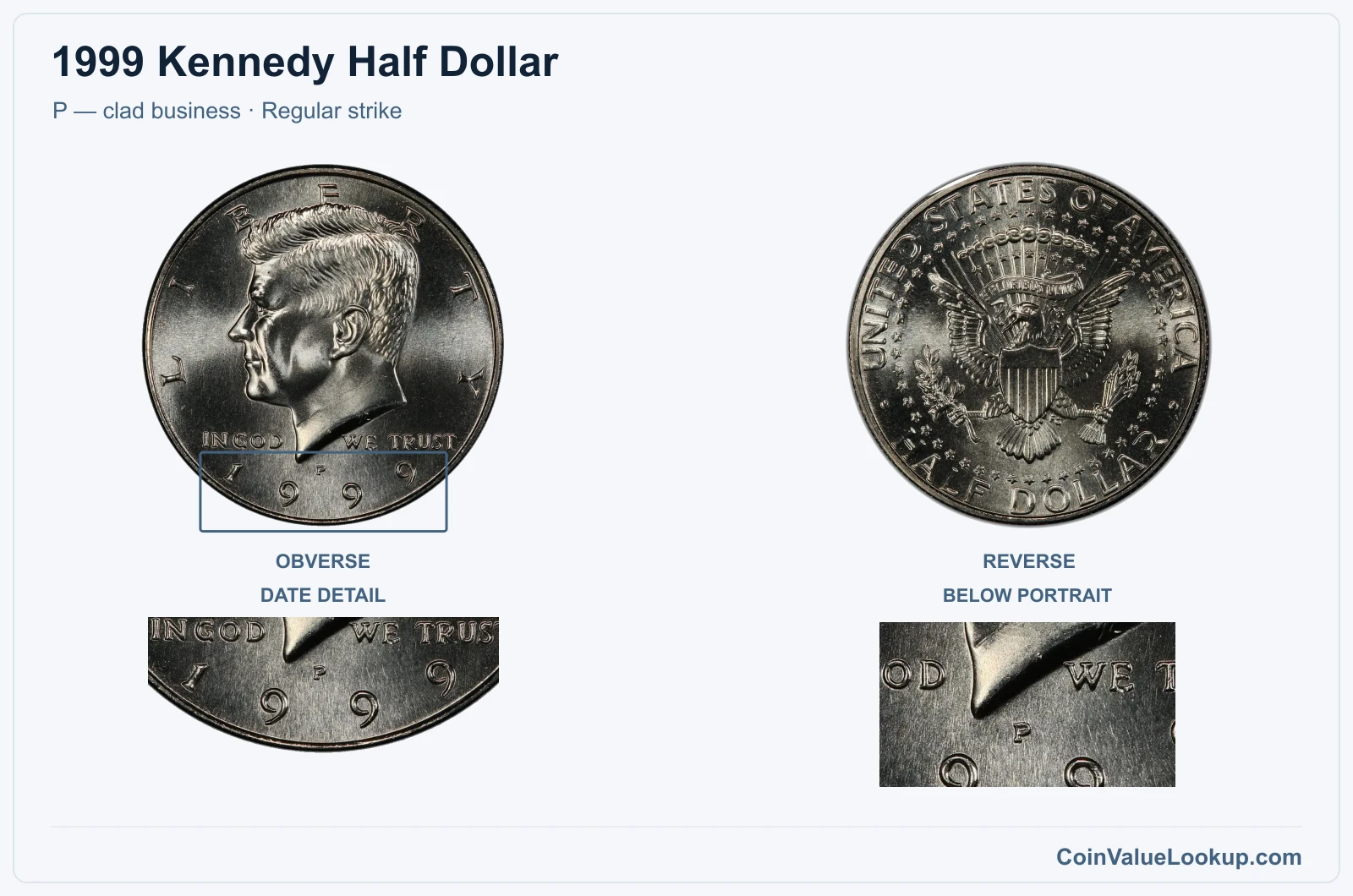
The 1999-P Kennedy half dollar is a copper-nickel clad business strike from the Philadelphia Mint. Look for the small "P" mintmark beneath Kennedy's portrait.
Millions were produced, and most that saw any circulation are worth face value.
In higher preserved condition the coin begins to carry a small premium. USA Coin Book lists an MS65 example at about $3.62.
That is not retirement money, but it does mean a sharp, mark-free roll coin is worth pulling aside. Focus on bag marks and luster when deciding whether yours qualifies.
Range Grade
Price Auction Records Appraisal PO PO 1
—
Coin Identifier FR FR 2
—
Coin Identifier AG AG 3
—
Coin Identifier G G 4
—
Coin Identifier
G 6
—
Coin Identifier VG VG 8
—
Coin Identifier
VG 10
—
Coin Identifier F F 12
—
Coin Identifier
F 15
—
Coin Identifier VF VF 20
—
Coin Identifier
VF 25
—
Coin Identifier
VF 30
—
Coin Identifier
VF 35
—
Coin Identifier XF XF 40
—
Coin Identifier
XF 45
—
Coin Identifier AU AU 50
—
Coin Identifier
AU 53
—
Coin Identifier
AU 55
—
Coin Identifier
AU 58
—
Coin Identifier MS MS 60
—
Coin Identifier
MS 61
—
Coin Identifier
MS 62
—
Coin Identifier
MS 63
—
Coin Identifier
MS 64
—
Coin Identifier
MS 65
Coin Identifier
MS 66
Coin Identifier
MS 67
Coin Identifier
MS 68
Coin Identifier
MS 69
—
—
—
MS 70
—
—
—
1999 Kennedy Half Dollar — D — clad business
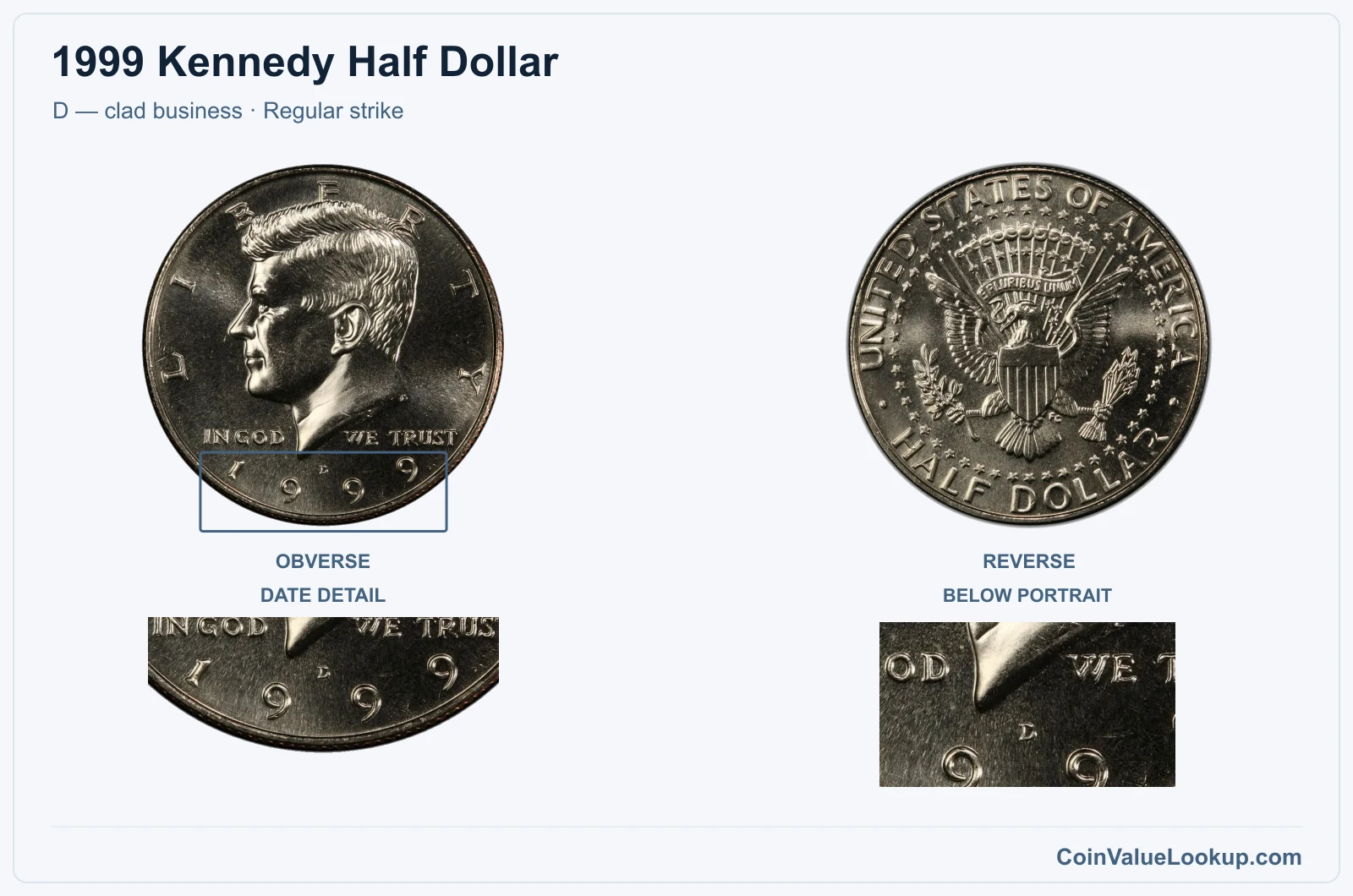
Denver's 1999-D half dollar is the same copper-nickel clad composition as its Philadelphia sibling. The "D" mintmark sits in the usual spot beneath Kennedy's portrait.
Circulated pieces are face-value coins.
An MS65 example is estimated at around $3.62 according to USA Coin Book. As with the P mint, the key to any premium is preservation — clean fields, full luster and minimal contact marks.
These were widely saved in mint sets, so finding one in good shape is not especially difficult, which keeps the premium modest.
Range Grade
Price Auction Records Appraisal PO PO 1
—
Coin Identifier FR FR 2
—
Coin Identifier AG AG 3
—
Coin Identifier G G 4
—
Coin Identifier
G 6
—
Coin Identifier VG VG 8
—
Coin Identifier
VG 10
—
Coin Identifier F F 12
—
Coin Identifier
F 15
—
Coin Identifier VF VF 20
—
Coin Identifier
VF 25
—
Coin Identifier
VF 30
—
Coin Identifier
VF 35
—
Coin Identifier XF XF 40
—
Coin Identifier
XF 45
—
Coin Identifier AU AU 50
—
Coin Identifier
AU 53
—
Coin Identifier
AU 55
—
Coin Identifier
AU 58
—
Coin Identifier MS MS 60
—
Coin Identifier
MS 61
—
Coin Identifier
MS 62
—
Coin Identifier
MS 63
Coin Identifier
MS 64
Coin Identifier
MS 65
Coin Identifier
MS 66
Coin Identifier
MS 67
Coin Identifier
MS 68
Coin Identifier
MS 69
—
—
—
MS 70
—
—
—
1999 Kennedy Half Dollar — S — clad proof
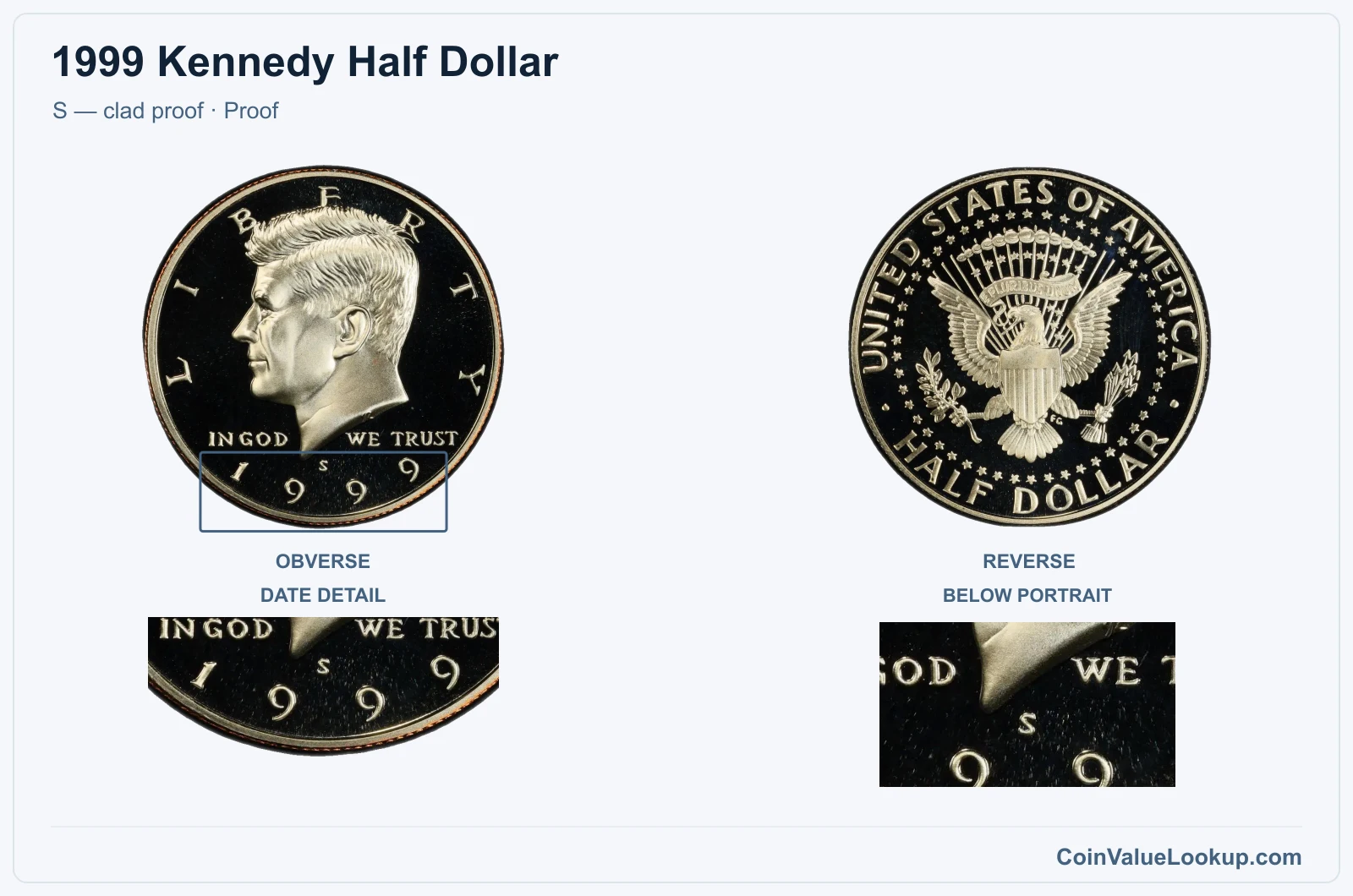
The 1999-S clad proof was struck at San Francisco on copper-nickel clad planchets specifically for collector proof sets. It shares the "S" mintmark with the silver proof, so do not assume silver just because you see that letter.
Mirror-like fields and frosted design devices are the hallmarks of a proof finish. USA Coin Book estimates a PR65 clad proof at $16.00.
When evaluating one, look for hairlines across the open fields around Kennedy's portrait and any haze or toning on the mirror surfaces. Most of these were sold in sealed sets, so coins outside original packaging deserve extra scrutiny for handling marks.
Range Grade
Price Auction Records Appraisal PR PR 1
—
Coin Identifier
PR 2
—
Coin Identifier
PR 3
—
Coin Identifier
PR 4
—
Coin Identifier
PR 6
—
Coin Identifier
PR 8
—
Coin Identifier
PR 10
—
Coin Identifier
PR 12
—
Coin Identifier
PR 15
—
Coin Identifier
PR 20
—
Coin Identifier
PR 25
—
Coin Identifier
PR 30
—
Coin Identifier
PR 35
—
Coin Identifier
PR 40
—
Coin Identifier
PR 45
—
Coin Identifier
PR 50
—
Coin Identifier
PR 53
—
Coin Identifier
PR 55
—
Coin Identifier
PR 58
—
Coin Identifier
PR 60
—
Coin Identifier
PR 61
—
Coin Identifier
PR 62
—
Coin Identifier
PR 63
—
Coin Identifier
PR 64
—
Coin Identifier
PR 65
—
Coin Identifier
PR 66
—
Coin Identifier
PR 67
—
Coin Identifier
PR 68
Coin Identifier
PR 69
Coin Identifier
PR 70
Coin Identifier
1999 Kennedy Half Dollar — S — silver proof
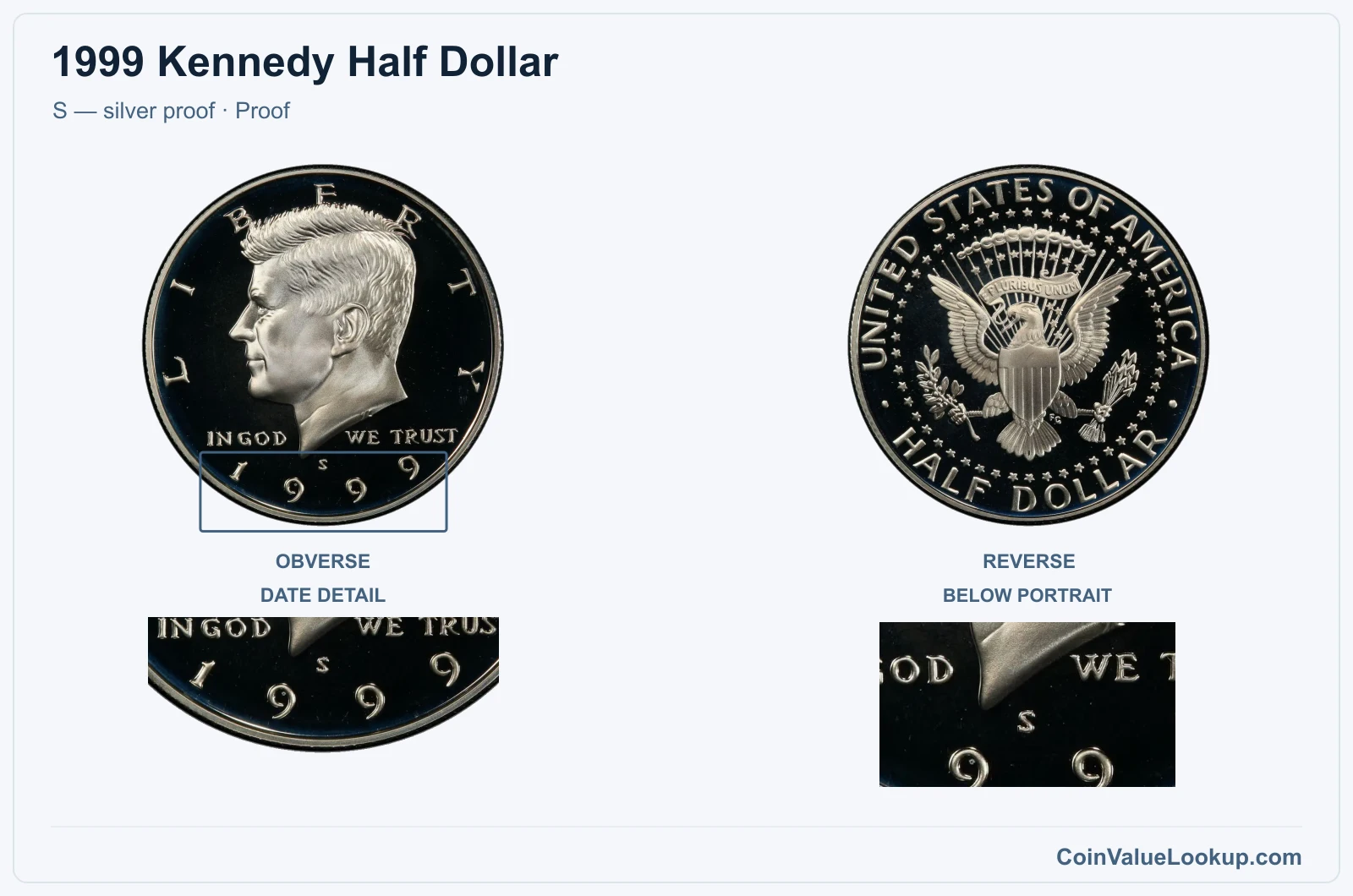
This is the premium version of the 1999 San Francisco proof — struck on a 90% silver, 10% copper planchet weighing roughly 12.50 grams. It carries the same S mintmark as the clad proof, which is why weight and edge examination matter.
USA Coin Book places a PR65 silver proof at $47.00, the highest guide value for any regular-issue 1999 Kennedy half. The silver content alone gives it intrinsic metal value, and the proof finish adds collector appeal on top of that.
Confirm composition before paying a silver-proof premium; a kitchen scale accurate to a tenth of a gram can help separate 11.34-gram clad from 12.50-gram silver. Original mint packaging with a certificate of authenticity is the easiest confirmation of all.
Range Grade
Price Auction Records Appraisal PR PR 1
—
Coin Identifier
PR 2
—
Coin Identifier
PR 3
—
Coin Identifier
PR 4
—
Coin Identifier
PR 6
—
Coin Identifier
PR 8
—
Coin Identifier
PR 10
—
Coin Identifier
PR 12
—
Coin Identifier
PR 15
—
Coin Identifier
PR 20
—
Coin Identifier
PR 25
—
Coin Identifier
PR 30
—
Coin Identifier
PR 35
—
Coin Identifier
PR 40
—
Coin Identifier
PR 45
—
Coin Identifier
PR 50
—
Coin Identifier
PR 53
—
Coin Identifier
PR 55
—
Coin Identifier
PR 58
—
Coin Identifier
PR 60
—
Coin Identifier
PR 61
—
Coin Identifier
PR 62
—
Coin Identifier
PR 63
—
Coin Identifier
PR 64
—
Coin Identifier
PR 65
—
Coin Identifier
PR 66
—
Coin Identifier
PR 67
—
Coin Identifier
PR 68
Coin Identifier
PR 69
Coin Identifier
PR 70
Coin Identifier
1999 Kennedy Half Dollar Error List
1. 1999 Kennedy Half Dollar — Missing FG Initials
On a normal Kennedy half dollar reverse, the designer's initials "FG" (for Frank Gasparro) appear between the eagle's tail feathers and the right leg. On a reported No FG variety, those initials are absent or nearly invisible due to die polishing at the mint during production.
Before getting excited, check whether the initials simply wore away from circulation or were obscured by grease or debris during striking. Genuine die-polished examples typically show a smooth, uninterrupted field where the letters should be, with surrounding design elements still sharp.
A worn coin with missing FG will also show flatness on the eagle's tail and nearby feathers.
Condition, the degree of letter absence and third-party authentication all affect what a confirmed example is worth. No reliable numerical price range is available here for the 1999 date.
2. 1999 Kennedy Half Dollar — Doubled Die Obverse
A doubled die obverse on a 1999 Kennedy half shows consistent doubling on obverse design elements — letters, the date or profile details. The key word is consistent: true hub doubling produces separation or notching that repeats in the same direction across affected areas.
Compare suspect lettering to a normal 1999 half under the same magnification and lighting. Machine doubling, which is far more common, tends to produce a flat, shelf-like secondary image rather than rounded, distinct separation.
Reflections from proof-like surfaces can also mimic doubling to the untrained eye.
Value depends on the specific die, visibility of the doubling and the coin's overall condition. No adopted price range is available for this date, so individual assessment by a grading service is the practical path for any promising find.
3. 1999 Kennedy Half Dollar — Doubled Die Reverse
A doubled die reverse affects the back of the coin — look at the lettering in UNITED STATES OF AMERICA, HALF DOLLAR, or E PLURIBUS UNUM, and examine the eagle's design contours. True doubling appears as a second, slightly offset impression of the same element.
Do not confuse this with machine doubling, which leaves a flat, smeared shelf next to the raised design. Machine doubling is mechanical damage, not a die variety, and carries little collector premium.
Random nicks and scratches can also look like doubling at a glance.
Compare your coin side by side with a normal 1999 reverse under magnification. No specific price range is adopted for a 1999 doubled die reverse here; value hinges on the particular die, the strength of doubling and overall condition.
4. 1999 Kennedy Half Dollar — Off-Center Strike
An off-center strike happens when the planchet is not seated properly between the dies. The result is a design that is shifted to one side, leaving an unstruck crescent of blank metal on the opposite edge.
Small off-center shifts of a few percent are relatively common and only modestly collectible. Larger shifts — say 10% or more — attract more attention, especially when the full date remains visible.
A coin missing its date loses a key attribution point and is harder to sell.
Do not confuse an off-center strike with a clipped planchet or a coin that was damaged after leaving the mint. Post-mint flattening or vise damage can push design elements around but will also distort the rim unevenly.
No specific price range is adopted for a 1999 off-center Kennedy half; the percentage of displacement, date visibility and condition all factor into value.
5. 1999 Kennedy Half Dollar — Struck-Through Error
A struck-through error occurs when foreign material — grease, a thread, a piece of metal, even a fragment of plastic — gets caught between the die and the planchet during striking. The result is a localized depression or incomplete design area that matches the shape of whatever was in the way.
Grease-filled dies are the most common version: they leave soft, slightly sunken blanks where details should be. A retained foreign object actually embedded in the coin's surface is rarer and typically more desirable.
The distinction from ordinary wear is important. Wear removes metal gradually and affects high points first.
A struck-through impression can appear anywhere and often has sharper edges. Scratches and cleaning marks are post-mint damage, not strike errors.
Value depends on the size, location and type of obstruction, plus overall coin condition. No numerical price range is adopted here.
6. 1999 Kennedy Half Dollar — Missing Clad Layer
A missing clad layer error means one of the outer copper-nickel layers was absent from the planchet before it was struck. The exposed side may show a distinctly different color — the copper core — and the coin will weigh noticeably less than the standard 11.34 grams.
Check both sides and the edge carefully. On a normal clad half, the edge shows a visible sandwich of layers.
A coin missing one clad layer will look asymmetric at the edge, with copper visible on the affected face.
Toning, corrosion and environmental damage can also change a coin's surface color, so weight is the best quick test. Deliberate removal of the clad layer after minting (acid etching, for example) does not count.
No adopted price range is available for a 1999 missing-clad Kennedy half; the extent of the missing layer and the coin's condition both matter for value.
7. 1999 Kennedy Half Dollar — Clipped Planchet
A clipped planchet error results when the blank is punched from strip metal that overlaps a previously punched hole or the edge of the strip. The coin ends up missing a curved, straight or irregular portion of its rim and field.
Look for a characteristic weakness in the design opposite the clip — metal flow during striking can thin the design on that side. The edge at the clip itself should show the natural texture of the blank's cut, not a filed or ground surface.
A straight clip from the end of a strip looks different from the more common curved clip.
Post-mint damage such as a filed edge, plier marks or corrosion can mimic a clip. If your coin has sharp tool marks or an unnatural edge profile, it was likely altered.
No specific price range is adopted for a 1999 clipped-planchet Kennedy half; the size and type of clip, along with overall condition, determine collector interest.