1876 Liberty Seated Half Dollar Coin Value: How Much Is It Worth?
The 1876 Liberty Seated Half Dollar carries guide estimates starting around $79 in G4 and climbing to roughly $394 in AU50 for Philadelphia issues. Your coin's actual worth depends heavily on which mint struck it, its condition, and whether it belongs to a scarcer design or variety branch.
Carson City pieces, Proofs, and certain named varieties all command separate and often much higher values.
Fast Way to Identify Your 1876 Liberty Seated Half Dollar
Snap clear photos of the front and back of your 1876 half dollar and upload them for a preliminary identification. This helps narrow down the mint, mintmark style, and reverse type so you can start comparing your coin to the right version.
Good lighting at a slight angle reveals details that straight-on shots can miss.
1876 Liberty Seated Half Dollar Value
Upload both sides of your 1876 Liberty Seated Half Dollar.
Front Obverse
Upload photo
Back Reverse
Upload photo
Which 1876 Liberty Seated Half Dollar Versions Are Worth Money?
- Carson City half dollars (Small, Medium, or Large CC) start around $162 in G4 and reach approximately $1,082 in AU50, roughly double to triple Philadelphia prices at each grade level.
- Philadelphia Proofs with mirrored fields and crisp rims have a guide estimate near $1,409 in PR63, making confirmed Proofs among the most valuable 1876 half dollar issues.
- The Large over Small Date variety from Philadelphia shows remnants of smaller numerals beneath the larger date punch, and values depend on individual authentication and condition rather than standard guide tables.
Step 1: Identify Your 1876 Liberty Seated Half Dollar Mint Mark and Version
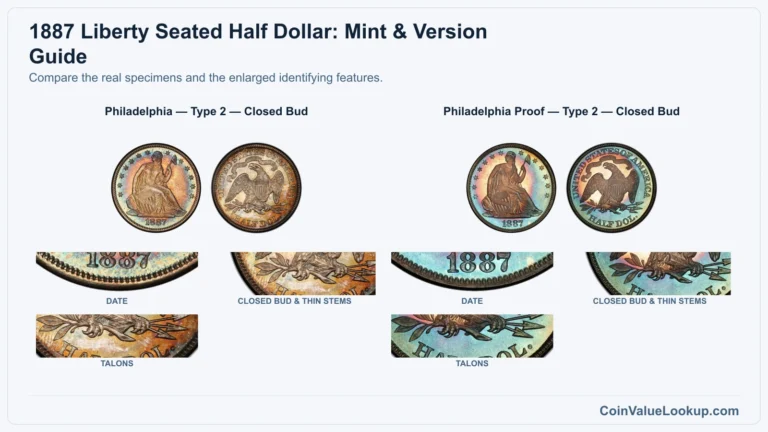
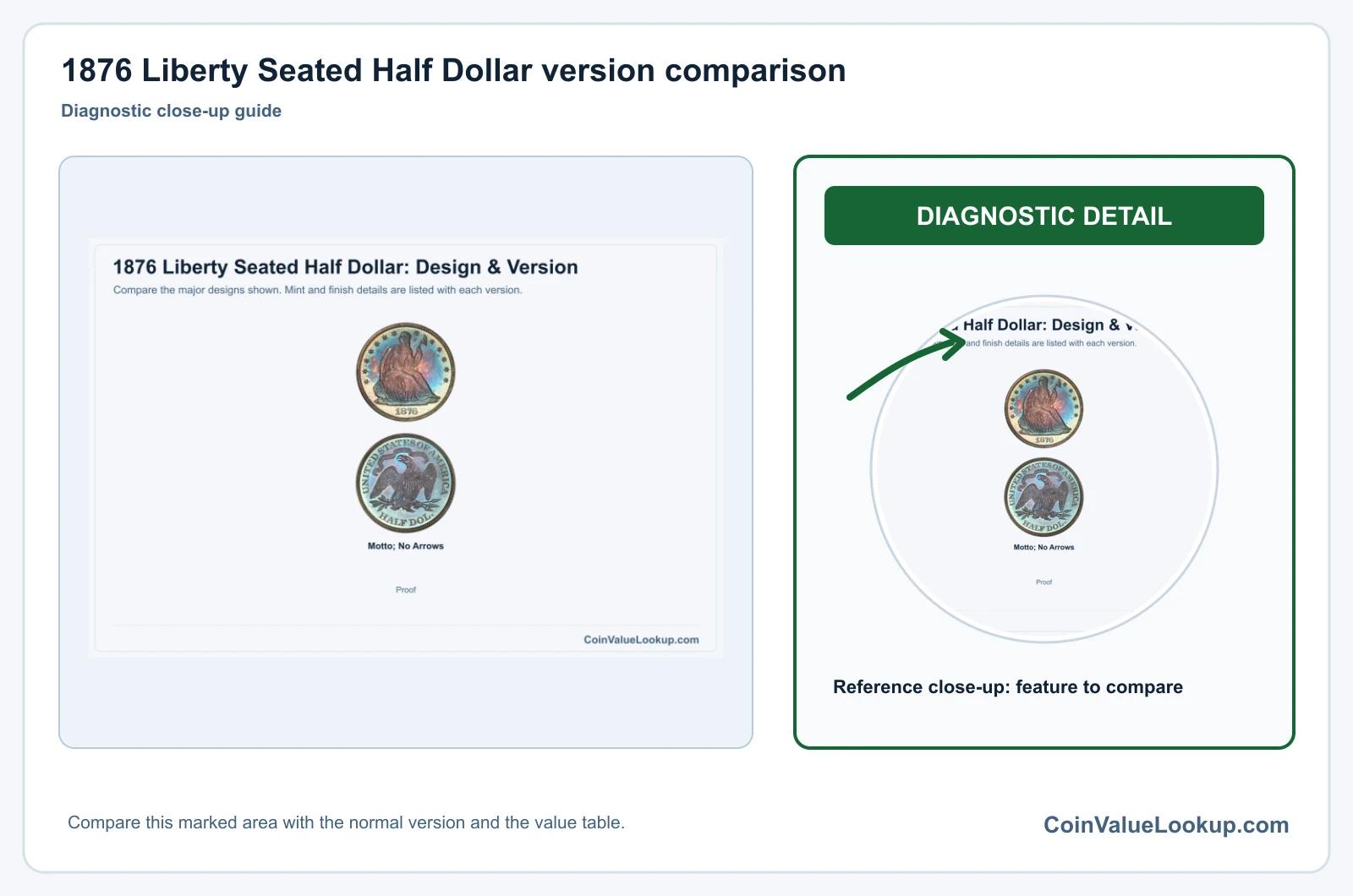
The obverse shows Liberty seated on a rock, holding a pole with a cap, surrounded by stars and the date 1876. The reverse features an eagle beneath a ribbon reading IN GOD WE TRUST, with HALF DOL below.
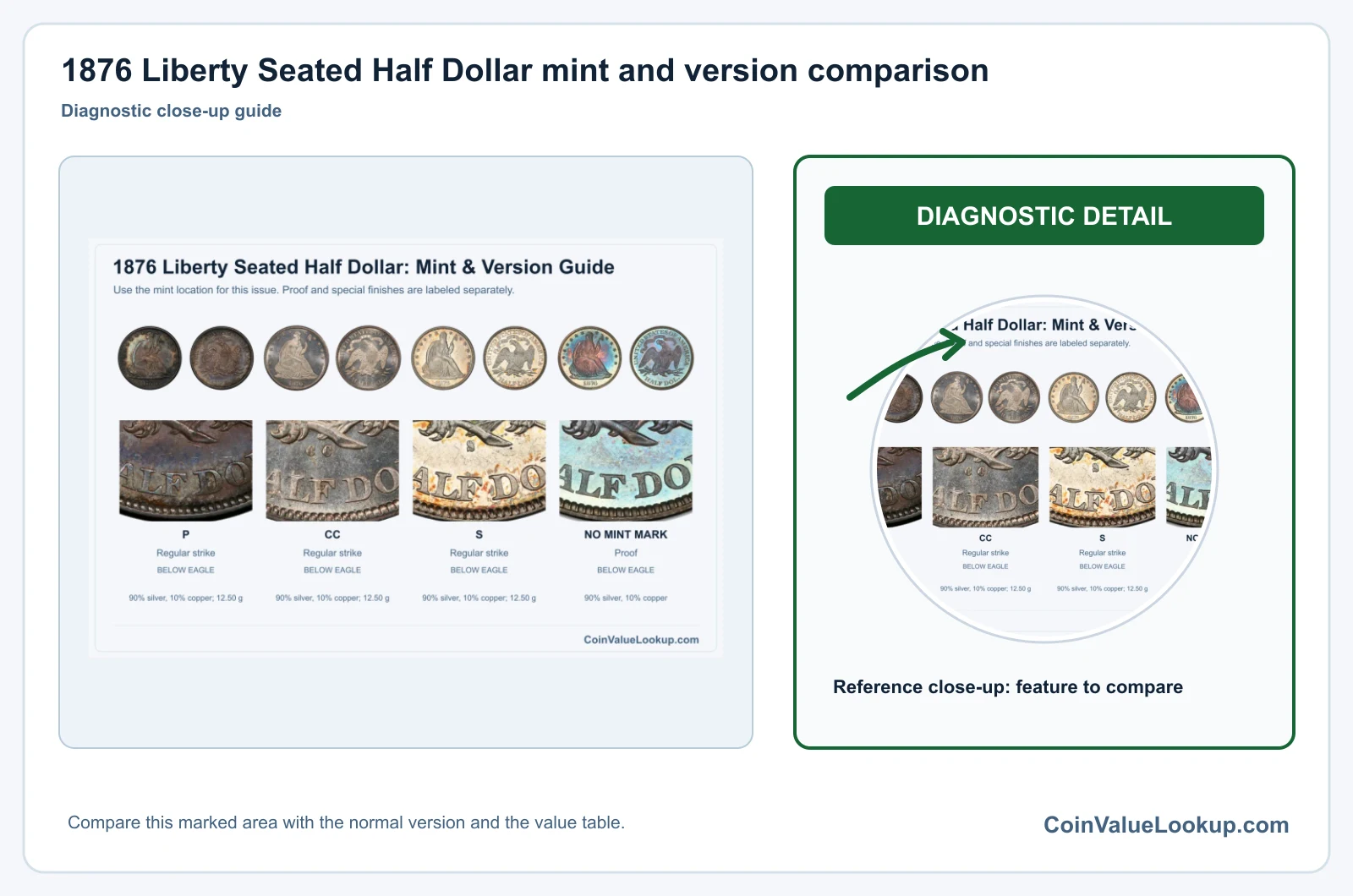
Flip the coin over and look directly below the eagle for the mintmark. No letter means Philadelphia.
An "S" means San Francisco. "CC" means Carson City, and those are the ones that get collectors excited.
The coin is struck in 90% silver and 10% copper, weighing 12.50 grams. That weight was established in 1873 when arrows flanked the date, but by 1876 the arrows were gone even though the heavier standard remained.
Reverse types matter here. The Type 1 reverse has a split berry above the "H" in HALF, while the Type 2 reverse shows a pointed berry.
These Motto-era hub names are specific to this series and differ from earlier No Motto designations, so do not confuse them.
Mintmark sizes also vary. Carson City coins come in Small CC, Medium CC, and Large CC.
San Francisco pieces appear with Micro S and Very Small S mintmarks. Check yours against the dedicated comparison images to pin down the exact branch.
A Proof is a special manufacturing finish with mirrored fields and sharp rims, not a grade above Mint State. A shiny or reflective surface alone does not make a coin a Proof.
Step 2: Check Your 1876 Liberty Seated Half Dollar Grade
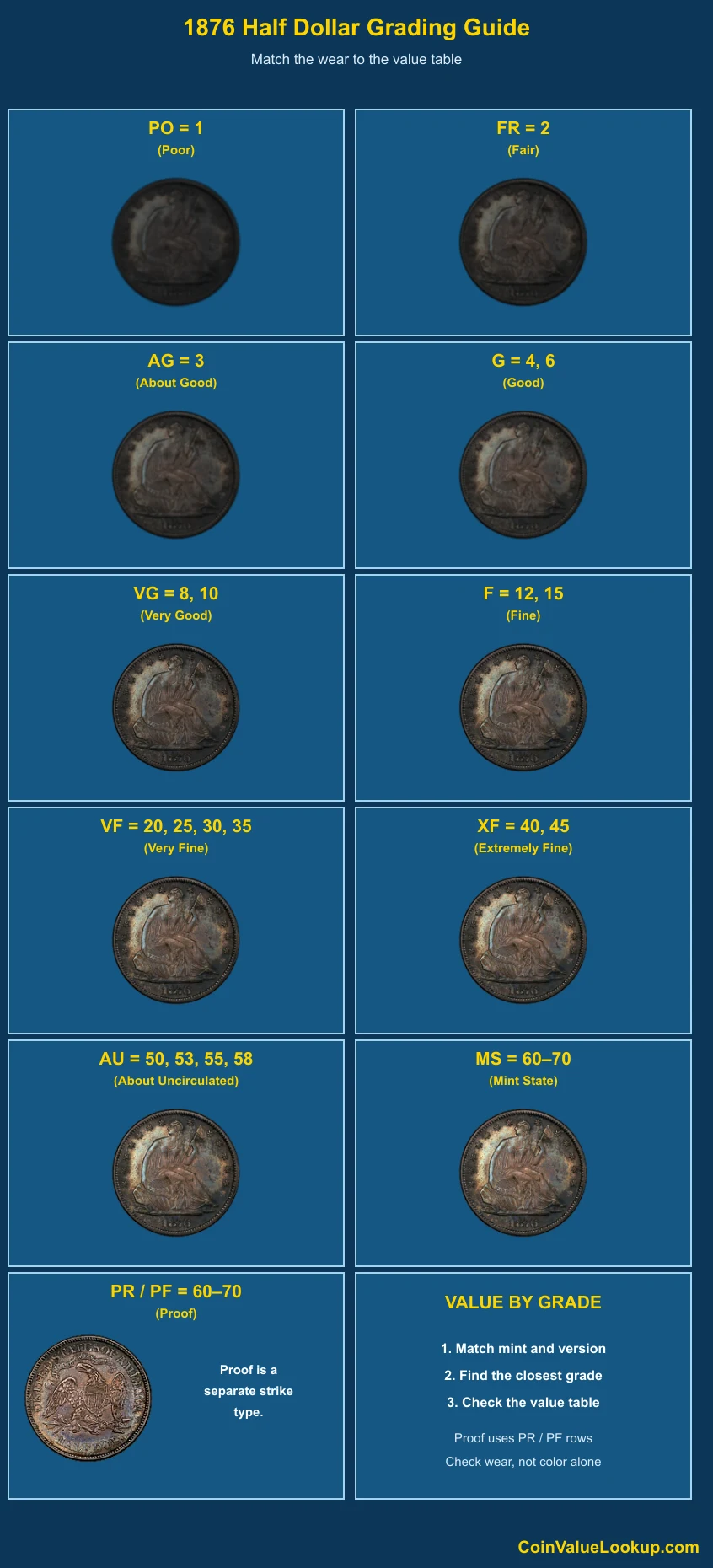
Start with Liberty's head and knee on the obverse. These are the first high points to lose detail as the coin circulates.
On the reverse, check the eagle's breast feathers and the horizontal lines of the shield.
A coin in Good (G4) condition will show Liberty's outline and a readable date, but most interior detail is gone. By Very Fine (VF20), you should see partial drapery lines and some feather separation on the eagle.
At About Uncirculated (AU50), only the slightest friction appears on the highest points, and original mint luster remains in protected areas. Compare your coin to the grading image provided.
Weak strikes can mimic wear. If the detail is soft but luster remains unbroken in the flat areas, the coin may simply be weakly struck rather than worn.
Look for luster in the recesses around the stars and letters.
Cleaning, rim dings, and holes reduce value independently of the wear grade. A cleaned AU coin can be worth less than an original VF, so preservation matters as much as sharpness.
Step 3: Check 1876 Liberty Seated Half Dollar Value by Mint and Version
1876 Liberty Seated Half Dollar — Philadelphia — Type 1 Reverse
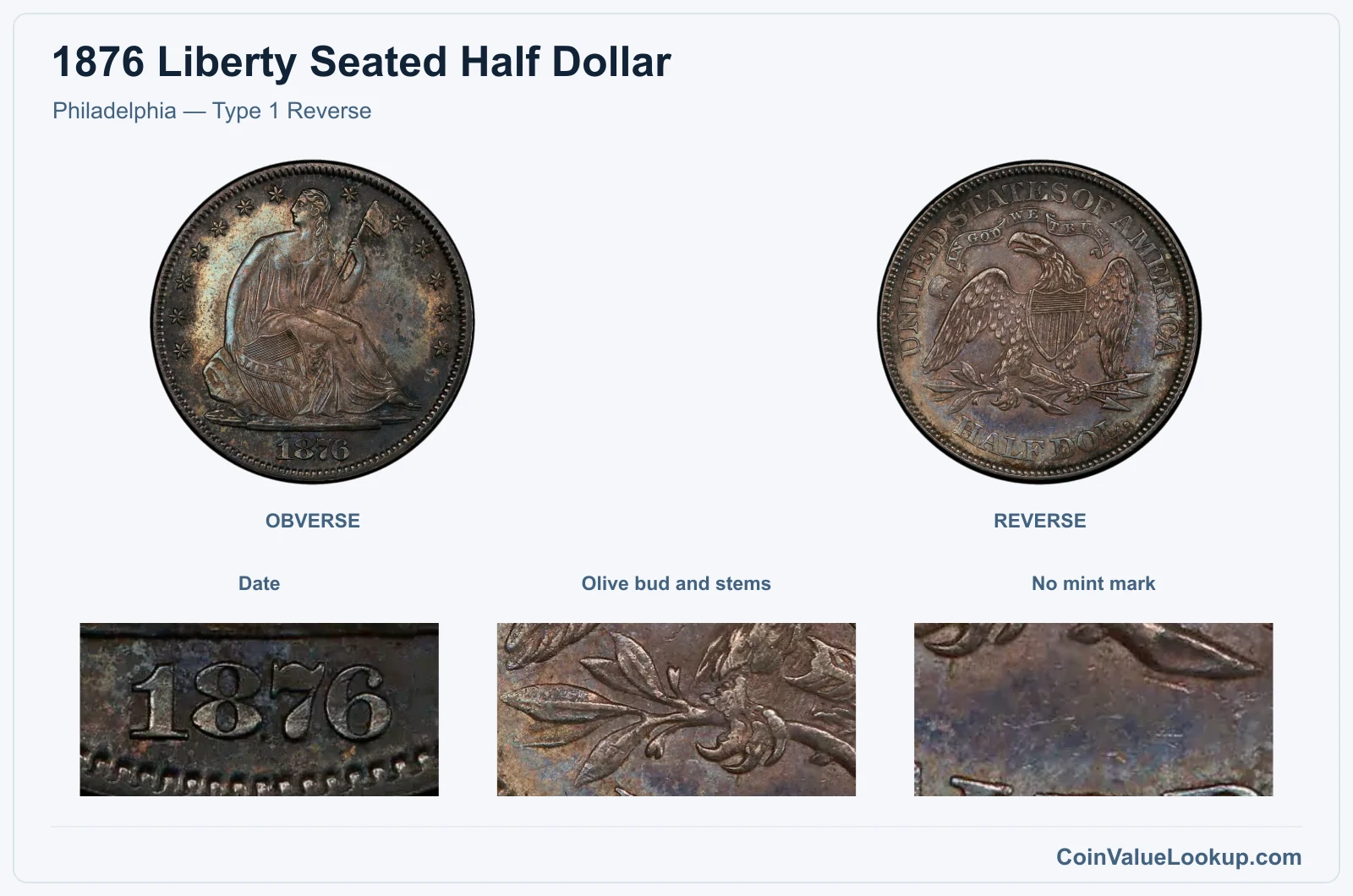
The Philadelphia Type 1 Reverse uses a reverse hub where the berry directly above the "H" in HALF is split. No mintmark appears below the eagle.
This is the standard circulation issue.
Guide estimates place this version at about $79 in G4, $194 in VF20, and $394 in AU50. These are baseline figures for the date and mint overall.
Actual value depends on your coin's exact condition, eye appeal, and whether it matches a scarcer die pairing. Do not confuse the Motto-era Type 1 designation with the earlier No Motto Type 1, as they use different diagnostic features entirely.
Ordinary-issue reference: Ordinary-issue reference only: The table below shows prices for the 1876 Liberty Seated Half Dollar (regular strike). It does not represent the value of the specific Philadelphia — Type 1 Reverse variety or its variety premium. Year, mint, metal and strike type are matched; the specific variety is not priced by this table.
Range Grade
Price Auction Records Appraisal PO PO 1
—
Coin Identifier FR FR 2
—
Coin Identifier AG AG 3
—
Coin Identifier G G 4
—
Coin Identifier
G 6
—
Coin Identifier VG VG 8
Coin Identifier
VG 10
Coin Identifier F F 12
Coin Identifier
F 15
—
Coin Identifier VF VF 20
—
Coin Identifier
VF 25
Coin Identifier
VF 30
Coin Identifier
VF 35
Coin Identifier XF XF 40
Coin Identifier
XF 45
Coin Identifier AU AU 50
Coin Identifier
AU 53
Coin Identifier
AU 55
Coin Identifier
AU 58
Coin Identifier MS MS 60
Coin Identifier
MS 61
Coin Identifier
MS 62
Coin Identifier
MS 63
Coin Identifier
MS 64
Coin Identifier
MS 65
Coin Identifier
MS 66
Coin Identifier
MS 67
Coin Identifier
MS 68
—
—
—
MS 69
—
—
—
MS 70
—
—
—
1876 Liberty Seated Half Dollar — Philadelphia — Type 2 Reverse
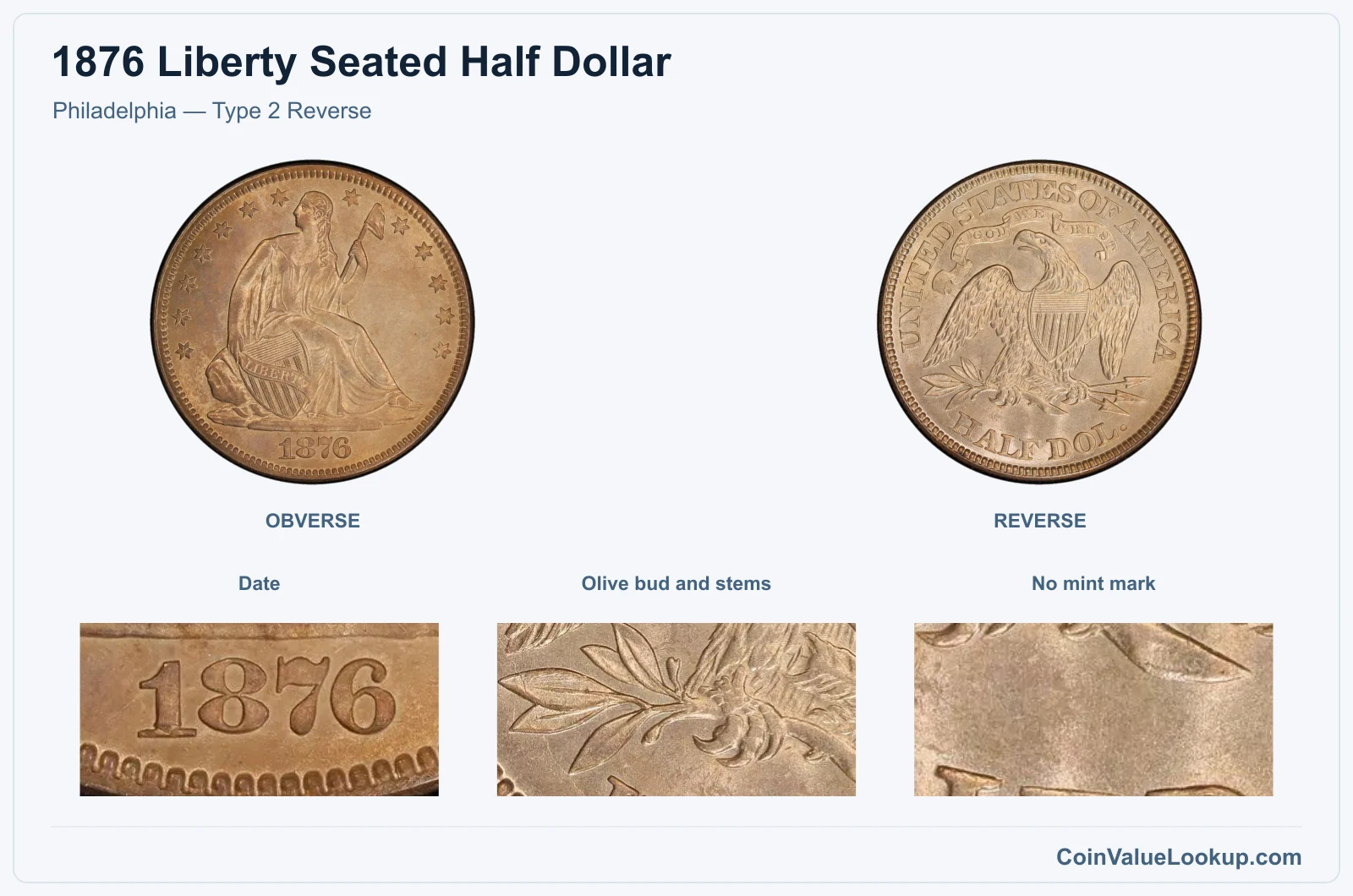
Philadelphia also produced coins using the Type 2 Reverse hub, identified by a pointed berry above the "H" in HALF rather than the split berry of Type 1. Still no mintmark.
The same aggregate guide estimates apply here: roughly $79 at G4, $194 at VF20, and $394 at AU50. No separate subtype premium is adopted in the available guide data.
To tell which reverse you have, a loupe or magnifying glass aimed at that small berry cluster above the "H" is essential. It is a subtle difference but a real one.
Ordinary-issue reference: Ordinary-issue reference only: The table below shows prices for the 1876 Liberty Seated Half Dollar (regular strike). It does not represent the value of the specific Philadelphia — Type 2 Reverse variety or its variety premium. Year, mint, metal and strike type are matched; the specific variety is not priced by this table.
Range Grade
Price Auction Records Appraisal PO PO 1
—
Coin Identifier FR FR 2
—
Coin Identifier AG AG 3
—
Coin Identifier G G 4
—
Coin Identifier
G 6
—
Coin Identifier VG VG 8
Coin Identifier
VG 10
Coin Identifier F F 12
Coin Identifier
F 15
—
Coin Identifier VF VF 20
—
Coin Identifier
VF 25
Coin Identifier
VF 30
Coin Identifier
VF 35
Coin Identifier XF XF 40
Coin Identifier
XF 45
Coin Identifier AU AU 50
Coin Identifier
AU 53
Coin Identifier
AU 55
Coin Identifier
AU 58
Coin Identifier MS MS 60
Coin Identifier
MS 61
Coin Identifier
MS 62
Coin Identifier
MS 63
Coin Identifier
MS 64
Coin Identifier
MS 65
Coin Identifier
MS 66
Coin Identifier
MS 67
Coin Identifier
MS 68
—
—
—
MS 69
—
—
—
MS 70
—
—
—
1876 Liberty Seated Half Dollar — Philadelphia — Large over Small Date
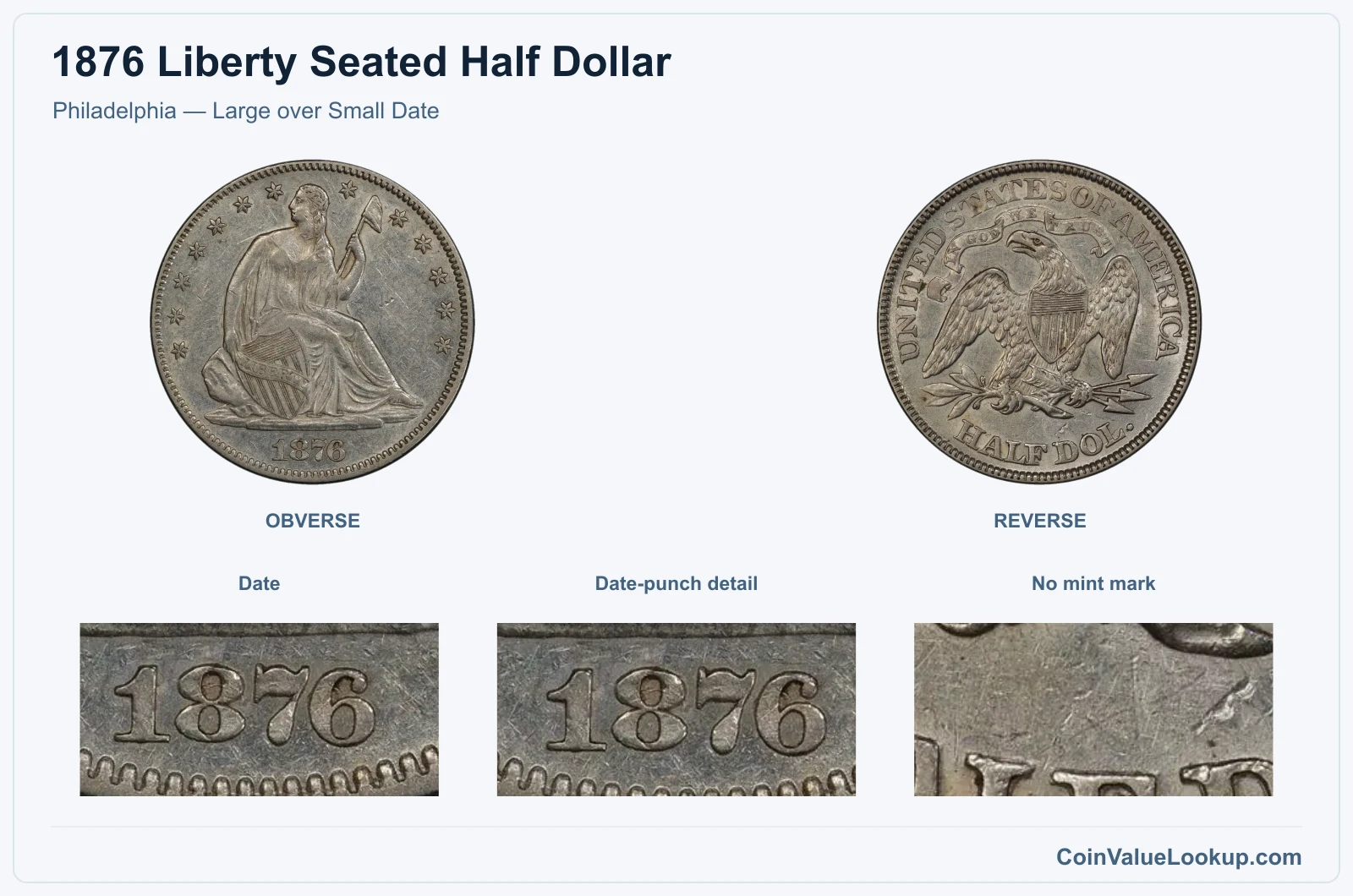
This Philadelphia variety shows a larger date punched over a smaller one, with traces of the original smaller numerals visible beneath the final digits. This is same-year repunching by the die maker, not an overdate from a different year.
Look closely at the base of the "1" and the loops of the "8," "7," and "6" for ghost outlines of the earlier, smaller punch. A loupe at 5x or better helps.
No standard guide price is adopted for this variety. Value depends on authentication, the visibility of the underlying date remnants, and overall condition.
A certified example with bold doubling will command more attention than one where the effect is barely discernible.
Ordinary-issue reference: Ordinary-issue reference only: The table below shows prices for the 1876 Liberty Seated Half Dollar (regular strike). It does not represent the value of the specific Philadelphia — Large over Small Date variety or its variety premium. Year, mint, metal and strike type are matched; the specific variety is not priced by this table.
Range Grade
Price Auction Records Appraisal PO PO 1
—
Coin Identifier FR FR 2
—
Coin Identifier AG AG 3
—
Coin Identifier G G 4
—
Coin Identifier
G 6
—
Coin Identifier VG VG 8
Coin Identifier
VG 10
Coin Identifier F F 12
Coin Identifier
F 15
—
Coin Identifier VF VF 20
—
Coin Identifier
VF 25
Coin Identifier
VF 30
Coin Identifier
VF 35
Coin Identifier XF XF 40
Coin Identifier
XF 45
Coin Identifier AU AU 50
Coin Identifier
AU 53
Coin Identifier
AU 55
Coin Identifier
AU 58
Coin Identifier MS MS 60
Coin Identifier
MS 61
Coin Identifier
MS 62
Coin Identifier
MS 63
Coin Identifier
MS 64
Coin Identifier
MS 65
Coin Identifier
MS 66
Coin Identifier
MS 67
Coin Identifier
MS 68
—
—
—
MS 69
—
—
—
MS 70
—
—
—
1876 Liberty Seated Half Dollar — Carson City — Small CC
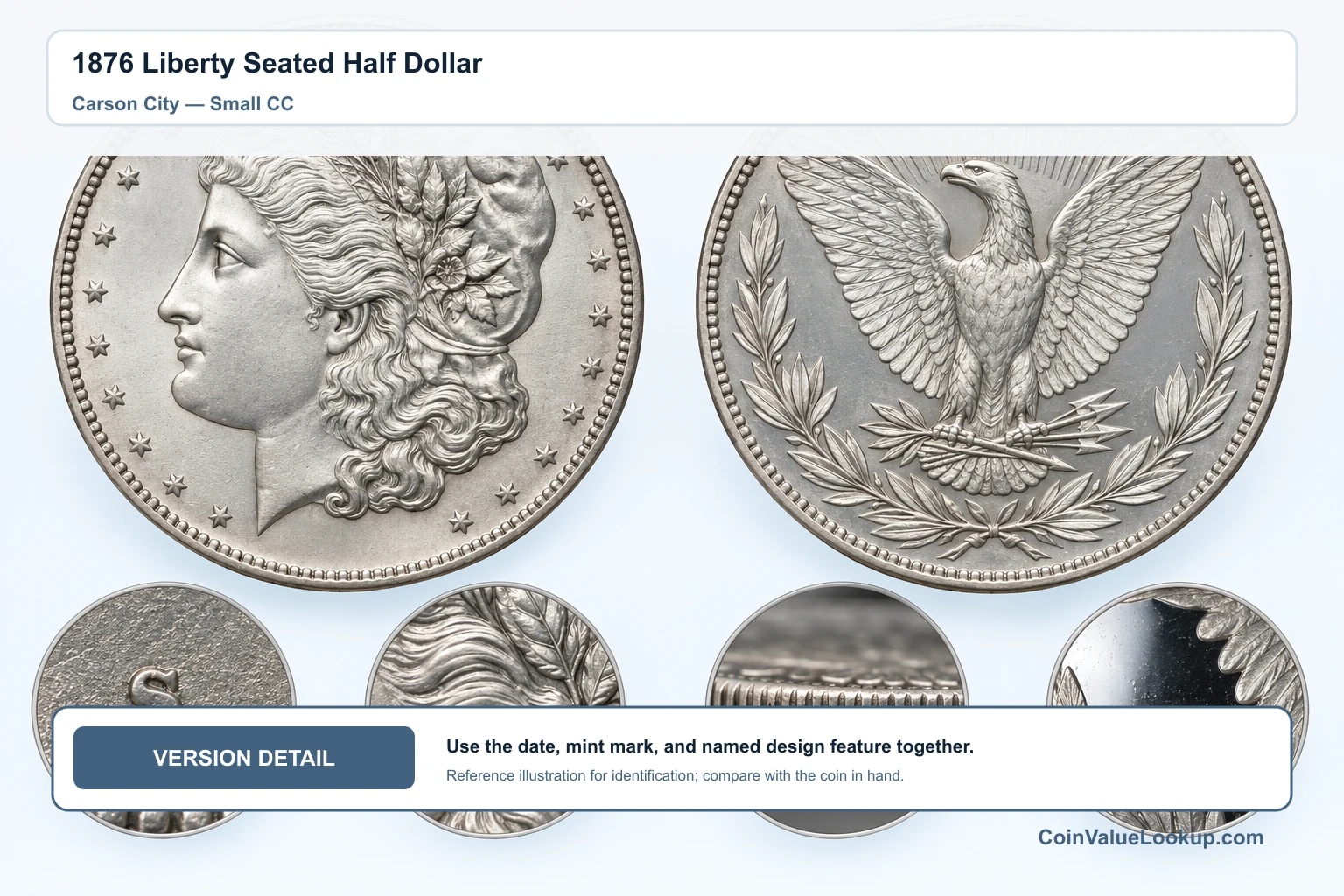
Carson City Small CC pieces carry the smallest of three mintmark punches used at that facility in 1876. Look below the eagle for two tiny, closely spaced "C" letters.
Guide estimates run about $162 in G4, $363 in VF20, and $1,082 in AU50. That is a significant jump over Philadelphia pricing at every grade.
A reflective surface alone does not make a Carson City coin a Proof; branch-mint Proofs require authenticated confirmation beyond just shiny fields. Compare your mintmark carefully to the dedicated size reference to confirm the Small CC designation.
Ordinary-issue reference: Ordinary-issue reference only: The table below shows prices for the 1876-CC Liberty Seated Half Dollar (regular strike). It does not represent the value of the specific Carson City — Small CC variety or its variety premium. Year, mint, metal and strike type are matched; the specific variety is not priced by this table.
Range Grade
Price Auction Records Appraisal PO PO 1
—
Coin Identifier FR FR 2
—
Coin Identifier AG AG 3
—
Coin Identifier G G 4
Coin Identifier
G 6
Coin Identifier VG VG 8
Coin Identifier
VG 10
Coin Identifier F F 12
Coin Identifier
F 15
Coin Identifier VF VF 20
Coin Identifier
VF 25
Coin Identifier
VF 30
Coin Identifier
VF 35
Coin Identifier XF XF 40
Coin Identifier
XF 45
Coin Identifier AU AU 50
Coin Identifier
AU 53
Coin Identifier
AU 55
Coin Identifier
AU 58
Coin Identifier MS MS 60
Coin Identifier
MS 61
Coin Identifier
MS 62
Coin Identifier
MS 63
Coin Identifier
MS 64
Coin Identifier
MS 65
Coin Identifier
MS 66
Coin Identifier
MS 67
—
—
—
MS 68
—
—
—
MS 69
—
—
—
MS 70
—
—
—
1876 Liberty Seated Half Dollar — Carson City — Medium CC
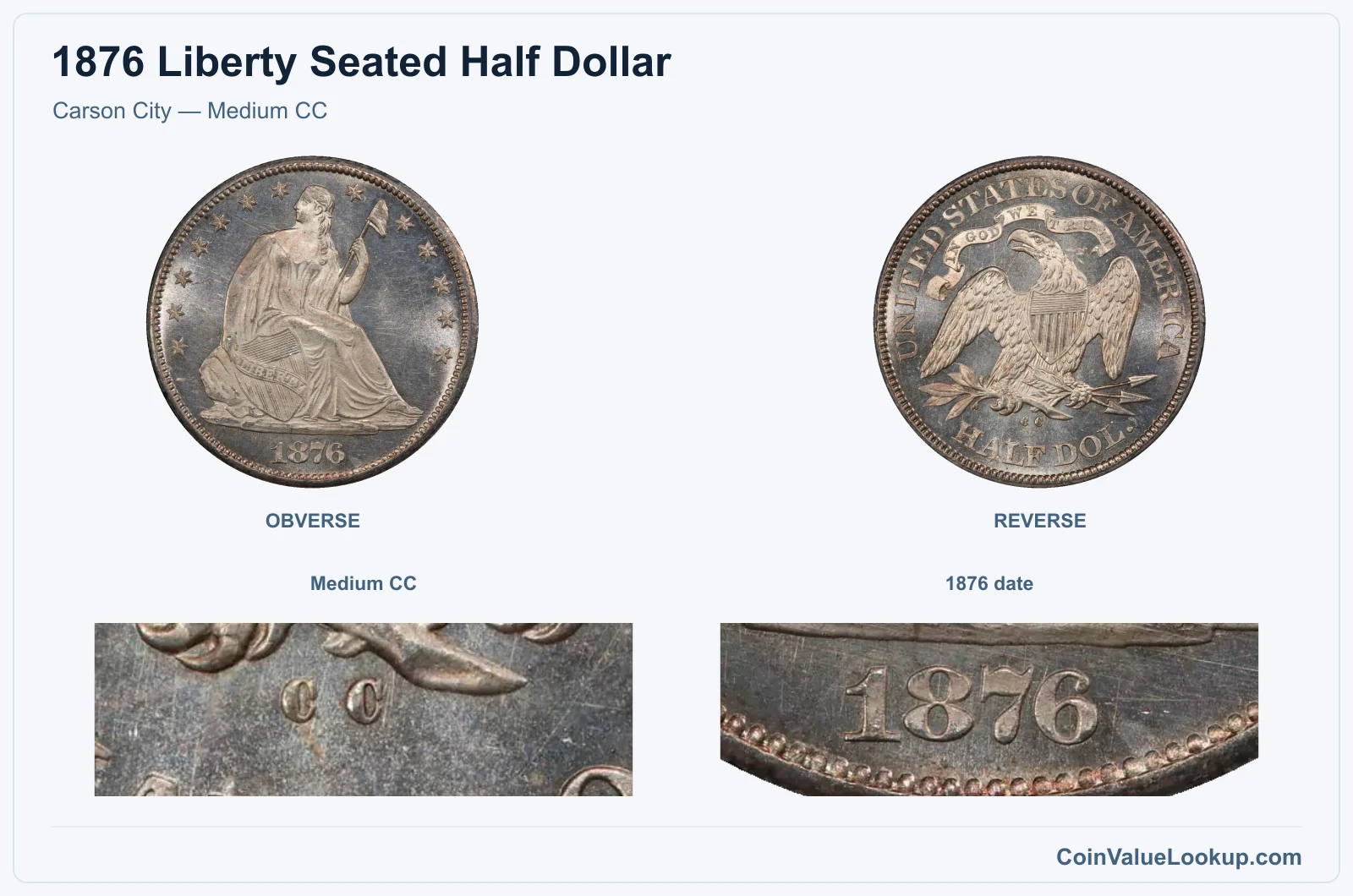
The Medium CC mintmark sits between the small and large punches in overall size. It can be tricky to classify without a side-by-side comparison, so use the reference images carefully.
Aggregate guide estimates are the same across Carson City subtypes: approximately $162 at G4, $363 at VF20, and $1,082 at AU50. No separate premium for mintmark size is adopted in the available data.
Carson City coins in any configuration tend to draw collector interest because of the mint's relatively short operating history and lower production volumes compared to Philadelphia or San Francisco.
Ordinary-issue reference: Ordinary-issue reference only: The table below shows prices for the 1876-CC Liberty Seated Half Dollar (regular strike). It does not represent the value of the specific Carson City — Medium CC variety or its variety premium. Year, mint, metal and strike type are matched; the specific variety is not priced by this table.
Range Grade
Price Auction Records Appraisal PO PO 1
—
Coin Identifier FR FR 2
—
Coin Identifier AG AG 3
—
Coin Identifier G G 4
Coin Identifier
G 6
Coin Identifier VG VG 8
Coin Identifier
VG 10
Coin Identifier F F 12
Coin Identifier
F 15
Coin Identifier VF VF 20
Coin Identifier
VF 25
Coin Identifier
VF 30
Coin Identifier
VF 35
Coin Identifier XF XF 40
Coin Identifier
XF 45
Coin Identifier AU AU 50
Coin Identifier
AU 53
Coin Identifier
AU 55
Coin Identifier
AU 58
Coin Identifier MS MS 60
Coin Identifier
MS 61
Coin Identifier
MS 62
Coin Identifier
MS 63
Coin Identifier
MS 64
Coin Identifier
MS 65
Coin Identifier
MS 66
Coin Identifier
MS 67
—
—
—
MS 68
—
—
—
MS 69
—
—
—
MS 70
—
—
—
1876 Liberty Seated Half Dollar — Carson City — Large CC
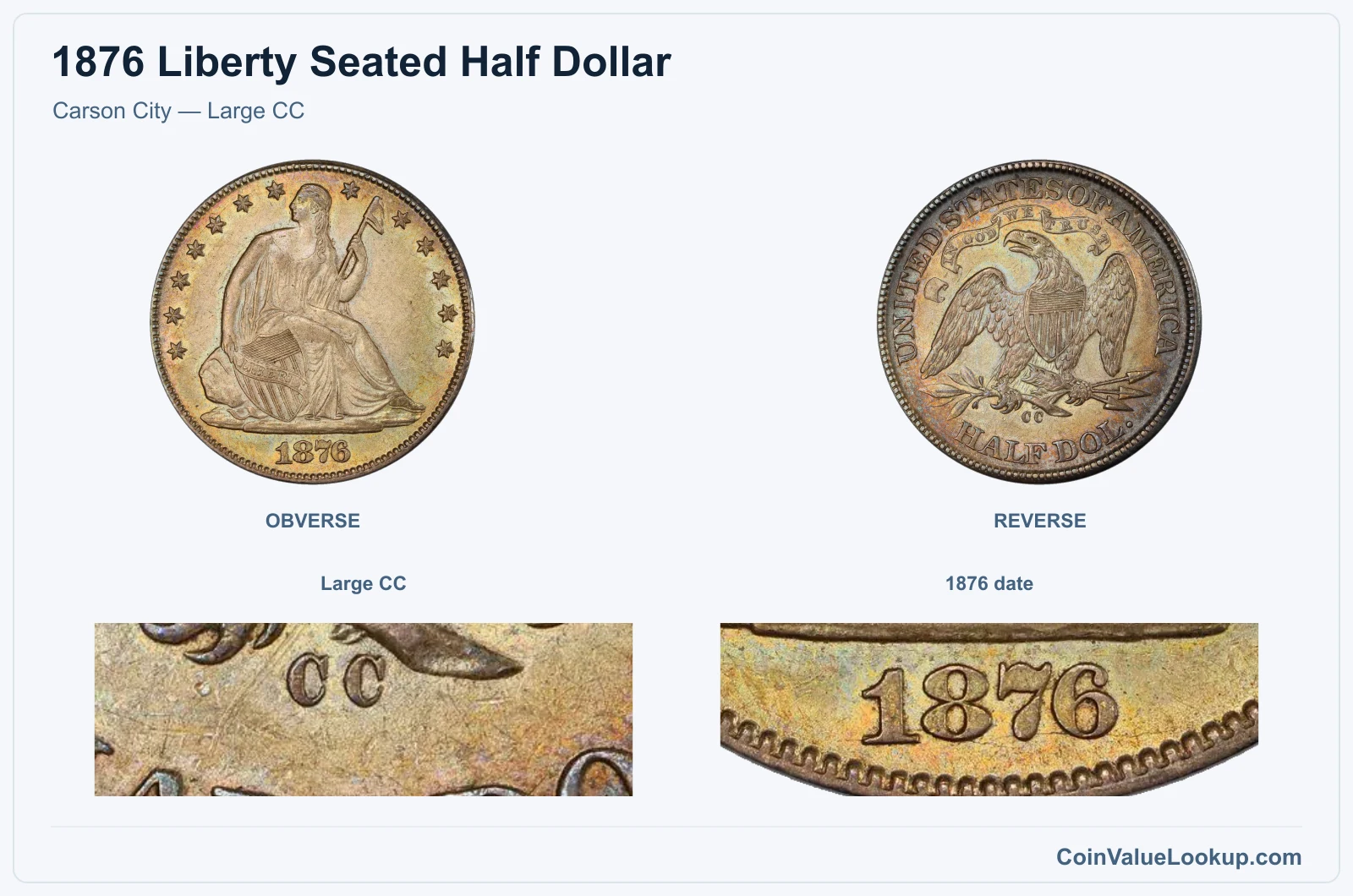
The Large CC version features the biggest mintmark punch of the three Carson City styles. The letters are noticeably wider and taller, making this the easiest CC subtype to spot without magnification.
Pricing follows the same aggregate Carson City baseline: around $162 in G4, $363 in VF20, and $1,082 in AU50. As with the other CC sizes, individual premiums for this specific punch are not separated in the adopted guide.
Authentication matters here because a coin that merely looks large due to wear or a filled die is not the same as a genuinely different punch.
Coin Value Lookup is a good starting point if you want to compare your Carson City half dollar against other denominations and years in the series.
Ordinary-issue reference: Ordinary-issue reference only: The table below shows prices for the 1876-CC Liberty Seated Half Dollar (regular strike). It does not represent the value of the specific Carson City — Large CC variety or its variety premium. Year, mint, metal and strike type are matched; the specific variety is not priced by this table.
Range Grade
Price Auction Records Appraisal PO PO 1
—
Coin Identifier FR FR 2
—
Coin Identifier AG AG 3
—
Coin Identifier G G 4
Coin Identifier
G 6
Coin Identifier VG VG 8
Coin Identifier
VG 10
Coin Identifier F F 12
Coin Identifier
F 15
Coin Identifier VF VF 20
Coin Identifier
VF 25
Coin Identifier
VF 30
Coin Identifier
VF 35
Coin Identifier XF XF 40
Coin Identifier
XF 45
Coin Identifier AU AU 50
Coin Identifier
AU 53
Coin Identifier
AU 55
Coin Identifier
AU 58
Coin Identifier MS MS 60
Coin Identifier
MS 61
Coin Identifier
MS 62
Coin Identifier
MS 63
Coin Identifier
MS 64
Coin Identifier
MS 65
Coin Identifier
MS 66
Coin Identifier
MS 67
—
—
—
MS 68
—
—
—
MS 69
—
—
—
MS 70
—
—
—
1876 Liberty Seated Half Dollar — San Francisco — Type 1 — Micro S
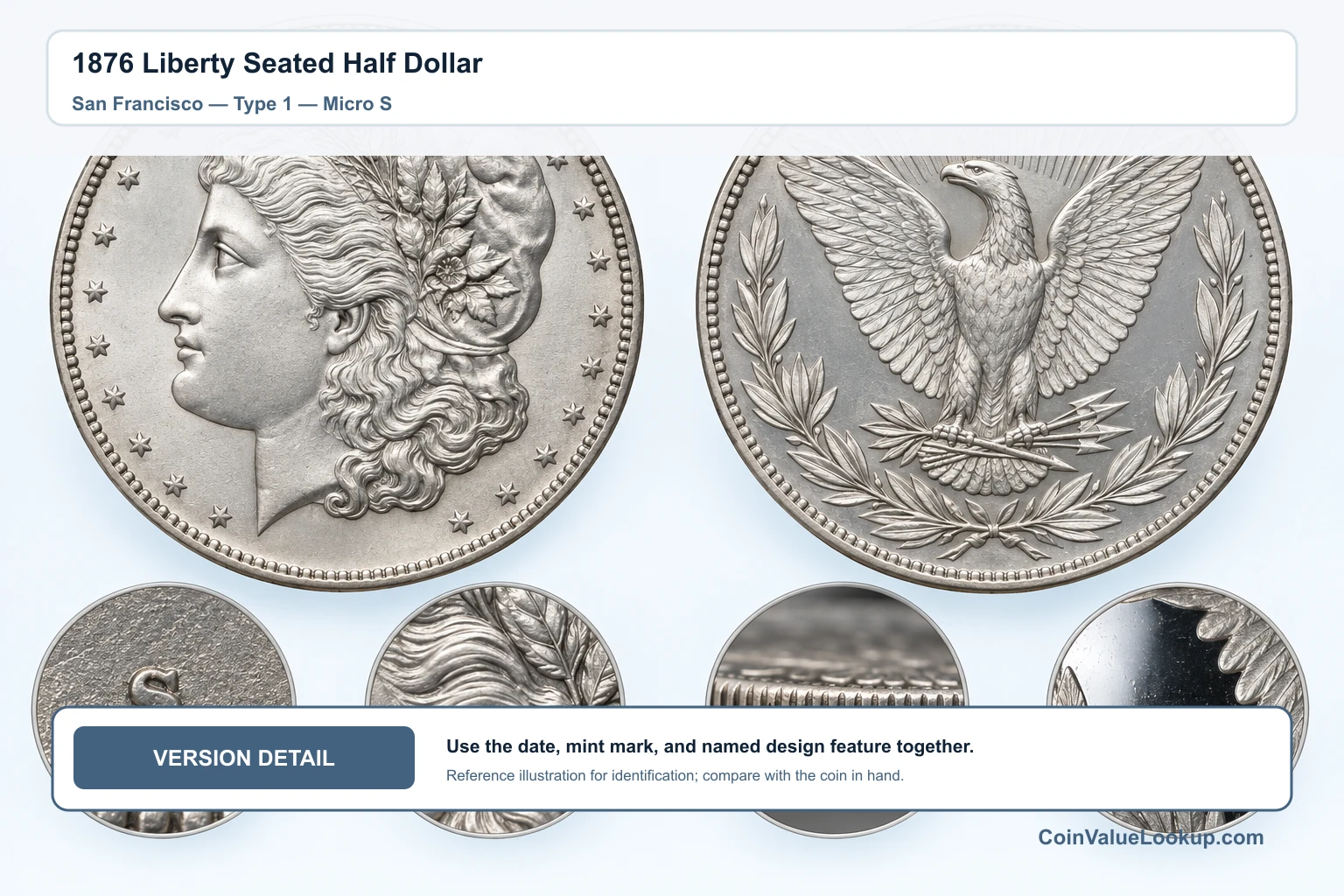
San Francisco struck 1876 half dollars with a Type 1 Reverse (split berry above "H") combined with a Micro S mintmark below the eagle. The Micro S is small but distinct from the Very Small S used on other die pairings.
Guide estimates place San Francisco issues at roughly $79 in G4, $172 in VF20, and $363 in AU50. These figures are slightly lower than Philadelphia at VF20 and AU50 but remain in the same general range.
Confirming the Micro S requires careful comparison against the reference image, since the size difference from the Very Small S is subtle.
Ordinary-issue reference: Ordinary-issue reference only: The table below shows prices for the 1876-S Liberty Seated Half Dollar (regular strike). It does not represent the value of the specific San Francisco — Type 1 — Micro S variety or its variety premium. Year, mint, metal and strike type are matched; the specific variety is not priced by this table.
Range Grade
Price Auction Records Appraisal PO PO 1
Coin Identifier FR FR 2
—
Coin Identifier AG AG 3
—
Coin Identifier G G 4
—
Coin Identifier
G 6
Coin Identifier VG VG 8
—
Coin Identifier
VG 10
—
Coin Identifier F F 12
Coin Identifier
F 15
—
Coin Identifier VF VF 20
—
Coin Identifier
VF 25
Coin Identifier
VF 30
—
Coin Identifier
VF 35
Coin Identifier XF XF 40
Coin Identifier
XF 45
Coin Identifier AU AU 50
Coin Identifier
AU 53
Coin Identifier
AU 55
Coin Identifier
AU 58
Coin Identifier MS MS 60
Coin Identifier
MS 61
Coin Identifier
MS 62
Coin Identifier
MS 63
Coin Identifier
MS 64
Coin Identifier
MS 65
Coin Identifier
MS 66
Coin Identifier
MS 67
—
—
—
MS 68
—
—
—
MS 69
—
—
—
MS 70
—
—
—
1876 Liberty Seated Half Dollar — San Francisco — Type 1 — Very Small S
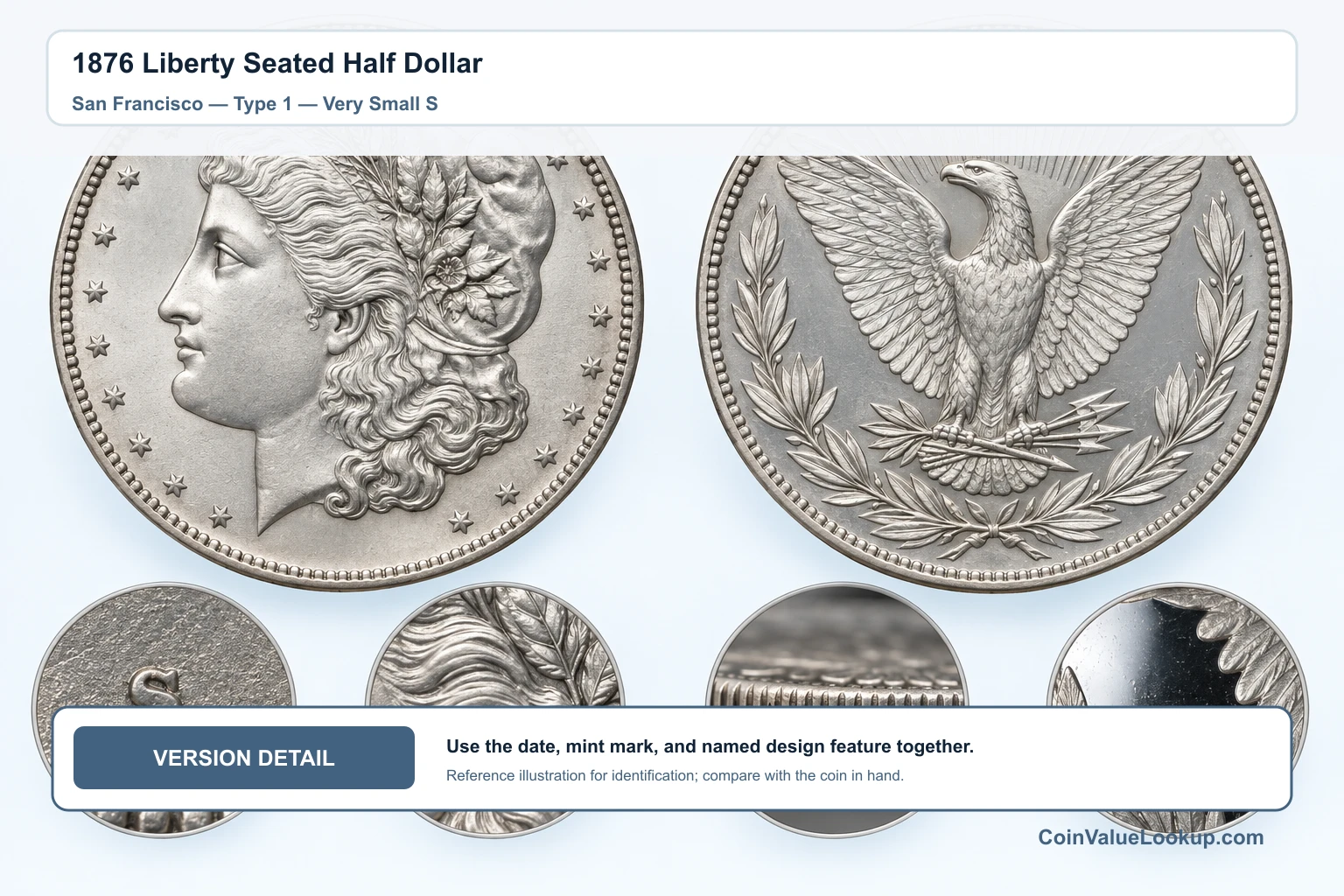
This San Francisco die pairing also uses the Type 1 Reverse (split berry) but with a Very Small S mintmark instead of the Micro S. The two are close in size, and telling them apart without a reference image is a recipe for frustration.
The same aggregate San Francisco estimates apply: about $79 at G4, $172 at VF20, and $363 at AU50. No separate mintmark-size premium is adopted.
Focus on the overall proportions of the letter relative to the eagle's tail feathers when comparing.
Ordinary-issue reference: Ordinary-issue reference only: The table below shows prices for the 1876-S Liberty Seated Half Dollar (regular strike). It does not represent the value of the specific San Francisco — Type 1 — Very Small S variety or its variety premium. Year, mint, metal and strike type are matched; the specific variety is not priced by this table.
Range Grade
Price Auction Records Appraisal PO PO 1
Coin Identifier FR FR 2
—
Coin Identifier AG AG 3
—
Coin Identifier G G 4
—
Coin Identifier
G 6
Coin Identifier VG VG 8
—
Coin Identifier
VG 10
—
Coin Identifier F F 12
Coin Identifier
F 15
—
Coin Identifier VF VF 20
—
Coin Identifier
VF 25
Coin Identifier
VF 30
—
Coin Identifier
VF 35
Coin Identifier XF XF 40
Coin Identifier
XF 45
Coin Identifier AU AU 50
Coin Identifier
AU 53
Coin Identifier
AU 55
Coin Identifier
AU 58
Coin Identifier MS MS 60
Coin Identifier
MS 61
Coin Identifier
MS 62
Coin Identifier
MS 63
Coin Identifier
MS 64
Coin Identifier
MS 65
Coin Identifier
MS 66
Coin Identifier
MS 67
—
—
—
MS 68
—
—
—
MS 69
—
—
—
MS 70
—
—
—
1876 Liberty Seated Half Dollar — San Francisco — Type 2 — Very Small S
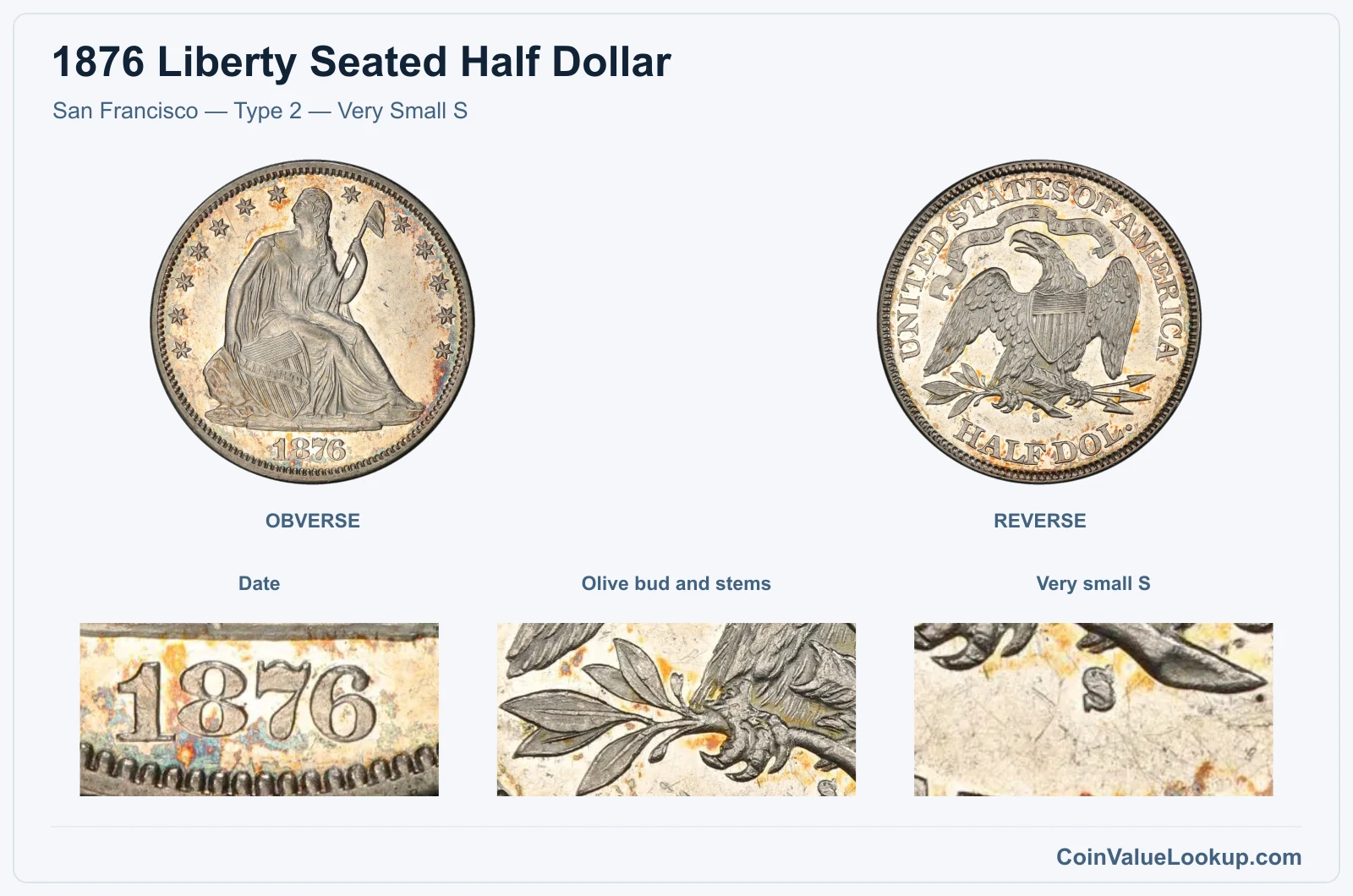
San Francisco also paired the Type 2 Reverse (pointed berry above "H") with a Very Small S mintmark. So you need to check two things: the berry shape and the mintmark size.
Guide estimates remain consistent with the other San Francisco subtypes at around $79 in G4, $172 in VF20, and $363 in AU50. Identifying the pointed versus split berry is the first step.
Then confirm the Very Small S against the Micro S reference. Getting both right narrows your coin to the correct die combination.
Ordinary-issue reference: Ordinary-issue reference only: The table below shows prices for the 1876-S Liberty Seated Half Dollar (regular strike). It does not represent the value of the specific San Francisco — Type 2 — Very Small S variety or its variety premium. Year, mint, metal and strike type are matched; the specific variety is not priced by this table.
Range Grade
Price Auction Records Appraisal PO PO 1
Coin Identifier FR FR 2
—
Coin Identifier AG AG 3
—
Coin Identifier G G 4
—
Coin Identifier
G 6
Coin Identifier VG VG 8
—
Coin Identifier
VG 10
—
Coin Identifier F F 12
Coin Identifier
F 15
—
Coin Identifier VF VF 20
—
Coin Identifier
VF 25
Coin Identifier
VF 30
—
Coin Identifier
VF 35
Coin Identifier XF XF 40
Coin Identifier
XF 45
Coin Identifier AU AU 50
Coin Identifier
AU 53
Coin Identifier
AU 55
Coin Identifier
AU 58
Coin Identifier MS MS 60
Coin Identifier
MS 61
Coin Identifier
MS 62
Coin Identifier
MS 63
Coin Identifier
MS 64
Coin Identifier
MS 65
Coin Identifier
MS 66
Coin Identifier
MS 67
—
—
—
MS 68
—
—
—
MS 69
—
—
—
MS 70
—
—
—
1876 Liberty Seated Half Dollar — Philadelphia Proof
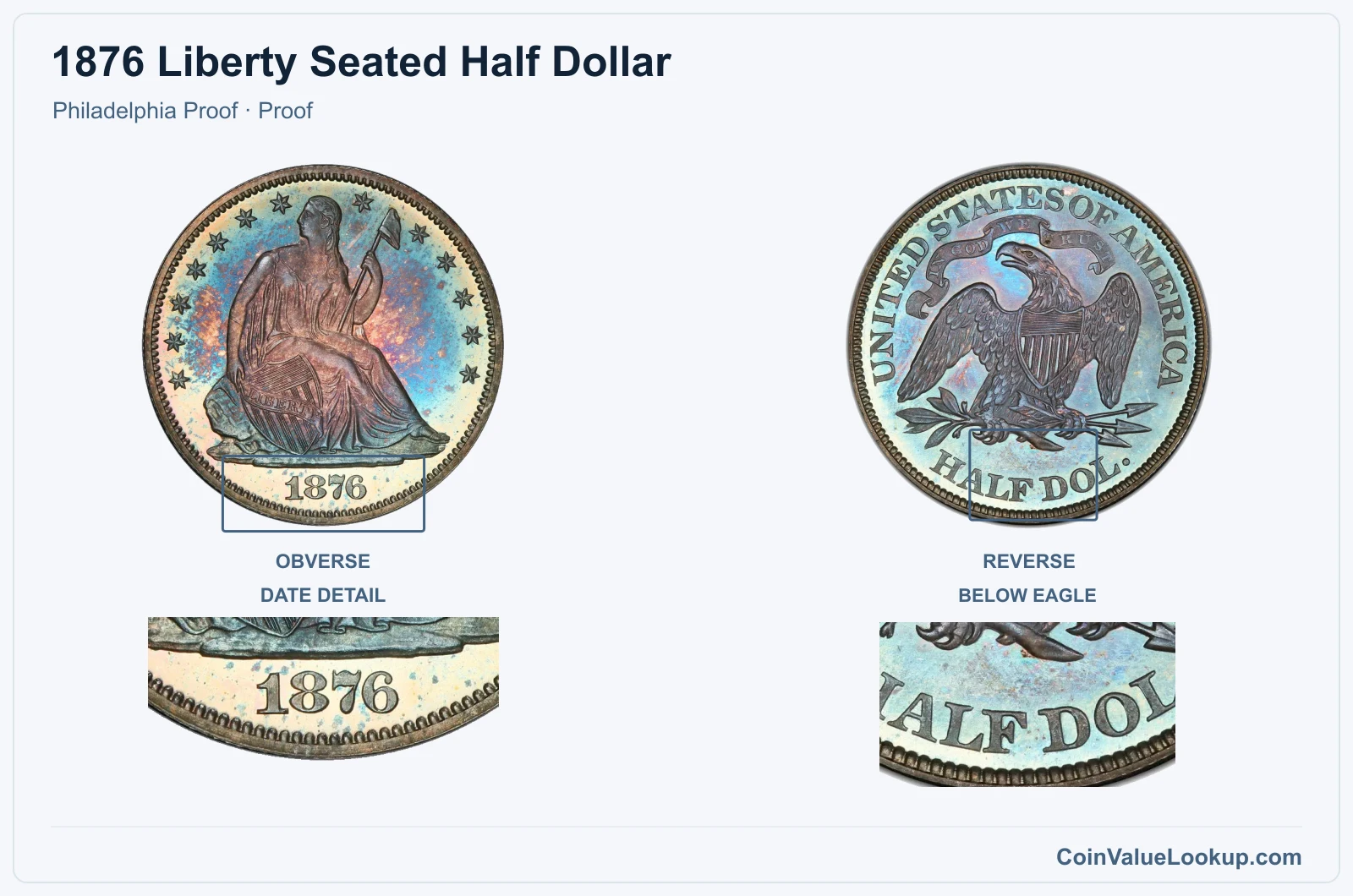
Philadelphia Proof half dollars of 1876 were struck with polished dies on specially prepared planchets, producing mirrored fields and razor-sharp device edges. There is no mintmark.
A guide estimate for PR63 comes in at approximately $1,409. That makes confirmed Proofs among the priciest 1876 half dollar issues.
A Proof is a manufacturing method, not a condition grade above Mint State, so a Proof can still show handling marks or hairlines that affect its numeric grade.
Look for squared, wire-sharp rims and deeply reflective fields. An ordinary business strike that has been polished or dipped may look shiny, but it will lack the precision edge detail and die finish of a true Proof.
Authentication by a recognized grading service is the safest route to confirming Proof status.
Range Grade
Price Auction Records Appraisal PR PR 1
—
Coin Identifier
PR 2
—
Coin Identifier
PR 3
—
Coin Identifier
PR 4
—
Coin Identifier
PR 6
—
Coin Identifier
PR 8
—
Coin Identifier
PR 10
—
Coin Identifier
PR 12
—
Coin Identifier
PR 15
—
Coin Identifier
PR 20
—
Coin Identifier
PR 25
—
Coin Identifier
PR 30
—
Coin Identifier
PR 35
—
Coin Identifier
PR 40
—
Coin Identifier
PR 45
—
Coin Identifier
PR 50
—
Coin Identifier
PR 53
—
Coin Identifier
PR 55
—
Coin Identifier
PR 58
Coin Identifier
PR 60
Coin Identifier
PR 61
Coin Identifier
PR 62
Coin Identifier
PR 63
Coin Identifier
PR 64
Coin Identifier
PR 65
Coin Identifier
PR 66
Coin Identifier
PR 67
Coin Identifier
PR 68
—
—
—
PR 69
—
—
—
PR 70
—
—
—
1876 Liberty Seated Half Dollar Error List
1. 1876 Liberty Seated Half Dollar — Repunched Date
Repunched dates on the 1876 half dollar have been reported for Philadelphia strikes, including the Large over Small Date variety, and for San Francisco issues where the "6" shows evidence of recutting. In each case, remnants of an earlier punch position or size appear as ghost outlines near or beneath the final date digits.
Use magnification and look for doubled serifs on the "1," misaligned loops on the "8" or "7," or a shadow outline around the "6." These are deliberate same-year repunchings by the engraver, not damage.
Do not confuse this with machine doubling, which produces flat, shelf-like outlines without the depth of a true repunched date. Post-strike damage can also shift or distort digits.
No specific price range is adopted for repunched dates; value depends on visibility, the specific error, and overall condition of the coin.
2. 1876 Liberty Seated Half Dollar — Misplaced Date
Misplaced dates have been cataloged on both Philadelphia and Carson City 1876 half dollars. A misplaced date shows portions of a digit appearing outside the normal date position, sometimes in the denticles or within the rock below Liberty.
These stray digit fragments occur when a date punch lands in the wrong spot before being corrected. They are faint and easy to overlook without a loupe.
Do not mistake ordinary hub design elements, wear patterns, or post-strike damage for a misplaced date. Compare your coin to a known reference for the same mint.
A scratch or die polish line near the date area is not the same thing as an errant numeral fragment. No numerical price is adopted; value hinges on the specific misplacement, its boldness, and the coin's grade.
3. 1876 Liberty Seated Half Dollar — Repunched Mintmark
Repunched mintmarks are reported on San Francisco 1876 half dollars, appearing across more than one die pairing and reverse type. The diagnostic is a secondary impression of the "S" mintmark visible beside or beneath the primary punch, indicating the mintmark was applied to the die more than once in slightly different positions.
Look below the eagle for doubling of the "S" outline. You may see a clear second serif or a widened base that does not match a normal single punch.
Machine doubling, die chips filling in the mintmark, and corrosion near the letter can all mimic a repunched mintmark. True repunching shows rounded, raised secondary outlines with depth.
No specific price range is adopted for this error; value depends on how dramatic the repunching is and the coin's overall condition and authentication.
4. 1876 Liberty Seated Half Dollar — Partial Collar Strike
A Philadelphia 1876 half dollar struck through a partial collar has been reported, graded G6 by a major grading service. A partial collar strike occurs when the coin is not fully seated in the collar die during striking, producing a stepped or shelf-like edge on one side while the opposite side retains a normal rim.
The diagnostic is that distinctive ledge along part of the rim where the planchet expanded beyond the collar boundary. The struck faces still show normal design detail.
Do not confuse this with simple edge damage, a flattened rim from a drop, or a full broadstrike where no collar contact exists at all. A partial collar shows a clear transition zone between the restrained and unrestrained portions of the edge.
No price range is adopted; value depends on the severity of the misalignment, overall condition, and authentication.
5. 1876 Liberty Seated Half Dollar — Die Gouge / Named Raised-Line Variety
The San Francisco "Smoking Liberty" variety is a cataloged raised-line die gouge that appears near Liberty's face on the obverse, giving the visual impression of smoke or a line extending from her lips. This raised line was incised into the die as damage, transferring to every coin struck from that die as a raised feature.
The key diagnostic is a consistent raised line in the same position relative to Liberty's profile, accompanied by the full date and San Francisco mintmark. Compare your coin to the dedicated reference image.
An incuse scratch, random contact mark, or unrelated die crack will not match the specific location and orientation of the Smoking Liberty line. Scratches are recessed, not raised, and die cracks tend to follow stress patterns rather than appearing as isolated lines near the face.
No price range is adopted; value depends on the line's visibility and the coin's condition and authentication.