1876 Indian Head Penny Coin Value: How Much Is It Worth?
The 1876 Indian Head penny is a solid collectible from the centennial year of the United States. Guide estimates for ordinary Philadelphia business strikes range from about $50 at G4 (a well-worn but readable coin) to around $468 at MS63 (a choice uncirculated example with original luster).
Proofs, major die varieties, and mint errors require their own assessment beyond those figures.
Fast Way to Identify Your 1876 Indian Head Penny
If you have an 1876 Indian Head cent and want a quick read on what you are holding, snap clear photos of both the front and back of the coin. Upload them here for a preliminary identification of the version, finish, and approximate condition.
Good lighting and a straight-on angle help the most.
1876 Indian Head Penny Value
Upload both sides of your 1876 Indian Head Penny.
Front Obverse
Upload photo
Back Reverse
Upload photo
Which 1876 Indian Head Penny Versions Are Worth Money?
- Business strikes in uncirculated condition with original surfaces are the strongest performers, with guide values reaching around $468 at MS63.
- Proof examples carry their own market; a PR63 lists near $376, so confirming proof manufacture matters before pricing.
- Coins retaining significant original red color typically bring premiums over brown-toned examples in the same technical grade.
- Die varieties such as misplaced dates and repunched dates are collected separately and valued by authenticated identity, condition, and error severity.
Step 1: Identify Your 1876 Indian Head Penny Mint Mark and Version
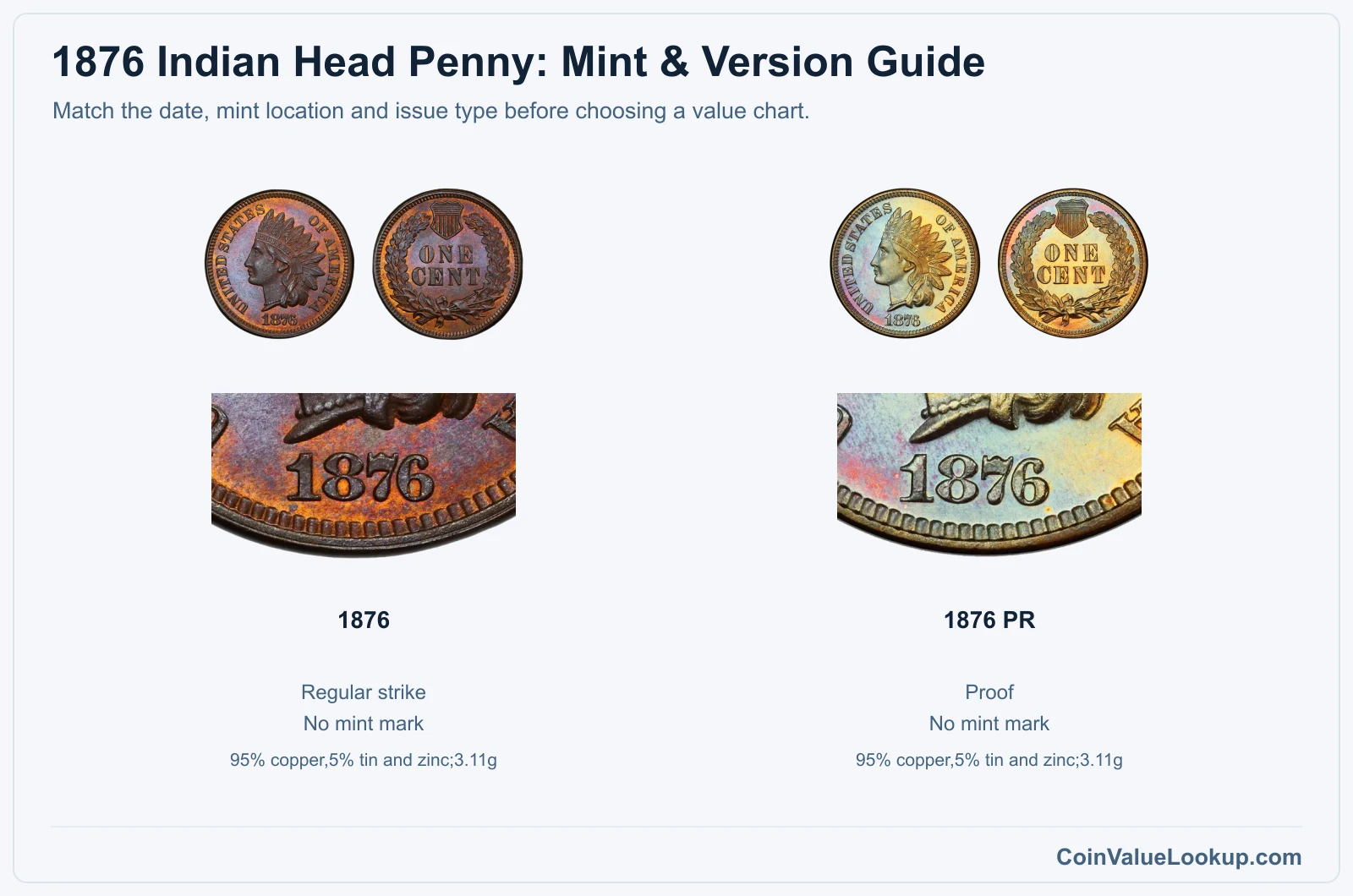
Every regular 1876 Indian Head cent was struck at the Philadelphia Mint. There is no mintmark on this coin, and the small "L" on the ribbon behind the neck is the engraver's initial, not a mint designation.
Do not confuse it with a mintmark.
The obverse shows the Indian portrait with a feathered headdress and the word LIBERTY on the headband. The reverse features an oak wreath surrounding a small shield at the top and the words ONE CENT inside.
If your coin has a wheat-ear reverse or a flying eagle, you are looking at a different series entirely.
The two main branches for this date are the standard business strike and the proof. Proof coins were specially manufactured with polished dies and planchets, producing mirror-like fields and sharp detail.
A proof is a method of manufacture, not a higher grade than Mint State. Simply polishing a circulated coin does not create proof surfaces, so look for consistent mirror reflectivity across the entire field, squared-off rims, and full strike sharpness before concluding you have a proof.
Step 2: Check Your 1876 Indian Head Penny Grade
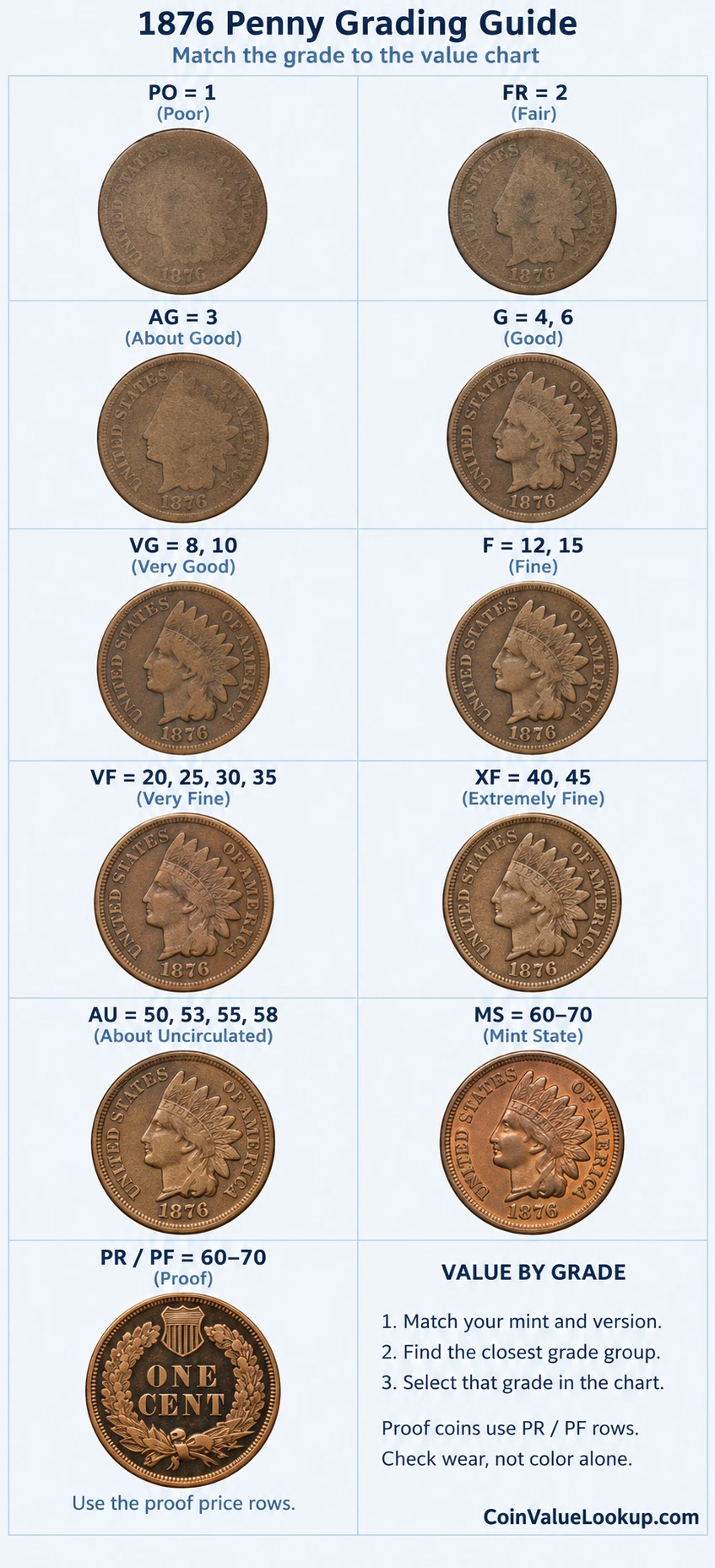
Start with the headband. On a well-preserved coin, every letter of LIBERTY should be fully visible and sharply defined.
As wear increases, the letters fade from the ends inward, so L and Y tend to soften first. By G4, only a partial outline of the headband remains, and the portrait is a flat silhouette.
Check the feather tips above the headband next. These high points lose detail early.
Then move to the cheek and hair curls below the ear; flattening there signals moderate wear. On the reverse, examine the bow knot and the leaf tips closest to the shield.
One important caution: some 1876 cents were softly struck at the mint, leaving mushy feather or hair detail even on coins that never circulated. Do not downgrade a coin based on a single weak area if the surrounding luster is intact and the fields are free of contact marks.
Bronze color designations (BN, RB, RD) describe how much original copper-red color remains. A coin graded RD retains nearly full red; BN has toned to brown.
These are color descriptions within the bronze composition, not different metals. Compare your coin to the reference image to judge both wear and remaining color honestly.
Step 3: Check 1876 Indian Head Penny Value by Mint and Version
1876 Indian Head Penny
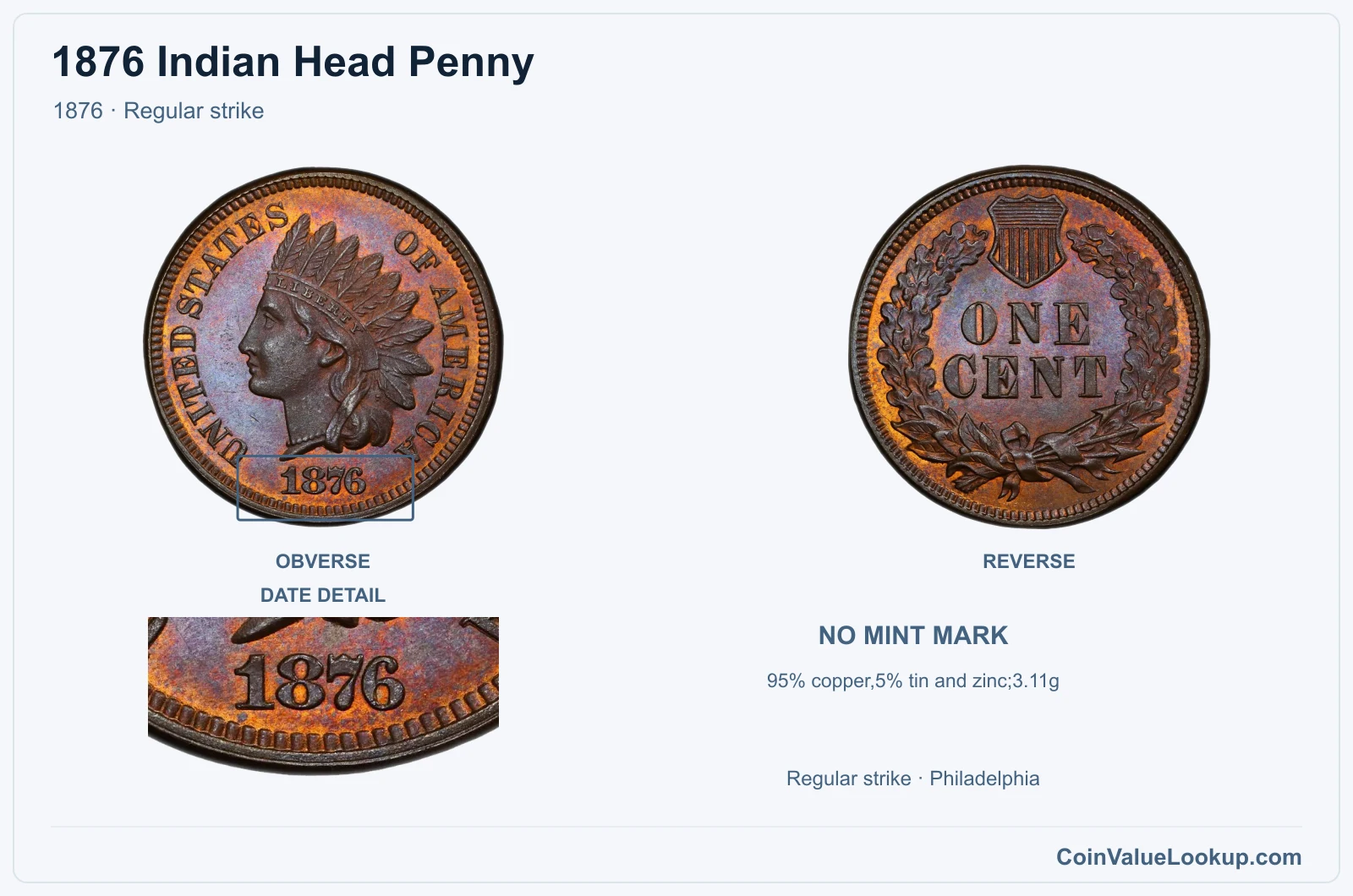
This is the standard 1876 Indian Head cent, struck for circulation at Philadelphia. It weighs 3.11 grams and is composed of 95% copper with 5% tin and zinc, the bronze alloy used since 1864.
No mintmark appears on the coin.
Guide estimates place a G4 example around $50 and an MS63 around $468, according to USA Coin Book. Those figures assume original, problem-free surfaces.
Cleaned, corroded, or damaged coins trade well below guide levels regardless of wear grade. When comparing values, make sure you are looking at the correct finish; do not borrow proof or rare-variety pricing for an ordinary business strike.
| Range | Grade | Price | Auction Records | Appraisal |
|---|---|---|---|---|
| PO | PO 1 | — | Coin Identifier | |
| FR | FR 2 | — | Coin Identifier | |
| AG | AG 3 | Coin Identifier | ||
| G | G 4 | — | Coin Identifier | |
| G 6 | Coin Identifier | |||
| VG | VG 8 | — | Coin Identifier | |
| VG 10 | — | Coin Identifier | ||
| F | F 12 | Coin Identifier | ||
| F 15 | Coin Identifier | |||
| VF | VF 20 | Coin Identifier | ||
| VF 25 | Coin Identifier | |||
| VF 30 | Coin Identifier | |||
| VF 35 | Coin Identifier | |||
| XF | XF 40 | Coin Identifier | ||
| XF 45 | Coin Identifier | |||
| AU | AU 50 | Coin Identifier | ||
| AU 53 | Coin Identifier | |||
| AU 55 | Coin Identifier | |||
| AU 58 | Coin Identifier | |||
| MS | MS 60 | Coin Identifier | ||
| MS 61 | Coin Identifier | |||
| MS 62 | Coin Identifier | |||
| MS 63 | Coin Identifier | |||
| MS 64 | Coin Identifier | |||
| MS 65 | Coin Identifier | |||
| MS 66 | Coin Identifier | |||
| MS 67 | — | — | — | |
| MS 68 | — | — | — | |
| MS 69 | — | — | — | |
| MS 70 | — | — | — |
1876 Indian Head Penny — PR
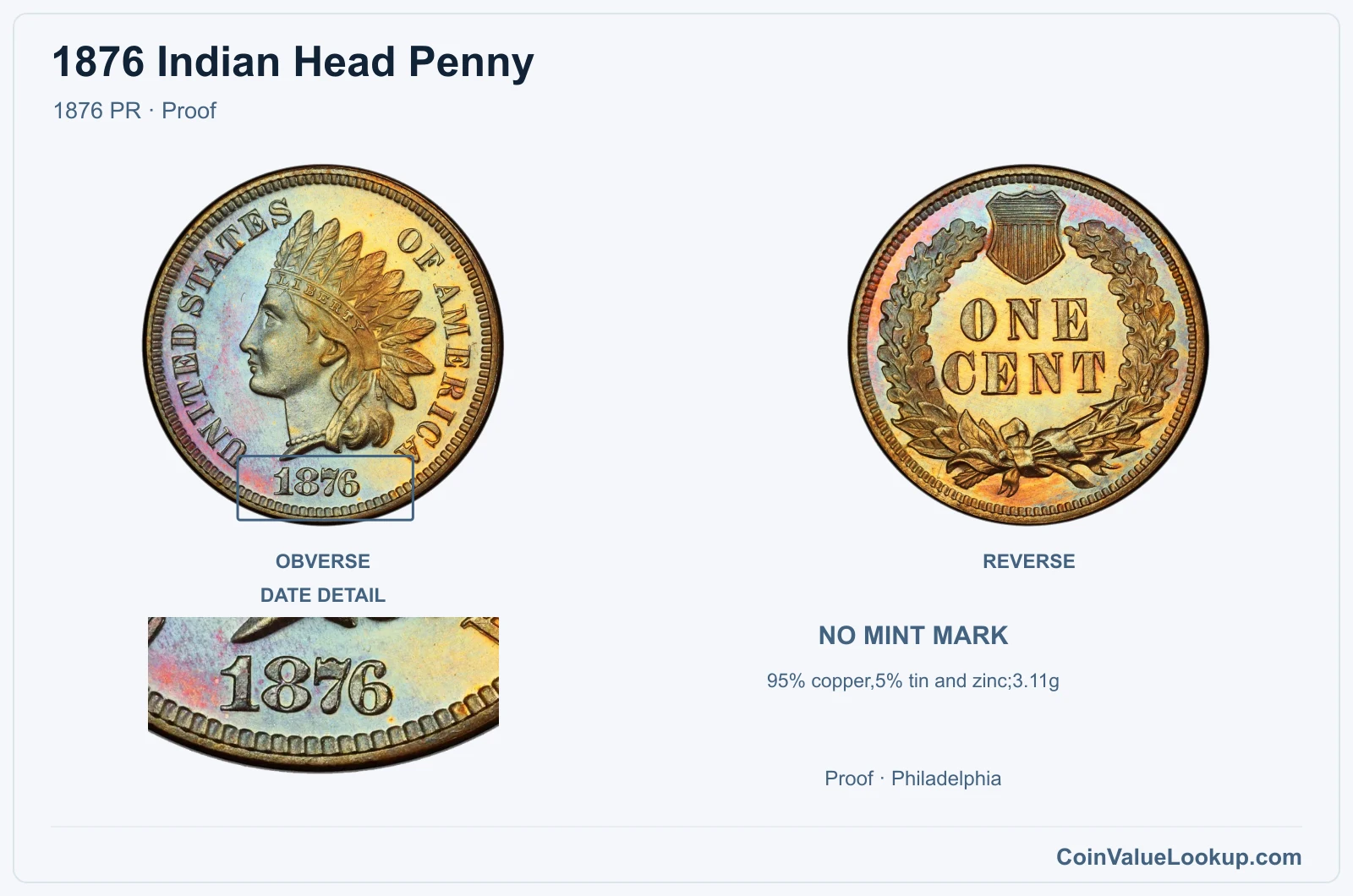
The 1876 proof Indian Head cent was a special striking sold to collectors directly by the Philadelphia Mint. It shares the same bronze composition and design as the business strike but was produced using polished dies and carefully prepared planchets, yielding mirror-like fields and exceptionally sharp detail.
A PR63 example lists around $376 per USA Coin Book. To confirm proof status, look for consistent reflective fields across the entire coin, not just a shiny high spot.
The rims on a proof tend to be squarer and more precisely formed than on a business strike. A circulation coin that someone buffed or dipped will show uneven reflectivity and hairlines from abrasion, which is a giveaway.
If you are unsure whether your coin is a proof, professional authentication is the safest route.
Coin Value Lookup is a good starting point when you want to compare values across different dates, denominations, and series before deciding on next steps.
| Range | Grade | Price | Auction Records | Appraisal |
|---|---|---|---|---|
| PR | PR 1 | — | Coin Identifier | |
| PR 2 | — | Coin Identifier | ||
| PR 3 | — | Coin Identifier | ||
| PR 4 | — | Coin Identifier | ||
| PR 6 | — | Coin Identifier | ||
| PR 8 | — | Coin Identifier | ||
| PR 10 | — | Coin Identifier | ||
| PR 12 | — | Coin Identifier | ||
| PR 15 | — | Coin Identifier | ||
| PR 20 | — | Coin Identifier | ||
| PR 25 | — | Coin Identifier | ||
| PR 30 | — | Coin Identifier | ||
| PR 35 | — | Coin Identifier | ||
| PR 40 | — | Coin Identifier | ||
| PR 45 | — | Coin Identifier | ||
| PR 50 | — | Coin Identifier | ||
| PR 53 | — | Coin Identifier | ||
| PR 55 | — | Coin Identifier | ||
| PR 58 | — | Coin Identifier | ||
| PR 60 | — | Coin Identifier | ||
| PR 61 | — | Coin Identifier | ||
| PR 62 | Coin Identifier | |||
| PR 63 | Coin Identifier | |||
| PR 64 | Coin Identifier | |||
| PR 65 | Coin Identifier | |||
| PR 66 | Coin Identifier | |||
| PR 67 | — | — | — | |
| PR 68 | — | — | — | |
| PR 69 | — | — | — | |
| PR 70 | — | — | — |
1876 Indian Head Penny Error List
1. 1876 Indian Head Penny — Misplaced Date
A misplaced date on an 1876 Indian Head cent shows partial impressions of one or more date digits in an unintended location, typically embedded in the denticles near the rim or close to the portrait, well away from where the final date sits. The die was punched with the date in the wrong spot before being corrected.
Look carefully along the denticles below the date and near the bust truncation. You are searching for the faint outline of a numeral, often just a curve or serif fragment, that matches the style of the 1876 digits.
Compare any suspect mark against a known source photograph of confirmed examples.
Die chips, random scratches, and small bumps can mimic parts of a numeral, so the shape must clearly correspond to a specific digit. Value depends on the authenticated identity of the specific die variety, the coin's overall condition, and how dramatic the misplacement is.
Professional attribution is recommended before assuming a premium.
2. 1876 Indian Head Penny — Repunched Date
A repunched date occurs when the date punch was applied to the die more than once in slightly different positions, leaving remnants of the earlier impression visible alongside the final numerals. On an 1876 cent, look for doubling, shadow lines, or offset serifs on any of the four digits.
This is different from machine doubling, which is a flat, shelf-like distortion created during striking rather than during die preparation. Repunched date traces tend to look sharp and well-formed because they were impressed into the die steel, while machine doubling looks mushy and lacks depth.
Damage from circulation hits or corrosion can also distort the date area and be mistaken for a repunch. The key diagnostic is that the extra impression should mirror the shape of the numeral and appear in a consistent offset direction.
Pricing depends on the specific die variety, authenticated identity, and the coin's condition.
3. 1876 Indian Head Penny — Die Crack
Die cracks on an 1876 Indian Head cent appear as thin, raised lines running across the coin's surface. They form when a working die develops a stress fracture, and metal flows into that crack during striking, producing a ridge on the finished coin.
To identify one, trace the line from its starting point to its end. A genuine die crack is raised above the field, follows a somewhat irregular path, and may cross both open field and design elements.
It will appear in the same location on every coin struck from that cracked die.
Do not confuse a die crack with an incuse scratch, which is sunk into the surface, or with corrosion lines, which tend to branch and follow no consistent path. A displaced-metal scrape from post-mint contact will also sit below the surface rather than above it.
Value is assessed individually based on authenticated identity, length, location, and coin condition.
4. 1876 Indian Head Penny — Die Break / Cud
A cud is a specific type of die break where a piece of the die rim has broken away entirely. On the struck coin, that missing section shows up as a raised, featureless blob of metal connected to the rim, replacing whatever design detail was originally there.
When examining an 1876 Indian Head cent, look along the entire rim for any area where the normal denticles and adjacent design simply disappear into a smooth, raised lump. The boundary between the cud and the surviving design should be distinct.
Rim dents from post-mint damage are recessed, not raised, so that is usually an easy distinction. Corrosion buildup can look lumpy but will have a different texture and will not show a clean boundary against struck detail.
Interior die chips are similar in origin but do not connect to the rim. Pricing requires authentication of the specific break, plus evaluation of the coin's overall grade and the size of the cud.
5. 1876 Indian Head Penny — Die Chip
A die chip on an 1876 Indian Head cent appears as a small, raised lump of metal, usually found inside a letter, numeral, or in the nearby field. It forms when a tiny fragment of the die face flakes away, leaving a void that fills with metal during striking.
The diagnostic clue is that the surrounding struck detail flows smoothly into the raised area. The lump sits naturally within the coin's design rather than looking like something was stuck on top.
Check letters like the E in ONE CENT or inside the loops of the date numerals, as these are common spots.
A post-mint gouge will displace metal in a directional way and typically show a scratch or impact mark nearby. Glued debris sits on the surface without blending into the struck design.
Die chips are collected as minor varieties, and their value is assessed individually based on the authenticated die, size and location of the chip, and the coin's condition.