1876 Liberty Seated Dime Coin Value: How Much Is It Worth?
The 1876 Liberty Seated dime spans several mint and design branches, with USA Coin Book retail guide estimates running from about $22 at G4 to $933 at MS63 across the normal Philadelphia, Carson City and San Francisco business strikes. A CC Doubled Die Obverse commands stronger prices, and a rare CC Specimen striking exists as well.
Sorting your coin by mint, reverse type and finish is the first step toward understanding its value.
Fast Way to Identify Your 1876 Liberty Seated Dime
Upload clear photos of both the front and back of your 1876 dime and our identifier will provide a preliminary identification of your coin's mint, reverse type and general category. This is not authentication or exact grading, but it helps you figure out which branch your coin belongs to before you dig deeper.
1876 Liberty Seated Dime Value
Upload both sides of your 1876 Liberty Seated Dime.
Front Obverse
Upload photo
Back Reverse
Upload photo
Which 1876 Liberty Seated Dime Versions Are Worth Money?
- The CC Doubled Die Obverse carries a USA Coin Book guide estimate of about $41 at G4 up to $4,251 at MS63, making it the standout variety to check for among 1876 dimes.
- Carson City coins (CC mintmark) generally guide higher than Philadelphia or San Francisco pieces at comparable grades, with the unsplit CC issue anchored at about $47 (G4) to $933 (MS63).
- The CC Type II Reverse is reported as scarce and worth identifying separately from the more common CC Type I.
- The Philadelphia Proof (Type I Reverse) carries a guide value of about $725 at PR63.
- A rare CC Specimen striking exists with mirror fields and bold devices; authenticated examples are seldom encountered.
- Repunched mintmark, doubled die and misplaced date varieties are reported for this year and can carry premiums depending on visibility and condition.
Step 1: Identify Your 1876 Liberty Seated Dime Mint Mark and Version
Start with the obverse: a seated Liberty figure, thirteen stars and the date 1876. The reverse reads UNITED STATES OF AMERICA around an agricultural wreath enclosing ONE DIME.
Half dimes are smaller and say HALF DIME, so set those aside.
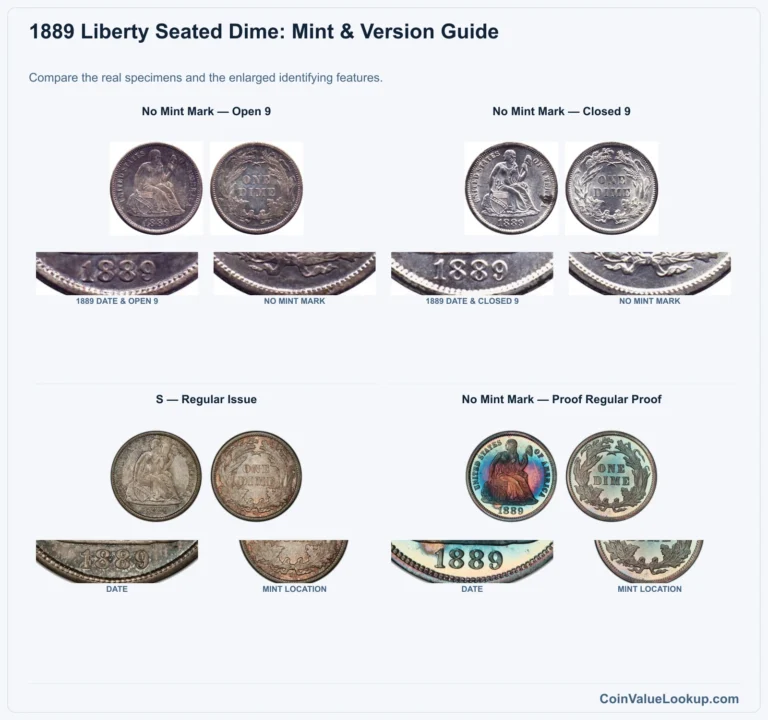
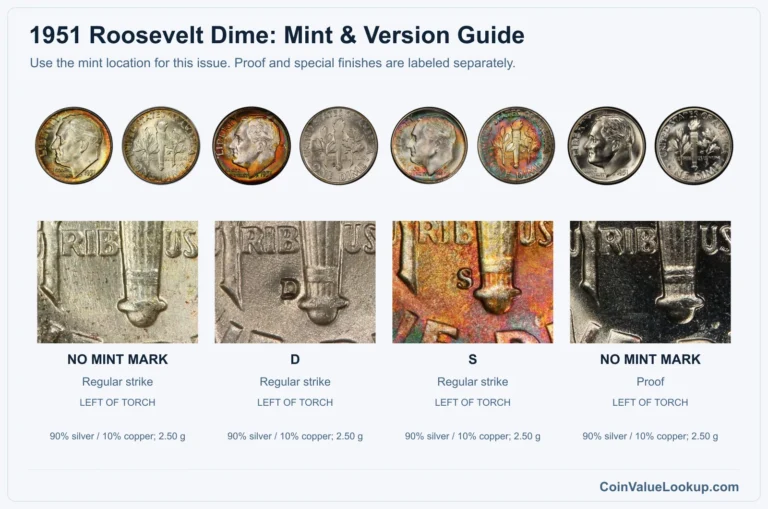
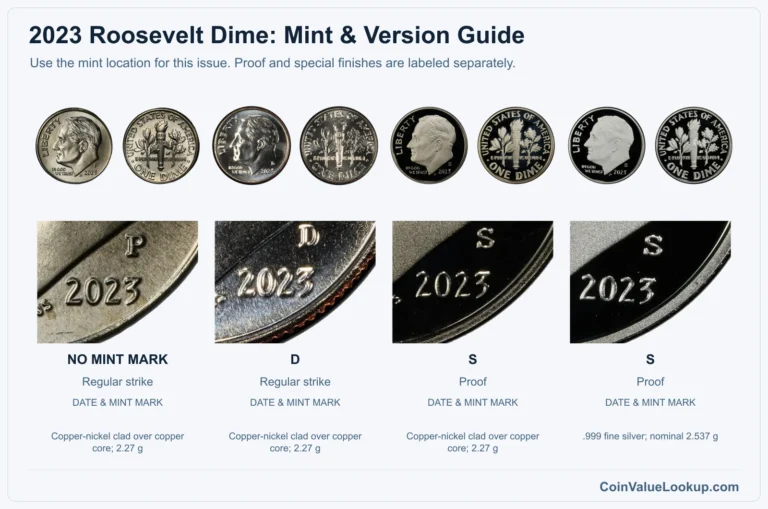
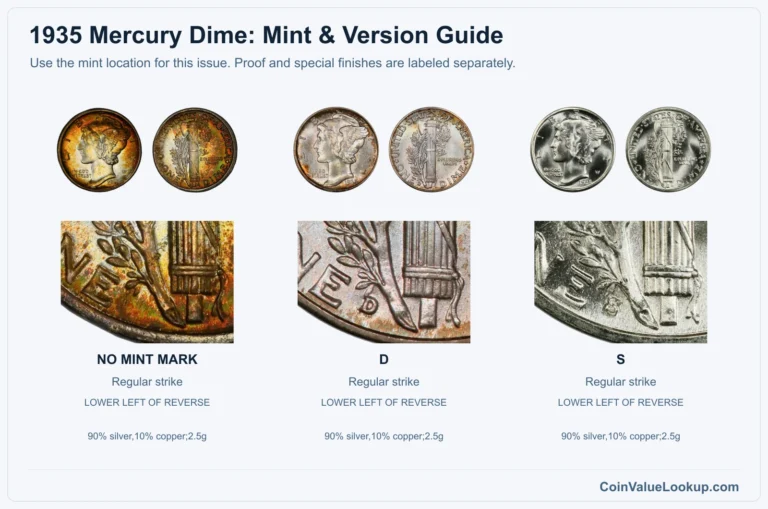
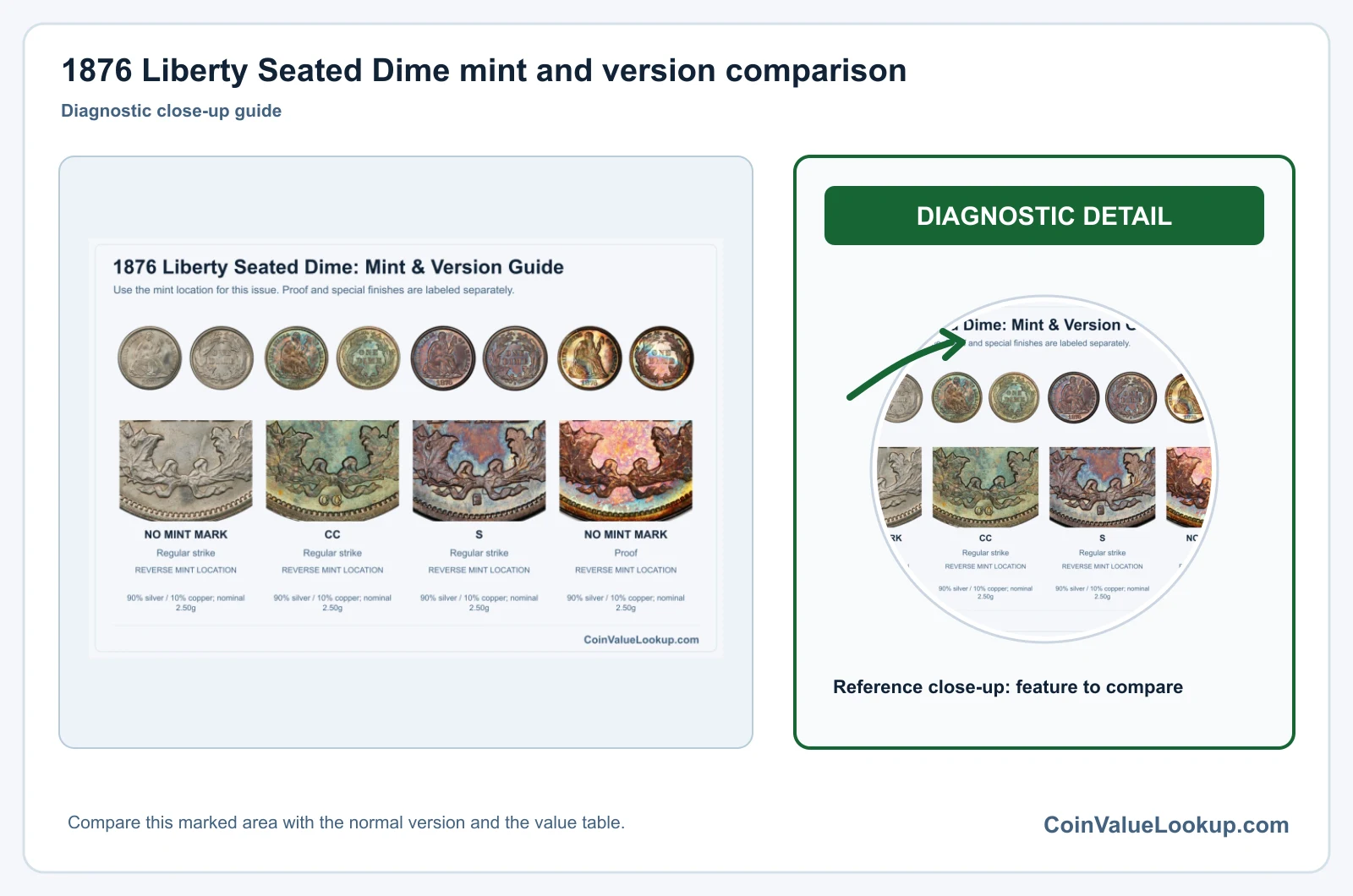
Philadelphia coins carry no mintmark. Carson City pieces show a small "CC" and San Francisco pieces an "S," both on the reverse near the base of the wreath.
All regular 1876 dimes are struck in 90% silver and 10% copper, measure 17.9 mm with a reeded edge and weigh a nominal 2.50 grams. If your coin is noticeably light or the edge is smooth, investigate further.
The critical split is the reverse hub. Type I has the "E" of ONE sitting close to the wheat grains and a two-point (split) left ribbon end.
Type II shows a wider gap between that "E" and the grains, plus a single-point left ribbon end. Every mint used both hubs this year, so check carefully regardless of the mintmark you find.
Coin Value Lookup is a good place to explore guides for other Liberty Seated dime dates and denominations while you work through your identification.
Step 2: Check Your 1876 Liberty Seated Dime Grade
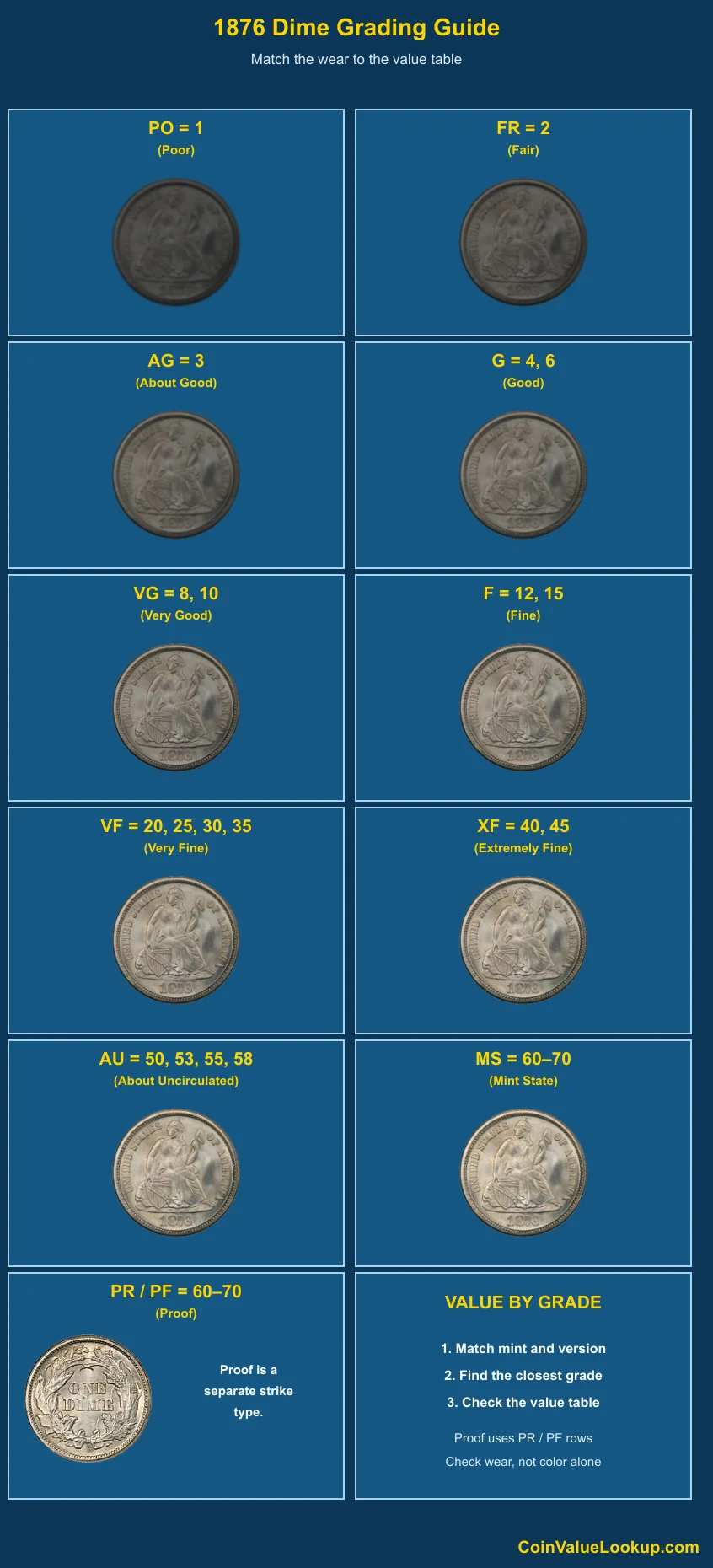
Focus first on the highest points of the design. On the obverse, check Liberty's head, the breast and knee area, and the shield for signs of smoothing or friction.
On the reverse, inspect the top leaves of the wreath.
At G4 (Good), the seated figure is outlined but most internal detail is gone. At MS63 (Mint State), you should see full original luster with only minor contact marks or blemishes.
Compare your coin side by side with the grading comparison image. Pay attention to whether luster survives in the protected areas around stars and letters.
Weak strikes and tired dies can flatten design elements even on uncirculated coins. If the knee or shield lines are soft but luster is intact everywhere, suspect a strike issue rather than wear.
Proof coins have mirror fields from specially prepared dies. A polished coin is not a Proof.
Specimen strikings are a separate category with their own attributes. Keep all three finishes apart when assessing your piece.
Step 3: Check 1876 Liberty Seated Dime Value by Mint and Version
1876 Liberty Seated Dime — No Mint Mark — Type I Reverse
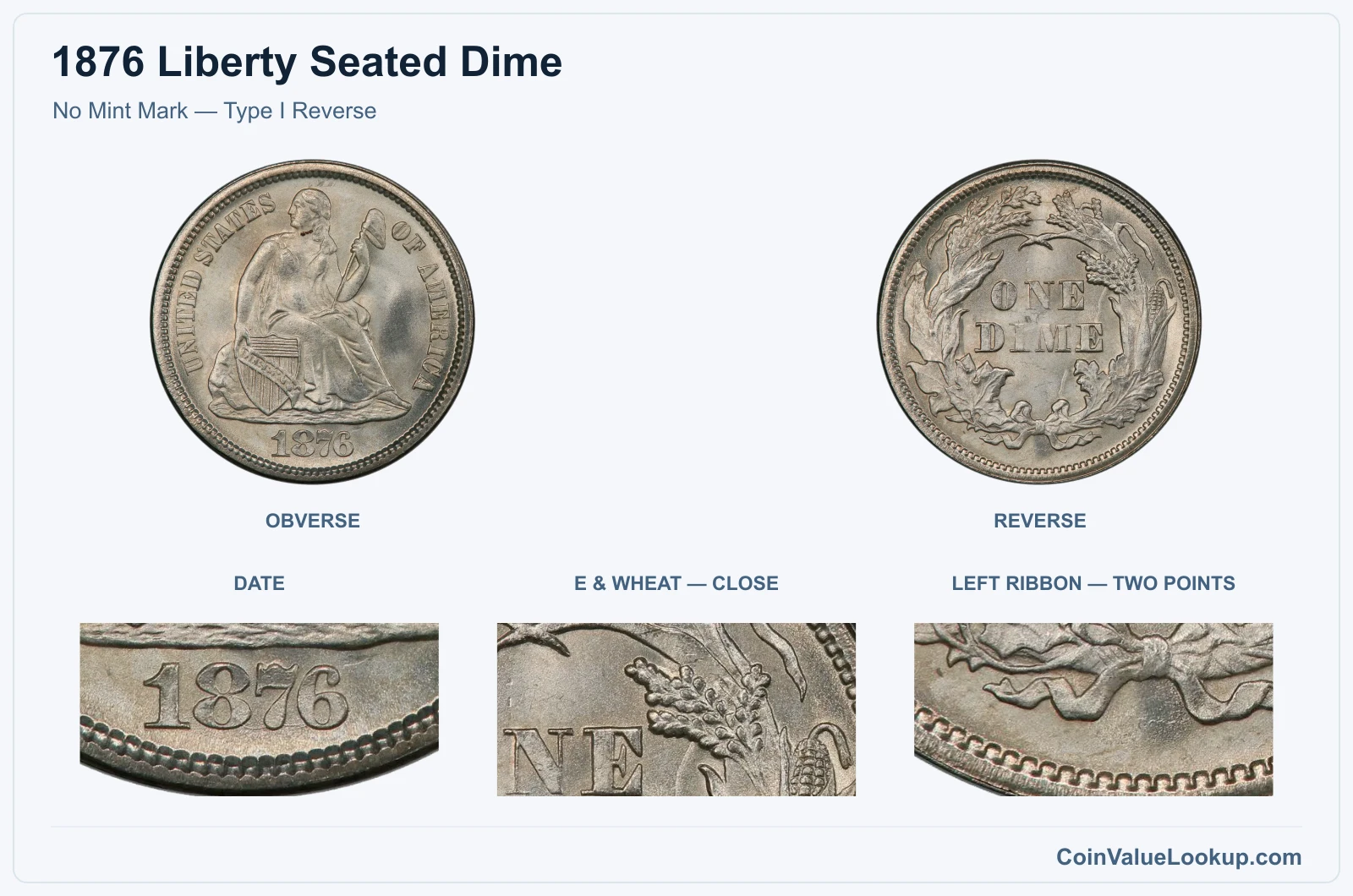
Philadelphia Type I Reverse dimes have no mintmark and show the "E" of ONE positioned close to the wheat grains, with a two-point (split) left ribbon end. These are the diagnostics that separate it from the Type II hub.
The unsplit Philadelphia issue guides at roughly $22 (G4) to $316 (MS63) per USA Coin Book, but no separate Type I quote is established. Your coin's value depends on its authenticated identity and condition.
Silver content alone provides a floor, and nice original surfaces always help.
Ordinary-issue reference: Ordinary-issue reference only: The table below shows prices for the 1876 Liberty Seated Dime (regular strike). It does not represent the value of the specific No Mint Mark — Type I Reverse variety or its variety premium. Year, mint, metal and strike type are matched; the specific variety is not priced by this table.
Range Grade
Price Auction Records Appraisal PO PO 1
—
Coin Identifier FR FR 2
—
Coin Identifier AG AG 3
—
Coin Identifier G G 4
—
Coin Identifier
G 6
—
Coin Identifier VG VG 8
Coin Identifier
VG 10
—
Coin Identifier F F 12
—
Coin Identifier
F 15
—
Coin Identifier VF VF 20
Coin Identifier
VF 25
—
Coin Identifier
VF 30
—
Coin Identifier
VF 35
—
Coin Identifier XF XF 40
Coin Identifier
XF 45
—
Coin Identifier AU AU 50
Coin Identifier
AU 53
Coin Identifier
AU 55
Coin Identifier
AU 58
Coin Identifier MS MS 60
Coin Identifier
MS 61
Coin Identifier
MS 62
Coin Identifier
MS 63
Coin Identifier
MS 64
Coin Identifier
MS 65
Coin Identifier
MS 66
Coin Identifier
MS 67
Coin Identifier
MS 68
Coin Identifier
MS 69
—
—
—
MS 70
—
—
—
1876 Liberty Seated Dime — No Mint Mark — Type II Reverse
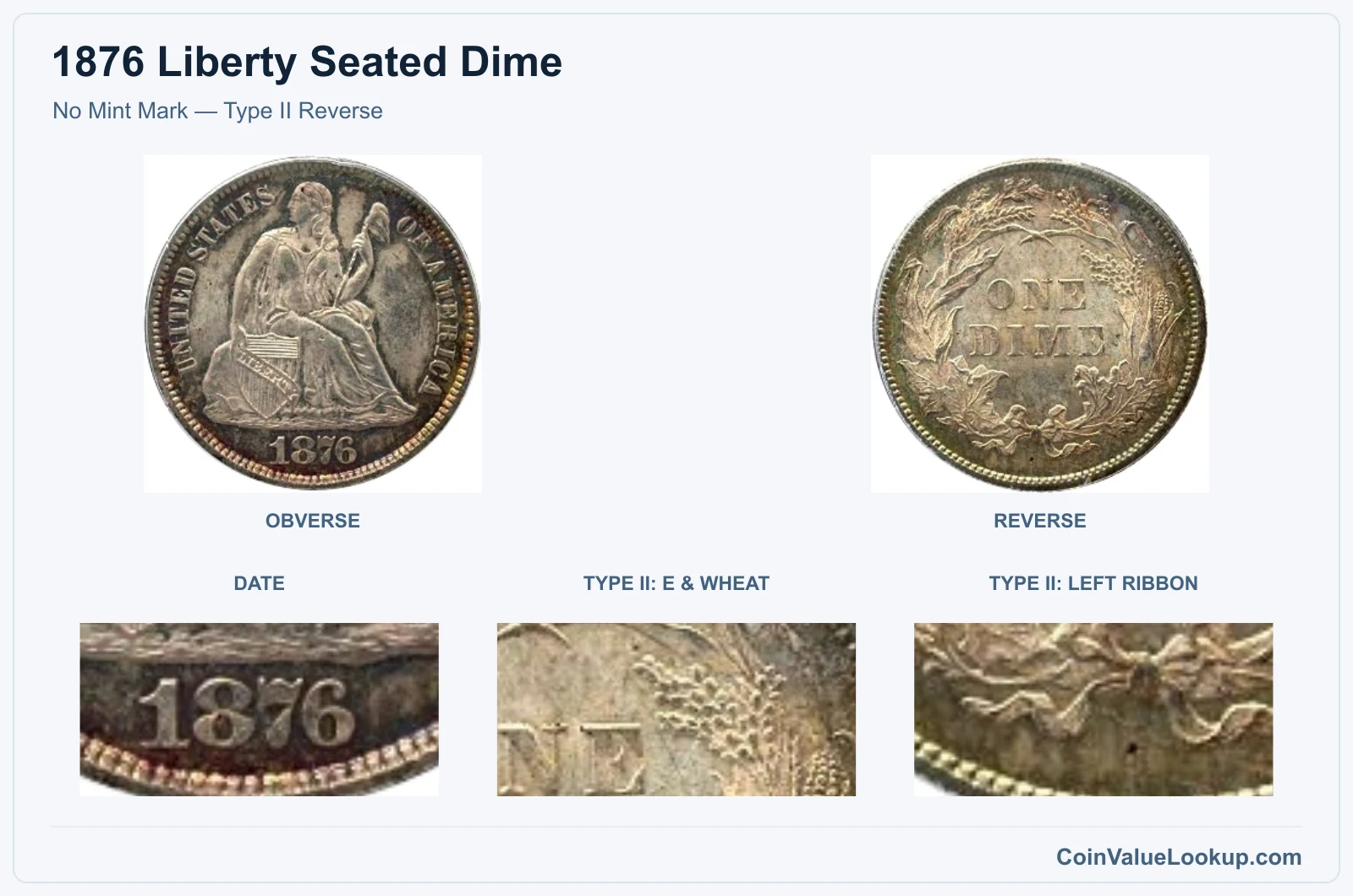
The Philadelphia Type II Reverse shows a wider gap between the "E" of ONE and the wheat grains, and the left ribbon end comes to a single point instead of splitting. Flip between the two types under magnification if you are unsure.
As with the Type I, the unsplit Philadelphia guide anchors sit at about $22 (G4) to $316 (MS63), but no separate Type II figure is adopted. Actual value depends on the coin's confirmed identity, condition and surface quality.
Ordinary-issue reference: Ordinary-issue reference only: The table below shows prices for the 1876 Liberty Seated Dime (regular strike). It does not represent the value of the specific No Mint Mark — Type II Reverse variety or its variety premium. Year, mint, metal and strike type are matched; the specific variety is not priced by this table.
Range Grade
Price Auction Records Appraisal PO PO 1
—
Coin Identifier FR FR 2
—
Coin Identifier AG AG 3
—
Coin Identifier G G 4
—
Coin Identifier
G 6
—
Coin Identifier VG VG 8
Coin Identifier
VG 10
—
Coin Identifier F F 12
—
Coin Identifier
F 15
—
Coin Identifier VF VF 20
Coin Identifier
VF 25
—
Coin Identifier
VF 30
—
Coin Identifier
VF 35
—
Coin Identifier XF XF 40
Coin Identifier
XF 45
—
Coin Identifier AU AU 50
Coin Identifier
AU 53
Coin Identifier
AU 55
Coin Identifier
AU 58
Coin Identifier MS MS 60
Coin Identifier
MS 61
Coin Identifier
MS 62
Coin Identifier
MS 63
Coin Identifier
MS 64
Coin Identifier
MS 65
Coin Identifier
MS 66
Coin Identifier
MS 67
Coin Identifier
MS 68
Coin Identifier
MS 69
—
—
—
MS 70
—
—
—
1876 Liberty Seated Dime — CC — Type I Reverse
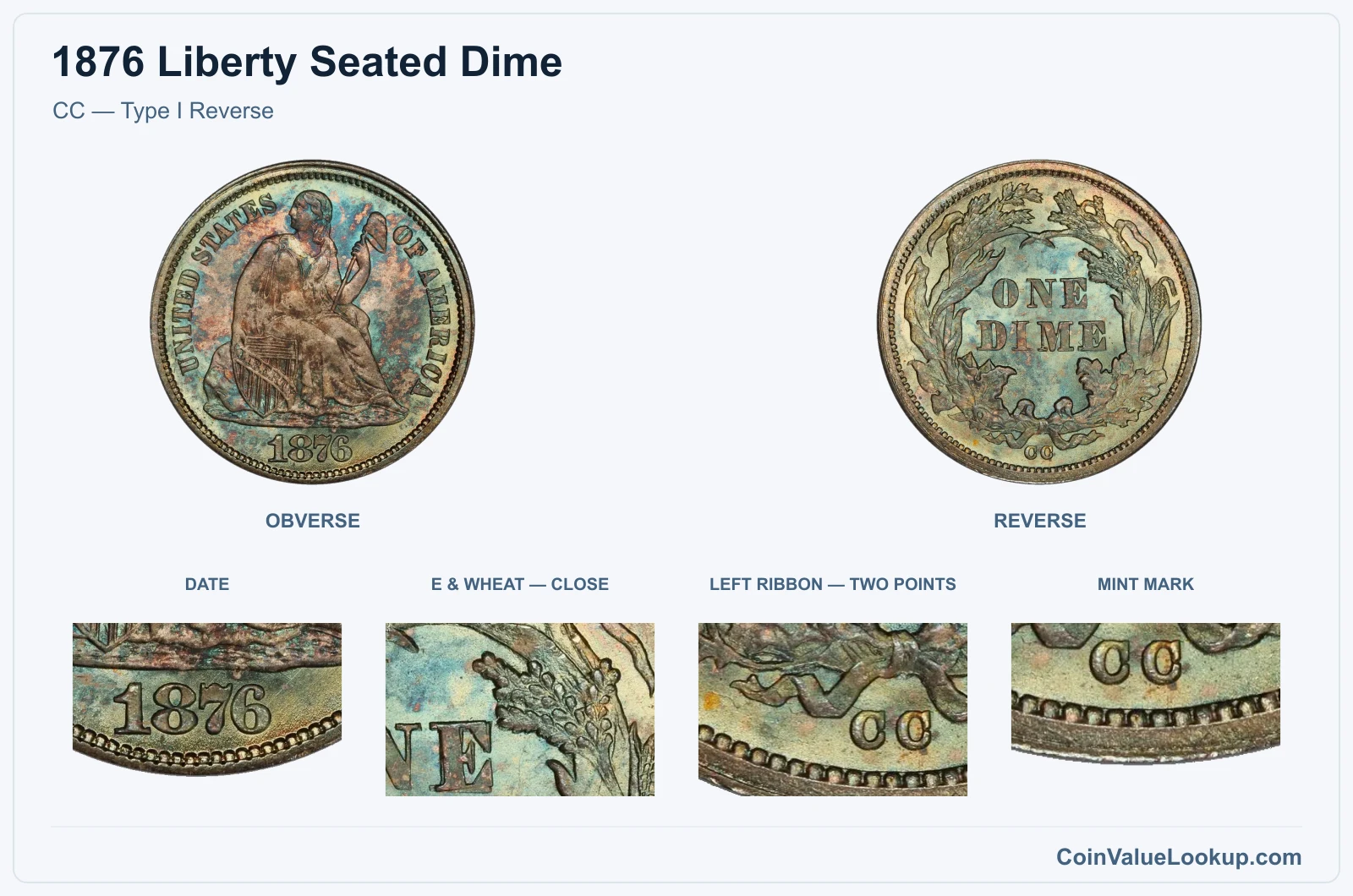
Carson City Type I Reverse dimes carry the "CC" mintmark on the reverse. The Type I hub places the "E" of ONE close to the wheat grains and has a split (two-point) left ribbon end.
The unsplit CC issue guides at roughly $47 (G4) to $933 (MS63) per USA Coin Book, though a separate Type I price is not established. Carson City dimes tend to draw collector interest simply because of the mint, so original surfaces and sharp detail matter.
Condition and authenticated identity drive the final number.
Ordinary-issue reference: Ordinary-issue reference only: The table below shows prices for the 1876-CC Liberty Seated Dime (regular strike). It does not represent the value of the specific CC — Type I Reverse variety or its variety premium. Year, mint, metal and strike type are matched; the specific variety is not priced by this table.
Range Grade
Price Auction Records Appraisal PO PO 1
—
Coin Identifier FR FR 2
—
Coin Identifier AG AG 3
—
Coin Identifier G G 4
—
Coin Identifier
G 6
—
Coin Identifier VG VG 8
Coin Identifier
VG 10
Coin Identifier F F 12
Coin Identifier
F 15
Coin Identifier VF VF 20
Coin Identifier
VF 25
Coin Identifier
VF 30
Coin Identifier
VF 35
Coin Identifier XF XF 40
Coin Identifier
XF 45
Coin Identifier AU AU 50
Coin Identifier
AU 53
Coin Identifier
AU 55
Coin Identifier
AU 58
Coin Identifier MS MS 60
Coin Identifier
MS 61
Coin Identifier
MS 62
Coin Identifier
MS 63
Coin Identifier
MS 64
Coin Identifier
MS 65
Coin Identifier
MS 66
Coin Identifier
MS 67
Coin Identifier
MS 68
—
—
—
MS 69
—
—
—
MS 70
—
—
—
1876 Liberty Seated Dime — CC — Type II Reverse
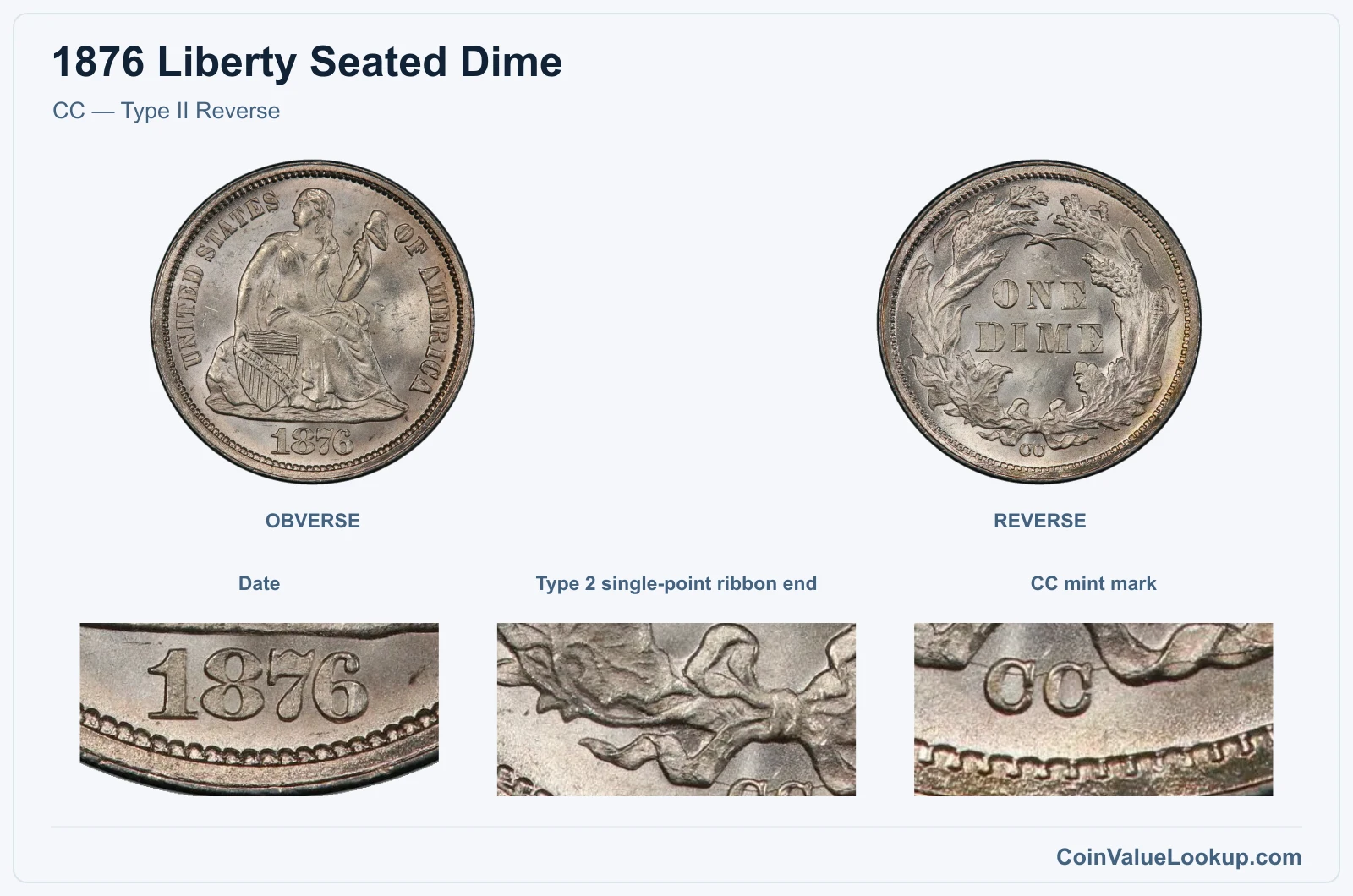
This is the scarce one. The CC Type II Reverse pairs the Carson City mintmark with the later hub, identifiable by the wider gap between the "E" of ONE and the grains, plus a single-point left ribbon end.
The unsplit CC guide sits at about $47 (G4) to $933 (MS63), but no separate Type II quote is adopted. Scarcity means demand can push realized prices beyond generic CC estimates for properly attributed examples.
Have the reverse type confirmed by a knowledgeable dealer or grading service before assuming you hold the scarcer hub.
Ordinary-issue reference: Ordinary-issue reference only: The table below shows prices for the 1876-CC Liberty Seated Dime (regular strike). It does not represent the value of the specific CC — Type II Reverse variety or its variety premium. Year, mint, metal and strike type are matched; the specific variety is not priced by this table.
Range Grade
Price Auction Records Appraisal PO PO 1
—
Coin Identifier FR FR 2
—
Coin Identifier AG AG 3
—
Coin Identifier G G 4
—
Coin Identifier
G 6
—
Coin Identifier VG VG 8
Coin Identifier
VG 10
Coin Identifier F F 12
Coin Identifier
F 15
Coin Identifier VF VF 20
Coin Identifier
VF 25
Coin Identifier
VF 30
Coin Identifier
VF 35
Coin Identifier XF XF 40
Coin Identifier
XF 45
Coin Identifier AU AU 50
Coin Identifier
AU 53
Coin Identifier
AU 55
Coin Identifier
AU 58
Coin Identifier MS MS 60
Coin Identifier
MS 61
Coin Identifier
MS 62
Coin Identifier
MS 63
Coin Identifier
MS 64
Coin Identifier
MS 65
Coin Identifier
MS 66
Coin Identifier
MS 67
Coin Identifier
MS 68
—
—
—
MS 69
—
—
—
MS 70
—
—
—
1876 Liberty Seated Dime — CC — Doubled Die Obverse
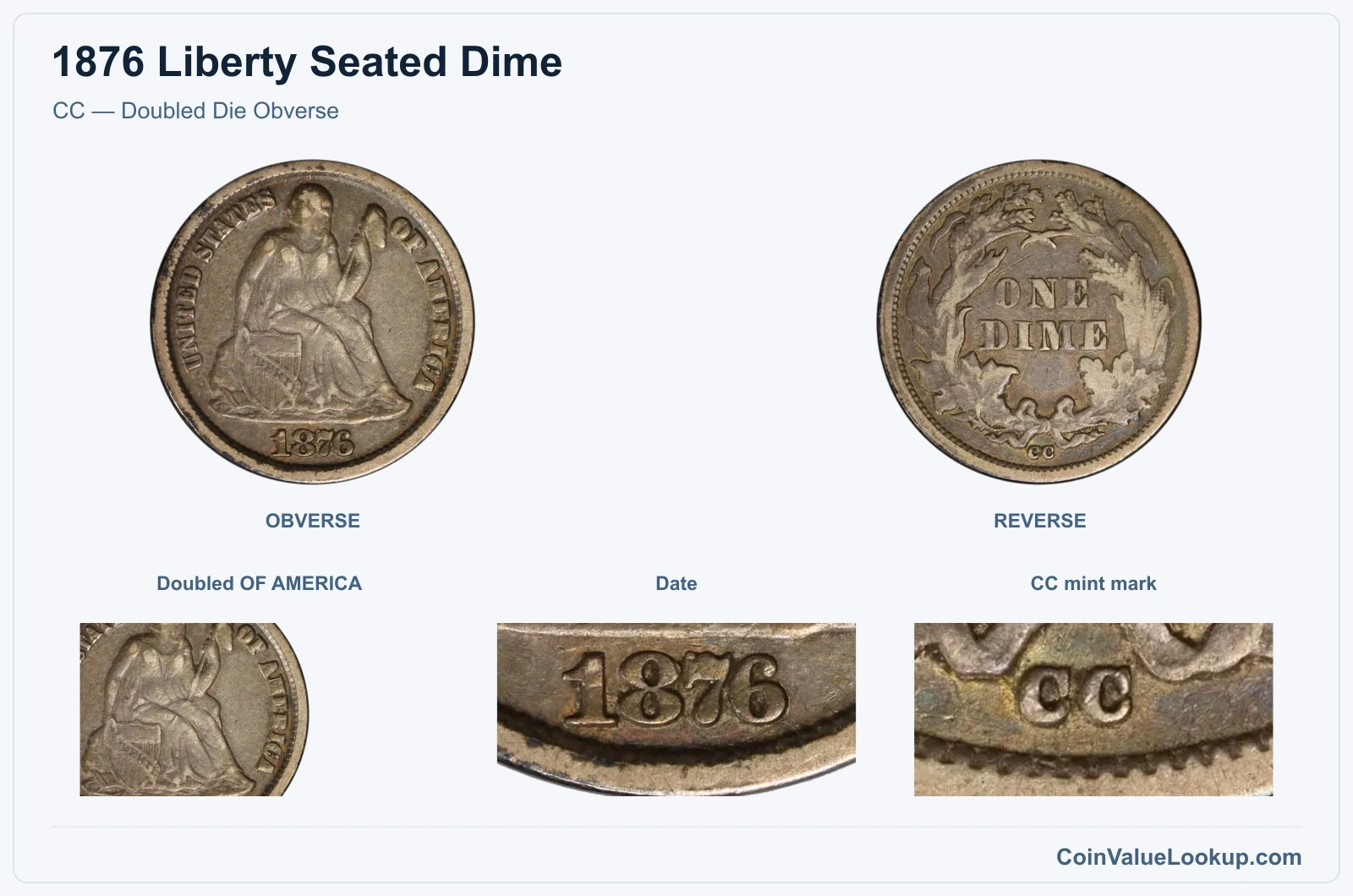
The major CC Doubled Die Obverse is the highest-valued regular business strike variety for 1876 dimes. USA Coin Book guides it at about $41 in G4 and $4,251 in MS63.
Look for clear doubling on the obverse lettering, date or design elements. The separation should be consistent across multiple features, not just a flat shelf on one letter.
This is a recognized die variety, not simple strike wobble.
Because the premium is large, professional attribution matters. A well-worn example still carries meaningful value at lower grades, but the spread between G4 and Mint State is dramatic.
Confirm the CC mintmark and compare against known diagnostic images before celebrating.
Ordinary-issue reference: Ordinary-issue reference only: The table below shows prices for the 1876-CC Liberty Seated Dime (regular strike). It does not represent the value of the specific CC — Doubled Die Obverse variety or its variety premium. Year, mint, metal and strike type are matched; the specific variety is not priced by this table.
Range Grade
Price Auction Records Appraisal PO PO 1
—
Coin Identifier FR FR 2
—
Coin Identifier AG AG 3
—
Coin Identifier G G 4
—
Coin Identifier
G 6
—
Coin Identifier VG VG 8
Coin Identifier
VG 10
Coin Identifier F F 12
Coin Identifier
F 15
Coin Identifier VF VF 20
Coin Identifier
VF 25
Coin Identifier
VF 30
Coin Identifier
VF 35
Coin Identifier XF XF 40
Coin Identifier
XF 45
Coin Identifier AU AU 50
Coin Identifier
AU 53
Coin Identifier
AU 55
Coin Identifier
AU 58
Coin Identifier MS MS 60
Coin Identifier
MS 61
Coin Identifier
MS 62
Coin Identifier
MS 63
Coin Identifier
MS 64
Coin Identifier
MS 65
Coin Identifier
MS 66
Coin Identifier
MS 67
Coin Identifier
MS 68
—
—
—
MS 69
—
—
—
MS 70
—
—
—
1876 Liberty Seated Dime — S — Type I Reverse
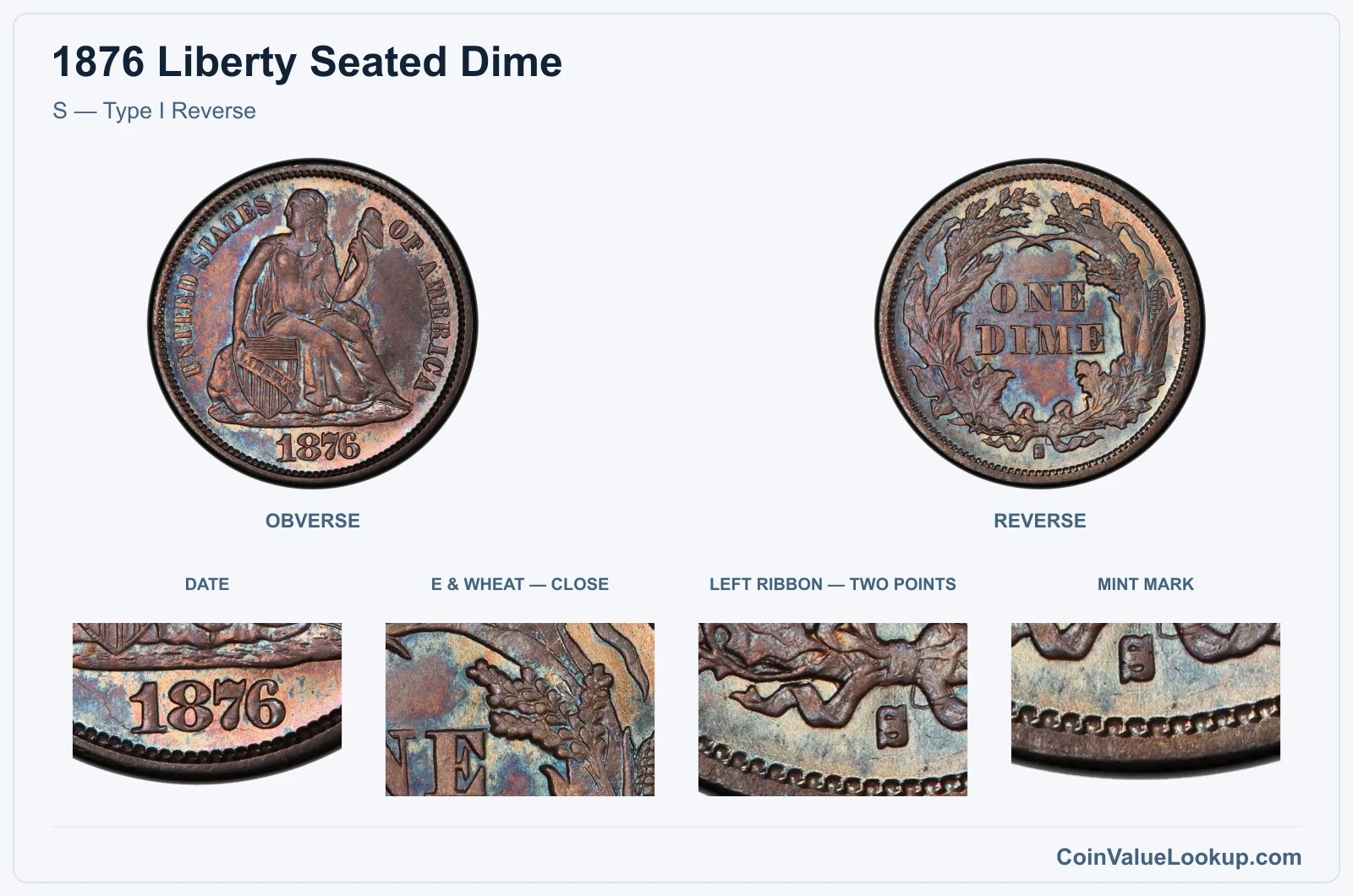
San Francisco Type I Reverse dimes carry the "S" mintmark and the earlier reverse hub. Check for the "E" of ONE sitting tight against the wheat grains and the two-point left ribbon end.
The unsplit S issue guides at about $22 (G4) to $316 (MS63), but no separate Type I figure is adopted. Value depends on the coin's confirmed identity and condition.
San Francisco strikes sometimes come weakly impressed, so distinguish strike softness from actual wear.
Ordinary-issue reference: Ordinary-issue reference only: The table below shows prices for the 1876-S Liberty Seated Dime (regular strike). It does not represent the value of the specific S — Type I Reverse variety or its variety premium. Year, mint, metal and strike type are matched; the specific variety is not priced by this table.
Range Grade
Price Auction Records Appraisal PO PO 1
—
Coin Identifier FR FR 2
—
Coin Identifier AG AG 3
—
Coin Identifier G G 4
—
Coin Identifier
G 6
—
Coin Identifier VG VG 8
—
Coin Identifier
VG 10
—
Coin Identifier F F 12
—
Coin Identifier
F 15
—
Coin Identifier VF VF 20
—
Coin Identifier
VF 25
—
Coin Identifier
VF 30
—
Coin Identifier
VF 35
—
Coin Identifier XF XF 40
—
Coin Identifier
XF 45
—
Coin Identifier AU AU 50
—
Coin Identifier
AU 53
Coin Identifier
AU 55
Coin Identifier
AU 58
Coin Identifier MS MS 60
—
Coin Identifier
MS 61
Coin Identifier
MS 62
Coin Identifier
MS 63
Coin Identifier
MS 64
Coin Identifier
MS 65
Coin Identifier
MS 66
Coin Identifier
MS 67
Coin Identifier
MS 68
—
—
—
MS 69
—
—
—
MS 70
—
—
—
1876 Liberty Seated Dime — S — Type II Reverse
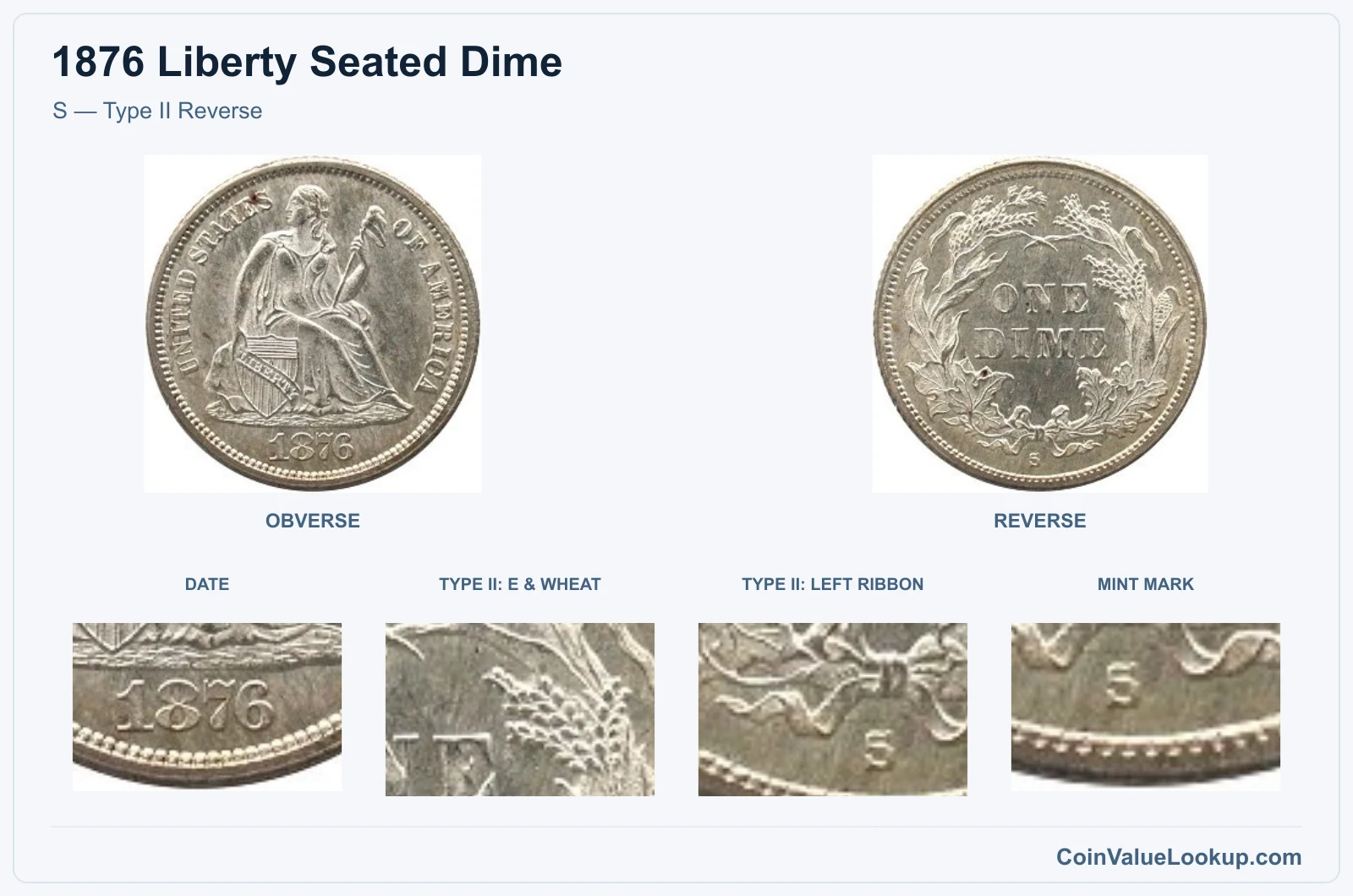
San Francisco Type II Reverse dimes use the later hub with a wider gap between the "E" of ONE and the grains and a single-point left ribbon end, paired with the "S" mintmark.
The unsplit S guide anchors at about $22 (G4) to $316 (MS63), without a dedicated Type II quote. As with other mints, authenticated identity and surface condition are what set the price.
Check both ribbon ends carefully; wear can obscure the split on a Type I and make it look like a Type II.
Ordinary-issue reference: Ordinary-issue reference only: The table below shows prices for the 1876-S Liberty Seated Dime (regular strike). It does not represent the value of the specific S — Type II Reverse variety or its variety premium. Year, mint, metal and strike type are matched; the specific variety is not priced by this table.
Range Grade
Price Auction Records Appraisal PO PO 1
—
Coin Identifier FR FR 2
—
Coin Identifier AG AG 3
—
Coin Identifier G G 4
—
Coin Identifier
G 6
—
Coin Identifier VG VG 8
—
Coin Identifier
VG 10
—
Coin Identifier F F 12
—
Coin Identifier
F 15
—
Coin Identifier VF VF 20
—
Coin Identifier
VF 25
—
Coin Identifier
VF 30
—
Coin Identifier
VF 35
—
Coin Identifier XF XF 40
—
Coin Identifier
XF 45
—
Coin Identifier AU AU 50
—
Coin Identifier
AU 53
Coin Identifier
AU 55
Coin Identifier
AU 58
Coin Identifier MS MS 60
—
Coin Identifier
MS 61
Coin Identifier
MS 62
Coin Identifier
MS 63
Coin Identifier
MS 64
Coin Identifier
MS 65
Coin Identifier
MS 66
Coin Identifier
MS 67
Coin Identifier
MS 68
—
—
—
MS 69
—
—
—
MS 70
—
—
—
1876 Liberty Seated Dime — No Mint Mark — Proof Type I Reverse
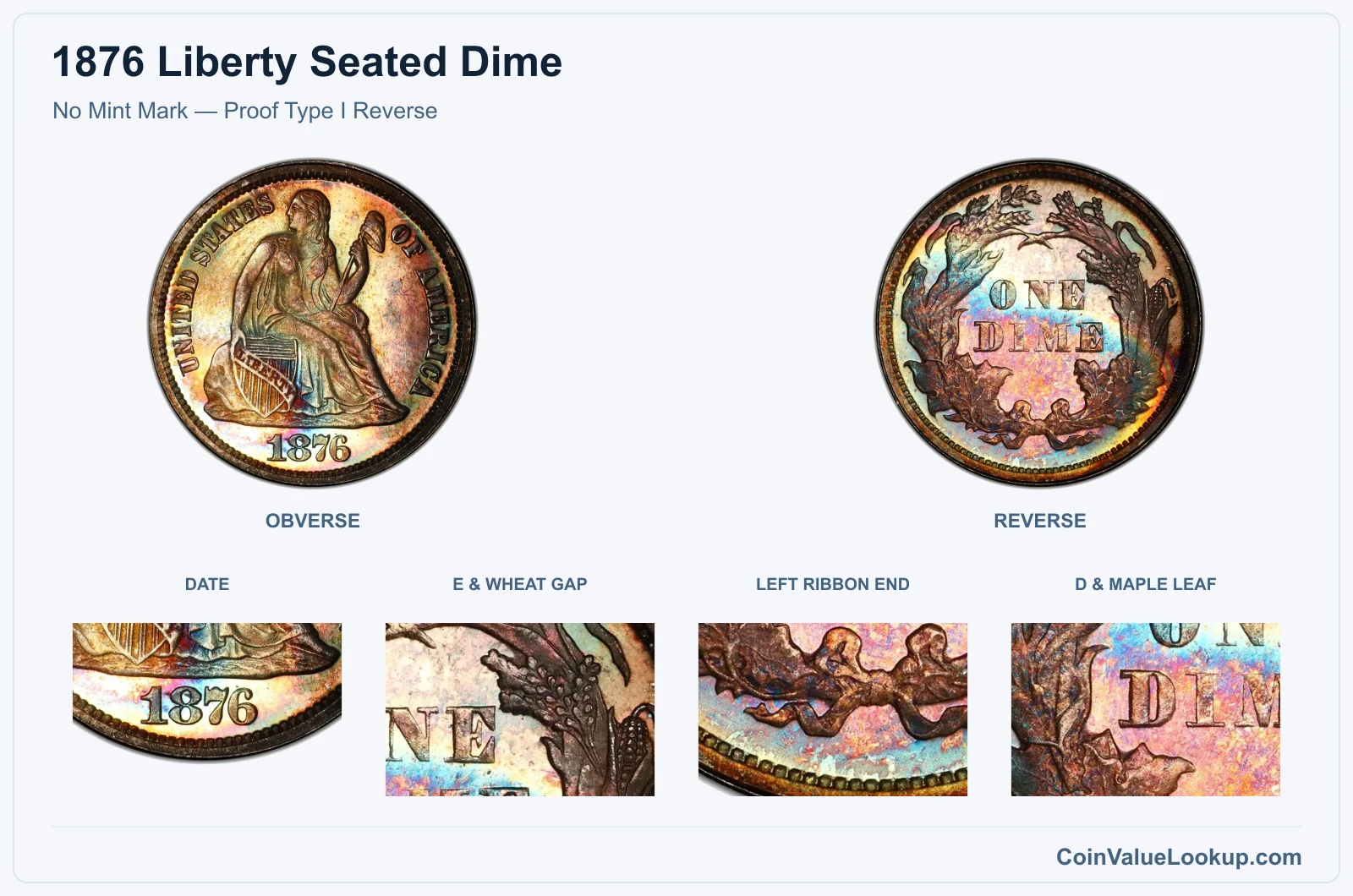
Philadelphia struck Proof dimes with the Type I Reverse hub in 1876. Genuine Proofs show deeply mirrored fields from polished dies and sharp, squared-off device edges.
USA Coin Book guides PR63 examples at about $725.
Hairlines from old cleaning are common on Proofs and will lower the grade. Brilliance alone does not make a Proof; the field texture and edge sharpness of the devices are what matter.
A business strike that has been polished flat is still a business strike. Professional certification is strongly recommended before assigning Proof status to any Liberty Seated dime.
Ordinary-issue reference: Ordinary-issue reference only: The table below shows prices for the 1876 Liberty Seated Dime (proof). It does not represent the value of the specific No Mint Mark — Proof Type I Reverse variety or its variety premium. Year, mint, metal and strike type are matched; the specific variety is not priced by this table.
Range Grade
Price Auction Records Appraisal PR PR 1
—
Coin Identifier
PR 2
—
Coin Identifier
PR 3
—
Coin Identifier
PR 4
—
Coin Identifier
PR 6
—
Coin Identifier
PR 8
—
Coin Identifier
PR 10
—
Coin Identifier
PR 12
—
Coin Identifier
PR 15
—
Coin Identifier
PR 20
—
Coin Identifier
PR 25
—
Coin Identifier
PR 30
—
Coin Identifier
PR 35
—
Coin Identifier
PR 40
—
Coin Identifier
PR 45
—
Coin Identifier
PR 50
—
Coin Identifier
PR 53
—
Coin Identifier
PR 55
—
Coin Identifier
PR 58
Coin Identifier
PR 60
Coin Identifier
PR 61
Coin Identifier
PR 62
Coin Identifier
PR 63
Coin Identifier
PR 64
Coin Identifier
PR 65
Coin Identifier
PR 66
Coin Identifier
PR 67
Coin Identifier
PR 68
Coin Identifier
PR 69
—
—
—
PR 70
—
—
—
1876 Liberty Seated Dime — CC — Special Specimen Striking
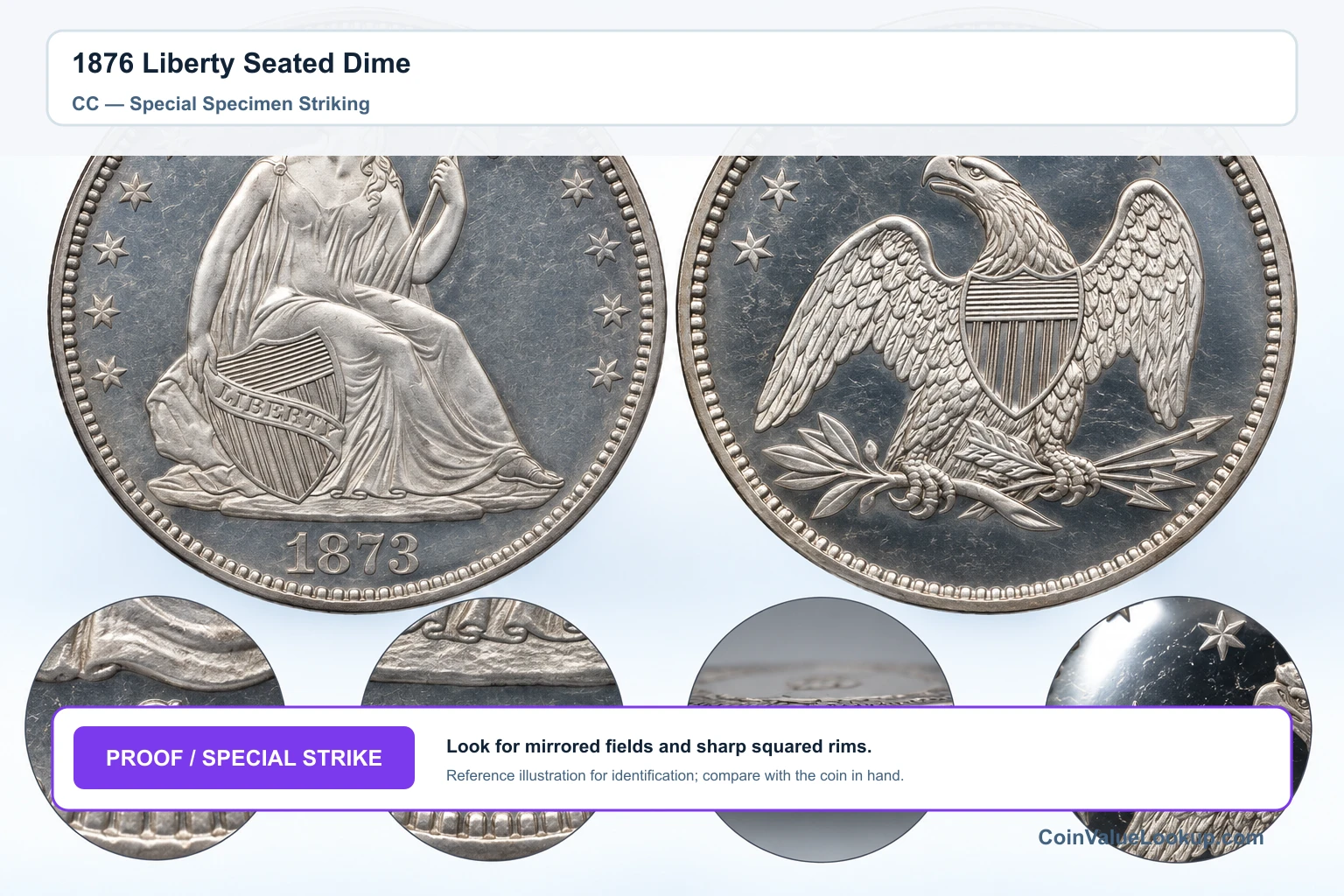
A rare CC Specimen striking exists for 1876. One documented example, graded SP65 by NGC, shows an unusually bold strike, fully mirrored fields, a wire rim edge and doubled lettering on the "E" of DIME.
This is a special preparation, distinct from both ordinary business strikes and standard Proofs.
No numeric price range is adopted here because of the coin's extreme rarity. Ordinary prooflike Carson City dimes should not be promoted into this category.
Only coins with professional third-party attribution as Specimen strikings belong in this branch. If you suspect you have one, seek expert evaluation rather than making the call yourself.
Separate attributed varieties: The columns below show the specifically named varieties separately. Use only the column that matches the authenticated attribution of your coin.
Range Grade
Price1876-CC Liberty Seated Dime — Specimen Type A Price1876-CC Liberty Seated Dime — Specimen Type B Auction Records Appraisal SP SP 1
—
Coin Identifier
SP 2
—
Coin Identifier
SP 3
—
Coin Identifier
SP 4
—
Coin Identifier
SP 6
—
Coin Identifier
SP 8
—
Coin Identifier
SP 10
—
Coin Identifier
SP 12
—
Coin Identifier
SP 15
—
Coin Identifier
SP 20
—
Coin Identifier
SP 25
—
Coin Identifier
SP 30
—
Coin Identifier
SP 35
—
Coin Identifier
SP 40
—
Coin Identifier
SP 45
—
Coin Identifier
SP 50
—
Coin Identifier
SP 53
—
Coin Identifier
SP 55
—
Coin Identifier
SP 58
—
Coin Identifier
SP 60
—
Coin Identifier
SP 61
—
Coin Identifier
SP 62
—
Coin Identifier
SP 63
—
Coin Identifier
SP 64
—
Coin Identifier
SP 65
Coin Identifier
SP 66
Coin Identifier
SP 67
—
—
—
—
SP 68
—
—
—
—
SP 69
—
—
—
—
SP 70
—
—
—
—
1876 Liberty Seated Dime Error List
1. 1876 Liberty Seated Dime — Repunched Date
A repunched date shows remnants of an earlier position of one or more date numerals alongside the final placement. On an 1876 dime, look for traces of a shifted "1," "8," "7" or "6" peeking out from behind the accepted digits.
This is a die-making variety, not a doubled die. The date punch was physically repositioned before final use, leaving ghost impressions.
Under magnification, you may see an extra serif or partial numeral slightly offset from the final number.
Do not confuse this with post-strike damage such as a scratch crossing the date, or with machine doubling that produces a flat shelf. A genuine repunched date will show raised, rounded contours matching the shape of a numeral.
Value depends on the visibility of the repunching and overall coin condition.
2. 1876 Liberty Seated Dime — Misplaced Date
A misplaced date occurs when part of a date digit is punched into the wrong area of the die, typically into the drapery, scroll or field rather than the intended date position. On 1876 Carson City dimes, look near the gown or scroll for stray fragments of "7" or "6."
The key is recognizing a raised contour that matches the shape of a specific numeral. Random die scratches and corrosion lines will not follow the curves of a date digit.
Compare any suspect mark against known numeral profiles at matching magnification.
Condition and the clarity of the misplaced digit affect value. A bold, easily visible fragment is more desirable than one requiring extreme magnification to detect.
3. 1876 Liberty Seated Dime — Rotated Dies
Normal United States coins have the obverse and reverse oriented 180 degrees apart, so when you flip the coin top-to-bottom the other side appears upright. A rotated die error means the reverse is turned some number of degrees off that standard alignment.
To test, hold the obverse upright and rotate the coin on a vertical axis. If the reverse is tilted, you may have a die rotation.
Small rotations of a few degrees are common and carry modest interest. Larger rotations, especially approaching 90 or 180 degrees, are more significant.
Do not confuse a rotation with a photograph taken at an angle, or with simply turning the coin sideways. Value depends on the degree of rotation, condition and collector demand.
4. 1876 Liberty Seated Dime — Doubled Die Obverse
A doubled die obverse on an 1876 dime shows consistent doubling across obverse design elements such as stars, lettering or the date. The separation appears as notching or a distinct secondary image, not a flat, shelf-like displacement.
Compare your coin's obverse letters and stars against a normal example under identical lighting. Genuine hub doubling will repeat across multiple features in a consistent direction.
Machine doubling, which is a strike artifact, produces a flat, shelf-like distortion and generally adds no premium. Reflections or worn die contours can also mimic doubling to the untrained eye.
Value depends on the strength of the doubling, the specific die and overall condition.
5. 1876 Liberty Seated Dime — Doubled Die Reverse
A doubled die reverse displays consistent doubling on reverse legends, the wreath or the denomination. Look for separation or notching on letters like "UNITED STATES" or "ONE DIME" that repeats in the same direction across the design.
Compare your reverse carefully against a normal 1876 dime. True hub doubling is raised and rounded, while machine doubling appears flat.
Random damage, scratches and corrosion can also trick you under magnification.
No specific die marker is supplied here, so examine the entire reverse for suspicious letter profiles. Value depends on the particular die, strength of the doubling and the coin's condition.
6. 1876 Liberty Seated Dime — Die Crack / Die Chip
Die cracks appear as thin, raised lines on the coin's surface where the steel die fractured during use. Die chips are small raised blobs from a piece of the die breaking away inside the field or a device.
Both are reported on 1876 Philadelphia dimes.
A crack may run from the rim inward through a letter or device, or wander across the field. A chip tends to be localized and blob-shaped.
Neither should be confused with incuse scratches, which are recessed, or with surface corrosion.
These features are interesting die-state markers. Value depends on size, location and the coin's overall condition.
A dramatic crack running through a major device draws more attention than a tiny field chip.
7. 1876 Liberty Seated Dime — Clashed Dies
Clashed dies result when the obverse and reverse dies strike each other without a planchet between them. The impact transfers faint traces of the opposite design onto each die, and those traces then appear on subsequent coins as extra raised lines.
On an 1876 dime, look for faint outlines of the wreath or letters in the obverse field, or hints of Liberty's outline in the reverse field. The ghost image should align with where the opposing die would normally sit.
Do not confuse clashed die marks with random scratches, raised corrosion or brockage impressions. Clashed features are subtle and follow the geometry of the opposite die.
Value depends on clarity and the coin's grade.
8. 1876 Liberty Seated Dime — Off-Center Strike
An off-center strike happens when the planchet is not properly seated between the dies, resulting in a design that is shifted to one side with a blank crescent on the opposite edge.
On an 1876 Seated dime, the key is whether the date remains visible. A coin that is 5-10% off center with a full date is more collectible than one that loses the date entirely.
Do not confuse an off-center strike with a clipped planchet, which removes part of the blank before striking, or with post-mint flattening that distorts the rim. A genuine off-center piece has an unstruck crescent and a shifted but otherwise normal design.
Value depends on the percentage of displacement and the coin's condition.
9. 1876 Liberty Seated Dime — Clipped Planchet
A clipped planchet error means a portion of the original metal blank was missing before the coin was struck. The clip may be curved, straight or ragged, depending on how it occurred during blank production.
Look at the edge texture where the metal is missing. A genuine clip often shows metal flow and weakness on the opposite side of the coin, because the die could not fully form the design over the thinner area.
Post-mint damage like filing, edge cuts or heavy corrosion can mimic a clip. A real clip will have characteristics consistent with the striking process.
Value depends on the size and type of the clip and overall condition of the coin.
10. 1876 Liberty Seated Dime — Struck-Through Error
A struck-through error occurs when foreign material, such as grease, thread or a metal fragment, sits between the die and the planchet during striking. The result is a localized depression, an impression of the object, or an area where the design did not fully form.
Grease-filled dies produce smooth, rounded depressions in specific design elements. A retained foreign object may leave a distinctive shape pressed into the surface.
These are different phenomena and collectors treat them separately.
Do not confuse a struck-through with normal wear, cleaning damage or an area that simply struck weakly. A genuine struck-through depression is recessed and localized, not broadly spread.
Value depends on the size, clarity and nature of the obstruction, plus the coin's condition.
11. 1876 Liberty Seated Dime — Brockage
A brockage happens when a previously struck coin sticks to one die and acts as a die itself, impressing its design into the next planchet. The result is one normal side and one side showing an incuse, mirror-image version of the design from the stuck coin.
This is a dramatic error. The mirror image will be recessed rather than raised, and it will appear reversed left to right.
Full brockages, where the entire design is transferred, are more collectible than partial ones.
Do not confuse a brockage with a die clash, which transfers only faint outlines, or with coins pressed together after leaving the mint. A genuine brockage has a complete incuse impression made under full striking pressure.
Value depends on completeness of the impression and the coin's condition.
12. 1876 Liberty Seated Dime — Die Break / Cud
A cud is a specific type of die break where a piece of the die breaks away at the rim, leaving a raised, featureless lump of metal on the coin connected to the edge. On 1876-CC dimes, a cud has been reported as a late die state of the doubled-obverse die.
The boundary between the cud and the normal design should be visible as a sharp transition. Part of the design that was under the missing die fragment will be absent or distorted.
Do not confuse a cud with a rim dent, which is recessed, or with corrosion buildup. An interior die chip that does not touch the rim is not a cud.
Value depends on the size and location of the cud, plus condition and the association with the underlying die variety.
13. 1876 Liberty Seated Dime — Repunched Mintmark
A repunched mintmark on an 1876-CC dime shows remnants of an earlier "CC" punch position beneath or beside the final mintmark. This variety has been cataloged by PCGS.
Under magnification, look for traces of extra serifs or letter outlines slightly offset from the accepted mintmark. The remnant should match the shape and style of the "CC" punch.
Compare against a normal CC mintmark at the same magnification to spot the difference.
Machine doubling, die chips near the mintmark, and corrosion can all create false impressions of repunching. Genuine repunched mintmarks show raised, rounded contours consistent with a second punch impression.
Value depends on the clarity of the repunching and the coin's overall condition.