1849 Liberty Seated Dime Coin Value: How Much Is It Worth?
The 1849 Liberty Seated Dime spans a wide value range depending on mint and condition. A USA Coin Book guide estimate places the Philadelphia issue around $29 at G4 and about $1,131 at MS63, while the New Orleans mint coin runs from roughly $42 at G4 up to around $6,833 at MS63.
Proof examples and specialist varieties carry their own separate pricing. Two mints produced this date, and a few die errors are known.
Fast Way to Identify Your 1849 Liberty Seated Dime
The quickest way to start figuring out what you have is to upload clear photos of both the front and back of your coin. Our identifier can give you a preliminary read on the year, mint, and design type from those images.
Snap the obverse (seated Liberty side) and the reverse (wreath side) in good light, and you will be off to a solid start.
1849 Liberty Seated Dime Value
Upload both sides of your 1849 Liberty Seated Dime.
Front Obverse
Upload photo
Back Reverse
Upload photo
Which 1849 Liberty Seated Dime Versions Are Worth Money?
- The New Orleans (O mintmark) regular issue carries higher guide estimates than the Philadelphia coin, reaching about $6,833 at MS63 per USA Coin Book.
- Philadelphia Proof examples are rare early-era collector pieces; a PCGS guide estimate places PR64 around $32,500.
- A repunched date variety exists for 1849 and can add a premium, though value depends on the specific die pairing, visibility, and condition.
- Original, unpolished surfaces and correct identification of mint and design branch matter far more than a shiny appearance.
- Die cracks and rotated dies are reported for this date; not every such feature commands an automatic premium.
Step 1: Identify Your 1849 Liberty Seated Dime Mint Mark and Version
First, confirm you actually have a dime and not a half dime. Both feature a seated Liberty on the obverse, but the reverse of the dime reads ONE DIME inside the wreath, and the coin measures about 17.9 mm across with a reeded edge.
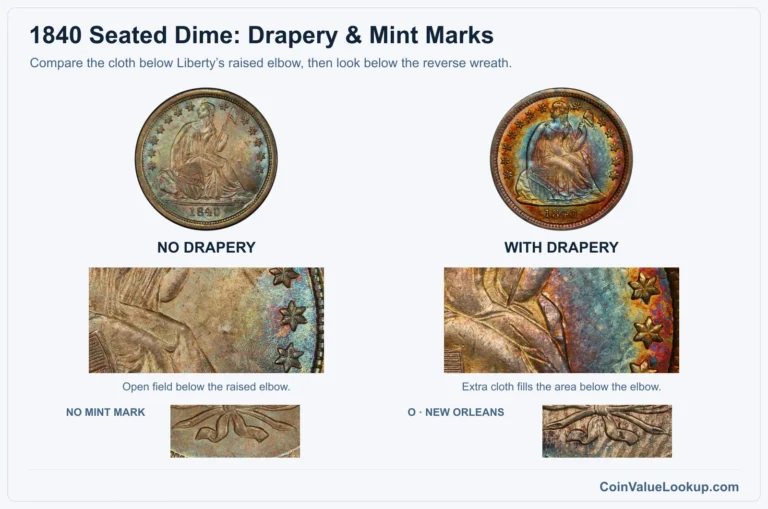
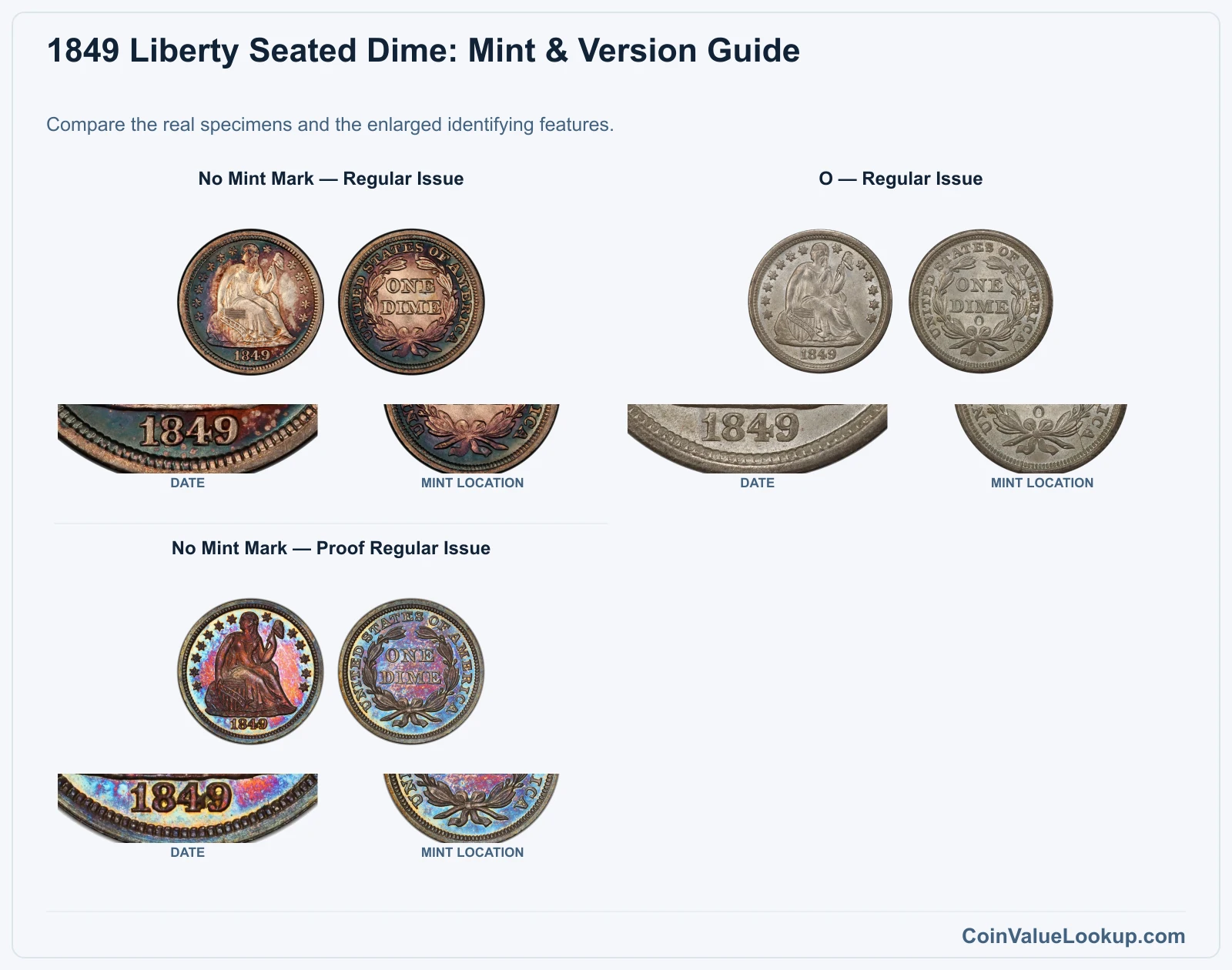
Next, check the date. Then flip to the reverse and look below the wreath for a mintmark.
If you see an "O," your coin was struck in New Orleans. No letter means Philadelphia.
The 1849 dime uses the Stars Obverse with Drapery subtype and carries the small wreath reverse with the legend. The standard alloy is 90% silver and 10% copper, with a nominal weight of 2.67 grams.
One thing worth knowing: the so-called "1849/8" dime that sometimes pops up in listings is treated by the specialist reference as a repunched date, not a confirmed overdate. That is a different animal from the 1849/8 half dime overdate, so keep them straight.
Step 2: Check Your 1849 Liberty Seated Dime Grade
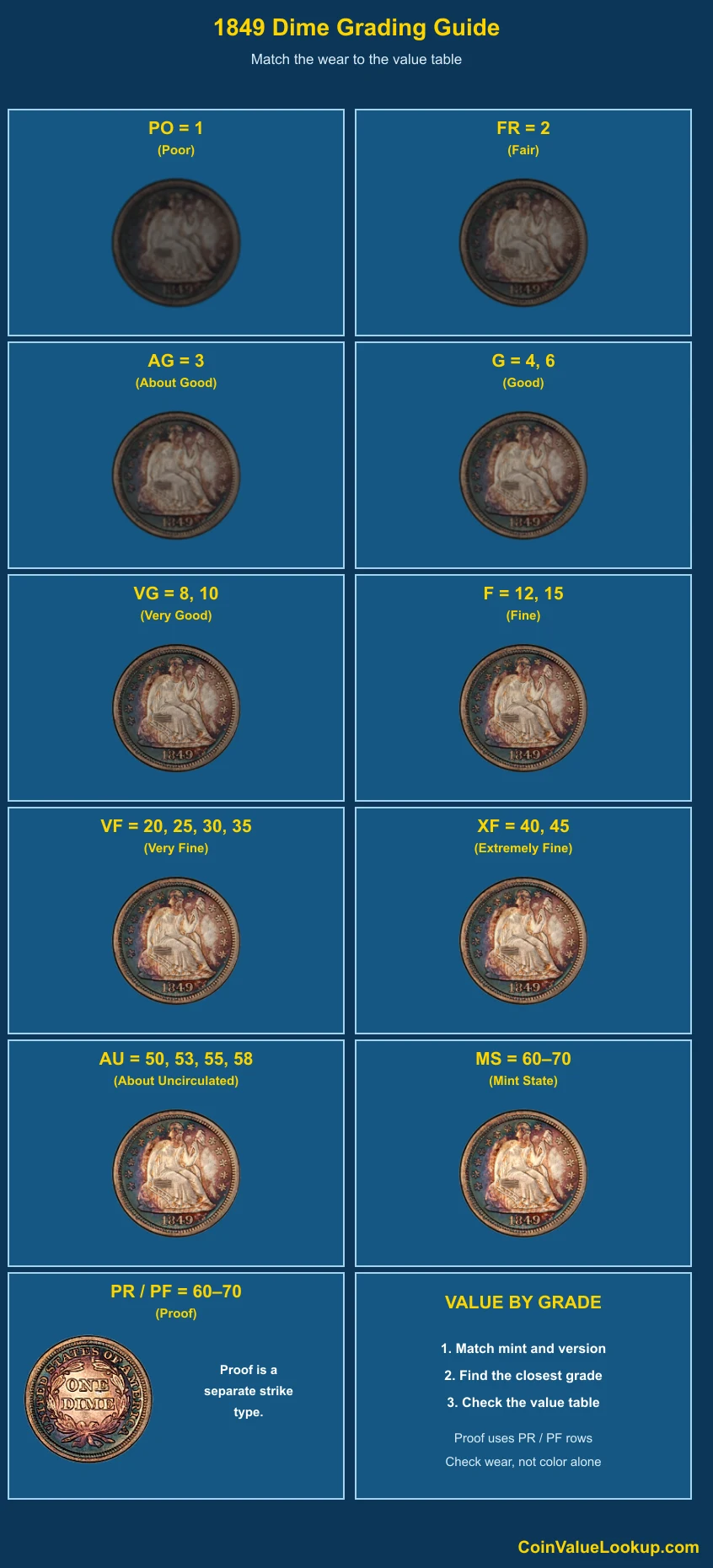
When grading an 1849 Seated Dime, use the comparison image for this specific subtype. Focus on the shield details, the folds of Liberty's gown, the definition on her head and feet, and the wreath on the reverse.
Wear first shows on Liberty's knee, breast, and the top of her head. A coin grading around G4 will have a smooth, flat Liberty with the date and rim still readable.
By MS63 you should see full luster with only minor contact marks.
Do not confuse a weakly struck coin with a heavily circulated one. Some dies wore out before the run ended, and a soft strike on the stars or wreath base is not the same as friction from pocket wear.
Look at the fields for original mint luster to tell the difference.
Also, a polished circulation-strike coin is not a Proof. Proof coins have mirrored fields from specially prepared dies, not from someone buffing a dime with a cloth.
Keep those categories completely separate when evaluating your piece.
Step 3: Check 1849 Liberty Seated Dime Value by Mint and Version
1849 Liberty Seated Dime — No Mint Mark — Regular Issue
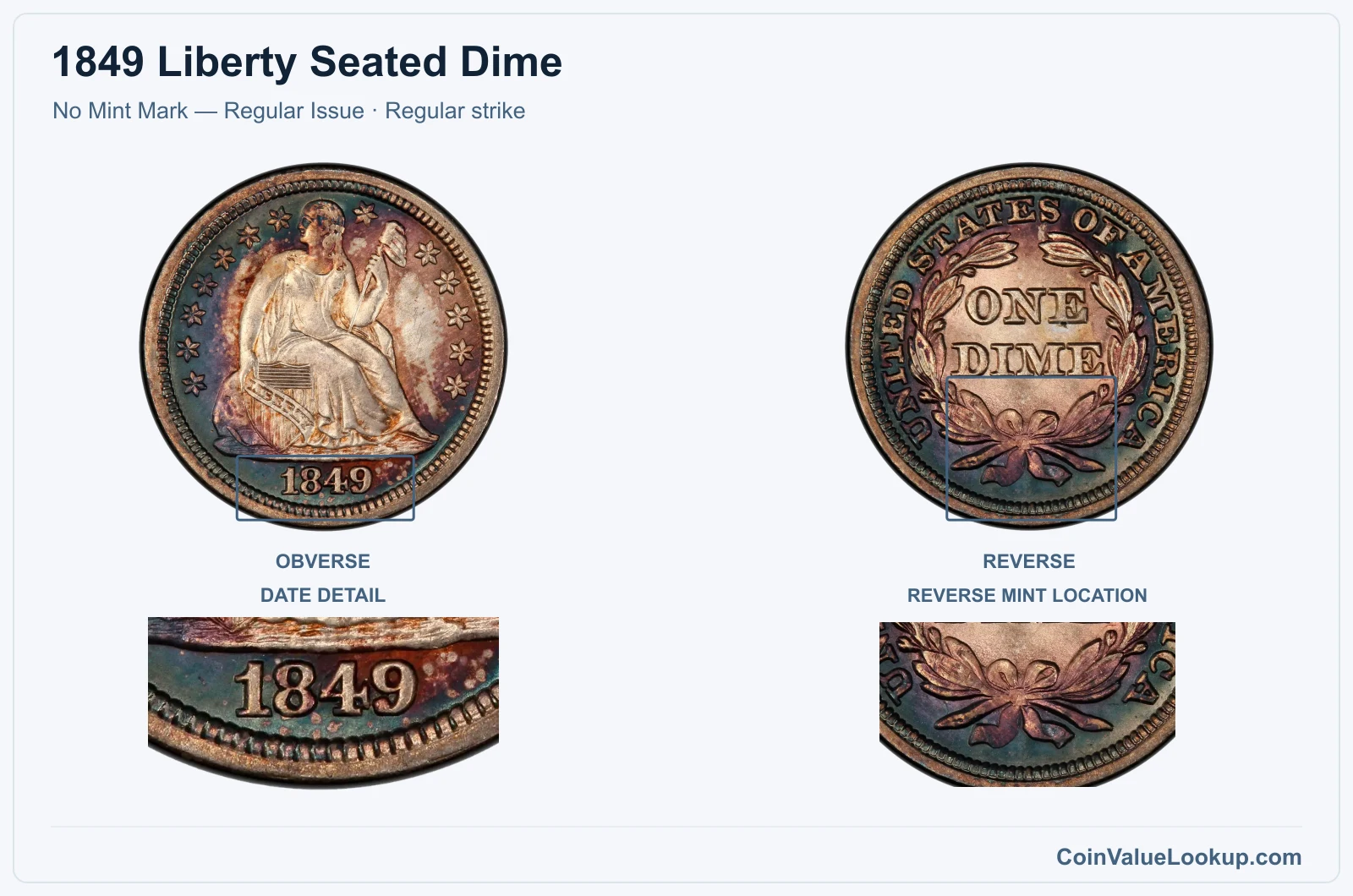
The Philadelphia regular issue is the more common of the two 1849 dimes. It carries no mintmark, so the area below the reverse wreath is blank.
The design is the Stars Obverse with Drapery subtype paired with the small wreath reverse bearing the ONE DIME legend. Standard composition is 90% silver and 10% copper at a nominal weight of 2.67 grams.
USA Coin Book guide estimates place this coin at about $29 in G4 and around $1,131 in MS63. Condition drives everything here.
Before consulting any price chart, confirm the mint, subtype, and honest wear level of your coin. And remember, the so-called 1849/8 on dimes is classified as a repunched date by the specialist reference, not a confirmed overdate.
Range Grade
Price Auction Records Appraisal PO PO 1
—
Coin Identifier FR FR 2
—
Coin Identifier AG AG 3
—
Coin Identifier G G 4
—
Coin Identifier
G 6
—
Coin Identifier VG VG 8
—
Coin Identifier
VG 10
—
Coin Identifier F F 12
Coin Identifier
F 15
—
Coin Identifier VF VF 20
—
Coin Identifier
VF 25
Coin Identifier
VF 30
Coin Identifier
VF 35
—
Coin Identifier XF XF 40
Coin Identifier
XF 45
Coin Identifier AU AU 50
Coin Identifier
AU 53
Coin Identifier
AU 55
Coin Identifier
AU 58
Coin Identifier MS MS 60
Coin Identifier
MS 61
Coin Identifier
MS 62
Coin Identifier
MS 63
Coin Identifier
MS 64
Coin Identifier
MS 65
Coin Identifier
MS 66
Coin Identifier
MS 67
Coin Identifier
MS 68
—
—
—
MS 69
—
—
—
MS 70
—
—
—
1849 Liberty Seated Dime — O — Regular Issue
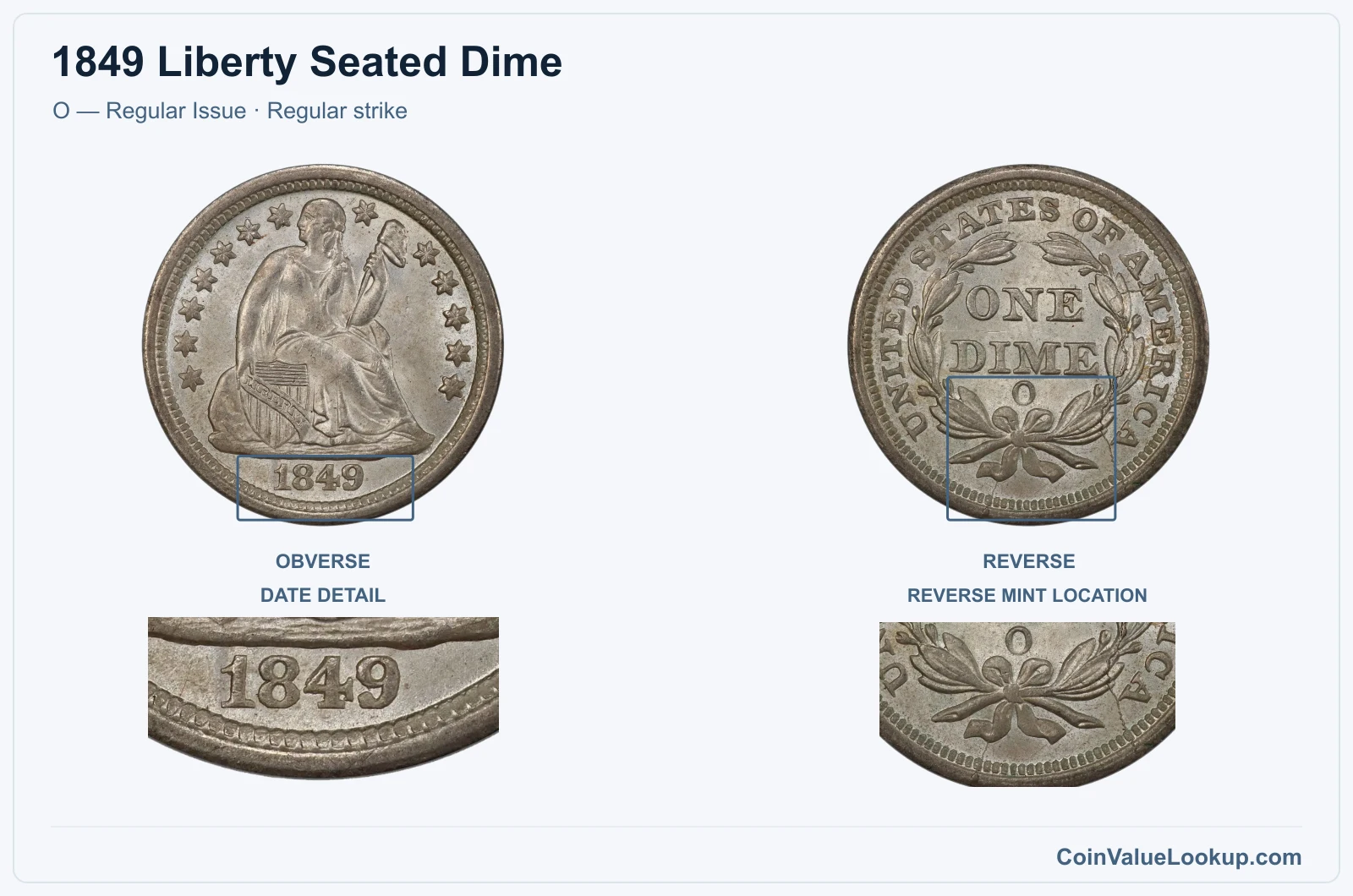
The New Orleans issue is identified by a small "O" mintmark located below the wreath on the reverse. Same design, same alloy, same 2.67-gram target weight as the Philadelphia coin, but a different mint and generally a tougher find in higher grades.
USA Coin Book guide estimates run from about $42 at G4 to roughly $6,833 at MS63. That upper figure reflects how scarce well-preserved New Orleans dimes of this era really are.
Weak strikes from New Orleans are common, so pay close attention to whether softness is from the die or from wear.
Coin Value Lookup is a handy starting point if you want to look up guide values for other dates or denominations in this series.
Range Grade
Price Auction Records Appraisal PO PO 1
—
Coin Identifier FR FR 2
—
Coin Identifier AG AG 3
Coin Identifier G G 4
—
Coin Identifier
G 6
—
Coin Identifier VG VG 8
—
Coin Identifier
VG 10
—
Coin Identifier F F 12
Coin Identifier
F 15
—
Coin Identifier VF VF 20
Coin Identifier
VF 25
Coin Identifier
VF 30
Coin Identifier
VF 35
Coin Identifier XF XF 40
Coin Identifier
XF 45
Coin Identifier AU AU 50
Coin Identifier
AU 53
Coin Identifier
AU 55
Coin Identifier
AU 58
Coin Identifier MS MS 60
—
Coin Identifier
MS 61
Coin Identifier
MS 62
Coin Identifier
MS 63
Coin Identifier
MS 64
Coin Identifier
MS 65
—
Coin Identifier
MS 66
—
—
—
MS 67
—
—
—
MS 68
—
—
—
MS 69
—
—
—
MS 70
—
—
—
1849 Liberty Seated Dime — No Mint Mark — Proof Regular Issue
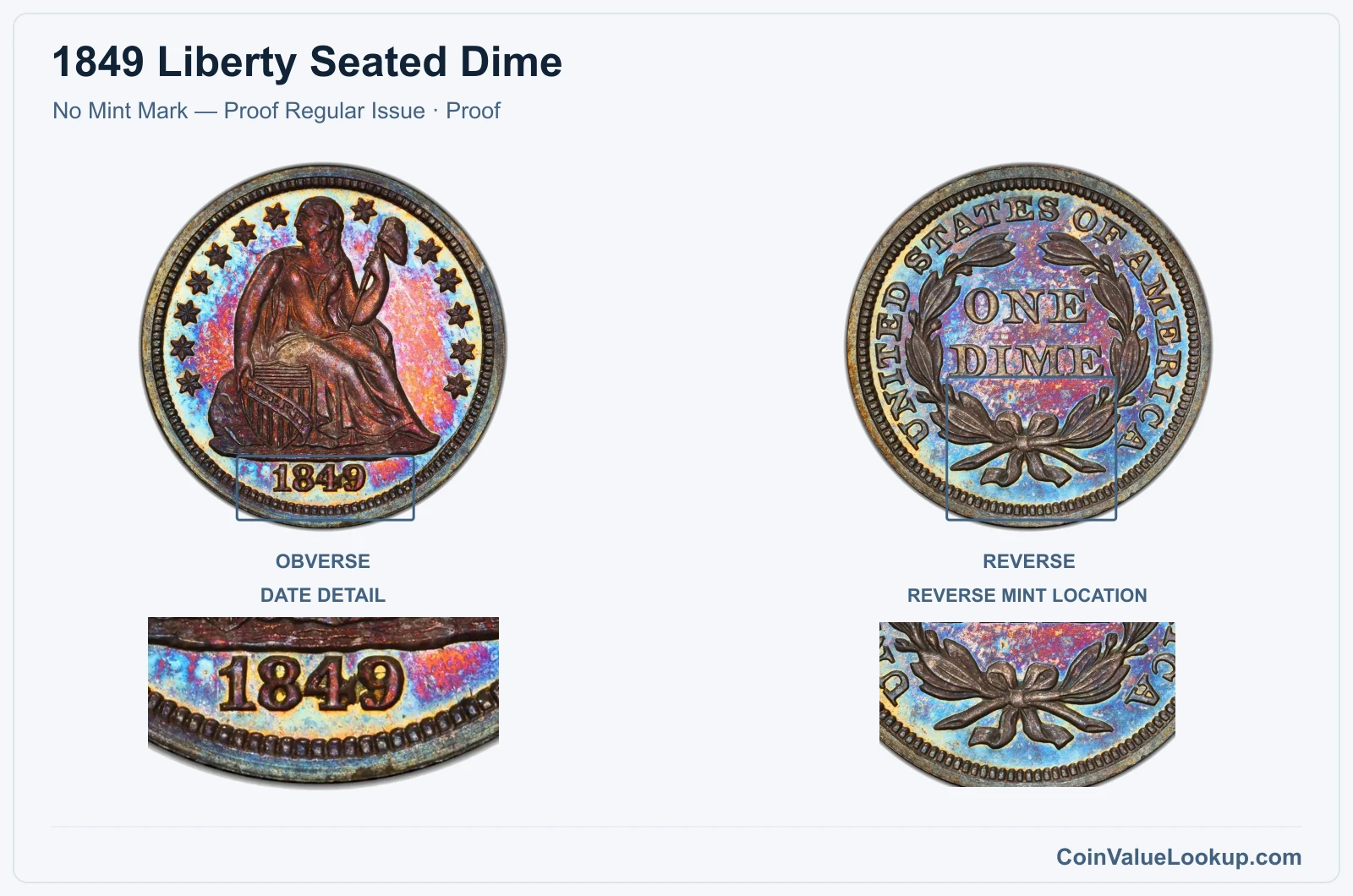
Proof 1849 Liberty Seated Dimes were struck at Philadelphia using specially prepared dies and polished planchets. These are genuinely rare coins from an era before the Mint routinely sold annual proof sets to collectors.
Do not confuse a polished or lightly circulated business strike with a Proof; the mirrored fields on a real Proof come from the die preparation, not aftermarket cleaning.
A PCGS guide estimate places the PR64 grade at about $32,500. That single-grade anchor gives you a sense of how seriously the market treats these early proofs.
Cameo contrast, when present, is a surface characteristic, not a separate mint origin. Authentication and attribution by a recognized grading service is essentially a prerequisite for any coin at this level.
Range Grade
Price Auction Records Appraisal PR PR 1
—
Coin Identifier
PR 2
—
Coin Identifier
PR 3
—
Coin Identifier
PR 4
—
Coin Identifier
PR 6
—
Coin Identifier
PR 8
—
Coin Identifier
PR 10
—
Coin Identifier
PR 12
—
Coin Identifier
PR 15
—
Coin Identifier
PR 20
—
Coin Identifier
PR 25
—
Coin Identifier
PR 30
—
Coin Identifier
PR 35
—
Coin Identifier
PR 40
—
Coin Identifier
PR 45
—
Coin Identifier
PR 50
—
Coin Identifier
PR 53
—
Coin Identifier
PR 55
—
Coin Identifier
PR 58
—
Coin Identifier
PR 60
—
Coin Identifier
PR 61
—
Coin Identifier
PR 62
—
Coin Identifier
PR 63
—
Coin Identifier
PR 64
Coin Identifier
PR 65
Coin Identifier
PR 66
Coin Identifier
PR 67
—
—
—
PR 68
—
—
—
PR 69
—
—
—
PR 70
—
—
—
1849 Liberty Seated Dime Error List
1. 1849 Liberty Seated Dime — Repunched Date
A repunched date on an 1849 dime shows traces of an earlier position of one or more date numerals alongside the final, accepted digits. You are looking for faint remnants, often visible as a shadow or secondary outline near the base or tops of the numbers.
This is a die variety, meaning every coin struck from that particular die pair carries the same feature.
Do not confuse this with machine doubling, which produces flat, shelf-like distortion, or with post-strike damage to the date area. The specialist reference for this series treats the sometimes-cited 1849/8 as repunching rather than a confirmed overdate, so keep that distinction in mind.
No specific price data was adopted for this variety. The premium depends on the visibility of the repunching, overall coin condition, and collector demand for the specific die pairing.
A strong, clearly visible repunched date on a well-preserved coin will always draw more attention than a subtle one on a worn piece.
2. 1849 Liberty Seated Dime — Die Crack / Die Chip
Die cracks appear as thin, raised lines on the coin's surface, tracing the path of a fracture in the steel die. A die chip is a small raised blob where a piece of the die broke away entirely.
Both are struck into the coin during production, so they sit above the field rather than being cut into it.
On 1849 dimes, these features are reported in the specialist literature. A crack running from the rim through a major design element is more collectible than a tiny interior chip.
A large break at the rim that leaves a raised, flat area is sometimes called a cud.
Do not mistake incuse scratches, corrosion spots, or crud stuck to the surface for a die crack. A genuine crack is raised metal that is part of the strike.
No specific pricing was adopted for this category; value depends on the size, location, and visibility of the crack alongside the coin's overall condition.
3. 1849 Liberty Seated Dime — Rotated Dies
A rotated die error means the obverse and reverse dies were not aligned in their normal orientation when the coin was struck. For a standard US coin, if you hold the obverse upright and flip the coin top to bottom, the reverse should also appear upright.
Any deviation from that is a rotation.
Small rotations of a few degrees are relatively common and carry minimal interest. Larger rotations, say 45 degrees or more, attract more collector attention because they are visually obvious and harder to miss during quality control.
Before claiming a rotation, make sure you are not just looking at a photo someone took at an odd angle, or holding the coin sideways. The test is physical: hold one side upright, flip on the vertical axis, and check the other side.
No specific pricing was adopted for rotated dies on the 1849 dime. As with other errors, the premium depends on the degree of rotation, eye appeal, and overall condition of the coin.