2013 Roosevelt Dime Coin Value: How Much Is It Worth?
Most 2013 Roosevelt dimes you pull from pocket change are worth face value — ten cents. In mint state, a USA Coin Book guide lists the MS65 grade at around $2.50 for either the Philadelphia or Denver issue.
San Francisco proof editions carry higher guide values, with the silver proof reaching about $16 at PR65. Matching the correct mint, metal and finish to your coin is the first step toward knowing what you have.
Fast Way to Identify Your 2013 Roosevelt Dime
Upload clear photos of both the front and back of your 2013 dime for a preliminary identification. Good lighting and a steady shot help distinguish mintmarks, surface quality and strike details.
This quick step can point you toward the right version before you dig into specifics.
2013 Roosevelt Dime Value
Upload both sides of your 2013 Roosevelt Dime.
Front Obverse
Upload photo
Back Reverse
Upload photo
Which 2013 Roosevelt Dime Versions Are Worth Money?
- Uncirculated P or D business strikes with strong, fully separated torch bands can carry a modest premium over face value.
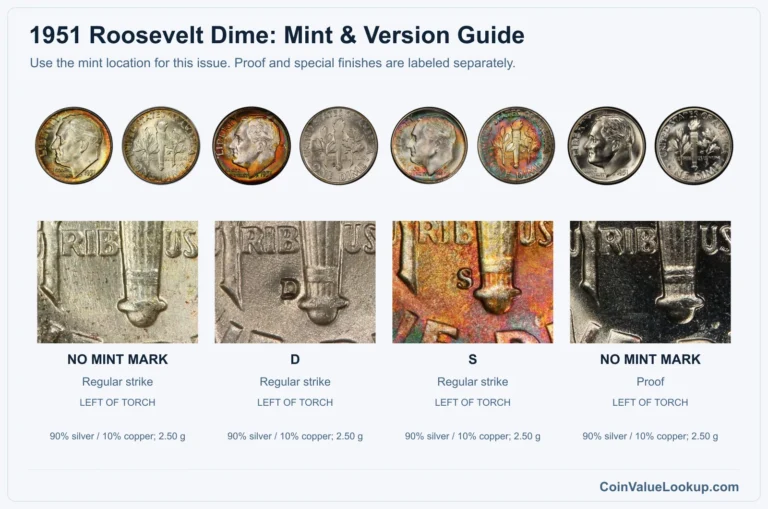
- S-mintmark silver proofs, identified by weight (2.50 g) and a uniform silver-colored edge, carry higher guide values — about $16 at PR65 per USA Coin Book.
Step 1: Identify Your 2013 Roosevelt Dime Mint Mark and Version
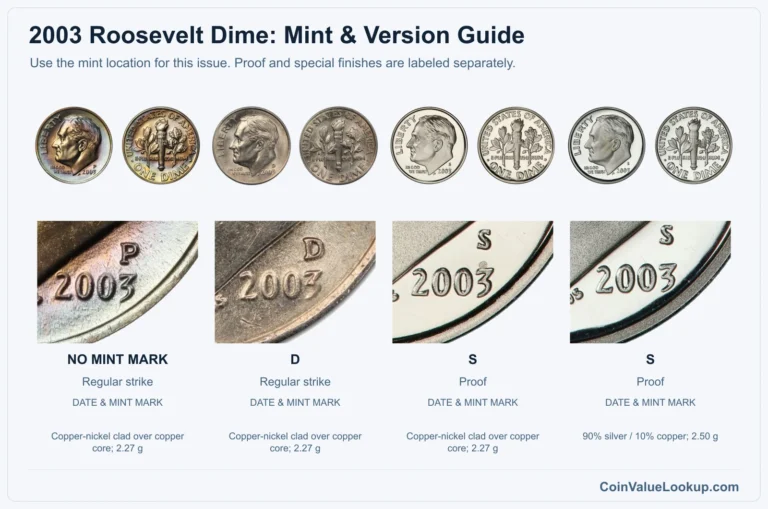
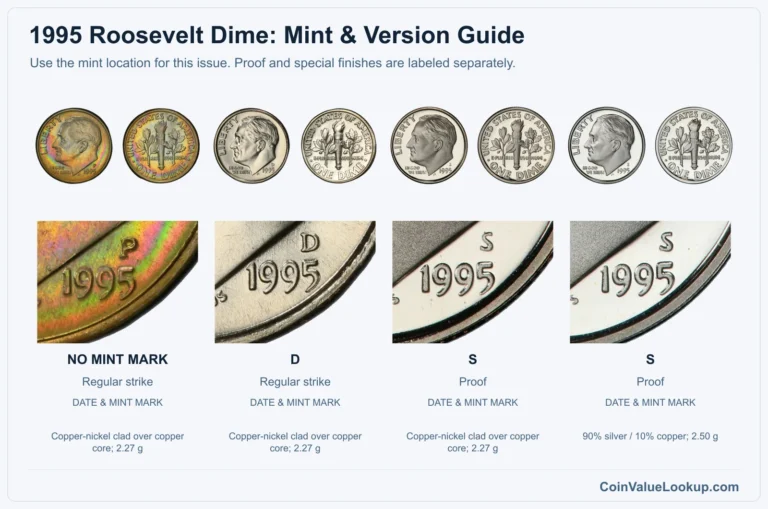
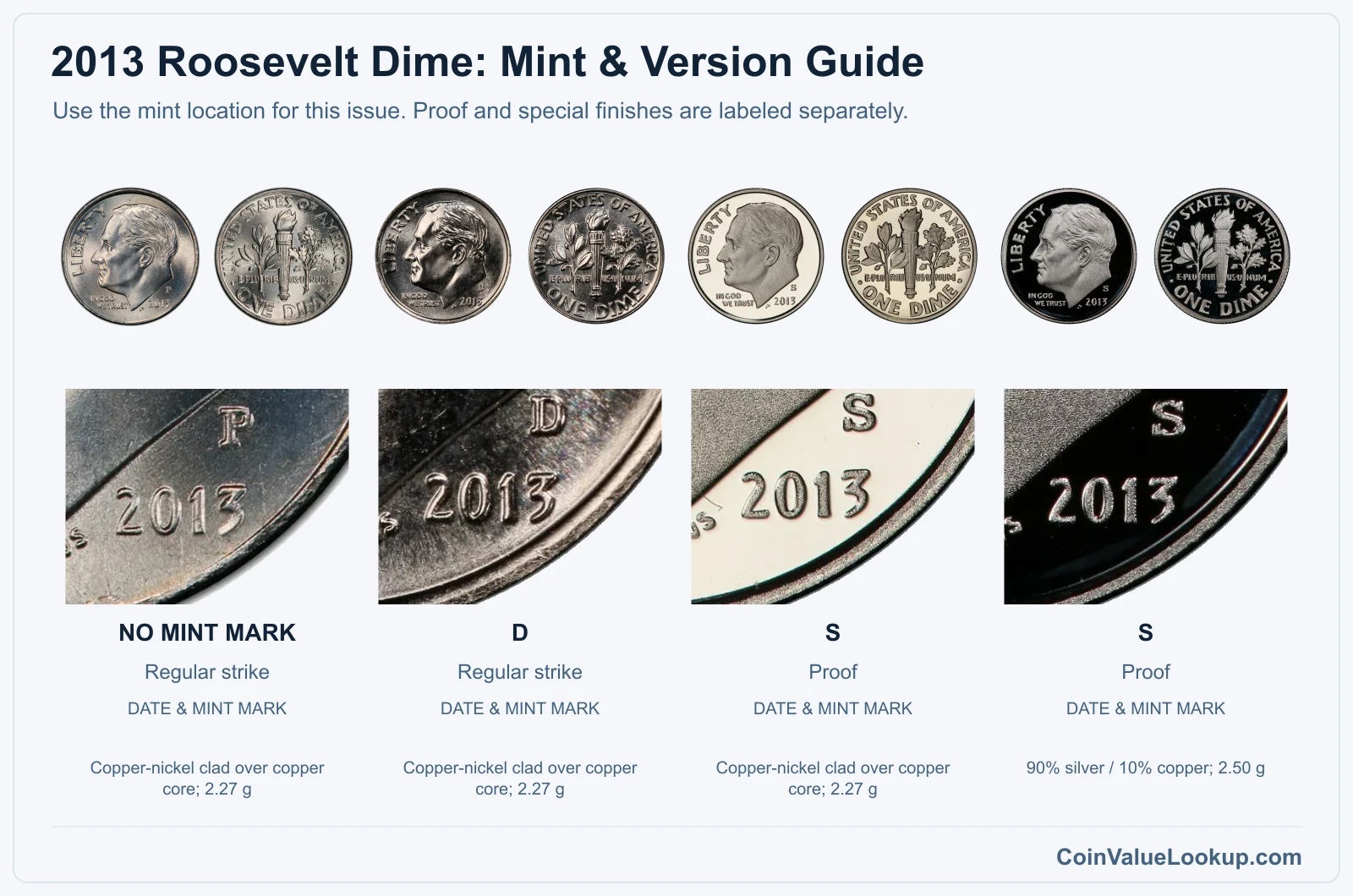
Start by confirming the 2013 date on the obverse, the Roosevelt portrait facing left, and the torch-with-branches reverse. The mintmark sits just above the date on the obverse — look for a P, D or S.
Philadelphia (P) and Denver (D) coins are copper-nickel clad business strikes weighing 2.27 grams. San Francisco (S) coins come in two flavors: a clad proof, also 2.27 grams, and a 90% silver proof at 2.50 grams.
Both measure roughly 17.9 mm across.
There is no normal circulating silver 2013 dime. If you suspect silver, check the edge — a silver proof lacks the copper stripe visible on clad coins.
Weight is your friend here: 2.50 grams versus 2.27 grams is a real difference on a decent scale. Packaging matters too, since silver proofs were sold in specific collector sets.
Step 2: Check Your 2013 Roosevelt Dime Grade
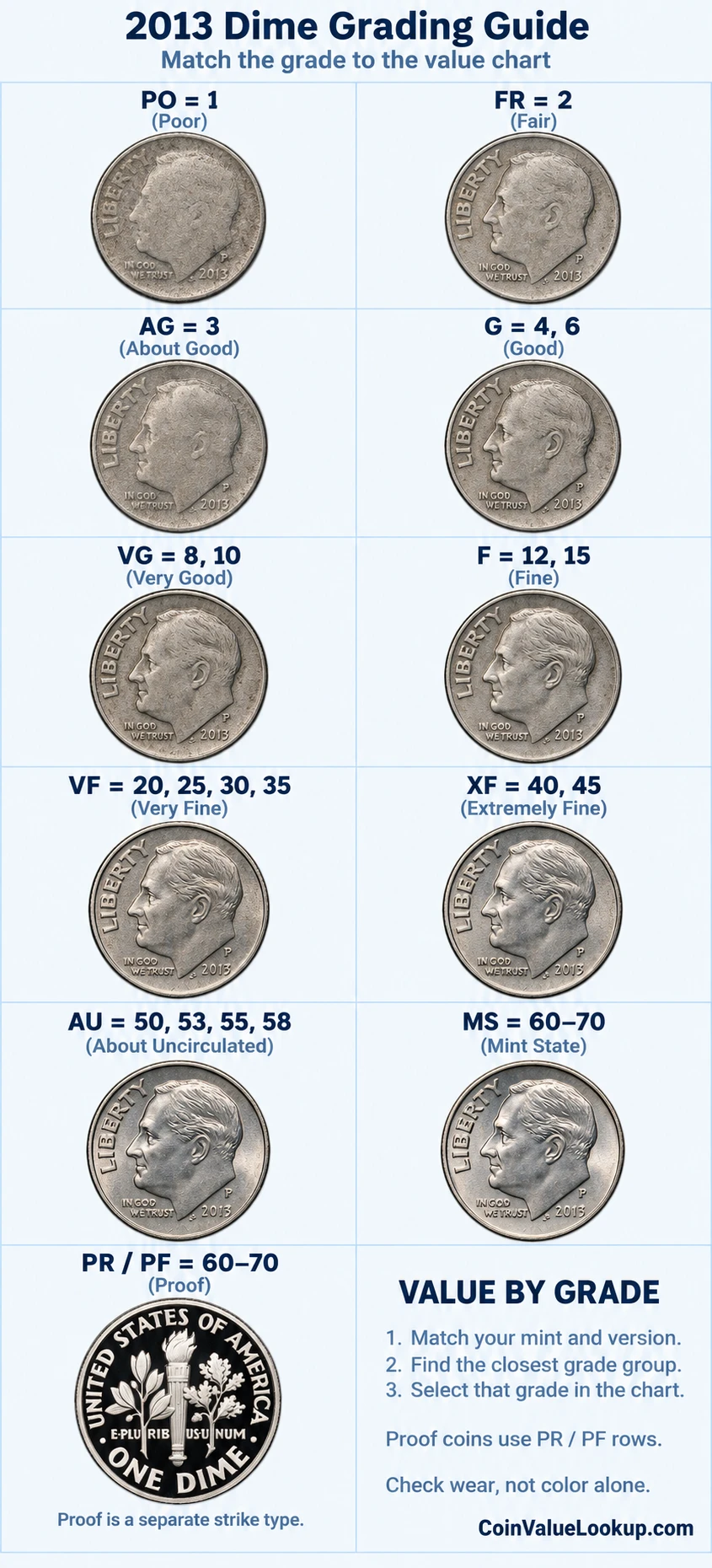
Focus on Roosevelt's cheek, jawline and hair detail first. These high points show wear before anything else.
On the reverse, check the torch lines and the leaf details on the branches.
Original mint luster has a cartwheel sheen when you tilt the coin under a light. A cleaned coin may look shiny but lacks that rotating glow — don't confuse the two.
For business strikes, Full Bands refers to well-separated horizontal bands on the torch. A weak strike can blur those bands even on an unworn coin, so weak bands alone do not prove circulation wear.
Compare your coin to the reference image using the same finish type.
Proof coins have mirror fields and frosted devices by design. Judge proof condition against other proofs, not against business strikes.
Hairlines and haze matter more than high-point wear on a proof surface.
Step 3: Check 2013 Roosevelt Dime Value by Mint and Version
2013 Roosevelt Dime — P Business Strike
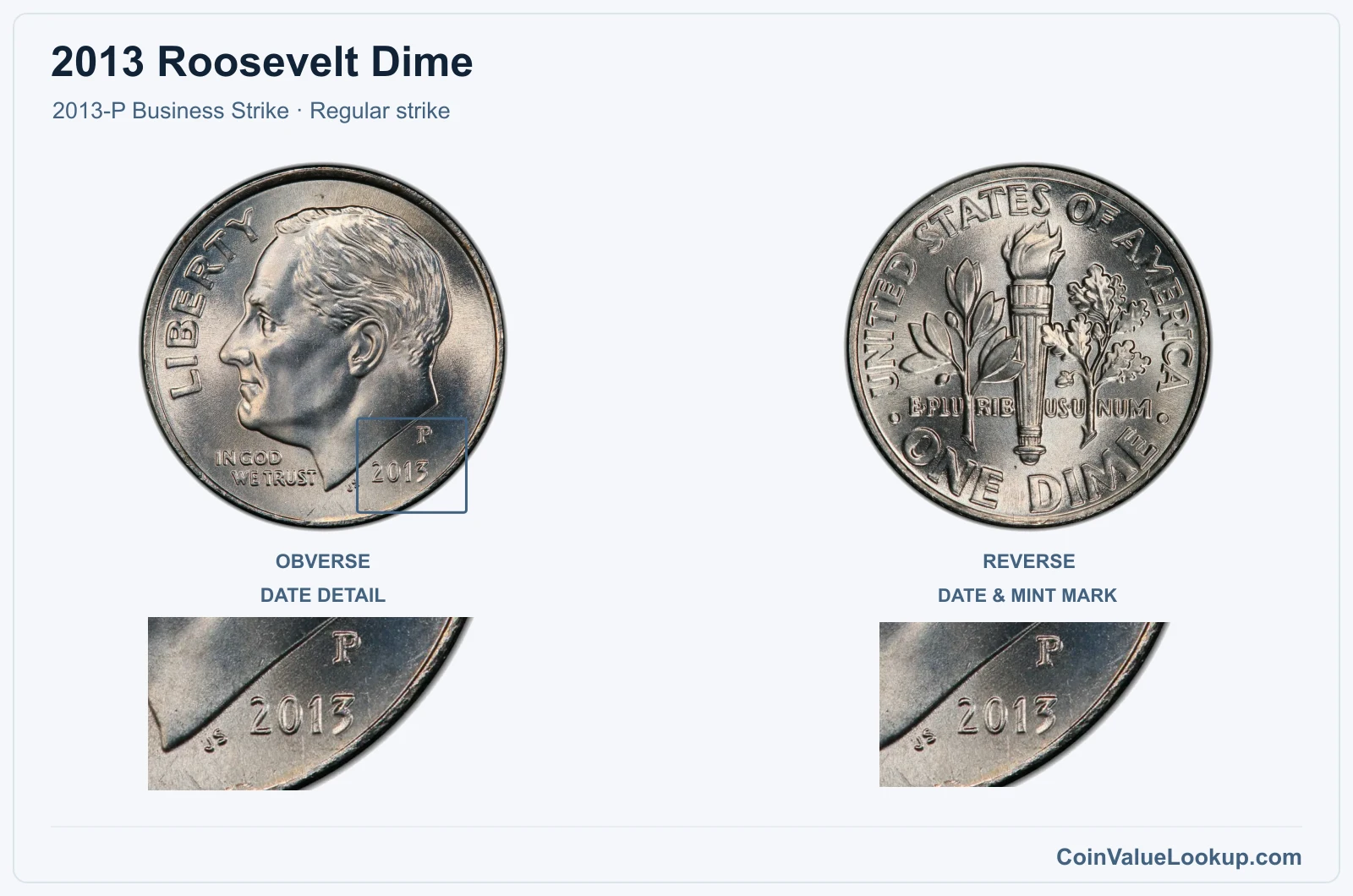
The 2013-P business strike was produced at Philadelphia and carries a small P mintmark above the date. It is copper-nickel clad over a copper core, weighing 2.27 grams.
In typical circulated condition these are worth ten cents.
At the MS65 grade, the USA Coin Book guide lists this coin at $2.50. Look for original luster and minimal contact marks if you think yours never saw a cash register.
Coins with clearly separated horizontal torch bands — the Full Bands designation — may attract a bit more attention from specialists.
Range Grade
Price Auction Records Appraisal PO PO 1
—
Coin Identifier FR FR 2
—
Coin Identifier AG AG 3
—
Coin Identifier G G 4
—
Coin Identifier
G 6
—
Coin Identifier VG VG 8
—
Coin Identifier
VG 10
—
Coin Identifier F F 12
—
Coin Identifier
F 15
—
Coin Identifier VF VF 20
—
Coin Identifier
VF 25
—
Coin Identifier
VF 30
—
Coin Identifier
VF 35
—
Coin Identifier XF XF 40
—
Coin Identifier
XF 45
—
Coin Identifier AU AU 50
—
Coin Identifier
AU 53
—
Coin Identifier
AU 55
—
Coin Identifier
AU 58
—
Coin Identifier MS MS 60
—
Coin Identifier
MS 61
—
Coin Identifier
MS 62
—
Coin Identifier
MS 63
—
Coin Identifier
MS 64
—
Coin Identifier
MS 65
—
Coin Identifier
MS 66
—
Coin Identifier
MS 67
—
Coin Identifier
MS 68
—
—
—
MS 69
—
—
—
MS 70
—
—
—
2013 Roosevelt Dime — D Business Strike
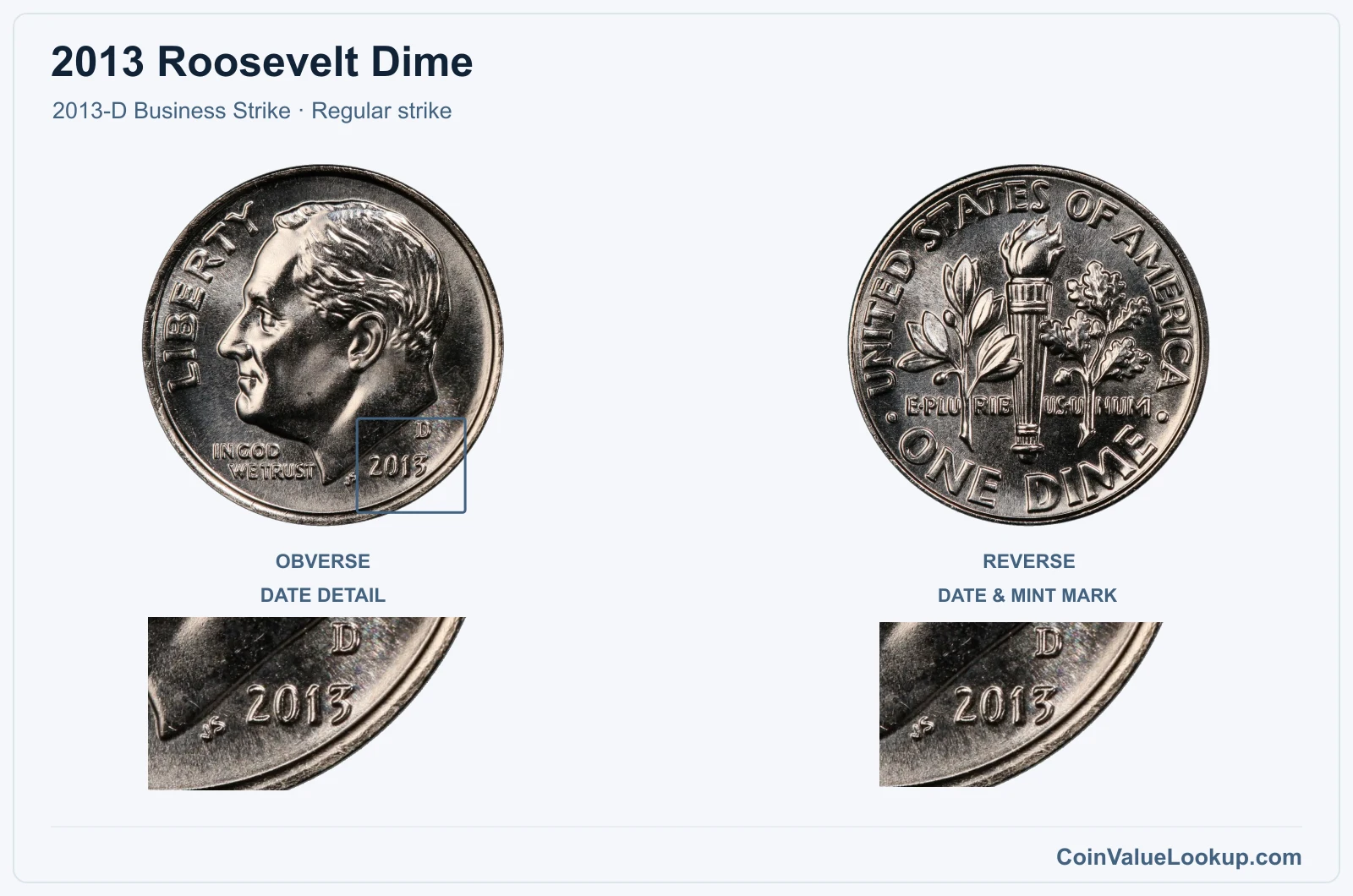
Denver's 2013-D dime is the same composition and weight as the P issue — copper-nickel clad, 2.27 grams. The D mintmark above the date is the only visual difference from the Philadelphia version.
The MS65 guide value is also $2.50 per USA Coin Book. Circulated examples remain at face value.
As with the P mint, full separation of the horizontal torch bands is a strike quality that collectors note. Check both sides under magnification before assuming a high grade.
Range Grade
Price Auction Records Appraisal PO PO 1
—
Coin Identifier FR FR 2
—
Coin Identifier AG AG 3
—
Coin Identifier G G 4
—
Coin Identifier
G 6
—
Coin Identifier VG VG 8
—
Coin Identifier
VG 10
—
Coin Identifier F F 12
—
Coin Identifier
F 15
—
Coin Identifier VF VF 20
—
Coin Identifier
VF 25
—
Coin Identifier
VF 30
—
Coin Identifier
VF 35
—
Coin Identifier XF XF 40
—
Coin Identifier
XF 45
—
Coin Identifier AU AU 50
—
Coin Identifier
AU 53
—
Coin Identifier
AU 55
—
Coin Identifier
AU 58
—
Coin Identifier MS MS 60
—
Coin Identifier
MS 61
—
Coin Identifier
MS 62
—
Coin Identifier
MS 63
—
Coin Identifier
MS 64
—
Coin Identifier
MS 65
—
Coin Identifier
MS 66
—
Coin Identifier
MS 67
—
Coin Identifier
MS 68
Coin Identifier
MS 69
—
—
—
MS 70
—
—
—
2013 Roosevelt Dime — S Clad Proof
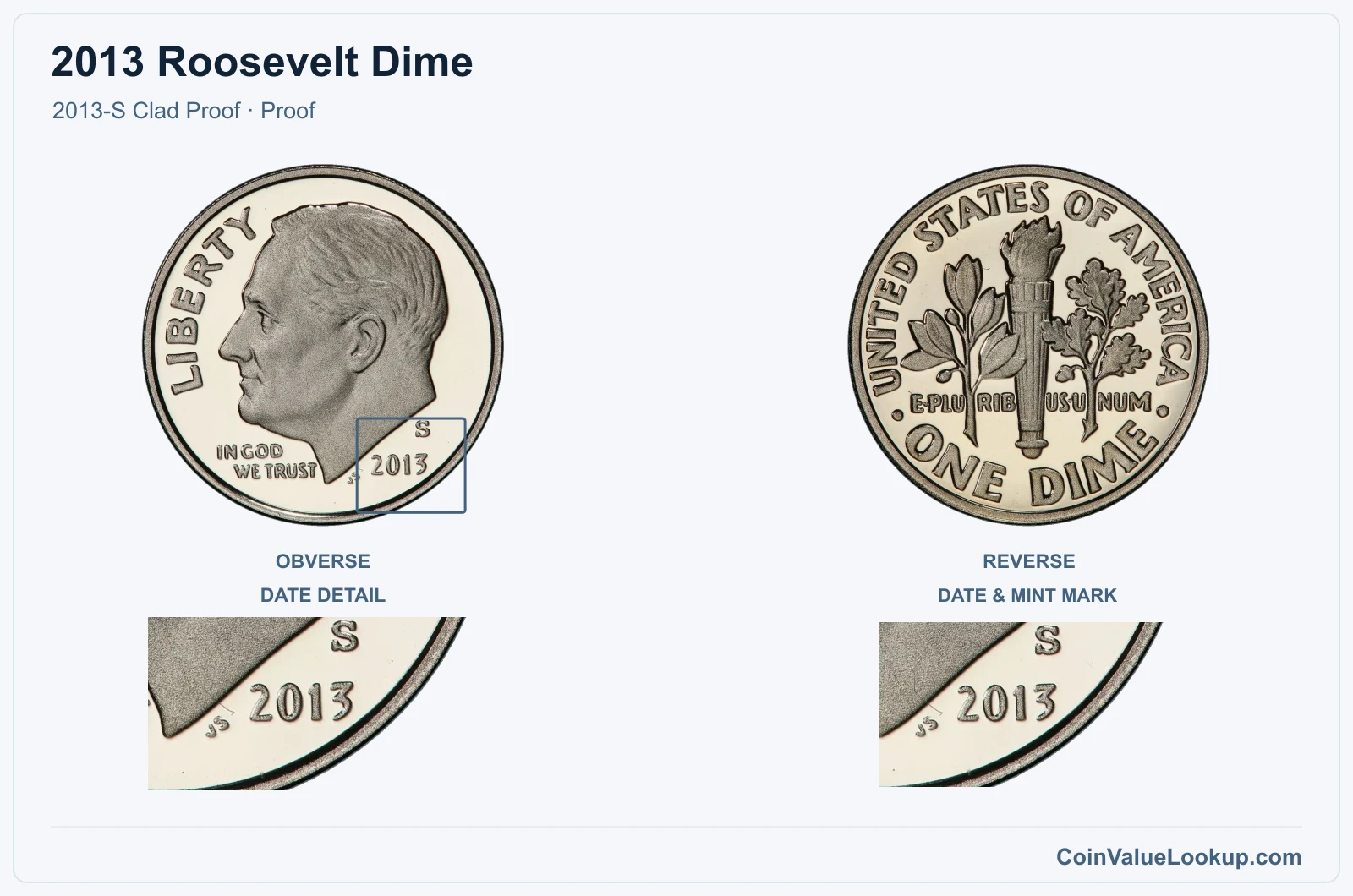
The 2013-S clad proof was struck at San Francisco with polished dies on prepared planchets, giving it mirror-like fields and frosted raised devices. It weighs 2.27 grams, identical to the business strikes, and the edge still shows the copper-nickel sandwich stripe.
USA Coin Book guides this at $4.96 in PR65. These were sold in standard proof sets, not released into circulation.
If yours is loose with no packaging, verify the S mintmark and compare the reflective surface quality to known examples. Coin Value Lookup is a handy starting point for looking up guides on this and other Roosevelt dime years.
Range Grade
Price Auction Records Appraisal PR PR 1
—
Coin Identifier
PR 2
—
Coin Identifier
PR 3
—
Coin Identifier
PR 4
—
Coin Identifier
PR 6
—
Coin Identifier
PR 8
—
Coin Identifier
PR 10
—
Coin Identifier
PR 12
—
Coin Identifier
PR 15
—
Coin Identifier
PR 20
—
Coin Identifier
PR 25
—
Coin Identifier
PR 30
—
Coin Identifier
PR 35
—
Coin Identifier
PR 40
—
Coin Identifier
PR 45
—
Coin Identifier
PR 50
—
Coin Identifier
PR 53
—
Coin Identifier
PR 55
—
Coin Identifier
PR 58
—
Coin Identifier
PR 60
—
Coin Identifier
PR 61
—
Coin Identifier
PR 62
—
Coin Identifier
PR 63
—
Coin Identifier
PR 64
—
Coin Identifier
PR 65
—
Coin Identifier
PR 66
—
Coin Identifier
PR 67
—
Coin Identifier
PR 68
—
Coin Identifier
PR 69
Coin Identifier
PR 70
Coin Identifier
2013 Roosevelt Dime — S Silver Proof
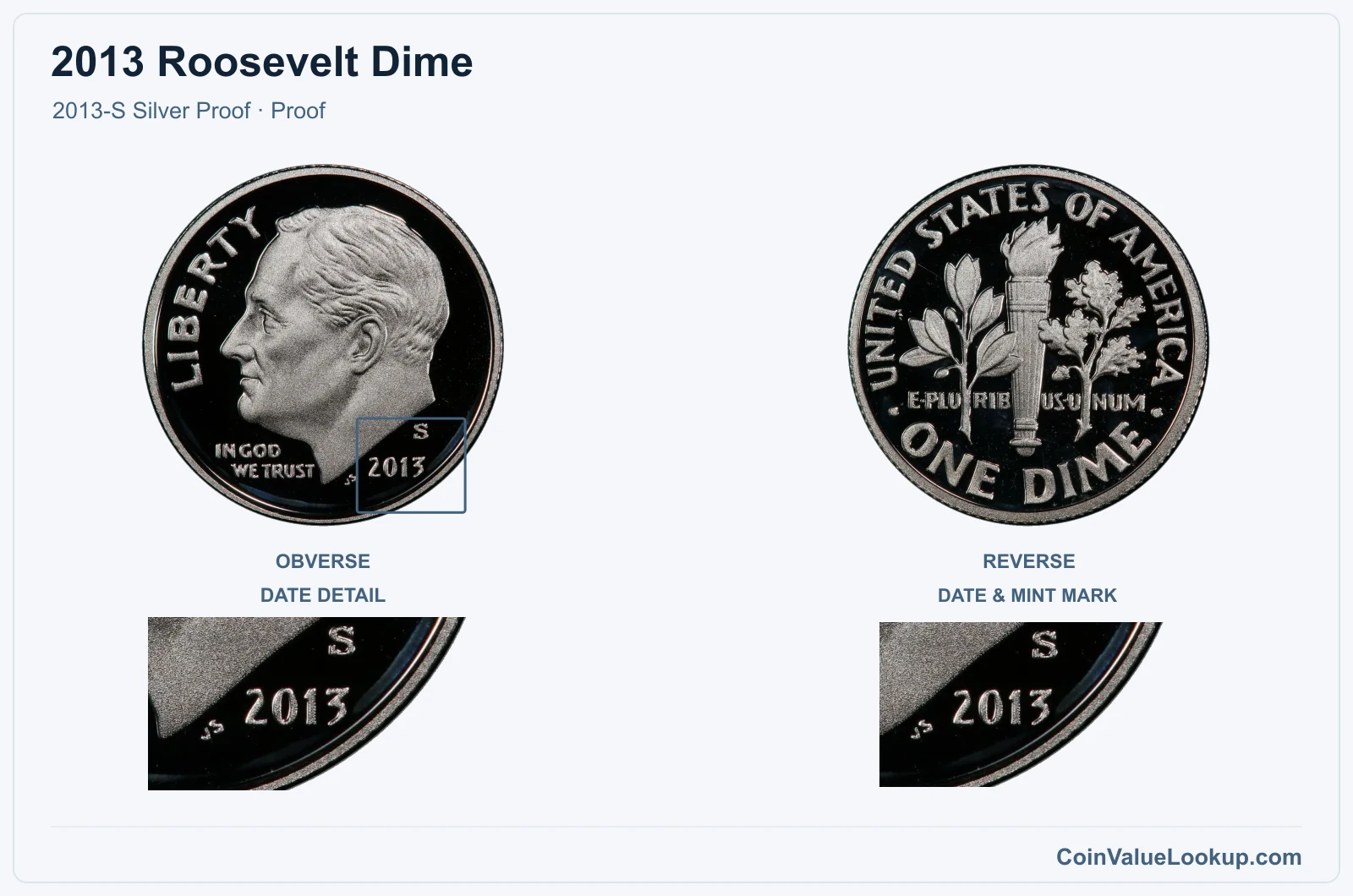
The 2013-S silver proof is the premium version of this year's dime. Struck in 90% silver and 10% copper, it weighs 2.50 grams — noticeably heavier than the 2.27-gram clad coins.
The edge appears uniformly silver-colored with no copper stripe.
At PR65, USA Coin Book lists this coin at about $16. Silver proofs were issued in specific silver proof sets from the U.S. Mint.
Identifying one outside its original packaging requires checking both weight and edge color, since the S mintmark alone does not distinguish it from the clad proof. A kitchen scale accurate to 0.01 grams handles this easily.
Range Grade
Price Auction Records Appraisal PR PR 1
—
Coin Identifier
PR 2
—
Coin Identifier
PR 3
—
Coin Identifier
PR 4
—
Coin Identifier
PR 6
—
Coin Identifier
PR 8
—
Coin Identifier
PR 10
—
Coin Identifier
PR 12
—
Coin Identifier
PR 15
—
Coin Identifier
PR 20
—
Coin Identifier
PR 25
—
Coin Identifier
PR 30
—
Coin Identifier
PR 35
—
Coin Identifier
PR 40
—
Coin Identifier
PR 45
—
Coin Identifier
PR 50
—
Coin Identifier
PR 53
—
Coin Identifier
PR 55
—
Coin Identifier
PR 58
—
Coin Identifier
PR 60
—
Coin Identifier
PR 61
—
Coin Identifier
PR 62
—
Coin Identifier
PR 63
—
Coin Identifier
PR 64
—
Coin Identifier
PR 65
—
Coin Identifier
PR 66
—
Coin Identifier
PR 67
—
Coin Identifier
PR 68
—
Coin Identifier
PR 69
Coin Identifier
PR 70
Coin Identifier
2013 Roosevelt Dime Error List
1. 2013 Roosevelt Dime — Lamination / Split Planchet
A lamination error on a 2013 dime shows as peeling, flaking or a retained flap of metal on one or both faces. The separation occurs within the planchet material itself, so the affected area looks like a layer lifting away from the coin's body.
To identify one, examine the edge and the affected surface together — a genuine lamination has a natural metal texture underneath the flap, not a gouged or scraped look. Post-mint damage from scraping, corrosion or deliberate cutting can mimic this, so compare carefully.
Condition, the size of the affected area and overall eye appeal all influence what a lamination error is worth. No specific adopted price is available for this variety, so individual assessment matters.
2. 2013 Roosevelt Dime — Die Crack / Die Chip
Die cracks and die chips appear as raised lines or small raised blobs on the coin's surface. They result from damage to the die itself, so every coin struck by that die carries the same mark in the same location.
A raised line running across the field is a die crack. A small raised lump, often near lettering or the rim, is a die chip.
If the crack connects to the rim and produces a larger blob of raised metal, that is sometimes called a cud.
Don't confuse these with incuse scratches, which are cut into the surface rather than raised above it. Corrosion or foreign material stuck to the coin can also fool you.
Value depends on the size, location and visual impact of the defect — no specific price is adopted for this category.
3. 2013 Roosevelt Dime — Off-Center Strike
An off-center strike happens when the blank is not properly seated between the dies. The result is a displaced design with an unstruck crescent of blank metal on one side.
The percentage of off-center displacement matters a lot. A barely noticeable 2–3% shift is common and adds little.
A dramatic shift — say 10% or more — with the full date still visible is the combination collectors look for.
A clipped planchet, a one-sided die misalignment or post-mint flattening can resemble an off-center strike, so check both sides carefully. Genuine off-center coins show the shift consistently on obverse and reverse.
Value depends on the degree of displacement, date visibility and overall condition; no specific price is adopted here.
4. 2013 Roosevelt Dime — Clipped Planchet
A clipped planchet error means a portion of the original blank was missing before the coin was struck. On a 2013 dime, this can appear as a curved, straight or irregular bite out of the edge.
Look for the Blakesley effect — a zone of weakness on the rim directly opposite the clip. This happens because the missing metal reduces striking pressure on the far side.
That opposite weakness is a strong diagnostic for a genuine clip.
A filed notch, deliberate edge cut or corrosion loss will not produce that opposite-rim weakness and usually shows tool marks under magnification. The size and number of clips, plus overall coin condition, determine collector interest.
No specific adopted price is available for this variety.
5. 2013 Roosevelt Dime — Struck-Through Error
A struck-through error occurs when foreign material sits between the die and the planchet during striking. On a 2013 dime, grease is a commonly reported culprit, leaving a smooth, slightly depressed area where design details are missing or blurred.
The key diagnostic is a localized soft spot that differs from ordinary wear. Wear removes metal gradually across high points; a grease strike-through blanks out a specific patch while surrounding detail remains sharp.
Don't mistake normal circulation wear, cleaning or a weak strike for this error. A genuinely struck-through area has distinct boundaries and sits slightly below the normal surface plane.
The size of the affected area, its location and overall coin condition all matter. No adopted price is available, so value requires individual evaluation.
6. 2013 Roosevelt Dime — Misaligned Die
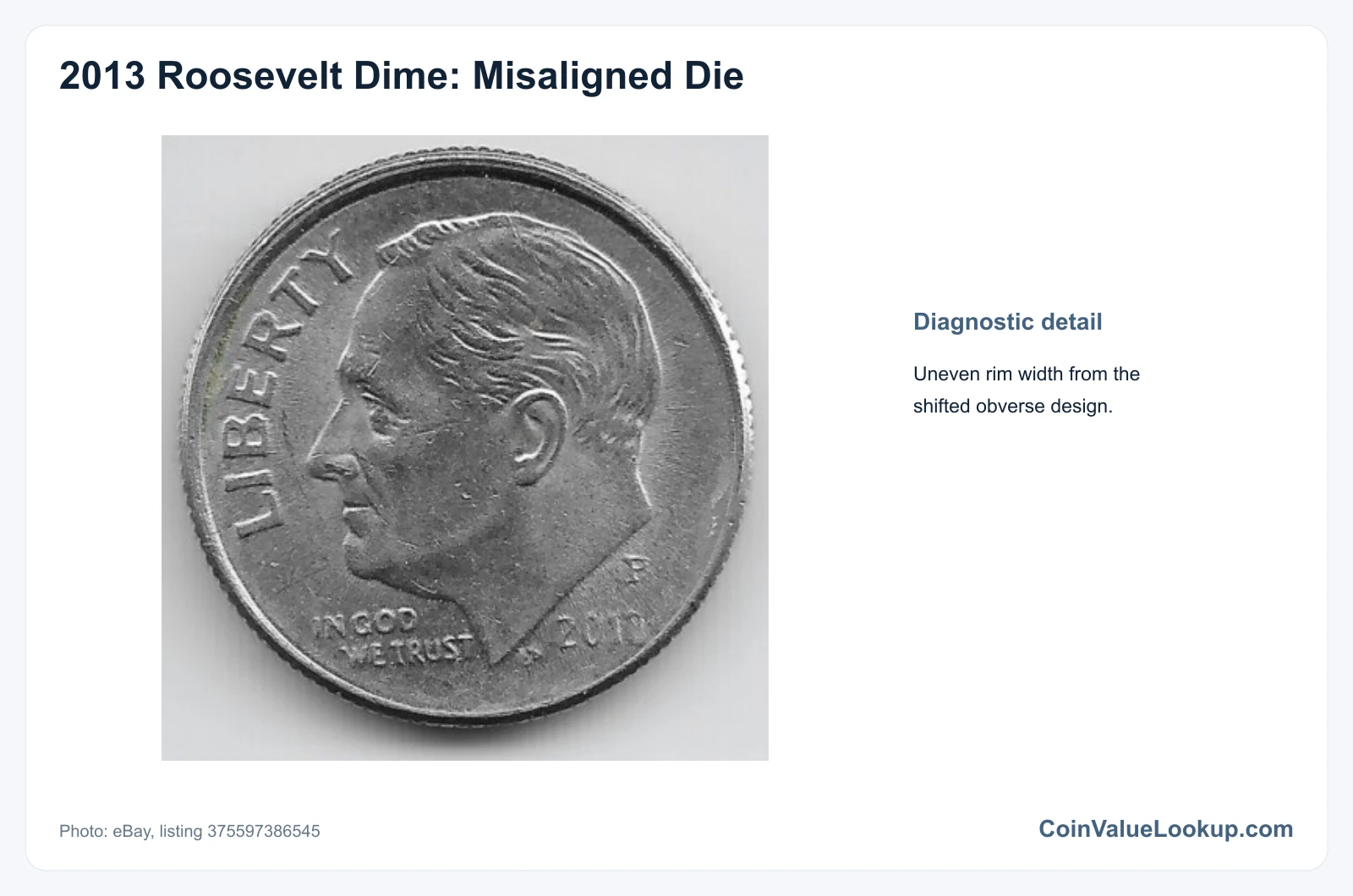
A misaligned die error means one die was shifted off its proper position relative to the planchet or the opposite die. The result is that one side of the coin shows a wider rim on one edge and a narrower rim on the opposite edge, while the other side remains centered.
This is different from an off-center strike, where the entire planchet is displaced and both sides shift together. With a misaligned die, only one face is affected.
It is also different from a rotated die, where the alignment is angular rather than lateral.
Check that a tilted photograph or post-mint rim damage is not fooling your eye. Measure the rim width at multiple points on each side.
Value depends on the degree of misalignment and overall condition; no specific price is adopted for this category.
7. 2013 Roosevelt Dime — Missing Clad Layer
A missing clad layer error means one of the outer copper-nickel layers was absent from the planchet before striking. The exposed side may show a distinctly different color — potentially a copper tone — and the coin will weigh less than the standard 2.27 grams.
Edge inspection is important. A normal clad dime shows a visible sandwich of layers; a missing-clad coin will lack one visible outer layer on the affected side.
Weigh the coin on a precise scale and compare.
Toning, environmental damage, corrosion or deliberate removal of surface metal after minting can all mimic this error. Genuine missing-clad pieces show consistent coloring across the entire affected face and a corresponding weight reduction.
No specific adopted price is available, so the coin's condition, visual impact and confirmation of the error drive its value.