2003 Roosevelt Dime Coin Value: How Much Is It Worth?
Most 2003 Roosevelt dimes pulled from pocket change are worth face value — ten cents. In higher mint-state grades the picture changes a bit: a USA Coin Book guide estimate places an MS65 Philadelphia or Denver strike at about $2.50.
The S clad proof sits around $3.08 in PR65, while the S silver proof reaches roughly $9.65 at the same grade. Finish, authenticated errors and overall condition all shift the comparison from there, so it pays to look carefully before spending one at a vending machine.
Fast Way to Identify Your 2003 Roosevelt Dime
The quickest way to start figuring out what you have is to upload clear photos of both sides of your coin. A sharp front image captures the mintmark and portrait details, while the reverse shows the torch and lettering.
Use those images for a preliminary identification of your coin's version, then compare it against the guide information below.
2003 Roosevelt Dime Value
Upload both sides of your 2003 Roosevelt Dime.
Front Obverse
Upload photo
Back Reverse
Upload photo
Which 2003 Roosevelt Dime Versions Are Worth Money?
- Mint-state 2003-P or 2003-D dimes with sharp, fully separated torch bands can carry a strike premium over ordinary examples at the same grade.
- The 2003-S silver proof, confirmed by weight at 2.50 grams, carries a higher guide value than the clad proof at comparable grades.
- A 2003-S clad proof in original, undamaged condition still warrants comparison separately from circulation strikes.
- Authenticated error coins — such as an elliptical clipped planchet or an off-center strike on a 2003-P — can trade well above normal values depending on severity and grade.
Step 1: Identify Your 2003 Roosevelt Dime Mint Mark and Version
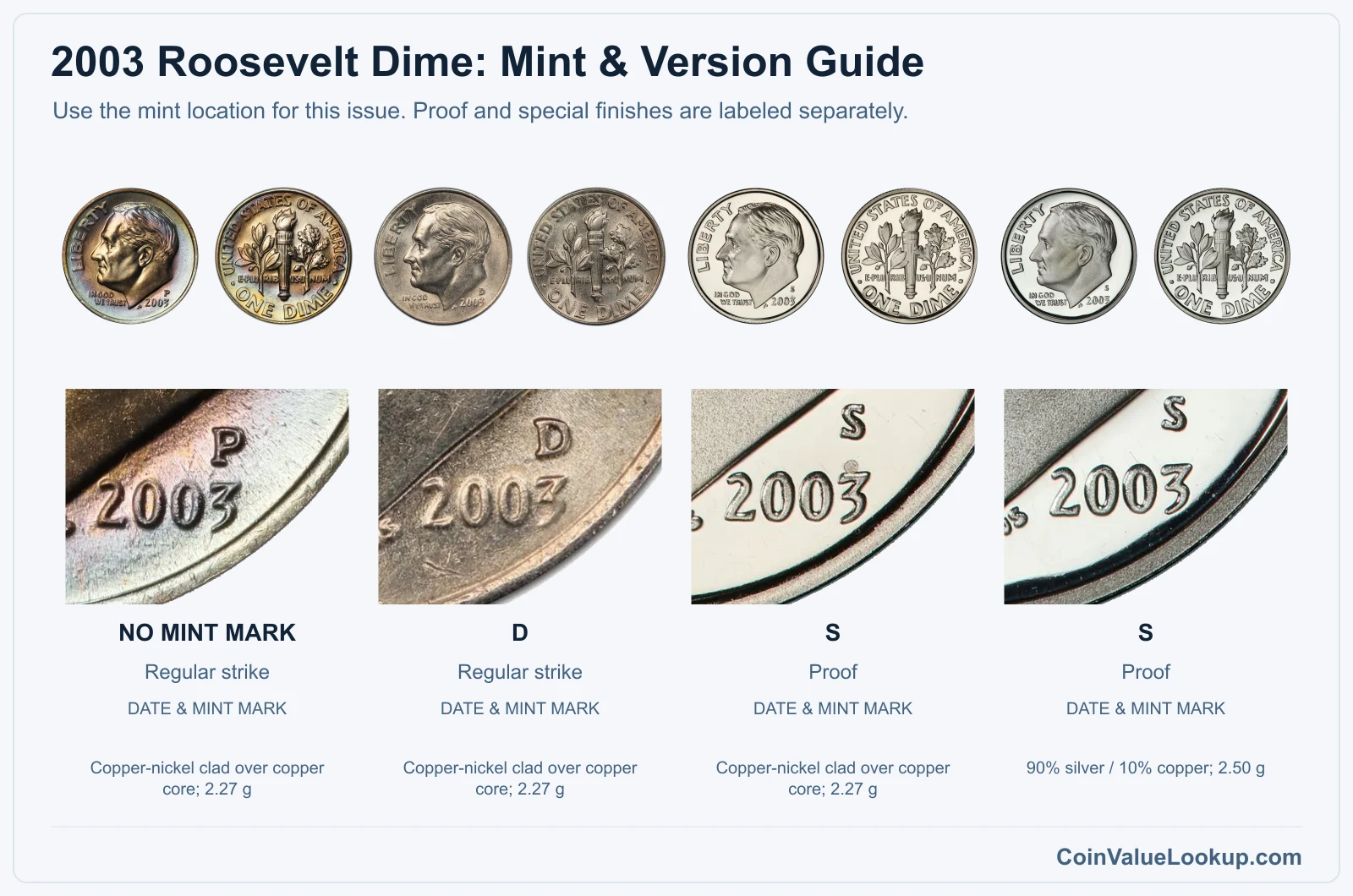
Every 2003 dime carries Franklin Roosevelt's portrait on the obverse and an olive-branch-and-torch design on the reverse. Look just above the date on the obverse for the mintmark: P for Philadelphia, D for Denver, or S for San Francisco.
P and D coins are copper-nickel clad business strikes meant for circulation. S-mintmark dimes come in two versions — clad proof and 90% silver proof — and they look almost identical at a glance.
To tell them apart, weigh the coin: a clad dime comes in at 2.27 grams, while a silver proof weighs 2.50 grams. Edge color helps too, since a clad coin shows a visible copper-colored stripe, but weight and original packaging together are much more reliable than color alone.
Diameter for both is about 17.9 mm.
If you find an S-mintmark dime outside its original government packaging, do not assume it is silver. Test the weight independently before drawing conclusions about composition.
Step 2: Check Your 2003 Roosevelt Dime Grade
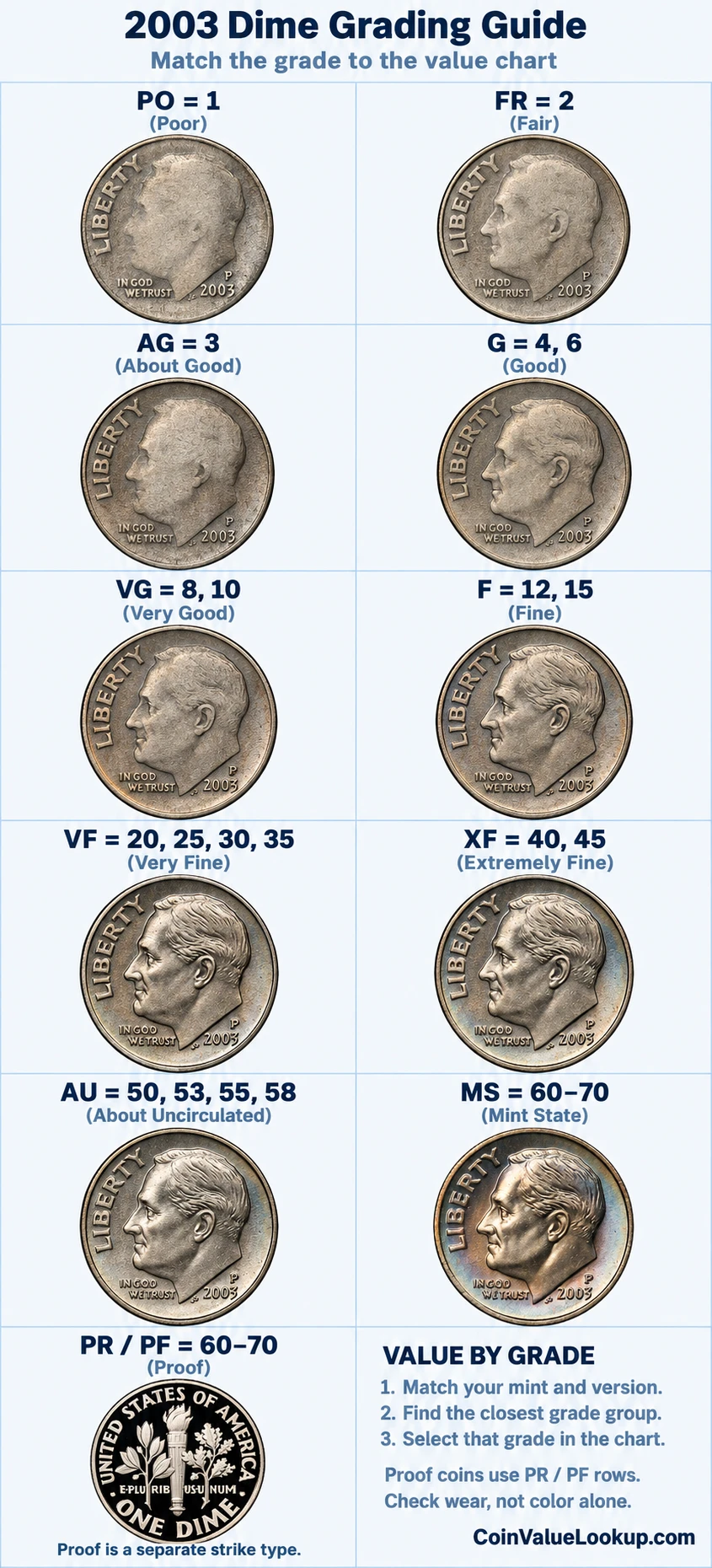
Start by checking Roosevelt's cheek, jawline and hair above the ear — those areas show wear first. On the reverse, the horizontal bands of the torch and the leaf details lose definition early.
Compare what you see against the reference image provided.
Original luster matters more than raw shininess. A coin can look bright from cleaning yet grade lower than a slightly toned piece with undisturbed surfaces.
If the fields still reflect light in an unbroken cartwheel pattern, that is a strong sign of mint-state preservation.
Do not confuse a weak strike with wear. Full Bands is a strike designation applied by grading services when both pairs of horizontal torch bands show clear separation; it describes how well the dies impressed the metal, not a different alloy or a higher grade category.
Proof coins have their own grading scale and visual standards. Hairlines from mishandling are the main enemy of proof surfaces.
Any cleaned, scratched or damaged coin — business strike or proof — will receive a condition qualifier that lowers its market standing compared to a problem-free example at the same technical grade.
Step 3: Check 2003 Roosevelt Dime Value by Mint and Version
2003 Roosevelt Dime — P Business Strike
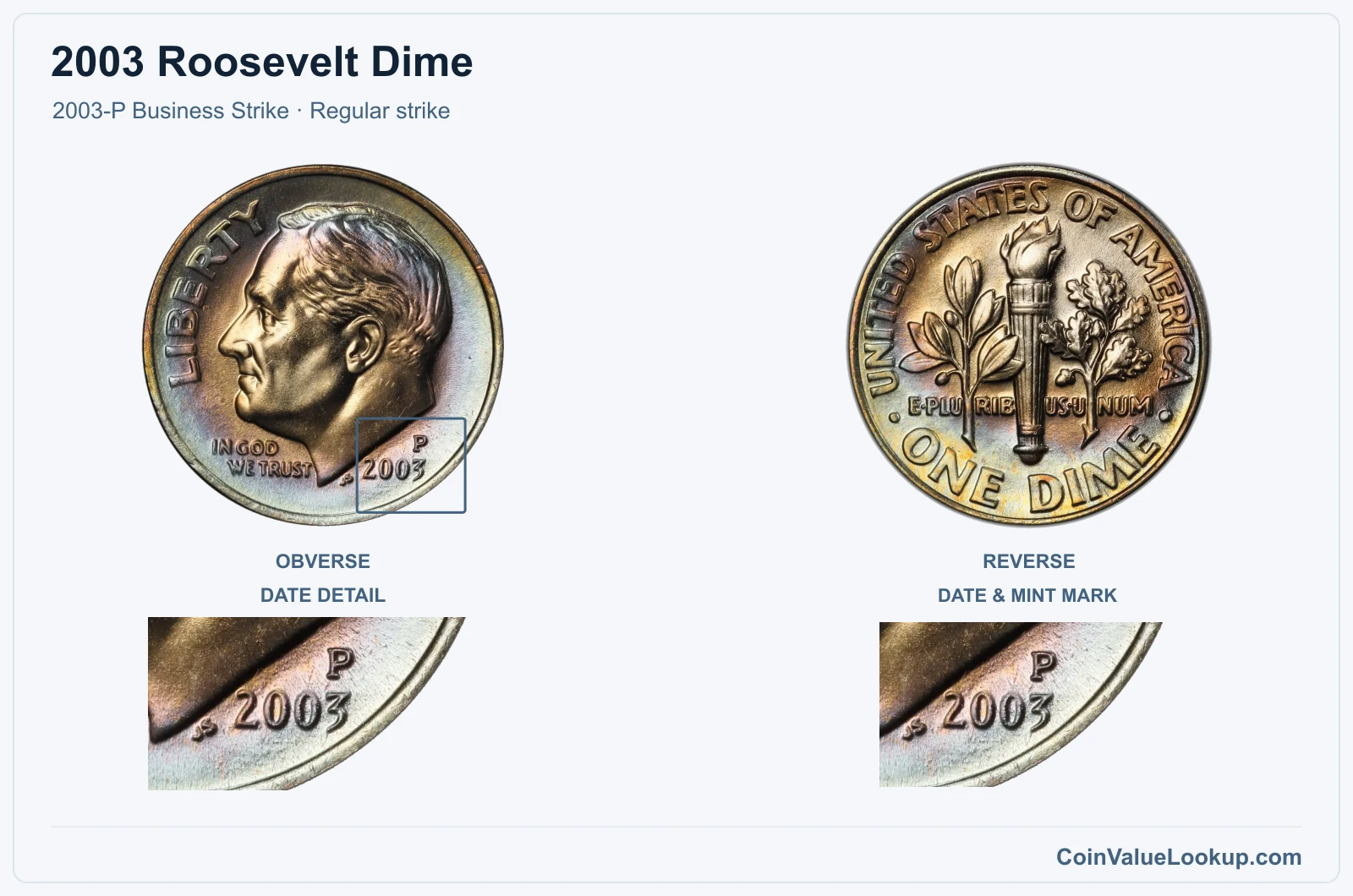
The 2003-P Roosevelt dime is a copper-nickel clad business strike from Philadelphia, weighing 2.27 grams. Look for the small P mintmark on the obverse near the date.
In circulated condition these are worth face value.
At the MS65 level, the USA Coin Book guide places this version at about $2.50. Coins displaying full separation of the horizontal torch bands may carry a strike-related premium.
Confirm the mintmark and check for original, undisturbed luster before comparing your coin to graded examples.
Range Grade
Price Auction Records Appraisal PO PO 1
—
Coin Identifier FR FR 2
—
Coin Identifier AG AG 3
—
Coin Identifier G G 4
—
Coin Identifier
G 6
—
Coin Identifier VG VG 8
—
Coin Identifier
VG 10
—
Coin Identifier F F 12
—
Coin Identifier
F 15
—
Coin Identifier VF VF 20
—
Coin Identifier
VF 25
—
Coin Identifier
VF 30
—
Coin Identifier
VF 35
—
Coin Identifier XF XF 40
—
Coin Identifier
XF 45
—
Coin Identifier AU AU 50
—
Coin Identifier
AU 53
—
Coin Identifier
AU 55
—
Coin Identifier
AU 58
—
Coin Identifier MS MS 60
—
Coin Identifier
MS 61
—
Coin Identifier
MS 62
—
Coin Identifier
MS 63
—
Coin Identifier
MS 64
—
Coin Identifier
MS 65
—
Coin Identifier
MS 66
Coin Identifier
MS 67
—
Coin Identifier
MS 68
—
Coin Identifier
MS 69
—
—
—
MS 70
—
—
—
2003 Roosevelt Dime — D Business Strike
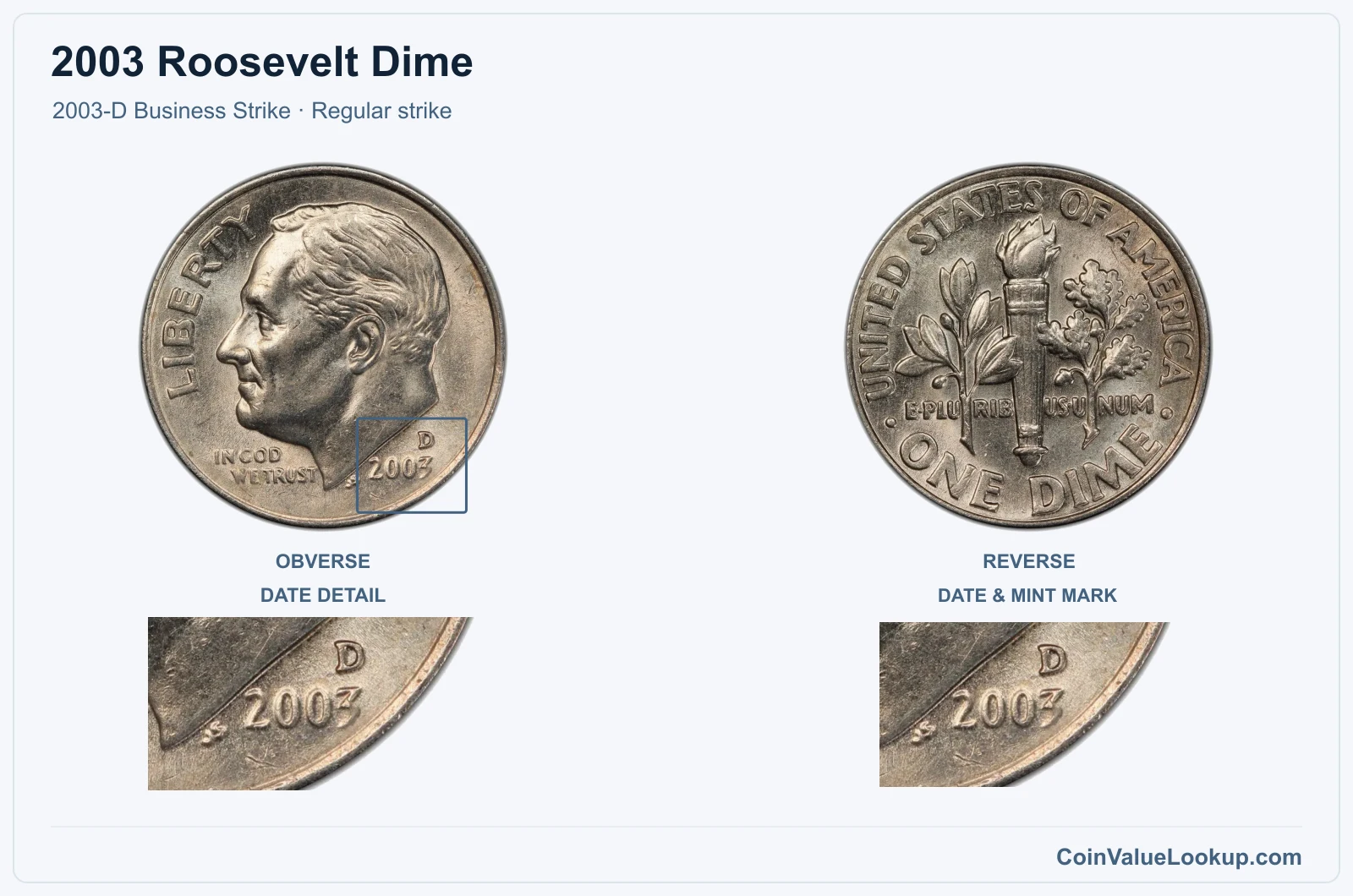
Denver's 2003-D dime is identical in design and composition to the Philadelphia issue — copper-nickel clad, 2.27 grams. The D mintmark sits in the same obverse position.
Guide value at MS65 is also around $2.50 per USA Coin Book. As with the P mint, sharp torch-band detail can distinguish a well-struck coin from the majority of the mintage.
Worn examples remain at face value, so this is really a coin to evaluate only if it appears uncirculated.
Range Grade
Price Auction Records Appraisal PO PO 1
—
Coin Identifier FR FR 2
—
Coin Identifier AG AG 3
—
Coin Identifier G G 4
—
Coin Identifier
G 6
—
Coin Identifier VG VG 8
—
Coin Identifier
VG 10
—
Coin Identifier F F 12
—
Coin Identifier
F 15
—
Coin Identifier VF VF 20
—
Coin Identifier
VF 25
—
Coin Identifier
VF 30
—
Coin Identifier
VF 35
—
Coin Identifier XF XF 40
—
Coin Identifier
XF 45
—
Coin Identifier AU AU 50
—
Coin Identifier
AU 53
—
Coin Identifier
AU 55
—
Coin Identifier
AU 58
—
Coin Identifier MS MS 60
—
Coin Identifier
MS 61
—
Coin Identifier
MS 62
—
Coin Identifier
MS 63
—
Coin Identifier
MS 64
—
Coin Identifier
MS 65
—
Coin Identifier
MS 66
—
Coin Identifier
MS 67
—
Coin Identifier
MS 68
—
Coin Identifier
MS 69
—
—
—
MS 70
—
—
—
2003 Roosevelt Dime — S Clad Proof
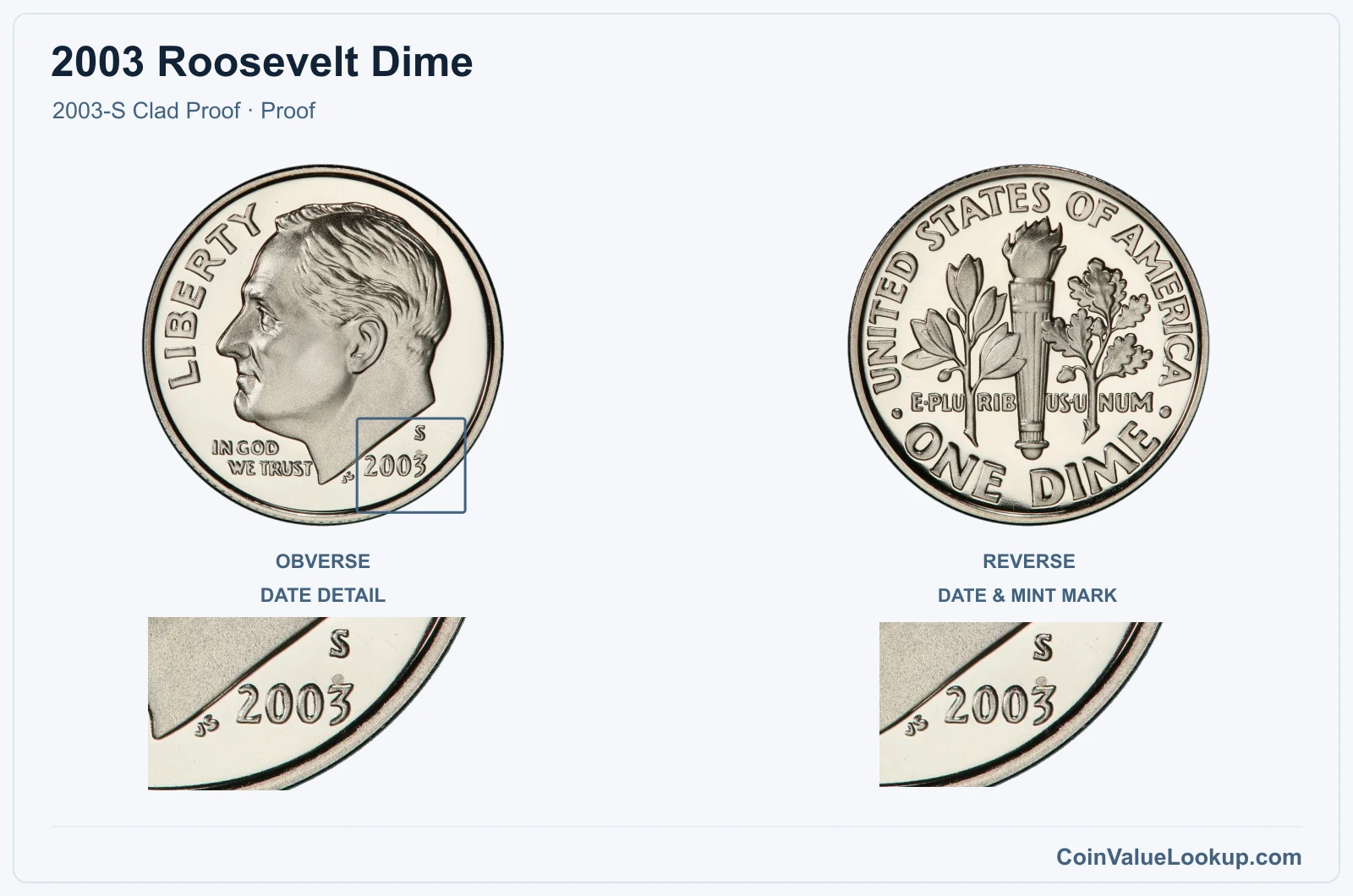
San Francisco produced a clad proof version of the 2003 dime in copper-nickel clad at 2.27 grams. It shares the S mintmark with the silver proof, so weight is the key separator.
Coin Value Lookup is a handy starting point when you need to compare different Roosevelt dime years and versions side by side. Use the guides there to put your coin in context before deciding on next steps.
At PR65 the USA Coin Book guide lists this clad proof at approximately $3.08. These were sold in annual proof sets, and most survivors remain in excellent condition.
Look for hairlines, haze or any signs of handling that would affect the proof surfaces.
Range Grade
Price Auction Records Appraisal PR PR 1
—
Coin Identifier
PR 2
—
Coin Identifier
PR 3
—
Coin Identifier
PR 4
—
Coin Identifier
PR 6
—
Coin Identifier
PR 8
—
Coin Identifier
PR 10
—
Coin Identifier
PR 12
—
Coin Identifier
PR 15
—
Coin Identifier
PR 20
—
Coin Identifier
PR 25
—
Coin Identifier
PR 30
—
Coin Identifier
PR 35
—
Coin Identifier
PR 40
—
Coin Identifier
PR 45
—
Coin Identifier
PR 50
—
Coin Identifier
PR 53
—
Coin Identifier
PR 55
—
Coin Identifier
PR 58
—
Coin Identifier
PR 60
—
Coin Identifier
PR 61
—
Coin Identifier
PR 62
—
Coin Identifier
PR 63
—
Coin Identifier
PR 64
—
Coin Identifier
PR 65
—
Coin Identifier
PR 66
—
Coin Identifier
PR 67
—
Coin Identifier
PR 68
—
Coin Identifier
PR 69
Coin Identifier
PR 70
Coin Identifier
2003 Roosevelt Dime — S Silver Proof
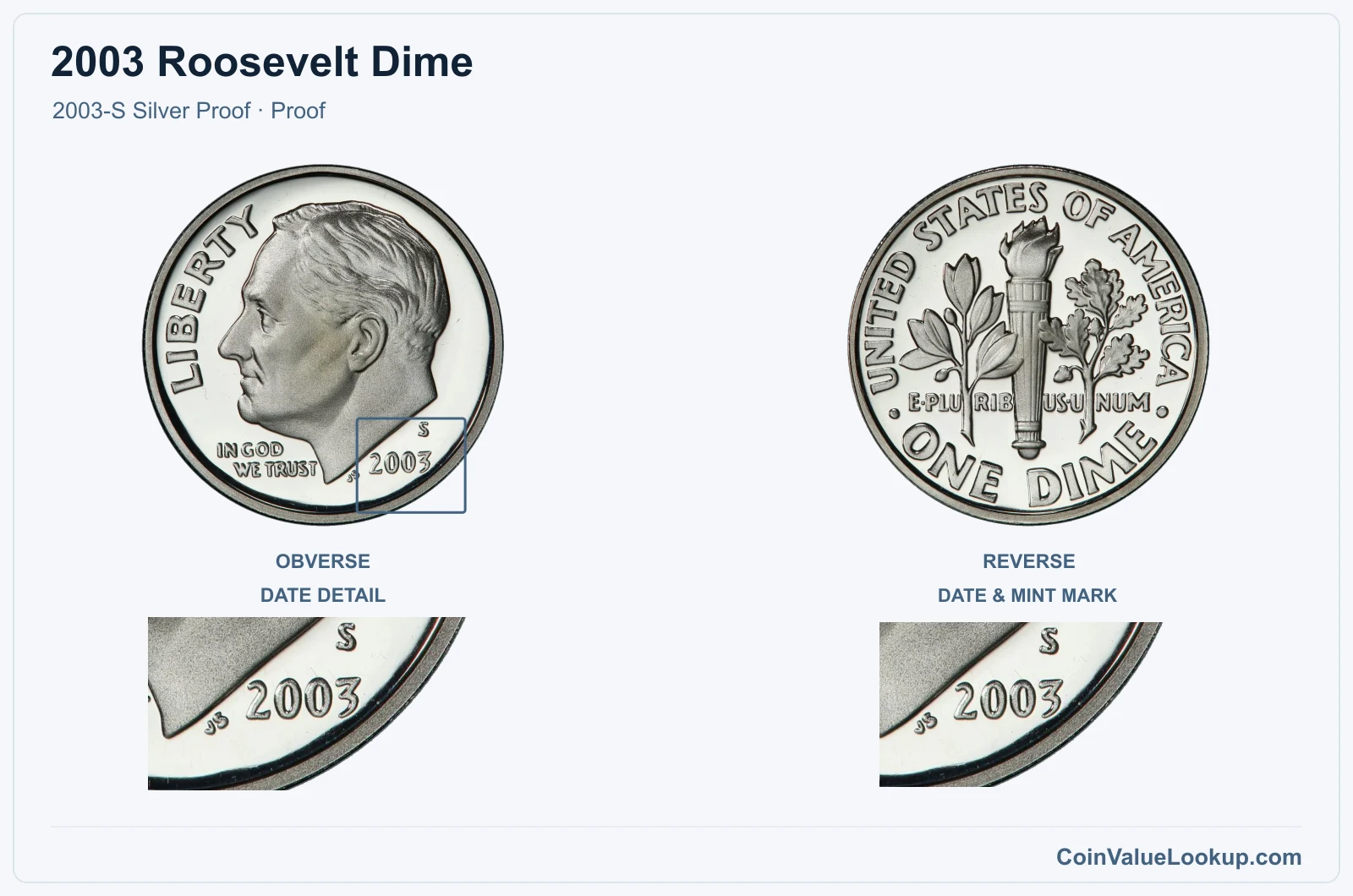
The 2003-S silver proof dime is struck in 90% silver and 10% copper, weighing 2.50 grams — noticeably heavier than the 2.27-gram clad version. This was part of the silver proof set reintroduced by the U.S. Mint in 1992.
USA Coin Book's guide places it at roughly $9.65 in PR65. That higher figure reflects both the precious-metal content and collector demand for the silver finish.
Edge examination can help: a silver proof will not show the copper stripe visible on clad edges. Confirm with a precise scale if packaging is absent, because visual inspection alone is not reliable enough to authenticate the alloy.
Range Grade
Price Auction Records Appraisal PR PR 1
—
Coin Identifier
PR 2
—
Coin Identifier
PR 3
—
Coin Identifier
PR 4
—
Coin Identifier
PR 6
—
Coin Identifier
PR 8
—
Coin Identifier
PR 10
—
Coin Identifier
PR 12
—
Coin Identifier
PR 15
—
Coin Identifier
PR 20
—
Coin Identifier
PR 25
—
Coin Identifier
PR 30
—
Coin Identifier
PR 35
—
Coin Identifier
PR 40
—
Coin Identifier
PR 45
—
Coin Identifier
PR 50
—
Coin Identifier
PR 53
—
Coin Identifier
PR 55
—
Coin Identifier
PR 58
—
Coin Identifier
PR 60
—
Coin Identifier
PR 61
—
Coin Identifier
PR 62
—
Coin Identifier
PR 63
—
Coin Identifier
PR 64
—
Coin Identifier
PR 65
—
Coin Identifier
PR 66
—
Coin Identifier
PR 67
—
Coin Identifier
PR 68
—
Coin Identifier
PR 69
Coin Identifier
PR 70
Coin Identifier
2003 Roosevelt Dime Error List
1. 2003 Roosevelt Dime — Elliptical Clipped Planchet
An elliptical clipped planchet occurs when the blank is punched from strip metal in a way that overlaps a previously punched hole, producing a football-shaped coin. On this 2003-P business strike, portions of the top and bottom of the design are missing, though the date survives.
Both sides lose design content in matching locations — the missing area corresponds to the shape of the blank, not a shifted die. That is the key distinction from an off-center strike: the blank itself is incomplete rather than misaligned under the dies.
A PCGS-graded MS66 example of this error sold through Heritage Auctions for $172.50 in February 2005. That is one documented specimen, not a guaranteed market range.
If you suspect you have an elliptical clip, photograph the overall shape and both faces clearly, and seek professional authentication before drawing value conclusions.
2. 2003 Roosevelt Dime — Off-Center Strike
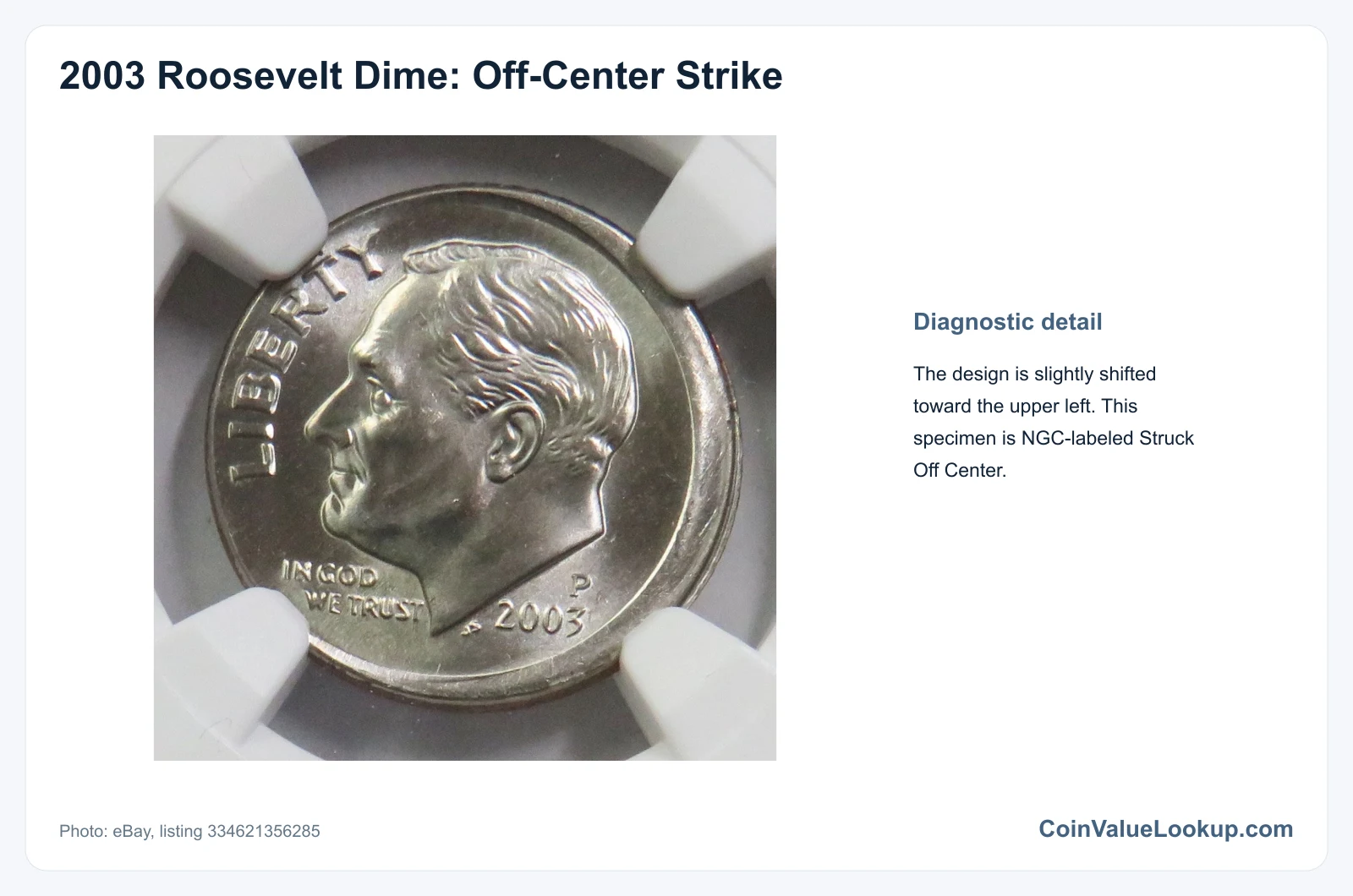
An off-center strike happens when a properly shaped blank feeds into the press out of alignment, so the dies impress only part of the design. One side of the coin shows a blank crescent where no detail was struck, and both faces are shifted in the same direction.
For a 2003-P business strike, an ICG-graded MS65 off-center specimen has been documented. No specific sale price was adopted from the available data, so value depends on individual assessment — factors like the degree of displacement, whether the date and mintmark remain readable, and overall condition all matter.
Do not confuse this with a misaligned die, which shifts one face slightly while the other stays centered, or with an incomplete blank that simply has missing metal. A true off-center strike affects both sides symmetrically relative to the blank's edge.
Authentication by a recognized grading service is the safest route before assigning any premium.
3. 2003 Roosevelt Dime — Die Crack / Die Chip
Die cracks and die chips appear as raised lines or small raised lumps on the coin's surface. They form when a working die develops fractures or loses tiny pieces of steel; the void in the die fills with metal during striking, leaving a raised feature on the finished coin.
A crack that runs from the rim inward is the most common form. An interior chip — a small raised blob surrounded by normal design — is less typical and sometimes more collectible.
A larger break connecting to the rim is sometimes called a cud.
Do not mistake incuse scratches, corrosion pitting or stuck debris for a die crack. A genuine crack is raised above the field, consistent across multiple coins from the same die, and does not scrape away under magnification.
Value depends on size, location and the coin's overall condition. Professional authentication helps confirm the feature before assigning any premium.
4. 2003 Roosevelt Dime — Broadstrike
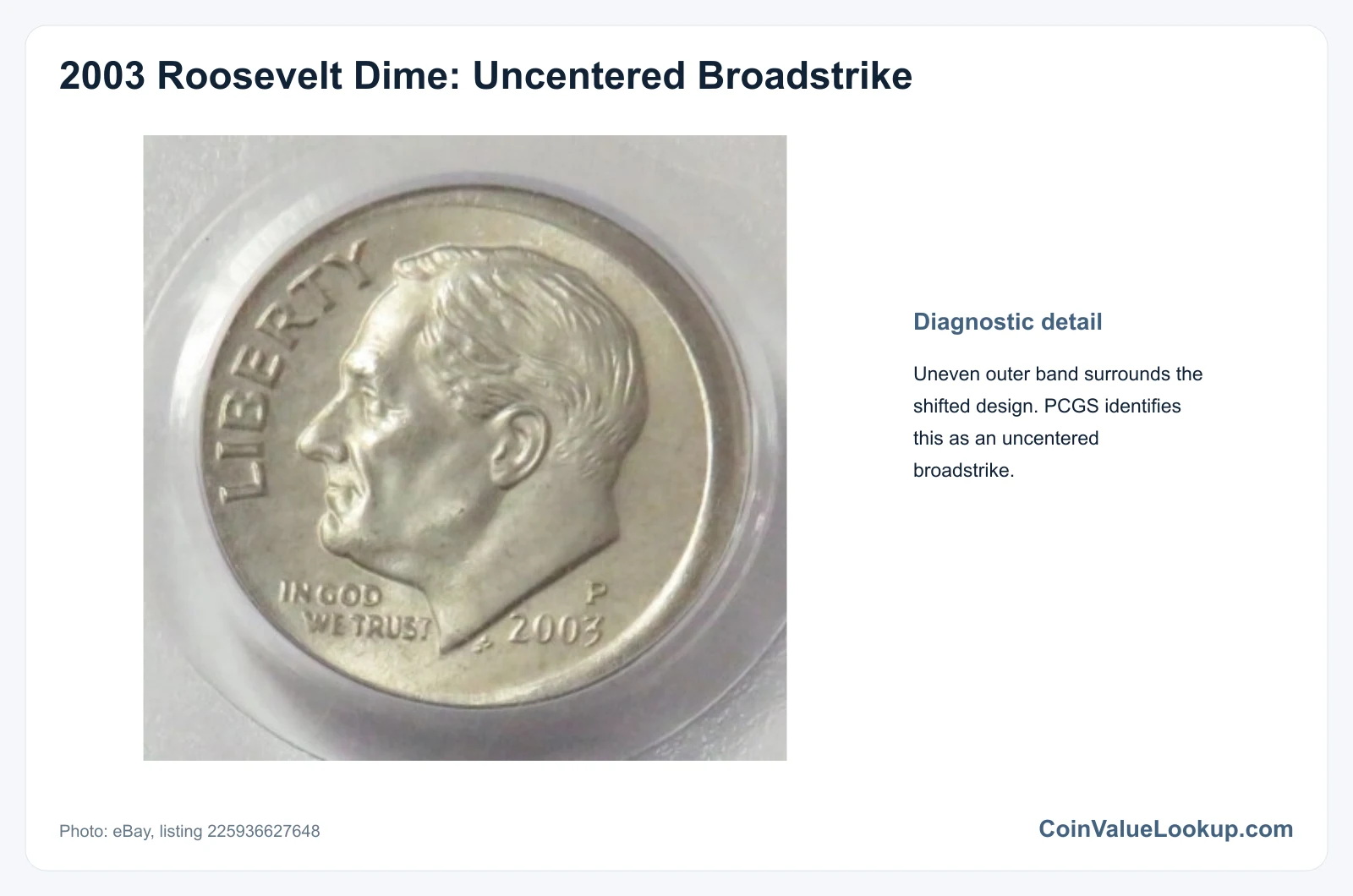
A broadstrike results when a coin is struck without proper collar confinement. The collar normally restrains the blank so it forms a uniform diameter and a reeded edge on a dime.
Without it, metal spreads outward, making the coin noticeably wider than normal while retaining a full or nearly full design on both faces.
Check the edge carefully. A broadstruck dime will have a smooth, spread edge instead of the usual reeding.
The design may look slightly stretched toward the rim.
This is different from an off-center strike, where the blank is misaligned and part of the design is entirely missing. It is also different from a coin that was flattened after leaving the mint — post-mint damage typically shows irregular distortion and surface marks.
Condition, degree of spread and overall eye appeal all affect value. Authentication by a grading service is recommended.
5. 2003 Roosevelt Dime — Doubled Die
A doubled die shows consistent doubling of design elements caused during the die-manufacturing process. On a 2003 dime, look for separation, notching or shelf-like doubling on lettering, the date, or design features such as the torch or Roosevelt's profile.
The doubling will appear in the same location and same direction on every coin struck by that die. That consistency is what separates a true doubled die from machine doubling, which tends to show flat, shelf-like distortion in the opposite direction of the raised design and is far less collectible.
Also rule out optical illusions from lighting or reflections, and post-mint damage such as a coin being struck against a hard surface. Examine the coin under magnification and compare specific letters or features with a known normal example.
No specific price was adopted for this variety, so value depends on the strength and visibility of the doubling and the coin's condition. Have the coin authenticated before assuming a premium.
6. 2003 Roosevelt Dime — Die Cap / Capped-Die Strike
A die cap forms when a struck coin sticks to the upper die and is carried upward, acting as a cap over the die face. Subsequent blanks are then struck through that adhered coin, producing progressively deeper cup-shaped impressions.
Two distinct collectibles come from this process: the cap coin itself, which becomes increasingly cupped and shows a mirror-image brockage on one side, and the coins struck beneath it, which display a softened, spread impression of the cap's reverse design.
Do not confuse a capped-die error with simple bending, vise damage, or a weak strike. A genuine cap shows a progressive, symmetrical deformation and clear evidence of the striking process.
Photograph both sides and the edge profile. Value depends on how dramatic the cap is and the coin's overall condition.
Professional authentication is strongly recommended for this type of error.
7. 2003 Roosevelt Dime — Misaligned Die
A misaligned die error occurs when one of the two dies shifts slightly from its correct position relative to the blank. The result is a coin where one face appears offset — the design is complete but not centered — while the opposite face remains properly centered.
This is different from an off-center strike, where both faces are shifted together because the blank itself was out of position. With a misaligned die, only one side looks wrong.
Compare both faces: if the obverse is shifted but the reverse is centered (or vice versa), that points to a die alignment issue.
Rule out tilted photography and post-mint rim damage, which can mimic the appearance of a shift. Minor misalignments are common and carry small premiums; more dramatic shifts attract more attention.
Value depends on the degree of displacement and overall condition. Authentication is recommended for any significant example.
8. 2003 Roosevelt Dime — Lamination / Split Planchet
A lamination or split planchet error appears as peeling, flaking or outright separation of metal layers within the coin. On a clad dime this can look like a thin flap lifting away from the surface, or in extreme cases the coin may split into two thinner halves.
Photograph the affected face and the edge together — the edge view is often the clearest evidence, showing where layers have separated. A partial lamination might appear as a raised blister or a missing patch exposing a different-colored layer underneath.
Do not confuse this with surface corrosion, deliberate scraping or a coin that has been cut. Genuine laminations follow the plane of the metal and show no tool marks.
The size, visibility and completeness of the separation all affect value, as does the coin's overall condition. If you think you have a split planchet, professional authentication will distinguish it from post-mint damage.