2003 Quarter Coin Value: How Much Is It Worth?
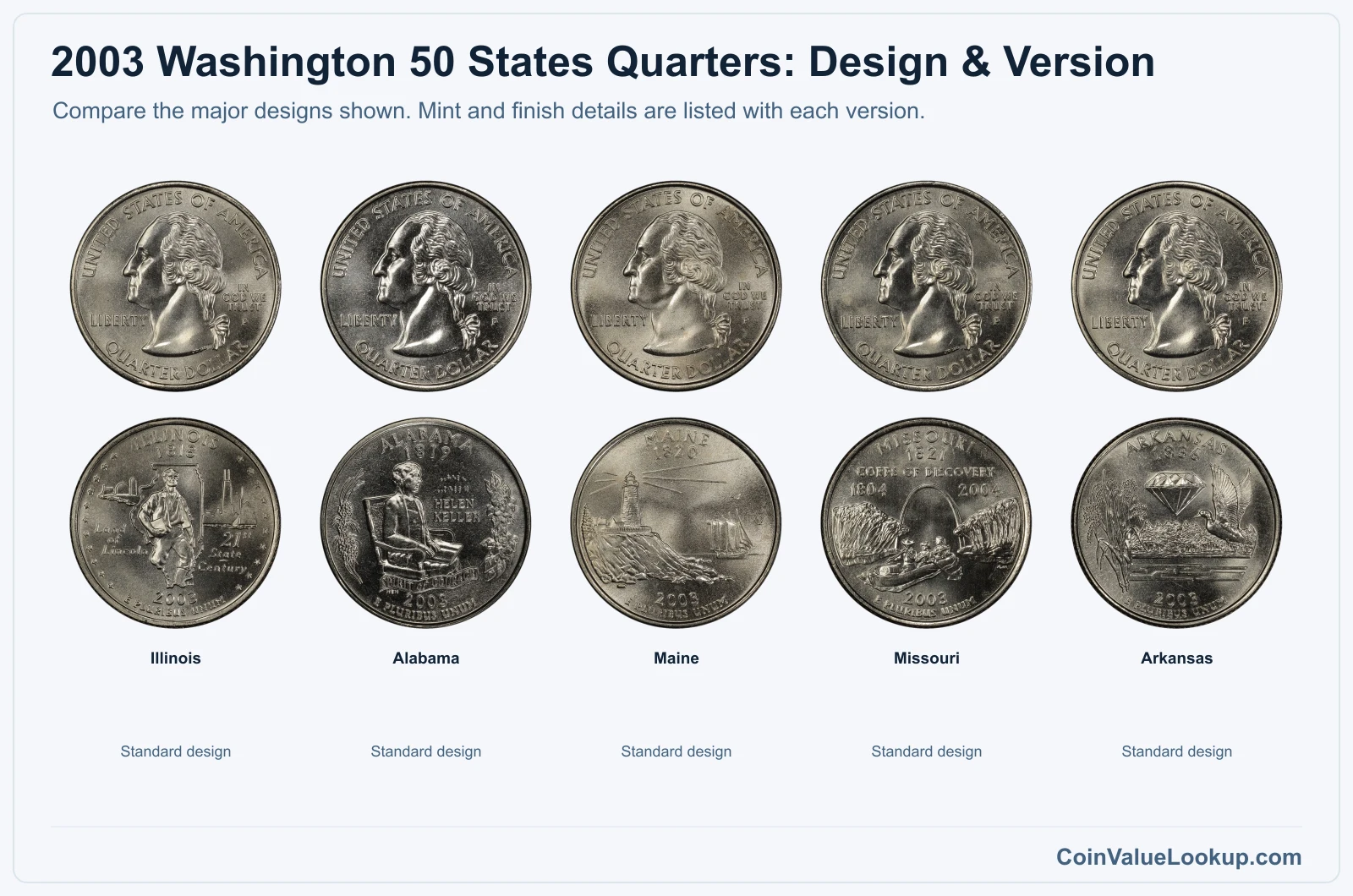
The 2003 quarter belongs to the Washington 50 States Quarters series, and five different reverse designs were struck that year: Illinois, Alabama, Maine, Missouri, and Arkansas. Guide estimates from USA Coin Book range from about $0.74 to $23.00, but that spread depends entirely on which mint, reverse, finish and grade you have.
A worn clad quarter from pocket change is not in the same category as a pristine silver proof.
Fast Way to Identify Your 2003 Quarter
The quickest way to start figuring out what your 2003 quarter is worth is to upload clear photos of the front and back. Our identifier can give you a preliminary read on the mint, reverse design and finish so you know which version to look up.
Snap both sides in even lighting and avoid glare.
2003 Quarter Value
Upload both sides of your 2003 Quarter.
Front Obverse
Upload photo
Back Reverse
Upload photo
Which 2003 Quarter Versions Are Worth Money?
- S-mint silver proof quarters (Illinois, Alabama, Maine, Missouri, Arkansas) carry the highest guide estimates at about $23.00 each in PR65, due to their 90% silver content and collector-only distribution.
- S-mint clad proofs are valued around $6.25 in PR65 — less than silver proofs but well above face value for a quarter.
- P and D mint business strikes in MS65 condition are guided at $1.88 to $2.50, with Illinois examples slightly higher at $2.50.
Step 1: Identify Your 2003 Quarter Mint Mark and Version
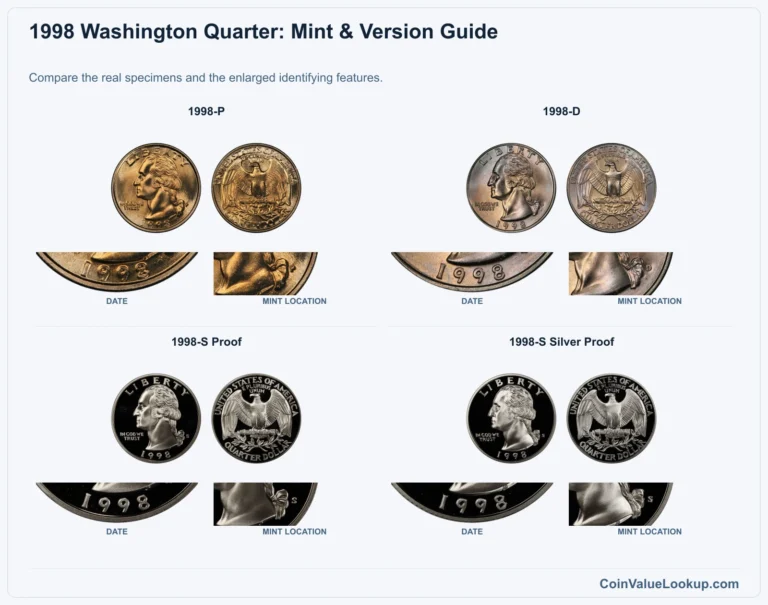
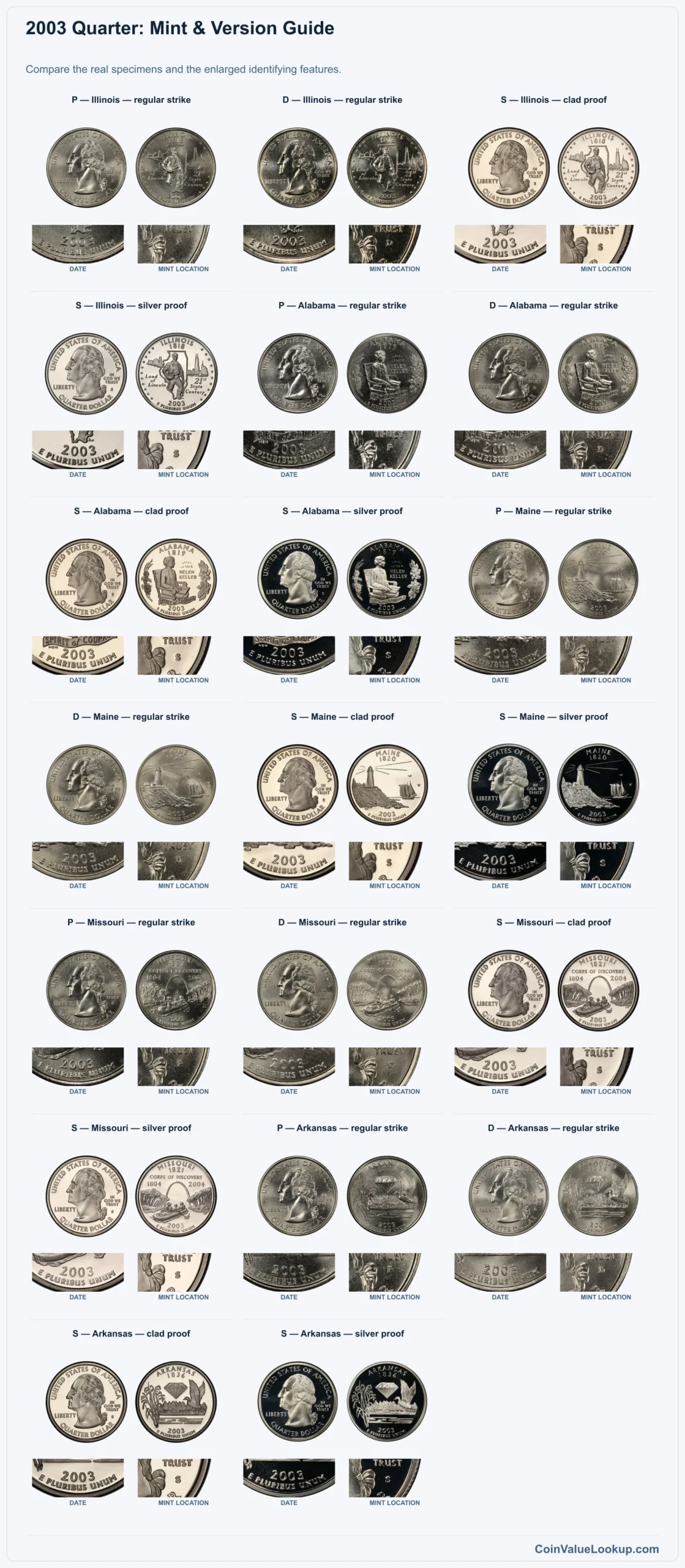
Start on the obverse. The mintmark sits near Washington's ponytail: P for Philadelphia, D for Denver, S for San Francisco.
Every S-mint 2003 quarter is a proof, but there are two compositions — copper-nickel clad and 90% silver.
Flip the coin over and identify the reverse design. Illinois, Alabama, Maine, Missouri and Arkansas each have distinct imagery, and the state name appears on the reverse itself.
Don't confuse the statehood date on the reverse with the year of issue. Your coin was minted in 2003 regardless of the historical date shown.
To tell a clad proof from a silver proof, check the edge: a clad coin shows visible layering, while a silver proof has a uniform gray edge. Weight helps too — silver proofs nominally weigh 6.25 g versus 5.67 g for clad.
A proof finish (mirror fields, frosted devices) and a specific mintmark are normal manufacturing choices, not errors.
Step 2: Check Your 2003 Quarter Grade
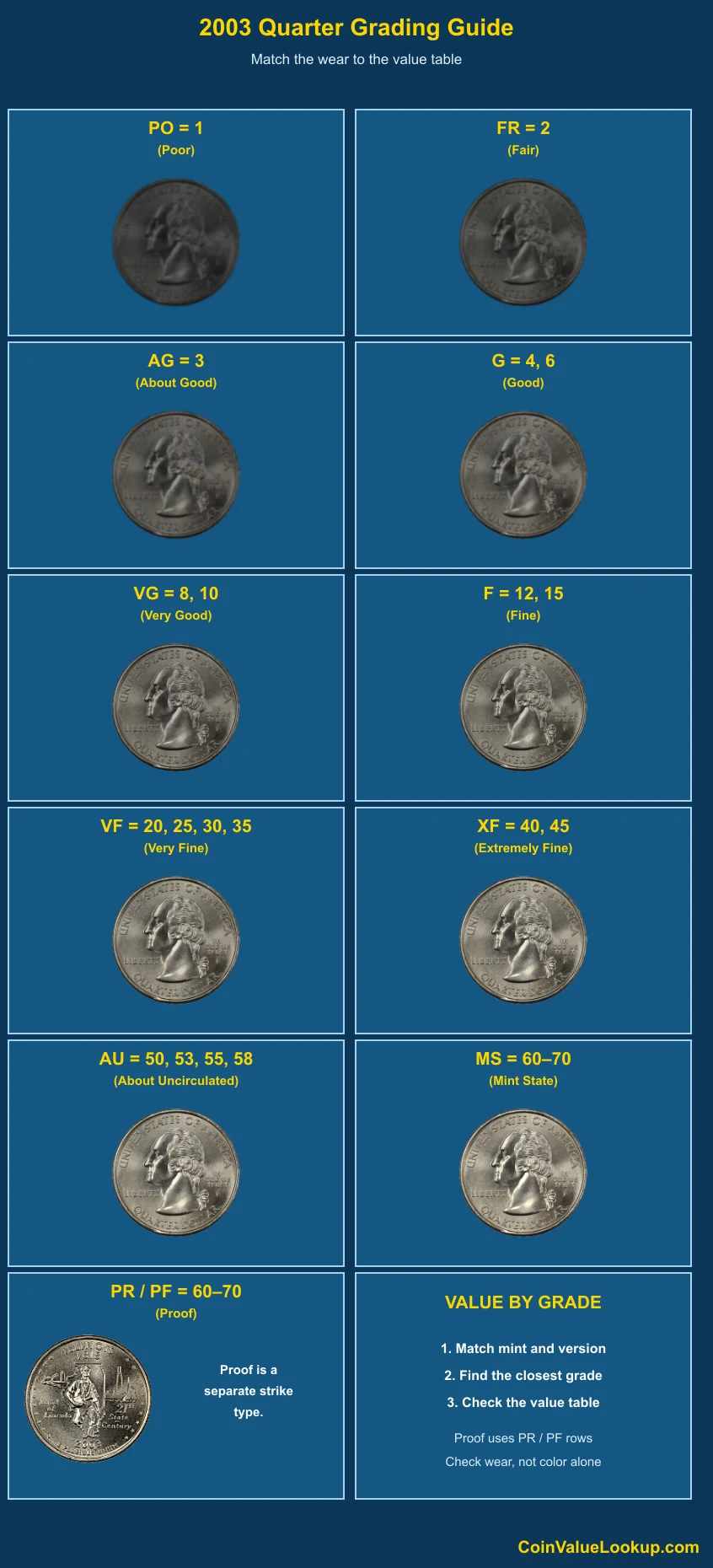
Focus on Washington's cheek and the hair detail above his ear — those are the first spots to show friction on a circulated quarter. On the reverse, check the highest relief points of each state design for the same kind of wear.
For proof coins, tilt the coin under a single light source and look for hairlines across the mirror fields. Haze or milky toning on a proof can lower its grade even when the devices look sharp.
Compare your coin against the reference image to gauge luster. A coin can look flat from a weak strike without actually being worn, so look at both sharpness and surface reflectivity together.
Don't assume a shiny coin is uncirculated — cleaning destroys original luster and leaves a distinctive harsh brightness that graders penalize.
Step 3: Check 2003 Quarter Value by Mint and Version
2003 Quarter — P — Illinois — regular strike
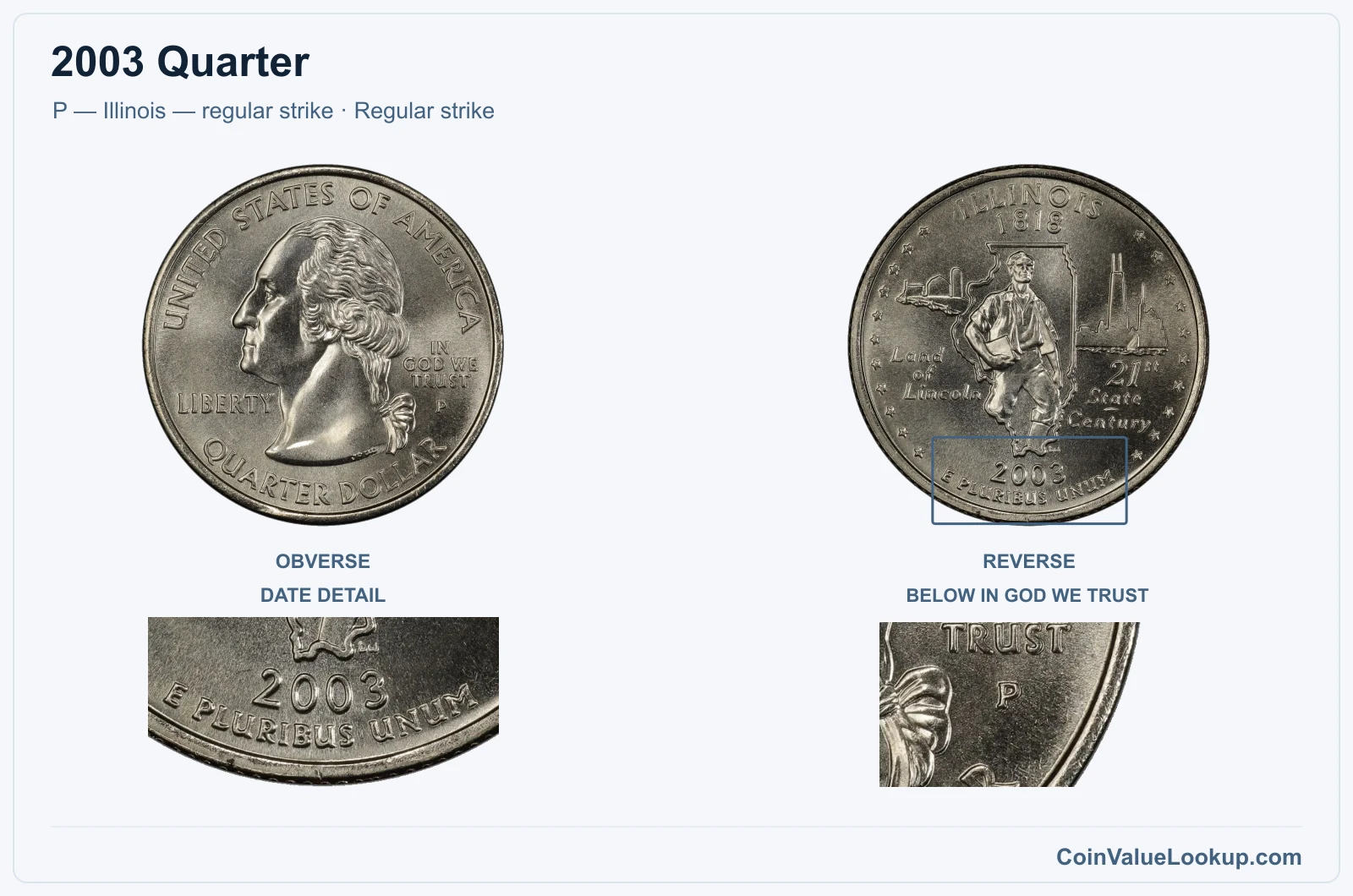
The 2003-P Illinois quarter is a copper-nickel clad coin struck at Philadelphia. It measures 24.26 mm across and weighs about 5.67 g.
Circulated examples are common and trade near face value.
In higher grades this coin starts to separate from the pile. USA Coin Book estimates about $0.93 at MS60 and $2.50 at MS65.
Look for full original luster and minimal bag marks on both the obverse portrait and the Illinois reverse design before assuming a high mint-state grade.
Range Grade
Price Auction Records Appraisal PO PO 1
—
Coin Identifier FR FR 2
—
Coin Identifier AG AG 3
—
Coin Identifier G G 4
—
Coin Identifier
G 6
—
Coin Identifier VG VG 8
—
Coin Identifier
VG 10
—
Coin Identifier F F 12
—
Coin Identifier
F 15
—
Coin Identifier VF VF 20
—
Coin Identifier
VF 25
—
Coin Identifier
VF 30
—
Coin Identifier
VF 35
—
Coin Identifier XF XF 40
—
Coin Identifier
XF 45
—
Coin Identifier AU AU 50
—
Coin Identifier
AU 53
—
Coin Identifier
AU 55
—
Coin Identifier
AU 58
—
Coin Identifier MS MS 60
—
Coin Identifier
MS 61
—
Coin Identifier
MS 62
—
Coin Identifier
MS 63
—
Coin Identifier
MS 64
—
Coin Identifier
MS 65
—
Coin Identifier
MS 66
—
Coin Identifier
MS 67
Coin Identifier
MS 68
Coin Identifier
MS 69
—
—
—
MS 70
—
—
—
2003 Quarter — D — Illinois — regular strike
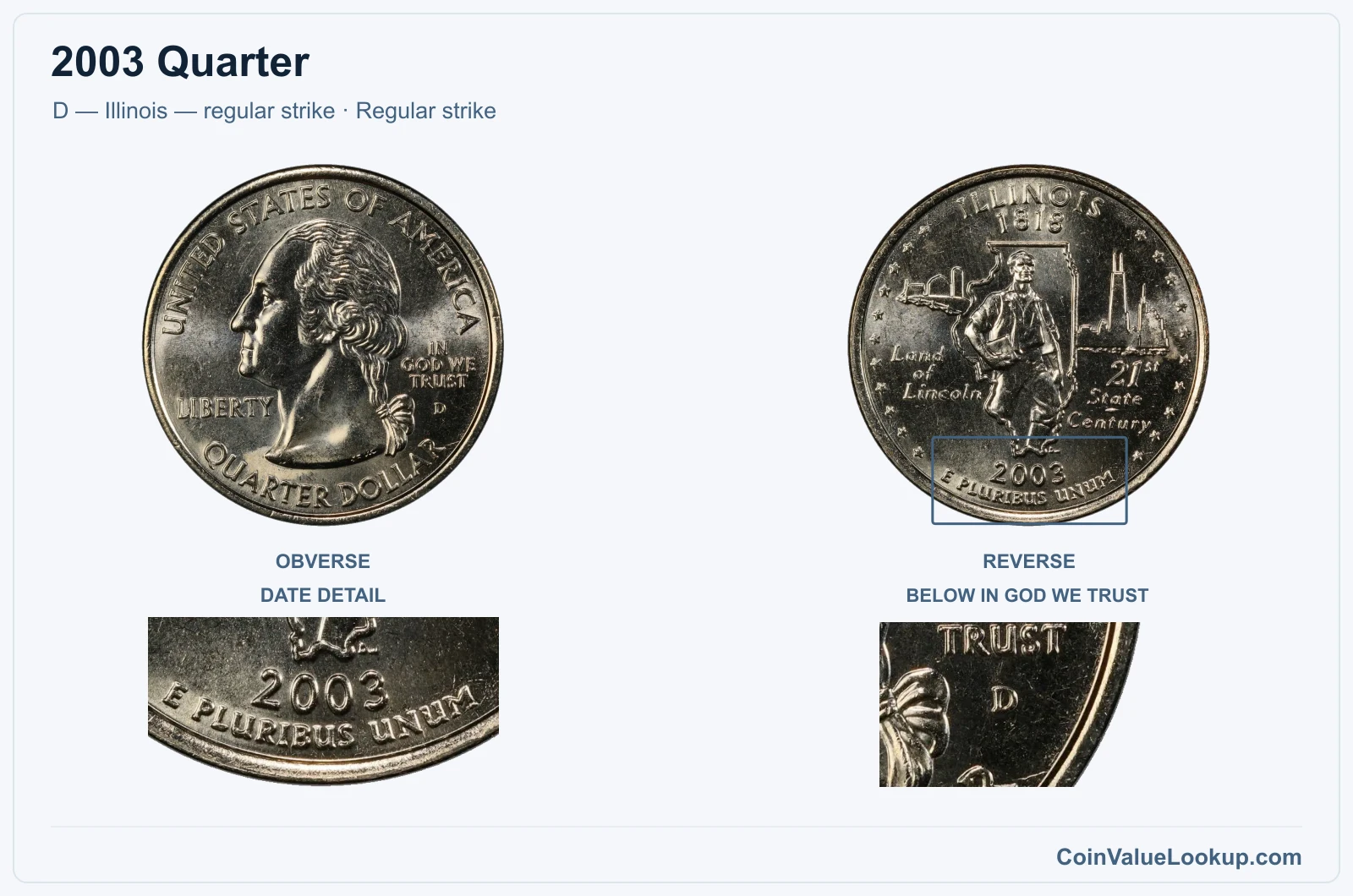
Denver's version of the 2003 Illinois quarter shares the same copper-nickel clad composition and 24.26 mm diameter as its Philadelphia sibling. The D mintmark near Washington's portrait is the distinguishing feature.
Guide estimates match the P-mint: roughly $0.93 at MS60 and $2.50 at MS65 per USA Coin Book. Worn pieces are worth face value.
If yours has full cartwheel luster and clean fields, it is worth comparing against the grade chart.
Range Grade
Price Auction Records Appraisal PO PO 1
—
Coin Identifier FR FR 2
—
Coin Identifier AG AG 3
—
Coin Identifier G G 4
—
Coin Identifier
G 6
—
Coin Identifier VG VG 8
—
Coin Identifier
VG 10
—
Coin Identifier F F 12
—
Coin Identifier
F 15
—
Coin Identifier VF VF 20
—
Coin Identifier
VF 25
—
Coin Identifier
VF 30
—
Coin Identifier
VF 35
—
Coin Identifier XF XF 40
—
Coin Identifier
XF 45
—
Coin Identifier AU AU 50
—
Coin Identifier
AU 53
—
Coin Identifier
AU 55
—
Coin Identifier
AU 58
—
Coin Identifier MS MS 60
—
Coin Identifier
MS 61
—
Coin Identifier
MS 62
—
Coin Identifier
MS 63
—
Coin Identifier
MS 64
—
Coin Identifier
MS 65
—
Coin Identifier
MS 66
—
Coin Identifier
MS 67
Coin Identifier
MS 68
Coin Identifier
MS 69
—
—
—
MS 70
—
—
—
2003 Quarter — S — Illinois — clad proof
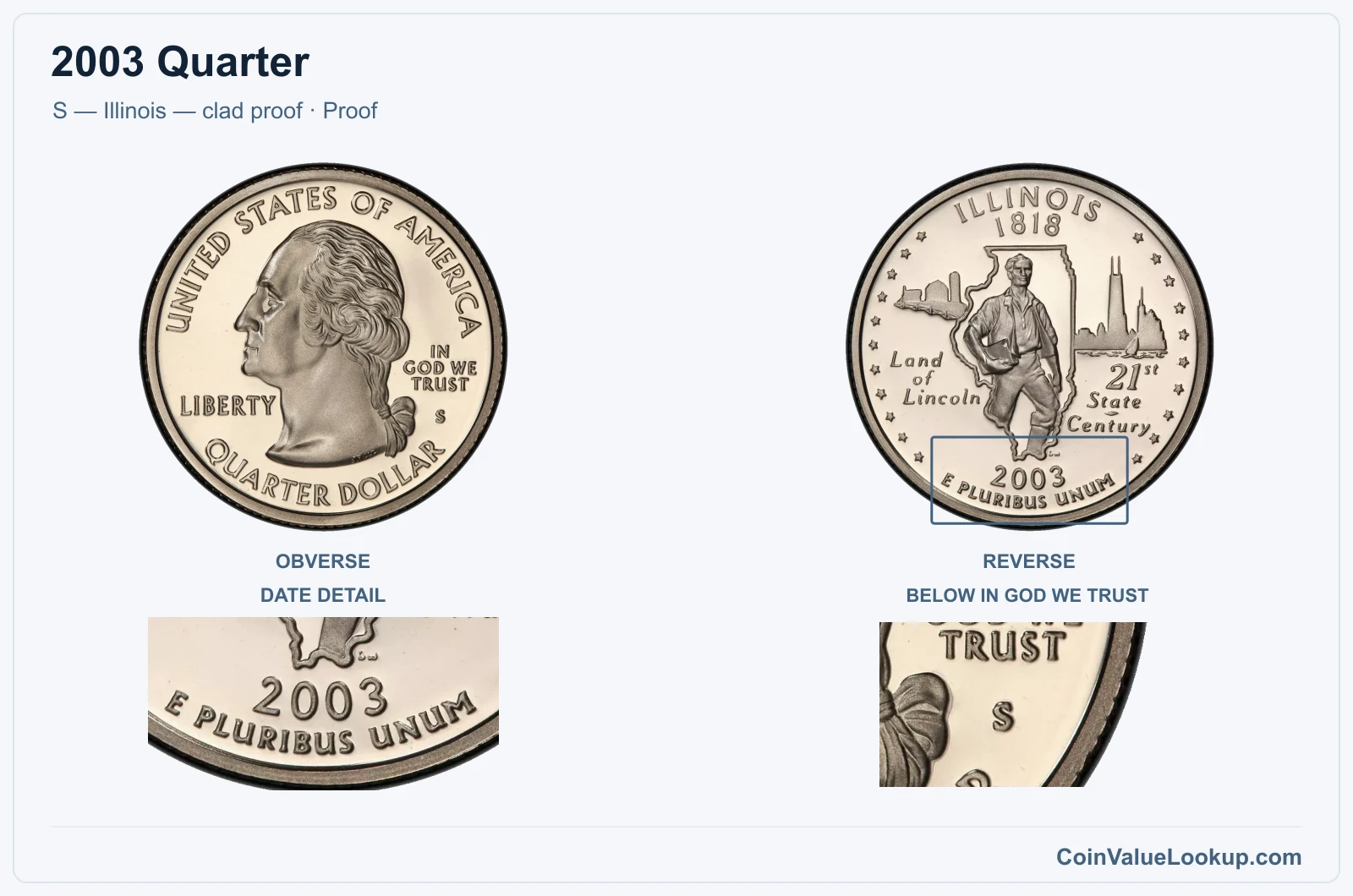
The 2003-S Illinois clad proof was produced at San Francisco for collector sets. It is copper-nickel clad, not silver — check the edge for visible layers to confirm.
USA Coin Book guides this coin at about $6.25 in PR65. Mirror fields should be free of hairlines and the frosted devices crisp.
If you bought it in a government proof set, it is almost certainly this version. Keep it separate from the silver proof when looking up values.
Range Grade
Price Auction Records Appraisal PR PR 1
—
Coin Identifier
PR 2
—
Coin Identifier
PR 3
—
Coin Identifier
PR 4
—
Coin Identifier
PR 6
—
Coin Identifier
PR 8
—
Coin Identifier
PR 10
—
Coin Identifier
PR 12
—
Coin Identifier
PR 15
—
Coin Identifier
PR 20
—
Coin Identifier
PR 25
—
Coin Identifier
PR 30
—
Coin Identifier
PR 35
—
Coin Identifier
PR 40
—
Coin Identifier
PR 45
—
Coin Identifier
PR 50
—
Coin Identifier
PR 53
—
Coin Identifier
PR 55
—
Coin Identifier
PR 58
—
Coin Identifier
PR 60
—
Coin Identifier
PR 61
—
Coin Identifier
PR 62
—
Coin Identifier
PR 63
—
Coin Identifier
PR 64
—
Coin Identifier
PR 65
—
Coin Identifier
PR 66
—
Coin Identifier
PR 67
—
Coin Identifier
PR 68
—
Coin Identifier
PR 69
Coin Identifier
PR 70
Coin Identifier
2003 Quarter — S — Illinois — silver proof
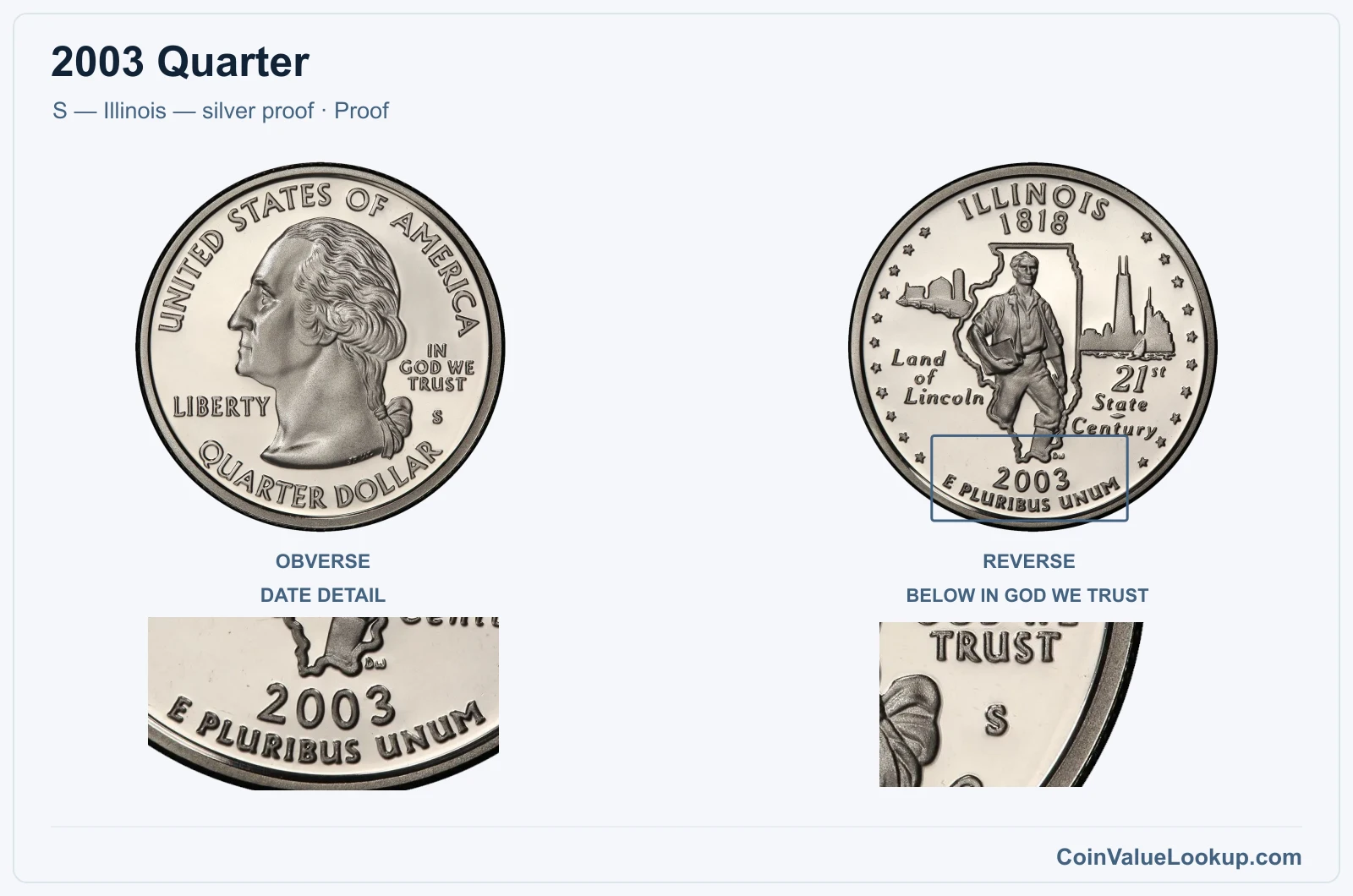
This is the 2003-S Illinois silver proof, struck in 90% silver with a nominal weight of 6.25 g. The edge appears uniformly gray with no visible copper stripe, and it feels slightly heavier than a clad quarter.
USA Coin Book estimates about $23.00 at PR65, making it the top-valued Illinois version at that grade. These were sold in Silver Proof Sets.
Confirm the composition before assuming you have the silver version — weight and edge color are your best friends here.
Range Grade
Price Auction Records Appraisal PR PR 1
—
Coin Identifier
PR 2
—
Coin Identifier
PR 3
—
Coin Identifier
PR 4
—
Coin Identifier
PR 6
—
Coin Identifier
PR 8
—
Coin Identifier
PR 10
—
Coin Identifier
PR 12
—
Coin Identifier
PR 15
—
Coin Identifier
PR 20
—
Coin Identifier
PR 25
—
Coin Identifier
PR 30
—
Coin Identifier
PR 35
—
Coin Identifier
PR 40
—
Coin Identifier
PR 45
—
Coin Identifier
PR 50
—
Coin Identifier
PR 53
—
Coin Identifier
PR 55
—
Coin Identifier
PR 58
—
Coin Identifier
PR 60
—
Coin Identifier
PR 61
—
Coin Identifier
PR 62
—
Coin Identifier
PR 63
—
Coin Identifier
PR 64
—
Coin Identifier
PR 65
—
Coin Identifier
PR 66
—
Coin Identifier
PR 67
—
Coin Identifier
PR 68
—
Coin Identifier
PR 69
Coin Identifier
PR 70
Coin Identifier
2003 Quarter — P — Alabama — regular strike
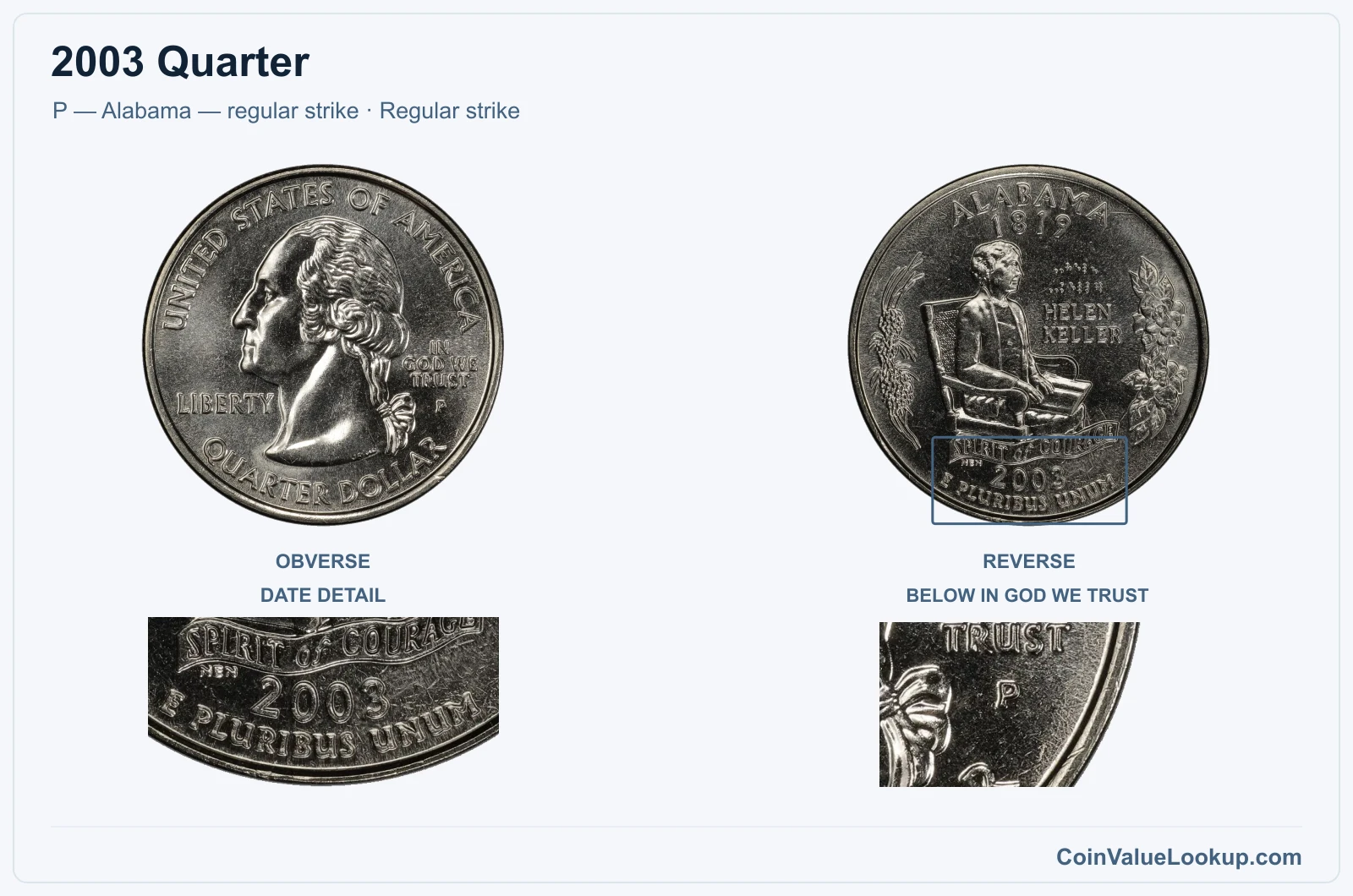
The 2003-P Alabama quarter is a standard copper-nickel clad issue from Philadelphia. At 24.26 mm and approximately 5.67 g, it is physically identical to other business-strike state quarters of the era.
Circulated coins trade at face value. USA Coin Book guides uncirculated pieces at about $0.74 in MS60 and $1.88 in MS65.
Bag marks and contact on the high points of the Alabama reverse design are common on mint-state examples.
Range Grade
Price Auction Records Appraisal PO PO 1
—
Coin Identifier FR FR 2
—
Coin Identifier AG AG 3
—
Coin Identifier G G 4
—
Coin Identifier
G 6
—
Coin Identifier VG VG 8
—
Coin Identifier
VG 10
—
Coin Identifier F F 12
—
Coin Identifier
F 15
—
Coin Identifier VF VF 20
—
Coin Identifier
VF 25
—
Coin Identifier
VF 30
—
Coin Identifier
VF 35
—
Coin Identifier XF XF 40
—
Coin Identifier
XF 45
—
Coin Identifier AU AU 50
—
Coin Identifier
AU 53
—
Coin Identifier
AU 55
—
Coin Identifier
AU 58
—
Coin Identifier MS MS 60
—
Coin Identifier
MS 61
—
Coin Identifier
MS 62
—
Coin Identifier
MS 63
—
Coin Identifier
MS 64
—
Coin Identifier
MS 65
—
Coin Identifier
MS 66
—
Coin Identifier
MS 67
Coin Identifier
MS 68
—
Coin Identifier
MS 69
—
—
—
MS 70
—
—
—
2003 Quarter — D — Alabama — regular strike
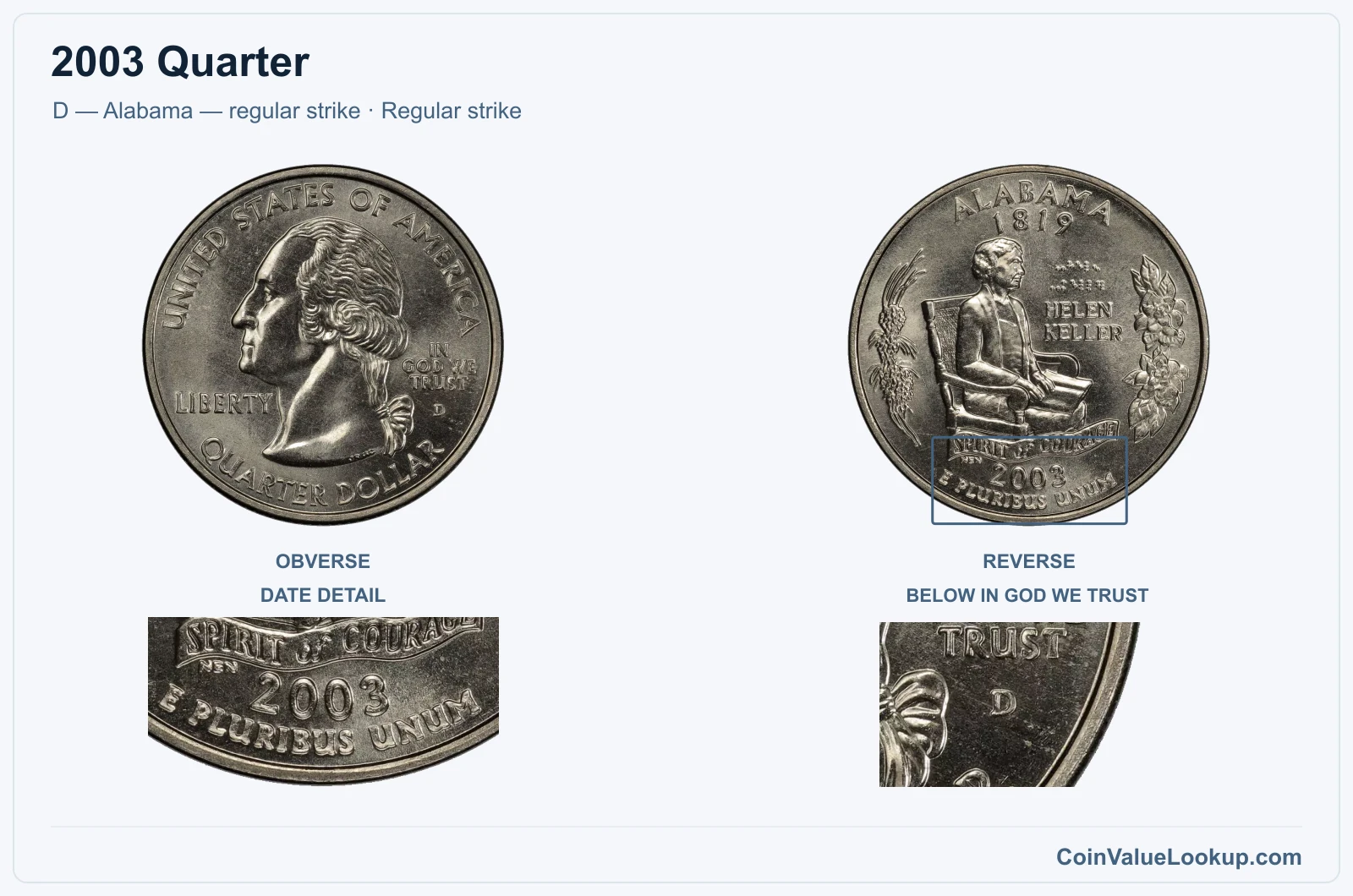
Denver struck its share of 2003 Alabama quarters in the same copper-nickel clad composition. Look for the small D mintmark on the obverse to confirm.
Pricing follows the P-mint closely: about $0.74 at MS60 and $1.88 at MS65 according to USA Coin Book. Worn examples are worth a quarter.
For mint-state pieces, inspect the fields for distracting marks and compare luster to the reference image.
Range Grade
Price Auction Records Appraisal PO PO 1
—
Coin Identifier FR FR 2
—
Coin Identifier AG AG 3
—
Coin Identifier G G 4
—
Coin Identifier
G 6
—
Coin Identifier VG VG 8
—
Coin Identifier
VG 10
—
Coin Identifier F F 12
—
Coin Identifier
F 15
—
Coin Identifier VF VF 20
—
Coin Identifier
VF 25
—
Coin Identifier
VF 30
—
Coin Identifier
VF 35
—
Coin Identifier XF XF 40
—
Coin Identifier
XF 45
—
Coin Identifier AU AU 50
—
Coin Identifier
AU 53
—
Coin Identifier
AU 55
—
Coin Identifier
AU 58
—
Coin Identifier MS MS 60
—
Coin Identifier
MS 61
—
Coin Identifier
MS 62
—
Coin Identifier
MS 63
—
Coin Identifier
MS 64
—
Coin Identifier
MS 65
—
Coin Identifier
MS 66
Coin Identifier
MS 67
Coin Identifier
MS 68
Coin Identifier
MS 69
—
—
—
MS 70
—
—
—
2003 Quarter — S — Alabama — clad proof
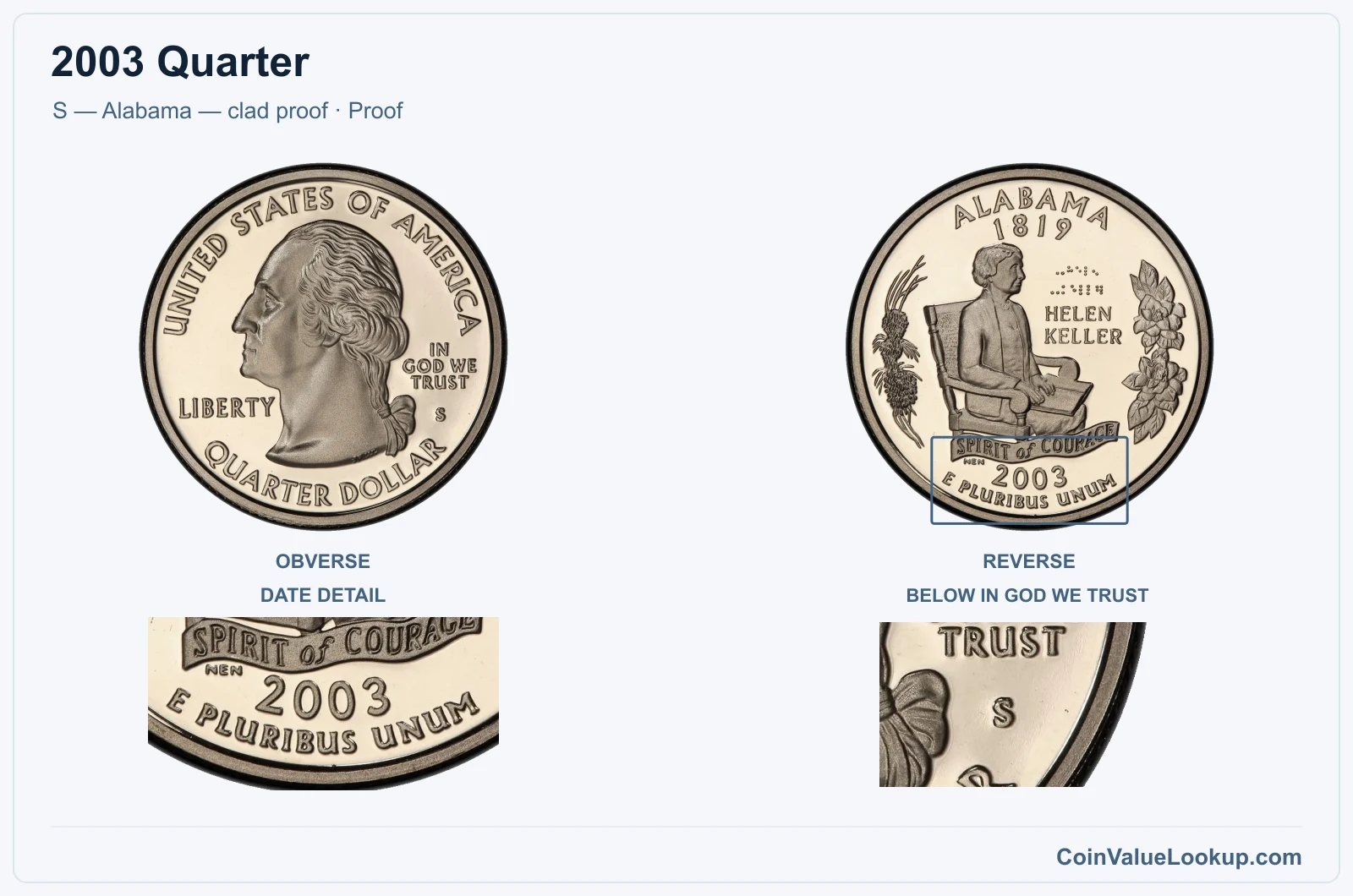
The 2003-S Alabama clad proof is copper-nickel clad despite the S mintmark. Its mirror finish and frosted devices distinguish it from business strikes, but it contains no silver.
Coin Value Lookup is a good place to look up guides for different state quarters if you are sorting through a collection. This version is estimated at about $6.25 in PR65 by USA Coin Book.
Check the edge for layered metal before assuming it is the more valuable silver proof.
Range Grade
Price Auction Records Appraisal PR PR 1
—
Coin Identifier
PR 2
—
Coin Identifier
PR 3
—
Coin Identifier
PR 4
—
Coin Identifier
PR 6
—
Coin Identifier
PR 8
—
Coin Identifier
PR 10
—
Coin Identifier
PR 12
—
Coin Identifier
PR 15
—
Coin Identifier
PR 20
—
Coin Identifier
PR 25
—
Coin Identifier
PR 30
—
Coin Identifier
PR 35
—
Coin Identifier
PR 40
—
Coin Identifier
PR 45
—
Coin Identifier
PR 50
—
Coin Identifier
PR 53
—
Coin Identifier
PR 55
—
Coin Identifier
PR 58
—
Coin Identifier
PR 60
—
Coin Identifier
PR 61
—
Coin Identifier
PR 62
—
Coin Identifier
PR 63
—
Coin Identifier
PR 64
—
Coin Identifier
PR 65
—
Coin Identifier
PR 66
—
Coin Identifier
PR 67
—
Coin Identifier
PR 68
—
Coin Identifier
PR 69
Coin Identifier
PR 70
Coin Identifier
2003 Quarter — S — Alabama — silver proof
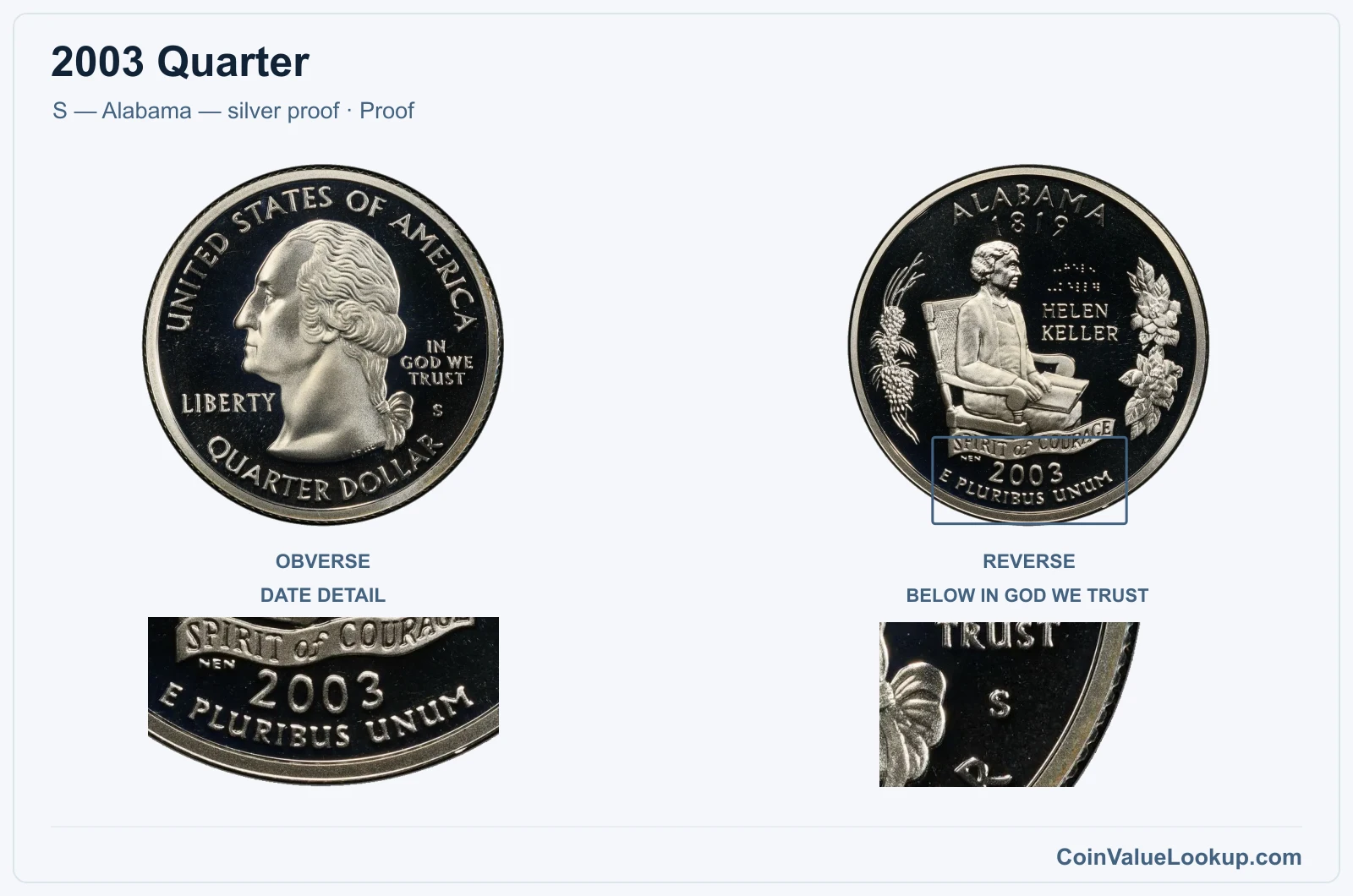
The 2003-S Alabama silver proof is struck in 90% silver and 10% copper, weighing approximately 6.25 g. The edge will show a uniform silver-gray color with no copper band.
USA Coin Book places this at about $23.00 in PR65. These were available only through Silver Proof Sets from the U.S. Mint.
Handling and hairlines matter — even small imperfections on mirror proof fields can reduce the grade. Store these in capsules or the original packaging if possible.
Range Grade
Price Auction Records Appraisal PR PR 1
—
Coin Identifier
PR 2
—
Coin Identifier
PR 3
—
Coin Identifier
PR 4
—
Coin Identifier
PR 6
—
Coin Identifier
PR 8
—
Coin Identifier
PR 10
—
Coin Identifier
PR 12
—
Coin Identifier
PR 15
—
Coin Identifier
PR 20
—
Coin Identifier
PR 25
—
Coin Identifier
PR 30
—
Coin Identifier
PR 35
—
Coin Identifier
PR 40
—
Coin Identifier
PR 45
—
Coin Identifier
PR 50
—
Coin Identifier
PR 53
—
Coin Identifier
PR 55
—
Coin Identifier
PR 58
—
Coin Identifier
PR 60
—
Coin Identifier
PR 61
—
Coin Identifier
PR 62
—
Coin Identifier
PR 63
—
Coin Identifier
PR 64
—
Coin Identifier
PR 65
—
Coin Identifier
PR 66
—
Coin Identifier
PR 67
—
Coin Identifier
PR 68
—
Coin Identifier
PR 69
Coin Identifier
PR 70
Coin Identifier
2003 Quarter — P — Maine — regular strike
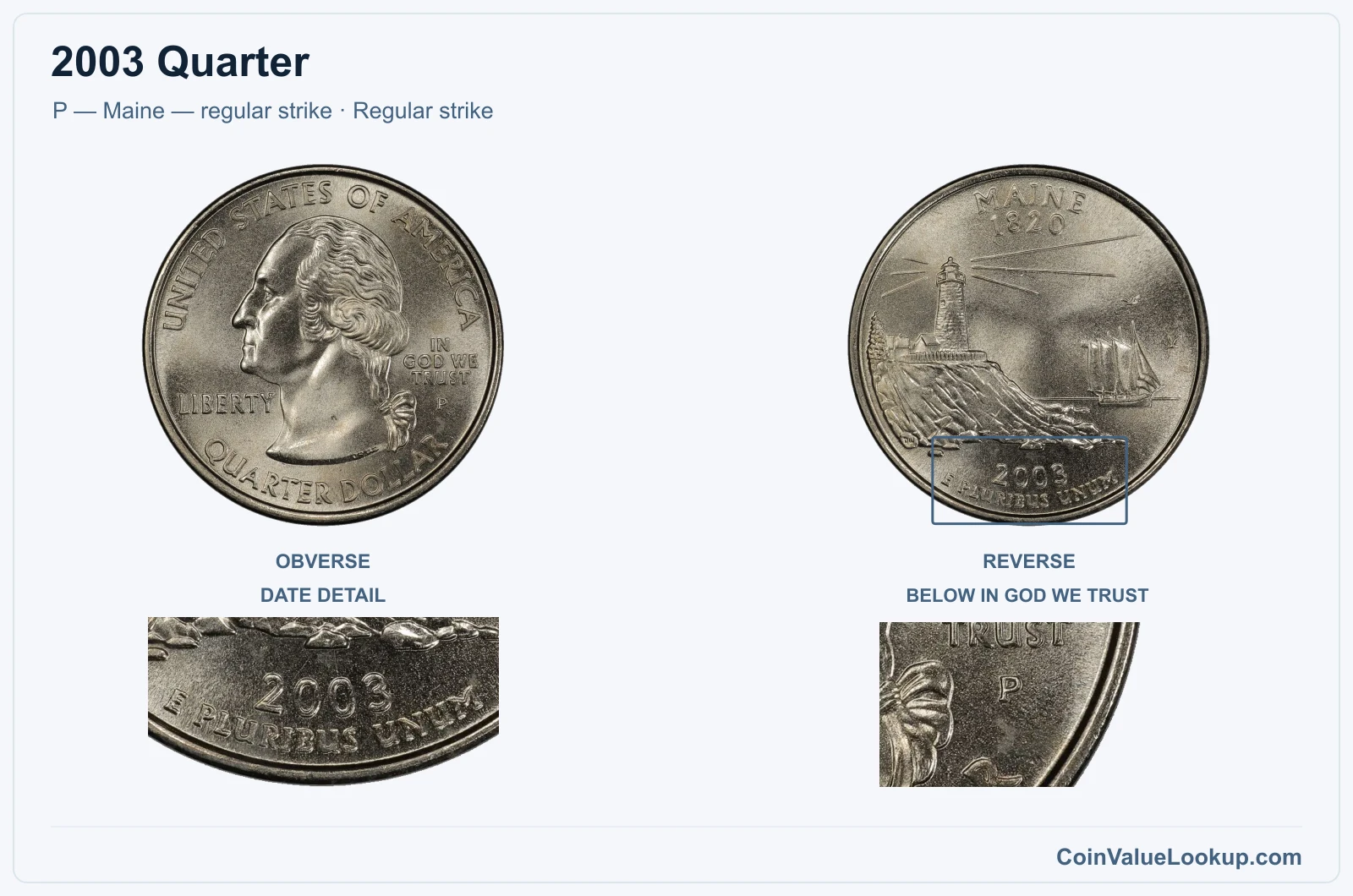
Philadelphia produced the 2003-P Maine quarter in copper-nickel clad. The reverse features Maine's state design, and the P mintmark appears on the obverse near Washington's hair.
Circulated examples are worth face value. USA Coin Book guides this at about $0.74 in MS60 and $1.88 in MS65.
If the coin has been sitting in a roll untouched since 2003, check for original mint luster and clean surfaces before assigning a grade.
Range Grade
Price Auction Records Appraisal PO PO 1
—
Coin Identifier FR FR 2
—
Coin Identifier AG AG 3
—
Coin Identifier G G 4
—
Coin Identifier
G 6
—
Coin Identifier VG VG 8
—
Coin Identifier
VG 10
—
Coin Identifier F F 12
—
Coin Identifier
F 15
—
Coin Identifier VF VF 20
—
Coin Identifier
VF 25
—
Coin Identifier
VF 30
—
Coin Identifier
VF 35
—
Coin Identifier XF XF 40
—
Coin Identifier
XF 45
—
Coin Identifier AU AU 50
—
Coin Identifier
AU 53
—
Coin Identifier
AU 55
—
Coin Identifier
AU 58
—
Coin Identifier MS MS 60
—
Coin Identifier
MS 61
—
Coin Identifier
MS 62
—
Coin Identifier
MS 63
—
Coin Identifier
MS 64
—
Coin Identifier
MS 65
—
Coin Identifier
MS 66
Coin Identifier
MS 67
Coin Identifier
MS 68
Coin Identifier
MS 69
—
—
—
MS 70
—
—
—
2003 Quarter — D — Maine — regular strike
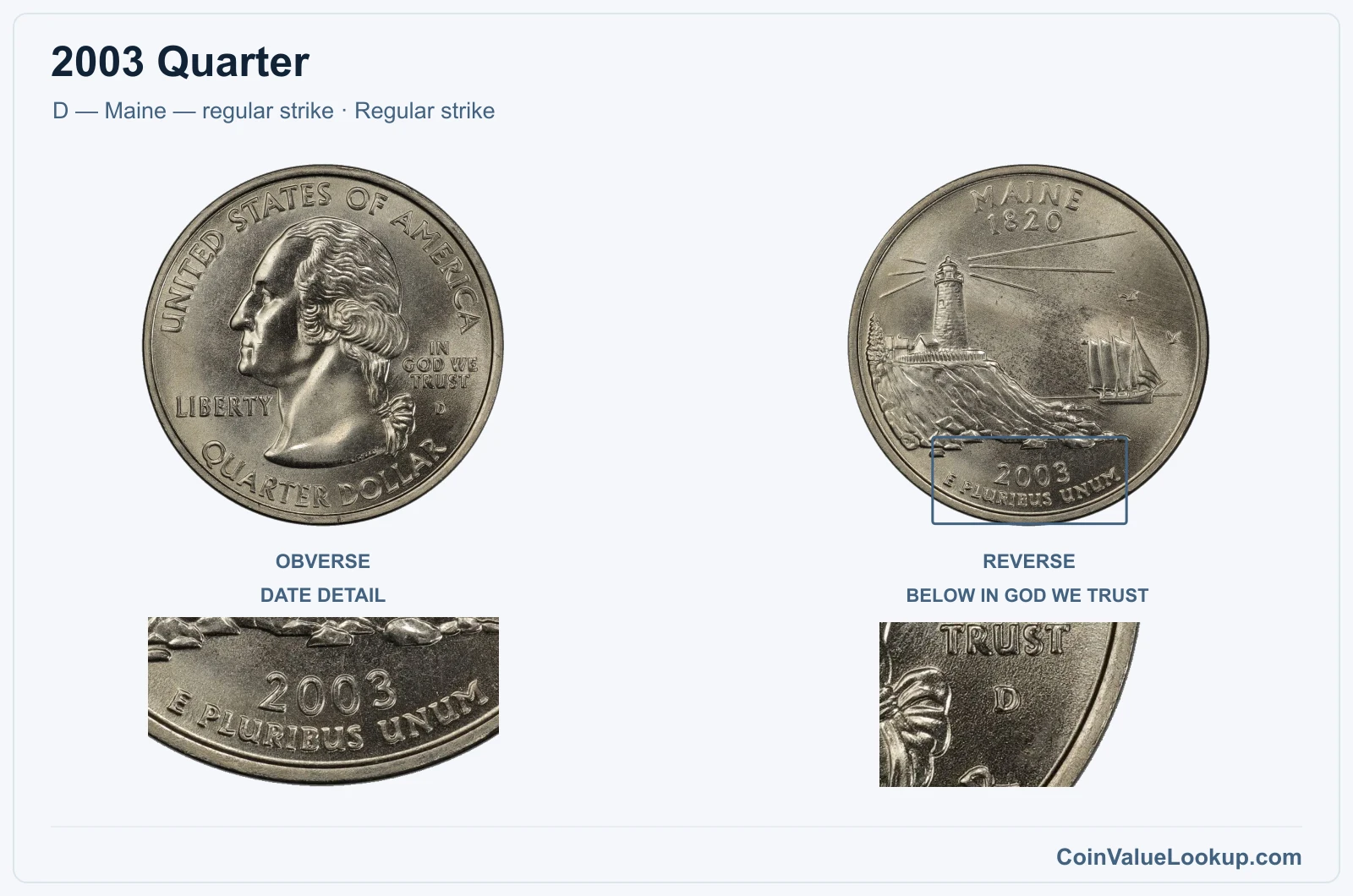
The 2003-D Maine quarter is the Denver counterpart, identical in composition and dimensions to the P-mint issue. Only the D mintmark distinguishes it.
Guide estimates from USA Coin Book run about $0.74 at MS60 and $1.88 at MS65. Like all business-strike state quarters, worn pieces are common and circulate at twenty-five cents.
Original rolls or mint sets are the usual source of higher-grade examples.
Range Grade
Price Auction Records Appraisal PO PO 1
—
Coin Identifier FR FR 2
—
Coin Identifier AG AG 3
—
Coin Identifier G G 4
—
Coin Identifier
G 6
—
Coin Identifier VG VG 8
—
Coin Identifier
VG 10
—
Coin Identifier F F 12
—
Coin Identifier
F 15
—
Coin Identifier VF VF 20
—
Coin Identifier
VF 25
—
Coin Identifier
VF 30
—
Coin Identifier
VF 35
—
Coin Identifier XF XF 40
—
Coin Identifier
XF 45
—
Coin Identifier AU AU 50
—
Coin Identifier
AU 53
—
Coin Identifier
AU 55
—
Coin Identifier
AU 58
—
Coin Identifier MS MS 60
—
Coin Identifier
MS 61
—
Coin Identifier
MS 62
—
Coin Identifier
MS 63
—
Coin Identifier
MS 64
—
Coin Identifier
MS 65
—
Coin Identifier
MS 66
—
Coin Identifier
MS 67
Coin Identifier
MS 68
Coin Identifier
MS 69
—
—
—
MS 70
—
—
—
2003 Quarter — S — Maine — clad proof
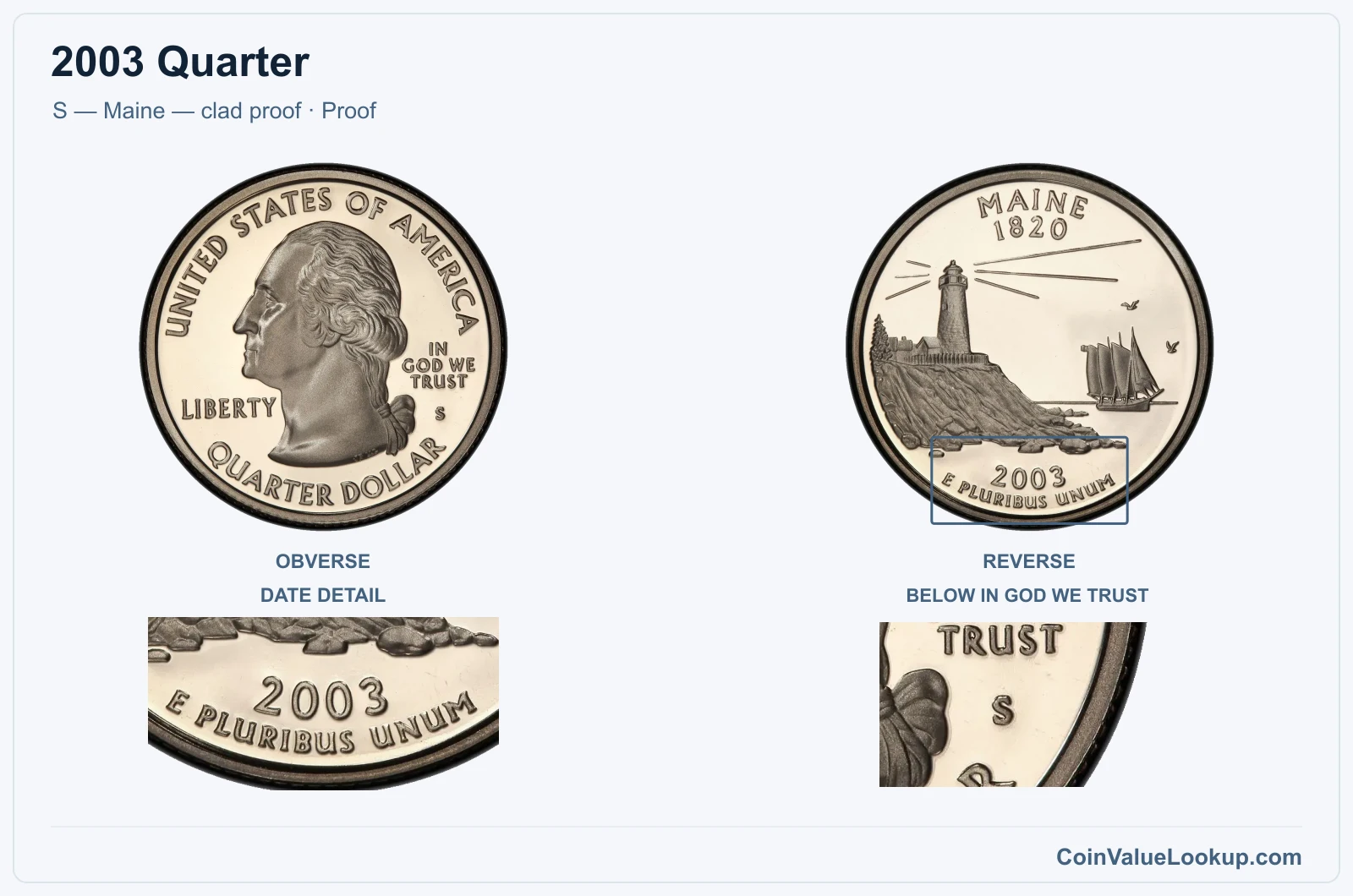
San Francisco struck the 2003-S Maine clad proof for inclusion in annual proof sets. It is copper-nickel clad, not silver.
The mirror fields and frosted relief set it apart visually from business strikes.
USA Coin Book estimates about $6.25 in PR65. Confirm the clad composition by examining the edge for a visible copper-nickel sandwich line.
Hairlines across the fields are the most common grade-reducing flaw on proofs like this.
Range Grade
Price Auction Records Appraisal PR PR 1
—
Coin Identifier
PR 2
—
Coin Identifier
PR 3
—
Coin Identifier
PR 4
—
Coin Identifier
PR 6
—
Coin Identifier
PR 8
—
Coin Identifier
PR 10
—
Coin Identifier
PR 12
—
Coin Identifier
PR 15
—
Coin Identifier
PR 20
—
Coin Identifier
PR 25
—
Coin Identifier
PR 30
—
Coin Identifier
PR 35
—
Coin Identifier
PR 40
—
Coin Identifier
PR 45
—
Coin Identifier
PR 50
—
Coin Identifier
PR 53
—
Coin Identifier
PR 55
—
Coin Identifier
PR 58
—
Coin Identifier
PR 60
—
Coin Identifier
PR 61
—
Coin Identifier
PR 62
—
Coin Identifier
PR 63
—
Coin Identifier
PR 64
—
Coin Identifier
PR 65
—
Coin Identifier
PR 66
—
Coin Identifier
PR 67
—
Coin Identifier
PR 68
—
Coin Identifier
PR 69
Coin Identifier
PR 70
Coin Identifier
2003 Quarter — S — Maine — silver proof
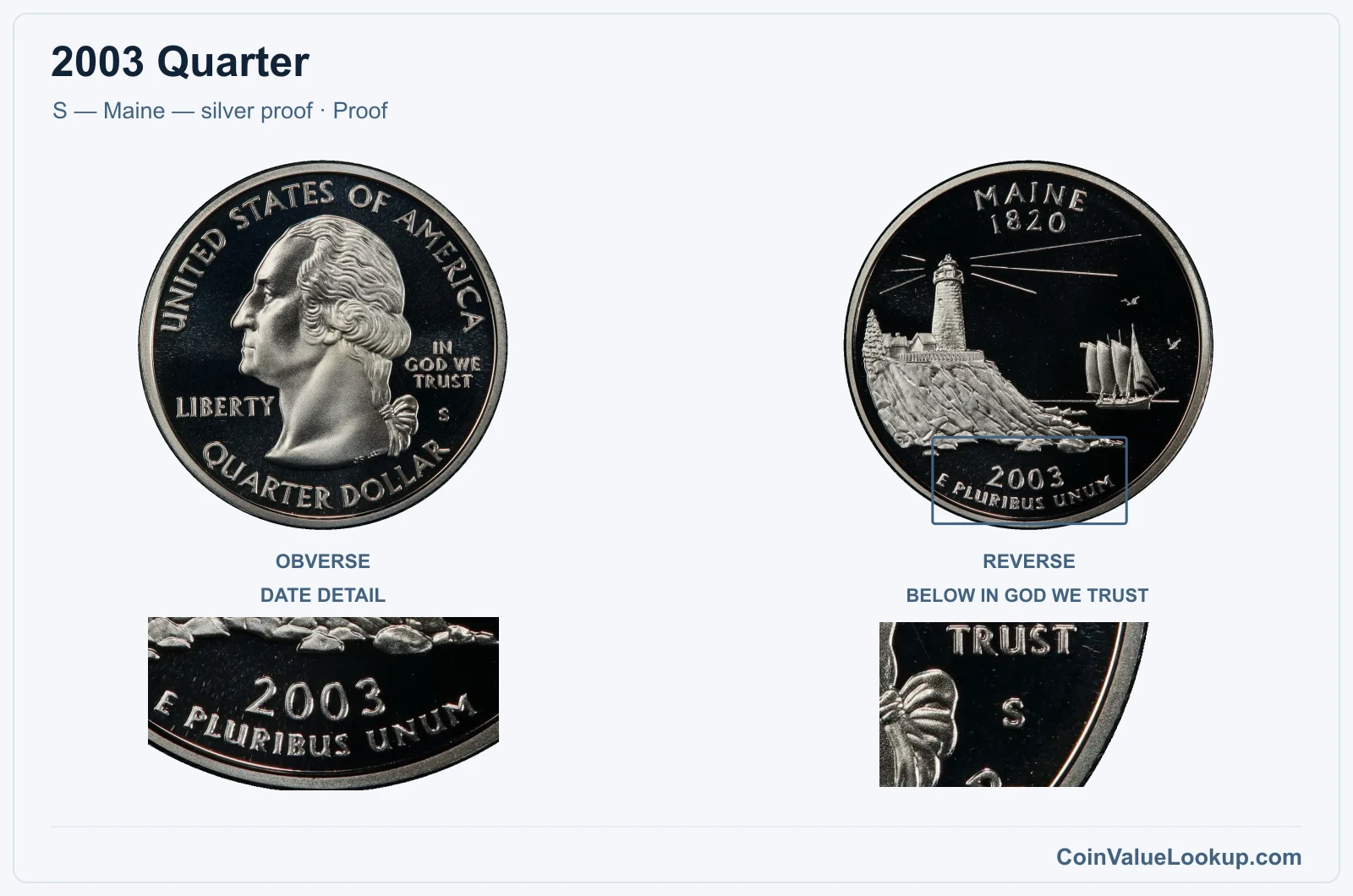
The 2003-S Maine silver proof is composed of 90% silver and weighs about 6.25 g. Its edge is solid silver-gray.
These were sold in Silver Proof Sets and are the most sought-after Maine quarter version.
USA Coin Book estimates about $23.00 in PR65. Silver proofs from this era are still relatively affordable, but condition matters.
Check for haze, fingerprints and hairlines under a single directed light before grading.
Range Grade
Price Auction Records Appraisal PR PR 1
—
Coin Identifier
PR 2
—
Coin Identifier
PR 3
—
Coin Identifier
PR 4
—
Coin Identifier
PR 6
—
Coin Identifier
PR 8
—
Coin Identifier
PR 10
—
Coin Identifier
PR 12
—
Coin Identifier
PR 15
—
Coin Identifier
PR 20
—
Coin Identifier
PR 25
—
Coin Identifier
PR 30
—
Coin Identifier
PR 35
—
Coin Identifier
PR 40
—
Coin Identifier
PR 45
—
Coin Identifier
PR 50
—
Coin Identifier
PR 53
—
Coin Identifier
PR 55
—
Coin Identifier
PR 58
—
Coin Identifier
PR 60
—
Coin Identifier
PR 61
—
Coin Identifier
PR 62
—
Coin Identifier
PR 63
—
Coin Identifier
PR 64
—
Coin Identifier
PR 65
—
Coin Identifier
PR 66
—
Coin Identifier
PR 67
—
Coin Identifier
PR 68
—
Coin Identifier
PR 69
Coin Identifier
PR 70
Coin Identifier
2003 Quarter — P — Missouri — regular strike
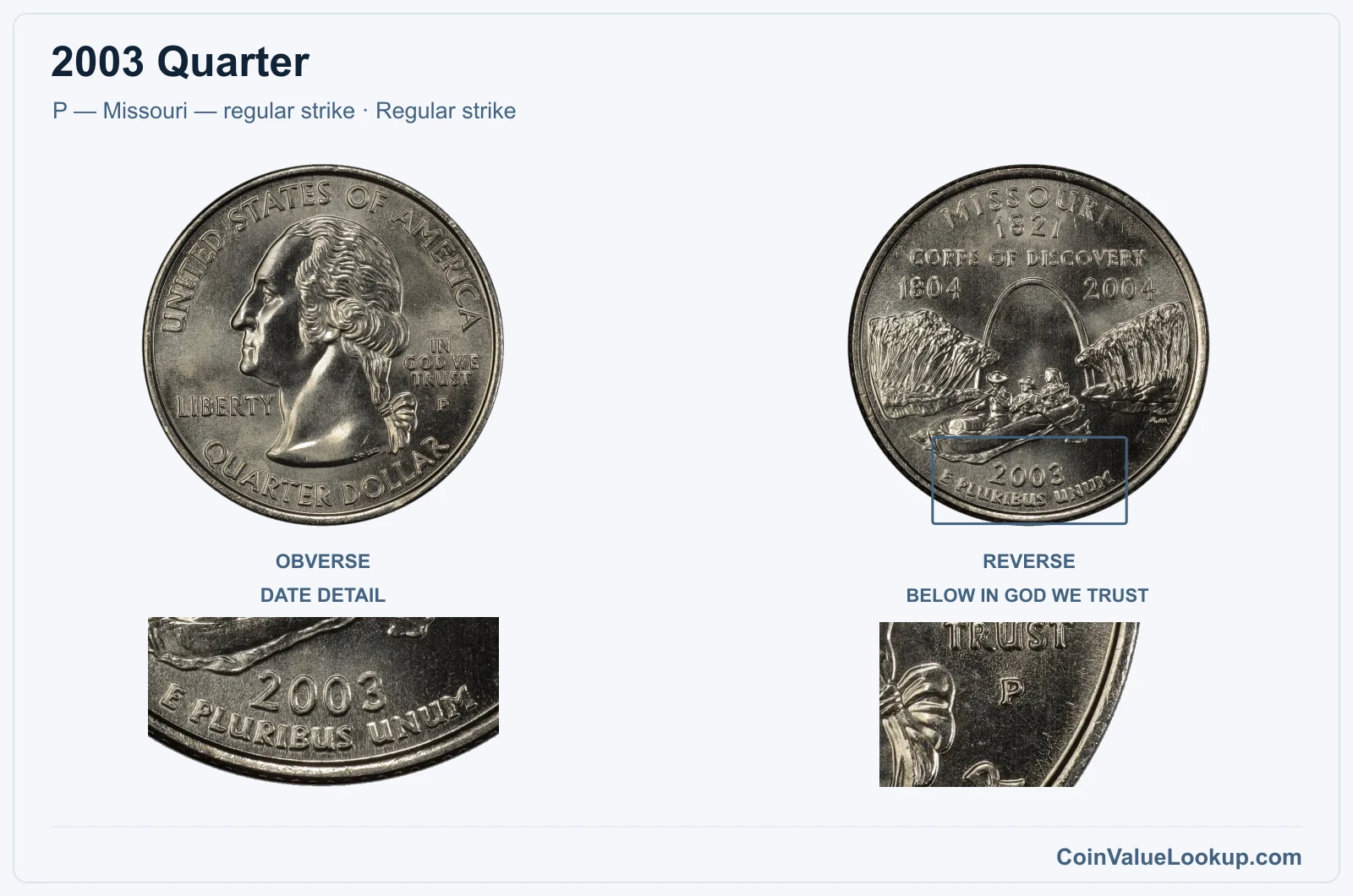
The 2003-P Missouri quarter is a copper-nickel clad business strike from Philadelphia. Standard dimensions apply: 24.26 mm diameter, roughly 5.67 g.
Worn coins are worth face value. USA Coin Book guides an MS60 at about $0.74 and an MS65 at about $1.88.
If you pulled this from change, odds are it has enough wear to sit below collectible thresholds. Check the high points on both sides and the overall luster.
Range Grade
Price Auction Records Appraisal PO PO 1
—
Coin Identifier FR FR 2
—
Coin Identifier AG AG 3
—
Coin Identifier G G 4
—
Coin Identifier
G 6
—
Coin Identifier VG VG 8
—
Coin Identifier
VG 10
—
Coin Identifier F F 12
—
Coin Identifier
F 15
—
Coin Identifier VF VF 20
—
Coin Identifier
VF 25
—
Coin Identifier
VF 30
—
Coin Identifier
VF 35
—
Coin Identifier XF XF 40
—
Coin Identifier
XF 45
—
Coin Identifier AU AU 50
—
Coin Identifier
AU 53
—
Coin Identifier
AU 55
—
Coin Identifier
AU 58
—
Coin Identifier MS MS 60
—
Coin Identifier
MS 61
—
Coin Identifier
MS 62
—
Coin Identifier
MS 63
—
Coin Identifier
MS 64
—
Coin Identifier
MS 65
Coin Identifier
MS 66
—
Coin Identifier
MS 67
Coin Identifier
MS 68
Coin Identifier
MS 69
—
—
—
MS 70
—
—
—
2003 Quarter — D — Missouri — regular strike
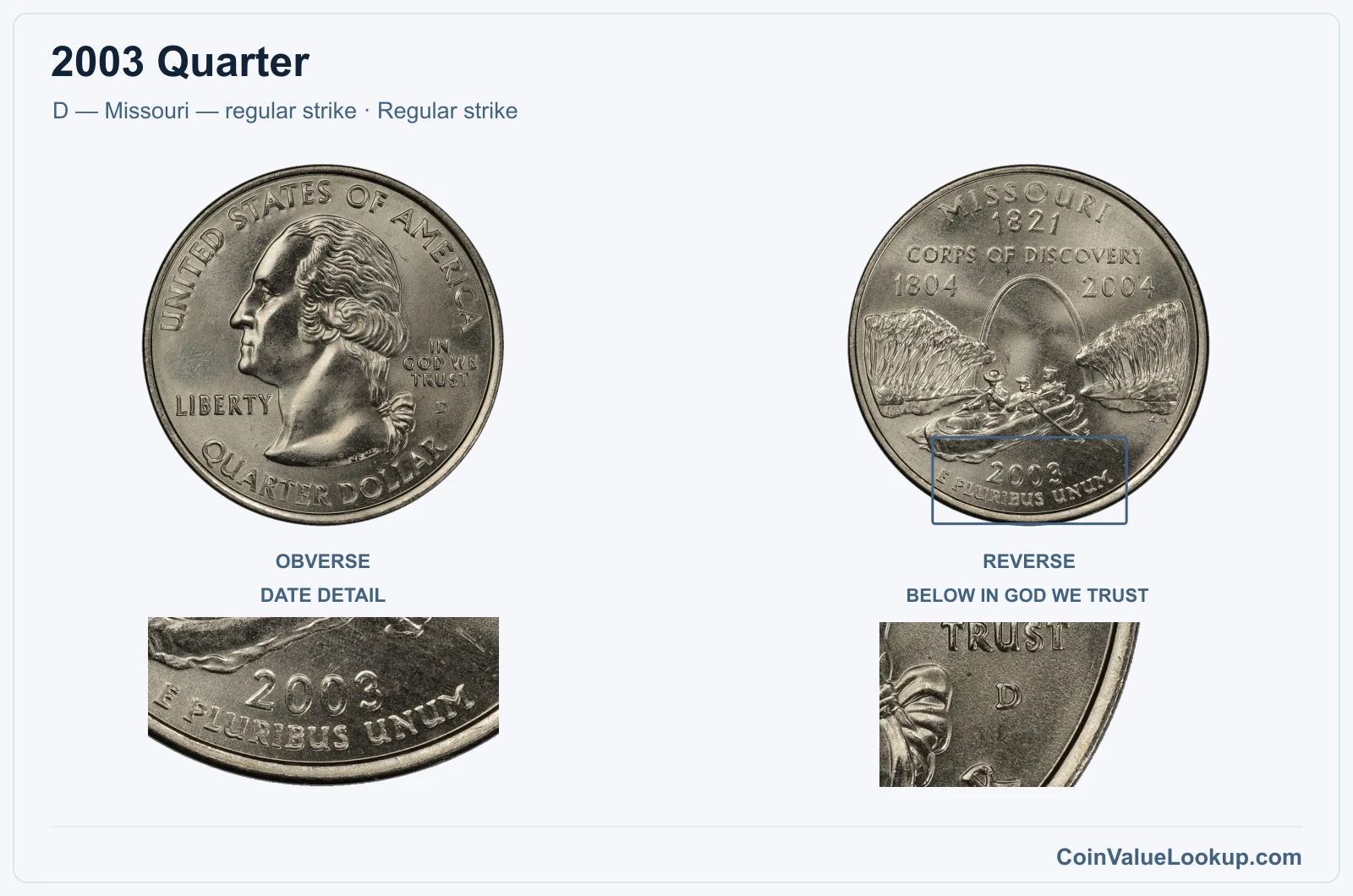
Denver's 2003-D Missouri quarter is the same copper-nickel clad composition, distinguished by the D mintmark. Circulated examples are extremely common.
USA Coin Book guides this at about $0.74 in MS60 and $1.88 in MS65. Original mint-set examples tend to grade highest since they avoided the coin-counting machines.
As with all business strikes from this year, any sign of circulation drops the value to face.
Range Grade
Price Auction Records Appraisal PO PO 1
—
Coin Identifier FR FR 2
—
Coin Identifier AG AG 3
—
Coin Identifier G G 4
—
Coin Identifier
G 6
—
Coin Identifier VG VG 8
—
Coin Identifier
VG 10
—
Coin Identifier F F 12
—
Coin Identifier
F 15
—
Coin Identifier VF VF 20
—
Coin Identifier
VF 25
—
Coin Identifier
VF 30
—
Coin Identifier
VF 35
—
Coin Identifier XF XF 40
—
Coin Identifier
XF 45
—
Coin Identifier AU AU 50
—
Coin Identifier
AU 53
—
Coin Identifier
AU 55
—
Coin Identifier
AU 58
—
Coin Identifier MS MS 60
—
Coin Identifier
MS 61
—
Coin Identifier
MS 62
—
Coin Identifier
MS 63
—
Coin Identifier
MS 64
—
Coin Identifier
MS 65
—
Coin Identifier
MS 66
—
Coin Identifier
MS 67
Coin Identifier
MS 68
Coin Identifier
MS 69
—
—
—
MS 70
—
—
—
2003 Quarter — S — Missouri — clad proof
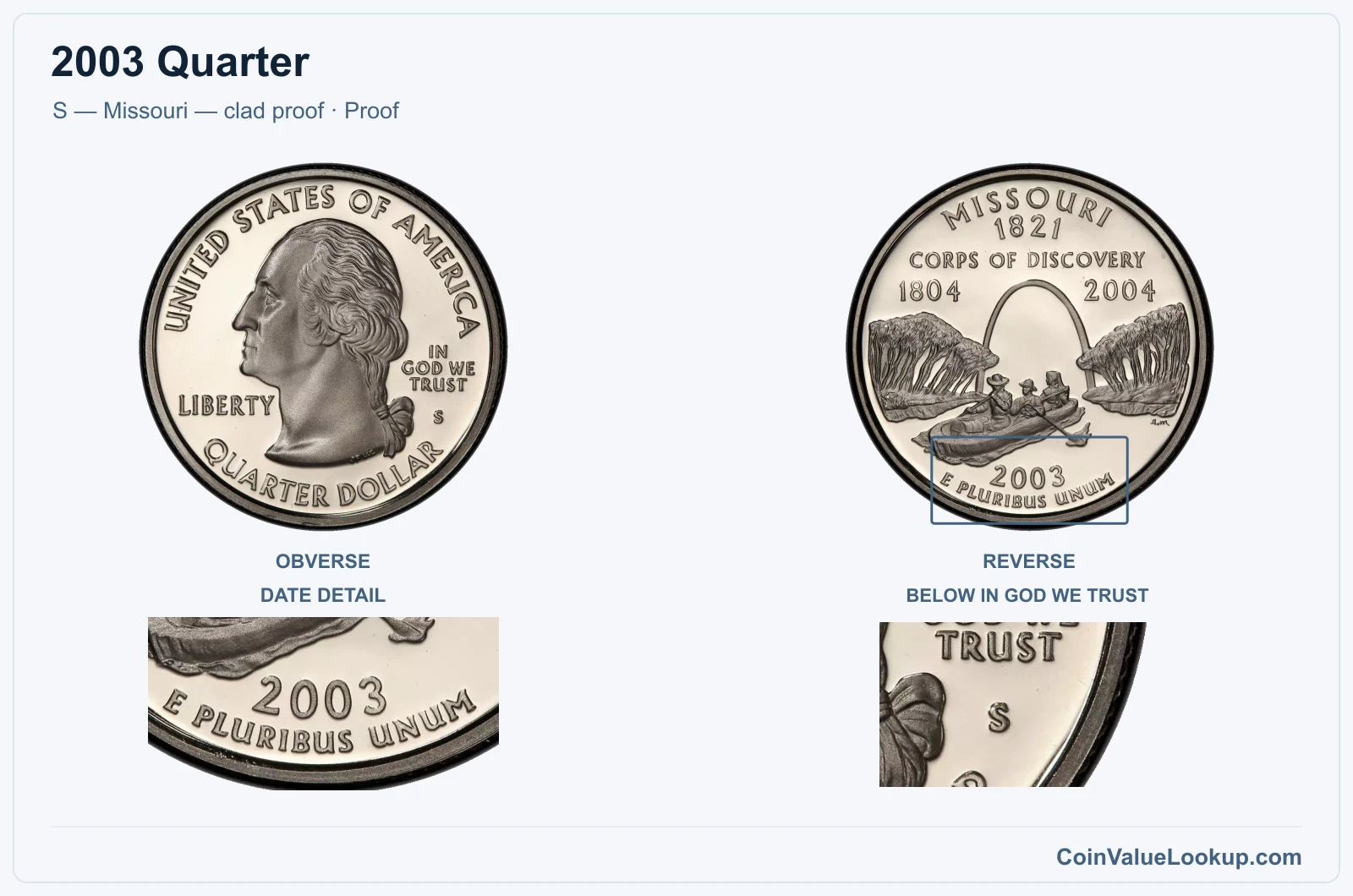
The 2003-S Missouri clad proof carries the S mintmark and was included in standard proof sets. Composition is copper-nickel clad — verify by checking the edge for layered metal.
USA Coin Book estimates about $6.25 in PR65. The reflective fields should look like dark mirrors under a single light.
Any light scuffing across the proof surfaces will show up easily and reduce the grade, so handle by the edges only.
Range Grade
Price Auction Records Appraisal PR PR 1
—
Coin Identifier
PR 2
—
Coin Identifier
PR 3
—
Coin Identifier
PR 4
—
Coin Identifier
PR 6
—
Coin Identifier
PR 8
—
Coin Identifier
PR 10
—
Coin Identifier
PR 12
—
Coin Identifier
PR 15
—
Coin Identifier
PR 20
—
Coin Identifier
PR 25
—
Coin Identifier
PR 30
—
Coin Identifier
PR 35
—
Coin Identifier
PR 40
—
Coin Identifier
PR 45
—
Coin Identifier
PR 50
—
Coin Identifier
PR 53
—
Coin Identifier
PR 55
—
Coin Identifier
PR 58
—
Coin Identifier
PR 60
—
Coin Identifier
PR 61
—
Coin Identifier
PR 62
—
Coin Identifier
PR 63
—
Coin Identifier
PR 64
—
Coin Identifier
PR 65
—
Coin Identifier
PR 66
—
Coin Identifier
PR 67
—
Coin Identifier
PR 68
—
Coin Identifier
PR 69
Coin Identifier
PR 70
Coin Identifier
2003 Quarter — S — Missouri — silver proof
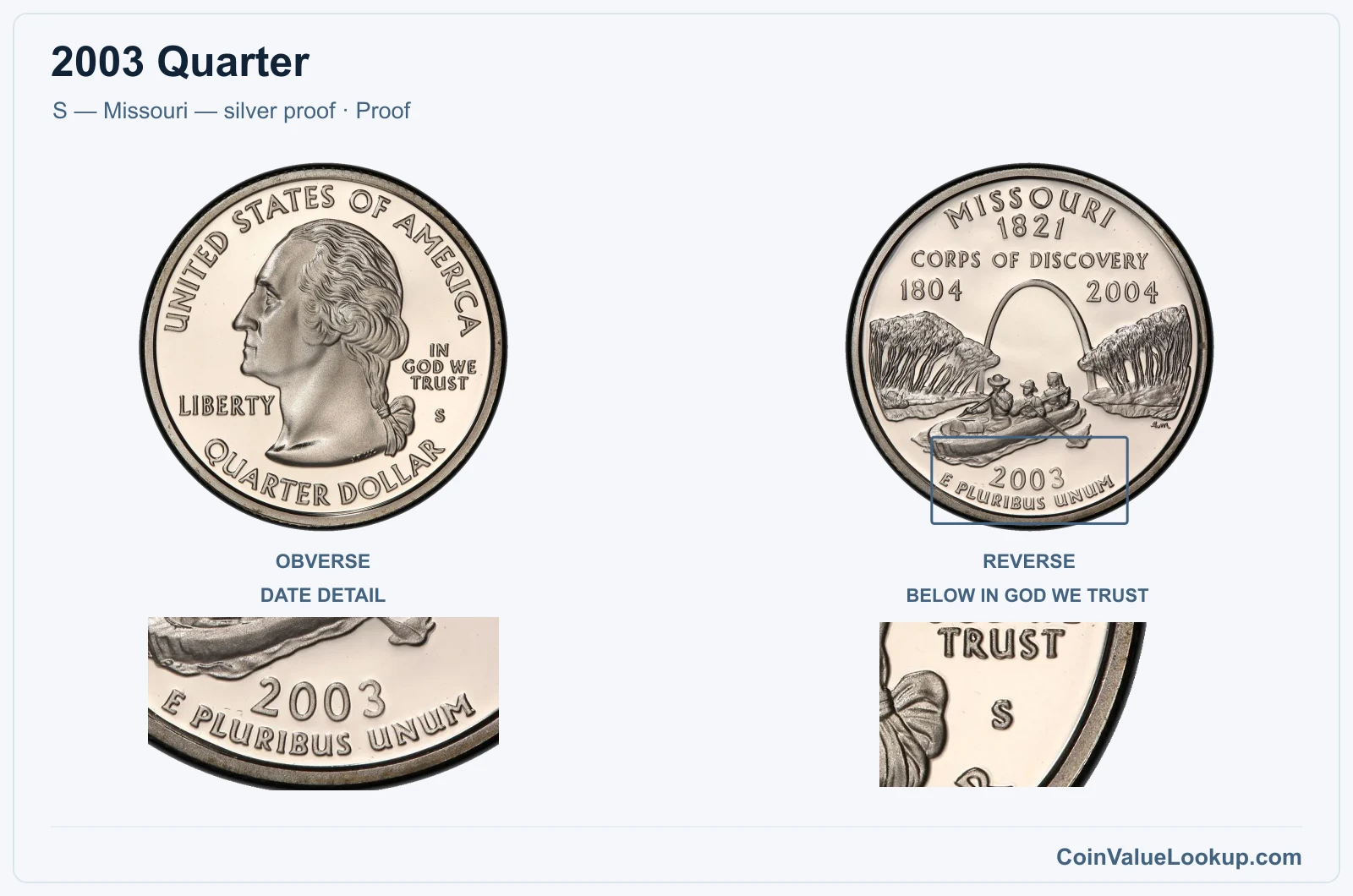
This is the 2003-S Missouri silver proof. At 90% silver and approximately 6.25 g, it is heavier than a clad proof and shows a uniform gray edge.
USA Coin Book guides this version at about $23.00 in PR65.
Silver proofs from the 50 States series are popular with type collectors. The combination of precious-metal content and limited collector-set distribution supports the premium over clad proofs.
As always, grade depends on surface preservation, not just composition.
Range Grade
Price Auction Records Appraisal PR PR 1
—
Coin Identifier
PR 2
—
Coin Identifier
PR 3
—
Coin Identifier
PR 4
—
Coin Identifier
PR 6
—
Coin Identifier
PR 8
—
Coin Identifier
PR 10
—
Coin Identifier
PR 12
—
Coin Identifier
PR 15
—
Coin Identifier
PR 20
—
Coin Identifier
PR 25
—
Coin Identifier
PR 30
—
Coin Identifier
PR 35
—
Coin Identifier
PR 40
—
Coin Identifier
PR 45
—
Coin Identifier
PR 50
—
Coin Identifier
PR 53
—
Coin Identifier
PR 55
—
Coin Identifier
PR 58
—
Coin Identifier
PR 60
—
Coin Identifier
PR 61
—
Coin Identifier
PR 62
—
Coin Identifier
PR 63
—
Coin Identifier
PR 64
—
Coin Identifier
PR 65
—
Coin Identifier
PR 66
—
Coin Identifier
PR 67
—
Coin Identifier
PR 68
—
Coin Identifier
PR 69
Coin Identifier
PR 70
Coin Identifier
2003 Quarter — P — Arkansas — regular strike
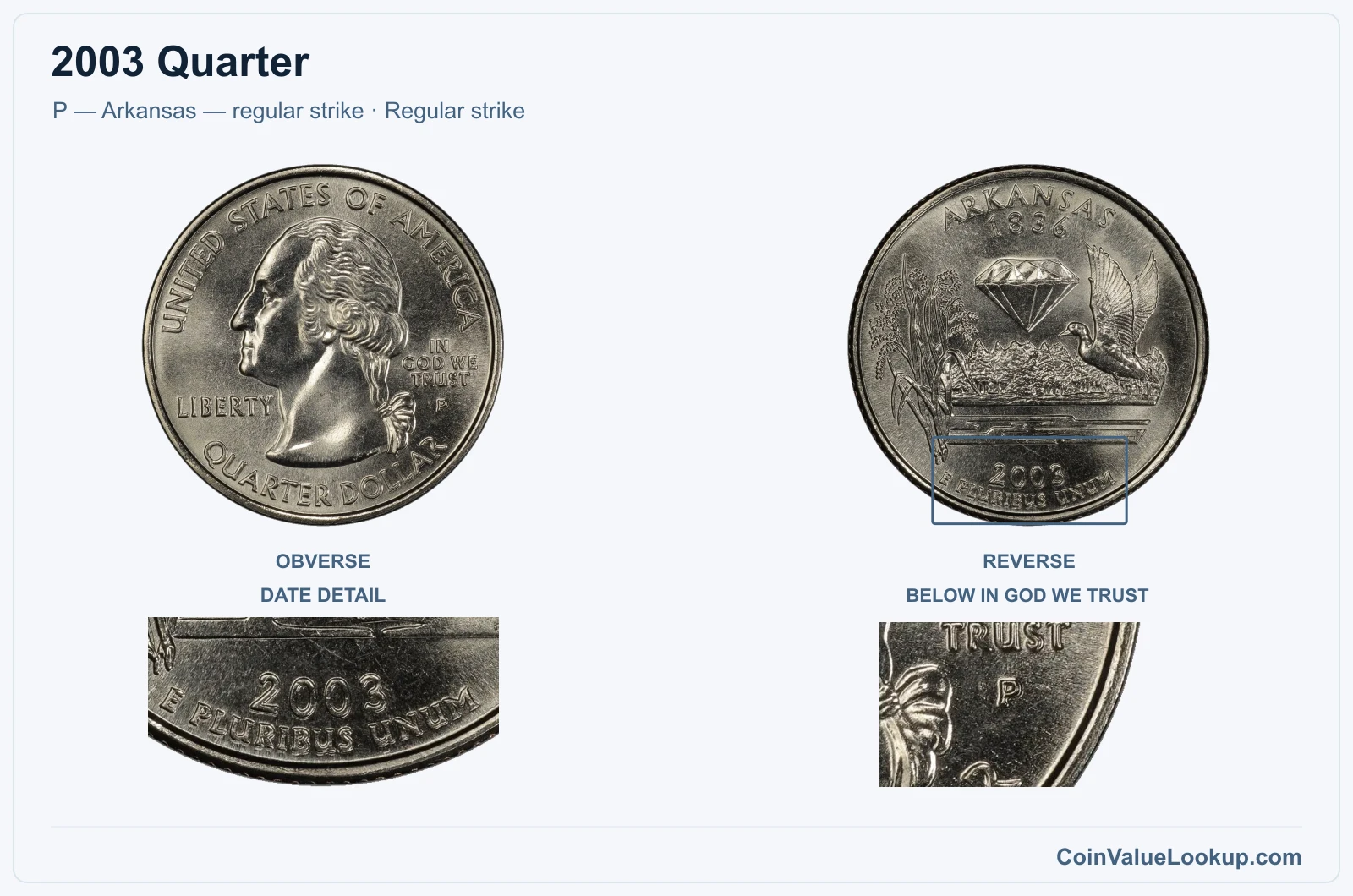
Philadelphia struck the 2003-P Arkansas quarter in copper-nickel clad. The Arkansas reverse design and P mintmark identify this version.
Circulated pieces are worth face value.
In uncirculated condition, USA Coin Book estimates about $0.74 at MS60 and $1.88 at MS65. These are easy to find in rolls and mint sets.
High-grade examples need clean fields and strong luster to earn a meaningful premium.
Range Grade
Price Auction Records Appraisal PO PO 1
—
Coin Identifier FR FR 2
—
Coin Identifier AG AG 3
—
Coin Identifier G G 4
—
Coin Identifier
G 6
—
Coin Identifier VG VG 8
—
Coin Identifier
VG 10
—
Coin Identifier F F 12
—
Coin Identifier
F 15
—
Coin Identifier VF VF 20
—
Coin Identifier
VF 25
—
Coin Identifier
VF 30
—
Coin Identifier
VF 35
—
Coin Identifier XF XF 40
—
Coin Identifier
XF 45
—
Coin Identifier AU AU 50
—
Coin Identifier
AU 53
—
Coin Identifier
AU 55
—
Coin Identifier
AU 58
—
Coin Identifier MS MS 60
—
Coin Identifier
MS 61
—
Coin Identifier
MS 62
—
Coin Identifier
MS 63
—
Coin Identifier
MS 64
Coin Identifier
MS 65
—
Coin Identifier
MS 66
—
Coin Identifier
MS 67
Coin Identifier
MS 68
Coin Identifier
MS 69
—
—
—
MS 70
—
—
—
2003 Quarter — D — Arkansas — regular strike
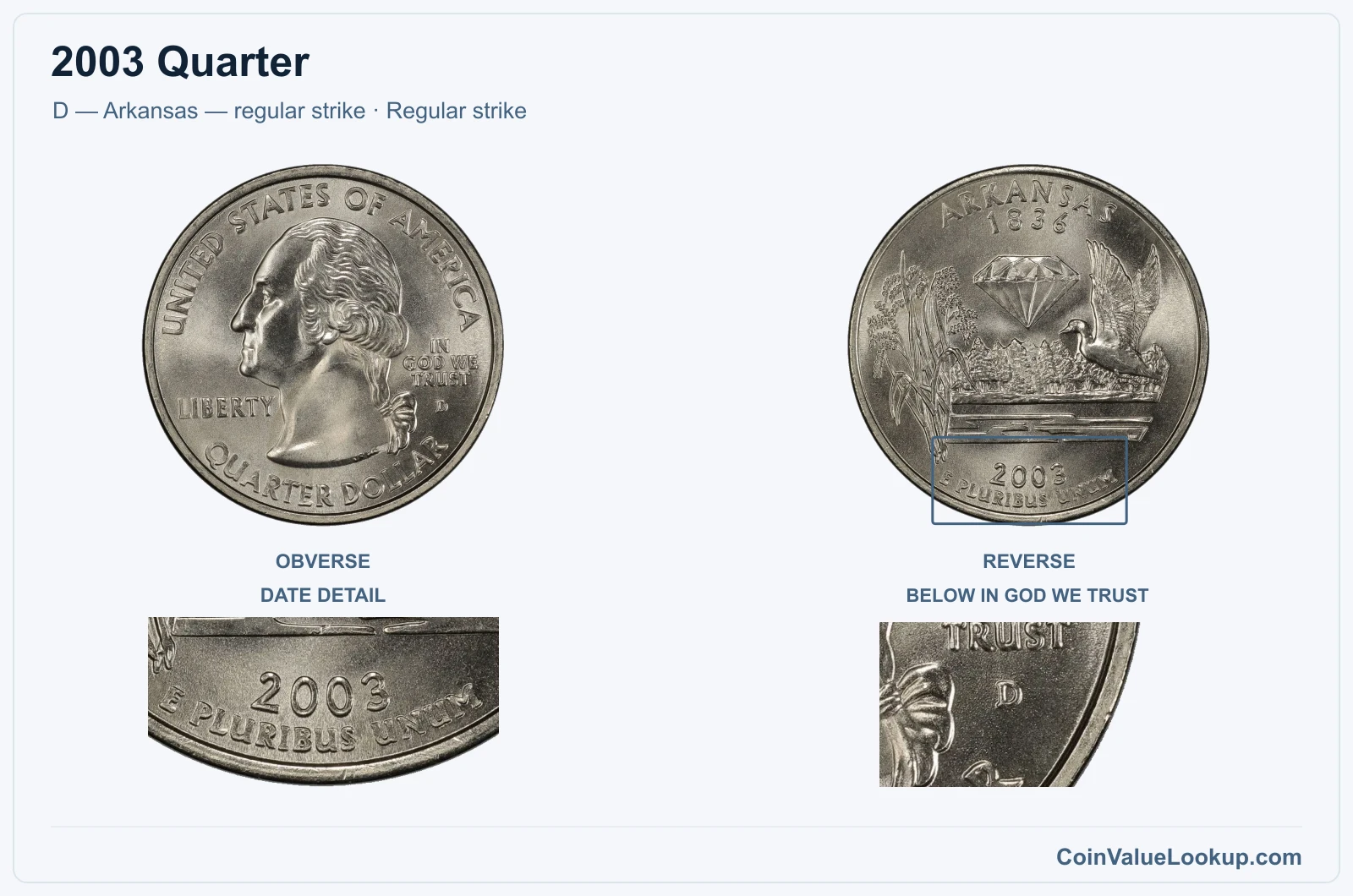
The 2003-D Arkansas quarter shares the same copper-nickel clad makeup as the P-mint, with a D mintmark on the obverse. Worn examples circulate at twenty-five cents.
USA Coin Book guides about $0.74 at MS60 and $1.88 at MS65. Denver and Philadelphia business strikes from 2003 trade at very similar levels.
Sorting for quality in original rolls is the usual path to a collectible grade.
Range Grade
Price Auction Records Appraisal PO PO 1
—
Coin Identifier FR FR 2
—
Coin Identifier AG AG 3
—
Coin Identifier G G 4
—
Coin Identifier
G 6
—
Coin Identifier VG VG 8
—
Coin Identifier
VG 10
—
Coin Identifier F F 12
—
Coin Identifier
F 15
—
Coin Identifier VF VF 20
—
Coin Identifier
VF 25
—
Coin Identifier
VF 30
—
Coin Identifier
VF 35
—
Coin Identifier XF XF 40
—
Coin Identifier
XF 45
—
Coin Identifier AU AU 50
—
Coin Identifier
AU 53
—
Coin Identifier
AU 55
—
Coin Identifier
AU 58
—
Coin Identifier MS MS 60
—
Coin Identifier
MS 61
—
Coin Identifier
MS 62
—
Coin Identifier
MS 63
—
Coin Identifier
MS 64
—
Coin Identifier
MS 65
—
Coin Identifier
MS 66
—
Coin Identifier
MS 67
Coin Identifier
MS 68
Coin Identifier
MS 69
—
—
—
MS 70
—
—
—
2003 Quarter — S — Arkansas — clad proof
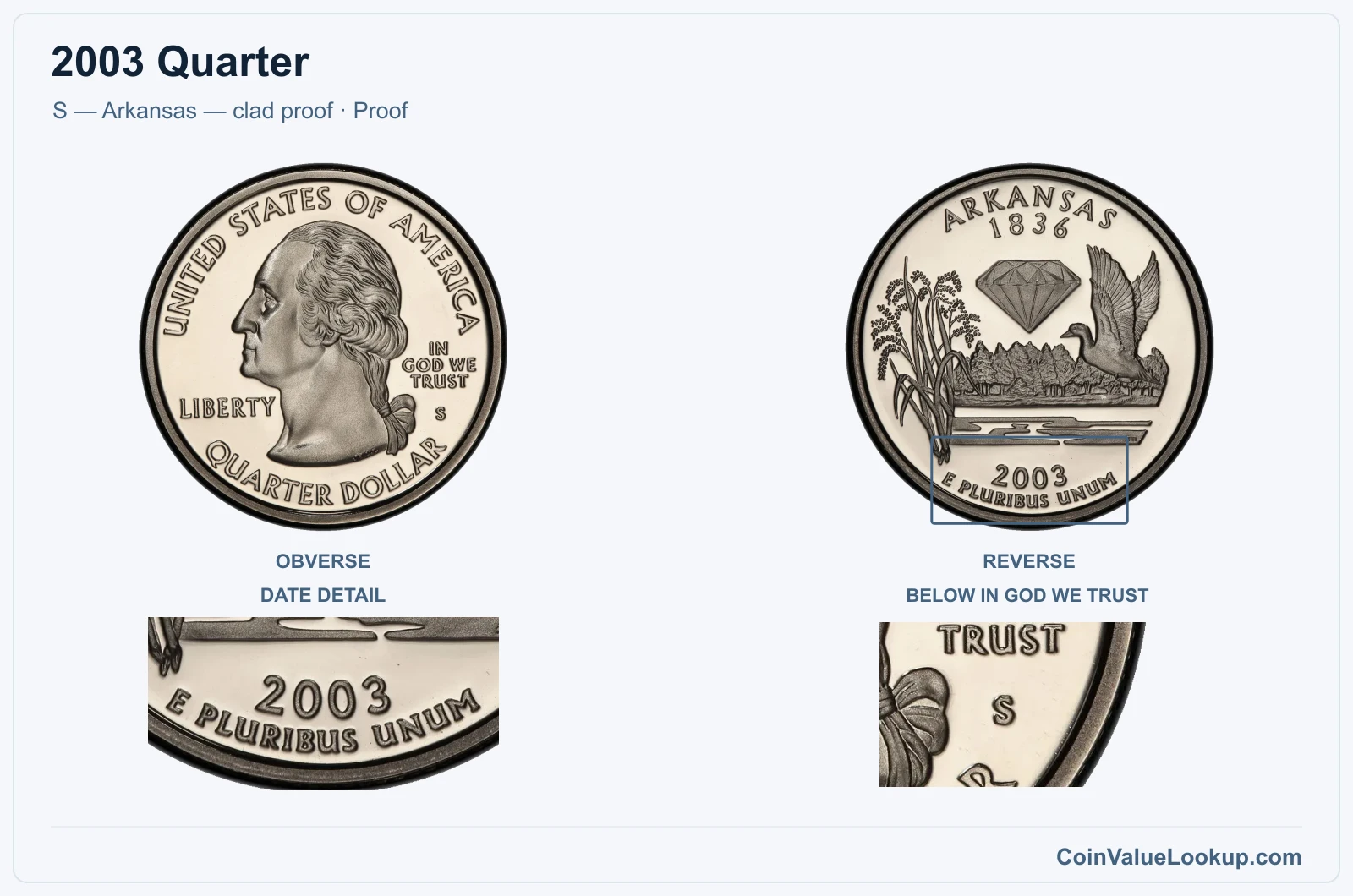
San Francisco struck the 2003-S Arkansas clad proof for annual proof sets. It is copper-nickel clad, confirmed by the visible layering on the edge.
Mirror fields and frosted devices give it the classic proof look.
USA Coin Book estimates about $6.25 in PR65. This is a collectible version even though it contains no silver.
Handle only by the edges and store in a capsule to preserve the proof surfaces.
Range Grade
Price Auction Records Appraisal PR PR 1
—
Coin Identifier
PR 2
—
Coin Identifier
PR 3
—
Coin Identifier
PR 4
—
Coin Identifier
PR 6
—
Coin Identifier
PR 8
—
Coin Identifier
PR 10
—
Coin Identifier
PR 12
—
Coin Identifier
PR 15
—
Coin Identifier
PR 20
—
Coin Identifier
PR 25
—
Coin Identifier
PR 30
—
Coin Identifier
PR 35
—
Coin Identifier
PR 40
—
Coin Identifier
PR 45
—
Coin Identifier
PR 50
—
Coin Identifier
PR 53
—
Coin Identifier
PR 55
—
Coin Identifier
PR 58
—
Coin Identifier
PR 60
—
Coin Identifier
PR 61
—
Coin Identifier
PR 62
—
Coin Identifier
PR 63
—
Coin Identifier
PR 64
—
Coin Identifier
PR 65
—
Coin Identifier
PR 66
—
Coin Identifier
PR 67
—
Coin Identifier
PR 68
Coin Identifier
PR 69
Coin Identifier
PR 70
Coin Identifier
2003 Quarter — S — Arkansas — silver proof
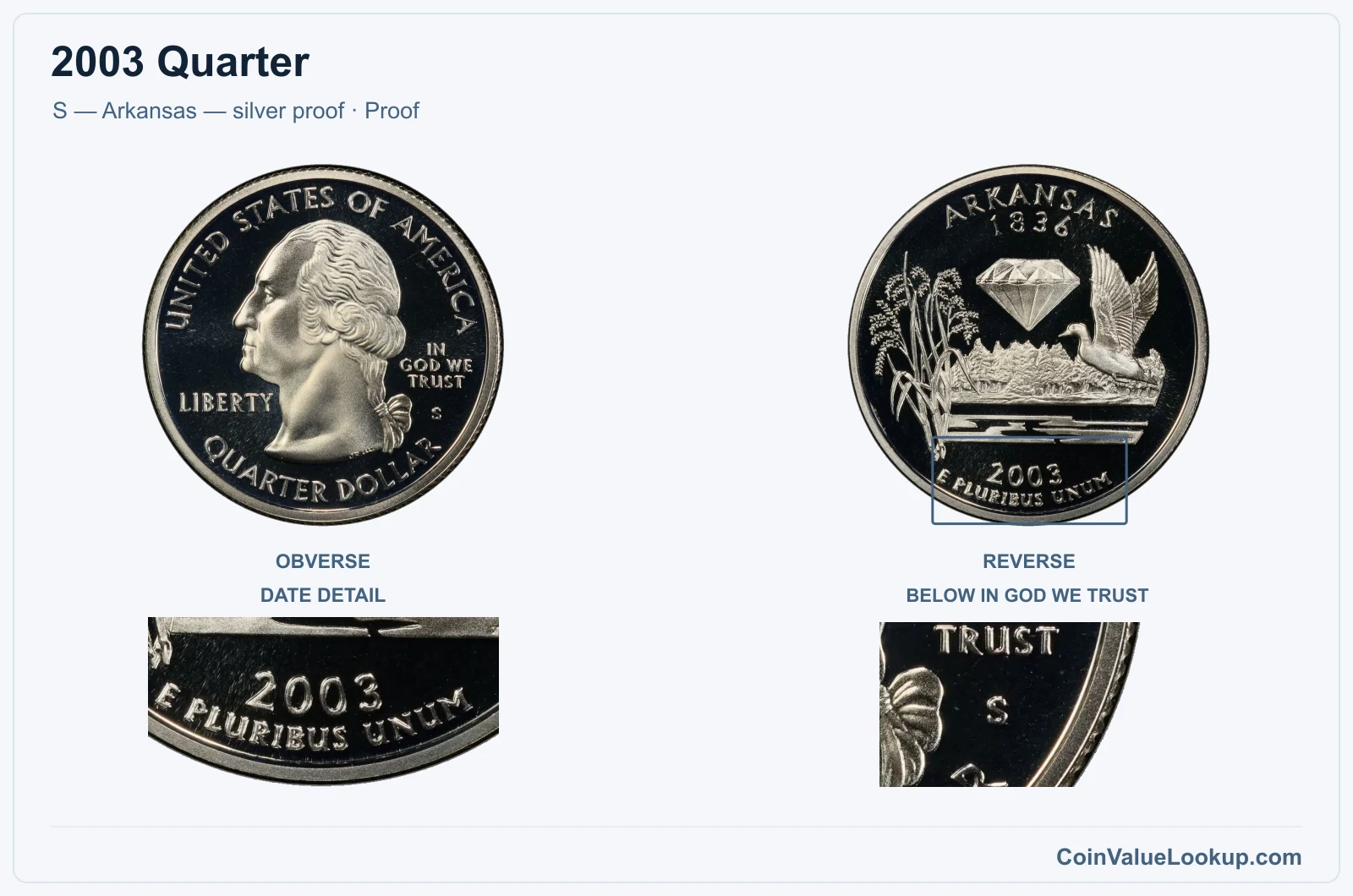
The 2003-S Arkansas silver proof is the premium collector version, struck in 90% silver and weighing roughly 6.25 g. The solid gray edge and slightly heavier feel distinguish it from the clad proof.
USA Coin Book estimates about $23.00 in PR65, the same guide level as the other four silver proof state quarters from 2003. These were distributed in Silver Proof Sets and remain popular with series collectors.
Condition preservation is critical for value — hairlines on mirrored surfaces are unforgiving.
Range Grade
Price Auction Records Appraisal PR PR 1
—
Coin Identifier
PR 2
—
Coin Identifier
PR 3
—
Coin Identifier
PR 4
—
Coin Identifier
PR 6
—
Coin Identifier
PR 8
—
Coin Identifier
PR 10
—
Coin Identifier
PR 12
—
Coin Identifier
PR 15
—
Coin Identifier
PR 20
—
Coin Identifier
PR 25
—
Coin Identifier
PR 30
—
Coin Identifier
PR 35
—
Coin Identifier
PR 40
—
Coin Identifier
PR 45
—
Coin Identifier
PR 50
—
Coin Identifier
PR 53
—
Coin Identifier
PR 55
—
Coin Identifier
PR 58
—
Coin Identifier
PR 60
—
Coin Identifier
PR 61
—
Coin Identifier
PR 62
—
Coin Identifier
PR 63
—
Coin Identifier
PR 64
—
Coin Identifier
PR 65
—
Coin Identifier
PR 66
—
Coin Identifier
PR 67
—
Coin Identifier
PR 68
Coin Identifier
PR 69
Coin Identifier
PR 70
Coin Identifier
2003 Quarter Error List
1. 2003 Quarter — Doubled Die Obverse
A doubled die obverse on a 2003 quarter shows consistent doubling — separation or notching — on obverse lettering or design elements. Compare your coin under magnification to a normal example under the same lighting.
The key distinction is consistency. Genuine doubled-die doubling appears in the same direction across affected features and has a slightly raised profile.
Machine doubling, by contrast, tends to produce flat, shelf-like outlines that look mechanical rather than sculpted. Reflections and worn die contours can also mimic doubling.
Condition, the visibility of the doubling, and the specific variety all affect what a doubled die obverse is worth. No standard numerical price is established across this year, so individual assessment is needed.
2. 2003 Quarter — Improper Annealing
An improperly annealed 2003 quarter may show an unusual copper-toned surface caused by a problem during the heat-treatment stage of planchet preparation. The discoloration is typically across one or both faces rather than in a localized spot.
To screen for this, compare your coin's surface color and texture to a normal 2003 quarter. A genuine annealing error usually has a consistent, even discoloration that does not flake off or sit on top of the design.
The tricky part: environmental toning, corrosion, and heat applied after minting can look similar. Surface appearance alone is a screening clue, not proof.
Value depends on the extent and clarity of the error, and no standard price range applies across the board.
3. 2003 Quarter — Lamination / Split Planchet
A lamination error on a 2003 quarter appears as peeling, flaking or separated metal within the planchet. You might see a thin flap of metal still attached, a missing patch where metal has broken away, or a visible split along the edge.
Photograph both the affected face and the edge together when documenting this type of error. The split or peel should follow the metal's grain and show a natural break rather than a clean mechanical cut.
Lookalikes include post-mint scraping, corrosion pitting, and deliberately altered coins. On a genuine lamination, the exposed layer is typically smooth underneath and follows a natural separation plane.
Value depends on the size and visibility of the flaw, and no fixed price range is established for this year.
4. 2003 Quarter — Maine — Off-Center Strike
An off-center strike on a 2003 Maine quarter means the planchet was not properly centered between the dies when struck. The result is a crescent of blank metal on one side and a displaced design on the other.
More dramatic off-center errors — say 10% or more — with a readable date are generally more desirable. Minor shifts of a few percent are common and not worth much.
Don't confuse an off-center strike with a clipped planchet, which removes part of the rim before striking, or with post-mint damage that flattened the edge. On a genuine off-center coin the design itself is shifted uniformly.
Value depends on the degree of displacement and overall condition.
5. 2003 Quarter — Maine — Die Crack / Die Chip
Die cracks and die chips on a 2003 Maine quarter appear as raised lines or small raised blobs on the coin's surface. They are caused by fractures in the steel die transferring their profile onto every coin struck afterward.
A die crack is a thin raised line, often running from one design element to another or from the rim inward. A die chip is a small raised lump, usually within a letter or design element where a tiny piece of die steel broke away.
Incuse scratches — lines pressed into the surface — are post-mint damage and the opposite of what a die crack looks like. Corrosion or embedded debris can also mimic a chip.
Value depends on prominence and location; no set price range applies.
6. 2003 Quarter — Maine — Die Break / Cud
A cud on a 2003 Maine quarter is a specific type of die break where a chunk of the die near the rim breaks away. The result is a raised, featureless blob that connects to the rim, replacing part of the normal design.
Look for a smooth, flat raised area at the coin's edge that obliterates the design beneath it. The boundary between the cud and the normal struck design should show a clear transition.
Rim dents from post-mint contact go inward, not outward. An interior die chip that does not touch the rim is not a cud.
Corrosion can mimic a rough raised area but lacks the sharp boundary. Value varies with size and location — no standard price applies across this date.
7. 2003 Quarter — Maine — Doubled Die
A doubled die error on a 2003 Maine quarter shows a second, offset impression of design elements — letters, numerals, or portions of the main design. This can appear on the obverse or reverse.
Compare suspect features to a normal coin at the same magnification. Genuine doubling shows consistent separation or notching in the same direction across multiple design points.
It has a sculpted, raised quality.
Machine doubling looks similar at first glance but produces flat, shelf-like secondary images and is far more common. Reflections or post-mint impressions from contact can also fool you.
Value depends on the strength and location of the doubling, and no standardized price range covers this year.
8. 2003 Quarter — Maine — Missing Clad Layer
A missing clad layer on a 2003 Maine quarter means one of the outer nickel-alloy layers was absent when the coin was struck. The exposed surface may appear copper-colored on the affected face.
Check the edge: a normal clad quarter shows distinct layers, while a missing-clad example will look asymmetrical in cross section. Weigh the coin too — it should be noticeably lighter than the standard 5.67 g.
Toning, corrosion, plating and deliberate acid stripping can all produce a copper-looking surface without being a genuine mint error. If the coin weighs normal and the edge looks right, it probably is not a missing clad layer.
Value depends on extent and condition.
9. 2003 Quarter — Maine — Struck-Through Error
A struck-through error on a 2003 Maine quarter occurs when foreign material — grease, cloth, wire, a metal fragment — sits between the die and planchet during striking. The result is usually a localized depression or incomplete design area.
A grease-filled die produces a smooth, undefined area where detail is missing. A retained foreign object leaves a distinctive impression, sometimes with texture from the object itself.
Ordinary wear, cleaning scratches and weak strikes can all produce faded design areas, but struck-through errors typically have sharper boundaries between the affected and normal zones. Value depends on the size, clarity and type of obstruction involved, and no standard price is established for this date.
10. 2003 Quarter — Wrong Planchet / Off-Metal Strike
A wrong planchet error means a 2003 quarter was struck on a blank intended for a different denomination or possibly a foreign coin. These are uncommon and draw serious collector interest.
To evaluate, measure the coin's weight and diameter and compare to the standard 5.67 g and 24.26 mm of a normal quarter. If both are significantly off, the edge profile and design completeness can offer additional clues.
Do not assume a specific metal or denomination without confirmed measurements.
Coins that look odd due to plating, corrosion, acid treatment or deliberate grinding are far more common than genuine wrong-planchet errors. Value depends on confirmation of the mismatch and overall condition.
11. 2003 Quarter — Illinois — Doubled Die
A doubled die on a 2003 Illinois quarter shows a second, slightly offset impression on design elements. This can affect obverse lettering, the date, or features on the Illinois reverse.
Under magnification, look for consistent separation or notching across multiple letters or design points in the same direction. The doubling has a raised, sculpted appearance.
Machine doubling is the most common lookalike — it produces flat, shelf-like echoes rather than rounded separation. Reflections or post-mint impressions from contact damage can also mimic doubling.
Value depends on the strength of the doubling and the coin's overall condition, and no standardized price is available for this year.
12. 2003 Quarter — Illinois — Repunched Mintmark
A repunched mintmark on a 2003 Illinois quarter shows remnants of a second mintmark position underneath or beside the primary one. Look at the mintmark area near Washington's portrait under at least 5x magnification.
You are looking for traces — a partial letter outline, a shadow or notch — that indicate the mintmark was applied more than once in slightly different positions. Compare to a normal example at the same magnification so you know what a clean single punch looks like.
A die chip next to the mintmark or corrosion around the letter can mimic a repunched mintmark. Machine doubling of the mintmark is also common and less valuable.
No standard price range is established for this category on the 2003 Illinois quarter.
13. 2003 Quarter — Illinois — Off-Center Strike
An off-center 2003 Illinois quarter has a design that is shifted away from center, leaving an unstruck crescent of blank metal along part of the rim. The more dramatic the shift, the more noticeable the error.
For an off-center error to attract collector interest, the date usually needs to remain visible. A coin struck 5% off center barely looks wrong; one struck 20% or more with a readable date is a different story.
Don't confuse this with a clipped planchet, which removes a piece of the blank before striking, or with post-mint flattening that can distort the rim. The design on a genuine off-center strike shifts uniformly.
No fixed price applies across the board.
14. 2003 Quarter — Illinois — Die Crack / Die Chip
Die cracks and die chips on a 2003 Illinois quarter show up as raised lines or raised blobs on the coin's surface. These are impressions left by fractures or missing pieces in the steel die.
A die crack runs as a thin raised line, sometimes connecting design elements or extending from the rim. A die chip is a small raised bump, often found within letters.
Both are raised — meaning you can feel them with a fingernail if they are large enough.
Incuse scratches, corrosion pits, and stuck-on debris are common lookalikes. Scratches go into the surface rather than rising above it.
Value depends on the prominence and placement of the crack or chip, with no set price range for this date.
15. 2003 Quarter — Alabama — Off-Center Strike
An off-center strike on a 2003 Alabama quarter displaces the design relative to the planchet, creating a visible blank crescent. The coin was not centered between the dies when struck.
Small percentages of off-center — two or three percent — are minor and add little value. Larger shifts with a visible date are more collectible.
Check that the design displacement is uniform and consistent on both sides.
A clipped planchet or post-mint edge damage can look similar at first glance but differ in how the remaining design relates to the rim. Value depends on the severity of the misalignment and overall condition.
16. 2003 Quarter — Alabama — Die Crack / Die Chip
Die cracks on a 2003 Alabama quarter appear as thin raised lines across the coin's surface, caused by fracturing within the die. Die chips are small raised lumps from missing die fragments, typically found in letters or confined design areas.
To confirm, tilt the coin under a light and look for raised features that follow a consistent path or sit within a letter. They should be above the surface, not below it.
Incuse scratches, surface corrosion and foreign material can mimic these features but behave differently under magnification. Scratches cut into metal; die cracks ride above it.
No standard price applies, as value depends on size, placement and how dramatically the crack affects the design.
17. 2003 Quarter — Alabama — Die Break / Cud
A cud on a 2003 Alabama quarter is a raised, featureless area that connects to the rim. It results from a large piece of the die breaking away near the edge, leaving nothing to impress a design onto that section of the planchet.
The boundary between a cud and the normal design should be relatively sharp. The cud area itself will be smooth or slightly irregular but without any intended design elements.
Rim dents from drops or rolling-machine contact push metal inward and are not cuds. An interior die chip that does not reach the rim is also a different category.
Corrosion can create rough raised areas but lacks the defined boundary. Value varies with size and position.
18. 2003 Quarter — Alabama — Clipped Planchet
A clipped planchet on a 2003 Alabama quarter means part of the blank was missing before the coin was struck. The clip may be curved, straight or irregular depending on how it occurred during the blanking process.
Look at the edge: a genuine clip will show a smooth, sometimes slightly curved missing section, and the design opposite the clip may appear slightly weak due to incomplete metal flow during striking. That opposite-side weakness is a useful diagnostic.
A coin with an edge that was filed, cut or corroded after minting is not a clipped planchet. Post-mint damage tends to show tool marks or rough, uneven surfaces.
Value depends on the size and type of clip and the coin's overall condition.
19. 2003 Quarter — Alabama — Double / Multiple Strike
A double or multiple strike on a 2003 Alabama quarter shows two or more separate impressions from the dies, usually overlapping with one design rotated or displaced relative to the other. This is different from a doubled die, which is a single strike from a defective die.
Look for distinct, repeated outlines of major design elements — portrait, lettering, the reverse image — that are clearly offset from each other. The effect should be dramatic and unmistakable, not subtle.
A doubled die produces fine, close doubling within the design. Post-mint impressions from vise damage or stacking pressure can leave secondary marks but lack the sharp strike quality of a genuine double strike.
No standard price range applies for this error on the 2003 Alabama quarter.
20. 2003 Quarter — Alabama — Missing Clad Layer
A missing clad layer error on a 2003 Alabama quarter means one of the outer layers was absent when the coin was struck, exposing copper-colored metal on one face. This only occurs on clad coins — a silver proof cannot have this error.
Weigh the coin. A genuine missing clad layer produces a noticeably underweight coin compared to the standard 5.67 g.
Examine the edge as well: it should look asymmetrical, with one layer visibly absent.
Toning, environmental damage, corrosion and deliberate acid stripping can all make a quarter look copper-toned without being a genuine error. If the weight and edge look normal, the surface color alone is not enough.
Value depends on the extent and confirmation of the missing layer.