1845 Liberty Seated Quarter Coin Value: How Much Is It Worth?
The 1845 Liberty Seated Quarter is a Philadelphia-only business strike issue that draws steady collector interest. A USA Coin Book guide places the regular example around $70 in G4 and up to roughly $1,531 at the MS63 level.
Early proofs exist but live in a separate specialist market with no routine price curve. Identifying your coin's actual condition and any die features is the first step toward understanding its value.
Fast Way to Identify Your 1845 Liberty Seated Quarter
Snap a clear photo of the front and a clear photo of the back of your 1845 quarter, then upload both for a preliminary identification. This helps confirm the mint, design type, and whether any obvious die features are present.
It is not a substitute for professional grading or authentication, but it gives you a solid starting point.
1845 Liberty Seated Quarter Value
Upload both sides of your 1845 Liberty Seated Quarter.
Front Obverse
Upload photo
Back Reverse
Upload photo
Which 1845 Liberty Seated Quarter Versions Are Worth Money?
- Philadelphia business strikes in problem-free high grade can reach the $1,531 range at MS63 per USA Coin Book.
- Authenticated early Philadelphia proofs are a separate specialist market with no routine guide price.
- Repunched Date examples have sold individually for thousands in high grade — check the date area carefully.
- Peripheral die breaks and a reverse crack are documented on some 1845 dies and may affect collector interest.
Step 1: Identify Your 1845 Liberty Seated Quarter Mint Mark and Version
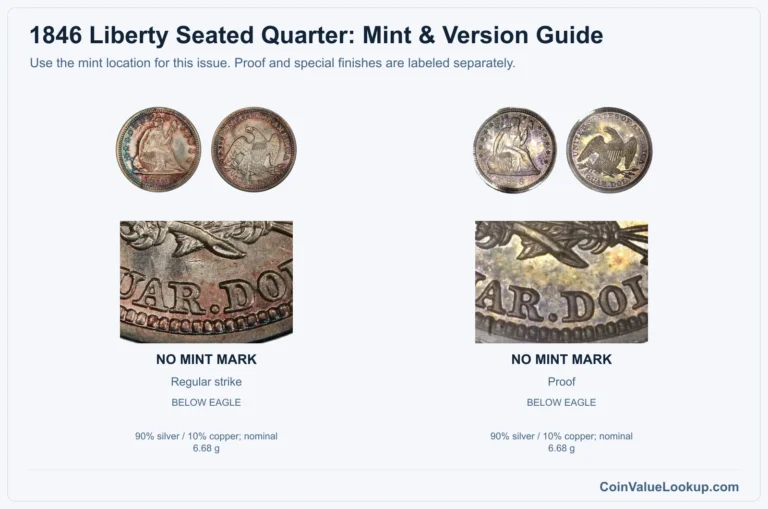
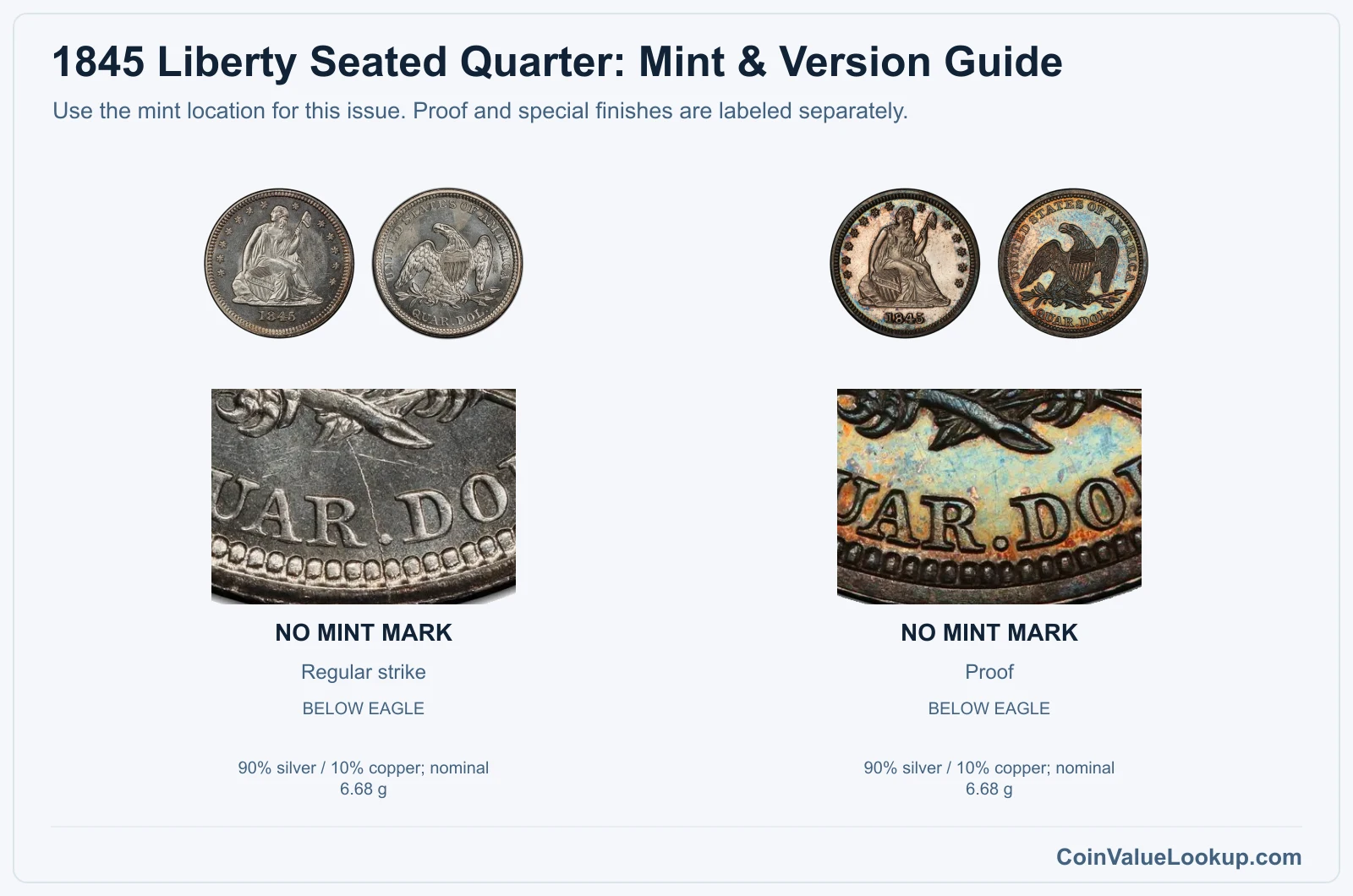
Every 1845 quarter was struck at Philadelphia, so there is no mintmark to look for. If you see a small letter beneath the eagle on the reverse, you are holding a different date — the O mintmark indicates New Orleans, and this date was not struck there.
The design shows a seated Liberty figure on the obverse with drapery at her elbow, and an eagle without a motto on the reverse. Composition is 90% silver and 10% copper, with a nominal weight of 6.68 g and a diameter of about 24.3 mm.
Wear can reduce the actual weight slightly.
A small number of early proofs were made in 1845. These are rare specialist coins confirmed by die characteristics, surface quality, and provenance — not just a shiny appearance.
A polished or lightly circulated business strike with reflective fields is not a proof. If you suspect yours might be one, professional attribution is essential.
Step 2: Check Your 1845 Liberty Seated Quarter Grade
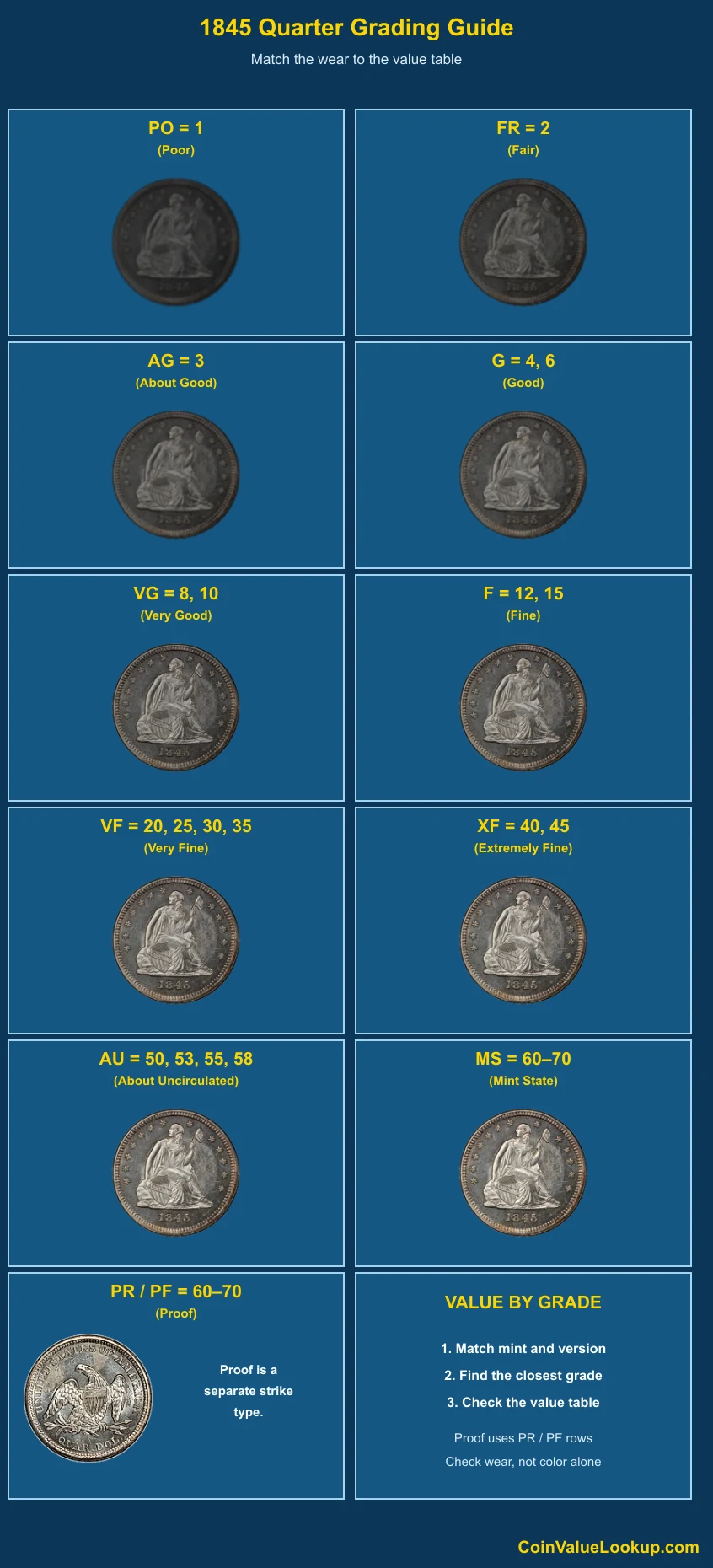
Start on the obverse. Liberty's head, breast, knee, and the lettering on the shield are your key wear checkpoints.
On the reverse, look at the eagle's breast feathers, wing tips, and claws.
A coin grading around G4 will show a clear outline of Liberty but most interior detail is gone. By VF20, the shield letters are partially visible and the eagle's feathers show moderate definition.
An MS63 piece retains full luster with only minor contact marks.
Do not confuse a weak strike with wear. Some 1845 quarters left the press with soft shield letters, which is a strike issue, not a grade issue.
Use the comparison image to check your coin's luster and surface continuity alongside the wear points.
Hairlines from cleaning, smoothed surfaces, holes, and environmental damage all reduce value significantly. Originality matters — a natural, lightly toned surface is far more desirable than a harshly cleaned coin that happens to show sharp detail.
Step 3: Check 1845 Liberty Seated Quarter Value by Mint and Version
1845 Liberty Seated Quarter — Philadelphia Business Strike
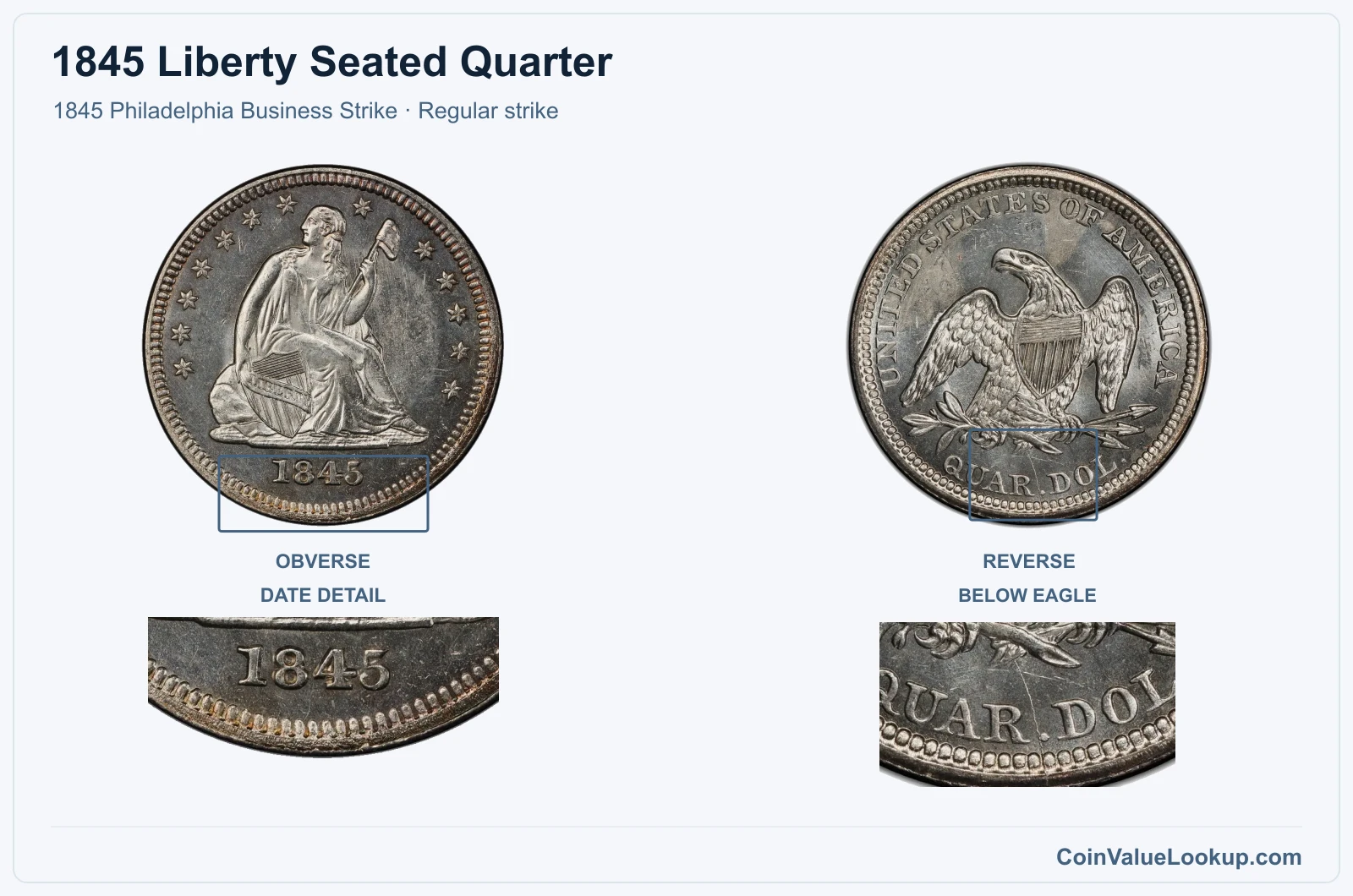
This is the standard 1845 quarter, struck for circulation at Philadelphia with no mintmark. The design features the With Drapery version of the Seated Liberty obverse paired with the no-motto eagle reverse.
It is composed of 90% silver and 10% copper at a nominal 6.68 g.
USA Coin Book places the guide value at about $70 in G4, $109 in VF20, and $1,531 in MS63. Most surviving examples fall in the lower circulated grades, so a problem-free VF or better coin commands a noticeable step up.
Original surfaces without cleaning or damage are important at every grade level. The repunched date variety is separately covered in the error section below.
| Range | Grade | Price | Auction Records | Appraisal |
|---|---|---|---|---|
| PO | PO 1 | — | Coin Identifier | |
| FR | FR 2 | — | Coin Identifier | |
| AG | AG 3 | — | Coin Identifier | |
| G | G 4 | — | Coin Identifier | |
| G 6 | — | Coin Identifier | ||
| VG | VG 8 | — | Coin Identifier | |
| VG 10 | — | Coin Identifier | ||
| F | F 12 | — | Coin Identifier | |
| F 15 | Coin Identifier | |||
| VF | VF 20 | Coin Identifier | ||
| VF 25 | Coin Identifier | |||
| VF 30 | Coin Identifier | |||
| VF 35 | Coin Identifier | |||
| XF | XF 40 | Coin Identifier | ||
| XF 45 | Coin Identifier | |||
| AU | AU 50 | Coin Identifier | ||
| AU 53 | Coin Identifier | |||
| AU 55 | Coin Identifier | |||
| AU 58 | Coin Identifier | |||
| MS | MS 60 | — | Coin Identifier | |
| MS 61 | Coin Identifier | |||
| MS 62 | Coin Identifier | |||
| MS 63 | Coin Identifier | |||
| MS 64 | Coin Identifier | |||
| MS 65 | Coin Identifier | |||
| MS 66 | — | Coin Identifier | ||
| MS 67 | — | — | — | |
| MS 68 | — | — | — | |
| MS 69 | — | — | — | |
| MS 70 | — | — | — |
1845 Liberty Seated Quarter — Proof Philadelphia
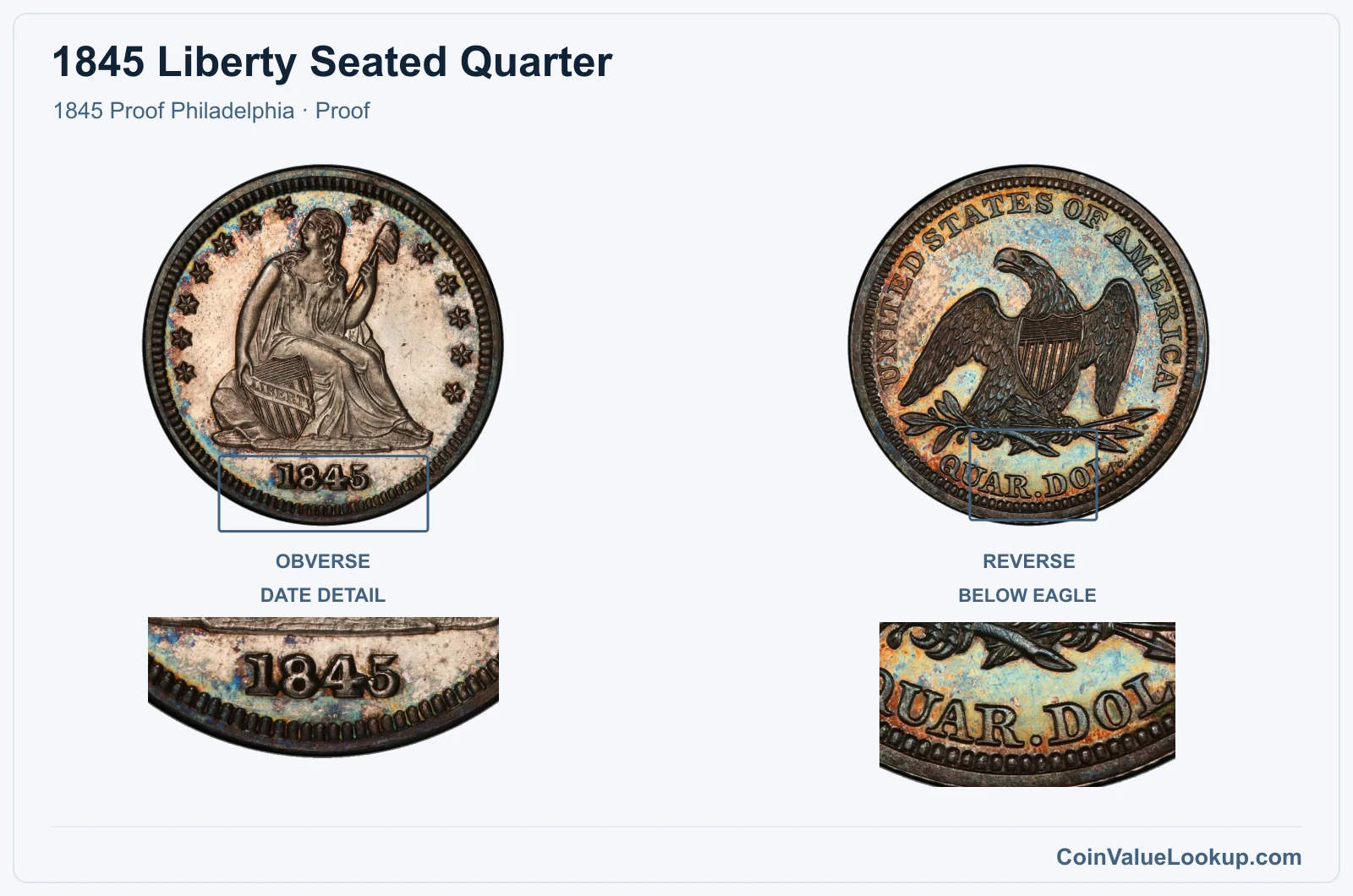
Early Philadelphia proofs of the 1845 Seated quarter are genuinely rare. These were made from specially prepared dies and planchets, producing mirror-like fields and sharp detail that business strikes do not replicate.
No supported numeric price range is available for these proofs because so few trade and each sale depends on the individual coin's authentication, provenance, and condition. A reflective business strike is not enough to call a coin a proof — expert die-pair analysis and surface comparison are required.
Coin Value Lookup is a good place to start exploring coin guides for various dates and denominations before you consult a specialist. If you believe you have one of these early proofs, professional third-party authentication is the necessary next step.
| Range | Grade | Price | Auction Records | Appraisal |
|---|---|---|---|---|
| PR | PR 1 | — | Coin Identifier | |
| PR 2 | — | Coin Identifier | ||
| PR 3 | — | Coin Identifier | ||
| PR 4 | — | Coin Identifier | ||
| PR 6 | — | Coin Identifier | ||
| PR 8 | — | Coin Identifier | ||
| PR 10 | — | Coin Identifier | ||
| PR 12 | — | Coin Identifier | ||
| PR 15 | — | Coin Identifier | ||
| PR 20 | — | Coin Identifier | ||
| PR 25 | — | Coin Identifier | ||
| PR 30 | — | Coin Identifier | ||
| PR 35 | — | Coin Identifier | ||
| PR 40 | — | Coin Identifier | ||
| PR 45 | — | Coin Identifier | ||
| PR 50 | — | Coin Identifier | ||
| PR 53 | — | Coin Identifier | ||
| PR 55 | — | Coin Identifier | ||
| PR 58 | — | Coin Identifier | ||
| PR 60 | — | Coin Identifier | ||
| PR 61 | — | Coin Identifier | ||
| PR 62 | — | Coin Identifier | ||
| PR 63 | Coin Identifier | |||
| PR 64 | Coin Identifier | |||
| PR 65 | Coin Identifier | |||
| PR 66 | Coin Identifier | |||
| PR 67 | — | — | — | |
| PR 68 | — | — | — | |
| PR 69 | — | — | — | |
| PR 70 | — | — | — |
1845 Liberty Seated Quarter Error List
1. 1845 Liberty Seated Quarter — Repunched Date
On this 1845 variety, the date was punched more than once into the working die, leaving remnant impressions visible around the final digits. The clearest trace appears above the flag of the 5, with additional doubling visible at the 8 and 4.
This happened because the original date punch was repositioned — essentially a large-over-small or shifted date punching event during die preparation.
A Heritage Auctions example graded MS64 sold for $3,290 in June 2013. That price reflects a high-grade, authenticated specimen — do not expect that figure for every circulated repunched date quarter.
Value depends heavily on grade and eye appeal.
Be careful not to confuse this with machine doubling, which produces flat, shelf-like distortion rather than the raised, overlapping digits of a true repunched date. An overdate from a different year is also a distinct category.
2. 1845 Liberty Seated Quarter — Peripheral Die Breaks and Reverse Crack
Some 1845 Philadelphia business-strike dies developed cracks during their production run. The documented example shows peripheral breaks on the obverse and a crack on the reverse running below the words STATES OF.
These appear as thin, raised lines on the coin's surface because metal flowed into the fractures in the die face.
A Heritage Auctions lot graded MS66 displayed both features alongside the repunched date on the same coin. No separate supported price range exists for the die breaks alone, so value depends on the individual coin's overall grade, eye appeal, and authentication.
Do not confuse die cracks with impact damage or incuse scratches. Die cracks are raised above the coin's surface, while scratches and contact marks are recessed into it.
If you spot thin raised lines on your 1845 quarter, compare them carefully to the documented positions before drawing conclusions.