2017 Quarter Coin Value: How Much Is It Worth?
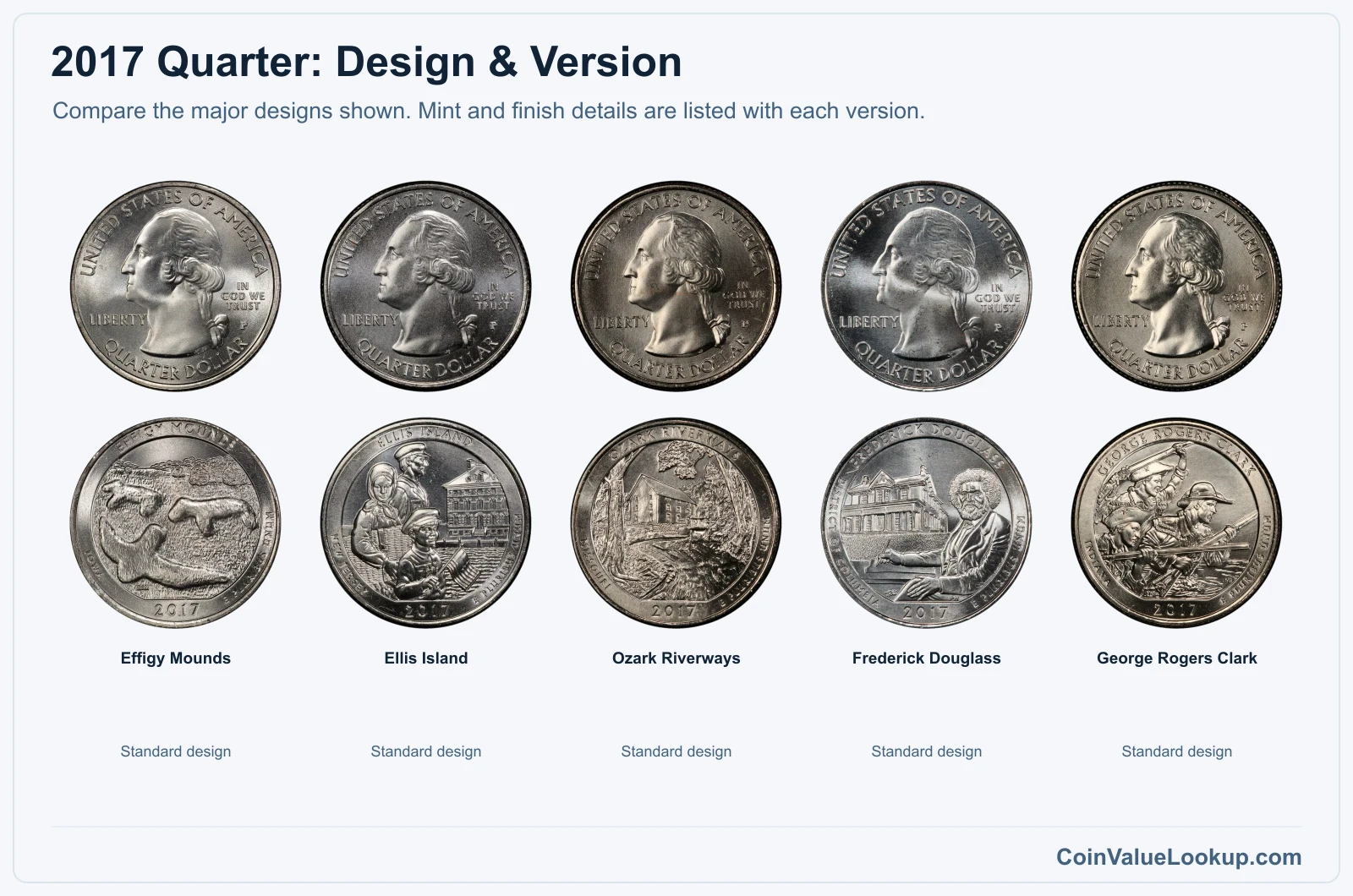
The 2017 America the Beautiful quarters come in five reverse designs, three mint facilities and several collector finishes, so the version you hold matters a lot. Guide estimates from USA Coin Book range from about $0.61 at MS60 for a common Philadelphia or Denver business strike up to $24.00 at PR65 for a silver proof.
Your coin's specific mint, reverse design, composition and condition determine where it falls within that span.
Fast Way to Identify Your 2017 Quarter
Upload clear photos of both sides of your 2017 quarter and we can help with a preliminary identification. The front will show the mintmark and date, while the reverse tells us which of the five designs you have.
From there, matching your coin to the right version and finish is straightforward.
2017 Quarter Value
Upload both sides of your 2017 Quarter.
Front Obverse
Upload photo
Back Reverse
Upload photo
Which 2017 Quarter Versions Are Worth Money?
- Silver proofs from all five designs carry a USA Coin Book guide estimate of $24.00 at PR65, the highest listed figure among 2017 quarter versions with adopted prices.
- Enhanced uncirculated quarters from the 225th Anniversary set (all five designs, S mint) are a distinct collector finish; value depends on authenticated identity and condition.
- San Francisco regular business strikes with the S mintmark guide around $3.62 at MS65 — several times above face value — because they were not released into general circulation.
- Clad proofs at PR65 guide around $5.63, well above pocket-change quarters, but be sure to separate them from silver proofs by checking edge color and weight.
Step 1: Identify Your 2017 Quarter Mint Mark and Version
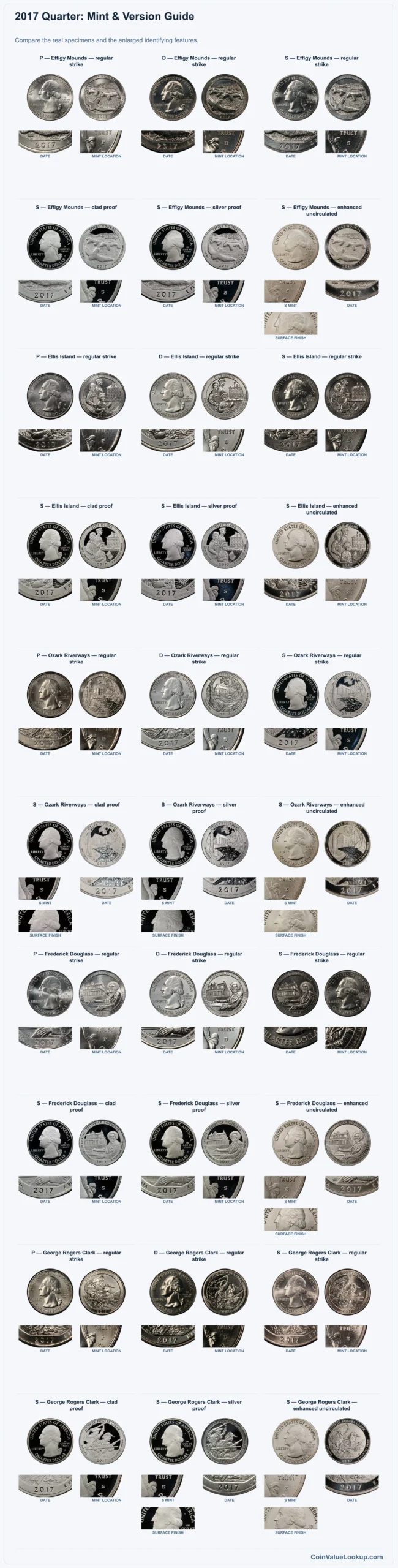
Start on the obverse. The small mintmark letter near Washington's portrait tells you the issuing facility: P for Philadelphia, D for Denver or S for San Francisco.
Then flip the coin and identify which reverse design you have: Effigy Mounds, Ellis Island, Ozark Riverways, Frederick Douglass or George Rogers Clark.
An S mintmark does not automatically mean proof. San Francisco produced regular business strikes, clad proofs, silver proofs and enhanced uncirculated coins in 2017, each with a different value path.
Ordinary circulation quarters are copper-nickel clad over a copper core, measuring 24.26 mm and weighing about 5.67 grams. Silver proofs are 90% silver and 10% copper, and they tip the scale closer to 6.25 grams.
Check the edge: a clad coin shows a visible copper-colored band, while a silver proof edge is uniformly silver.
The enhanced uncirculated coins were part of a 225th Anniversary set and display multiple surface textures distinct from standard business strikes and mirror-field proofs. If any date appears in the reverse design itself, that is not the minting year; the issue year is always 2017 on the obverse.
This guide covers standard-size quarter dollars only. Five-ounce silver collector or bullion pieces sharing these designs are a completely separate product with different values.
Step 2: Check Your 2017 Quarter Grade
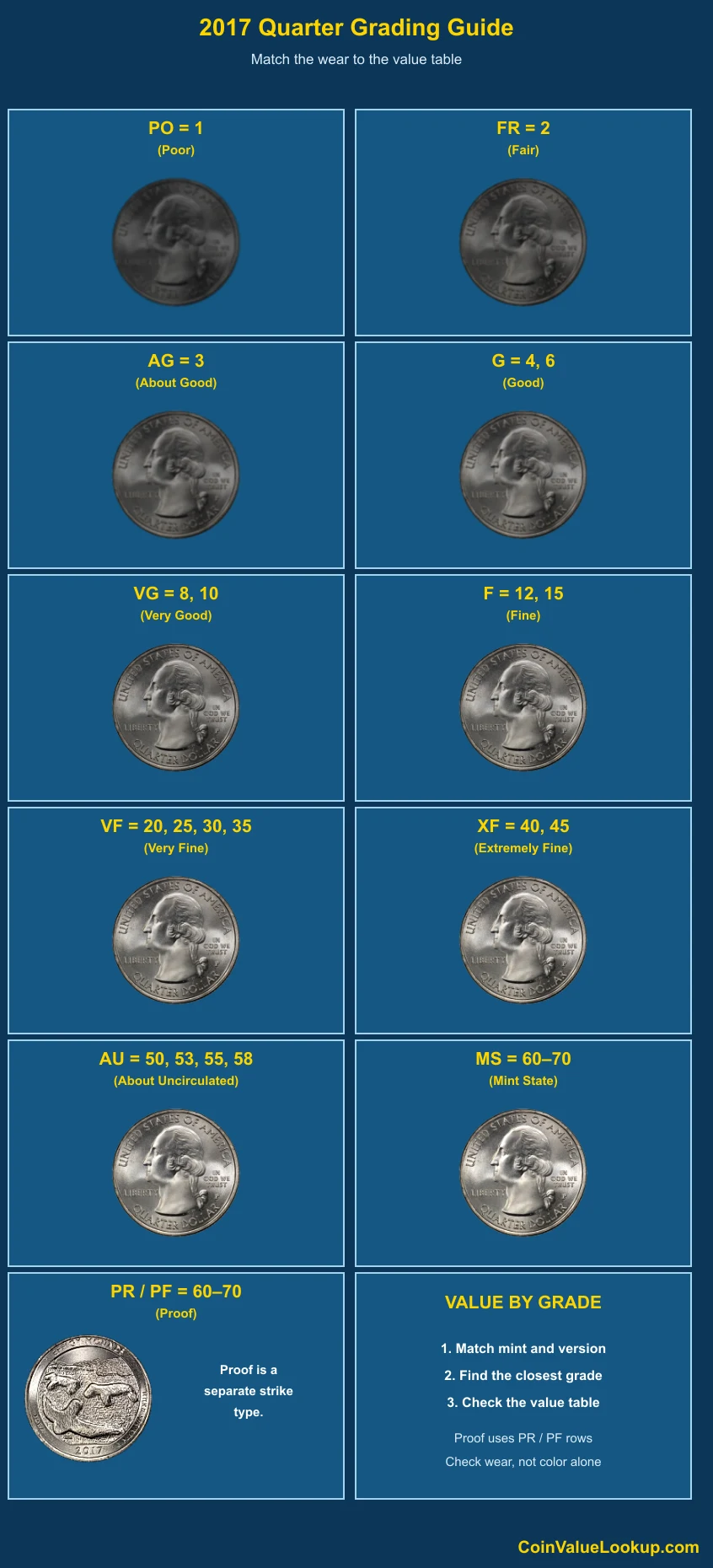
Focus on Washington's cheek and the hair strands above his ear; those are the first spots to lose detail on a circulated quarter. On the reverse, the highest relief points of each design wear down next.
For proofs, tilt the coin under a single light source and look for hairlines in the mirror fields and any haze on the frosted devices. Compare your coin side-by-side with the reference image to see where it lands on the wear spectrum.
Luster matters as much as sharpness. A coin can show full design detail but still grade lower if its original mint luster has been disrupted by cleaning or mishandling.
A weak strike can also reduce detail on an unworn coin, so do not confuse soft features with actual wear.
Step 3: Check 2017 Quarter Value by Mint and Version
2017 Quarter — P — Effigy Mounds — regular strike
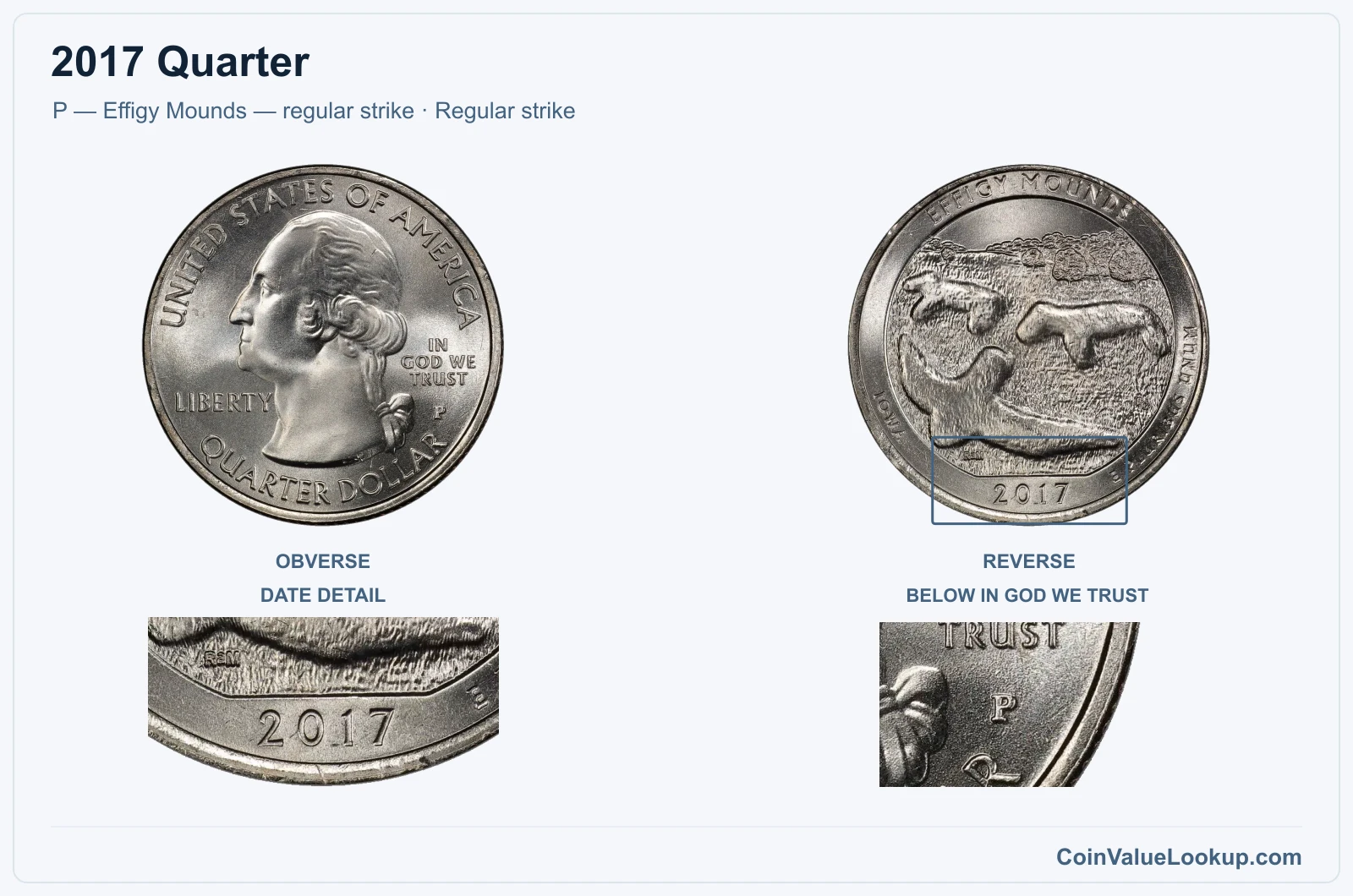
This is the Philadelphia-mint Effigy Mounds quarter in standard copper-nickel clad. If yours has been circulating, it is realistically a 25-cent coin.
Uncirculated examples guide at about $0.61 at MS60 and $1.24 at MS65 per USA Coin Book.
Confirm the P mintmark on the obverse and the Effigy Mounds reverse depicting the bear-shaped mound scene. Worn pieces lack collector premium, but original, unhandled rolls can yield MS65 or better coins worth tracking down.
Range Grade
Price Auction Records Appraisal PO PO 1
—
Coin Identifier FR FR 2
—
Coin Identifier AG AG 3
—
Coin Identifier G G 4
—
Coin Identifier
G 6
—
Coin Identifier VG VG 8
—
Coin Identifier
VG 10
—
Coin Identifier F F 12
—
Coin Identifier
F 15
—
Coin Identifier VF VF 20
—
Coin Identifier
VF 25
—
Coin Identifier
VF 30
—
Coin Identifier
VF 35
—
Coin Identifier XF XF 40
—
Coin Identifier
XF 45
—
Coin Identifier AU AU 50
—
Coin Identifier
AU 53
—
Coin Identifier
AU 55
—
Coin Identifier
AU 58
—
Coin Identifier MS MS 60
—
Coin Identifier
MS 61
—
Coin Identifier
MS 62
—
Coin Identifier
MS 63
—
Coin Identifier
MS 64
—
Coin Identifier
MS 65
—
Coin Identifier
MS 66
—
Coin Identifier
MS 67
—
Coin Identifier
MS 68
—
Coin Identifier
MS 69
—
—
—
MS 70
—
—
—
2017 Quarter — D — Effigy Mounds — regular strike
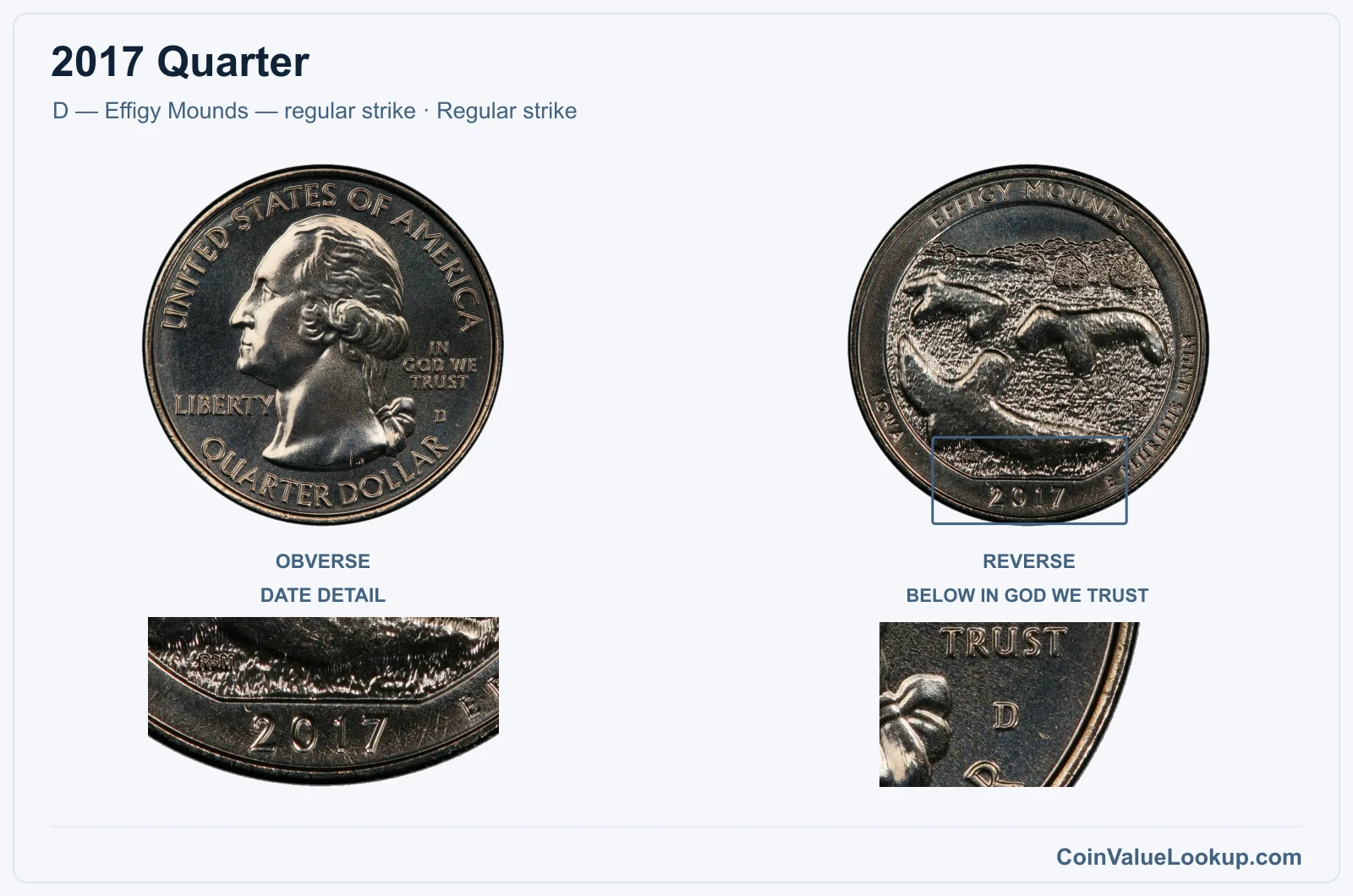
The Denver-mint Effigy Mounds quarter shares the same copper-nickel clad composition and design as the P-mint version. USA Coin Book guide estimates sit at $0.61 for MS60 and $1.24 for MS65.
Look for the D mintmark on the obverse. Circulated examples trade at face value, so condition is the whole game here.
A genuinely pristine coin pulled from a fresh roll is the only realistic path to a collector premium.
Range Grade
Price Auction Records Appraisal PO PO 1
—
Coin Identifier FR FR 2
—
Coin Identifier AG AG 3
—
Coin Identifier G G 4
—
Coin Identifier
G 6
—
Coin Identifier VG VG 8
—
Coin Identifier
VG 10
—
Coin Identifier F F 12
—
Coin Identifier
F 15
—
Coin Identifier VF VF 20
—
Coin Identifier
VF 25
—
Coin Identifier
VF 30
—
Coin Identifier
VF 35
—
Coin Identifier XF XF 40
—
Coin Identifier
XF 45
—
Coin Identifier AU AU 50
—
Coin Identifier
AU 53
—
Coin Identifier
AU 55
—
Coin Identifier
AU 58
—
Coin Identifier MS MS 60
—
Coin Identifier
MS 61
—
Coin Identifier
MS 62
—
Coin Identifier
MS 63
—
Coin Identifier
MS 64
—
Coin Identifier
MS 65
—
Coin Identifier
MS 66
—
Coin Identifier
MS 67
—
Coin Identifier
MS 68
—
—
—
MS 69
—
—
—
MS 70
—
—
—
2017 Quarter — S — Effigy Mounds — regular strike
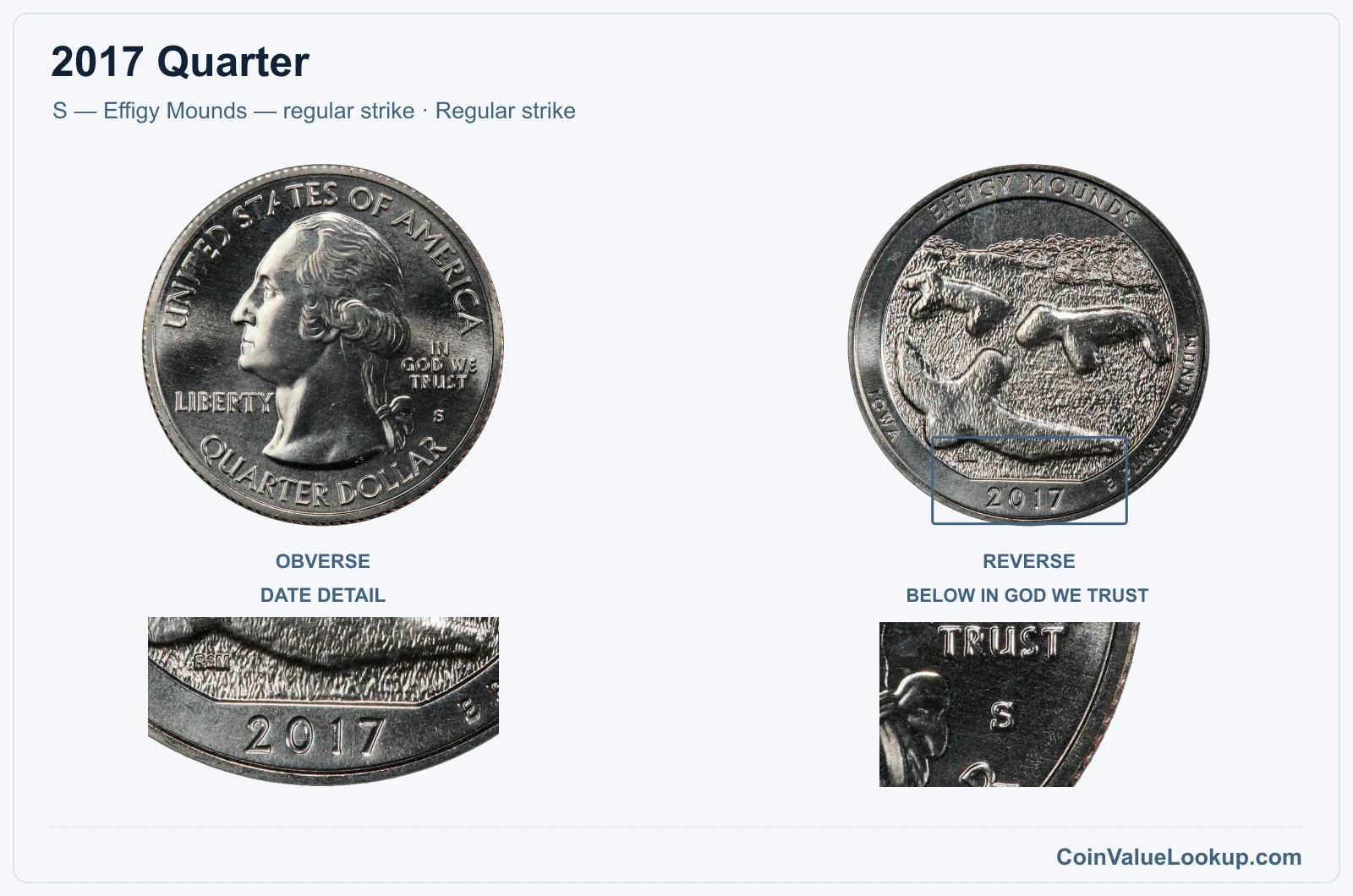
San Francisco also struck a non-proof business strike Effigy Mounds quarter in copper-nickel clad. These were sold in Mint sets, not dumped into circulation, so most survivors are in good shape.
The S mintmark alone does not mean proof. This version has a satin-like business strike surface, not mirror fields.
USA Coin Book estimates $3.62 at MS65, reflecting the lower availability compared to P and D rolls.
Range Grade
Price Auction Records Appraisal PO PO 1
—
Coin Identifier FR FR 2
—
Coin Identifier AG AG 3
—
Coin Identifier G G 4
—
Coin Identifier
G 6
—
Coin Identifier VG VG 8
—
Coin Identifier
VG 10
—
Coin Identifier F F 12
—
Coin Identifier
F 15
—
Coin Identifier VF VF 20
—
Coin Identifier
VF 25
—
Coin Identifier
VF 30
—
Coin Identifier
VF 35
—
Coin Identifier XF XF 40
—
Coin Identifier
XF 45
—
Coin Identifier AU AU 50
—
Coin Identifier
AU 53
—
Coin Identifier
AU 55
—
Coin Identifier
AU 58
—
Coin Identifier MS MS 60
—
Coin Identifier
MS 61
—
Coin Identifier
MS 62
—
Coin Identifier
MS 63
—
Coin Identifier
MS 64
—
Coin Identifier
MS 65
—
Coin Identifier
MS 66
—
Coin Identifier
MS 67
—
Coin Identifier
MS 68
Coin Identifier
MS 69
—
—
—
MS 70
—
—
—
2017 Quarter — S — Effigy Mounds — clad proof
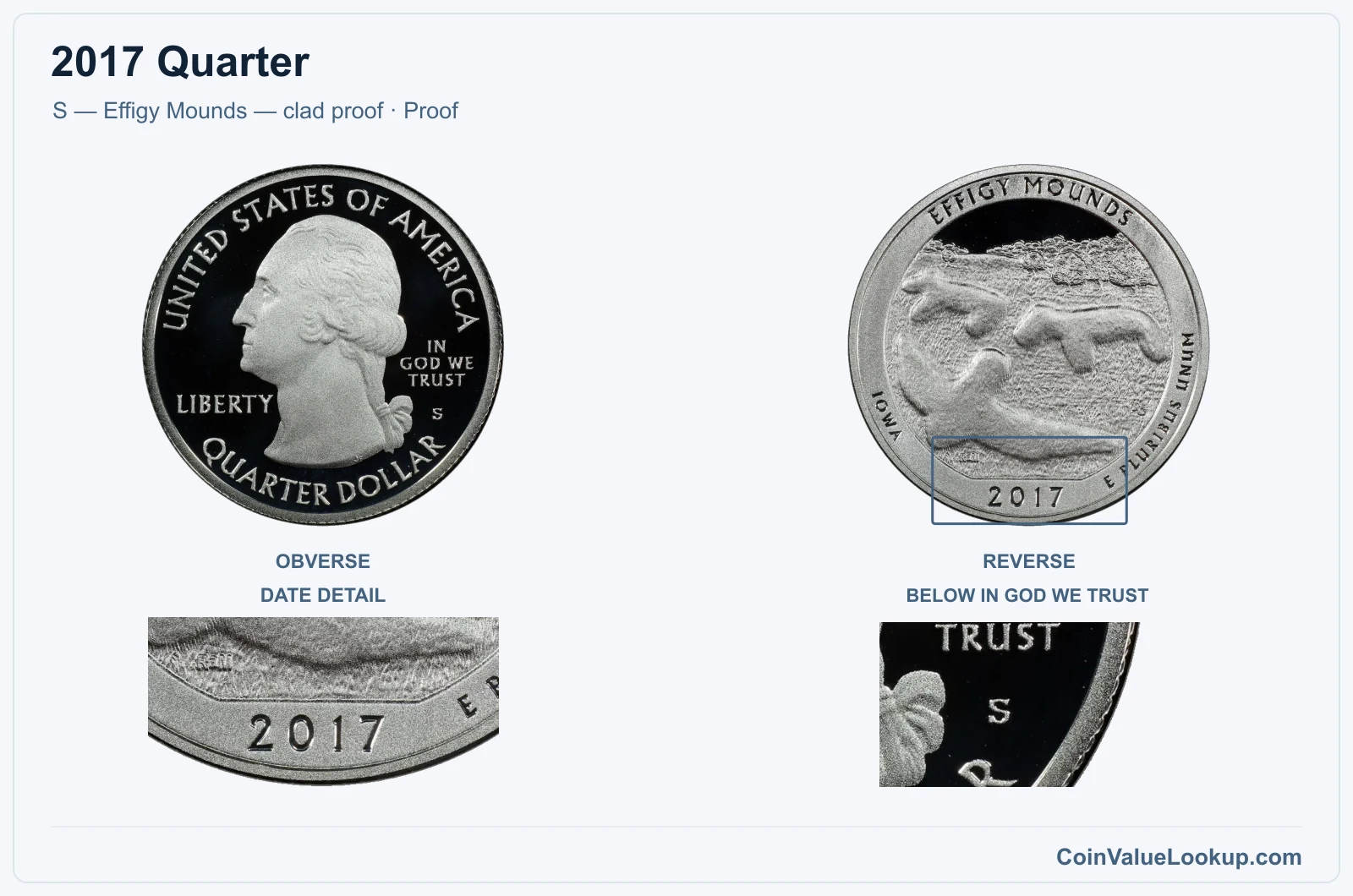
This is the clad proof Effigy Mounds quarter from San Francisco. It features mirror-like fields with frosted raised devices, the signature look of a modern proof.
The composition is copper-nickel clad, not silver, so check the edge for a visible copper band. USA Coin Book guides this at about $5.63 in PR65.
Keep it separate from the silver proof version, which looks nearly identical from the front but weighs more and has a uniformly silver edge.
Range Grade
Price Auction Records Appraisal PR PR 1
—
Coin Identifier
PR 2
—
Coin Identifier
PR 3
—
Coin Identifier
PR 4
—
Coin Identifier
PR 6
—
Coin Identifier
PR 8
—
Coin Identifier
PR 10
—
Coin Identifier
PR 12
—
Coin Identifier
PR 15
—
Coin Identifier
PR 20
—
Coin Identifier
PR 25
—
Coin Identifier
PR 30
—
Coin Identifier
PR 35
—
Coin Identifier
PR 40
—
Coin Identifier
PR 45
—
Coin Identifier
PR 50
—
Coin Identifier
PR 53
—
Coin Identifier
PR 55
—
Coin Identifier
PR 58
—
Coin Identifier
PR 60
—
Coin Identifier
PR 61
—
Coin Identifier
PR 62
—
Coin Identifier
PR 63
—
Coin Identifier
PR 64
—
Coin Identifier
PR 65
—
Coin Identifier
PR 66
—
Coin Identifier
PR 67
—
Coin Identifier
PR 68
—
Coin Identifier
PR 69
—
Coin Identifier
PR 70
Coin Identifier
2017 Quarter — S — Effigy Mounds — silver proof
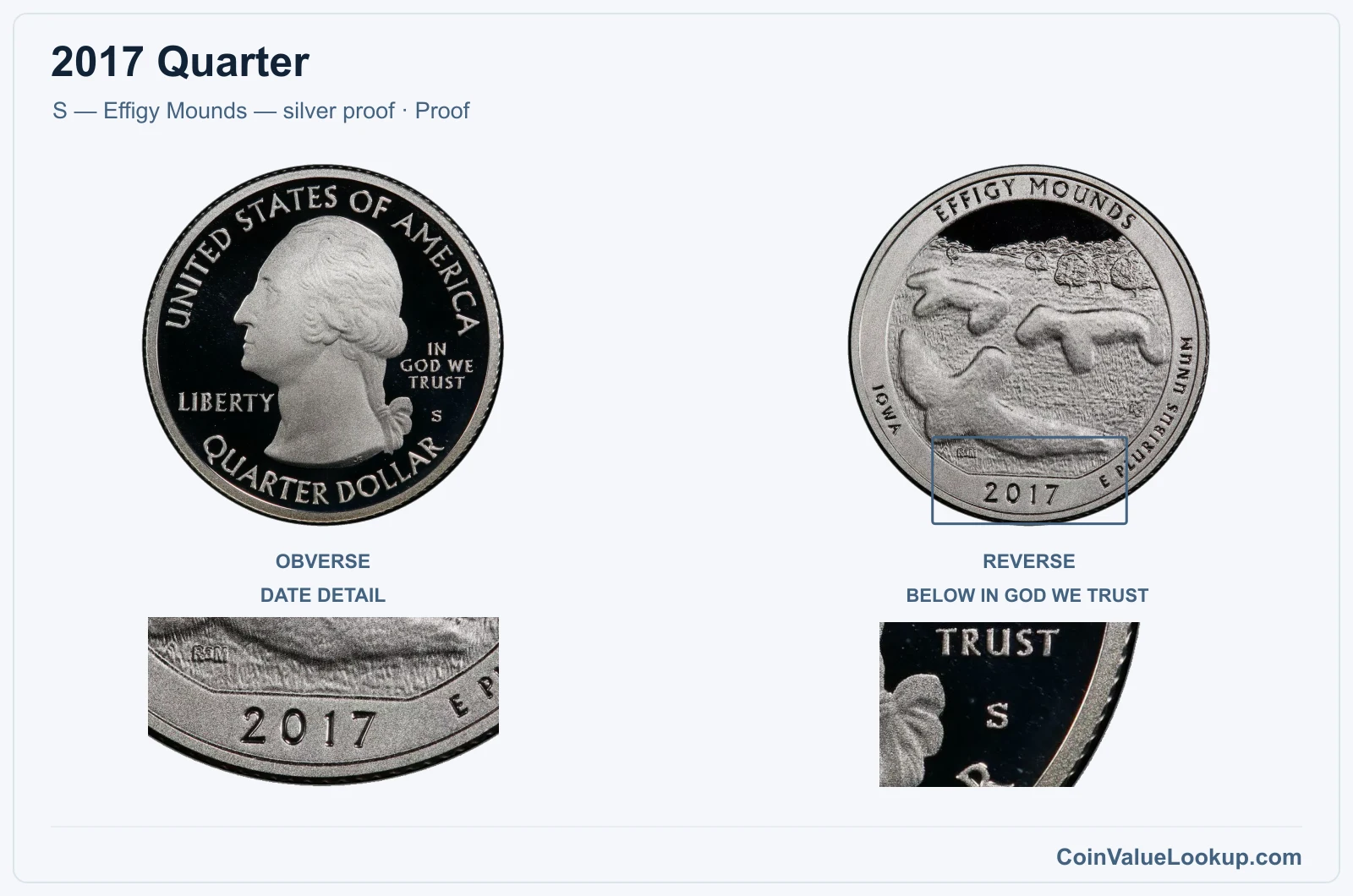
The silver proof Effigy Mounds quarter is struck in 90% silver and 10% copper, weighing approximately 6.25 grams. That is heavier than the 5.67-gram clad version, and the edge will appear uniformly silver with no copper stripe.
USA Coin Book places this at $24.00 in PR65, making it one of the higher-value regular versions for 2017. Original packaging helps confirm the silver composition if you are uncertain.
Hairline-free mirror fields and strong frosted devices are what separate a top-grade example from a merely average one.
Range Grade
Price Auction Records Appraisal PR PR 1
—
Coin Identifier
PR 2
—
Coin Identifier
PR 3
—
Coin Identifier
PR 4
—
Coin Identifier
PR 6
—
Coin Identifier
PR 8
—
Coin Identifier
PR 10
—
Coin Identifier
PR 12
—
Coin Identifier
PR 15
—
Coin Identifier
PR 20
—
Coin Identifier
PR 25
—
Coin Identifier
PR 30
—
Coin Identifier
PR 35
—
Coin Identifier
PR 40
—
Coin Identifier
PR 45
—
Coin Identifier
PR 50
—
Coin Identifier
PR 53
—
Coin Identifier
PR 55
—
Coin Identifier
PR 58
—
Coin Identifier
PR 60
—
Coin Identifier
PR 61
—
Coin Identifier
PR 62
—
Coin Identifier
PR 63
—
Coin Identifier
PR 64
—
Coin Identifier
PR 65
—
Coin Identifier
PR 66
—
Coin Identifier
PR 67
—
Coin Identifier
PR 68
—
Coin Identifier
PR 69
—
Coin Identifier
PR 70
Coin Identifier
2017 Quarter — S — Effigy Mounds — enhanced uncirculated
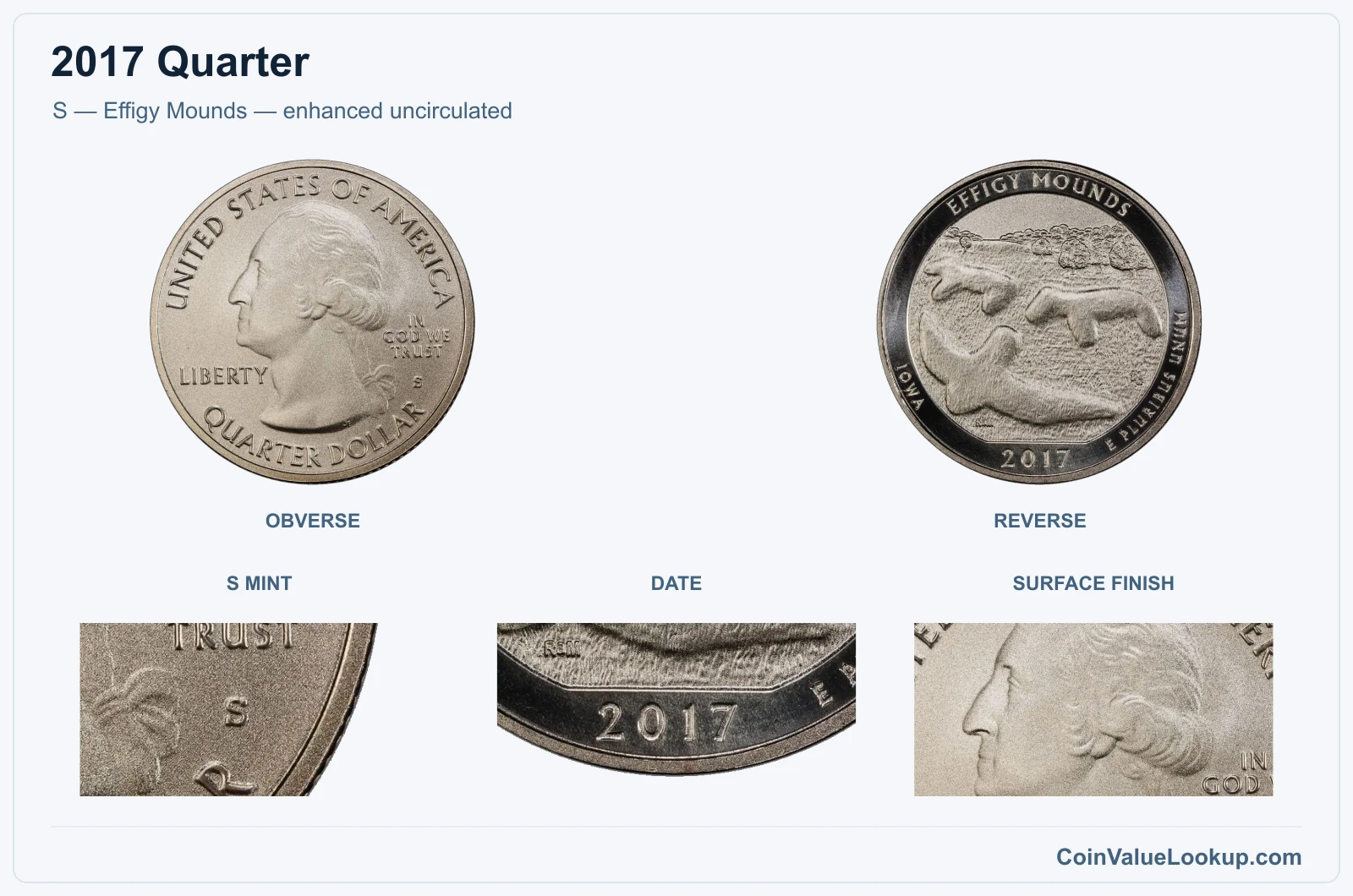
The enhanced uncirculated Effigy Mounds quarter was issued as part of the 225th Anniversary set. It carries an S mintmark and is copper-nickel clad, but it is neither a standard business strike nor a proof.
The finish uses multiple surface textures to create a distinctive look. Value depends on the coin's authenticated identity and condition, so there is no single guide figure to cite here.
If you believe you have one, confirm it came from the original Mint packaging or have it professionally attributed.
Range Grade
Price Auction Records Appraisal SP SP 1
—
Coin Identifier
SP 2
—
Coin Identifier
SP 3
—
Coin Identifier
SP 4
—
Coin Identifier
SP 6
—
Coin Identifier
SP 8
—
Coin Identifier
SP 10
—
Coin Identifier
SP 12
—
Coin Identifier
SP 15
—
Coin Identifier
SP 20
—
Coin Identifier
SP 25
—
Coin Identifier
SP 30
—
Coin Identifier
SP 35
—
Coin Identifier
SP 40
—
Coin Identifier
SP 45
—
Coin Identifier
SP 50
—
Coin Identifier
SP 53
—
Coin Identifier
SP 55
—
Coin Identifier
SP 58
—
Coin Identifier
SP 60
—
Coin Identifier
SP 61
—
Coin Identifier
SP 62
—
Coin Identifier
SP 63
—
Coin Identifier
SP 64
—
Coin Identifier
SP 65
—
Coin Identifier
SP 66
—
Coin Identifier
SP 67
—
Coin Identifier
SP 68
—
Coin Identifier
SP 69
—
Coin Identifier
SP 70
—
Coin Identifier
2017 Quarter — P — Ellis Island — regular strike
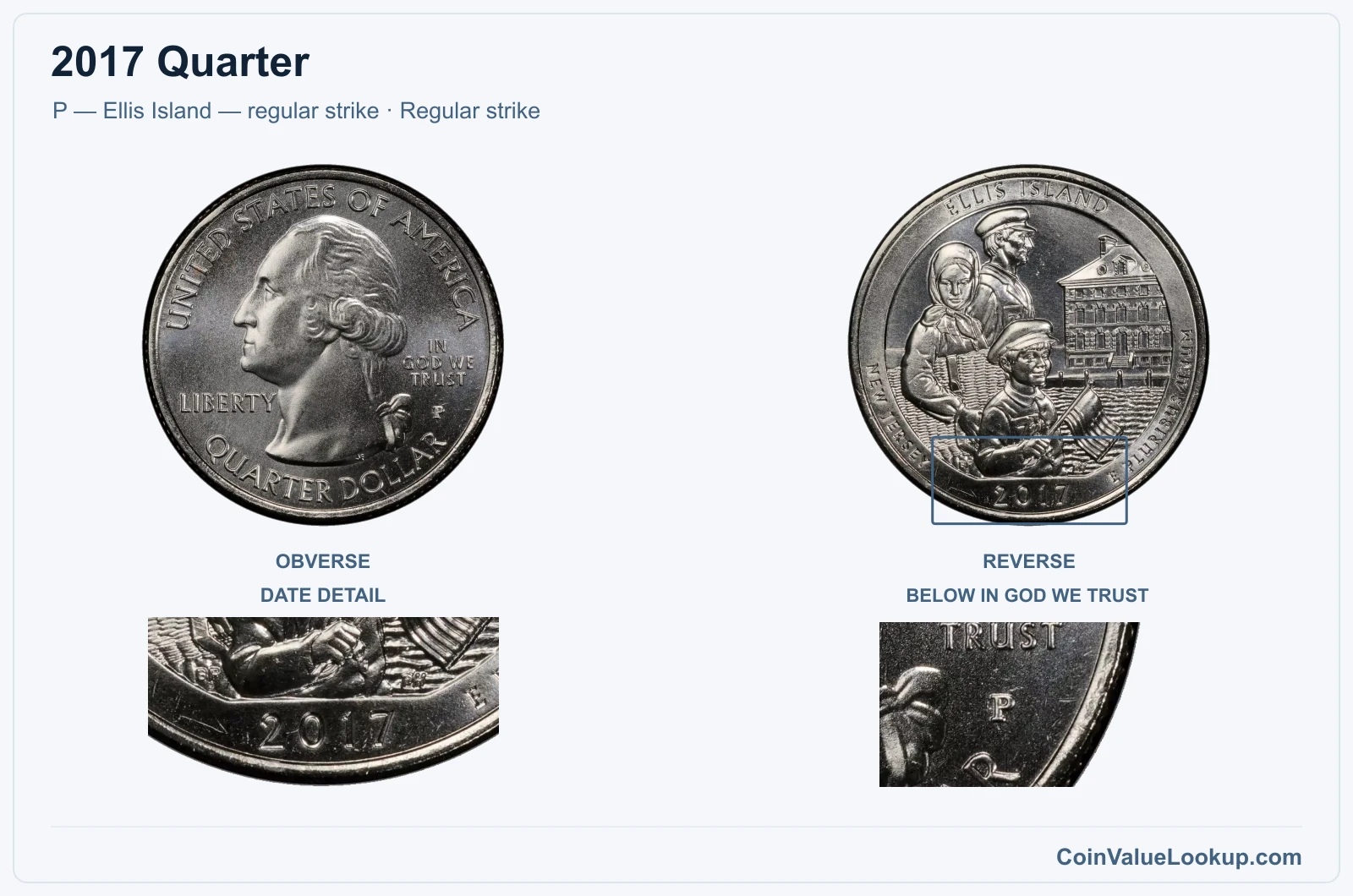
Philadelphia-mint Ellis Island quarter in copper-nickel clad. The reverse shows the famous immigrant gateway.
USA Coin Book estimates $0.61 at MS60 and $1.24 at MS65.
Circulated examples are worth 25 cents. For a collector premium, you need an original uncirculated coin with full luster.
Confirm the P mintmark and the Ellis Island reverse before comparing grades.
Range Grade
Price Auction Records Appraisal PO PO 1
—
Coin Identifier FR FR 2
—
Coin Identifier AG AG 3
—
Coin Identifier G G 4
—
Coin Identifier
G 6
—
Coin Identifier VG VG 8
—
Coin Identifier
VG 10
—
Coin Identifier F F 12
—
Coin Identifier
F 15
—
Coin Identifier VF VF 20
—
Coin Identifier
VF 25
—
Coin Identifier
VF 30
—
Coin Identifier
VF 35
—
Coin Identifier XF XF 40
—
Coin Identifier
XF 45
—
Coin Identifier AU AU 50
—
Coin Identifier
AU 53
—
Coin Identifier
AU 55
—
Coin Identifier
AU 58
—
Coin Identifier MS MS 60
—
Coin Identifier
MS 61
—
Coin Identifier
MS 62
—
Coin Identifier
MS 63
—
Coin Identifier
MS 64
—
Coin Identifier
MS 65
—
Coin Identifier
MS 66
—
Coin Identifier
MS 67
—
Coin Identifier
MS 68
—
—
—
MS 69
—
—
—
MS 70
—
—
—
2017 Quarter — D — Ellis Island — regular strike
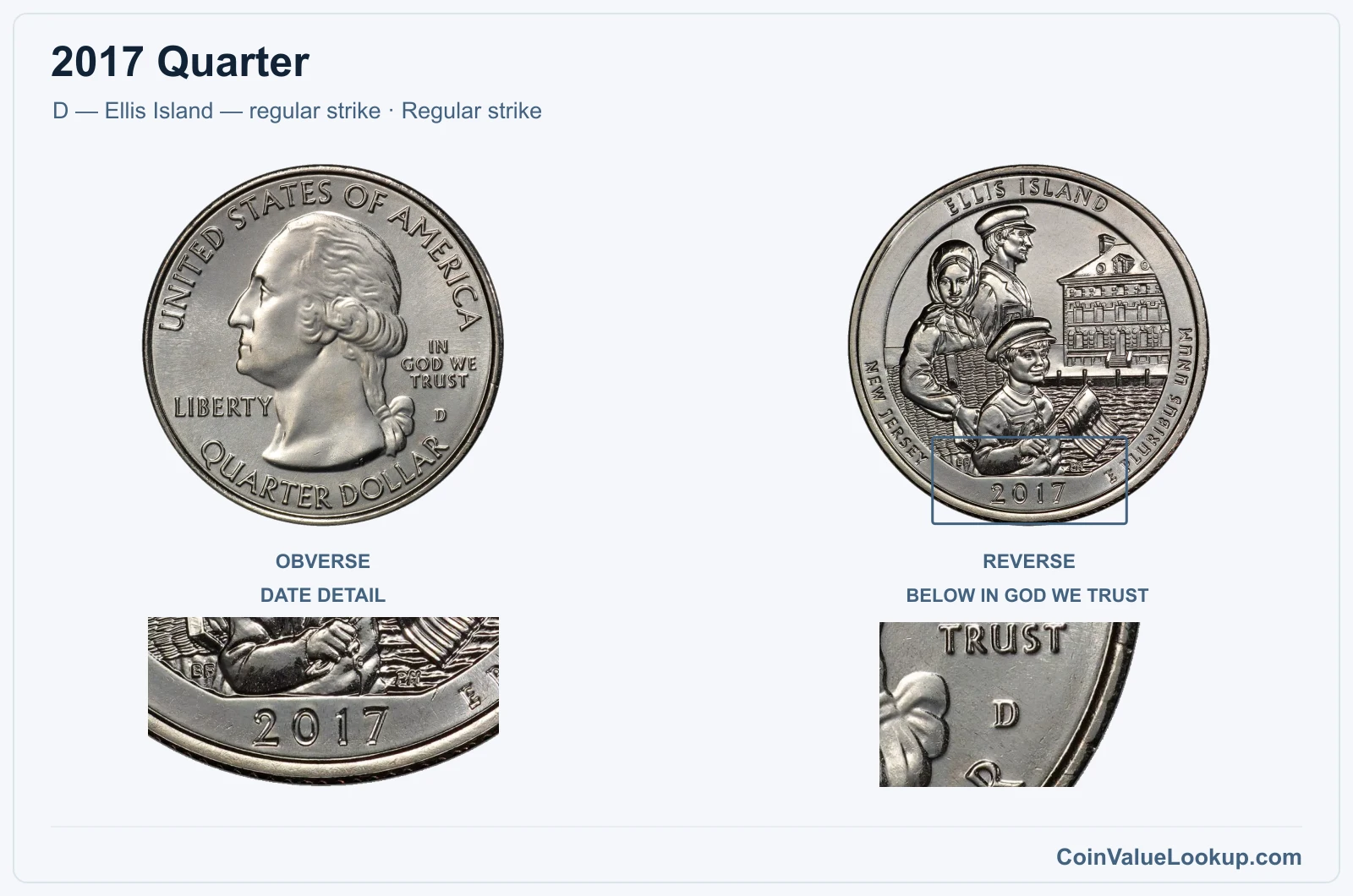
The Denver-mint Ellis Island quarter is the same copper-nickel clad composition and design as its P-mint sibling. Guide estimates from USA Coin Book: $0.61 at MS60 and $1.24 at MS65.
Look for the D mintmark near Washington's portrait. Worn pieces circulate at face value.
Only well-preserved, original-luster examples command a small premium above 25 cents.
Range Grade
Price Auction Records Appraisal PO PO 1
—
Coin Identifier FR FR 2
—
Coin Identifier AG AG 3
—
Coin Identifier G G 4
—
Coin Identifier
G 6
—
Coin Identifier VG VG 8
—
Coin Identifier
VG 10
—
Coin Identifier F F 12
—
Coin Identifier
F 15
—
Coin Identifier VF VF 20
—
Coin Identifier
VF 25
—
Coin Identifier
VF 30
—
Coin Identifier
VF 35
—
Coin Identifier XF XF 40
—
Coin Identifier
XF 45
—
Coin Identifier AU AU 50
—
Coin Identifier
AU 53
—
Coin Identifier
AU 55
—
Coin Identifier
AU 58
—
Coin Identifier MS MS 60
—
Coin Identifier
MS 61
—
Coin Identifier
MS 62
—
Coin Identifier
MS 63
—
Coin Identifier
MS 64
—
Coin Identifier
MS 65
—
Coin Identifier
MS 66
—
Coin Identifier
MS 67
—
Coin Identifier
MS 68
—
—
—
MS 69
—
—
—
MS 70
—
—
—
2017 Quarter — S — Ellis Island — regular strike
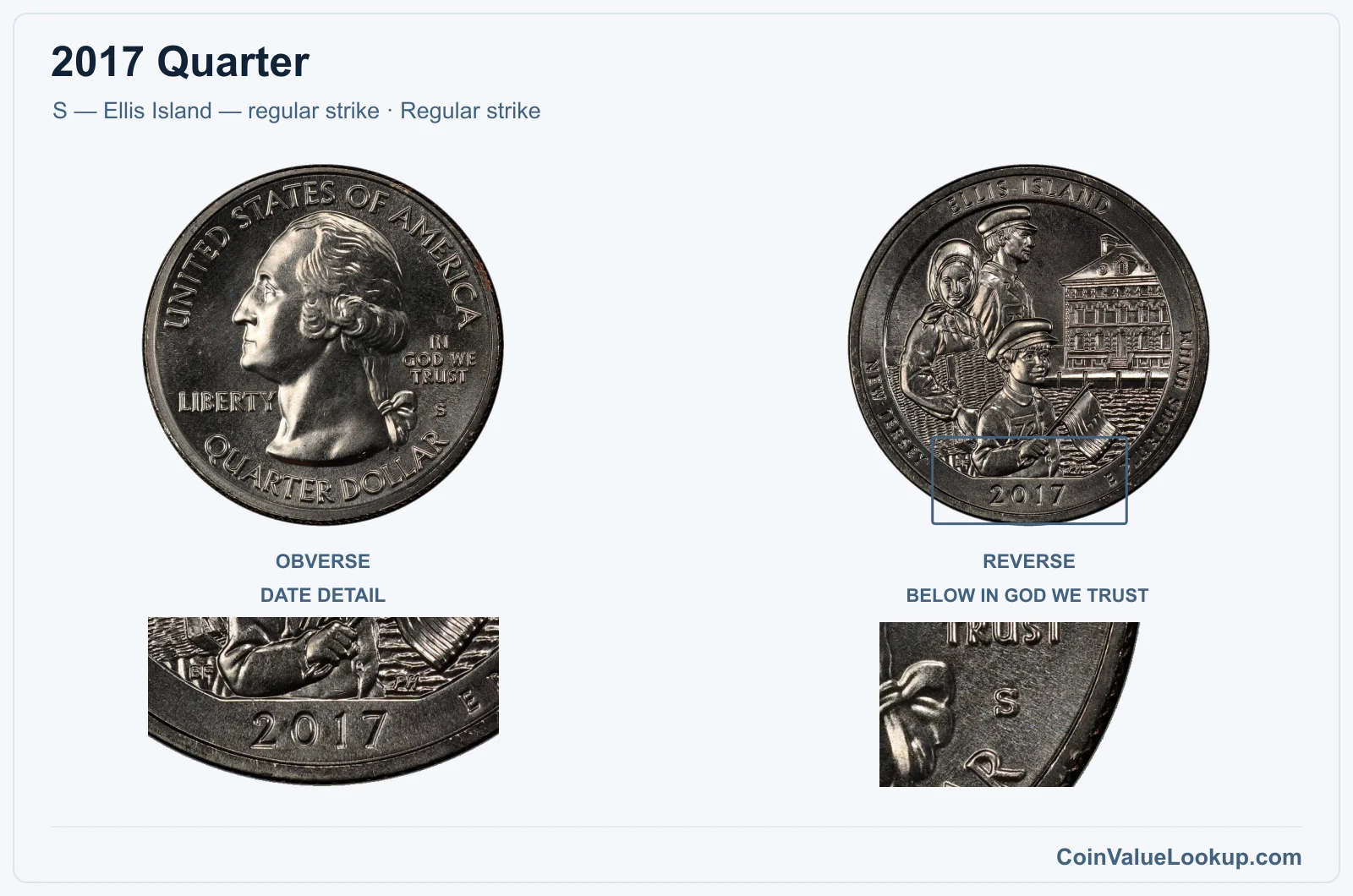
San Francisco's non-proof Ellis Island quarter is copper-nickel clad with an S mintmark. It was distributed in Mint sets, not through banks, so most examples survive in uncirculated condition.
USA Coin Book guides this at $3.62 in MS65. Do not assume proof just because you see an S.
The surfaces should look like a business strike, not a mirror.
Range Grade
Price Auction Records Appraisal PO PO 1
—
Coin Identifier FR FR 2
—
Coin Identifier AG AG 3
—
Coin Identifier G G 4
—
Coin Identifier
G 6
—
Coin Identifier VG VG 8
—
Coin Identifier
VG 10
—
Coin Identifier F F 12
—
Coin Identifier
F 15
—
Coin Identifier VF VF 20
—
Coin Identifier
VF 25
—
Coin Identifier
VF 30
—
Coin Identifier
VF 35
—
Coin Identifier XF XF 40
—
Coin Identifier
XF 45
—
Coin Identifier AU AU 50
—
Coin Identifier
AU 53
—
Coin Identifier
AU 55
—
Coin Identifier
AU 58
—
Coin Identifier MS MS 60
—
Coin Identifier
MS 61
—
Coin Identifier
MS 62
—
Coin Identifier
MS 63
—
Coin Identifier
MS 64
—
Coin Identifier
MS 65
—
Coin Identifier
MS 66
—
Coin Identifier
MS 67
—
Coin Identifier
MS 68
—
—
—
MS 69
—
—
—
MS 70
—
—
—
2017 Quarter — S — Ellis Island — clad proof
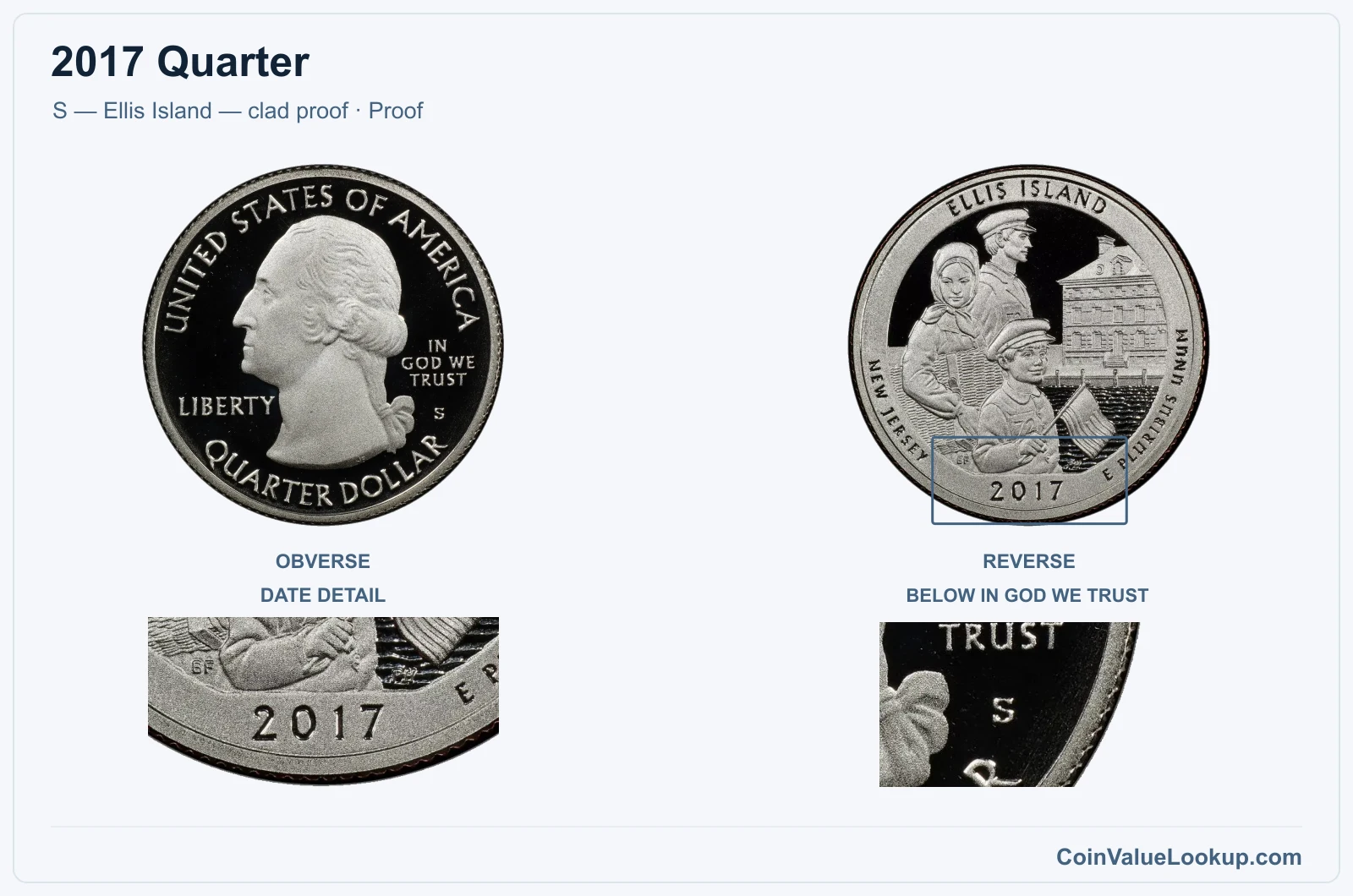
The clad proof Ellis Island quarter from San Francisco shows mirror fields and frosted devices. Composition is copper-nickel clad; check the edge for a copper band to distinguish it from the silver proof.
USA Coin Book guides it at $5.63 in PR65. Proofs are a manufacturing finish, not a grade above Mint State, so the PR scale is used rather than MS.
Hairlines from improper handling are the most common condition detractor.
Range Grade
Price Auction Records Appraisal PR PR 1
—
Coin Identifier
PR 2
—
Coin Identifier
PR 3
—
Coin Identifier
PR 4
—
Coin Identifier
PR 6
—
Coin Identifier
PR 8
—
Coin Identifier
PR 10
—
Coin Identifier
PR 12
—
Coin Identifier
PR 15
—
Coin Identifier
PR 20
—
Coin Identifier
PR 25
—
Coin Identifier
PR 30
—
Coin Identifier
PR 35
—
Coin Identifier
PR 40
—
Coin Identifier
PR 45
—
Coin Identifier
PR 50
—
Coin Identifier
PR 53
—
Coin Identifier
PR 55
—
Coin Identifier
PR 58
—
Coin Identifier
PR 60
—
Coin Identifier
PR 61
—
Coin Identifier
PR 62
—
Coin Identifier
PR 63
—
Coin Identifier
PR 64
—
Coin Identifier
PR 65
—
Coin Identifier
PR 66
—
Coin Identifier
PR 67
—
Coin Identifier
PR 68
—
Coin Identifier
PR 69
—
Coin Identifier
PR 70
—
Coin Identifier
2017 Quarter — S — Ellis Island — silver proof
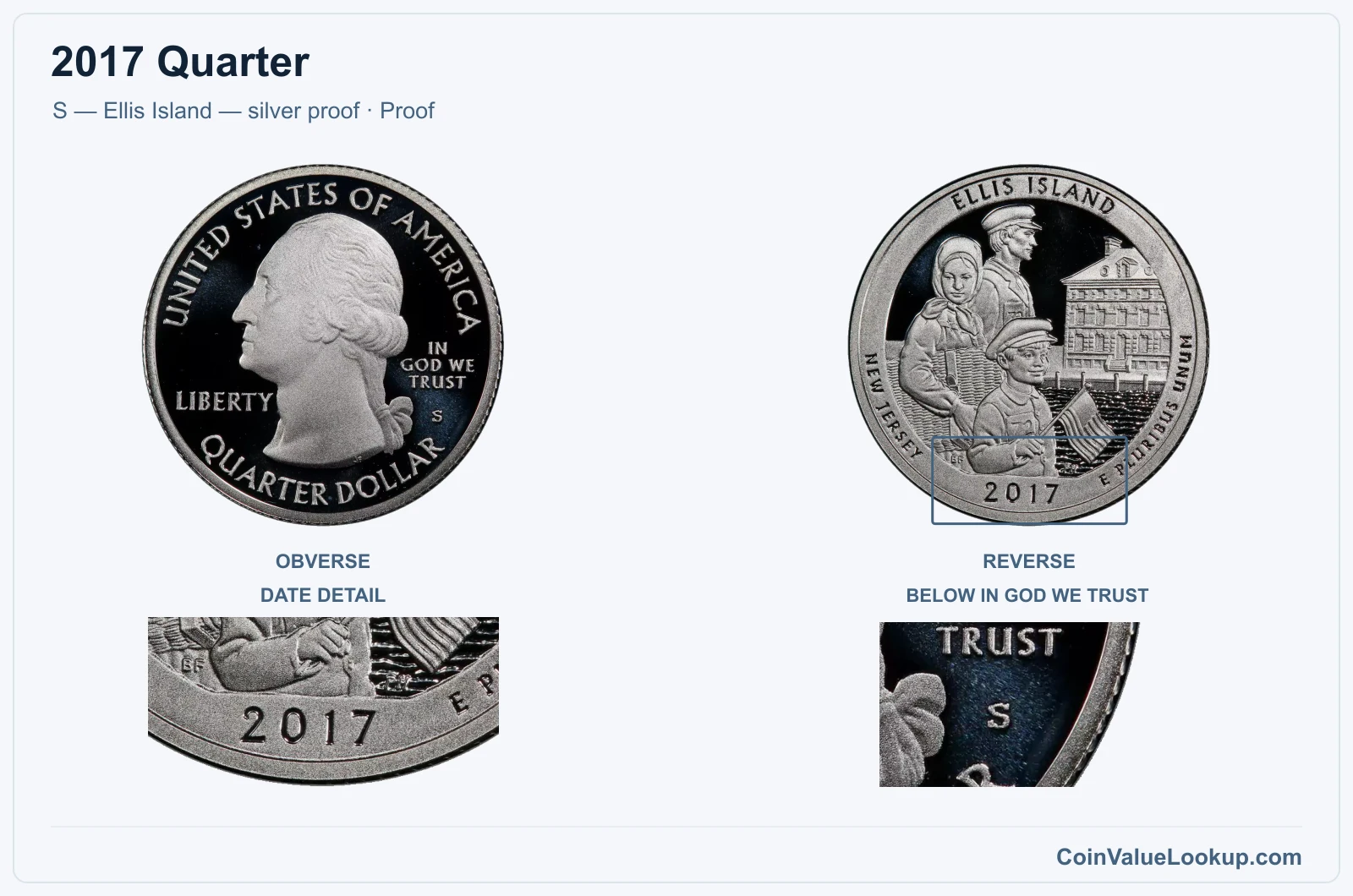
The silver proof Ellis Island quarter is 90% silver and 10% copper, weighing about 6.25 grams. The edge is uniformly silver with no copper layer visible.
USA Coin Book estimates $24.00 at PR65. If you are looking up several 2017 quarter designs at once, Coin Value Lookup is a convenient starting point for finding the right guide for each version.
Confirm silver composition through weight or original Mint packaging before assuming you have the higher-value version.
Range Grade
Price Auction Records Appraisal PR PR 1
—
Coin Identifier
PR 2
—
Coin Identifier
PR 3
—
Coin Identifier
PR 4
—
Coin Identifier
PR 6
—
Coin Identifier
PR 8
—
Coin Identifier
PR 10
—
Coin Identifier
PR 12
—
Coin Identifier
PR 15
—
Coin Identifier
PR 20
—
Coin Identifier
PR 25
—
Coin Identifier
PR 30
—
Coin Identifier
PR 35
—
Coin Identifier
PR 40
—
Coin Identifier
PR 45
—
Coin Identifier
PR 50
—
Coin Identifier
PR 53
—
Coin Identifier
PR 55
—
Coin Identifier
PR 58
—
Coin Identifier
PR 60
—
Coin Identifier
PR 61
—
Coin Identifier
PR 62
—
Coin Identifier
PR 63
—
Coin Identifier
PR 64
—
Coin Identifier
PR 65
—
Coin Identifier
PR 66
—
Coin Identifier
PR 67
—
Coin Identifier
PR 68
—
Coin Identifier
PR 69
—
Coin Identifier
PR 70
—
Coin Identifier
2017 Quarter — S — Ellis Island — enhanced uncirculated
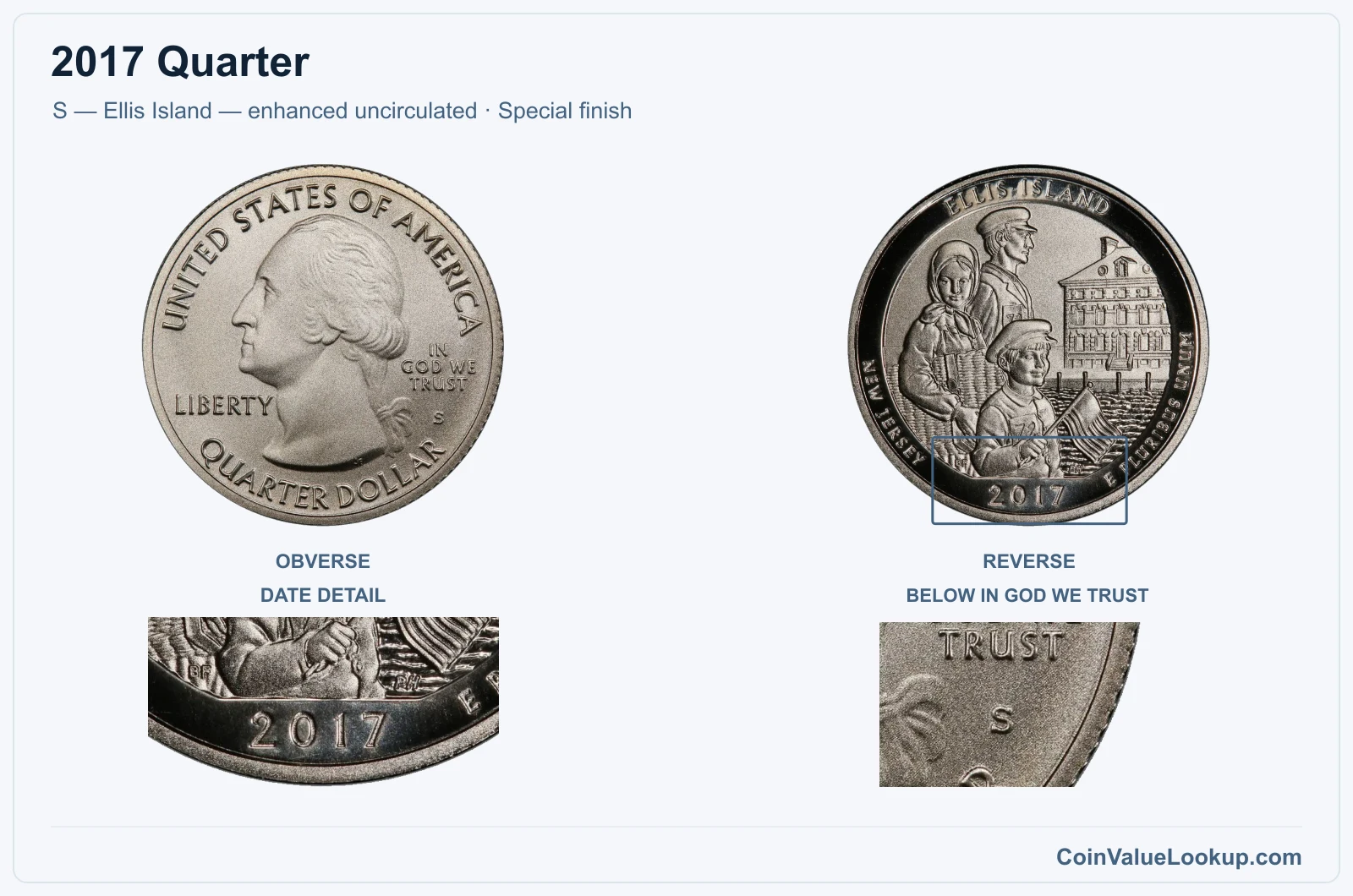
The enhanced uncirculated Ellis Island quarter was part of the 225th Anniversary set, struck at San Francisco in copper-nickel clad. Its finish features multiple deliberate textures that set it apart from both business strikes and proofs.
No guide price is adopted for this version. Value is determined individually based on authenticated identity and condition.
Original Mint packaging or professional attribution is the best way to confirm this finish.
Range Grade
Price Auction Records Appraisal SP SP 1
—
Coin Identifier
SP 2
—
Coin Identifier
SP 3
—
Coin Identifier
SP 4
—
Coin Identifier
SP 6
—
Coin Identifier
SP 8
—
Coin Identifier
SP 10
—
Coin Identifier
SP 12
—
Coin Identifier
SP 15
—
Coin Identifier
SP 20
—
Coin Identifier
SP 25
—
Coin Identifier
SP 30
—
Coin Identifier
SP 35
—
Coin Identifier
SP 40
—
Coin Identifier
SP 45
—
Coin Identifier
SP 50
—
Coin Identifier
SP 53
—
Coin Identifier
SP 55
—
Coin Identifier
SP 58
—
Coin Identifier
SP 60
—
Coin Identifier
SP 61
—
Coin Identifier
SP 62
—
Coin Identifier
SP 63
—
Coin Identifier
SP 64
—
Coin Identifier
SP 65
—
Coin Identifier
SP 66
—
Coin Identifier
SP 67
—
Coin Identifier
SP 68
—
Coin Identifier
SP 69
—
Coin Identifier
SP 70
—
Coin Identifier
2017 Quarter — P — Ozark Riverways — regular strike
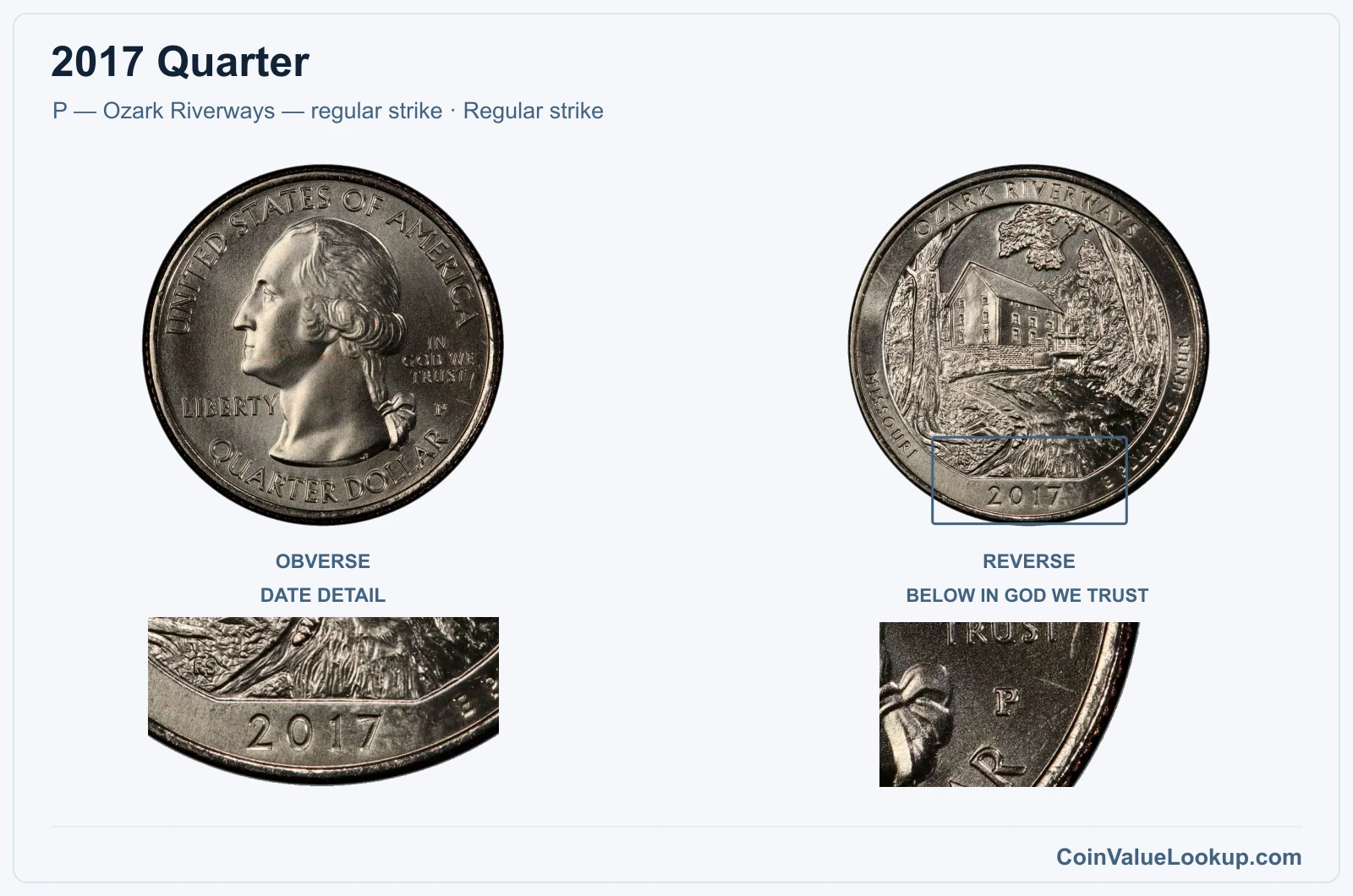
Philadelphia-mint Ozark Riverways quarter, copper-nickel clad. The reverse shows a canoeist on the riverway.
Worn examples trade at face value.
No specific guide price is adopted for this version. Value depends on the individual coin's condition and authenticated identity.
Uncirculated examples pulled from original rolls are the ones most likely to carry a small collector premium.
Range Grade
Price Auction Records Appraisal PO PO 1
—
Coin Identifier FR FR 2
—
Coin Identifier AG AG 3
—
Coin Identifier G G 4
—
Coin Identifier
G 6
—
Coin Identifier VG VG 8
—
Coin Identifier
VG 10
—
Coin Identifier F F 12
—
Coin Identifier
F 15
—
Coin Identifier VF VF 20
—
Coin Identifier
VF 25
—
Coin Identifier
VF 30
—
Coin Identifier
VF 35
—
Coin Identifier XF XF 40
—
Coin Identifier
XF 45
—
Coin Identifier AU AU 50
—
Coin Identifier
AU 53
—
Coin Identifier
AU 55
—
Coin Identifier
AU 58
—
Coin Identifier MS MS 60
—
Coin Identifier
MS 61
—
Coin Identifier
MS 62
—
Coin Identifier
MS 63
—
Coin Identifier
MS 64
—
Coin Identifier
MS 65
—
Coin Identifier
MS 66
—
Coin Identifier
MS 67
—
Coin Identifier
MS 68
Coin Identifier
MS 69
—
—
—
MS 70
—
—
—
2017 Quarter — D — Ozark Riverways — regular strike
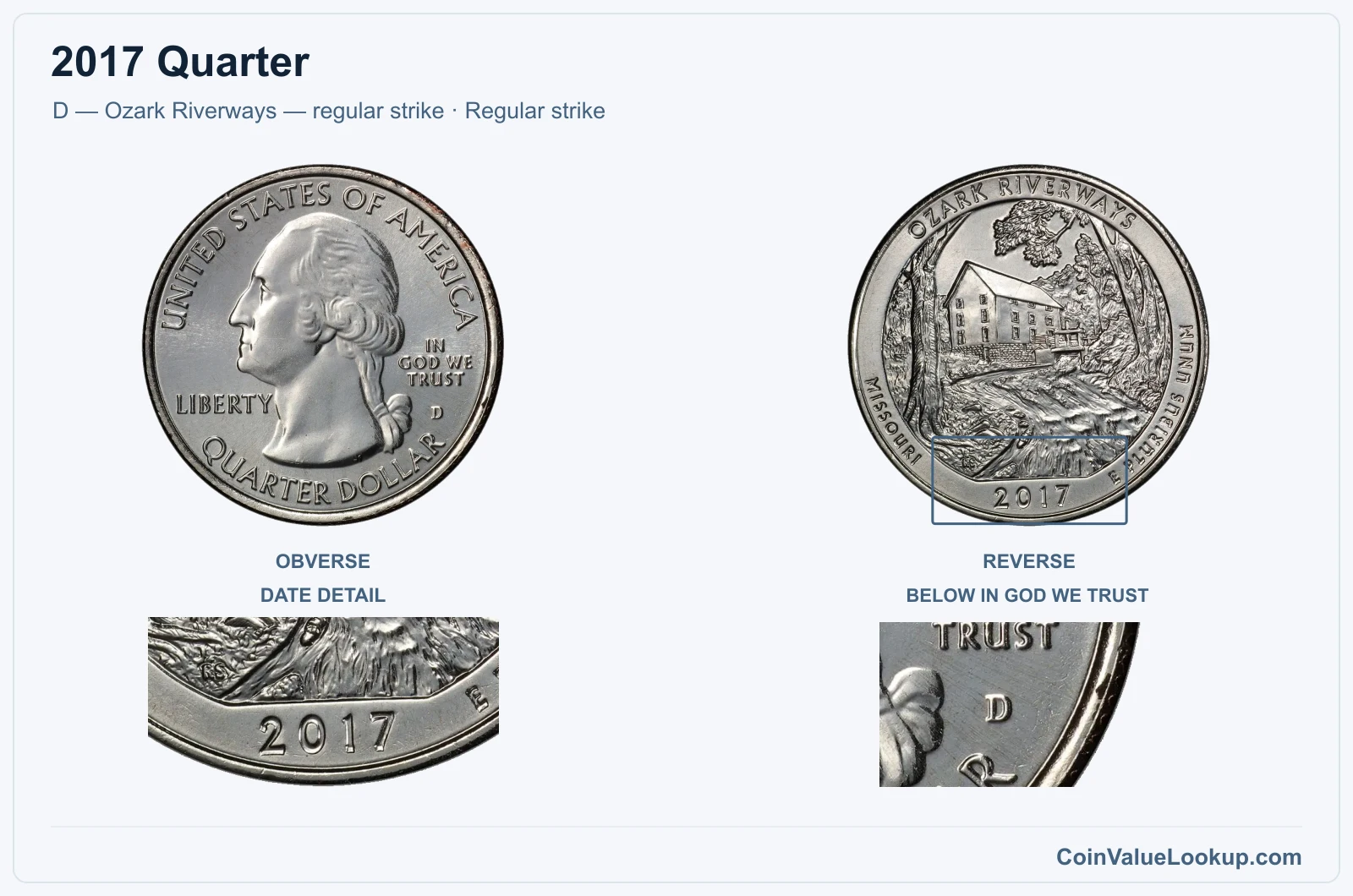
The Denver-mint Ozark Riverways quarter shares the same copper-nickel clad makeup as the P-mint version. Look for the D mintmark on the obverse to distinguish it.
No adopted guide price is available for this version. Circulated coins are worth 25 cents.
Only pristine, original-luster specimens would attract collector attention, so condition is everything.
Range Grade
Price Auction Records Appraisal PO PO 1
—
Coin Identifier FR FR 2
—
Coin Identifier AG AG 3
—
Coin Identifier G G 4
—
Coin Identifier
G 6
—
Coin Identifier VG VG 8
—
Coin Identifier
VG 10
—
Coin Identifier F F 12
—
Coin Identifier
F 15
—
Coin Identifier VF VF 20
—
Coin Identifier
VF 25
—
Coin Identifier
VF 30
—
Coin Identifier
VF 35
—
Coin Identifier XF XF 40
—
Coin Identifier
XF 45
—
Coin Identifier AU AU 50
—
Coin Identifier
AU 53
—
Coin Identifier
AU 55
—
Coin Identifier
AU 58
—
Coin Identifier MS MS 60
—
Coin Identifier
MS 61
—
Coin Identifier
MS 62
—
Coin Identifier
MS 63
—
Coin Identifier
MS 64
—
Coin Identifier
MS 65
—
Coin Identifier
MS 66
—
Coin Identifier
MS 67
—
Coin Identifier
MS 68
—
—
—
MS 69
—
—
—
MS 70
—
—
—
2017 Quarter — S — Ozark Riverways — regular strike
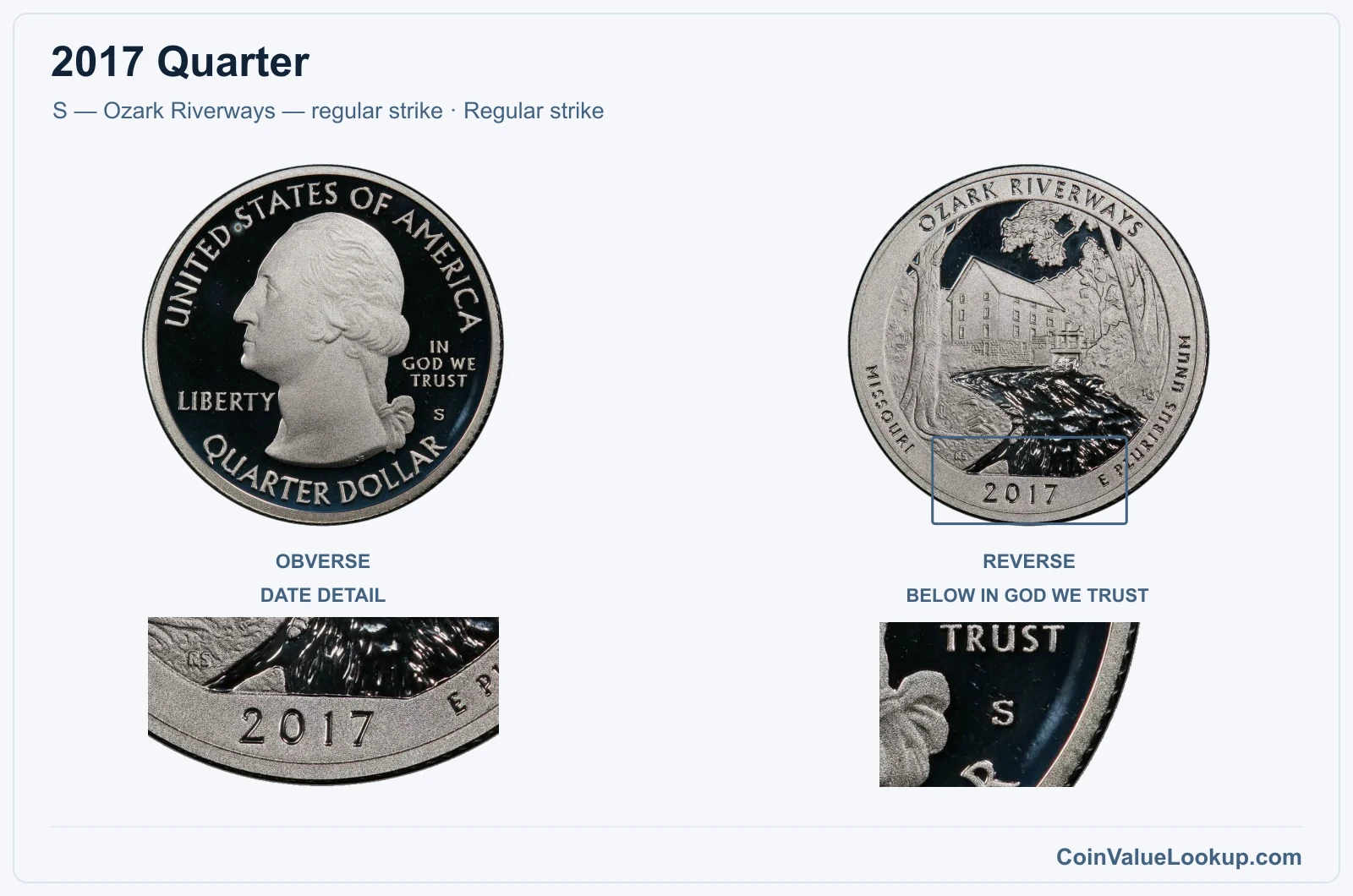
San Francisco's non-proof Ozark Riverways quarter bears an S mintmark but is a business strike, not a proof. It is copper-nickel clad and was sold through Mint sets.
No guide price is adopted for this version. The S mintmark and Mint-set distribution mean most surviving examples are in good condition, and individual value depends on precise grade and authentication.
Range Grade
Price Auction Records Appraisal PO PO 1
—
Coin Identifier FR FR 2
—
Coin Identifier AG AG 3
—
Coin Identifier G G 4
—
Coin Identifier
G 6
—
Coin Identifier VG VG 8
—
Coin Identifier
VG 10
—
Coin Identifier F F 12
—
Coin Identifier
F 15
—
Coin Identifier VF VF 20
—
Coin Identifier
VF 25
—
Coin Identifier
VF 30
—
Coin Identifier
VF 35
—
Coin Identifier XF XF 40
—
Coin Identifier
XF 45
—
Coin Identifier AU AU 50
—
Coin Identifier
AU 53
—
Coin Identifier
AU 55
—
Coin Identifier
AU 58
—
Coin Identifier MS MS 60
—
Coin Identifier
MS 61
—
Coin Identifier
MS 62
—
Coin Identifier
MS 63
—
Coin Identifier
MS 64
—
Coin Identifier
MS 65
—
Coin Identifier
MS 66
—
Coin Identifier
MS 67
—
Coin Identifier
MS 68
—
—
—
MS 69
—
—
—
MS 70
—
—
—
2017 Quarter — S — Ozark Riverways — clad proof
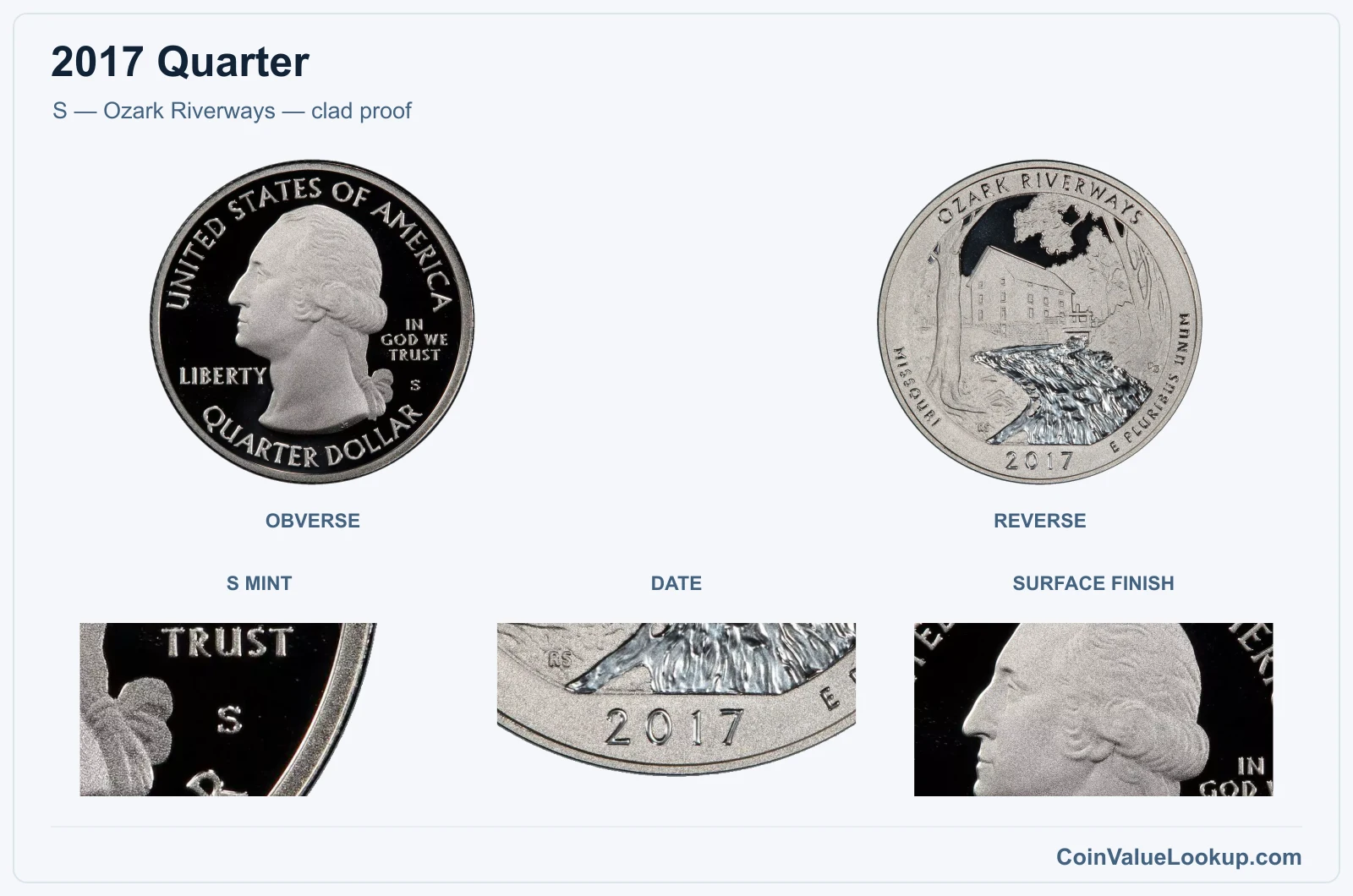
The clad proof Ozark Riverways quarter from San Francisco features mirror fields and frosted devices on copper-nickel clad planchets. Confirm the clad edge before comparing with silver proof prices.
No specific guide price is adopted for this version. Proof condition is graded on the PR scale; look for hairline-free fields and strong contrast between frosted and mirrored surfaces to identify a high-grade piece.
Range Grade
Price Auction Records Appraisal PR PR 1
—
Coin Identifier
PR 2
—
Coin Identifier
PR 3
—
Coin Identifier
PR 4
—
Coin Identifier
PR 6
—
Coin Identifier
PR 8
—
Coin Identifier
PR 10
—
Coin Identifier
PR 12
—
Coin Identifier
PR 15
—
Coin Identifier
PR 20
—
Coin Identifier
PR 25
—
Coin Identifier
PR 30
—
Coin Identifier
PR 35
—
Coin Identifier
PR 40
—
Coin Identifier
PR 45
—
Coin Identifier
PR 50
—
Coin Identifier
PR 53
—
Coin Identifier
PR 55
—
Coin Identifier
PR 58
—
Coin Identifier
PR 60
—
Coin Identifier
PR 61
—
Coin Identifier
PR 62
—
Coin Identifier
PR 63
—
Coin Identifier
PR 64
—
Coin Identifier
PR 65
—
Coin Identifier
PR 66
—
Coin Identifier
PR 67
—
Coin Identifier
PR 68
—
Coin Identifier
PR 69
—
Coin Identifier
PR 70
—
Coin Identifier
2017 Quarter — S — Ozark Riverways — silver proof
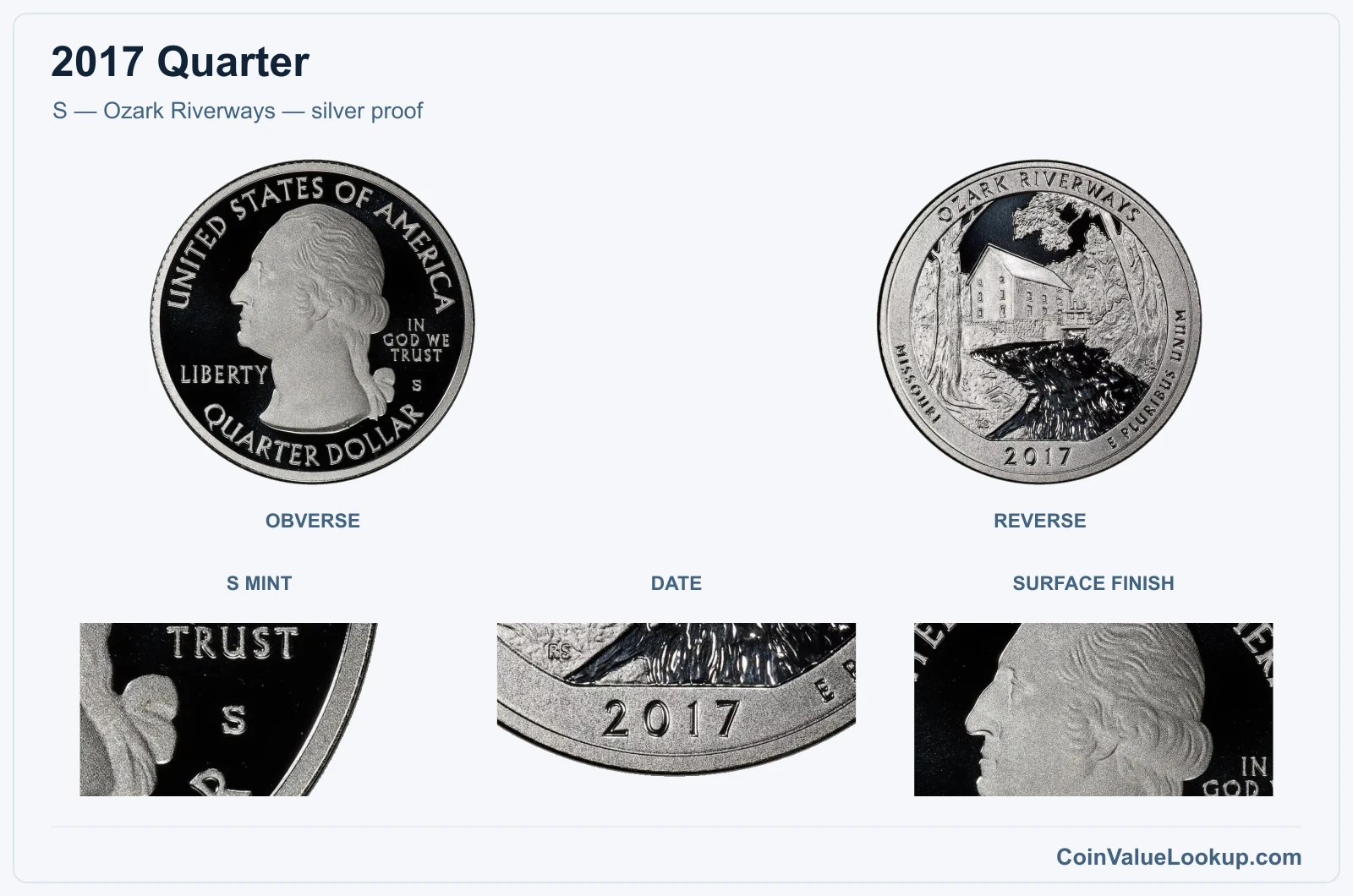
The silver proof Ozark Riverways quarter is 90% silver and 10% copper, with a nominal weight of about 6.25 grams. The edge looks uniformly silver, and the weight difference from a clad proof is noticeable on a precise scale.
No adopted guide price is available for this version. Silver proofs generally command a premium over their clad counterparts.
Confirm silver composition via edge inspection, weight or original packaging before assuming you have this version.
Range Grade
Price Auction Records Appraisal PR PR 1
—
Coin Identifier
PR 2
—
Coin Identifier
PR 3
—
Coin Identifier
PR 4
—
Coin Identifier
PR 6
—
Coin Identifier
PR 8
—
Coin Identifier
PR 10
—
Coin Identifier
PR 12
—
Coin Identifier
PR 15
—
Coin Identifier
PR 20
—
Coin Identifier
PR 25
—
Coin Identifier
PR 30
—
Coin Identifier
PR 35
—
Coin Identifier
PR 40
—
Coin Identifier
PR 45
—
Coin Identifier
PR 50
—
Coin Identifier
PR 53
—
Coin Identifier
PR 55
—
Coin Identifier
PR 58
—
Coin Identifier
PR 60
—
Coin Identifier
PR 61
—
Coin Identifier
PR 62
—
Coin Identifier
PR 63
—
Coin Identifier
PR 64
—
Coin Identifier
PR 65
—
Coin Identifier
PR 66
—
Coin Identifier
PR 67
—
Coin Identifier
PR 68
—
Coin Identifier
PR 69
—
Coin Identifier
PR 70
—
Coin Identifier
2017 Quarter — S — Ozark Riverways — enhanced uncirculated
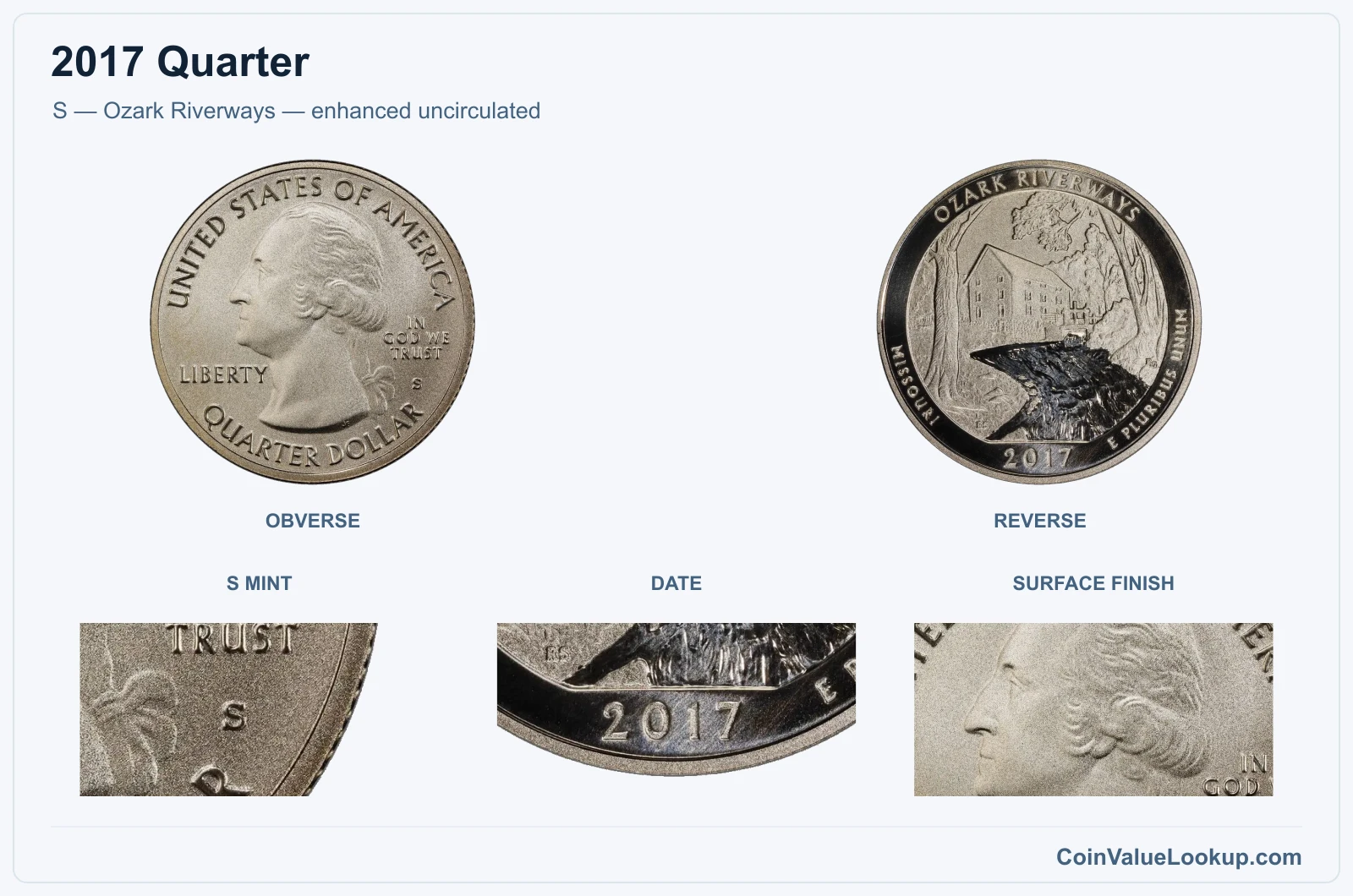
The enhanced uncirculated Ozark Riverways quarter is an S-mint copper-nickel clad coin from the 225th Anniversary set. Its multi-texture finish is distinct from the regular S business strike and the proof.
No guide price is adopted for this version. If you think you have one, original Mint packaging or professional attribution is the reliable way to confirm it.
Value depends on authenticated identity and the coin's condition.
Range Grade
Price Auction Records Appraisal SP SP 1
—
Coin Identifier
SP 2
—
Coin Identifier
SP 3
—
Coin Identifier
SP 4
—
Coin Identifier
SP 6
—
Coin Identifier
SP 8
—
Coin Identifier
SP 10
—
Coin Identifier
SP 12
—
Coin Identifier
SP 15
—
Coin Identifier
SP 20
—
Coin Identifier
SP 25
—
Coin Identifier
SP 30
—
Coin Identifier
SP 35
—
Coin Identifier
SP 40
—
Coin Identifier
SP 45
—
Coin Identifier
SP 50
—
Coin Identifier
SP 53
—
Coin Identifier
SP 55
—
Coin Identifier
SP 58
—
Coin Identifier
SP 60
—
Coin Identifier
SP 61
—
Coin Identifier
SP 62
—
Coin Identifier
SP 63
—
Coin Identifier
SP 64
—
Coin Identifier
SP 65
—
Coin Identifier
SP 66
—
Coin Identifier
SP 67
—
Coin Identifier
SP 68
—
Coin Identifier
SP 69
—
Coin Identifier
SP 70
—
Coin Identifier
2017 Quarter — P — Frederick Douglass — regular strike
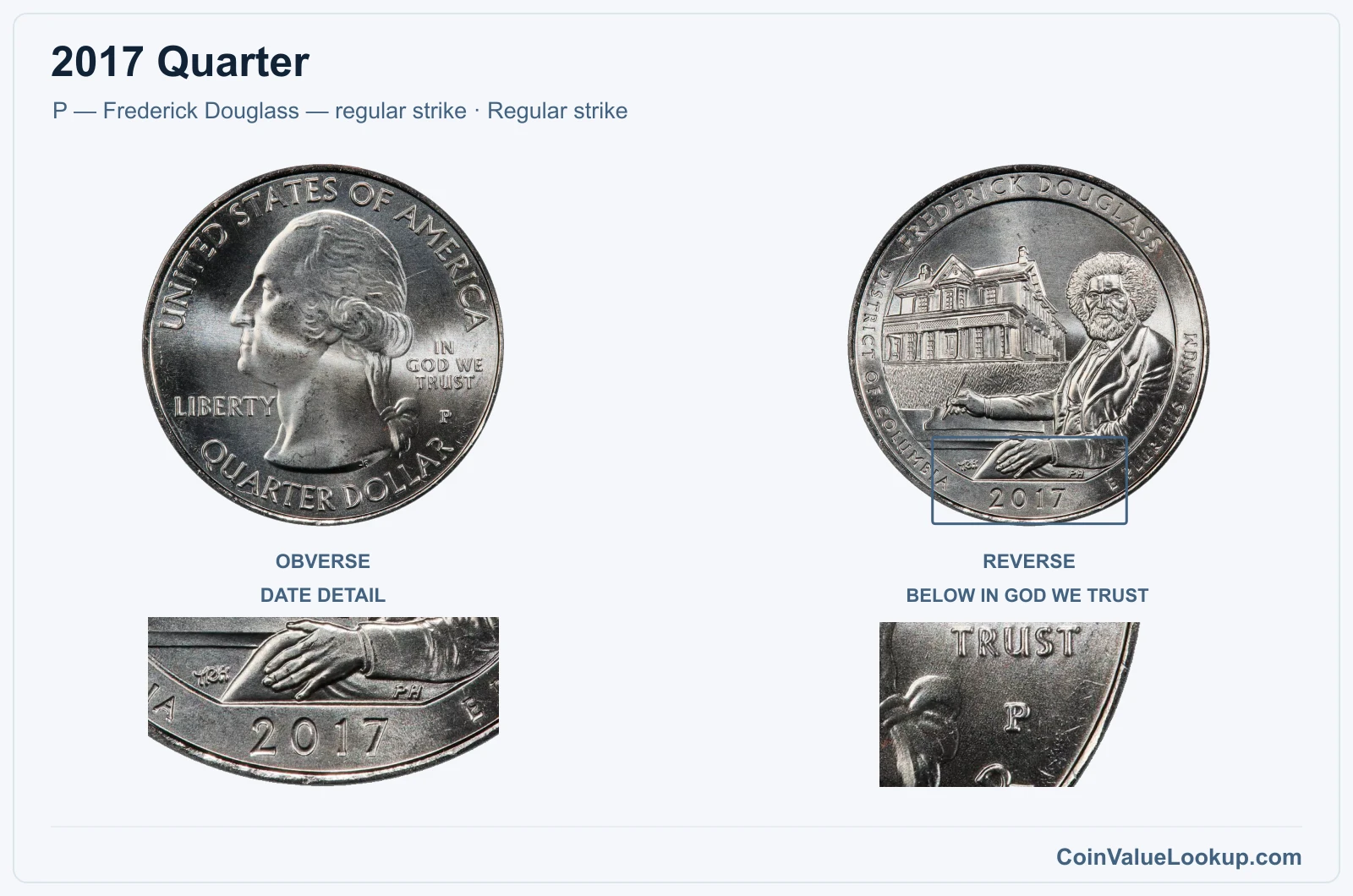
Philadelphia-mint Frederick Douglass quarter in standard copper-nickel clad. The reverse depicts Frederick Douglass seated with a book.
USA Coin Book guides this at $0.61 in MS60 and $1.24 in MS65.
Circulated pieces are face-value coins. An uncirculated example with strong original luster is needed for any collector premium.
Confirm the P mintmark and the correct reverse before grading.
Range Grade
Price Auction Records Appraisal PO PO 1
—
Coin Identifier FR FR 2
—
Coin Identifier AG AG 3
—
Coin Identifier G G 4
—
Coin Identifier
G 6
—
Coin Identifier VG VG 8
—
Coin Identifier
VG 10
—
Coin Identifier F F 12
—
Coin Identifier
F 15
—
Coin Identifier VF VF 20
—
Coin Identifier
VF 25
—
Coin Identifier
VF 30
—
Coin Identifier
VF 35
—
Coin Identifier XF XF 40
—
Coin Identifier
XF 45
—
Coin Identifier AU AU 50
—
Coin Identifier
AU 53
—
Coin Identifier
AU 55
—
Coin Identifier
AU 58
—
Coin Identifier MS MS 60
—
Coin Identifier
MS 61
—
Coin Identifier
MS 62
—
Coin Identifier
MS 63
—
Coin Identifier
MS 64
—
Coin Identifier
MS 65
—
Coin Identifier
MS 66
—
Coin Identifier
MS 67
—
Coin Identifier
MS 68
Coin Identifier
MS 69
—
—
—
MS 70
—
—
—
2017 Quarter — D — Frederick Douglass — regular strike
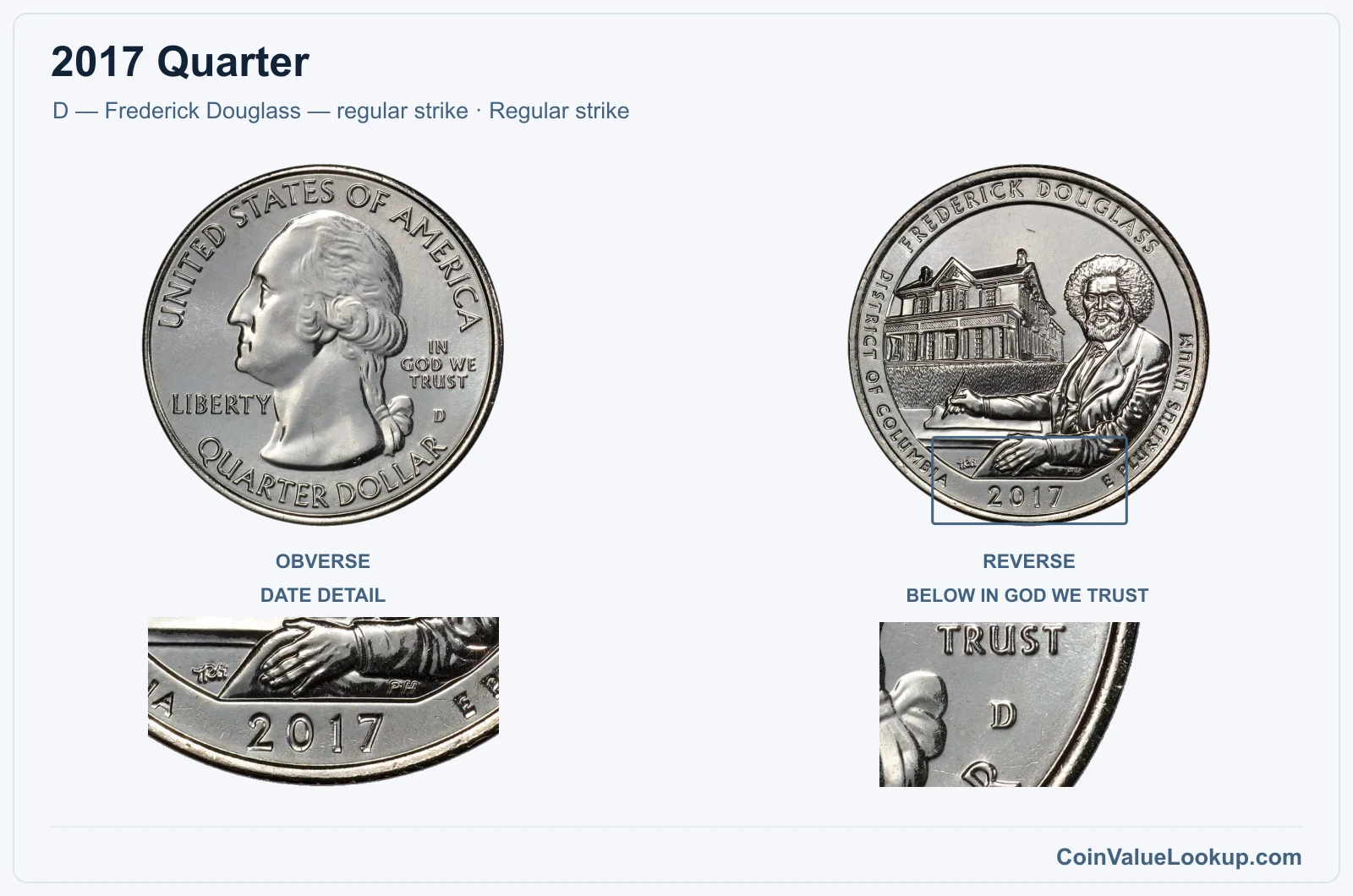
Denver-mint Frederick Douglass quarter, copper-nickel clad. USA Coin Book estimates $0.61 at MS60 and $1.24 at MS65.
Same story as the P-mint: circulated examples are 25-cent spenders.
Look for the D mintmark on the obverse. High-grade survivors from original rolls are the realistic source for collector-quality pieces.
Range Grade
Price Auction Records Appraisal PO PO 1
—
Coin Identifier FR FR 2
—
Coin Identifier AG AG 3
—
Coin Identifier G G 4
—
Coin Identifier
G 6
—
Coin Identifier VG VG 8
—
Coin Identifier
VG 10
—
Coin Identifier F F 12
—
Coin Identifier
F 15
—
Coin Identifier VF VF 20
—
Coin Identifier
VF 25
—
Coin Identifier
VF 30
—
Coin Identifier
VF 35
—
Coin Identifier XF XF 40
—
Coin Identifier
XF 45
—
Coin Identifier AU AU 50
—
Coin Identifier
AU 53
—
Coin Identifier
AU 55
—
Coin Identifier
AU 58
—
Coin Identifier MS MS 60
—
Coin Identifier
MS 61
—
Coin Identifier
MS 62
—
Coin Identifier
MS 63
—
Coin Identifier
MS 64
—
Coin Identifier
MS 65
—
Coin Identifier
MS 66
—
Coin Identifier
MS 67
—
Coin Identifier
MS 68
—
—
—
MS 69
—
—
—
MS 70
—
—
—
2017 Quarter — S — Frederick Douglass — regular strike
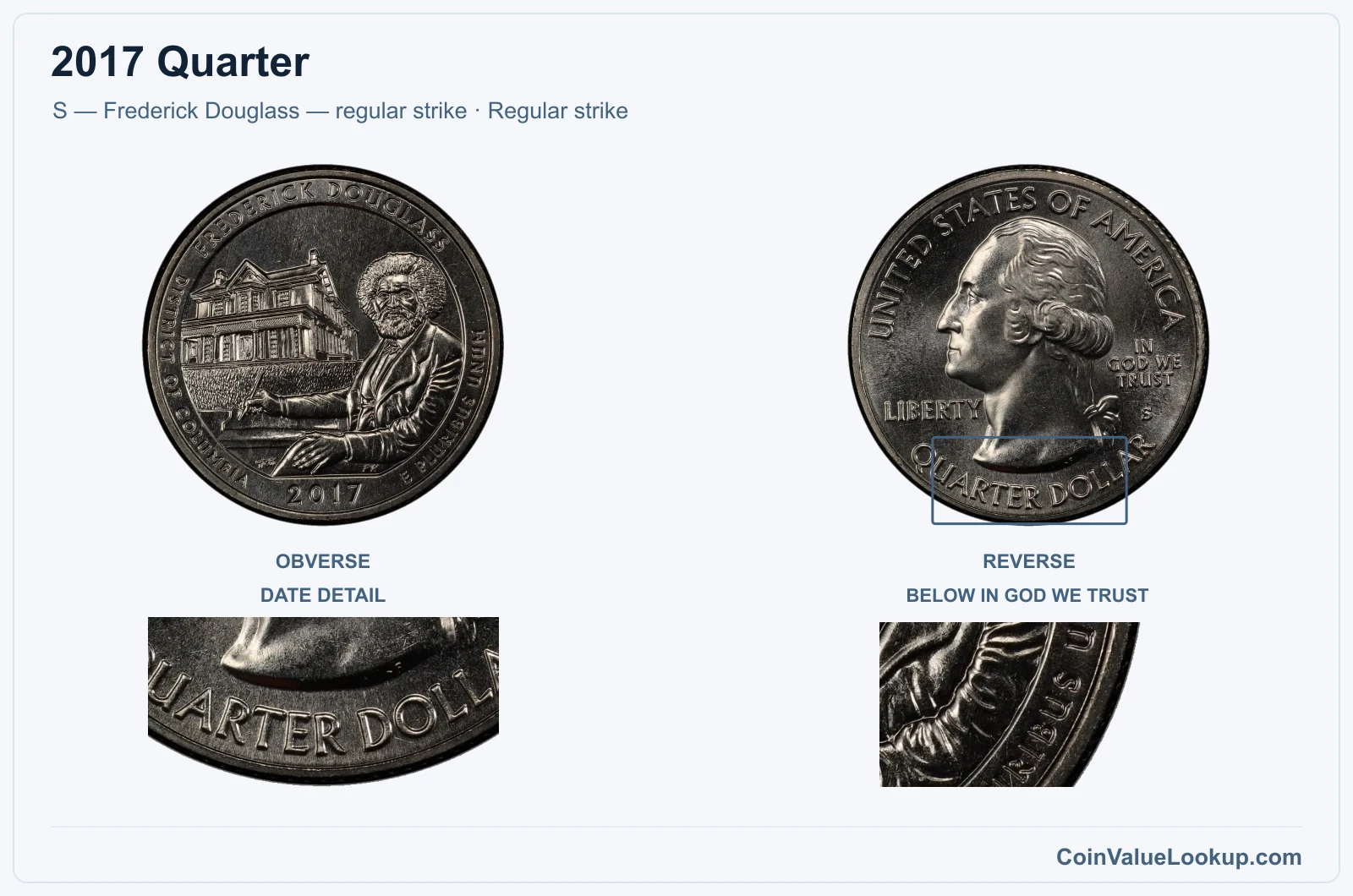
The San Francisco non-proof Frederick Douglass quarter is copper-nickel clad with an S mintmark. It was distributed in Mint sets, not through circulation channels.
USA Coin Book guides this at $3.62 in MS65. An S mintmark on a business-strike surface means this is a collector distribution coin, not a proof.
Most examples start out in decent shape because they were never spent.
Range Grade
Price Auction Records Appraisal PO PO 1
—
Coin Identifier FR FR 2
—
Coin Identifier AG AG 3
—
Coin Identifier G G 4
—
Coin Identifier
G 6
—
Coin Identifier VG VG 8
—
Coin Identifier
VG 10
—
Coin Identifier F F 12
—
Coin Identifier
F 15
—
Coin Identifier VF VF 20
—
Coin Identifier
VF 25
—
Coin Identifier
VF 30
—
Coin Identifier
VF 35
—
Coin Identifier XF XF 40
—
Coin Identifier
XF 45
—
Coin Identifier AU AU 50
—
Coin Identifier
AU 53
—
Coin Identifier
AU 55
—
Coin Identifier
AU 58
—
Coin Identifier MS MS 60
—
Coin Identifier
MS 61
—
Coin Identifier
MS 62
—
Coin Identifier
MS 63
—
Coin Identifier
MS 64
—
Coin Identifier
MS 65
—
Coin Identifier
MS 66
—
Coin Identifier
MS 67
—
Coin Identifier
MS 68
Coin Identifier
MS 69
—
—
—
MS 70
—
—
—
2017 Quarter — S — Frederick Douglass — clad proof
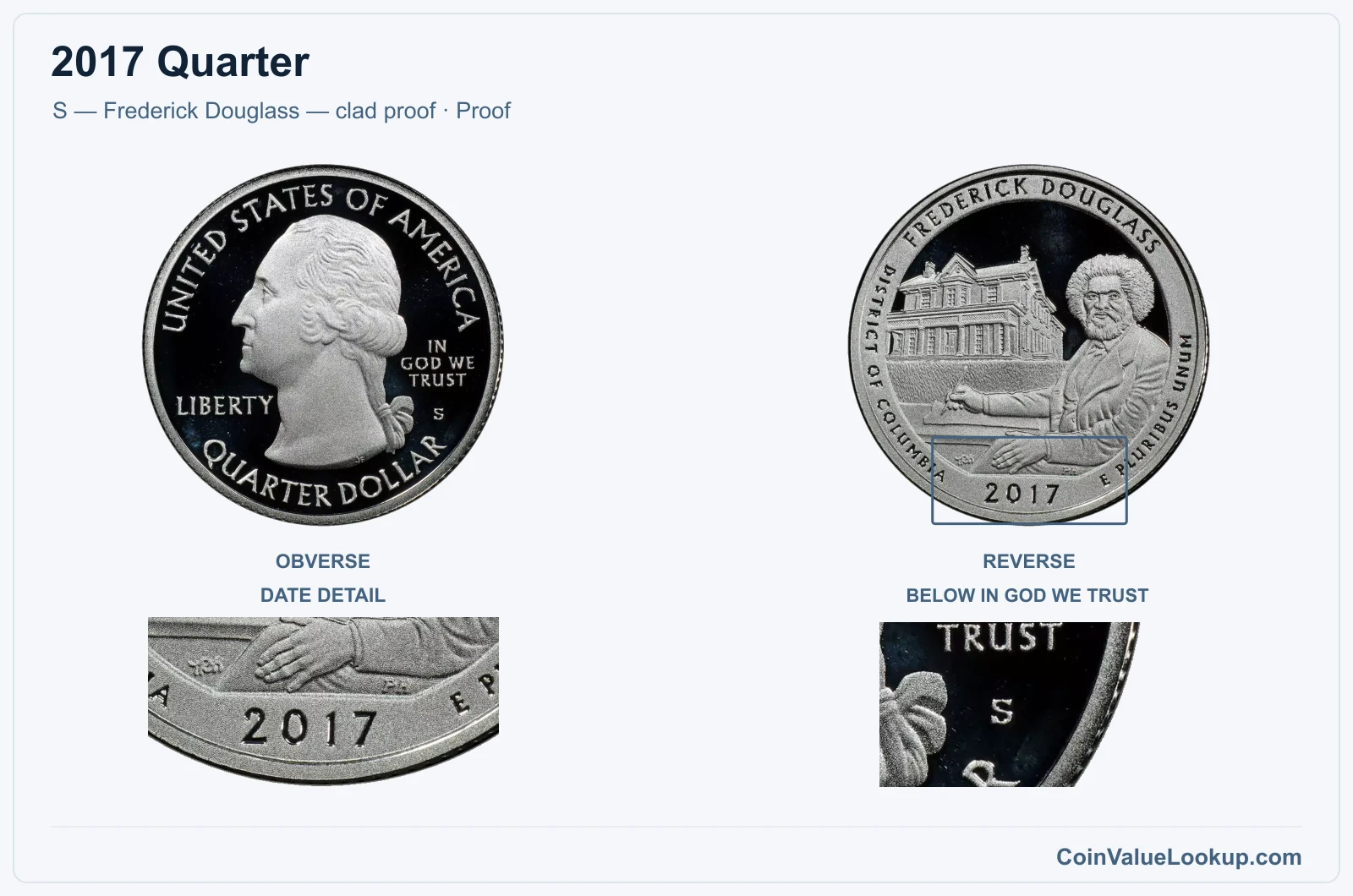
The clad proof Frederick Douglass quarter from San Francisco has mirror fields and frosted devices on a copper-nickel clad planchet. A visible copper edge band confirms the clad composition.
USA Coin Book guides it at $5.63 in PR65. Keep this version separate from the silver proof; the two look almost identical face-on, but edge color and weight tell them apart instantly.
Range Grade
Price Auction Records Appraisal PR PR 1
—
Coin Identifier
PR 2
—
Coin Identifier
PR 3
—
Coin Identifier
PR 4
—
Coin Identifier
PR 6
—
Coin Identifier
PR 8
—
Coin Identifier
PR 10
—
Coin Identifier
PR 12
—
Coin Identifier
PR 15
—
Coin Identifier
PR 20
—
Coin Identifier
PR 25
—
Coin Identifier
PR 30
—
Coin Identifier
PR 35
—
Coin Identifier
PR 40
—
Coin Identifier
PR 45
—
Coin Identifier
PR 50
—
Coin Identifier
PR 53
—
Coin Identifier
PR 55
—
Coin Identifier
PR 58
—
Coin Identifier
PR 60
—
Coin Identifier
PR 61
—
Coin Identifier
PR 62
—
Coin Identifier
PR 63
—
Coin Identifier
PR 64
—
Coin Identifier
PR 65
—
Coin Identifier
PR 66
—
Coin Identifier
PR 67
—
Coin Identifier
PR 68
—
Coin Identifier
PR 69
—
Coin Identifier
PR 70
—
Coin Identifier
2017 Quarter — S — Frederick Douglass — silver proof
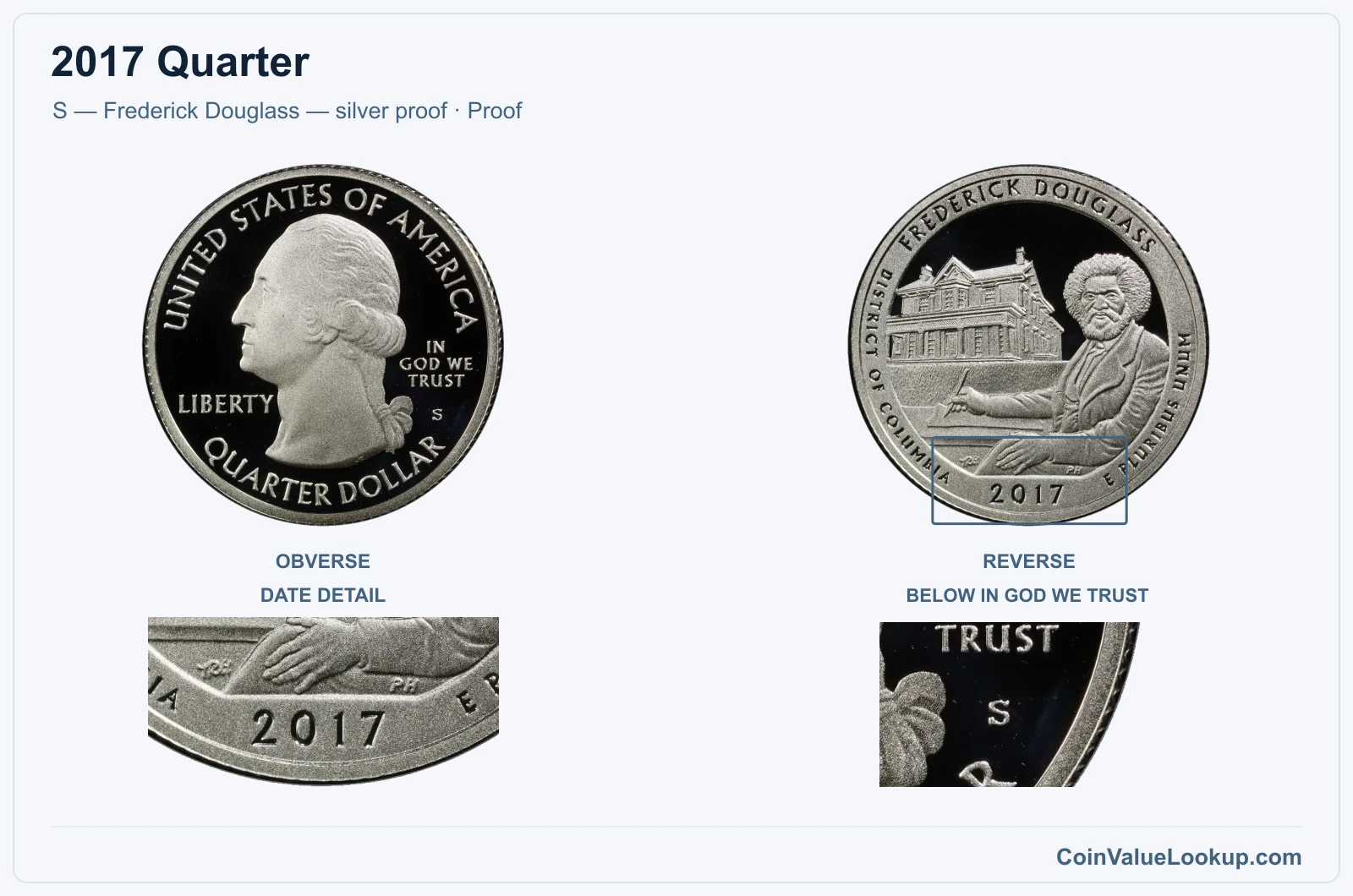
The silver proof Frederick Douglass quarter is 90% silver and 10% copper, weighing approximately 6.25 grams. Its edge is uniformly silver without a copper stripe.
USA Coin Book estimates $24.00 at PR65. This sits at the top of the adopted guide range for 2017 quarters alongside the other silver proofs.
Pristine mirror fields free of handling marks are essential for the highest grades. Original packaging is the simplest way to confirm silver content.
Range Grade
Price Auction Records Appraisal PR PR 1
—
Coin Identifier
PR 2
—
Coin Identifier
PR 3
—
Coin Identifier
PR 4
—
Coin Identifier
PR 6
—
Coin Identifier
PR 8
—
Coin Identifier
PR 10
—
Coin Identifier
PR 12
—
Coin Identifier
PR 15
—
Coin Identifier
PR 20
—
Coin Identifier
PR 25
—
Coin Identifier
PR 30
—
Coin Identifier
PR 35
—
Coin Identifier
PR 40
—
Coin Identifier
PR 45
—
Coin Identifier
PR 50
—
Coin Identifier
PR 53
—
Coin Identifier
PR 55
—
Coin Identifier
PR 58
—
Coin Identifier
PR 60
—
Coin Identifier
PR 61
—
Coin Identifier
PR 62
—
Coin Identifier
PR 63
—
Coin Identifier
PR 64
—
Coin Identifier
PR 65
—
Coin Identifier
PR 66
—
Coin Identifier
PR 67
—
Coin Identifier
PR 68
—
Coin Identifier
PR 69
—
Coin Identifier
PR 70
—
Coin Identifier
2017 Quarter — S — Frederick Douglass — enhanced uncirculated
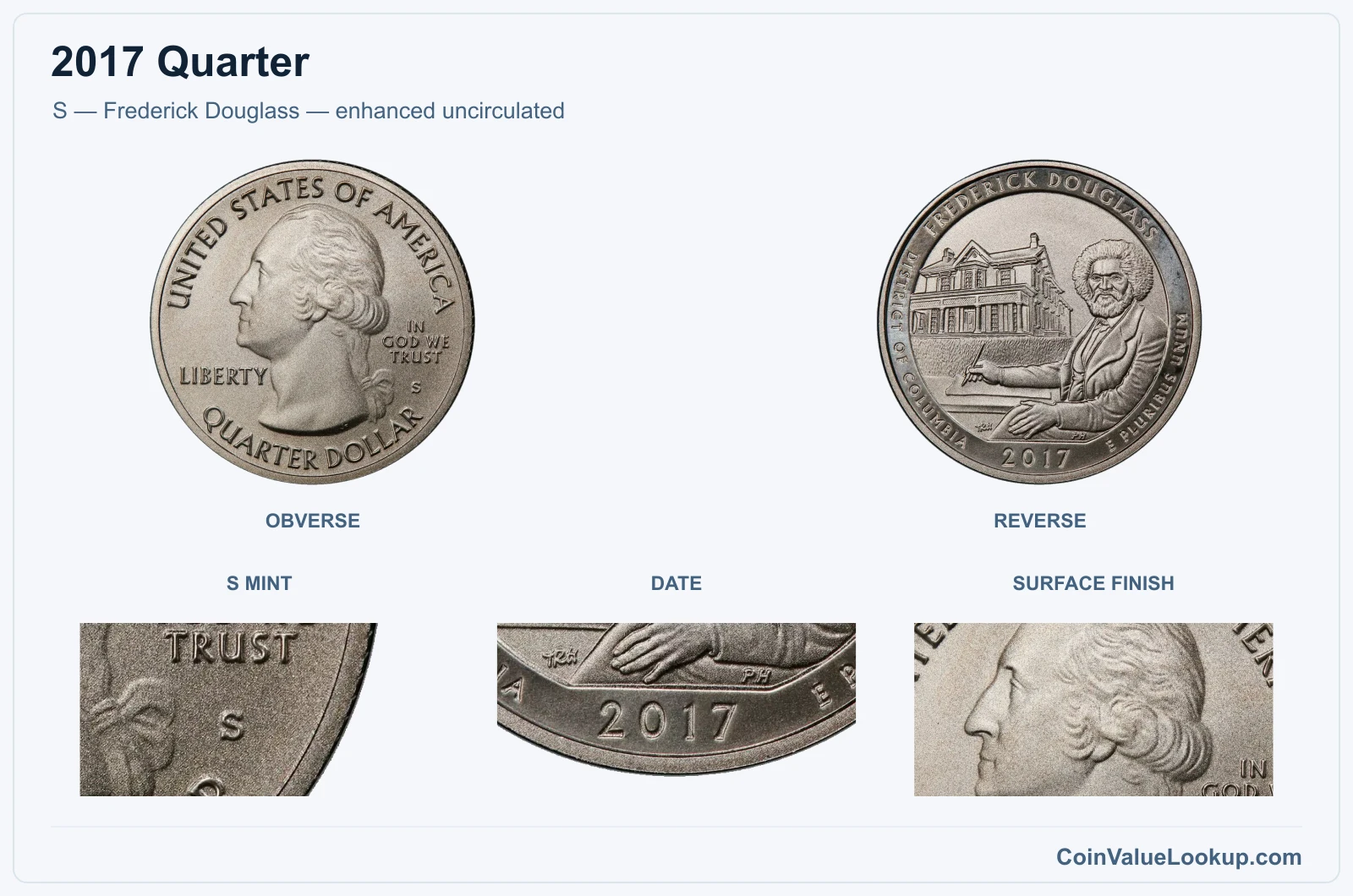
The enhanced uncirculated Frederick Douglass quarter is an S-mint copper-nickel clad coin from the 225th Anniversary set. Its multiple deliberate surface textures differentiate it from both the regular S business strike and the proof.
No guide price is adopted for this version. Value depends on authenticated identity and condition.
Professional attribution or possession of the original Mint packaging is the best confirmation method.
Range Grade
Price Auction Records Appraisal SP SP 1
—
Coin Identifier
SP 2
—
Coin Identifier
SP 3
—
Coin Identifier
SP 4
—
Coin Identifier
SP 6
—
Coin Identifier
SP 8
—
Coin Identifier
SP 10
—
Coin Identifier
SP 12
—
Coin Identifier
SP 15
—
Coin Identifier
SP 20
—
Coin Identifier
SP 25
—
Coin Identifier
SP 30
—
Coin Identifier
SP 35
—
Coin Identifier
SP 40
—
Coin Identifier
SP 45
—
Coin Identifier
SP 50
—
Coin Identifier
SP 53
—
Coin Identifier
SP 55
—
Coin Identifier
SP 58
—
Coin Identifier
SP 60
—
Coin Identifier
SP 61
—
Coin Identifier
SP 62
—
Coin Identifier
SP 63
—
Coin Identifier
SP 64
—
Coin Identifier
SP 65
—
Coin Identifier
SP 66
—
Coin Identifier
SP 67
—
Coin Identifier
SP 68
—
Coin Identifier
SP 69
—
Coin Identifier
SP 70
—
Coin Identifier
2017 Quarter — P — George Rogers Clark — regular strike
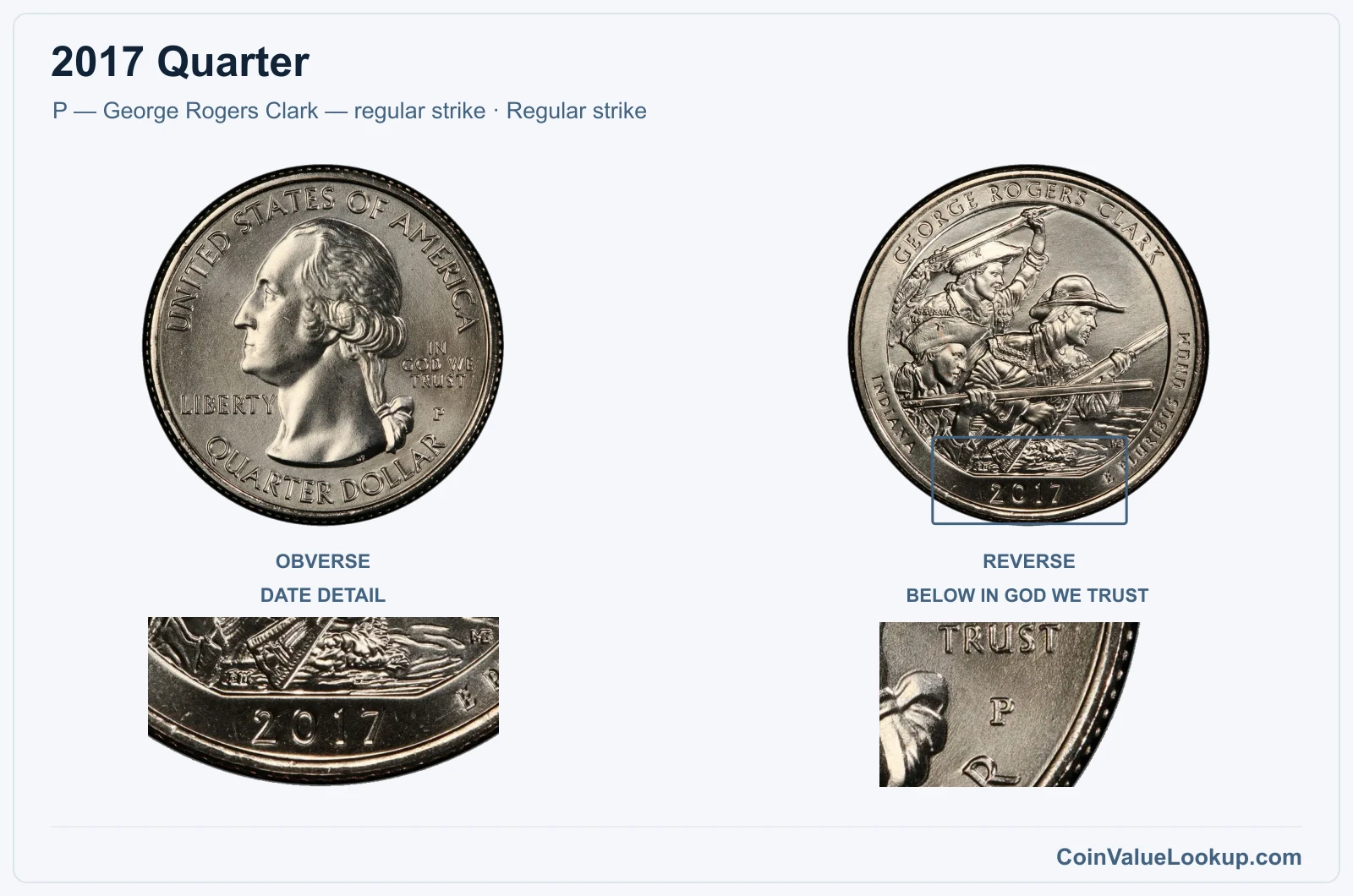
Philadelphia-mint George Rogers Clark quarter in copper-nickel clad. The reverse shows George Rogers Clark and Fort Sackville.
USA Coin Book guides this at $0.61 at MS60 and $1.24 at MS65.
Circulated examples are worth face value. Only uncirculated, well-preserved coins carry any collector premium.
Confirm the P mintmark and the correct reverse scene.
Range Grade
Price Auction Records Appraisal PO PO 1
—
Coin Identifier FR FR 2
—
Coin Identifier AG AG 3
—
Coin Identifier G G 4
—
Coin Identifier
G 6
—
Coin Identifier VG VG 8
—
Coin Identifier
VG 10
—
Coin Identifier F F 12
—
Coin Identifier
F 15
—
Coin Identifier VF VF 20
—
Coin Identifier
VF 25
—
Coin Identifier
VF 30
—
Coin Identifier
VF 35
—
Coin Identifier XF XF 40
—
Coin Identifier
XF 45
—
Coin Identifier AU AU 50
—
Coin Identifier
AU 53
—
Coin Identifier
AU 55
—
Coin Identifier
AU 58
—
Coin Identifier MS MS 60
—
Coin Identifier
MS 61
—
Coin Identifier
MS 62
—
Coin Identifier
MS 63
—
Coin Identifier
MS 64
—
Coin Identifier
MS 65
—
Coin Identifier
MS 66
—
Coin Identifier
MS 67
—
Coin Identifier
MS 68
—
Coin Identifier
MS 69
—
—
—
MS 70
—
—
—
2017 Quarter — D — George Rogers Clark — regular strike
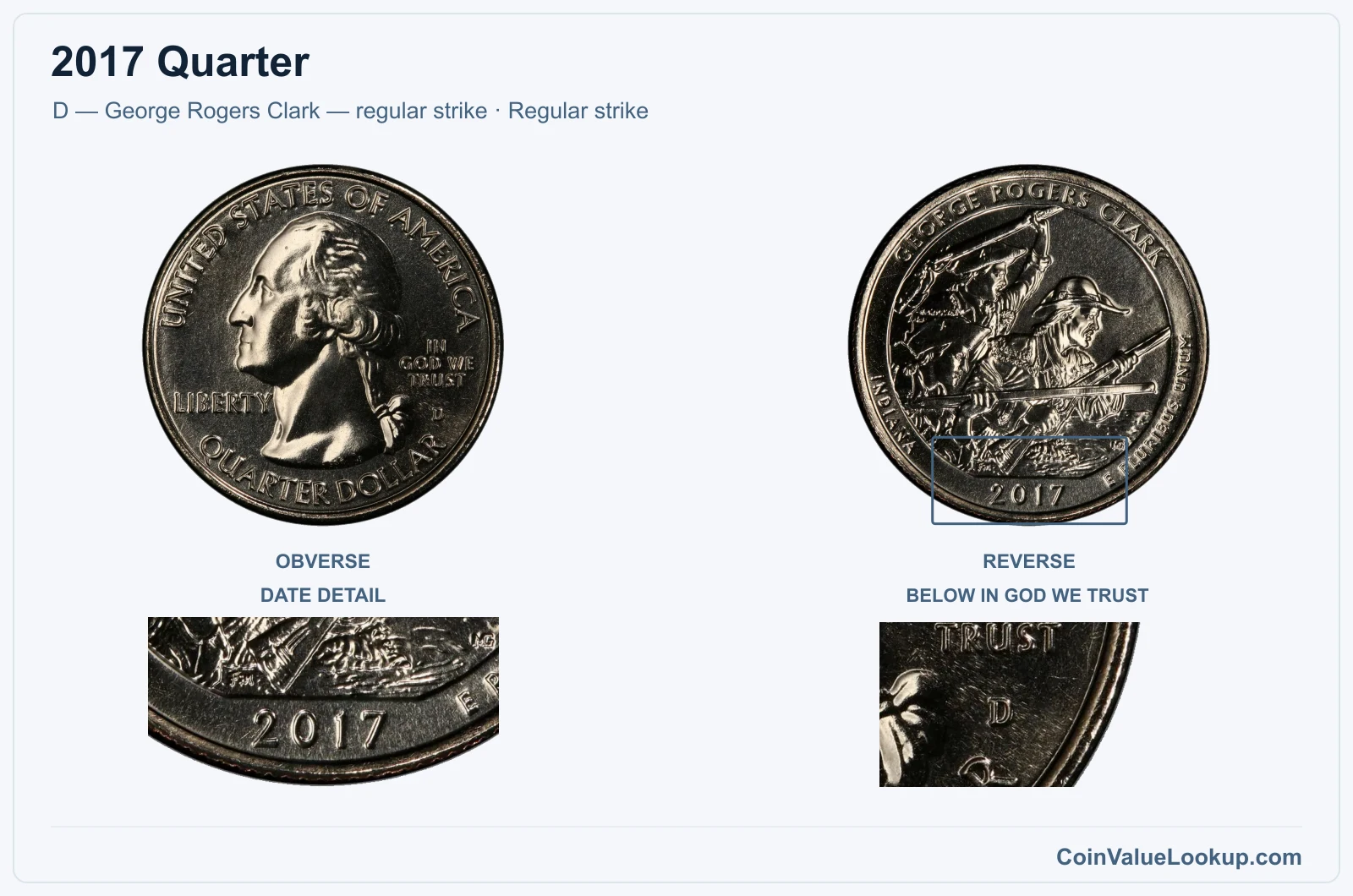
Denver-mint George Rogers Clark quarter, copper-nickel clad. USA Coin Book estimates $0.61 at MS60 and $1.24 at MS65.
As with every common 2017 business strike, circulated coins are worth a quarter.
The D mintmark is on the obverse near Washington's portrait. Original uncirculated rolls are the usual source for higher-grade examples.
Range Grade
Price Auction Records Appraisal PO PO 1
—
Coin Identifier FR FR 2
—
Coin Identifier AG AG 3
—
Coin Identifier G G 4
—
Coin Identifier
G 6
—
Coin Identifier VG VG 8
—
Coin Identifier
VG 10
—
Coin Identifier F F 12
—
Coin Identifier
F 15
—
Coin Identifier VF VF 20
—
Coin Identifier
VF 25
—
Coin Identifier
VF 30
—
Coin Identifier
VF 35
—
Coin Identifier XF XF 40
—
Coin Identifier
XF 45
—
Coin Identifier AU AU 50
—
Coin Identifier
AU 53
—
Coin Identifier
AU 55
—
Coin Identifier
AU 58
—
Coin Identifier MS MS 60
—
Coin Identifier
MS 61
—
Coin Identifier
MS 62
—
Coin Identifier
MS 63
—
Coin Identifier
MS 64
—
Coin Identifier
MS 65
—
Coin Identifier
MS 66
—
Coin Identifier
MS 67
—
Coin Identifier
MS 68
—
—
—
MS 69
—
—
—
MS 70
—
—
—
2017 Quarter — S — George Rogers Clark — regular strike
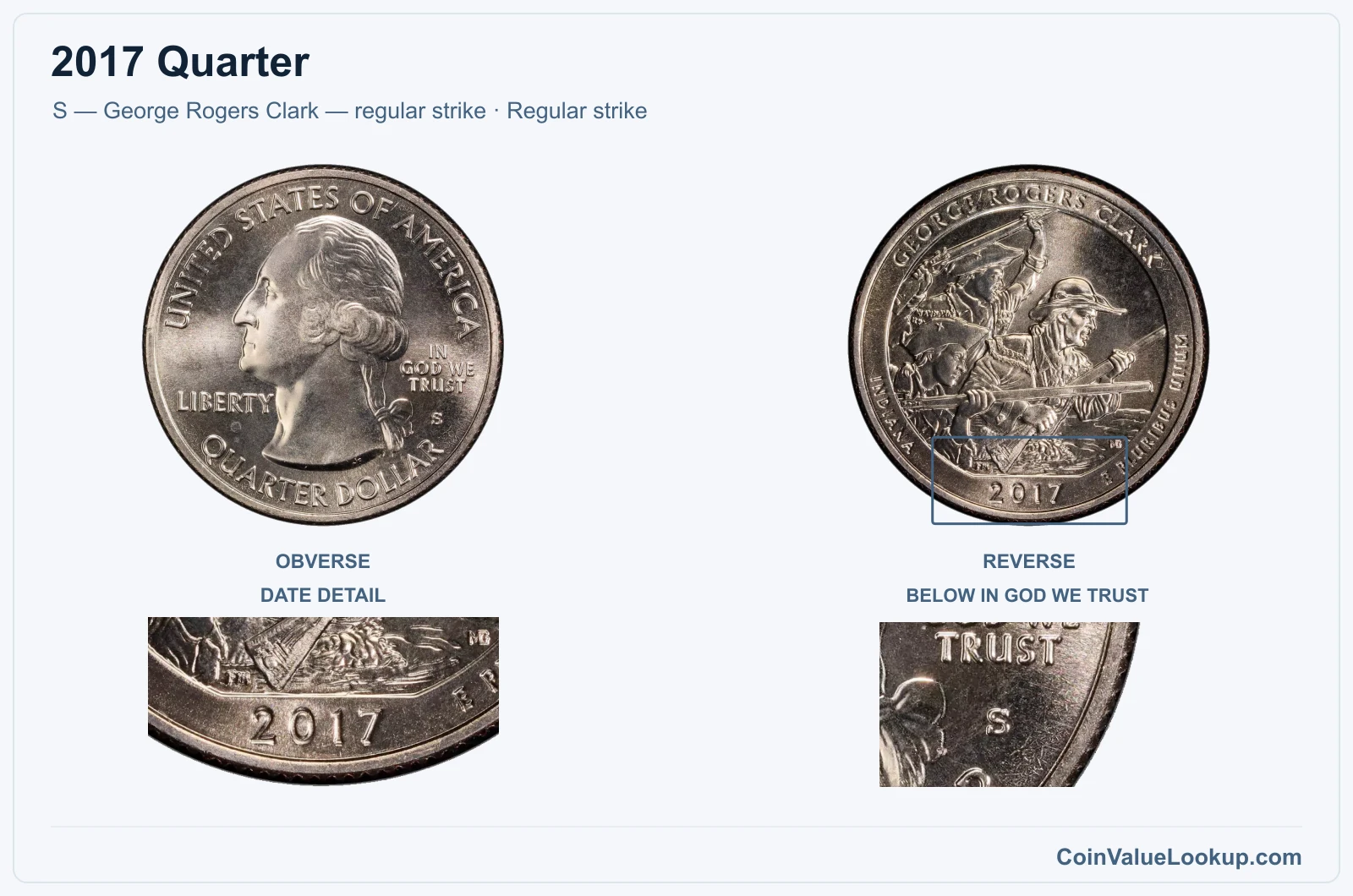
San Francisco's non-proof George Rogers Clark quarter is copper-nickel clad with an S mintmark. It was sold through Mint sets, keeping most examples out of circulation.
USA Coin Book guides this at $3.62 in MS65. Do not mistake it for a proof; the surfaces will resemble a standard business strike despite the S mintmark.
The limited distribution channel is why it carries a small premium over P and D issues.
Range Grade
Price Auction Records Appraisal PO PO 1
—
Coin Identifier FR FR 2
—
Coin Identifier AG AG 3
—
Coin Identifier G G 4
—
Coin Identifier
G 6
—
Coin Identifier VG VG 8
—
Coin Identifier
VG 10
—
Coin Identifier F F 12
—
Coin Identifier
F 15
—
Coin Identifier VF VF 20
—
Coin Identifier
VF 25
—
Coin Identifier
VF 30
—
Coin Identifier
VF 35
—
Coin Identifier XF XF 40
—
Coin Identifier
XF 45
—
Coin Identifier AU AU 50
—
Coin Identifier
AU 53
—
Coin Identifier
AU 55
—
Coin Identifier
AU 58
—
Coin Identifier MS MS 60
—
Coin Identifier
MS 61
—
Coin Identifier
MS 62
—
Coin Identifier
MS 63
—
Coin Identifier
MS 64
—
Coin Identifier
MS 65
—
Coin Identifier
MS 66
—
Coin Identifier
MS 67
—
Coin Identifier
MS 68
—
—
—
MS 69
—
—
—
MS 70
—
—
—
2017 Quarter — S — George Rogers Clark — clad proof
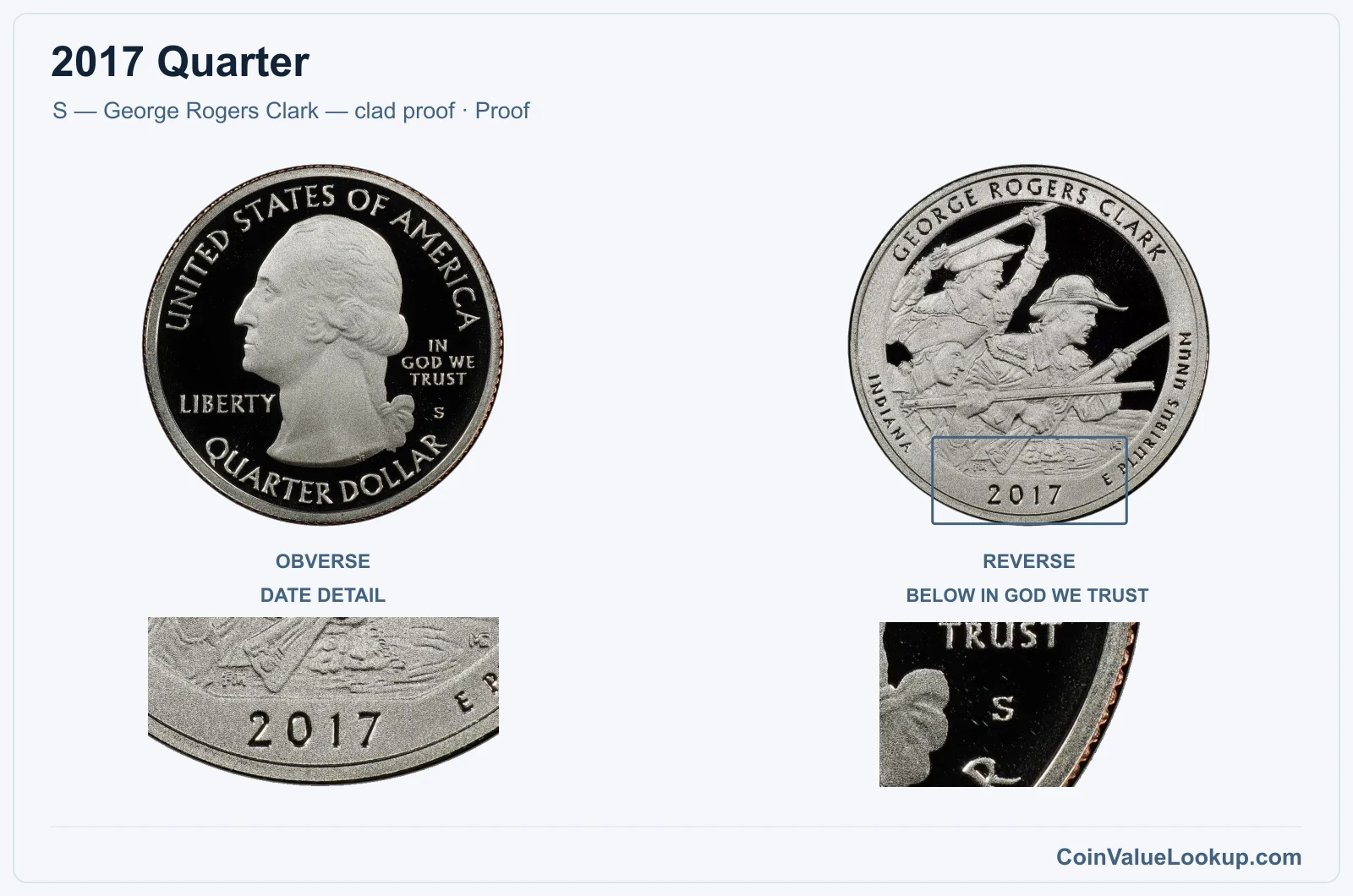
The clad proof George Rogers Clark quarter from San Francisco shows mirror fields and frosted raised elements on a copper-nickel clad planchet. A copper band on the edge confirms clad composition.
USA Coin Book estimates $5.63 at PR65. Separate it from the silver proof by checking edge color and weight.
Hairlines from careless handling are the main enemy of high proof grades.
Range Grade
Price Auction Records Appraisal PR PR 1
—
Coin Identifier
PR 2
—
Coin Identifier
PR 3
—
Coin Identifier
PR 4
—
Coin Identifier
PR 6
—
Coin Identifier
PR 8
—
Coin Identifier
PR 10
—
Coin Identifier
PR 12
—
Coin Identifier
PR 15
—
Coin Identifier
PR 20
—
Coin Identifier
PR 25
—
Coin Identifier
PR 30
—
Coin Identifier
PR 35
—
Coin Identifier
PR 40
—
Coin Identifier
PR 45
—
Coin Identifier
PR 50
—
Coin Identifier
PR 53
—
Coin Identifier
PR 55
—
Coin Identifier
PR 58
—
Coin Identifier
PR 60
—
Coin Identifier
PR 61
—
Coin Identifier
PR 62
—
Coin Identifier
PR 63
—
Coin Identifier
PR 64
—
Coin Identifier
PR 65
—
Coin Identifier
PR 66
—
Coin Identifier
PR 67
—
Coin Identifier
PR 68
—
Coin Identifier
PR 69
—
Coin Identifier
PR 70
—
Coin Identifier
2017 Quarter — S — George Rogers Clark — silver proof
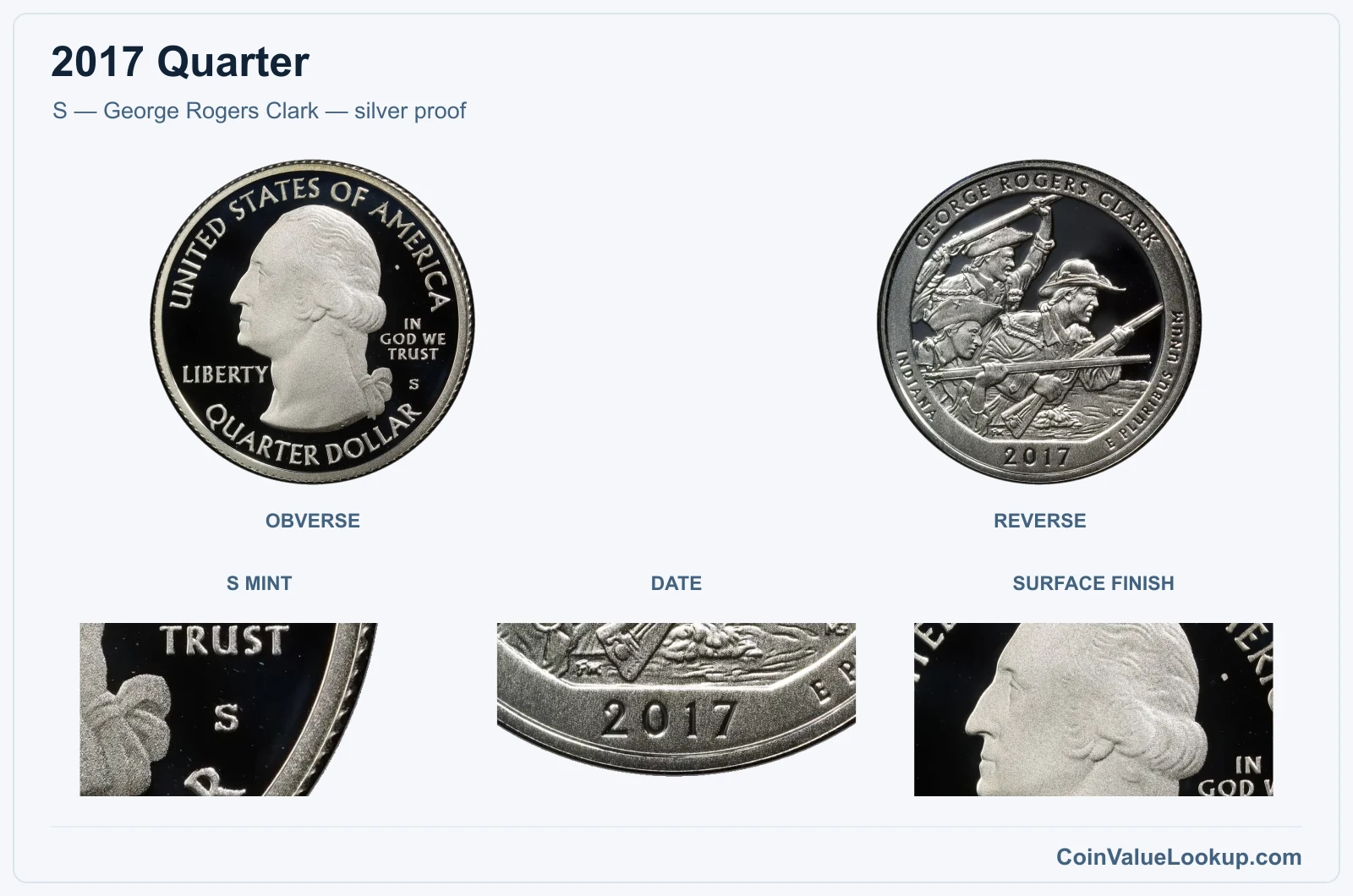
The silver proof George Rogers Clark quarter is 90% silver and 10% copper, weighing about 6.25 grams. The uniformly silver edge and heavier weight set it apart from the clad proof.
USA Coin Book guides this at $24.00 in PR65, tied with the other silver proofs as the top adopted guide figure for 2017 quarters at that grade. Original Mint packaging or a precise scale reading confirms the silver composition.
Range Grade
Price Auction Records Appraisal PR PR 1
—
Coin Identifier
PR 2
—
Coin Identifier
PR 3
—
Coin Identifier
PR 4
—
Coin Identifier
PR 6
—
Coin Identifier
PR 8
—
Coin Identifier
PR 10
—
Coin Identifier
PR 12
—
Coin Identifier
PR 15
—
Coin Identifier
PR 20
—
Coin Identifier
PR 25
—
Coin Identifier
PR 30
—
Coin Identifier
PR 35
—
Coin Identifier
PR 40
—
Coin Identifier
PR 45
—
Coin Identifier
PR 50
—
Coin Identifier
PR 53
—
Coin Identifier
PR 55
—
Coin Identifier
PR 58
—
Coin Identifier
PR 60
—
Coin Identifier
PR 61
—
Coin Identifier
PR 62
—
Coin Identifier
PR 63
—
Coin Identifier
PR 64
—
Coin Identifier
PR 65
—
Coin Identifier
PR 66
—
Coin Identifier
PR 67
—
Coin Identifier
PR 68
—
Coin Identifier
PR 69
—
Coin Identifier
PR 70
—
Coin Identifier
2017 Quarter — S — George Rogers Clark — enhanced uncirculated
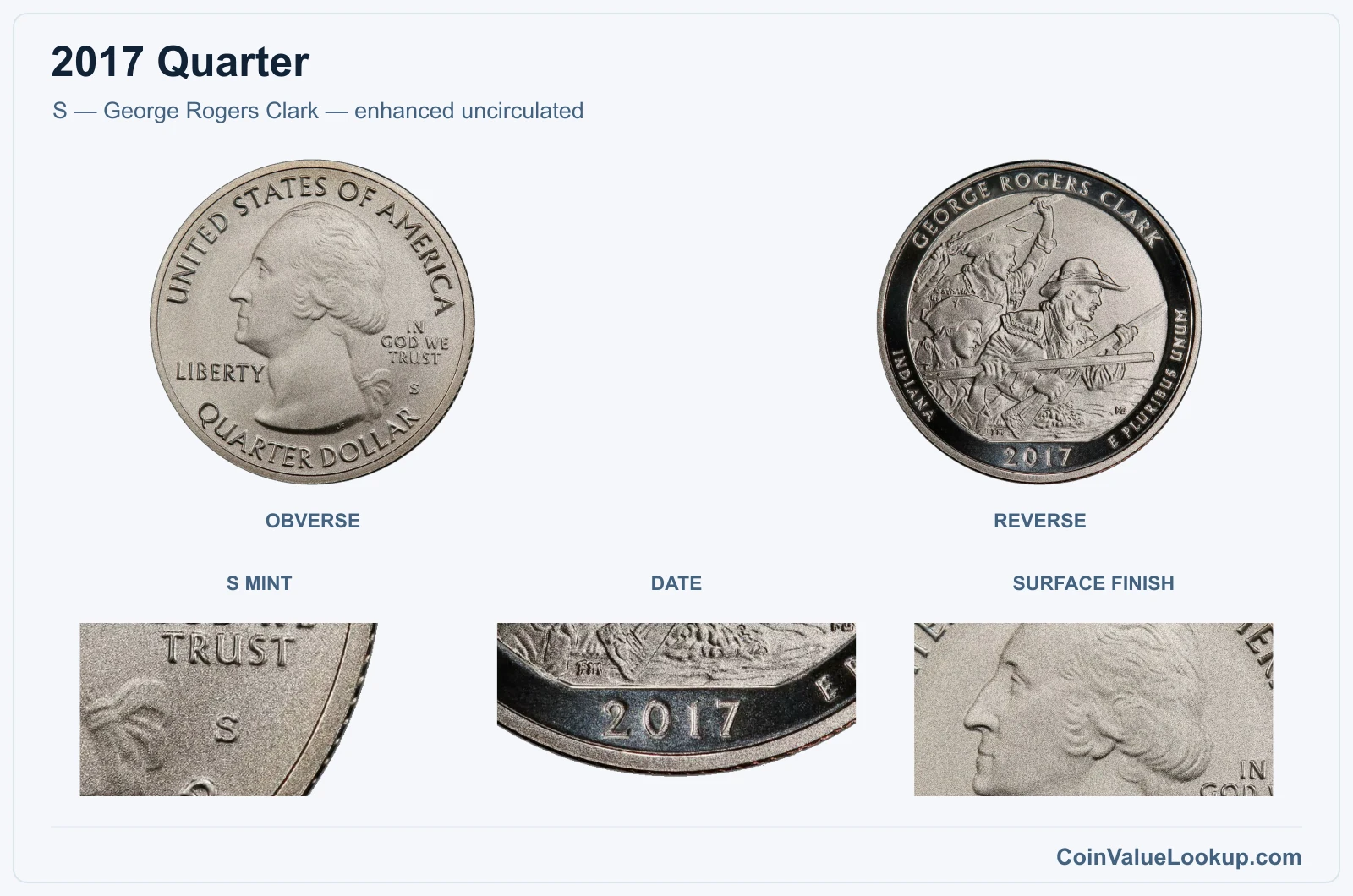
The enhanced uncirculated George Rogers Clark quarter is an S-mint copper-nickel clad coin produced for the 225th Anniversary set. Its multi-texture finish differs from both the standard S business strike and the proof.
No adopted guide price is available for this version. Value depends on authenticated identity and condition.
Original Mint packaging or third-party attribution is the reliable way to confirm the enhanced uncirculated finish.
Range Grade
Price Auction Records Appraisal SP SP 1
—
Coin Identifier
SP 2
—
Coin Identifier
SP 3
—
Coin Identifier
SP 4
—
Coin Identifier
SP 6
—
Coin Identifier
SP 8
—
Coin Identifier
SP 10
—
Coin Identifier
SP 12
—
Coin Identifier
SP 15
—
Coin Identifier
SP 20
—
Coin Identifier
SP 25
—
Coin Identifier
SP 30
—
Coin Identifier
SP 35
—
Coin Identifier
SP 40
—
Coin Identifier
SP 45
—
Coin Identifier
SP 50
—
Coin Identifier
SP 53
—
Coin Identifier
SP 55
—
Coin Identifier
SP 58
—
Coin Identifier
SP 60
—
Coin Identifier
SP 61
—
Coin Identifier
SP 62
—
Coin Identifier
SP 63
—
Coin Identifier
SP 64
—
Coin Identifier
SP 65
—
Coin Identifier
SP 66
—
Coin Identifier
SP 67
—
Coin Identifier
SP 68
—
Coin Identifier
SP 69
—
Coin Identifier
SP 70
—
Coin Identifier
2017 Quarter Error List
1. 2017 Quarter — George Rogers Clark — Struck-Through Error
A struck-through error on the 2017 George Rogers Clark quarter occurs when foreign material sits between the die and the planchet during striking. The result is a localized depression or incomplete area in the design where the obstruction blocked metal flow.
Look for a distinct impression, not just random weakness. Grease fill-ins leave a smooth, featureless patch, while a retained foreign object may leave a textured imprint.
Either way, the depression should have sharp, consistent boundaries.
Wear, scratches and cleaning can mimic weak detail, so compare the suspect area against the rest of the coin. A genuine struck-through will be confined to one area while surrounding design elements remain normal.
Value depends on the size, visibility and location of the obstruction impression, as well as overall coin condition.
2. 2017 Quarter — Frederick Douglass — Doubled Die Reverse
A doubled die reverse has been reported on the 2017 Frederick Douglass quarter. This type of error comes from a misalignment during the die-making process, resulting in doubled design elements on the finished coin.
To check, compare your coin's reverse lettering and design contours against a known normal example under consistent lighting. Genuine doubling shows as a secondary image with consistent separation or notching on affected elements.
Machine doubling is the common lookalike. It produces a flat, shelf-like distortion rather than the rounded, separated profiles of a true doubled die.
Reflections and lighting tricks can also create the illusion of doubling, so examine the coin at multiple angles. Value depends on the strength and visibility of the doubling and the coin's overall condition.
3. 2017 Quarter — Frederick Douglass — Die Crack / Die Chip
Die cracks and die chips have been reported on the 2017 Frederick Douglass quarter from the Philadelphia mint. These appear as raised lines or small raised blobs on the coin's surface, created when the steel die itself developed a crack or lost a small fragment.
A die crack shows as a thin raised line that may run across design elements or open fields. A die chip is a small raised lump where a piece of the die face broke away.
Both are raised because the damaged area in the die acts as a recessed cavity that fills with metal.
Do not confuse these with incuse scratches, which are pressed into the surface rather than raised above it. Corrosion or foreign material stuck to the surface can also mimic a die chip.
Value depends on the crack's length, location and overall coin condition.
4. 2017 Quarter — Improper Annealing
Improper annealing has been reported on 2017 America the Beautiful quarters. Annealing is the heat treatment given to planchets before striking, and when the process goes wrong the coin can display unusual surface discoloration, a rough or grainy texture, or uneven toning patterns.
To evaluate, compare your coin's surface and edge against a normal example. The affected coin may look darker, streaky or have an odd matte texture that differs from standard luster.
Environmental toning, corrosion and post-mint heat exposure can produce similar appearances. Surface appearance is a screening clue, not definitive proof of the cause.
Professional evaluation is the reliable way to confirm an annealing error. Value depends on the severity of the visual effect and the coin's overall condition.
5. 2017 Quarter — Die Gouge / Named Raised-Line Variety
Die gouges have been reported on 2017 America the Beautiful quarters. A die gouge is a raised line or blob of extra metal on the coin's surface caused by damage to the die face itself, such as a tool mark or contact scratch on the steel die.
The key diagnostic is that the feature is raised above the coin's surface and appears in a consistent position across multiple coins struck from the same die. Compare the suspect mark against a normal coin to confirm it is not random.
An incuse scratch goes into the surface, which is the opposite of a die gouge. Unrelated die cracks tend to follow stress patterns rather than appearing as isolated gouges.
Value depends on the prominence of the gouge, its location within the design and overall coin condition.
6. 2017 Quarter — Effigy Mounds — Doubled Die Obverse
A doubled die obverse has been reported on the 2017 Effigy Mounds quarter. This means obverse design elements — such as lettering or Washington's profile — may show a secondary, slightly displaced image from a die-manufacturing misalignment.
Compare the obverse letters and design details against a normal coin under the same lighting. Look for consistent separation or notching on multiple elements rather than a flat, shelf-like distortion on just one letter.
Machine doubling is the most common lookalike; it creates a flat shelf rather than a rounded secondary image. Worn die contours and lighting reflections can also trick the eye.
Value depends on the strength and visibility of the doubling as well as the coin's overall condition.
7. 2017 Quarter — Effigy Mounds — Clipped Planchet
Clipped planchet errors have been reported on the 2017 Effigy Mounds quarter. A clip occurs when the blank is punched from strip metal that overlaps a previously punched hole, leaving a curved missing section, or when the strip edge intrudes, creating a straight clip.
Look for a missing portion along the coin's edge with a smooth, natural boundary. Genuine clips often show weakness in the design directly opposite the missing area because metal could not flow evenly during striking.
The edge at the clip will lack the normal reeded texture.
A filed notch, deliberate edge cut or heavy corrosion can mimic a clip. Post-mint damage usually leaves sharp, unnatural edges and no corresponding opposite-side weakness.
Value depends on clip size, type and overall coin condition.
8. 2017 Quarter — Effigy Mounds — Die Break / Cud
Die breaks, sometimes called cuds, have been reported on the 2017 Effigy Mounds quarter. A cud forms when a chunk of the die breaks away at the rim, leaving a raised, featureless blob of metal on the struck coin that connects to the edge.
The diagnostic is a smooth raised area replacing part of the normal design and rim. It should have a distinct boundary where the intact die surface resumes.
An interior die break is similar but does not reach the rim.
Rim dents, corrosion and interior die chips can be confused with cuds. Post-mint rim damage is typically depressed rather than raised.
Value depends on the size of the break, its visual impact and overall coin condition.
9. 2017 Quarter — Effigy Mounds — Missing Clad Layer
Missing clad layer errors have been reported on the 2017 Effigy Mounds quarter. On a normal coin, the copper-nickel clad layers sandwich a copper core.
When one clad layer is absent before striking, the exposed side shows a different color and the coin weighs less than the standard 5.67 grams.
Compare the affected face, the edge profile and the measured weight against a normal clad quarter. A missing layer on one side will show the copper core while the opposite side retains its normal appearance.
Toning, plating, corrosion and surface metal removed after minting can mimic this error. Weight is your best friend here: a genuine missing-layer coin should weigh noticeably less.
Value depends on which side is affected, the visual contrast and overall coin condition.
10. 2017 Quarter — Effigy Mounds — Struck-Through Error
Struck-through errors have been reported on the 2017 Effigy Mounds quarter, specifically struck through grease. When grease or debris fills part of the die cavity, the coin receives an incomplete impression in that area, leaving a smooth, featureless patch.
Look for a localized area where design details are absent but the surface is smooth and level, not scratched or worn down. Grease-filled errors typically affect a contained region, leaving surrounding details crisp.
Wear, cleaning and ordinary weak strikes can look similar. The difference is that a struck-through area is sharply bounded while wear fades gradually.
A retained foreign-object strike leaves a textured impression rather than a smooth void. Value depends on the size and location of the affected area and overall coin condition.
11. 2017 Quarter — Effigy Mounds — Off-Center Strike
Off-center strikes have been reported on the 2017 Effigy Mounds quarter. This error happens when the planchet is not centered between the dies, producing a displaced design and an unstruck crescent of blank metal on one side.
The percentage of off-center displacement and whether the date remains visible are the two biggest factors for collector interest. A 5% shift is minor; a 50% shift with a readable date is dramatic and more desirable.
Do not confuse an off-center strike with a clipped planchet, which removes metal from the blank before striking, or with a one-sided die misalignment. Post-mint flattening by a machine can also push metal to one side.
Value depends on the degree of displacement, date visibility and overall coin condition.
12. 2017 Quarter — Effigy Mounds — Partial Collar Strike
Partial collar strikes, sometimes called railroad rim errors, have been reported on the 2017 Effigy Mounds quarter. The collar die normally restrains the planchet to produce uniform diameter and reeding.
When the blank sits partially outside the collar during striking, part of the rim is properly formed while the rest flares outward.
Look for a stepped or uneven edge: one section has normal reeding and diameter, while the opposing section is wider and may lack reeding. Tilt the coin to see the transition point.
Edge damage, a flattened rim and a full broadstrike can look similar. A broadstrike affects the entire perimeter uniformly, while a partial collar shows a clear transition between confined and unconfined areas.
Value depends on the degree of collar displacement and overall condition.
13. 2017 Quarter — Effigy Mounds — Broadstrike
Broadstrike errors have been reported on the 2017 Effigy Mounds quarter. A broadstrike happens when the coin is struck entirely outside the retaining collar, allowing metal to spread outward in all directions.
The result is a coin noticeably wider than normal with a flattened, reeding-free rim.
The entire perimeter should be uniformly affected. The design is still centered, unlike an off-center strike, but the coin's diameter exceeds the standard 24.26 mm.
Do not confuse a broadstrike with a partial collar, which only affects one section of the rim. A coin flattened after leaving the mint — by a train track, for example — can spread similarly, but post-mint damage usually shows surface scratches and uneven distortion.
Value depends on how dramatically the coin exceeds normal diameter and overall condition.
14. 2017 Quarter — Ellis Island — Die Crack / Die Chip
Die cracks and die chips have been reported on the 2017 Ellis Island quarter. A die crack appears as a raised line on the coin, often running across letters, design features or open fields.
It forms when the hardened steel die develops a stress fracture during production.
A die chip is a small raised blob where a piece of the die surface broke free. Both features are raised above the coin's surface because they correspond to recesses in the damaged die.
Incuse scratches, corrosion deposits and foreign material stuck to the coin are the usual lookalikes. Scratches go into the surface; die cracks rise above it.
Run a fingernail or toothpick across the suspect line to feel the direction. Value depends on the crack's length, position and overall coin condition.
15. 2017 Quarter — Ellis Island — Misaligned Die
Misaligned die errors have been reported on the 2017 Ellis Island quarter. A misaligned die shifts one face of the coin relative to the other or relative to the blank, producing a design that is slightly off-register on one side while the other side appears normal.
Compare both sides of the coin. A horizontal shift will show a wider rim on one side and a narrower rim on the opposite side for the same face, while the other face looks centered.
This is different from a rotational misalignment, where the two sides are twisted relative to each other.
A tilted photograph, an off-center strike and post-mint rim damage can mimic misalignment. An off-center strike displaces the design on both sides equally.
Value depends on the degree of shift and overall coin condition.
16. 2017 Quarter — Ellis Island — Partial Collar Strike
Partial collar strike errors have been reported on the 2017 Ellis Island quarter. When the planchet does not seat fully inside the collar die, part of the rim forms normally while the rest of the coin spreads beyond its intended diameter.
The diagnostic is a visible step or transition along the edge where normal reeding gives way to a smooth, flared section. Rotate the coin slowly and examine the rim profile from the side.
Edge damage from post-mint contact often looks rough and irregular, while a partial collar produces a smooth, consistent flare. A full broadstrike affects the entire circumference uniformly, which is a different situation.
Value depends on the severity of the collar displacement and overall condition.
17. 2017 Quarter — Ozark Riverways — Doubled Die
Doubled die errors have been reported on the 2017 Ozark Riverways quarter. A doubled die is created during die manufacture, producing a secondary image on the coin's design elements.
This can appear on either the obverse or reverse.
Compare your coin's lettering and design contours against a normal example under consistent light. True die doubling shows a rounded, separated secondary image on multiple design elements in a consistent direction.
Machine doubling is the primary lookalike. It creates a flat, shelf-like distortion concentrated on one side of each letter rather than a full secondary outline.
Post-mint impressions and photographic reflections can also fool you. Value depends on the strength and visibility of the doubling and overall coin condition.
18. 2017 Quarter — Ozark Riverways — Die Crack / Die Chip
Die cracks and die chips have been reported on the 2017 Ozark Riverways quarter. These raised features result from fractures or small breakages in the steel die during the striking run.
A die crack runs as a thin raised line across the coin's surface, while a die chip appears as a small raised bump. Both are above the coin's surface, which distinguishes them from incuse scratches that cut into the metal.
Corrosion, foreign material and contact marks can resemble die damage. The key test is whether the feature is raised.
If it sinks below the surface, it is not from the die. Die cracks consistent across multiple coins from the same die are more collectible.
Value depends on length, location and overall coin condition.
19. 2017 Quarter — Ozark Riverways — Die Break / Cud
Die break or cud errors have been reported on the 2017 Ozark Riverways quarter. A cud is a specific type of die break where the broken section extends to the rim, leaving a raised, flat blob of metal that replaces part of the design and rim.
The raised area should be smooth and featureless with a clear boundary where the normal design resumes. The corresponding area on the opposite side of the coin may also show weakness or a sunken spot.
A rim dent goes into the surface rather than rising above it. Corrosion bumps are usually irregular and do not follow a geometric break pattern.
An interior die chip is smaller and does not connect to the rim. Value depends on the cud's size, visual impact and overall coin condition.
20. 2017 Quarter — George Rogers Clark — Doubled Die Obverse
A doubled die obverse has been reported on the 2017 George Rogers Clark quarter. This error originates during die production, creating a secondary offset impression on the obverse design elements.
Compare your coin's obverse lettering, date and Washington's profile details against a known normal coin under matching light. Look for consistent notching or separation on multiple design elements pointing in the same direction.
Machine doubling is the most frequent lookalike. It pushes metal to one side in a flat shelf rather than showing a distinct, rounded secondary image.
Worn die contours can also soften letters in a way that mimics doubling. Examining several design elements together — not just one letter — helps rule out a false positive.
Value depends on doubling strength, visibility and overall coin condition.