1804 Draped Bust Quarter Coin Value: How Much Is It Worth?
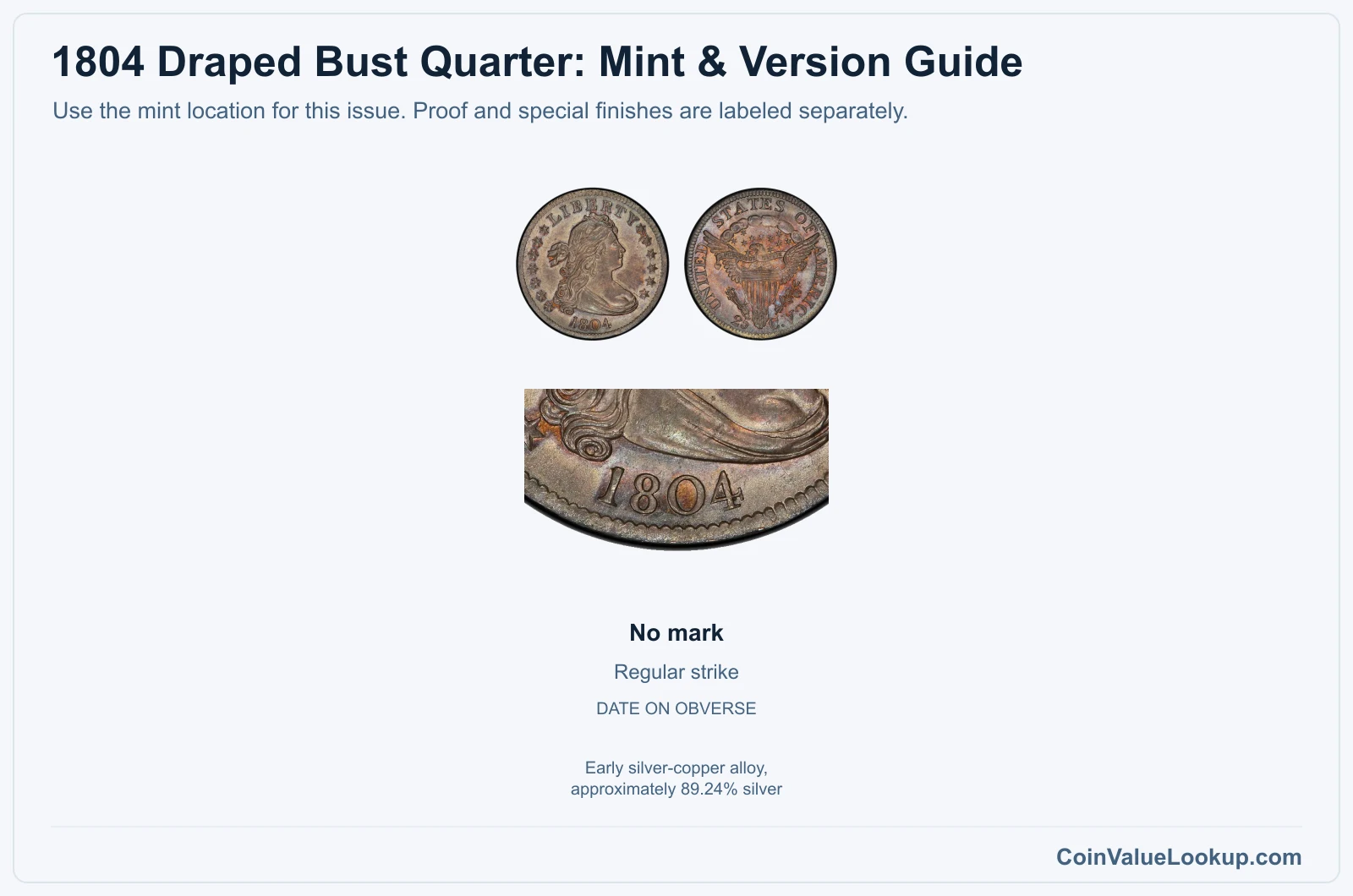
The 1804 Draped Bust quarter is a scarce early American silver coin struck only at the Philadelphia Mint. Guide estimates from USA Coin Book range from about $5,227.00 in Good-4 condition up to $221,900.00 at the MS63 grade level.
These are not blanket prices for every coin — your quarter's actual value depends on its condition, surface quality and originality.
Fast Way to Identify Your 1804 Draped Bust Quarter
The quickest way to get a preliminary identification of your 1804 quarter is to upload clear photos of both the front and back. That lets the design, date and overall condition be compared against known references.
Snap the images in even lighting without glare and include the edge if possible.
1804 Draped Bust Quarter Value
Upload both sides of your 1804 Draped Bust Quarter.
Front Obverse
Upload photo
Back Reverse
Upload photo
Which 1804 Draped Bust Quarter Versions Are Worth Money?
- 1804 Philadelphia quarter: USA Coin Book guide estimates reach $221,900.00 at MS63, making high-grade originals exceptionally valuable among early quarters.
- Verify the mint, date and surface condition first — damage, cleaning or heavy wear significantly reduce value compared to these guide anchors.
Step 1: Identify Your 1804 Draped Bust Quarter Mint Mark and Version
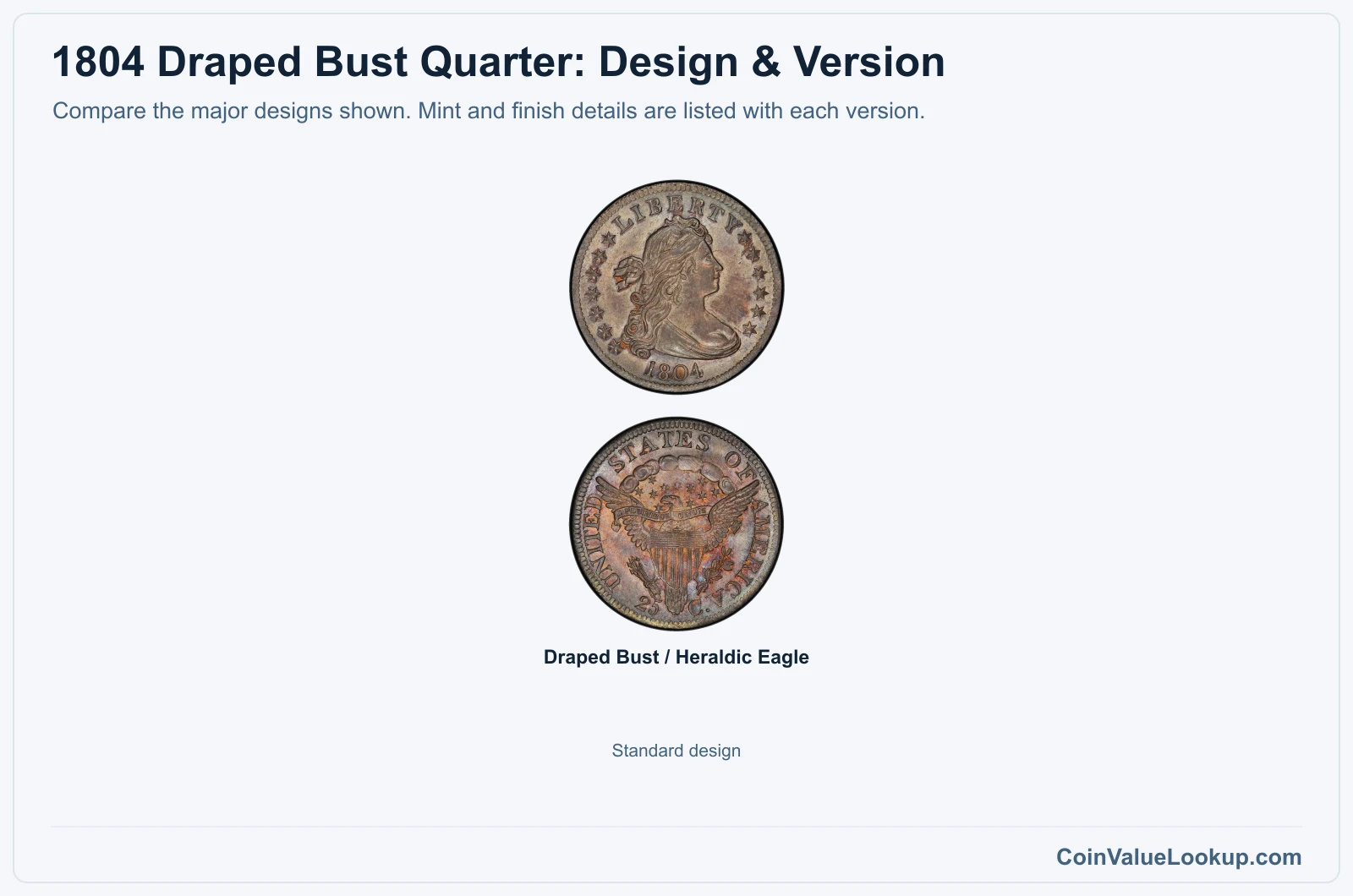
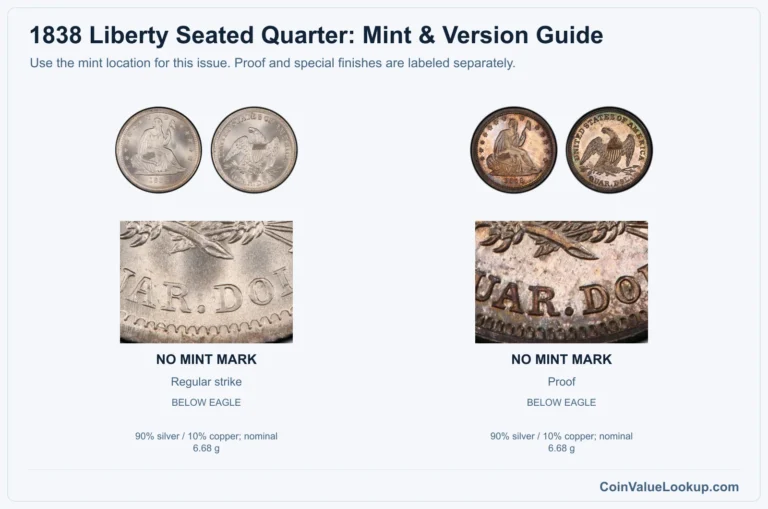
Every 1804 quarter was struck at the Philadelphia Mint, which used no mintmark at all during this era. Do not look for a small "P" — there is none.
The obverse shows the Draped Bust portrait of Liberty facing right, with flowing hair and a draped bodice. The reverse carries the Heraldic Eagle design with a shield on its breast and arrows and olive branch in its talons.
The coin is composed of an early silver-copper alloy, roughly 89.24% silver. If a magnet sticks to it, you have a fake.
Genuine examples will show a reeded edge and weigh close to the standard quarter specification of the period.
Confirm the date reads 1804 exactly. Early bust quarters from adjacent years can look similar at a glance, and a worn 1806 misread as 1804 is a different coin entirely.
Get the date right before anything else.
Step 2: Check Your 1804 Draped Bust Quarter Grade
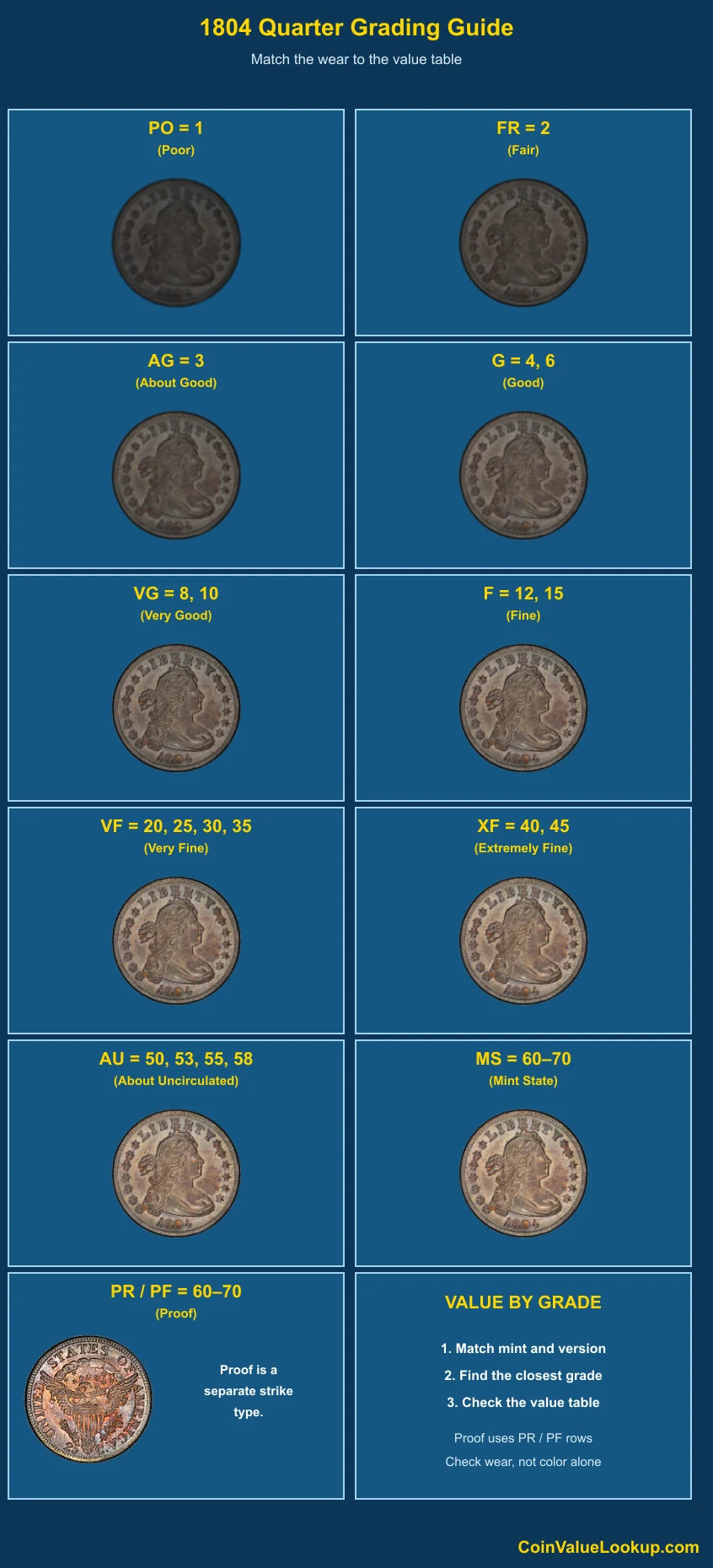
Start by examining the hair above Liberty's ear and the drapery across her chest. On a well-worn coin grading around Good-4, those areas will be flat and merged, but the date and major outlines remain clear.
As you move up the scale, look for separated hair strands and defined folds in the fabric.
On the reverse, check the eagle's breast feathers and wing tips. These are the first spots to show friction.
A coin grading around MS60 (Mint State, uncirculated) will have no wear at all, though it may show bag marks or contact from storage.
Early quarter strikes were often uneven. A soft area on one side does not automatically mean the coin circulated — it can be a weak strike from the original press.
Compare your coin to the reference image and separate genuine wear (smoothing with lost luster) from strike softness (flat but still lustrous). Cleaned or polished coins lose their original surface texture and typically grade lower or receive a details designation.
Step 3: Check 1804 Draped Bust Quarter Value by Mint and Version
1804 Draped Bust Quarter
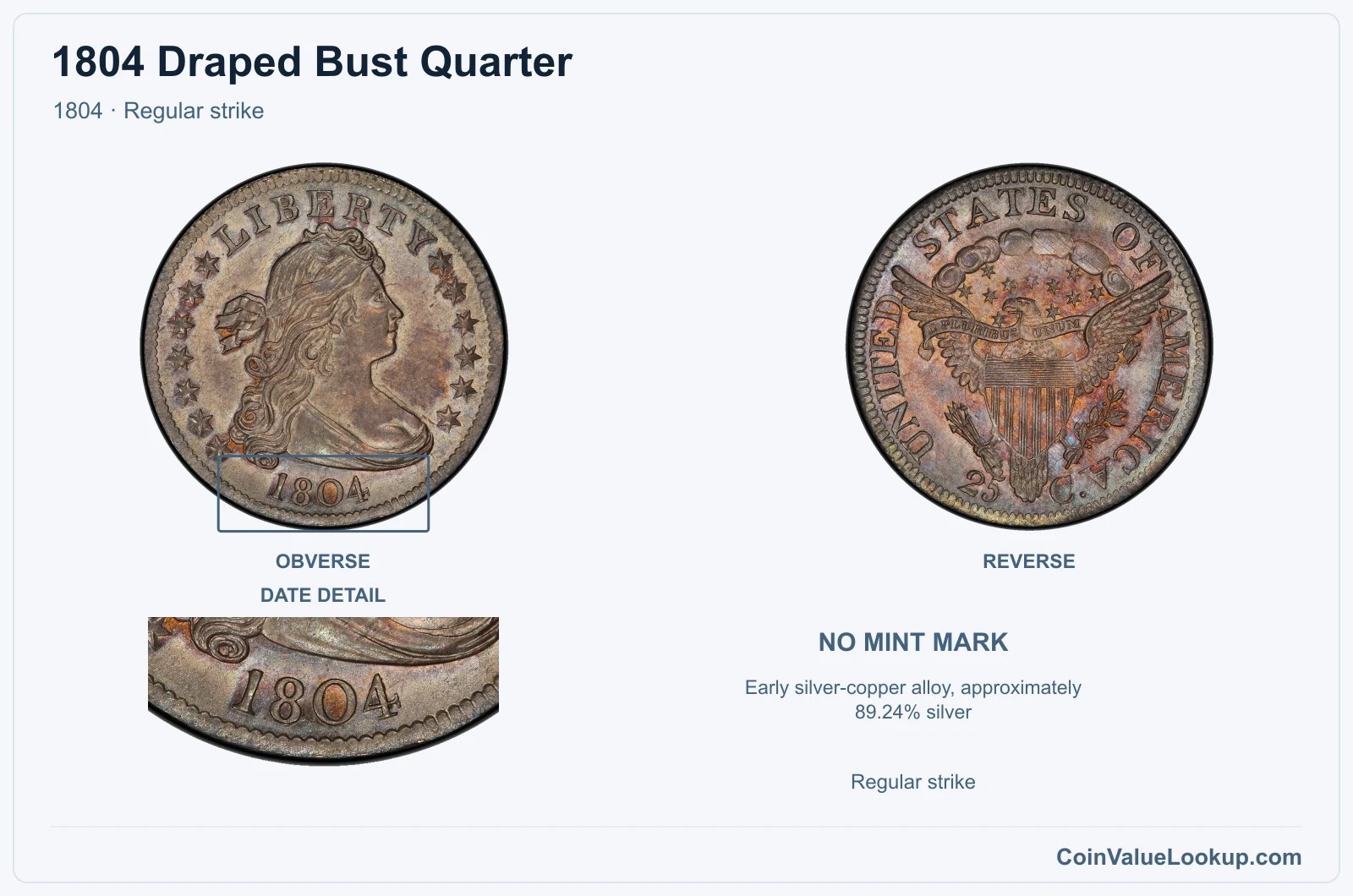
The 1804 quarter was produced at Philadelphia with no mintmark. It features the Draped Bust obverse paired with the Heraldic Eagle reverse, struck in an early silver-copper alloy of approximately 89.24% silver.
USA Coin Book guide estimates place this coin at about $5,227.00 in Good-4, $118,839.00 at MS60 and $221,900.00 at MS63. These are retail guide estimates, not guaranteed offers.
Before comparing prices, confirm you have original surfaces. A coin that has been cleaned, whizzed or repaired may look bright but will not command the same value as one with natural toning and undisturbed luster.
Strike quality varies on these early issues, so judge wear separately from softness.
Coin Value Lookup is a good starting point if you want to look up guides for other early quarters or different denominations alongside this one.
Range Grade
Price Auction Records Appraisal PO PO 1
Coin Identifier FR FR 2
Coin Identifier AG AG 3
Coin Identifier G G 4
Coin Identifier
G 6
Coin Identifier VG VG 8
Coin Identifier
VG 10
Coin Identifier F F 12
Coin Identifier
F 15
Coin Identifier VF VF 20
Coin Identifier
VF 25
Coin Identifier
VF 30
Coin Identifier
VF 35
Coin Identifier XF XF 40
Coin Identifier
XF 45
Coin Identifier AU AU 50
Coin Identifier
AU 53
—
Coin Identifier
AU 55
—
Coin Identifier
AU 58
Coin Identifier MS MS 60
—
Coin Identifier
MS 61
Coin Identifier
MS 62
Coin Identifier
MS 63
Coin Identifier
MS 64
—
Coin Identifier
MS 65
—
—
—
MS 66
—
—
—
MS 67
—
—
—
MS 68
—
—
—
MS 69
—
—
—
MS 70
—
—
—
1804 Draped Bust Quarter Error List
1. 1804 Draped Bust Quarter — Clipped Planchet
A clipped planchet error on an 1804 Draped Bust quarter means part of the original silver blank was missing before the coin was struck. You will see a curved, straight or ragged section absent from the rim, and the design in that area simply stops at the clip boundary.
Often the metal on the opposite side of the coin shows slight weakness because the incomplete blank did not fill the die evenly.
To distinguish a genuine clip from post-mint damage, look at the edge texture near the missing area. A real clip will have a smooth or slightly beveled transition that was created when the blank was punched.
Filed notches, corrosion pits or deliberate cuts leave rough, irregular tool marks. No specific price data is available for this error on the 1804 quarter — value depends on the clip's size, visibility and the coin's overall condition.
2. 1804 Draped Bust Quarter — Double / Multiple Strike
A double-struck 1804 Draped Bust quarter received two impressions from the dies, producing overlapping or displaced design elements. You will typically see two distinct outlines of Liberty's portrait or two sets of lettering offset from each other.
The displacement can range from slight to dramatic, and sometimes the second strike is rotated relative to the first.
Do not confuse this with a doubled die, which is a different phenomenon caused during die manufacturing and produces uniform doubling on every coin struck by that die. A double strike is unique to the individual coin.
Also rule out post-mint impressions — if someone pressed a coin against another object, the marks will lack the sharpness and depth of a genuine second strike. No adopted price data exists for this error on the 1804 quarter, so individual assessment based on condition and severity would be necessary.
3. 1804 Draped Bust Quarter — Off-Center Strike
An off-center strike happens when the planchet is not seated properly between the dies, so part of the design is pushed to one side and a blank crescent remains on the opposite edge. On an 1804 quarter, this would leave a portion of Liberty's bust or the Heraldic Eagle missing, with unstruck metal visible where the design should be.
The key detail collectors want is a readable date. An off-center coin that still shows "1804" clearly is far more desirable than one where the date has shifted off the flan entirely.
Do not confuse an off-center strike with a clipped planchet (which removes metal from the blank before striking) or with post-mint flattening from a vise or press. No specific price is available for this error on the 1804 quarter; value will depend on the degree of off-center shift, date visibility and overall preservation.
4. 1804 Draped Bust Quarter — Clashed Dies
Die clash marks appear when the obverse and reverse dies strike each other without a planchet between them. The impact transfers faint mirror-image traces of one die's design onto the face of the other.
On an 1804 quarter, you might spot ghostly outlines of the eagle's wings on the obverse field near Liberty, or traces of Liberty's hair on the reverse around the eagle.
These marks align consistently with the opposing design — that is how you separate them from random scratches or contact marks, which will not match the opposite die's layout. A brockage, where an already-struck coin acts as a die, produces a much deeper and more complete mirror image.
No adopted price is available for clashed dies on the 1804 quarter. Value depends on how visible and dramatic the clash is, along with the coin's grade.
5. 1804 Draped Bust Quarter — Defective Planchet
A defective planchet error means the silver blank itself had a flaw before it was struck. This could appear as a void, lamination crack, rough patch or irregular area in the metal that the striking process did not fully conceal.
The struck design will flow around or over the defect, confirming it existed before the coin was made.
Check both sides and the edge. A genuine planchet flaw typically shows disturbed metal with design detail partially impressed over it.
Post-mint damage — gouges, corrosion holes or deliberate removal of metal — will cut through the existing design rather than sitting underneath it. That distinction is critical.
No specific price data is available for this error on the 1804 quarter, so evaluation would depend on the flaw's size, location, visual impact and the coin's overall condition.