1796 Draped Bust Quarter Coin Value: How Much Is It Worth?
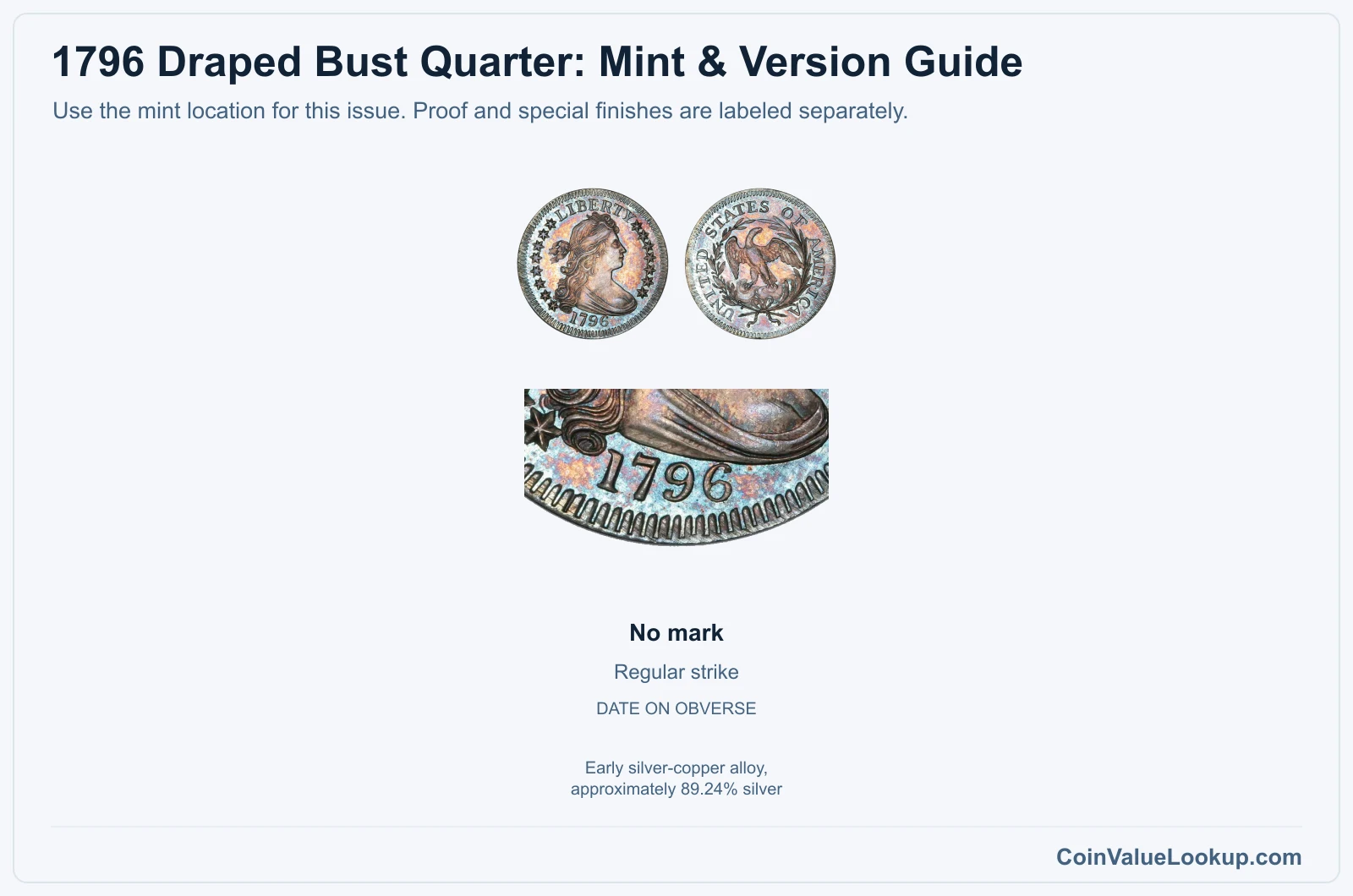
The 1796 Draped Bust Quarter is the first quarter dollar ever struck by the United States Mint. Only one version exists for this year, produced in Philadelphia with no mintmark.
USA Coin Book guide estimates range from $13,755.00 in G4 condition to $215,939.00 in MS63, depending on the coin's actual grade. Condition, original surfaces and strike quality all determine where a specific coin falls within that spread.
Fast Way to Identify Your 1796 Draped Bust Quarter
Upload clear photos of both the front and back of your coin for a preliminary identification. This helps confirm the date, design type and overall condition before you start comparing guide values.
Sharp, well-lit images showing the full rim on each side give the best results.
1796 Draped Bust Quarter Value
Upload both sides of your 1796 Draped Bust Quarter.
Front Obverse
Upload photo
Back Reverse
Upload photo
Which 1796 Draped Bust Quarter Versions Are Worth Money?
- 1796 Philadelphia (no mintmark): USA Coin Book estimates $13,755.00 at G4 and up to $215,939.00 at MS63, making higher-grade survivors extremely significant.
- Confirm your coin's mint and finish before assuming value; damage, heavy wear or a cleaned surface does not establish a rare version.
Step 1: Identify Your 1796 Draped Bust Quarter Mint Mark and Version
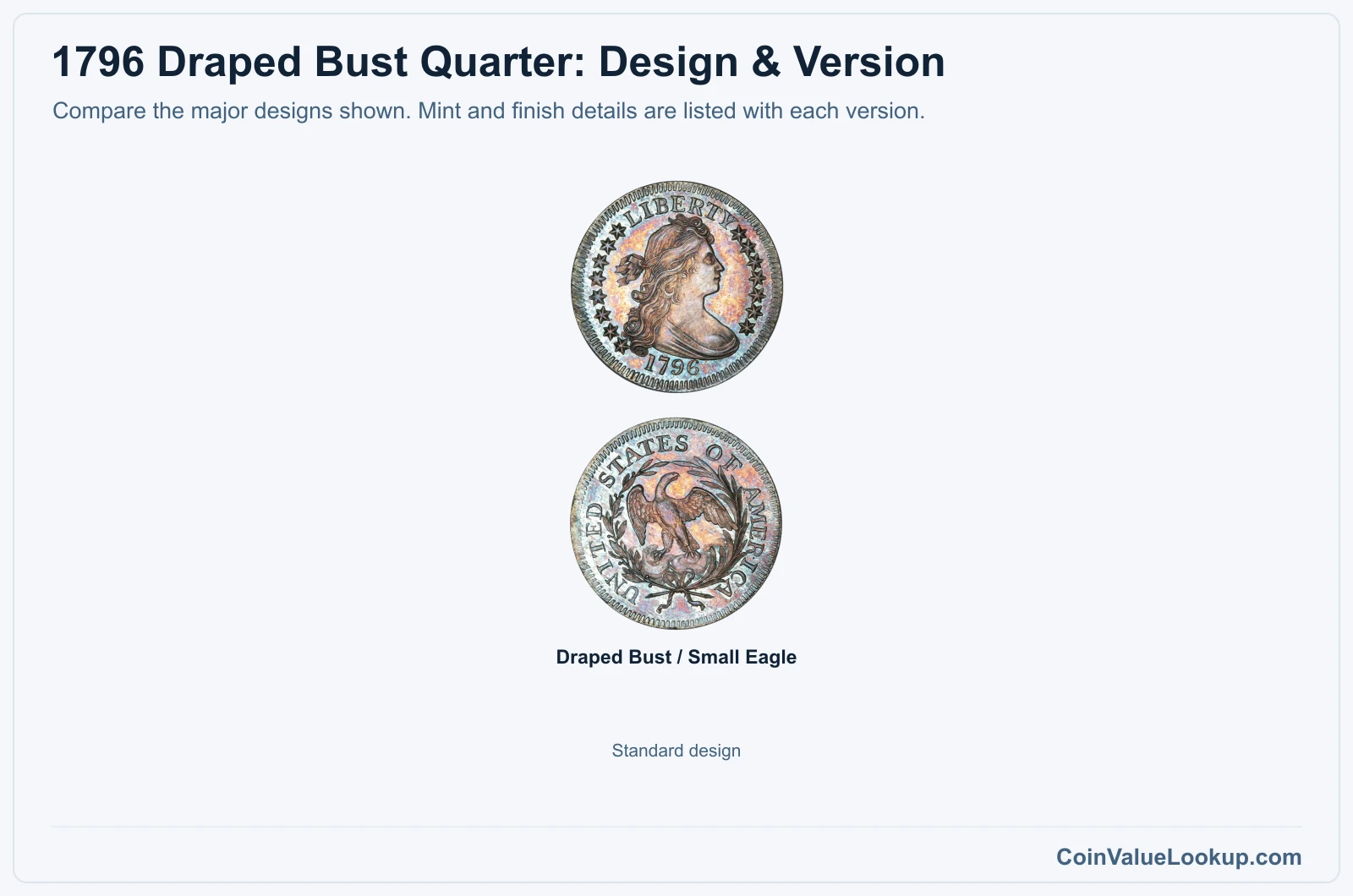
Every 1796 quarter was struck at the Philadelphia Mint. There is no mintmark on this coin, and no "P" stamp was used in this era, so the absence of a letter is expected.
The obverse shows the Draped Bust portrait of Liberty facing right, with the date below. The reverse features a Small Eagle perched on a cloud within a wreath.
This Small Eagle reverse is specific to 1796; later Draped Bust quarters (1804–1807) switched to a Heraldic Eagle design, so the reverse is one quick way to confirm you have the right year.
The coin is struck in an early silver-copper alloy, approximately 89.24% silver. It has a distinctive soft, warm tone when original surfaces survive.
If your coin looks like modern clad coinage or sticks to a magnet, it is not genuine.
Step 2: Check Your 1796 Draped Bust Quarter Grade
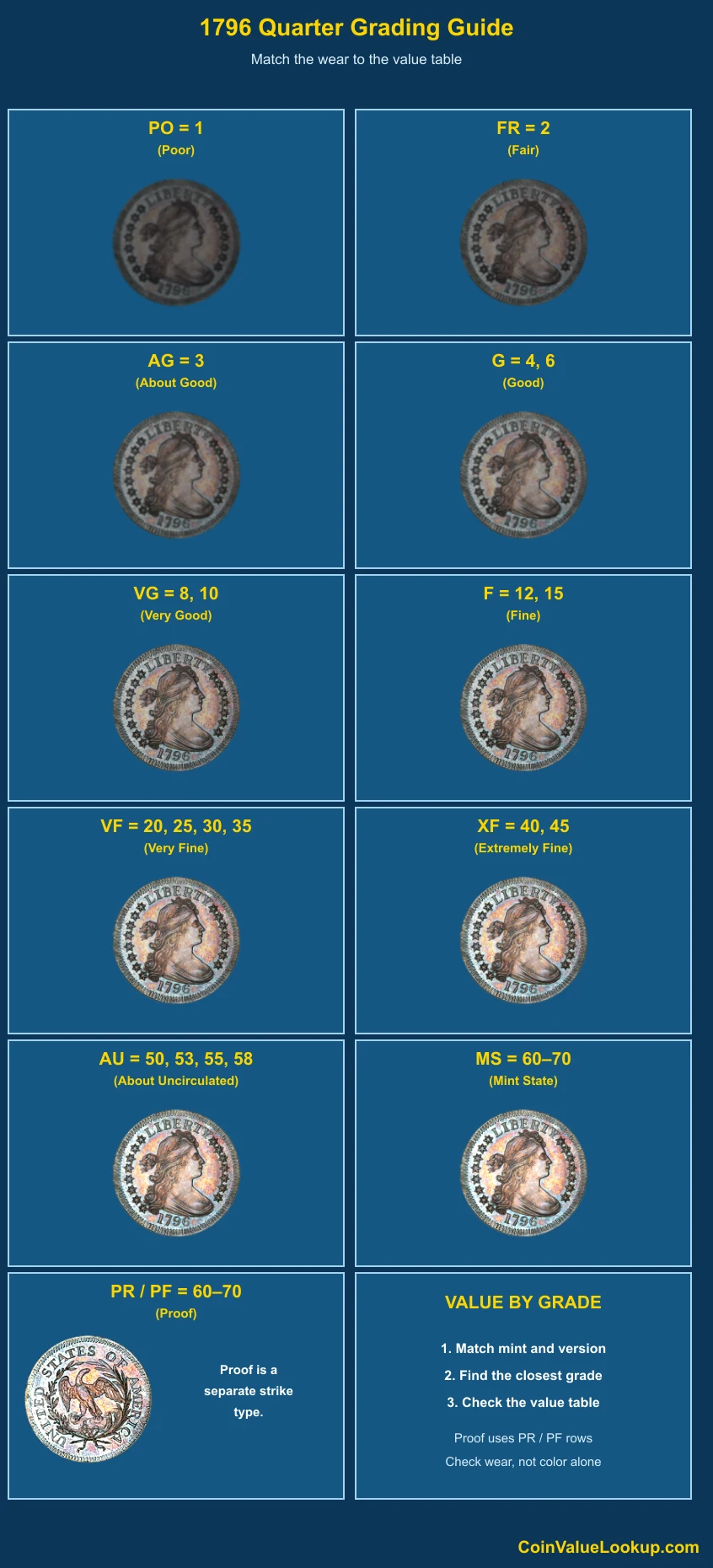
Start with Liberty's hair above the ear on the obverse. On a well-worn coin (around Good-4), the outline of Liberty's portrait is visible but nearly all hair detail is gone.
As you move up in grade, individual hair strands above the ear and across the forehead become sharper.
The cheek and the drapery lines across Liberty's bust are next. Moderate wear smooths the cheek first, then flattens the fabric folds.
On the reverse, check the eagle's breast feathers and wing tips for softness.
These early coins were struck on hand-operated presses, so uneven strikes are common. A coin can be technically unworn yet still show weak detail in spots.
Compare your coin's wear pattern and remaining luster together using the comparison image, and be cautious about assuming high grade from one strong area when the rest looks flat. Cleaning or tooling also drops the coin's market standing sharply, regardless of remaining detail.
Step 3: Check 1796 Draped Bust Quarter Value by Mint and Version
1796 Draped Bust Quarter
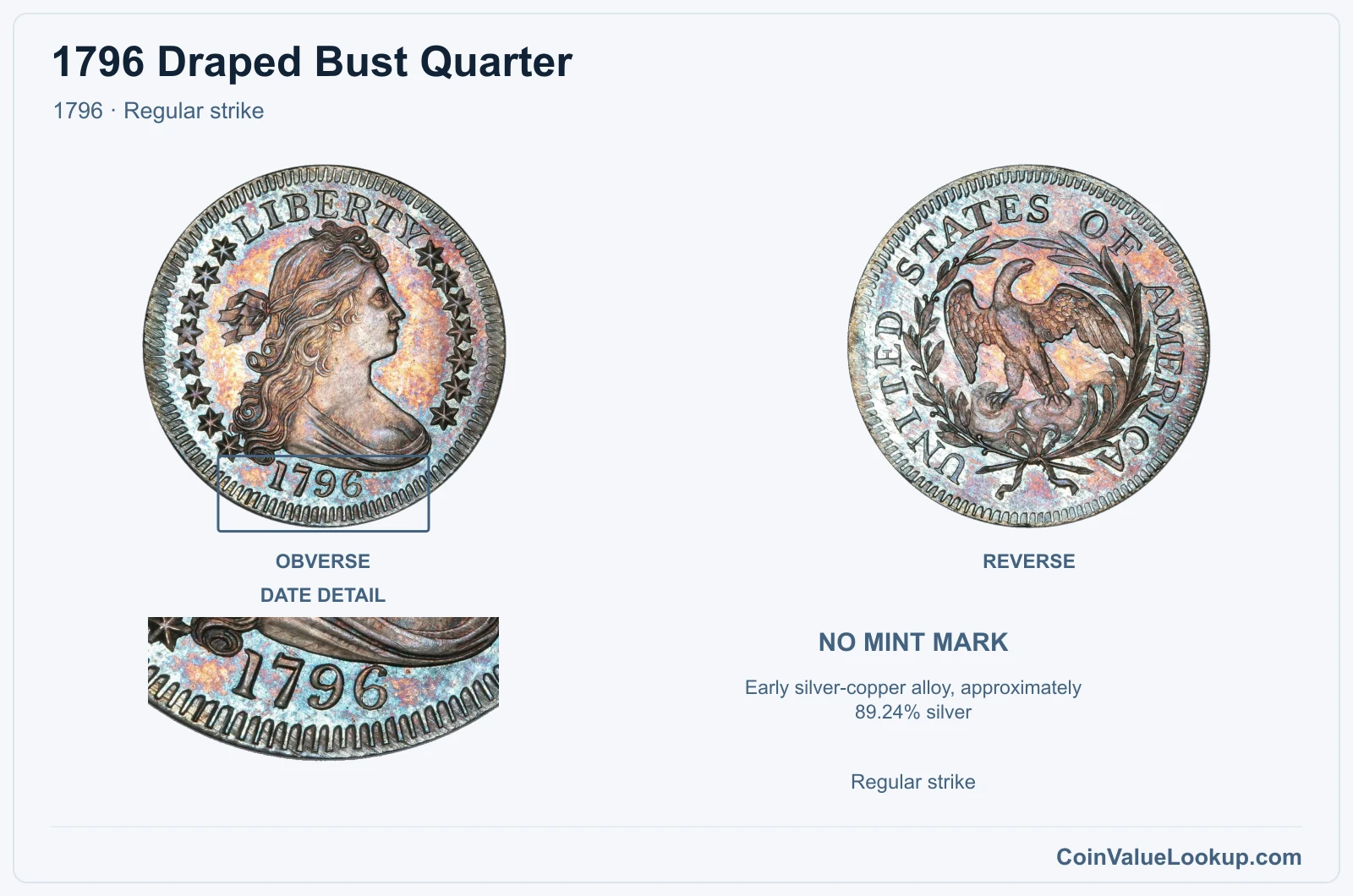
The 1796 quarter was struck only at Philadelphia with no mintmark. Look for the Draped Bust obverse paired with the Small Eagle reverse, and confirm the date reads 1796.
The coin is approximately 89.24% silver.
USA Coin Book estimates place this coin at about $13,755.00 in G4, $106,553.00 in MS60, and $215,939.00 in MS63. These are guide estimates, not guaranteed offers.
Original surfaces matter enormously here. A coin with honest wear and natural toning will command stronger interest than one that has been cleaned, polished or repaired, even if the remaining detail looks similar at first glance.
Coin Value Lookup is a good starting point if you want to look up guides for other early U.S. denominations alongside this one.
Range Grade
Price Auction Records Appraisal PO PO 1
Coin Identifier FR FR 2
Coin Identifier AG AG 3
Coin Identifier G G 4
Coin Identifier
G 6
Coin Identifier VG VG 8
Coin Identifier
VG 10
Coin Identifier F F 12
Coin Identifier
F 15
Coin Identifier VF VF 20
Coin Identifier
VF 25
Coin Identifier
VF 30
Coin Identifier
VF 35
Coin Identifier XF XF 40
Coin Identifier
XF 45
Coin Identifier AU AU 50
Coin Identifier
AU 53
Coin Identifier
AU 55
Coin Identifier
AU 58
Coin Identifier MS MS 60
—
Coin Identifier
MS 61
Coin Identifier
MS 62
Coin Identifier
MS 63
Coin Identifier
MS 64
Coin Identifier
MS 65
Coin Identifier
MS 66
Coin Identifier
MS 67
—
Coin Identifier
MS 68
—
—
—
MS 69
—
—
—
MS 70
—
—
—
1796 Draped Bust Quarter Error List
1. 1796 Draped Bust Quarter — Clipped Planchet
A clipped planchet error on a 1796 Draped Bust Quarter means part of the original blank was missing before the coin was struck. You will see a curved, straight or irregular section of the edge absent, and the design near that area may appear weak or incomplete.
Often there is a corresponding area of weakness on the opposite side of the coin where metal did not flow fully into the die.
To separate a genuine clip from post-mint damage, examine the edge texture carefully. A real clip shows undisturbed metal flow at the boundary, while a filed notch or corrosion pit will have sharp, irregular tool marks or pitting.
No specific price data is available for this error on the 1796 quarter; value depends on the size and visibility of the clip, the coin's overall condition and collector demand at the time of sale.
2. 1796 Draped Bust Quarter — Double / Multiple Strike
A double-struck 1796 Draped Bust Quarter shows two separate impressions of the design, typically displaced or rotated from each other. You may see a second outline of Liberty's portrait offset from the first, or duplicated lettering that does not align with the primary strike.
The key is that two distinct full or partial design impressions exist on the same planchet.
Do not confuse this with a doubled die, which is a repeating element within a single strike caused by a hub error. Post-mint damage from a vise or drop can also press foreign shapes into a coin's surface but will lack the precise die detail of an authentic second strike.
No adopted price exists for this error on the 1796 quarter. Condition, degree of displacement and date visibility all influence how collectors value such a piece.
3. 1796 Draped Bust Quarter — Off-Center Strike
An off-center strike happens when the planchet is not seated properly between the dies, so part of the design is missing and an unstruck crescent of blank metal appears along one side. On a 1796 quarter, confirm the date is still visible, because off-center coins that retain the full date are far more collectible than those where digits are lost.
Be careful not to mistake a clipped planchet or one-sided die misalignment for a true off-center strike. A clip removes metal from the blank itself, while off-center striking shifts the entire design.
Post-mint flattening from damage can also mimic the look but will not show the characteristic blank crescent with original planchet edge. No specific price is available for this error; value depends on the percentage off center, date visibility and the coin's preservation.
4. 1796 Draped Bust Quarter — Die Crack / Die Chip
Die cracks appear as raised lines on the coin's surface, created when a crack formed in the steel die and metal filled the gap during striking. On a 1796 quarter, look for thin raised lines that may run from the rim inward or connect design elements.
A die chip is a small raised blob where a fragment of the die broke away, leaving a void that filled with metal.
A crack that reaches the rim and produces a substantial raised area is sometimes called a cud. These are distinct from interior chips.
To tell a genuine die crack from damage, remember that cracks are raised and follow consistent paths, while scratches are incised into the surface and corrosion creates irregular pitting. No adopted price is available for die cracks on this date; significance depends on size, location and the coin's overall grade.
5. 1796 Draped Bust Quarter — Clashed Dies
Clashed dies occur when the obverse and reverse dies strike each other without a planchet between them. The impact transfers part of each die's design onto the other.
On a 1796 quarter, look for faint outlines of the Small Eagle appearing in the open fields around Liberty's portrait, or traces of the Draped Bust visible in the reverse fields near the eagle.
These ghost impressions should align with where the opposing design would naturally sit during a normal strike. Random raised lines, scratches or a brockage (where another coin acts as the die) can mimic clash marks but will not align consistently with the opposite die's features.
No price data is adopted for clashed-die examples of this date. Value depends on how clearly the transferred design is visible and the coin's condition overall.