1796 Draped Bust Dollar Coin Value: How Much Is It Worth?
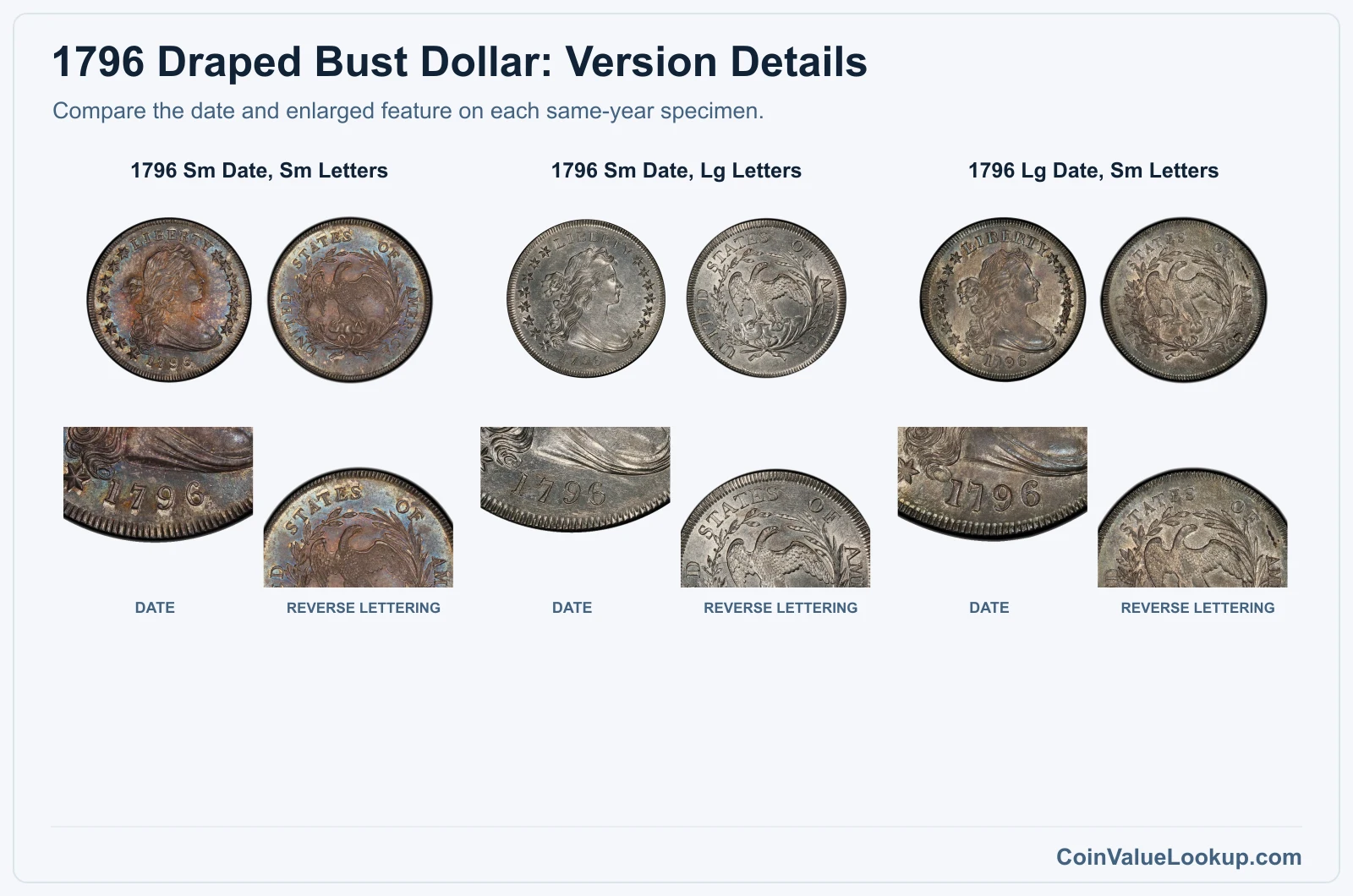
The 1796 Draped Bust Dollar is one of the earliest silver dollars struck by the United States Mint. Guide estimates for this date range from roughly $2,535 in well-worn Good-4 condition up to $1,465,152 at the gem Mint State 65 level, though these are not guaranteed offers and your coin's actual worth depends on its specific branch, grade, and surface quality.
Three distinct varieties exist for this year — Small Date with Small Letters, Small Date with Large Letters, and Large Date with Small Letters — and correctly identifying which one you have is the first step toward understanding its value.
Fast Way to Identify Your 1796 Draped Bust Dollar
Snap clear, well-lit photos of both the front and back of your 1796 dollar and upload them here for a preliminary identification. This helps narrow down which variety you hold and gives a rough sense of condition.
It is not a substitute for professional authentication or grading, but it is a solid starting point.
1796 Draped Bust Dollar Value
Upload both sides of your 1796 Draped Bust Dollar.
Front Obverse
Upload photo
Back Reverse
Upload photo
Which 1796 Draped Bust Dollar Versions Are Worth Money?
- 1796 Sm Date, Sm Letters — Guide estimates range from $2,535 at G4 to $1,465,152 at MS65; identify by compact date numerals and fine reverse lettering.
- 1796 Sm Date, Lg Letters — Same guide range; distinguished by small date numerals paired with heavier, bolder reverse legend letters.
- 1796 Lg Date, Sm Letters — Same guide range; look for taller, thicker date numerals combined with delicate reverse lettering.
Step 1: Identify Your 1796 Draped Bust Dollar Mint Mark and Version
All 1796 Draped Bust Dollars were struck at the Philadelphia Mint, so there is no mintmark to look for. The coin is a silver-copper alloy at a nominal weight of 26.96 grams, with a lettered edge.
The obverse shows the Draped Bust Liberty facing right, surrounded by stars; the reverse features the Small Eagle design.
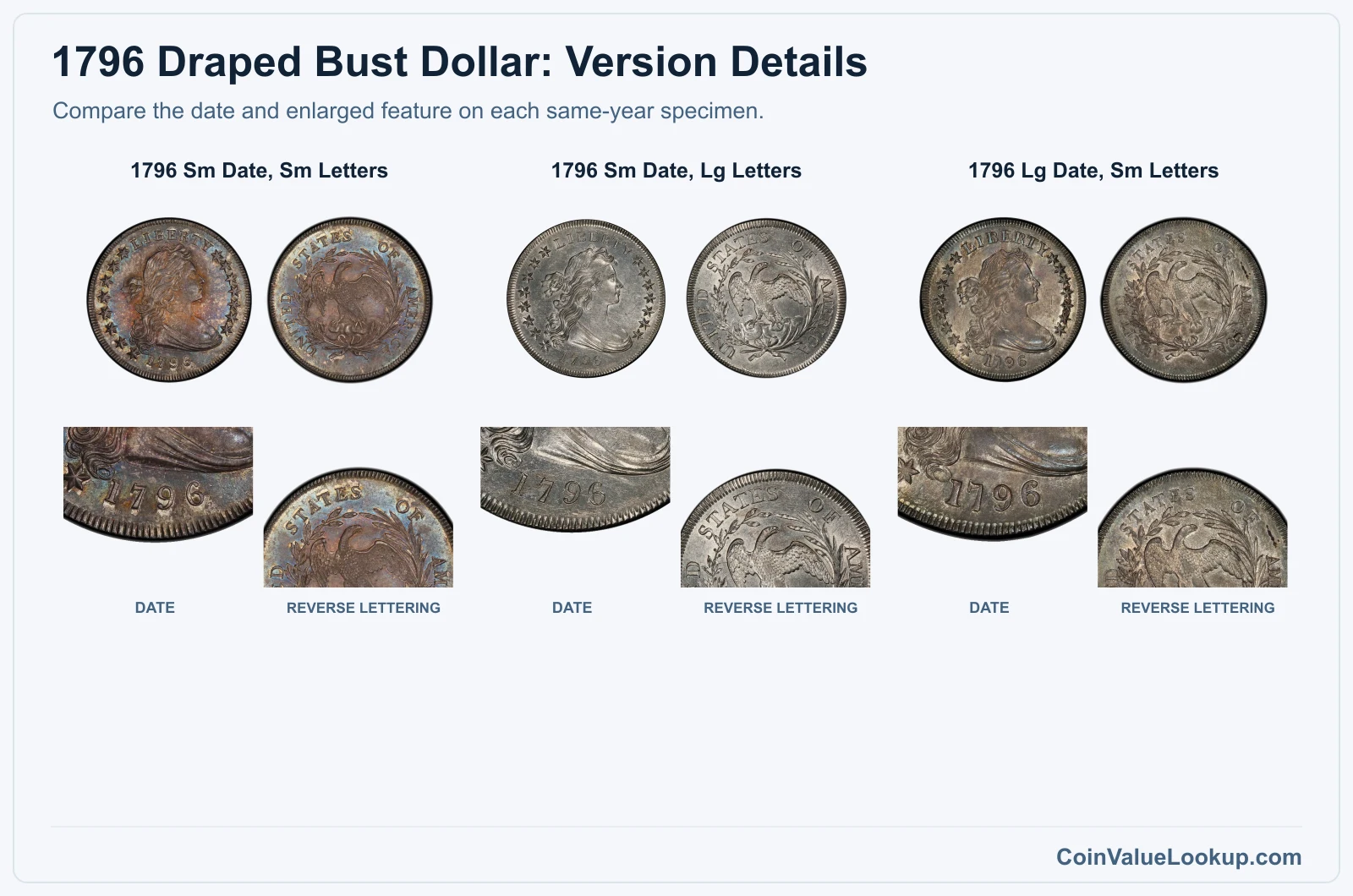
To identify the variety, focus on two things: the size of the date numerals and the size of the reverse legend lettering. "Small Date" coins have slightly more compact, thinner numerals compared to the bolder, taller "Large Date" style.
On the reverse, compare the lettering of UNITED STATES OF AMERICA — "Small Letters" are noticeably finer and more delicate than the heavier "Large Letters" version.
Three combinations were produced this year: Small Date with Small Letters, Small Date with Large Letters, and Large Date with Small Letters. A magnifying glass and a reliable reference image are your best friends here, because the differences are subtle to the naked eye.
Confirm the branch before you start looking at price guides.
Step 2: Check Your 1796 Draped Bust Dollar Grade
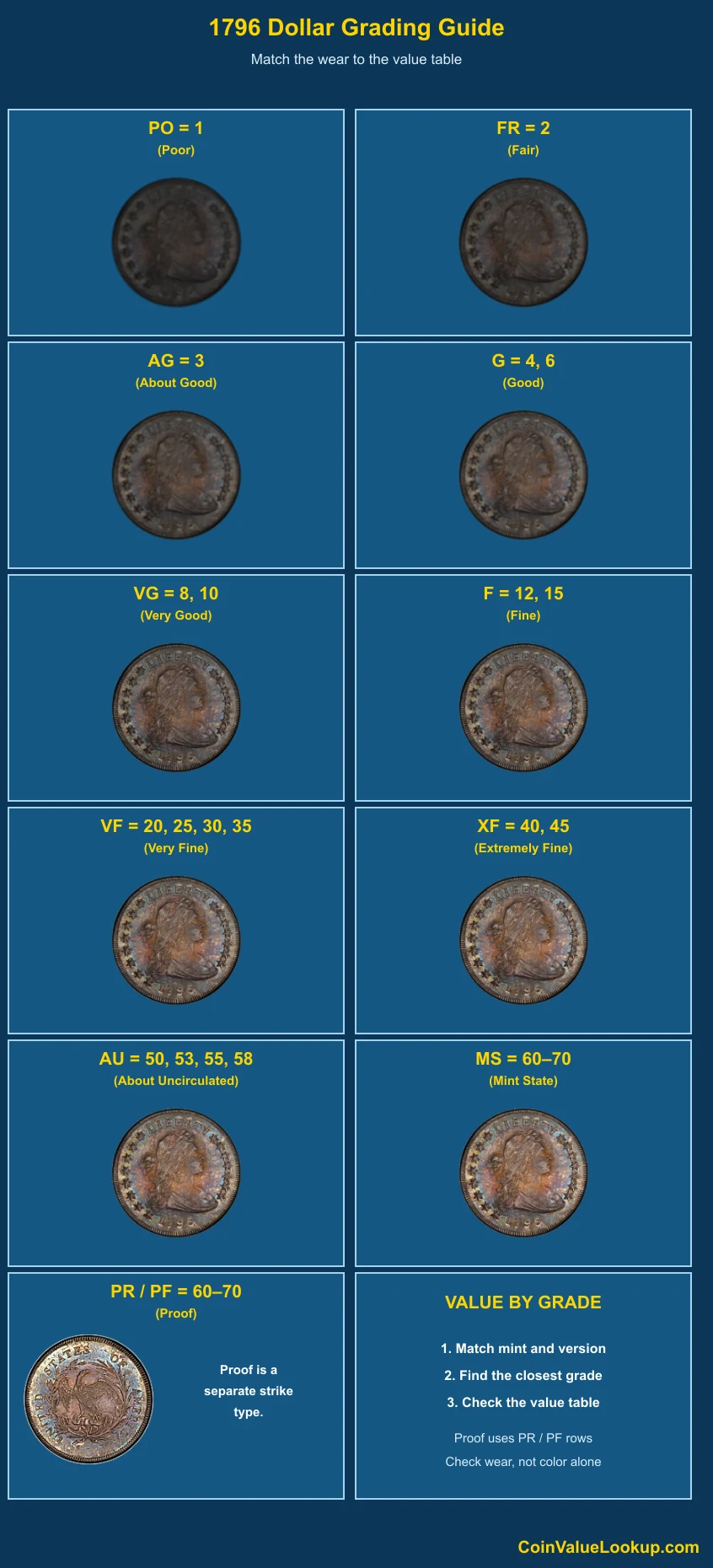
On circulated examples, the first areas to lose detail are Liberty's hair above the forehead and around the ear, the drapery across her bust, and the eagle's breast feathers on the reverse. In lower grades like Good-4, the outline of the design is visible but nearly all fine detail is flat.
As the grade climbs into Very Fine territory, you will see distinct hair strands and sharper drapery folds.
At About Uncirculated, only the highest points show light friction, and original luster remains in protected areas. Mint State coins retain full luster with no wear, though contact marks and strike quality still matter for the final number.
One important caution: weak strikes are common on early dollars. A soft area on the eagle's breast or Liberty's hair does not always mean wear — it can be a strike issue from the original production.
Compare your coin against a same-type grading reference image to tell the difference. Also watch for past cleaning or polishing; these reduce a coin's desirability and market comparability significantly, even if the underlying detail looks sharp.
Step 3: Check 1796 Draped Bust Dollar Value by Mint and Version
1796 Draped Bust Dollar — Sm Date, Sm Letters
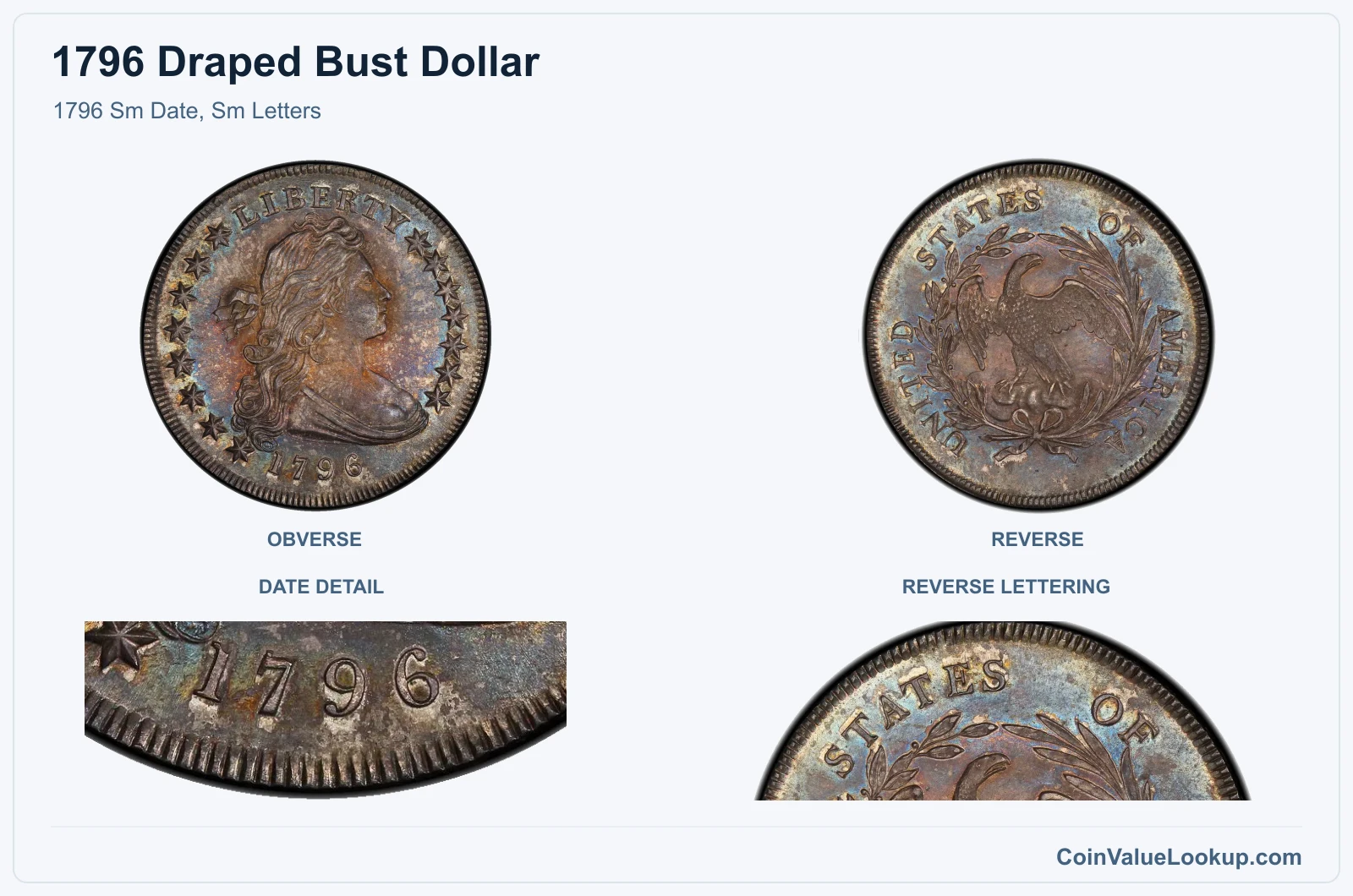
The Small Date, Small Letters variety pairs compact, thinner date numerals with fine, delicate lettering in the reverse legend. All were struck in Philadelphia from the standard silver-copper alloy at 26.96 grams, using the Draped Bust obverse and Small Eagle reverse.
Guide estimates place a Good-4 example around $2,535 and a gem MS65 at roughly $1,465,152, per USA Coin Book. These are reference estimates, not buy-it-now prices.
Original, uncleaned surfaces matter enormously at every grade level — a problem-free VF coin often outperforms a harshly cleaned AU in the marketplace.
Coin Value Lookup is a handy starting point if you want to look up guides for other early dollar dates or different denominations while you are researching.
Range Grade
Price Auction Records Appraisal PO PO 1
—
Coin Identifier FR FR 2
—
Coin Identifier AG AG 3
—
Coin Identifier G G 4
—
Coin Identifier
G 6
—
Coin Identifier VG VG 8
Coin Identifier
VG 10
Coin Identifier F F 12
Coin Identifier
F 15
Coin Identifier VF VF 20
Coin Identifier
VF 25
Coin Identifier
VF 30
Coin Identifier
VF 35
Coin Identifier XF XF 40
Coin Identifier
XF 45
Coin Identifier AU AU 50
Coin Identifier
AU 53
Coin Identifier
AU 55
Coin Identifier
AU 58
—
Coin Identifier MS MS 60
—
Coin Identifier
MS 61
—
Coin Identifier
MS 62
—
Coin Identifier
MS 63
—
Coin Identifier
MS 64
—
Coin Identifier
MS 65
—
Coin Identifier
MS 66
—
—
—
MS 67
—
—
—
MS 68
—
—
—
MS 69
—
—
—
MS 70
—
—
—
1796 Draped Bust Dollar — Sm Date, Lg Letters
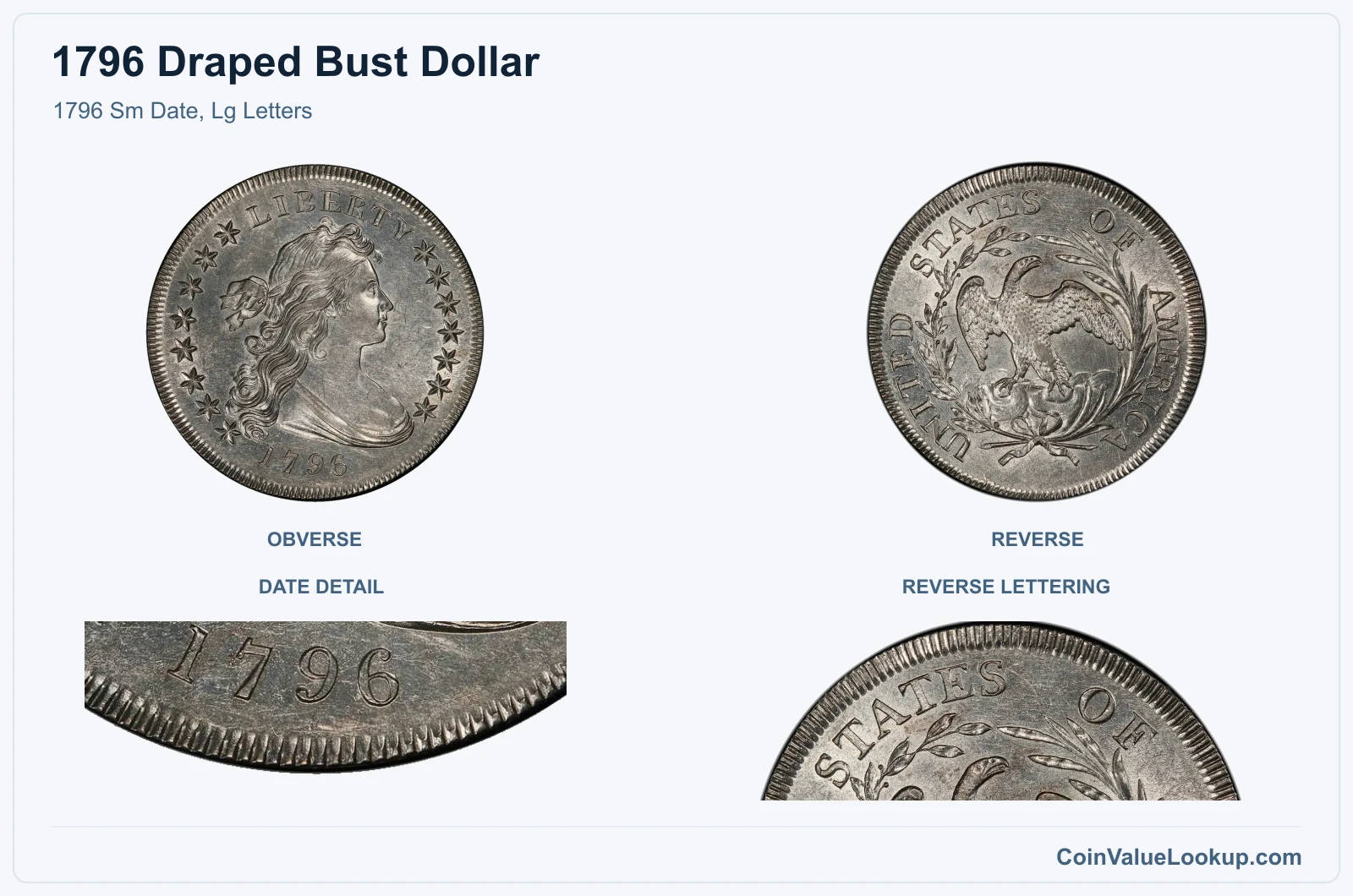
This variety combines the same small, compact date as version one but pairs it with noticeably larger, heavier letters in the UNITED STATES OF AMERICA legend on the reverse. Side-by-side comparison with a Small Letters example makes the distinction obvious; on its own it takes a careful eye.
The coin was struck in Philadelphia from a silver-copper alloy at 26.96 grams, featuring the Draped Bust obverse and Small Eagle reverse. Guide estimates from USA Coin Book list $2,535 at Good-4 and $1,465,152 at MS65.
Confirm the variety match before applying any value guide, because a misattributed variety leads to misplaced expectations.
Range Grade
Price Auction Records Appraisal PO PO 1
—
Coin Identifier FR FR 2
—
Coin Identifier AG AG 3
Coin Identifier G G 4
Coin Identifier
G 6
Coin Identifier VG VG 8
Coin Identifier
VG 10
Coin Identifier F F 12
Coin Identifier
F 15
Coin Identifier VF VF 20
Coin Identifier
VF 25
Coin Identifier
VF 30
Coin Identifier
VF 35
Coin Identifier XF XF 40
Coin Identifier
XF 45
Coin Identifier AU AU 50
Coin Identifier
AU 53
Coin Identifier
AU 55
Coin Identifier
AU 58
Coin Identifier MS MS 60
Coin Identifier
MS 61
Coin Identifier
MS 62
—
Coin Identifier
MS 63
—
—
—
MS 64
—
—
—
MS 65
—
—
—
MS 66
—
—
—
MS 67
—
—
—
MS 68
—
—
—
MS 69
—
—
—
MS 70
—
—
—
1796 Draped Bust Dollar — Lg Date, Sm Letters
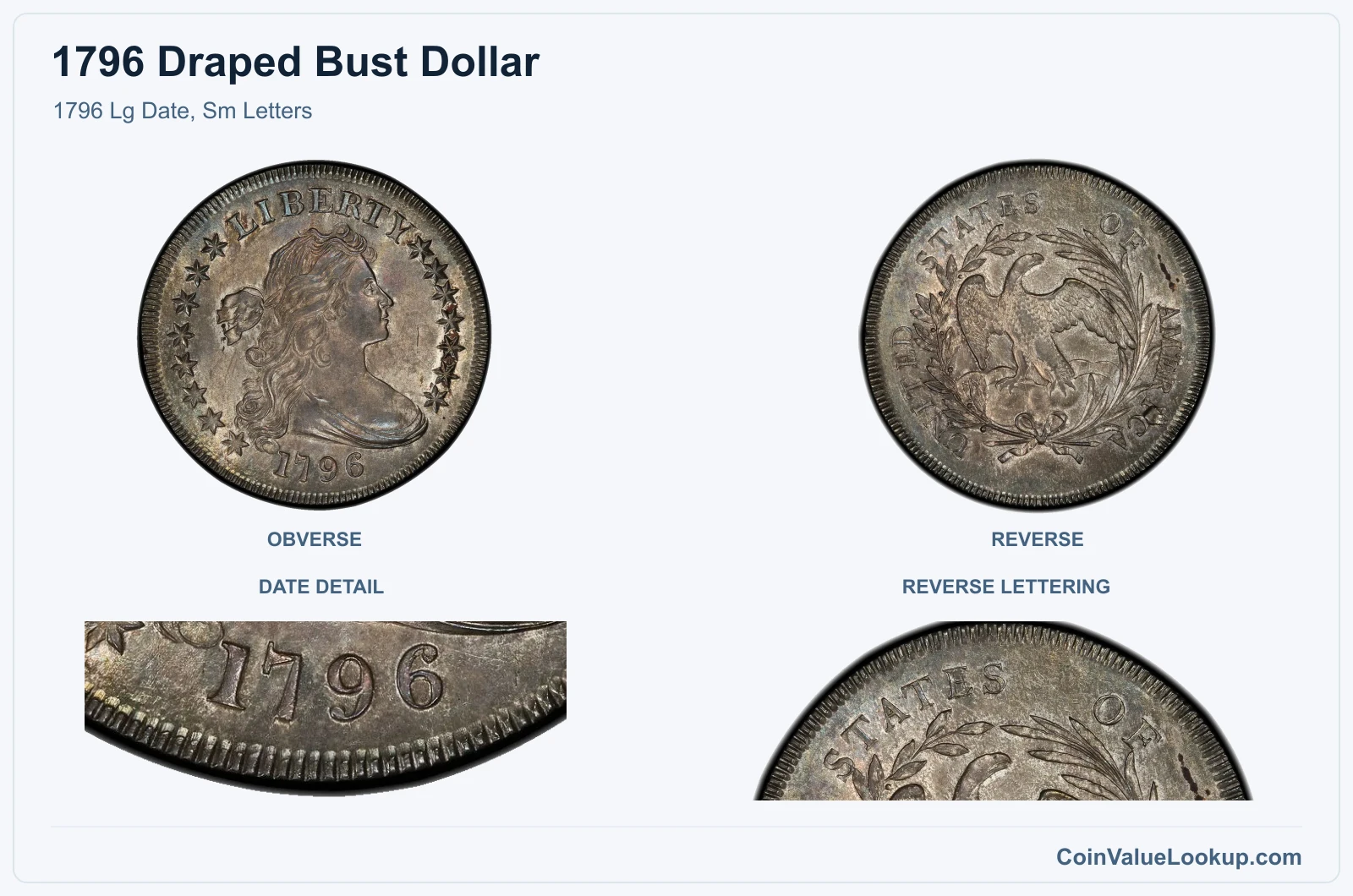
Large Date, Small Letters is identified by taller, bolder date numerals on the obverse combined with the finer, more delicate reverse lettering. It is the third recognized branch for this year.
Like its siblings, it was produced at Philadelphia in a silver-copper alloy weighing nominally 26.96 grams, with a Draped Bust obverse and Small Eagle reverse. USA Coin Book guide estimates run from $2,535 at G4 to $1,465,152 at MS65.
As with all 1796 dollars, condition and originality of surfaces drive real-world pricing far more than variety alone at the lower grade levels.
Range Grade
Price Auction Records Appraisal PO PO 1
—
Coin Identifier FR FR 2
—
Coin Identifier AG AG 3
—
Coin Identifier G G 4
—
Coin Identifier
G 6
Coin Identifier VG VG 8
Coin Identifier
VG 10
—
Coin Identifier F F 12
Coin Identifier
F 15
Coin Identifier VF VF 20
Coin Identifier
VF 25
Coin Identifier
VF 30
Coin Identifier
VF 35
Coin Identifier XF XF 40
Coin Identifier
XF 45
Coin Identifier AU AU 50
Coin Identifier
AU 53
Coin Identifier
AU 55
Coin Identifier
AU 58
Coin Identifier MS MS 60
—
Coin Identifier
MS 61
Coin Identifier
MS 62
Coin Identifier
MS 63
—
Coin Identifier
MS 64
—
Coin Identifier
MS 65
—
—
—
MS 66
—
—
—
MS 67
—
—
—
MS 68
—
—
—
MS 69
—
—
—
MS 70
—
—
—
1796 Draped Bust Dollar Error List
1. 1796 Draped Bust Dollar — Die Crack / Die Chip
Die cracks appear as thin raised lines running across the coin's surface, caused by fractures in the steel die during striking. Die chips show up as small raised blobs, often near letters or design elements.
On a 1796 Draped Bust Dollar, these features have been reported on Philadelphia-struck examples with the Small Eagle reverse. A crack that extends from the interior of the design to the rim can develop into what collectors call a cud — a larger, flatter raised area at the edge.
Do not confuse die cracks with incuse scratches, corrosion tracks, or foreign material stuck to the surface. A genuine die crack is raised above the field, follows a consistent path, and appears the same on every coin struck from that damaged die.
Scratches, by contrast, are recessed into the surface.
No specific price data is available for die-crack examples of this date. Value depends on the crack's size, location, visual appeal, and the coin's overall grade.
Professional authentication is recommended before assigning any premium.