1805 Draped Bust Half Dollar Coin Value: How Much Is It Worth?
An 1805 Draped Bust Half Dollar carries serious collector value well beyond its silver content. Guide estimates for a normal-date example run from about $341 in G4 to $5,640 in AU50.
The 1805/4 overdate variety commands roughly double those figures. Condition and variety matter enormously with these early federal coins.
Fast Way to Identify Your 1805 Draped Bust Half Dollar
Upload clear photos of both sides of your coin and we can help with a preliminary identification. Front and back images let us check the date digits, overall wear level, and whether an overdate might be present.
This is not a substitute for professional authentication, but it gets you pointed in the right direction fast.
1805 Draped Bust Half Dollar Value
Upload both sides of your 1805 Draped Bust Half Dollar.
Front Obverse
Upload photo
Back Reverse
Upload photo
Which 1805 Draped Bust Half Dollar Versions Are Worth Money?
- Normal Date in AU50 condition guides near $5,640; even a well-worn G4 example sits around $341, reflecting strong demand for early federal silver.
- 1805/4 Overdate pieces guide at roughly $685 in G4 and climb to about $10,621 in AU50, nearly doubling the normal-date values at each grade level because the visible overdate is a recognized die-preparation variety.
Step 1: Identify Your 1805 Draped Bust Half Dollar Mint Mark and Version
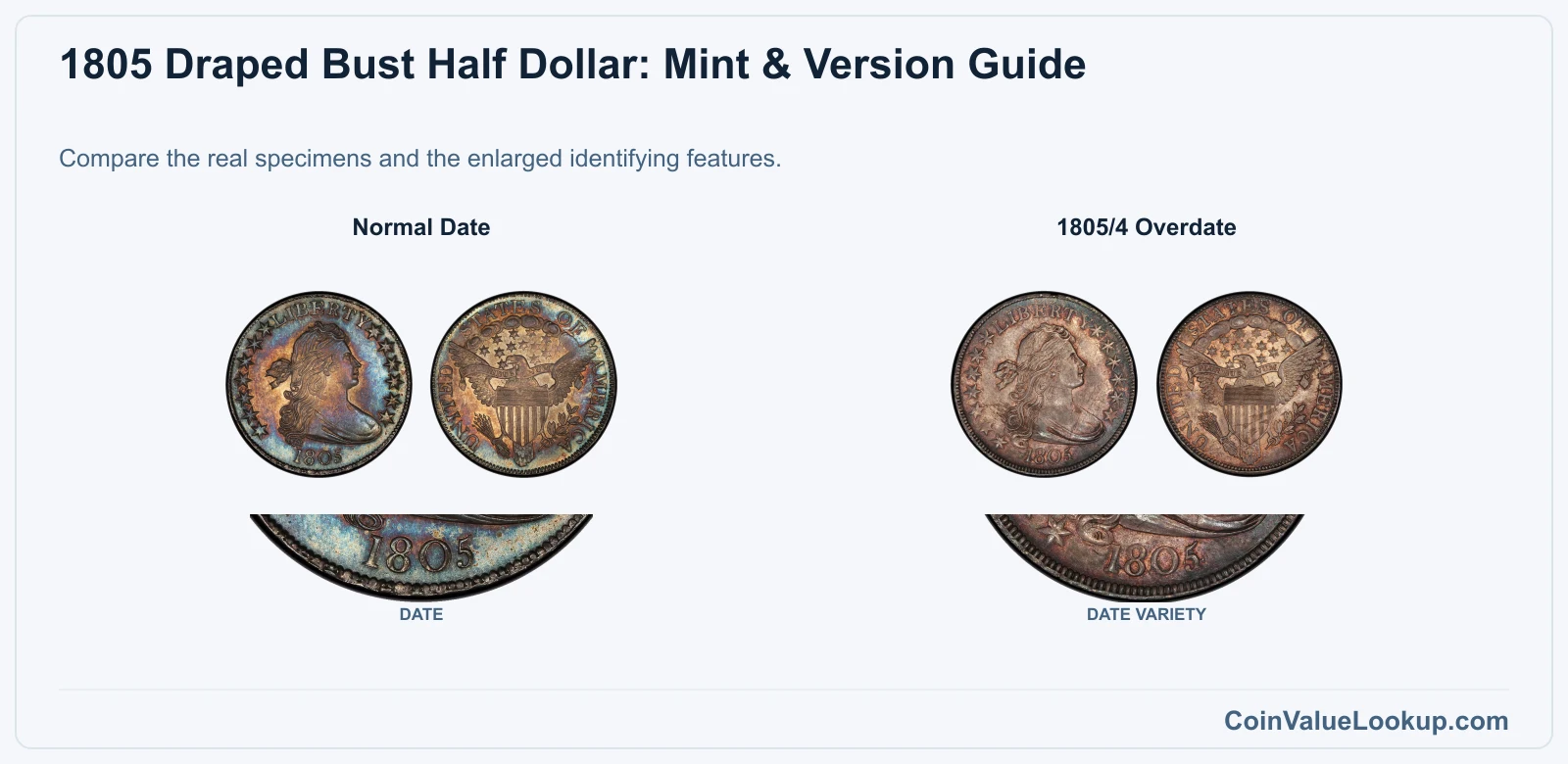
Every 1805 half dollar was struck at Philadelphia. There is no mintmark, and that is normal — no branch mints produced half dollars this year.
Do not look for a small letter under the eagle or elsewhere.
Confirm the denomination by reading the lettered edge: FIFTY CENTS OR HALF A DOLLAR. The obverse shows the Draped Bust of Liberty facing right, the reverse a Heraldic Eagle with shield.
Nominal specs are about 32.5 mm diameter and 13.48 g weight; weight can help screen obvious fakes but is not authentication by itself.
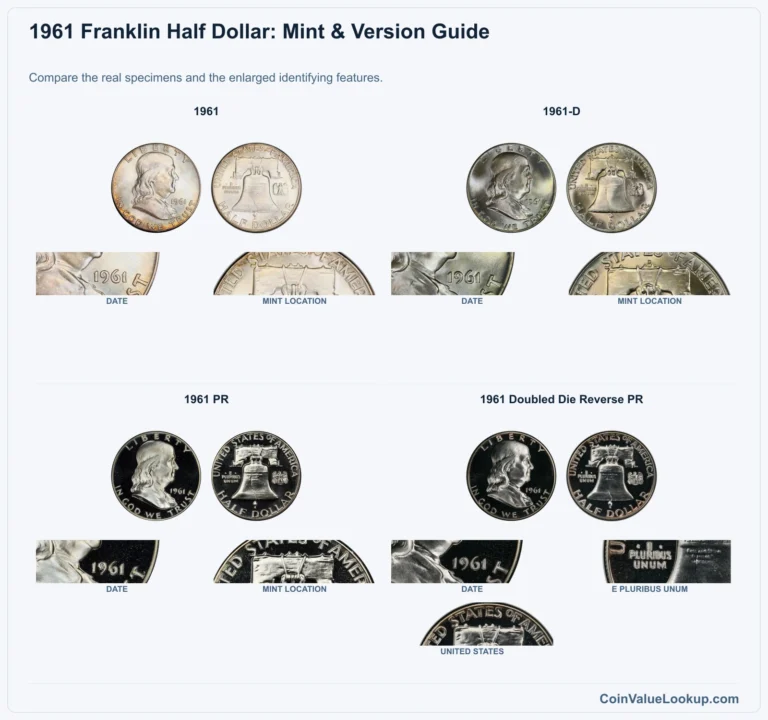
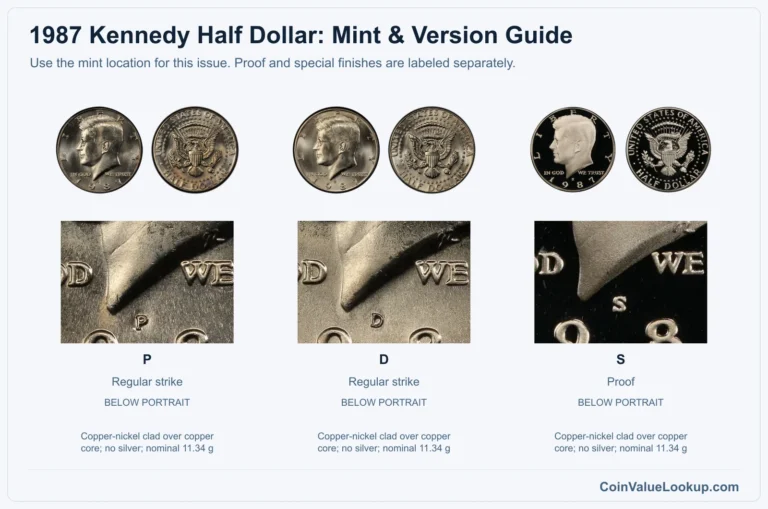
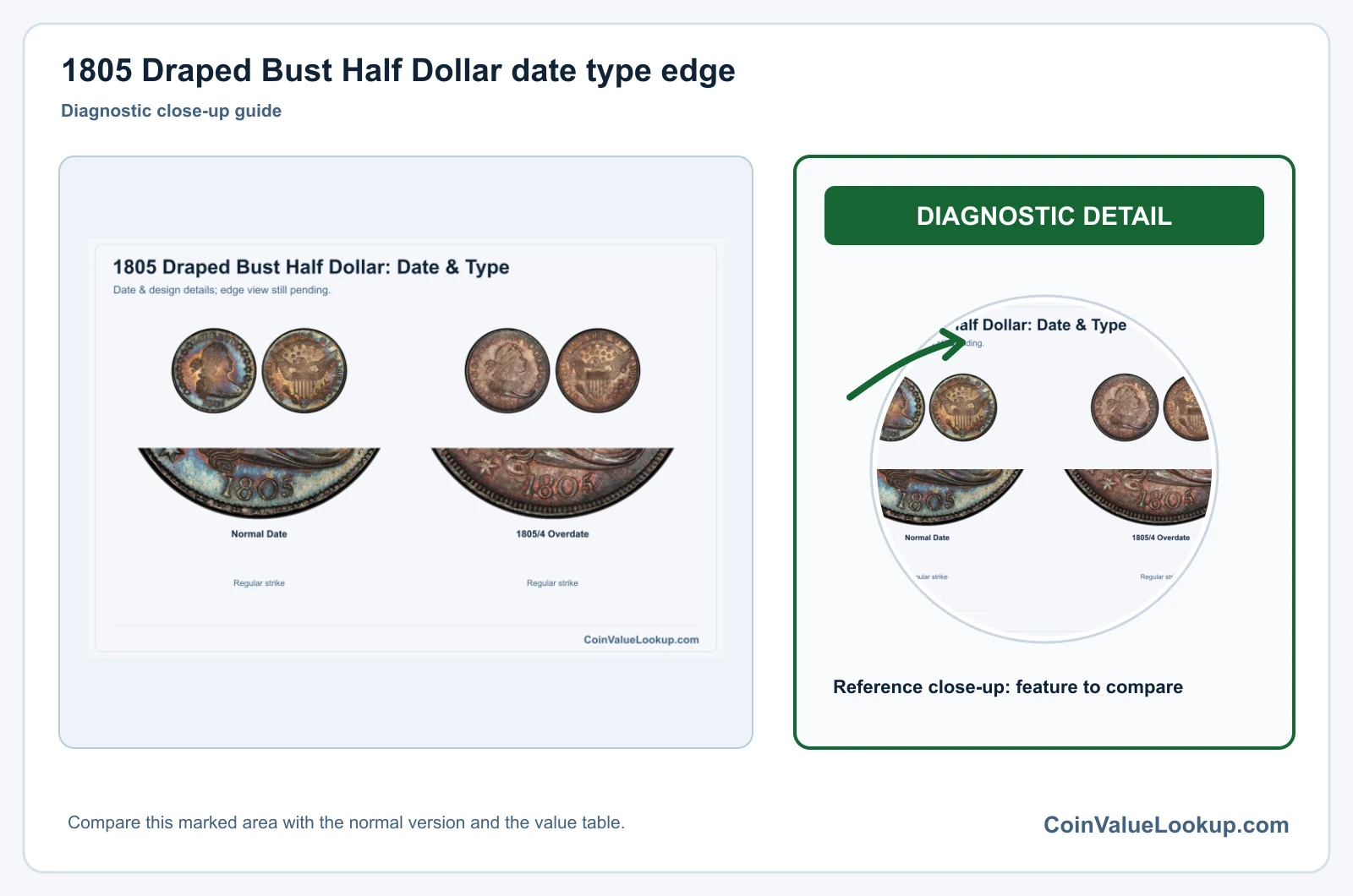
The two major identities to separate are the Normal Date and the 1805/4 Overdate. Look closely at the final digit.
On a normal-date coin the 5 is cleanly cut. On the overdate, remnants of a 4 are visible beneath and beside the 5 — the lower diagonal of the 4 typically shows at the base of the 5.
A loupe helps considerably here.
Coin Value Lookup is a good starting point if you want to look up guides for other early U.S. coin types while you are comparing your half dollar.
Step 2: Check Your 1805 Draped Bust Half Dollar Grade
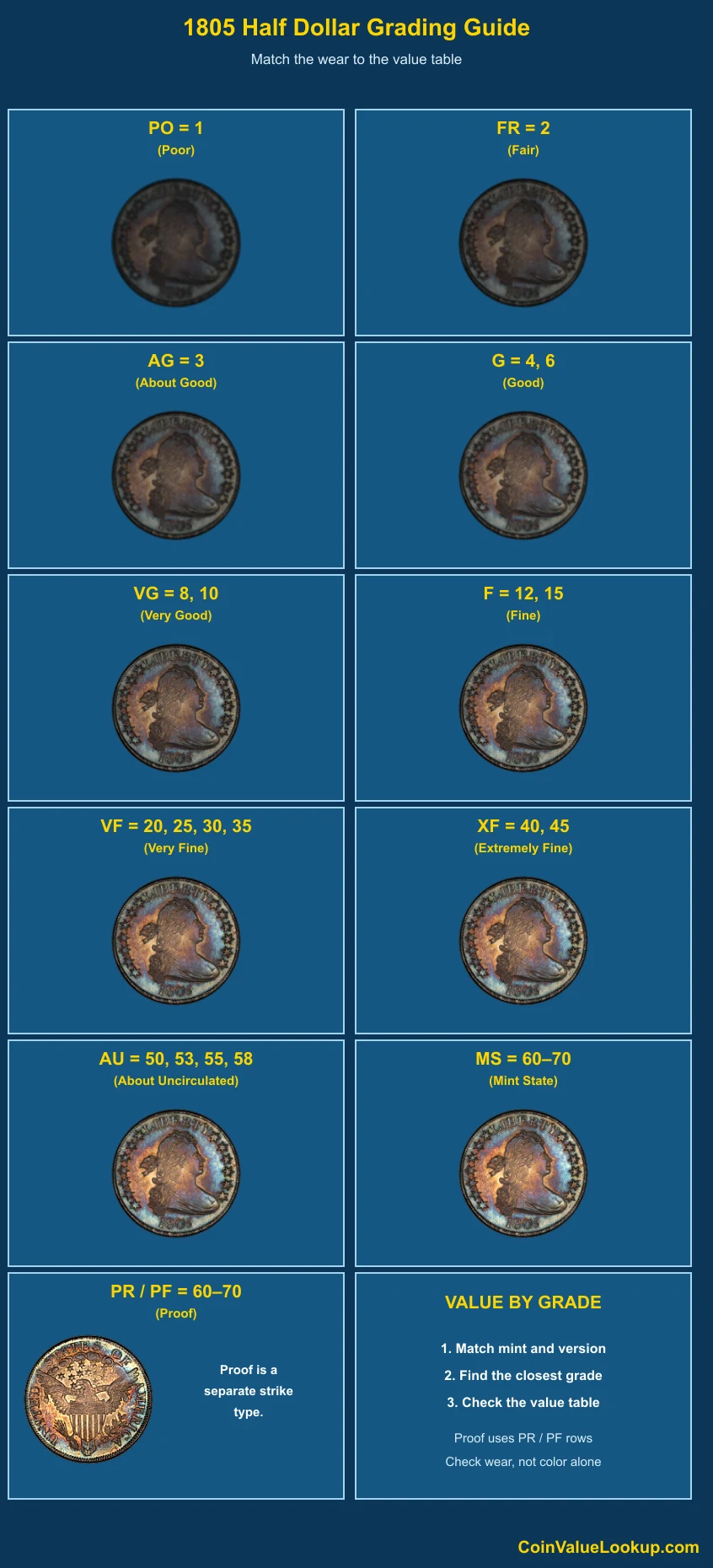
Focus on Liberty's hair directly above her forehead, the high point of her cheek, and the drapery across her shoulder. These are the first areas to lose detail as a coin circulates.
Compare your coin against images of the same Draped Bust type, not modern half dollars.
On the reverse, check the eagle's breast feathers and wing tips for wear. Early half dollars often have areas of weakness from the original strike, so a soft spot is not always wear.
Look for intact luster around protected areas — if the luster is uniformly gone but the detail is sharp, you may be seeing light friction rather than a lower grade.
Coins with cleaning, holes, plugs, tooling, or heavy scratches get a "Details" designation from grading services. A Details coin does not follow the same price curve as a straight-graded example, so note any surface problems separately when evaluating yours.
Step 3: Check 1805 Draped Bust Half Dollar Value by Mint and Version
1805 Draped Bust Half Dollar — Normal Date
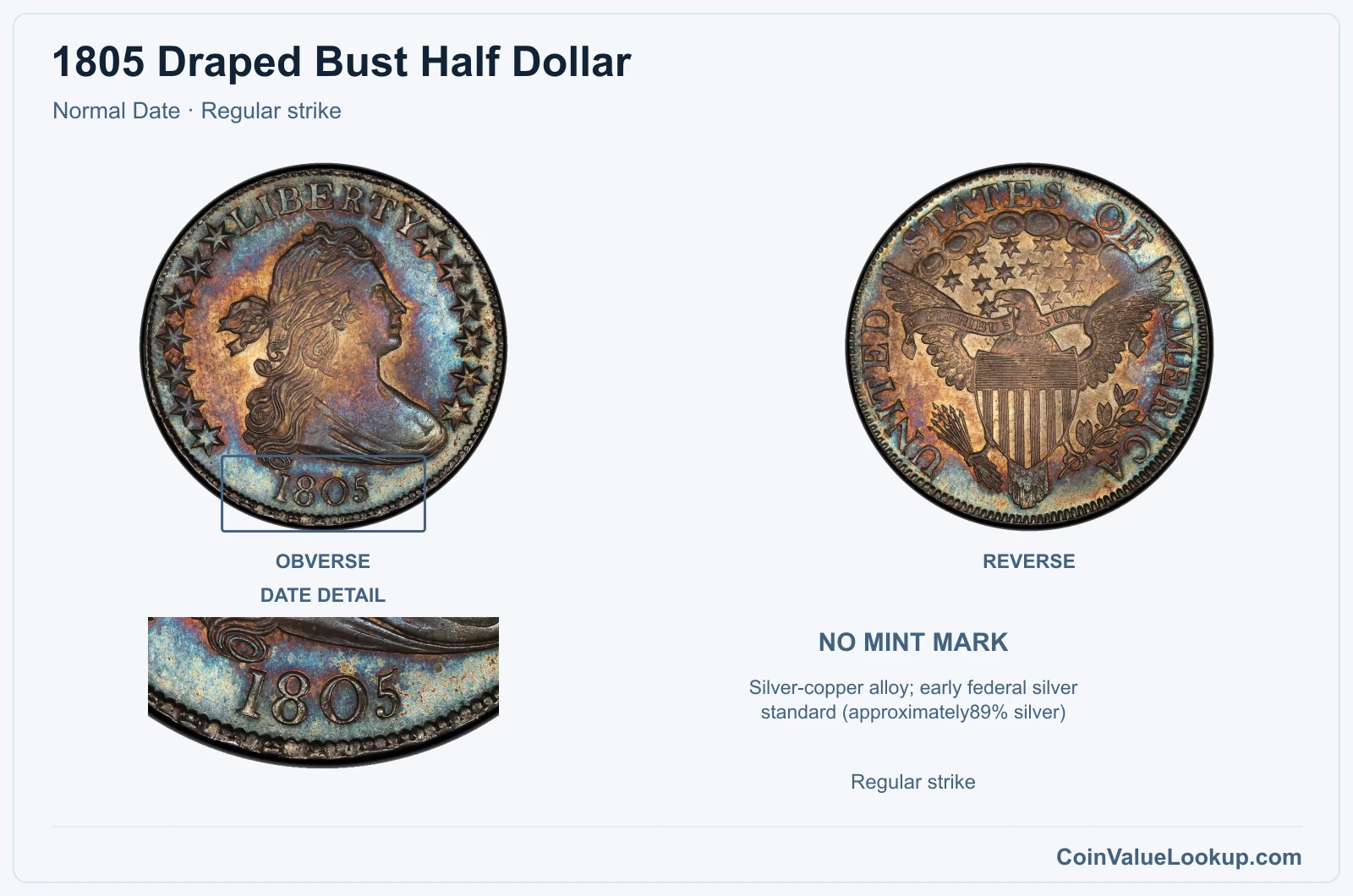
The normal-date 1805 half dollar is your baseline. The 5 in the date should be cleanly punched with no trace of an underlying 4.
Before settling on this attribution, examine the base and lower curves of the 5 under magnification — any stray serifs or diagonal remnants suggest the overdate instead.
Guide estimates from USA Coin Book place a normal-date example at about $341 in G4, $1,083 in VF20, and $5,640 in AU50. These are retail guide figures, not guaranteed sale prices.
Struck in silver-copper alloy at the early federal standard of approximately 89% silver, the coin carries intrinsic metal value too, but collector demand pushes prices well above melt.
Range Grade
Price Auction Records Appraisal PO PO 1
—
Coin Identifier FR FR 2
—
Coin Identifier AG AG 3
Coin Identifier G G 4
Coin Identifier
G 6
Coin Identifier VG VG 8
Coin Identifier
VG 10
Coin Identifier F F 12
Coin Identifier
F 15
Coin Identifier VF VF 20
Coin Identifier
VF 25
Coin Identifier
VF 30
Coin Identifier
VF 35
Coin Identifier XF XF 40
Coin Identifier
XF 45
Coin Identifier AU AU 50
Coin Identifier
AU 53
Coin Identifier
AU 55
Coin Identifier
AU 58
Coin Identifier MS MS 60
—
Coin Identifier
MS 61
Coin Identifier
MS 62
Coin Identifier
MS 63
Coin Identifier
MS 64
—
—
—
MS 65
—
—
—
MS 66
—
—
—
MS 67
—
—
—
MS 68
—
—
—
MS 69
—
—
—
MS 70
—
—
—
1805 Draped Bust Half Dollar — /4 Overdate
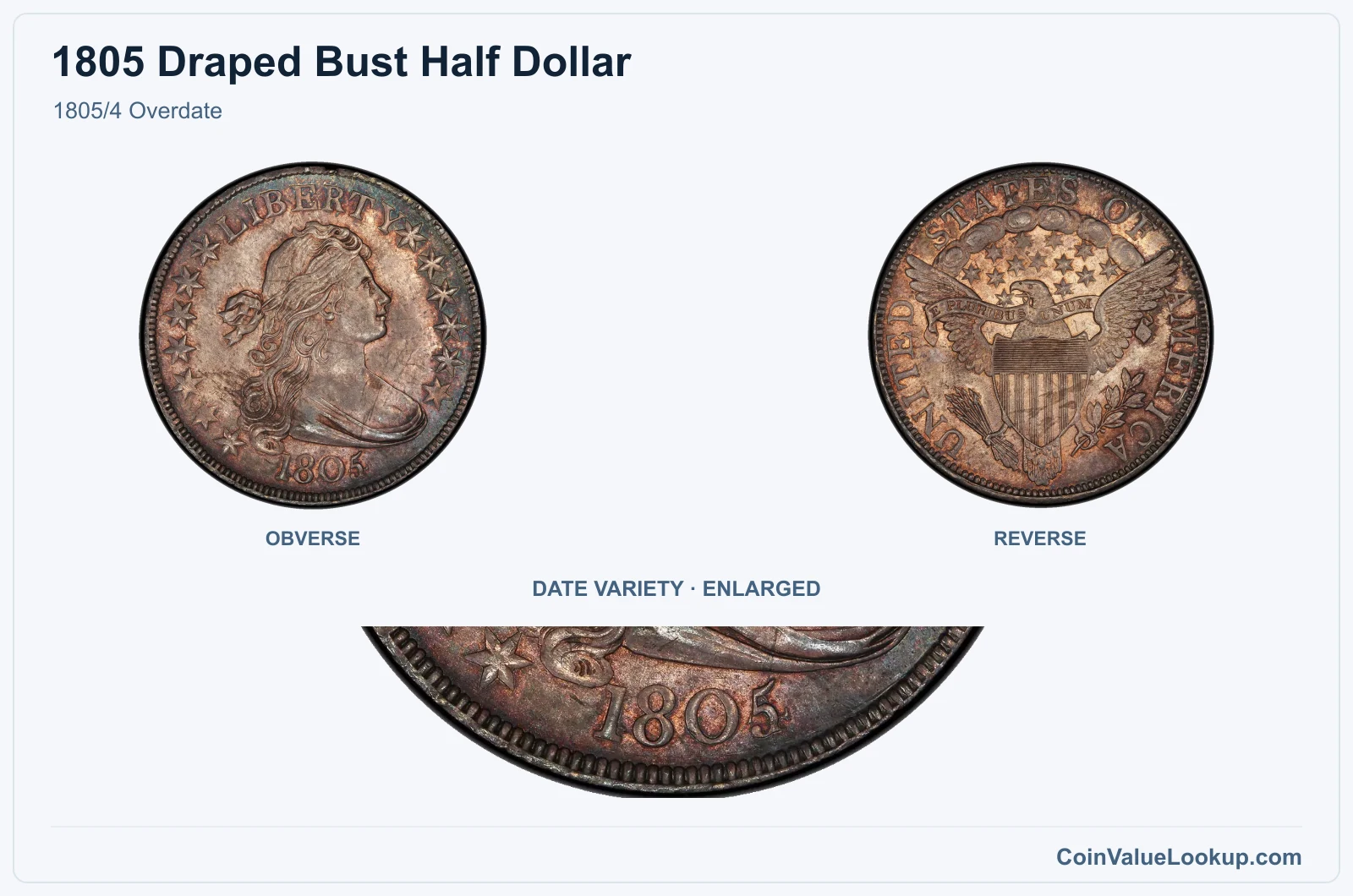
This is the variety to hope for. On 1805/4 overdate half dollars the Mint reused a die originally dated 1804, punching a 5 over the 4.
Remains of the 4 are visible — typically the lower left diagonal of the 4 protrudes at the base or left side of the 5, and the upper portion of the 4's crossbar can sometimes be traced as well. A 5x or 10x loupe makes attribution much easier.
USA Coin Book guide estimates run about $685 at G4, $2,516 at VF20, and $10,621 at AU50, roughly double the normal-date figures across the board. The premium exists because the overdate is a genuine die-preparation variety with strong collector following.
All examples were struck at Philadelphia in silver-copper alloy at approximately 89% silver, same as the normal date. Condition still drives the final number — a cleaned overdate will trail a problem-free normal-date coin in the same technical grade.
Range Grade
Price Auction Records Appraisal PO PO 1
—
Coin Identifier FR FR 2
—
Coin Identifier AG AG 3
—
Coin Identifier G G 4
—
Coin Identifier
G 6
—
Coin Identifier VG VG 8
Coin Identifier
VG 10
Coin Identifier F F 12
Coin Identifier
F 15
Coin Identifier VF VF 20
Coin Identifier
VF 25
Coin Identifier
VF 30
Coin Identifier
VF 35
Coin Identifier XF XF 40
Coin Identifier
XF 45
Coin Identifier AU AU 50
Coin Identifier
AU 53
Coin Identifier
AU 55
Coin Identifier
AU 58
Coin Identifier MS MS 60
—
Coin Identifier
MS 61
—
Coin Identifier
MS 62
—
Coin Identifier
MS 63
—
Coin Identifier
MS 64
—
Coin Identifier
MS 65
Coin Identifier
MS 66
—
—
—
MS 67
—
—
—
MS 68
—
—
—
MS 69
—
—
—
MS 70
—
—
—
1805 Draped Bust Half Dollar Error List
1. 1805 Draped Bust Half Dollar — Die Break / Cud
A die break or cud on an 1805 half dollar appears as a raised, irregular blob of metal, usually along the rim. One documented location involves the area near stars 9 through 12 on the obverse.
What happens mechanically is that a chunk of the die surface fractures and falls away; the resulting void fills with metal during striking, creating a raised lump on the coin.
Do not confuse a cud with a rim dent, which is incuse rather than raised, or with surface corrosion that can mimic irregular texture. A genuine retained die break will show a smooth, rounded profile where the die metal was lost.
The value of a cud depends on its size, location, and the overall condition of the coin — no single price applies to every example. Have the coin evaluated individually if you spot one.
2. 1805 Draped Bust Half Dollar — Die Crack / Die Chip
Die cracks show up as thin raised lines on the coin's surface, tracing the path of a fracture in the steel die. On 1805 half dollars, one documented crack runs from the first S of STATES through the cloud design toward the final letters of the legend on the reverse.
Because the crack is a gap in the die, metal flows into it during striking, so the line on the coin is raised — the opposite of a scratch, which is incuse.
That distinction is your main diagnostic. Run a fingernail across the line: if it catches going over it, it is raised and likely a die crack.
If your nail drops into it, you are looking at a scratch, corrosion channel, or deposited foreign material. A crack that widens into a retained break at the rim overlaps with the cud category above — they are stages of the same die failure, not separate error types.
Value depends on prominence and coin condition; no standard premium applies across the board.