1803 Draped Bust Half Dollar Coin Value: How Much Is It Worth?
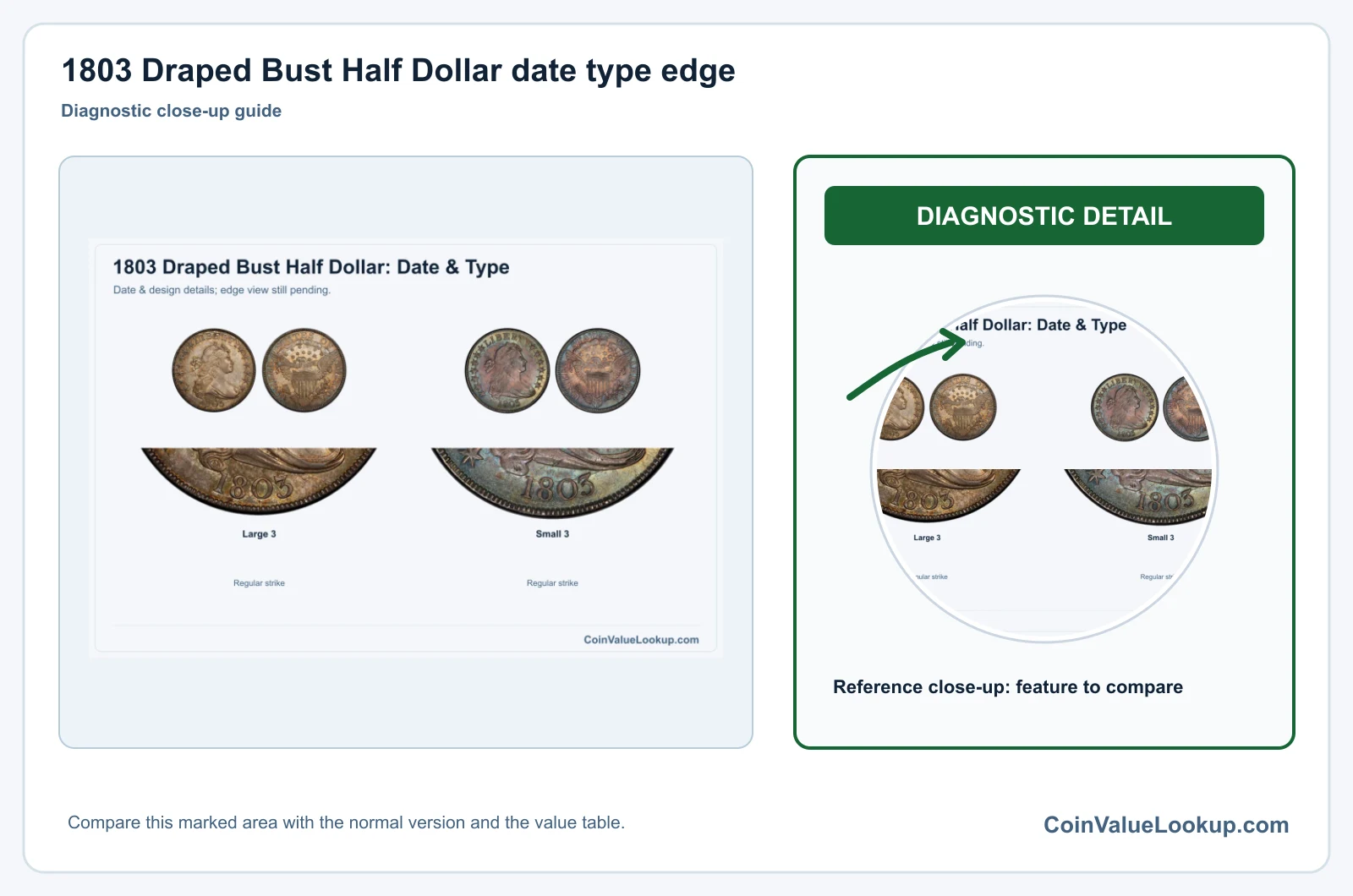
An 1803 Draped Bust Half Dollar is a serious early American coin. Even well-worn examples carry substantial collector value — guide estimates run from about $487 at G4 to $3,651 or higher at AU50, depending on the variety.
Special die varieties and superior preservation can push values well beyond those anchors. This is a coin where details matter.
Fast Way to Identify Your 1803 Draped Bust Half Dollar
The fastest way to start figuring out what you have is to upload clear photos of both the front and back of your coin. Our identifier can offer a preliminary read on the variety and general condition.
Good lighting and a close crop of the date digits help a lot — the difference between the two main varieties lives in the size of the "3" in the date.
1803 Draped Bust Half Dollar Value
Upload both sides of your 1803 Draped Bust Half Dollar.
Front Obverse
Upload photo
Back Reverse
Upload photo
Which 1803 Draped Bust Half Dollar Versions Are Worth Money?
- Large 3 — guide values from about $487 at G4 to $3,651 at AU50; confirm the larger date punch with its prominent serif before assuming this variety.
- Small 3 — carries higher guide values at mid and upper grades (about $1,363 at VF20 and $5,640 at AU50), making variety identification worth the effort.
Step 1: Identify Your 1803 Draped Bust Half Dollar Mint Mark and Version
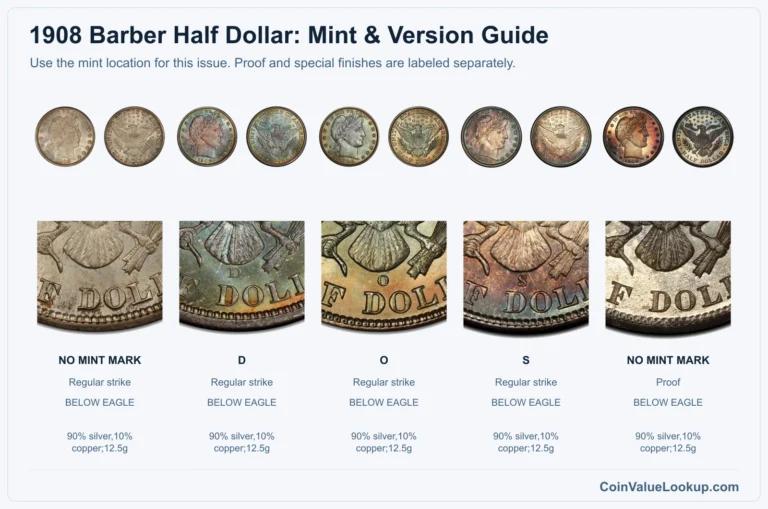
Every 1803 half dollar was struck at the Philadelphia Mint. There is no mintmark, and that is completely normal — do not look for a D, S, or O anywhere on the coin.
Confirm the denomination by checking the lettered edge, which reads FIFTY CENTS OR HALF A DOLLAR. The obverse shows Liberty facing right with draped fabric at the shoulder, while the reverse features a heraldic eagle with a shield on its breast.
Nominal specifications are about 32.5 mm diameter and roughly 13.48 g; weight can help screen out fakes, but it does not authenticate a coin on its own.
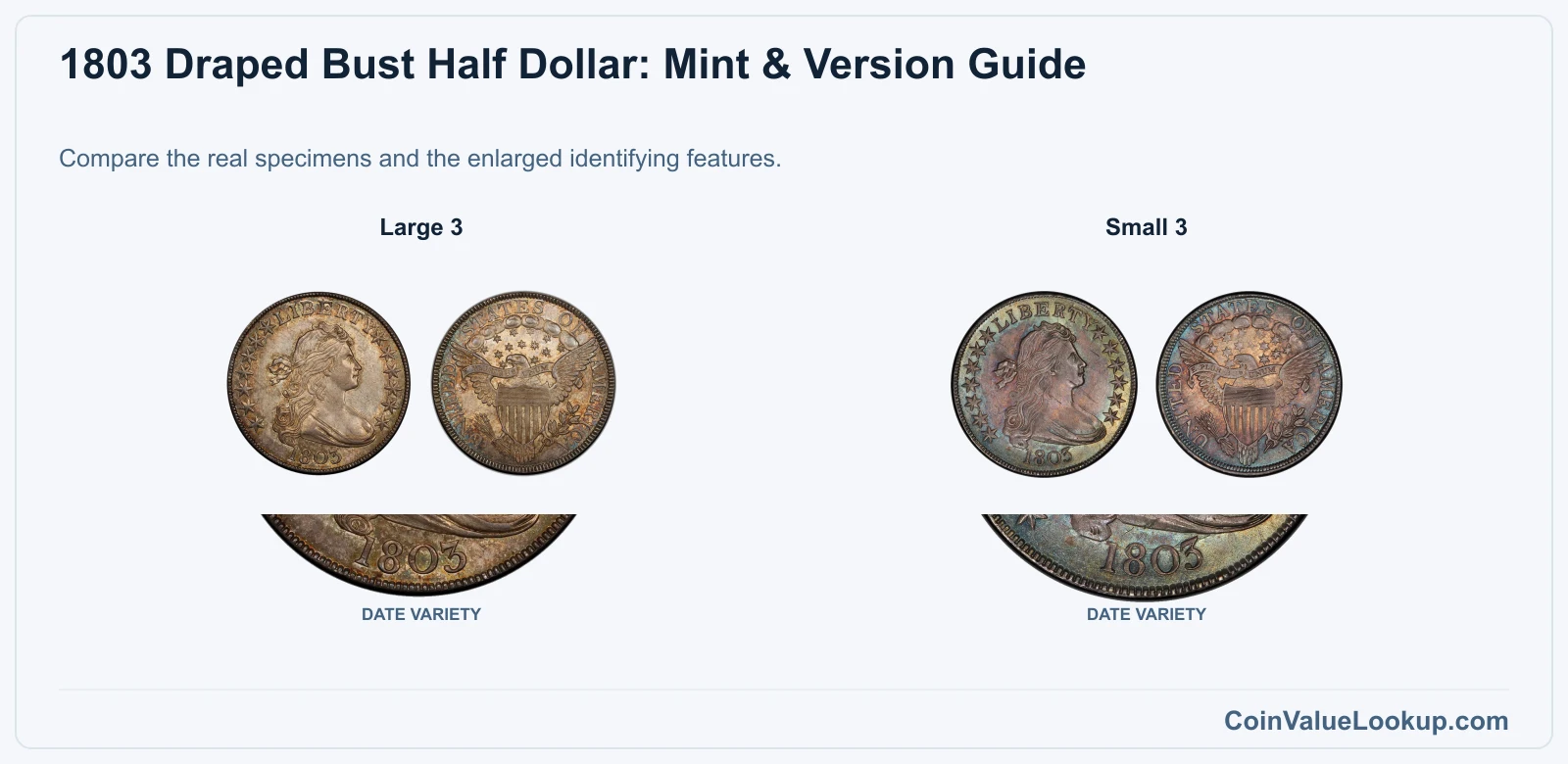
The two major varieties are the Large 3 and the Small 3. You need magnification and a direct side-by-side comparison of the final date digit.
The Large 3 has a noticeably bigger punch with a prominent serif, while the Small 3 is more compact. Wear and camera angles can blur the distinction, so a single blurry photo is not enough to call it.
Step 2: Check Your 1803 Draped Bust Half Dollar Grade
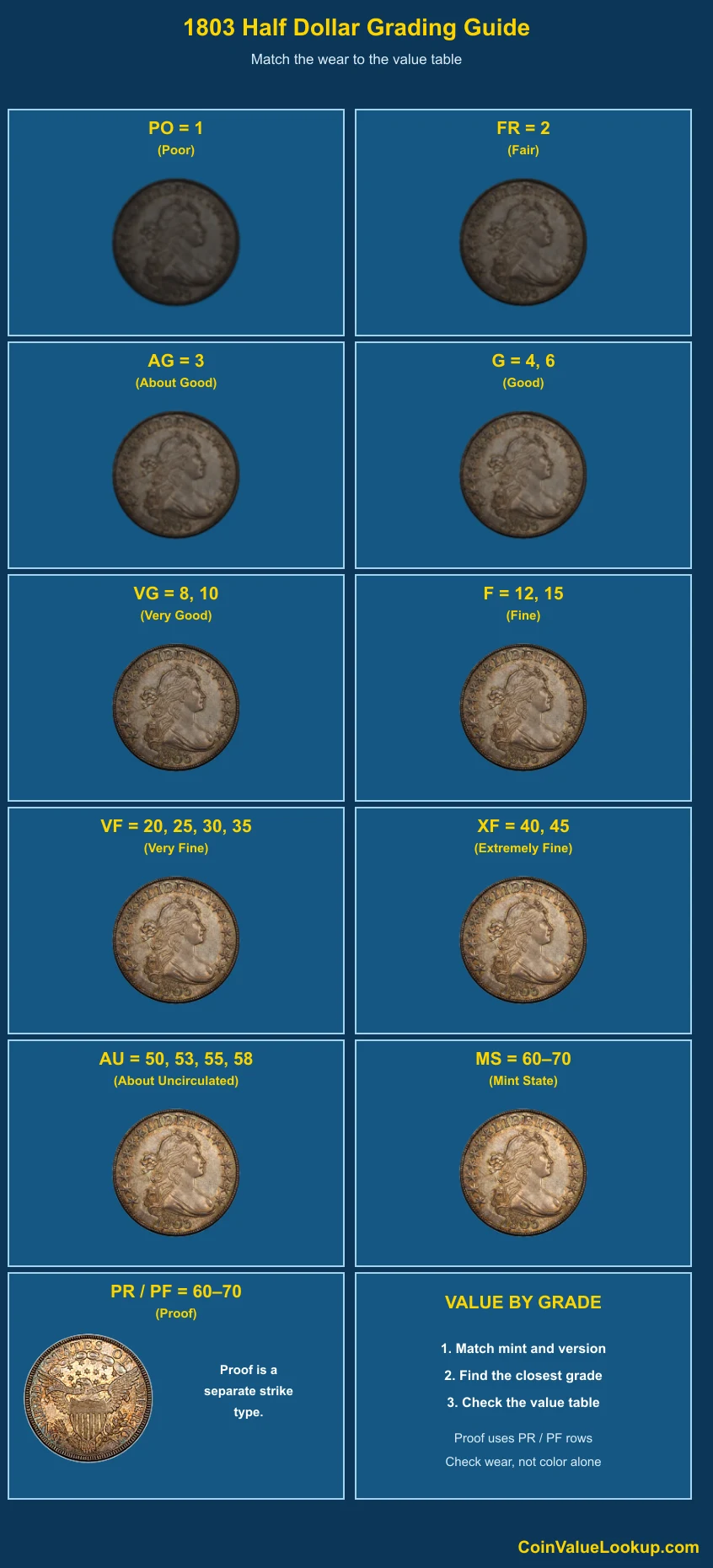
Start with Liberty's hair detail above the forehead. On a well-circulated piece, the strands merge into a flat mass early.
Check the cheek for smoothness and the drapery lines across the shoulder — these wear progressively and give you a rough grade bracket.
On the reverse, examine the eagle's breast feathers and wing detail. Early federal coins sometimes came off the press with soft strikes in spots, so a mushy area is not always wear.
Look for friction or lost luster around the high points to separate genuine circulation from an incomplete strike.
Use the comparison image to gauge your coin against known grade standards for this specific type. Comparing it to a modern Kennedy half or even a later Seated Liberty will mislead you.
Finally, look hard for cleaning, holes, plugs, tooling, or deep scratches. A coin with any of these problems is typically graded as a "Details" coin by third-party services, meaning it does not follow the straight-grade price curve.
A cleaned AU can sell for less than an original VF.
Step 3: Check 1803 Draped Bust Half Dollar Value by Mint and Version
1803 Draped Bust Half Dollar — Large 3
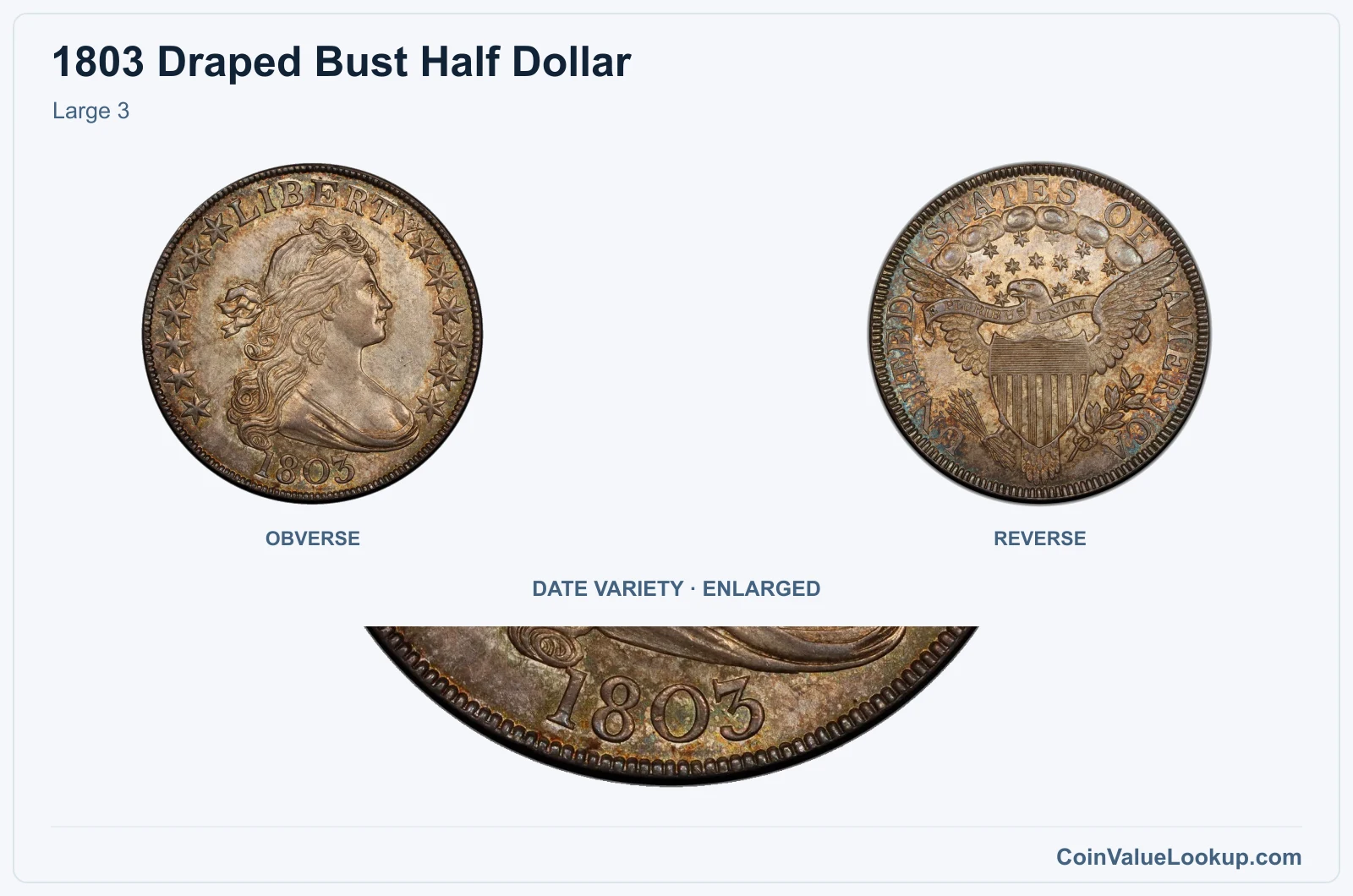
The Large 3 variety uses a bigger date punch for the final digit, and the serif on the 3 is distinctly more prominent than on its counterpart. You will need at least a 5x loupe and ideally a reference image of both varieties side by side to be confident.
All 1803 half dollars were struck at Philadelphia in a silver-copper alloy at the early federal standard of approximately 89% silver. The design is the Draped Bust obverse paired with the Heraldic Eagle reverse.
Guide estimates from USA Coin Book place the Large 3 at roughly $487 in G4, $948 in VF20, and $3,651 in AU50. These are retail guide figures, not guaranteed sale prices, but they give a useful baseline.
Higher-grade survivors are scarce and can exceed these anchors.
Range Grade
Price Auction Records Appraisal PO PO 1
—
Coin Identifier FR FR 2
Coin Identifier AG AG 3
Coin Identifier G G 4
Coin Identifier
G 6
Coin Identifier VG VG 8
Coin Identifier
VG 10
Coin Identifier F F 12
Coin Identifier
F 15
Coin Identifier VF VF 20
Coin Identifier
VF 25
Coin Identifier
VF 30
Coin Identifier
VF 35
Coin Identifier XF XF 40
Coin Identifier
XF 45
Coin Identifier AU AU 50
Coin Identifier
AU 53
Coin Identifier
AU 55
Coin Identifier
AU 58
Coin Identifier MS MS 60
—
Coin Identifier
MS 61
Coin Identifier
MS 62
Coin Identifier
MS 63
Coin Identifier
MS 64
Coin Identifier
MS 65
—
—
—
MS 66
—
—
—
MS 67
—
—
—
MS 68
—
—
—
MS 69
—
—
—
MS 70
—
—
—
1803 Draped Bust Half Dollar — Small 3
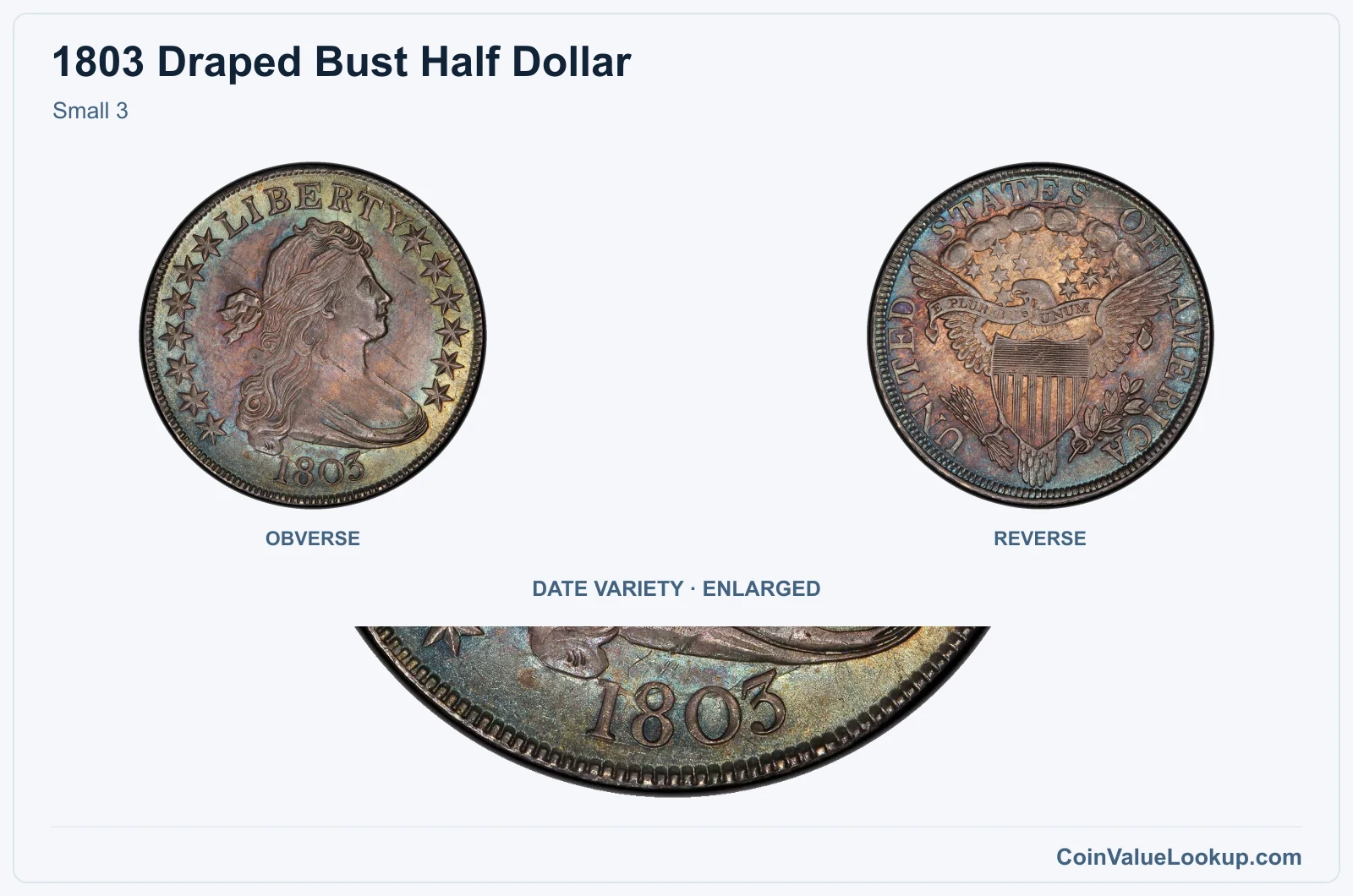
The Small 3 uses a more compact date punch for the final digit, and at certain grades it commands a meaningful premium over the Large 3. Guide estimates run about $487 at G4 — similar to the Large 3 at that level — but climb to approximately $1,363 at VF20 and about $5,640 at AU50.
That widening gap at higher grades makes correct variety attribution important. Do not rely on wear patterns or a single photograph taken at an angle; a clear, magnified view of the date is essential.
The smaller punch simply looks more delicate, but confirming it requires a direct comparison crop at the same scale.
Coin Value Lookup is a handy starting point when you want to look up guide values for other early half dollars or compare different Draped Bust dates. It covers a wide range of U.S. coin series.
Range Grade
Price Auction Records Appraisal PO PO 1
—
Coin Identifier FR FR 2
—
Coin Identifier AG AG 3
—
Coin Identifier G G 4
—
Coin Identifier
G 6
—
Coin Identifier VG VG 8
—
Coin Identifier
VG 10
Coin Identifier F F 12
Coin Identifier
F 15
Coin Identifier VF VF 20
Coin Identifier
VF 25
Coin Identifier
VF 30
Coin Identifier
VF 35
Coin Identifier XF XF 40
Coin Identifier
XF 45
Coin Identifier AU AU 50
Coin Identifier
AU 53
Coin Identifier
AU 55
Coin Identifier
AU 58
Coin Identifier MS MS 60
—
Coin Identifier
MS 61
Coin Identifier
MS 62
Coin Identifier
MS 63
—
Coin Identifier
MS 64
Coin Identifier
MS 65
—
—
—
MS 66
—
—
—
MS 67
—
—
—
MS 68
—
—
—
MS 69
—
—
—
MS 70
—
—
—
1803 Draped Bust Half Dollar Error List
1. 1803 Draped Bust Half Dollar — Off-Center Strike
An off-center strike happens when the planchet is not seated properly in the collar at the moment of striking. The result is a shifted design and a blank, unstruck crescent along part of the rim.
A reported example for the 1803 half dollar shows roughly 10% off-center displacement with the date still visible — that last detail matters a great deal to collectors.
Look for a clear crescent of unstruck metal on one side and a corresponding crowding of the design on the opposite side. Merely uneven borders or slightly tilted devices are not the same thing.
Common lookalikes include a clipped planchet, one-sided die misalignment, or post-mint damage such as vice flattening. Each of those leaves different traces.
No specific price range is adopted here because value depends heavily on the percentage of the shift, whether the date is complete, and the coin's overall condition. Individual assessment by a knowledgeable dealer or grading service is the safest route.
2. 1803 Draped Bust Half Dollar — Die Break / Cud
A cud is a raised blob of metal connected to the rim, caused by a piece of the die breaking away entirely. A retained die break is a related stage where a crack outlines a section but the die fragment has not yet fallen out.
Both have been reported on 1803 half dollars — specifically a small rim-connected cud above the first T in STATES and a retained break in the same STATES area of the reverse.
To identify one, look for an irregular raised lump that merges into the rim rather than sitting randomly on the field. A rim dent goes inward; a cud goes outward.
Corrosion can mimic the texture but lacks the sharp rim connection, and an interior die chip (not connected to the rim) is a different category altogether.
No specific price range is adopted for these die breaks on the 1803 half dollar. Value depends on size, location, visual drama, and the coin's overall grade.
A large, well-defined cud on an otherwise attractive coin will draw more attention than a hairline crack.