1852 Liberty Seated Half Dollar Coin Value: How Much Is It Worth?
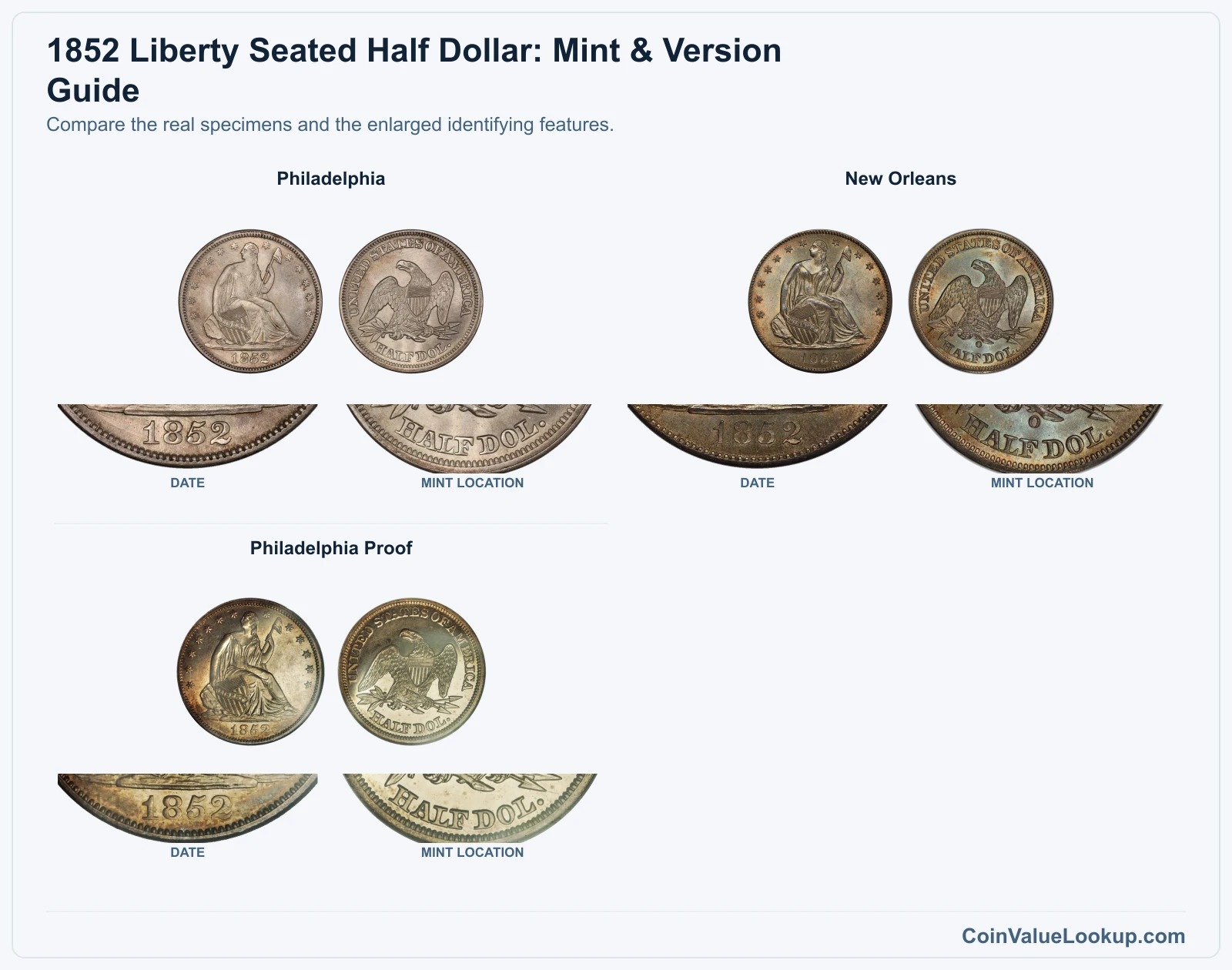
An 1852 Liberty Seated Half Dollar in typical circulated condition carries guide values from roughly $632 in Good-4 to around $2,849 in About Uncirculated-50 for Philadelphia strikes. New Orleans pieces follow a different curve, and Proofs occupy their own scarce category entirely.
What your coin is actually worth depends on its grade, mint and specific version.
Fast Way to Identify Your 1852 Liberty Seated Half Dollar
Want a quick starting point? Upload clear photos of the front and back of your 1852 half dollar using the identifier on this page.
It can help with preliminary identification of your coin's mint and version so you know which value range to explore. Two sharp, well-lit images are all you need.
1852 Liberty Seated Half Dollar Value
Upload both sides of your 1852 Liberty Seated Half Dollar.
Front Obverse
Upload photo
Back Reverse
Upload photo
Which 1852 Liberty Seated Half Dollar Versions Are Worth Money?
- Philadelphia strikes are scarce due to low mintage; guide values range from about $632 at G4 to $2,849 at AU50, with condition and originality driving price.
- New Orleans (O mintmark) coins follow their own value curve, starting around $364 at G4 and reaching roughly $2,191 at AU50.
- Philadelphia Proof coins are a separate, very scarce collector category; a single PR65 example sold for $74,750 at Heritage in 2008.
Step 1: Identify Your 1852 Liberty Seated Half Dollar Mint Mark and Version
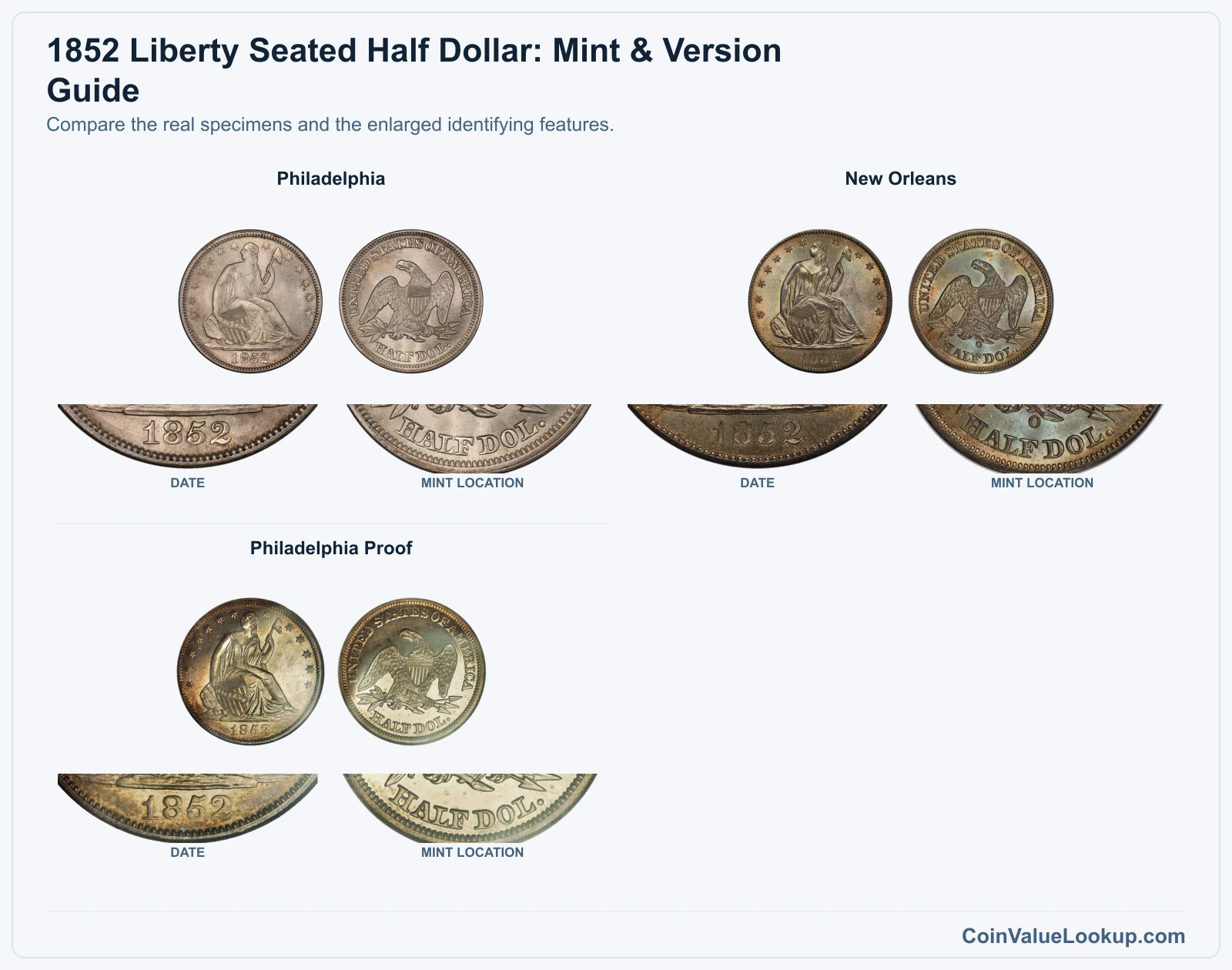
The 1852 half dollar uses the Seated Liberty No Motto design — Liberty seated on the obverse, an eagle with HALF DOL on the reverse, and no IN GOD WE TRUST banner. Two mints produced these coins.
Flip your coin over and look directly below the eagle. A small "O" means New Orleans.
No letter at all means Philadelphia. That single detail changes your value lookup entirely.
The coin is 90% silver and 10% copper, weighing 13.36 grams under the old standard. If yours feels noticeably lighter or shows arrows beside the date, you probably have an 1853 or later issue — the weight dropped to about 12.44 grams that year and arrowheads were added to signal the change.
Proofs are a special manufacturing finish, not simply a high grade. Mirror-like fields alone do not confirm a Proof; cleaned circulation strikes can look reflective too.
Genuine Proofs show consistent deep reflectivity across both faces and sharp, squared rims.
Step 2: Check Your 1852 Liberty Seated Half Dollar Grade
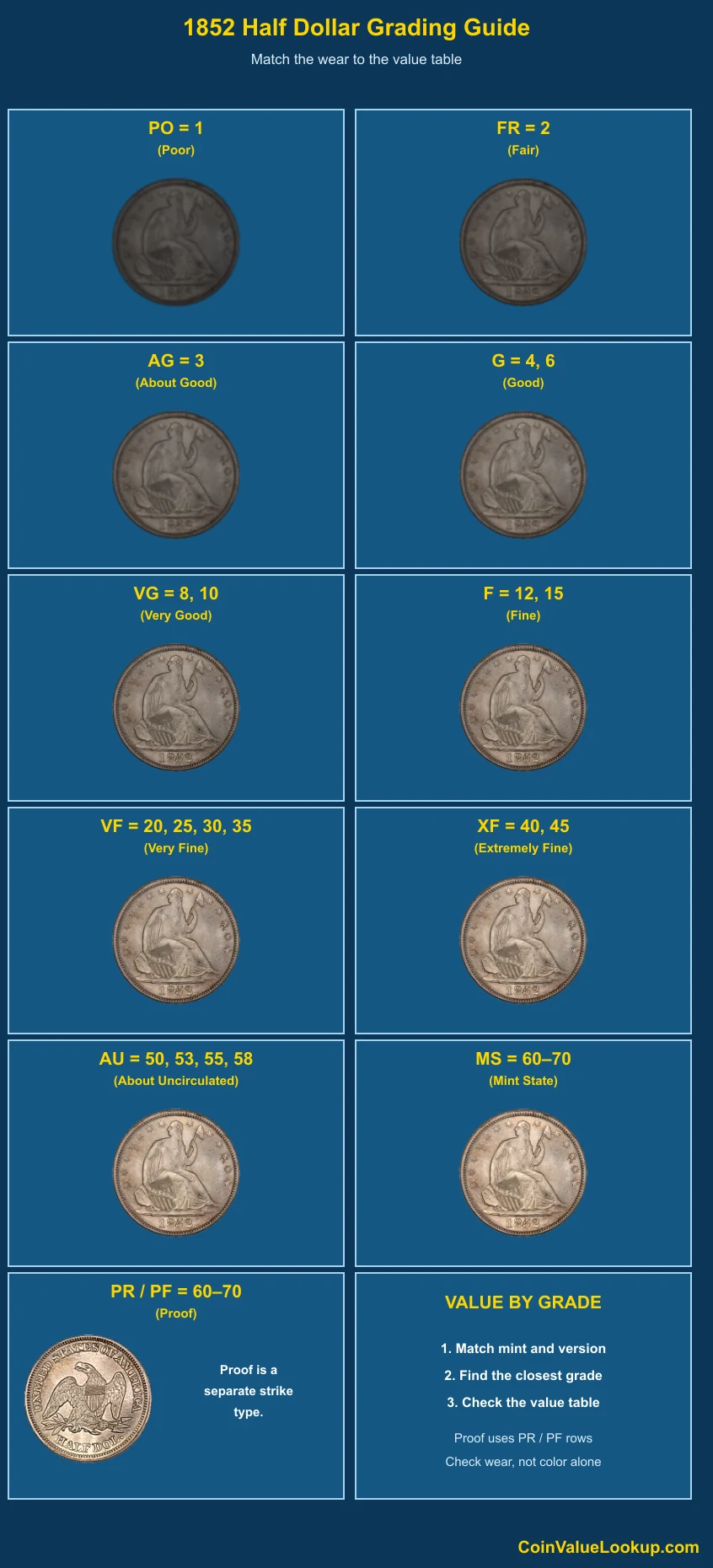
Start with Liberty's head and knee on the obverse. In lower grades those areas go flat first, and the shield lines across her lap fade.
On the reverse, check the eagle's breast feathers, wing tips and claws — these are the high points that wear reveals.
Here is the tricky part: flat centers on a Seated Liberty half can also come from a weak strike at the mint, not just from years in pocket change. The difference is that wear breaks the original luster and flattens high points unevenly, while a weak strike leaves luster intact in protected areas.
Compare your coin side-by-side with the grading image on this page to see where genuine wear typically appears on this type.
Photograph both sides and the edge under good lighting. Whatever you do, do not clean the coin.
Even a gentle wipe can leave hairlines that drop the grade — and the value — significantly.
Step 3: Check 1852 Liberty Seated Half Dollar Value by Mint and Version
1852 Liberty Seated Half Dollar — Philadelphia
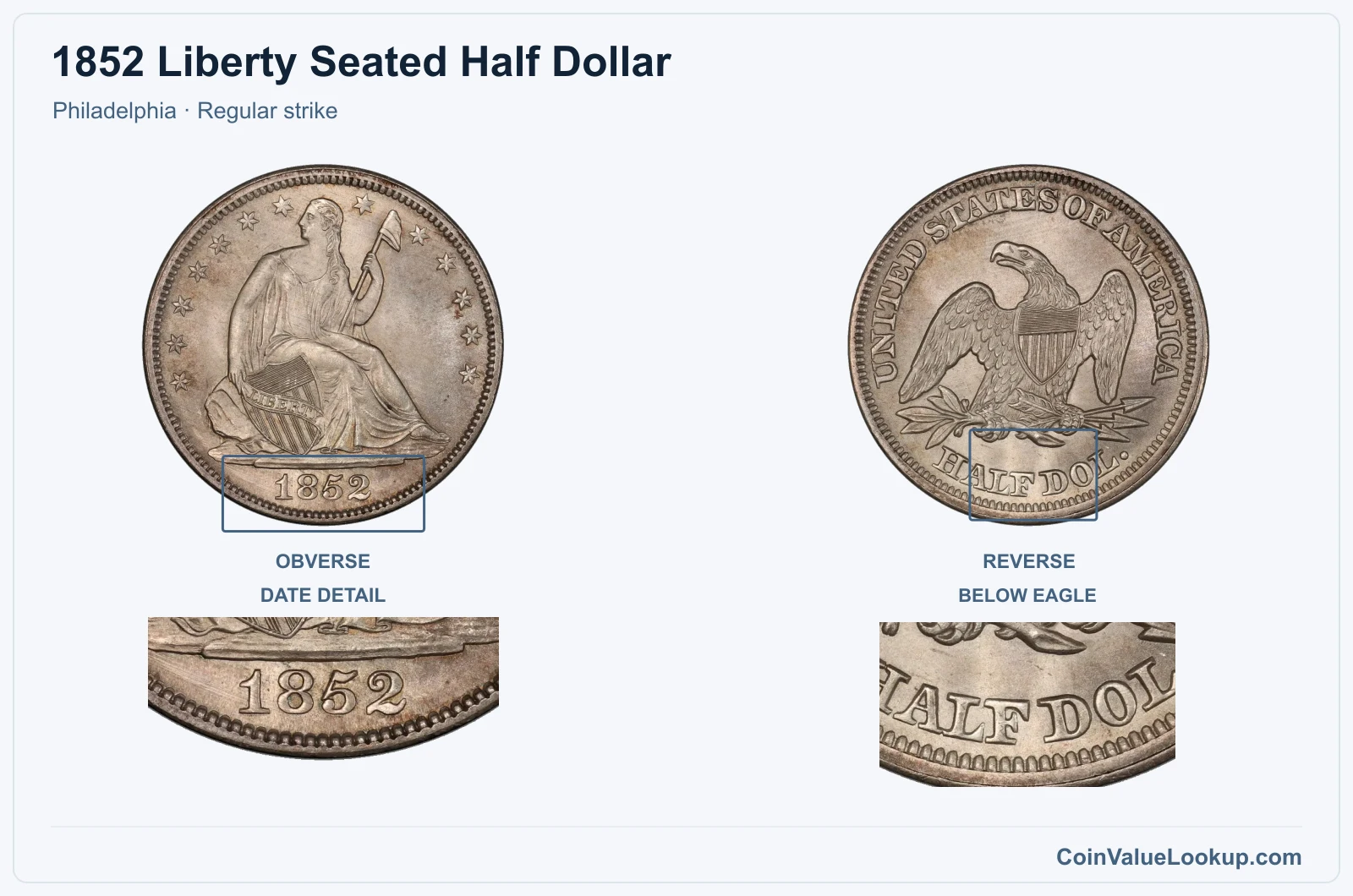
The 1852 Philadelphia half dollar carries no mintmark. It was a scarce, low-mintage issue even when new, which is why survivors command respect today.
Guide estimates place it around $632 in G4, $1,542 in VF20, and $2,849 in AU50.
Condition and surface quality matter a lot here. Cleaning — common on old silver — will knock value down hard.
Look for original gray or blue toning and undisturbed luster in protected areas. Those details separate a coin that brings strong money from one that disappoints.
Range Grade
Price Auction Records Appraisal PO PO 1
—
Coin Identifier FR FR 2
—
Coin Identifier AG AG 3
—
Coin Identifier G G 4
—
Coin Identifier
G 6
Coin Identifier VG VG 8
—
Coin Identifier
VG 10
—
Coin Identifier F F 12
—
Coin Identifier
F 15
Coin Identifier VF VF 20
—
Coin Identifier
VF 25
Coin Identifier
VF 30
Coin Identifier
VF 35
Coin Identifier XF XF 40
Coin Identifier
XF 45
Coin Identifier AU AU 50
Coin Identifier
AU 53
Coin Identifier
AU 55
Coin Identifier
AU 58
Coin Identifier MS MS 60
Coin Identifier
MS 61
Coin Identifier
MS 62
Coin Identifier
MS 63
Coin Identifier
MS 64
Coin Identifier
MS 65
Coin Identifier
MS 66
Coin Identifier
MS 67
—
—
—
MS 68
—
—
—
MS 69
—
—
—
MS 70
—
—
—
1852 Liberty Seated Half Dollar — New Orleans
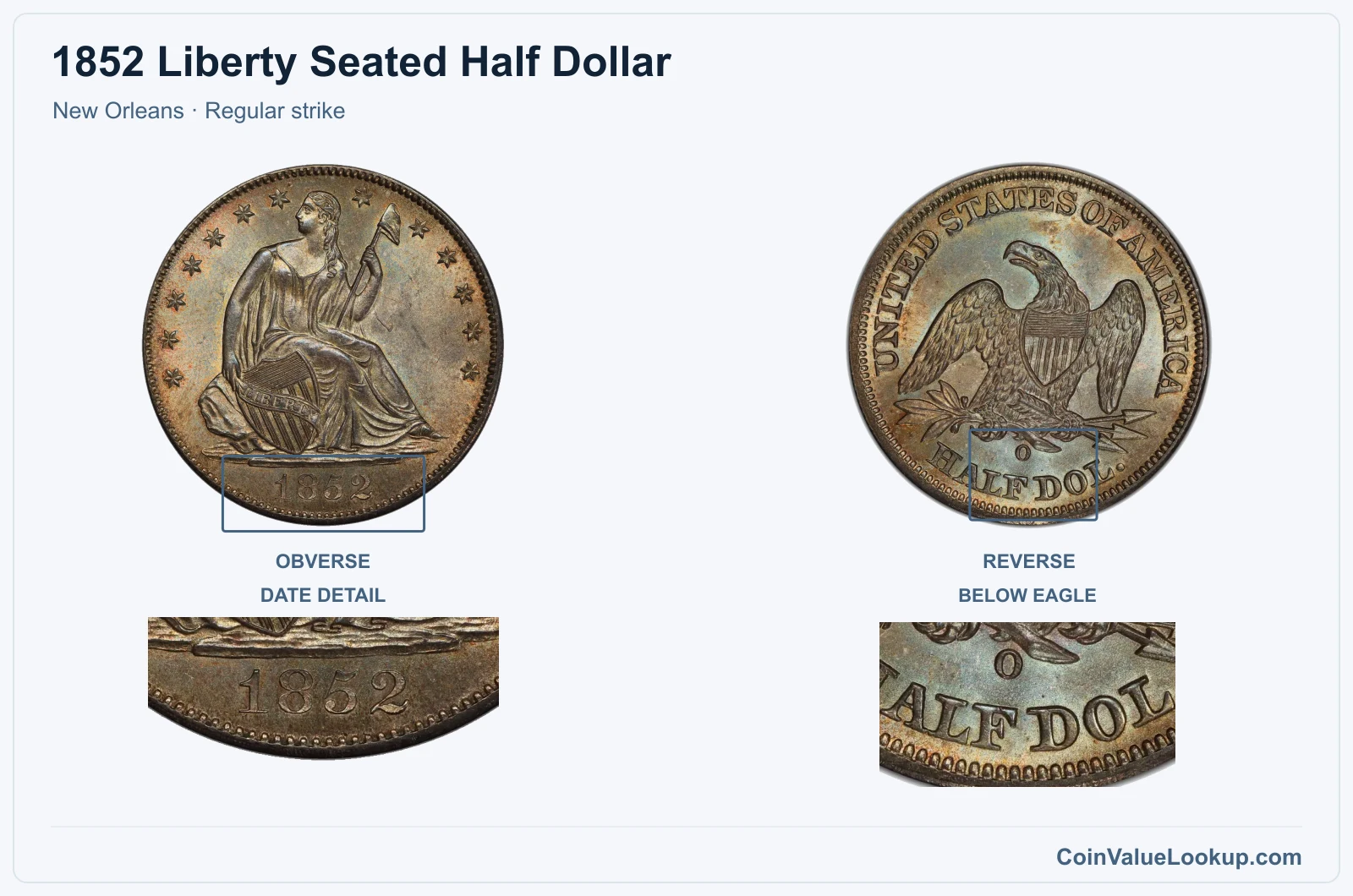
The small "O" below the eagle on the reverse identifies a New Orleans strike. This is another scarce date in the series, and its value curve runs a bit lower than Philadelphia's: roughly $364 at G4, $1,017 at VF20, and $2,191 at AU50 according to guide estimates.
That reverse mintmark is the whole ballgame for identification. Make sure it is genuinely an "O" and not a scratch or damage mark — a loupe helps.
As with all Seated halves, originality of surfaces matters; an uncleaned, problem-free O-mint coin will always outperform a scrubbed example of the same technical grade.
Coin Value Lookup is a handy place to look up value guides for this and other Liberty Seated half dollar dates when you want to compare across the series.
Range Grade
Price Auction Records Appraisal PO PO 1
—
Coin Identifier FR FR 2
—
Coin Identifier AG AG 3
—
Coin Identifier G G 4
—
Coin Identifier
G 6
—
Coin Identifier VG VG 8
Coin Identifier
VG 10
—
Coin Identifier F F 12
Coin Identifier
F 15
Coin Identifier VF VF 20
Coin Identifier
VF 25
Coin Identifier
VF 30
Coin Identifier
VF 35
Coin Identifier XF XF 40
Coin Identifier
XF 45
Coin Identifier AU AU 50
Coin Identifier
AU 53
Coin Identifier
AU 55
Coin Identifier
AU 58
Coin Identifier MS MS 60
—
Coin Identifier
MS 61
—
Coin Identifier
MS 62
Coin Identifier
MS 63
Coin Identifier
MS 64
Coin Identifier
MS 65
Coin Identifier
MS 66
—
—
—
MS 67
—
—
—
MS 68
—
—
—
MS 69
—
—
—
MS 70
—
—
—
1852 Liberty Seated Half Dollar — Philadelphia Proof
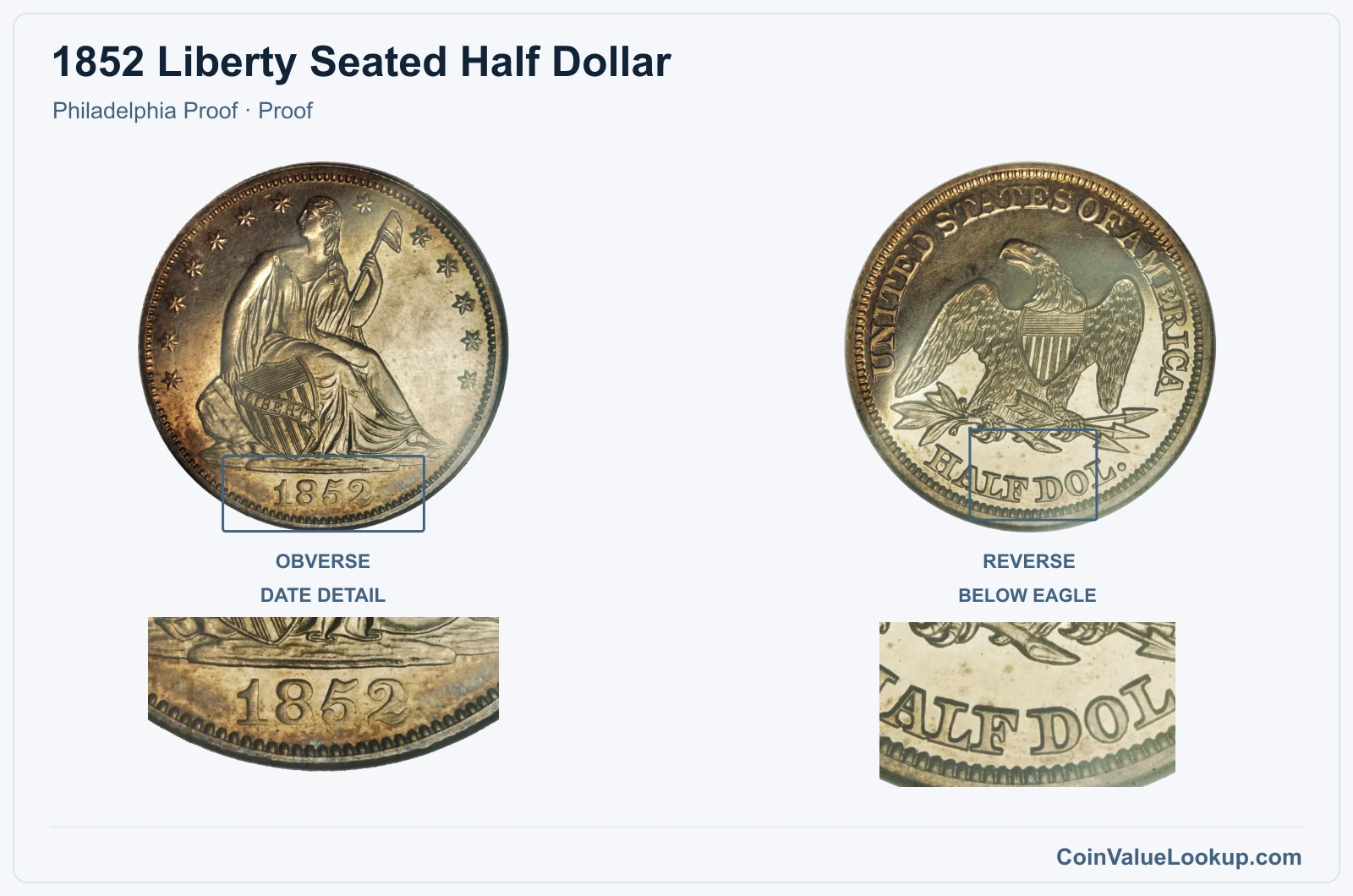
Philadelphia Proof 1852 half dollars are genuinely rare collector pieces, struck with polished dies on prepared planchets. Both sides should display deep, consistent mirror reflectivity with sharp, squared rims — not just a shiny surface from an old cleaning.
A single PR65 example realized $74,750 at a Heritage auction in 2008. That is an individual historical sale, not a current market curve, so treat it as a reference point rather than a price tag for every surviving Proof.
Within this version, CAM and DCAM designations describe the degree of contrast between frosted devices and mirrored fields. Certification by a major grading service is essentially mandatory for a coin at this level; the difference between a genuine Proof and a well-preserved business strike is worth tens of thousands of dollars.
Range Grade
Price Auction Records Appraisal PR PR 1
—
Coin Identifier
PR 2
—
Coin Identifier
PR 3
—
Coin Identifier
PR 4
—
Coin Identifier
PR 6
—
Coin Identifier
PR 8
—
Coin Identifier
PR 10
—
Coin Identifier
PR 12
—
Coin Identifier
PR 15
—
Coin Identifier
PR 20
—
Coin Identifier
PR 25
—
Coin Identifier
PR 30
—
Coin Identifier
PR 35
—
Coin Identifier
PR 40
—
Coin Identifier
PR 45
—
Coin Identifier
PR 50
—
Coin Identifier
PR 53
—
Coin Identifier
PR 55
—
Coin Identifier
PR 58
—
Coin Identifier
PR 60
—
Coin Identifier
PR 61
—
Coin Identifier
PR 62
—
Coin Identifier
PR 63
Coin Identifier
PR 64
—
—
—
PR 65
Coin Identifier
PR 66
—
—
—
PR 67
—
—
—
PR 68
—
—
—
PR 69
—
—
—
PR 70
—
—
—
1852 Liberty Seated Half Dollar Error List
1. 1852 Liberty Seated Half Dollar — Repunched Date
Dealer references list a repunched date variety for the 1852 half dollar. The reported forms include a doubled date punched low and a partly repunched date, meaning extra impressions of one or more date digits are visible near or overlapping the final position.
To check yours, use a 5x or 10x loupe and examine each digit of the date closely. Look for traces of an earlier, slightly offset impression — extra serifs, shadowed outlines, or a second base line beneath a numeral.
The precise direction of the extra punching is not firmly established for this date, so focus on whether any doubling is present at all.
Do not confuse this with simple damage or machine doubling, which tends to produce flat, shelf-like doubling rather than the rounded, distinct secondary image of a true repunched date. Value depends on the visibility of the error and overall coin condition; no specific numerical premium is established here.