1839 Capped Bust Half Dollar Coin Value: How Much Is It Worth?
The 1839 Capped Bust Half Dollar is a coin that sits right at the crossroads of two classic American designs. Ordinary Philadelphia Large Letters strikes range from about $111 in G4 to $658 in AU50 per guide estimates, but the version you hold matters enormously.
A rare Small Letters reverse, a New Orleans mint issue, or a special strike can push values into entirely different territory.
Fast Way to Identify Your 1839 Capped Bust Half Dollar
Snap a clear photo of both the front and back of your 1839 half dollar and upload them here. That gives us a starting point for preliminary identification, helping sort out whether you have a Philadelphia or New Orleans issue, and which reverse style is on your coin.
It is not a substitute for professional certification, but it points you in the right direction.
1839 Capped Bust Half Dollar Value
Upload both sides of your 1839 Capped Bust Half Dollar.
Front Obverse
Upload photo
Back Reverse
Upload photo
Which 1839 Capped Bust Half Dollar Versions Are Worth Money?
- Philadelphia Small Letters reverse: Guide values reach $18,715 at G4 and $118,870 at AU50, reflecting genuine scarcity of this attributed variety with its smaller eagle and thin lettering.
- New Orleans (O mintmark on obverse): Scarcer than typical Philadelphia issues, with guide values from $517 at G4 to $3,103 at AU50.
- New Orleans Special Strike: A single SP65 example sold for $373,750 at a February 2008 Goldberg auction, an individual historical result rather than a current market range.
- Philadelphia Proof strikes: Extremely rare manufacturing type requiring professional authentication; no reliable guide price range is available.
Step 1: Identify Your 1839 Capped Bust Half Dollar Mint Mark and Version
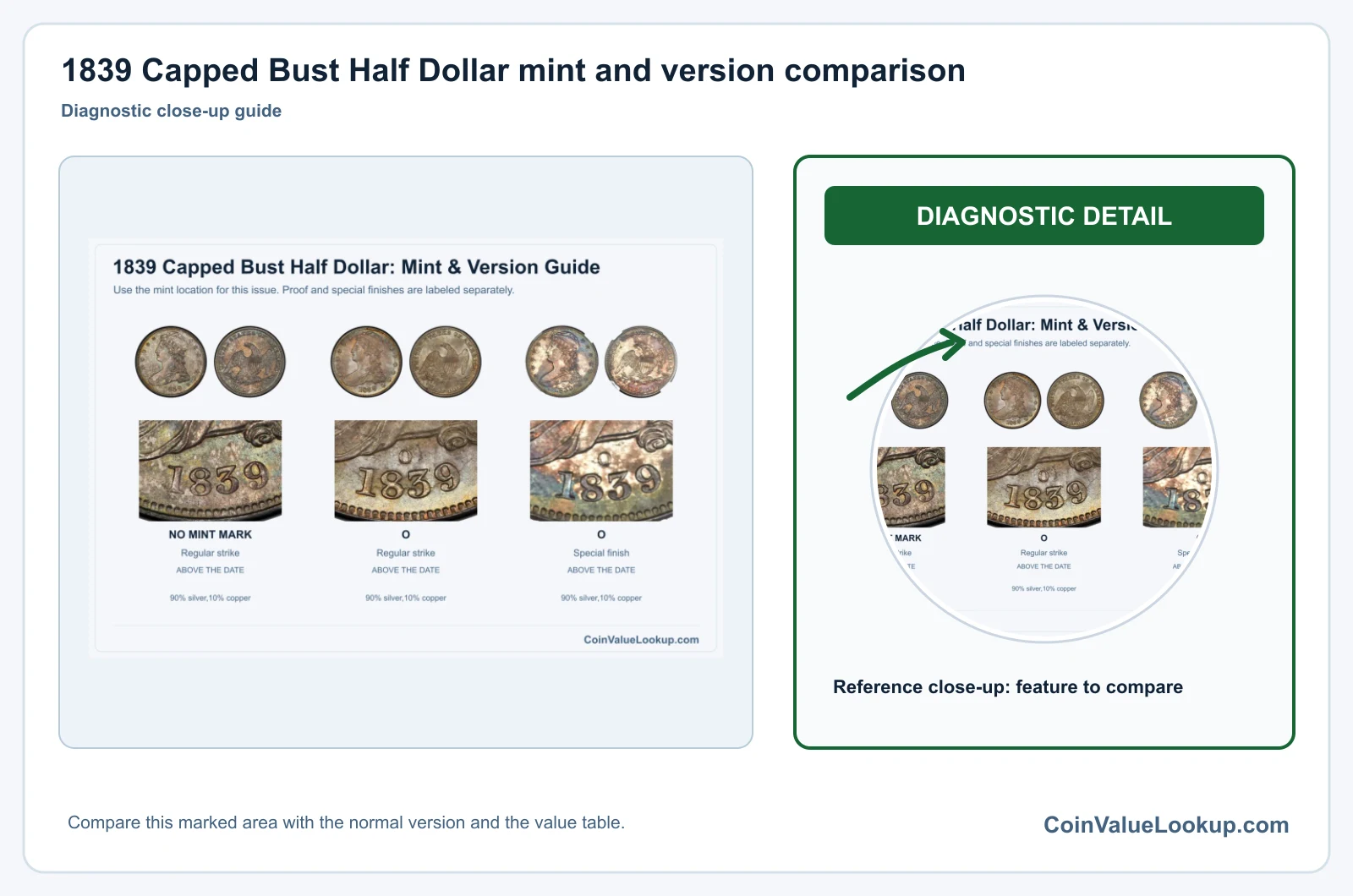
The 1839 Capped Bust Half Dollar shows Liberty facing left wearing a cap, with an eagle on the reverse reading HALF DOL. The edge is reeded, and the coin is struck in 90% silver and 10% copper at a nominal weight of 13.36 grams.
Do not assume purity based on how shiny or toned the surface looks.
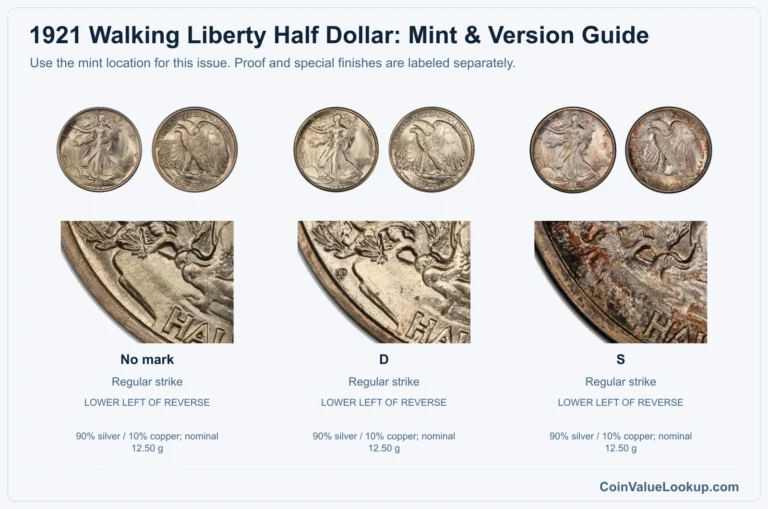
Philadelphia coins carry no mintmark. New Orleans coins have an O on the obverse, sitting above the date and below Liberty's bust.
This is a Capped Bust design, not a Seated Liberty; the 1839-O Seated issue does not exist.
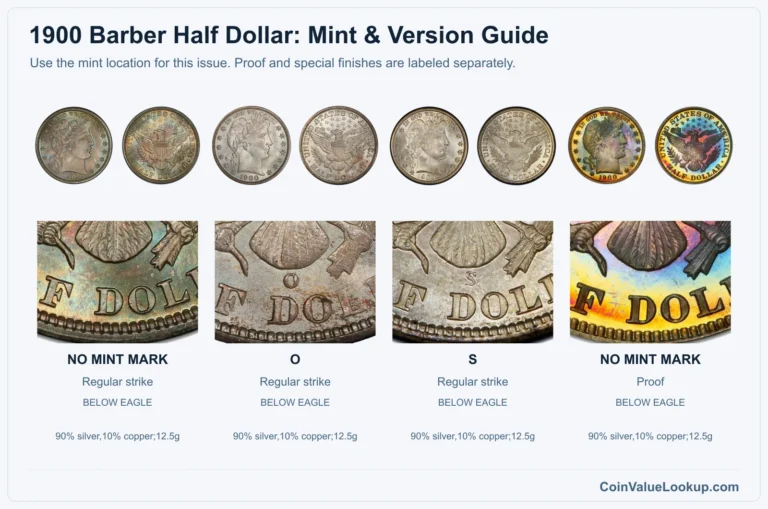
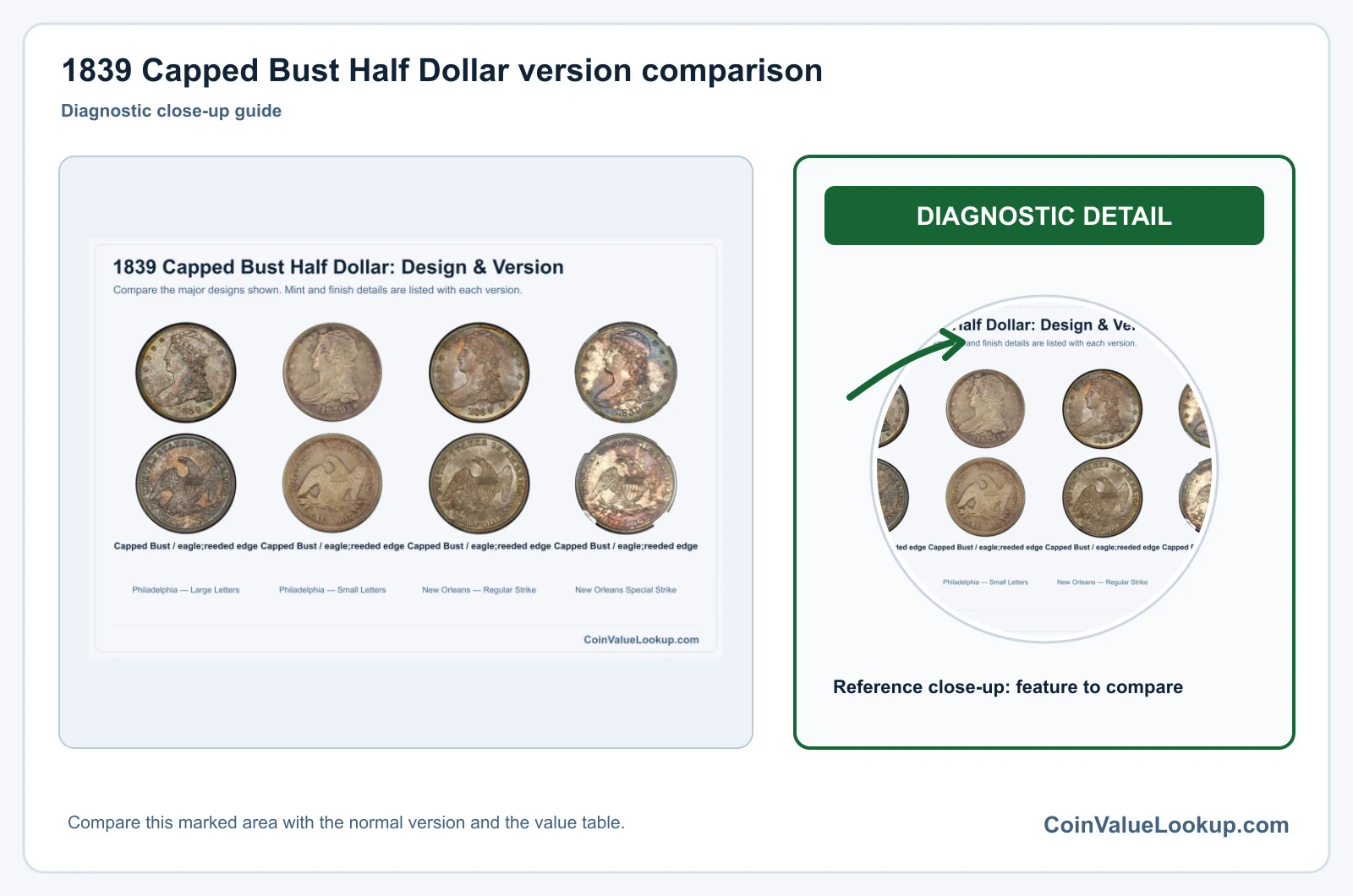
Within Philadelphia strikes, there are two distinct reverse types. The Large Letters version has a bigger eagle and thick legends positioned closer to the rim.
The Small Letters version has a noticeably smaller eagle, tall thin letters set farther from the rim, and only the tip of the lower arrow feather peeks below the olive branch stem. That last detail is a reliable diagnostic.
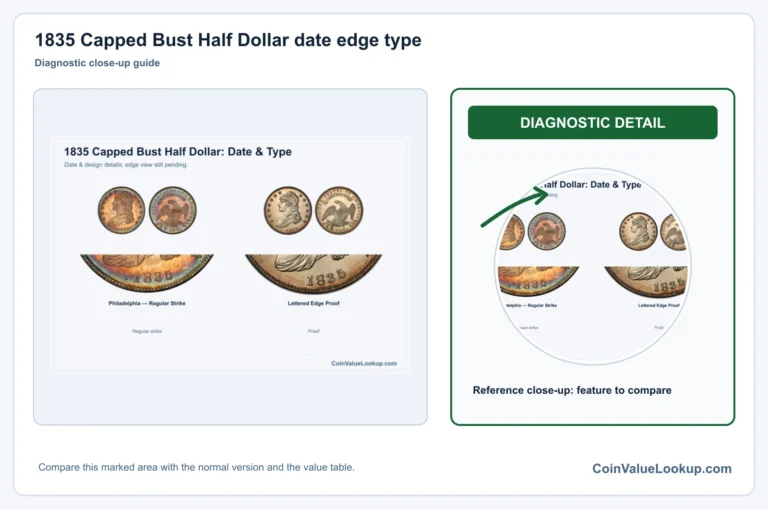
Proof and special strikes are a category of manufacture, not a grade above Mint State. These require professional attribution to confirm.
Step 2: Check Your 1839 Capped Bust Half Dollar Grade
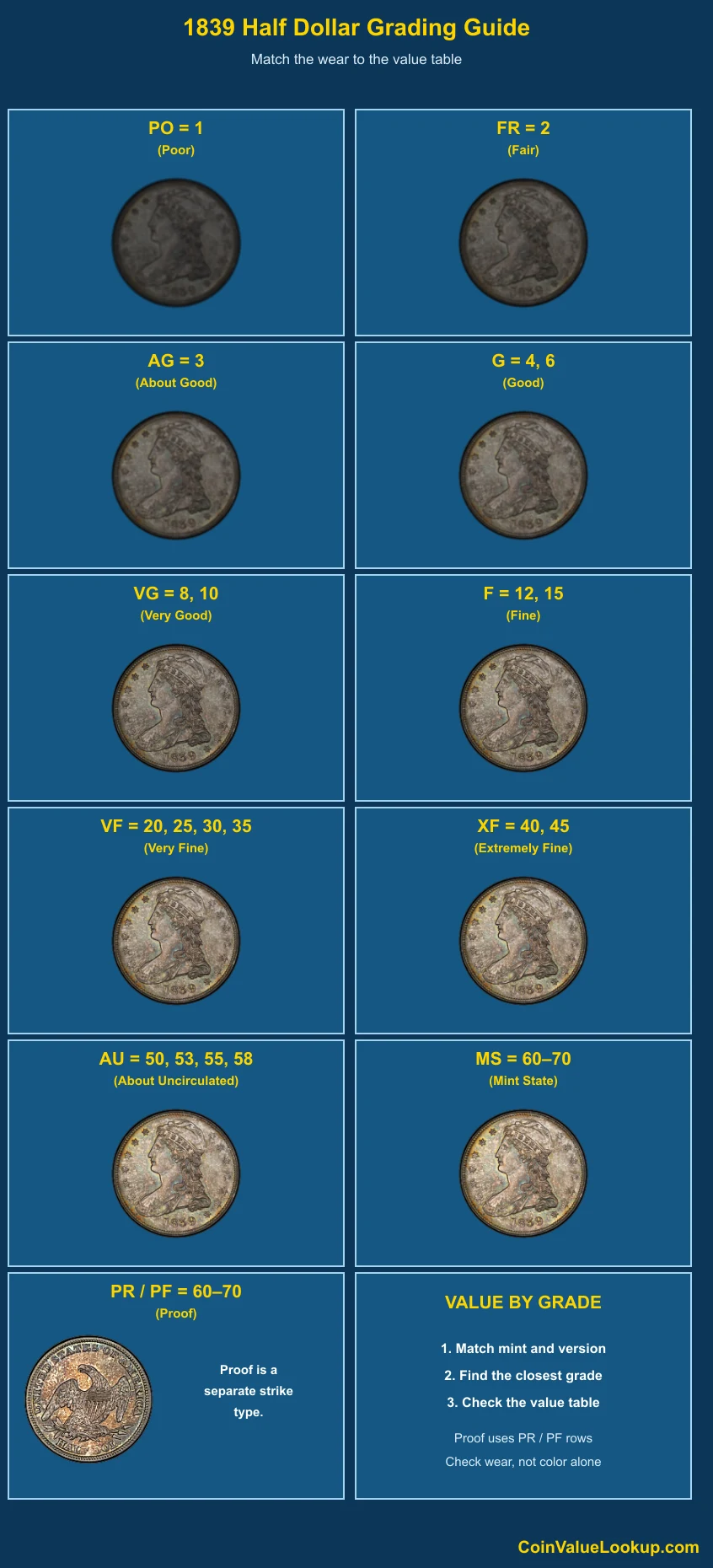
Start by checking Liberty's hair detail, the curls around her ear, the cap, and her cheek. On the reverse, look at the eagle's breast feathers and wing tips.
Wear hits these high points first, so a coin grading G4 will show them nearly flat, while an AU50 retains most detail with only light friction on the highest surfaces.
Keep in mind that 1839 strikes can be uneven from the original minting process. A soft area is not necessarily wear.
Compare your coin side by side with the type-matched grading images, checking both faces against examples from circulated through Mint State.
Cleaning, holes, scratches, and altered surfaces all reduce a coin's value. If you spot unnatural brightness or hairline scratches running in one direction, someone likely cleaned it.
Leave it alone. No amount of polishing helps.
Step 3: Check 1839 Capped Bust Half Dollar Value by Mint and Version
1839 Capped Bust Half Dollar — Philadelphia — Large Letters
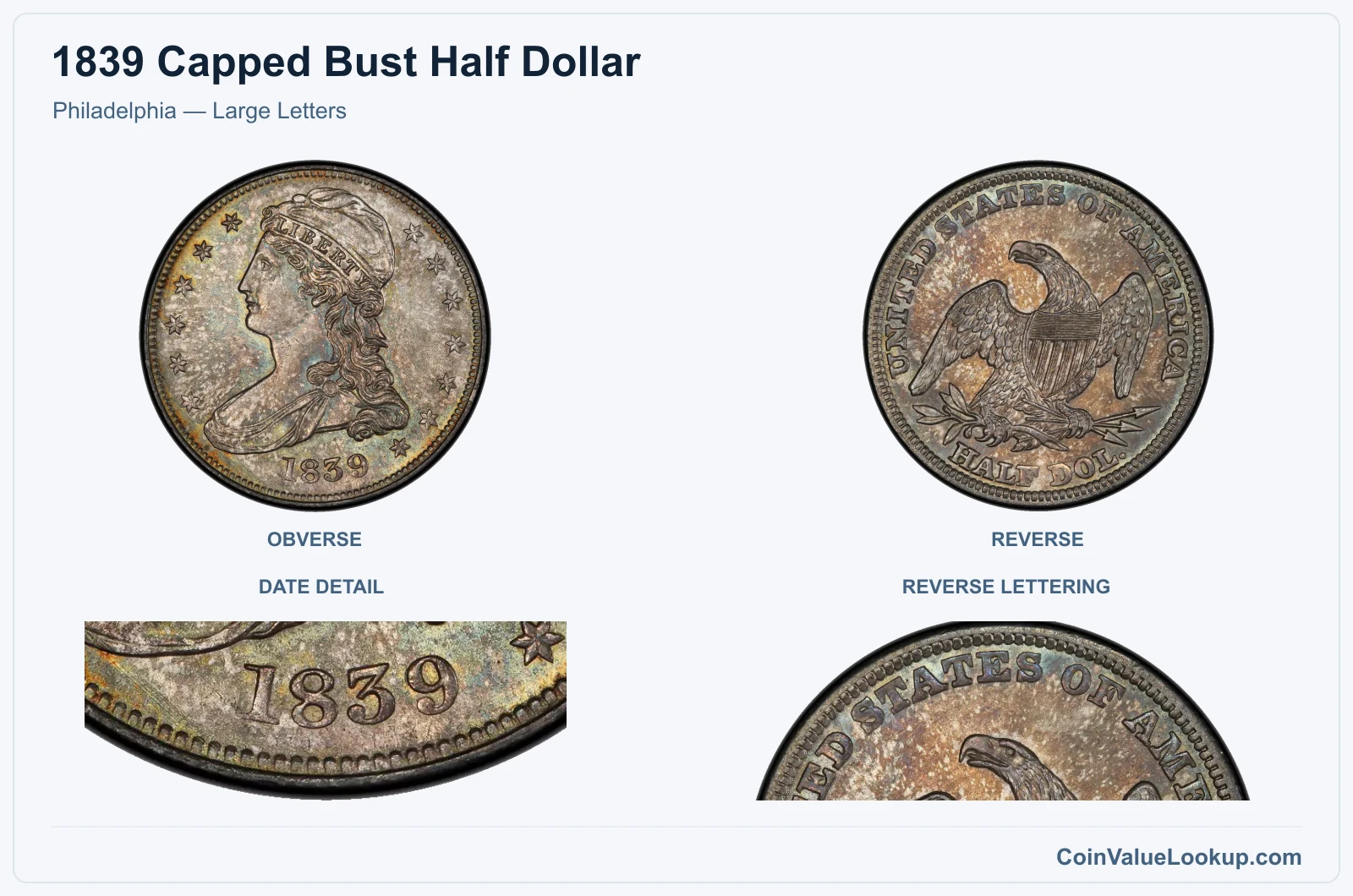
This is the standard 1839 Capped Bust Half Dollar from Philadelphia with no mintmark. The Large Letters reverse features a relatively large eagle and thick lettering placed close to the rim.
It is the most commonly encountered version of this date.
Guide estimates from USA Coin Book place this coin at roughly $111 in G4, $205 in VF20, and $658 in AU50. These are estimates, not guaranteed sale prices.
Actual results depend on eye appeal, surface quality, and whether the coin has been cleaned or damaged.
Ordinary-issue reference: Ordinary-issue reference only: The table below shows prices for the 1839 Capped Bust Half Dollar (regular strike). It does not represent the value of the specific Philadelphia — Large Letters variety or its variety premium. Year, mint, metal and strike type are matched; the specific variety is not priced by this table.
Range Grade
Price Auction Records Appraisal PO PO 1
—
Coin Identifier FR FR 2
—
Coin Identifier AG AG 3
—
Coin Identifier G G 4
—
Coin Identifier
G 6
—
Coin Identifier VG VG 8
—
Coin Identifier
VG 10
Coin Identifier F F 12
Coin Identifier
F 15
Coin Identifier VF VF 20
Coin Identifier
VF 25
Coin Identifier
VF 30
Coin Identifier
VF 35
Coin Identifier XF XF 40
Coin Identifier
XF 45
Coin Identifier AU AU 50
Coin Identifier
AU 53
Coin Identifier
AU 55
Coin Identifier
AU 58
Coin Identifier MS MS 60
Coin Identifier
MS 61
Coin Identifier
MS 62
Coin Identifier
MS 63
Coin Identifier
MS 64
Coin Identifier
MS 65
Coin Identifier
MS 66
Coin Identifier
MS 67
—
—
—
MS 68
—
—
—
MS 69
—
—
—
MS 70
—
—
—
1839 Capped Bust Half Dollar — Philadelphia — Small Letters
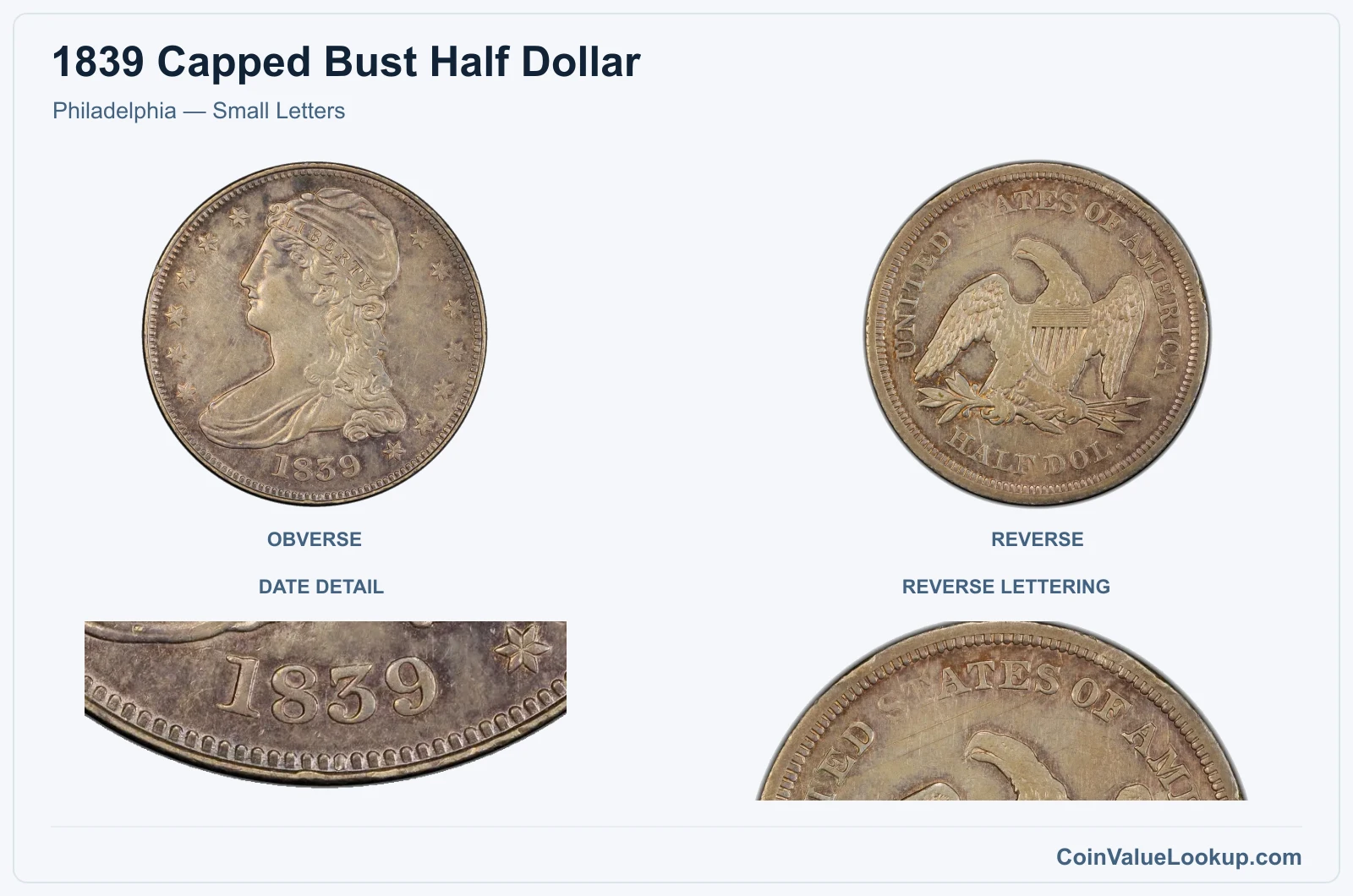
The Small Letters reverse is a genuinely rare variety that commands serious premiums. Instead of the chunky lettering and large eagle of the standard reverse, this version shows a smaller eagle, taller and thinner letters positioned farther from the rim, and only the tip of the lowest arrow feather visible below the olive branch stem.
That arrow feather detail is the quickest diagnostic.
Guide estimates reflect the rarity: about $18,715 at G4, $62,620 at VF20, and $118,870 at AU50 per USA Coin Book. Even well-worn examples carry substantial value.
If you suspect you have this variety, professional attribution is strongly recommended before any sale.
Coin Value Lookup can help you look up guides for other Capped Bust Half Dollar dates and varieties if you are building a set or just curious about what else is out there.
Range Grade
Price Auction Records Appraisal PO PO 1
—
Coin Identifier FR FR 2
—
Coin Identifier AG AG 3
—
Coin Identifier G G 4
—
Coin Identifier
G 6
—
Coin Identifier VG VG 8
—
Coin Identifier
VG 10
—
Coin Identifier F F 12
—
Coin Identifier
F 15
—
Coin Identifier VF VF 20
—
Coin Identifier
VF 25
Coin Identifier
VF 30
—
Coin Identifier
VF 35
—
Coin Identifier XF XF 40
—
Coin Identifier
XF 45
Coin Identifier AU AU 50
Coin Identifier
AU 53
—
—
—
AU 55
—
—
—
AU 58
—
—
— MS MS 60
—
—
—
MS 61
—
—
—
MS 62
—
—
—
MS 63
—
Coin Identifier
MS 64
—
—
—
MS 65
—
—
—
MS 66
—
—
—
MS 67
—
—
—
MS 68
—
—
—
MS 69
—
—
—
MS 70
—
—
—
1839 Capped Bust Half Dollar — New Orleans — Regular Strike
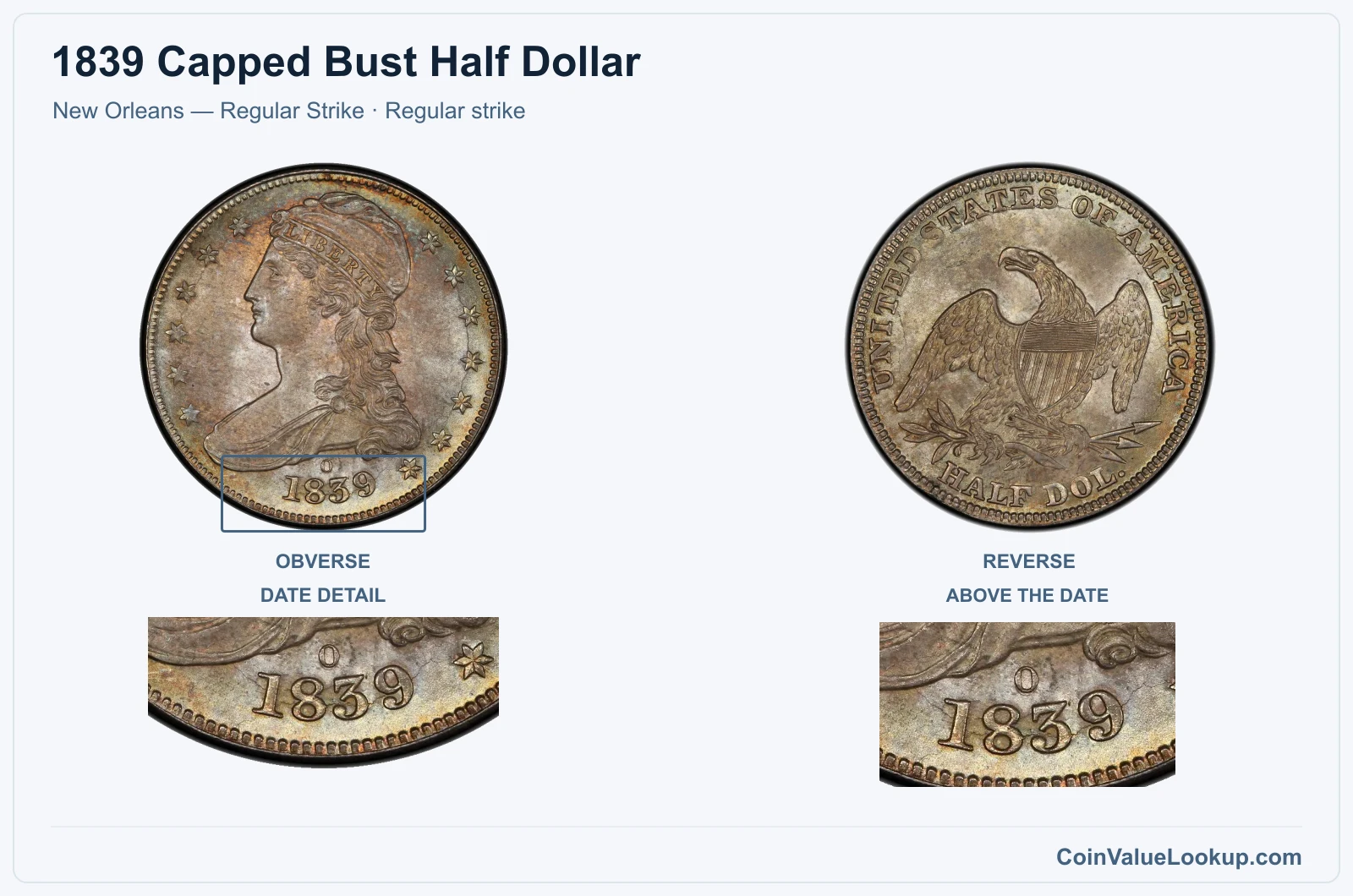
The 1839-O was struck at the New Orleans Mint and carries an O mintmark on the obverse, above the date and below Liberty's bust. This is a Capped Bust design.
The Seated Liberty series does not include an 1839-O half dollar, so if you see that bust-and-cap portrait with an O, you have the right coin.
Guide estimates run $517 at G4, $1,431 at VF20, and $3,103 at AU50. These are well above Philadelphia Large Letters prices at every grade.
The New Orleans mintage makes this a coin worth identifying correctly, especially since the O can sometimes be weak or partially obscured by wear.
Range Grade
Price Auction Records Appraisal PO PO 1
—
Coin Identifier FR FR 2
Coin Identifier AG AG 3
Coin Identifier G G 4
—
Coin Identifier
G 6
Coin Identifier VG VG 8
Coin Identifier
VG 10
Coin Identifier F F 12
Coin Identifier
F 15
Coin Identifier VF VF 20
Coin Identifier
VF 25
Coin Identifier
VF 30
Coin Identifier
VF 35
Coin Identifier XF XF 40
Coin Identifier
XF 45
Coin Identifier AU AU 50
Coin Identifier
AU 53
Coin Identifier
AU 55
Coin Identifier
AU 58
Coin Identifier MS MS 60
Coin Identifier
MS 61
Coin Identifier
MS 62
Coin Identifier
MS 63
Coin Identifier
MS 64
Coin Identifier
MS 65
Coin Identifier
MS 66
Coin Identifier
MS 67
Coin Identifier
MS 68
—
—
—
MS 69
—
—
—
MS 70
—
—
—
1839 Capped Bust Half Dollar — Philadelphia Proof
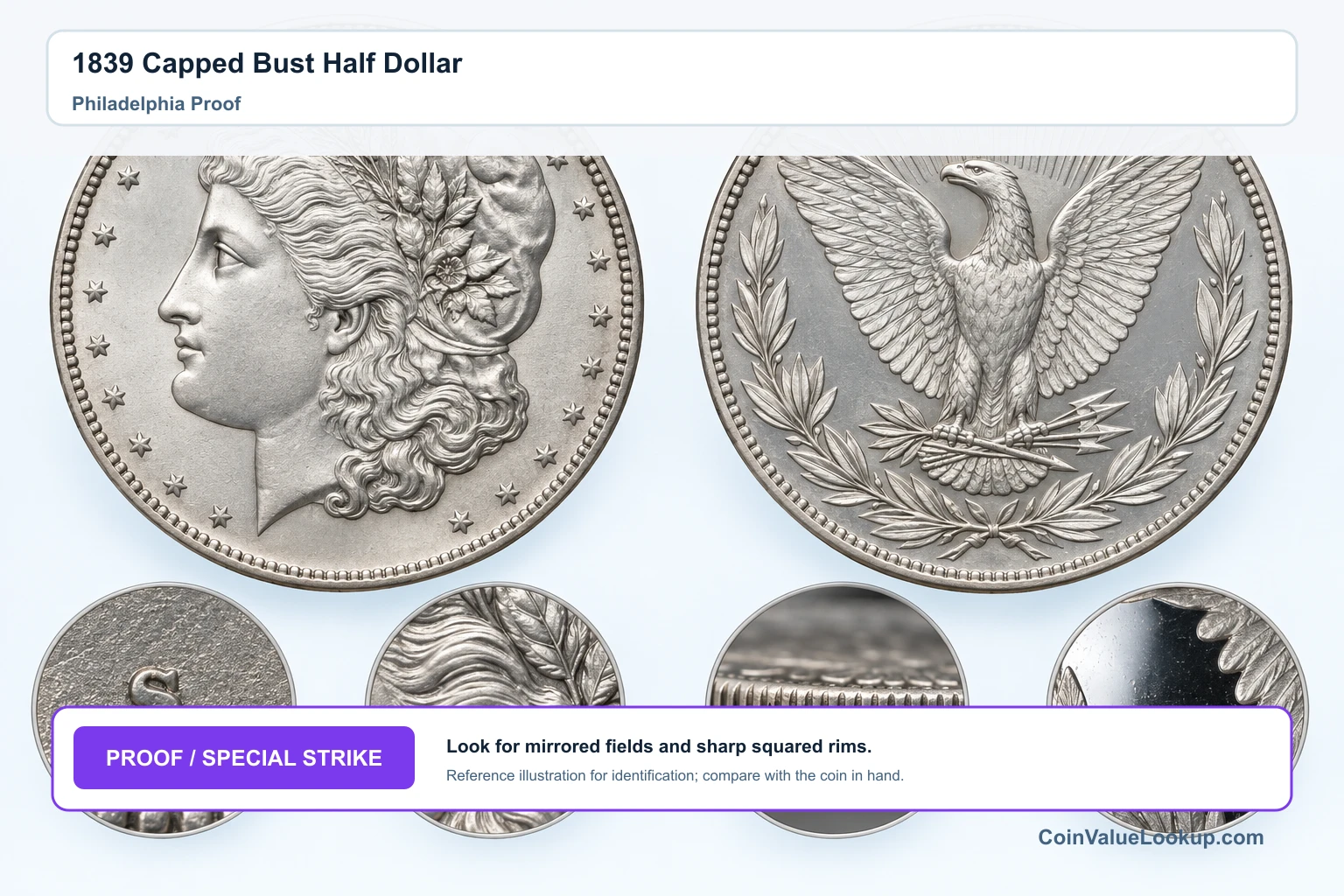
Philadelphia Proof Capped Bust Half Dollars from 1839 are extremely rare presentation pieces. They were manufactured with a different process than regular circulation strikes, producing sharper detail and mirror-like fields.
A Proof is a type of manufacture, not a higher grade than Mint State.
No reliable numerical price range has been adopted for this version. Each example must be evaluated individually based on its authenticated identity, surface preservation, and any imperfections.
Professional certification is essential. Bright, well-preserved regular strikes can superficially resemble Proofs, so do not assume a shiny coin is one.
Range Grade
Price Auction Records Appraisal PR PR 1
—
Coin Identifier
PR 2
—
Coin Identifier
PR 3
—
Coin Identifier
PR 4
—
Coin Identifier
PR 6
—
Coin Identifier
PR 8
—
Coin Identifier
PR 10
—
Coin Identifier
PR 12
—
Coin Identifier
PR 15
—
Coin Identifier
PR 20
—
Coin Identifier
PR 25
—
Coin Identifier
PR 30
—
Coin Identifier
PR 35
—
Coin Identifier
PR 40
—
Coin Identifier
PR 60
—
—
—
PR 61
—
—
—
PR 62
—
—
—
PR 63
—
—
—
PR 64
—
Coin Identifier
PR 65
—
Coin Identifier
PR 66
—
—
—
PR 67
—
—
—
PR 68
—
—
—
PR 69
—
—
—
PR 70
—
—
—
1839 Capped Bust Half Dollar — New Orleans Special Strike
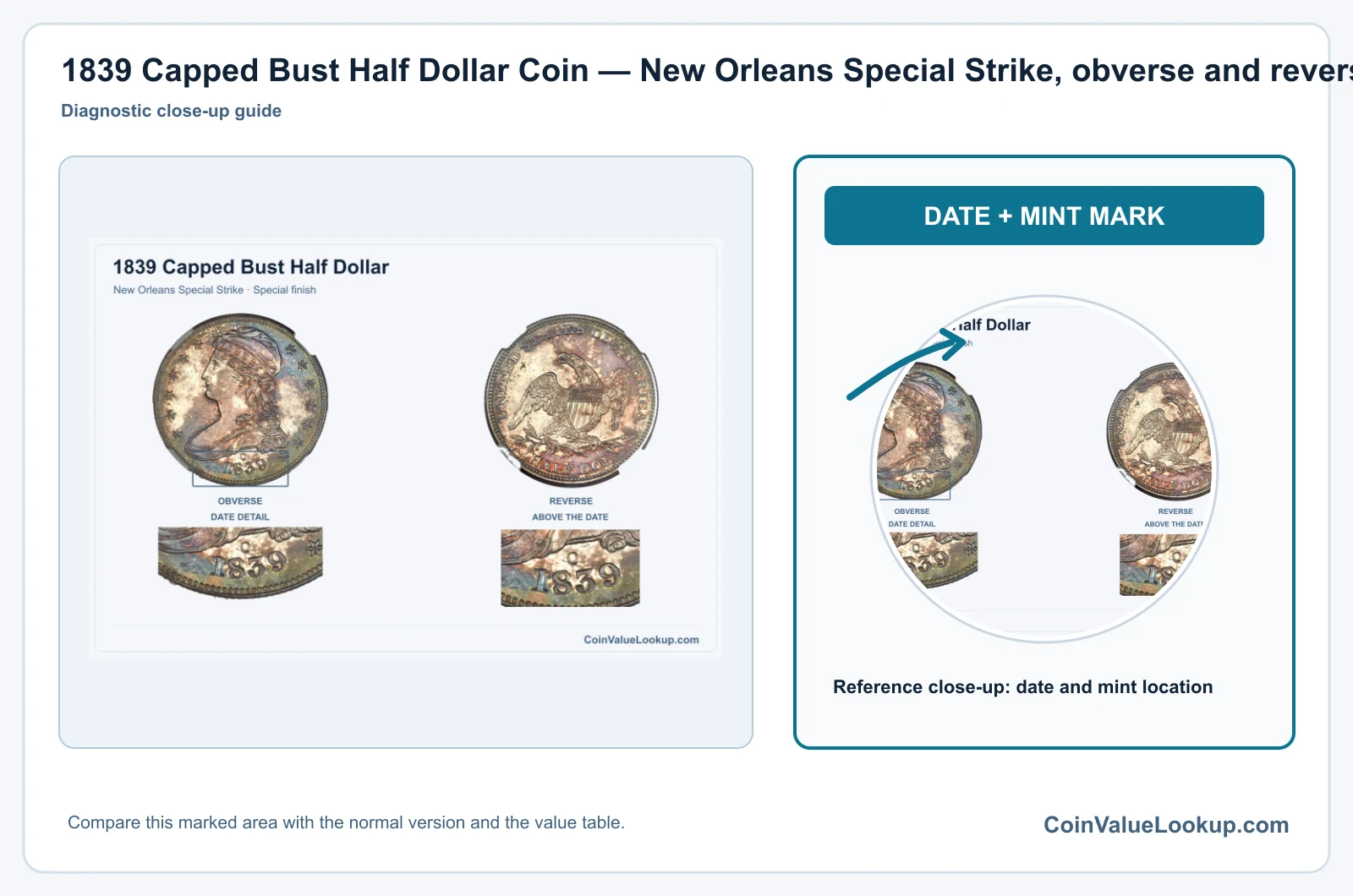
The New Orleans Special Strike is an extraordinary rarity. These coins received a different level of care during production compared to standard circulation issues, and they carry specialized certification terminology such as SP (Specimen) rather than MS grades.
A single SP65 example sold for $373,750 at a Goldberg auction in February 2008. That is one historical sale, not a current market range or a guarantee of what any other specimen might bring.
The value of any special strike depends entirely on its certified identity and condition.
Professional attribution is absolutely necessary. Both faces, the edge, and surface details should be examined by a recognized grading service before drawing conclusions about manufacture type.
Range Grade
Price Auction Records Appraisal SP SP 1
—
Coin Identifier
SP 2
—
Coin Identifier
SP 3
—
Coin Identifier
SP 4
—
Coin Identifier
SP 6
—
Coin Identifier
SP 8
—
Coin Identifier
SP 10
—
Coin Identifier
SP 12
—
Coin Identifier
SP 15
—
Coin Identifier
SP 20
—
Coin Identifier
SP 25
—
Coin Identifier
SP 30
—
Coin Identifier
SP 35
—
Coin Identifier
SP 40
—
Coin Identifier
SP 45
—
Coin Identifier
SP 50
—
Coin Identifier
SP 53
—
Coin Identifier
SP 55
—
Coin Identifier
SP 58
—
Coin Identifier
SP 60
—
Coin Identifier
SP 61
—
Coin Identifier
SP 62
Coin Identifier
SP 63
Coin Identifier
SP 64
Coin Identifier
SP 65
—
—
—
SP 66
—
—
—
SP 67
—
—
—
SP 68
—
—
—
SP 69
—
—
—
SP 70
—
—
—
1839 Capped Bust Half Dollar Error List
1. 1839 Capped Bust Half Dollar — Rotated Dies
On a normal U.S. coin, flipping it top to bottom reveals the reverse right-side up. A rotated die error means the reverse appears turned from that expected orientation.
The 1839-O Half Dollar has been reported with medal-turn alignment, where the reverse appears upside down relative to the standard orientation when flipped along the vertical axis.
To check, hold the obverse upright and flip the coin from top to bottom in a controlled motion. If the reverse comes up inverted rather than properly oriented, you may have a rotated die.
Do not simply rotate the coin sideways in your hand, as that will give a false impression. A photograph turned independently also is not the same thing.
No specific price range has been adopted for this error. Value depends on the degree of rotation, the coin's overall condition, and collector demand for the particular variety.
2. 1839 Capped Bust Half Dollar — Repunched Mintmark
A repunched mintmark occurs when the mintmark punch was applied more than once in slightly different positions, leaving traces of the earlier impression. On 1839-O Half Dollars, this has been reported as the O appearing repunched low and doubled at the right side.
Look at the mintmark above the date on the obverse and compare it carefully to a normal, cleanly struck O.
Do not confuse this with machine doubling, which tends to produce flat shelf-like distortion, or with die chips and corrosion around the letter. A true repunched mintmark shows a distinct secondary outline of the same letter shape.
No numerical price range has been adopted for this error. The visibility of the repunching, overall coin condition, and how dramatic the doubling appears all influence what a collector would pay.
3. 1839 Capped Bust Half Dollar — Die Crack / Die Chip
Die cracks show up as raised lines on the coin's surface, formed when the steel die itself developed fractures during use. On 1839-O Half Dollars, raised cracks have been reported running through the date and stars on the obverse, as well as through the peripheral legends on the reverse.
One notable crack runs from the word STATES to the eagle's beak in a thick branch.
These raised lines are the key diagnostic. Incuse scratches, which are pressed into the surface rather than raised above it, are post-mint damage.
Corrosion or foreign material stuck to the coin can also mimic a crack at first glance but will not have the sharp, continuous raised profile of a genuine die crack.
No specific price range has been adopted. Value depends on the crack's prominence, the coin's grade, and collector interest in the specific die state.